MCQ Questions for Class 11 Maths Chapter 4 Principle of Mathematical Induction with Answers

Check the below NCERT MCQ Questions for Class 11 Maths Chapter 4 Principle of Mathematical Induction with Answers Pdf free download. MCQ Questions for Class 11 Maths with Answers were prepared based on the latest exam pattern. We have provided Principle of Mathematical Induction Class 11 Maths MCQs Questions with Answers to help students understand the concept very well. https://mcqquestions.guru/mcq-questions-for-class-11-maths-chapter-4/

Principle of Mathematical Induction Class 11 MCQs Questions with Answers

Mathematical Induction MCQ Question 1.
The sum of the series 1³ + 2³ + 3³ + ………..n³ is
(a) {(n + 1)/2}²
(b) {n/2}²
(c) n(n + 1)/2
(d) {n(n + 1)/2}²

Answer

Answer: (d) {n(n + 1)/2}²
Hint:
Given, series is 1³ + 2³ + 3³ + ……….. n³
Sum = {n(n + 1)/2}²


MCQ On Mathematical Induction Question 2.
If n is an odd positive integer, then an + bn is divisible by :
(a) a² + b²
(b) a + b
(c) a – b
(d) none of these

Answer

Answer: (b) a + b
Hint:
Given number = an + bn
Let n = 1, 3, 5, ……..
an + bn = a + b
an + bn = a³ + b³ = (a + b) × (a² + b² + ab) and so on.
Since, all these numbers are divisible by (a + b) for n = 1, 3, 5,…..
So, the given number is divisible by (a + b)


MCQ Questions On Mathematical Induction Question 3.
1/(1 ∙ 2) + 1/(2 ∙ 3) + 1/(3 ∙ 4) + ….. + 1/{n(n + 1)}
(a) n(n + 1)
(b) n/(n + 1)
(c) 2n/(n + 1)
(d) 3n/(n + 1)

Answer

Answer: (b) n/(n + 1)
Hint:
Let the given statement be P(n). Then,
P(n): 1/(1 ∙ 2) + 1/(2 ∙ 3) + 1/(3 ∙ 4) + ….. + 1/{n(n + 1)} = n/(n + 1).
Putting n = 1 in the given statement, we get
LHS = 1/(1 ∙ 2) = and RHS = 1/(1 + 1) = 1/2.
LHS = RHS.
Thus, P(1) is true.
Let P(k) be true. Then,
P(k): 1/(1 ∙ 2) + 1/(2 ∙ 3) + 1/(3 ∙ 4) + ….. + 1/{k(k + 1)} = k/(k + 1) ..…(i)
Now 1/(1 ∙ 2) + 1/(2 ∙ 3) + 1/(3 ∙ 4) + ….. + 1/{k(k + 1)} + 1/{(k + 1)(k + 2)}
[1/(1 ∙ 2) + 1/(2 ∙ 3) + 1/(3 ∙ 4) + ….. + 1/{k(k + 1)}] + 1/{(k + 1)(k + 2)}
= k/(k + 1)+1/{ (k + 1)(k + 2)}.
{k(k + 2) + 1}/{(k + 1)²/[(k + 1)k + 2)] using …(ii)
= {k(k + 2) + 1}/{(k + 1)(k + 2}
= {(k + 1)² }/{(k + 1)(k + 2)}
= (k + 1)/(k + 2) = (k + 1)/(k + 1 + 1)
⇒ P(k + 1): 1/(1 ∙ 2) + 1/(2 ∙ 3) + 1/(3 ∙ 4) + ……… + 1/{ k(k + 1)} + 1/{(k + 1)(k + 2)}
= (k + 1)/(k + 1 + 1)
⇒ P(k + 1) is true, whenever P(k) is true.
Thus, P(1) is true and P(k + 1)is true, whenever P(k) is true.
Hence, by the principle of mathematical induction, P(n) is true for all n ∈ N.


Mathematical Induction MCQs Pdf Question 4.
The sum of the series 1² + 2² + 3² + ………..n² is
(a) n(n + 1)(2n + 1)
(b) n(n + 1)(2n + 1)/2
(c) n(n + 1)(2n + 1)/3
(d) n(n + 1)(2n + 1)/6

Answer

Answer: (d) n(n + 1)(2n + 1)/6
Hint:
Given, series is 1² + 2² + 3² + ………..n²
Sum = n(n + 1)(2n + 1)/6


Class 11 Maths Chapter 4 MCQ With Answers Question 5.
{1 – (1/2)}{1 – (1/3)}{1 – (1/4)} ……. {1 – 1/(n + 1)} =
(a) 1/(n + 1) for all n ∈ N.
(b) 1/(n + 1) for all n ∈ R
(c) n/(n + 1) for all n ∈ N.
(d) n/(n + 1) for all n ∈ R

Answer

Answer: (a) 1/(n + 1) for all n ∈ N.
Hint:
Let the given statement be P(n). Then,
P(n): {1 – (1/2)}{1 – (1/3)}{1 – (1/4)} ……. {1 – 1/(n + 1)} = 1/(n + 1).
When n = 1, LHS = {1 – (1/2)} = ½ and RHS = 1/(1 + 1) = ½.
Therefore LHS = RHS.
Thus, P(1) is true.
Let P(k) be true. Then,
P(k): {1 – (1/2)}{1 – (1/3)}{1 – (1/4)} ……. [1 – {1/(k + 1)}] = 1/(k + 1)
Now, [{1 – (1/2)}{1 – (1/3)}{1 – (1/4)} ……. [1 – {1/(k + 1)}] ∙ [1 – {1/(k + 2)}]
= [1/(k + 1)] ∙ [{(k + 2 ) – 1}/(k + 2)}]
= [1/(k + 1)] ∙ [(k + 1)/(k + 2)]
= 1/(k + 2)
Therefore p(k + 1): [{1 – (1/2)}{1 – (1/3)}{1 – (1/4)} ……. [1 – {1/(k + 1)}] = 1/(k + 2)
⇒ P(k + 1) is true, whenever P(k) is true.
Thus, P(1) is true and P(k + 1) is true, whenever P(k) is true.
Hence, by the principle of mathematical induction, P(n) is true for all n ∈ N.


Mathematical Induction MCQs Question 6.
For any natural number n, 7n – 2n is divisible by
(a) 3
(b) 4
(c) 5
(d) 7

Answer

Answer: (c) 5
Hint:
Given, 7n – 2n
Let n = 1
7n – 2n = 71 – 21 = 7 – 2 = 5
which is divisible by 5
Let n = 2
7n – 2n = 72 – 22 = 49 – 4 = 45
which is divisible by 5
Let n = 3
7n – 2n = 73 – 23 = 343 – 8 = 335
which is divisible by 5
Hence, for any natural number n, 7n – 2n is divisible by 5


Principle Of Mathematical Induction Class 11 MCQs Question 7.
1/(1 ∙ 2 ∙ 3) + 1/(2 ∙ 3 ∙ 4) + …….. + 1/{n(n + 1)(n + 2)} =
(a) {n(n + 3)}/{4(n + 1)(n + 2)}
(b) (n + 3)/{4(n + 1)(n + 2)}
(c) n/{4(n + 1)(n + 2)}
(d) None of these

Answer

Answer: (a) {n(n + 3)}/{4(n + 1)(n + 2)}
Hint:
Let P (n): 1/(1 ∙ 2 ∙ 3) + 1/(2 ∙ 3 ∙ 4) + ……. + 1/{n(n + 1)(n + 2)} = {n(n + 3)}/{4(n + 1)(n + 2)} .
Putting n = 1 in the given statement, we get
LHS = 1/(1 ∙ 2 ∙ 3) = 1/6 and RHS = {1 × (1 + 3)}/[4 × (1 + 1)(1 + 2)] = ( 1 × 4)/(4 × 2 × 3) = 1/6.
Therefore LHS = RHS.
Thus, the given statement is true for n = 1, i.e., P(1) is true.
Let P(k) be true. Then,
P(k): 1/(1 ∙ 2 ∙ 3) + 1/(2 ∙ 3 ∙ 4) + ……… + 1/{k(k + 1)(k + 2)} = {k(k + 3)}/{4(k + 1)(k + 2)}. ……. (i)
Now, 1/(1 ∙ 2 ∙ 3) + 1/(2 ∙ 3 ∙ 4) + ………….. + 1/{k(k + 1)(k + 2)} + 1/{(k + 1)(k + 2)(k + 3)}
= [1/(1 ∙ 2 ∙ 3) + 1/(2 ∙ 3 ∙ 4) + ………..…. + 1/{ k(k + 1)(k + 2}] + 1/{(k + 1)(k + 2)(k + 3)}
= [{k(k + 3)}/{4(k + 1)(k + 2)} + 1/{(k + 1)(k + 2)(k + 3)}] [using(i)]
= {k(k + 3)² + 4}/{4(k + 1)(k + 2)(k + 3)}
= (k³ + 6k² + 9k + 4)/{4(k + 1)(k + 2)(k + 3)}
= {(k + 1)(k + 1)(k + 4)}/{4 (k + 1)(k + 2)(k + 3)}
= {(k + 1)(k + 4)}/{4(k + 2)(k + 3)
⇒ P(k + 1): 1/(1 ∙ 2 ∙ 3) + 1/(2 ∙ 3 ∙ 4) + ……….….. + 1/{(k + 1)(k + 2)(k + 3)}
= {(k + 1)(k + 2)}/{4(k + 2)(k + 3)}
⇒ P(k + 1) is true, whenever P(k) is true.
Thus, P(1) is true and P(k + 1) is true, whenever P(k) is true.
Hence, by the principle of mathematical induction, P(n) is true for all n ∈ N.


MCQs On Mathematical Induction Question 8.
The nth terms of the series 3 + 7 + 13 + 21 +………. is
(a) 4n – 1
(b) n² + n + 1
(c) none of these
(d) n + 2

Answer

Answer: (b) n² + n + 1
Hint:
Let S = 3 + 7 + 13 + 21 +……….an-1 + an …………1
and S = 3 + 7 + 13 + 21 +……….an-1 + an …………2
Subtract equation 1 and 2, we get
S – S = 3 + (7 + 13 + 21 +……….an-1 + an) – (3 + 7 + 13 + 21 +……….an-1 + an)
⇒ 0 = 3 + (7 – 3) + (13 – 7) + (21 – 13) + ……….+ (an – an-1) – an
⇒ 0 = 3 + {4 + 6 + 8 + ……(n-1)terms} – an
⇒ an = 3 + {4 + 6 + 8 + ……(n-1)terms}
⇒ an = 3 + (n – 1)/2 × {2 ×4 + (n – 1 – 1)2}
⇒ an = 3 + (n – 1)/2 × {8 + (n – 2)2}
⇒ an = 3 + (n – 1) × {4 + n – 2}
⇒ an = 3 + (n – 1) × (n + 2)
⇒ an = 3 + n² + n – 2
⇒ an = n² + n + 1
So, the nth term is n² + n + 1


MCQ On Principle Of Mathematical Induction Question 9.
n(n + 1)(n + 5) is a multiple of ____ for all n ∈ N
(a) 2
(b) 3
(c) 5
(d) 7

Answer

Answer: (b) 3
Hint:
Let P(n) : n(n + 1)(n + 5) is a multiple of 3.
For n = 1, the given expression becomes (1 × 2 × 6) = 12, which is a multiple of 3.
So, the given statement is true for n = 1, i.e. P(1) is true.
Let P(k) be true. Then,
P(k) : k(k + 1)(k + 5) is a multiple of 3
⇒ K(k + 1)(k + 5) = 3m for some natural number m, … (i)
Now, (k + 1)(k + 2)(k + 6) = (k + 1)(k + 2)k + 6(k + 1)(k + 2)
= k(k + 1)(k + 2) + 6(k + 1)(k + 2)
= k(k + 1)(k + 5 – 3) + 6(k + 1)(k + 2)
= k(k + 1)(k + 5) – 3k(k + 1) + 6(k + 1)(k + 2)
= k(k + 1)(k + 5) + 3(k + 1)(k +4) [on simplification]
= 3m + 3(k + 1 )(k + 4) [using (i)]
= 3[m + (k + 1)(k + 4)], which is a multiple of 3
⇒ P(k + 1) : (k + 1 )(k + 2)(k + 6) is a multiple of 3
⇒ P(k + 1) is true, whenever P(k) is true.
Thus, P(1) is true and P(k + 1) is true, whenever P(k) is true.
Hence, by the principle of mathematical induction, P(n) is true for all n ∈ N.


Mathematical Induction MCQ Questions Question 10.
Find the number of shots arranged in a complete pyramid the base of which is an equilateral triangle, each side containing n shots.
(a) n(n+1)(n+2)/3
(b) n(n+1)(n+2)/6
(c) n(n+2)/6
(d) (n+1)(n+2)/6

Answer

Answer: (b) n(n+1)(n+2)/6
Hint:
Let each side of the base contains n shots,
then the number of shots in the lowest layer = n + (n – 1) + (n – 2) + ………..+ 1
= n(n + 1)/2
= (n² + n)/2
Now, write (n – 1), (n – 2), ….. for n, then we obtain the number of shots in 2nd, 3rd…layers
So, Total shots = ∑(n² + n)/2
= (1/2)×{∑n² + ∑n}
= (1/2)×{n(n+1)(2n+1)/6 + n(n+1)/2}
= n(n+1)(n+2)/6


Principle Of Mathematical Induction MCQs Question 11.
For any natural number n, 7n – 2n is divisible by
(a) 3
(b) 4
(c) 5
(d) 7

Answer

Answer: (c) 5
Hint:
Given, 7n – 2n
Let n = 1
7n – 2n = 71 – 21 = 7 – 2 = 5
which is divisible by 5
Let n = 2
7n – 2n = 72 – 22 = 49 – 4 = 45
which is divisible by 5
Let n = 3
7n – 2n = 7³ – 2³ = 343 – 8 = 335
which is divisible by 5
Hence, for any natural number n, 7n – 2n is divisible by 5


Principle Of Mathematical Induction MCQ Question 12.
(n² + n) is ____ for all n ∈ N.
(a) Even
(b) odd
(c) Either even or odd
(d) None of these

Answer

Answer: (a) Even
Hint:
Let P(n): (n² + n) is even.
For n = 1, the given expression becomes (1² + 1) = 2, which is even.
So, the given statement is true for n = 1, i.e., P(1)is true.
Let P(k) be true. Then,
P(k): (k² + k) is even
⇒ (k² + k) = 2m for some natural number m. ….. (i)
Now, (k + 1)² + (k + 1) = k² + 3k + 2
= (k² + k) + 2(k + 1)
= 2m + 2(k + 1) [using (i)]
= 2[m + (k + 1)], which is clearly even.
Therefore, P(k + 1): (k + 1)² + (k + 1) is even
⇒ P(k + 1) is true, whenever P(k) is true.
Thus, P(1) is true and P(k + 1) is true, whenever P(k) is true.
Hence, by the principle of mathematical induction, P(n)is true for all n ∈ N.


Principle Of Mathematical Induction Class 11 Extra Questions Question 13.
For all n ∈ N, 3×52n+1 + 23n+1 is divisible by
(a) 19
(b) 17
(c) 23
(d) 25

Answer

Answer: (b) 17
Hint:
Given, 3 × 52n+1 + 23n+1
Let n = 1,
3 × 52×1+1 + 23×1+1 = 3 × 52+1 + 23+1 = 3 × 5³ + 24 = 3 × 125 + 16 = 375 + 16 = 391
Which is divisible by 17
Let n = 2,
3 × 52×2+1 + 23×2+1 = 3 × 54+1 + 26+1 = 3 × 55 + 27 = 3 × 3125 + 128 = 9375 + 128
= 9503
Which is divisible by 17
Hence, For all n ∈ N, 3 × 52n+1 + 23n+1 is divisible by 17


Maths MCQs For Class 11 With Answers Pdf Question 14.
Find the number of shots arranged in a complete pyramid the base of which is an equilateral triangle, each side containing n shots.
(a) n(n+1)(n+2)/3
(b) n(n+1)(n+2)/6
(c) n(n+2)/6
(d) (n+1)(n+2)/6

Answer

Answer: (b) n(n+1)(n+2)/6
Hint:
Let each side of the base contains n shots,
then the number of shots in the lowest layer = n + (n – 1) + (n – 2) + ………..+ 1
= n(n + 1)/2
= (n² + n)/2
Now, write (n – 1), (n – 2), ….. for n, then we obtain the number of shots in 2nd, 3rd…layers
So, Total shots = ∑(n² + n)/2
= (1/2) × {∑n² + ∑n}
= (1/2) × {n(n+1)(2n+1)/6 + n(n+1)/2}
= n(n+1)(n+2)/6


Question 15.
{1 – (1/2)}{1 – (1/3)}{1 – (1/4)} ……. {1 – 1/(n + 1)} =
(a) 1/(n + 1) for all n ∈ N.
(b) 1/(n + 1) for all n ∈ R
(c) n/(n + 1) for all n ∈ N.
(d) n/(n + 1) for all n ∈ R

Answer

Answer: (a) 1/(n + 1) for all n ∈ N.
Hint:
Let the given statement be P(n). Then,
P(n): {1 – (1/2)}{1 – (1/3)}{1 – (1/4)} ……. {1 – 1/(n + 1)} = 1/(n + 1).
When n = 1, LHS = {1 – (1/2)} = ½ and RHS = 1/(1 + 1) = ½.
Therefore LHS = RHS.
Thus, P(1) is true.
Let P(k) be true. Then,
P(k): {1 – (1/2)}{1 – (1/3)}{1 – (1/4)} ……. [1 – {1/(k + 1)}] = 1/(k + 1)
Now, [{1 – (1/2)}{1 – (1/3)}{1 – (1/4)} ……. [1 – {1/(k + 1)}] ∙ [1 – {1/(k + 2)}]
= [1/(k + 1)] ∙ [{(k + 2 ) – 1}/(k + 2)}]
= [1/(k + 1)] ∙ [(k + 1)/(k + 2)]
= 1/(k + 2)
Therefore p(k + 1): [{1 – (1/2)}{1 – (1/3)}{1 – (1/4)} ……. [1 – {1/(k + 1)}] = 1/(k + 2)
⇒ P(k + 1) is true, whenever P(k) is true.
Thus, P(1) is true and P(k + 1) is true, whenever P(k) is true.
Hence, by the principle of mathematical induction, P(n) is true for all n ∈ N.


Question 16.
(1 + x)n ≥ ____ for all n ∈ N,where x > -1
(a) 1 + nx
(b) 1 – nx
(c) 1 + nx/2
(d) 1 – nx/2

Answer

Answer: (a) 1 + nx
Hint:
Let P(n): (1 + x) )n ≥ (1 + nx).
For n = 1, we have LHS = (1 + x))1 = (1 + x), and
RHS = (1 + 1 ∙ x) = (1 + x).
Therefore LHS ≥ RHS is true.
Thus, P(1) is true.
Let P(k) is true. Then,
P(k): (1 + x)1 ≥ (1 + kx). …….. (i)
Now,(1 + x)k+1 = (1 + x)k (1 + x)
≥ (1 + kx)(1 + x) [using (i)]
=1 + (k + 1)x + kx²
≥ 1 + (k + 1)x + x [Since kx² ≥ 0]
Therefore P(k + 1) : (1 + x)k + 1 ≥ 1 + (k + 1)x
⇒ P(k +1) is true, whenever P(k) is true.
Thus, P(1) is true and P(k + 1) is true, whenever P(k) is true. Hence, by the principle of mathematical induction, P(n) is true for all n ∈ N.


Question 17.
102n-1 + 1 is divisible by ____ for all N ∈ N
(a) 9
(b) 10
(c) 11
(d) 13

Answer

Answer: (c) 11
Hint:
Let P (n): (102n-1 + 1) is divisible by 11.
For n=1, the given expression becomes {10(2×1-1) + 1} = 11, which is divisible by 11.
So, the given statement is true for n = 1, i.e., P (1) is true.
Let P(k) be true. Then,
P(k): (102k-1 + 1) is divisible by 11
⇒ (102k-1 + 1) = 11 m for some natural number m.
Now, {102(k-1)-1 – 1 + 1} = (102k+1 + 1) = {10² ∙ 10(2k+1)+ 1}
= 100 × {102k-1 + 1 } – 99
= (100 × 11 m) – 99
= 11 × (100 m – 9), which is divisible by 11
⇒ P (k + 1) : {102(k-1) – 1 + 1} is divisible by 11
⇒ P (k + 1) is true, whenever P(k) is true.
Thus, P (1) is true and P(k + 1) is true , whenever P(k) is true.
Hence, by the principle of mathematical induction, P(n) is true for all n ∈ N.


Question 18.
For all n∈N, 72n − 48n−1 is divisible by :
(a) 25
(b) 2304
(c) 1234
(d) 26

Answer

Answer: (b) 2304
Hint:
Given number = 72n − 48n − 1
Let n = 1, 2 ,3, 4, ……..
72n − 48n − 1 = 7² − 48 − 1 = 49 – 48 – 1 = 49 – 49 = 0
72n − 48n − 1 = 74 − 48 × 2 − 1 = 2401 – 96 – 1 = 2401 – 97 = 2304
72n − 48n − 1 = 76 − 48 × 3 − 1 = 117649 – 144 – 1 = 117649 – 145 = 117504 = 2304 × 51
Since, all these numbers are divisible by 2304 for n = 1, 2, 3,…..
So, the given number is divisible by 2304


Question 19.
The sum of the series 1² + 2² + 3² + ………..n² is
(a) n(n + 1)(2n + 1)
(b) n(n + 1)(2n + 1)/2
(c) n(n + 1)(2n + 1)/3
(d) n(n + 1)(2n + 1)/6

Answer

Answer: (d) n(n + 1)(2n + 1)/6
Hint:
Given, series is 1² + 2² + 3² + ………..n²
Sum = n(n + 1)(2n + 1)/6


Question 20.
{1/(3 ∙ 5)} + {1/(5 ∙ 7)} + {1/(7 ∙ 9)} + ……. + 1/{(2n + 1)(2n + 3)} =
(a) n/(2n + 3)
(b) n/{2(2n + 3)}
(c) n/{3(2n + 3)}
(d) n/{4(2n + 3)}

Answer

Answer: (c) n/{3(2n + 3)}
Hint:
Let the given statement be P(n). Then,
P(n): {1/(3 ∙ 5) + 1/(5 ∙ 7) + 1/(7 ∙ 9) + ……. + 1/{(2n + 1)(2n + 3)} = n/{3(2n + 3).
Putting n = 1 in the given statement, we get
and LHS = 1/(3 ∙ 5) = 1/15 and RHS = 1/{3(2 × 1 + 3)} = 1/15.
LHS = RHS
Thus, P(1) is true.
Let P(k) be true. Then,
P(k): {1/(3 ∙ 5) + 1/(5 ∙ 7) + 1/(7 ∙ 9) + …….. + 1/{(2k + 1)(2k + 3)} = k/{3(2k + 3)} ….. (i)
Now, 1/(3 ∙ 5) + 1/(5 ∙ 7) + ..…… + 1/[(2k + 1)(2k + 3)] + 1/[{2(k + 1) + 1}2(k + 1) + 3
= {1/(3 ∙ 5) + 1/(5 ∙ 7) + ……. + [1/(2k + 1)(2k + 3)]} + 1/{(2k + 3)(2k + 5)}
= k/[3(2k + 3)] + 1/[2k + 3)(2k + 5)] [using (i)]
= {k(2k + 5) + 3}/{3(2k + 3)(2k + 5)}
= (2k² + 5k + 3)/[3(2k + 3)(2k + 5)]
= {(k + 1)(2k + 3)}/{3(2k + 3)(2k + 5)}
= (k + 1)/{3(2k + 5)}
= (k + 1)/[3{2(k + 1) + 3}]
= P(k + 1) : 1/(3 ∙ 5) + 1/(5 ∙ 7) + …….. + 1/[2k + 1)(2k + 3)] + 1/[{2(k + 1) + 1}{2(k + 1) + 3}]
= (k + 1)/{3{2(k + 1) + 3}]
⇒ P(k + 1) is true, whenever P(k) is true.
Thus, P(1) is true and P(k + 1) is true, whenever P(k) is true.
Hence, by the principle of mathematical induction, P(n) is true for n ∈ N.


We hope the given NCERT MCQ Questions for Class 11 Maths Chapter 4 Principle of Mathematical Induction with Answers Pdf free download will help you. If you have any queries regarding CBSE Class 11 Maths Principle of Mathematical Induction MCQs Multiple Choice Questions with Answers, drop a comment below and we will get back to you soon.
MCQ Questions for Class 11 Maths Chapter 3 Trigonometric Functions with Answers

Check the below NCERT MCQ Questions for Class 11 Maths Chapter 3 Trigonometric Functions with Answers Pdf free download. MCQ Questions for Class 11 Maths with Answers were prepared based on the latest exam pattern. We have provided Trigonometric Functions Class 11 Maths MCQs Questions with Answers to help students understand the concept very well. https://mcqquestions.guru/mcq-questions-for-class-11-maths-chapter-3/

Trigonometric Functions Class 11 MCQs Questions with Answers

MCQ On Trigonometry For Class 11 Pdf Question 1.
The value of cos² x + cos² y – 2cos x × cos y × cos (x + y) is
(a) sin (x + y)
(b) sin² (x + y)
(c) sin³ (x + y)
(d) sin4 (x + y)

Answer

Answer: (b) sin² (x + y)
Hint:
cos² x + cos² y – 2cos x × cos y × cos(x + y)
{since cos(x + y) = cos x × cos y – sin x × sin y }
= cos² x + cos² y – 2cos x × cos y × (cos x × cos y – sin x × sin y)
= cos² x + cos² y – 2cos² x × cos² y + 2cos x × cos y × sin x × sin y
= cos² x + cos² y – cos² x × cos² y – cos² x × cos² y + 2cos x × cos y × sin x × sin y
= (cos² x – cos² x × cos² y) + (cos² y – cos² x × cos² y) + 2cos x × cos y × sin x × sin y
= cos² x(1- cos² y) + cos² y(1 – cos² x) + 2cos x × cos y × sin x × sin y
= sin² y × cos² x + sin² x × cos² y + 2cos x × cos y × sin x × sin y (since sin² x + cos² x = 1 )
= sin² x × cos² y + sin² y × cos² x + 2cos x × cos y × sin x × sin y
= (sin x × cos y)² + (sin y × cos x)² + 2cos x × cos y × sin x × sin y
= (sin x × cos y + sin y × cos x)²
= {sin (x + y)}²
= sin² (x + y)


Trigonometry MCQ Class 11 Question 2.
If a×cos x + b × cos x = c, then the value of (a × sin x – b²cos x)² is
(a) a² + b² + c²
(b) a² – b² – c²
(c) a² – b² + c²
(d) a² + b² – c²

Answer

Answer: (d) a² + b² – c²
Hint:
We have
(a×cos x + b × sin x)² + (a × sin x – b × cos x)² = a² + b²
⇒ c² + (a × sin x – b × cos x)² = a² + b²
⇒ (a × sin x – b × cos x)² = a² + b² – c²


Trigonometry Class 11 MCQ Question 3.
If cos a + 2cos b + cos c = 2 then a, b, c are in
(a) 2b = a + c
(b) b² = a × c
(c) a = b = c
(d) None of these

Answer

Answer: (a) 2b = a + c
Hint:
Given, cos A + 2 cos B + cos C = 2
⇒ cos A + cos C = 2(1 – cos B)
⇒ 2 cos((A + C)/2) × cos((A-C)/2 = 4 sin²(B/2)
⇒ 2 sin(B/2)cos((A-C)/2) = 4sin² (B/2)
⇒ cos((A-C)/2) = 2sin (B/2)
⇒ cos((A-C)/2) = 2cos((A+C)/2)
⇒ cos((A-C)/2) – cos((A+C)/2) = cos((A+C)/2)
⇒ 2sin(A/2)sin(C/2) = sin(B/2)
⇒ 2{√(s-b)(s-c)√bc} × {√(s-a)(s-b)√ab} = √(s-a)(s-c)√ac
⇒ 2(s – b) = b
⇒ a + b + c – 2b = b
⇒ a + c – b = b
⇒ a + c = 2b


Trigonometric Functions Class 11 MCQ Question 4.
The value of cos 5π is
(a) 0
(b) 1
(c) -1
(d) None of these

Answer

Answer: (c) -1
Hint:
Given, cos 5π = cos (π + 4π) = cos π = -1


Class 11 Trigonometry MCQ Questions Question 5.
In a triangle ABC, cosec A (sin B cos C + cos B sin C) equals
(a) none of these
(b) c/a
(c) 1
(d) a/c

Answer

Answer: (c) 1
Hint:
Given cosec A (sin B cos C + cos B sin C)
= cosec A × sin(B+C)
= cosec A × sin(180 – A)
= cosec A × sin A
= cosec A × 1/cosec A
= 1


Class 11 Maths Chapter 3 MCQ With Answers Question 6.
If the angles of a triangle be in the ratio 1 : 4 : 5, then the ratio of the greatest side to the smallest side is
(a) 4 : (√5 – 1)
(b) 5 : 4
(c) (√5 – 1) : 4
(d) none of these

Answer

Answer: (a) 4 : (√5 – 1)
Hint:
Given, the angles of a triangle be in the ratio 1 : 4 : 5
⇒ x + 4x + 5x = 180
⇒ 10x = 180
⇒ x = 180/10
⇒ x = 18
So, the angle are: 18, 72, 90
Since a : b : c = sin A : sin B : sin C
⇒ a : b : c = sin 18 : sin 72 : sin 90
⇒ a : b : c = (√5 – 1)/4 : {√(10 + 2√5)}/4 : 1
⇒ a : b : c = (√5 – 1) : {√(10 + 2√5)} : 4
Now, c /a = 4/(√5 – 1)
⇒ c : a = 4 : (√5 – 1)


MCQ On Trigonometry For Class 11 Pdf Download Question 7.
The value of cos 180° is
(a) 0
(b) 1
(c) -1
(d) infinite

Answer

Answer: (c) -1
Hint:
180 is a standard degree generally we all know their values but if we want to go theoretically then
cos(90 + x) = – sin(x)
So, cos 180 = cos(90 + 90)
= -sin 90
= -1 {sin 90 = 1}
So, cos 180 = -1


MCQ Of Trigonometry Class 11 Question 8.
The perimeter of a triangle ABC is 6 times the arithmetic mean of the sines of its angles. If the side b is 2, then the angle B is
(a) 30°
(b) 90°
(c) 60°
(d) 120°

Answer

Answer: (b) 90°
Hint:
Let the lengths of the sides if ∆ABC be a, b and c
Perimeter of the triangle = 2s = a + b + c = 6(sinA + sinB + sinC)/3
⇒ (sinA + sinB + sinC) = ( a + b + c)/2
⇒ (sinA + sinB + sinC)/( a + b + c) = 1/2
From sin formula,Using
sinA/a = sinB/b = sinC/c = (sinA + sinB + sinC)/(a + b + c) = 1/2
Now, sinB/b = 1/2
Given b = 2
So, sinB/2 = 1/2
⇒ sinB = 1
⇒ B = π/2


Trigonometry Objective Questions For Class 11 Question 9.
If 3 × tan(x – 15) = tan(x + 15), then the value of x is
(a) 30
(b) 45
(c) 60
(d) 90

Answer

Answer: (b) 45
Hint:
Given, 3×tan(x – 15) = tan(x + 15)
⇒ tan(x + 15)/tan(x – 15) = 3/1
⇒ {tan(x + 15) + tan(x – 15)}/{tan(x + 15) – tan(x – 15)} = (3 + 1)/(3 – 1)
⇒ {tan(x + 15) + tan(x – 15)}/{tan(x + 15) – tan(x – 15)} = 4/2
⇒ {tan(x + 15) + tan(x – 15)}/{tan(x + 15) – tan(x – 15)} = 2
⇒ sin(x + 15 + x – 15)/sin(x + 15 – x + 15) = 2
⇒ sin 2x/sin 30 = 2
⇒ sin 2x/(1/2) = 2
⇒ 2 × sin 2x = 2
⇒ sin 2x = 1
⇒ sin 2x = sin 90
⇒ 2x = 90
⇒ x = 45


MCQ Questions On Trigonometry Class 11 Question 10.
If the sides of a triangle are 13, 7, 8 the greatest angle of the triangle is
(a) π/3
(b) π/2
(c) 2π/3
(d) 3π/2

Answer

Answer: (c) 2π/3
Hint:
Given, the sides of a triangle are 13, 7, 8
Since greatest side has greatest angle,
Now Cos A = (b² + c² – a²)/2bc
⇒ Cos A = (7² + 8² – 13²)/(2×7×8)
⇒ Cos A = (49 + 64 – 169)/(2×7×8)
⇒ Cos A = (113 – 169)/(2×7×8)
⇒ Cos A = -56/(2×56)
⇒ Cos A = -1/2
⇒ Cos A = Cos 2π/3
⇒ A = 2π/3
So, the greatest angle is
= 2π/3


MCQ On Trigonometry For Class 11 Question 11.
The value of tan 20 × tan 40 × tan 80 is
(a) tan 30
(b) tan 60
(c) 2 tan 30
(d) 2 tan 60

Answer

Answer: (b) tan 60
Hint:
Given, tan 20 × tan 40 × tan 80
= tan 40 × tan 80 × tan 20
= [{sin 40 × sin 80}/{cos 40 × cos 80}] × (sin 20/cos 20)
= [{2 * sin 40 × sin 80}/{2 × cos 40 × cos 80}] × (sin 20/cos 20)
= [{cos 40 – cos 120}/{cos 120 + cos 40}] × (sin 20/cos 20)
= [{cos 40 – cos (90 + 30)}/{cos (90 + 30) + cos 40}] × (sin 20/cos 20)
= [{cos 40 + sin30}/{-sin30 + cos 40}] × (sin 20/cos 20)
= [{(2 × cos 40 + 1)/2}/{(-1 + cos 40)/2}] × (sin 20/cos 20)
= [{2 × cos 40 + 1}/{-1 + cos 40}] × (sin 20/cos 20)
= [{2 × cos 40 × sin 20 + sin 20}/{-cos 20 + cos 40 × cos 20}]
= (sin 60 – sin 20 + sin 20)/(-cos 20 + cos 60 + cos 20)
= sin 60/cos 60
= tan 60
So, tan 20 × tan 40 × tan 80 = tan 60


MCQ Trigonometry Class 11 Question 12.
If the angles of a triangle be in the ratio 1 : 4 : 5, then the ratio of the greatest side to the smallest side is
(a) 4 : (√5 – 1)
(b) 5 : 4
(c) (√5 – 1) : 4
(d) none of these

Answer

Answer: (a) 4 : (√5 – 1)
Hint:
Given, the angles of a triangle be in the ratio 1 : 4 : 5
⇒ x + 4x + 5x = 180
⇒ 10x = 180
⇒ x = 180/10
⇒ x = 18
So, the angle are: 18, 72, 90
Since a : b : c = sin A : sin B : sin C
⇒ a : b : c = sin 18 : sin 72 : sin 90
⇒ a : b : c = (√5 – 1)/4 : {√(10 + 2√5)}/4 : 1
⇒ a : b : c = (√5 – 1) : {√(10 + 2√5)} : 4
Now, c /a = 4/(√5 – 1)
⇒ c : a = 4 : (√5 – 1)


Class 11 Maths Trigonometry MCQ Questions Question 13.
The general solution of √3 cos x – sin x = 1 is
(a) x = n × π + (-1)n × (π/6)
(b) x = π/3 – n × π + (-1)n × (π/6)
(c) x = π/3 + n × π + (-1)n × (π/6)
(d) x = π/3 – n × π + (π/6)

Answer

Answer: (c) x = π/3 + n × π + (-1)n × (π/6)
Hint:
√3 cos x-sin x=1
⇒ (√3/2)cos x – (1/2)sin x = 1/2
⇒ sin 60 × cos x – cos 60 × sin x = 1/2
⇒ sin (x – 60) = 1/2
⇒ sin (x – π/3) = sin 30
⇒ sin (x – π/3) = sinπ/6
⇒ x – π/3 = n × π + (-1)n × (π/6) {where n ∈ Z}
⇒ x = π/3 + n × π + (-1)n × (π/6)


Class 11 Maths Trigonometry MCQs Question 14.
If tan² θ = 1 – e², then the value of sec θ + tan³ θ × cosec θ is
(a) 2 – e²
(b) (2 – e²)1/2
(c) (2 – e²)²
(d) (2 – e²)3/2

Answer

Answer: (d) (2 – e²)3/2
Hint:
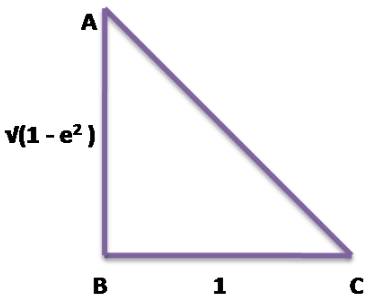
Given, tan² θ = 1 – e²
⇒ tan θ = √(1 – e²)
MCQ Questions for Class 11 Maths Chapter 3 Trigonometric Functions with Answers 1
From the figure and Pythagorus theorem,
AC² = AB² + BC²
⇒ AC² = {√(1 – e²)}² + 12
⇒ AC² = 1 – e² + 1
⇒ AC² = 2 – e²
⇒ AC = √(2 – e²)
Now, sec θ = √(2 – e²)
cosec θ = √(2 – e²)/√(1 – e²)
and tan θ = √(1 – e²)
Given, sec θ + tan³ θ × cosec θ
= √(2 – e²) + {(1 – e²)3/2 × √(2 – e²)/√(1 – e²)}
= √(2 – e²) + {(1 – e²) × (1 – e²) × √(2 – e²)/√(1 – e²)}
= √(2 – e²) + (1 – e²) × √(2 – e²)
= √(2 – e²) × (1 + 1 – e²)
= √(2 – e²) × (2 – e²)
= (2 – e²)3/2
So, sec θ + tan³ θ × cosec θ = (2 – e²)3/2


Trigonometry Class 11 MCQ With Answers Question 15.
The value of cos 20 + 2sin² 55 – √2 sin65 is
(a) 0
(b) 1
(c) -1
(d) None of these

Answer

Answer: (b) 1
Hint:
Given, cos 20 + 2sin² 55 – √2 sin65
= cos 20 + 1 – cos 110 – √2 sin65 {since cos 2x = 1 – 2sin² x}
= 1 + cos 20 – cos 110 – √2 sin65
= 1 – 2 × sin {(20 + 110)/2 × sin{(20 – 110)/2} – √2 sin65 {Apply cos C – cos D formula}
= 1 – 2 × sin 65 × sin (-45) – √2 sin65
= 1 + 2 × sin 65 × sin 45 – √2 sin65
= 1 + (2 × sin 65)/√2 – √2 sin65
= 1 + √2 ( sin 65 – √2 sin 65
= 1
So, cos 20 + 2sin² 55 – √2 sin65 = 1


Question 16.
If the radius of the circumcircle of an isosceles triangle PQR is equal to PQ ( = PR), then the angle P is
(a) 2π/3
(b) π/3
(c) π/2
(d) π/6

Answer

Answer: (a) 2π/3
Hint:
Let S be the center of the circumcircle of triangle PQR.
So, SP = SQ = SR = PQ = PR, where SP, SQ & SR are radii.
Thus SPQ & SPR are equilateral triangles.
⇒ ∠QSP = 60°;
Similarly ∠RQP = 60°
⇒ Angle at the center QSP = 120°
So, SRPQ is a rhombus, since all the four sides are equal.
Hence, its opposite angles are equal; so ∠P = ∠QSP = 120°


Question 17.
If cos a + 2cos b + cos c = 2 then a, b, c are in
(a) 2b = a + c
(b) b² = a × c
(c) a = b = c
(d) None of these

Answer

Answer: (a) 2b = a + c
Hint:
Given, cos A + 2 cos B + cos C = 2
⇒ cos A + cos C = 2(1 – cos B)
⇒ 2 cos((A + C)/2) × cos((A-C)/2 = 4 sin² (B/2)
⇒ 2 sin(B/2)cos((A-C)/2) = 4sin² (B/2)
⇒ cos((A-C)/2) = 2sin (B/2)
⇒ cos((A-C)/2) = 2cos((A+C)/2)
⇒ cos((A-C)/2) – cos((A+C)/2) = cos((A+C)/2)
⇒ 2sin(A/2)sin(C/2) = sin(B/2)
⇒ 2{√(s-b)(s-c)√bc} × {√(s-a)(s-b)√ab} = √(s-a)(s-c)√ac
⇒ 2(s – b) = b
⇒ a + b + c – 2b = b
⇒ a + c – b = b
⇒ a + c = 2b


Question 18.
The value of 4 × sin x × sin(x + π/3) × sin(x + 2π/3) is
(a) sin x
(b) sin 2x
(c) sin 3x
(d) sin 4x

Answer

Answer: (c) sin 3x
Hint:
Given, 4 × sin x × sin(x + π/3) × sin(x + 2π/3)
= 4 × sin x × {sin x × cos π/3 + cos x × sin π/3} × {sin x × cos 2π/3 + cos x × sin 2π/3}
= 4 × sin x × {(sin x)/2 + (√3 × cos x)/2} × {-(sin x)/2 + (√3 × cos x)/2}
= 4 × sin x × {-(sin 2x)/4 + (3 × cos 2x)/4}
= sin x × {-sin 2x + 3 × cos 2x}
= sin x × {-sin 2x + 3 × (1 – sin 2x)}
= sin x × {-sin 2x + 3 – 3 × sin 2x}
= sin x × {3 – 4 × sin 2x}
= 3 × sin x – 4 sin 3x
= sin 3x
So, 4 × sin x × sin(x + π/3) × sin(x + 2π/3) = sin 3x


Question 19.
If tan A – tan B = x and cot B – cot A = y, then the value of cot (A – B) is
(a) x + y
(b) 1/x + y
(c) x + 1/y
(d) 1/x + 1/y

Answer

Answer: (d) 1/x + 1/y
Hint:
Given,
tan A – tan B = x ……………. 1
and cot B – cot A = y ……………. 2
From equation,
1/cot A – 1/cot B = x
⇒ (cot B – cot A)/(cot A × cot B) = x
⇒ y/(cot A × cot B) = x {from equation 2}
⇒ y = x × (cot A × cot B)
⇒ cot A × cot B = y/x
Now, cot (A – B) = (cot A × cot B + 1)/(cot B – cot A)
⇒ cot (A – B) = (y/x + 1)/y
⇒ cot (A – B) = (y/x) × (1/y) + 1/y
⇒ cot (A – B) = 1/x + 1/y


Question 20.
The value of (sin 7x + sin 5x) /(cos 7x + cos 5x) + (sin 9x + sin 3x) / (cos 9x + cos 3x) is
(a) tan 6x
(b) 2 tan 6x
(c) 3 tan 6x
(d) 4 tan 6x

Answer

Answer: (b) 2 tan 6x
Hint:
Given, (sin 7x + sin 5x) /(cos 7x + cos 5x) + (sin 9x + sin 3x) / (cos 9x + cos 3x)
⇒ [{2 × sin(7x+5x)/2 × cos(7x-5x)/2}/{2 × cos(7x+5x)/2 × cos(7x-5x)/2}] + [{2 × sin(9x+3x)/2 × cos(9x-3x)/2}/{2 × cos(9x+3x)/2 × cos(9x-3x)/2}]
⇒ [{2 × sin 6x × cosx}/{2 × cos 6x × cosx}] + [{2 × sin 6x × cosx}/{2 × cos 6x × cosx}]
⇒ (sin 6x/cos 6x) + (sin 6x/cos 6x)
⇒ tan 6x + tan 6x
⇒ 2 tan 6x


We hope the given NCERT MCQ Questions for Class 11 Maths Chapter 3 Trigonometric Functions with Answers Pdf free download will help you. If you have any queries regarding CBSE Class 11 Maths Trigonometric Functions MCQs Multiple Choice Questions with Answers, drop a comment below and we will get back to you soon.
MCQ Questions for Class 11 Maths Chapter 5 Complex Numbers and Quadratic Equations with Answers

Check the below NCERT MCQ Questions for Class 11 Maths Chapter 5 Complex Numbers and Quadratic Equations with Answers Pdf free download. MCQ Questions for Class 11 Maths with Answers were prepared based on the latest exam pattern. We have provided Complex Numbers and Quadratic Equations Class 11 Maths MCQs Questions with Answers to help students understand the concept very well. https://mcqquestions.guru/mcq-questions-for-class-11-maths-chapter-5/

Complex Numbers and Quadratic Equations Class 11 MCQs Questions with Answers

Complex Numbers Class 11 MCQ Question 1.
The value of √(-16) is
(a) -4i
(b) 4i
(c) -2i
(d) 2i

Answer

Answer: (b) 4i
Hint:
Given, √(-16) = √(16) × √(-1)
= 4i {since i = √(-1) }


Complex Numbers Class 11 MCQ Questions And Answers Question 2.
The value of √(-144) is
(a) 12i
(b) -12i
(c) ±12i
(d) None of these

Answer

Answer: (a) 12i
Hint:
Given, √(-144) = √{(-1) × 144}
= √(-1) × √(144)
= i × 12 {Since √(-1) = i}
= 12i
So, √(-144) = 12i


MCQ On Complex Numbers Class 11 Question 3.
The value of √(-25) + 3√(-4) + 2√(-9) is
(a) 13i
(b) -13i
(c) 17i
(d) -17i

Answer

Answer: (c) 17i
Hint:
Given, √(-25) + 3√(-4) + 2√(-9)
= √{(-1) × (25)} + 3√{(-1) × 4} + 2√{(-1) × 9}
= √(-1) × √(25) + 3{√(-1) × √4} + 2{√(-1) × √9}
= 5i + 3×2i + 2×3i {since √(-1) = i}
= 5i + 6i + 6i
= 17i
So, √(-25) + 3√(-4) + 2√(-9) = 17i


Class 11 Maths Chapter 5 MCQ With Answers Question 4.
if z lies on |z| = 1, then 2/z lies on
(a) a circle
(b) an ellipse
(c) a straight line
(d) a parabola

Answer

Answer: (a) a circle
Hint:
Let w = 2/z
Now, |w| = |2/z|
=> |w| = 2/|z|
=> |w| = 2
This shows that w lies on a circle with center at the origin and radius 2 units.


Class 11 Maths Chapter 5 MCQ Question 5.
If ω is an imaginary cube root of unity, then (1 + ω – ω²)7 equals
(a) 128 ω
(b) -128 ω
(c) 128 ω²
(d) -128 ω²

Answer

Answer: (d) -128 ω²
Hint:
Given ω is an imaginary cube root of unity.
So 1 + ω + ω² = 0 and ω³ = 1
Now, (1 + ω – ω²)7 = (-ω² – ω²)7
⇒ (1 + ω – ω2)7 = (-2ω2)7
⇒ (1 + ω – ω2)7 = -128 ω14
⇒ (1 + ω – ω2)7 = -128 ω12 × ω2
⇒ (1 + ω – ω2)7 = -128 (ω3)4 ω2
⇒ (1 + ω – ω2)7 = -128 ω2


MCQ Of Complex Numbers Class 11 Question 6.
The least value of n for which {(1 + i)/(1 – i)}n is real, is
(a) 1
(b) 2
(c) 3
(d) 4

Answer

Answer: (b) 2
Hint:
Given, {(1 + i)/(1 – i)}n
= [{(1 + i) × (1 + i)}/{(1 – i) × (1 + i)}]n
= [{(1 + i)²}/{(1 – i²)}]n
= [(1 + i² + 2i)/{1 – (-1)}]n
= [(1 – 1 + 2i)/{1 + 1}]n
= [2i/2]n
= in
Now, in is real when n = 2 {since i2 = -1 }
So, the least value of n is 2


MCQ Of Chapter 5 Maths Class 11 Question 7.
Let z be a complex number such that |z| = 4 and arg(z) = 5π/6, then z =
(a) -2√3 + 2i
(b) 2√3 + 2i
(c) 2√3 – 2i
(d) -√3 + i

Answer

Answer: (a) -2√3 + 2i
Hint:
Let z = r(cos θ + i × sin θ)
Then r = 4 and θ = 5π/6
So, z = 4(cos 5π/6 + i × sin 5π/6)
⇒ z = 4(-√3/2 + i/2)
⇒ z = -2√3 + 2i


MCQ On Complex Numbers Class 11 Pdf Question 8.
The value of i-999 is
(a) 1
(b) -1
(c) i
(d) -i

Answer

Answer: (c) i
Hint:
Given, i-999
= 1/i999
= 1/(i996 × i³)
= 1/{(i4)249 × i3}
= 1/{1249 × i3} {since i4 = 1}
= 1/i3
= i4/i3 {since i4 = 1}
= i
So, i-999 = i


MCQ Questions On Complex Numbers Class 11 Question 9.
Let z1 and z2 be two roots of the equation z² + az + b = 0, z being complex. Further assume that the origin, z1 and z1 form an equilateral triangle. Then
(a) a² = b
(b) a² = 2b
(c) a² = 3b
(d) a² = 4b

Answer

Answer: (c) a² = 3b
Hint:
Given, z1 and z2 be two roots of the equation z² + az + b = 0
Now, z1 + z2 = -a and z1 × z2 = b
Since z1 and z2 and z3 from an equilateral triangle.
⇒ z12 + z22 + z32 = z1 × z2 + z2 × z3 + z1 × z3
⇒ z12+ z22 = z1 × z2 {since z3 = 0}
⇒ (z1 + z2)² – 2z1 × z2 = z1 × z2
⇒ (z1 + z2)² = 2z1 × z2 + z1 × z2
⇒ (z1 + z2)² = 3z1 × z2
⇒ (-a)² = 3b
⇒ a² = 3b


Complex Numbers MCQs With Solution Question 10.
The complex numbers sin x + i cos 2x are conjugate to each other for
(a) x = nπ
(b) x = 0
(c) x = (n + 1/2) π
(d) no value of x

Answer

Answer: (d) no value of x
Hint:
Given complex number = sin x + i cos 2x
Conjugate of this number = sin x – i cos 2x
Now, sin x + i cos 2x = sin x – i cos 2x
⇒ sin x = cos x and sin 2x = cos 2x {comparing real and imaginary part}
⇒ tan x = 1 and tan 2x = 1
Now both of them are not possible for the same value of x.
So, there exist no value of x


Class 11 Complex Numbers MCQ Question 11.
The curve represented by Im(z²) = k, where k is a non-zero real number, is
(a) a pair of striaght line
(b) an ellipse
(c) a parabola
(d) a hyperbola

Answer

Answer: (d) a hyperbola
Hint:
Let z = x + iy
Now, z² = (x + iy)²
⇒ z² = x² – y² + 2xy
Given, Im(z²) = k
⇒ 2xy = k
⇒ xy = k/2 which is a hyperbola.


Class 11 Maths Complex Numbers MCQ Question 12.
The value of x and y if (3y – 2) + i(7 – 2x) = 0
(a) x = 7/2, y = 2/3
(b) x = 2/7, y = 2/3
(c) x = 7/2, y = 3/2
(d) x = 2/7, y = 3/2

Answer

Answer: (a) x = 7/2, y = 2/3
Hint:
Given, (3y – 2) + i(7 – 2x) = 0
Compare real and imaginary part, we get
3y – 2 = 0
⇒ y = 2/3
and 7 – 2x = 0
⇒ x = 7/2
So, the value of x = 7/2 and y = 2/3


Complex Numbers MCQs With Solution Pdf Question 13.
Find real θ such that (3 + 2i × sin θ)/(1 – 2i × sin θ) is imaginary
(a) θ = nπ ± π/2 where n is an integer
(b) θ = nπ ± π/3 where n is an integer
(c) θ = nπ ± π/4 where n is an integer
(d) None of these

Answer

Answer: (b) θ = nπ ± π/3 where n is an integer
Hint:
Given,
(3 + 2i × sin θ)/(1 – 2i × sin θ) = {(3 + 2i × sin θ)×(1 – 2i × sin θ)}/(1 – 4i² × sin² θ)
(3 + 2i × sin θ)/(1 – 2i × sin θ) = {(3 – 4sin² θ) + 8i × sin θ}/(1 + 4sin² θ) …………. 1
Now, equation 1 is imaginary if
3 – 4sin² θ = 0
⇒ 4sin² θ = 3
⇒ sin² θ = 3/4
⇒ sin θ = ±√3/2
⇒ θ = nπ ± π/3 where n is an integer


Class 11 Maths Chapter 5 MCQ Questions Question 14.
If {(1 + i)/(1 – i)}n = 1 then the least value of n is
(a) 1
(b) 2
(c) 3
(d) 4

Answer

Answer: (d) 4
Hint:
Given, {(1 + i)/(1 – i)}n = 1
⇒ [{(1 + i) × (1 + i)}/{(1 – i) × (1 + i)}]n = 1
⇒ [{(1 + i)²}/{(1 – i²)}]n = 1
⇒ [(1 + i² + 2i)/{1 – (-1)}]n = 1
⇒ [(1 – 1 + 2i)/{1 + 1}]n = 1
⇒ [2i/2]n = 1
⇒ in = 1
Now, in is 1 when n = 4
So, the least value of n is 4


Class 11 Maths MCQ Chapter 5 Question 15.
If arg (z) < 0, then arg (-z) – arg (z) =
(a) π
(b) -π
(c) -π/2
(d) π/2

Answer

Answer: (a) π
Hint:
Given, arg (z) < 0
Now, arg (-z) – arg (z) = arg(-z/z)
⇒ arg (-z) – arg (z) = arg(-1)
⇒ arg (-z) – arg (z) = π {since sin π + i cos π = -1, So arg(-1) = π}


Question 16.
if x + 1/x = 1 find the value of x2000 + 1/x2000 is
(a) 0
(b) 1
(c) -1
(d) None of these

Answer

Answer: (c) -1
Hint:
Given x + 1/x = 1
⇒ (x² + 1) = x
⇒ x² – x + 1 = 0
⇒ x = {-(-1) ± √(1² – 4 × 1 × 1)}/(2 × 1)
⇒ x = {1 ± √(1 – 4)}/2
⇒ x = {1 ± √(-3)}/2
⇒ x = {1 ± √(-1)×√3}/2
⇒ x = {1 ± i√3}/2 {since i = √(-1)}
⇒ x = -w, -w²
Now, put x = -w, we get
x2000 + 1/x2000 = (-w)2000 + 1/(-w)2000
= w2000 + 1/w2000
= w2000 + 1/w2000
= {(w³)666 × w²} + 1/{(w³)666 × w²}
= w² + 1/w² {since w³ = 1}
= w² + w³ /w²
= w² + w
= -1 {since 1 + w + w² = 0}
So, x2000 + 1/x2000 = -1


Question 17.
The value of √(-144) is
(a) 12i
(b) -12i
(c) ±12i
(d) None of these

Answer

Answer: (a) 12i
Hint:
Given, √(-144) = √{(-1)×144}
= √(-1) × √(144)
= i × 12 {Since √(-1) = i}
= 12i
So, √(-144) = 12i


Question 18.
If the cube roots of unity are 1, ω, ω², then the roots of the equation (x – 1)³ + 8 = 0 are
(a) -1, -1 + 2ω, – 1 – 2ω²
(b) – 1, -1, – 1
(c) – 1, 1 – 2ω, 1 – 2ω²
(d) – 1, 1 + 2ω, 1 + 2ω²

Answer

Answer: (c) – 1, 1 – 2ω, 1 – 2ω²
Hint:
Note that since 1, ω, and ω² are the cube roots of unity (the three cube roots of 1), they are the three solutions to x³ = 1 (note: ω and ω² are the two complex solutions to this)
If we let u = x – 1, then the equation becomes
u³ + 8 = (u + 2)(u² – 2u + 4) = 0.
So, the solutions occur when u = -2 (giving -2 = x – 1 ⇒ x = -1), or when:
u² – 2u + 4 = 0,
which has roots, by the Quadratic Formula, to be u = 1 ± i√3
So, x – 1 = 1 ± i√3
⇒ x = 2 ± i√3
Now, x³ = 1 when x³ – 1 = (x – 1)(x² + x + 1) = 0, giving x = 1 and
x² + x + 1 = 0
⇒ x = (-1 ± i√3)/2
If we let ω = (-1 – i√3)/2 and ω₂ = (-1 + i√3)/2
then 1 – 2ω and 1 – 2ω² yield the two complex solutions to (x – 1)³ + 8 = 0
So, the roots of (x – 1)³ + 8 are -1, 1 – 2ω, and 1 – 2ω²


Question 19.
(1 – w + w²)×(1 – w² + w4)×(1 – w4 + w8) × …………… to 2n factors is equal to
(a) 2n
(b) 22n
(c) 23n
(d) 24n

Answer

Answer: (b) 22n
Hint:
Given, (1 – w + w²)×(1 – w² + w4)×(1 – w4 + w8) × …………… to 2n factors
= (1 – w + w2)×(1 – w2 + w )×(1 – w + w2) × …………… to 2n factors
{Since w4 = w, w8 = w2}
= (-2w) × (-2w²) × (-2w) × (-2w²)× …………… to 2n factors
= (2² w³)×(2² w³)×(2² w³) …………… to 2n factors
= (2²)n {since w³ = 1}
= 22n


Question 20.
The modulus of 5 + 4i is
(a) 41
(b) -41
(c) √41
(d) -√41

Answer

Answer: (c) √41
Hint:
Let Z = 5 + 4i
Now modulus of Z is calculated as
|Z| = √(5² + 4²)
⇒ |Z| = √(25 + 16)
⇒ |Z| = √41
So, the modulus of 5 + 4i is √41


We hope the given NCERT MCQ Questions for Class 11 Maths Chapter 5 Complex Numbers and Quadratic Equations with Answers Pdf free download will help you. If you have any queries regarding CBSE Class 11 Maths Complex Numbers and Quadratic Equations MCQs Multiple Choice Questions with Answers, drop a comment below and we will get back to you soon.

MCQ Questions for Class 11 Maths Chapter 2 Relations and Functions with Answers

Check the below NCERT MCQ Questions for Class 11 Maths Chapter 2 Relations and Functions with Answers Pdf free download. MCQ Questions for Class 11 Maths with Answers were prepared based on the latest exam pattern. We have provided Relations and Functions Class 11 Maths MCQs Questions with Answers to help students understand the concept very well. https://mcqquestions.guru/mcq-questions-for-class-11-maths-chapter-2/

Relations and Functions Class 11 MCQs Questions with Answers

Relation And Function Class 11 MCQ Question 1.
If f(x) = (a – x)1/n, a > 0 and n ∈ N, then the value of f(f(x)) is
(a) 1/x
(b) x
(c) x²
(d) x1/2

Answer

Answer: (b) x
Hint:
Given, f(x) = (a – x)1/n
Now, f(f(x)) = [(a – f(x))n]1/n
⇒ f(f(x)) = [(a – {(a – xn)1/n }n ]1/n
⇒ f(f(x)) = [a – (a – xn)]1/n
⇒ f(f(x)) = [a – a + xn)]1/n
⇒ f(f(x)) = (xn)1/n
⇒ f(f(x)) = x


MCQ On Relation And Function Class 11 Question 2.
The domain of the definition of the real function f(x) = √(log12 x² ) of the real variable x is
(a) x > 0
(b) |x| ≥ 1
(c) |x| > 4
(d) x ≥ 4

Answer

Answer: (b) |x| ≥ 1
Hint:
We have f(x) = √(log12 x²)
Since, loga k ≥ 0 if a > 1, k ≥ 1
or 0 < a < 1 and 0 < k ≤ 1
So, the function f(x) exists if
log12 x² ≥ 0
⇒ x² ≥ 1
⇒ |x| ≥ 1


Relations And Functions Class 11 MCQ Question 3.
If f(x) = ex and g(x) = loge x then the value of fog(1) is
(a) 0
(b) 1
(c) -1
(d) None of these

Answer

Answer: (b) 1
Hint:
Given, f(x) = ex
and g(x) = log x
fog(x) = f(g(x))
= f (log x)
= elog x
= x
So, fog(1) = 1


Class 11 Maths Chapter 2 MCQ With Answers Question 4.
Two functions f and g are said to be equal if f
(a) the domain of f = the domain of g
(b) the co-domain of f = the co-domain of g
(c) f(x) = g(x) for all x
(d) all of above

Answer

Answer: (d) all of above
Hint:
Two functions f and g are said to be equal if f
1. the domain of f = the domain of g
2. the co-domain of f = the co-domain of g
3. f(x) = g(x) for all x


Relations And Functions Class 11 MCQ Questions Question 5.
A function f(x) is said to be an odd function if
(a) f(-x) = f(x)
(b) f(-x) = -f(x)
(c) f(-x) = k * f(x) where k is a constant
(d) None of these

Answer

Answer: (b) f(-x) = -f(x)
Hint:
A function f(x) is said to be an odd function if
f(-x) = -f(x) for all x


Class 11 Maths Chapter 2 MCQ Question 6.
If f(x) is an odd differentiable function on R, then df(x)/dx is a/an
(a) Even function
(b) Odd function
(c) Either even or odd function
(d) Neither even nor odd function

Answer

Answer: (a) Even function
Hint:
Given, f(x) is an odd differentiable function on R
⇒ f(-x) = -f(x) for all x ∈ R
differentiate on both side, we get
⇒ -df(-x)/dx = -df(x)/dx for all x ∈ R
⇒ df(-x)/dx = df(x)/dx for all x ∈ R
⇒ df(x)/dx is an even function on R.


MCQ Of Relation And Function Class 11 Question 7.
The function f(x) = sin (‎πx/2) + cos (πx/2) is periodic with period
(a) 4
(b) 6
(c) 12
(d) 24

Answer

Answer: (a) 4
Hint:
Period of sin (‎πx/2) = 2π/(π/2) = 4
Period of cos (πx/2) = 2π/(π/2) = 4
So, period of f(x) = LCM (4, 4) = 4


Relations And Functions MCQ Class 11 Question 8.
If f(x) = log3 x and A = (3, 27) then f(A) =
(a) (1, 1)
(b) (3, 3)
(c) (1, 3)
(d) (2, 3)

Answer

Answer: (c) (1, 3)
Hint:
Since f(x) = log3 x is an increasing function
So, f(A) = (log3 3, log3 27) = (1, 3)


Relation And Function MCQ Class 11 Question 9.
The domain of tan-1 (2x + 1) is
(a) R
(b) R -{1/2}
(c) R -{-1/2}
(d) None of these

Answer

Answer: (a) R
Hint:
Since tan-1 x exists if x ∈ (-∞, ∞)
So, tan-1 (2x + 1) is defined if
-∞ < 2x + 1 < ∞
⇒ -∞ < x < ∞
⇒ x ∈ (-∞, ∞)
⇒ x ∈ R
So, domain of tan-1 (2x + 1) is R.


Class 11 Maths Ch 2 MCQ Question 10.
the function f(x) = x – [x] has period of
(a) 0
(b) 1
(c) 2
(d) 3

Answer

Answer: (b) 1
Hint:
Let T is a positive real number.
Let f(x) is periodic with period T.
Now, f(x + T) = f(x), for all x ∈ R
⇒ x + T – [x + T] = x – [x], for all x ∈ R
⇒ [x + T] – [x] = T, for all x ∈ R
Thus, there exist T > 0 such that f(x + T) = f(x) for all x ∈ R
Now, the smallest value of T satisfying f(x + T) = f(x) for all x ∈ R is 1
So, f(x) = x – [x] has period 1


MCQ Questions On Relations And Functions Class 11 Question 11.
If f(x) =(3x – 2)/(2x – 3) then the value of f(f(x)) is
(a) x
(b) x²
(c) x³
(d) None of these

Answer

Answer: (a) x
Hint:
Given, f(x) = (3x – 2)/(2x – 3)
Now, f(f(x)) = f{(3x – 2)/(2x – 3)}
= {(3×(3x – 2)/(2x – 3) – 2)}/{(2(3x – 2)/(2x – 3) – 3)}
= {(9x – 6)/(2x – 3) – 2)}/{((6x – 4)/(2x – 3) – 3)}
= [{(9x – 6) – 2(2x – 3)}/(2x – 3)]/[{(6x – 4) – 3(2x – 3)}/(2x – 3)]
= {(9x – 6) – 2(2x – 3)}/{(6x – 4) – 3(2x – 3)}
= (9x – 6 – 4x + 6)/(6x – 4 – 6x + 9)
= 5x/5
= x
So, f(f(x)) = x


Ch 2 Maths Class 11 MCQ Question 12.
Let R be the set of real numbers. If f(x) = x² and g(x) = 2x + 1, then fog(x) is equal to
(a) 2x + 1
(b) 2x² + 1
(c) (2x + 1)²
(d) None of these

Answer

Answer: (b) 2x² + 1
Hint:
Given, f(x) = x² and g(x) = 2x + 1
Now gof(x) = g(f(x)) = f(x²) = 2x² + 1


MCQ Questions For Class 11 Maths Chapter 2 Question 13.
A relation R is defined from the set of integers to the set of real numbers as (x, y) = R if x² + y² = 16 then the domain of R is
(a) (0, 4, 4)
(b) (0, -4, 4)
(c) (0, -4, -4)
(d) None of these

Answer

Answer: (b) (0, -4, 4)
Hint:
Given that:
(x, y) ∈ R ⇔ x² + y² = 16
⇔ y = ±√(16 – x² )
when x = 0 ⇒ y = ±4
(0, 4) ∈ R and (0, -4) ∈ R
when x = ±4 ⇒ y = 0
(4, 0) ∈ R and (-4, 0) ∈ R
Now for other integral values of x, y is not an integer.
Hence R = {(0, 4), (0, -4), (4, 0), (-4, 0)}
So, Domain(R) = {0, -4, 4}


MCQ Questions For Class 11 Maths With Answers Chapter 2 Question 14.
The number of binary operations on the set {a, b} are
(a) 2
(b) 4
(c) 8
(d) 16

Answer

Answer: (d) 16
Hint:
Let S is a finite set containing n elements.
Since binary operation on S is a function from S×S to S, therefore total number of
binary operations on S is the
total number of functions from S×S to S = (nn
Given Set = {a, b}
Total number of elements = 2
Total number of binary operations = (2²)² = 24 = 16


Class 11 Relations And Functions MCQ Questions Question 15.
If f is an even function and g is an odd function the fog is a/an
(a) Even function
(b) Odd function
(c) Either even or odd function
(d) Neither even nor odd function

Answer

Answer: (a) Even function
Hint:
Given, f is an even function and g is an odd function.
Now, fog(-x) = f{g(-x)}
= f{-g(x)} {since g is an odd function}
= f{g(x)} for all x {since f is an even function}
So, fog is an even function.


Question 16.
The domain of the function f(x) = 1/(x² – 3x + 2) is
(a) {1, 2}
(b) R
(c) R – {1, 2}
(d) R – {1, -2}

Answer

Answer: (c) R – {1, 2}
Hint:
Given, function is f(x) = 1/(x² – 3x + 2)
Clearly, f(x) is not defined when x² – 3x + 2 = 0
⇒ (x – 1)×(x – 1) = 0
⇒ x = 1, 2
So, f(x) is not defined when x = 1, 2
So, domain of function is R – {1, 2}


Question 17.
The domain of the function f(x) = sin-1 (tan x) is
(a) -π/4 ≤ x ≤ π/4
(b) nπ – π/4 ≤ x ≤ nπ + π/4
(c) nπ – π/3 ≤ x ≤ nπ + π/3
(d) -π/3 ≤ x ≤ π/3

Answer

Answer: (b) nπ – π/4 ≤ x ≤ nπ + π/4
Hint:
sin-1 (tan x) is defined for -1 ≤ tan x ≤ 1
= -π/4 ≤ x ≤ π/4
The general solution of the above inequality is
nπ -π/4 ≤ x ≤ nπ + π/4


Question 18.
Let A = {-2, -1, 0} and f(x) = 2x – 3 then the range of f is
(a) {7, -5, -3}
(b) {-7, 5, -3}
(c) {-7, -5, 3}
(d) {-7, -5, -3}

Answer

Answer: (d) {-7, -5, -3}
Hint:
Given, A = {-2, -1, 0}
and f(x) = 2x – 3
Now, f(-2) = 2 × (-2) – 3 = -4 – 3 = -7
f(-1) = 2 × (-1) – 3 = -2 – 3 = -5
f(0) = 2 × 0 – 3 = -3
So, range of f = {-7, -5, -3}


Question 19.
The range of the function 7-xPx-3 is
(a) {1, 2, 3, 4, 5}
(b) {3, 4, 5}
(c) None of these
(d) {1, 2, 3}

Answer

Answer: (d) {1, 2, 3}
Hint:
The function f(x) = 7-xPx-3 is defined only if x is an integer satisfying the following inequalities:
1. 7 – x ≥ 0
2. x – 3 ≥ 0
3. 7 – x ≥ x – 3
Now, from 1, we get x ≤ 7 ……… 4
from 2, we get x ≥ 3 ……………. 5
and from 2, we get x ≤ 5 ………. 6
From 4, 5 and 6, we get
3 ≤ x ≤ 5
So, the domain is {3, 4, 5}
Now, f(3) = 7-3P3-3 = 4P0 = 1
⇒ f(4) = 7-4P4-3 = 3P1 = 3
⇒ f(5) = 7-5P5-3 = 2P2 = 2
So, the range of the function is {1, 2, 3}


Question 20.
The period of the function f(x) = sin4 3x + cos4 3x is
(a) π/2
(b) π/3
(c) π/4
(d) π/6

Answer

Answer: (d) π/6
Hint:
Since g(x) = sin4 x + cos4 x is periodic with period π/2
So, f(x) = sin4 3x + cos4 3x is periodic with period (π/2)/3 = π/6


We hope the given NCERT MCQ Questions for Class 11 Maths Chapter 2 Relations and Functions with Answers Pdf free download will help you. If you have any queries regarding CBSE Class 11 Maths Relations and Functions MCQs Multiple Choice Questions with Answers, drop a comment below and we will get back to you soon.

MCQ Questions for Class 11 Maths Chapter 1 Sets with Answers

Check the below NCERT MCQ Questions for Class 11 Maths Chapter 1 Sets with Answers Pdf free download. MCQ Questions for Class 11 Maths with Answers were prepared based on the latest exam pattern. We have provided Sets Class 11 Maths MCQs Questions with Answers to help students understand the concept very well. https://mcqquestions.guru/mcq-questions-for-class-11-maths-chapter-1/

Sets Class 11 MCQs Questions with Answers

Sets Class 11 MCQ Question 1.
If A, B and C are any three sets, then A – (B ∪ C) is equal to
(a) (A – B) ∪ (A – C)
(b) (A – B) ∪ C
(c) (A – B) ∩ C
(d) (A – B) ∩ (A – C)

Answer

Answer: (d) (A – B) ∩ (A – C)
Hint:
Given A, B and C are any three sets.
Now, A – (B ∪ C) = (A – B) ∩ (A – C)


Sets MCQ Questions Class 11 Question 2.
(A’)’ = ?
(a) ∪ – A
(b) A’
(c) ∪
(d) A

Answer

Answer: (d) A
Hint:
(A’)’ = A


MCQ On Sets Class 11 Question 3.
A – B is read as?
(a) Difference of A and B of B and A
(b) None of the above
(c) Difference of B and A
(d) Both a and b

Answer

Answer: (a) Difference of A and B of B and A
Hint:
A – B will read as difference of A and B of B and A
Ex: Let A = {1, 2, 3, 4, 5} and B = {1, 3, 5, 7}
Now, A – B = {2, 4}


Class 11 Sets MCQ Questions Question 4.
If A, B and C are any three sets, then A × (B ∪ C) is equal to
(a) (A × B) ∪ (A × C)
(b) (A ∪ B) × (A ∪ C)
(c) None of these
(d) (A × B) ∩ (A × C)

Answer

Answer: (a) (A × B) ∪ (A × C)
Hint:
Given A, B and C are any three sets.
Now, A × (B ∪ C) = (A × B) ∪ (A × C)


MCQ Of Sets Class 11 Question 5.
IF A = [5, 6, 7] and B = [7, 8, 9] then A ∪ B is equal to
(a) [5, 6, 7, 8, 9]
(b) [5, 6, 7]
(c) [7, 8, 9]
(d) None of these

Answer

Answer: (a) [5, 6, 7, 8, 9]
Hint:
Given A = [5, 6, 7] and B = [7, 8, 9]
then A ∪ B = [5, 6, 7, 8, 9]


Class 11 Maths Chapter 1 MCQ Question 6.
Which of the following sets are null sets
(a) {x: |x |< -4, x ?N}
(b) 2 and 3
(c) Set of all prime numbers between 15 and 19
(d) {x: x < 5, x > 6}

Answer

Answer: (b) 2 and 3
Hint:
2 and 3 is the null set.


Class 11 Maths Chapter 1 MCQ With Answers Question 7.
IF R = {(2, 1),(4, 3),(4, 5)}, then range of the function is?
(a) Range R = {2, 4}
(b) Range R = {1, 3, 5}
(c) Range R = {2, 3, 4, 5}
(d) Range R {1, 1, 4, 5}

Answer

Answer: (b) Range R = {1, 3, 5}
Hint:
Given R = {(2, 1),(4, 3),(4, 5)}
then Range(R) = {1, 3, 5}


Class 11 Maths MCQ Chapter 1 Question 8.
The members of the set S = {x | x is the square of an integer and x < 100} is
(a) {0, 2, 4, 5, 9, 58, 49, 56, 99, 12}
(b) {0, 1, 4, 9, 16, 25, 36, 49, 64, 81}
(c) {1, 4, 9, 16, 25, 36, 64, 81, 85, 99}
(d) {0, 1, 4, 9, 16, 25, 36, 49, 64, 121}

Answer

Answer: (b) {0, 1, 4, 9, 16, 25, 36, 49, 64, 81}
Hint:
The set S consists of the square of an integer less than 100
So, S = {0, 1, 4, 9, 16, 25, 36, 49, 64, 81}


Class 11 Maths Ch 1 MCQ Question 9.
In a class of 120 students numbered 1 to 120, all even numbered students opt for Physics, whose numbers are divisible by 5 opt for Chemistry and those whose numbers are divisible by 7 opt for Math. How many opt for none of the three subjects?
(a) 19
(b) 41
(c) 21
(d) 57

Answer

Answer: (b) 41
Hint:
The number of students who took at least one of the three subjects can be found by finding out A ∪ B ∪ C, where A is the set of those who took Physics, B the set of those who took Chemistry and C the set of those who opted for Math.
Now, A ∪ B ∪ C = A + B + C – (A ∩ B + B ∩ C + C ∩ A) + (A ∩ B ∩ C)
A is the set of those who opted for Physics = 120/2 = 60 students
B is the set of those who opted for Chemistry = 120/5 = 24
C is the set of those who opted for Math = 120/7 = 17
The 10th, 20th, 30th….. numbered students would have opted for both Physics and Chemistry.
Therefore, A ∩ B = 120/10 = 12
The 14th, 28th, 42nd….. Numbered students would have opted for Physics and Math.
Therefore, C ∩ A = 120/14 = 8
The 35th, 70th…. numbered students would have opted for Chemistry and Math.
Therefore, B ∩ C = 120/35 = 3
And the 70th numbered student would have opted for all three subjects.
Therefore, A ∪ B ∪ C = 60 + 24 + 17 – (12 + 8 + 3) + 1 = 79
Number of students who opted for none of the three subjects = 120 – 79 = 41


MCQ Questions For Class 11 Maths With Answers Chapter 1 Question 10.
{ (A, B) : A² +B² = 1} on the sets has the following relation
(a) reflexive
(b) symmetric
(c) none
(d) reflexive and transitive

Answer

Answer: (b) symmetric
Hint:
Given {(a, b) : a² + b² = 1} on the set S.
Now a² +b² = b² + a² = 1
So, the given relation is symmetric.


MCQ Class 11 Maths Chapter 1 Question 11.
Two finite sets have N and M elements. The number of elements in the power set of first set is 48 more than the total number of elements in power set of the second test. Then the value of M and N are
(a) 7, 6
(b) 6, 4
(c) 7, 4
(d) 6, 3

Answer

Answer: (b) 6, 4
Hint:
Let A and B be two sets having m and n numbers of elements respectively
Number of subsets of A = 2m
Number of subsets of B = 2n
Now, according to question
2m – 2n = 48
⇒ 2n(2m – n – 1) = 24(22 – 1)
So, n = 4
and m – n = 2
⇒ m – 4 = 2
⇒ m = 2 + 4
⇒ m = 6


MCQ Questions On Sets Class 11 Question 12.
The range of the function f(x) = 3x – 2‚ is
(a) (- ∞, ∞)
(b) R – {3}
(c) (- ∞, 0)
(d) (0, – ∞)

Answer

Answer: (a) (- ∞, ∞)
Hint:
Let the given function is
y = 3x – 2
⇒ y + 2 = 3x
⇒ x = (y + 2)/3
Now x is saisfied by all values.
So, Range{f(x)} = R = (-∞, ∞)


Ch 1 Maths Class 11 MCQ Question 13.
If A, B, C be three sets such that A ∪ B = A ∪ C and A ∩ B = A ∩ C, then,
(a) B = C
(b) A = C
(c) A = B = C
(d) A = B

Answer

Answer: (a) B = C
Hint:
Given A, B, C be three sets such that A ∪ B = A ∪ C and A ∩ B = A ∩ C then B = C


MCQ On Sets For Class 11 Pdf With Answers Question 14.
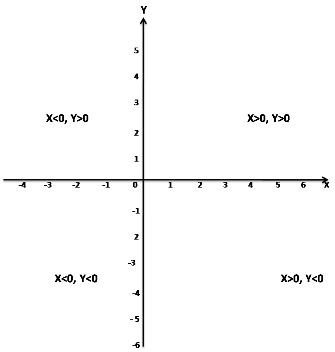
In 2nd quadrant?
(a) X < 0, Y < 0
(b) X < 0, Y > 0
(c) X > 0, Y > 0
(d) X > 0, Y < 0

Answer

Answer: (b) X < 0, Y > 0
Hint:
In the second quadrant,
MCQ Questions for Class 11 Maths Chapter 1 Sets with Answers 1
X < 0, Y > 0


MCQ Of Chapter Sets Class 11 Question 15.
How many rational and irrational numbers are possible between 0 and 1?
(a) 0
(b) Finite
(c) Infinite
(d) 1

Answer

Answer: (c) Infinite
Hint:
There are infinite many rational and irrational numbers are possible between 0 and 1
This is because between any two numbers, there are infinite numbers.


Question 16.
Empty set is a?
(a) Finite Set
(b) Invalid Set
(c) None of the above
(d) Infinite Set

Answer

Answer: (a) Finite Set
Hint:
In mathematics, and more specifically set theory, the empty set is the unique set having no elements and its size or cardinality (count of elements in a set) is zero.
So, an empty set is a finite set.


Question 17.
If A = [5, 6, 7] and B = [7, 8, 9] then A U B is equal to
(a) [5, 6, 7, 8, 9]
(b) [5, 6, 7]
(c) [7, 8, 9]
(d) None of these

Answer

Answer: (a) [5, 6, 7, 8, 9]
Hint:
Given A = [5, 6, 7] and B = [7, 8, 9]
then A U B = [5, 6, 7, 8, 9]


Question 18.
Which of the following two sets are equal?
(a) A = {1, 2} and B = {1}
(b) A = {1, 2} and B = {1, 2, 3}
(c) A = {1, 2, 3} and B = {2, 1, 3}
(d) A = {1, 2, 4} and B = {1, 2, 3}

Answer

Answer: (c) A = {1, 2, 3} and B = {2, 1, 3}
Hint:
Two sets are equal if and only if they have the same elements.
So, A = {1, 2, 3} and B = {2, 1, 3} are equal sets.


Question 19.
In a class of 50 students, 10 did not opt for math, 15 did not opt for science and 2 did not opt for either. How many students of the class opted for both math and science.
(a) 24
(b) 25
(c) 26
(d) 27

Answer

Answer: (d) 27
Hint:
Total students = 50
Students who did not opt for math = 10
Students who did not opt for Science = 15
Students who did not opt for either maths or science = 2
Total of 40 students in math and 13 did not opt for science but did for math = 40 – 13 = 27
So, students of the class opted for both math and science is 27


Question 20.
In last quadrant?
(a) X < 0, Y > 0
(b) X < 0, Y < 0
(c) X > 0, Y < 0
(d) X > 0, Y > 0

Answer

Answer: (d) X > 0, Y > 0
Hint:
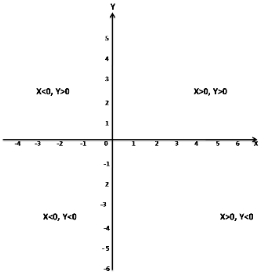
In the last quadrant,
MCQ Questions for Class 11 Maths Chapter 1 Sets with Answers 2
X > 0, Y > 0


We hope the given NCERT MCQ Questions for Class 11 Maths Chapter 1 Sets with Answers Pdf free download will help you. If you have any queries regarding CBSE Class 11 Maths Sets MCQs Multiple Choice Questions with Answers, drop a comment below and we will get back to you soon.