MCQ Questions for Class 10 History Chapter 1 The Rise of Nationalism in Europe with Answers

Check the below NCERT MCQ Questions for Class 10 History Chapter 1 The Rise of Nationalism in Europe with Answers Pdf free download. MCQ Questions for Class 10 Social Science with Answers were prepared based on the latest exam pattern. We have Provided The Rise of Nationalism in Europe Class 10 History MCQs Questions with Answers to help students understand the concept very well. https://mcqquestions.guru/mcq-questions-for-class-10-history-chapter-1/

The Rise of Nationalism in Europe Class 10 MCQs Questions with Answers

Choose the correct option:

Nationalism In Europe Class 10 MCQ Question 1.
What type of conservative regimes were set up in 1815 in Europe?
(a) Autocratic
(b) Democratic
(c) Aristocratic
(d) Dictatorial

Answer

Answer: (a) Autocratic


Rise Of Nationalism In Europe Class 10 MCQ Question 2.
Identify the French artist who prepared a series of four prints visualising his dream of a world from the following:
(a) Kitagewa Utamaro
(b) Richard M Hoe
(c) Voltaire
(d) Frederic Sorrieu

Answer

Answer: (d) Frederic Sorrieu


Class 10 History Chapter 1 MCQ Question 3.
Napoleon invaded Italy in
(a) 1821
(b) 1790s
(c) 1905
(d) 1797

Answer

Answer: (b) 1790s


The Rise Of Nationalism In Europe MCQ Question 4.
Who was proclaimed King of united Italy in 1861?
(a) Victor Emmanuel II
(b) Louis Philippe
(c) Mazzini
(d) Cavour

Answer

Answer: (a) Victor Emmanuel II


The Rise Of Nationalism In Europe Class 10 MCQ Question 5.
Which of the following artists painted the image of Germania?
(a) Philip Veit
(b) Frederic Sorrieu
(c) Ernst Renan
(d) Richar M Hoe

Answer

Answer: (a) Philip Veit


Class 10 History Chapter 1 MCQ With Answers Question 6.
Who said ‘When France sneezes, the rest of Europe catches cold’?
(a) Garibaldi
(b) Bismarck
(c) Mazzini
(d) Duke Metternich

Answer

Answer: (d) Duke Metternich


MCQ Questions For Class 10 History Chapter 1 Question 7.
What happened to Poland at the end of 18th century. Which of the following answers is correct?
(a) Poland achieved independence at the end of the 18th century.
(b) Poland came totally under the control of Russia and became part of Russia.
(c) Poland became the part of East Germany.
(d) Poland was partitioned at the end of the 18th century by three Great Powers: Russia, Prussia and Austria.

Answer

Answer: (d) Poland was partitioned at the end of the 18th century by three Great Powers: Russia, Prussia and Austria.


History Chapter 1 Class 10 MCQ Question 8.
Who played the leading role in the unification of Germany?
(a) German Emperor (formerly King of Prussia) – Kaiser William I.
(b) Otto Von Bismarck (Prussian Chief Minister).
(c) Johann Gottfried Herder – German philosopher.
(d) Austrian Chancellor – Duke Metternich.

Answer

Answer: (b) Otto Von Bismarck (Prussian Chief Minister).


Ch 1 History Class 10 MCQ Question 9.
Three wars over seven years with Austria, Denmark, Germany and France, ended in
(a) Danish victory
(b) Prussian victory
(c) French victory
(d) German victory

Answer

Answer: (b) Prussian victor


History Class 10 Chapter 1 MCQ Question 10.
Who was proclaimed the emperor of Germany in 1871?
(a) Otto Von Bismarck
(b) Victor Emmanuel II
(c) Count Cavour
(d) Kaiser William I of Prussia

Answer

Answer: (d) Kaiser William I of Prussia


MCQ Questions For Class 10 Icse History Chapter 1 Question 11.
Which one of the following was not the feature of Napoleonic Code?
(a) Equality before the law
(b) Universal Adult Franchise
(c) Right to Property
(d) Privileges based on birth

Answer

Answer: (d) Privileges based on birth
Explanation:
The Civil Code of 1804 – usually known as the Napoleonic Code – did away with all privileges based on birth, established equality before the law and secured the right to property.


The Rise Of Nationalism In Europe Class 10 MCQ With Answers Pdf Question 12.
Who hosted the ‘Treaty of Vienna’?
(a) Frédéric Sorrieu
(b) Victor Emmanuel
(c) Duke Metternich
(d) Giuseppe Garibaldi

Answer

Answer: (c) Duke Metternich
Explanation:
In 1815, representatives of the European powers – Britain, Russia, Prussia and Austria – who had collectively defeated Napoleon, met at Vienna to draw up a settlement for Europe. The Congress was hosted by the Austrian Chancellor Duke Metternich.


MCQ For Class 10 History Chapter 1 With Answers Question 13.
The political and constitutional changes brought about by the French Revolution were:
(a) it ended the absolute monarchy.
(b) It transferred power to a body of the French citizens.
(c) It proclaimed that henceforth people would constitute the nation and shape its destiny.
(d) All the above.

Answer

Answer: (d) All the above.
Explanation:
France, was a full-fledged territorial state in 1789 under the rule of an absolute monarch. The political and constitutional changes that came in the wake of the French Revolution led to the transfer of sovereignty from the monarchy to a body of French citizens. The revolution proclaimed that it was the people who would henceforth constitute the nation and shape its destiny.


MCQ Of Chapter 1 History Class 10 With Answers Question 14.
What does ‘Absolutist’ mean?
(a) A Philosophy
(b) A Theory
(c) Monarchical Government
(d) A Painting

Answer

Answer: (c) Monarchical Government
Explanation:
Absolutist is a government or system of rule that has no control on the power exercised. In history, the term refers to a form of monarchical government that was centralised, militarised and repressive.


The Rise Of Nationalism In Europe Class 10 MCQ With Answers Pdf Download Question 15.
The first clear expression of nationalism came with:
(a) The American Revolution
(b) The French Revolution
(c) The Russian Revolution
(d) The Industrial Revolution

Answer

Answer: (b) The French Revolution
Explanation:
The first clear expression of nationalism came with the French Revolution in 1789. France was a full-fledged territorial state in 1789 under the rule of an absolute monarch. The political and constitutional changes during French Revolution led to the transfer of sovereignty from the monarchy to a body of French citizens.


Question 16.
What does a blindfolded woman carrying a pair of weighing scales symbolise ?
(a) Peace
(b) Equality
(c) Justice
(d) Liberty

Answer

Answer: (c) Justice
Explanation:
The attributes of Liberty are the red cap, or the broken chain, while Justice is generally a blindfolded woman carrying a pair of weighing scales.


Question 17.
What was the main intention behind ‘Treaty of Vienna of 1815’?
(a) Restore republics
(b) Restore democracies
(c) Restore monarchies
(d) None of these

Answer

Answer: (c) Restore monarchies
Explanation:
The main intention behind ‘Treaty of Vienna of 1815’ was to restore the monarchies that had been overthrown by Napoleon, and create a new conservative order in Europe.


Question 18.
Who was proclaimed German Emperor after its unification?
(a) The Prussian King – William-I
(b) The French King – Louis Philippe
(c) Victor Emmanuel II
(d) None of these

Answer

Answer: (a) The Prussian King – William-I
Explanation:
Three wars over seven years – with Austria, Denmark and France – ended in Prussian victory and completed the process of unification. In January 1871, the Prussian king, William I, was proclaimed German Emperor in a ceremony held at Versailles.


Question 19.
What did Germania symbolize?
(a) French nation
(b) German nation
(c) British nation
(d) None of the above

Answer

Answer: (b) German nation
Explanation:
Germania became the allegory of the German nation. In visual representations, Germania wears a crown of oak leaves, as the German oak stands for heroism.


Question 20.
Who was Giuseppe Mazzini?
(a) French Revolutionary
(b) Italian Revolutionary
(c) Russian Revolutionary
(d) None of above

Answer

Answer: (b) Italian Revolutionary
Explanation:
Giuseppe Mazzini was an Italian revolutionary. Born in Genoa in 1807, he became a member of the secret society of the Carbonari. He founded two more underground societies, first, Young Italy in Marseilles, and then, Young Europe in Berne.


Question 21.
Name the customs union formed by Prussia to abolish tariff barriers.
(a) Elle
(b) Zollverein
(c) Zweibiicken
(d) La Patrie

Answer

Answer: (b) Zollverein
Explanation:
In 1834, a customs union or zollverein was formed at the initiative of Prussia and joined by most of the German states. The union abolished tariff barriers and reduced the number of currencies from over thirty to two.


Question 22.
What did ‘Das Volk’ stand for?
(a) Democracy
(b) Factory workers
(c) Slum dwellers
(d) Common people

Answer

Answer: (d) Common people
Explanation:
German philosopher Johann Gottfried Herder (1744-1803) claimed that true German culture was to be discovered among the common people – das volk. It was through folk songs, folk poetry and folk dances that the true spirit of the nation (volksgeist) was popularised.


Question 23.
Which of the following is true with reference to Romanticism?
(a) Concept of government by consent
(b) Freedom of markets
(c) Cultural movements
(d) Freedom of an individual

Answer

Answer: (c) Cultural movements
Explanation:
Romanticism, a cultural movement which sought to develop a particular form of nationalist sentiment. Romantic artists and poets generally criticised the glorification of reason and science and focused instead on emotions, intuition and mystical feelings.


Question 24.
Who were the Junkers?
(a) Soldiers
(b) Large landowners
(c) Aristocracy
(d) Nobility

Answer

Answer: (b) Large landowners
Explanation:
The liberal initiative to nation-building of Germany was repressed by the combined forces of the monarchy and the military, supported by the large landowners (called Junkers) of Prussia.


Question 25.
Which one of the following areas was the most serious source of nationalist tension in Europe after 1871?
(a) The Balkans
(b) Great Britain
(c) Italy
(d) Germany

Answer

Answer: (a) The Balkans
Explanation:
The most serious source of nationalist tension in Europe after 1871 was the area called the Balkans. The Balkans was a region of geographical and ethnic variation comprising modern-day Romania, Bulgaria, Albania, Greece, Macedonia, Croatia, Bosnia-Herzegovina, Slovenia, Serbia and Montenegro whose inhabitants were broadly known as the Slavs.


Match the following:

Column A
Attribute
Column B
Significance
1. Broken chainsa. heroism
2. Breastplate with eagleb. beginning of a new era
3. Crown of oak leavesc. being freed
4. Swordd. willingness to make peace
5. Olive branch around the sworde. symbol of the German empire-strength
6. Black, red and gold tricolorf. readiness to fight
7. Rays of the rising sung. flag of the liberal-nationalists in 1848, banned by the Dukes of the German states
Answer

Answer:

Column A
Attribute
Column B
Significance
1. Broken chainsc. being freed
2. Breastplate with eaglee. symbol of the German empire-strength
3. Crown of oak leavesa. heroism
4. Swordf. readiness to fight
5. Olive branch around the swordd. willingness to make peace
6. Black, red and gold tricolorg. flag of the liberal-nationalists in 1848, banned by the Dukes of the German states
7. Rays of the rising sunb. beginning of a new era

Picture-based Questions:

Study the picture (NCERT TB Page 23) and answer the questions that follows:
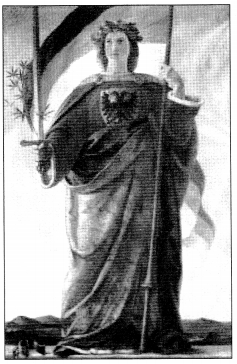
MCQ Questions for Class 10 History Chapter 1 The Rise of Nationalism in Europe with Answers 1
(i) Identify the above figure.
(ii) Name the artist who painted the image.
(iii) What is the significance of the image?

Answer

Answer: (i) It is the painting of Germania.
(ii) The name of the artist is Philip Veit.
(iii) Germania became the allegory of the German nation. In visual representations, she wears a crown of oak leaves, as the German oak stands for heroism.


We hope the given NCERT MCQ Questions for Class 10 History Chapter 1 The Rise of Nationalism in Europe with Answers Pdf free download will help you. If you have any queries regarding The Rise of Nationalism in Europe CBSE Class 10 History MCQs Multiple Choice Questions with Answers, drop a comment below and we will get back to you soon.

MCQ Questions for Class 10 Maths Chapter 15 Probability with Answers

Check the below NCERT MCQ Questions for Class 10 Maths Chapter 15 Probability with Answers Pdf free download. MCQ Questions for Class 10 Maths with Answers were prepared based on the latest exam pattern. We have provided Probability Class 10 Maths MCQs Questions with Answers to help students understand the concept very well. https://mcqquestions.guru/mcq-questions-for-class-10-maths-chapter-15/

Students can also refer to NCERT Solutions for Class 10 Maths Chapter 15 Probability for better exam preparation and score more marks.

Probability Class 10 MCQs Questions with Answers

Probability Class 10 MCQ Question 1.
If two different dice are rolled together, the probability of getting an even number on both dice is:
(a) \(\frac{1}{36}\)
(b) \(\frac{1}{2}\)
(c) \(\frac{1}{6}\)
(d) \(\frac{1}{4}\)

Answer

Answer: (d) \(\frac{1}{4}\)


Probability MCQ Class 10 Question 2.
The probability that a number selected at random from the numbers 1, 2, 3, 4, …, 15 is a multiple of 4 is
(a) \(\frac{4}{15}\)
(b) \(\frac{2}{15}\)
(c) \(\frac{1}{5}\)
(d) \(\frac{1}{3}\)

Answer

Answer: (c) \(\frac{1}{5}\)


Class 10 Probability MCQ Question 3.
An event is very unlikely to happen. Its probability is closest to:
(a) 0.0001
(b) 0.001
(c) 0.01
(d) 0.1

Answer

Answer: (a) 0.0001


MCQ Of Probability Class 10 Question 4.
If the probability of an event is P, the probability of its complementary event will be:
(a) P – 1
(b) P
(c) 1 – p
(d) 1 – \(\frac{1}{p}\)

Answer

Answer: (c) 1 – p


MCQ On Probability Class 10 Question 5.
In a family of 3 children, the probability of having atleast one boy is:
(a) \(\frac{7}{8}\)
(b) \(\frac{1}{8}\)
(c) \(\frac{5}{8}\)
(d) \(\frac{3}{4}\)

Answer

Answer: (d) \(\frac{3}{4}\)


Class 10 Maths Chapter 15 MCQ Question 6.
If P(A) denotes the probability of an event then:
(a) P(A) < 0
(b) P(A) > 0
(c) 0 ≤ P(A) ≤ 1
(d) -1 ≤ P(A) ≤ 0

Answer

Answer: (c) 0 ≤ P(A) ≤ 1


Ch 15 Maths Class 10 MCQ Question 7
A card is selected from a deck of 52 cards. The probability of its being a red face card is:
(a) \(\frac{3}{26}\)
(b) \(\frac{3}{13}\)
(c) \(\frac{2}{13}\)
(d) \(\frac{1}{2}\)

Answer

Answer: (a) \(\frac{3}{26}\)


Probability Class 10 MCQ With Answers Question 8.
The probability than a non-leap year selected at random will contain 53 Sundays is:
(a) \(\frac{1}{7}\)
(b) \(\frac{2}{7}\)
(c) \(\frac{3}{7}\)
(d) \(\frac{5}{7}\)

Answer

Answer: (a) \(\frac{1}{7}\)


MCQ Probability Class 10 Question 9.
When a die is thrown, the probability of getting an odd number less them 3 is:
(a) \(\frac{1}{6}\)
(b) \(\frac{1}{3}\)
(c) \(\frac{1}{2}\)
(d) 0

Answer

Answer: (a) \(\frac{1}{6}\)


Probability Class 10 MCQs Question 10.
A card is drawn from a deck of 52 cards. The event E is that card is not an ace of hearts. The number of outcomes favourable to E is:
(a) 4
(b) 13
(c) 48
(d) 51

Answer

Answer: (d) 51


Class 10 Maths Ch 15 MCQ Question 11.
The probability of getting a bad egg in a lot of 400 is 0.035. The number of bad eggs in the lot is:
(a) 7
(b) 14
(c) 21
(d) 28

Answer

Answer: (b) 14


Chapter 15 Maths Class 10 MCQ Question 12.
A girl calculate that the probability of her winning the first prize in a lottery is 0.08. If 6000 tickets are sold, how many tickets has she bought?
(a) 40
(b) 240
(c) 480
(d) 750

Answer

Answer: (c) 480


MCQs On Probability Class 10 Question 13.
One ticket is drawn at random from a bag containing tickets numbered 1 to 40. The probability that the selected ticket has a number which is a multiple of 5 is:
(a) \(\frac{1}{5}\)
(b) \(\frac{3}{5}\)
(c) \(\frac{4}{5}\)
(d) \(\frac{1}{3}\)

Answer

Answer: (a) \(\frac{1}{5}\)


Class 10 Maths Probability MCQs Question 14.
Someone is asked to take a number from 1 to 100. The probability that it is a prime is:
(a) \(\frac{1}{5}\)
(b) \(\frac{6}{25}\)
(c) \(\frac{1}{4}\)
(d) \(\frac{13}{50}\)

Answer

Answer: (c) \(\frac{1}{4}\)


Class 10 Maths Probability MCQ Question 15.
A school has five houses A, B, C, D and E. A class has 23 students, 4 from house A, 8 from house B, 5 from house C, 2 from house D and rest from house E. A single student is selected at random to be the class monitor. The probability that the selected student is not from A, B and C is:
(a) \(\frac{4}{23}\)
(b) \(\frac{6}{23}\)
(c) \(\frac{8}{23}\)
(d) \(\frac{17}{23}\)

Answer

Answer: (b) \(\frac{6}{23}\)


We hope the given NCERT MCQ Questions for Class 10 Maths Chapter 15 Probability with Answers Pdf free download will help you. If you have any queries regarding Probability CBSE Class 10 Maths MCQs Multiple Choice Questions with Answers, drop a comment below and we will get back to you soon.

MCQ Questions for Class 10 Maths Chapter 14 Statistics with Answers

Check the below NCERT MCQ Questions for Class 10 Maths Chapter 14 Statistics with Answers Pdf free download. MCQ Questions for Class 10 Maths with Answers were prepared based on the latest exam pattern. We have provided Statistics Class 10 Maths MCQs Questions with Answers to help students understand the concept very well. https://mcqquestions.guru/mcq-questions-for-class-10-maths-chapter-14/

Students can also refer to NCERT Solutions for Class 10 Maths Chapter 14 Statistics for better exam preparation and score more marks.

Statistics Class 10 MCQs Questions with Answers

Statistics Class 10 MCQ Question 1.
Cumulative frequency curve is also called
(a) histogram
(b) ogive
(c) bar graph
(d) median

Answer

Answer: (b) ogive


Statistics MCQ Class 10 Question 2.
The relationship between mean, median and mode for a moderately skewed distribution is
(a) mode = median – 2 mean
(b) mode = 3 median – 2 mean
(c) mode = 2 median – 3 mean
(d) mode = median – mean

Answer

Answer: (b) mode = 3 median – 2 mean
Hint:
Mode = 3 median – 2 mean


MCQ On Statistics Class 10 Question 3.
The median of set of 9 distinct observations is 20.5. If each of the largest 4 observations of the set is increased by 2, then the median of the new set
(a) is increased by 2
(b) is decreased by 2
(c) is two times of the original number
(d) Remains the same as that of the original set.

Answer

Answer: (d) Remains the same as that of the original set.
Hint:
No. of observations = 9
∴ median = 5th observation
∵ The largest four observations are increased
∴ 5th observation remains unchanged.


Statistics Class 10 MCQ With Answers Question 4.
Mode and mean of a data are 12k and 15A. Median of the data is
(a) 12k
(b) 14k
(c) 15k
(d) 16k

Answer

Answer: (b) 14k
Hint:
∵ Mode = 3 median – 2 mean
⇒ 12k = 3 median – 2 × 15k
⇒ 42k = 3 median
⇒ Median = 14k.


MCQ Of Statistics Class 10 Question 5.
The times, in seconds, taken by 150 atheletes to run a 110 m hurdle race are tabulated below:

ClassFrequency
13.8 – 14.02
14.0 – 14.24
14.2 – 14.45
14.4 – 14.671
14.6 – 14.848
14.8 – 15.020

The number of atheletes who completed the race in less then 14.6 seconds is:
(a) 11
(b) 71
(c) 82
(d) 130

Answer

Answer: (c) 82


Class 10 Statistics MCQ Question 6.
The abscissa of the point of intersection of the less than type and of the more than type cumulative frequency curves of a grouped data gives its
(a) mean
(b) median
(c) mode
(d) all the three above

Answer

Answer: (b) median


Class 10 Maths Chapter 14 MCQ Question 7.
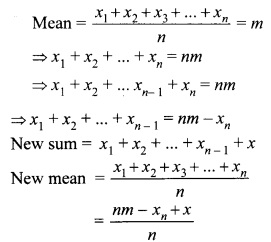
Mean of n numbers x1, x2, … xn is m. If xn is replaced by x, then new mean is
(a) m – xn + x
(b) \(\frac{nm-x_n+x}{n}\)
(c) \(\frac{(n-1)m+x}{n}\)
(d) \(\frac{m-x_n+x}{n}\)

Answer

Answer: (b) \(\frac{nm-x_n+x}{n}\)
Hint:
Class 10 Maths Chapter 14 MCQ


Chapter 14 Maths Class 10 MCQ Question 8.
While computing mean of grouped data, we assume that the frequencies are [NCERT Exemplar Problems]
(a) evenly distributed over all the classes
(b) centred at the classmarks of the classes
(c) centred at the upper limits of the classes
(d) centred at the lower limits of the classes

Answer

Answer: (b) centred at the classmarks of the classes


Class 10 Maths Ch 14 MCQ Question 9.
Mean of 100 items is 49. It was discovered that three items which should have been 60, 70, 80 were wrongly read as 40, 20, 50 respectively. The correct mean is
(a) 48
(b) 49
(c) 50
(d) 60

Answer

Answer: (c) 50
Hint:
Sum of 100 observations
= 100 × 49 = 4900
Correct sum
= 4900 – [40 + 20 + 50 ] + [60 + 70 + 80] = 5000
∴ Correct mean = \(\frac{5000}{100}\) = 50.


Ch 14 Maths Class 10 MCQ Question 10.
The times, in seconds, taken by 150 atheletes to run a 100 m hurdle race are tabulated below:

ClassFrequency
13.8-143
14 – 14.24
14.2 – 14.46
14.4 – 14.669
14.6 – 14.848
14.8 – 15.020

The number of atheletes who completed the race in less than 14.6 seconds is
(a) 13
(b) 69
(c) 82
(d) 130

Answer

Answer: (c) 82


MCQ Questions For Class 10 Maths Chapter 14 Question 11.
For the following distribution
MCQ Questions for Class 10 Maths Chapter 14 Statistics with Answers
the number of students who got marks less than 30 is
(a) 13
(b) 25
(c) 10
(d) 12

Answer

Answer: (b) 25


Chapter 14 Statistics MCQ Question 12.
In the given data:

C.IFrequency
65-854
85 – 1055
105 – 12513
125 – 14520
145 – 16514
165 – 1857
185 – 2054

the difference of the upper limit of the median class and the lower limit of the modal class is
(a) 38
(b) 20
(c) 19
(d) 0

Answer

Answer: (b) 20


MCQ Questions For Class 10 Maths Statistics Question 13.
For the following distribution

MarksNo. of students
Less than 204
Less than 4012
Less than 6025
Less than 8056
Less than 10074
Less than 12080

the modal class is
(a) 20 – 40
(b) 40 – 60
(c) 60 – 80
(d) 80 -100

Answer

Answer: (c) 60 – 80


MCQs On Statistics Class 10 Question 14.
For the following distribution
MCQ Questions for Class 10 Maths Chapter 14 Statistics with Answers
the sum of lower limits of the modal class and the median class is
(a) 20
(b) 30
(c) 40
(d) 50

Answer

Answer: (d) 50


Class 10 Maths Statistics MCQs Question 15.
While computing mean of grouped data, we assume that the frequencies are
(a) centred at the upper limits of the classes
(b) centred at the lower limits of the classes
(c) centred at the classmarks of the classes
(d) evenly distributed over all the classes

Answer

Answer: (c) centred at the classmarks of the classes


Question 16.
Which of the following can not be determined graphically?
(a) Mean
(b) Median
(c) Mode
(d) None of these

Answer

Answer: (a) Mean


Question 17.
Mode is the
(a) middle most frequent value
(b) least frequent value
(c) maximum frequent value
(d) none of these

Answer

Answer: (c) maximum frequent value


We hope the given NCERT MCQ Questions for Class 10 Maths Chapter 14 Statistics with Answers Pdf free download will help you. If you have any queries regarding Statistics CBSE Class 10 Maths MCQs Multiple Choice Questions with Answers, drop a comment below and we will get back to you soon.

MCQ Questions for Class 10 Maths Chapter 13 Surface Areas and Volumes with Answers

Check the below NCERT MCQ Questions for Class 10 Maths Chapter 13 Surface Areas and Volumes with Answers Pdf free download. MCQ Questions for Class 10 Maths with Answers were prepared based on the latest exam pattern. We have provided Surface Areas and Volumes Class 10 Maths MCQs Questions with Answers to help students understand the concept very well. https://mcqquestions.guru/mcq-questions-for-class-10-maths-chapter-13/

Students can also refer to NCERT Solutions for Class 10 Maths Chapter 13 Surface Areas and Volumes for better exam preparation and score more marks.

Surface Areas and Volumes Class 10 MCQs Questions with Answers

Surface Area And Volume Class 10 MCQ Question 1.
If the surface areas of two spheres are in ratio 16 : 9, then their volumes will be in the ratio:
(a) 27 : 64
(b) 64 : 27
(c) 4 : 3
(d) 3 : 4

Answer

Answer: (b) 64 : 27


Surface Area And Volume MCQ Question 2.
A cylinder, a cone and a hemisphere are of equal base and have the same height. What is the ratio of their volumes?
(a) 3 : 1 : 2
(b) 3 : 2 : 1
(c) 1 : 2 : 3
(d) 1 : 3 : 2

Answer

Answer: (a) 3 : 1 : 2


Surface Area And Volume Class 10 MCQ With Answers Question 3.
If the area of three adjacent faces of cuboid are X, Y and Z respectively, then the volume of cuboid is:
(a) XYZ
(b) 3XYZ
(c) \(\sqrt{xyz}\)
(d) \(\sqrt{3xyz}\)

Answer

Answer: (c) \(\sqrt{xyz}\)


Class 10 Maths Chapter 13 MCQ Question 4.
The volumes of two spheres are in the ratio 27 : 8. The ratio of their curved surface is:
(a) 9 : 4
(b) 4 : 9
(c) 3 : 2
(d) 2 : 3

Answer

Answer: (a) 9 : 4


MCQ Of Chapter 13 Maths Class 10 Question 5.
The ratio of the volumes of two spheres is 8 : 27. If r and R are the radii of spheres respectively, then (R – r): r is:
(a) 1 : 2
(b) 1 : 3
(c) 2 : 3
(d) 4 : 9

Answer

Answer: (a) 1 : 2


MCQ On Surface Area And Volume Question 6.
The radii of two cylinders are in the ratio 2 : 3 and their heights are in the ratio 5 : 3. The ratio of their volumes is:
(a) 27 : 20
(b) 20 : 27
(c) 9 : 4
(d) 4 : 9

Answer

Answer: (b) 20 : 27


MCQ On Surface Area And Volume Class 10 Question 7.
If the radius of base of a right circular cylinder is halved, keeping the height same, the ratio of the volume of the reduced cylinder to that of the original cylinder is:
(a) 2 : 3
(b) 3 : 4
(c) 1 : 4
(d) 4 : 1

Answer

Answer: (c) 1 : 4


Surface Area And Volume MCQ Questions Class 10 Question 8.
If the volumes of a cube is 1728 cm³, the length of its edge is equal to:
(a) 7 cm
(b) 12 cm
(c) 18 cm
(d) 19 cm

Answer

Answer: (b) 12 cm


MCQ Surface Area And Volume Class 10 Question 9.
The volume (in cm³) of the largest right circular cone that can be cut off from a cube of edge 4.2 cm is: .
(a) 9.7
(b) 72.6
(c) 58.2
(d) 19.4

Answer

Answer: (d) 19.


Class 10 Surface Area And Volume MCQ Question 10.
The circumference of the edge of hemispherical bowl is 132 cm. When π is taken as \(\frac{22}{7}\), the capacity of bowl in cm³ is:
(a) 2772
(b) 924
(c) 19404
(d) 9702

Answer

Answer: (a) 2772


MCQ On Surface Area And Volume Class 10 Pdf Question 11.
The surface areas of two spheres are in the ratio 1 : 2. The ratio of their volume is:
(a) √2 : 1
(b) 1 : 2√2
(c) 1 : 8
(d) 1 : 4

Answer

Answer: (b) 1 : 2√2


MCQ Questions For Class 10 Maths Chapter 13 Question 12.
The radius of spherical balloon increases from 8 cm to 12 cm. The ratio of the surface areas of balloon in two cases is:
(a) 2 : 3
(b) 3 : 2
(c) 8 : 27
(d) 4 : 9

Answer

Answer: (d) 4 : 9


MCQ Questions For Class 10 Maths Surface Area And Volume Question 13.
Two cubes each of volume 8 cm³ are joined end to end, then the surface area of the resulting cuboid is:
(a) 80 cm²
(b) 64 cm²
(c) 40 cm²
(d) 8 cm²

Answer

Answer: (c) 40 cm²


Ch 13 Maths Class 10 MCQ Question 14.
A cylindrical pencil sharpened at one edge is combination of:
(a) a cone and a cylinder
(b) frustum of a cone and cylinder
(c) a hemisphere and a cylinder
(d) four cylinders

Answer

Answer: (a) a cone and a cylinder


MCQ Of Surface Area And Volume Class 10 Question 15.
Taking π = \(\frac{22}{7}\), if surface area of a sphere is 616 cm², then its diameter is:
(a) 7 cm
(b) 14 cm
(c) 56 cm
(d) 28 cm

Answer

Answer: (b) 14 cm


Question 16.
The area of the square that can be inscribed in a circle of radius 8 cm is (in cm²):
(a) 256
(b) 128
(c) 64√2
(d) 64

Answer

Answer: (b) 128


Question 17.
The curved surface area of a right circular cone of height 15 cm and base diameter 16 cm² is:
(a) 60π cm²
(b) 68π cm²
(c) 1200π cm²
(d) 136π cm²

Answer

Answer: (d) 136π cm²


Question 18.
A shuttle cock used for playing badminton has the shape of a combination of:
(а) a cylinder and a sphere
(b) a cylinder and a hemisphere
(c) a cone and a sphere
(d) a frustum of a cone and a hemisphere

Answer

Answer: (d) a frustum of a cone and a hemisphere


Question 19.
The total surface area of a solid hemisphere of radius r is:
(a) 47πr²
(b) 2πr²
(c) \(\frac{4}{3}\)πr³
(d) 3πr²

Answer

Answer: (d) 3πr²


Question 20.
The radius of a wire is decreased to one third. If volume remains the same, the length will become:
(a) 3 times
(b) 6 times
(c) 9 times
(d) 27 times

Answer

Answer: (c) 9 times


Question 21.
The volume of a right circular cylinder is 345 cm³. Then, the volume of a right circular cone whose radius of the base and height is the same as of circular cylinder will be:
(a) 345 cm³
(b) 690 cm³
(c) 115 cm³
(d) 230 cm³

Answer

Answer: (c) 115 cm³


Question 22.
The slant height of a bucket is 26 cm. The diameter of upper and lower circular ends are 36 cm and 16 cm. then height of bucket is:
(a) 22 cm
(b) 24 cm
(c) 10 cm
(d) 25 cm

Answer

Answer: (b) 24 cm


Question 23.
The volume (in cm³) of the largest right circular cone that can be cut off from a cube of edge 4.2 cm is:
(a) 9.7
(b) 77.6
(c) 58.2
(d) 19.4

Answer

Answer: (d) 19.4


Question 24.
By melting a solid sphere of radius 5 cm a solid right circular cone of the same circular base radius is made. The height of cone is:
(a) 20 cm
(b) 10 cm
(c) 5 cm
(d) 12 cm

Answer

Answer: (a) 20 cm


Question 25.
A cylinder and a cone area of same base radius and of same height. The ratio of the volume of cylinder to that of cone is:
(a) 3 : 1
(b) 1 : 3
(c) 2 : 3
(d) 1 : 1

Answer

Answer: (a) 3 : 1


Question 26.
Eight solid sphere of same size are made by melting a solid metallic cylinder of base diameter 6 cm and height 32 cm. The diameter of each sphere is:
(a) 3 cm
(b) 6 cm
(c) 12 cm
(d) 8 cm

Answer

Answer: (b) 6 cm


Question 27.
The number of conical bottles of radius 2 cm and height 3.6 cm, required to empty the liquid from a cylindrical bottle of radius 6 cm and height 10 cm is:
(a) 100
(b) 9
(c) 75
(d) 20

Answer

Answer: (c) 75


We hope the given NCERT MCQ Questions for Class 10 Maths Chapter 13 Surface Areas and Volumes with Answers Pdf free download will help you. If you have any queries regarding Surface Areas and Volumes CBSE Class 10 Maths MCQs Multiple Choice Questions with Answers, drop a comment below and we will get back to you soon.

MCQ Questions for Class 10 Maths Chapter 12 Areas Related to Circles with Answers

Check the below NCERT MCQ Questions for Class 10 Maths Chapter 12 Areas Related to Circles with Answers Pdf free download. MCQ Questions for Class 10 Maths with Answers were prepared based on the latest exam pattern. We have provided Areas Related to Circles Class 10 Maths MCQs Questions with Answers to help students understand the concept very well. https://mcqquestions.guru/mcq-questions-for-class-10-maths-chapter-12/

Students can also refer to NCERT Solutions for Class 10 Maths Chapter 12 Areas Related to Circles for better exam preparation and score more marks.

Areas Related to Circles Class 10 MCQs Questions with Answers

Area Related To Circle Class 10 MCQ Question 1.
Perimeter of a sector of a circle whose central angle is 90° and radius 7 cm is
(a) 35 cm
(b) 25 cm
(c) 77 cm
(d) 7 cm

Answer

Answer: (b) 25 cm


Areas Related To Circles Class 10 MCQ Question 2.
The area of a circle that can be inscribed in a square of side 10 cm is
(a) 40π cm²
(b) 30π cm²
(c) 100π cm²
(d) 25π cm²

Answer

Answer: (d) 25π cm²


Class 10 Maths Chapter 12 MCQ Question 3.
The perimeter of a square circumscribing a circle of radius a units is
(a) 2 units
(b) 4α units
(c) 8α units
(d) 16α units

Answer

Answer: (c) 8α units


Areas Related To Circles Class 10 MCQ With Answers Question 4.
The perimeter of the sector with radius 10.5 cm and sector angle 60° is
(a) 32 cm
(b) 23 cm
(c) 41 cm
(d) 11 cm

Answer

Answer: (a) 32 cm


MCQ Questions For Class 10 Maths Areas Related To Circles Question 5.
In a circle of diameter 42 cm, if an arc subtends an angle of 60° at the centre, where π = \(\frac{22}{7}\) then length of arc is
(a) 11 cm
(b) \(\frac{22}{7}\) cm
(c) 22 cm
(d) 44 cm

Answer

Answer: (c) 22 cm


Ch 12 Maths Class 10 MCQ Question 6.
The perimeter of a sector of radius 5.2 cm is 16.4 cm, the area of the sector is
(a) 31.2 cm²
(b) 15 cm²
(c) 15.6 cm²
(d) 16.6 cm²

Answer

Answer: (c) 15.6 cm²


Class 10 Area Related To Circle MCQ Question 7.
If the perimeter of a semicircular protractor is 72 cm where π = \(\frac{22}{7}\), then the diameter of protractor is
(a) 14 cm
(b) 33 cm
(c) 28 cm
(d) 42 cm

Answer

Answer: (c) 28 cm


MCQ Area Related To Circle Class 10 Question 8.
If the radius of a circle is doubled, its area becomes
(a) 2 times
(b) 4 times
(c) 8 times
(d) 16 times

Answer

Answer: (b) 4 times


Class 10 Areas Related To Circles MCQ Question 9.
If the sum of the circumferences of two circles with radii R1 and R2 is equal to circumference of a circle of radius R, then
(a) R1 + R2 = R
(b) R1 + R2 > R
(c) R1 + R2 < R
(d) Can’t say;

Answer

Answer: (a) R1 + R2 = R


MCQ On Areas Related To Circles Class 10 Question 10.
The perimeter of a circular and square fields are equal. If the area of the square field is 484 m² then the diameter of the circular field is
(a) 14 m
(b) 21 m
(c) 28 m
(d) 7 m

Answer

Answer: (c) 28 m


Question 11.
The radius of sphere is r cm. It is divided into . two equal parts. The whole surface area of two parts will be
(a) 8πr² cm²
(b) 6πr² cm²
(c) 4πr² cm²
(d) 3πr² cm²

Answer

Answer: (b) 6πr² cm²


Question 12.
If the diameter of a semicircular protractor is 14 cm, then its perimeter is .
(a) 27 cm
(b) 36 cm
(c) 18 cm
(d) 9 cm

Answer

Answer: (b) 36 cm


Question 13.
A race track is in the form of a circular ring whose outer and inner circumferences are 396 m and 352 m respectively. The width of the track is
(a) 63 m
(b) 56 m
(c) 7 m
(d) 3.5 m

Answer

Answer: (c) 7 m


Question 14.
The area of the largest square that can be inscribed in a circle of radius 12 cm is
(a) 24 cm²
(b) 249 cm²
(c) 288 cm²
(d) 196√2 cm²

Answer

Answer: (c) 288 cm²


Question 15.
The area of the largest triangle that can be inscribed in a semicircle of radius r is
(a) r²
(b) 2r²
(c) r³
(d) 2r³

Answer

Answer: (a) r²


Question 16.
The area (in cm²) of the circle that can be inscribed in a square of side 8 cm is
(a) 64 π
(b) 16 π
(c) 8 π
(d) 32 π

Answer

Answer: (b) 16 π


Question 17.
If the perimeter of a circle is equal to that of a square, then the ratio of their areas is
(a) 22 : 7
(b) 14 : 11
(c) 7 : 22
(d) 11 : 14

Answer

Answer: (b) 14 : 11


Question 18.
The circumference of two concentric circles forming a ring are 88 cm and 66 cm. Taking π = \(\frac{22}{7}\), the width of the ring is
(a) 14 cm
(b) 7 cm
(c) \(\frac{7}{2}\) cm
(d) 21 cm

Answer

Answer: (c) \(\frac{7}{2}\) cm


Question 19.
A steel wire when bent in the form of a square encloses an area of 121 cm². If the same wire is bent in the form of a circle, then the circumference of the circle is
(a) 88 cm
(b) 44 cm
(c) 22 cm
(d) 11 cm

Answer

Answer: (b) 44 cm


Question 20.
The diameter of a circle whose area is equal to sum of the areas of the two circles of radii 40 cm and 9 cm is
(a) 41 cm
(b) 49 cm
(c) 82 cm
(d) 62 cm

Answer

Answer: (c) 82 cm


We hope the given NCERT MCQ Questions for Class 10 Maths Chapter 12 Areas Related to Circles with Answers Pdf free download will help you. If you have any queries regarding Areas Related to Circles CBSE Class 10 Maths MCQs Multiple Choice Questions with Answers, drop a comment below and we will get back to you soon.