Value Based Questions in Science for Class 10 Chapter 11 Human Eye and Colourful World

Value Based Questions in Science for Class 10 Chapter 11 Human Eye and Colourful World

These Solutions are part of Value Based Questions in Science for Class 10. Here we have given Value Based Questions in Science for Class 10 Chapter 11 Human Eye and Colourful World

Question 1.
Seeta and Geeta are best friends and study in class X. Geeta is facing difficulty in reading the black board text from he bench in the first row in a classroom. Seeta wonders why Geeta avoids sitting in the first row. Seeta came to know that Geeta avoids milk and green vegetables. She started sharing her lunch-full of green vegetables and fruits with Geeta. Geeta is now better and has started taking a ’balanced diet’.

  1. Name the eye defect Geeta is suffering from.
  2. What values are shown by Seeta and Geeta ?

Answer:

  1. Hypermetropia or long sightedness.
  2. Both are good friends. Both are concerned about each other. Seeta is well aware of the importance of balanced diet. Geeta also learnt the importance of balanced diet for good health through Seeta.

More Resources

Question 2.
Maya and Meera are good friends and study in class X. Meera is facing difficulty in reading the black board text from the last desk. Maya came to know that Meera carries junk food in her lunch. Maya started sharing her lunch full of green vegetables and fruits. She alsô motivated Meera to consult a doctor and for the check up of her eyes. Meera is now better and started taking a ’balanced diet’.

  1. Name the eye defect Meera is suffering from.
  2. What value is shown by Maya and Meera ?

Answer:

  1. Myopia or short sightedness.
  2. Concern for each other, friendship and importance of balanced diet.

Question 3.
Arun is a student of class X. One day, when he was coming from his school, he saw that an old man was finding it difficult to cross a busy road. An old man was unable to see the nearer objects. Arun helped the old man to cross the road.

  1. Name the defect of vision an old man was suffering,
  2. Name the lens used to correct this defect of vision.
  3. What values are shown by Arun ?

Answer:

  1. Hypermetropia or long – sightedness.
  2. Convex lens.
  3. Arun is helpful. He is concerned about others. He thinks that it was his moral duty to help old and needy persons.

Hope given Value Based Questions in Science for Class 10 Chapter 11 Human Eye and Colourful World are helpful to complete your science homework.

If you have any doubts, please comment below. Learn Insta try to provide online science tutoring for you.

HOTS Questions for Class 10 Science Chapter 11 Human Eye and Colourful World

HOTS Questions for Class 10 Science Chapter 11 Human Eye and Colourful World

These Solutions are part of HOTS Questions for Class 10 Science. Here we have given HOTS Questions for Class 10 Science Chapter 11 Human Eye and Colourful World

Question 1.
A person is able to see objects clearly only when these are lying at distance between 50 cm and 300 cm from his eye.

  1. What kind of defect of vision he is suffering from ?
  2. What kind of lenses will he required to increase his range of vision from 25 cm to infinity ? Explain briefly.

Answer:

  1. For a normal eye, the near point is at 25 cm and the far point is at infinity from the eye. The given
    person cannot see object clearly either closer to the eye or far away from the eye. So, he is suffering horn both myopia and hypermetropia.
  2. A bi-focal lens consisting of a concave lens and convex lens of suitable focal lengths will be required to correct the defects and to increase his range or vision from 25 cm to infinity. In a bi-focal lens, upper portion is concave which corrects distant vision and lower portion is convex which corrects near vision.

More Resources

Question 2.
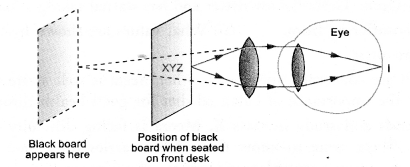
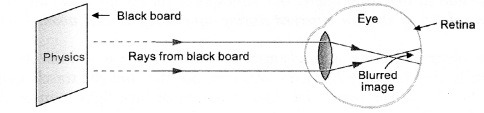
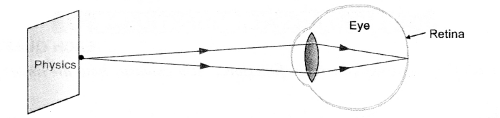
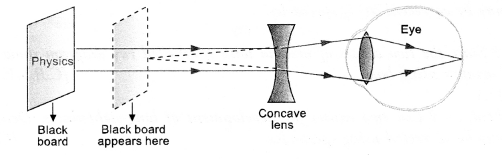
A student finds the writing on the black board as blurred and unclear when sitting on the last desk in a classroom. He however, sees it clearly when sitting on the front desk at an approximate distance of 2 m from the black board.
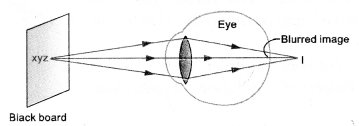
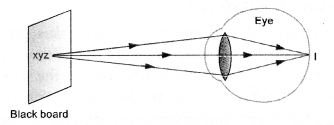
(a) Draw ray diagrams to illustrate the formation of image of the black board writing by his eye-lens when he is seated at the

  1. last desk,
  2. front desk. (CBSE 2011, 2015)

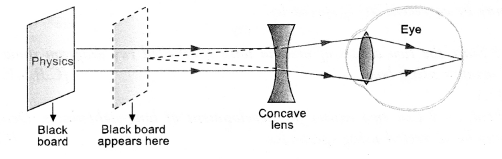
(b) Name the kind of lens that would help him to see clearly even when he is seated at the last desk. Draw a ray diagram to illustrate how this lens helps him to see clearly. (CBSE 2011, 2012, 2015)
Answer:
(a)

  1. Formation of image of the black board writing by the eye-lens of the student sitting at the last desk is shown in figure.
    HOTS Questions for Class 10 Science Chapter 11 Human Eye and Colourful World image - 1
  2. Formation of image of the black board writing by the eye-lens of the student sitting at the front-desk is shown in figure.
    HOTS Questions for Class 10 Science Chapter 11 Human Eye and Colourful World image - 2

(b) Student is suffering from Myopia, so his eye defect can be corrected by using a concave lens as shown in figure.
HOTS Questions for Class 10 Science Chapter 11 Human Eye and Colourful World image - 3

Question 3.
A student finds the writing on the black board as blurred and unclear while sitting on the front desk in a classroom of a big size. He however, sees it clearly while sitting on the last desk of the classroom.
(a) Draw ray diagrams to illustrate the formation of image of the black board writing by his eye-lens when he is seated at

  1. the front desk,
  2. last desk.

(b) Name the defect, the eye of the student is suffering from?
(c) Name the type of lens that would enable him to see the black board writing clearly, when seated on the front desk.
(d) Draw a ray diagram to illustrate how this lens helps him to see clearly.
Answer:
(a)

  1. Formation of image of black board writing by the eye-lens of the student sitting on the front desk is shown in figure.
    HOTS Questions for Class 10 Science Chapter 11 Human Eye and Colourful World image - 4
  2. Formation of the image of the black board writing by the eye-lens of the student sitting on the last desk is shown in figure.
    HOTS Questions for Class 10 Science Chapter 11 Human Eye and Colourful World image - 5

(b) Student’s eye suffers from hypermetropia or long sightedness as he is able to see far off object clearly but unable to see near object clearly.
(c) Convex lens of suitable focal length.
(d)
HOTS Questions for Class 10 Science Chapter 11 Human Eye and Colourful World image - 6

Question 4.
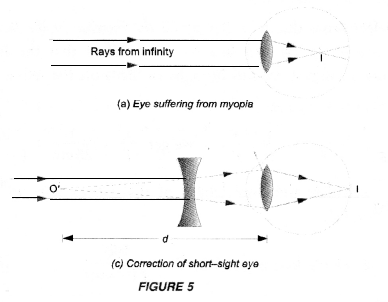
A person cannot see object farther than 10m from the eye clearly. Name the defect of vision, he is suffering from. How can it be corrected ? Draw ray diagrams for

  1. defective eye,
  2. its correction.

Answer:
He is suffering from myopia or short-sightedness. The defect can be corrected using spectacles having concave lens.
HOTS Questions for Class 10 Science Chapter 11 Human Eye and Colourful World image - 7

Question 5.
A 14-years old student is not able to see clearly the questions written on a black board placed at a distance of 5 m from him.
(a) Name the defect of vision, he is suffering from.
(b) With the help of labelled ray diagram show how this defect can be corrected.
(c) Name the type of lens used to correct this defect.
(d) State two causes of this defect. (CBSE 2007, 2011, 2013, 2017)
Answer:
(a) Student is suffering from Myopia or short-sightedness
(b) For ray diagram,
HOTS Questions for Class 10 Science Chapter 11 Human Eye and Colourful World image - 8
(c) Concave lens of suitable focal length is used to correct this defect.
(d) It is due to

  1. elongation of the eye ball,
  2. excessive curvature of the cornea.

Question 6.
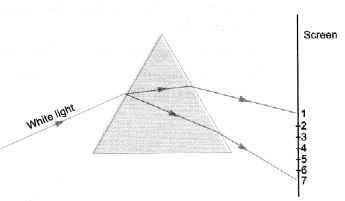
A beam of white light falling on a glass prism gets split up into seven colours marked 1 to 7 as shown in the diagram. A student makes the following statements about the spectrum observed on the screen.
(a) The colours at position marked 3 and 5 are similar to the colour of the sky and the core of a hard boiled egg respectively. Is the statement made by the student correct or incorrect ? Justify.
(b) Which two positions correspond closely to the colour of

  1. a solution of potassium permanganate ?
  2. Danger or stop signal lights ? (CBSE 2011, 2012, 2016)
    HOTS Questions for Class 10 Science Chapter 11 Human Eye and Colourful World image - 9

Answer:
(a) (i) The colours at positions 3 and 5 are yellow and blue respectively. On the other hand, student has identified them as blue (i.e colour of sky) and yellow (colour of the core of a hard boiled egg) respectively. Hence, the statement is incorrect.
(b)

  1. Position 7 is the position of violet colour, which corresponds to the colour of a solution of potassium permanganate.
  2. Position 1 is the position of red colour, which corresponds to the colour of ‘danger’ or stop signal lights.

Question 7.
A glass prims is able to produce a spectrum when white light passes through it but a glass slab does not produce any spectrum. Explain. Why is it so ? [CBSE (All India) 2009]
Answer:
When white light enters the glass slab, dispersion of light takes place. The angle of refraction for violet colour is more than for red colour on entering the glass slab. But all colours of light return to the original direction of propagation while refracting from other side of the glass slab and thus white light emerges out of the glass slab. Hence, glass slab does not produce any spectrum.

Hope given HOTS Questions for Class 10 Science Chapter 11 Human Eye and Colourful World are helpful to complete your science homework.

If you have any doubts, please comment below. Learn Insta try to provide online science tutoring for you.

NCERT Exemplar Solutions for Class 10 Science Chapter 10 Light Reflection and Refraction

NCERT Exemplar Solutions for Class 10 Science Chapter 10 Light Reflection and Refraction

These Solutions are part of NCERT Exemplar Solutions for Class 10 Science. Here we have given NCERT Exemplar Solutions for Class 10 Science Chapter 10 Light Reflection and Refraction

Question 1.
Which of the following can make a parallel beam of light when light from a point source is incident on it ?
(a) Concave mirror as well as convex lens
(b) Convex mirror as well as concave lens
(c) Two plane mirrors placed at 90° to each other.
(d) Concave mirror as well as concave lens.
Answer:
(a).
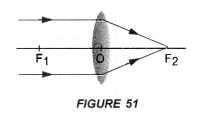
Explanation : When a point source is placed at the focus of a concave mirror or a convex lens, light after reflecting from the concave mirror and light after refracting from a convex lens goes as a parallel beam.

More Resources

Question 2.
A 10 mm long owl pin is placed vertically in front of a concave mirror. A 5 mm long image of the owl pin is formed at 30 cm in front of the mirror. The focal length of this mirror is
(a) – 30 cm
(b) – 20 cm
(c) – 40 cm
(d) – 60 cm
Answer:
(b).
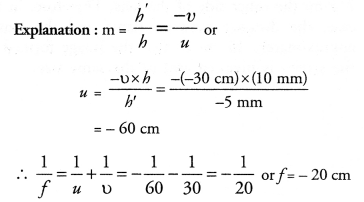
NCERT Exemplar Solutions for Class 10 Science Chapter 10 Light Reflection and Refraction image - 1

Question 3.
Under which of the following conditions a concave mirror can form a real image larger than the actual object ?
(a) When object is kept at a distance equal to its radius of curvature.
(b) When object is placed between the focus and centre of curvature.
(c) When object is kept at a distance less than its focal length.
(d) When object is kept at a distance greater than its radius of curvature.
Answer:
(b).
Explanation :
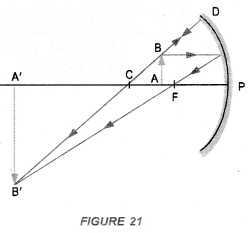
NCERT Exemplar Solutions for Class 10 Science Chapter 10 Light Reflection and Refraction image - 2

Question 4.
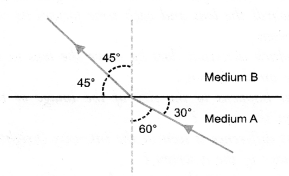
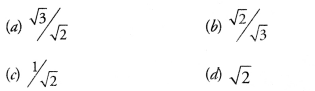
Figure shows a ray of light as it travels from medium A to medium B. Refractive index of the medium B relative to medium A is
NCERT Exemplar Solutions for Class 10 Science Chapter 10 Light Reflection and Refraction image - 3
NCERT Exemplar Solutions for Class 10 Science Chapter 10 Light Reflection and Refraction image - 4
Answer:
(a).
NCERT Exemplar Solutions for Class 10 Science Chapter 10 Light Reflection and Refraction image - 5

Question 5.
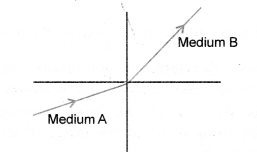
A light ray enters from medium A to medium B as shown in figure. The refractive index of medium B relative to medium A will be
NCERT Exemplar Solutions for Class 10 Science Chapter 10 Light Reflection and Refraction image - 6
(a) greater than unity
(b) less than unity
(c) equal to unity
(d) zero
Answer:
(a).
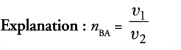
Explanation :
NCERT Exemplar Solutions for Class 10 Science Chapter 10 Light Reflection and Refraction image - 7
where v1 = speed of light in medium A
V2 = speed of light in medium B.
Since ray of light bends towards the normal, when it goes from medium A to rrtedium B, therefore, medium A is rarer and medium B is denser medium. Speed of light in rarer medium (v1) is greater than the speed of light in denser medium (v2). Hence, nBA > 1.

Question 6.
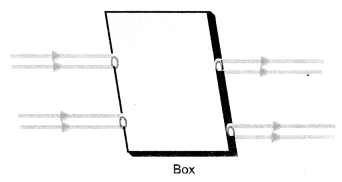
Beams of light are incident through the holes A and B and emerge out of a box through the holes C and D respectively as shown in figure. Which of the following could be inside the box ?
NCERT Exemplar Solutions for Class 10 Science Chapter 10 Light Reflection and Refraction image - 8
(a) A rectangular glass slab
(b) A convex lens
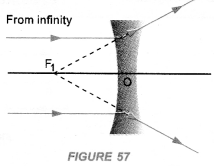
(c) A concave lens
(d) A prism.
Answer:
(a).
Explanation : Rectangular glass slab causes the lateral dis¬placement of a ray of light following on it. However, incident ray and emergent ray are paralled to each other.

Question 7.
A beam of light is incident through the holes on side A and emerges out of the holes on the other side of the box as shown in figure. Which of the following could be inside the box ?
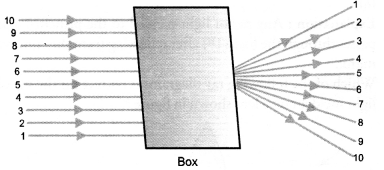
NCERT Exemplar Solutions for Class 10 Science Chapter 10 Light Reflection and Refraction image - 9
(a) Concave lens
(b) Rectangular slab
(c) prism
(d) Convex lens
Answer:
(d).
Explanation :
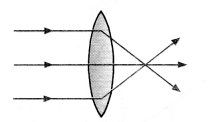
NCERT Exemplar Solutions for Class 10 Science Chapter 10 Light Reflection and Refraction image - 10

Question 8.
Which of the following statements is true ?
(a) A convex lens has 4 dioptre power having focal length 0.25 m.
(b) A convex lens has – 4 dioptre power having focal length 0.25 m.
(c) A concave lens has 4 dioptre power having focal length 0.25 m.
(d) A concave lens has – 4 dioptre power having focal length 0.25 m.
Answer:
(a).
Explanation : Convex lens has positive power and positive focal length.
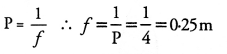
NCERT Exemplar Solutions for Class 10 Science Chapter 10 Light Reflection and Refraction image - 11

Question 9.
Magnification produced by a rear view mirror fitted in vehicles.
(a) is less than one
(b) is more than one
(c) is equal to one
(d) can be more than or less than one depending upon the position of the object in front of it.
Answer:
(a).
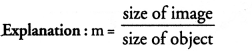
NCERT Exemplar Solutions for Class 10 Science Chapter 10 Light Reflection and Refraction image - 12
Rear view mirror is a convex mirror, which always forms an image whose size is less than the size of the object.

Question 10.
Rays from sun converge at a point 15 cm in front of a concave mirror. Where should an object be placed so that size of its image is equal to the size of the object ?
(a) 15 cm in front of the mirror
(b) 30 cm in front of the mirror
(c) between 15 cm and 30 cm in front of the mirror.
(d) more than 30 cm in front of the mirror.
Answer:
(b).
Explanation : Here, Focal length of concave mirror, f = -15 cm Radius of curvature of the mirror, R = 2f = -30 cm.
In case of concave mirror, size of image is equal to the size of the object if the object is placed at the centre of curvature (see figure 20). The distance of centre of curvature from the mirror = radius of curvature of the mirror.

Question 11.
A full length image of a distance tall building can definitely be seen by using
(a) concave mirror
(b) convex mirror
(c) plane mirror
(d) both concave as well as plane mirror.
Answer:
(b).
Explanation : Convex mirror forms full length of a distant tall object irrespective of the position of the object. However, plane mirror forms full size image of the object if the size of the plane mirror is half the size of the object. Concave mirror forms full size image of the object if the object is far away from it.

Question 12.
In torches, search lights and head lights of vehicles, the bulb is placed
(a) between the pole and the focus of the reflector
(b) very near to the focus of the reflector
(c) between the focus and centre of curvature of the reflector
(d) at the centre of curvature of the reflector.
Answer:
(b).
Explanation :
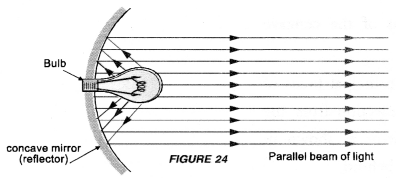
NCERT Exemplar Solutions for Class 10 Science Chapter 10 Light Reflection and Refraction image - 13

Question 13.
The laws of reflection hold good for
(a) plane mirror only
(b) concave mirror only
(c) convex mirror only
(d) all mirrors irrespective of their shape
Answer:
(d).

Question 14.
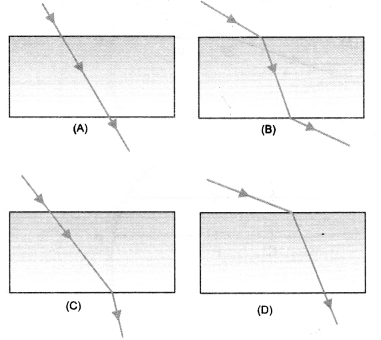
The path of a ray of light coming from air passing through a rectangular glass slab traced by four students are shown as A, B, C and D in the figure. Which one of them is correct ?
NCERT Exemplar Solutions for Class 10 Science Chapter 10 Light Reflection and Refraction image - 14
Answer:
(B)
Explanation : Glass slab causes the lateral displacement of a ray of light falling on it. However, incident ray and emergent ray are parallel to each other.

Question 15.
You are given water, mustard oil, glycerine and kerosene. In which of these media, a ray of light incident obliquely at same angle would bend the most ?
(a) Kerosene
(b) Water
(c) Mustard Oil
(d) Glycerine
Answer:
(d).
Explanation : The ray would bend the most, when it goes from rarer medium (say air) to the most denser medium. Since refrac¬tive index of glycerine is the highest among all these medium, so glycerine is the most denser medium.

Question 16.
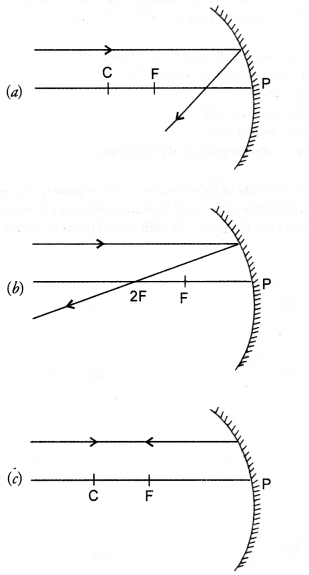
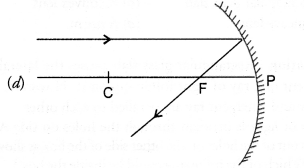
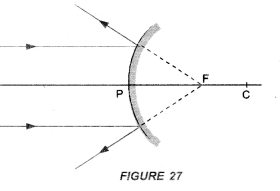
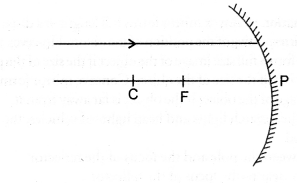
Which of the following ray diagrams is correct for the ray of light incident on a concave mirror as shown in figure ?
NCERT Exemplar Solutions for Class 10 Science Chapter 10 Light Reflection and Refraction image - 15
NCERT Exemplar Solutions for Class 10 Science Chapter 10 Light Reflection and Refraction image - 16
NCERT Exemplar Solutions for Class 10 Science Chapter 10 Light Reflection and Refraction image - 17
Answer:
(d).
Explanation : Any ray of light parallel to the principal axis passes through the focus (F) after reflecting from the concave mirror.

Question 17.
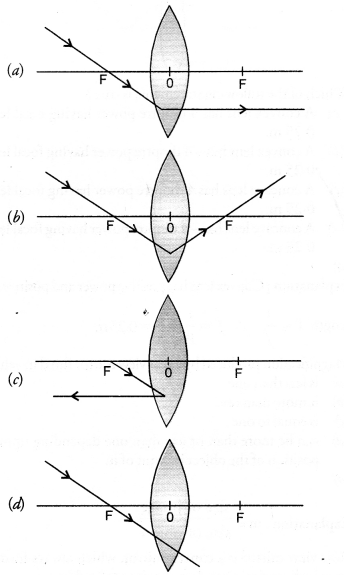
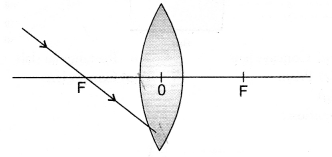
Which of the following ray diagrams is correct for the ray of light incident on a lens shown in figure ?
NCERT Exemplar Solutions for Class 10 Science Chapter 10 Light Reflection and Refraction image - 18
NCERT Exemplar Solutions for Class 10 Science Chapter 10 Light Reflection and Refraction image - 19
Answer:
(a).
Explanation : A ray of light passing through the focus of a lens travels parallel to the principal axis after refracting through the lens.

Question 18.
A girl is standing in front of a magic mirror. She finds the image of her head bigger, the middle portion of her body of the same size and that of the legs smaller. The order of combinations for the magic mirror from the top is :
(a) Convex, plane and concave
(b) Plane, convex and concave
(c) Concave, plane and convex
(d) Convex, concave and plane.
Answer:
(c).
Explanation : Concave mirror forms a magnified (enlarged) image of the object if the object is placed close to the concave mirror (i.e. a distance less than its focal length). Plane mirror always forms the mage of the same size as that of the object.

Question 19.
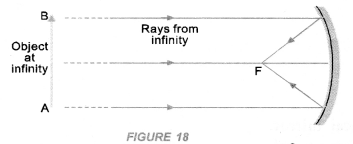
Convex mirror always forms a diminished image of the object irrespective of the position of the object from the mirror. In which of the following, the image of an object placed at infinity will be highly diminished and point sized ?
(a) Concave mirror only
(b) Convex mirror only
(c) Convex lens only
(d) Concave mirror, convex mirror, concave lens and convex lens.
Answer:
(d).
Explanation :
NCERT Exemplar Solutions for Class 10 Science Chapter 10 Light Reflection and Refraction image - 20
NCERT Exemplar Solutions for Class 10 Science Chapter 10 Light Reflection and Refraction image - 21
NCERT Exemplar Solutions for Class 10 Science Chapter 10 Light Reflection and Refraction image - 22
NCERT Exemplar Solutions for Class 10 Science Chapter 10 Light Reflection and Refraction image - 23

Question 20.
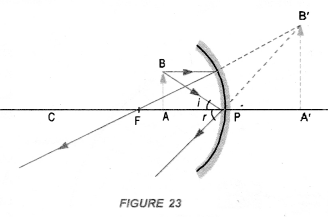
Identify the device used as a spherical mirror or lens in the following cases, when the image formed is virtual and erect in each case.
(a) Object is placed between device and its focus, image formed is enlarged and behind it.
(b) Object is placed between the focus and device, image formed is enlarged and on the same side as that of an object.
(c) Object is placed between infinity and device, image formed is diminished and between focus and optical centre on the same side as that of the object.
(d) Obj ect is placed between infinity and device, image formed is diminished and between pole and focus, behind it.
Answer:
(a) Concave mirror.
NCERT Exemplar Solutions for Class 10 Science Chapter 10 Light Reflection and Refraction image - 24
(b) Convex lens.
NCERT Exemplar Solutions for Class 10 Science Chapter 10 Light Reflection and Refraction image - 25
(c) Concave lens.
NCERT Exemplar Solutions for Class 10 Science Chapter 10 Light Reflection and Refraction image - 26
(d) Convex mirror.
NCERT Exemplar Solutions for Class 10 Science Chapter 10 Light Reflection and Refraction image - 27

Question 21.
Why does a light ray incident on a rectangular glass slab immersed in any medium emerges parallel to itself? Explain using a diagram.
Answer:
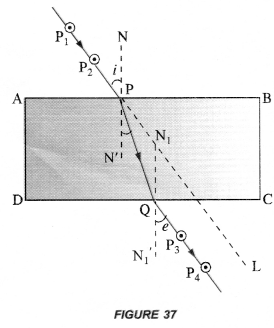
Perform an experiment to demonstrate that light bends from its path, when it falls obliquely on the surface of a glass slab. Also show that angle of incidence is about equal to the emergent angle.

  1. Take a glass slab and place it on a white sheet of paper fixed on a drawing board.
  2. Mark the boundary ABCD of the glass slab.
  3. Fix two pins P1 and P2, vertically on the drawing board such that line joining the pins is inclined to the edge AB of the glass slab (Figure 37).
    NCERT Exemplar Solutions for Class 10 Science Chapter 10 Light Reflection and Refraction image - 28
  4. Now, look through the glass slab from opposite side so that the images of pins P1 and P2 are seen exactly in line. Fix two pins P3 and P4, vertically on the drawing board such that pins P3, P4 and image of P1 and P2 are exactly in one line.
  5. Remove the glass slab and all pins. Join the points P1 and P2 with a line and extend this line to touch the edge AB at P. Similarly join the points P3 and P4 with a line and extend the line to touch the edge DC at Q.
  6. Join points P and Q with a straight line.
  7. Draw normal NN’ at P on the edge AB and a normal N1N1‘ at Q on the edge DC.
  8. Measure ∠P2 PN and ∠P3 QN1‘ using a protractor or dee.

This experiment shows that when light falls obliquely on a glass slab, it bends along PQ from its original path along PL.
Also ∠P2PN ≈ ∠P3QN1‘. That is, angle of incidence is about equal to the emergent angle.
Note : Distance between pins P1 and P2, and between P3 and P4 must be large.

Question 22.
A pencil when dipped in water in a glass tumbler appears to be bent at the interface of air and water. Will the pencil appear to be bent to the same extent, if instead of water, we use liquids like, kerosene or turpentine. Support your answer with reason.
Answer:
A pencil dipped in water appears to be bent at the interface of air and water due to the refraction of light. The refraction of light occurs because the speed of light changes when light travels from one medium to another. The pencil will not appear to be bent to the same extent, when it is dipped in kerosene or turpentine. This is because refractive index of kerosene or turpentine is greater than the index of water and hence speed of light (v = c/n) is less in kerosene or turpentine as compared to in water.

Question 23.
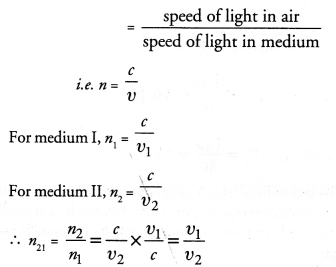
How is the refractive index of a medium related to the speed of light ?
Obtain an expression for refractive index of a medium with respect to another in terms of speed of light in these two media.
Answer:
Refractive index of a medium
NCERT Exemplar Solutions for Class 10 Science Chapter 10 Light Reflection and Refraction image - 29

Question 24.
Refractive index of diamond with respect to glass is 1.6 and absolute refractive index of glass is 1.5.
Find out the absolute refractive index of diamond.
Answer:
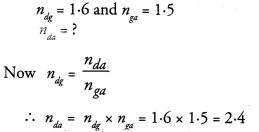
NCERT Exemplar Solutions for Class 10 Science Chapter 10 Light Reflection and Refraction image - 30

Question 25.
A convex lens of focal length 20 cm can produce a magnified virtual as well as real image.
Is this a correct statement ? If yes, where shall the object be placed in each case for obtaining these images ?
Answer:
The statement is correct.
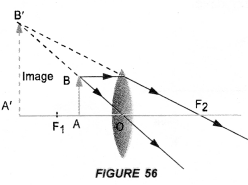
A convex lens of focal length 20 cm will produce a magnified Virtual image if object is placed at a distance less than 20 cm from the lens.
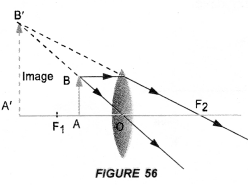
NCERT Exemplar Solutions for Class 10 Science Chapter 10 Light Reflection and Refraction image - 31
A convex lens of focal length 20 cm will produce a magnified real image if object is placed at a distance greater than 20 cm and less than 40 cm from the lens.
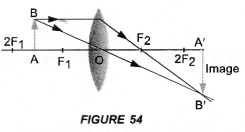
NCERT Exemplar Solutions for Class 10 Science Chapter 10 Light Reflection and Refraction image - 32
Sudha finds out that the sharp image of the window pane of her science laboratory is formed at a distance of 15 cm from the lens. She now tries to focus the building visible to her outside the window instead of the window pane without disturbing the lens.

Question 26.
In which direction will she move the screen to obtain a sharp image of the building ? What is the approximate focal length of this lens ?
Answer:
A real image can be obtained on the screen. Therefore, the lens used is convex lens as it forms real as well as virtual image. The distance of the real image formed by a convex lens from the lens decreases as the object distance from the lens increases. Hence, the screen has to be moved towards the lens to obtain the sharp image of the building.
Approximate focal length of the lens = 15 cm. The rays of light from the window pane are considered to come from infinity. These rays of light are focused by the convex lens at its focus (i.e. on the screen).

Question 27.
How are power and focal length of a lens related ? You are provided with two lenses of focal length 20 cm and 40 cm respectively. Which lens will you use to obtain more convergent light ? (CBSE 2012)
Answer:
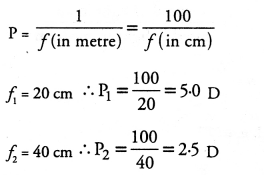
NCERT Exemplar Solutions for Class 10 Science Chapter 10 Light Reflection and Refraction image - 33
The lens of focal length 20 cm or power 5.0 D will be used to have more convergent light. This is because lens of small focal length or large power strongly converges the parallel beam of light.

Question 28.
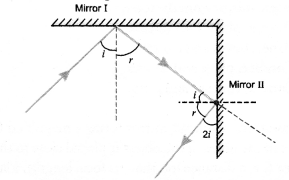
Under what condition in an arrangement of two plane mirrors, incident ray and reflected ray will always be parallel to each other, whatever may be the angle of incidence. Show the same with the help of diagram.
Answer:
Incident ray and reflected ray will always be parallel to each other if two plane mirrors are placed perpendicular to each other as shown in figure, i = r.
NCERT Exemplar Solutions for Class 10 Science Chapter 10 Light Reflection and Refraction image - 34

Question 29.
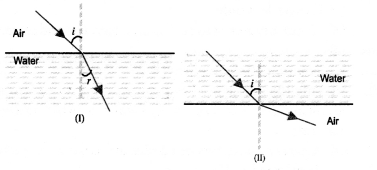
Draw a ray diagram showing the path of rays of light when it enters with oblique incidence

  1. from air into water,
  2. from water into air.

Answer:

  1. When ray of light enters from air into water, it bends towards the normal as shown in figure I
  2. When ray of light enters from water into air, it bends away from the normal as shown in figure II.
    NCERT Exemplar Solutions for Class 10 Science Chapter 10 Light Reflection and Refraction image - 35


Hope given NCERT Exemplar Solutions for Class 10 Science Chapter 10 Light Reflection and Refraction are helpful to complete your science homework.

If you have any doubts, please comment below. Learn Insta try to provide online science tutoring for you.
Value Based Questions in Science for Class 10 Chapter 10 Light Reflection and Refraction

Value Based Questions in Science for Class 10 Chapter 10 Light Reflection and Refraction

These Solutions are part of Value Based Questions in Science for Class 10. Here we have given Value Based Questions in Science for Class 10 Chapter 10 Light Reflection and Refraction

Question 1.
Rajesh is a student of class X and Ram is studying in class VII. Rajesh told Ram that he would show a magic to him. Rajesh had a lens. He focused the rays of sunlight on the bare arm of Ram. After few seconds, Ram felt pain and removed his arm away. Rajesh was laughing at Ram.

  1. Name the type of lens Rajesh had.
  2. Why did Ram feel pain ?
  3. Comment on the behaviour of Rajesh.

Answer:

  1. Convex lens
  2. When sun light is focused on the arm of Ram, heat is produced. This heat gave the . burning sensation to the skin of Ram’s arm,
  3. Rajesh should not have exploited the ignorance of Ram. He could have performed this magic on a black paper rather than the arm of Ram.

More Resources

Question 2.
A lady visited a shopping store with her friend. The owner of the store had fixed number of mirrors at different locations to monitor the activities of the customers. The lady picked up some items of make up and placed those items in her purse thinking that no one is watching her activity. But her friend asked her not to do so. The lady ignored her friend. When the lady came to the counter, the owner of the shop asked her to open her purse. She was humiliated in front of other customer and her friend.

  1. Name the type of mirrors fixed in the shop.
  2. Why was the lady asked by her friend not to place the make up items in her purse ?
  3. Why was the lady humiliated by the owner of the shop ?

Answer:

  1. Convex mirrors.
  2. The friend of the lady knew that stealing is crime.
  3. The lady had stolen the articles of owner of the shop.

Question 3.
Akhil, a student of class X went to an amusement park along with his younger brother. There, they entered in a small hall having number of large size mirrors. In front of one of the mirrors, they looked very funny. Their faces were normal, their bellies were fat and legs were short. Akhil’s younger brother was frightened and tried to hit the mirror with his foot. However, Akhil stopped him to do so.

  1. Name the type of mirror in front of which Akhil and his brother were standing ?
  2. What is the cause of the distortion of their images ?
  3. What values are shown by Akhil ?

Answer:

  1. The mirror was the combination of plane, concave and convex mirrors. The top most part was a plane mirror, the middle one was concave and the lower most was convex mirror.
  2. The refraction of light from mirrors distorted their images.
  3. Akhil knew that public or private property should not be damaged. Therefore, he stopped his brother to break the mirror.

Question 4.
Ram is a student of class X. His teacher told him that we can see stars clearly with the help of a telescope. He picked up the telescope from the lab and put it in his bag without telling the lab attendant. During night, he watched the stars and enjoyed.

  1. Name the lenses used in the telescope.
  2. Comment on the action of Ram.

Answer:

  1. Convex lenses.
  2. Ram has the curiosity to see stars with telescope. However, he should have asked his teacher or lab attendant to take the telescope to his home. He should be ashamed of his act as stealing is crime.

Hope given Value Based Questions in Science for Class 10 Chapter 10 Light Reflection and Refraction are helpful to complete your science homework.

If you have any doubts, please comment below. Learn Insta try to provide online science tutoring for you.
HOTS Questions for Class 10 Science Chapter 10 Light Reflection and Refraction

HOTS Questions for Class 10 Science Chapter 10 Light Reflection and Refraction

These Solutions are part of HOTS Questions for Class 10 Science. Here we have given HOTS Questions for Class 10 Science Chapter 10 Light Reflection and Refraction

Question 1.
You have a spherical mirror. The image of an object placed in front of the mirror is virtual. If the position of the object is changed, the image remains virtual and erect. Is the spherical mirror concave or convex ?
Answer:
Since convex mirror always forms a virtual and erect image irrespective of the position of the object in front of the mirror. So the given spherical mirror is convex mirror.

More Resources

Question 2.
The following table gives the value of refractive indices of a few media.
HOTS Questions for Class 10 Science Chapter 10 Light Reflection and Refraction image - 1
Name the medium having highest optical density and a medium having lowest optical density.
(Similar to Text Book Question, CBSE 2012, 2016)
Answer:
Optical density of a medium is directly proportional to its refractive index. Therefore, diamond has the highest optical density and ice has the lowest optical density.

Question 3.
Refractive indices of kerosene, turpentine and water are 1.44, 1.47 and 1.333 respectively. Through which of these media, light travels fast ? Explain. (Similar to Text Book Question)
Answer:
HOTS Questions for Class 10 Science Chapter 10 Light Reflection and Refraction image - 2
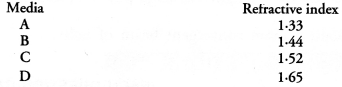
Since, refractive index of water (1.333) is less than the refractive indices of kerosene and turpentine, so light travels faster in water than in kerosene and turpentine. Refractive indices of media A, B, C and D are given below :
HOTS Questions for Class 10 Science Chapter 10 Light Reflection and Refraction image - 3

Question 4.
In which of these four media is the speed of light  (i) maximum and (ii) minimum ? Find refractive index of medium D w.r.t. medium A. (New CBSE Sample Paper, CBSE 2011, 2013, 2016)
Answer:
HOTS Questions for Class 10 Science Chapter 10 Light Reflection and Refraction image - 4
Since, refractive index of medium A is the least, so speed of light in medium A is maximum.
Refractive index of medium D is the highest, so the speed of light in medium D is minimum.
HOTS Questions for Class 10 Science Chapter 10 Light Reflection and Refraction image - 5

Question 5.
The following table gives the values of refractive indices of a few media
HOTS Questions for Class 10 Science Chapter 10 Light Reflection and Refraction image - 6
Use this table to give an example of (i) a medium pair so that light speeds up when it goes from one of these media to another, (ii) a medium pair so that light slows down when it goes from one of these media to another. (CBSE Sample Paper 2008)
Answer:

  1. Light speeds up or speed of light increases when it travels from a medium of higher refractive index to a medium of lower refractive index. Therefore, speed of light increases when it travels from crown glass or water or from rock salt to water or from diamond to water.
  2. Light slows down or speed of light decreases when it travels from a medium of lower refractive index to a medium of higher refractive index. For example, when it travels from water to crown glass or from water to diamond.

Question 6.
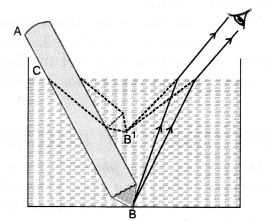
Explain with the help of a diagram, why a pencil partly immersed in water appears to be bent at the water surface ? (CBSE (Delhi) 2008, 2011)
Answer:
It is due to the refraction of light.
HOTS Questions for Class 10 Science Chapter 10 Light Reflection and Refraction image - 7
Consider a pencil AB, such that CB portion of the pencil is immersed in water as shown in figure. Rays of light from the tip (B) of the pencil bend away from the normal as they go from water to air. The refracted rays appear to come from point B’. Thus, the immersed portion of pencil in water appears as CB’. Hence, the pencil appears to bent at the water surface. Moreover, the immersed portion of the pencil in water also appears to be shorter than the actual length of the pencil.

Hope given HOTS Questions for Class 10 Science Chapter 10 Light Reflection and Refraction are helpful to complete your science homework.

If you have any doubts, please comment below. Learn Insta try to provide online science tutoring for you.