NCERT Exemplar Solutions for Class 10 Science Chapter 2 Acids, Bases and Salts

NCERT Exemplar Solutions for Class 10 Science Chapter 2 Acids, Bases and Salts

These Solutions are part of NCERT Exemplar Solutions for Class 10 Science. Here we have given NCERT Exemplar Solutions for Class 10 Science Chapter 2 Acids, Bases and Salts

NCERT Exemplar Solutions for Class 10 Science Chapter 2 Multiple Choice Questions

Question 1.
What happens when a solution of an acid is mixed with a solution of a base in a test tube ?
(i) The temperature of the solution increases
(ii) The temperature of the solution decreases
(iii) The temperature of the solution remains the same
(iv) Salt formation takes place
(a) (i) only
(b) (i) and (iii)
(c) (ii) and (iii)
(d) (i) and (iv)
Answer:
(d). Salt formation takes place in the neutralisation reaction. It is always exothermic and temperature increases.

More Resources

Question 2.
An aqueous solution turns red litmus solution blue. Excess addition of which of the following solutions would reverse the change ?
(a) Baking powder
(b) Lime
(c) Ammonium hydroxide solution
(d) Hydrochloric acid
Answer:
(d). The aqueous solution is of basic nature since red litmus changes to blue. The reaction can be reversed (acidic solution) by adding excess of hydrochloric acid.

Question 3.
During the preparation of hydrogen chloride gas on a humid day, the gas is usually passed through the guard tube containing anhydrous calcium chloride. The role of anhydrous calcium chloride taken in the guard tube is to
(a) absorb the evolved gas
(b) moisten the gas
(c) absorb moisture from the gas
(d) absorb Cl ions from the evolved gas
Answer:
(c). Anhydrous CaCl2 absorbs moisture to keep the gas in dry state. Otherwise, it will dissolve in moisture to form hydrochloric acid.

Question 4.
Which of the following salts does not contain any water of crystallisation ?
(a) Blue vitriol
(b) Baking soda
(c) Washing soda
(d) Gypsum
Answer:
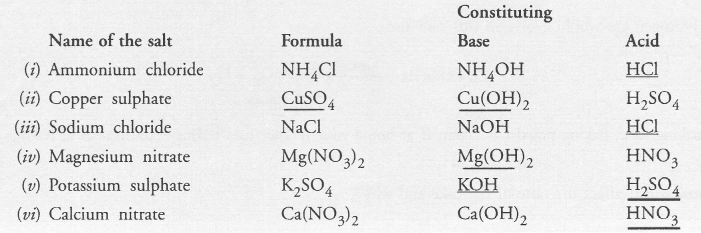
(b). Baking soda (NaHCO3) does not contain any water of crystallisation.

Question 5.
Sodium carbonate is a basic salt because it is a salt of
(a) strong acid and strong base
(b) weak acid and weak base
(c) strong acid and weak base
(d) weak acid and strong base
Answer:
(d). Na2CO3 is a salt of weak acid (H2CO3) and strong base (NaOH).

Question 6.
Calcium phosphate is present in tooth enamel. Its nature is
(a) basic
(b) acidic
(c) neutral
(d) amphoteric
Answer:
(a). Ca3(PO4)2 is a salt of strong base Ca(OH)2 and weak acid H3PO4.

Question 7.
A sample of soil is mixed with water and allowed to settle. The clear supernatant solution turns the pH paper yellowish-orange. Which of the following would change the colour of this pH paper to greenish-blue ?
(a) Lemon juice
(b) Vinegar
(c) Common salt
(d) An antacid
Answer:
(d). The colour of the pH paper signifies that the solution is somewhat acidic. In order to change it to greenish-blue, we need an antacid.

Question 8.
Which of the following gives the correct increasing order of acidic strength ?
(a) Water
(b) Water
(c) Acetic acid
(d) Hydrochloric acid Water Acetic acid
Answer:
(a).

Question 9.
If a few drops of a concentrated acid accidentally spill over the hand of a student, what should be done ?
(a) Wash the hand with saline solution
(b) Wash the hand immediately with plenty of water and apply a paste of sodium hydrogen carbonate
(c) After washing hand with plenty of water, apply solution of sodium hydroxide on the hand
(d) Neutralise the acid with a strong alkali
Answer:
(b). Washing the hand initially with plenty of water gives partial relief from burning sensation. The paste of sodium hydrogen carbonate completely neutralises the effect of the acid.

Question 10.
Sodium hydrogen carbonate when added to acetic acid evolves a gas. Which of the following statements are true about the gas evolved ?
(i) It turns lime water milky
(ii) It extinguishes a burning splinter
(iii) It dissolves in a solution of sodium hydroxide
(iv) It has a pungent odour
(a) (i) and (ii)
(b) (i), (ii) and (iii)
(c) (ii), (iii) and (iv)
(d) (i) and (iv)
Answer:
(b). The gas evolved is carbon dioxide (CO2). The statements (i), (ii) and (iii) are true about the gas.

Question 11.
Common salt besides being used in kitchen can also be used as the raw material for making
(i) washing soda
(ii) bleaching powder
(iii) baking soda
(iv) slaked lime
(a) (i) and (ii)
(b) (i), (ii) and (iv)
(c) (i) and (iii)
(d) (i), (iii) and (iv)
Answer:
(c).

Question 12.
One of the constituents of baking powder is sodium hydrogen carbonate. The other constituent is :
(a) hydrochloric acid
(b) tartaric acid
(c) acetic acid
(d) sulphuric acid
Answer:
(b). Tartaric acid is the other consument.

Question 13.
To protect tooth decay, we are advised to brush our teeth regularly. The nature of the tooth paste commonly used is
(a) acidic
(b) neutral
(c) basic
(d) corrosive
Answer:
(c). The basic ingredient in the paste will neutralise any acid released from the sugary’ items which we eat.

Question 14.
Which of the following statements is correct about an aqueous solution of an acid and of a base ?
(i) Higher the pH, stronger the acid
(ii) Higher the pH, weaker the acid
(iii) Lower the pH, stronger the base
(iv) Lower the pH, weaker the base
(a) (i) and (iii)
(b) (ii) and (iii)
(c) (i) and (iv)
(d) (ii) and (iv)
Answer:
(d). Statements (ii) and (iv) are correct.

Question 15.
The pH of the gastric juices released during digestion is
(a) less than 7
(b) more than 7
(c) equal to 7
(d) equal to 0
Answer:
(a). Gastric juices generally release hydrochloric acid during digestion. Therefore the pH is less than 7.

Question 16.
Which of the following phenomena occur when a small amount of acid is added to water ?
(i) Ionisation
(ii) Neutralisation
(iii) Dilution
(iv) Salt formation
(a) (i) and (ii)
(b) (i) and (iii)
(c) (ii) and (iii)
(d) (ii) and (iv)
Answer:
(b). Water helps in the ionisation of acid and also in its dilution.

Question 17.
Which one of the following can be used as an acid- base indicator by a visually impared student ?
(a) Litmus
(b) Turmeric
(c) Vanilla essence
(d) Petunia leaves
Answer:
(c). Vanilla essence is an olfactory inidicator.

Question 18.
Which of the following substances will not give carbon dioxide on treatment with dilute acid ?
(a) Marble
(b) Lime stone
(c) Baking soda
(d) Lime
Answer:
(d). Since lime (CaO) does not contain carbon, it will not give any carbon dioxide gas.

Question 19.
Which of the following is acidic in nature ?
(a) Lime juice
(b) Human blood
(c) Lime water
(d) Antacid
Answer:
(a). Lime juice is of acidic nature. It contains citric acid.

Question 20.
In an attempt to demonstrate electrical conductivity through an electrolyte, the apparatus set up is given. Which among the following statement(s) is(are) correct ?
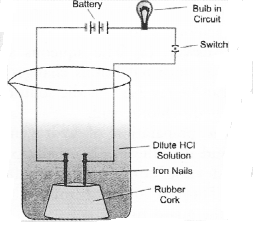
NCERT Exemplar Solutions for Class 10 Science Chapter 2 Acids, Bases and Salts image - 1
(i) Bulb will not glow because electrolyte is not acidic
(ii) Bulb will glow because HCl is a strong acid and furnishes ions for conduction.
(iii) Bulb will not glow because circuit is incomplete
(iv) Bulb will not glow because it depends upon the type of electrolytic solution
(a) (i) and (iii)
(b) (ii) and (iv)
(c) (ii) only
(d) (iv) only
Answer:
(c). Bulb will glow because the acid will furnish ions which conduct electricity.

Question 21.
Which of the following is used for dissolution of gold ?
(a) Hydrochloric acid
(b) Sulphuric acid
(c) Nitric acid
(d) Aqua regia.
Answer:
(d). For the details of aqua regia.

Question 22.
Which of the following is not a mineral acid ?
(a) Hydrochloric acid
(b) Citric acid
(c) Sulphuric acid
(d) Nitric acid.
Answer:
(b). Citric acid is an organic acid present in citrus fruits. It is not a mineral acid.

Question 23.
Which of the following is not a base ?
(a) NaOH
(b) KOH
(c) NH4OH
(d) C2H5OH.
Answer:
(d). Ethyl alcohol (C2H5OH) is not a base. It is an alcohol and is very weakly acidic in nature.

Question 24.
Which of the following statements is not correct ?
(a) All metal carbonates react with acid to give a salt, water and carbon dioxide
(b) All metal oxides react with water to give salt and acid
(c) Some metals react with acids to give salt and hydrogen
(d) Some non metal oxides react with water to form an acid
Answer:
(b). The statement is not correct as the metal oxide reacts with water to form metal hydroxide.

Question 25.
Match the chemical substances given in Column (A) with their appropriate application given in Column (B)

Column (A)   

Column (B)

(1) Bleaching powder

(i) Constituent of glass

(2) Baking soda

(ii) Production of H2 and Cl?
(3) Borax

(iii) Decolourisation

(4) Sodium chloride

(iv) Antacid

(a) 1—(ii), 2—(i), 3—(iv), 4—(iii)
(b) 1—(iii), 2—(ii), 3—(iv), 4—(i)
(c) 1—(iii), 2—(iv), 3—(i), 4—(ii)
(d) 1—(ii), 2—(iv), 3—(i), 4—(iii)
Answer:
(c).

Question 26.
Equal volumes of hydrochloric acid and sodium hydroxide solutions of same concentration are mixed and the pH of the resulting solution is checked with a pH paper. What would be the colour obtained ?

NCERT Exemplar Solutions for Class 10 Science Chapter 2 Acids, Bases and Salts image - 2
(a) Red
(b) Yellow
(c) Green
(d) Blue
Answer:
(c). pH paper will acqure green colour which indicates that the solution is of neutral nature.

Question 27.
Which of the following is(are) true when HCl (g) is passed through water ?
(i) It does not ionise in the solution as it is a covalent compound.
(ii) It ionises in the solution
(iii) It gives both hydrogen and hydroxyl ions in the solution
(iv) It forms hydronium ion in the solution due to the combination of hydrogen ion with water molecule
(a) (i) only
(b) (iii) only
(c) (ii) and (iv)
(d) (iii) and (iv)
Answer:
(c). Both are true.

Question 28.
Which of the following statements is true for acids ?
(a) Bitter and change red litmus to blue
(b) Sour and change red litmus to blue
(c) Sour and change blue litmus to red
(d) Bitter and change blue litmus to red
Answer:
(c). Both are the characteristics of acids.

Question 29.
Which of the following are present in a dilute aqueous solution of hydrochloric acid ?
(a) H3O+ + Cl
(b) H3O+ + OH
(c) Cl + OH
(d) unionised HCl
Answer:
(a). HCl will react with water as follows :
HCl (l) + H2O(l) ———> H3O+(aq) + Cl(aq)

Question 30.
Identify the correct representation of reaction occurring during chloralkali process
(а) 2NaCl(l) + 2H2O(l) ———–>2NaOH(s) + Cl2(g) + H2(g)
(b) 2NaCI(aq) + 2H2O (aq) ———–> 2NaOH(aq) + Cl2(g) + H2 (aq)
(c) 2NaCl(aq) + 2H2O(l) ———–> 2NaOH(aq) + Cl2(aq) + H2(g)
(d) 2NaCl (aq) + 2H2O (l) ———–> 2NaOH (aq) + Cl2(g) + H2(g)
Answer:
(d). It is the correct answer since the physical states of all the species involved are correct.

NCERT Exemplar Solutions for Class 10 Science Chapter 2 Short Answer Questions

Question 31.
Match the acids given in column (A) with their correct sources given in column (B)

Column (A)

Column (B)

 (a) Lactic acid

(i)          Tamarind

(b) Acetic acid

(ii)         Lemon
(c) Citric acid

(iii)       Vinegar

(d) Tartaric acid

(iv)        Curd

Answer:
(a)-(iv)
(b)-(iii)
(c)-(ii)
(d)-(i)

Question 32.
Match the important chemicals given in Column (A) with the chemical formulae given in Column (B)

Column (A)

Column (B)

(a) Plaster of Paris

(i) Ca(OH)2

(b) Gypsum

(ii)         CaSO4.½ H2O
(c) Bleaching Powder

(iii)       CaS04.2H7O

(d) Tartaric acid

(iv)        CaOCl2

Answer:
(a)-(ii) ;
(b)-(iii) ;
(c)-(iv) ;
(d)-(i)

Question 33.
What will be the action of the following substances on blue litmus paper ?
Answer:
Dry HCl gas, Moistened NH3 gas, Lemon juice, Carbonated soft drink, Curd, Soap solution.
It will become red, will remain blue, will become red, will become red, will become red, will remain blue.

Question 34.
Name the acid present in ant sting and give its chemical formula. Also give the common method to get relief from the discomfort caused by the ant sting.
Answer:
The acid present in ant sting is methanoic acid or formic acid. Its chemical formula is HCOOH. Being poisonous in nature, it causes pain and irritation. Even blisters may appear on the stung area. One should immediately rub the stung area with a mild base like baking soda (NaHCO3). It will react with formic acid to form salt and water. Its poisonous effect will be completely neutralised.

NCERT Exemplar Solutions for Class 10 Science Chapter 2 Acids, Bases and Salts image - 3
Remember : We should never apply sodium hydroxide pellets or solution directly or the affected portion. Being strongly corrosive in nature, it will aggrievate pain by forming more blisters. However, sodium hydrogen carbonate can be applied.

Question 35.
What happens when egg shell is placed in concentrated nitric acid taken in a beaker ?
Answer:
Egg shell contains calcium carbonate as its main constituent. When dipped in concentrated nitric acid, calcium carbonate reacts to evolve carbon dioxide. As a result, egg shell slowly dissolves.

NCERT Exemplar Solutions for Class 10 Science Chapter 2 Acids, Bases and Salts image - 4

Question 36.
A student prepares solutions of (i) an acid and (ii) a base in two separate beakers. She forgets to label the solutions and litmus paper is not available in the laboratory. Since both the solutions are colourless, how will she distinguish between the two ?
Answer:
Phenolphthalein and methyl orange are also acid-base indicators. They can be used in place of litmus.
Procedure : Transfer a portion of the colourless solutions to two glass tubes. Add one or two drops of henolphthalein indicator to these. An acid solution will remain colourless while the solution of base will ecome pink. Now, repeat the experiment with methyl orange indicator. In acid solution, the indicator will become reddish while in base, it will be yellowish.

Question 37.
How would you distinguish between baking soda and washing soda upon heating ?
Answer:
Baking soda is sodium hydrogen carbonate (NaHCO3). Upon heating, it will evolve CO2 gas which upon passing through lime water, will make it milky.

NCERT Exemplar Solutions for Class 10 Science Chapter 2 Acids, Bases and Salts image - 5
Washing soda is sodium carbonate decahydrate (Na2CO3.10H2O). Upon heating, it will not evolve any gas.

NCERT Exemplar Solutions for Class 10 Science Chapter 2 Acids, Bases and Salts image - 6

Question 38.
Salt ‘A’ commonly used in bakery products on heating gets converted into another salt ‘B which itself is used for the removal of hardness of water and a gas ‘C’ is evolved. The gas ‘C’ when passed through lime water, turns it milky. Identify A, B and C.
Answer:
The salt ‘A’ is sodium hydrogen carbonate (baking soda) and is commonly used in bakeries as a constitutent of baking power. Upon heating, it changes to sodium carbonate ‘B’ and evolves carbon dioxide gas ‘C’.

NCERT Exemplar Solutions for Class 10 Science Chapter 2 Acids, Bases and Salts image - 7
Sodium carbonate removes hardness from water while CO2 gas turns lime water milky.

Question 39.
In one of the industrial processes used for the manufacture of sodium hydroxide, a gas ‘X’ is formed as by-product. The gas ‘X’ reacts with lime water to give a compound ‘Y’ which is used as a bleaching agent in chemical industry. Identify ‘X’ and ‘Y’ giving the chemical equation of the reactions involved.
Answer:
Sodium hydroxide is manufactured by the electrolysis of a strong solution of sodium chloride (called brine). As a result, chlorine (X) is evolved at anode while hydrogen at cathode. Chlorine reacts with lime water containing slaked lime to form bleaching power (Y)

NCERT Exemplar Solutions for Class 10 Science Chapter 2 Acids, Bases and Salts image - 8

Question 40.
Fill in the missing data in the following table
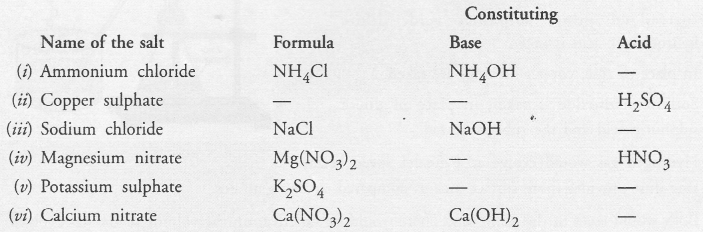
NCERT Exemplar Solutions for Class 10 Science Chapter 2 Acids, Bases and Salts image - 9
Answer:
NCERT Exemplar Solutions for Class 10 Science Chapter 2 Acids, Bases and Salts image - 10

Question 41.
What are strong and weak acids ? In the following list of acids, separate strong acids from weak acids.
Hydrochloric acid, citric acid, acetic acid, nitric acid, formic acid, sulphuric acid.
Answer:
For the definitions of strong and weak acids and bases,
An acid may be defined as a substance which releases one or more H+ ions in aqueous solution. These ions exist as hydronium (H2O+) ions.
A base may be defined as a substance capable of releasing one or more OH ions in aqueous solution.
In general, mineral acids are strong acids while organic acids are weak. From the available list :
Strong acids : Hydrochloric acid, nitric acid, sulphuric acid.
Weak acids : Citric acid, acetic acid, formic acid.

Question 42.
When zinc metal is treated with a dilute solution of a strong acid, a gas is evolved which is utilised in the hydrogenation of oils. Name the gas evolved. Write the chemical equation of the reaction involved and also write a test to detect the gas formed.
Answer:
The gas evoloved is hydrogen. The gas burns brightly with a pop sound when a burning splinter is brought in its contact. This causes the hydrogenation of edible liquid oils to form solid fats also called Vanaspati ghee.

NCERT Exemplar Solutions for Class 10 Science Chapter 2 Acids, Bases and Salts image - 11

NCERT Exemplar Solutions for Class 10 Science Chapter 2 Long Answer Questions

Question 43.
In the following schematic diagram for the preparation of hydrogen gas as shown in the figure, what would happen if following changes are made ?
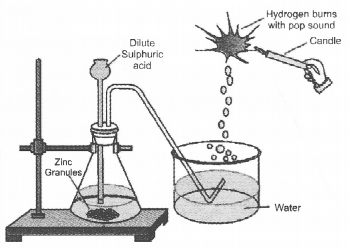
NCERT Exemplar Solutions for Class 10 Science Chapter 2 Acids, Bases and Salts image - 12
(a) In place of zinc granules, same amount of zinc dust is taken in the test tube
(b) Instead of dilute sulphuric acid, dilute hydrochloric acid is taken
(c) In place of zinc, copper turnings are taken
(d) Sodium hydroxide is taken in place of dilute sulphuric acid and the tube is heated.
Answer:
(a) Hydrogen gas would evolve at a greater speed because zinc dust provides more surface area as compared to zinc granules.
(b) Both would react in the same way. There would be no effect on the volume of the gas evolved.
(c) Copper does not react with either dilute HCl or dilute H2SO4. No gas would evolve in both the cases.
(d) Hydrogen gas would evolve in this case also.

NCERT Exemplar Solutions for Class 10 Science Chapter 2 Acids, Bases and Salts image - 13

Question 44.
For making cake, baking powder is taken. If at home your mother uses baking soda instead of baking powder in cake,
(a) how will it affect the taste of the cake and why ?
(b) how can baking soda be converted into baking powder ?
(c) what is the role of tartaric acid added to baking soda ?
Answer:
Baking powder is a mixture of baking soda and tartaric acid. Out of the two, only baking soda is actually used for making bread or cake fluffy. The role of tartaric acid is to neutralise sodium carbonate formed in the reaction.
(a) If baking soda is used for making cake in place of baking powder, then cake will taste bitter since there is no tartaric acid available to neutralise sodium carbonate formed.

NCERT Exemplar Solutions for Class 10 Science Chapter 2 Acids, Bases and Salts image - 14
(b) Baking soda can be converted to baking powder by adding appropriate amount of tartaric acid.
(c) Tartaric acid as pointed above will react with sodium carbonate which makes cake bitter. This means that the cake will not taste bitter.

Question 45.
A metal carbonate (X) on reacting with an acid gives a gas which when passed through a solution (Y) gives the carbonate back. On the other hand, a gas (G) that is obtained at anode during electrolysis of brine is passed on dry substance (Y). It gives a compound (Z), used for disinfecting drinking water. Identity X, Y, G and Z.
Answer:
The gas (G) obtained at anode during the electrolysis of brine is chlorine. The compound (Z) used for disinfecting drinking water is bleaching powder. It is formed on reacting chlorine with dry slaked lime i.e., Ca(OH)2. It is denoted as ‘Y’ This means that the metal carbonate ‘X’ is calcium carbonate. Upon heating, it evolves CO2 gas which gives back ‘X’ on reacting with calcium hydroxide. The chemical reactions involved are listed :
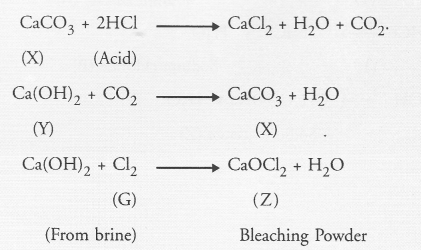
NCERT Exemplar Solutions for Class 10 Science Chapter 2 Acids, Bases and Salts image - 15

Question 46.
A dry pellet of a common base ‘B’, when kept in open absorbs moisture and turns sticky. The compound is also formed by chloralkali process. Identify ‘B’. What type of reaction occurs when B is treated with an acidic oxide ? Write a balanced chemical equation for one such solution.
Answer:
The available information suggests that the base ‘B’ is sodium hydroxide (NaOH). It is a deliquescent substance and becomes sticky on absorbing moisture from atmosphere. It is commercially formed by the electrolysis of a strong solution of sodium chloride (brine).
It reacts with an acidic oxide such as CO2 or SO, gas to form corresponding salt and water. For example,

NCERT Exemplar Solutions for Class 10 Science Chapter 2 Acids, Bases and Salts image - 16

Question 47.
A sulphate salt of Group 2 element of the Periodic Table is a white, soft substance which can be moulded into different shapes by making its dough. When this compound is left in open for some time, it becomes a solid mass and cannot be used for moulding purposes. Identify the sulphate salt. Why does it show such a behaviour ? Give the reaction involved.
Answer:
The available information suggests that the element present in group 2 of the Periodic Table* is calcium (Ca) and the sulphate salt (white in colour) is Plaster of Paris. It can be moulded into different shapes by making its dough with water. When left in the open, Plaster of Paris changes into Gypsum which is a solid mass quite hard in nature and can no longer be used for moulding.

NCERT Exemplar Solutions for Class 10 Science Chapter 2 Acids, Bases and Salts image - 17

Question 48.
Identify the compound ‘Y’ on the basis of the reactions given below. Also write the name and chemical formulae of A, B and C.
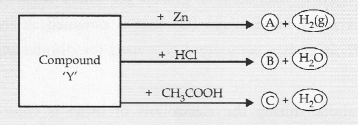
NCERT Exemplar Solutions for Class 10 Science Chapter 2 Acids, Bases and Salts image - 18
Answer:
The compound ‘Y’ is sodium hydroxide. It forms A, B and C as follows :
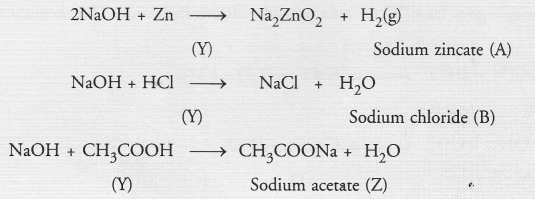
NCERT Exemplar Solutions for Class 10 Science Chapter 2 Acids, Bases and Salts image - 19

Hope given NCERT Exemplar Solutions for Class 10 Science Chapter 2 Acids, Bases and Salts are helpful to complete your science homework.

If you have any doubts, please comment below. Learn Insta try to provide online science tutoring for you.


Value Based Questions in Science for Class 10 Chapter 2 Acids, Bases and Salts

Value Based Questions in Science for Class 10 Chapter 2 Acids, Bases and Salts

These Solutions are part of Value Based Questions in Science for Class 10. Here we have given Value Based Questions in Science for Class 10 Chapter 2 Acids, Bases and Salts

Question 1.
Ritesh was asked to determine the melting point of a given organic solid. For this, he used a bath containing cone. H2SO4. When he was looking at the thermometer, he lost his concentration and became a little casual. The beaker containing boiling sulphuric acid fell on his clothes. His clothes were burnt and he got severe burns on hands.

  1. Why did Ritesh meet with an accident ?
  2. Why did he get severe burns on the hands ?
  3. What lessons can a student learn from the above episode ?

Answer:

  1. The bath or the beaker containing cone. H2SO4 was not properly placed on the tripod stand. It lost balance and the acid fell over him.
  2. Sulphuric acid is a very powerful dehydrating agent. It removed water contents from the skin which got charred and burns appeared on hands.
  3. While working in the chemistry laboratory, a student must observe the following precautions :
    1. Must always wear an appron in the laboratory.
    2. Must always keep some distance from the table where the experiment is performed.
    3. Must always remain alert in the laboratory and must not lose concentration.

More Resources

Question 2.
Ram was suffering from a stomach pain for a number of days. He consulted a doctor who advised him to take two antacid tablets after each meal for about a week and avoid spicy food. Ram followed the advice strictly and was cured.

  1. What was the problem faced by Ram ?
  2. How did doctor help him ?
  3. Write the chemical equation if any
  4. What is the value associated with this ?

Answer:

  1. Ram had developed acidity in the stomach resulting in the formation of small ulcers which caused pain.
  2. The antacid tablets contain base like NaHCO3 or Mg(OH)2 which neutralise the affect of HCl released in the stomach.
  3. NaHCO3 + HCl ———–> NaCl + H2O + CO2 (Antacid)
  4. As far as possible, one should always avoid spicy and fried food stuff. They create acidity in the stomach. This leads in the formation of small ulcers which give pain. Apart from that one must always keep some antacid tablets or liquid gels.

Question 3.
Kamla was playing in the garden. She was stung by a wasp and started crying. Her mother immediately applied a coating of tooth paste on the affected area and then took her to the doctor.

  1. Why did Kamla cry ?
  2. What does wasp sting contain ?
  3. Why did her mother apply tooth paste on the affected area ?
  4. What values are displayed by this episode ?

Answer:

  1. Kamla cried because the sting by the wasp is very painful.
  2. Wasp sting contains in it formic acid (HCOOH)
  3. Tooth paste contains in it some basic ingredients which neutralise the effect of formic acid (HCOOH) and give relief.
  4. Kamla’s mother had a knowledge of chemistry. Tooth paste is readily available and she gave a first aid to her daughter.

Hope given Value Based Questions in Science for Class 10 Chapter 2 Acids, Bases and Salts are helpful to complete your science homework.

If you have any doubts, please comment below. Learn Insta try to provide online science tutoring for you.

HOTS Questions for Class 10 Science Chapter 2 Acids, Bases and Salts

HOTS Questions for Class 10 Science Chapter 2 Acids, Bases and Salts

These Solutions are part of HOTS Questions for Class 10 Science. Here we have given HOTS Questions for Class 10 Science Chapter 2 Acids, Bases and Salts

Question 1.
A student working in the laboratory added some water to a syrupy liquid taken in a tube. The tube immediately cracked and the liquid which escaped out of it, produced blisters on the skin of the student. What actually happened ?
Answer:
The syrupy liquid in the tube was concentrated sulphuric acid. Since it has great affinity for water, the energy released was in the form of heat. That is why the tube cracked and the vapours of the escaping acid produced blisters on the skin.

More Resources

Question 2.
A baker found that the cake prepared by him is hard and small in size. Which ingredient has he forgotten to add that would have made the cake fluffy ? Give reason.
Answer:
The baker has forgotten to add baking powder while making the dough for the cake. Actually, sodium hydrogen carbonate present in baking powder releases carbon dioxide on baking. The bubbles of the gas evolved leave behind pores which make the cake soft and fluffy.
HOTS Questions for Class 10 Science Chapter 2 Acids, Bases and Salts image - 1

Question 3.
A substance X is used as a building material and is insoluble in water. When reacted with dilute HCl, it produces a gas which turns lime water milky. Predict the substance. Write the chemical equations involved.
Answer:
The substance is probably calcium carbonate (CaCO3). also called lime stone or marble. It is used as a building material. On reacting with dilute HCl, it evolves CO2 gas which turns lime water milky.
HOTS Questions for Class 10 Science Chapter 2 Acids, Bases and Salts image - 2

Question 4.
Dry pellets of base ‘X’ when kept in open absorb moisture and turn sticky. The compound is also formed by chlor-alkali process. Write chemical name and formula of X. Describe chlor-alkali process with balanced chemical equation. Name the type of reaction that occurs when X is treated with dilute hydrochloric acid. Write the chemical equation. While diluting an acid, why is it recommended that the acid should be added to water and not water to the acid ?
Answer:
The base ‘X’ is NaOH. It is of deliquescent nature and absorbs moisture from air and becomes wet. It is manufactured by chlor-alkali process.  The reaction of NaOH with dilute HCl is known as neutralisation reaction.
HOTS Questions for Class 10 Science Chapter 2 Acids, Bases and Salts image - 3
Pure HCl is highly concentrated. In case, it is to be diluted, the acid should be added drop-by-drop to water taken in a glass beaker with constant stirring. Actually, the acid has a strong affinity for water and the process of dissolution is highly exothermic. If water is added to acid so much heat is evolved that the glass beaker is likely to crack and the acid will spill.

Question 5.
What will you observe when :

  1. Red litmus paper is introduced into a solution of sodium carbonate.
  2. A methyl orange drop is added to dilute hydrochloric acid.
  3. A drop of phenolphthalein is added to the solution of lime water.
  4. Blue litmus is introduced into a solution of ferric chloride.

Answer:

  1. The colour of the litmus paper will change to blue. Sodium carbonate (Na2CO3) dissolves in water to form sodium hydroxide and carbonic acid (H2O and CO2). The solution is of basic nature since sodium hydroxide is a strong bases and carbonic acid is a weak acid.
    HOTS Questions for Class 10 Science Chapter 2 Acids, Bases and Salts image - 4
  2. In the acidic solution, the colour of methyl orange will change to reddish.
  3. Lime water contains traces of calcium hydroxide, Ca(OH)2. It is therefore, basic in nature. The colour of phenolphthalein will become pink.
  4. Ferric chloride (FeCl3) solution on reacting with water will form ferric hydroxide and hydrochloric acid. Since the acid is strong, the solution will be acidic. Therefore, the colour of blue litmus will change to red.
    HOTS Questions for Class 10 Science Chapter 2 Acids, Bases and Salts image - 5


Hope given HOTS Questions for Class 10 Science Chapter 2 Acids, Bases and Salts are helpful to complete your science homework.

If you have any doubts, please comment below. Learn Insta try to provide online science tutoring for you.

NCERT Exemplar Solutions for Class 10 Science Chapter 1 Chemical Reactions and Equations

NCERT Exemplar Solutions for Class 10 Science Chapter 1 Chemical Reactions and Equations

These Solutions are part of NCERT Exemplar Solutions for Class 10 Science. Here we have given NCERT Exemplar Solutions for Class 10 Science Chapter 1 Chemical Reactions and Equations

NCERT Exemplar Solutions for Class 10 Science Chapter 1 Multiple Choice Questions

Question 1.
Which of the following is not a physical change ?
(a) Boiling of water to give water vapours
(b) Melting of ice to give water
(c) Dissolution of salt in water
(d) Combustion of Liquefied Petroleum Gas (LPG)
Answer:
(d). LPG is a mixture of gases like propane (C3Hg) and butane (C4H10) in liquefied form. These are chemical substances and undergo combustion upon heating with air or oxygen. It is therefore, a chemical change.

More Resources

Question 2.
The following reaction is an example of a
4NH3(g) + SO2(g) ————-> 4NO(g) + 6H2O(g)
(i) displacement reaction
(ii) combustion reaction
(iii) redox reaction
(iv) neutralisation reaction
(a) (i) and (iv)
(b) (ii) and (iii)
(c) (i) and (ii)
(d) (iii) and (iv)
Answer:
(c). Oxygen has displaced hydrogen from NH3. It is also a combustion reaction.

Question 3.
Which of the following statements about the given reaction are correct ?
3Fe(s) + 4H2O(g) ———-> Fe3O4(s) + 4H2(g)
(i) Iron metal is getting oxidised
(ii) Water is getting reduced
(iii) Water is acting as reducing agent
(iv) Water is acting as oxidising agent
(a) (i), (ii) and (iii)
(b) (iii) and (iv)
(c) (i), (ii) and (iv)
(d) (ii) and (iv).
Answer:
(c). Statements (i), (ii) and (iv) are all correct.

Question 4.
Which of the following are exothermic processes ?
(i) Reaction of water with quick lime
(ii) Dilution of an acid
(iii) Evaporation of water
(iv) Sublimation of camphor (crystals)
(a) (i) and (ii)
(b) (ii) and (iii)
(c) (i) and (iv)
(d) (iii) and (iv)
Answer:
(a).
(i) Reaction of quick lime with ; water and (ii) dilution of an acid are both exothermic processes. The other two processes (iii) and (iv) are of endothermic nature.

Question 5.
Three beakers labelled as A, B and C each containing 25 mL of water were taken. A small amount of NaOH, anhydrous CuS04 and NaCl were added to the beakers A, B and C respectively. It was observed that there was an increase in the temperature of the solutions contained in beakers A and B, whereas in case of beaker C, the temperature of the solution fell. Which one of the following statement(s) is(are) correct ?
(i) In beakers A and B, exothermic process has occurred.
(ii) In beakers A and B, endothermic process has occurred.
(iii) In beaker C exothermic process has occurred.
(iv) In beaker C endothermic process has occurred.
(a) (i) only
(b) (ii) only
(c) (i) and (iv)
(d) (ii) and (iii)
Answer:
(c).

Question 6.
A dilute ferrous sulphate solution is gradually added to the beaker containing acidified permanganate solution. The light purple colour of the solution fades and finally disappears. Which of the following is the correct explanation for the observation ?
(a) KMnO4 is an oxidising agent and it oxidises FeSO4
(b) FeSO4 acts as an oxidising agent and it oxidises KMnO4
(c) The colour disappears due to dilution; no reaction is involved
(d) KMnO4 is an unstable compound and decomposes in presence of FeSO4 to a colourless compound.
Answer:
(a). Potassium permanganate (KMnO4) is an oxidising agent. It oxidises ferrous sulphate to ferric sulphate in the presence of dilute
H2SO4.
NCERT Exemplar Solutions for Class 10 Science Chapter 1 Chemical Reactions and Equations image - 1
By taking part in the reaction, the light purple colour of the solution slowly fades and finally disappears.

Question 7.
Which among the following is(are) double displacement reaction(s) ?
(i) Pb + CuCl2 ————> PbCl2 + Cu
(ii) Na2SO4 + BaCl2 ———-> BaSO4 + 2NaCl
(iii) C + O ———–> CO2
(iv) CH4 + 2O ———> CO2 + 2H2O
(a) (i) and (iv)
(b) (ii) only
(c) (i) and (ii)
(d) (iii) and (iv)
Answer:
(b). Only reaction (ii) is double displacement in nature.

Question 8.
Which among the following statement(s) is(are) true ? ‘Exposure of silver chloride to sunlight for a long duration turns grey due to
(i) the formation of silver by decomposition of silver chloride
(ii) sublimation of silver chloride
(iii) decomposition of chlorine gas from silver chloride
(iv) oxidation of silver chloride
(a) (i) only
(b) (i) and (iii)
(c) (ii) and (iii)
(d) (iv) only
Answer:
(a). Silver chloride is sensitive to sun light and decomposes slowly to give silver which is grey in colour and chlorine.
NCERT Exemplar Solutions for Class 10 Science Chapter 1 Chemical Reactions and Equations image - 2

Question 9.
Solid calcium oxide reacts vigorously with water to form calcium hydroxide accompanied by liberation of heat. This process is called slaking of lime. Calcium hydroxide dissolves in water to form a solution called lime water. Which among the following is (are) true about slaking of lime and the solution formed ?
(i) It is an endothermic reaction
(ii) It is an exothermic reaction
(iii) The pH of the resulting solution will be more than seven
(iv) The pH of the resulting solution will be less than seven
(a) (i) and (ii)
(b) (ii) and (iii)
(c) (i) and (iv)
(d) (iii) and (iv).
Answer:
(b). Slaking of lime is an exothermic process. Lime (CaO) dissolves in water to form calcium hydroxide called slaked lime Ca(OH)2. Since it is a base, the pH of solution will become more than seven (7).

Question 10.
Barium chloride on reacting with ammonium sulphate forms barium sulphate and ammonium chloride. Which of the following correctly represents the type of the reaction involved ?
(i) Displacement reaction
(ii) Precipitation reaction
(iii) Combination reaction
(iv) Double displacement reaction
(a) (i) only
(b) (ii) only
(c) (iv) only
(d) (ii) and (iv).
Answer:
(d). A white precipitate of BaSO4 is formed. The reaction is double displacement in nature.

Question 11.
Electrolysis of water is a decomposition reaction. The mole ratio of hydrogen and oxygen gases liberated during electrolysis of water is
(a) 1:1
(b) 2:1
(c) 4:1
(d) 1:2.
Answer:
(b).

Question 12.
Which of the following is(are) an endothermic process (es) ?
(i) Dilution of sulphuric acid
(ii) Sublimation of dry ice
(iii) Condensation of water vapours
(iv) Evaporation of water
(a) (i) and (iii)
(b) (ii) only
(c) (iii) only
(d) (ii) and (iv)
Answer:
(d). Both sublimation of dry ice (ii) and evaporation of water (iv) are of endothermic nature.

Question 13.
In the double displacement reaction between aqueous potassium iodide .and aqueous lead nitrate, a yellow precipitate of lead iodide is formed. While performing the activity if lead nitrate is not available, which of the following can be used in place of lead nitrate ?
(a) Lead sulphate (insoluble)
(b) Lead acetate
(c) Ammonium nitrate
(d) Potassium sulphate.
Answer:
(b). Lead sulphate being insoluble in water will not react. However, lead acetate can be used since it is water soluble in nature.
NCERT Exemplar Solutions for Class 10 Science Chapter 1 Chemical Reactions and Equations image - 3

Question 14.
Which of the following gases can be used for storage of fresh sample of an oil for a long time ?
(a) Carbon dioxide or oxygen
(b) Nitrogen or oxygen
(c) Carbon dioxide or helium
(d) Helium or nitrogen.
Answer:
(d). Both helium (He) and nitrogen (N2) can be used. In their presence, rancidity of fresh sample of an oil will not take place.

Question 15.
The following reaction is used for the preparation of oxygen gas in the laboratory
NCERT Exemplar Solutions for Class 10 Science Chapter 1 Chemical Reactions and Equations image - 4
Which of the following statement(s) is(are) correct about the reaction ?
(a) It is a decomposition reaction and is endothermic in nature
(b) It is a combination reaction
(c) It is a decomposition reaction and is accompanied by release of heat
(d) It is a photochemical decomposition reaction and exothermic in nature
Answer:
(a).

Question 16.
Which one of the following processes involve chemical reactions ?
(a) Storing of oxygen gas under pressure in a gas cylinder
(b) Liquefaction of air
(c) Keeping petrol in a china dish in the open
(d) Heating copper wire in the presence of air at high temperature.
Answer:
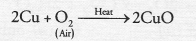
(d). Copper will react with oxygen present in air upon strong heating to form copper (II) oxide or cupric oxide.
NCERT Exemplar Solutions for Class 10 Science Chapter 1 Chemical Reactions and Equations image - 5

Question 17.
In which of the following chemical equations, the abbreviations represent the correct states of the reactants and products involved at reaction temperature ?
(a) H2(l) + O2(l) ———–> 2H2O(g)
(b) H2(g) + O2(l) ———>2H2O(l)
(c) 2H2(g) + O2(g) ———> 2H2O(l)
(d) 2H2(0) + O2(g) ——–> 2H2O(g)
Answer:
(d). The reaction is carried upon strong heating. At this temperature, H2O formed is in gaseous state.

Question 18.
Which of the following are combination reactions ?
(i)  2KClO3  ———-> 2KCl + 3O
(ii) MgO + H2O ———–> Mg(OH)2
(iii) 4Al + 3O2 ———–> 2Al2O3
(iv) Zn + FeSO———-> ZnSO4 + Fe
(a) (i) and (iii)
(b) (iii) and (iv)
(c) (ii) and (iv)
(d) (ii) and (iii).
Answer:
(d). Both the reactions (ii) and (iii) are the examples of combination reactions.

NCERT Exemplar Solutions for Class 10 Science Chapter 1 Short Answer Questions

Question 19.
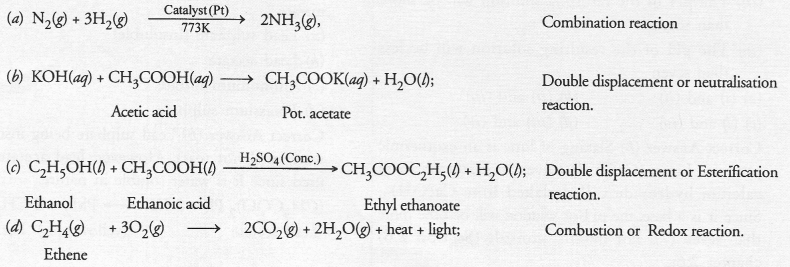
Write the balanced chemical equations for the following reactions and identify the type of reaction in each
(a) Nitrogen gas is treated with hydrogen gas in the presence of a catalyst at 773 K to form ammonia gas.
(b) Potassium hydroxide solution is treated with acetic acid to form potassium acetate and water.
(c) Ethanol is warmed with ethanoic acid to form ethyl acetate in the presence of concentrated H2SO4.
(d) Ethene is burnt in the presence of oxygen to form carbon dioxide, water and to release heat and light. Catalyst (Pt)
Answer:
NCERT Exemplar Solutions for Class 10 Science Chapter 1 Chemical Reactions and Equations image - 6

Question 20.
Write the balanced chemical equations for the following reactions and identify the type of reaction in each case.
(a) Iron (III) oxide reacts with aluminium and gives molten iron and aluminium oxide. (CBSE 2012)
(b) Magnesium ribbon is burnt in an atmosphere of nitrogen gas to form solid magnesium nitride.
(c) Chlorine gas is passed in an aqueous potassium iodide solution to form potassium chloride solution and solid iodine.
(d) Ethanol is burnt in air to form carbon dioxide, water and releases heat. (CBSE 2013)
Answer:
NCERT Exemplar Solutions for Class 10 Science Chapter 1 Chemical Reactions and Equations image - 7

Question 21.
Complete the missing components/variables given as x and y in the following reactions
(a) Pb(NO3)2 (aq) + 2KI(aq) ———>PbI2(x) + 2KNO3(y)
(b) Cu(s) + 2AgNO3(aq) ————> Cu(NO3)2(aq) + x(s)
(c) Zn(s) + H2SO4(aq) ———–> ZnSO4(x) + H2(g)
(d) CaCO3(s)  ————>  CaO(s) + CO2(g)
Answer:
(a) x = yellow precipitate, y = (aq)
(b) x = 2Ag(s)
(c) x = (aq) ; y = (g)
(d) x = heat.

Question 22.
Which among the following changes are exothermic or endothermic in nature ?
(a) Decomposition of ferrous sulphate
(b) Dilution of sulphuric acid
(c) Dissolution of sodium hydroxide in water
(d) Dissolution of ammonium chloride in water
Answer:
(a) Endothermic
(b) Exothermic
(c) Exothermic
(d) Endothermic.

Question 23.
Identify the reducing agent in the following reactions
Ammonia (NH3) is the reducing agent. It has reduced oxygen (O2) which acts as oxidising agent.
(b) Water (H2O) is the reducing agent. It has reduced fluorine (F2) which acts as oxidising agent.
(c) Carbon monoxide (CO) is the reducing agent. It has reduced ferric oxide (Fe2O3) which acts as oxidising agent.
(d) Hydrogen (H2) is the reducing agent. It has reduced oxygen (O2) which acts as oxidising agent.
Answer:

Question 24.
Identify the oxidising agent (oxidant) in the following reactions
(a) Pb3O4 + 8HCl ———-> 3PbCl2 + Cl2 + 4H2O
(b) 2Ca + O———-> 2CaO
(c) CuSO4 + Zn ———-> Cu + ZnSO4
(d) V2O5 + 5Ca ————> 2V + 5Ca
(e) 3Fe + 4H2O ———–> Fe3O4 + 4H2
(f) ZnO + H2 ———–> Zn + H2O
Answer:
(a) Pb3O4
(b) O2
(c) CuSO4
(d) V2O5
(e) H2O
(f) ZnO

Question 25.
Write the balanced chemical equations for the following reactions
(a) Sodium carbonate on reaction with hydrochloric acid in equal molar concentrations gives sodium chloride and sodium hydrogen carbonate.
(b) Sodium hydrogen carbonate on reaction with hydrochloric acid gives sodium chloride, water and liberates carbon dioxide.
(c) Copper sulphate on treatment with potassium iodide precipitates cuprous iodide (Cu2I2), liberates iodine gas and also forms potassium sulphate.
Identify the reducing agent in the following reactions
Answer:
(a) Na2CO3 (s) + HCl (aq) ———–> NaCl(aq) + NaHCO3 (aq)
(b) NaHCO3 (s) + HCl (aq) ———–> NaCl(aq) + H2O (aq) + CO2(g)
(c) 2CuSO4 (s) + 4KI (aq) ———–> Cu2I(s) + 2K2SO4 (aq) + I2 (g)

Question 26.
A solution of potassium chloride when mixed with silver nitrate solution, an insoluble substance is formed.
Write the chemical reaction involved and mention the type of the chemical reaction.
Answer:
The chemical reaction is :
NCERT Exemplar Solutions for Class 10 Science Chapter 1 Chemical Reactions and Equations image - 8
It is an example of the double displacement reaction.

Question 27.
Ferrous sulphate decomposes with the evolution of a gas having a characteristic smell of burning sulphur. Write the chemical reaction involved and identify the type of reaction.
Answer:
The chemical reaction is an example of thermal decomposition reaction.
NCERT Exemplar Solutions for Class 10 Science Chapter 1 Chemical Reactions and Equations image - 9
The gases evolved are a mixture of sulphur dioxide and sulphur trioxide. Both have the smell of burning sulphur.

Question 28.
Why do fire flies glow at night ?
Answer:
Fire flies are associated with certain protein. In the presence of a enzyme, the protein undergoes aerial oxidation. The reaction is accompanied by emission of light. As a result, fire flies glow at night.

Question 29.
Grapes hanging on the plants do not ferment but after being plucked from the plant, can be fermented. Under what conditions do these grapes ferment ? Is it a chemical or a physical change ?
Answer:
Grapes hanging on the plants are living in nature. Their immune system does not allow any fermentation.
However, when these are plucked, they are no longer living. They undergo fermentation under aerobic conditions (in the absence of air or oxygen). The other factors which favour fermentation are enzyme and temperature between 25°C to 30°C. The fermentation is a chemical change.

Question 30.
Which among the following are physical or chemical changes ?
(a) Evaporation of petrol
(b) Burning of Liquefied Petroleum Gas (LPG)
(c) Heating of an iron rod to red hot.
(d) Curding of milk
(e) Sublimation of solid ammonium chloride.
Answer:
(a) Physical
(b) Chemical
(c) Physical
(d) Chemical
(e) Physical.

Question 31.
During the reaction of some metals with dilute hydrochloric acid, following observations are made.
(a) Silver metal does not show any change
(b) The temperature of the reaction mixture rises when aluminium (Al) is added.
(c) The reaction of sodium metal is found to be highly explosive
(d) Some bubbles of a gas are seen when lead (Pb) is reacted with the acid.
Explain these observations giving suitable reasons.
Answer:
(a) Silver (Ag) is placed below hydrogen in the activity series. It cannot replace hydrogen from dilute HCl and no chemical reaction is possible.
(b) The reaction of aluminium (Al) with dilute HCl is of exothermic nature. Therefore the temperature rises.
(c) Hydrogen gas is evolved when sodium metal (Na) is reacted with dilute HCl. The reaction is of exothermic nature. Therefore, hydrogen catches fire accompanied by explosion.
2Na (s) + 2HCl(aq) ———-> 2NaCl(aq) + H2(g)
Remember : Sodium metal as such does not catch fire. It is the hydrogen gas evolved which burns since the reaction is highly exothermic in nature.
(d) Lead (Pb) reacts with dilute HCl to evolve hydrogen gas accompanied by bubbles.
Pb(s) + 2HCl (aq) ———-> PbCl2(aq) + H2(g).

Question 32.
A substance ‘A’, which is an oxide of a group 2 element, is used intensively in the cement industry. This element is present in bones also. On treatment with water it forms a solution which turns red litmus blue. Identify A’ and also write the chemical reactions involved.
Answer:
The available information suggests that the substance A’ is oxide of the element calcium (Ca) which is present in group 2 of the periodic table. Calcium is also a constituent of our bones in the form of calcium phosphate. . Calcium oxide (CaO) reacts with water to form calcium hydroxide (basic in nature). It forms a basic solution which turns red litmus blue.
NCERT Exemplar Solutions for Class 10 Science Chapter 1 Chemical Reactions and Equations image - 10

Question 33.
Write a balanced chemical equation for each of the following reactions and also classify them.
(a) Lead acetate solution is treated with dilute hydrochloric acid to form lead chloride and acetic acid solution.
(b) A piece of sodium metal is added to absolute ethanol to form sodium ethoxide and hydrogen gas.
(c) Iron (III) oxide on heating with carbon monoxide gas reacts to form solid iron and liberates carbon dioxide gas.
(d) Hydrogen sulphide gas reacts with oxygen gas to form solid sulphur and liquid water. (CBSE 2014)
Answer:
NCERT Exemplar Solutions for Class 10 Science Chapter 1 Chemical Reactions and Equations image - 11

Question 34.
Why do we store silver chloride in a dark coloured bottle ?
Answer:
Silver chloride is a white solid. However, it is very senstive to sun light and decomposes in the presence of light to form silver (grey in colour) and chlorine.
NCERT Exemplar Solutions for Class 10 Science Chapter 1 Chemical Reactions and Equations image - 12
In order to avoid action by sun light, it is kept in a coloured bottle.

Question 35.
Balance the following chemical equations and identify the type of chemical reaction.
NCERT Exemplar Solutions for Class 10 Science Chapter 1 Chemical Reactions and Equations image - 13
Answer:
The chemical equations in their balanced form may be written as follows :
NCERT Exemplar Solutions for Class 10 Science Chapter 1 Chemical Reactions and Equations image - 14

Question 36.
A magnesium ribbon is burnt in oxygen to give a white compound ‘X’ accompanied by emission of light. If the burning ribbon is now placed in an atmosphere of nitrogen, it continues to burn and forms a compound ‘Y’.
(a) Write the chemical formulae of X and Y.
(b) Write a balanced chemical equations when X and Y are dissolved in water.
Answer:
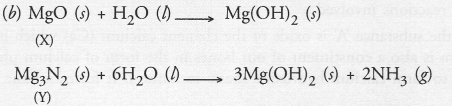
(a) The Compound ‘X’ is magnesium oxide (MgO). The compound ‘Y’ is magnesium nitride (Mg3N2)
NCERT Exemplar Solutions for Class 10 Science Chapter 1 Chemical Reactions and Equations image - 15

Question 37.
Zinc liberates hydrogen gas when reacted with dilute hydrochloric acid whereas copper does not. Explain why ?
Answer:
Zinc (Zn) is placed above hydrogen in the activity series. It therefore, displaces hydrogen from dilute HCl.
Zn (s) + 2HCl (aq) ————-> ZnCl2 (aq) + H2(g)
Copper is placed below hydrogen and therefore, does not react with dilute HCl.
Cu (s) + HCl (aq) ———–> No action.

Question 38.
A silver article generally turns black when kept in the open for a few days. The article when rubbed with toothpaste again starts shining.
(a) Why do silver articles turn black when kept in the open for a few days ? Name the phenomenon involved.
(b) Name the black substance formed and give its chemical formula.
Answer:
(a) Air contains traces of hydrogen sulphide (H2S) gas. It slowly reacts with silver present in the silver article to form silver sulphide (black in colour). A coating of silver sulphide (Ag2S) gets deposited on the surface of the metal. The phenomenon is known as corrosion. Tooth pastes generally contain traces of hydrogen peroxide as one of the constitutents. It reacts with silver sulphide to form silver sulphate which is white in colour. Therefore, whiteness is restored to the article.
(b)
NCERT Exemplar Solutions for Class 10 Science Chapter 1 Chemical Reactions and Equations image - 16

NCERT Exemplar Solutions for Class 10 Science Chapter 1 Long Answer Questions

Question 39.
On heating blue coloured powder of copper (II) nitrate, in a boiling tube, copper oxide (black), oxygen gas and a brown gas X is formed
(a) Write a balanced chemical equation of the reaction.
(b) Identify the brown gas X evolved.
(c) Identify the type of reaction.
(d) What could be the pH range of aqueous solution of the gas X ?
Answer:
NCERT Exemplar Solutions for Class 10 Science Chapter 1 Chemical Reactions and Equations image - 17
(b) Brown gas (X) is nitrogen dioxide.
(c) It is an example of decomposition reaction.
(d) Nitrogen dioxide is an acidic oxide. Therefore, it dissolves in water to form an acidic solution. The pH of the solution is expected to be less than 7.

Question 40.
Give the characteristic tests for the following gases :
(a) CO2
(b) SO2
(c) O2
(d) H2
Answer:
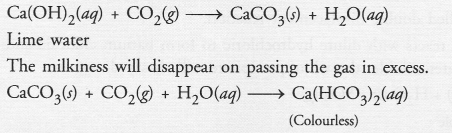
(a) CO2 gas : It is a colourless and odourless gas. When passed through lime water, it will initially become milky.
NCERT Exemplar Solutions for Class 10 Science Chapter 1 Chemical Reactions and Equations image - 18
(b) SO2 gas : It is a colourless but a pungent smelling gas. The gas when passed through an acidified solution of potassium permanganate (pink) will decolourise it.
NCERT Exemplar Solutions for Class 10 Science Chapter 1 Chemical Reactions and Equations image - 19
Similarly the gas when passed through an acidified solution of potassium dichromate (orange) will make it light green.
NCERT Exemplar Solutions for Class 10 Science Chapter 1 Chemical Reactions and Equations image - 20
(c) Oxygen gas : The gas is a supporter of combustion. It can be tested by bringing a burning or smouldering match-stick near the mouth of the test tube from which the gas escapes. The match-stick will burn more brightly.
(d) Hydrogen gas : The gas itself is combustible. It will burn with a pop sound when a burning candle or match- stick is brought near it.
2H2 (g) + O2 (g) ———-> 2H2O (g)

Question 41.
What happens when a piece of
(a) zinc metal is added to copper sulphate solution ?
(b) aluminium metal is added to dilute hydrochloric acid ?
(c) silver metal is added to copper sulphate solution ?
Also write the balanced chemical equation if the reaction occurs.
Answer:
(a) Metal zinc displaces hydrogen component on reacting with dilute sulphuric acid (H2SO4) as H2 gas which is evolved
Zn(s) + H2SO2(aq) ———-> ZnSO4(aq) + H2(g)
(b) Ammonia and hydrogen chloride gas. When vapours of ammonia and hydrogen chloride gas are mixed, the compound formed is ammonium chloride. It is a white solid.
NH3(g) + HCl(g) ———-> NH4Cl (s)
(c) Copper displaces silver from the aqueous solution of silver nitrate.
Cu(s) + 2AgNO3(aq) ——–> Cu(NO3)2(aq) + 2Ag(s)

Question 42.
What happens when zinc granules are treated with dilute solution of H2SO4, HCl, HNO3, NaCl and NaOH ? Also write the chemical equations if reaction oçcurs.
Answer:
With dilute H2SO4 : Hydrogen gas evolves
Zn (s) + H2SO4 (dil.) ————> ZnSO4 (aq) + H2(g)
with dilute HCl : Hydrogen gas evolves
Zn (s) + 2HCl (dil.) ———–> ZnCl2(aq) + H2(g)
with dilute HNO3 : Nitrous oxide gas evolves. It is colourless.
4Zn (s) + 10HNO3 (aq) ———->  4Zn(NO3)2 (aq) + 5H2O (l) + N2O(g)
with NaCl : There is no chemical reaction, with NaOH : Hydrogen gas evolves :
NCERT Exemplar Solutions for Class 10 Science Chapter 1 Chemical Reactions and Equations image - 21

Question 43.
On adding a drop of barium chloride solution to an aqueous solution of sodium sulphite, white precipitate is obtained :
(a) Write a balanced chemical equation for the reaction involved.
(b) What other name can be given to this precipitation reaction ?
(c) On adding dilute hydrochloric acid to the reaction mixture, white precipitate disappears. Why ?
Answer:
NCERT Exemplar Solutions for Class 10 Science Chapter 1 Chemical Reactions and Equations image - 22
(b) The precipitation reaction is also called double displacement reaction.
(c) White precipitate of barium sulphite reacts with dilute hydrochloric to form barium chloride and sulphur dioxide gas. Since barium chloride is water soluble, the white precipitate will slowly disappear.
NCERT Exemplar Solutions for Class 10 Science Chapter 1 Chemical Reactions and Equations image - 23

Question 44.
You are provided with two containers made up of copper and aluminium. You are also provided with solutions of dilute HCl, dilute HNO3, ZnCl2 and water. In which of the above containers, can these solutions be kept ?
Answer:
Solutions to be kept in copper container :

  1. Dilute HCl can be kept since no chemical reaction is expected. Copper is placed below hydrogen in the activity series.
  2. Dilute HNO3 cannot be kept since a chemical reaction is expected. Nitric acid is a strong oxidising agent.
    3Cu (s) + 8HNO3 (dit) ———–> 3 CU(NO3)2 (aq) + 2NO (g) + 4H2O (aq)
  3. ZnCl2 solution can be kept since copper is placed below zinc in the activity series and no chemical reaction is possible.
  4. Water can be kept since no chemical reaction is expected.

Solutions to be kept in aluminium container:

  1. Dilute HCl cannot be kept since aluminium reacts with acid to evolve hydrogen gas.
    2Al (s) + 6HCl (aq) ———-> 2AlCl3 (aq) + 3H2 (g)
  2. Dilute HNO3 can be kept. Actually, aluminium is initially oxidised by the acid to aluminium oxide (Al2O3). A coating of aluminium oxide gets deposited on the surface of the metal and makes it passive towards reaction with the acid.
  3. ZnCl2 solution cannot be kept since a chemical reaction will take place as aluminium is placed above zinc in the activity series.
    2Al (s) + 3ZnCl2 (aq) ———-> 2AlCl3 (aq) + 3Zn (s)
  4. Water as such can be kept in the container. However, we cannot keep steam since a chemical reaction is likely to take place.
    NCERT Exemplar Solutions for Class 10 Science Chapter 1 Chemical Reactions and Equations image - 24

Hope given NCERT Exemplar Solutions for Class 10 Science Chapter 1 Chemical Reactions and Equations are helpful to complete your science homework.

If you have any doubts, please comment below. Learn Insta try to provide online science tutoring for you.

Value Based Questions in Science for Class 10 Chapter 1 Chemical Reactions and Equations

Value Based Questions in Science for Class 10 Chapter 1 Chemical Reactions and Equations

These Solutions are part of Value Based Questions in Science for Class 10. Here we have given Value Based Questions in Science for Class 10 Chapter 1 Chemical Reactions and Equations

Question 1.
A lady wanted to give a coating of white wash to her room. She purchased quick lime from the market and dissolved it in water and immediately applied the same on the wall. In this process, she spoiled her hands and even suffered minor burns. Her friend advised her not be in haste and keep the container overnight before applying a coating on the wall. She followed her advice and there was now no problem.

  1. What mistake was committed by the lady ?
  2. Why did she suffer from burns ?
  3. Why was so much heat evolved ?
  4. What values are exhibited by her friend in this episode ?

Answer:

  1. The lady should have waited for a few hours because when quick lime is dissolved in water, slaked lime is formed and this process is highly exothermic.
  2. The solution might have become very hot and that is why the lady suffered from burns.
  3. Quick lime is CaO and it reacts with water to form Ca(OH)2 which is known as slaked lime. The dissolution process is highly exothermic. That is why so much heat was evolved. By keeping container overnight, the chemical reaction subsided and now there was no problem to apply the coating of white wash on the wall. In this way, she rendered service to the lady.
  4. Her friend had the knowledge of chemistry.

More Resources

Question 2.
Mohan was working in a factory. He purchased a new cycle but kept it in the open. After two months he found that the cycle chain and even the handles got rusted. His friend advised him to apply a coating of rust proof paint to the cycle and not to keep it in the open in future.

  1. Why was the cycle rusted ?
  2. What is the role of rust proof paint ?
  3. What values are associated with this gesture ?

Answer:

  1. Air contains both oxygen and moisture. In their presence iron slowly got rusted
    Value Based Questions in Science for Class 10 Chapter 1 Chemical Reactions and Equations image - 1
  2. The coating of rust proof paint checked further corrosion. Similarly, by keeping the cycle under a covered shed, rusting can be avoided.
  3. He played the role of a sincere friend and gave a very sincere advice to Mohan.

Question 3.
A student working in the laboratory prepared an aqueous solution of silver nitrate and kept it in a glass beaker overnight. Next morning, he found that the beaker has developed black turbidity.

  1. Why did the solution develop black turbidity ?
  2. In your opinion, what precaution he should have taken ?

Answer:

  1. The silver salts are sensitive to light. When kept exposed to light for a few hours silver nitrate decomposes and a black turbidity appears.
  2. The student should have covered the beaker from outside with the help of a brown paper to avoid direct action of sun light.

Question 4.
Sonia purchased a packet of potato chips from the shop. She opened the packet and ate some of the chips and left the packet as such in one comer of her study room. After a gap of about two weeks, she saw the packet and wanted to do so munching again. At that time, her elder sister Pallavi, a science student of class eleven was present in her room. She found that a foul smell was coming out from the packet. She immediately threw it in the dustbin and did not allow her sister to eat the chips.

  1. Why did potato chips develop foul smell ?
  2. What was the cause of the spoilage of the chips ?
  3. What is the nature of the chemical reaction involved in it ?
  4. Why do not sealed packets develop foul smell even if kept for months ?
  5. What values are displaced by Pallavi ?

Answer:

  1. Potato chips developed foul smell due to rancidity.
  2. Potato chips contain some oil as well as fat. These were slowly oxidised since they were exposed to air and therefore, developed foul smell.
  3. It is an oxidation reaction
  4. The bags or packets containing chips or other such etables are filled with nitrogen and then sealed. This checks rancidity.
  5. The knowledge of science came to the help of Pallavi. She was aware of the consequences if one eats rancid food material. She therefore, did not allow her sister to eat the chips and thus, saved her from getting sick.

Hope given Value Based Questions in Science for Class 10 Chapter 1 Chemical Reactions and Equations are helpful to complete your science homework.

If you have any doubts, please comment below. Learn Insta try to provide online science tutoring for you.