ML Aggarwal Class 10 Solutions for ICSE Maths Chapter 3 Shares and Dividends Chapter Test

ML Aggarwal Class 10 Solutions for ICSE Maths Chapter 3 Shares and Dividends Chapter Test

These Solutions are part of ML Aggarwal Class 10 Solutions for ICSE Maths. Here we have given ML Aggarwal Class 10 Solutions for ICSE Maths Chapter 3 Shares and Dividends Chapter Test

More Exercises

Question 1.
If a man received ₹1080 as dividend from 9% ₹20 shares, find the number of shares purchased by him.
Solution:
Income on one share = \(\\ \frac { 9 }{ 100 } \) x 20
= Rs \(\\ \frac { 9 }{ 5 } \)
.’. No. of shares = 1080 x \(\\ \frac { 5 }{ 9 } \)
= 120 x 5 = 600 Ans.

Question 2.
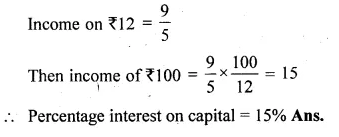
Find the percentage interest on capital invested in 18% shares when a Rs 10 share costs Rs 12.
Solution:
Dividend on one share = 18% of Rs 10
= \(\\ \frac { 18\times 10 }{ 100 } \)
= Rs \(\\ \frac { 9 }{ 5 } \)
ML Aggarwal Class 10 Solutions for ICSE Maths Chapter 3 Shares and Dividends Chapter Test Q2.1

Question 3.
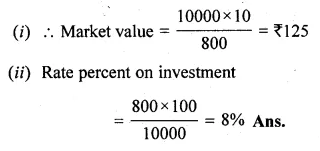
Rohit Kulkami invests Rs 10000 in 10% Rs 100 shares of a company. If his annual dividend is Rs 800, find :
(i) The market value of each share.
(ii) The rate percent which he earns on his investment.
Solution:
Investment = Rs 10000
Face value of each share = Rs 100
Rate of dividend = 10%
Annual dividend = Rs 800
ML Aggarwal Class 10 Solutions for ICSE Maths Chapter 3 Shares and Dividends Chapter Test Q3.1

Question 4.
At what price should a 9% Rs 100 share be quoted when the money is worth 6% ?
Solution:
If interest is 6 then investment = Rs 100
and if interest is 9, then investment
= Rs \(\\ \frac { 100\times 9 }{ 6 } \)
= Rs 150
Market value of each share = Rs 150 Ans

Question 5.
By selling at Rs 92, some 2.5% Rs 100 shares and investing the proceeds in 5% Rs 100 shares at Rs 115, a person increased his annual income by Rs 90. Find:
(i) the number of shares sold.
(ii) the number of shares purchased.
(iii) the new income.
(iv) the rate percent which he earns on his investment.
Solution:
Rate of dividend = 2.5% and market price = Rs 92
Let number of shares purchased = x.
Selling price of x shares = 92 x
Income from investing
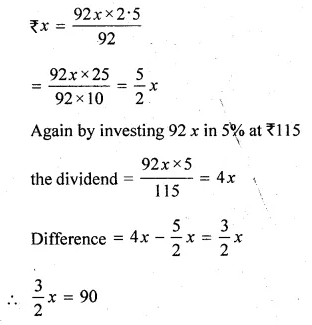
ML Aggarwal Class 10 Solutions for ICSE Maths Chapter 3 Shares and Dividends Chapter Test Q5.1
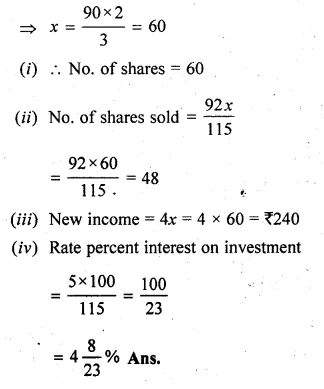
ML Aggarwal Class 10 Solutions for ICSE Maths Chapter 3 Shares and Dividends Chapter Test Q5.2

Question 6.
A man has some shares of Rs. 100 par value paying 6% dividend. He sells half of these at a discount of 10% and invests the proceeds in 7% Rs. 50 shares at a premium of Rs. 10. This transaction decreases his income from dividends by Rs. 120. Calculate:
(i) the number of shares before the transaction.
(ii) the number of shares he sold.
(iii) his initial annual income from shares.
Solution:
Let no. of shares = x
Value of x shares = x × 100 = 100 x
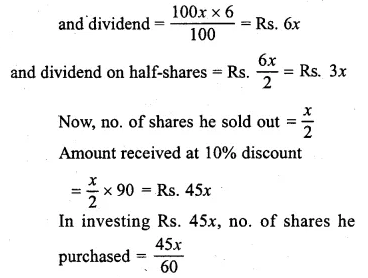
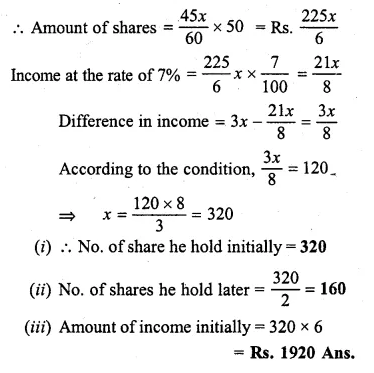
ML Aggarwal Class 10 Solutions for ICSE Maths Chapter 3 Shares and Dividends Chapter Test Q6.1
ML Aggarwal Class 10 Solutions for ICSE Maths Chapter 3 Shares and Dividends Chapter Test Q6.2

Question 7.
Divide Rs. 101520 into two parts such that if one part is invested in 8% Rs. 100 shares at 8% discount and the other in 9% Rs. 50 shares at 8% premium, the annual incomes are equal.
Solution:
Total investment = Rs. 101520
Let investment in first part = x
and in second part = (101520 – x)
Market value of first kind of shares = Rs. 100 – Rs. 8
= Rs. 92
and rate of dividend = 8%
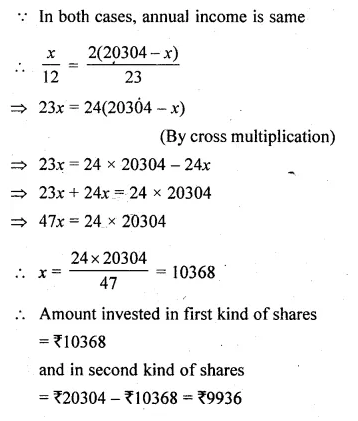
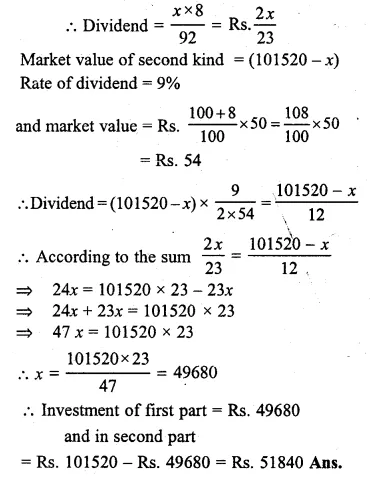
ML Aggarwal Class 10 Solutions for ICSE Maths Chapter 3 Shares and Dividends Chapter Test Q7.1

Question 8.
A man buys Rs. 40 shares of a company which pays 10% dividend. He buys the shares at such a price that his profit is 16% on his investment. At what price did he buy each share ?
Solution:
Face value of each share = Rs. 40
Dividend = 10%
Gain on investment = 10%
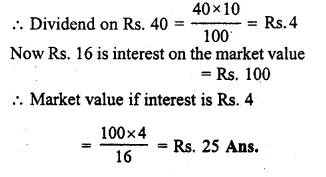
ML Aggarwal Class 10 Solutions for ICSE Maths Chapter 3 Shares and Dividends Chapter Test Q8.1

Hope given ML Aggarwal Class 10 Solutions for ICSE Maths Chapter 3 Shares and Dividends Chapter Test are helpful to complete your math homework.

If you have any doubts, please comment below. Learn Insta try to provide online math tutoring for you.

ML Aggarwal Class 10 Solutions for ICSE Maths Chapter 3 Shares and Dividends MCQS

ML Aggarwal Class 10 Solutions for ICSE Maths Chapter 3 Shares and Dividends MCQS

These Solutions are part of ML Aggarwal Class 10 Solutions for ICSE Maths. Here we have given ML Aggarwal Class 10 Solutions for ICSE Maths Chapter 3 Shares and Dividends MCQS

More Exercises

Question 1.
If Jagbeer invest ₹10320 on ₹100 shares at a discount of ₹ 14, then the number of shares he buys is
(a) 110
(b) 120
(c) 130
(d) 150
Solution:
Investment = ₹ 10320
Face value of each share = ₹100
M.V. of each share = ₹100 – 14 = ₹86
No. of shares = \(\\ \frac { 10320 }{ 86 } \) = 120 (b)

Question 2.
If Nisha invests ₹19200 on ₹50 shares at a premium of 20%, then the number of shares she buys is
(a) 640
(b) 384
(c) 320
(d) 160
Solution:
Investment = ₹19200
Face value of each share = ₹50
M.V. = ₹50 x \(\\ \frac { 120 }{ 100 } \) = ₹60
Number of shares = \(\\ \frac { 19200 }{ 60 } \)
= 320 (c)

Question 3.
₹40 shares of a company are selling at 25% premium. If Mr. Jacob wants to buy 280 shares of the company, then the investment required by him is
(a) ₹11200
(b) ₹14000
(c) ₹16800
(d) ₹8400
Solution:
Face value of each share = ₹40
M.V. = 40 x \(\\ \frac { 125 }{ 100 } \)= ₹50
Number of shares = 280
Total investment = ₹280 x 50 = ₹ 14000 (d)

Question 4.
Arun possesses 600 shares of ₹25 of a company. If the company announces a dividend of 8%, then Arun’s annual income is
(a) ₹48
(b) ₹480
(c) ₹600
(d) ₹1200
Solution:
Number of shares = 600
F.V. of each share = ₹25
Rate of dividend = 8%
Annual income = 600 x 25 x \(\\ \frac { 8 }{ 100 } \)
= ₹1200 (d)

Question 5.
A man invests ₹24000 on ₹60 shares at a discount of 20%. if the dividend declared by the company is 10%, then his annual income is
(a) ₹3000
(b) ₹2880
(c) ₹ 1500
(d) 1440
Solution:
Investment = ₹24000
F.V. of each share = ₹60
M.V. at discount of 20% = 60 x \(\\ \frac { 80 }{ 100 } \)= ₹48
Rate of dividend = 10%
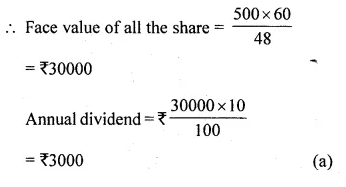
ML Aggarwal Class 10 Solutions for ICSE Maths Chapter 3 Shares and Dividends MCQS Q5.1

Question 6.
Salman has some shares of ₹50 of a company paying 15% dividend. If his annual income is ₹3000, then the number of shares he possesses is
(a) 80
(b) 400
(c) 600
(d) 800
Solution:
F.V. of each share = ₹50
Dividend = 15%
Annual income = ₹3000
Let x be the share, then
F.V. of shares = x × 50 = ₹50x
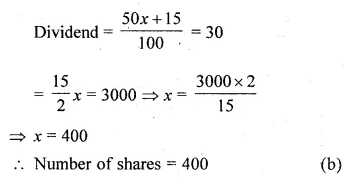
ML Aggarwal Class 10 Solutions for ICSE Maths Chapter 3 Shares and Dividends MCQS Q6.1

Question 7.
₹25 shares of a company are selling at ₹20. If the company is paying a dividend of 12%, then the rate of return is
(a) 10%
(b) 12%
(c) 15%
(d) 18%
Solution:
F.V. of each share = ₹25 ,
M.V. = ₹20
Rate of dividend = 12%
Dividend on each share = \(\\ \frac { 12 }{ 100 } \) x 25 = ₹3
Return on ₹20 = ₹3
and on ₹100 = ₹ \(\\ \frac { 3 }{ 20 } \) x \(\\ \frac { 5 }{ 100 } \) = 15% (c)

Hope given ML Aggarwal Class 10 Solutions for ICSE Maths Chapter 3 Shares and Dividends MCQS are helpful to complete your math homework.

If you have any doubts, please comment below. Learn Insta try to provide online math tutoring for you.

ML Aggarwal Class 10 Solutions for ICSE Maths Chapter 3 Shares and Dividends Ex 3

ML Aggarwal Class 10 Solutions for ICSE Maths Chapter 3 Shares and Dividends Ex 3

These Solutions are part of ML Aggarwal Class 10 Solutions for ICSE Maths. Here we have given ML Aggarwal Class 10 Solutions for ICSE Maths Chapter 3 Shares and Dividends Ex 3

More Exercises

Question 1.
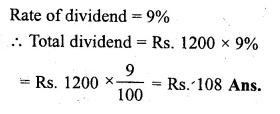
Find the dividend received on 60 shares of Rs, 20 each if 9% dividend is declared.
Solution:
Value of one share = Rs. 20
Value of 60 shares = Rs. 20 x 60
= Rs. 1200
ML Aggarwal Class 10 Solutions for ICSE Maths Chapter 3 Shares and Dividends Ex 3 Q1.1

Question 2.
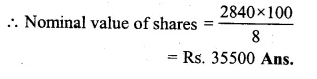
A company declares 8 percent dividend to the share holders. If a man receives Rs. 2840 as his dividend, find the nominal value of his shares.
Solution:
Rate of dividend = 8%
Amount of dividend = Rs. 2840
ML Aggarwal Class 10 Solutions for ICSE Maths Chapter 3 Shares and Dividends Ex 3 Q2.1

Question 3.
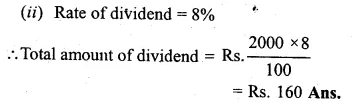
A man buys 200 ten-rupee shares at Rs 12.50 each and receives a dividend of 8%. Find the amount invested by him and the dividend received by him in cash.
Solution:
Face value of 200 shares = Rs. 10 x 200
= Rs. 2000
(i) Amount invested for the purchase of 200 shares at the rate of Rs. 12.50 each
= Rs. 12.50 x 200
= Rs. 2500
ML Aggarwal Class 10 Solutions for ICSE Maths Chapter 3 Shares and Dividends Ex 3 Q3.1

NCVT MIS

Question 4.
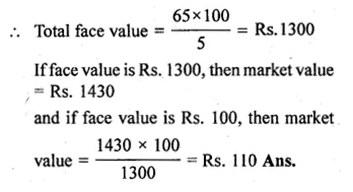
Find the market price of 5% share when a person gets a dividend of Rs 65 by investing Rs. 1430.
Solution:
Amount of dividend = Rs. 65
Rate of dividend = 5%
ML Aggarwal Class 10 Solutions for ICSE Maths Chapter 3 Shares and Dividends Ex 3 Q4.1

Question 5.
Salman buys 50 shares of face value Rs 100 available at Rs 132.
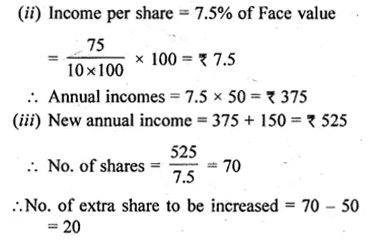
(i) What is his investment ?
(ii) If the dividend is 7.5% p.a., what will be his annual income ?
(iii) If he wants to increase his annual income by Rs 150, how many extra shares should he
Solution:
Face Value = Rs 100
(i) Market Value = Rs 132
No. of shares = 50
Investment = no. of shares x Market value
= 50 x 132 = Rs 6600
ML Aggarwal Class 10 Solutions for ICSE Maths Chapter 3 Shares and Dividends Ex 3 Q5.1

Question 6.
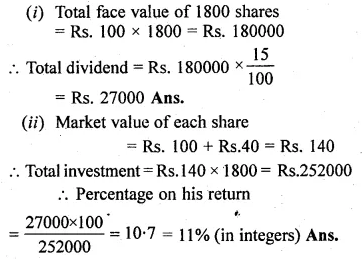
A lady holds 1800, Rs. 100 shares of a company that pays 15% dividend annually. Calculate her annual dividend. If she had bought these shares at 40% premium, what percentage return does she get on her investment ? Give your answer to the nearest integer.
Solution:
Total number of shares = 1800
Nominal value of each share = Rs. 100
Rate of dividend = 15%
ML Aggarwal Class 10 Solutions for ICSE Maths Chapter 3 Shares and Dividends Ex 3 Q6.1

Question 7.
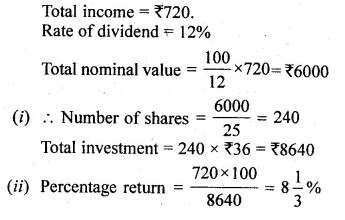
What sum should a person invest in Rs 25 shares, selling at Rs 36, to obtain an income of Rs 720, if the dividend declared is 12%? Also find the percentage return on his income.
(i) The number of shares bought by him.
(ii) The percentage return on his income.
Solution:
Nominal value of each share = Rs. 25
Market value of each share = Rs. 36
ML Aggarwal Class 10 Solutions for ICSE Maths Chapter 3 Shares and Dividends Ex 3 Q7.1

Question 8.
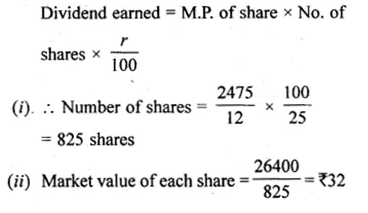
Ashok invests Rs 26400 on 12% Rs 25 shares of a company. If he receives a dividend of Rs 2475, find:
(i) the number of shares he bought.
(ii) the market value of each share. (2016)
Solution:
Investment = Rs 26400
Face value of each share = Rs 25
Rate of dividend = 12%
and total dividend = Rs 2475
We know,
ML Aggarwal Class 10 Solutions for ICSE Maths Chapter 3 Shares and Dividends Ex 3 Q8.1

Question 9.
Amit Kumar invests Rs 36,000 in buying Rs 100 shares at Rs 20 premium. The dividend is 15% per annum. Find :
(i) The number of shares he buys
(ii) His yearly dividend
(iii) The percentage return on his investment.
Give your answer correct to the nearest whole number.
Solution:
Investment = Rs 36000
Face value = Rs 100
Premium = Rs 20, dividend = 15%
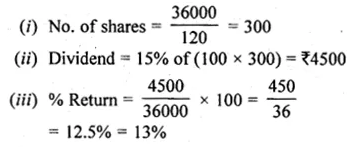
ML Aggarwal Class 10 Solutions for ICSE Maths Chapter 3 Shares and Dividends Ex 3 Q9.1

Question 10.
Mr. Tiwari invested Rs 29,040 in 15% Rs 100 shares at a premium of 20%. Calculate:
(i) The number of shares bought by Mr. Tiwari.
(ii) Mr. Tiwari’s income from the investment.
(iii) The percentage return on his investment.
Solution:
(i) M.V. of one share = \(\left[ \frac { 20 }{ 100 } \times 100+100 \right] \)
= Rs 120
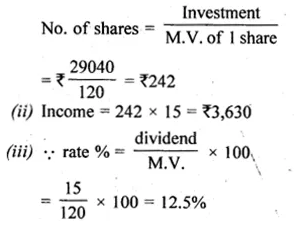
ML Aggarwal Class 10 Solutions for ICSE Maths Chapter 3 Shares and Dividends Ex 3 Q10.1

Question 11.
A man buys shares at the par value of Rs 10 yielding 8% dividend at the end of a year. Find the number of shares bought if he receives a dividend of Rs 300.
Solution:
Face value of each share = Rs 10
Rate of dividend = 8% p.a.
Total dividend = Rs 300
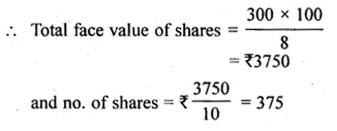
ML Aggarwal Class 10 Solutions for ICSE Maths Chapter 3 Shares and Dividends Ex 3 Q11.1

Question 12.
A man invests Rs 8800 on buying shares of face value of rupees hundred each at a premium of 10%. If he earns Rs 1200 at the end of year as dividend, find :
(i) the number of shares he has in the company.
(ii) the dividend percentage per share.
Solution:
Investment = Rs 8800
Face value of each share = Rs 100
and market value of each share
= Rs 100 + Rs 10 = Rs 110
Total income = Rs 1200
Total face value
= Rs \(\\ \frac { 8800\times 100 }{ 110 } \)
= Rs 8000
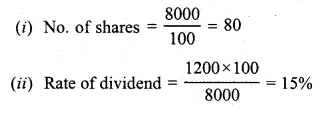
ML Aggarwal Class 10 Solutions for ICSE Maths Chapter 3 Shares and Dividends Ex 3 Q12.1

Question 13.
A man invested Rs. 45000 in 15% Rs. 100 shares quoted at Rs. 125. When the market value of these shares rose to Rs. 140, he sold some shares, just enough to raise Rs. 8400. Calculate :
(i) the number of shares he still holds.(2004)
(ii) the dividend due to him on these shares.
Solution:
Investment on shares = Rs. 45000
Face value of each share = Rs. 125
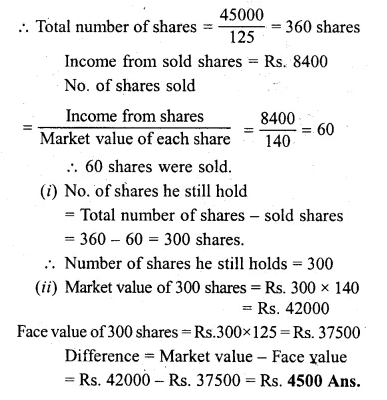
ML Aggarwal Class 10 Solutions for ICSE Maths Chapter 3 Shares and Dividends Ex 3 Q13.1

Question 14.
A company pays a dividend of 15% on its ten-rupee shares from which it deducts tax at the rate of 22%. Find the annual income of a man, who owns one thousand shares of this company.
Solution:
No. of shares = 1000
Face value of each are = Rs. 10
Rate of dividend = 15%,
Rate of tax deducted = 22%
Total face value of 1000 shares = Rs. 10 x 1000 = Rs. 10000
Total dividend = Rs 10000 x \(\\ \frac { 15 }{ 100 } \)
= Rs 1500
Tax deducted at the rate of 22 %
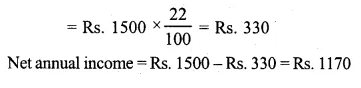
ML Aggarwal Class 10 Solutions for ICSE Maths Chapter 3 Shares and Dividends Ex 3 Q14.1

Question 15.
Ajay owns 560 shares of a company. The face value of each share is Rs. 25. The company declares a dividend of 9%. Calculate.
(i) the dividend that Ajay will get.
(ii) the rate of interest, on his investment if Ajay has paid Rs. 30 for each share. (2007)
Solution:
No. of shares = 560
Face value of each share = Rs. 25
Rate of dividend = 9% p.a.
Total face value of 560 shares = Rs. 25 x 560
= Rs. 14000
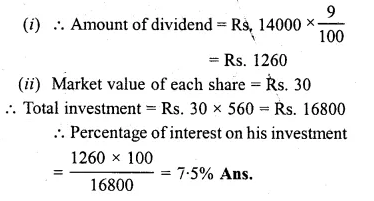
ML Aggarwal Class 10 Solutions for ICSE Maths Chapter 3 Shares and Dividends Ex 3 Q15.1

Question 16.
A company with 10000 shares of nominal value of Rs. 100 declares an annual dividend of 8% to the share holders.
(i) Calculate the total amount of dividend paid by the company.
(ii) Ramesh bought 90 shares of the company at Rs. 150 per share.
Calculate the dividend he received and the percentage return on his investment. (1994)
Solution:
(i) Number of shares = 10000
Nominal value of each share = Rs. 100
Rate of annual dividend = 8%
Total face value of 10000 shares
= Rs. 100 x 10000
= Rs. 1000000
and amount dividend = Rs \(\\ \frac { 1000000\times 8 }{ 100 } \)
= Rs 80000
(ii) Number of shares = 90
Face value of each share = Rs. 150
Total face value of 90 shades
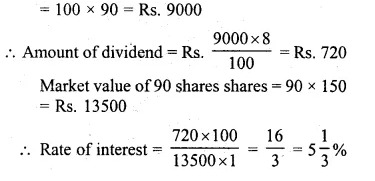
ML Aggarwal Class 10 Solutions for ICSE Maths Chapter 3 Shares and Dividends Ex 3 Q16.1

Question 17.
A company with 4000 shares of nominal value of Rs. 110 declares annual dividend of 15%. Calculate :
(i) the total amount of dividend paid by the company,
(ii) the annual income of Shah Rukh who holds 88 shares in the company,
(iii) if he received only 10% on his investment, find the price Shah Rukh paid for each share. (2008)
Solution:
Number of shares = 4000
Nominal (face) value of each share = Rs. 110
Total face value of 4000 shares = Rs. 110 x 4000
= Rs, 440000
Rate of annual dividend = 15%
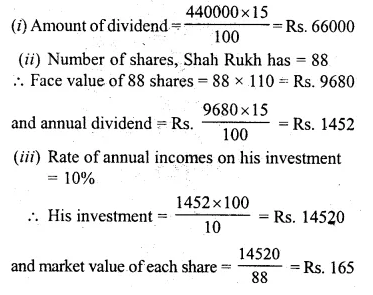
ML Aggarwal Class 10 Solutions for ICSE Maths Chapter 3 Shares and Dividends Ex 3 Q17.1

Question 18.
By investing Rs. 7500 in a company paying 10 percent dividend, an income of Rs. 500 is received. What price is paid for each Rs. 100 share
Solution:
Investment = Rs. 7500
Rate of dividend = 10%,
Total income = Rs. 500.
Face value of each share = Rs. 100
Total face value = \(\\ \frac { 100\times 500 }{ 10 } \) = Rs. 5000
If face value is Rs. 5000, then investment = Rs. 7500
and if face value is Rs. 100 then market value of
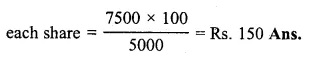
ML Aggarwal Class 10 Solutions for ICSE Maths Chapter 3 Shares and Dividends Ex 3 Q18.1

Question 19.
A man invests Rs. 8000 in a company paying 8% dividend when a share of face value of Rs. 100 is selling at Rs. 60 premium,
(i) What is his annual income,
(ii) What percent does he get on his money ?
Solution:
Investment = Rs. 8000
Face value of each share = Rs. 100
Market value = Rs. 100 + Rs. 60
= Rs. 160
Rate of dividend = 8% p.a.
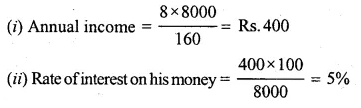
ML Aggarwal Class 10 Solutions for ICSE Maths Chapter 3 Shares and Dividends Ex 3 Q19.1

Question 20.
A man buys 400 ten-rupee shares at a premium of Rs. 2.50 on each share. If the rate of dividend is 8%, Find,
(i) his investment
(ii) dividend received
(iii) yield.
Solution:
No. of shares = 400
Face value of each share = Rs. 10
Market value of each share
= Rs. 10 + Rs. 2.50
= Rs. 12.50
Rate of dividend = 8%
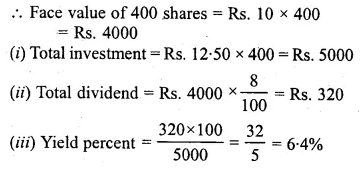
ML Aggarwal Class 10 Solutions for ICSE Maths Chapter 3 Shares and Dividends Ex 3 Q20.1

Question 21.
A man invests Rs. 10400 in 6% shares at Rs. 104 and Rs. 11440 in 10.4% shares at Rs. 143. How much income would he get in all ?
Solution:
In first case; Total investment = Rs. 10400
Rate of dividend = 6%
Market value of each share = Rs. 104
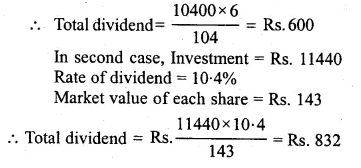
ML Aggarwal Class 10 Solutions for ICSE Maths Chapter 3 Shares and Dividends Ex 3 Q21.1
Total dividend from both cases = Rs. 600 + Rs. 832
= Rs. 1432 Ans.

Question 22.
Two companies have shares of 7% at Rs. 116 and 9% at Rs. 145 respectively. In which of the shares would the investment be more profitable ?
Solution:
Let the investment in each case = Rs. 116 x 145
Dividend in first case
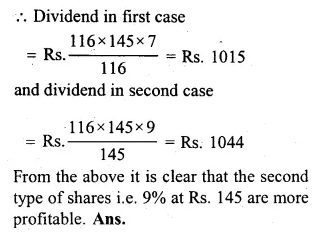
ML Aggarwal Class 10 Solutions for ICSE Maths Chapter 3 Shares and Dividends Ex 3 Q22.1

Question 23.
Which is better investment : 6% Rs. 100 shares at Rs. 120 or 8% Rs. 10 shares at Rs. 15
Solution:
Let the investment in each case = Rs. 120 In the fist case,
Dividend on Rs. 120 = Rs. 6
In second case, Dividend on Rs. 10
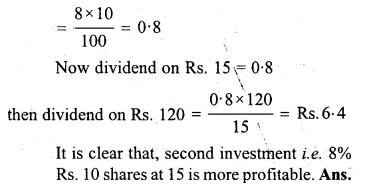
ML Aggarwal Class 10 Solutions for ICSE Maths Chapter 3 Shares and Dividends Ex 3 Q23.1

Question 24.
A man invests Rs -10080 in 6% hundred- rupee shares at Rs. 112. Find his annual income. When the shares fall to Rs. 96 he sells out the shares and invests the proceeds in 10% ten-rupee shares at Rs. 8. Find the change in his annual income.
Solution:
Investment = Rs. 10080
Face value of each share = Rs. 100
Market value of each share = Rs. 112
Rate of dividend = 6%
Total income for the year
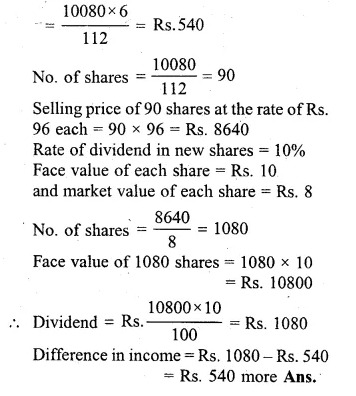
ML Aggarwal Class 10 Solutions for ICSE Maths Chapter 3 Shares and Dividends Ex 3 Q24.1

Question 25.
A man bought 360 ten-rupee shares paying 12% per annum. He sold them when the price rose to Rs. 21 and invested the proceeds in five-rupee shares paying \(4 \frac { 1 }{ 2 } \) % per annum at Rs. 3.5 per share. Find the annual change in his income.
Solution:
No. of shares bought = 360
Face value of each share = Rs. 10
Rate of dividend = 12%
Total face value of 360 shares
= Rs. 10 x 360
= Rs. 3600
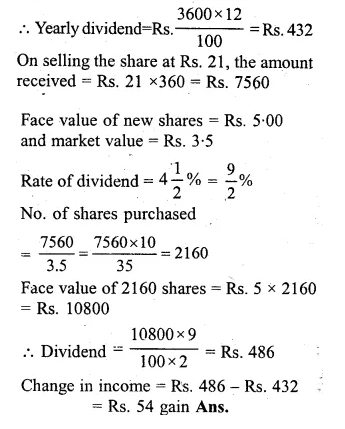
ML Aggarwal Class 10 Solutions for ICSE Maths Chapter 3 Shares and Dividends Ex 3 Q25.1

Question 26.
A person invests Rs. 4368 and buys certain hundred-rupee shares at 91. He sells out shares worth Rs. 2400 when they have t risen to 95 and the remainder when they have fallen to 85. Find the gain or loss on the total transaction,
Solution:
Investment = Rs. 4368
Market value of each share = Rs. 91
Face value of each share = Rs. 100
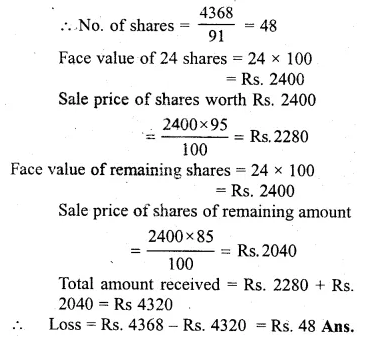
ML Aggarwal Class 10 Solutions for ICSE Maths Chapter 3 Shares and Dividends Ex 3 Q26.1

Question 27.
By purchasing Rs. 50 gas shares for Rs. 80 each, a man gets 4% profit on his investment. What rate percent is company paying ? What is his dividend if he buys 200 shares ?
Solution:
Market value of each share = Rs 80
Face value of each share = Rs. 50
Interest on investment = 4%
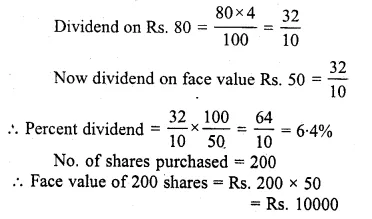
ML Aggarwal Class 10 Solutions for ICSE Maths Chapter 3 Shares and Dividends Ex 3 Q27.1
Dividend = Rs 10000 x \(\\ \frac { 6.4 }{ 100 } \)
= Rs 640

Question 28.
Rs. 100 shares of a company are sold at a discount of Rs. 20. If the return on the investment is 15%. Find the rate of dividend declared
Solution:
Market value of each shares = 100 – 20
= Rs.80
Interest on investment of Rs. 80
= 15% x 80
= \(\\ \frac { 15 }{ 100 } \) x 80
= Rs 12
Dividend on face value of Rs. 100 = Rs. 12
Rate of dividend = 12%. Ans.

Question 29.
A company declared a dividend of 14%. Find tire market value of Rs. 50 shares if the return on the investment was 10%.
Solution:
Rate of dividend = 14%
Dividend on Rs. 50 = \(\\ \frac { 14\times 50 }{ 100 } \) = Rs 7
Now Rs. 10 is interest on the investment of
= Rs. 100
Rs. 7 will be the interest on
= \(\\ \frac { 100\times 7 }{ 10 } \) = Rs. 70
Hence Market value of Rs. 50 shares = Rs. 70Ans.

Question 30.
At what price should a 6.25% Rs. 100 shares be quoted when the money is worth 5%?
Solution:
Interest on Rs. 100 worth = Rs. 5
If interest is Rs. 5, then market value = Rs. 100
and if interest is Rs. 6.25, then market value
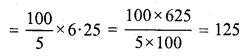
ML Aggarwal Class 10 Solutions for ICSE Maths Chapter 3 Shares and Dividends Ex 3 Q30.1
Market value of each share = Rs. 125 Ans.

Question 31.
At what price should a 6.25% Rs. 50 share be quoted when the money is worth 10%?
Solution:
Interest on Rs. 100
worth = Rs. 10
If the interest is Rs. 10, then market value = Rs. 100
and if interest is Rs. 6.25, then market

ML Aggarwal Class 10 Solutions for ICSE Maths Chapter 3 Shares and Dividends Ex 3 Q31.1

Question 32.
A company with 10000 shares of Rs. 100 each, declares an annual dividend of 5%.
(i) What is the total amount of dividend paid by the company ?
(ii) What would be the annual income of a man, who has 72 shares, in the company ?
(iii) If he received only 4% on his investment, find the price he paid for each share. (1998)
Solution:
No. of shares = 10000
Face value of each share = Rs. 100
Rate of dividend = 5%
(i) Total face value of 10000 shares
= Rs. 100 x 10000
= Rs. 1000000
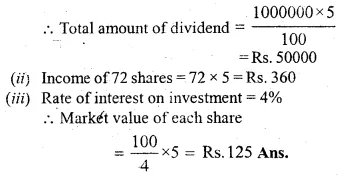
ML Aggarwal Class 10 Solutions for ICSE Maths Chapter 3 Shares and Dividends Ex 3 Q32.1

Question 33.
A man sold some Rs. 100 shares paying 10% dividend at a discount of 25% and invested the proceeds in Rs. 100 shares paying 16% dividend quoted at Rs. 80 and thus increased his income by Rs. 2000. Find the number of shares sold by him.
Solution:
Face value of each share = Rs. 100
Market value of each share
= Rs. 100 – Rs.25
= Rs. 75
Rate of dividend = 10%
Let no. of shares = x
Selling price = x × 75 =Rs. 75x
Face value of x share = 100 x
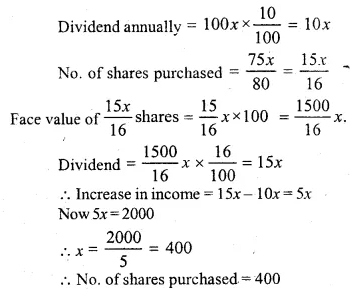
ML Aggarwal Class 10 Solutions for ICSE Maths Chapter 3 Shares and Dividends Ex 3 Q33.1

Question 34.
By selling at Rs. 77, some \(2 \frac { 1 }{ 4 } \) % shares of face value Rs. 100, and investing the proceeds in 6% shares of face value Rs. 100, selling at 110, a person increased his income by Rs, 117 per annum. How many shares did he sell ?
Solution:
Let the number of shares = x
On selling at Rs.77, the amt received x × 77 = Rs. 77 x
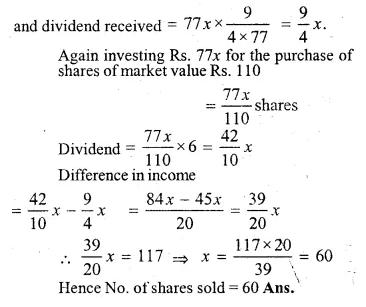
ML Aggarwal Class 10 Solutions for ICSE Maths Chapter 3 Shares and Dividends Ex 3 Q34.1

Question 35.
A man invests Rs. 6750, partly in shares of 6% at Rs. 140 and partly in shares of 5% at Rs. 125. If his total income is Rs. 280, how much has he invested in each ?
Solution:
Let the investment in first case = x
Then investment in second case = (6750 – x)
In first case, the dividend
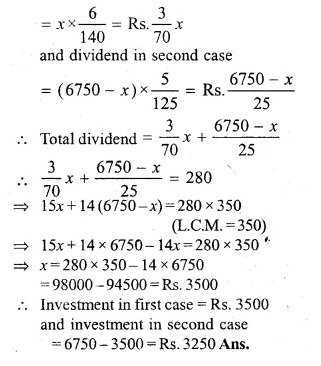
ML Aggarwal Class 10 Solutions for ICSE Maths Chapter 3 Shares and Dividends Ex 3 Q35.1

Question 36.
Divide Rs. 20304 into two parts such that if one part is invested in 9% Rs. 50 shares at 8% premium and the other part is invested in 8% Rs. 25 shares at 8% discount, then the annual incomes from both the investment are equal
Solution:
Total amount = Rs 20304
Let amount invested in 9% Rs 50 at 8%
premium = x
Then amount invested in 8% Rs 25 at 8%
Discount = 20304 – x
Income from both investments are equal Now income from first type of shares
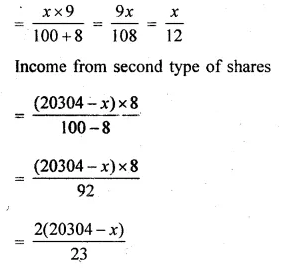
ML Aggarwal Class 10 Solutions for ICSE Maths Chapter 3 Shares and Dividends Ex 3 Q36.1
ML Aggarwal Class 10 Solutions for ICSE Maths Chapter 3 Shares and Dividends Ex 3 Q36.2

Hope given ML Aggarwal Class 10 Solutions for ICSE Maths Chapter 3 Shares and Dividends Ex 3 are helpful to complete your math homework.

If you have any doubts, please comment below. Learn Insta try to provide online math tutoring for you.

ML Aggarwal Class 10 Solutions for ICSE Maths Chapter 2 Banking Chapter Test

ML Aggarwal Class 10 Solutions for ICSE Maths Chapter 2 Banking Chapter Test

These Solutions are part of ML Aggarwal Class 10 Solutions for ICSE Maths. Here we have given ML Aggarwal Class 10 Solutions for ICSE Maths Chapter 2 Banking Chapter Test

More Exercises

Question 1.
Mr. Dhruv deposits Rs 600 per month in a recurring deposit account for 5 years at the rate of 10% per annum (simple interest). Find the amount he will receive at the time of maturity.
Solution:
Deposit per month = Rs 600
Rate of interest = 10% p.a.
Period (n) = 5 years 60 months.
Total principal for one month
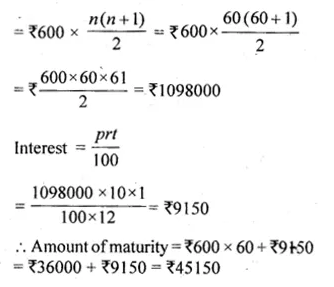
ML Aggarwal Class 10 Solutions for ICSE Maths Chapter 2 Banking Chapter Test Q1.1

Question 2.
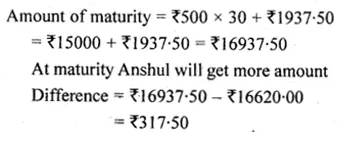
Ankita started paying Rs 400 per month in a 3 years recurring deposit. After six months her brother Anshul started paying Rs 500 per month in a \(2 \frac { 1 }{ 2 } \) years recurring deposit. The bank paid 10% p.a. simple interest for both. At maturity who will get more money and by how much?
Solution:
In case of Ankita,
Deposit per month = Rs 400
Period (n) = 3 years = 36 months
Rate of interest = 10%
Total principal for one month
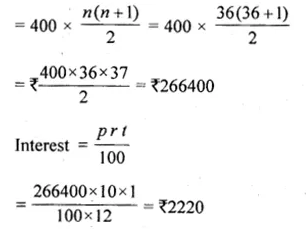
ML Aggarwal Class 10 Solutions for ICSE Maths Chapter 2 Banking Chapter Test Q2.1
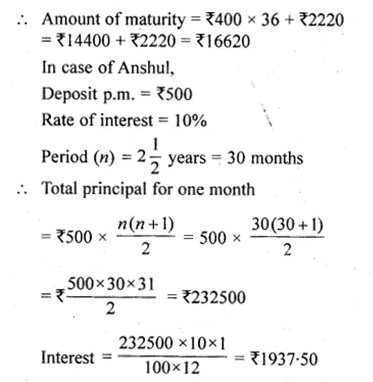
ML Aggarwal Class 10 Solutions for ICSE Maths Chapter 2 Banking Chapter Test Q2.2
ML Aggarwal Class 10 Solutions for ICSE Maths Chapter 2 Banking Chapter Test Q2.3

Question 3.
Shilpa has a 4 year recurring deposit account in Bank of Maharashtra and deposits Rs 800 per month. If she gets Rs 48200 at the time of maturity, find
(i) the rate of simple interest,
(ii) the total interest earned by Shilpa
Solution:
Deposit per month (P) = Rs 800
Amount of maturity = Rs 48200
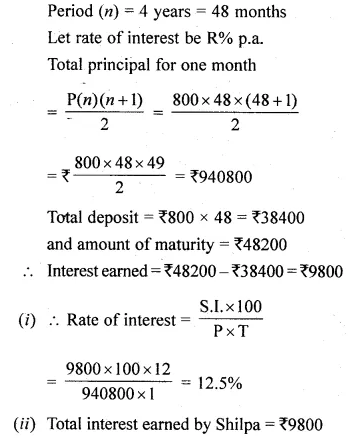
ML Aggarwal Class 10 Solutions for ICSE Maths Chapter 2 Banking Chapter Test Q3.1

Question 4.
Mr. Chaturvedi has a recurring deposit account in Grindlay’s Bank for \(4 \frac { 1 }{ 2 } \) years at 11% p.a. (simple interest). If he gets Rs 101418.75 at the time of maturity, find the monthly instalment.
Solution:
Let each monthly instalment = Rs x
Rate of interest = 11 %
Period (n) = \(4 \frac { 1 }{ 2 } \) years or 54 months,
Total principal for one month
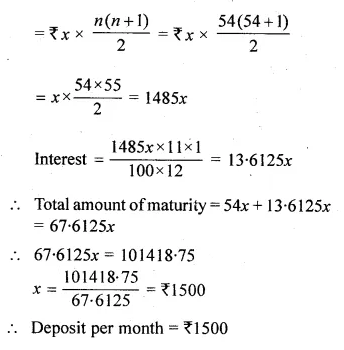
ML Aggarwal Class 10 Solutions for ICSE Maths Chapter 2 Banking Chapter Test Q4.1

Question 5.
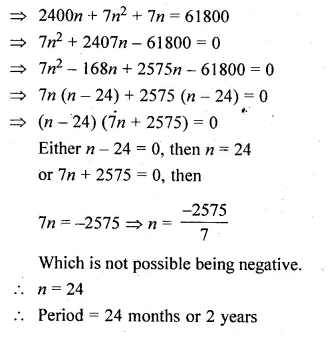
Rajiv Bhardwaj has a recurring deposit account in a bank of Rs 600 per month. If the bank pays simple interest of 7% p.a. and he gets Rs 15450 as maturity amount, find the total time for which the account was held.
Solution:
Deposit during the month (P) = Rs 600
Rate of interest = 7% p.a.
Amount of maturity = Rs 15450
Let time = n months
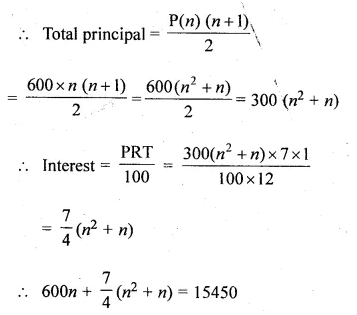
ML Aggarwal Class 10 Solutions for ICSE Maths Chapter 2 Banking Chapter Test Q5.1
ML Aggarwal Class 10 Solutions for ICSE Maths Chapter 2 Banking Chapter Test Q5.2

Hope given ML Aggarwal Class 10 Solutions for ICSE Maths Chapter 2 Banking Chapter Test are helpful to complete your math homework.

If you have any doubts, please comment below. Learn Insta try to provide online math tutoring for you.
ML Aggarwal Class 10 Solutions for ICSE Maths Chapter 2 Banking MCQS

ML Aggarwal Class 10 Solutions for ICSE Maths Chapter 2 Banking MCQS

These Solutions are part of ML Aggarwal Class 10 Solutions for ICSE Maths. Here we have given ML Aggarwal Class 10 Solutions for ICSE Maths Chapter 2 Banking MCQS

More Exercises

Choose the correct answer from the given four options (1 to 4) :

Question 1.
If Sharukh opened a recurring deposit account in a bank and deposited Rs 800 per month for \(1 \frac { 1 }{ 2 } \) years, then the total money
deposited in the account is
(a) Rs 11400
(b) Rs 14400
(c) Rs 13680
(d) none of these
Solution:
Monthly deposit = Rs800
Period (n) = \(1 \frac { 1 }{ 2 } \) years = 18 months
.’. Total money deposit = Rs 800 x 18
= Rs 14400 (b)

Question 2.
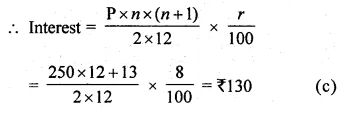
Mrs. Asha Mehta deposit Rs 250 per month for one year in a bank’s recurring deposit account. If the rate of (simple) interest is 8% per annum, then the interest earned by her on this account is
(a) Rs 65
(b) Rs 120
(c) Rs 130
(d) Rs 260
Solution:
Deposit per month (P) = Rs 250
Period (n) = 1 year = 12 months
Rate (r) = 8% p.a.
ML Aggarwal Class 10 Solutions for ICSE Maths Chapter 2 Banking MCQS Q2.1

Question 3.
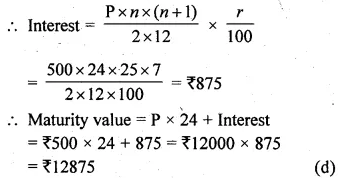
Mr. Sharma deposited Rs 500 every month in a cumulative deposit account for 2 years. If the bank pays interest at the rate of 7% per annum, then the amount he gets on maturity is
(a) Rs 875
(b) Rs 6875
(c) Rs 10875
(d) Rs 12875
Solution:
Deposit (P) = Rs 500 per month
Period (n) = 2 years = 24 months
Rate (r) = 7% p.a.
ML Aggarwal Class 10 Solutions for ICSE Maths Chapter 2 Banking MCQS Q3.1

Question 4.
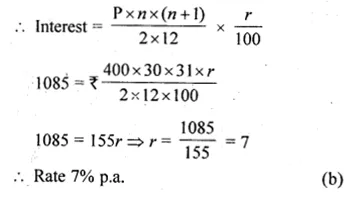
John deposited Rs 400 every month in a bank’s recurring deposit account for \(2 \frac { 1 }{ 2 } \) years. If he gets Rs 1085 as interest at the time of maturity, then the rate of interest per annum is
(a) 6%
(b) 7%
(c) 8%
(d) 9%
Solution:
Deposit (P) = Rs 400 per month
Period (n) = \(2 \frac { 1 }{ 2 } \) years = 3 months
Interest = Rs 1085
Let r% be the rate of interest
ML Aggarwal Class 10 Solutions for ICSE Maths Chapter 2 Banking MCQS Q4.1

Hope given ML Aggarwal Class 10 Solutions for ICSE Maths Chapter 2 Banking MCQS are helpful to complete your math homework.

If you have any doubts, please comment below. Learn Insta try to provide online math tutoring for you.