CA Foundation Business Laws Study Material Chapter 12 Transfer of Ownership

CA Foundation Business Laws Study Material Chapter 12 Transfer of Ownership

TRANSFER OF OWNERSHIP:TIME OF TRANSFER

Sale of goods involves transfer of ownership of property from the seller to the buyer. It is necessary to determine the precise moment of time at which the ownership of the goods passes from the seller to the buyer, because of the following reasons:
(a) Risk passes with property
The general rule is that risk prima facie passes with the property. If the goods are lost or damaged by accident or otherwise, then, subject to certain exceptions, the loss falls on the person who is the owner at the time when the goods are lost or damaged.
(b) Action against third parties.
If the goods are damaged by the action of third parties it is the owner who can take action.
(c) What is the effect of insolvency?
In case of insolvency of either the buyer or the seller it is necessary to know’ whether the goods will be taken over by the Official Assignee. The answer depends upon whether the ownership of the goods is with the party who has become insolvent.
(d) Suit for price.
Unless the contract provides otherwise, a suit for price by the seller does not lie unless the
property has passed to the buyer.

LAW RELATING TO PASSING OF RISK IN CASE OF THE SALE OF GOODS
The basic principle is the risk prima facie passes with the ownership. According to section 26—
Unless otherwise agreed, the goods remains at the seller’s risk until the property therein is transferred to the buyer. But when the property therein is transferred to the buyer, the goods are at the buyer’s \ risk whether delivery has been made or not.
Thus risk and ‘property’ (ownership) go together. But it is open to the parties to separate the risk from ownership. For example, the parties may agree that risk will pass sometime after or before the property has passed. The separation of risk from property can be made in the following ways. Firstly, where delivery has been delayed due to fault of seller or the buyer, the goods are at the risk of the party in fault. Secondly, risk and property may be separated by a trade custom. Thirdly, risk and property can be separated by the agreement of the parties.

WHEN DOES PROPERTY IN THE GOODS PASS UNDER THE SALE OF GOODS ACT?

Sections 18 to 25 of Sale of Goods Act lay down the rules which determine when ownership of property passes from the seller to the buyer. These rules may be summarised as follow:

  • A. TRANSFER OF PROPERTY IN UNASCERTAINED GOODS
  • B. TRANSFER OF PROPERTY IN ASCERTAINED GOODS
  • C. TRANSFER OF PROPERTY IN SALE BY APPROVAL
  • D. TRANSFER OF PROPERTY WHEN RIGHT OF DISPOSAL IS RESERVED

A. TRANSFER OF PROPERTY IN UNASCERTAINED GOODS
1. When there is a contract for the sale of unascertained goods, property in the goods is not transferred to the buyer unless and until the goods are ascertained. (Sec. 18).
2. How goods are ascertained?
By valid appropriation: Under Section 23(1), in a contract for the sale of unascertained or future goods by description, the property in the goods passes to the buyer when the goods of that description are in a deliverable state are unconditionally appropriated to the contract, either by the seller with the assent of the buyer or by the buyer with the assent of the seller. The goods are ascertained by appropriation. Until appropriation there is merely an agreement to sell. Appropriation means selection of goods with the mutual consent of the parties.
The following are the essentials of appropriation:

  1. The goods should confirm to the description and quality stated in the contract.
  2. The goods must be in a deliverable state.
  3. The goods must be unconditionally (as distinguished from an intention to appropriate) appropriated to the contract either by delivery to buyer or his agent or the carrier.
  4. The appropriation must be
    1. by seller with the assent of buyer or.
    2. by buyer with the assent of seller.
  5. The assent may be expressed or implied.
  6. The assent may be given either before or after appropriation.

Thus, if A agrees to sell to B 20 tonnes of oil of a certain description in his cisterns and he has more than 20 tonnes of oil of description in his cisterns, then no property will pass to B unless the 20 tonnes are separated from the rest and they are appropriated to the contract.
Delivery to the carrier [Sec. 23(2)] – When the seller delivers the goods, to a carrier for being taken to the buyer, and does not reserve the right of disposal, the property passes to the buyer. The carrier becomes the agent of the buyer and such a delivery amounts to a delivery to the buyer and the risk is, after the delivery of the buyer. The essentials of delivery to a carrier are—

  • Delivery must be in pursuance of the contract Le. the goods must be of the de-scription and quality of the goods contracted.
  • Seller delivers goods to the buyer or to a carrier or a bailee for transmission to the buyer. This must be pursuant to the contract,
  • Seller does not reserve right of disposal.

B. TRANSFER OF PROPERTY IN ASCERTAINED GOODS
Where there is a contract for the sale of specific or ascertained goods the property in them is transferred to the buyer at such time as the parties to the contract intend it to be transferred [Sec. 19(1)]. For the purpose of ascertaining the intention of the parties regard shall be had to—

  • the terms of the contract,
  • the conduct of the parties, and
  • the circumstances of the case. [Sec. 19(2)]

It is only when the intention of the parties cannot be judged from their contract or conduct or other circumstances that the rules laid dowh in Sections 20 to 24 apply. [Sec. 19(3)]. These rules are as follows:
(a) Specific goods in a deliverable state: [Section 20]

  • in case of an unconditional contract for the sale of specific goods in a deliverable state,
  • the property in the goods passes to the buyer on making the contract, and
  • it is immaterial whether the time of payment of the price or the time of delivery of the goods or both is postponed.

(b) Specific goods to be put in deliverable state: [Section 21]

  • where there is a contract for the sale of specific goods and
  • the seller is bound to do something to the goods for the purpose of putting them into a deliverable state,
  • the property in the goods does not pass until such thing is done and the buyer has the notice thereof.

(c) Specific goods to be Weighed or Measured: [Section 22]

  • in a contract for the sale of specific goods in a deliverable state,
  • where the seller is bound to weigh, measure, test or do some other act or thing
  • with reference to the goods for the purpose of ascertaining the price,
  • the property does not pass until such act or thing is done and the buyer has the notice of the same.

C. TRANSFER OF PROPERTY IN SALE BY APPROVAL
When goods are delivered on approval (Sec. 24): When goods are delivered to the buyer on approval or ‘on sale or return,’ or on other similar terms, the property therein passes to the buyer :

  1. When he signifies his approval or acceptance to the seller, or
  2. When the buyer does any other act adopting the transaction, e.g., pledges the goods or resells them.
  3. When the buyer retains the goods, without giving notice of rejection, beyond the time fixed for the return of goods, or if no time has been fixed, beyond a reasonable time. In short, the property passes either by acceptance or by failure to return the goods within specified or reasonable time.

D. TRANSFER OF PROPERTY WHEN RIGHT OF DISPOSAL IS RESERVED
The object of reserving the right of disposal of goods is to secure that the price is paid before the property passes to the buyer. For example, under the VPP (Value Pre Paid) system the ownership passes to the buyer when the price is paid against the delivery of goods, till then the seller retains control over the goods
Section 25(1) lays down that—
in a contract for the sale of specific goods or where goods are subsequently appropriated to the contract,

  • the seller may reserve the right of disposal of the goods until certain conditions are fulfilled.
  • In such a case, even if the goods are delivered to the buyer himself, or to a carrier or other bailee for transmission to the buyer, the buyer does not acquire ownership until the conditions imposed by the seller are satisfied.
  • For example, X sends certain goods by lorry to Y and instructs the lorry driver not to deliver the goods until the price is paid by Y to the lorry driver. The property passes only when the price is paid.

In the following circumstances, the seller is presumed to have reserved the right of disposal:—
(a) By taking a document of title in his own name or his agent’s name. [Sec. 25(2)].
When goods are shipped or delivered to railways for carriage but the document of title le. the bill of lading (in case of carriage of sea) or the railway receipts (in case of carriage by railways) are taken by the seller in his own name or in his agent’s name, the seller is presumed to have reserved the right of disposal. The property passes over to the buyer only when the buyer pays the price in exchange of bill of lading or the railway receipt.
Example : A sold certain bales of paper to B which were to be sent to him by railway. A took the railway receipt in the name of B, and sent them to his own banker to be delivered to B on the payment of the price. Before B paid the price, and received railway receipts, the goods were destroyed by fire. The court held that the seller should suffer the loss as he has reserved the right of disposal and at the time of destruction of bales, their ownership has not been transferred to the buyer – [General Papers Ltd. v. V.P. Mohideen & Bros. AIR 1958 Madras 482.]

(b) When the bills of exchange along with the RR/bill of lading is sent to the buyer. [Sec. 25(3)].
If the goods are delivered to a carrier {Le. the shipping company or railways) and the bill of lading or RR are taken in the name of the buyer. But the seller draws a bill of exchange on the buyer for the price of the goods, and sends the same to the buyer along with the bill of lading or railway receipts to secure the payment of the price. The property in goods does not pass to the buyer until he accepts the bill of exchange or pays the price of the goods. If he retains the goods without accepting the bill of exchange or payment of price the property does not pass.

TRANSFER OF TITLE BY NON-OWNER OR NO ONE CAN GIVE A BETTER TITLE THAN HE HIMSELF HAS

A sale is a contract plus a conveyance. As a conveyance it involves transfer of title of goods from the seller to the buyer. If the seller’s title is defective, the buyer’s title will also be defective. A person can only transfer what he has. No one can transfer a better title to the goods than he himself possesses. This principle is expressed by the Latin phrase, “Nemo dat quad non habet”, which means “none can give who does not himself possess”.
Exceptions
– In each of the following cases, a person who is not an owner, can give to the transferee a valid title to the goods:
1. Transfer of title by estoppel [(Sec. 27)]
When the true owner of the goods by his conduct or words or by any act or omission leads the buyer to believe that the seller is the ownfer of the goods or has the authority to sell them, he cannot afterwards deny the seller’s authority to sell. The buyer in such a case gets a better title than that of the seller.
Example:

  1. ‘O’ who is the true owner of the goods, causes the buyer ‘B’ to believe that ‘S’ has the authority to sell the goods. ‘O’ cannot afterwards question the seller’s want of title on the goods.
  2. ‘A’ was the true owner of goods. ‘B’ the seller told the buyer ‘C’ that the goods belonged to him. ‘A’ was present but remained silent. ‘C’ purchased the goods from ‘B’. Can ‘A’ question the title of ‘C’ over the goods?

2. Sale by a mercantile agent [Proviso to Sec. 27]
Sale of goods by a mercantile agent gives a good title to the purchaser even in cases where the agent acts beyond his authority, provided the following conditions are satisfied—

  1. The agent is in possession of the goods or of a document of title to the goods.
  2. Such possession is with the consent of the owner.
  3. The agent sells the goods in the ordinary course business. :
  4. The purchaser acts in good faith and has no notice that the agent had no authority to sell.

“Mercantile Agent”- ‘Mercantile agent’ means an agent having in the customary course of his business as such agent authority either (1) to sell goods, or (2) to consign goods for the purpose of sale, or (3) to buy goods, or (4) to raise money on the security of goods. [Sec. 2(9)]
Good faith means honestly, whether done negligently or not.

Document of Title to Goods. [Sec. 2(4)]
A document of title to goods is a document representing goods and is used—

  • in the ordinary course of business
  • as proof of the ownership, possession or control of goods.

It authorises the possessor of such document to receive or transfer the goods represented thereby.
According Sec. 2(4), documents of title to goods includes

  1. bill of lading
  2. dock warrant
  3. warehouse keeper’s certificate
  4. wharfinger’s certificate
  5. railway receipt (R/R), lorry receipt (L/R)
  6. multimodal transport document and
  7. delivery order.

Thus, document of title is a document, which is the evidence of full ownership of goods represented by the document. Delivery of document of title is as good as giving delivery of goods. Transfer of document of title is a symbolic delivery of goods to the purchaser. The document of title to goods is transferred by endorsement or by mere ’ delivery and it confers a good title to the transferee if he receives it in good faith. E.g. , Delivery of railway receipt is enough to constitute delivery of goods represented by railway receipt.
Document of title shall be distinguished from document showing title to the goods. In case of document showing title to the goods, ownership cannot be transferred by endorsement or mere delivery unlike as in document of title to the goods.

What is bill of lading?
When the goods are carried by sea, the carrier of goods issues to the shipper a bill of lading. It is a document of title. Transfer of goods can be effected by transfer of bill of lading. The buyer may demand delivery of goods at the destination on the basis of the bill of lading.

Wharfingers certificate. A Wharf is a platform alongside the water for loading and unloading a ship. A wharfingers certificate is a document issued by a wharfingers. It certifies that the j goods specified in it are in the wharf. ,

3. Sale by one of several joint owners [Sec. 28]
This section enables a co-owner to sell not only his own share but also of his other co-owners. If one of several joint owners of goods has the sole possession of them by permission of the co-owners, the property in the goods is transferred to any person who buys them from such joint owner provided the buyer acts in good faith and without notice that the seller had no authority to sell.
Section 28 lays down three conditions for validating a sale by one of co-owners :—

  1. He must be in sole possession by permission of his co-owners.
  2. The purchaser acts in good faith Le. with honesty.
  3. The purchaser had no notice at the time of the contract of sale that the seller had no authority to sell.

X, Y & Z own certain truck in common. X is in possession of the truck by permission of his co-owners. X sells the truck to A. A purchases bona fide. The property in the truck is transferred to A.

4. Sale of goods obtained under a voidable agreement [Sec. 29]
When the seller of goods has obtained possession thereof under a voidable agreement but the agreement has not been rescinded at the time of sale, the buyer obtains a good title to the goods, provided he buys them in good faith and without notice of the seller’s defect of title.
It is to be noted that the above section applies when the goods have been obtained under a voidable agreement, not when the goods have been obtained under a void or illegal agreement. If the original agreement is of no legal effect (void ab-initio) the title to the goods remains with the true owner and cannot be passed on to anybody else.

5. Sale by the seller in possession of goods after sale [Sec. 30(1)]
Under this exception, a second sale by the seller remaining in possession of the goods will give a good title to the buyer acting in good faith and without notice. Three conditions should be fulfilled under this exception :

  1. The seller must continue in possession of the goods or of the documents of title to the goods as seller. Possession as a hirer or bailee of the goods from the buyer after delivery of the goods to him will not do.
  2. The goods must have been delivered or transferred to the buyer or the documents of title must have been transferred to him.
  3. Good faith and absence of notice of the previous sale on the part of the second buyer.

6. Sale by buyer in possession of goods over which the seller has some rights [Sec. 30(2)]
This exception deals with the case of a sale by the buyer of goods in which the property has not yet passed to him. When goods are sold subject to some lien or right of the seller (for example for unpaid price) the buyer may pledge, or otherwise dispose of the goods to a third party and give him a good title, provided the following conditions for sell, are satisfied:

  1. The first buyer is in possession of the goods or of the documents of title to the goods . with the consent of the seller.
  2. Transfer is by the buyer or by a mercantile agent acting for him.
  3. The person receiving the same acts in goods faith and without notice of any lien or other right of the original seller.

7. Sale by an unpaid seller [Sec. 54]
An unpaid seller of goods can, under certain circumstances, re-sell the goods. The purchaser of such goods gets a valid title of the goods.

8. Sale under the Contract Act

  1. A pawnee may sell the goods of pawher if the latter makes a default of his dues. The purchaser under such a sale gets a good title. [Sec. 176 of Contract Act]
  2. A finder of goods can sell the goods under certain circumstances. The purchaser gets a good title. [Sec. 169 of Contract Act]
  3. Sale by an Official Receiver of Liquidator of the company will give the purchaser a valid title.

MULTIPLE CHOICE QUESTIONS:

1. Property in the goods ‘in the Sale of Goods Act means’
(a) ownership of goods
(b) possession of goods
(c) asset in the goods
(d) custody of goods

2. It is necessary to determine the precise moment of time at which the ownership of goods passes from seller to the buyer because
(a) risk passes with property
(b) action can be taken only by the owner
( c) suit for price by the seller does not lie unless the property has passed to the buyer
(d) all the above

3. The ownership in specific goods to be put in deliverable state passes—
(a) When the seller has brought the goods into a deliverable state and the buyer has notice thereof
( b) When the goods are brought in deliverable state by the seller
(c) The contract is made
(d) When the intention is clear

4. For passing of property in goods, the goods must be in
(a) deliverable state
(b) manufacturing stage
(c) consumable state
(d) marketing state

5. When the goods are sent on sale or return basis, the property in the goods passes to the buyer:
(a) When the buyer signifies his approval or acceptance to the seller
(b) When the buyer pledges the goods
(c) When the buyer resells the goods
(d) All the above

6. A seller sends the goods and takes the railway receipt in his own name at the buyer’s place the seller has—
(a) Reserved the right of disposal of goods
(b) Not reserved the right of disposal of goods
(c) May reserve the right of disposal of goods
(d) The question of reserving the right of dis-posal does not arise

7. “Nemo dat quad non habet”, means:
(a) no one is greater than god
( b) none can give who does not himself possess
(c) every one can give everything he has
(d) everyone is bound by is habit

8. Sale of goods by a mercantile agent gives a good title to the purchaser even in cases where the agent acts beyond his authority, provided the following conditions are satisfied—
(a) The agent is in possession of the goods or of a document of title to the goods.
(b) The agent sells the goods in the ordinary course business.
(c) The purchaser acts in good faith and has no notice that the agent had no authority to sell.
(d) All the above.

9. For passing of property in respect of specific or ascertained goods, the intention of the parties can be ascertained from —
(a) Terms of the contract
(b) Conduct of the parties
(c) Circumstances of the case
(d) All of the above

10. Under the Sale of Goods Act, 1930, the term “Mercantile Agent” means a mercantile agent, having as such agent, authority to —
(a) sell goods or consign goods for the purposes of sale
( b) buy goods
(c) raise money on the security of goods
(d) do all of the above.

11. Transfer of documents of title to the goods sold to the buyer, amounts to
(a) actual delivery
(b) symbolic delivery
(c) constructive delivery
(d) none of these.

12. A Share Certificate is a —
(a) Document of Title to Goods
(b) Bill of Exchange
(c) Document Showing Title to Goods
(d) Instrument of Transfer

13. A Bill of Lading is a —
(a) Bill of Exchange
(b) Promissory Note
(c) Cheque
(d) Document of Title to Goods.

14. When a bill of exchange in sent together with documents of title, the property in goods passes when the buyer.
(a) Receives the Bill of Exchange
(b) Returns the Bill of Exchange
(c) Accepts the Bill of Exchange
(d) None of these

15. Under the Sale of Goods Act, 1930, “Wharfinger’s Certificate” is a —
(a) Document of Title
(b) Document showing Title
(c) Certificate equivalent to a Negotiable Instrument
(d) Delivery Order

16. Which of these is NOT a Document of Title to Goods?
(a) Bill of Lading
(b) Railway Receipt
(c) Dock Warrant
(d) Bearer Cheque

17. Which of these is NOT a Document of Title to Goods?
(a) Warehouse Keeper’s Certificate
(b) Wharfinger’s Certificate
(c) Bill of Exchange
(d) Dock Warrant

18. Dock Warrant is a—
(a) Document showing title to Goods.
(b) Document of Title to Goods
(c) Bill of Exchange
(d) Warrant for Arrest of a Person

19. For transfer of property in un-ascertained goods, the basic condition is that —
(a) Goods must be ascertained and appropriated.
(b) Goods must be defined by description.
(c) Buyer must receive a sample of the goods
(d) Seller must have produced/purchased the goods

20. The property, in case of sale of un-ascertained goods, passes when—
(a) Delivery Order is entered
(b) Goods are identified and appropriated to the contract
( c) Goods are so far ascertained that the parties have agreed that they shall be taken from some specific larger stock.
(d) Transfer is made in the books of the warehouse man.

21. In case of sale of unascertained goods, the property in goods passes —
(a) when the contract provides that the property in goods shall pass
(b) when the goods are ascertained
(c) when the contract is made
(d) all of the above

22. There was a contract to supply “waste coal and ash for the next six months, as and when the waste is generated by the Seller’s Factory”. The Buyer paid the lumpsum price for the next six months in advance. When does the property in the goods pass to the Buyer?
(a) After the lapse of six months period
(b) At the time of entering into the contract
(c) At the time of paying advance money
(d) As and when the Factory discharges the waste

23. The process of identifying the goods and setting apart as per the intended quality or description is called —
(a) Identification
(b) Procurement
(c) Ascertainment
(d) Allocation

24. In a sale of specific or ascertained goods, the property therein is transferred to the buyer —
(a) upon delivery of goods
(b) upon payment of price
(c) at such time as the parties intend it to he transferred
(d) at such time as decided by the Court.

Answers:

CA Foundation Business Laws Study Material Chapter 12 Transfer of Ownership 1

STATE WHETHER THE FOLLOWING ARE TRUE OR FALSE:

1. The general rule of Sale of Goods Act is, risk prima facie passes with the delivery of goods.
2. Risk and ownership cannot be separated.
3. Parties may agree that risk will pass sometimes before the property has passed.
4. Promissory note is a document of title to goods.
5. Pledging of goods obtained under a “sale or return” contract completes the contract of sale.
6. A contract of sale of future goods will always be an agreement to sell.
7. When there is a contract for the sale of un-ascertained goods, the property in the goods is not transferred to the buyer unless and until the goods are ascertained.
8. The seller in possession of the goods after sale can make a valid second sale even if he is not in the possession of the goods or document of title to the goods.
9. A agrees to sell to B 20 tonnes of oil of a certain description in his cisterns and he has more than 20 tonnes of oil of description in his cisterns, then no property will pass to B unless the 20 tonnes are separated from the rest and they are appropriated to the contract.

Answers:

CA Foundation Business Laws Study Material Chapter 12 Transfer of Ownership 2

ML Aggarwal Class 10 Solutions for ICSE Maths Chapter 7 Ratio and Proportion Chapter Test

ML Aggarwal Class 10 Solutions for ICSE Maths Chapter 7 Ratio and Proportion Chapter Test

These Solutions are part of ML Aggarwal Class 10 Solutions for ICSE Maths. Here we have given ML Aggarwal Class 10 Solutions for ICSE Maths Chapter 7 Ratio and Proportion Chapter Test

More Exercises

Question 1.
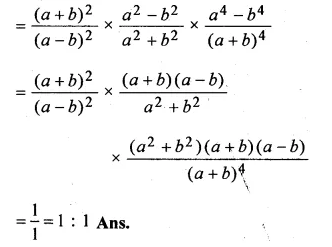
Find the compound ratio of:
(a + b)2 : (a – b )2 ,
(a2 – b2) : (a2 + b2),
(a4 – b4) : (a + b)4
Solution:
(a + b)2 : (a – b )2 ,
(a2 – b2) : (a2 + b2),
(a4 – b4) : (a + b)4
ML Aggarwal Class 10 Solutions for ICSE Maths Chapter 7 Ratio and Proportion Chapter Test Q1.1

Question 2.
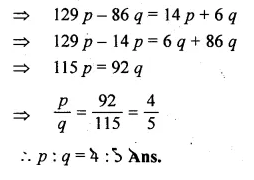
If (7 p + 3 q) : (3 p – 2 q) = 43 : 2 find p : q
Solution:
(7p + 3q) : (3p – 2q) = 43 : 2
⇒ \(\frac { 7p+3q }{ 3p-2q } =\frac { 43 }{ 2 } \)
ML Aggarwal Class 10 Solutions for ICSE Maths Chapter 7 Ratio and Proportion Chapter Test Q2.1

Question 3.
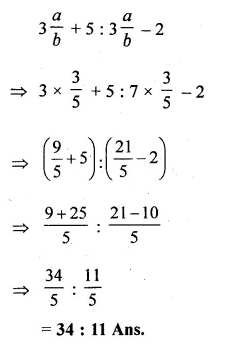
If a : b = 3 : 5, find (3a + 5b): (7a – 2b).
Solution:
a : b = 3 : 5
⇒ \(\frac { a }{ b } =\frac { 3 }{ 5 } \)
⇒ 3a + 5n : 7a – 2b
Dividing each term by b
ML Aggarwal Class 10 Solutions for ICSE Maths Chapter 7 Ratio and Proportion Chapter Test Q3.1

Question 4.
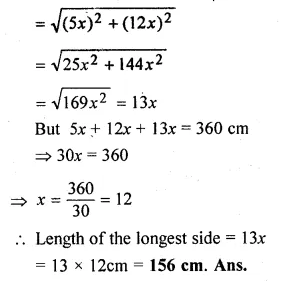
The ratio of the shorter sides of a right angled triangle is 5 : 12. If the perimeter of the triangle is 360 cm, find the length of the longest side.
Solution:
Let the two shorter sides of a right-angled triangle be 5x and 12x.
Third (longest side)
ML Aggarwal Class 10 Solutions for ICSE Maths Chapter 7 Ratio and Proportion Chapter Test Q4.1

Question 5.
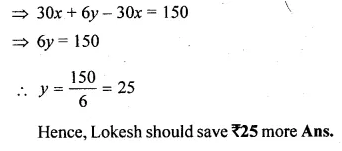
The ratio of the pocket money saved by Lokesh and his sister is 5 : 6. If the sister saves Rs 30 more, how much more the brother should save in order to keep the ratio of their savings unchanged?
Solution:
Let the savings of Lokesh and his sister are 5x and 6x.
and the Lokesh should save Rs y more Now, according to the problem,
⇒ \(\frac { 5x+y }{ 6x+30 } =\frac { 5 }{ 6 } \)
⇒ 30x + 6y = 30x + 150
ML Aggarwal Class 10 Solutions for ICSE Maths Chapter 7 Ratio and Proportion Chapter Test Q5.1

Question 6.
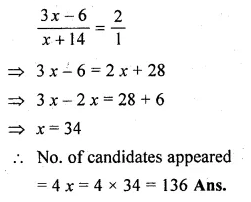
In an examination, the number of those who passed and the number of those who failed were in the ratio of 3 : 1. Had 8 more appeared, and 6 less passed, the ratio of passed to failures would have been 2 : 1. Find the number of candidates who appeared.
Solution:
Let number of passed = 3 x
and failed = x
Total candidates appeared = 3x + x = 4x.
In second case
No. of candidates appeared = 4 x + 8
and No. of passed = 3 x – 6
and failed = 4x + 8 – 3x + 6 = x + 14
then ratio will be = 2 : 1
Now according to the condition
ML Aggarwal Class 10 Solutions for ICSE Maths Chapter 7 Ratio and Proportion Chapter Test Q6.1

Question 7.
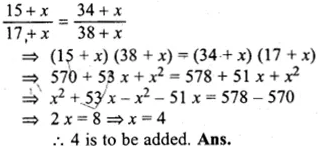
What number must be added to each of the numbers 15, 17, 34 and 38 to make them proportional ?
Solution:
Let x be added to each number, then numbers will be
15 + x, 17 + x, 34 + x, and 38 + x.
Now according to the condition
ML Aggarwal Class 10 Solutions for ICSE Maths Chapter 7 Ratio and Proportion Chapter Test Q7.1

Question 8.
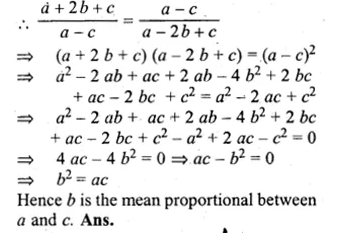
If (a + 2 b + c), (a – c) and (a – 2 b + c) are in continued proportion, prove that b is the mean proportional between a and c.
Solution:
(a + 2 b + c), (a – c) and (a – 2 b + c) are in continued proportion
⇒ \(\frac { a+2b+c }{ a-c } =\frac { a-c }{ a-2b+c } \)
ML Aggarwal Class 10 Solutions for ICSE Maths Chapter 7 Ratio and Proportion Chapter Test Q8.1

Question 9.
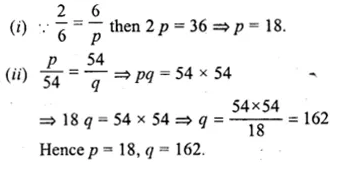
If 2, 6, p, 54 and q are in continued proportion, find the values of p and q.
Solution:
2, 6, p, 54 and q are in continued proportional then
⇒ \(\frac { 2 }{ 6 } =\frac { 6 }{ p } =\frac { p }{ 54 } =\frac { 54 }{ q } \)
ML Aggarwal Class 10 Solutions for ICSE Maths Chapter 7 Ratio and Proportion Chapter Test Q9.1

Question 10.
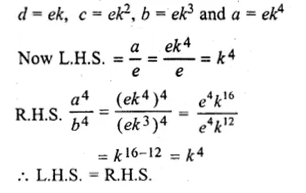
If a, b, c, d, e are in continued proportion, prove that: a : e = a4 : b4.
Solution:
a, b, c, d, e are in continued proportion
⇒ \(\frac { a }{ b } =\frac { b }{ c } =\frac { c }{ d } =\frac { d }{ e } \) = k (say)
ML Aggarwal Class 10 Solutions for ICSE Maths Chapter 7 Ratio and Proportion Chapter Test Q10.1

Question 11.
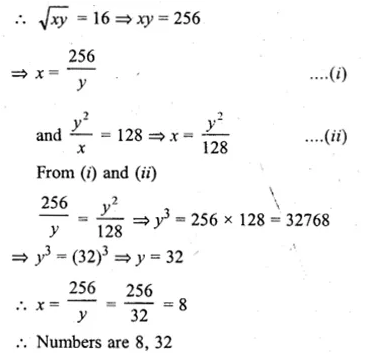
Find two numbers whose mean proportional is 16 and the third proportional is 128.
Solution:
Let x and y be two numbers
Their mean proportion = 16
and third proportion = 128
ML Aggarwal Class 10 Solutions for ICSE Maths Chapter 7 Ratio and Proportion Chapter Test Q11.1

Question 12.
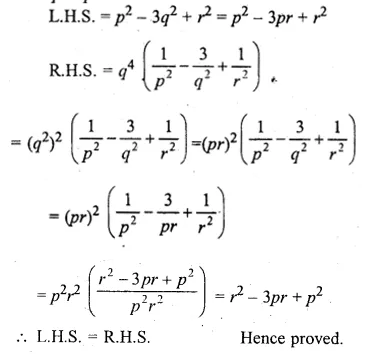
If q is the mean proportional between p and r, prove that:
\({ p }^{ 2 }-{ 3q }^{ 2 }+{ r }^{ 2 }={ q }^{ 4 }\left( \frac { 1 }{ { p }^{ 2 } } -\frac { 3 }{ { q }^{ 2 } } +\frac { 1 }{ { r }^{ 2 } } \right) \)
Solution:
q is mean proportional between p and r
q² = pr
ML Aggarwal Class 10 Solutions for ICSE Maths Chapter 7 Ratio and Proportion Chapter Test Q12.1

Question 13.
If \(\frac { a }{ b } = \frac { c }{ d } = \frac { e }{ f } \), prove that each ratio is
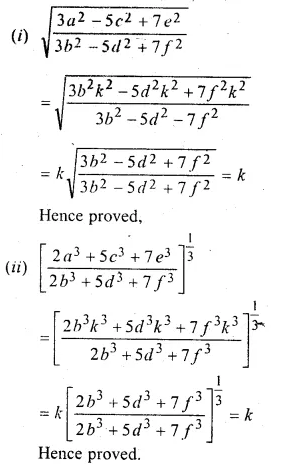
(i) \(\sqrt { \frac { { 3a }^{ 2 }-{ 5c }^{ 2 }+{ 7e }^{ 2 } }{ { 3b }^{ 2 }-{ 5d }^{ 2 }+{ 7f }^{ 2 } } } \)
(ii) \({ \left[ \frac { { 2a }^{ 3 }+{ 5c }^{ 3 }+{ 7e }^{ 3 } }{ { 2b }^{ 3 }+{ 5d }^{ 3 }+{ 7f }^{ 3 } } \right] }^{ \frac { 1 }{ 3 } } \)
Solution:
\(\frac { a }{ b } = \frac { c }{ d } = \frac { e }{ f } \) = k(say)
∴ a = k, c = dk, e = fk
ML Aggarwal Class 10 Solutions for ICSE Maths Chapter 7 Ratio and Proportion Chapter Test Q13.1

Question 14.
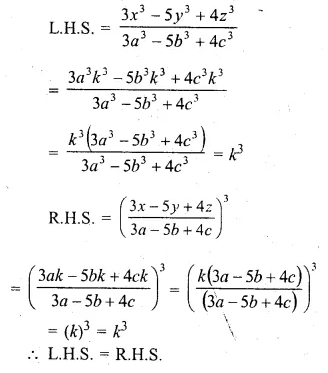
If \(\frac { x }{ a } = \frac { y }{ b } = \frac { z }{ c } \), prove that
\(\frac { { 3x }^{ 3 }-{ 5y }^{ 3 }+{ 4z }^{ 3 } }{ { 3a }^{ 3 }-{ 5b }^{ 3 }+{ 4c }^{ 3 } } ={ \left( \frac { 3x-5y+4z }{ 3a-5b+4c } \right) }^{ 3 }\)
Solution:
\(\frac { x }{ a } = \frac { y }{ b } = \frac { z }{ c } \) = k (say)
x = ak, y = bk, z = ck
ML Aggarwal Class 10 Solutions for ICSE Maths Chapter 7 Ratio and Proportion Chapter Test Q14.1

Question 15.
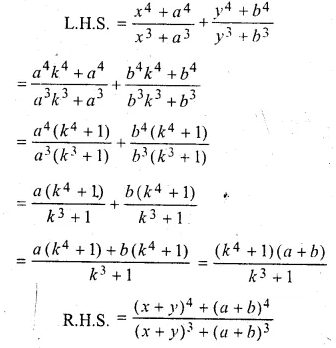
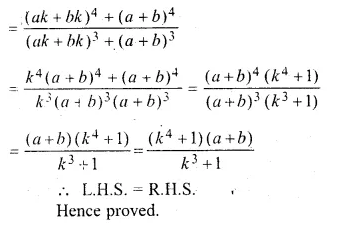
If x : a = y : b, prove that
\(\frac { { x }^{ 4 }+{ a }^{ 4 } }{ { x }^{ 3 }+{ a }^{ 3 } } +\frac { { y }^{ 4 }+{ b }^{ 4 } }{ { y }^{ 3 }+{ b }^{ 3 } } =\frac { { \left( x+y \right) }^{ 4 }+{ \left( a+b \right) }^{ 4 } }{ { \left( x+y \right) }^{ 3 }+{ \left( a+b \right) }^{ 3 } } \)
Solution:
\(\frac { x }{ a } = \frac { y }{ b } \) = k (say)
x = ak, y = bk
ML Aggarwal Class 10 Solutions for ICSE Maths Chapter 7 Ratio and Proportion Chapter Test Q15.1
ML Aggarwal Class 10 Solutions for ICSE Maths Chapter 7 Ratio and Proportion Chapter Test Q15.2

Question 16.
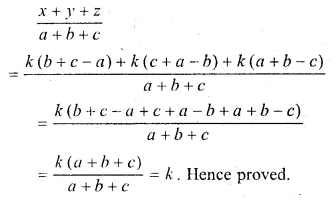
If \(\frac { x }{ b+c-a } =\frac { y }{ c+a-b } =\frac { z }{ a+b-c } \) prove that each ratio’s equal to :
\(\frac { x+y+z }{ a+b+c } \)
Solution:
\(\frac { x }{ b+c-a } =\frac { y }{ c+a-b } =\frac { z }{ a+b-c } \) = k(say)
x = k(b + c – a),
y = k(c + a – b),
z = k(a + b – c)
ML Aggarwal Class 10 Solutions for ICSE Maths Chapter 7 Ratio and Proportion Chapter Test Q16.1

Question 17.
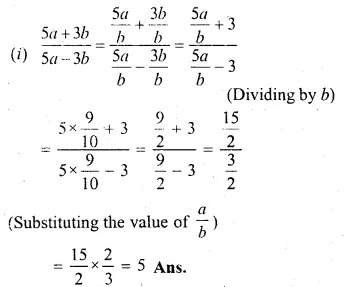
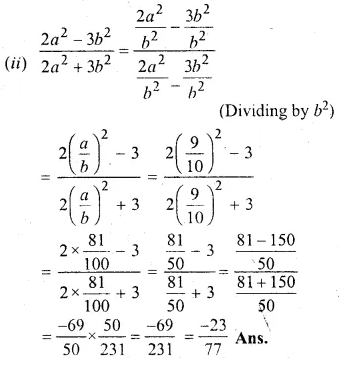
If a : b = 9 : 10, find the value of
(i) \(\frac { 5a+3b }{ 5a-3b } \)
(ii) \(\frac { { 2a }^{ 2 }-{ 3b }^{ 2 } }{ { 2a }^{ 2 }+{ 3b }^{ 2 } } \)
Solution:
a : b = 9 : 10
⇒ \(\frac { a }{ b } = \frac { 9 }{ 10 }\)
ML Aggarwal Class 10 Solutions for ICSE Maths Chapter 7 Ratio and Proportion Chapter Test Q17.1
ML Aggarwal Class 10 Solutions for ICSE Maths Chapter 7 Ratio and Proportion Chapter Test Q17.2

Question 18.
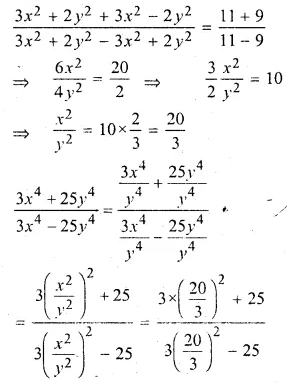
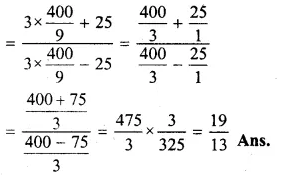
If (3x² + 2y²) : (3x² – 2y²) = 11 : 9, find the value of \(\frac { { 3x }^{ 4 }+{ 25y }^{ 4 } }{ { 3x }^{ 4 }-{ 25y }^{ 4 } } \) ;
Solution:
\(\frac { { 3x }^{ 4 }+{ 25y }^{ 4 } }{ { 3x }^{ 4 }-{ 25y }^{ 4 } } =\frac { 11 }{ 9 } \)
Applying componendo and dividendo
ML Aggarwal Class 10 Solutions for ICSE Maths Chapter 7 Ratio and Proportion Chapter Test Q18.1
ML Aggarwal Class 10 Solutions for ICSE Maths Chapter 7 Ratio and Proportion Chapter Test Q18.2

Question 19.
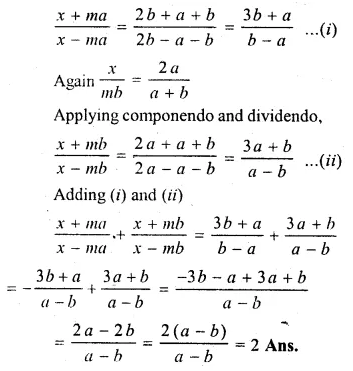
If \(x=\frac { 2mab }{ a+b } \) , find the value of
\(\frac { x+ma }{ x-ma } +\frac { x+mb }{ x-mb } \)
Solution:
\(x=\frac { 2mab }{ a+b } \)
⇒ \(\frac { x }{ ma } +\frac { 2b }{ a+b } \)
Applying componendo and dividendo
ML Aggarwal Class 10 Solutions for ICSE Maths Chapter 7 Ratio and Proportion Chapter Test Q19.1

Question 20.
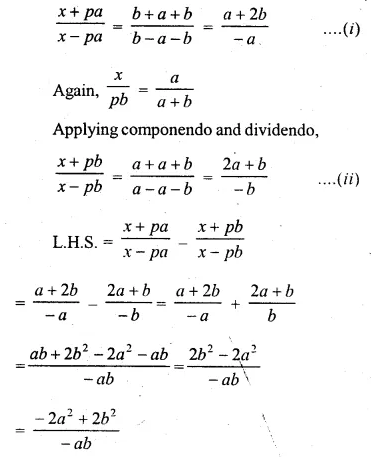
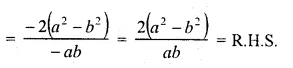
If \(x=\frac { pab }{ a+b } \) ,prove that \(\frac { x+pa }{ x-pa } -\frac { x+pb }{ x-pb } =\frac { 2\left( { a }^{ 2 }-{ b }^{ 2 } \right) }{ ab } \)
Solution:
\(x=\frac { pab }{ a+b } \)
⇒ \(\frac { x }{ pa } +\frac { b }{ a+b } \)
Applying componendo and dividendo
ML Aggarwal Class 10 Solutions for ICSE Maths Chapter 7 Ratio and Proportion Chapter Test Q20.1
ML Aggarwal Class 10 Solutions for ICSE Maths Chapter 7 Ratio and Proportion Chapter Test Q20.2

Question 21.
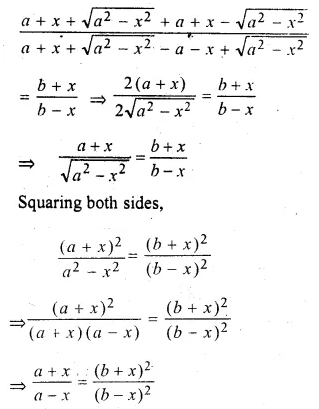
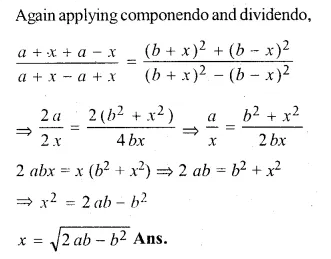
Find x from the equation \(\frac { a+x+\sqrt { { a }^{ 2 }-{ x }^{ 2 } } }{ a+x-\sqrt { { a }^{ 2 }-{ x }^{ 2 } } } =\frac { b }{ x } \)
Solution:
\(\frac { a+x+\sqrt { { a }^{ 2 }-{ x }^{ 2 } } }{ a+x-\sqrt { { a }^{ 2 }-{ x }^{ 2 } } } =\frac { b }{ x } \)
Applying componendo and dividendo,
ML Aggarwal Class 10 Solutions for ICSE Maths Chapter 7 Ratio and Proportion Chapter Test Q21.1
ML Aggarwal Class 10 Solutions for ICSE Maths Chapter 7 Ratio and Proportion Chapter Test Q21.2

Question 22.
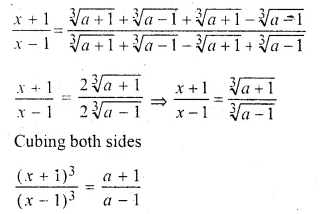
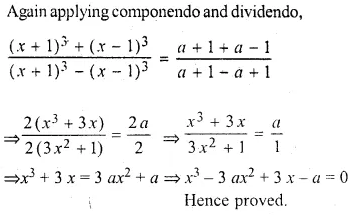
If \(x=\frac { \sqrt [ 3 ]{ a+1 } +\sqrt [ 3 ]{ a-1 } }{ \sqrt [ 3 ]{ a+1 } -\sqrt [ 3 ]{ a-1 } } \), prove that :
x³ – 3ax² + 3x – a = 0
Solution:
\(x=\frac { \sqrt [ 3 ]{ a+1 } +\sqrt [ 3 ]{ a-1 } }{ \sqrt [ 3 ]{ a+1 } -\sqrt [ 3 ]{ a-1 } } \)
Applying componendo and dividendo,
ML Aggarwal Class 10 Solutions for ICSE Maths Chapter 7 Ratio and Proportion Chapter Test Q22.1
ML Aggarwal Class 10 Solutions for ICSE Maths Chapter 7 Ratio and Proportion Chapter Test Q22.2

Question 23.
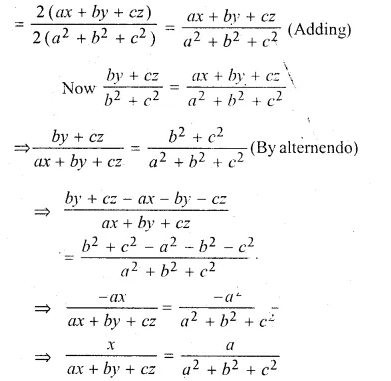
If \(\frac { by+cz }{ b^{ 2 }+{ c }^{ 2 } } =\frac { cz+ax }{ { c }^{ 2 }+{ a }^{ 2 } } =\frac { ax+by }{ { a }^{ 2 }+{ b }^{ 2 } } \), prove that each of these ratio is equal to \(\frac { x }{ a } =\frac { y }{ b } =\frac { z }{ c } \)
Solution:
\(\frac { by+cz }{ b^{ 2 }+{ c }^{ 2 } } =\frac { cz+ax }{ { c }^{ 2 }+{ a }^{ 2 } } =\frac { ax+by }{ { a }^{ 2 }+{ b }^{ 2 } } \)
ML Aggarwal Class 10 Solutions for ICSE Maths Chapter 7 Ratio and Proportion Chapter Test Q23.1
ML Aggarwal Class 10 Solutions for ICSE Maths Chapter 7 Ratio and Proportion Chapter Test Q23.2

Hope given ML Aggarwal Class 10 Solutions for ICSE Maths Chapter 7 Ratio and Proportion Chapter Test are helpful to complete your math homework.

If you have any doubts, please comment below. Learn Insta try to provide online math tutoring for you.

CA Foundation Business Laws Study Material Chapter 11 Conditions and Warranties

CA Foundation Business Laws Study Material Chapter 11 Conditions and Warranties

Sec. 12 of the Sale of Goods Act states that a stipulation (or term) in a contract of sale with reference to goods may be a condition or a warranty.
CA Foundation Business Laws Study Material Chapter 11 Conditions and Warranties 1

CONDITION

A condition is a stipulation essential to the main purpose of the contract, the breach of which gives rise to a right to treat the contract as repudiated. [Sec. 12(2)]
For example, A wants to buy a car which can give a mileage of 20 kms/litre. B, the car dealer, points out at a particular car and says “this car will suit you”. A buys the car. But later on he finds that the car is giving a mileage of only 10 kms/litre. THERE IS A BREACH OF CONDITION, because the stipulation made by B forms the very basis of the contract.

WARRANTY

A warranty is stipulation collateral to the main purpose of the contract, the breach of which gives rise to claim for damages but not a right to reject the goods and treat the contract as repudiated- I [Sec. 12(3)]
For example : A goes to B, a car dealer, and says, “I want a good car” The car dealer shows him a car and says, “it can give you a mileage of 20 kms/litre”. A buys the car. Later on, A finds that the car is giving a mileage of 10 kms/litre only. THERE IS A BREACH OF WARRANTY, because the stipulation made by the seller was only collateral one.
Whether a stipulation in a contract of sale is a condition or a warranty depends in each case on the construction of the contract. A stipulation may the a condition, though called a warranty in the contract – [Sec. 12(4)]
Conditions and warranties may be expressly stated or may be implied by law. Implied conditions and warranties are enumerated in sections 14 to 17. They are deemed to be incorporated in every contract of sale unless the terms of the contract show a contrary intention.

When a condition can be treated as a warranty:
Voluntary waiver of a condition [Sec. 13(1)]
1. Where a contract of sale is subject to a condition to be fulfilled by the seller, the buyer may—

  1. waive the condition, for example a buyer may accept defective goods or accept goods
    beyond stipulated time.
  2. elect to treat a breach of condition as a breach of warranty, i.e. instead of repudiating the contract he may accept performance and sue for damages, if he has suffered any.

Once a buyer decides to waive, he cannot afterwards insist on its fulfilment.

Compulsory waiver of a condition [Sec. 13(2)]
Where a contract of sale is not severable (Le. indivisible) and the buyer has accepted the goods or a part thereof, he cannot repudiate the contract but can only sue for damages. In such a case, the breach of condition can only be treated as a breach of war ranty, unless there is a contract to the contrary. [Sec. 13(2)]
E.g: W bought laptops from M and resold it to C without examining the laptops. The laptops were defective. It was held that W must be deemed to have accepted the goods and therefore he could not repudiate the contract but could claim only damages.

  • However, there may be an agreement between the parties which may be contrary to section 13(2). In that case the parties may agree between themselves that the provision of section 13(2) will not apply in their case and the buyer shall have a right to reject the goods even though he has accepted the indivisible goods.
  • If the contract of sale is divisible and the buyer has accepted a part of the goods, he can still exercise the right to reject the remaining goods.
  • Impossibility [Sec.13(3)] : The above provisions of Section 13(1) and 13(2) do not affect the cases where the fulfilment of any condition or warranty is excused by law by reason of impossibility or otherwise. This means that under section 13(3) the seller has the right to rely upon impossibility as an excused in appropriate cases, if sued by the buyer.

    CONDITION

    WARRANTY

    Condition is a term, which is essential to the main purpose of the contract.Warranty is only a collateral term. It is subsidiary to the main purpose of the contract.
    Breach of a condition gives the aggrieved party a right to repudiate the contract and also to claim damages.Breach of warranty entitles the aggrieved party to claim damages only. He cannot repudiate the contract.
    A breach of condition may under certain circumstances, be treated as breach of warrantyBut a warranty cannot become a condition.

IMPLIED CONDITIONS AND WARRANTIES
A stipulation (or term) in a contract of sale of goods may be express or implied. Express terms are those which have been expressly agreed upon by the parties. Implied terms are those which have been enacted in the Sale of Goods Act. Sections 14 to 17 of the Act contain a list of conditions and warranties which are implied in a contract for the sale of goods, unless the circumstances of the contract are such as to show a different intention. The implied conditions and warrants are stated below:
(a) Implied conditions
1. Implied condition as to title. – [Sec. 14]
There is an implied condition on the part of the seller that, in the case of a sale he has the right to sell the goods, and in the case of an agreement to sell, he will have the right to sell the goods at the time when the property is to pass. If the seller’s title turns out to be defective, the buyer is entitled to reject the goods and claim refund of the price plus damages.

  • A bought a motor car from B. He used it for 3 months and thereafter the car was detected to have been stolen. A was compelled to return it to the true owner. Could A recover the sale price from B?
    (Ans: Yes)
  • A sells to B tins of condensed milk labelled “Nissly Brand” and this is proved to be an infringement of Nestle Company’s trade mark. Is it a breach of implied condition as to title?
    (Ans: When a person sell the goods by infringing a copyrights or trademark of the others, he is considered as not having right to sell such goods.)

2. Implied condition in a sale by description. – [Sec. 14]
Where there is a contract for the sale of goods by description, there is an implied condition that the goods shall correspond with the description. “Correspond with the description” means that the buyer must get the goods that he has asked for. The description may be given—

  1. by mentioning qualities or characteristics of the goods e.g. Basmati rice.
  2. by mentioning the trademark or brand name e.g. Videocon TV.
  3. by the type of packing e.g. 1 kg. packing of tea in plastic jar.

If the buyer does not get the goods he has described he can reject the goods. The rule is “If you contract to sell peas, you cannot oblige a party to take beans. If the description of the article tendered is different in any respect, it is not the article bargained for, and the other party is not bound to take it”. E.g. A car is sold as a “new maruti car”. The buyer finds it to be a used one. The buyer may reject the car or retain the car and claim damages.

3. Implied condition in a sale by sample as well as by description. – [Sec. 15]
When goods are sold by sample as well as by description, the goods shall correspond both with the sample and with the description.

4. Implied condition as to fitness or quality. – [Sec. 16(1)]
The general rule is, there is no implied condition as to quality or fitness for the purpose of the buyer. This is based on the doctrine of “caveat emptor” that is, let the buyer beware. It means that while buying the goods, it is the responsibility of the buyer to check that the goods he is buying would suit his purpose or not. However, in the following situation, the responsibility as to fitness of goods falls upon the seller:
a. where the buyer, expressly or by implication, makes known to the seller the particular purpose for which the goods are required,
b. so as to show that the buyer relies on the seller’s skill, or judgment, and
c. the goods are of a description which it is in the course of the seller’s business to supply (whether he is the manufacturer or not), there is an implied condition that the goods shall be reasonably fit for such purpose.

  • A contracts to make and deliver a set of false teeth to B. The false teeth do not fit in the mouth of B. B is entitled to reject the goods.
  • X places order for lorries to be used for ‘heavy traffic in a hilly country’. The lorries were unfit for this purpose and broke down. It was held that there was breach of condition as to fitness.

Sale under patent or trade name. Proviso to section 16(1) lays down that in the case of a contract for the sale of a specified article under its patent or other trade name, there is no implied condition as to its fitness for any particular purpose. It is so because in such a case the buyer is not relying on the skill and judgment of the seller but relies on the patent name. For example, a hotelier orders ‘Sujeet’ juicer and mixer (patent product) for his business. The juicer and mixer supplied was found to be unsuitable for commercial use. The buyer has no cause of action against the seller, since he purchased the juicer by its patent name.

5. Implied condition as to merchantability. – [Sec. 16(2)]
Where goods are brought by description from a seller who deals in goods of that description, there is an implied condition that goods shall be of merchantable quality. Merchantable means that the goods are commercially saleable and that they are hit for the purpose for which they are generally used.
Where the buyer examines the goods prior to sale, there is no implied condition as to merchantability as regards defects which such examination ought to have revealed. However, inspite of exil amination, if the goods have certain latent defects which no examination could reveal, the implied condition remains.

  • X bought a colour TV from M/s Concord Electronics. The TV was defective right from the beginning and it did not work inspite of repairs by expert technicians. There is a breach of implied condition as to merchantability and the dealer will have to take back the defective TV and refund the amount.
  • X orders motor horns from a manufacturer. The horns supplied are defective. X is entitled to reject them as unmerchantable.

6. Implied condition in a sale by sample. – [Sec. 17]
When goods are to be supplied according to a sample agreed upon, the following conditions are implied:

  1. The bulk shall correspond with the sample in quality.
  2. The buyer shall have a reasonable opportunity of comparing the goods with the sample.
  3. The goods shall be free from any latent defect ( hidden defect) rendering them unmerchantable. Latent defects are the defects which would not be apparent on reasonable examination of the sample and they can be discovered only when the goods are put to use. If the defect is easily discoverable on inspection and the buyer takes delivery after inspection, he has no remedy.

A sale is by sample where there is a term in contract, express or implied to that effect. The effect of the section is that where goods are sold by sample, there should not be any latent defect therein which renders them unmerchantable.

7. Implied condition as to wholesomeness
In case of food stuff and eatables, in addition to the implied condition as to merchantability, there is another implied condition that the goods shall be wholesome that is fit for human consumption.
X bought milk from Y, a dairy owner. The milk was contaminated with germs of typhoid fever. X’s
wrfe, on taking the milk, became infected and died of it. Y was held liable in damages.

(b) Implied warranties
In the absence of an agreement to the contrary, the following warranties are implied in every con-tract of sale:
1. The buyer must get quiet possession [Sec. 14(b)]
The buyer shall have and enjoy quiet possession of the goods. For e.g.: X has given his car on hire for a period of one month to Y. Thereafter, X sold it to Z without disclosing to him that Y was en-titled to use the car on account of the hire agreement. Z claims the car from Y. Y’s possession is disturbed. He can claim damages from X.

2. The goods must be free from encumbrance [Sec. 14(c)]
There is an implied warranty that the goods shall be free from any charge or encumbrance in favour of a third party not declared or known to the buyer before or at the time when the contract iis made. The effect of this clause is that if the buyer pays off the charge of encumbrance, he will be entitled to recover the money from the seller.

3. Warranty for quality or use by usage of trade [Sec. 16(3)]
A warranty as to fitness for a particular purpose may be annexed to a contract of sale by a custom usage of trade.

4. Disclosure of dangerous nature of goods
Where the goods are dangerous in nature and the buyer is ignorant of the danger, the seller must warn the buyer of the probable danger. If there is a breach of this warranty, the seller may be liable i in damages.
Note:

  1. Express terms – [Sec. 16(4)]: An express warranty or condition does not negate a warranty or condition implied by the Act. (Unless the express terms are inconsistent with the implied conditions). This means that implied warranty or condition may co-exist with express warranty or condition. Thus, for example, where sleepers supplied to a railway company were required to be approved by its experts, it was held that it did not exclude the implied condition of merchantableness.
  2. Exclusion of implied terms – [Sec. 62]: These implied conditions and warranties may be ex- eluded or modified by the parties to the contract by express contract, by course of dealing i and by usage of trade.

THE DOCTRINE OF CAVEAT EMPTOR

Caveat Emptor is a Latin expression, which means, “Buyers Beware”. The doctrine of caveat emptor means that, ordinarily, a buyer must buy goods after satisfying himself of their quality and fitness. If he makes a bad choice he cannot blame the seller or recover damages from him. This doctrine is stated in the opening words of section 16: Subject to the provisions of this Act and of any other law for the time being in force, there is no implied warranty or condition as to the quality or fitness for any particular purpose of goods supplied under a contract of sale.

  • It is buyer’s duty to examine goods thoroughly.
  • The buyer should ensure at the time of purchase that the goods conform to his requirements.
  • If the goods turn out to be defective, buyer cannot hold the seller responsible.

EXCEPTIONS:
The doctrine of caveat emptor does not apply in the following situations:
1. Fitness as to quality or use. [Sec. 16(1)]

  1. Where the buyer, expressly or by implication, makes known to the seller the particular purpose for which the goods are required,
  2. soas to show that the buyer relies on the seller’s skill, or judgment, and
  3. the goods are of a description which it is in the course of the seller’s business to supply (whether he is the manufacturer or not, there is an implied condition that the goods shall be reasonably fit for such purpose.)

In Priest Vs. Last, P purchased a hot water bottle from a chemist. The chemist informed him that the bottle was specially meant for holding hot water. At the time of use, the bottle burst as soon as hot water was poured into it and injured P’s wife. Chemist was held liable to pay damages to P’.
However, this rule does not apply when the goods are sold under a patent or a brand name.

2. Sale of goods by description. [Sec. 16(2)]
Where there is a sale of goods by description, there is an implied condition that the goods are merchantable that is, fit for particular purpose.

3. Trade usage. [Sec. 16(3)]
An implied condition of fitness may be annexed to a contract of sale by usage of trade.
E.g. In readymade garment business, there is an implied condition by usage of trade that the garments shall be reasonably fit on the buyer.

4. Where the seller is guilty of fraud.
Where the seller makes a false representation and buyer relies on that representation, the doctrine of caveat emptor will not apply. In such a case the buyer will be entitled to the goods according to that representation.

5. Where seller actively conceals a defect
Where the seller actively conceals a defect in the goods so that the same could not be discovered on a reasonable examination, the doctrine of caveat emptor will not apply. Such a contract will be voidable.

6. Sale by sample
When goods are purchased by sample, the bulk must correspond with the sample and the buyer must have reasonable opportunity of inspecting the goods.

7. Sale by sample as well as description
The doctrine of Caveat Emptor is not applicable if the goods do not correspond to both, sample as well as description.

MULTIPLE CHOICE QUESTIONS:

1. Conditions are stipulations
(a) essential to the main purpose of the contract
(b) collateral to the main purpose of the contract
(c) either ‘a’ or ‘b’
(d) neither ‘a’ nor ‘b’

2. A warranty is stipulation
(a) essential to the main purpose of the contract
(b) collateral to the main purpose of the contract
(c) very important to the seller
(d) very important to the buyer

3. Breach of a condition gives rise to
(a) claim for damages
(b) a right to treat the contract as repudiated
(c) both ‘a’ and ‘b’
(d) either ‘a’ or ‘b’

4. Breach of a warranty gives rise to
(a) claim for damages
( b) a right to treat the contract as repudiated
(c) both ‘a’ and ‘b’
(d) either ‘a’ or ‘b’

5. What are implied stipulations of a contract?
(a) agreed by the parties.
(b) incorporated by law unless specifically agreed otherwise.
(c) implied by the circumstances
(d) implied by trade customs

6. If the condition as to the title of goods is not fulfilled, the buyer
(a) may reject the goods
(b) has no alternative but to buy the goods
(c) may reject the goods and claim damages
(d) all the above

7. In a sale by sample and description, there is an implied condition
(a) that bulk of the goods correspond with the sample
(b) that bulk of goods must correspond to the j description as well as the sample thereof
(c) the bulk of goods must correspond either to the description or to the sample
(d) the bulk of goods must correspond to the description only

8. “If you contract to sell peas, you cannot oblige a party to have beans”: this statement applies to
(a) a implied condition as to be description of goods
(b) the implied condition as to fitness of goods
for a particular purpose
(c) implied condition as to sample
(d) implied condition as to title

9. Under section 11 of the Sale of Goods Act, 1930, the time of payment can be of the essence of the contract —
(a) by agreement between the parties
(b) by operation of law
(c) both (a) and (b)
(d) either (a) or (b)

10. Whether or not any stipulation other than time of payment is of the essence of the contract depends upon —
(a) application of section 11
(b) operation of law
(c) terms of the contract
(d) all of the above

11. A stipulation in a contract of sale which is collateral to the main purpose of contract is called as
(a) guarantee
(b) warranty
(c) condition
(d) term

12. Merchantable quality of goods means
(a) that the goods are commercially saleable
(b) they are fit for the purpose for which they are generally used
(c) both ‘a’ and ‘b’
(d) the quality should be of high standard

Answers:
CA Foundation Business Laws Study Material Chapter 11 Conditions and Warranties 2

STATE WHETHER THE FOLLOWING ARE TRUE OR FALSE:

1. Where the buyer is deprived to goods by their true owner then the buyer may recover the price for breach of the condition as to title.
2. A stipulation essential to the main purpose of the contract is called as guarantee.
3. There is an implied condition that the goods shall be free from all encumbrances.
4. If a contract of sale contains a stipulation which has become impossible to perform the law excuses such a stipulation by reason of impossibility.
5. Breach of implied warranties leads to the repudiation of a contract.
6. Once the buyer decides to waive the condition he cannot insist on its fulfilment later on.
7. Implied condition as to description can be given by the type of packing.

Answers:
CA Foundation Business Laws Study Material Chapter 11 Conditions and Warranties 3

ML Aggarwal Class 10 Solutions for ICSE Maths Chapter 7 Ratio and Proportion MCQS

ML Aggarwal Class 10 Solutions for ICSE Maths Chapter 7 Ratio and Proportion MCQS

These Solutions are part of ML Aggarwal Class 10 Solutions for ICSE Maths. Here we have given ML Aggarwal Class 10 Solutions for ICSE Maths Chapter 7 Ratio and Proportion MCQS

More Exercises

Choose the correct answer from the given options (1 to 10):

Question 1.
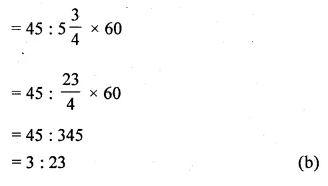
The ratio of 45 minutes to \(5 \frac { 3 }{ 4 } \) hours is
(a) 180:23
(b) 3:23
(c) 23:3
(d) 6:23
Solution:
ratio of 45 minutes to \(5 \frac { 3 }{ 4 } \) hours is
45 minutes to : \(5 \frac { 3 }{ 4 } \) hours
ML Aggarwal Class 10 Solutions for ICSE Maths Chapter 7 Ratio and Proportion MCQS Q1.1

Question 2.
The ratio of 4 litres to 900 mL is
(a) 4 : 9
(b) 40 : 9
(c) 9 : 40
(d) 20 : 9
Solution:
4l : 900 ml
= 4000 ml : 900 ml
= 4000 : 900
= 40 : 9 (b)

Question 3.
When the number 210 is increased in the ratio 5 : 7, the the new number is
(a) 150
(b) 180
(c) 294
(d) 420
Solution:
210 is increased in the ratio 5 : 7, then
New increased number will be
= 210 × \(\\ \frac { 7 }{ 5 } \)
= 294 (c)

Question 4.
Two numbers are in the ratio 7 : 9. If the sum of the numbers is 288, then the smaller number is
(a) 126
(b) 162
(c) 112
(d) 144
Solution:
Ratio in two number = 7 : 9
Sum of numbers = 288
Sum of ratios = 7 + 9
= 16
Smaller number = \(\\ \frac { 288\times 7 }{ 16 } \)
= 126 (a)

Question 5.
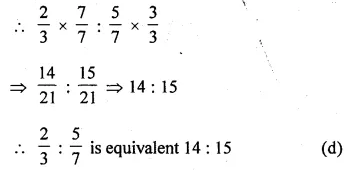
A ratio equivalent to the ratio \(\\ \frac { 2 }{ 3 } \) : \(\\ \frac { 5 }{ 7 } \) is
(a) 4:6
(b) 5:7
(c) 15:14
(d) 14:15
Solution:
\(\\ \frac { 2 }{ 3 } \) : \(\\ \frac { 5 }{ 7 } \)
Multiply and divide \(\\ \frac { 2 }{ 3 } \) by 7 and
Multiply and divide \(\\ \frac { 5 }{ 7 } \) by 3
ML Aggarwal Class 10 Solutions for ICSE Maths Chapter 7 Ratio and Proportion MCQS Q5.1

Question 6.
The ratio of number of edges of a cube to the number of its faces is
(a) 2 : 1
(b) 1 : 2
(c) 3 : 8
(d) 8 : 3
Solution:
No. of edges of the cube = 12
No. of faces = 6
Ratio in edges a cube to the number of faces = 12 : 6
= 2 : 1 (a)

Question 7.
If x, 12, 8 and 32 are in proportion, then the value of x is
(a) 6
(b) 4
(c) 3
(d) 2
Solution:
x, 12, 8, 32 are in proportion, then
x × 32 = 12 × 8 (∵ ad = bc)
⇒ x = \(\\ \frac { 12\times 8 }{ 32 } \) = 3
x = 3 (c)

Question 8.
The fourth proportional to 3, 4, 5 is
(a) 6
(b) \(\\ \frac { 20 }{ 3 } \)
(c) \(\\ \frac { 15 }{ 4 } \)
(d) \(\\ \frac { 12 }{ 5 } \)
Solution:
The fourth proportion to 3, 4, 5 will be
= \(\\ \frac { 4\times 5 }{ 3 } \)
= \(\\ \frac { 20 }{ 3 } \) (b)

Question 9.
The third proportional to \(6 \frac { 1 }{ 4 } \) and 5 is
(a) 4
(b) \(8 \frac { 1 }{ 2 } \)
(c) 3
(d) none of these
Solution:
The third proportional to \(6 \frac { 1 }{ 4 } \) and 5 is
⇒ \(6 \frac { 1 }{ 4 } \) : 5 :: 5 : x
⇒ \(\\ \frac { 25 }{ 4 } \) : 5 :: 5 : x
⇒ x = \(\\ \frac { 5\times 5 }{ 25 } \) × 4
⇒ 4 (a)

Question 10.
The mean proportional between \(\\ \frac { 1 }{ 2 } \) and 128 is
(a) 64
(b) 32
(c) 16
(d) 8
Solution:
The mean proportional between \(\\ \frac { 1 }{ 2 } \) and 128 is
= \(\sqrt { \frac { 1 }{ 2 } \times 128 } \)
= √64
= 8 (d)

Hope given ML Aggarwal Class 10 Solutions for ICSE Maths Chapter 7 Ratio and Proportion MCQS are helpful to complete your math homework.

If you have any doubts, please comment below. Learn Insta try to provide online math tutoring for you.

CA Foundation Business Laws Study Material Chapter 10 Formation of Contract of Sale

CA Foundation Business Laws Study Material Chapter 10 Formation of Contract of Sale

INTRODUCTION

The Sale of Goods Act, 1930, governs transfer of property in goods. It does not include transfer of immovable property which is governed by the Transfer of Property Act, 1882.

  • Contract of Sale of Goods is a special contract. Originally, it was part of Indian Contract Act itself in chapter VII (sections 76 to 123). Later these sections in Contract Act were deleted, and separate Sale of Goods Act was passed in 1930.
  • The Sale of Goods Act, 1930, contains 66 sections in VII Chapters. It came into force on the 1st of July 1930 as, ‘The Indian Sale of Goods Act, 1930’. Later in 1963, the word “Indian” was omitted and it became “The Sale of Goods Act, 1930”.
  • The Sale of Goods Act, extends to the whole of India except the State of Jammu and Kashmir.
  • As per section 3 of the Sale of Goods Act, the principles of the Contract Act relating to formation of contract, performance of contract, law of damages etc. are also applicable to contract of the sale of goods insofar as they are not inconsistent with the express provisions of the Sale of Goods Act.

A. WHAT IS A CONTRACT OF SALE?
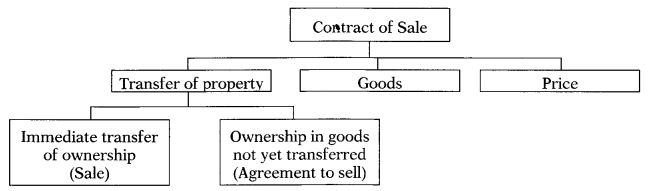
Sec. 4(1) of the Sale of Goods Act defines a contract of sale of goods as -“a contract whereby the seller transfers or agrees to transfer the property in goods to the buyer for a price”.
 contract of sale of goods, like any other contract, results by an offer by one party and its acceptance by the other. The parties are free to decide the terms and conditions of performance of their contract. Wherever the contract is silent, rules provided by the Sale of Goods Act apply to the relevant issue.

Buyer means a person who buys or agrees to buy goods. [Sec. 2(1)]
Seller means a person who sells or agrees to sell goods. [Sec. 2(13)]
Property means the general property in goods, and not merely a special property. Sec. 2(11). Property means ownership. If A who owns goods pledges them for raising money to B, A has the general property in the goods, while B (pledgee, person with whom goods are pledged) has a special property or interest in them, e.g. pledgee has a right to retain the pledged goods until he is paid by A (pledgor) the entire amount of his loan with interest.
CA Foundation Business Laws Study Material Chapter 10 Formation of Contract of Sale 1

Essential characteristics of a contract of sale

  1. Two parties – there must be two parties a buyer and a seller.
  2. Transfer of property – a transfer of property i.e. ownership, in goods from the seller to the buyer must take place (in the case of sale) or ownership should be agreed to be transferred (in the case of agreement to sell)
  3. Goods – the subject matter of sale must be goods.
  4. Price – transfer of property must take place for some money consideration called price.
  5. It includes both a ‘sale’and ‘an agreement to sell’.
  6. A contract of sale may be absolute or conditional [Sec. 4(2)].
  7. It may be in writing/oral or implied
  8. Essential elements of a valid contract must be present.

B. SALE & AGREEMENT TO SELL
A contract for the sale of goods may be either a sale or an agreement to sell.
Sale
Where under a contract of sale the property in the goods (Le. the ownership) is transferred from the seller to the buyer the contract is called a sale. Sec. 4(3). The transaction is a sale even though the price is payable at a later date or delivery is to be given in the future, provided the ownership of the goods is transferred from the seller to the buyer.
Example: S makes a contract with P for sale of his Nano Car for Rs. 80,000. P makes the payment and takes the delivery of car. This is the transaction of sale where the ownership has passed from S to P for a price.

Agreement to sell
When the transfer of ownership is to take place at a future time or subject to some condition to be fulfilled later, the contract is called an agreement to sell. [Sec. 4(3)]
Example: S agrees to sell his Car to P for Rs. 2,00,000 after one month. P agrees to buy the car and make payment after one month. This an agreement to sell and it will become a sale after one month when P make the payment and gets the ownership of car.
The conditional contract of sale like goods sent op “sale or return” basis are in the nature of an agreement to sell.

When an agreement to sell becomes a sale?
An agreement to sell becomes a sale when the prescribed time elapses or the conditions, subject to which the property in the goods is to be transferred, are fulfilled. [Sec. 4(4)]
Thus, if goods are delivered to the buyer on approval Le. “on sale or return”, the transaction is an agreement to sell, but it becomes a sale and the property in the goods passes to the buyer where the buyer gives his approval or acceptance to the seller.

SALE                  

AGREEMENT TO SELL

1. Transfer of property

The title to the goods passes to the buyer immediately.The title to the goods passes to the buyer on future date or on fulfilment of some condition.

2. Nature of Contract

It is an executed contract.It is an executory contract.

3. Burden of risk

Risk of loss is that of buyer since risk follows ownership.Risk of loss is that of seller.

4. Nature of rights

It creates jus in rem that is the buyer as a owner gets the right to enjoy the goods against the whole world. If the seller refuses to deliver the goods the buyer may sue for recovery of goods by specific performance.It creates jus in personam that is the buyer has only a personal remedy against the seller. He can sue only for damages for breach and not for recovery of goods.

5. Remedies for breach

If the buyer fails to pay for the goods, the seller may sue for the price (suit for price sec. 55) and also has other remedies available to an unpaid seller.If the buyer fails to accept and pay for the goods, the seller can only sue for damages and not for price. (Damages for non­acceptance sec. 56)

6. Insolvency of Buyer

If the buyer becomes insolvent before paying the price, the seller shall have to deliver the goods to the Official Receiver on his demand because the ownership of the goods has passed to the buyer.Since the seller continues to be the owner, he can refuse to deliver the goods to the Official Receiver unless he is paid the price because the seller continuous to be the owner of the goods.

7. Insolvency of Seller

If the seller becomes insolvent while the goods are still in his possession, the buyer shall have a right to claim the goods from the Official Receiver because the ownership of goods has passed to the buyer.If the seller becomes insolvent, the buyer cannot claim the goods. If the buyer has paid the price he can claim ratable dividend from the estate of the insolvent seller.

Sale & Hire-Purchase
Hire purchase agreement is a contract for the hire of an asset, which contains a provision giving the hirer an option to purchase. A hire purchase agreement has two elements:

  1. Element of bailment, since the possession of goods is given to the buyer
  2. Element of sale, since it contemplates an eventual sale.

The hirer is given an option either to become the owner after the payment of the stipulated hire charges/instalments or to return the goods and put an end to the hiring. The agreement must give the hirer an option to terminate the agreement and to refuse payment for further instalments, if he so desires. If the hirer defaults in paying the instalments, the seller can terminate the agreement and resume the possession of the goods.
If there is an immediate transfer of ownership of goods, it is a sale, even though, the price is paid by instalments.

SALE

HIRE-PURCHASE

(1)

In a contract of sale, the seller transfers or agrees to transfer the property in goods to the buyer for a price.In hire purchase there is an agreement for the hire of an asset conferring an option to purchase.

(2)

The ownership in goods passes on making the contract even if price is paid in instalments.The ownership passes when the option to purchase is finally exercised by the intending purchaser after complying with the terms of agreement.

(3)

The purchaser becomes owner of goodsIn a hire-purchase the hirer is not the owner but only a bailee of goods.

(4)

After a sale takes place the buyer cannot terminate the contract and refuse to pay the price of the goods.In a hire-purchase the hire purchaser can terminate the contract at any time and he is not bound to pay any further instalments.

(5)

On default by the buyer the seller cannot claim back the goods.On default of any payment by the hirer, the owner of the article has the right to terminate the agreement and to regain the possession of the article.

Sale and contract for work and labour
A contract of sale involves transfer of property in goods for a price. A contract for work and labour involves exercise of skill or labour. The main object is providing service by using skills, though goods are also delivered under the contract. For example, where a goldsmith is given gold for making ornaments or an artist is given paint and canvas to paint a picture, These are contracts of work and labour.

  • Nagpur Computer Services Ltd. has taken a comprehensive maintenance contract of computers which covers not only the maintenance of computers but also the supply of spares. This is a contract of work and labour.
  • A lady gave a plain saree to Jariwala Brothers for embroidering with Jari, to be purchased by Jariwala Brothers. It was held by the court that it was contract for work and labour and not a sale.

Sale and bailment
In case of bailment possession of goods is transferred from the bailor to bailee for some purpose, e.g., safe custody, repair, etc. The goods are to be returned on the fulfilment of purpose. In case of sale there is transfer of ownership, and the question of return of goods does not arise. The following are the points of distinction:

SALE

BAILMENT

(1)

In a contract of sale, the seller transfers or agrees to transfer the property in goods to the buyer for a price.In case of bailment possession of goods is transferred from the bailor to bailee for some purpose, e.g., safe custody, repair, etc.

(2)

The buyer can deal with the goods the way he likes.The bailee can use the goods only for the intended purpose of bailment

(3)

The buyer gets ownership of the goods.The bailee only acquires possession.

(4)

Generally, the goods are not returnable in a contract of sale.The goods are returnable after a specified period or when the purpose for which they were delivered is achieved.

(5)

The consideration for a sale is the price in terms of money.The consideration for bailment may be gratuitous or non-gratuitous.

C. FORMALITIES OF CONTRACT OF SALE [SEC. 5]
A contract of sale is formed by offer and acceptance. There is an offer to sell or buy goods for a price and the acceptance of such an offer.
– The contract shall provide for delivery of goods. Delivery may be immediate, simultaneous, by instalments or in future.
– The contract shall provide for payment of price. Payment of price may be immediate, simultaneous, by instalments or in future.
Contract of Sale. – How it is Made?

  1. May be in writing
  2. May be by word of mouth
  3. May be partly in writing and partly oral
  4. May be implied from the conduct of parties or by course of their business.

D. GOODS: SUBJECT MATTER OF CONTRACT OF SALE
Goods means—
every kind of movable property other than actionable claims and money.
and includes – stock and shares, growing crops, grass, and things attached to or forming part of the land which are agreed to be severed before sale or under the contract of sale. Section 2(7).
Actionable claim means a right to a debt or to any beneficial interest in movable property not in the possession of the claimant, which can be recovered by a suit or legal action. Money means the legal tender or currency of the country and It does not include old coins and foreign currency.
A. Classification of Goods

  1. Existing Goods
    1. Specific
    2. Ascertained
    3. Unascertained
  2. Future Goods
  3. Contingent Goods

1. Existing goods
A. Specific goods
The goods which are identified and agreed upon at the time when the contract of sale is §; made, are called ‘specific goods’ (Section 2(14). For example, a Videocon washing machine, a specified and finally decided car or scooter etc.

B. Ascertained goods
The term ‘ascertained goods’ is not defined in the Sale of Goods Act but has been judicially interpreted. Ascertained goods are those goods which are identified in accordance with the agreement after the contract of sale is made. When out of a large number or large quantity * of unascertained goods, the number or quantity contracted for is identified and set aside for such contract, such number or quantity is said to be ‘ascertained goods’. E.g. A whole seller of wheat has 100 bags in his godown. He agrees to sell 10 bags of wheat and these bags are identified and set aside. On selection the goods become ascertained.
Both, specific or ascertained goods in the ultimate analysis mean identified goods. The dif-ference is in the point of time when identified. In case of specific goods, they are identified at the time of making of the contract, while in case of ascertained goods, they are identified after the making but before the performance of the contract, the process being conducted in conformity with the agreement. ,

C. Unascertained goods
The goods which are not specifically identified and agreed upon at the time when the contract of sale is made, are called ‘un-ascertained goods’. For example, X is a wholesaler dealing in wheat. He agrees to sell 50 bags of wheat to Y. This contract is for the sale of un-ascertained goods because the bags of wheat have not been identified at the time of the contract of sale.
If I have 3 cars of the same kind and I offer to sell one particular car, the goods are un-ascertained till one particular car is appropriated towards the contract. On appropriation the goods become ascertained. If the identity of contract goods is not established by appropriating them towards the contract, the contract remains in respect of un-ascertained goods.

2. Future goods
Those goods which are yet to be manufactured or produced or acquiredby the seller after the making of the contract of sale, are called ‘future goods’. Sec. 2(6). For e.g. A gives an advance of t 2 lakhs for booking a Maruti car which is to be delivered after three months. This is the contract for the sale of future goods. A contract for the sale of future goods is always an agreement to sell It is never actual sale because a man cannot transfer what is not in existence.

3. Contingent goods
As per section 6(2) of the Act, contingent goods are those goods the acquisition of which by the seller depends upon a contingency (uncertain event) which may or may not happen. It may be noted that although the contingent goods are a type of future goods but they are different from future goods in the sense that the procurement of contingent goods is dependent upon an uncertain event or uncertainty of occurrence, whereas the obtaining of future goods does not depend upon any uncertainty of occurrence.
Example: A car dealer agrees to sell a yellow colour car to a customer provided it is available with the manufacturer. This agreement is for a sale of contingent goods and it will become void if the yellow colour car is not available with the manufacturer.
Quality of Goods includes their stai^ or condition. [Sec. 2(12)]

B. Effect of Destruction or Perishing of Goods
The destruction or perishing of goods may take at any of the following stages:
a. Goods perishing before making the contract [Section 7]

  • Where specific goods had perished or become damaged
  • before the contract was made
  • without the knowledge of the seller, the contract is void.

Thus, the contract of sale shall be void on the perishing of goods, if the following conditions are satisfied:

  1. It must be a contract for sale of specific goods;
  2. The goods must have perished before making the contract; and
  3. The seller must not be aware of the perishing or damaging.

Example: A agrees to sell B a certain horse. It turns out, that the horse was dead at the time of agreement, though neither party was aware of the fact. The agreement is void.

b. Goods perishing before sale but after agreement to sell [Section 8]

  • Where specific goods had perished or became damaged
  • without the fault of seller or buyer
  • after the agreement to sell is made and before the risk passes to the buyer
  • the contract becomes void.

Thus, the agreement to sell become void in the following circumstances:

  1. The contract of sale must be an agreement to sale and an actual sale
  2. The agreement to sale must be for specific goods
  3. The goods must perish or become damaged after agreement to sale but before sale
  4. The goods get perished or damaged without any wrongful act or default on the part of the seller or the buyer.

For example, an agreement to sell a car after a certain period becomes void, if the car is de-stroyed or damaged in the intervening period.
Note:

  1. Perishing of goods means not only physical destruction of the goods but it also covers loss by theft or the loss in the commercial value of the goods (e.g. where cement is spoiled by water and becomes stone)
  2. It should be noted that both the Sections 7 and 8 as mentioned above, apply only to ‘specific goods’. It is only perishing of specific and ascertained goods that affects a contract of sale. Where, un-ascertained goods are perished the contract will remain valid and the seller is bound to supply the goods. For example if X agrees to sell to Y 10 bags of wheat out of 100 bags lying in his godown and the bags in the godown are totally destroyed by fire, the contract does not become void. X must supply 10 bags of wheat or pay damages for the breach.

E. PRICE
Price is an essential condition of a contract of sale of goods. According to Section 2(10), price is the
money consideration for a sale of goods. Money means legal tender money in circulation. Old and
rare coins are not included in the definition of money.
How is the price of the goods ascertained?
Section 9 provides 4 modes of ascertainment of price. The price in a contract of sale may be—

  1. fixed by the contract
  2. may be left to be fixed in an agreed manner (such as market price or fixation of price by a third party).
  3. may be determined by the course of dealings between parties, (such as manufacturing cost, market price).
  4. a reasonable price (if price cannot be fixed in accordance with the above provisions).

What is a reasonable price is a question of fact dependent on the circumstances of each particular case. [Sec. 9(2)]
Consequence of Non-Fixation of Price by Third Party [Section 10]

  1. The parties may agree to sell and buy goods on the terms that the price is to be fixed by the valuation of a third party. If such third party fails to make the valuation the contract becomes void.
  2. However, if the buyer has received and appropriated the goods or any part thereof, he becomes bound to pay reasonable price.
  3. If the third party is prevented from making the valuation by the fault of the seller or the buyer, the innocent party may maintain suit for damages against the party in fault.

Stipulations regarding payment of price [Sec. 11]
In a contract of sale, stipulations as to time may be of two kinds:

– Stipulations relating to time of payment, and
– Stipulations not relating to time of payment, for e.g. relating to time of delivery of goods

  • Stipulations as to time for payment of price are not regarded as essence of contract, unless a different intention appears from the terms of the contract. Thus if the payment is not made in time, the seller cannot avoid the contract but can claim damages. For example A sells a laptop computer to B with a stipulation that payment should be made within 3 days. B makes the payment after 7 days of the contract. Here A cannot avoid the contract on the ground of breach of stipulation as to time of payment.
    However, time of payment can be made essence of the contract, if there is an express provision in the contract of sale. If there is no express provision in the contract of sale, with regard to time of payment, then time of payment is not deemed to be the essence of contract.
  • Whether any other stipulation as to time (c.g. of delivery of goods) is of the essence of contract, will depend upon the terms agreed upon. It means that time of delivery of goods etc., can also be made essence of the contract of sale if an express provision to this effect is made in it. If no such provision is made, then time of delivery of goods will not be the essence of contract. (Sec. 11) Suppose if time of delivery of goods is made the essence of the contract of sale by providing express terms in this regard – what will be the remedy for the buyer, if the seller does not make the delivery within the stipulated time? (The buyer can avoid the contract)
  • It may be noted that in ordinary commercial contracts for sale of goods, time is prima facie of the essence with respect to delivery.

MULTIPLE CHOICE QUESTIONS:

1. The code governing sale of goods was earlier contained in
(a) the Indian Contract Act
(b) the Transfer of Property Act
(c) the Hire Purchase Act
(d) None of the above

2. The Sale of Goods Act, 1930 governs the transfer of property in
(a) movable property
(b) immovable property
(c) both movable and immovable property
(d) all type of properties

3. “Goods” means
(a) every kind of movable property other than actionable claims and money
(b) some kinds of immovable property only
(c) every kind of movable property including actionable claims and money
(d) Both ‘a’ and ‘b’

4. Where under a contract of sale the property in goods is transferred from the seller to the buyer, the contract is called.
(a) an agreement to sell
(b) a sale
(c) both ‘a’ and ‘b’
(d) either ‘a’ or ‘b’

5. A valid sale must have two parties who
(a) must be competent to contract
(b) may not be competent to contract
(c) must be Indian citizens
(d) must be residents of the same state

6. An agreement to sell is
(a) an executory contract
(b) an executed contract
(c) neither ‘a’ or ‘b’
(d) sometime ‘a’ or ‘b’

7. Specific goods are such goods which are
(a) existing and identified at the time of making the contract
(b) identified after the making of contract but before the performance of contract
(c) both ‘a’ and ‘b’
(d) neither ‘a’ nor ‘b’

8. ‘Future goods’
(a) can be the subject matter of sale
(b) cannot be subject matter of sale
(c) sometimes may be the subject matter of sale
(d) depends on circumstances

9. When there is a contract for un-ascertained goods, and goods perish without the fault of the seller or buyer before the risk passes to the buyer, the contract
(a) can be avoided
(b) cannot be avoided
(c) becomes void
(d) becomes unenforceable

10. To constitute a Contract of Sale, the transfer of property in goods
(a) must be for monetary consideration
(b) may be for non-monetary consideration
(c) must be for both monetary and non-monetary consideration
(d) may be either monetary or non-monetary consideration

Answers:
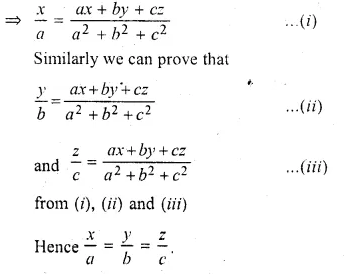
CA Foundation Business Laws Study Material Chapter 10 Formation of Contract of Sale 2

STATE WHETHER THE FOLLOWING ARE TRUE OR FALSE:

1. The term “goods” under Sale of Goods Act, 1930 includes actionable Claims.
2. The Sale of Goods Act, 1930 deals with movable goods only.
3. The Sale of Goods Act, 1930 covers mortgage and pledge of goods.
4. The provisions of Sale of Goods were originally contained in the Indian Contract Act, 1872.
5. In case of hire purchase the hirer can pass title to a bona fide purchaser.
6. In a contract of sale, subject matter of the contract must always be money.
7. In a contract of sale. The agreement may be expressed or implied from the conduct of the parties.
8. The property in goods means possession of goods.
9. The goods are at the risk of the party who has the ownership of the goods.
10. A lady gave a plain saree to Jariwala Brothers for embroidering with lari, to be purchased by Jariwala Brothers. It was held by the court that it was contract of sale.

Answers:
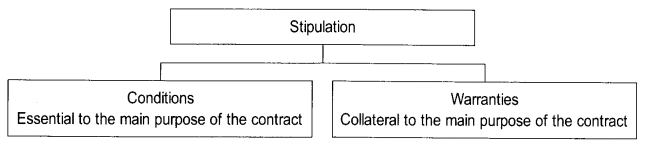
CA Foundation Business Laws Study Material Chapter 10 Formation of Contract of Sale 3