ML Aggarwal Class 10 Solutions for ICSE Maths Chapter 8 Matrices Ex 8.1

ML Aggarwal Class 10 Solutions for ICSE Maths Chapter 8 Matrices Ex 8.1

These Solutions are part of ML Aggarwal Class 10 Solutions for ICSE Maths. Here we have given ML Aggarwal Class 10 Solutions for ICSE Maths Chapter 8 Matrices Ex 8.1

More Exercises

Question 1.
(i)\(\begin{bmatrix} 2 & -1 \\ 5 & 1 \end{bmatrix}\)
(ii)[2 3 – 7]
(iii)\(\left[ \begin{matrix} 3 \\ 0 \\ -1 \end{matrix} \right] \)
(iv)\(\left[ \begin{matrix} \begin{matrix} 2 \\ 0 \\ 1 \end{matrix} & \begin{matrix} -4 \\ 0 \\ 7 \end{matrix} \end{matrix} \right] \)
(v)\(\left[ \begin{matrix} \begin{matrix} 2 & 7 & 8 \end{matrix} \\ \begin{matrix} -1 & \sqrt { 2 } & 0 \end{matrix} \end{matrix} \right] \)
(vi)\(\left[ \begin{matrix} \begin{matrix} 0 & 0 & 0 \end{matrix} \\ \begin{matrix} 0 & 0 & 0 \end{matrix} \end{matrix} \right] \)
Solution:
(i) It is square matrix of order 2
(ii) It is row matrix of order 1 × 3
(iii) It is column matrix of order 3 × 1
(iv) It is matrix of order 3 × 2
(v) It is matrix of order 2 × 3
(vi) It is zero matrix of order 2 × 3

Question 2.
(i) If a matrix has 4 elements, what are the possible order it can have ?
(ii) If a matrix has 8 elements, what are the possible order it can have ?
Solution:
(i) It can have 1 × 4, 4 × 1 or 2 × 2 order
(ii) It can have 1 × 8, 8 × 1,2 × 4 or 4 × 2 order

Question 3.
Construct a 2 x 2 matrix whose elements aij are given by
(i) aij = 2i – j
(ii) aij = i.j
Solution:
(i) It can be \(\begin{bmatrix} 1 & 0 \\ 3 & 2 \end{bmatrix}\)
(ii) It can be \(\begin{bmatrix} 1 & 2 \\ 2 & 4 \end{bmatrix}\)

Question 4.
Find the values of x and y if : \(\left[ \begin{matrix} 2x+y \\ 3x-2y \end{matrix} \right] =\left[ \begin{matrix} 5 \\ 4 \end{matrix} \right] \)
Solution:
Comparing corresponding elements,
2x + y = 5 …(i)
3x – 2y = 4 …(ii)
Multiply (i) by 2 and (ii) by ‘1’ we get
4x + 2y = 10, 3x – 2y = 4
Adding we get, 7x = 14 ⇒ x = 2
Substituting the value of x in (i)
2 x 2 + y = 5 ⇒ 4 + y = 5
y = 5 – 4 = 1
Hence x = 2, y = 1

Question 5.
Find the value of x if \(\left[ \begin{matrix} \begin{matrix} 3x+y & \quad -y \end{matrix} \\ \begin{matrix} 2y-x & \quad \quad 3 \end{matrix} \end{matrix} \right] =\begin{bmatrix} 1 & 2 \\ -5 & 3 \end{bmatrix} \)
Solution:
\(\left[ \begin{matrix} \begin{matrix} 3x+y & \quad -y \end{matrix} \\ \begin{matrix} 2y-x & \quad \quad 3 \end{matrix} \end{matrix} \right] =\begin{bmatrix} 1 & 2 \\ -5 & 3 \end{bmatrix} \)
Comparing the corresponding terms, we get.
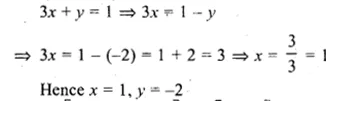
-y = 2
⇒ y = -2
ML Aggarwal Class 10 Solutions for ICSE Maths Chapter 8 Matrices Ex 8.1 Q5.1

Question 6.
If \(\left[ \begin{matrix} \begin{matrix} x+3 & \quad \quad 4 \end{matrix} \\ \begin{matrix} y-4 & \quad \quad x+y \end{matrix} \end{matrix} \right] =\begin{bmatrix} 5 & 4 \\ 3 & 9 \end{bmatrix} \) ,find values of x and y
Solution:
\(\left[ \begin{matrix} \begin{matrix} x+3 & \quad \quad 4 \end{matrix} \\ \begin{matrix} y-4 & \quad \quad x+y \end{matrix} \end{matrix} \right] =\begin{bmatrix} 5 & 4 \\ 3 & 9 \end{bmatrix} \)
Comparing the corresponding terms, we get.
x + 3 = 5
⇒ x = 5 – 3 = 2
⇒ y – 4 = 3
⇒ y = 3 + 4 = 7
x = 2, y = 7

Question 7.
Find the values of x, y and z if
\(\left[ \begin{matrix} \begin{matrix} x+2 & \quad \quad 6 \end{matrix} \\ \begin{matrix} 3 & \quad \quad \quad 5z \end{matrix} \end{matrix} \right] =\begin{bmatrix} -5 & \quad { y }^{ 2 }+y \\ 3 & -20 \end{bmatrix}\)
Solution:
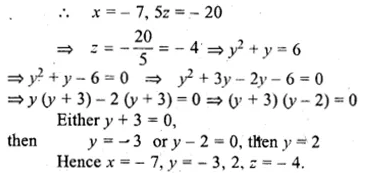
Comparing the corresponding elements of equal determinents,
x + 2 = -5
⇒ x = -5 – 2 = -7
ML Aggarwal Class 10 Solutions for ICSE Maths Chapter 8 Matrices Ex 8.1 Q7.1

Question 8.
Find the values of x, y, a and b if
\(\begin{bmatrix} x-2 & y \\ a+2b & 3a-b \end{bmatrix}=\begin{bmatrix} 3 & 1 \\ 5 & 1 \end{bmatrix}\)
Solution:
Comparing corresponding elements
x – 2 = 3, y = 1
x = 3 + 2 = 5
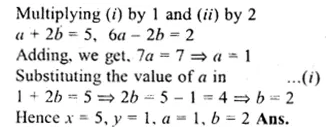
a + 2b = 5 ……(i)
3a – b = 1 ……..(ii)
ML Aggarwal Class 10 Solutions for ICSE Maths Chapter 8 Matrices Ex 8.1 Q8.1

Question 9.
Find the values of a, b, c and d if
\(\begin{bmatrix} a+b & 3 \\ 5+c & ab \end{bmatrix}=\begin{bmatrix} 6 & d \\ -1 & 8 \end{bmatrix} \)
Solution:
\(\begin{bmatrix} a+b & 3 \\ 5+c & ab \end{bmatrix}=\begin{bmatrix} 6 & d \\ -1 & 8 \end{bmatrix} \)
Comparing the corresponding terms, we get.
3 = d ⇒ d = 3
⇒ 5 + c = – 1
⇒ c = -1 – 5
⇒ c = -6
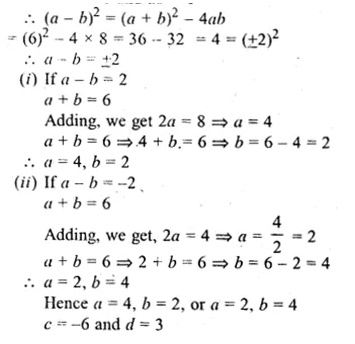
a + b = 6 and ab = 8
ML Aggarwal Class 10 Solutions for ICSE Maths Chapter 8 Matrices Ex 8.1 Q9.1

Question 10.
Find the values of x, y, a and b, if
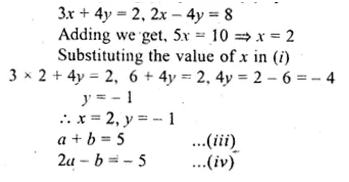
\(\left[ \begin{matrix} \begin{matrix} 3x+4y & 2 & x-2y \end{matrix} \\ \begin{matrix} a+b & 2a-b & -1 \end{matrix} \end{matrix} \right] =\left[ \begin{matrix} \begin{matrix} 2 & \quad 2\quad & 4 \end{matrix} \\ \begin{matrix} 5 & -5 & -1 \end{matrix} \end{matrix} \right] \)
Solution:
Comparing the corresponding terms, we get.
3x + 4y = 2 ……(i)
x – 2y = 4 …….(ii)
Multiplying (i) by 1 and (ii) by 2
ML Aggarwal Class 10 Solutions for ICSE Maths Chapter 8 Matrices Ex 8.1 Q10.1

Hope given ML Aggarwal Class 10 Solutions for ICSE Maths Chapter 8 Matrices Ex 8.1 are helpful to complete your math homework.

If you have any doubts, please comment below. Learn Insta try to provide online math tutoring for you.

CA Foundation Business Laws Study Material Chapter 16 Nature of Partnership

CA Foundation Business Laws Study Material Chapter 16 Nature of Partnership

INTRODUCTION

Prior to the Partnership Act, 1932 the law of partnership was covered by the Indian Contract Act, 1872. Due to rapid growth in trade and commerce and growing industrialization, a need was felt to
have a separate law on partnership. This led to the enactment of the Indian Partnership Act, 1932. It extends to the whole of India except the State of Jammu and Kashmir. It came into force on the 1st day of October, 1932, except section 69, which come into force on the 1st day of October, 1933.

The Partnership Act is not exhaustive. Where the Partnership Act is silent on any point, the general principles of the law of contract apply (section 3)

A. WHAT IS PARTNERSHIP?
Section 4 of the Indian Partnership Act, 1932, lays down that “Partnership is the relation between persons who have agreed to share the profits of a business carried on by all or any one of them acting for all ”
Partnership v. Firm

  • Persons who have entered into partnership with one another are called individually “Partners ” and collectively “a firm”.
  • The name under which their business is carried on is called the “firm name”.
  • A firm is a collective name of partners. It is a physical unit. It is concrete. While partnership is merely an abstract legal relation between the partners. Partnership is an invisible tie, which binds the partners together, and the firm is the visible form of those partners who are thus bound together.

The legal status of a firm. A firm is not a legal entity. It is merely a collective name for the individuals, who have entered into partnership. It does not have a separate legal entity distinct from the partners who compose it. As a firm is not a legal entity, there cannot be partnership of firms.

B. WHAT ARE THE ESSENTIAL ELEMENTS OF PARTNERSHIP?
All the following elements must be present if an association of persons is to be called a partnership:
1. Association of two or more persons
There must be at least two persons to form a partnership. As far as the maximum number of partners, in a firm is concerned, the Partnership Act is silent. However, Section 464 of the Indian Companies Act, 2013 lays down that where the firm is carrying any business, the number of partners should not exceed 50 (It can be increased upto 100). If the number of maximum partners exceeds this limit, the partnership becomes an illegal association of persons.

2. Agreement between persons
According to Section 5 of Partnership Act, the relation of partnership arises from contract and not from status. Thus, the members of a Hindu Joint Family carrying on a business, or the co-owners of a business are not ‘ partners’ because H U F and co-ownership are created by operation of law and not by contract. The agreement of partnership may be expressed or implied.

3. Business
Partnership can be formed only for the purpose of carrying on some business. Section 2(b) of Partnership Act says that the term ‘business’ includes every trade, occupation or profession.
Thus, an association created primarily for charitable, religious and social purposes are not regarded as partnership. Similarly, when two or more persons agree to share the income of a joint property, it does not amount to partnership such relationship is termed as co-ownership.

4. Sharing of Profits
The division of profits is an essential condition of the existence of a partnership. The sharing of profits is only a prima facie evidence of the existence of partnership, and this is not the conclusive test of it.

5. Business carried on by all or any of them acting for all. (Mutual Agency)
The underlying or cardinal principle which governs partnership is the mutual agency relationship amongst the partners. It means each partner is the agent of the firm as well as of the other partners. The business of the firm may be carried on by all the partners or by any of them acting for all. Thus, a partner is both an agent and a principal. He can bind the other partners by his acts and is also bound by the acts of the other partners. The law of partnership is regarded as an extension of the general law of agency.

“Partnership arises from contract and not from status”.
That partnership is the result of a contract and cannot arise by status is sufficiently emphasised by section 4 itself by use of the words “partnership is the relation between the persons who have agreed to share the profits of a business”. It is clear from the definition that the partnership is of contractual nature. It springs from an agreement. The same point is further stressed by the opening words of Section 5 that the relation of partnership arises from contract and not from status.

Thus if on the death of the sole proprietor of a business the legal heirs decide to continue to carry on the business, they cannot be called as partners because there is no agreement between them. Similarly members of Joint Hindu Family business carrying on a family business cannot be treated as partners because a person becomes the member of the business by birth and not by agreement. Sec.5
On the death of a partner, his legal heirs do not automatically become the partners of the firm. If the surviving partners agree to admit the legal heirs into partnership, then a fresh agreement to that effect will have to be made. Thus from the above it is clear that partnership always arises out of a contract and not from status.

Who may be partners of a firm?
According to the definition of partnership in section 4, a partnership is an agreement. All those persons who are competent to contract can become partners. As per section 11 of Contract Act, a person is competent to contract if he is a major, of sound mind and is not disqualified from contracting by any law. Thus a partner must fulfil the conditions of section 11. However, a minor u/s 30 of the Partnership Act, can be admitted to the benefits of the partnership firm with the consent of all the partners.

C. THE TESTS OF A TRUE PARTNERSHIP:
According to Sec. 4, there are 4 essential elements of partnership;

  1. That it is the result of an agreement, between two or more persons.
  2. That it is formed to carry on a business.
  3. That the persons concerned agree to share the profits of the business.
  4. That the business is to be carried on by all or any of them acting for all.

If there is an express agreement between them to share the profits of a business and the business is being carried on by all or any of the acting for all there will be no difficulty, in the light of provisions of sec. 4, in determining the existence or otherwise of partnership.
But the task becomes difficult when either there is no specific agreement or the agreement is such as does not specifically speak of partnership. In such a case, for testing the existence or otherwise of partnership relation, Section 6 has to be referred.

According to Sec. 6 in determining whether a group of persons is or is not a firm or whether a person is or is not a partner in a firm, regard shall be had to the real relation between the parties, as shown by all relevant facts taken together.
If all the relevant facts taken together show that all the four essential elements are present, the group of persons doing business together will be called a partnership. The tests of a true partnership were first laid down by the House of Lords in the case of Cox v. Hickman (1860) 8 II L.C. 268. In that case, a trader entered into arrangement with creditors to manage his business and to use the profits for paying off the creditors. It was held that the creditors were not partners of the business. Sec. 6 of the Partnership Act is a comprehensive restatement of the rule laid down in this case.

The relevant factors to be considered for determining whether there is partnership are the conduct of parties, the mode of doing business, who controls the property, the mode of keeping accounts, correspondence, the manner of distribution of profits, etc. of the four elements, the third element, viz., sharing of profits is important but not conclusive.
In the following cases there is no partnership even though there is sharing profits:

  1. A creditor taking a share of profits in lieu of interest and part-payment of principal.
  2. An employee getting a share of profits as remuneration.
  3. Share of profits given to workers as bonus.
  4. Share of profits given to the widow or children of deceased partners as annuity.
  5. Share of profits given to a previous owner of the business as the consideration for the sale of the goodwill (Explanation 2 to Section 6).

In all the above cases the fourth essential element of partnership (viz., agency) is absent. A creditor or any employee, or the widow and children of deceased partners cannot bind the firm by any act done on behalf of the firm. Only those who have authority to bind the firm by their actions can be called partners. Thus, the most important test of partnership is agency and authority. This is the cardinal principle of partnership law. If this element of mutual agency is absent, then there will be no partnership.

KD Kamath & Co.:
It was held by the Supreme Court that the two essential conditions need to be satisfied in relation to the partnership:

  1. There should be an agreement to share the profits as well as the losses of business, and
  2. The business must be carried on by all or any of them acting for all, within the meaning of the definition of Partnership under section 4.

If the above-said conditions are satisfied and even if the exclusive power and control was vested in one partner or if the bank account can be operated by only one partner, then also there will be a partnership between the parties.

Satranjan Das Gupta v. Dasyran Murzamull (SC):
It was held that there was no partnership between the parties because of the following conditions:

  1. Parties have not retained any record of ternis and conditions of the partnership.
  2. Partnership business has maintained no accounts of its own, which would be open to inspection by both the parties.
  3. No account of the partnership was opened with any bank.
  4. No written intimation was conveyed to the Deputy Director of Procurement with respect to the newly created partnership.

D. DIFFERENCE BETWEEN PARTNERSHIP FIRM AND VARIOUS ENTITIES:
(A) Distinction between Partnership & Company
A company is a legal entity distinct from its shareholders. While a firm is a compendious name for all the partners. Both are forms of business organization:

Sr. no.

Company

Partnership Firm

1. Formation

A company comes into existence only after registration under the Companies Act.A partnership is formed by mutual agree­ment of all the partners. Registration is not compulsory.

2. Legal Status

A company has a separate legal entity distinct from its members.A partnership is collection of individuals. It does not have a separate legal entity.

3. Number of Members

(i) The minimum number of persons re­quired to form a company is 2 for pri­vate company (other than One Person Company) and 7 for public co.(i) The minimum number of persons re­quired to form a partnership is 2.
(ii) There is no maximum limit to the num­ber of members in the case of public company. A private company cannot have more than 200 members.(ii) As per Companies Act, 2013 the num­ber of partners in a partnership firm carrying on any business should not exceed 50 persons.

4. Liability of Members

The liability of the members is limited.The liability of partners is unlimited.

5. Agency of Members

A shareholder is not an agent of the company nor he is agent of other shareholdersEvery partner is the agent of the firm and his partners for the purposes of the business of the firm.

6. Transfer of shares

Shares can be transferred without the con­sent of other members. In a private company there are restrictions on transfer of shares.No partner can transfer his share or inter­est in the firm without the consent of his co-partners.

7. Stability

A company has perpetual succession. The death or insolvency of a member does not affects its existence.A partnership comes to an end on the death and insolvency of its partners.

8. Management

There is separation of ownership from man­agement. The shareholders do not actually take part in the management of the company. The Board of Directors manage the company.A partnership firm is managed by partners themselves.
9. PowersThe general powers of the company are regulated by Memorandum of Association. It is difficult to change the objects.The partnership agreement (deed) regulates the mutual rights and duties of partners only.
10. Statutory ObligationsA company is required to comply with various statutory obligation. Such as compulsory au­dit, the holding of the meetings, the keeping of proper account books and registers, filing of annual returns etc.A partnership firm is not required to comply with any such statutory obligation.
11. InterestA member has no interest in the assets of the company.A partner has an interest in assets of the partnership.

(B) Distinction between Partnership and Co-Ownership.
Co-ownership’s like joint purchasers, co-tenants, co-heirs are different from partnerships. Co-owners may share profits, by virtue of their status and not by virtue of a contract; One co-owner is not the agent of other co-owner; co-owner may transfer his shares to a stranger but a partner cannot do so.
The following are the points of distinction:

  1. Formation
    Partnership always arises out of contract. Co-ownership may arise either from agreement or by the operation of law, such as by inheritance.
  2. Sharing of profits
    In a partnership, profit must have to be shared, but in the case of a co-ownership, it does not necessarily involve sharing of profits.
  3. Agency
    In a partnership, a partner is the agent of the other partners, but in the case of co-ownership, a co-owner is not the agent of other co-owners.
  4. Lien
    A partner has a lien on the partnership property for outlay or expenses or a loan advanced to the firm, whereas a co-owner has no such lien.
  5. Transfer of interest
    A share in the partnership may be transferred only with the consent of all other partners. Co-owner may transfer his interest in the property without the consent of other co-owners.

(C) Distinction between Partnership and Joint Hindu Family.
There are some common features in partnership and Joint Hindu Family. Both are forms of business organization and there is sharing of profits. The important points of distinction are :

1. Mode of creation
The partnership is created by agreement, whereas joint family is established by law. A person becomes a member of a joint family by birth.

2. Death
Death of a partner brings about dissolution of partnership. But the death of a member of a Joint Hindu Family does not give rise to dissolution of the family business. HUF has continuity till its partition.

3. Mutual Agency
In a partnership, every partner can bind the firm by his acts. However, in HUF, only the Karta has the authority to contract on behalf of HUF.

4. Management
In a joint family, only Karta has the right to manage the business. In partnership, all the partners have the right to take part in the management of the firm.

Note: the amendment in the Hindu Succession Act, 2005, entitled all adult members, whether male or female, to become coparceners in a HUF. They enjoy equal rights of inheritance due to this amendment, On 1st February, 2016, Justice Najmi Wazari, in a judgment allowed the eldest female coparcener of an HUF to become the Karta.

5. Liability
The liability of partners in a partnership concern is unlimited, joint and several. The liability of members of a joint Hindu family except the Karta is limited only to the extent of their share in the business of the family.

6. Calling for accounts
On the partition of joint family a member is not entitled to ask for the accounts of the family business. But a partner can bring a suit against the firm for account on the dissolution of the firm.

7. Registration
Registration of partnership is essential for the maintenance of suits both against the partners as well as outsider but a joint family business need not be registered at all.

8. Number of members
In a partnership the number of partners is limited to 50, but in the case of joint family business there is no such restriction.

9. Minor’s position
A minor can be a member of a Hindu joint family, but a minor cannot be a partner in a firm. However, he can be admitted to the benefits of partnership with the consent of all the partners.

10. Governing Law
A partnership is governed by the Indian Partnership Act, 1932, while joint Hindu family is governed by Hindu Law.

11. Share in Business
Share in a partnership is defined by an agreement between partners. However, in HUF, share of coparceners is not definite. His interest is fluctuation which is capable of being enlarged by deaths in the family and diminished by births.

(D) Partnership and Club or Society:
Partnership is different from a club or a society. In case of a club or a society, the two essential ingredients viz. intention to share profits and an intention to constitute one member as agent for another member are lacking.
The following are the points of distinction :
1. Definition/meaning
A club or a society is an association of persons formed with the object, but to promote some beneficial purposes such as improvement of health or providing recreation for the member ‘ etc. A partnership on the other hand is an association of persons also, but formed for earning profits from a business carried on by all or any one of them acting for all. These persons share the profit so earned as per their agreement.

2. Relationship
Persons forming a club/society are called members, while persons forming a partnership are called partners. Members of a club are not agents for the other member’s while a partner is an agent for other partners.

3. Interest in the property
A member of a club/society has no interest in the property of the club/society in the manner a partner has in the property of the firm.

4. Dissolution
A member leaving a club or a society shall not affect the existence of the club, while retirement of a partner from the firm does effect the existence of the firm.

(E) Partnership and Association
An association evolve due to social cause where there need not be a motive to earn and share profits. Further, there may not be a contract of mutual agency unlike as in case of a partnership.

TYPES OF PARTNERS
1. Active partner
An active partner is one who actually participates in the business of the firm. He is also known as actual or ostensible partner.

2. Dormant or sleeping partner
The dormant or sleeping partner joins the firm by agreement but do not take any active part in the business. The liabilities are same as of active partners.

3. Nominal partner
A nominal partner lends his name to the firm. The firm gets advantage of his reputation and name.

  • He does not contribute capital nor does he participate in the partnership business.
  • He is liable to the third parties for the act of the firm.

4. Sub partner
Where a partner agrees to share his profits in the firm with a third person, that third person is called a sub-partner. Thus a sub-partner is a transferee of a share of a partner’s interest in a firm. Suppose P, the owner of 25% share of firm transfers 10% of his share to Q. Q will be called a sub-partner.

  • A sub-partnership is a partnership within a partnership
  • A sub-partner has no obligations towards the firm and
  • He does not carry any liability for the debts of the firm.
  • He cannot bind the firm by his acts.
  • A sub-partner does not get any right against the main firm to take part in or to interfere with the business of the firm or to examine the accounts of the firm. So long as main partnership continues, he is also not allowed to ask for the accounts of the firm. He has a right to
  • claim the agreed share from the actual partner with whom he has entered into sub-partnership.
    The sub-partner does not become a partner in the original firm. Such partners are not counted for the maximum number of partners. Sub-Partner does not become a partner in the original firm. Such partners are not counted for the maximum number of partners.

5. Partner in Profits only
He is a partner who is entitled to share of profits only without being liable to any losses. He is liable to the third parties for all acts of the profits only.

6. Outgoing Partner
A partner who is leaving the firm and rest of the partners continue to carry on the business is called as a retiring partner.

7. Incoming Partner
Incoming partner is a partner who is admitted as a partner into an already existing firm. He should be admitted with the consent of all the existing partners.

8. Partner by estoppel or holding out:
The circumstances under which a person may be held liable for the acts of a firm. without being its partners.

Doctrine of ‘holding out’
Holding out means “to represent”. Strangers, who hold themselves out or represent themselves to be partners in a firm, whereby they induce others to give credit to the partnership are called “part- ners by holding out” or partnership by estoppel. The object of the above stated rule, obviously, is to prevent frauds to which creditors would otherwise be exposed.
The principle of ‘holding out’ has been recognised by Sec. 28 of the Indian Partnership Act.

“Anyone who by words spoken or written or by conduct represents himself, or knowing per-
mils himself to be represented, to be a partner in a firm, is liable as partner in that firm to any one who has on the faith of any such representation given credit to the firm, whether the person representing himself or represented to be a partner does or does not know that the representation has reached the person so giving credit”.

In order to hold a person liable as a partner-though in fact he may not be one on the basis of holding i out, it must be established:

  1. That by words or conduct he represented himself to be a partner or knowingly permitted himself to be represented as a partner to anyone and,
  2. That the other person acting on the faith of the representation gave credit to the firm.

Effects of holding out: The partner by estoppel or holding out becomes personally liable for the | acts of the firm. But he does not become a partner in the firm and is not entitled to any rights or I claim upon the firm. An outsider, who has given credit to the firm thinking him to be a partner can hold him liable as if he is a partner in that firm.
Example: A retired businessman of some repute assumed the honorary presidentship of the business j of certain persons who requested him for the same. Held, he was liable for the debts of the firm | to those who gave credit to the firm in the bona fide belief that he was a partner. [Lake v. Duke of Argyll, (1844) 6 Q.B. 477],

TYPES OF PARTNERSHIP
Partnership can be classified as below:
1. Partnership at will (sec. 7)
A partnership is called a partnership at will—

  1. When the partnership is not for a fixed period of time and
  2. When no provision is made as to when and how the partnership will come to an end.

Thus, in partnership at will there is no provision in the contract between the partners for the duration of their partnership. Secondly, there should be no provision in their contract for the determination [i.e. ending] of their partnership. If either of these provisions exist, it is not
partnership at will. The essence of partnership at will is that it is open to either partner to dissolve the partnership by giving notice in writing to all other partners.
The firm is then dissolved from the date mentioned in the notice as the date of dissolution, and if no such date is mentioned, then from the date of the communication of the notice (sec. 43)
If a partnership is to be dissolved by mutual agreement only, then it will not be a partnership at will.
Examples:

  1. Anil and Mukesh agree to do trading of laptops for a period of 3 years. This partnership is to be terminated after the expiry of 3 years. This is not a partnership at will.
  2. Ram, Laxman and Bharat agree to carry on a business in partnership subject to the condition that the partnership may be terminated by mutual agreement. In this case, a specific i mode is prescribe to determine the partnership, thus it is not a partnership at will.

2. Particular partnership (sec. 8)
A particular partnership is one which is formed for a particular adventure or a particular undertaking. Such a partnership is usually dissolved on the completion of the adventure or undertaking. For example, forming a partnership for construction of a bridge.

3. Partnership for a Fixed period
Where a provision is made by a contract for the duration of the partnership, the partnership is called as a partnership for a fixed period. Such partnership comes to an end after the expiry of the fixed period.

4. General Partnership
Where a partnership is constituted with respect to the business in general, it is called a general partnership. A general partnership is different from a particular partnership. In particular partnership, the liability of the partners extends only to that particular adventure or an undertaking but it is not so in case of a general partnership.

PARTNERSHIP PROPERTY (SECS. 14 & 15)

What constitutes a partnership property depends upon the agreement between the partners?
It is open to the partners to agree among themselves as to what is to be treated as the property of the firm and what is to be separate property of one or more partners. They can convert by mutual agreement, partnership property into separate property of an individual partner and vice versa. In the absence of any such agreement, the property of the firm according section 14, means—

  1. property originally brought into the common stock of the firm by the partners,
  2. property acquired in the course of the business with money belonging to the firm;
  3. the goodwill of the firm.

Unless the contrary intention appears, property and rights and interests in property acquired with money belonging to the firm are deemed to have been acquired for the firm.
Application of the property of the firm (sec. 15)
Subj ect to contract between partners, the property of the firm shall be held and used by the partners exclusively for the purposes of the business.
Goodwill

  1. Goodwill is not defined in the Partnership Act. Goodwill may be described as the advantage which is acquired by a firm from the connection it has built up with its customers and the reputation it has gained.
  2. “The goodwill of business is the whole advantage of the reputation and connection formed with customers together with the circumstances whether of habit or otherwise, which tend to make such connection permanent. It represents in connection with any business of business product the value of attraction to customers which the name & reputation possesses.”
  3. Goodwill is part of the property of the firm (Sec. 14).

Sale of goodwill after dissolution (sec. 55)
The rules relating to sale of goodwill upon dissolution of a firm are as follows:

  1. In settling the accounts of a firm after dissolution, the goodwill shall, subject to contract between the partners be included in the assets, and it may be sold either separate or along with other property of the firm. [Sec. 55(1)],
  2. The rights of the buyer and seller of the goodwill are as follows:
    1. Seller’s rights : After the sale of goodwill, the seller i.e., the partner of the dissolved firm,
      1. may carry on a business competing with that of the buyer of goodwill, and
      2. may advertise such business. [Sec. 55(2)].
        But subject to agreement between him and the buyer, the seller of goodwill that is, partners of the dissolved firm may not :

        1. use the firm name,
        2. represent themselves as carrying on the business of the old firm, and
        3. solicit the customers of the old firm. [Sec. 55(2)]
    2. Buyer’s rights- On the purchase of goodwill the buyer gets the (I) right to carry on the same business under the old name and (II) to represent himself in continuing the business and solicit former customers of the business and restrain the sellers of the goodwill from doing so.
  3. But any partner of the dissolved firm may make an agreement with the buyer that such partner will not carry on a business similar to that of the firm within a specified period or within specified local limits, provided the restrictions imposed are reasonable. Sec. 55(3)

MULTIPLE CHOICE QUESTIONS:

1. What among the following is not an essential element of partnership:
(a) There must be an agreement entered into by all the persons concerned
( b) The agreement must be to share the profits of a business
(c) The business must start within six months from the date of agreement
(d) The business must be carried on by all or any one of them acting for all.

2. A Joint Hindu Family is created:
(a) By a contract
(b) By operation of law or status
(c) By registration
(d) By all the above mode

3. A club is the form of:
(a) Association not for profit
(b) Partnership
(c) Sole proprietorship
(d) Public company.

4. The Partnership Act, 1932
(a) Specifies the minimum number of partners in a firm
( b) Specifies the maximum number of partners in a firm
(c) Both (a) and (b)
(d) None of the above

5. The ceiling on maximum number of partners in a firm is laid down in:
(a) The Partnership Act, 1932
(b) The Indian Contract Act, 1872
(c) The Companies Act, 1956
(d) Central Government notification

6. The test of partnership is laid down in the following case:
(a) Cox v. Hickman
(b) Garner v. Murray
(c) Mohiribibi v. Dharmodas Ghosh
(d) None of the above

7. A partnership firm
(a) Is a legal person
(b) Is not a legal person
(c) Has a distinct legal personality
(d) None of the above

8. A partnership formed for the purpose of carrying on particular venture or undertaking is known as:
(a) Limited partnership
(b) Special partnership
(c) Joint Venture
(d) Particular partnership

9. The principle of is applicable to partners in a partnership:
(a) Uberrimae fidei/Utmost Good Faith
(b) Ultimate Trust
(c) Insurable Interest
(d) Blind Faith

10. Limited Liability partnership is a form of part-nership that:
(a) Is not possible
(b) Is allowed in certain circumstances in the Partnership Act, 1932
(c) Is now abolished
(d) Can be set up by LLP Act, 2008

11. A partnership for which no period or duration is fixed under the Indian Partnership Act is known as :
(a) Unlimited partnership
(b) Co-ownership
(c) Particular partnership
(d) Partnership at will

12. The essential elements of partnership does not include:
(a) Partnership should be registered
( b) There must bean agreement to share profits of a business.
(c) There must be mutual agency among partners.
(d) There must be an association of two or more persons.

13. To form a partnership, the minimum capital contribution should be:
(a) Rs. 1 lakh
(b) Rs. 10 lakh
(c) Rs. 1 crore
(d) There is no minimum limit.

14. Property of firm does not include:
(a) All property which the partners have originally brought into the common stock of the business
(b) Goodwill of the business
(c) Personal properties belonging to the partner
(d) Property acquired by the funds of the firm

15. Which of the parties may be admitted to the benefits of partnership?
(a) Person of unsound mind
(b) Minor
(c) Alien enemies
(d) An insolvent.

Answers:

CA Foundation Business Laws Study Material Chapter 16 Nature of Partnership 1

STATE WHETHER THE FOLLOWING ARE TRUE OR FALSE:

1. Maximum number in a partnership firm is 50 members.
2. A partnership firm cannot be registered for carrying on any charitable activity.
3. The maximum number of partners in a partnership firm is specified in Companies Act, 2013.
4. Sharing of profits is the conclusive evidence of the existence of the partnership between the parties.
5. A minor can be a partner in a partnership firm.
6. A and B agree to buy 100 tins of ghee agreeing to share it between them. They are not partners.
7. If a partnership can be dissolved by the mutual agreement only, then it will be called as a partnership at will.
8. Forming a partnership for construction of a bridge is a type of particular partnership.
9. Goodwill is to be considered as a partnership property.
10. Prior to the enactment of Indian Partnership Act, 1932 the law relating to partnership was contained in the Indian Contract Act, 1872.
11. True test of partnership was first laid down in the case of Cox v. Hickman.
12. A sub-partner has a right to participate in the conduct of the business.
13. Law of partnership is an extension of the general law of guarantee.
14. Partnership firm has a separate legal entity.

Answers:

CA Foundation Business Laws Study Material Chapter 16 Nature of Partnership 2

CA Foundation Business Laws Study Material Chapter 15 Auction Sale

CA Foundation Business Laws Study Material Chapter 15 Auction Sale

A sale by auction is a public sale where various intending buyers offer bids for the goods and try to outbid each other. Ultimately, the goods are sold to the highest bidder. A bid by the buyer is an offer and it is said to be accepted when the auctioneer announces its completion by the fall of the hammer or in any other customary manner. The words ‘any other customary manner’, takes into account all the manners which may be prevalent to denote acceptance in an auction sale. It may be by shouting one, two, three; or shouting going, going, gone, etc.
A person may himself sell his own goods by auction, or he may appoint an agent, known as auc¬tioneer, to conduct the sale on his behalf.

15.1

Rules of Auction Sale (Sec. 64)

Following rules have been laid down to regulate the sales by auction:

1. Sale of goods in lots

Where goods are put up for sale in lots, each lot is prima facie deemed to be the subject of a separate contract of sale.

2. Completion of Sale

An auction sale is complete when the auctioneer announces its completion by the fall of the hammer or in other customary manner, and until then the bidder has the right to revoke or retract his bid. If before the fall of the hammer the bidder withdraws, his security amount cannot be forfeited. But if he does so after the fall of the hammer, it amounts to a breach of the contract and his security amount will be liable to be forfeited. If the conditions of sec. 20, namely, the goods should be specific and in a deliverable state, are satisfied, the property in such goods passes to the buyer at the completion of the contract (by the fall of the hammer)

3. Seller’s Right to Bid

Unless the auction is notified to be subject to a right to bid on behalf of the seller, it is not lawful –
(i) for the seller to bid himself or to employ any person to bid at such sale on his behalf and
(ii) for the auctioneer to, knowingly take any bid from the seller or any such person. Any contravention of this rule renders the sale as fraudulent.

4. Pretended bi­ding

If the seller makes use of pretended bidding to raise the price, the sale is voidable at the option of the buyer. However, the seller may expressly reserve the right to bid at the auction and in such case, the seller or any one person on his behalf may bid at the auction. But there should be only one person on behalf of the seller; if there are more than one person, the intention is to raise the price and is fraudulent.        .

5. Reserve Price

The seller may notify that the auction will be subject to a reserve or upset price, that is, the price below which the auctioneer will not sell. In such a case the auctioneer is not bound to accept the highest bid unless it reaches the reserve price. Further the property in the goods, even if they are specific, will not pass if the highest bid falls short.of the reserve price.

6. Knock-out agreement

Knock-out agreement is a f arm of combination of buyers to prevent competition among themselves at an auction sale. They agree that they will not raise the bid against each other and only one of them will bid of the auction. When the goods have been purchased they will share the profits. Prima facie, a knock-out agreement is not illegal. However, if the intention of the parties to the agreement is to defraud third party, the third party can claim the damages.

The seller may protect his interests against such agreements by reserving his right to bid at the auction, or by fixing a reserved price.

15.2

Upset price

“Upset price” is the Scottish equivalent of “reserved price”.

15.3

Damping

It is an unlawful act by which an intending purchaser is prevented from bidding or raising the price at an auction sale. The damping is usually done in any of the following ways :

(i)    By pointing out defects in the goods put up in an auction sale.

(ii)  By taking the intending buyers away from the place of auction by some other device.

Damping is illegal and the auctioneer can withdraw the goods from auction sale in case he observes that the damping is being resorted to Puffer-A person who is appointed by the seller to raise the price by fictitious bids.

15.4

Incidence of Taxation [Sec. 64A]

♦     Where after a contract has been made but before it has been performed, tax revision takes place, the parties would become entitled to readjust the price of the goods accordingly. Taxes covered are customs or goods and service tax on the goods and any tax payable on manufacture, sale or purchase of goods.

♦      The buyer would have to be pay the increased price if the tax increases and would be entitled to the benefit of reduction if taxes are curtailed.

♦      Thus, the seller may add the increased taxes in the price.

♦     The effect of the provision can, however, is excluded by an agreement to the contrary. It is open to the parties to stipulate anything about the incidence of taxation.


MULTIPLE CHOICE QUESTIONS:

1. An auction sale is complete on the –
(a) delivery of goods
(b) payment of price
(c) fall of hammer
(d) None of the above

2. In the case of sale by auction, where goods are put for sale in lots, each lot is prima facie the subject of—
(a) a single contract of sale
(b) a separate contract of sale
(c) either (a) or (b)
(d) both (a) and (b)

3. Where a right to bid at the auction has been expressly reserved by the seller, the seller can depute —
(a) not more than one agent to bid on his behalf
(b) not more than two agents to bid on his behalf
(c) not more than three agents to bid on his behalf
(d) any number of agents to bid on his behalf

4. Where the sale is not notified to be subject to a right to bid on behalf of seller, it shall not be lawful for the seller—
(a) to bid for himself
(b) to employ any person to bid at such sale
(c) either (a) or (b)
(d) neither (a) nor (b)

5. X purchased a VCD at a public auction. Neither Auctioneer nor X knew at that time that the VCD was a stolen property. In such case, the true owner can —
(a) recover the goods from X
(b) sue the Auctioneer for fraud
(c) both (a) and (b)
(d) either (a) or (b)

6. At an auction sale, the bidder can withdraw his bid –
(a) before fall of hammer
(b) at any time during auction
(c) before payment of price
(d) cannot withdraw bid

7. An act by which an intending bidder is discour¬aged or dissuaded from bidding in the auction sale is called
(a) Puffer
(b) Damping
(c) Dumping
(d) knockout

8. is a form of combination of buyers to prevent competition among themselves at an auction sale.
(a) Knock-out agreement
(.b) monopoly agreement
(c) oligopoly agreement
(d) puffing agreement

9. In pretended bidding, sale is
(a) voidable at the option of the seller
(b) valid
(c) voidable at the option of the buyer
(d) illegal

10. Unless excluded by an agreement to the contrary, where after a contract has been made but before it has been performed, excise duty is increased:—
(a) The buyer would have to pay increased price
(b) The seller cannot charge increased price
(c) The seller can charge increased price
(d) Both ‘a’ and ‘c’

11. Any imposition, increase, decrease or remission of (z) Customs or Excise Duty on Goods and (z’z) Tax on the Sale or Purchase of Goods, subsequent to the sale, in case of decrease of tax, shall be deducted from the contract price by the Buyer and he shall not be liable to pay or be sued for such deduction.
(a) True
(b) Depends on the contract
(c) False
(d) Both ‘a’ and ‘b’

Answers:
CA Foundation Business Laws Study Material Chapter 15 Auction Sale 1

IS STATE WHETHER THE FOLLOWING ARE TRUE OR FALSE

1. In case of sale by auction, a bid can be recalled at any time before the fall of hammer.
2. An auctioneer shall be liable for damages if the auctioneer had no authority to sell the goods.
3. If the buyer’s possession is disturbed by the auctioneer or the seller then buyer has a right to claim compensation.

Answers:
CA Foundation Business Laws Study Material Chapter 15 Auction Sale 2

CA Foundation Business Laws Study Material Chapter 14 Rights of Buyer & Rights of Unpaid Seller

CA Foundation Business Laws Study Material Chapter 14 Rights of Buyer & Rights of Unpaid Seller

RIGHTS OF BUYER

A. GENERAL RIGHTS

  1. Right to have delivery as per contracts (Secs. 31 & 32).
  2. Right to reject the goods if they are delivered in wrong quantities (Sec. 37).
  3. Right to refuse delivery of goods by instalments (Sec. 38)
  4. Right to notice of shipment in case the goods are sent by sea so that he may get the goods insured (Sec. 39).
  5. Right to examine goods for the purpose of ascertaining whether they are in conformity with the contract (Sec. 41)

B. RIGHTS OF A BUYER AGAINST THE SELLER FOR BREACH OF CONTRACT
A seller may breach the contract in any of the following ways:

  1. He fails to deliver the goods at the time or in the manner called for in the contract
  2. He repudiates the contract.
  3. He delivers non-conforming goods and the buyer rightfully rejects the goods or properly revokes acceptance.

A buyer has the following rights against the seller for breach of contract under the Sale of Goods Act.
1. Suit for non-delivery [Sec. 57]
Where the seller wrongfully neglects or refuses to deliver the goods to the buyer, the buyer may sure the seller for damages for non-delivery. This remedy would be available even if the property has passed to the buyer.

2. Specific performance [Sec. 58]
Where property has passed to the buyer, he also can exercise another right, viz., a right to sue for specific performance and its limits are regulated by the Specific Relief Act. In such cases the court may in its discretion grant a decree ordering the seller to deliver those specific or ascertained goods which formed the subject-matter of the contract. It should be noted that the remedy is discretionary and will only be granted if the damages are not an adequate remedy or the goods are unique, e.g., rare book, a picture or a rare piece of jewellery.

3. Breach of Warranty [Sec. 59]
Where there is a breach of warranty by the seller (Le. defects in the goods delivered) or where the buyer elects or is compelled to treat any breach of condition on the part of the seller as a breach of warranty, the buyer has the following remedies:

  1. He may claim a deduction from the price.
  2. He may refuse to pay the price altogether, if the loss equals the price.
  3. If the loss exceeds the price, he may not only refuse to pay the price, but also claim the excess, or
  4. He may sue the seller for damages for the breach of warranty in addition to the right to claim diminution or extinction of the price.

4. Suit for Anticipatory breach [Sec. 60]
The buyer has the right to sue the seller for damages for anticipatory breach of contract Section 60 lays down that where the seller repudiates the contracts before the date of delivery, the buyer may either treat the contract has subsisting and wait till the date of delivery or he may treat the contract as rescinded and sue for damages for the breach.

5. Suit for interest and recovery of the price [Sec. 61]
If the buyer has already paid the price and the seller fails to deliver the goods, the buyer is entitled to file a suit for the refund of the price. In such a suit, the buyer may also claim interest or special damages from the defaulting seller. In the absence of any other contract to the contrary, the court may award interest at such rate as it thinks fit on the amount of price from the date on which the payment was made.

RIGHTS OF THE UNPAID SELLER

  1. Unpaid seller defined [Sec. 45]
  2. Unpaid sellers’ rights [Sec. 46]
    1. Unpaid sellers ’ lien [Secs. 47 to 49]
    2. Stoppage in transit [Secs. 50 to 52]
    3. Transfer by buyer and seller [Secs. 53 & 54]
  3. Suit for breach of the contract [Secs. 55 to 61 ]

A. Who is an unpaid seller?
The seller is deemed to be an unpaid seller under any of the following circumstances:
(a) If the whole of the purchase price is not paid on the due date.
(b) If payment is made in the form of a negotiable instrument. (Bill of exchange or cheque) and the instrument is dishonoured.

B. Unpaid Sellers’ Rights [Sec. 46] 
Rights of an unpaid seller can be listed as follows:

  1. Against the goods
    1. Right of Lien,
    2. Right of Stoppage in Transit, and
    3. Right of Resale
  2. Against the buyer personally
    1. Suit for price,
    2. Suit for damages for non-acceptance of delivery,
    3. Suit for damages for repudiation of the contract, and
    4. Suit for interest or special damages

B(a). Right of Unpaid Seller against the Goods
(I) Right of Lien or Vendor’s Lien [Secs. 47-49]
The ‘unpaid seller’ has a lien on the goods for the price while he is in possession, until the payment or tender of the price. A lien is a right to retain possession of goods until payment of the price. He is entitled to lien in the following three cases, namely;

  1. where goods have been sold without any stipulation as to credit; Le. cash sale.
  2. where goods have been sold on credit but the term of credit has expired; or
  3. where the buyer becomes insolvent.

Rules:

  1. The seller may exercise his right of lien notwithstanding that he is in possession of the goods as agent or bailee for the buyer.
  2. If the goods have been sold on credit, the seller cannot refuse to part with possession unless the term of credit has expired.
  3. Lien can be exercised for non-payment of the price, not for any other charges.
  4. Effect of part delivery (Sec. 48): When an unpaid seller has made a part delivery of the goods he can exercise lien on the balance of the goods not delivered unless the part delivery was made under such circumstances as to show an intention to waive the lien.
  5. The seller can abandon or waive the lien if he so desires.
  6. Termination of lien (Sec. 49): If possession is lost, lien is lost. The unpaid seller of goods loses his lien thereon in the following cases:
    1. When he delivers the goods to a carrier or other bailee for the purpose of transmission to the buyer without reserving the right of disposal of the goods;
    2. when the buyer or his agent lawfully obtains possession of the goods; and
    3. where the seller has waived the right of lien. The unpaid seller does not lose his lien by reason only that he has obtained a decree for the price of the goods.
  7. Sale not rescinded by lien (Sec. 54): A contract of sale is not rescinded by the mere exercise of the right of lien. The contract still remains live and the buyer can claim delivery of the goods by tendering the price. However, if the buyer defaults, the sellers remedy is to resell the goods and claim damages.

(II) The Right of Stoppage in Transit [Secs. 50-52]
When the buyer of goods becomes insolvent, and the goods are in course of transit to the buyer, the seller can resume possession of the goods from the carrier. This is known as the right of stoppage in transit. The right is exercisable by the seller only if the following conditions are fulfilled:
The seller must be unpaid.

  1. He must have parted with the possession of goods.
  2. The goods must be in transit.
  3. The buyer must have become insolvent.
  4. The right is subject to provisions of the Act.

The right of stoppage means the right to stop further transit of the goods to resume possession and to retain the same till the price is paid.
Who is an insolvent?
The term insolvent is used here to denote a person who is financially embarrassed. It is not necessary that the buyer should be declared insolvent by a court of law before the right of stoppage in transit can be exercised. According to section 2(8). The buyer is said to be ‘insolvent’ when he has ceased to pay his debts in the ordinary course of business, or cannot pay his debts as they become due whether he has committed an act of insolvency or not.

Rules:
The following points are to be noted in connection with the right of stoppage in transit:
1. Duration of transit [Sec. 51]
The goods are deemed to be in course of transit from the time they are delivered to a carrier or other bailee for the purpose of transmission to the buyer, until the buyer or his agent takes delivery of them.

2. When does transit end?

  1. Delivery before destination:If the buyer or his agent obtains delivery of the goods before their arrival at the appointed destination, the transit is at an end. [Sec. 51(2)]
  2. Attornment by carrier to buyer: if after the arrival of the goods at the appointed destination, the carrier expressly or by implication enters into a new agreement to hold the goods for the buyer (for purpose of custody), the original transit comes to an end. [Sec. 51(3)]
  3. Goods rejected by biiyer.Af the goods are rejected by the buyer and they continue to be in possession of the carrier or other bailee, then the transit continues even if the seller has refused to receive them back. [Sec. 51(4)]
  4. Delivery on ship chartered by buyer: When the goods are delivered to a carrier who is acting as agent of the buyer, e.g. when goods are delivered to a ship chartered by the buyer, the transit comes to an end as soon as the goods are loaded on board the ship. [Sec. 51(5)]
  5. Wrongful refusal by carrier to deliver: If the carrier wrongfully refuses to deliver the goods to the buyer, the transit is at an end. [Sec. 51(6)]
  6. Part delivery. Where the part delivery of the goods has been made to the buyer the remainder of the goods may be stopped in transit, unless such part delivery has been given in such circumstances as to show an agreement to give up possession of the whole of the goods. [Sec. gi 51(7)]

3. How stoppage in transit is effected [Sec. 52]
There two modes of stoppage in transit are—

  1. By taking actual possession of the goods or
  2. By giving notice to the carrier not to deliver the goods to the buyer or his agent.

When notice of stoppage in transit is given by the seller to the carrier or other bailee in possession of the goods, he shall re-deliver the goods to, or according to the directions of, the seller. The expenses of such re-delivery shall be borne by the seller.
Effect of Stoppage: Contract not rescinded- The contract of sale is not rescinded when the seller exercises his right of stoppage in transit. The contract still remains in force and the buyer can ask for delivery of goods on payment of price. [Sec. 54]

Effect of sub-sale or pledge by the buyer [Section 53]
The unpaid seller’s right of lien or stoppage in transit is not affected by any sale or pledge of the goods made by the buyer.
Exceptions: In the following two cases the unpaid seller’s right of lien or stoppage in transit is affected by any sale or pledge of the goods made by the buyer: (i.e., Unpaid seller cannot exercise right of lien or stoppage in transit.)

  1. when the seller assents to such sale or pledge; or
  2. when the seller has transferred a document of title to the goods, who transfers it by way of a sale, pledge or other disposition for value, to a person who takes it in good faith and for consideration.

Where (i) the seller has issued or lawfully transferred a document of title to goods, e.g. a bill of lading or a railway receipt to a person as buyer and (ii) the buyer transfers the document by way of sale or pledge to a person who takes the document in good faith and for consideration. In such a case if the transfer is by way of sale the unpaid sellers right of lien or stoppage is defeated, and if it was by way of pledge, his right of lien or stoppage can only be exercised subject to the rights of the pledgee.
Thus the effect of the rule is that the seller may still exercise his rights by paying off the pledgee.

DISTINCTION BETWEEN LIEN AND STOPPAGE IN TRANSIT:

  1. The essence of lien is to retain possession while the essence of the stoppage in transit is to regain possession.
  2. The right of lien is applicable to goods, which are in the possession of the seller. The right of stoppage in transit is applicable to the goods, which are in possession of the carrier.
  3. The right of stoppage in transit is applicable to the insolvent buyer. But the right of lien is applicable to all persons, solvent or insolvent.
  4. The right of stoppage in transit is applied to the buyer through the carrier. Therefore stoppage means the seller’s right to ‘regain’ the goods. But lien means the right to ‘retain’ the goods. Of course both the rights are applicable to goods only.
  5. When the right of lien ends the right to stop in transit begins.

(Ill) The Right of Resale [Sec. 54]
The unpaid seller who has retained possession of the goods in exercise of his right of lien or who has resumed possession from the carrier upon insolvency of the buyer, can resell the goods:

  1. If the goods are of a perishable nature, without any notice to the buyer, and
  2. In other cases after notice to the buyer, calling upon him to pay or tender the price within reasonable time, and upon failure of the buyer to do so.

If the money realised upon such resale is not sufficient to compensate the seller, he can sue the buyer for the balance. But if he receives more than what is due to him, he can retain the excess. A resale does not absolve the buyer from his liabilities to compensate the seller for damages he may 2 have suffered.

B(b). Right of Unpaid seller against the buyer personally
1. Suit for the Price [Sec. 55]
Where under a contract of sale the property in the goods has passed to the buyer and the buyer wrongfully neglects or refuses to pay for the goods according to the terms of the contract, the seller may sue him for the price of the goods.
Where the property in goods has not passed to the buyer, the seller as a rule cannot file a suit for the price and his remedy is to claim damages.
According to section 55(2), where under a contract of sale the price is payable on a certain day irrespective of delivery and the buyer wrongfully neglects or refuses to pay such price, the seller may sue him for the price although the property in the goods has not passed and the goods have not been appropriated to the contract.

2. Suit for damages for non-acceptance [Sec. 56]
Where the buyer wrongfully neglects or refuses to accept and pay for the goods, the seller may sue him for damages for non-acceptance.

3. Suit for damages for repudiation of the contract [Sec. 60]
Where the buyer repudiates the contract before the date of delivery, the seller may either treat the contract as subsisting and wait till the date of delivery, or he may treat the contract as rescinded i and sue for damages for the breach.

4. Claim for interest and special damages [Sec. 61]
The seller may recover interest or special damages in any case where by law interest or special damages may be recoverable. He may also recover the money paid where the consideration for the payment of it has failed.

MULTIPLE CHOICE QUESTIONS:

1. The Seller of Goods is deemed to be an Unpaid Seller —
(a) when the whole of the price has not been paid or tendered.
(b) when a bill of exchange or other negotiable instrument has been received as conditional payment and the condition has not been fulfilled by reason of the dishonour of the instrument or otherwise.
(c) both (a) and (b).
(d) either (a) or (b).

2. The term “Unpaid Seller” includes —
(a) Agent of the Buyer
(b) Agent of the Seller
(c) Agent of the Carrier/Transporter
(d) All of the above

3. The right of lien is available to the Unpaid Seller, only when —
(a) he is not in possession of the goods
(b) he is in possession of the goods
(c) he has delivered the goods to the Carrier/ Transporter
(d) he has delivered the goods to the Buyer

4. The right of lien is available to the Unpaid Seller, u/s 47 of the Sale of Goods Act, when he is in possession of goods —
(a) as an agent of the Buyer
(b) as a Bailee for the buyer
(c) in his own right.
(d) all of the above

5. In which of the following situations, the right of lien available to the Unpaid Seller is lost?
(a) Where the Goods have been sold without any stipulation as to credit;
( b) Where the Goods have been sold on credit, but the credit period has expired;
(c) Where the Buyer becomes insolvent;
(d) Where the Unpaid Seller has parted with the possession of the goods.

6. Where the goods have been delivered to Railways for carriage and the R/R is taken in the name of the seller or his agent :
(a) the seller is prima facie deemed to reserve the right of disposal
( b) the seller did not retain the right of disposal
(c) the seller cannot retain right of disposal
(d) none of the above.

7. When the goods have been sold on credit and the credit period lien can he exercised
(a) has not expired
(b) has expired
(c) has not been extended
(d) has been extended

8. The right of lien can be exercised by the Unpaid Seller in respect of—
(a) Price
(b) Any other expenses, e.g. Godown Charges, Interest, etc.
(c) Both (a) and (b)
(d) Either (a) or (b)

9. The Unpaid Seller to deliver a part of the Goods on payment of a proportionate part of the price by the Buyer.
(a) shall be bound
(b) may refuse
(c) must honour his commitment
(d) shall request the carrier

10. Generally, where an Unpaid Seller has made part delivery of the Goods, he —
(a) may exercise his right of lien on the remainder
(b) has to honour the entire contract
(c) loses his lien on the remainder of the goods
(d) can supply defective goods in respect of the remainder

11. Where the Unpaid Seller has parted with the goods by handing it over to a carrier for transmission, and the goods are in transit, he can reclaim possession thereof. This right is called —
(a) Right of Lien
(b) Right of Stoppage of goods in transit
(c) Right of withholding delivery of goods
(d) Right of Re-sale

12. Right of Stoppage in transit can be exercised by the Unpaid Seller, where he —
(a) has lost his right of lien
(b) still enjoys his right of lien
(c) either (a) or (b)
(d) neither (a) nor (b)

13. Right of Stoppage in transit can be exercised by the Unpaid Seller, where the Buyer—
(a) is solvent
(b) becomes insolvent
(c) acts fraudulently
(d) acts smartly

14. The right of stoppage in transit may be exercised by the Unpaid Seller till—
(a) payment or tender of the price
(b) Buyer becomes solvent
(c) such time as the Carrier may think fit
(d) such time as the Court may think fit

15. Goods are deemed to be in transit from the time they are delivered to the Carrier or other bailee for transmission to the buyer, until —
(a) Buyer becomes solvent
(b) Buyer or his agent takes delivery of the goods
(c) Seller becomes solvent
(d) Seller or his agent takes delivery of the goods

16. If, after the arrival of goods at their destination, Carrier or other Bailee acknowledges to Buyer or his agent that he holds goods on his behalf, and continues possession of the goods, the transit —
(a) is at an end
(b) is deemed to continue
(c) is not at an end
(d) is not affected at all

17. If goods are rejected by the buyer and the Carrier or other Bailee continues in possession of them, and the seller has refused to receive them back, then transit —
(a) is at an end
( b) is deemed to be at an end
(c) is not deemed to be at an end
(d) is dependent on the Court’s decision.

18. If the Carrier/Bailee wrongfully refuses to deliver the goods to the buyer or his agent, the transit —
(a) is at an end
(b) is deemed to be at an end
(c) is not deemed to be at an end
(d) is dependent on the Court’s decision

19. Right of Stoppage in Transit may be exercised by the Unpaid Seller, by —
(a) taking actual possession of Goods
(b) giving notice of his claim to the Carrier/ Bailee who holds the Goods.
(c) either (a) or (b)
(d) Both (a) and (b)

20. The Unpaid Seller’s right of lien is to —
(a) re-organize possession of goods
(b) re-sell the goods
(c) regain possession of goods
(d) retain possession of goods

21. The word “perishable” in respect of goods, u/s 54 of the Sale of Goods Act, means —
(a) physically perishable
(b) commercially perishable
(c) both (a) and (b)
(d) either (a) or (b)

22. Where under a contract of sale, the price is payable on a certain day irrespective of delivery and Buyer wrongfully neglects or refuses to pay the price, the Seller can sue the Buyer for the price of goods. For this purpose, goods —
(a) should be appropriated to the contract
(b) need not be appropriated to the contract
(c) should be delivered to the buyer
(d) need not be delivered to the buyer

23. The unpaid seller who has retained possession of the goods in exercise of his right of lien or who has resumed possession from the carrier upon insolvency of the buyer, can resell the goods :
(a) If the goods are of perishable nature, without any notice to the buyer
(b) If the goods are non-perishable, by giving notice to the buyer
(c) Either ‘a’ or ‘b’
(d) Neither ‘a’ nor ‘b’

24. In case of interest by way of damages and special damages in a suit by the seller u/s 61, the interest may be calculated from —
(a) date of tender of goods
(b) date on which the price was payable
(c) either (a) or (b)
(d) both (a) and (b)

25. When under a contract of sale, buyer has paid the price, but seller neglects to deliver goods, buyer has a right to claim interest on the amount of price. The buyer can claim interest —
(a) only when he can recover the price
(b) only when he is entitled to claim damages
(c) either (a) or (b)
(d) both (a) and (b)

Answers:
CA Foundation Business Laws Study Material Chapter 14 Rights of Buyer & Rights of Unpaid Seller 1

STATE WHETHER THE FOLLOWING ARE TRUE OR FALSE:

1. The term unpaid seller includes buyer’s agent to whom bill of lading is endorsed.
2. Unpaid seller can exercise his right of lien even when property in goods has been passed to the buyer.
3. Once possession is lost, right of lien of the unpaid seller is also lost.
4. Unpaid seller can exercise his right of resale of goods only when property in goods has not passed to the buyer.
5. Where the unpaid seller has obtained a decree for the price of the goods the right of lien cannot be exercised.
6. Nemo dat quad non habet means let the buyer beware.
7. Sub-sale by the buyer with seller’s consent leads to loss of right of stoppage in transit.
8. Unpaid seller’s right of stoppage in transit can be exercised only when the buyer is insolvent.

Answers:
CA Foundation Business Laws Study Material Chapter 14 Rights of Buyer & Rights of Unpaid Seller 2

CA Foundation Business Laws Study Material Chapter 13 Performance of Contract: Delivery and Payment

CA Foundation Business Laws Study Material Chapter 13 Performance of Contract: Delivery and Payment

After the conclusion of contract of sale, the next stage is of performance of that contract. The buyer & seller must perform their respective duties and obligations Sec. 31 lays down that it is the duty of the seller to deliver the goods and of the buyer to accept and pay for them in accordance with the terms of the contract of sale.

DELIVERY OF GOODS
Delivery means voluntary transfer of possession of goods from the seller to the buyer. It may be

  1. actual,
  2. symbolic, or
  3. constructive.

Section 33 lays down that delivery of goods sold may be made by doing anything which the parties agree shall be treated as delivery or the delivery may be made by doing anything which has the effect of putting the goods in possession of the buyer.
Delivery is said to be actual when the seller hands over the goods physically, to the buyer or his agent, authorised to take possession of the goods.

A symbolic delivery
A symbolic delivery takes place when the ‘means of obtaining possession’ is handed over to the buyer. This happens where the goods are bulky and incapable of actual delivery, e.g. a truck is delivered” (symbolically) by handling over its keys to the buyer or the transfer of bill of lading/RR in the name of the buyer entitles him to obtain the goods. Delivery of the key of a godown is symbolic delivery of the goods therein.

A constructive delivery
A constructive delivery takes place when goods are delivered to another person on behalf of buyer, instead of buyer himself. A third party is authorized by buyer to take delivery on his behalf. Such third party may be seller himself or carrier or godown keeper.
Constructive delivery is a delivery by attornment i. e. by formal acknowledgement. It involves change in the possession of goods without any change in,their actual and visible custody. It takes place when the person in possession of the goods acknowledges that he holds.the goods on behalf of and at the disposal of the buyer. Constructive delivery takes place in the following cases:

  1. when the seller, who is in possession of the goods, agrees to hold them on behalf of the buyer;
  2. when the buyer is already in possession of the goods and the seller agrees to the buyer’s holding the goods as owner;
  3. when the goods are in possession of a third person (e.g. a warehouseman, a carrier or any other bailee) who acknowledges to hold them on behalf of the buyer. For instance, A sells 100 bags of sugar to B, A’s stock of sugar-bags is lying in X’s godown. A issues a delivery order to X, asking him to deliver to B or his order 100 bags. X acknowledges the delivery order and agrees to hold 100 bags of sugar on B’s behalf. This is a constructive delivery, even though the goods still continue to be in X’s possession.

Rules as to delivery
1. Duty to deliver [Sec. 31]
It is the duty of the seller to deliver the goods. It is duty of the buyer to accept the goods and to pay for them in accordance with the terms of the contract of sale.

2. Payment and delivery are concurrent conditions [Sec. 32]
Unless otherwise agreed, delivery of the goods and payment of the price are concurrent conditions.

3. Mode of delivery [Sec. 33]
Mode of delivery may be actual, symbolic or constructive.

4. Part delivery [Sec. 34]
HOW MUCH GOODS MUST BE DELIVERED? (SECTION 34):
The quantity of goods to be delivered is specified in the contract. If the parties have not agreed otherwise, the seller must deliver all the goods in a single delivery. However, where part of the goods have been delivered, and rest of the goods are yet to be delivered, there may be two possibilities:

  1. where the part delivery is made in progress of the whole delivery, then it is treated as a delivery of the whole. And the ownership of the whole quantity is transferred to the buyer.
  2. Where the part delivery is made with the intention of separating it from the whole, then in is not treated as delivery of the whole, (since each part of delivery is intended to be treated as separate delivery) In such a case the ownership of the whole quantity is not passed to the buyer.

Example: Goods were sold in a lot and the seller instructed the wharfinger to deliver them to the buyer who had paid for them. The buyer thereafter weighed all the goods, accepted them and took away a part. The court held this constituted delivery of the whole – Hommond v. Anderson (1803) 1 Bank P.N.S. 69.

5. Buyer to apply for delivery [Sec. 35]
Apart from any express contract, the seller of goods is not bound to deliver them until the buyer applies for delivery. The buyer has no cause of action against the seller if he has not applied for delivery. It may be noted here that this provision is intended for the benefit of the seller. The seller may, if he chooses, deliver the goods without any application in that behalf of the buyer. But he is also entitled to wait until the buyer applies for delivery.

6. Place of delivery [Sec. 36(1)]
Whether it is for the buyer to take possession of the goods or for the seller to send them to the buyer is a question depending in each case on the terms of the contract. When nothing is agreed upon, the following rules apply — a) the goods are to be delivered at the place where they were lying, at the time of the sale or at the time of the agreement to sell; b) if the goods are future goods, they should be delivered at the place of manufacture or production thereof.

7. Time for delivery [Sec. 36(2) & 36(4)]
If time is fixed, and the seller is bound to send the goods to the buyer, he must send them within the fixed time. If no time is fixed, then the seller must send them within a reasonable time 36(2). The demand or tender of delivery must be at a reasonable hour 36(4).

8. Goods in possession of third person [Sec. 36(3)]
If the goods are in possession of a third party, there is no delivery until such third party acknowledges to the buyer that he holds the goods on his behalf.

9. Expenses of delivery [Sec. 36(5)]
Unless otherwise agreed, expenses of making delivery are borne by the seller and expenses of obtaining delivery by the buyer.

10. Delivery of wrong quantity [Sec. 37]
Subject to any usage of trade, special agreement or course of dealing between parties, the following rules shall apply when delivery of wrong quantity is made—

  1. Short delivery : If the seller delivers to the buyer a quantity less than he contracted to sell, the buyer may:
    1. reject the goods, or
    2. accept the goods, if he accepts, he shall pay for the accepted quantity at the rates contracted for.
  2. Excess delivery: If the seller delivers to the buyer a quantity larger than he contracted to sell, the buyer may:
    1. reject the whole, or
    2. accept the whole, or
    3. accept the quantity he ordered and reject the rest.
  3. Delivery of goods mixed with other goods:Ii the seller delivers to the buyer goods ordered mixed with goods of a different description, the buyer may:
    1. reject the whole, or
    2. accept the agreed goods and reject the remaining goods.

11. Instalment deliveries [Sec. 38]
Unless otherwise agreed, the goods are not to be delivered by instalments. There might be an agreement for delivery by instalments but the price may be payable either on complete delivery or on delivery of each instalment. There will be a breach of such contract in the following cases:
(a) If the seller makes no delivery or makes defective delivery, in respect of one or more instalments; or
(b) If the buyer neglects or refuses to take delivery of or pay for, one or more instalments.
In each of the above breach, it will depend upon the terms of the contract and the circumstances of each individual case whether

  1. the whole contract is repudiated, or
  2. it is a severable (separable) breach giving rise to a claim for compensation but not to right to treat the whole contract as repudiated [Sec. 38(2)].

12. Delivery to a carrier or wharfinger [Sec. 39]
The delivery of goods to a carrier or a wharfinger in pursuance of a contract of sale, is prima facie deemed to be delivery of goods to buyer. If the contract of sale specifies the name of the carrier, the seller must deliver the goods to such named carrier. If the instructions of the buyer are carried out properly, the risk is with the buyer. If the instructions of the buyer are not carried out properly, the goods remain at the risk of the seller during transit.

While delivering goods to the carrier, it is the sellers duty to do whatever is necessary to secure the carrier’s responsibility for the safe delivery of goods to the buyer so that in the event of the loss, the buyer can claim compensation against the carrier.
Where the goods are sent by sea it is usual fçr the buyer himself to insure. In such a case it is the duty of the seller to give such notice of the shipment to the buyer as may enable him to insure the goods. If he does not, the risk does not pass to the buyer.

13. Buyer’s risk for deterioration of goods in transit [Sec. 40]
Where the seller agrees to deliver the goods to the buyer at a place other than that where they are when sold, the merchantable quality of the goods may be affected due to transit. In such a case any risk of deterioration in the goods necessarily incident to the course of transit shall be borne by the buyer, unless otherwise agreed. e.g. A sold to B a certain quantity of hoop iron which was to be sent by canal at the request of B. It was rusted before it reached the buyer. The sting, however, was not more than what was necessarily incidental to its transmission. It was held that B was bound to accept the goods.

“Force majeure”: Force majeure is a situation in which either of the parties to a contract is prevented from performing its obligations due to circumstances beyond its control. The clause on force majeure usually starts with a description of the events which are considered as events of force majeure. Such events are acts of God, acts of nature (earthquakes, floods, epidemics and fires etc.), acts of governments, wars, riots and civil disturbances, strikes and lockouts etc.
The party who is affected by it, has to notify the other party of the occurrence of the event and the cessation of the event, supported by documentary evidence. If it is a strike or a lockout, the labour departments certificate/statement would act as the evidence.

The force majeure may be short term or long term or prolonged force majeure. For short term force majeure, the normal remedy is to allow extension of the delivery date(s) to the extent the performance is affected by the event. Examples of long-term or prolonged force majeure are natural calamities such as earthquakes, typhoons, severe cyclones, devastating fire/explosion in chemical factories, which may ravage the facilities and prevent the performance of the obligations. The general remedy is to provide for a discussion between the two parties within a time-frame already specified in the clause to explore ways to fulfil all or some obligations and to find a solution. If is not feasible to perform the contract, it may be terminated.

14. Buyers Right of Examining the Goods
A buyer cannot be said to have accepted the goods unless he had an opportunity to examine the goods and ascertain that they are in conformity with the contract, (sec. 41).

15. ‘Delivery of the goods to the buyer does not mean acceptance of the goods’
Delivery of goods to the buyer does not amount to acceptance thereof by the buyer. According to sec. 42 a buyer is deemed to have accepted the goods—

  1. When he intimates to the seller that he has accepted them, or
  2. When he does an act in relation to such goods which is inconsistent with the ownership of the seller. e.g. pledges or resells, or
  3. When, after the lapse of a reasonable time, he retains the goods without intimating the seller that he has rejected the goods.

16. Buyer not bound to return rejected goods [Sec. 43]
Where goods are delivered to the buyer and he refuses to accept them, having the right so to do, he is not bound to return them to the seller. It is sufficient if he intimates to the seller that he refuses to accept them. This rule applies when the rejection is rightful and there is no agreement to the contrary.

17. Liability of buyer for neglecting or refusing delivery of good [Sec. 44]
When the property in the goods has passed to the buyer and the seller is ready and willing to deliver the goods and requests the buyer to take delivery, but the buyer fails to take delivery within reasonable time, he is liable to the seller for any loss occasioned by his neglect or refusal to take delivery, and also for reasonable charge for the care and custody of the goods.

FORMS OF CONTRACT AS REGARDS CARRIAGE BY SEA

The three common forms of contract as regards carriage by sea are –

  1. F.O.B. (Free on board),
  2. C.I.F. (Cost Insurance & Freight)
  3. Ex-ship.

1. Free On Board (FOB):
Transportation term meaning that the invoice price includes delivery at the seller’s expense to a specified point and no further. In other words the seller has to place the goods on board a ship at his own expense. He has only to bear the expenses of loading the goods. The seller must notify the buyer immediately that the goods have been delivered on board, so that the buyer may insure them. If he fails to do so the goods shall be deemed to be at seller’s risk during such sea transit. Thereafter the goods are at the buyer’s risk and he is responsible for freight, insurance and subsequent expenses thus the price is exclusive of freight and insurance.
For example, “FOB our Nagpur warehouse” means that the buyer must pay all shipping and other charges associated with transporting the merchandise from the seller’s warehouse in Nagpur to the buyer’s receiving point.
In a F.O.B. (Free on Board) shipment, the risk passes to buyer at the F.O.B. point. The F.O.B. point can be the seller’s factory or warehouse. In that case, the sale price quoted does not include freight which is the responsibility of the buyer as is the risk from the warehouse onward. If, however, the term is F.O.B. point of destination, seller bears the risk during transit and is responsible for payment of the freight.

FAS (free alongside): The term F.A.S. (Free Alongside) followed by “vessel” at some specific port is a variation of F.O.B. The sale of consummated when the seller delivers the goods alongside the vessel. The difference between the terms “F.O.B. vessel” and “F.A.S. vessel” is that in the F.O.B. the seller bears the risk until the loading has been completed.
FAS means that the seller fulfils his obligation to deliver when the goods have been placed alongside | he vessel on the quay or in lighters at the named port of shipment. This means that the buyer has to bear all costs and risks of loss of or damage to the goods from that moment. The FAS term requires the buyer to clear the goods for export. It should not be used when the buyer cannot carry out either directly or indirectly all of the export formalities. This term can only be used for sea freight or inland waterway transport.

2. C.I.F. Contracts:
‘C.I.F.’ stands for cost, insurance and freight. A CIF contract is a type of contract where in the price includes cost, insurance and freight charges. “C.I.F. London”, for example, would mean that the quoted price would include the price of the goods plus freight up to London and insurance.
A CIF contract is performed by delivery of the shipping documents relating to the goods and not by actual delivery of goods. Documents of title to the goods (bill of lading) are delivered so as to symbolise the delivery of goods. Under a CIF contract the seller is required to insure the goods, deliver them to the shipping company, arrange for their affreightment and send the bill of lading and insurance policy together with the invoice and a certificate of origin to a bank. The documents are usually delivered by the bank against payment of the price, or against acceptance of the bill. This method protects the seller since he continues to be the owner of goods until the buyer pays for them and obtains the documents. The buyer is equally protected as he is called upon to pay only against the documents and the moment he pays, he obtains the documents, which enable him to get delivery of the goods.

3. Ex-ship Contracts:
“Ex Ship” means that the seller fulfils his obligation to deliver when the goods have been made available to the buyer on board the ship uncleared for import at the named port of destination. The seller has to bear all costs and risks involved in bringing the goods to the named
port of destination.

MULTIPLE CHOICE QUESTIONS:

1. Voluntary transfer of possession from one person to another is called as
(a) Ownership
(b) Delivery
(c) Gift
(d) License

2. Delivery of goods means
(a) Voluntary transfer of possession
(b) Compulsory transfer of possession
(c) Exchange of goods
(d) Voluntary transfer of ownership

3. For a valid contract of sale, delivery may be:
(a) Actual delivery
(b) Symbolic delivery
(c) Constructive delivery
(d) All of these

4. Delivery of the keys of a godown where goods are kept amounts to:
(a) Actual delivery
(b) Symbolic delivery
(c) Constructive delivery
(d) All of these

5. delivery involves change in the possession of goods without any change in their actual custody.
(a) Actual delivery
(b) Symbolic delivery
(c) Constructive delivery
(d) None of these

6. Which of the following is not a form of delivery
(a) Actual delivery
(b) Symbolic delivery
(c) Constructive delivery
(d) Systematic delivery

7. When goods are in possession of third person, delivery is complete:
(a) When such third party acknowledges to the buyer that he holds the goods on his behalf
(b) Even though such third party does not acknowledge
(c) When the physical possession of the goods is given
(d) None of the above

8. Where the part delivery is made in progress of the whole delivery, then:
(a) It is treated as delivery of the whole
(b) It is treated as delivery of the part
(c) It is not treated as delivery at all
(d) None of these

9. Unless otherwise agreed, the expenses of making delivery are borne by:
(a) The carrier
(b) The buyer
(c) The seller
(d) The agent

10. Unless otherwise agreed, the expenses of obtaining delivery are borne by:
(a) The carrier
(b) The buyer
(c) The seller
(d) The agent

11. If the seller delivers to the buyer a quantity less than he contracted to sell, the buyer may
(a) reject the goods,
(b) accept the goods,
(c) either ‘a’ or ‘b’
(d) neither ‘a’ nor ‘b’

12. If the seller delivers to the buyer a quantity larger than he contracted to sell, the buyer may
(a) reject the whole
( b) accept the whole
(c) accept the quantity he ordered and reject the rest X
(d) either ‘a’, ‘b’ or ‘c’

13. If the seller delivers to the buyer goods ordered mixed with goods of a different description, the | buyer may—
(a) reject the whole
(b) accept the agreed goods and reject the remaining goods
(c) either ‘a’ or ‘b’
(d) neither ‘a’ nor ‘b’

14. In case of carriage of goods by sea, where the seller has to put the goods on board a ship at his own expenses, the contract is known as
(a) F.O.B. Contract
(b) C.I.F. Contract
(c) Ex-ship Contract
(d) FAS Contract

15. In case of carriage of goods by sea, where the seller has to deliver the goods to the buyer at the port of destination, the contract is known as
(a) F.O.B. Contract
(b) C.I.F. Contract
(c) Ex-ship Contract
(d) FAS Contract

16. Under a contract the seller is required to insure the goods, deliver them to the shipping company, and arrange for their affreightment.
(a) F.O.B. Contract
(b) C.I.F. Contract
(c) Ex-ship Contract
(d) FAS Contract

17. The general principle regarding transfer of title in case of sale of goods is that—
(a) The seller cannot transfer to the buyer a better title than he himself has
(b) The seller can transfer to the buyer a better title than he himself has
( c) The buyer can transfer to the seller a better title than he himself has
(d) The seller’s representative can transfer to the buyer no title

18. Diamond necklace valued Rs. 10 lacs was sent by S to B on sale or return basis. B pledged the diamond necklace with money lender M for Rs. 6 lacs. Discuss the rights and liability of the parties.
(a) B is not bound to pay the price to S
(b) B is bound to pay the price to S and M will remain as pawnee
(c) B is bound to pay the price to S and M will not have rights as pawnee
(d) B is not bound to pay anything to M

Answers:
CA Foundation Business Laws Study Material Chapter 13 Performance of Contract Delivery and Payment 1

IS STATE WHETHER THE FOLLOWING ARE TRUE OR FALSE:

1. It is not the duty of the seller to deliver the goods.
2. Delivery by acknowledgement is an actual delivery.
3. There are three modes of delivery.
4. Unless otherwise agreed, goods shall be delivered before payment of price.
5. Unless otherwise agreed, the buyer must apply for the delivery.
6. The place of delivery can be the place where the goods are lying at the time of sale.
7. When means of obtaining possession are handed over to the buyer, it amounts to symbolic delivery.
8. When goods are delivered to the buyer and the buyer refuses to accept them, having a right to do so, then the buyer is bound to return them to the seller.
9. It is the duty of seller to take back the goods in case where buyer rightfully refuses to accept the goods.
10. Any risk of deterioration in the goods necessarily incident to the course of transit shall be borne by the „ seller.
11. The delivery of goods to a carrier in pursuance of a contract of sale, is prima facie deemed to be the
delivery of goods to the buyer.

Answers:
CA Foundation Business Laws Study Material Chapter 13 Performance of Contract Delivery and Payment 2