CA Foundation Business Laws Study Material Chapter 19 Reconstitution and Dissolution of Firm

CA Foundation Business Laws Study Material Chapter 19 Reconstitution and Dissolution of Firm

RECONSTITUTION OF A FIRM

Incoming and outgoing Partners: The constitution of a firm may be changed by the introduction of a new partner; death, retirement, insolvency and expulsion of a partner; or by the transfer of a partner’s share to an outsider. All these are included within the term reconstitution of a firm. Upon reconstitution, the rights and liabilities of the incoming and outgoing partners have to be determined. The provisions of the Partnership Act regarding such cases are stated below.

Introduction of a New Partner (Sec. 31)
A new partner can be introduced only with the consent of all the partners. The share of profits which a new partner is entitled to get is fixed at the time he becomes a partner. He is liable for all the debts of the firm after the date of his admission but he is not responsible for any act of the firm done before he became a partner, unless otherwise agreed. These rules do not apply to a minor becoming a partner under Sec. 30.
The incoming partner may, however, assume liability for past debts by novation that is, by tripartite agreement between

  1. the creditor
  2. the partners and
  3. the incoming partner.

Retirement of a Partner (Sec. 32)
A partner may retire

  1. with the consent of all the other partners,
  2. in accordance with the terms of the agreement of partnership or
  3. where the partnership is at will, by giving notice in writing to all the other partners of his intention to retire.

A retiring partner remains liable for the partnership debts contracted while he was a partner. He may however be discharged from any liability to any third party for acts of the firm done before his retirement by novation, if it is so agreed with the third party and the partners of the reconstituted firm. Such agreement may be implied from the course of dealing between the firm and the third party after he had knowledge of the retirement.
The retired partner continues to remain liable to third parties for all acts of the firm until public notice is given of the retirement. Such notice may be given either by the retired partner or by any member of the reconstituted firm. A retired partner is not liable for the debts of the firm incurred after public notice of his retirement. A sleeping partner may retire without giving a public notice of his retirement because he is not known to be a partner to third parties.

Expulsion of a partner (Sec. 33)
A partner can be expelled only when the following conditions are fulfilled:

  1. When the contract of partnership contains a provision for expulsion under stated circumstances.
  2. The power to expel is exercised in good faith by the majority of the partners.
  3. The expelled partner has been given notice of the charges against him and has been given an opportunity to answer the charges.

The liabilities of an expelled partner for the debts of the firm are the same as those of retired partner.

Insolvency of a partner (Sec. 34)
When the partner of a firm is adjudicated an insolvent, he ceases to be a partner from the date on which the order of adjudication was passed by the court. Whether the firm is thereby dissolved or not depends on the terms of the agreement between the partners.

Death of Partners (Sec. 35)
Ordinarily the death of partner has the effect of dissolving the firm. But it is competent for the partners to agree that the firm will continue to exist even after the death of partner.

Transfer of interest (Sec. 29)
What are the Rights of Transferee of Partner’s share?
Transferee’s rights: A share in a partnership is transferable like any other property, but as the 1z partnership relationship is based on mutual confidence, the assignee of a partner’s interest by sale, mortgage or otherwise cannot enjoy the same rights and privileges as the original one (section 29 x of the Partnership Act). The Supreme Court in Narayanappa v. Krishnappa( 1966) has held that the assignee will enjoy only the rights to receive the shares of the profits of the assignor and amount of profits agreed to by other partners.

The rights of such a transferee may be noted as follows:
(a) During the continuance of partnership
During the continuance of partnership, such transferee is entitled to receive the share of the
profits of the transferring partner. However, he is bound to accept the profits as agreed to by the partners i.e. he cannot challenge the accounts.
A transferee of a Partner’s share is not entitled:

  1. to interfere with the conduct of the business.
  2. to require accounts or
  3. to inspect books of the firm.

(b) On the dissolution of the firm
On the dissolution of the firm or on the retirement of the transferring partner, the transferee will be entitled against the remaining partners:

  1. to receive the share of the assets of the firm to which the transferring partners was entitled and
  2. for the purpose of ascertaining the share, to an account as from the date of the dissolution.

Rights and liabilities of an outgoing partner
(I) Rights of an outgoing partner
An outgoing partner possesses following rights:
(a) Right to carry on competing business
An outgoing partner has the right to carry on the business competing with that of the firm, and he may advertise such business (Sec. 36). But section 36 imposes some restrictions on his activities in order to prevent unfair competition with the firm. The ‘ restrictions imposed upon outgoing partner are:

  1. he may not use firm’s name,
  2. he may not represent himself as carrying on the business on behalf of the firm or
  3. he may not solicit the customers or the persons who were already dealing with the firm before he left the firm. The above restrictions are subject to a contract to the contrary.

However, the firm may enter into an agreement with the retiring partner not to do competitive business, and then he will not be entitled to carry on competitive business. This agreement will not be void as it will not be treated as an agreement in restraint of trade.

(b) Right to share subsequent profit in certain cases
As per section 37, in case the accounts of the outgoing partners continue to remain unsettled and the remaining partner continues to run the business, such a partner is entitled to receive his share of profit or interest at the rate of 6% p.a. on the amount of his share in the firm.

(II) Liabilities of an outgoing partner
These may be classified into two stages:
(a) Liability for acts done before leaving the firm
A retiring partner is liable for the acts done and debts incurred before his retirement, but he may be exempted from this liability in case on an agreement made by him with the third party and the remaining partners of the reconstituted firm.
(b) Liability for acts done after leaving the firm
In case of retirement of a partner, a public notice is essential to this effect. If it is not given, the retiring partner will continue to be liable to third parties for the acts of the . firm even after his retirement. A public notice is not essential in case of sleeping and deceased partners who is not known to be partner, and so will not be liable for such acts.

DISSOLUTION OF FIRM (SECS. 39 TO 55)
Dissolution of partnership and dissolution of firm

Dissolution of firm

Dissolution of Partnership

It involves closing down of the business as the partnership between all the partners comes to an end.It,involves a change in the relationship amongst the partners due to retirement, expulsion etc., and the business of the firm does not necessary come to an end. It leads to reconstitution of firm.

Modes of dissolution of firm
A firm may be dissolved on any of the following grounds:
1. By agreement (Sec. 40)
A firm may be dissolved any time with the consent of all the partners of the firm. Partnership is created by contract, it can also be terminated by contract.

2. By Compulsory Dissolution (Sec. 41)
A firm is dissolved-

  1. by the adjudication of all the partners or of all the partners but one as insolvent, or
  2. by the happening of any event which makes the business of the firm unlawful.

3. Dissolution on the happening of certain contingencies (Sec. 42)
Subject to contract between the partners, a firm is dissolved-

  1. if constituted for a fixed term, by the expiry of that term,
  2. if constituted to carry out one or more adventures of undertakings, by the completion thereof,
  3. by the death of a partner, and
  4. by the adjudication of a partner as an insolvent.

The partnership agreement may provide that the firm will not be dissolved in any of the aforementioned cases. Such a provision is valid.

4. Dissolution by notice (Sec. 43)
Where the partnership is at will, the firm may be dissolved by any partner giving notice in writing to all other partners of his intention to dissolve the firm. The firm is dissolved as from the date mentioned in the notice as the date of dissolution, or, if no date is mentioned, as from the date of communication of the notice.

5. Dissolution by the Court (Sec. 44)
At the suit of a partner, the court may dissolve a firm on any one of the following grounds:
A. Insanity
If a partner has become of unsound mind. The suit for dissolution in this case can be filed by the next friend of the insane partner or by any other partner.

B. Permanent incapacity
If a partner becomes permanently incapable of performing his duties as a partner. Permanent incapacity may arise from an incurable illness like paralysis. The suit for dissolution in this case must be brought by a partner other than the person who has become incapable.

C. Guilty conduct
If a partner is guilty of conduct which is likely to affect prejudicially the carrying on of the business, regard being had to the nature of the business. The suit for dissolution on the ground mentioned in this clause must be brought by a partner other than the partner who is guilty of misconduct.

D. Persistent breach of agreement
If a partner wilfully and persistently commits breach of the partnership agreement regarding management or otherwise conducts himself in such a way that it is not rea-sonably practicable for the other partriers to carry on business in partnership with him.

E. Transfer of whole interest
If a Partner has transferred the whole of his interest in the firm to an outsider or as allowed his interest to be sold in execution of a decree. Transfer of partner’s interest does not by itself dissolves the firm. But the other partners may ask the court to dissolve the firm if such a transfer occurs.

F. Loss
If the business of the firm cannot be carried on except at a loss. Since the motive, with which partnerships are formed, is acquisition of gain, the courts have been given discretion to dissolve a firm in cases where it is impossible to make profits.

G. Just and Equitable clause
If the court considers it just and equitable to dissolve the firm. This clause gives a discretionary power to the court to dissolve a firm in cases which do not come within j any of the foregoing clauses but which are considered to be fit and proper cases for dissolution.

Consequences of dissolution:
a. Rights & liabilities of partners on dissolution (Secs. 45 to 55)
When the firm is dissolved, the business of the firm is wound up, the assets are realised to pay the debts and the surplus, if any is distributed amongst the partners. For the purposes of winding up of the firm, the partners possess certain rights and are subject to certain liabilities. These are discussed below.
1. Right to have the business wound up (Sec. 46)
On the dissolution of a firm, a partner has the right

  1. to have the business of the firm wound up and the debts of the firm settled out of the property of the firm and
  2. to have the surplus distributed among the partners according to their rights.

2. Continuing authority of partners for purpose of winding up (Sec. 47)
The partners authority to act for the firm and to bind their co-partners continues even after dissolution of the firm for the following two purposes :

  1. to wind up the affairs of the firm (for example recovering money from debtors)
  2. to complete transaction begun but unfinished at the time of the dissolution.

3. Right to share in personal profits earned after dissolution (Sec. 50)
Every partner has a right to share in any secret profits derived by any partner under any transaction carried out in the firm name or by use of the property or business connection of the firm, after the dissolution but before winding up.

4. Right to have premium returned on premature dissolution (Sec. 51)
Where a partner has paid a premium (goodwill) on entering into partnership for a fixed term, and the firm is dissolved before the expiration of that term, he shall be entitled ! to repayment of the whole or a reasonable part of the premium. The amount of repayment will depend upon
(a) the terms upon which he became a partner &
(b) length of the time during which he was a partner.

Example: X entered into a partnership, in a firm for a period of 10 years and paid Rs. 5,00,000 as premium. The firm was dissolved after expiration of 3 years because of the insolvency of a partner. Here, X shall be entitled to Rs. 3,50,000 (5,00,000/10 *3= 1,50,000; 5,00,000 -1,50,000 = 3,50,000) as return of premium.
No such premium shall be paid to the partner if such premature dissolution

  1. is due to death of a partner, or
  2. is due to his own misconduct or
  3. is as per agreement which contains no provision for the return of premium.

5. Rights where partnership contract is rescinded for fraud or misrepresentation (Sec. 52)
Where a partner was induced to join the firm by the fraud or misrepresentation of any other partner, the aggrieved partner has the right to rescind the partnership agreement and is entitled:

  1. to a lien on, or a right of retention of, the surplus or the assets of the firm remaining after the debts of the firm have been paid, for any sum paid by him for the purchase of a share in the firm and for any capital contributed by him;
  2. to rank as a creditor of the firm in respect of any payment made by him towards the debts of the firm; and
  3. to be indemnified by the partner or partners guilty of fraud or misrepresentation against all the debts of the firm.

6. Right to restrain the use of firm name or firm property (Sec. 53)
After a firm is dissolved, every partner, may restrain any other partner:

  1. from carrying on a similar business in the firm name or
  2. from using any of the property of the firm for his own benefit, until the affairs of the firm have been completely wound up. However, it will not affect the right of any partner or his representative who has bought the goodwill of the firm to use the firm name.

b. Liabilities of partners on dissolution
1. Continuing liability until public notice (Sec. 45)
If a public notice is not given of the dissolution of a firm the partners continue to be liable to third parties for any act done by any of them after dissolution.

2. Liability for continuing authority of Partners for purpose of winding up (Sec. 47)
After the dissolution of the firm, the partners continue to be liable for acts done to wind up the affairs of the firm and to complete transactions begun but unfinished at the time of the dissolution.

Mode of settlement of accounts after dissolution
The partners may lay down their own procedure for the settlement of accounts after dissolution. In the absence of a prior agreement between the partners in this regard, the accounts may be settled in accordance with the provisions provided in sections 48, 49 and 55 of the Indian Partnership Act which are discussed below:

  1. Goodwill shall be included in the assets and it might be sold separately or along with other property of the firm.
  2. Losses, including deficiencies of capital, shall be paid first out of profits, next out of capital, and lastly, for the balance, the partners shall individually subscribe in their profit sharing ratio.
  3. Assets of the firm, including partners’ contributions to make deficiencies of capital, shall be applied firstly, for paying the debts of the firm to third parties, secondly if there remains any surplus, it shall be utilized in paying each partner the amount of advances given to the firm. Such payments are made in the ratio of advances made by the partners. For example, if X gives an advance of Rs. 50,000 and Y of Rs. 60,000, then the ratio of payment shall be 5:6. thirdly, if still there remains any surplus, it shall be utilized for paying each partner rateably on account of capital. For example, the capitals of X, Y and Z have been contributed for Rs. 6,00,000, Rs. 7,00,000 and Rs. 8,00,000 respectively. Here, the proportion of capital shall be 6:7:8. and finally, the residue to be divided amongst partners in their profit sharing ratio.
  4. In case one of the partners is insolvent and nothing is recoverable from him, then, the deficiency of such a partner is borne by the solvent partners in the ratio of their capitals in accordance with the rule in Garner v. Murray.
  5. Payment of firm debts and separate debts: According to Section 49 of Partnership Act, where there are debts of the firm as well as individual debts of the partners, then the following rules shall apply:
    1. The property of the firm shall be first utilized in payment of the debts of the firm; and if there remains any surplus, then the share of each partner in such surplus shall be applied in payment of his individual debts, or if there is no such individual debt then his share shall be paid to him.
    2. The individual property of any partner shall be applied first in the payment of his individual debts; and if there remains any surplus, it shall be utilized in the payment of the debts of the firm.

PUBLIC NOTICE (SEC. 72)
1. The Partnership Act requires that a public notice must be given in each of the following cases:

  1. On minor attaining majority
    A minor partner on becoming a major must give public notice of his intention to remain or not to remain a partner. [Sec. 30(5)]
  2. Retirement of a partner
    When a partner retires from the firm, he must give public notice to terminate further liability. [Sec. 32(3)]
  3. Expulsion of a partner
    When a partner is expelled from the partnership business he must give public notice to terminate further liability. [Sec. 33]
  4. Dissolution of the firm
    When a partnership firm is dissolved, the partners of the dissolved firm must give public notice to terminate further liability [Section 45(1)]

2. Mode of the Public Notice
According to Sec. 72 the Public Notice becomes effective when the following steps have been taken:

  1. The notice has been published in the Official Gazette.
  2. The notice has been published in at least one vernacular newspaper (Le. which is published in Indian language) circulating in the district where the concerned firm has its place or principal place of business.
  3. If the firm is registered, the notice has been sent to the Registrar of Firms.

3. Consequences of not giving public notice
(a) On minor attaining majority
If a minor is admitted to the benefits of partnership under Section 30 he has to give public notice within 6 months of his attaining majority or of his obtaining knowledge that he has been admitted to the benefits of partnership, whichever date is later. If he fails to give notice, that he has elected to become or not to become a partner in the firm, he shall become a partner in the firm on the expiry of the said 6 months and is liable as a partner of the firm.

(b) Retirement of a partner
If a retiring partner does not give a public notice of the retirement from the firm under section 32, he and the other partners shall continue to be liable as partners to third parties for any act done by any of them which would have been an act of the firm if done before the retirement.

(c) Expulsion of a partner
If in case of expulsion of a partner from the firm a public notice is not given, the expelled partner and the other partners shall continue to be liable to third parties dealing with the firm as in the case of a retired partner. [Section 33],

(d) Dissolution of the firm
If a public notice is not given on dissolution of a registered firm, the partners shall be liable to third persons of any act done by any of them which would have been an act of the firm if done before the dissolution (section 45). When public notice is given of the dissolution of a firm, no partner shall have authority to bind the firm except for certain specific purposes as given in Section 47. According to this section, after the dissolution of a firm, the authority of each partner to bind the firm and their mutual rights and obligations of the partners shall continue :

  1. so far as may be necessary wind up the affairs of the firm; and
  2. to complete transactions begun but unfinished at the time of the dissolution.

MULTIPLE CHOICE QUESTIONS:

1. A partner may not be expelled from the firm by any majority of partners unless:
(a) The terms of partnership agreement confer the power to expel a partner
(b) The expulsion is made by a majority of the partners of the firm
(c) The decision of expulsion is made by all the partners in good faith
(d) All the above.

2. Agreement in restraint of trade is void. But if an
outgoing partner agrees with the firm that he will not carry on any competing business, such an agreement will be valid if:
(a) Such restraint is in respect of carrying of any business similar to that of the firm
(b) Such agreement is made by the partners beforehand i.e. well in advance
(c) Such agreement is made without any specific reference to time period.
(d) Such agreement is made without reference to local limits.

3. A notice in writing by one partner must be given to all the partners of the firm in case of:
(a) Dissolution on the happening of contingencies
(b) Dissolution of partnership at will
(c) Dissolution by court
(d) Compulsory dissolution

4. A firm is compulsorily dissolved
(a) By adjudication of any partner of the firm as insolvent
(b) By the death of a partner
(c) By adjudication of all the partners or of all the partners but one is insolvent
(d) In any of the above circumstances

5. The partners authority to act for the firm and to bind their co-partners continues even after the dissolution of the firm:
(a) To wind up the affairs of the firm
(b) To complete the unfinished transactions
(c) Both of above
(d) None of the above.

6. Retiring partner continues to remain liable to third parties for acts of the firm :—
(a) Until public notice is given of the retirement.
(b) From the date of retirement
(c) Upto the close of the financial year in which he retires.
(d) So long as the firm uses his name.

7. A partner can be expelled from a firm
(a) If power to expel is conferred by express agreement.
(b) If the power is exercised in good faith.
(c) By majority of partners after giving opportunity of explanation.
(d) All of the above.

8. A retired partner may be liable
(a) For debts incurred before retirement.
(b) For debts incurred after retirement until public notice is given.
(c) Either (a) or (b)
(d) Both (a) and (b)

9. Which of the following conditions is not necessary for expulsion of a partner?
(a) The power of expulsion must be given in the partnership deed.
(b) Such power has been exercised by a majority of the partners.
(c) Such power has been exercised in good faith for the interest of the firm and not used as vengeance against a partner
(d) An FIR has been filed in the Police Station.

10. No public notice is required
(a) On the death of a partner.
( b) On minor attaining majority.
(c) Retirement of partner.
(d) Dissolution of firm.

11. An outgoing partner can carry on a competing business and also advertise such business. For this purpose, in the absence of contract to the contrary —
(a) He can use the firm’s name
(b) He cannot use the firm’s name
(c) He cannot represent himself as carrying on the business of the firm.
(d) Both (b) and (c).

12. If all partners, or all but one partner, of the firm are declared insolvent —
(a) Firm is automatically dissolved
(b) Firm becomes illegal association.
(c) Firm is also declared insolvent.
(d) Firm becomes illegal entity.

13. Dissolution of partnership between all the partners of a firm is called —
(a) Dissolution of partnership.
(.b) Dissolution of partners.
(c) Dissolution of the firm.
(d) Reconstitution of firm.

14. The accounting rule in respect of loss arising due to insolvency of a partner is dealt within
(a) Derry v. Peek
(b) Carlill v. Carbolic Smoke Ball Co.
(c) Garner v. Murray
(d) Chinnaiah v. Ramaiya.

15. While selling goodwill of the firm, the selling partners may agree with the buyer that they will not carry on similar business, within a specified period or within specified local limits. Such agreement in restraint of trade shall be :
(a) Valid, if the restrictions imposed are rea-sonable
(b) Valid (whether restrictions are reasonable or not)
(c) Void
(d) Voidable

16. Public Notice under the Partnership Act, is given in the following manner:
(a) Serving a copy of the Notice to the Registrar of firms
( b) Publishing the Notice in the Official Gazette
(c) Publishing the Notice in one vernacular newspaper circulating in the district where the firm’s principal place of business is situated
(d) All of the above.

Answers:

CA Foundation Business Laws Study Material Chapter 19 Reconstitution and Dissolution of Firm 1

STATE WHETHER THE FOLLOWING ARE TRUE OR FALSE:

1. A partner who has purchased the goodwill of the firm on dissolution of partnership has a right to make use of the firm’s name for earning profits.
2. All partners are not the joint owners of the property of the firm, unless otherwise provided in the agree-ment.
3. The test of existence of partnership is the element of sharing of profits rather than mutual agency.
4. Legal representatives are required to give public notice so as to avoid the liability of the deceased partner.
5. Permanent incapacity of a partner is not a ground for dissolution of partnership firm.
6. A firm can be held liable for all wrongful acts of a partner done in the ordinary course of partnership business.
7. A firm signifies the abstract legal relation of the partners.
8. Dissolution of firm automatically results in dissolution of partnership.
9. Partnership will get dissolved if all the partnership except one are declared insolvent.
10. Public notice is not necessary on a minor admitted to the benefits of partnership opting to become a partner in the firm.
11. Losses including deficiencies of capital are to be paid by the partners in the portion in which they were entitled to share the profits.
12. Losses including deficiencies of capital shall be first paid out of capital.
13. In settling the accounts of a firm after dissolution, the assets are first utilized in paying the debts of the firm to the third parties.
14. The term dissolution of partnership and dissolution of firm are synonymous.
15. Indian Partnership act imposes penalty for non-registration of the firm.
16. The assignee of a partner’s interest, will enjoy the right to receive the share of the profits of the assignor and receive the accounts of profits agreed to by other partners.
17. When a partner of a firm becomes lunatic, the firm dissolves automatically.

Answers:

CA Foundation Business Laws Study Material Chapter 19 Reconstitution and Dissolution of Firm 2

ML Aggarwal Class 10 Solutions for ICSE Maths Chapter 8 Matrices Ex 8.3

ML Aggarwal Class 10 Solutions for ICSE Maths Chapter 8 Matrices Ex 8.3

These Solutions are part of ML Aggarwal Class 10 Solutions for ICSE Maths. Here we have given ML Aggarwal Class 10 Solutions for ICSE Maths Chapter 8 Matrices Ex 8.3

More Exercises

Question 1.
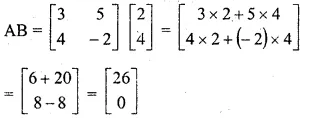
If A = \(\begin{bmatrix} 3 & \quad 5 \\ 4 & \quad -2 \end{bmatrix}\) and B = \(\left[ \begin{matrix} 2 \\ 4 \end{matrix} \right] \), is the product AB possible ? Give a reason. If yes, find AB.
Solution:
Yes, the product is possible because of
number of column in A = number of row in B
i.e., (2 x 2). (2 x 1) = (2 x 1) is the order of the matrix.
ML Aggarwal Class 10 Solutions for ICSE Maths Chapter 8 Matrices Ex 8.3 Q1.1

Question 2.
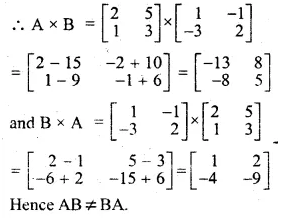
If A = \(\begin{bmatrix} 2 & 5 \\ 1 & 3 \end{bmatrix}\),B = \(\begin{bmatrix} 1 & -1 \\ -3 & 2 \end{bmatrix}\), find AB and BA, Is AB = BA ?
Solution:
A = \(\begin{bmatrix} 2 & 5 \\ 1 & 3 \end{bmatrix}\),
B = \(\begin{bmatrix} 1 & -1 \\ -3 & 2 \end{bmatrix}\)
ML Aggarwal Class 10 Solutions for ICSE Maths Chapter 8 Matrices Ex 8.3 Q2.1

Question 3.
If P = \(\begin{bmatrix} 4 & 6 \\ 2 & -8 \end{bmatrix}\),Q = \(\begin{bmatrix} 2 & -3 \\ -1 & 1 \end{bmatrix}\)
Find 2PQ
Solution:
P = \(\begin{bmatrix} 4 & 6 \\ 2 & -8 \end{bmatrix}\),
Q = \(\begin{bmatrix} 2 & -3 \\ -1 & 1 \end{bmatrix}\)
\(2PQ=2\begin{bmatrix} 4 & \quad 6 \\ 2 & -8 \end{bmatrix}\times \begin{bmatrix} 2\quad & -3 \\ -1 & \quad 1 \end{bmatrix}\)
ML Aggarwal Class 10 Solutions for ICSE Maths Chapter 8 Matrices Ex 8.3 Q3.1

Question 4.
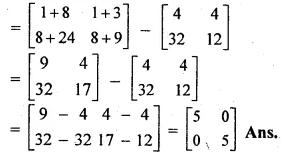
Given A = \(\begin{bmatrix} 1 & 1 \\ 8 & 3 \end{bmatrix}\) , evaluate A² – 4A
Solution:
A = \(\begin{bmatrix} 1 & 1 \\ 8 & 3 \end{bmatrix}\)
A² – 4A = \(\begin{bmatrix} 1 & \quad 1 \\ 8 & \quad 3 \end{bmatrix}\begin{bmatrix} 1\quad & 1 \\ 8\quad & 3 \end{bmatrix}-4\begin{bmatrix} 1\quad & 1 \\ 8\quad & 3 \end{bmatrix}\)
ML Aggarwal Class 10 Solutions for ICSE Maths Chapter 8 Matrices Ex 8.3 Q4.1

Question 5.
If A = \(\begin{bmatrix} 3 & \quad 7 \\ 2 & \quad 4 \end{bmatrix}\), B = \(\begin{bmatrix} 0 & \quad 2 \\ 5 & \quad 3 \end{bmatrix}\) and C = \(\begin{bmatrix} 1 & \quad -5 \\ -4 & \quad 6 \end{bmatrix}\)
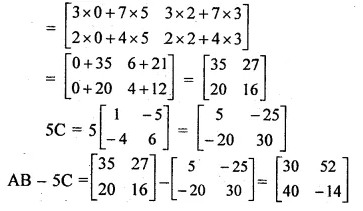
Find AB – 5C
Solution:
A = \(\begin{bmatrix} 3 & \quad 7 \\ 2 & \quad 4 \end{bmatrix}\), B = \(\begin{bmatrix} 0 & \quad 2 \\ 5 & \quad 3 \end{bmatrix}\) and C = \(\begin{bmatrix} 1 & \quad -5 \\ -4 & \quad 6 \end{bmatrix}\)
AB = \(\begin{bmatrix} 3 & \quad 7 \\ 2 & \quad 4 \end{bmatrix}\)\(\begin{bmatrix} 0 & \quad 2 \\ 5 & \quad 3 \end{bmatrix}\)
ML Aggarwal Class 10 Solutions for ICSE Maths Chapter 8 Matrices Ex 8.3 Q5.1

Question 6.
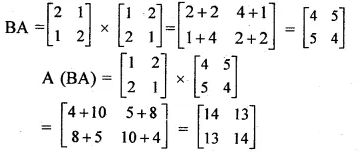
If A = \(\begin{bmatrix} 1 & \quad 2 \\ 2 & \quad 1 \end{bmatrix}\) and B = \(\begin{bmatrix} 2 & \quad 1 \\ 1 & \quad 2 \end{bmatrix}\), find A(BA)
Solution:
A = \(\begin{bmatrix} 1 & \quad 2 \\ 2 & \quad 1 \end{bmatrix}\)
B = \(\begin{bmatrix} 2 & \quad 1 \\ 1 & \quad 2 \end{bmatrix}\)
ML Aggarwal Class 10 Solutions for ICSE Maths Chapter 8 Matrices Ex 8.3 Q6.1

Question 7.
Given matrices:
A = \(\begin{bmatrix} 2 & \quad 1 \\ 4 & \quad 2 \end{bmatrix}\) and B = \(\begin{bmatrix} 3 & \quad 4 \\ -1 & \quad -2 \end{bmatrix}\), C = \(\begin{bmatrix} -3 & \quad 1 \\ 0 & \quad -2 \end{bmatrix}\)
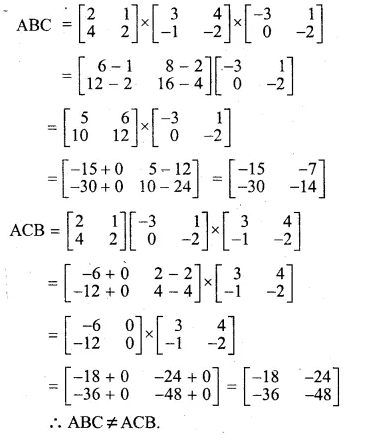
Find the products of (i) ABC (ii) ACB and state whether they are equal.
Solution:
A = \(\begin{bmatrix} 2 & \quad 1 \\ 4 & \quad 2 \end{bmatrix}\)
B = \(\begin{bmatrix} 3 & \quad 4 \\ -1 & \quad -2 \end{bmatrix}\),
C = \(\begin{bmatrix} -3 & \quad 1 \\ 0 & \quad -2 \end{bmatrix}\)
ML Aggarwal Class 10 Solutions for ICSE Maths Chapter 8 Matrices Ex 8.3 Q7.1

Question 8.
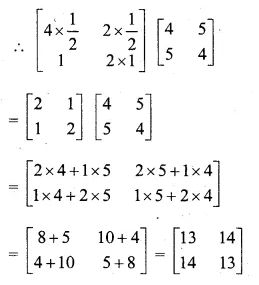
Evaluate : \(\begin{bmatrix} 4\sin { { 30 }^{ o } } & \quad 2cos{ 60 }^{ o } \\ sin{ 90 }^{ o } & \quad 2cos{ 0 }^{ o } \end{bmatrix}\begin{bmatrix} 4 & 5 \\ 5 & 4 \end{bmatrix}\)
Solution:
\(\begin{bmatrix} 4\sin { { 30 }^{ o } } & \quad 2cos{ 60 }^{ o } \\ sin{ 90 }^{ o } & \quad 2cos{ 0 }^{ o } \end{bmatrix}\begin{bmatrix} 4 & 5 \\ 5 & 4 \end{bmatrix}\)
\(sin{ 30 }^{ o }=\frac { 1 }{ 2 } ,cos{ 60 }^{ o }=\frac { 1 }{ 2 } \)
ML Aggarwal Class 10 Solutions for ICSE Maths Chapter 8 Matrices Ex 8.3 Q8.1

Question 9.
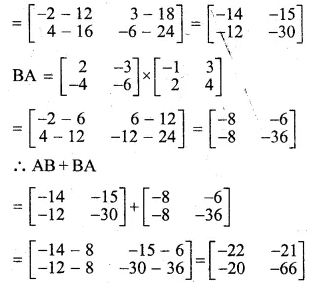
If A = \(\begin{bmatrix} -1 & \quad 3 \\ 2 & \quad 4 \end{bmatrix}\), B = \(\begin{bmatrix} 2 & \quad -3 \\ -4 & \quad -6 \end{bmatrix}\) find the matrix AB + BA
Solution:
A = \(\begin{bmatrix} -1 & \quad 3 \\ 2 & \quad 4 \end{bmatrix}\),
B = \(\begin{bmatrix} 2 & \quad -3 \\ -4 & \quad -6 \end{bmatrix}\)
\(AB=\begin{bmatrix} -1 & \quad 3 \\ 2 & \quad 4 \end{bmatrix}\times \begin{bmatrix} 2 & \quad -3 \\ -4 & \quad -6 \end{bmatrix}\)
ML Aggarwal Class 10 Solutions for ICSE Maths Chapter 8 Matrices Ex 8.3 Q9.1

Question 10.
A = \(\begin{bmatrix} 1 & \quad 2 \\ 3 & \quad 4 \end{bmatrix}\) and B = \(\begin{bmatrix} 6 & \quad 1 \\ 1 & \quad 1 \end{bmatrix}\), C = \(\begin{bmatrix} -2 & \quad -3 \\ 0 & \quad 1 \end{bmatrix}\)
find each of the following and state if they are equal.
(i) CA + B
(ii) A + CB
Solution:
(i) CA + B
CA = \(\begin{bmatrix} -2 & \quad -3 \\ 0 & \quad 1 \end{bmatrix}\)\(\begin{bmatrix} 1 & \quad 2 \\ 3 & \quad 4 \end{bmatrix}\)
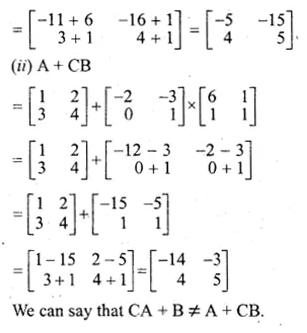
ML Aggarwal Class 10 Solutions for ICSE Maths Chapter 8 Matrices Ex 8.3 Q10.1

Question 11.
If A = \(\begin{bmatrix} 1 & -2 \\ 2 & -1 \end{bmatrix}\) and B = \(\begin{bmatrix} 3 & 2 \\ -2 & 1 \end{bmatrix}\)
Find 2B – A²
Solution:
A = \(\begin{bmatrix} 1 & -2 \\ 2 & -1 \end{bmatrix}\)
B = \(\begin{bmatrix} 3 & 2 \\ -2 & 1 \end{bmatrix}\)
2B = \(2\begin{bmatrix} 3 & 2 \\ -2 & 1 \end{bmatrix}\)
= \(\begin{bmatrix} 6 & 4 \\ -4 & 2 \end{bmatrix}\)
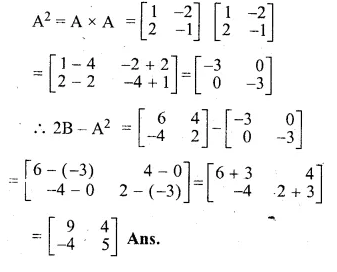
ML Aggarwal Class 10 Solutions for ICSE Maths Chapter 8 Matrices Ex 8.3 Q11.1

Question 12.
If A = \(\begin{bmatrix} 1 & 2 \\ 3 & 4 \end{bmatrix}\) and B = \(\begin{bmatrix} 2 & 1 \\ 4 & 2 \end{bmatrix}\), C = \(\begin{bmatrix} 5 & 1 \\ 7 & 4 \end{bmatrix}\), compute
(i) A(B + C)
(ii) (B + C)A
Solution:
(i) A(B + C)
A = \(\begin{bmatrix} 1 & 2 \\ 3 & 4 \end{bmatrix}\)
B = \(\begin{bmatrix} 2 & 1 \\ 4 & 2 \end{bmatrix}\),
C = \(\begin{bmatrix} 5 & 1 \\ 7 & 4 \end{bmatrix}\)
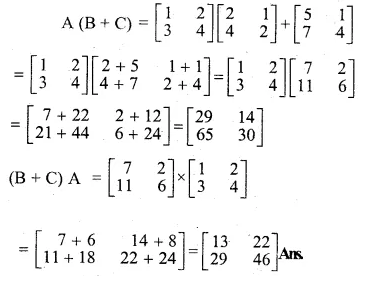
ML Aggarwal Class 10 Solutions for ICSE Maths Chapter 8 Matrices Ex 8.3 Q12.1

Question 13.
If A = \(\begin{bmatrix} 1 & 2 \\ 2 & 3 \end{bmatrix}\) and B = \(\begin{bmatrix} 2 & 1 \\ 3 & 2 \end{bmatrix}\), C = \(\begin{bmatrix} 1 & 3 \\ 3 & 1 \end{bmatrix}\)
find the matrix C(B – A)
Solution:
A = \(\begin{bmatrix} 1 & 2 \\ 2 & 3 \end{bmatrix}\)
B = \(\begin{bmatrix} 2 & 1 \\ 3 & 2 \end{bmatrix}\),
C = \(\begin{bmatrix} 1 & 3 \\ 3 & 1 \end{bmatrix}\)
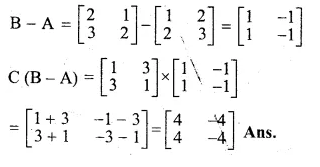
ML Aggarwal Class 10 Solutions for ICSE Maths Chapter 8 Matrices Ex 8.3 Q13.1

Question 14.
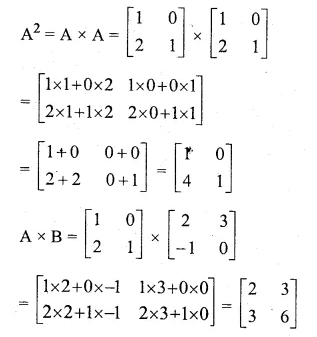
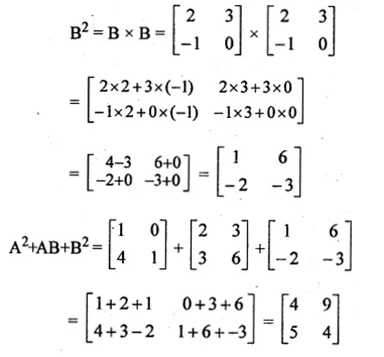
A = \(\begin{bmatrix} 1 & 0 \\ 2 & 1 \end{bmatrix}\) and B = \(\begin{bmatrix} 2 & 3 \\ -1 & 0 \end{bmatrix}\)
Find A² + AB + B²
Solution:
Given that
A = \(\begin{bmatrix} 1 & 0 \\ 2 & 1 \end{bmatrix}\)
B = \(\begin{bmatrix} 2 & 3 \\ -1 & 0 \end{bmatrix}\)
ML Aggarwal Class 10 Solutions for ICSE Maths Chapter 8 Matrices Ex 8.3 Q14.1
ML Aggarwal Class 10 Solutions for ICSE Maths Chapter 8 Matrices Ex 8.3 Q14.2

Question 15.
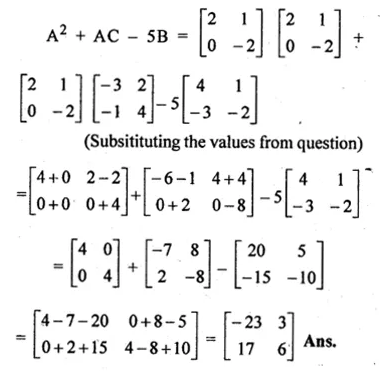
If A = \(\begin{bmatrix} 2 & 1 \\ 0 & -2 \end{bmatrix}\) and B = \(\begin{bmatrix} 4 & 1 \\ -3 & -2 \end{bmatrix}\), C = \(\begin{bmatrix} -3 & 2 \\ -1 & 4 \end{bmatrix}\)
Find A² + AC – 5B
Solution:
A = \(\begin{bmatrix} 2 & 1 \\ 0 & -2 \end{bmatrix}\)
B = \(\begin{bmatrix} 4 & 1 \\ -3 & -2 \end{bmatrix}\),
C = \(\begin{bmatrix} -3 & 2 \\ -1 & 4 \end{bmatrix}\)
ML Aggarwal Class 10 Solutions for ICSE Maths Chapter 8 Matrices Ex 8.3 Q15.1

Question 16.
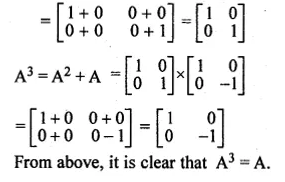
If A = \(\begin{bmatrix} 1 & 0 \\ 0 & -1 \end{bmatrix}\), find A2 and A3.Also state that which of these is equal to A
Solution:
A = \(\begin{bmatrix} 1 & 0 \\ 0 & -1 \end{bmatrix}\)
A² = A x A = \(\begin{bmatrix} 1 & 0 \\ 0 & -1 \end{bmatrix}\)\(\begin{bmatrix} 1 & 0 \\ 0 & -1 \end{bmatrix}\)
ML Aggarwal Class 10 Solutions for ICSE Maths Chapter 8 Matrices Ex 8.3 Q16.1

Question 17.
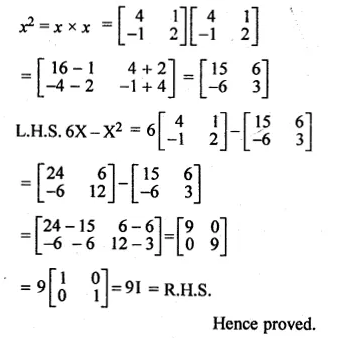
If X = \(\begin{bmatrix} 4 & 1 \\ -1 & 2 \end{bmatrix}\), show that 6X – X² = 9I Where I is the unit matrix.
Solution:
Given that
X = \(\begin{bmatrix} 4 & 1 \\ -1 & 2 \end{bmatrix}\)
ML Aggarwal Class 10 Solutions for ICSE Maths Chapter 8 Matrices Ex 8.3 Q17.1

Question 18.
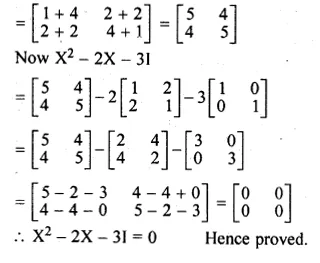
Show that \(\begin{bmatrix} 1 & 2 \\ 2 & 1 \end{bmatrix}\) is a solution of the matrix equation X² – 2X – 3I = 0,Where I is the unit matrix of order 2
Solution:
Given
X² – 2X – 3I = 0
Solution = \(\begin{bmatrix} 1 & 2 \\ 2 & 1 \end{bmatrix}\)
or
X = \(\begin{bmatrix} 1 & 2 \\ 2 & 1 \end{bmatrix}\)
∴ X² = \(\begin{bmatrix} 1 & 2 \\ 2 & 1 \end{bmatrix}\)\(\begin{bmatrix} 1 & 2 \\ 2 & 1 \end{bmatrix}\)
ML Aggarwal Class 10 Solutions for ICSE Maths Chapter 8 Matrices Ex 8.3 Q18.1

Question 19.
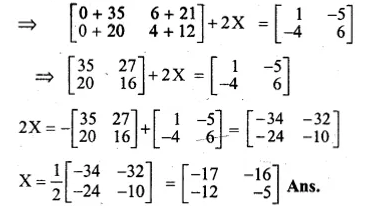
Find the matrix X of order 2 × 2 which satisfies the equation
\(\begin{bmatrix} 3 & 7 \\ 2 & 4 \end{bmatrix}\begin{bmatrix} 0 & 2 \\ 5 & 3 \end{bmatrix}+2X=\begin{bmatrix} 1 & -5 \\ -4 & 6 \end{bmatrix}\)
Solution:
Given
\(\begin{bmatrix} 3 & 7 \\ 2 & 4 \end{bmatrix}\begin{bmatrix} 0 & 2 \\ 5 & 3 \end{bmatrix}+2X=\begin{bmatrix} 1 & -5 \\ -4 & 6 \end{bmatrix}\)
ML Aggarwal Class 10 Solutions for ICSE Maths Chapter 8 Matrices Ex 8.3 Q19.1

Question 20.
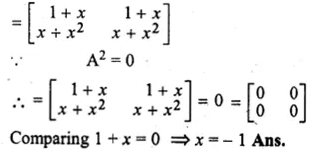
If A = \(\begin{bmatrix} 1 & 1 \\ x & x \end{bmatrix}\), find the value of x, so that A² – 0
Solution:
Given
A = \(\begin{bmatrix} 1 & 1 \\ x & x \end{bmatrix}\)
A² = \(\begin{bmatrix} 1 & 1 \\ x & x \end{bmatrix}\)\(\begin{bmatrix} 1 & 1 \\ x & x \end{bmatrix}\)
ML Aggarwal Class 10 Solutions for ICSE Maths Chapter 8 Matrices Ex 8.3 Q20.1

Question 21.
If \(\begin{bmatrix} 1 & 3 \\ 0 & 0 \end{bmatrix}\left[ \begin{matrix} 2 \\ -1 \end{matrix} \right] =\left[ \begin{matrix} x \\ 0 \end{matrix} \right] \) Find the value of x
Solution:
\(\begin{bmatrix} 1 & 3 \\ 0 & 0 \end{bmatrix}\left[ \begin{matrix} 2 \\ -1 \end{matrix} \right] =\left[ \begin{matrix} x \\ 0 \end{matrix} \right] \)
⇒ \(\begin{bmatrix} 2 & -3 \\ 0 & 0 \end{bmatrix}=\left[ \begin{matrix} x \\ 0 \end{matrix} \right] \)
⇒ \(\left[ \begin{matrix} -1 \\ 0 \end{matrix} \right] =\left[ \begin{matrix} x \\ 0 \end{matrix} \right] \)
Comparing the corresponding elements
x = -1

Question 22.
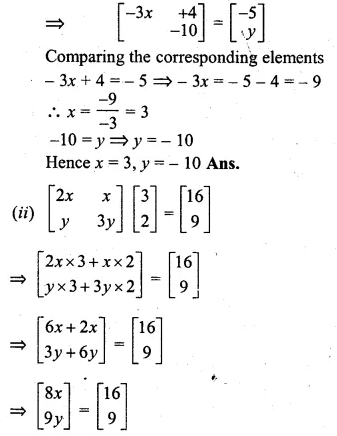
(i) Find x and y if \(\begin{bmatrix} -3 & 2 \\ 0 & -5 \end{bmatrix}\left[ \begin{matrix} x \\ 2 \end{matrix} \right] =\left[ \begin{matrix} -5 \\ y \end{matrix} \right] \)
(ii) Find x and y if \(\begin{bmatrix} 2x & x \\ y & 3y \end{bmatrix}\left[ \begin{matrix} 3 \\ 2 \end{matrix} \right] =\left[ \begin{matrix} 16 \\ 9 \end{matrix} \right] \)
Solution:
(i) \(\begin{bmatrix} -3 & 2 \\ 0 & -5 \end{bmatrix}\left[ \begin{matrix} x \\ 2 \end{matrix} \right] =\left[ \begin{matrix} -5 \\ y \end{matrix} \right] \)
⇒ \(\begin{bmatrix} -3x & 4 \\ 0 & -10 \end{bmatrix}=\left[ \begin{matrix} -5 \\ y \end{matrix} \right] \)
ML Aggarwal Class 10 Solutions for ICSE Maths Chapter 8 Matrices Ex 8.3 Q22.1
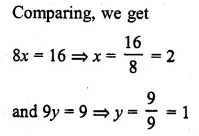
ML Aggarwal Class 10 Solutions for ICSE Maths Chapter 8 Matrices Ex 8.3 Q22.2
Here x = 2, y = 1

Question 23.
Find x and y if
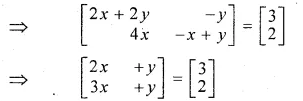
\(\begin{bmatrix} x+y & y \\ 2x & x-y \end{bmatrix}\left[ \begin{matrix} 2 \\ -1 \end{matrix} \right] =\left[ \begin{matrix} 3 \\ 2 \end{matrix} \right] \)
Solution:
Given
\(\begin{bmatrix} x+y & y \\ 2x & x-y \end{bmatrix}\left[ \begin{matrix} 2 \\ -1 \end{matrix} \right] =\left[ \begin{matrix} 3 \\ 2 \end{matrix} \right] \)
ML Aggarwal Class 10 Solutions for ICSE Maths Chapter 8 Matrices Ex 8.3 Q23.1

Question 24.
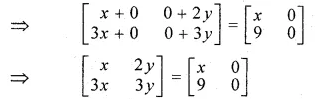
If \(\begin{bmatrix} 1 & 2 \\ 3 & 3 \end{bmatrix}\begin{bmatrix} x & 0 \\ 0 & y \end{bmatrix}=\begin{bmatrix} x & 0 \\ 9 & 0 \end{bmatrix} \) find the values of x and y
Solution:
Given
\(\begin{bmatrix} 1 & 2 \\ 3 & 3 \end{bmatrix}\begin{bmatrix} x & 0 \\ 0 & y \end{bmatrix}=\begin{bmatrix} x & 0 \\ 9 & 0 \end{bmatrix} \)
ML Aggarwal Class 10 Solutions for ICSE Maths Chapter 8 Matrices Ex 8.3 Q24.1

Question 25.
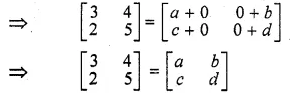
If \(\begin{bmatrix} 3 & 4 \\ 2 & 5 \end{bmatrix}=\begin{bmatrix} a & b \\ c & d \end{bmatrix}\begin{bmatrix} 1 & 0 \\ 0 & 1 \end{bmatrix}\) write down the values of a,b,c and d
Solution:
Given
\(\begin{bmatrix} 3 & 4 \\ 2 & 5 \end{bmatrix}=\begin{bmatrix} a & b \\ c & d \end{bmatrix}\begin{bmatrix} 1 & 0 \\ 0 & 1 \end{bmatrix}\)
ML Aggarwal Class 10 Solutions for ICSE Maths Chapter 8 Matrices Ex 8.3 Q25.1
Comparing the corresponding elements
a = 3, b = 4, c = 2, d = 5

Question 26.
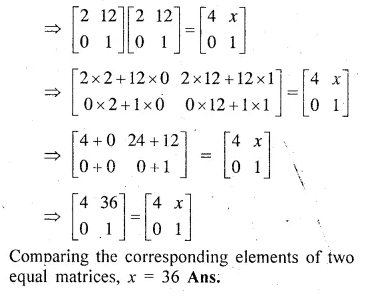
Find the value of x given that A² = B
Where A = \(\begin{bmatrix} 2 & 12 \\ 0 & 1 \end{bmatrix}\) and
B = \(\begin{bmatrix} 4 & x \\ 0 & 1 \end{bmatrix}\)
Solution:
A = \(\begin{bmatrix} 2 & 12 \\ 0 & 1 \end{bmatrix}\) and
B = \(\begin{bmatrix} 4 & x \\ 0 & 1 \end{bmatrix}\)
A² = B
ML Aggarwal Class 10 Solutions for ICSE Maths Chapter 8 Matrices Ex 8.3 Q26.1

Question 27.
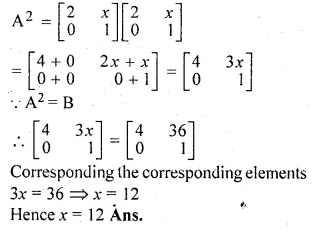
If A = \(\begin{bmatrix} 2 & x \\ 0 & 1 \end{bmatrix}\) and B = \(\begin{bmatrix} 4 & 36 \\ 0 & 1 \end{bmatrix}\), find the value of x, given that A² – B
Solution:
Given
A² = \(\begin{bmatrix} 2 & x \\ 0 & 1 \end{bmatrix}\)\(\begin{bmatrix} 2 & x \\ 0 & 1 \end{bmatrix}\)
ML Aggarwal Class 10 Solutions for ICSE Maths Chapter 8 Matrices Ex 8.3 Q27.1

Question 28.
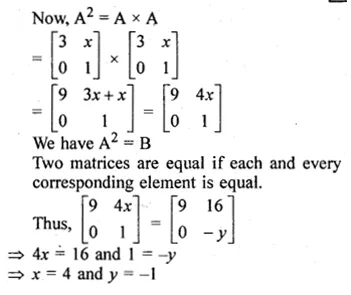
If A = \(\begin{bmatrix} 3 & x \\ 0 & 1 \end{bmatrix}\) and B = \(\begin{bmatrix} 9 & 16 \\ 0 & -y \end{bmatrix}\) find x and y when A² = B
Solution:
Given
A = \(\begin{bmatrix} 3 & x \\ 0 & 1 \end{bmatrix}\) and B = \(\begin{bmatrix} 9 & 16 \\ 0 & -y \end{bmatrix}\) find x and y when A² = B
ML Aggarwal Class 10 Solutions for ICSE Maths Chapter 8 Matrices Ex 8.3 Q28.1

Question 29.
Find x, y if \(\begin{bmatrix} -2 & 0 \\ 3 & 1 \end{bmatrix}\left[ \begin{matrix} -1 \\ 2x \end{matrix} \right] +3\left[ \begin{matrix} -2 \\ 1 \end{matrix} \right] =2\left[ \begin{matrix} y \\ 3 \end{matrix} \right] \)
Solution:
Given
\(\begin{bmatrix} -2 & 0 \\ 3 & 1 \end{bmatrix}\left[ \begin{matrix} -1 \\ 2x \end{matrix} \right] +3\left[ \begin{matrix} -2 \\ 1 \end{matrix} \right] =2\left[ \begin{matrix} y \\ 3 \end{matrix} \right] \)
ML Aggarwal Class 10 Solutions for ICSE Maths Chapter 8 Matrices Ex 8.3 Q29.1

Question 30.
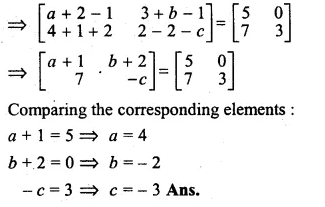
If \(\begin{bmatrix} a & 1 \\ 1 & 0 \end{bmatrix}\begin{bmatrix} 4 & 3 \\ -3 & 2 \end{bmatrix}=\begin{bmatrix} b & 11 \\ 4 & c \end{bmatrix} \) find a,b and c
Solution:
\(\begin{bmatrix} a & 1 \\ 1 & 0 \end{bmatrix}\begin{bmatrix} 4 & 3 \\ -3 & 2 \end{bmatrix}=\begin{bmatrix} b & 11 \\ 4 & c \end{bmatrix} \)
⇒ \(\begin{bmatrix} 4a-3 & 3a+2 \\ 4+0 & 3+0 \end{bmatrix}=\begin{bmatrix} b & 11 \\ 4 & c \end{bmatrix} \)
ML Aggarwal Class 10 Solutions for ICSE Maths Chapter 8 Matrices Ex 8.3 Q30.1

Question 31.
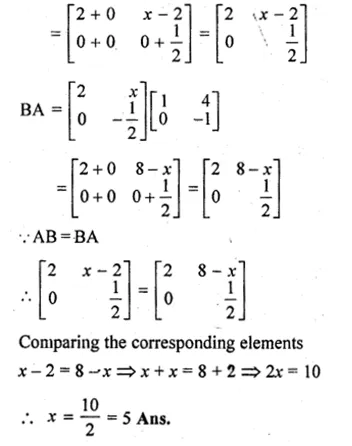
If A = \(\begin{bmatrix} 1 & 4 \\ 0 & -1 \end{bmatrix}\) ,B = \(\begin{bmatrix} 2 & x \\ 0 & -\frac { 1 }{ 2 } \end{bmatrix} \) find the value of x if AB = BA
Solution:
Given
AB = \(\begin{bmatrix} 1 & 4 \\ 0 & -1 \end{bmatrix}\)\(\begin{bmatrix} 2 & x \\ 0 & -\frac { 1 }{ 2 } \end{bmatrix} \)
ML Aggarwal Class 10 Solutions for ICSE Maths Chapter 8 Matrices Ex 8.3 Q31.1

Question 32.
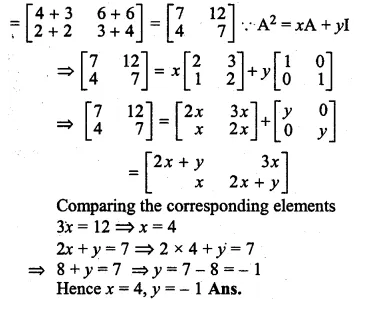
If A = \(\begin{bmatrix} 2 & 3 \\ 1 & 2 \end{bmatrix}\) find x and y so that A² – xA + yI
Solution:
Given
A² = \(\begin{bmatrix} 2 & 3 \\ 1 & 2 \end{bmatrix}\)\(\begin{bmatrix} 2 & 3 \\ 1 & 2 \end{bmatrix}\)
ML Aggarwal Class 10 Solutions for ICSE Maths Chapter 8 Matrices Ex 8.3 Q32.1

Question 33.
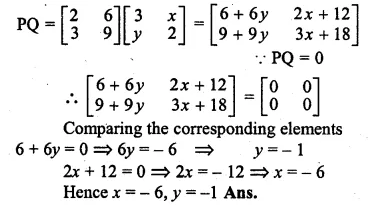
If P = \(\begin{bmatrix} 2 & 6 \\ 3 & 9 \end{bmatrix}\), Q = \(\begin{bmatrix} 3 & x \\ y & 2 \end{bmatrix}\)
find x and y such that PQ = 0
Solution:
Given
P = \(\begin{bmatrix} 2 & 6 \\ 3 & 9 \end{bmatrix}\),
Q = \(\begin{bmatrix} 3 & x \\ y & 2 \end{bmatrix}\)
ML Aggarwal Class 10 Solutions for ICSE Maths Chapter 8 Matrices Ex 8.3 Q33.1

Question 34.
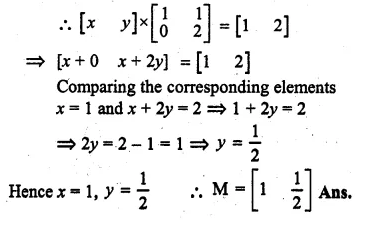
Let \(M\times \begin{bmatrix} 1 & 1 \\ 0 & 2 \end{bmatrix}=\left[ \begin{matrix} 1 & 2 \end{matrix} \right] \) where M is a matrix
(i) State the order of matrix M
(ii) Find the matrix M
Solution:
Given
(i) M is the order of 1 x 2
let M = [x y]
ML Aggarwal Class 10 Solutions for ICSE Maths Chapter 8 Matrices Ex 8.3 Q34.1

Question 35.
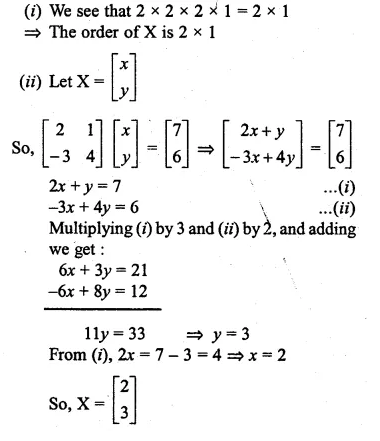
Given \(\begin{bmatrix} 2 & 1 \\ -3 & 4 \end{bmatrix}\) ,X = \(\left[ \begin{matrix} 7 \\ 6 \end{matrix} \right] \)
(i) the order of the matrix X
(ii) the matrix X
Solution:
We have
\(\begin{bmatrix} 2 & 1 \\ -3 & 4 \end{bmatrix}\) , X = \(\left[ \begin{matrix} 7 \\ 6 \end{matrix} \right] \)
ML Aggarwal Class 10 Solutions for ICSE Maths Chapter 8 Matrices Ex 8.3 Q35.1

Question 36.
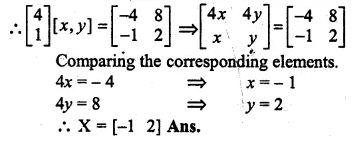
Solve the matrix equation : \(\left[ \begin{matrix} 4 \\ 1 \end{matrix} \right] \) ,X = \(\begin{bmatrix} -4 & 8 \\ -1 & 2 \end{bmatrix}\)
Solution:
\(\left[ \begin{matrix} 4 \\ 1 \end{matrix} \right] \) , X = \(\begin{bmatrix} -4 & 8 \\ -1 & 2 \end{bmatrix}\)
Let matrix X = [x y]
ML Aggarwal Class 10 Solutions for ICSE Maths Chapter 8 Matrices Ex 8.3 Q36.1

Question 37.
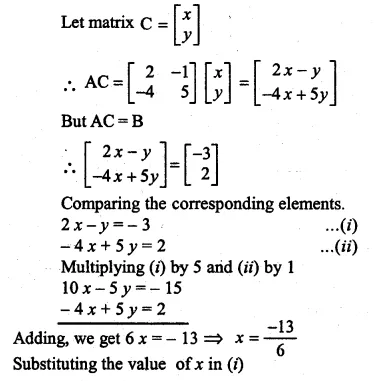
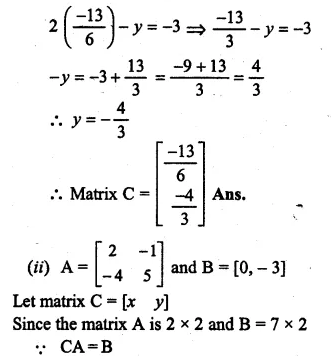
(i) If A = \(\begin{bmatrix} 2 & -1 \\ -4 & 5 \end{bmatrix}\) and B = \(\left[ \begin{matrix} -3 \\ 2 \end{matrix} \right] \) find the matrix C such that AC = B
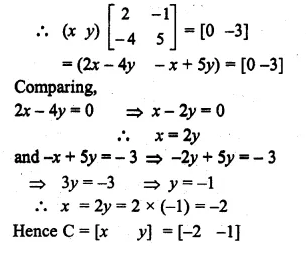
(ii) If A = \(\begin{bmatrix} 2 & -1 \\ -4 & 5 \end{bmatrix}\) and B = [0 -3] find the matrix C such that CA = B
Solution:
(i) given
A = \(\begin{bmatrix} 2 & -1 \\ -4 & 5 \end{bmatrix}\)
B = \(\left[ \begin{matrix} -3 \\ 2 \end{matrix} \right] \)
ML Aggarwal Class 10 Solutions for ICSE Maths Chapter 8 Matrices Ex 8.3 Q37.1
ML Aggarwal Class 10 Solutions for ICSE Maths Chapter 8 Matrices Ex 8.3 Q37.2
ML Aggarwal Class 10 Solutions for ICSE Maths Chapter 8 Matrices Ex 8.3 Q37.3

Question 38.
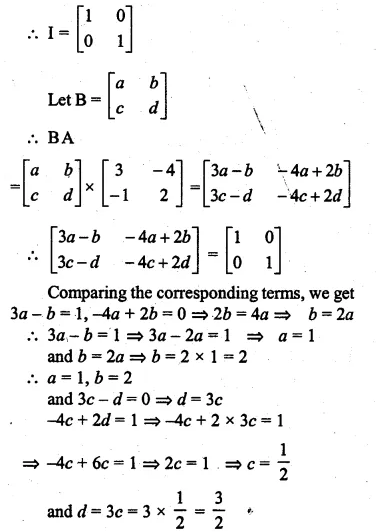
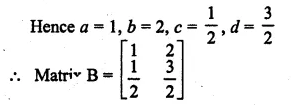
If A = \(\begin{bmatrix} 3 & -4 \\ -1 & 2 \end{bmatrix}\) , find matrix B such that BA = I,where I is unity matrix of order 2
Solution:
A = \(\begin{bmatrix} 3 & -4 \\ -1 & 2 \end{bmatrix}\)
BA = I, where I is unity matrix of order 2
ML Aggarwal Class 10 Solutions for ICSE Maths Chapter 8 Matrices Ex 8.3 Q38.1
ML Aggarwal Class 10 Solutions for ICSE Maths Chapter 8 Matrices Ex 8.3 Q38.2

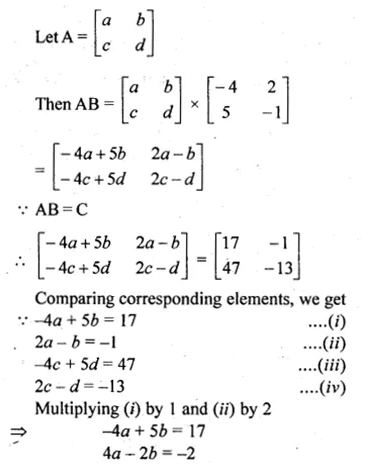
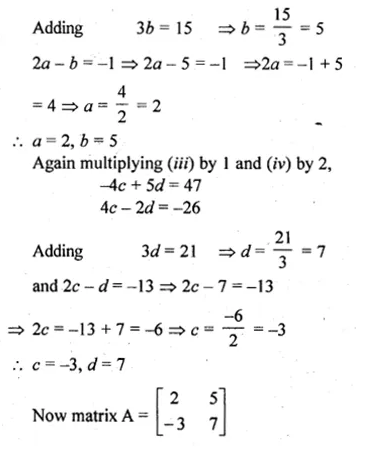
Question 39.
If B = \(\begin{bmatrix} -4 & 2 \\ 5 & -1 \end{bmatrix}\) and C = \(\begin{bmatrix} 17 & -1 \\ 47 & -13 \end{bmatrix}\)
find the matrix A such that AB = C
Solution:
B = \(\begin{bmatrix} -4 & 2 \\ 5 & -1 \end{bmatrix}\)
C = \(\begin{bmatrix} 17 & -1 \\ 47 & -13 \end{bmatrix}\)
and AB = C
ML Aggarwal Class 10 Solutions for ICSE Maths Chapter 8 Matrices Ex 8.3 Q39.1
ML Aggarwal Class 10 Solutions for ICSE Maths Chapter 8 Matrices Ex 8.3 Q39.2

Hope given ML Aggarwal Class 10 Solutions for ICSE Maths Chapter 8 Matrices Ex 8.3 are helpful to complete your math homework.

If you have any doubts, please comment below. Learn Insta try to provide online math tutoring for you.

CA Foundation Business Laws Study Material Chapter 18 Relations of Partners 170

CA Foundation Business Laws Study Material Chapter 18 Relations of Partners 170

RIGHTS & DUTIES OF PARTNERS (SECS. 9 TO 17)

The mutual rights & duties of the partners are usually governed by the agreement between them. Where there is no specific agreement, their relations to one another are governed by Secs. 9 to 17 of the Partnership Act.
a. Rights of partners
Subject to contract between the partners, the Partnership Act confers the following rights upon the partners of a firm:

1. Right to take part in the conduct of the business [Sec.12(a)]
Every partner has a right to take part in the conduct of the business of the firm. The partners among themselves, may agree to entrust the work of management to one or more of them and they may even agree to make payment to such partners by way of an extra remuneration.

2. Right to be consulted[Sec.12(c)]
Every partner has a right to be consulted and heard before any matter is decided. Ordinary matters may be decided by majority opinion but matters of fundamental nature would require unanimity.
The matters which are to be decided by unanimous consent of all the partners are discussed below :

  1. Nature of business [Sec. 12]:
    No change can be made in nature of the business without the consent of all the partners.
  2. Admission of a partner [Sec. 31(1)] :
    A person can be admitted as a partner, only with the consent of all the existing partners.
  3. Transfer by a partner of his interest in the firm. (sec. 29):
    A partner can transfer his share in the firm to a third person with the consent of all other partners.
  4. Admission of a minor to the benefits of partnership [Sec. 30(1)]:
    A minor is incompetent to contract and, therefore a contract of partnership cannot be entered into with a minor. However, he can be admitted to the benefits of an existing partnership firm provided all the partners consent to it.

3. Right to access to books [Sec.12(d)]
Every partner has a right to have access, to inspect and copy any of the records and books of the firm.

4. Right to share the profits [Sec. 13(b)]
Every partner has right to share equally in the profits earned and to contribute equally to the losses sustained by the firm. This provision is irrespective of the amount of capital j contribution made or business expertise offered. However, they may agree to share the profits in some other ratio.
5. Right to interest on Capital [Sec. 13(c)]
Every partner has right to interest on capital, if so agreed, out of profits only.

6. Right to interest on advances [Sec. 13(d)]
A Partner is entitled to receive interest at 6 % p.a. on any advance, in excess of the agreed amount of capital, made for the purposes of the business.

7. Right to indemnity [Sec. 13(e)]
Every partner has a right to claim indemnity from the firm in respect of payments made or liabilities incurred by him

  1. in the ordinary and proper conduct of the business, and
  2. in doing such act, in an emergency, for the purpose of protecting the firm from loss, as would be done by a person of ordinary prudence, in his own case, under similar circumstances.

8. Right to prevent the introduction of new partner [Sec. 31(1)]
Every partner is entitled to prevent the admission of a new partner into the firm.

9. Right to retire [Sec.32(1)]
A partner to retire from the firm

  1. with the consent of all other partners, or
  2. in accordance with the terms of the deed, or
  3. by giving a notice to all other partners, of his intention to retire.

10. Right not to be expelled [Sec.33]
Every partner has right to continue in the partnership and not to be expelled from the firm.

11. Right to carry on competing business after retirement [sec.36(1)]
Every outgoing partner has a right to carry on a competitive business under certain conditions.

12. Right to dissolve the firm (sec. 43)
Where the partnership is at will, the firm may dissolve by any partner giving notice in writing to all the other partners of his intention to dissolve the firm.

b. Duties of Partners
1. General Duties of Partners:
Section 9 of Partnership Act lays down that all the partners are bound:

  1. to carry on the business of the firm to the greatest common advantage,
  2. to be just and faithful to each other, and
  3. to render to any partner or his legal representative the true accounts and
  4. to render full information of all things affecting the firm.

2. Duty to indemnify for loss caused by fraud:
According to Section 10 of Partnership Act, every partner shall indemnify (reimburse or pay back) the firm for any loss caused to it by his fraud in the conduct of the business of the firm.

3. Duty to attend diligently to his duties[Sec. 12 (b)]:
Every partner is bound to attend diligently to his duties in the conduct of the business.

4. Duty to work without remuneration [Sec. 13(a)]:
A partner is normally not entitled to receive any remuneration for taking part in the business of the firm. However if the partnership agreement provides or business custom allows, a partner can be given remuneration.

5. Duty to contribute to the losses [(Sec. 13(b)]:
The partners shall contribute equally to the losses sustained by the firm without regard to the capital contribution made by the firm.

6. Duty to indemnify for wilful neglect [Sec. 13 (f)]:
A partner shall indemnify the firm for any loss caused to it by his wilful neglect in the conduct of the business of the firm.

7. Duty to use firm’s property exclusively by for the firm. (Sec. 15):
Subject to contract between the partners, the property of the firm shall be held exclu¬sively for the purposes of the business of the firm.

8. Duty to account for personal profits derived [Sec. 16(a)]:
If a partner derives any profit for himself from any transaction of the firm, or from the use of the property or business connection of the firm in the firm’s name, he shall account for that profit and pay it to the firm.

9. Duty not to compete with the business of the firm [Sec. 16 (b)]:
No partner can carry on a business which is competing with that of the firm without the consent of the other partners, otherwise the partner carrying on such a business will have to account for and pay to the firm all profits made by him in that business.

10. Not to assign (transfer) his interest in the firm (sec. 29):
It is the duty of a partner not to assign his interest in the firm to a stranger (outsider) without the consent of all other partners.

c. Mutual rights and duties of partners—

  1. after a change in the constitution of the firm,
  2. after the expiry of the term of the firm, and
  3. where additional undertakings or adventures are carried out.

(1) Rights and duties of partners after a change occurs in the constitution of the firm. Subject to contract between the partners, where a change occurs in the constitution of the firm, the mutual rights and duties of the partners in the reconstituted firm remain the same as they were immediately before the change, as far as may be [Sec. 17(a)],
(2) Rights and duties of the partners after the expiry of the term of the firm. Subject
to contract between the partners, where a firm constituted for a fixed term con¬tinues to carry on business after the expiry of that term, the mutual rights and duties of the partners remain the same as they were before the expiry, of the fixed term [Sec. 17(b)]. ’
(3) Rights and duties of partners where additional undertakings or adventures are carried out. Subject to contract between the partners, where a firm constituted to carry out one or more adventures or undertakings carries out other adventures or undertakings, the mutual rights and duties of the partners in respect of the other adventures or undertakings are the same as those in respect of the original adventures or undertakings [Sec. 17(c)].

Relation of Partners with third parties: [Secs. 18 to 30]

PARTNERS AS AGENTS

The law of partnership is an extension of the law of agency. This is evident from the concluding portion of the definition of partnership which says that the business may be carried on “by all or any all of them acting for all.” “This clearly establishes the implied agency, the partner conducting the affairs of the business is considered as agent of the remaining partners. Sec. 18 of the Partnership Act provides, “Subject to the provisions of this Act, a partner is the agent of the firm for the purposes of the business of the firm”.
In carrying on the business of the firm, partners act as agent as well as principals. While the relation between the partners inter se is that of principals, they are agents of one another in relation to third parties for purposes of business of the firm. Every partner has a two-fold character, he is an agent of the other partners (because other partners are bound by his acts) and also he himself is the principal (because he is bound by the acts of other partners). The liability of one partner for the acts of his co-partners is in truth the liability of a principal for the acts of his agent. This concept of mutual agency is, in fact, the true test of the existence of partnership.
The acts of the partner in the usual course of the business, bind the firm unless:

  1. The partner so acting has no authority to act for the firm in that matter; and
  2. The person with whom he is dealing knows that he has no authority; or
  3. Does not know or believe him to be a partner.

IMPLIED AUTHORITY OF PARTNER
a. Meaning of implied authority
Meaning of Implied Authority. The authority of a partner means the capacity of a partner to bind the firm by his act. This authority may be express or implied. Where the authority to a partner to act is expressly conferred by an agreement it is called express authority. It is implied when the law presumes certain powers exercisable by every partner unless negatived by a contract to the contrary. Sections 19(1) and 22 deal with the implied authority of a partner.

According to Sec. 19(1) of the Act, “the act of a partner which is done to carry on, in the usual way business of the kind carried on by the firm. ” is called Implied Authority of partner. It is subject to the following 3 conditions:

  1. The act done by the partner must relate to the normal business of the firm and must be within the scope of the business of the firm. For example, if the partner of a firm dealing in electronic goods, purchases some wine in the name of the firm, the firm would not be liable.
  2. The act must be done in the usual way Le., in the normal course. What is usual way of carrying on the business, will depend on the nature of the business, customs and usages in that kind of business and circumstances of each Particular case.
  3. The act must be done in the name of the firm, or in any other manner expressing or implying an intention to bind the firm (Sec. 22).

Examples of Implied Authority : The implied authority of a Partner shall usually include general powers of partners as agents of the firm. If the partnership is of general nature, the implied authority of a partner shall include the following acts :

  1. Buy or sell goods on account of firm,
  2. to borrow money,
  3. to employ or engage servants,
  4. settle accounts with third parties,
  5. receive payments of debts „ present accounts to creditors
  6. engage lawyer to defend the actions brought against the firm
  7. to draw negotiable instruments & cheques on name of firm. The implied authority of partners may differ from business to business.

b. Limitation on Implied authority or Statutory Restrictions on Implied Authority [Sec. 19(2)]
Sec. 19(2) contains the list of acts regarding which a partner does not have an implied authority unless there is usage or custom or contract to the contrary. Accordingly, a partner cannot:

  1. submit a dispute relating to the business of the firm to arbitration;
  2. open a banking account on behalf of the firm in his own name;
  3. compromise or relinquish any claim or portion of a claim by the firm;
  4. withdraw a suit or proceeding filed on behalf of the firm;
  5. admit any liability in a suit or proceeding against the firm;
  6. acquire immovable property on behalf of the firm;
  7. transfer immovable property belonging to the firm; or
  8. enter into partnership on behalf of the firm.

A partner can do any of the above thing if:

  1. he has specific or express authority of the partners or
  2. the usage or custom of trade permits him.

Illustrations

  1. A being one of a firm of solicitors and attorneys, draws a bill of exchange in the name of the firm without authority. The other partners are not liable on the bill, for it is no part of the ordinary business of a solicitor to draw, accept, or endorse bills of exchange.
  2. A and B carry on business in partnership as bankers. A sum of money is received by A on behalf of the firm. A does not inform B of such receipt, afterwards A appropriates the money to his own use. The partnership is liable to make good the money.
  3. A and B are partners. A with the intention of cheating B goes to a shop and purchases articles on behalf of the firm, such as might be used in the ordinary course of the partnership business, and converts them to his own separate use, there being no collusion between him and the seller. The firm is liable for the price of the goods.

EXTENT OF LIABILITY OF PARTNERS

1. Liability of a partner for acts of the firm. (Sec 25)
Every partner is liable jointly with all the other partners and also severally for all acts of the firm done while he is a. partner. A creditor can sue the partners jointly as well as separately and successively. For example when the partnership firm incurred liability to telephone dept., it became the liability of all the partners. The department is competent to disconnect the personal telephone line of the partner to meet the liability of the firm to the dept.

Every partner is liable, to an unlimited extent, for all debts due to third parties from the firm incurred while he was a partner. As between the partners, the liability is adjustable according to the terms of the partnership agreement. Thus if a partner is entitled to receive !4th share of the losses. The accounts between the partners will be adjusted on this basis. But a third party, who is a creditor of the firm, is entitled to realise the whole of his claim from any one of the partners.

An Act of a firm means any act or omission by all the partners or by any partner or agent of the firm which gives rise to right enforceable by or against the firm. Sec. 2(a). Illustration : Suppose R and S are partners. R enters into contract with X. Now if X commits breach of contract, the firm can sue X. Similarly, if the firm commits a breach of contract, X can sue the firm. The contract between R on behalf of the firm and the third party X would be an act of the firm.

2. Liability of firm for wrongful acts of partners (Sec. 26)
Where, by the wrongful act or omission of a partner (a) acting in the ordinary course of the business of a firm, or (b) with authority of his partner, loss or injury is caused to any third party, or any penalty is incurred, the firm is liable therefore to the same extent as the partner.

3. Liability of firm for misapplication by Partners. (Sec. 27)
Where –

  1. a Partner acting within in his apparent authority receives money or property from a third party and misapplies it or
  2. a firm in the course of its business receives money or property from a third Party, and the money or property is misapplied by any of the partners while it is in the custody of the firm, the firm is liable to make good the loss.

Example: P, Q and R carry on a partnership business. M, a debtor of the firm, repays his debt of ? 50,000 to P who does not inform Q and R about the repayment and purchases a television for the members of his family. Here, M is discharged from the debt after making payment of ? 50,000 to P. ”

4. The law relating to the liability of the estate of a deceased partner
Section 35 of the Indian Partnership Act provides that “where under a contract between the partners, the estate of the deceased partner is not liable for any act of the firm done after his death.” Thus, a deceased partner’s estate is not liable to third parties for what may be done after his death by the surviving partners.
Proviso to Sec. 45 lays down in identical rule applicable to a case where the death of a partner has caused dissolution of the firm.
No public notice is required in the case of death in order to absolve the estate of the deceased from future obligations of the firm.
Suppose, the surviving partners borrow money to pay for and take delivery of the goods ordered by the firm during the life-time of the deceased partner. In such a case, the latter’s estate is not * liable for the debt. The creditor can have only a personal decree against the surviving partners and a decree against the partnership assets in the hands of those partners. A suit for goods sold and delivered would not lie against the representatives of the deceased partner. This is because there was no debt due in respect of the goods during the life time of the deceased.

MINOR AS A PARTNER

Admission of a minor into the benefits of the firm: According to Sec. 11 of the Indian Contract Act, an agreement by or with a minor is void. As such, he is incapable of entering into a contract of partnership. But with consent of all the partner^ for the time being, a minor may be admitted to the benefits of partnership [Sec. 30(1)]. This provision is based on the rule that a minor cannot be a promiser, but he can be a promisee or a beneficiary. It should, however, be noted that a new partnership cannot be formed with a partner who is a minor. Also, there cannot be partnership of minors among themselves as they are incapable of entering into a contract.

The position of a minor partner may be studied, under two heads:
1. Position before attaining majority

  1. Rights:
    1. He has a right to such share of the property and of profits of the firm as may have been agreed upon.
    2. He has also a right to have access to and inspect and copy any of the accounts, but not books of the firm. [Sec. 30(2)]
    3. When he is not given his due share of profit, he has a right to file a suit for his share of property of the firm. But he can do so only, if he wants to sever his connection with the firm. [Sec. 30(4)].
  2. Liabilities: The liability of the minor partner is confined only to the extent of his share in the profits and property of the firm. Over and above this, he is neither personally liable nor is his private estate liable.

2. Position on attaining majority
On attaining majority, the minor partner has to decide within 6 months whether he shall continue in the firm or leave it. Within this period he should give a public notice of his choice:

  1. to become, or
  2. not to become, a partner in the firm.

If he fails to give a public notice he is deemed to have become a partner in the firm on the expiry of the said six months [Sec. 30(5)]
Where he elects to become a partner:

  1. He becomes personally liable to third par ties for all acts of the firm done since he was admitted to the benefits of partnership;
  2. His share in the property and profits oi the firm is the share to which he was entitled as a minor partner [Sec. 30(7)].

Where he elects not to become a partner:

  1. His rights & liabilities continue to be those of a minor upto the date of the public notice;
  2. His share is not liable for any acts of the firm done after the date of the public notice;
  3. He is entitled to sue the partners for his share of the property and profits in the firm [Sec. 30(8)]

MULTIPLE CHOICE QUESTIONS:

1. As per section 18, a partner in a partnership firm functions :
(a) In a dual capacity of principal and agent.
(b) As a principal.
(c) As an agent.
(d) Neither as a principal nor as an agent.

2. If a partner commits fraud in the conduct of the business of the firm:
(a) He shall indemnify the firm for any loss caused to it by his fraud.
(b) He is not liable to the firm.
(c) He is liable to the partners.
(d) He is liable to the third parties.

3. Partners are bound to carry on the business of the firm —
(a) To the greatest common advantage.
(b) For the welfare to the society.
(c) For the advantage of the family members.
(d) For earning’personal profits.

4. Which are the matters that require unanimous consent of all the partners:
(a) Admission of a partner.
(b) Transfer by a partner of his interest in the firm.
(c) Fundamental change in the nature of the business.
(d) All the above.

5. The liability of a minor partner is limited to the extent of :
(a) His share in the firm
(b) His personal assets
(c) His share in the firm as well as his personal assets
(d) He is not liable

6. Subject to contract between the partners, a partner does not have any one of the following rights :
(a) Right to receive remuneration.
( b) Right to share profits.
(c) Right to take part in the business.
(d) Right to claim interest on capital.

7. A partner can bind a firm by his act if he:
(a) Submits a dispute to arbitration.
( b) Withdraws suit or proceeding filed on behalf of the firm.
(c) Transfer immovable property belonging to the firm.
(d) Buys goods on behalf of the firm.

8. For ordinary business matters the decisions in the firm are taken on the basis of :
(a) Decision of majority of partners.
(b) Unanimous decision of partners.
(c) 2/3 majority.
(d) 1/3 majority.

9. For changing the nature of a business
(a) Consent of all the partners is needed.
(b) Consent of majority of partners is needed.
(c) Consent of court is needed.
(d) Consent of Registrar of firm is needed in reference to conduct of the business.

10. Where a partner has advanced any loan to the firm and the agreement provides for interest, but does not specify any rate, the rate shall be —
(a) 6%
(b) 8%
(c) 10%
(d) Nil

11. Property of the firm does not include:
(a) Trademark owned by the firm.
(b) Property acquired by or for the firm.
(c) Goodwill of the business.
(d) Property belonging to the partners.

12. Notice to a partner operates as notice to the firm. For such purpose, notice may be given to :
(a) All the partners jointly.
( b) A partner who habitually acts in the business of the firm.
(c) Any two partners.
(d) Only the dormant partners.

13. When a partner transfers his share, the transferee of partners share has the following rights:
(a) To take part in the conduct of the business
(b) To require accounts
(c) To inspect books of the firm
(d) To receive the share of the profits of the transferring partner

14. A minor may give public notice of his decision to continue or withdraw from the firm on his attaining majority within:
(a) Three months
(b) Six months
(c) Nine months
(d) One year

15. When a minor on attaining the age of majority, has elected to become a partner, he becomes personally liable to third parties for all the acts of the firm from the date of his:
(a) Decision to become a partner
(b) Attaining the age of majority
(c) Admission to the benefits of the firm
(d) Attaining majority or decision to become a partner, whichever is earlier

Answers:
CA Foundation Business Laws Study Material Chapter 18 Relations of Partners 170 1

STATE WHETHER THE FOLLOWING ARE TRUE OR FALSE:

1. It is the duty of the partners to work full time in the business of the firm.
2. Partner has a right to receive remuneration.
3. A partner can be admitted to the partnership with the consent of majority of the partners.
4. A partner is not the agent of the other partners.
5. On becoming major, the liability of a minor admitted to the benefits of partnership becomes unlimited from the fate of majority.
6. Where a partner is entitled to interest on the capital he will be paid interest only if there are profits.
7. If a partner advances money to the firm he will be entitled to interest @ 6% p.a. from the firm only in case of profits.

Answers:
CA Foundation Business Laws Study Material Chapter 18 Relations of Partners 170 2

ML Aggarwal Class 10 Solutions for ICSE Maths Chapter 8 Matrices Ex 8.2

ML Aggarwal Class 10 Solutions for ICSE Maths Chapter 8 Matrices Ex 8.2

These Solutions are part of ML Aggarwal Class 10 Solutions for ICSE Maths. Here we have given ML Aggarwal Class 10 Solutions for ICSE Maths Chapter 8 Matrices Ex 8.2

More Exercises

Question 1.
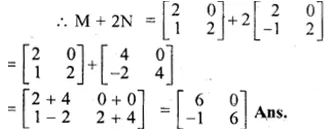
Given that M = \(\begin{bmatrix} 2 & 0 \\ 1 & 2 \end{bmatrix} \) and N = \(\begin{bmatrix} 2 & 0 \\ -1 & 2 \end{bmatrix}\),find M + 2N
Solution:
M = \(\begin{bmatrix} 2 & 0 \\ 1 & 2 \end{bmatrix} \)
N = \(\begin{bmatrix} 2 & 0 \\ -1 & 2 \end{bmatrix}\)
ML Aggarwal Class 10 Solutions for ICSE Maths Chapter 8 Matrices Ex 8.2 Q1.1

Question 2.
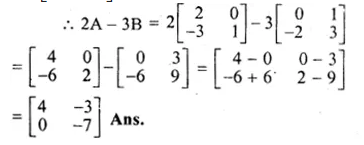
If A = \(\begin{bmatrix} 2 & 0 \\ -3 & 1 \end{bmatrix} \) and B = \(\begin{bmatrix} 0 & 1 \\ -2 & 3 \end{bmatrix} \)
find 2A – 3B
Solution:
A = \(\begin{bmatrix} 2 & 0 \\ -3 & 1 \end{bmatrix} \)
B = \(\begin{bmatrix} 0 & 1 \\ -2 & 3 \end{bmatrix} \)
ML Aggarwal Class 10 Solutions for ICSE Maths Chapter 8 Matrices Ex 8.2 Q2.1

Question 3.
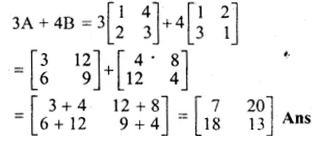
If A = \(\begin{bmatrix} 1 & 4 \\ 2 & 3 \end{bmatrix} \) and B = \(\begin{bmatrix} 1 & 2 \\ 3 & 1 \end{bmatrix} \)
Compute 3A + 4B
Solution:
A = \(\begin{bmatrix} 1 & 4 \\ 2 & 3 \end{bmatrix} \)
B = \(\begin{bmatrix} 1 & 2 \\ 3 & 1 \end{bmatrix} \)
ML Aggarwal Class 10 Solutions for ICSE Maths Chapter 8 Matrices Ex 8.2 Q3.1

Question 4.
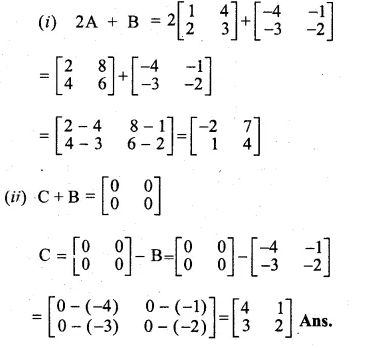
Given A = \(\begin{bmatrix} 1 & 4 \\ 2 & 3 \end{bmatrix} \) and B = \(\begin{bmatrix} -4 & -1 \\ -3 & -2 \end{bmatrix} \)
(i) find the matrix 2A + B
(ii) find a matrix C such that C + B = \(\begin{bmatrix} 0 & 0 \\ 0 & 0 \end{bmatrix} \)
Solution:
A = \(\begin{bmatrix} 1 & 4 \\ 2 & 3 \end{bmatrix} \)
B = \(\begin{bmatrix} -4 & -1 \\ -3 & -2 \end{bmatrix} \)
ML Aggarwal Class 10 Solutions for ICSE Maths Chapter 8 Matrices Ex 8.2 Q4.1

Question 5.
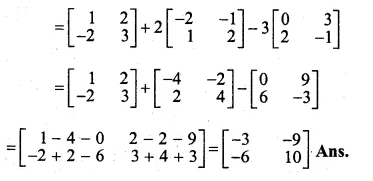
A = \(\begin{bmatrix} 1 & 2 \\ -2 & 3 \end{bmatrix} \) and B = \(\begin{bmatrix} -2 & -1 \\ 1 & 2 \end{bmatrix} \) , C = \(\begin{bmatrix} 0 & 3 \\ 2 & -1 \end{bmatrix} \)
Find A + 2B – 3C
Solution:
A = \(\begin{bmatrix} 1 & 2 \\ -2 & 3 \end{bmatrix} \) and B = \(\begin{bmatrix} -2 & -1 \\ 1 & 2 \end{bmatrix} \) , C = \(\begin{bmatrix} 0 & 3 \\ 2 & -1 \end{bmatrix} \)
∴ A + 2B – 3C
ML Aggarwal Class 10 Solutions for ICSE Maths Chapter 8 Matrices Ex 8.2 Q5.1

Question 6.
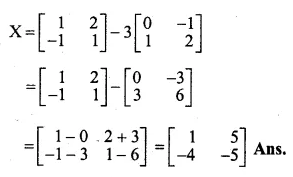
If A = \(\begin{bmatrix} 0 & -1 \\ 1 & 2 \end{bmatrix} \) and B = \(\begin{bmatrix} 1 & 2 \\ -1 & 1 \end{bmatrix} \)
Find the matrix X if :
(i) 3A + X = B
(ii) X – 3B = 2A
Solution:
A = \(\begin{bmatrix} 0 & -1 \\ 1 & 2 \end{bmatrix} \)
B = \(\begin{bmatrix} 1 & 2 \\ -1 & 1 \end{bmatrix} \)
(i) 3A + X = B
⇒ X = B – 3A
ML Aggarwal Class 10 Solutions for ICSE Maths Chapter 8 Matrices Ex 8.2 Q6.1

Question 7.
Solve the matrix equation
\(\begin{bmatrix} 2 & 1 \\ 5 & 0 \end{bmatrix}-3X=\begin{bmatrix} -7 & 4 \\ 2 & 6 \end{bmatrix}\)
Solution:
\(\begin{bmatrix} 2 & 1 \\ 5 & 0 \end{bmatrix}-3X=\begin{bmatrix} -7 & 4 \\ 2 & 6 \end{bmatrix}\)
\(\begin{bmatrix} 2 & 1 \\ 5 & 0 \end{bmatrix}-\begin{bmatrix} -7 & 4 \\ 2 & 6 \end{bmatrix}=3X\)
ML Aggarwal Class 10 Solutions for ICSE Maths Chapter 8 Matrices Ex 8.2 Q7.1

Question 8.
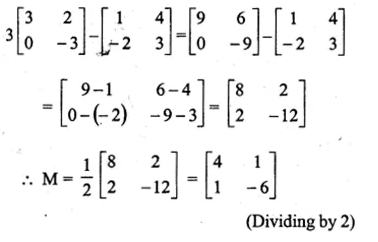
If \(\begin{bmatrix} 1 & \quad 4 \\ -2 & \quad 3 \end{bmatrix}+2M=3\begin{bmatrix} 3 & \quad 2 \\ 0 & -3 \end{bmatrix}\), find the matrix M
Solution:
\(\begin{bmatrix} 1 & \quad 4 \\ -2 & \quad 3 \end{bmatrix}+2M=3\begin{bmatrix} 3 & \quad 2 \\ 0 & -3 \end{bmatrix}\)
2M =
ML Aggarwal Class 10 Solutions for ICSE Maths Chapter 8 Matrices Ex 8.2 Q8.1

Question 9.
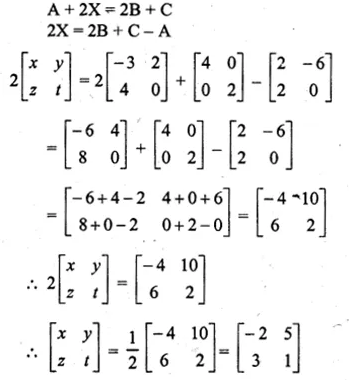
A = \(\begin{bmatrix} 2 & -6 \\ 2 & 0 \end{bmatrix} \) and B = \(\begin{bmatrix} -3 & 2 \\ 4 & 0 \end{bmatrix} \) , C = \(\begin{bmatrix} 4 & 0 \\ 0 & 2 \end{bmatrix} \)
Find the matrix X such that A + 2X = 2B + C
Solution:
A = \(\begin{bmatrix} 2 & -6 \\ 2 & 0 \end{bmatrix} \) and B = \(\begin{bmatrix} -3 & 2 \\ 4 & 0 \end{bmatrix} \) , C = \(\begin{bmatrix} 4 & 0 \\ 0 & 2 \end{bmatrix} \)
let X = \(\begin{bmatrix} x & y \\ z & t \end{bmatrix}\)
ML Aggarwal Class 10 Solutions for ICSE Maths Chapter 8 Matrices Ex 8.2 Q9.1

Question 10.
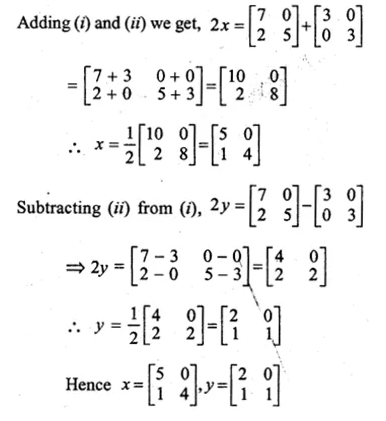
Find X and Y if X + Y = \(\begin{bmatrix} 7 & 0 \\ 2 & 5 \end{bmatrix}\) and X – Y = \(\begin{bmatrix} 3 & 0 \\ 0 & 3 \end{bmatrix}\)
Solution:
X + Y = \(\begin{bmatrix} 7 & 0 \\ 2 & 5 \end{bmatrix}\)…..(i)
X – Y = \(\begin{bmatrix} 3 & 0 \\ 0 & 3 \end{bmatrix}\)…….(ii)
ML Aggarwal Class 10 Solutions for ICSE Maths Chapter 8 Matrices Ex 8.2 Q10.1

Question 11.
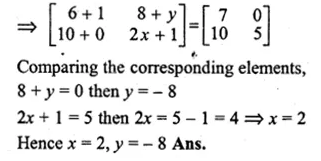
If \(2\begin{bmatrix} 3 & 4 \\ 5 & x \end{bmatrix}+\begin{bmatrix} 1 & y \\ 0 & 1 \end{bmatrix}=\begin{bmatrix} 7 & 0 \\ 10 & 5 \end{bmatrix}\) Find the values of x and y
Solution:
\(2\begin{bmatrix} 3 & 4 \\ 5 & x \end{bmatrix}+\begin{bmatrix} 1 & y \\ 0 & 1 \end{bmatrix}=\begin{bmatrix} 7 & 0 \\ 10 & 5 \end{bmatrix}\)
\(\begin{bmatrix} 6 & 8 \\ 10 & 2x \end{bmatrix}+\begin{bmatrix} 1 & y \\ 0 & 1 \end{bmatrix}=\begin{bmatrix} 7 & 0 \\ 10 & 5 \end{bmatrix}\)
ML Aggarwal Class 10 Solutions for ICSE Maths Chapter 8 Matrices Ex 8.2 Q11.1

Question 12.
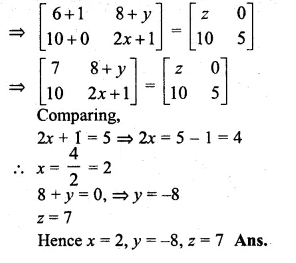
If \(2\begin{bmatrix} 3 & 4 \\ 5 & x \end{bmatrix}+\begin{bmatrix} 1 & y \\ 0 & 1 \end{bmatrix}=\begin{bmatrix} z & 0 \\ 10 & 5 \end{bmatrix}\) Find the values of x and y
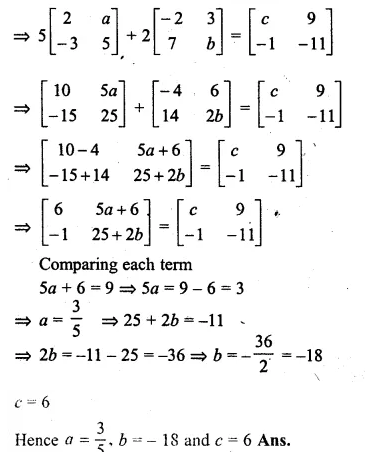
Solution:
\(2\begin{bmatrix} 3 & 4 \\ 5 & x \end{bmatrix}+\begin{bmatrix} 1 & y \\ 0 & 1 \end{bmatrix}=\begin{bmatrix} z & 0 \\ 10 & 5 \end{bmatrix}\)
\(\begin{bmatrix} 6 & 8 \\ 10 & 2x \end{bmatrix}+\begin{bmatrix} 1 & y \\ 0 & 1 \end{bmatrix}=\begin{bmatrix} z & 0 \\ 10 & 5 \end{bmatrix}\)
ML Aggarwal Class 10 Solutions for ICSE Maths Chapter 8 Matrices Ex 8.2 Q12.1

Question 13.
If \(\begin{bmatrix} 5 & 2 \\ -1 & \quad y+1 \end{bmatrix}-2\begin{bmatrix} 1 & 2x-1 \\ 3 & -2 \end{bmatrix}=\begin{bmatrix} 3 & -8 \\ -7 & 2 \end{bmatrix}\) Find the values of x and y
Solution:
\(\begin{bmatrix} 5 & 2 \\ -1 & \quad y+1 \end{bmatrix}-2\begin{bmatrix} 1 & 2x-1 \\ 3 & -2 \end{bmatrix}=\begin{bmatrix} 3 & -8 \\ -7 & 2 \end{bmatrix}\)
ML Aggarwal Class 10 Solutions for ICSE Maths Chapter 8 Matrices Ex 8.2 Q13.1

Question 14.
If \(\begin{bmatrix} a & \quad 3 \\ 4 & \quad 2 \end{bmatrix}+\begin{bmatrix} 2 & \quad b \\ 1 & -2 \end{bmatrix}-\begin{bmatrix} 1\quad & 1 \\ -2\quad & c \end{bmatrix}=\begin{bmatrix} 5 & 0 \\ 7 & 3 \end{bmatrix}\)
Find the value of a,b and c
Solution:
\(\begin{bmatrix} a & \quad 3 \\ 4 & \quad 2 \end{bmatrix}+\begin{bmatrix} 2 & \quad b \\ 1 & -2 \end{bmatrix}-\begin{bmatrix} 1\quad & 1 \\ -2\quad & c \end{bmatrix}=\begin{bmatrix} 5 & 0 \\ 7 & 3 \end{bmatrix}\)
ML Aggarwal Class 10 Solutions for ICSE Maths Chapter 8 Matrices Ex 8.2 Q14.1

Question 15.
If A = \(\begin{bmatrix} 2 & a \\ -3 & 5 \end{bmatrix} \) and B = \(\begin{bmatrix} -2 & 3 \\ 7 & b \end{bmatrix} \) , C = \(\begin{bmatrix} c & 9 \\ -1 & -11 \end{bmatrix} \) and 5A + 2B = C, find the values of a,b,c
Solution:
A = \(\begin{bmatrix} 2 & a \\ -3 & 5 \end{bmatrix} \) and B = \(\begin{bmatrix} -2 & 3 \\ 7 & b \end{bmatrix} \) , C = \(\begin{bmatrix} c & 9 \\ -1 & -11 \end{bmatrix} \)
and 5A + 2B = C
ML Aggarwal Class 10 Solutions for ICSE Maths Chapter 8 Matrices Ex 8.2 Q15.1

Hope given ML Aggarwal Class 10 Solutions for ICSE Maths Chapter 8 Matrices Ex 8.2 are helpful to complete your math homework.

If you have any doubts, please comment below. Learn Insta try to provide online math tutoring for you.

CA Foundation Business Laws Study Material Chapter 17 Registration of Firm

CA Foundation Business Laws Study Material Chapter 17 Registration of Firm

The registration of a partnership is not compulsory. Therefore an unregistered firm is not an illegal association. But an unregistered firm suffers from certain disabilities and therefore registration is necessary for carrying on business.
The formalities of registration (Sections 58-59): The following are the formalities that are required to he fulfilled for registration of the firm. The registration of the firm can be classified under the following 3 steps. It should be in a Prescribed Form, there should be Prescribed Documents and it should be deposited along with the Prescribed Fees.

PRESCRIBED FORM

The Registration of a firm may be effected at any time by sending by post or delivering to the Registrar of Firms of the locality, a statement in the prescribed form and accompanied by the prescribed fee.
The application for registration contains the following particulars;

  1. the firm-name,
  2. the place or principal place of business of the firm,
  3. the names of any other places where the firm carries on business,
  4. the date when each partner joined the firm
  5. the names in full and permanent addresses of the partners, and
  6. the duration of the firm.

Undesirable names suggesting the sanction, patronage or approval of the Govt, shall not be allowed unless specially consented to in writing by the Govt.

Signing and verification
The statement shall be signed and verified by all the partners or their agents specially authorised on this behalf.

Registration
When the Registrar is satisfied that the above provisions have been duly complied with, he shall j record an entry of the statement in the Register of Firms and then file the statement (sec. 59). He shall then issue under his hand a certificate of Registration.

Time of registration
There is no provision in the Partnership Act regarding the time of registration of firm. However, [ section 69(2) lays down that before any suit can be filed in Court of Law registration of the firm must have been effected, otherwise the suit will be dismissed.
Registration is effective from the date when the Registrar files the statement and makes entries in j the Register of Firms and not from the date of presentation of the statement to him.

PARTNERSHIP DEED
The partnership agreement may be oral or written. But to avoid any dispute, it is always advisable to have a written agreement, which is commonly known as partnership deed. Under the Income tax Act also, written partnership deed is a pre-requisite for the assessment of the firm.
The partnership deed usually contains provisions relating to the following :

  1. Name of the firm,
  2. Duration of partnership,
  3. Nature of business,
  4. Place where business is to be carried on,
  5. Capital brought in by each individual partner,
  6. Property of the firm,
  7. Proportions of profits and losses of each partner,
  8. Rights and duties of partners,
  9. Provisions for accounts, audit, keeping of account books,
  10. Drawings by partners and specially by a working partner,
  11. Dissolution of the firm,
  12. Retirement of a partner,
  13. Settlement of accounts, division of assets, profits etc., upon dissolution,
  14. Arbitration clause in case of dispute.

Under the Income-tax Act it is essential to insert clauses in the partnership for payment of interest to partners and remuneration to working partners so that payment thereof may be allowed as deduction to the firm.

CONSEQUENCES OF NON REGISTRATION (SEC. 69)
An unregistered firm and the partners thereof suffer from certain disabilities, Suit between partners and firm [sec. 69( 1 )]
A partner of an unregistered firm cannot file a suit (against the firm or any partner thereof) for the purpose of enforcing a right arising from contract or a right conferred by the Partnership Act.

Suits between firm & third parties [sec. 69(2)]
No suit can be filed by or on behalf of an unregistered firm against any third party for the purpose of enforcing a right arising from a contract, unless the firm is registered and the persons suing are or have been shown in the Register of Firms as partners in the Firm.

Claims of set-off [sec. 69(3)]
An unregistered firm cannot claim a set-off in a suit, (‘set-off’ means a claim by the defendant which would reduce the amount of money payable by him to the plaintiff).

EXCEPTIONS
There are certain exceptions to the rules stated above.

  1. A partner of an unregistered firm can file a suit for the dissolution of the firm or for accounts of dissolved firm.
  2. The Official Assignee or Receiver acting for an insolvent partner of unregistered firm may bring a suit for the realisation of the properties of an insolvent partner or further realisation of the property of dissolved firm.
  3. There is no bar to suits by firms which have no place of business in the territories to which the Indian Partnership Act extends.
  4. There is no bar to suits by unregistered firms or by the partners thereof in areas where the provisions relating to the registration of firms do not apply by notification of State Government under Section 56.
  5. An unregistered firm can file a suit (or claim a set off) for a sum not exceeding Rs. 100 in value, provided the suit is of such a nature that it has to be filed in the small Causes Court.
    Proceedings incidental to such suits, e.g., execution of decrees, are also allowed.
  6. Non-registration will not affect the enforcement of rights arising otherwise than out of contract e.g. for an injunction against wrongful infringement of a trademark etc.
    An unregistered firm suffers from certain disabilities but is not an illegal association. Therefore registration of a firm is optional.

ALTERATIONS
Any alteration in the name, principal place of business, branches, names and addresses of partners etc. of a firm subsequent to registration, must be intimated in the prescribed form to the Registrar of Partnership Firms. Registrar shall make the necessary amendment relating to such a firm in the Register of firms maintained by it. These matters are:

  1. Change in the firm name or in location of the principal place of business of the registered firm. Statement to be sent to the Registrar in this case should be accompanied by the prescribed fee. (Sec. 60)
  2. Closing and opening branches:
    When a registered firm discontinues at any place or begins to carry on business at any place other than the principal place of business, an intimation is to be sent to the Registrar by any partner or the agent of the firm. (Sec. 61)
  3. Changes in the names and addresses of partners:
    When any partner in a registered firm alters his name or permanent address, an intimation of the alteration is to be sent to the Registrar by any partner or agent of the firm. (Sec. 62)
  4. Changes in the constitution of a firm and its dissolution:
    When a change occurs in the constitu-tion of a registered firm, any incoming, continuing or outgoing partner may give notice to the Registrar of such change. Similarly, when a registered firm is dissolved, any person who was a partner immediately before the dissolution, may give notice to the Registrar. [Sec. 63(1)]
  5. Election of minor on attaining the age of the majority as partner:
    When a minor who had been admitted to the benefits of partnership attains majority, he has to choose whether he intends to continue as a partner or whether he intends to sever his connection from the firm which is a registered firm. Whatever the election, he or his agent specially authorized on his behalf may give notice to the Registrar that he has or has not become a partner. [Sec. 63(2)]

REGISTER OF FIRMS-A PUBLIC DOCUMENT
The register of firms is a public document shall be open to inspection by any person on payment of the prescribed fee (Sec. 66). Registrar shall also furnish to any person on payment of a prescribed fee a copy, certified under his of any entry or position thereof in the Register of Firms (Sec. 67)

REGISTER OF FIRMS-A CONCLUSIVE EVIDENCE (SEC. 68)
Any statement, intimation notice recorded or noted in the Register of Firms, shall, as against any person by whom whose behalf such statement, intimation or notice was signed, be conclusive of any fact the stated.
A certified copy of an entry relating to a firm in the Register of Firms may be the proof of the fact of the registration of such firm, and of the contents of any statement, intimation or notice recorded or noted therein.

PENALTY FOR FURNISHING FALSE PARTICULARS (SEC. 70)
The Act provides a penal imprisonment which may extend to three months or fine or both to any person liable supplying to the Registrar any information which he knows to be false or does not believe true.

MULTIPLE CHOICE QUESTIONS:

1. Registration of the firm under the Partnership Act is:
(a) Optional
(b) Obligatory
(c) Compulsory
(d) Necessary

2. The Partnership Act by section 69 indirectly renders the registration firm compulsory by providing :
(a) Certain disabilities.
( b) Penalties on partners of unregistered firms.
(c) Penalties on unregistered firms.
(d) Monetary fine on partners.

3. A firm name shall not contain any of the following words :
(a) Crown, Imperial.
(b) Emperor,Empress
(c) King, Queen
(d) All the above.

4. Registration of firm is effective from —
(a) The date when the Registrar files the statement and makes entries in the Register of firms
(b) The date of presentation of the statement to the Registrar of firms
(c) The date published in the Official Gazette
(d) The date intimated to the partners.

5. Non-registration of the firm does not affect the right of the firm to institute a suit or claim of set-off not exceeding —
(a) Rs. 100
(b) Rs. 1,000
(c) Rs. 10,000
(d) Rs. 50,000.

6. After the registration of a firm, if a partner retires, such a change in the constitution of the firm requires :
(a) A notice to be sent to the Registrar.
(b) New registration.
(c) An affidavit of a managing partner about the change.
(d) No intimation.

7. If an unregistered firm intends to file a suit against a third party, it should get itself registered before filing the suit.
(a) False, as such disability can never be removed.
(b) True, as after registration firm’s disability to file such suit is removed.
(c) It should take permission of the court before filing the suit.
(d) Either (b) or (c)

8. In case of an unregistered firm the partners can file a suit for the :
(a) Dissolution of the firm
(b) Accounts of dissolved firm
(c) Realization of property of dissolved firm
(d) All the above

9. Any person who supplies false information to the
Registrar of firms, shall be liable to punishment with imprisonment upto
(n) Three months
(b) Six months
(c) Nine months
(d) Twelve months

Answers:
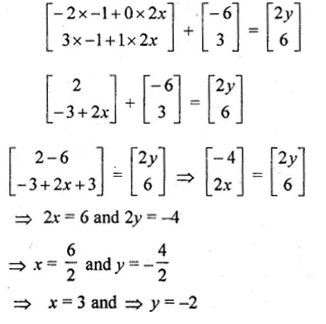
CA Foundation Business Laws Study Material Chapter 17 Registration of Firm 1

STATE WHETHER THE FOLLOWING ARE TRUE OR FALSE:

1. The registration of a firm is a condition precedent to the right to institute a suit.
2. If a partner refuses to sign the application for registration, then registration can be done only by dropping the name of such a partner from the firm.
3. Application for registration of the firm must be signed by all the partners.
4. A third party cannot file a suit against an unregistered firm.
5. A partner of an unregistered firm cannot sue for the dissolution of the firm.
6. Registration of the firm may be done before filing a suit against the third party.
7. Registration of the firm must be done at the time of formation of the firm.

Answers:
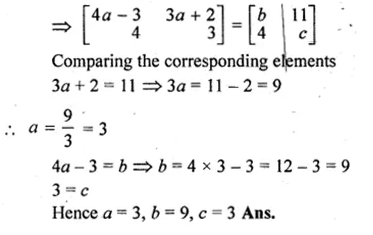
CA Foundation Business Laws Study Material Chapter 17 Registration of Firm 2