ML Aggarwal Class 10 Solutions for ICSE Maths Chapter 13 Similarity Chapter Test

ML Aggarwal Class 10 Solutions for ICSE Maths Chapter 13 Similarity Chapter Test

These Solutions are part of ML Aggarwal Class 10 Solutions for ICSE Maths. Here we have given ML Aggarwal Class 10 Solutions for ICSE Maths Chapter 13 Similarity Chapter Test

More Exercises

Question 1.
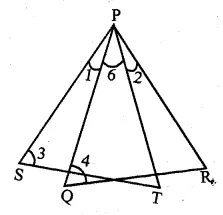
In the given figure, ∠1 = ∠2 and ∠3 = ∠4. Show that PT x QR = PR x ST.
Solution:
Given: In the given figure,
∠1 = ∠1 and ∠3 = ∠4
ML Aggarwal Class 10 Solutions for ICSE Maths Chapter 13 Similarity Chapter Test Q1.1
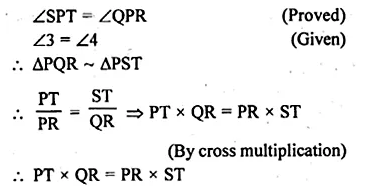
To prove : PT × QR = PR × ST
Proof: ∠1 = ∠2
Adding ∠6 to both sides
∠1 + ∠6 = ∠2 + ∠6
∠SPT = ∠QPR
In ∆PQR and ∆PST
ML Aggarwal Class 10 Solutions for ICSE Maths Chapter 13 Similarity Chapter Test Q1.2

Question 2.
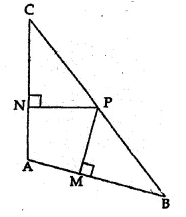
In the adjoining figure, AB = AC. If PM ⊥ AB and PN ⊥ AC, show that PM x PC = PN x PB.
ML Aggarwal Class 10 Solutions for ICSE Maths Chapter 13 Similarity Chapter Test Q2.1
Solution:
Given : In the given figure,
AB = AC, PM ⊥ AB and PN ⊥ AC
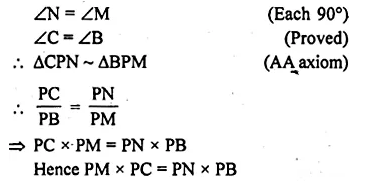
To prove : PM × PC = PN × PB
Proof: In ∆ABC, AB = AC
∠B = ∠C
Now in ∆CPN and ∆BPM,
ML Aggarwal Class 10 Solutions for ICSE Maths Chapter 13 Similarity Chapter Test Q2.2

Question 3.
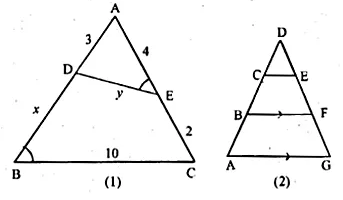
(a) In the figure (1) given below. ∠AED = ∠ABC. Find the values of x and y.
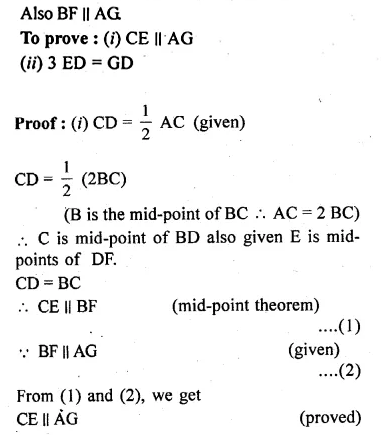
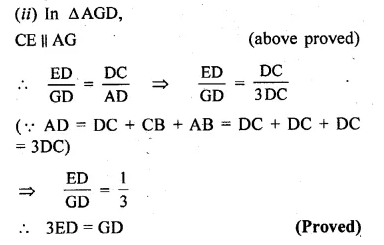
(b) In the fig. (2) given below, CD = \(\\ \frac { 1 }{ 2 } \) AC, B is mid-point of AC and E is mid-point of DF. If BF || AG, prove that :
(i) CE || AG
(ii) 3 ED = GD.
ML Aggarwal Class 10 Solutions for ICSE Maths Chapter 13 Similarity Chapter Test Q3.1
Solution:
(a) Given : In following figure, ∠AED = ∠ABC
Required: The values of x and y.
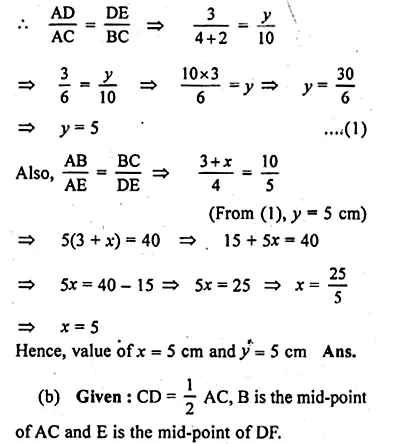
Now, in ∆ABC and ∆ADE
∠AED = ∠ABC (given)
∠A = ∠A (common)
∴ ∆ABC ~ ∆ADE
(By A.A. axiom of similarity)
ML Aggarwal Class 10 Solutions for ICSE Maths Chapter 13 Similarity Chapter Test Q3.2
ML Aggarwal Class 10 Solutions for ICSE Maths Chapter 13 Similarity Chapter Test Q3.3
ML Aggarwal Class 10 Solutions for ICSE Maths Chapter 13 Similarity Chapter Test Q3.4

Question 4.
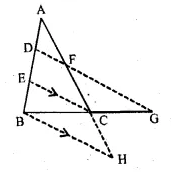
In the given figure, 2 AD = BD, E is mid-point of BD and F is mid-point of AC and EC || BH. Prove that:
(i) DF || BH
(ii) AH = 3 AF.
ML Aggarwal Class 10 Solutions for ICSE Maths Chapter 13 Similarity Chapter Test Q4.1
Solution:
Given: E is the mid-point of BD
and F is mid-point of AC
also 2 AD = BD and EC || BH
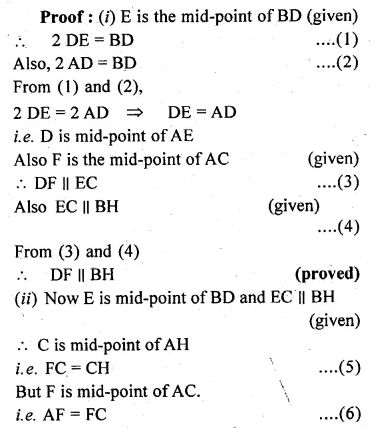
To Prove : (i) DF || BH
(ii) AH = 3 AF
ML Aggarwal Class 10 Solutions for ICSE Maths Chapter 13 Similarity Chapter Test Q4.2
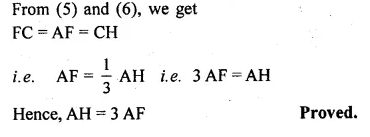
ML Aggarwal Class 10 Solutions for ICSE Maths Chapter 13 Similarity Chapter Test Q4.3

Question 5.
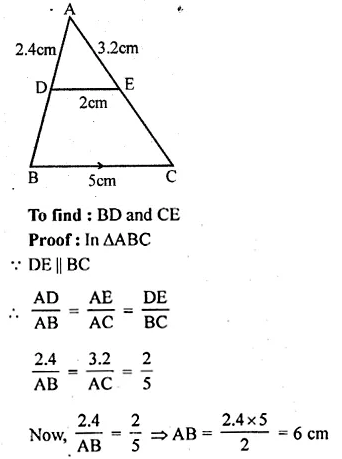
In a ∆ABC, D and E are points on the sides AB and AC respectively such that DE || BC. If AD = 2.4 cm, AE = 3.2 cm, DE = 2 cm and BC = 5 cm, find BD and CE.
Solution:
Given : In ∆ABC, D and E are the points
on the sides AB and AC respectively
DE || BC
AD = 2.4 cm, AE = 3.2 cm,
DE = 2 cm, BC = 5 cm
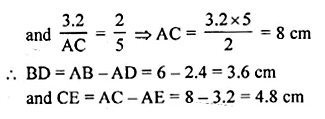
ML Aggarwal Class 10 Solutions for ICSE Maths Chapter 13 Similarity Chapter Test Q5.1
ML Aggarwal Class 10 Solutions for ICSE Maths Chapter 13 Similarity Chapter Test Q5.2

Question 6.
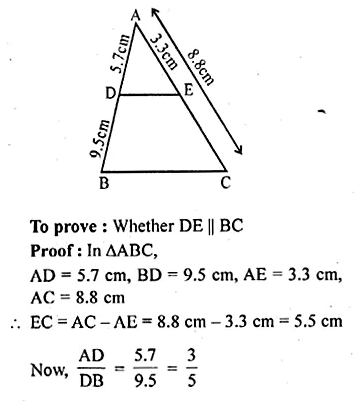
In a ∆ABC, D and E are points on the sides AB and AC respectively such that AD = 5.7cm, BD = 9.5cm, AE = 3.3cm and AC = 8.8cm. Is DE || BC? Justify your answer.
Solution:
In ∆ABC, D and E are points on the sides AB and AC respectively
AD = 5.7 cm, BD = 9.5 cm, AE = 3.3 cm and AC = 8.8 cm
ML Aggarwal Class 10 Solutions for ICSE Maths Chapter 13 Similarity Chapter Test Q6.1
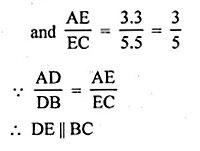
ML Aggarwal Class 10 Solutions for ICSE Maths Chapter 13 Similarity Chapter Test Q6.2

Question 7.
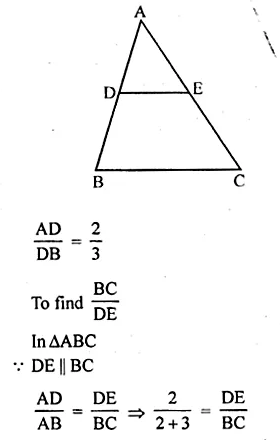
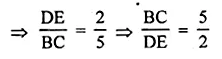
In a ∆ABC, DE is parallel to the base BC, with D on AB and E on AC. If \(\frac { AD }{ DB } =\frac { 2 }{ 3 } ,\frac { BC }{ DE } \)
Solution:
In ∆ABC, DE || BC
D is on AB and E is on AC
ML Aggarwal Class 10 Solutions for ICSE Maths Chapter 13 Similarity Chapter Test Q7.1
ML Aggarwal Class 10 Solutions for ICSE Maths Chapter 13 Similarity Chapter Test Q7.2

Question 8.
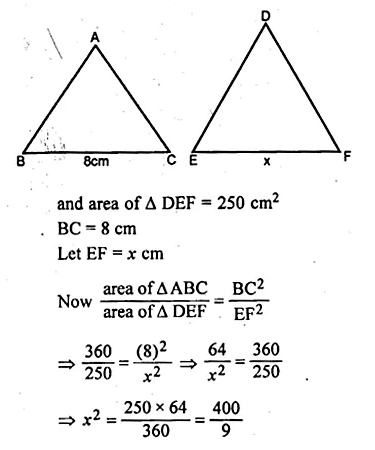
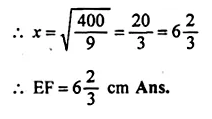
If the area of two similar triangles are 360 cm² and 250 cm² and if one side of the first triangle is 8 cm, find the length of the corresponding side of the second triangle.
Solution:
Let ∆ABC and ∆DEF are similar and area of
∆ABC = 360 cm²
ML Aggarwal Class 10 Solutions for ICSE Maths Chapter 13 Similarity Chapter Test Q8.1
ML Aggarwal Class 10 Solutions for ICSE Maths Chapter 13 Similarity Chapter Test Q8.2

Question 9.
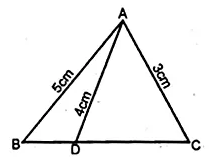
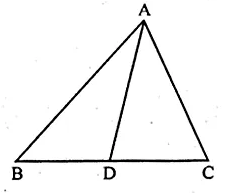
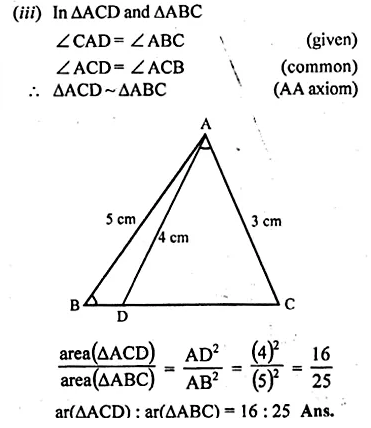
In the adjoining figure, D is a point on BC such that ∠ABD = ∠CAD. If AB = 5 cm, AC = 3 cm and AD = 4 cm, find
(i) BC
(ii) DC
(iii) area of ∆ACD : area of ∆BCA.
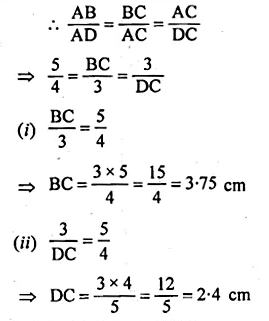
ML Aggarwal Class 10 Solutions for ICSE Maths Chapter 13 Similarity Chapter Test Q9.1
Solution:
In ∆ABC and ∆ACD
∠C = ∠C (Common)
∠ABC = ∠CAD (given)
∴ ∆ABC ~ ∆ACD
ML Aggarwal Class 10 Solutions for ICSE Maths Chapter 13 Similarity Chapter Test Q9.2
ML Aggarwal Class 10 Solutions for ICSE Maths Chapter 13 Similarity Chapter Test Q9.3

Question 10.
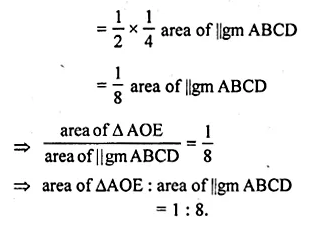
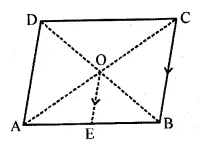
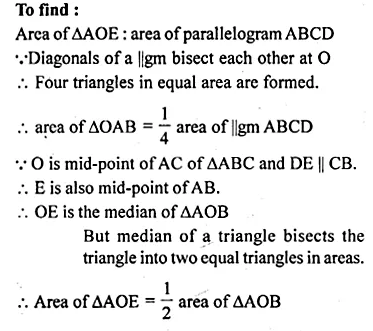
In the adjoining figure the diagonals of a parallelogram intersect at O. OE is drawn parallel to CB to meet AB at E, find area of DAOE : area of ||gm ABCD.
ML Aggarwal Class 10 Solutions for ICSE Maths Chapter 13 Similarity Chapter Test Q10.1
Solution:
(a) In the figure
Diagonals of parallelogram ABCD are
AC and BD which intersect each other at O.
OE is drawn parallel to CB to meet AB in E.
ML Aggarwal Class 10 Solutions for ICSE Maths Chapter 13 Similarity Chapter Test Q10.2
ML Aggarwal Class 10 Solutions for ICSE Maths Chapter 13 Similarity Chapter Test Q10.3

Question 11.
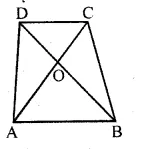
In the given figure, ABCD is a trapezium in which AB || DC. If 2AB = 3DC, find the ratio of the areas of ∆AOB and ∆COD.
ML Aggarwal Class 10 Solutions for ICSE Maths Chapter 13 Similarity Chapter Test Q11.1
Solution:
In the given figure, ABCD is trapezium in
which AB || DC, 2AB = 3DC
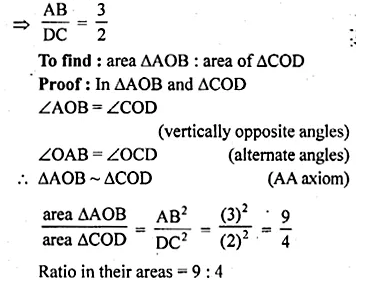
ML Aggarwal Class 10 Solutions for ICSE Maths Chapter 13 Similarity Chapter Test Q11.2

Question 12.
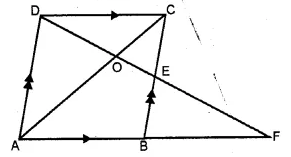
In the adjoining figure, ABCD is a parallelogram. E is mid-point of BC. DE meets the diagonal AC at O and meet AB (produced) at F. Prove that .
ML Aggarwal Class 10 Solutions for ICSE Maths Chapter 13 Similarity Chapter Test Q12.1
(i) DO : OE = 2 : 1
(ii) area of ∆OEC : area of ∆OAD = 1 : 4.
Solution:
Given : In || gm ABCD,
E is the midpoint of BC and DE meets the diagonal AC at O
and meet AB produced at F.
To prove : (i) DO : OE = 2 : 1
(ii) area of ∆OEC : area of ∆OAD = 1 : 4
Proof: In ∆AOD and ∆EDC
∠AOD = ∠EOC (vertically opposite angle)
∠OAD = ∠OCB (alt. angles)
∆AOD ~ ∆EOC (AA postulate)
ML Aggarwal Class 10 Solutions for ICSE Maths Chapter 13 Similarity Chapter Test Q12.2

Question 13.
A model of a ship is made to a scale of 1 : 250. Calculate :
(i) the length of the ship, if the length of model is 1.6 m.
(ii) the area of the deck of the ship, if the area of the deck of model is 2.4 m².
(iii) the volume of the model, if the volume of the ship is 1 km³.
Solution:
Scale factor (k) of the model of the ship = \(\\ \frac { 1 }{ 250 } \)
(i) Length of model = 1.6 m
ML Aggarwal Class 10 Solutions for ICSE Maths Chapter 13 Similarity Chapter Test Q13.1

Hope given ML Aggarwal Class 10 Solutions for ICSE Maths Chapter 13 Similarity Chapter Test are helpful to complete your math homework.

If you have any doubts, please comment below. Learn Insta try to provide online math tutoring for you.
ML Aggarwal Class 10 Solutions for ICSE Maths Chapter 13 Similarity MCQS

ML Aggarwal Class 10 Solutions for ICSE Maths Chapter 13 Similarity MCQS

These Solutions are part of ML Aggarwal Class 10 Solutions for ICSE Maths. Here we have given ML Aggarwal Class 10 Solutions for ICSE Maths Chapter 13 Similarity MCQS

More Exercises

Choose the correct answer from the given four options (1 to 22):

Question 1.
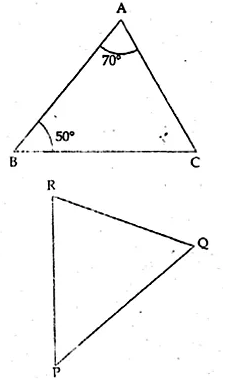
In the given figure, ∆ABC ~ ∆QPR. Then ∠R is
(a) 60°
(b) 50°
(c) 70°
(d) 80°
ML Aggarwal Class 10 Solutions for ICSE Maths Chapter 13 Similarity MCQS Q1.1
Solution:
In the given figure,
∆ABC ~ ∆QPR
∴ ∠A = ∠Q, ∠B = ∠P and ∠C = ∠R
But ∠A = 70°, ∠B = 50°
∴ ∠C = 180° – (70° + 500) = 180° – 120° = 60°
∠C = ∠R
∴ ∠R = ∠C = 60°

Question 2.
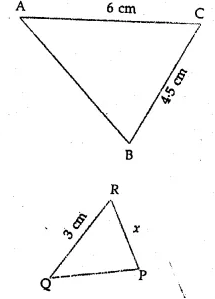
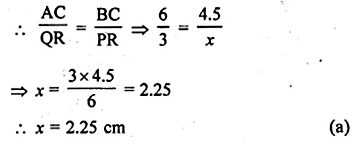
In the given figure, ∆ABC ~ ∆QPR. The value of x is
(a) 2.25 cm
(b) 4 cm
(c) 4.5 cm
(d) 5.2 cm
ML Aggarwal Class 10 Solutions for ICSE Maths Chapter 13 Similarity MCQS Q2.1
Solution:
In the given figure
∆ABC ~ ∆QPR
ML Aggarwal Class 10 Solutions for ICSE Maths Chapter 13 Similarity MCQS Q2.2

Question 3.
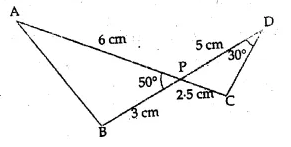
In the given figure, two line segments AC and BD intersect each other at the point P such that PA = 6 cm, PB = 3 cm, PC = 2.5 cm, PD = 5 cm, ∠APB = 50° and ∠CDP = 30°. Then, ∠PBA is equal to
(a) 50°
(b) 30°
(c) 60°
(d) 100°
ML Aggarwal Class 10 Solutions for ICSE Maths Chapter 13 Similarity MCQS Q3.1
Solution:
In the given figure two line segments AC and BD intersect each other at P
and PA = 6 cm, PB = 3 cm, PC = 2.5 cm, PD = 5 cm, ∠APB = 50° and ∠CDP = 30°
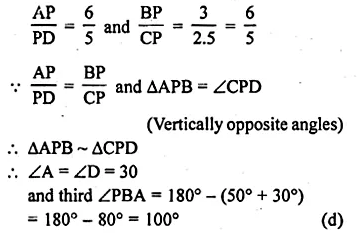
In ∆APB and ∆CPD
ML Aggarwal Class 10 Solutions for ICSE Maths Chapter 13 Similarity MCQS Q3.2

Question 4.
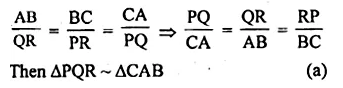
If in two triangles ABC and PQR,
\(\frac { AB }{ QR } =\frac { BC }{ PR } =\frac { CA }{ PQ } \)
then
(a) ∆PQR ~ ∆CAB
(b) ∆PQR ~ ∆ABC
(c) ∆CBA ~ ∆PQR
(d) ∆BCA ~ ∆PQR
Solution:
In two ∆ABC and ∆PQR
ML Aggarwal Class 10 Solutions for ICSE Maths Chapter 13 Similarity MCQS Q4.1

Question 5.
In triangles ABC and DEF, ∠B = ∠E, ∠F = ∠C and AB = 3DE, then the two triangles are
(a) congruent but not similar
(b) similar but not congruent
(c) neither congruent nor similar
(d) congruent as well as similar
Solution:
In ∆ABC and ∆DEF
∠B = ∠E, ∠F = ∠C
AB = 3DE
∵ Two angles of the one triangles are equal
to corresponding two angles of the other
But sides are not equal
∵ Triangles are similar but not congruent, (b)

Question 6.
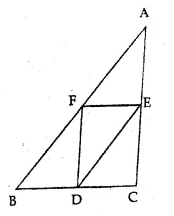
In the given figure, if D, E and F are midpoints of the sides BC, CA and AB respectively, then the two triangles ABC and DEF are
(a) similar
(b) congruent
(c) both similar and congruent
(d) neither similar nor congruent
ML Aggarwal Class 10 Solutions for ICSE Maths Chapter 13 Similarity MCQS Q6.1
Solution:
D, E and F are the mid-points of the sides BC, CA and AB of ∆ABC
then two triangles ABC and DEF are similar. (a)

Question 7.
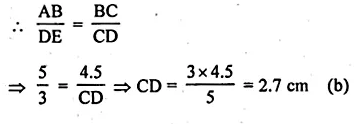
The given figure, AB || DE. The length of CD is
(a) 2.5 cm
(b) 2.7 cm
(c) \(\\ \frac { 10 }{ 3 } \) cm
(d) 3.5 cm
ML Aggarwal Class 10 Solutions for ICSE Maths Chapter 13 Similarity MCQS Q7.1
Solution:
In the given figure, AB || DE
∆ABC ~ ∆DCE
ML Aggarwal Class 10 Solutions for ICSE Maths Chapter 13 Similarity MCQS Q7.2

Question 8.
If in triangles ABC and DEF,\(\frac { AB }{ DE } =\frac { BC }{ FD } \) , then they will be similar when
(a) ∠B = ∠E
(b) ∠A = ∠D
(c) ∠B = ∠D
(d) ∠A = ∠F
Solution:
In two triangles ABC and DEF
\(\frac { AB }{ DE } =\frac { BC }{ FD } \)
They will be similar if their included angles are equal
∠B = ∠D (c)

Question 9.
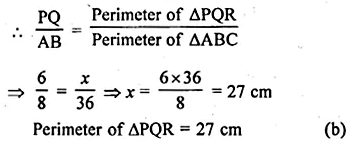
If ∆PQR ~ ∆ABC, PQ = 6 cm, AB = 8 cm and perimeter of ∆ABC is 36 cm, then perimeter of ∆PQR is
(a) 20.25 cm
(b) 27 cm
(c) 48 cm
(d) 64 cm
Solution:
∆PQR ~ ∆ABC
PQ = 6 cm, AB = 8 cm
Perimeter of ∆ABC = 36 cm
Let perimeter of ∆PQR be x cm
ML Aggarwal Class 10 Solutions for ICSE Maths Chapter 13 Similarity MCQS Q9.1

Question 10.
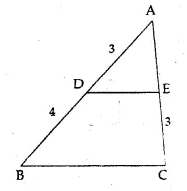
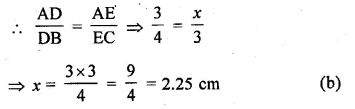
In the given figure, DE || BC and all measurements are in centimetres. The length of AE is
(a) 2 cm
(b) 2.25 cm
(c) 3.5 cm
(d) 4 cm
ML Aggarwal Class 10 Solutions for ICSE Maths Chapter 13 Similarity MCQS Q10.1
Solution:
In the given figure,
DE || BC
ML Aggarwal Class 10 Solutions for ICSE Maths Chapter 13 Similarity MCQS Q10.2

Question 11.
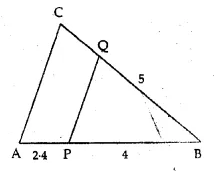
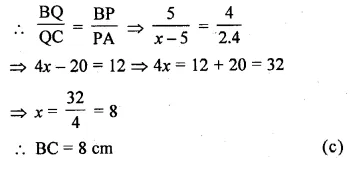
In the given figure, PQ || CA and all lengths are given in centimetres. The length of BC is
(a) 6.4 cm
(b) 7.5 cm
(c) 8 cm
(d) 9 cm
ML Aggarwal Class 10 Solutions for ICSE Maths Chapter 13 Similarity MCQS Q11.1
Solution:
In the given figure,
PQ || CA
Let BC = x
ML Aggarwal Class 10 Solutions for ICSE Maths Chapter 13 Similarity MCQS Q11.2

Question 12.
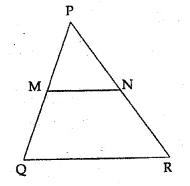
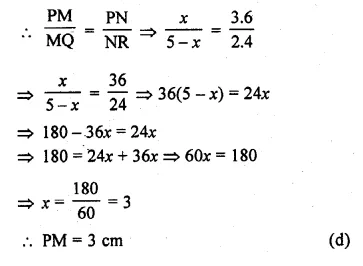
In the given figure, MN || QR. If PN = 3.6 cm, NR = 2.4 cm and PQ = 5 cm, then PM is
(a) 4 cm
(b) 3.6 cm
(c) 2 cm
(d) 3 cm
ML Aggarwal Class 10 Solutions for ICSE Maths Chapter 13 Similarity MCQS Q12.1
Solution:
In the given figure, MN || QR
PN = 3.6 cm, NR = 2.4 cm and PQ = 5 cm
Let PM = x cm
ML Aggarwal Class 10 Solutions for ICSE Maths Chapter 13 Similarity MCQS Q12.2

Question 13.
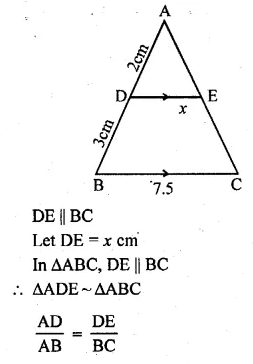
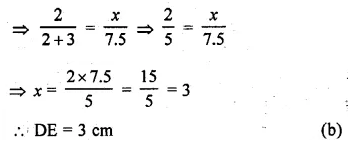
D and E are respectively the points on the sides AB and AC of a ∆ABC such that AD = 2 cm, BD = 3 cm, BC = 7.5 cm and DE || BC. Then the length of DE is
(a) 2.5 cm
(b) 3 cm
(c) 5 cm
(d) 6 cm
Solution:
D and E are the points on sides AB and AC of ∆ABC,
AD = 2 cm, BD = 3 cm,
BC = 7.5 cm
ML Aggarwal Class 10 Solutions for ICSE Maths Chapter 13 Similarity MCQS Q13.1
ML Aggarwal Class 10 Solutions for ICSE Maths Chapter 13 Similarity MCQS Q13.2

Question 14.
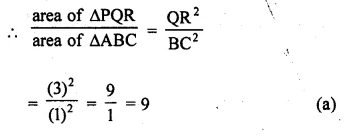
It is given that ∆ABC ~ ∆PQR with \(\frac { BC }{ QR } =\frac { 1 }{ 3 } \) then \(\frac { area\quad of\quad \Delta PQR }{ area\quad of\quad \Delta ABC } \) equal to
(a) 9
(b) 3
(c) \(\\ \frac { 1 }{ 3 } \)
(d) \(\\ \frac { 1 }{ 9 } \)
Solution:
∆ABC ~ ∆PQR
\(\frac { BC }{ QR } =\frac { 1 }{ 3 } \)
ML Aggarwal Class 10 Solutions for ICSE Maths Chapter 13 Similarity MCQS Q14.1

Question 15.
If the areas of two similar triangles are in the ratio 4 : 9, then their corresponding sides are in the ratio
(a) 9 : 4
(b) 3 : 2
(c) 2 : 3
(d) 16 : 81
Solution:
Ratio in the areas of two similar triangles = 4 : 9
Ratio in their corresponding sides
= √4 : √9
= 2 : 3 (c)

Question 16.
If ∆ABC ~ ∆PQR, BC = 8 cm and QR = 6 cm, then the ratio of the areas of ∆ABC and ∆PQR is
(a) 8 : 6
(b) 3 : 4
(c) 9 : 16
(d) 16 : 9
Solution:
∆ABC ~ ∆PQR, BC = 8 cm, QR = 6 cm
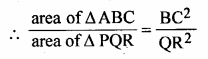
\(\frac { area\quad of\quad \Delta ABC }{ area\quad of\quad \Delta PQR } =\frac { { BC }^{ 2 } }{ { QR }^{ 2 } } \)
= \(\frac { { 8 }^{ 2 } }{ { 6 }^{ 2 } } =\frac { 64 }{ 36 } =\frac { 16 }{ 9 } \) (d)

Question 17.
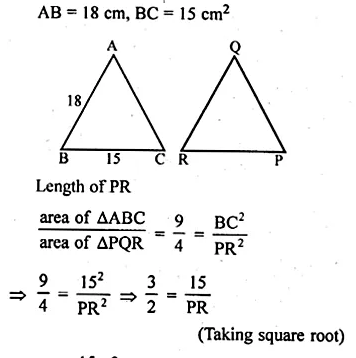
If ∆ABC ~ ∆QRP \(\frac { area\quad of\quad \Delta ABC }{ area\quad of\quad \Delta PQR } \) AB = 18 cm and BC = 15 cm, then the length of PR is equal to
(a) 10 cm
(b) 12 cm
(c) \(\\ \frac { 20 }{ 3 } \)
(d) 8 cm
Solution:
∆ABC ~ ∆QRP
\(\frac { area\quad of\quad \Delta ABC }{ area\quad of\quad \Delta PQR } \)
ML Aggarwal Class 10 Solutions for ICSE Maths Chapter 13 Similarity MCQS Q17.1
ML Aggarwal Class 10 Solutions for ICSE Maths Chapter 13 Similarity MCQS Q17.2

Question 18.
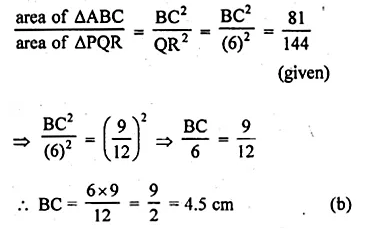
If ∆ABC ~ ∆PQR, area of ∆ABC = 81 cm², area of ∆PQR = 144 cm² and QR = 6 cm, then length of BC is
(a) 4 cm
(b) 4.5 cm
(c) 9 cm
(d) 12 cm
Solution:
∆ABC ~ ∆PQR,
area of ∆ABC = 81 cm² and area of ∆PQR = 144 cm²,
QR = 6 cm, BC = ?
ML Aggarwal Class 10 Solutions for ICSE Maths Chapter 13 Similarity MCQS Q18.1

Question 19.
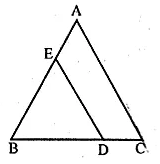
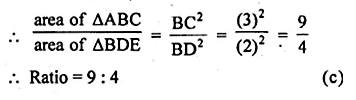
In the given figure, DE || CA and D is a point on BD such that BD : DC = 2 : 1. The ratio of area of ∆ABC to area of ∆BDE is
(a) 4 : 1
(b) 9 : 1
(c) 9 : 4
(d) 3 : 2
ML Aggarwal Class 10 Solutions for ICSE Maths Chapter 13 Similarity MCQS Q19.1
Solution:
In the given figure, DE || CA ,
D is a point on BC and BD : DC = 2 : 1
BD : BC = 2 : (2 + 1) = 2 : 3
In ∆ABC, DE || CA
∆ABC ~ ∆BDE
ML Aggarwal Class 10 Solutions for ICSE Maths Chapter 13 Similarity MCQS Q19.2

Question 20.
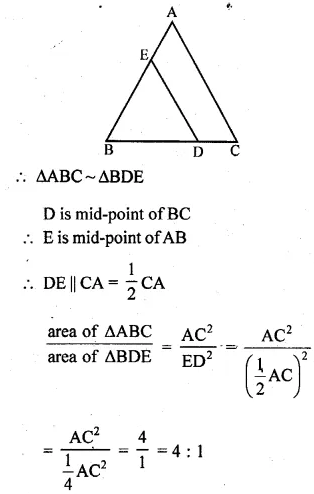
If ABC and BDE are two equilateral triangles such that D is mid-point of BC, then the ratio of the areas of triangles ABC and BDE is
(a) 2 : 1
(b) 1 : 2
(c) 1 : 4
(d) 4 : 1
Solution:
∆ABC and ∆BDE are an equilateral triangles
ML Aggarwal Class 10 Solutions for ICSE Maths Chapter 13 Similarity MCQS Q20.1
ML Aggarwal Class 10 Solutions for ICSE Maths Chapter 13 Similarity MCQS Q20.2

Question 21.
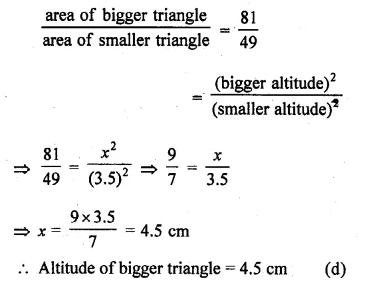
The areas of two similar triangles are 81 cm² and 49 cm² respectively. If an altitude of the smaller triangle is 3.5 cm, then the corresponding altitude of the bigger triangle is
(a) 9 cm
(b) 7 cm
(c) 6 cm
(d) 4.5 cm
Solution:
Areas of two similar triangles are 81 cm² and 49 cm²
The altitude of the smaller triangle is 3.5 cm
Let the altitude of the bigger triangle is x, then
ML Aggarwal Class 10 Solutions for ICSE Maths Chapter 13 Similarity MCQS Q21.1

Question 22.
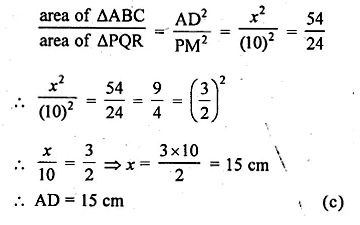
Given ∆ABC ~ ∆PQR, area of ∆ABC = 54 cm² and area of ∆PQR = 24 cm². If AD and PM are medians of ∆’s ABC and PQR respectively, and length of PM is 10 cm, then length of AD is
(a) \(\\ \frac { 49 }{ 3 } \) cm
(b) \(\\ \frac { 20 }{ 3 } \) cm
(c) 15 cm
(d) 22.5 cm
Solution:
∆ABC ~ ∆PQR
area of ∆ABC = 54 cm²
and of ∆PQR = 24 cm²
AD and PM are their median respectively
PM = 10 cm
Let AD = x cm, then
ML Aggarwal Class 10 Solutions for ICSE Maths Chapter 13 Similarity MCQS Q22.1

Hope given ML Aggarwal Class 10 Solutions for ICSE Maths Chapter 13 Similarity MCQS are helpful to complete your math homework.

If you have any doubts, please comment below. Learn Insta try to provide online math tutoring for you.
ML Aggarwal Class 10 Solutions for ICSE Maths Chapter 13 Similarity Ex 13.3

ML Aggarwal Class 10 Solutions for ICSE Maths Chapter 13 Similarity Ex 13.3

These Solutions are part of ML Aggarwal Class 10 Solutions for ICSE Maths. Here we have given ML Aggarwal Class 10 Solutions for ICSE Maths Chapter 13 Similarity Ex 13.3

More Exercises

Question 1.
Given that ∆s ABC and PQR are similar.
Find:
(i) The ratio of the area of ∆ABC to the area of ∆PQR if their corresponding sides are in the ratio 1 : 3.
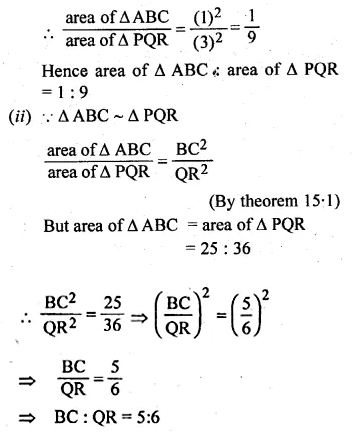
(ii) the ratio of their corresponding sides if area of ∆ABC : area of ∆PQR = 25 : 36.
Solution:
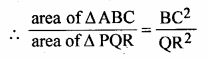
(i) ∴ ∆ABC ~ ∆PQR
ML Aggarwal Class 10 Solutions for ICSE Maths Chapter 13 Similarity Ex 13.3 Q1.1
(By theorem 15.1)
But BC = QR =1 : 3
ML Aggarwal Class 10 Solutions for ICSE Maths Chapter 13 Similarity Ex 13.3 Q1.1
ML Aggarwal Class 10 Solutions for ICSE Maths Chapter 13 Similarity Ex 13.3 Q1.2

Question 2.
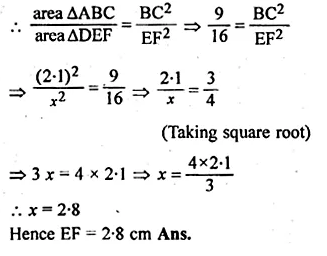
∆ABC ~ DEF. If area of ∆ABC = 9 sq. cm., area of ∆DEF =16 sq. cm and BC = 2.1 cm., find the length of EF.
Solution:
Let EF = x
Given that
∆ABC ~ ∆DEF,
ML Aggarwal Class 10 Solutions for ICSE Maths Chapter 13 Similarity Ex 13.3 Q2.1

Question 3.
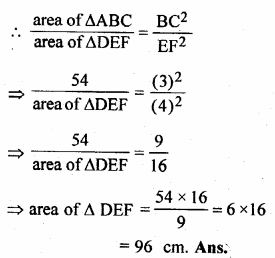
∆ABC ~ ∆DEF. If BC = 3 cm, EF = 4 cm and area of ∆ABC = 54 sq. cm. Determine the area of ∆DEF.
Solution:
∆ABC ~ ∆DEF
ML Aggarwal Class 10 Solutions for ICSE Maths Chapter 13 Similarity Ex 13.3 Q3.1

Question 4.
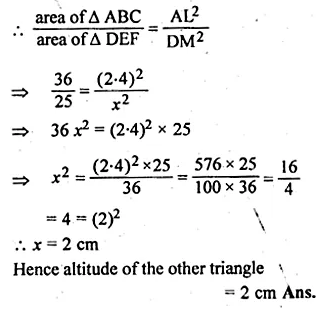
The area of two similar triangles are 36 cm² and 25 cm². If an altitude of the first triangle is 2.4 cm, find the corresponding altitude of the other triangle.
Solution:
Let ABC ~ ∆DEF, AL and DM are their altitudes
then area of ∆ABC = 36 cm²
area of ∆DEF = 25 cm² and AL = 2.4 cm.
Let DM = x
Now ∆ABC ~ ∆DEF
ML Aggarwal Class 10 Solutions for ICSE Maths Chapter 13 Similarity Ex 13.3 Q4.1

Question 5.
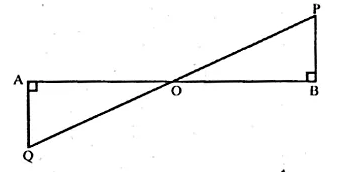
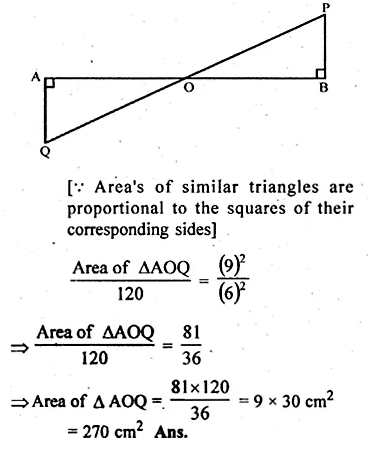
(a) In the figure, (i) given below, PB and QA are perpendiculars to the line segment AB. If PO = 6 cm, QO = 9 cm and the area of ∆POB = 120 cm², find the area of ∆QOA. (2006)
ML Aggarwal Class 10 Solutions for ICSE Maths Chapter 13 Similarity Ex 13.3 Q5.1
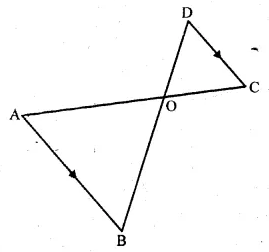
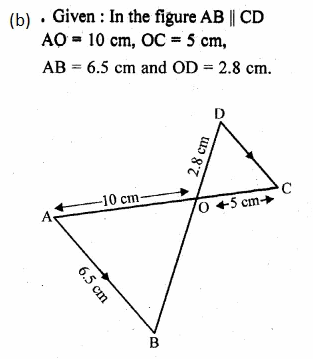
(b) In the figure (ii) given below, AB || DC. AO = 10 cm, OC = 5cm, AB = 6.5 cm and OD = 2.8 cm.
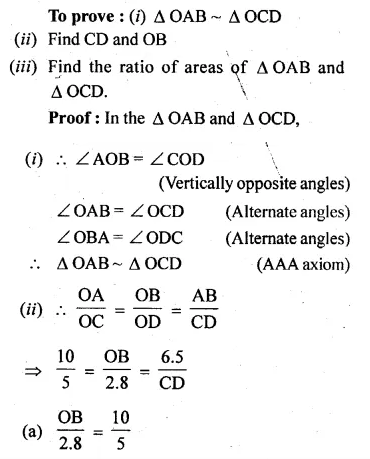
(i) Prove that ∆OAB ~ ∆OCD.
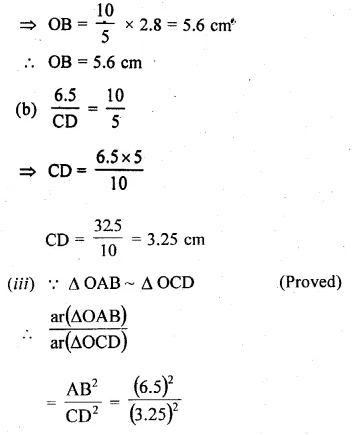
(ii) Find CD and OB.
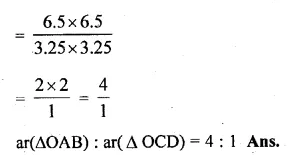
(iii) Find the ratio of areas of ∆OAB and ∆OCD.
ML Aggarwal Class 10 Solutions for ICSE Maths Chapter 13 Similarity Ex 13.3 Q5.2
Solution:
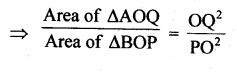
In ∆AOQ and ∆BOP, we have
∠ OAQ = ∠ OBP [Each = 90°]
∠ AOQ= ∠BOP
[Vertically opposite angles]
∆AOQ ~ ∆BOP [A.A. similarity]
ML Aggarwal Class 10 Solutions for ICSE Maths Chapter 13 Similarity Ex 13.3 Q5.3
ML Aggarwal Class 10 Solutions for ICSE Maths Chapter 13 Similarity Ex 13.3 Q5.4
ML Aggarwal Class 10 Solutions for ICSE Maths Chapter 13 Similarity Ex 13.3 Q5.5
ML Aggarwal Class 10 Solutions for ICSE Maths Chapter 13 Similarity Ex 13.3 Q5.6
ML Aggarwal Class 10 Solutions for ICSE Maths Chapter 13 Similarity Ex 13.3 Q5.7
ML Aggarwal Class 10 Solutions for ICSE Maths Chapter 13 Similarity Ex 13.3 Q5.8

Question 6.
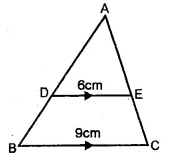
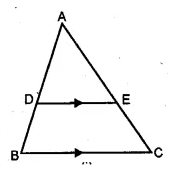
(a) In the figure (i) given below, DE || BC. If DE = 6 cm, BC = 9 cm and area of ∆ADE = 28 sq. cm, find the area of ∆ABC.
ML Aggarwal Class 10 Solutions for ICSE Maths Chapter 13 Similarity Ex 13.3 Q6.1
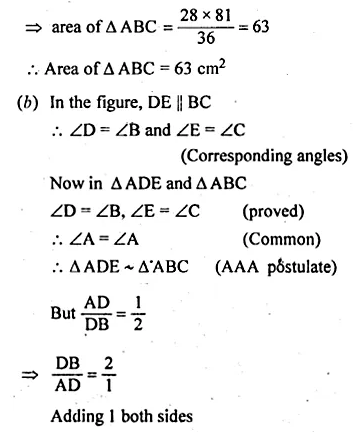
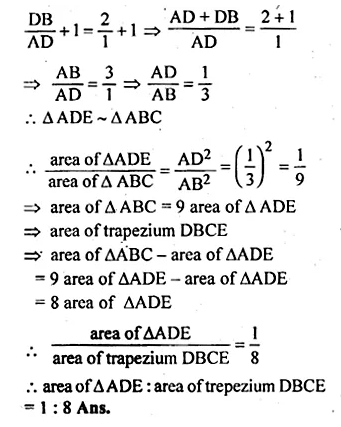
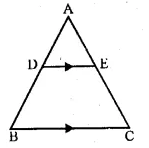
(b) In the figure (iii) given below, DE || BC and AD : DB = 1 : 2, find the ratio of the areas of ∆ADE and trapezium DBCE.
ML Aggarwal Class 10 Solutions for ICSE Maths Chapter 13 Similarity Ex 13.3 Q6.2
Solution:
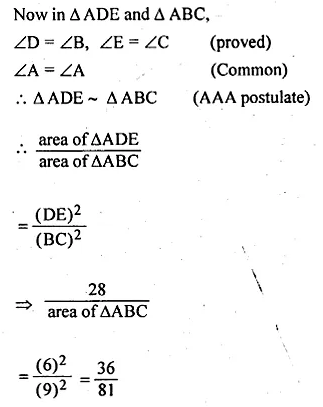
(a) In the figure,
DE || BC
∠D = ∠B and ∠E = ∠C
(Corresponding angles)
ML Aggarwal Class 10 Solutions for ICSE Maths Chapter 13 Similarity Ex 13.3 Q6.3
ML Aggarwal Class 10 Solutions for ICSE Maths Chapter 13 Similarity Ex 13.3 Q6.4
ML Aggarwal Class 10 Solutions for ICSE Maths Chapter 13 Similarity Ex 13.3 Q6.5

Question 7.
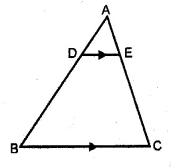
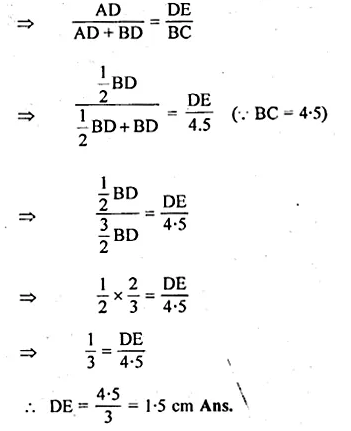
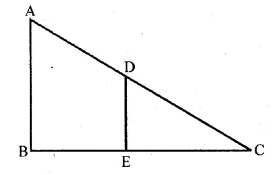
In the given figure, DE || BC.
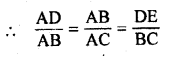
(i) Prove that ∆ADE and ∆ABC are similar.
(ii) Given that AD = \(\\ \frac { 1 }{ 2 } \) BD, calculate DE if BC = 4.5 cm.
ML Aggarwal Class 10 Solutions for ICSE Maths Chapter 13 Similarity Ex 13.3 Q7.1
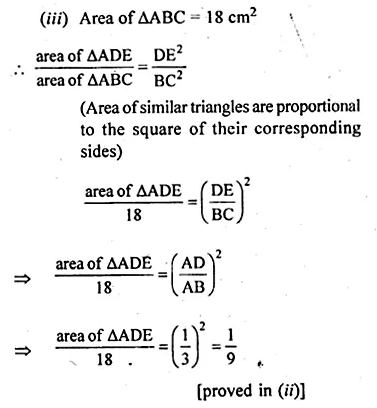
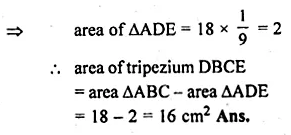
(iii) If area of ∆ABC = 18cm², find the area of trapezium DBCE
Solution:
(i) Given : In ∆ABC, DE || BC.
To prove : ∆ADE ~ ∆ABC
Proof: In ∆ADE and ∆ABC,
∠A = ∠A (common)
∠ADE = ∠ABC (corresponding angles)
∴ ∆ADE ~ ∆ABC. (AA axiom)
(ii) ∴ ∆ADE ~ ∆ABC
ML Aggarwal Class 10 Solutions for ICSE Maths Chapter 13 Similarity Ex 13.3 Q7.2
ML Aggarwal Class 10 Solutions for ICSE Maths Chapter 13 Similarity Ex 13.3 Q7.3
ML Aggarwal Class 10 Solutions for ICSE Maths Chapter 13 Similarity Ex 13.3 Q7.4
ML Aggarwal Class 10 Solutions for ICSE Maths Chapter 13 Similarity Ex 13.3 Q7.5

Question 8.
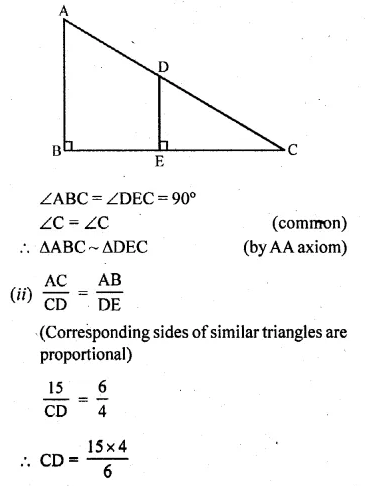
In the given figure, AB and DE are perpendicular to BC.
(i) Prove that ∆ABC ~ ∆DEC
(ii) If AB = 6 cm: DE = 4 cm and AC = 15 cm, calculate CD.
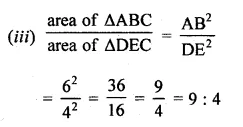
(iii) Find the ratio of the area of ∆ABC : area of ∆DEC.
ML Aggarwal Class 10 Solutions for ICSE Maths Chapter 13 Similarity Ex 13.3 Q8.1
Solution:
(i) To prove : ∆ABC ~ ∆DEC
In ∆ABC and ∆DEC
ML Aggarwal Class 10 Solutions for ICSE Maths Chapter 13 Similarity Ex 13.3 Q8.2
ML Aggarwal Class 10 Solutions for ICSE Maths Chapter 13 Similarity Ex 13.3 Q8.3

Question 9.
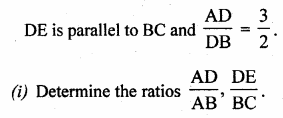
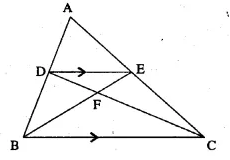
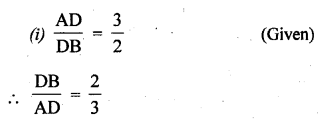
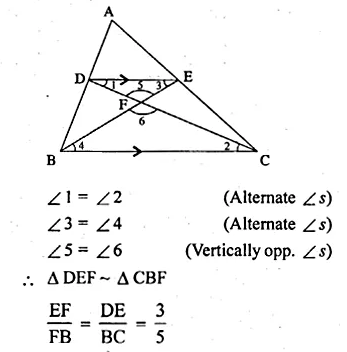
In the adjoining figure, ABC is a triangle.
ML Aggarwal Class 10 Solutions for ICSE Maths Chapter 13 Similarity Ex 13.3 Q9.1
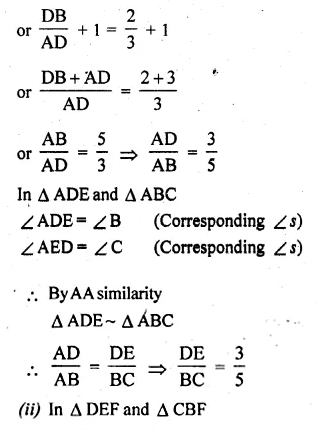
(ii) Prove that ∆DEF is similar to ∆CBF.
Hence, find \(\\ \frac { EF }{ FB } \).
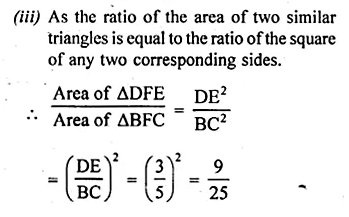
(iii) What is the ratio of the areas of ∆DEF and ∆CBF ? (2007)
ML Aggarwal Class 10 Solutions for ICSE Maths Chapter 13 Similarity Ex 13.3 Q9.2

Solution:
ML Aggarwal Class 10 Solutions for ICSE Maths Chapter 13 Similarity Ex 13.3 Q9.3
ML Aggarwal Class 10 Solutions for ICSE Maths Chapter 13 Similarity Ex 13.3 Q9.4
ML Aggarwal Class 10 Solutions for ICSE Maths Chapter 13 Similarity Ex 13.3 Q9.5
ML Aggarwal Class 10 Solutions for ICSE Maths Chapter 13 Similarity Ex 13.3 Q9.6

Question 10.
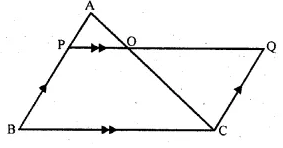
In ∆ABC, AP : PB = 2 : 3. PO is parallel to BC and is extended to Q so that CQ is parallel to BA. Find:
(i) area ∆APO : area ∆ABC.
(ii) area ∆APO : area ∆CQO. (2008)
ML Aggarwal Class 10 Solutions for ICSE Maths Chapter 13 Similarity Ex 13.3 Q10.1
Solution:
In the figure,
PQ || BC and PO is produced to Q such that CQ || BA
and AP : PB = 2 : 3.
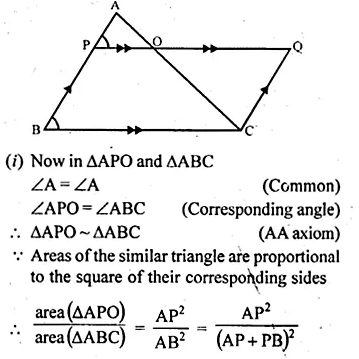
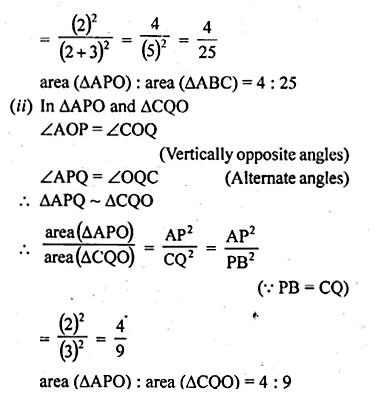
ML Aggarwal Class 10 Solutions for ICSE Maths Chapter 13 Similarity Ex 13.3 Q10.2
ML Aggarwal Class 10 Solutions for ICSE Maths Chapter 13 Similarity Ex 13.3 Q10.3

Question 11.
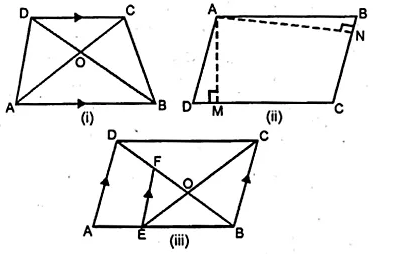
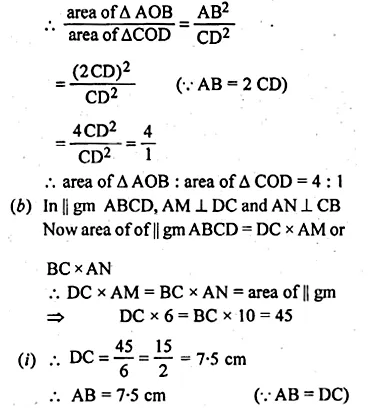
(a) In the figure (i) given below, ABCD is a trapezium in which AB || DC and AB = 2 CD. Determine the ratio of the areas of ∆AOB and ∆COD.
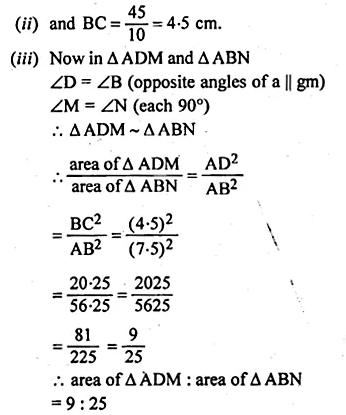
(b) In the figure (ii) given below, ABCD is a parallelogram. AM ⊥ DC and AN ⊥ CB. If AM = 6 cm, AN = 10 cm and the area of parallelogram ABCD is 45 cm², find
(i) AB
(ii) BC
(iii) area of ∆ADM : area of ∆ANB.
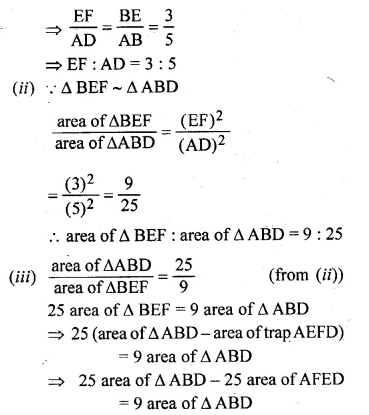
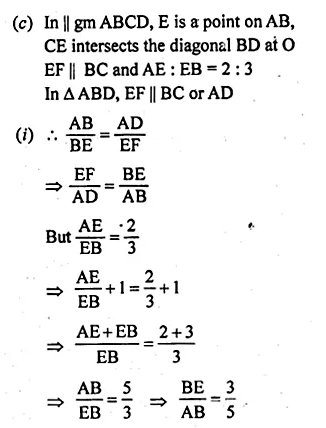
(c) In the figure (iii) given below, ABCD is a parallelogram. E is a point on AB, CE intersects the diagonal BD at O and EF || BC. If AE : EB = 2 : 3, find
(i) EF : AD
(ii) area of ∆BEF : area of ∆ABD
(iii) area of ∆ABD : area of trap. AFED
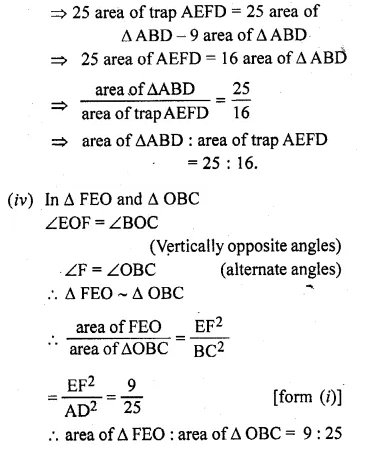
(iv) area of ∆FEO : area of ∆OBC.
ML Aggarwal Class 10 Solutions for ICSE Maths Chapter 13 Similarity Ex 13.3 Q11.1
Solution:
(a) In trapezium ABCD, AB || DC.
∠OAB = ∠OCD [alternate angles]
∠OBA = ∠ODC
∆AOB ~ ∆COD
ML Aggarwal Class 10 Solutions for ICSE Maths Chapter 13 Similarity Ex 13.3 Q11.2
ML Aggarwal Class 10 Solutions for ICSE Maths Chapter 13 Similarity Ex 13.3 Q11.3
ML Aggarwal Class 10 Solutions for ICSE Maths Chapter 13 Similarity Ex 13.3 Q11.4
ML Aggarwal Class 10 Solutions for ICSE Maths Chapter 13 Similarity Ex 13.3 Q11.5
ML Aggarwal Class 10 Solutions for ICSE Maths Chapter 13 Similarity Ex 13.3 Q11.6

Question 12.
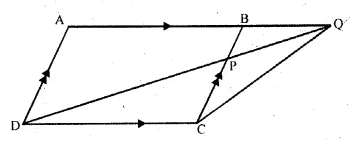
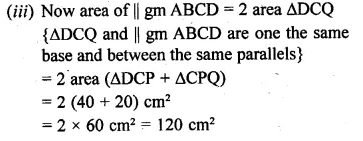
In the adjoining figure, ABCD is a parallelogram. P is a point on BC such that BP : PC = 1 : 2 and DP produced meets AB produced at Q. If area of ∆CPQ = 20 cm², find
ML Aggarwal Class 10 Solutions for ICSE Maths Chapter 13 Similarity Ex 13.3 Q12.1
(i) area of ∆BPQ.
(ii) area ∆CDP.
(iii) area of || gm ABCD.
Solution:
In the figure, ABCD is a parallelogram.
P is a point on BC such that BP : PC = 1 : 2
and DP is produced to meet ABC produced at Q.
Area ∆CPQ = 20 cm²
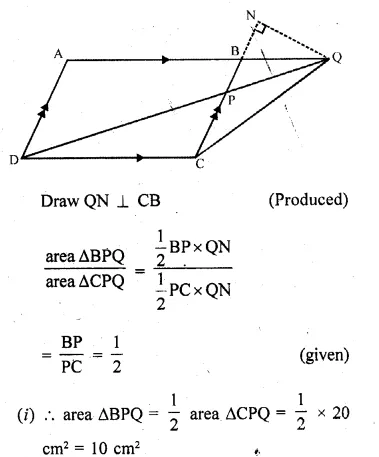
ML Aggarwal Class 10 Solutions for ICSE Maths Chapter 13 Similarity Ex 13.3 Q12.2
ML Aggarwal Class 10 Solutions for ICSE Maths Chapter 13 Similarity Ex 13.3 Q12.3
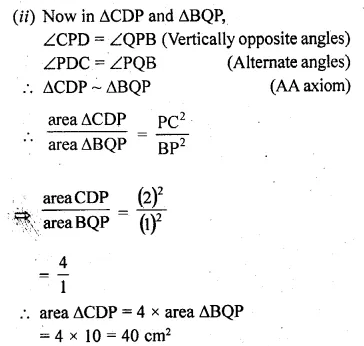
ML Aggarwal Class 10 Solutions for ICSE Maths Chapter 13 Similarity Ex 13.3 Q12.4
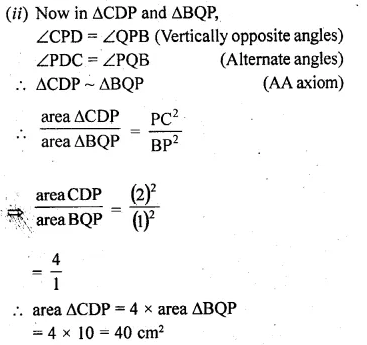
ML Aggarwal Class 10 Solutions for ICSE Maths Chapter 13 Similarity Ex 13.3 Q12.5

Question 13.
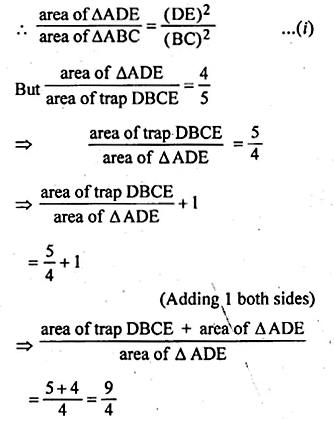
(a) In the figure (i) given below, DE || BC and the ratio of the areas of ∆ADE and trapezium DBCE is 4 : 5. Find the ratio of DE : BC.
ML Aggarwal Class 10 Solutions for ICSE Maths Chapter 13 Similarity Ex 13.3 Q13.1
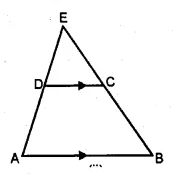
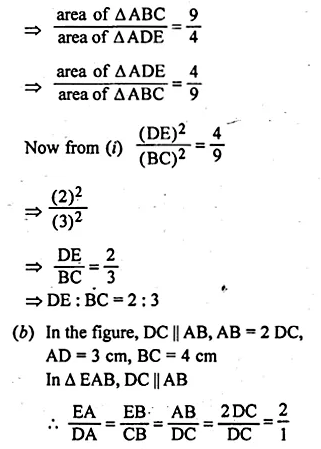
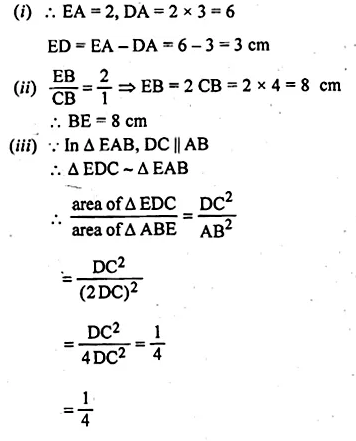
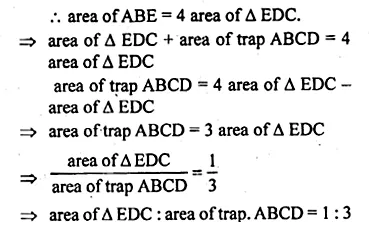
(b) In the figure (ii) given below, AB || DC and AB = 2 DC. If AD = 3 cm, BC = 4 cm and AD, BC produced meet at E, find (i) ED (ii) BE (iii) area of ∆EDC : area of trapezium ABCD.
ML Aggarwal Class 10 Solutions for ICSE Maths Chapter 13 Similarity Ex 13.3 Q13.2
Solution:
(a) In ∆ABC, DE || BC
Now in ∆ABC and ∆ADE
∠A = ∠A (common)
∠D = ∠B and ∠E = ∠C
(Corresponding angles)
∆ADE ~ ∆ABC
ML Aggarwal Class 10 Solutions for ICSE Maths Chapter 13 Similarity Ex 13.3 Q13.3
ML Aggarwal Class 10 Solutions for ICSE Maths Chapter 13 Similarity Ex 13.3 Q13.4
ML Aggarwal Class 10 Solutions for ICSE Maths Chapter 13 Similarity Ex 13.3 Q13.5
ML Aggarwal Class 10 Solutions for ICSE Maths Chapter 13 Similarity Ex 13.3 Q13.6

Question 14.
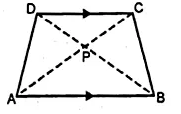
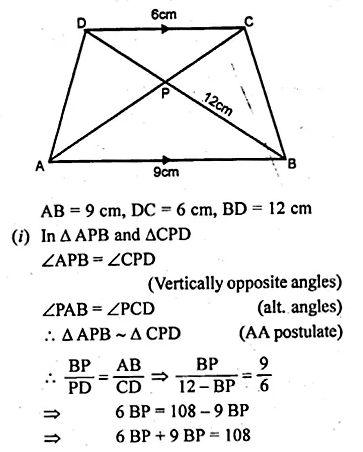
(a) In the figure given below, ABCD is a trapezium in which DC is parallel to AB. If AB = 9 cm, DC = 6 cm and BB = 12 cm., find
(i) BP
(ii) the ratio of areas of ∆APB and ∆DPC.
ML Aggarwal Class 10 Solutions for ICSE Maths Chapter 13 Similarity Ex 13.3 Q14.1
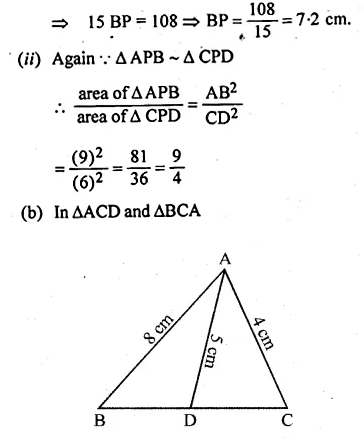
(b) In the figure given below, ∠ABC = ∠DAC and AB = 8 cm, AC = 4 cm, AD = 5 cm.
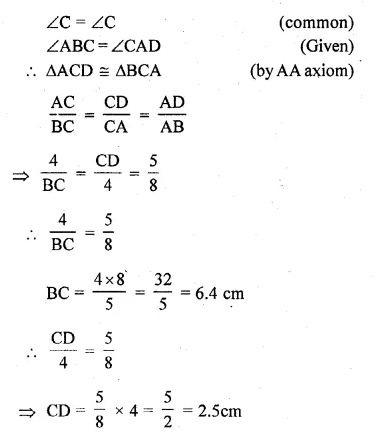
(i) Prove that ∆ACD is similar to ∆BCA
(ii) Find BC and CD
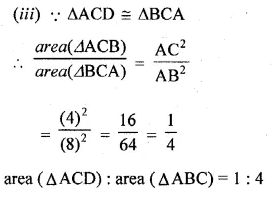
(iii) Find the area of ∆ACD : area of ∆ABC.
ML Aggarwal Class 10 Solutions for ICSE Maths Chapter 13 Similarity Ex 13.3 Q14.2
Solution:
(a) In trapezium ABCD, DC || AB
ML Aggarwal Class 10 Solutions for ICSE Maths Chapter 13 Similarity Ex 13.3 Q14.3
ML Aggarwal Class 10 Solutions for ICSE Maths Chapter 13 Similarity Ex 13.3 Q14.4
ML Aggarwal Class 10 Solutions for ICSE Maths Chapter 13 Similarity Ex 13.3 Q14.5
ML Aggarwal Class 10 Solutions for ICSE Maths Chapter 13 Similarity Ex 13.3 Q14.6

Question 15.
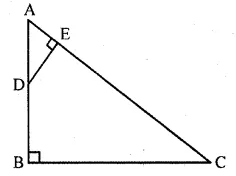
ABC is a right angled triangle with ∠ABC = 90°. D is any point on AB and DE is perpendicular to AC. Prove that:
(i) ∆ADE ~ ∆ACB.
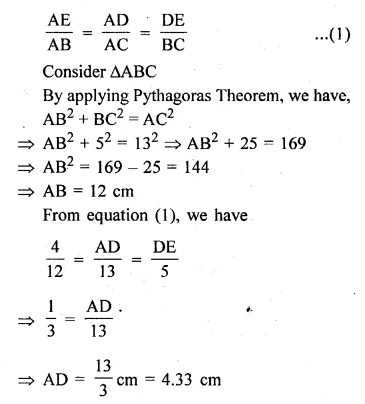
(ii) If AC = 13 cm, BC = 5 cm and AE = 4 cm. Find DE and AD.
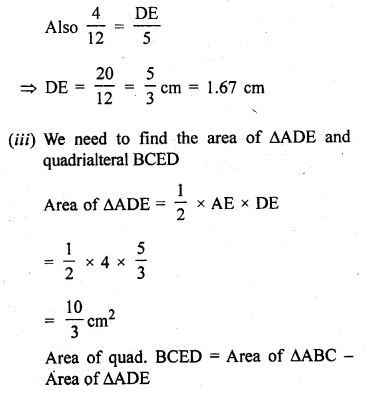
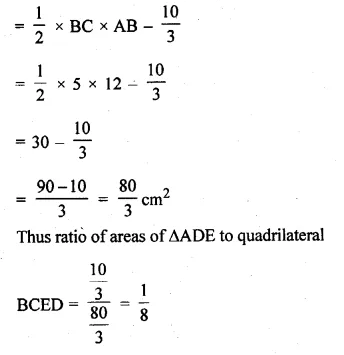
(iii) Find, area of ∆ADE : area of quadrilateral BCED.
ML Aggarwal Class 10 Solutions for ICSE Maths Chapter 13 Similarity Ex 13.3 Q15.1
Solution:
(i) Consider DADE and DACB
∠A = ∠A (Common)
m∠B = m∠E = 90°
Thus by angle-angle similarity, triangles,
∆ACB ~ ∆ADE
(ii) Consider ∆ADE and ∆ACB
Since they are similar triangles,
the sides are proportional Thus, we have,
ML Aggarwal Class 10 Solutions for ICSE Maths Chapter 13 Similarity Ex 13.3 Q15.2
ML Aggarwal Class 10 Solutions for ICSE Maths Chapter 13 Similarity Ex 13.3 Q15.3
ML Aggarwal Class 10 Solutions for ICSE Maths Chapter 13 Similarity Ex 13.3 Q15.4

Question 16.
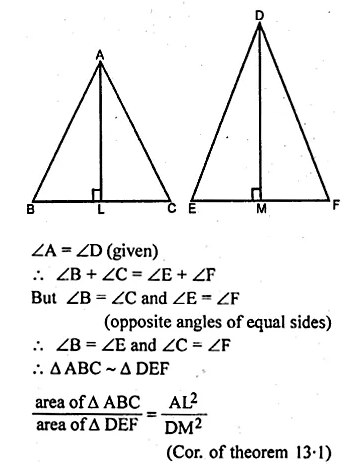
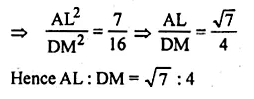
Two isosceles triangles have equal vertical angles and their areas are in the ratio 7 : 16. Find the ratio of their corresponding height.
Solution:
In two isosceles ∆s ABC and DEF
ML Aggarwal Class 10 Solutions for ICSE Maths Chapter 13 Similarity Ex 13.3 Q16.1
ML Aggarwal Class 10 Solutions for ICSE Maths Chapter 13 Similarity Ex 13.3 Q16.2

Question 17.
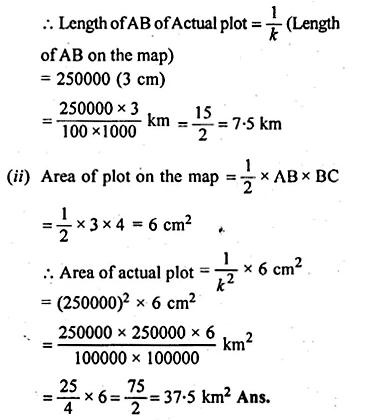
On a map drawn to a scale of 1 : 250000, a triangular plot of land has the following measurements :
AB = 3 cm, BC = 4 cm and ∠ABC = 90°. Calculate
(i) the actual length of AB in km.
(ii) the area of the plot in sq. km:
Solution:
Scale factor k = 1 : 250000 = \(\\ \frac { 1 }{ 250000 } \)
Length on map,
AB = 3 cm, BC = 4 cm
ML Aggarwal Class 10 Solutions for ICSE Maths Chapter 13 Similarity Ex 13.3 Q17.1

Question 18.
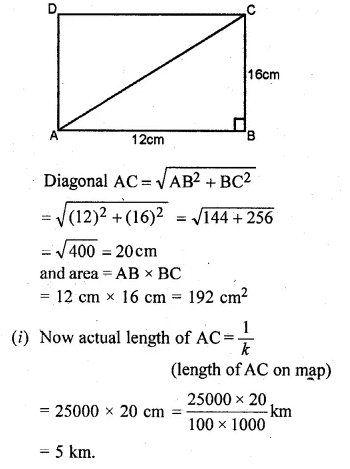
On a map drawn to a scale of 1 : 25000, a rectangular plot of land, ABCD has the following measurements AB = 12 cm and BG = 16 cm.
Calculate:
(i) the distance of a diagonal of the plot in km.
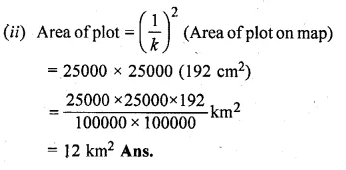
(ii) the area of the plot in sq. km.
Solution:
Scale factor (k) = \(\\ \frac { 1 }{ 25000 } \)
Measurements of plot ABCD on the map are
AB = 12 cm and BC = 16 cm.
ML Aggarwal Class 10 Solutions for ICSE Maths Chapter 13 Similarity Ex 13.3 Q18.1
ML Aggarwal Class 10 Solutions for ICSE Maths Chapter 13 Similarity Ex 13.3 Q18.2

Question 19.
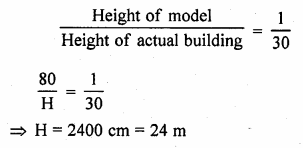
The model of a building is constructed with the scale factor 1 : 30.
(i) If the height of the model is 80 cm, find the actual height of the building in metres.
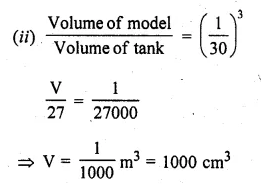
(ii) If the actual volume of a tank at the top of the building is 27 m³, find the volume of the tank on the top of the model. (2009)
Solution:
(i)
ML Aggarwal Class 10 Solutions for ICSE Maths Chapter 13 Similarity Ex 13.3 Q19.1
ML Aggarwal Class 10 Solutions for ICSE Maths Chapter 13 Similarity Ex 13.3 Q19.2

Question 20.
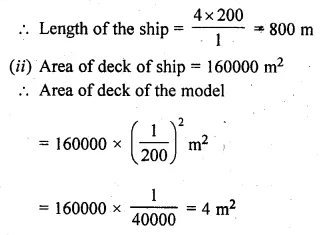
A model of a ship is made to a scale of 1 : 200.
(i) If the length of the model is 4 m, find the length of the ship.
(ii) If the area of the deck of the ship is 160000 m², find the area of the deck of the model.
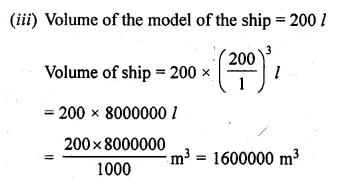
(iii) If the volume of the model is 200 litres, find the volume of the ship in m³.
(100 litres = m³)
Solution:
Scale = 1 : 200
(i) Length of a model of ship = 4 m
ML Aggarwal Class 10 Solutions for ICSE Maths Chapter 13 Similarity Ex 13.3 Q20.1
ML Aggarwal Class 10 Solutions for ICSE Maths Chapter 13 Similarity Ex 13.3 Q20.2

Hope given ML Aggarwal Class 10 Solutions for ICSE Maths Chapter 13 Similarity Ex 13.3 are helpful to complete your math homework.

If you have any doubts, please comment below. Learn Insta try to provide online math tutoring for you.
ML Aggarwal Class 10 Solutions for ICSE Maths Chapter 13 Similarity Ex 13.2

ML Aggarwal Class 10 Solutions for ICSE Maths Chapter 13 Similarity Ex 13.2

These Solutions are part of ML Aggarwal Class 10 Solutions for ICSE Maths. Here we have given ML Aggarwal Class 10 Solutions for ICSE Maths Chapter 13 Similarity Ex 13.2

More Exercises

Question 1.
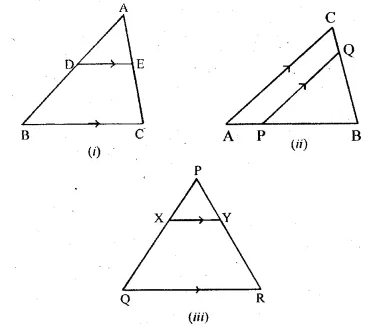
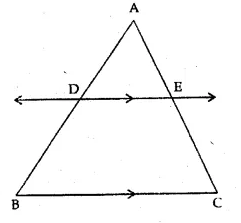
(a) In the figure (i) given below if DE || BG, AD = 3 cm, BD = 4 cm and BC = 5 cm. Find (i) AE : EC (ii) DE.
(b) In the figure (ii) given below, PQ || AC, AP = 4 cm, PB = 6 cm and BC = 8 cm. Find CQ and BQ.
(c) In the figure (iii) given below, if XY || QR, PX = 1 cm, QX = 3 cm, YR = 4.5 cm and QR = 9 cm, find PY and XY.
ML Aggarwal Class 10 Solutions for ICSE Maths Chapter 13 Similarity Ex 13.2 Q1.1
Solution:
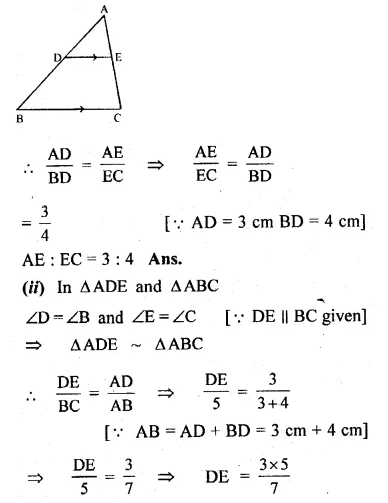
(a) In the figure (i)
Given : DE || BC, AD = 3 cm, BD = 4 cm and BC = 5 cm.
To find (i) AE : EC and
(ii) DE Since DE || BC of ∆ABC
ML Aggarwal Class 10 Solutions for ICSE Maths Chapter 13 Similarity Ex 13.2 Q1.2
ML Aggarwal Class 10 Solutions for ICSE Maths Chapter 13 Similarity Ex 13.2 Q1.3
ML Aggarwal Class 10 Solutions for ICSE Maths Chapter 13 Similarity Ex 13.2 Q1.4
ML Aggarwal Class 10 Solutions for ICSE Maths Chapter 13 Similarity Ex 13.2 Q1.5

Question 2.
In the given figure, DE || BC.
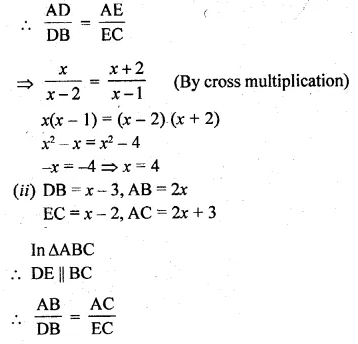
(i) If AD = x, DB = x – 2, AE = x + 2 and EC = x – 1, find the value of x.
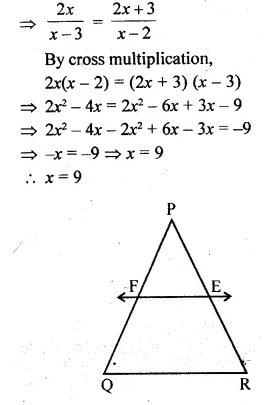
(ii) If DB = x – 3, AB = 2x, EC = x – 2 and AC = 2x + 3, find the value of x.
ML Aggarwal Class 10 Solutions for ICSE Maths Chapter 13 Similarity Ex 13.2 Q2.1
Solution:
In the given figure, DE || BC
(i) AD = x, DB = x – 2, AE = x + 2, EC = x – 1
In ∆ABC,
∵DE || BC
ML Aggarwal Class 10 Solutions for ICSE Maths Chapter 13 Similarity Ex 13.2 Q2.2
ML Aggarwal Class 10 Solutions for ICSE Maths Chapter 13 Similarity Ex 13.2 Q2.3
ML Aggarwal Class 10 Solutions for ICSE Maths Chapter 13 Similarity Ex 13.2 Q2.4

Question 3.
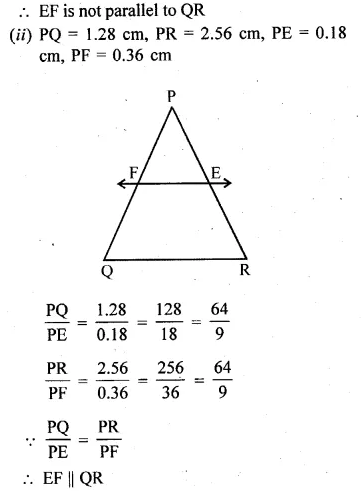
E and F are points on the sides PQ and PR respectively of a ∆PQR. For each of the following cases, state whether EF || QR:
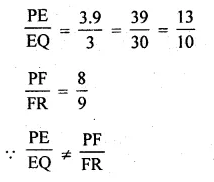
(i) PE = 3.9 cm, EQ = 3 cm, PF = 8 cm and RF = 9 cm.
(ii) PQ = 1.28 cm, PR = 2.56 cm, PE = 0.18 cm and PF = 0.36 cm.
Solution:
(i) In ∆PQR, E and F are the points on the sides PQ and PR respectively
PE = 3.9 cm, EQ = 3 cm, PF = 8 cm,
RF = 9 cm
Is EF || QR ?
ML Aggarwal Class 10 Solutions for ICSE Maths Chapter 13 Similarity Ex 13.2 Q3.1

Question 4.
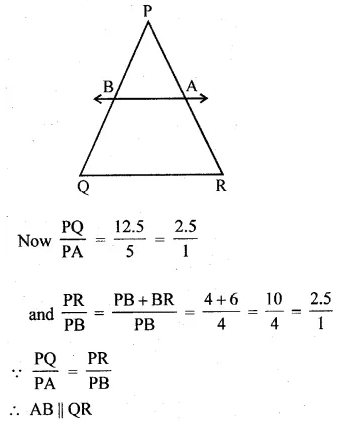
A and B are respectively the points on the sides PQ and PR of a triangle PQR such that PQ = 12.5 cm, PA = 5 cm, BR = 6 cm and PB = 4 cm. Is AB || QR? Give reasons for your answer.
Solution:
In ∆PQR, A and B are points on the sides PQ and PR such that
PQ = 12.5 cm, PA = 5 cm, BR = 6 cm and PB = 4 cm
ML Aggarwal Class 10 Solutions for ICSE Maths Chapter 13 Similarity Ex 13.2 Q4.1

Question 5.
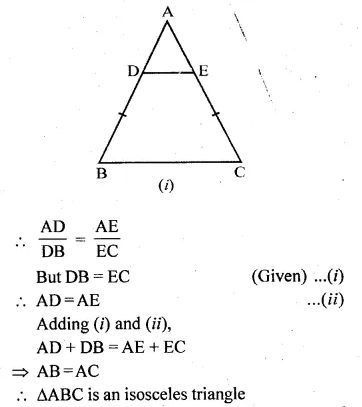
(a) In figure (i) given below, DE || BC and BD = CE. Prove that ABC is an isosceles triangle.
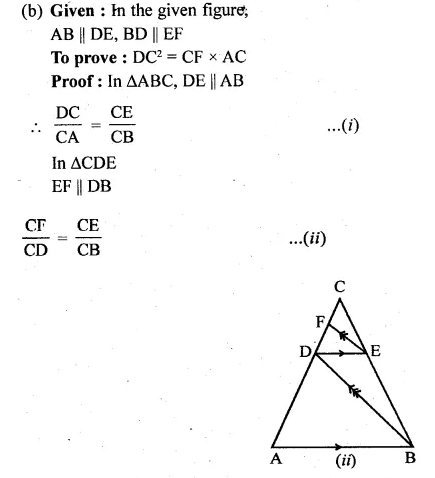
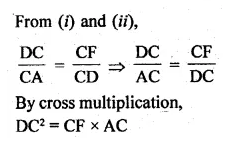
(b) In figure (ii) given below, AB || DE and BD || EF. Prove that DC² = CF x AC.
Solution:
(a) Given: In the figure,
DE || BC and BD = CE
To prove: ∆ABC is an isosceles triangle
Proof: In ∆ABC, DE || BC
ML Aggarwal Class 10 Solutions for ICSE Maths Chapter 13 Similarity Ex 13.2 Q5.1
ML Aggarwal Class 10 Solutions for ICSE Maths Chapter 13 Similarity Ex 13.2 Q5.2
ML Aggarwal Class 10 Solutions for ICSE Maths Chapter 13 Similarity Ex 13.2 Q5.3

Question 6.
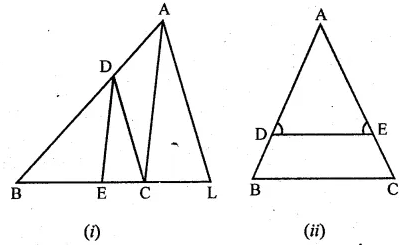
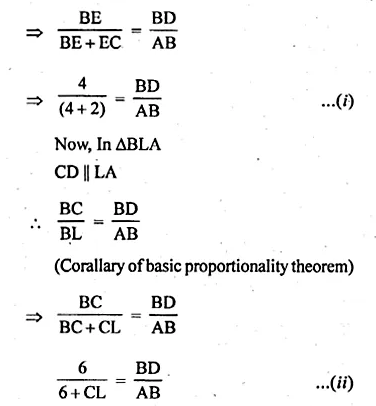
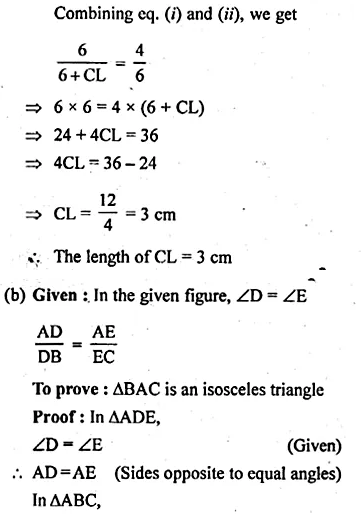
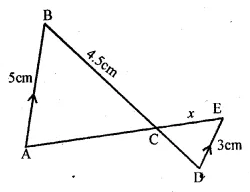
(a) In the figure (i) given below, CD || LA and DE || AC. Find the length of CL if BE = 4 cm and EC = 2 cm.
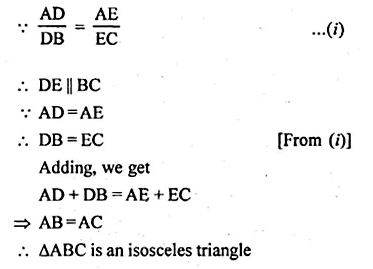
(b) In the given figure, ∠D = ∠E and \(\frac { AD }{ BD } =\frac { AE }{ EC } \). Prove that BAC is an isosceles triangle.
ML Aggarwal Class 10 Solutions for ICSE Maths Chapter 13 Similarity Ex 13.2 Q6.1
Solution:
(a) Given : CD || LA and DE || AC
Length of BE = 4 cm
Length of EC = 2 cm
Now, in ∆BCA
DE || AC
\(\frac { BE }{ BC } =\frac { BD }{ BA } \)
(Corallary of basic proportionality theorem)
ML Aggarwal Class 10 Solutions for ICSE Maths Chapter 13 Similarity Ex 13.2 Q6.2
ML Aggarwal Class 10 Solutions for ICSE Maths Chapter 13 Similarity Ex 13.2 Q6.3
ML Aggarwal Class 10 Solutions for ICSE Maths Chapter 13 Similarity Ex 13.2 Q6.4

Question 7.
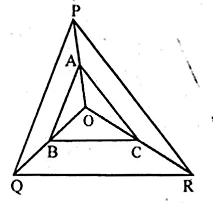
In the figure given below, A, B and C are points on OP, OQ and OR respectively such that AB || PQ and AC || PR. show that BC || QR.
ML Aggarwal Class 10 Solutions for ICSE Maths Chapter 13 Similarity Ex 13.2 Q7.1
Solution:
In the given figure, A, B, C are points on
OP, OQ and OR respectively
and AB || PQ and AC || PR
To prove: BC || QR
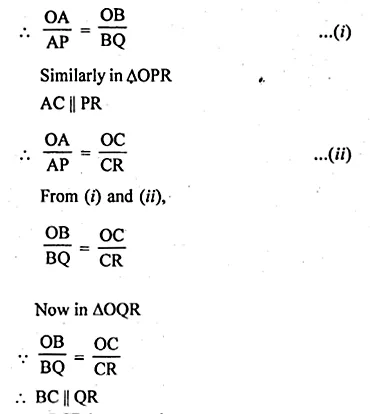
Proof: In POQ,
AB || PQ
ML Aggarwal Class 10 Solutions for ICSE Maths Chapter 13 Similarity Ex 13.2 Q7.2

Question 8.
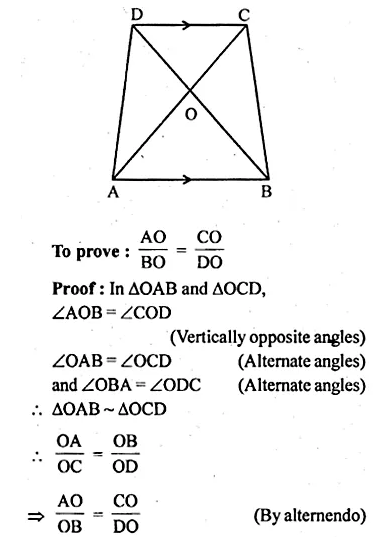
ABCD is a trapezium in which AB || DC and its diagonals intersect each other at O. Using Basic Proportionality theorem, prove that \(\frac { AO }{ BO } =\frac { CO }{ DO } \)
Solution:
Given : ABCD is a trapezium in which AB || DC
Its diagonals AC and BD intersect each other at O
ML Aggarwal Class 10 Solutions for ICSE Maths Chapter 13 Similarity Ex 13.2 Q8.1

Question 9.
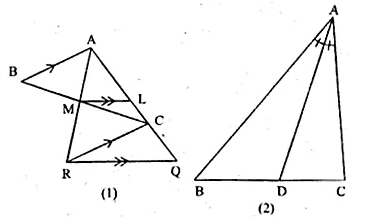
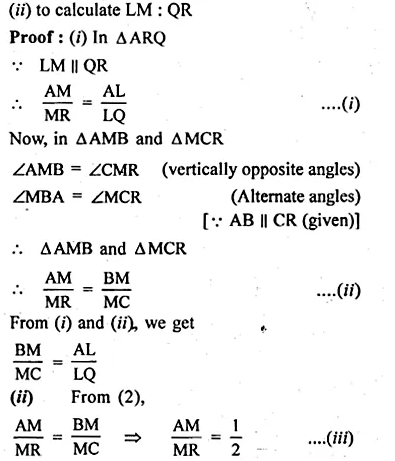
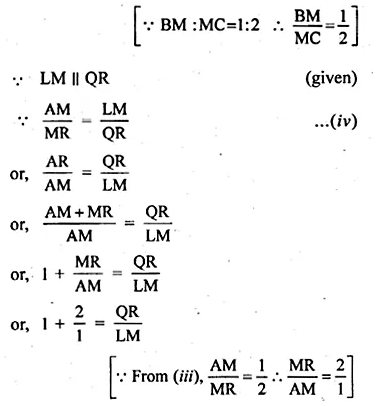
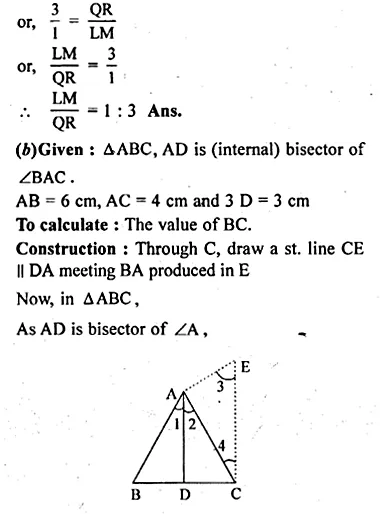
(a) In the figure (1) given below, AB || CR and LM || QR.
(i) Prove that \(\frac { BM }{ MC } =\frac { AL }{ LQ } \)
(ii) Calculate LM : QR, given that BM : MC = 1 : 2.
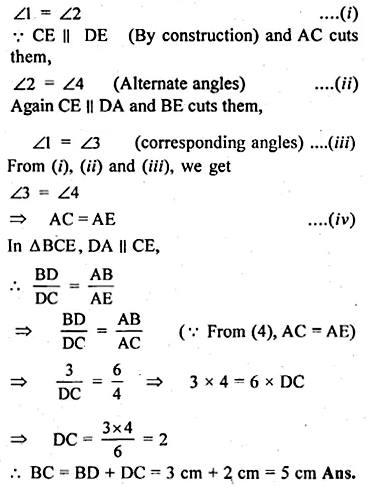
(b) In the figure (2) given below AD is bisector of ∠BAC. If AB = 6 cm, AC = 4 cm and BD = 3cm, find BC
ML Aggarwal Class 10 Solutions for ICSE Maths Chapter 13 Similarity Ex 13.2 Q9.1
Solution:
(a) Given: AB || CR and LM II QR.
Also BM : MC = 1:2
To Prove:
(i) \(\frac { BM }{ MC } =\frac { AL }{ LQ } \)
ML Aggarwal Class 10 Solutions for ICSE Maths Chapter 13 Similarity Ex 13.2 Q9.2
ML Aggarwal Class 10 Solutions for ICSE Maths Chapter 13 Similarity Ex 13.2 Q9.3
ML Aggarwal Class 10 Solutions for ICSE Maths Chapter 13 Similarity Ex 13.2 Q9.4
ML Aggarwal Class 10 Solutions for ICSE Maths Chapter 13 Similarity Ex 13.2 Q9.5

Hope given ML Aggarwal Class 10 Solutions for ICSE Maths Chapter 13 Similarity Ex 13.2 are helpful to complete your math homework.

If you have any doubts, please comment below. Learn Insta try to provide online math tutoring for you.
NCERT Solutions for Class 10 Hindi Sparsh Chapter 13

NCERT Solutions for Class 10 Hindi Sparsh Chapter 13 तीसरी कसम के शिल्पकार शैलेंद्र

These Solutions are part of NCERT Solutions for Class 10 Hindi. Here we have given NCERT Solutions for Class 10 Hindi Sparsh Chapter 13 तीसरी कसम के शिल्पकार शैलेंद्र.
पाठ्य पुस्तक प्रश्न

मौखिक

निम्नलिखित प्रश्नों के उत्तर एक-दो पंक्तियों में दीजिए-

प्रश्न 1.
‘तीसरी कसम’ फिल्म को कौन-कौन से पुरस्कारों से सम्मानित किया गया है?
उत्तर:

‘तीसरी कसम’ फ़िल्म को जिन पुरस्कारों से सम्मानित किया गया, वे हैं-

  • राष्ट्रपति स्वर्ण पदक।
  • बंगाल जर्नलिस्ट एसोसिएशन का सर्वश्रेष्ठ फ़िल्म पुरस्कार।
  • मास्को फ़िल्म फेस्टिवल पुरस्कार।

प्रश्न 2.
शैलेंद्र ने कितनी फिल्में बनाईं?
उत्तर:
शैलेंद्र ने मात्र एक फिल्म ‘तीसरी कसम’ बनाई।

प्रश्न 3.
राजकपूर द्वारा निर्देशित कुछ फिल्मों के नाम बताइए।
उत्तर:
राजकपूर द्वारा निर्देशित कुछ फ़िल्में हैं- राम तेरी गंगा मैली, सत्यम् शिवम् सुंदरम्, प्रेमरोग, मेरा नाम जोकर आदि।

प्रश्न 4.
‘तीसरी कसम’ फ़िल्म के नायक व नायिकाओं के नाम बताइए और फिल्म में इन्होंने किन पात्रों का अभिनय किया है?
उत्तर:
नायक का नाम- राजकपूर, नायिका का नाम-वहीदा रहमान।
नायक राजकपूर ने ‘हीरामन’ का और नायिका वहीदा रहमान ने ‘हीराबाई का अभिनय किया।

प्रश्न 5.
फिल्म ‘तीसरी कसम’ का निर्माण किसने किया था?
उत्तर:
फ़िल्म ‘तीसरी कसम’ का निर्माण प्रसिद्ध गीतकार शैलेंद्र ने किया।

प्रश्न 6.
राजकपूर ने ‘मेरा नाम जोकर’ के निर्माण के समय किस बात की कल्पना भी नहीं की थी?
उत्तर:
राजकपूर ने ‘मेरा नाम जोकर’ के निर्माण के समय शायद इसे बात की कल्पना नहीं की थी कि इस फ़िल्म के एक भाग को बनाने में छहः वर्ष का समय लग जाएगा।

प्रश्न 7.
राजकपूर की किस बात पर शैलेंद्र का चेहरा मुरझा गया?
उत्तर:
राजकपूर ने शैलेंद्र की फ़िल्म में काम करना स्वीकार कर लिया परंतु उन्होंने जब अपना पारिश्रमिक एडवांस माँगा तो शैलेंद्र का चेहरा मुरझा गया।

प्रश्न 8.
फ़िल्म समीक्षक राजकपूर को किस तरह का कलाकार मानते थे?
उत्तर:
समीक्षक मानते हैं कि राजकपूर एक बड़े फिल्म निर्माता, सफल अभिनेता और कुशल निर्देशक थे। उन्हें जो भी चरित्र अभिनीत करने के लिए दिया जाता था, वे उससे एकाकार हो जाते थे। उनका महिमामय व्यक्तित्व किसी भी चरित्र की आत्मा में उतर जाता था। वे जुवान से नहीं आँखों से बोलते थे। वे कला मर्मज्ञ थे।

लिखित

(क) निम्नलिखित प्रश्नों के उत्तर (25-30 शब्दों में) लिखिए-

प्रश्न 1.
‘तीसरी कसम’ फिल्म को ‘सैल्यूलाइड पर लिखी कविता’ क्यों कहा गया है?
उत्तर:
‘तीसरी कसम’ फ़िल्म लोकतत्वों को समेटे एक संवेदना एवं एक भावना प्रधान फ़िल्म थी। फ़िल्म को देखकर लगता था कि यह अभिनेताओं द्वारा अभिनीत कोई कहानी न होकर कैमरे की रील पर लिखी कोई कविता हो, जिसका फ़िल्मांकन करके प्रस्तुत किया जा रहा हो।

प्रश्न 2.
‘तीसरी कसम’ फ़िल्म को खरीददार क्यों नहीं मिल रहे थे?
उत्तर:
‘तीसरी कसम’ फिल्म को खरीददार इसलिए नहीं मिल रहे थे, क्योंकि इसमें मनोरंजन सामान्य कोटि का नहीं था। यह एक साहित्यिक फ़िल्म थी। इसकी संवेदना को धन कमाने की इच्छा रखनेवाले वितरक समझ नहीं सके, लेकिन इस फ़िल्म में रची-बसी करुणा पैसे के तराजू पर तौली जा सकने वाली चीज़ नहीं थी। वितरक जोखिम नहीं लेना चाहते थे, जबकि इसमें कलाकार भी उच्च स्तर के थे।

प्रश्न 3.
शैलेंद्र के अनुसार कलाकार का कर्तव्य क्या है?
उत्तर:
शैलेंद्र के अनुसार, कलाकार का कर्तव्य है कि वह दर्शकों की रुचि का ध्यान तो रखे पर रुचि की आड़ में उथले और सस्ते मनोरंजन को उनके सामने न परोसे। उसे चाहिए कि वह दर्शकों की रुचि का परिष्कार और उसे उन्नत करे।

प्रश्न 4.
फ़िल्मों में त्रासद स्थितियों का चित्रांकन ग्लोरीफाई क्यों कर दिया जाता है?
उत्तर:
फ़िल्मों में त्रासद स्थितियों का चित्रांकन ग्लोरीफ़ाई इसलिए कर दिया जाता है ताकि अधिकतर लोगों का रुझान नकारात्मकता, त्रासद स्थितियों एवं हिंसा की ओर अधिक होने से उनको फ़िल्म देखने के लिए आकर्षित किया जा सके। जबकि सामाजिक सुधार के लिए उनमें कुछ सद्गुणों एवं शिक्षाप्रद दृश्यों को ग्लोरीफ़ाई करना चाहिए।

प्रश्न 5.
“शैलेंद्र ने राजकपूर की भावनाओं को शब्द दिए हैं। इस कथन से आप क्या समझते हैं? स्पष्ट कीजिए।
उत्तर:
एक निर्माता के रूप में स्वयं राजकपूर भी तीसरी कसम के समान ही भावपूर्ण और साहित्यिक फ़िल्म का निर्माण करना चाहते थे। शैलेंद्र के इस फ़िल्म को देखकर ऐसा लगता था मानों राजकपूर जो चाहते थे वही शैलेंद्र ने कर दिया है।

प्रश्न 6.
लेखक ने राजकपूर को एशिया का सबसे बड़ा शोमैन कहा है। शोमैन से आप क्या समझते हैं?
उत्तर:
शोमैन ऐसे व्यक्ति को कहते हैं, जो बहुत लोकप्रिय हो, जो श्रेष्ठ कला का प्रदर्शन करके अधिक से अधिक जनसमुदाय को एकत्र कर सके और जिसके नाम से ही फिल्में बिकती हों। लेखक ने राजकपूर को एशिया का सबसे बड़ा “शोमैन’ इसलिए कहा है, क्योंकि उन्होंने अपने व्यापक विषयों को भी बड़ी संपूर्णता के साथ फिल्मी परदे पर उतारा था। साथ ही अंतर्मन की भावनाओं को भी बड़ी ही सूक्ष्मता के साथ उकेरा था। राजकपूर की फ़िल्में इन बातों की कसौटी पर खरी उतरती हैं। यही ‘शोमैन’ का आशय है, तात्पर्य है।

प्रश्न 7.
फ़िल्म ‘श्री 420′ के गीत ‘रातें दसों दिशाओं से कहेंगी अपनी कहानियाँ’ पर संगीतकार जयकिशन ने आपत्ति क्यों की?
उत्तर:
इस गीत के शब्द-दसों दिशाओं’ पर संगीतकार शंकर जयकिशन ने इसलिए आपत्ति की क्योंकि जन सामान्य को दस दिशाओं का ज्ञान नहीं होता। उसकी समझ में दिशाएँ चार ही होती हैं। इस शब्द के प्रयोग से गीत अधिक चर्चित एवं लोक प्रिय बन सकेगा।

(ख) निम्नलिखित प्रश्नों के उत्तर (50-60 शब्दों में) लिखिए-

प्रश्न 1.
राजकपूर द्वारा फ़िल्म की असफलता के खतरों से आगाह करने पर भी शैलेंद्र ने यह फ़िल्म क्यों बनाई? ।
उत्तर:
शैलेंद्र मुख्य रूप से कवि हृदय रखने वाले गीतकार थे। वे फ़िल्मी दुनिया से जुड़े हुए थे परंतु फ़िल्म निर्माण एवं एक को दो, दो को चार बनाने की कला से अपरिचित थे। इसके अलावा तीसरी कसम फ़िल्म की कहानी, भाव प्रबलता देखकर राजकपूर ने उन्हें फ़िल्म की असफलता के प्रति सावधान किया परंतु शैलेंद्र ने यह फ़िल्म इसलिए बनाई क्योंकि वे धन-यश लिप्सा के लिए नहीं बल्कि आत्मसंतुष्टि के लिए फ़िल्म निर्माण कर रहे थे।

प्रश्न 2.
‘तीसरी कसम’ में राजकपूर की महिमामय व्यक्तित्व किस तरह हीरामन की आत्मा में उतर गया है? स्पष्ट कीजिए।
उत्तर:
‘तीसरी कसम’ में राजकपूर का महिमामय व्यक्तित्व हीरामन की आत्मा में उतर जाता है। हीरामन फ़िल्म कथा का मुख्य पुरुष पात्र है। उसकी अपनी विशेषताएँ ओर सीमाएँ हैं। राजकपूर के व्यक्तित्व की यह विशेषता रही कि स्वयं हीरामन न होते हुए भी अपनी उत्कृष्ट अभिनय कला से हीरामन बन जाते हैं। वे हीरामन पर हावी नहीं होते। दूसरे शब्दों में दो होते हुए एक बन जाते हैं। अर्थात् इस अभिनय में राजकपूर की अभिनय कला का चरमोत्कर्ष उभरकर सामने आता है।

प्रश्न 3.
लेखक ने ऐसा क्यों लिखा कि ‘तीसरी कसम’ ने साहित्य-रचना के साथ शत प्रतिशत न्याय किया है?
उत्तर:
प्रायः देखा जाता है कि फ़िल्म निर्माता मूल कहानी के साथ इतनी छेड़छाड़ और काट-छाँट करते हैं तथा इतने मसाले और लटके-झटके शामिल कर देते हैं कि मूल कहानी कहीं खो-सी जाती है तथा उसका स्तर गिर जाता है, परंतु ‘तीसरी कसम’ के निर्माता शैलेंद्र ने फणीश्वर नाथ ‘रेणु’ की मूल रचना को यथावत बनाए रखा जिससे उसकी साहित्यिक गहराई एवं प्रभाव पर कोई असर नहीं हुआ।

प्रश्न 4.
शैलेंद्र के गीतों की क्या विशेषताएँ हैं? अपने शब्दों में लिखिए।
उत्तर:
शैलेंद्र के गीतों की सबसे पहली विशेषता यह थी कि उनके गीत लोकप्रिय थे। उनके गीतों में गहराई के साथ-साथ आम जनता से जुड़ाव भी था। उनके गीत अच्छे भावों से ओत-प्रोत थे। शैलेंद्र के गीतों में कहीं भी जटिलता नहीं थी। उनके गीतों में शांत नदी की तरह गति व समुद्र की-सी गहराई थी। उनके गीतों में उनकी जिंदगी अभिव्यक्त हुई है।

प्रश्न 5.
फ़िल्म निर्माता के रूप में शैलेंद्र की विशेषताओं पर प्रकाश डालिए।
उत्तर:
एक फिल्म निर्माता के रूप में शैलेंद्र अपना अलग स्थान एवं महत्त्व रखते हैं। वे व्यावसायिकता से कोसों दूर रहकर धन और यश लिप्सा को फ़िल्म निर्माण के क्षेत्र में आड़े नहीं आने दिया। उन्होंने फ़िल्म में मूल कृति से छेड़छाड़ किए बिना उसकी साहित्यिकता को बनाए रखा। इसके अलावा उन्होंने करुणा पूर्ण दृश्यों को बढ़ा-चढ़ाकर दिखाते हुए लोगों की भावनाओं का शोषण नहीं किया।

प्रश्न 6.
शैलेंद्र के निजी जीवन की छाप उनकी फ़िल्म में झलकती है-कैसे? स्पष्ट कीजिए।
उत्तर:
शैलेंद्र के निजी जीवन की छाप उनकी फिल्म ‘तीसरी कसम’ में झलकती है। शैलेंद्र अपने जीवन में बेहद गंभीर, शांत, उदार और भावुक कवि हृदय के व्यक्ति थे। उनके इन सभी गुणों का समावेश फिल्म में पूरी तरह से उजागर होता है। शैलेंद्र ने कभी भी झूठे अभिजात्य को नहीं अपनाया था और फिल्म में भी इसे नहीं दर्शाया। उनका जीवन नदी के समान शांत तथा समुद्र की तरह गंभीर था। यही विशेषता उन्होंने अपनी फिल्म में भी प्रदर्शित की है।

प्रश्न 7.
लेखक के इस कथन से कि ‘तीसरी कसम’ फ़िल्म कोई सच्चा कवि-हृदय ही बना सकता था, आप कहाँ तक सहमत हैं? स्पष्ट कीजिए।
उत्तर:
‘तीसरी कसम’ फ़िल्म कोई सच्चा कवि हृदय ही बना सकता था-इस कथन से मैं पूरी तरह सहमत हूँ। इस फ़िल्म के निर्माता शैलेंद्र ने यश, धन लिप्सा से दूर रहकर यह फ़िल्म बनाई थी। इसके निर्माण में आत्म संतुष्टि की अभिलाषा थी। इसके अलावा इस फ़िल्म में भावनाओं की जिस तरह से सुंदर अभिव्यक्ति हुई है उसे देखकर कहा जा सकता है कि ऐसा कोई सच्चा कवि हृदय ही कर सकता है।

(ग) निम्नलिखित के आशय स्पष्ट कीजिए-

प्रश्न 1.
…….वह तो एक आदर्शवादी भावुक कवि था, जिसे अपार संपत्ति और यश तक की इतनी कामना नहीं थी जितनी आत्म-संतुष्टि के सुख की अभिलाषा थी।
उत्तर:
‘तीसरी कसम’ की कहानी लोकतत्वों का समावेश, कारुणिका दृश्यों का ग्लोरीफाई न होना, सफल बनाने के लिए मसाले या लटके-झटके न होना देखकर राजकपूर ने उन्हें फ़िल्म की असफलता के प्रति चेताया पर शैलेंद्र पर इसका कोई असर न हुआ क्योंकि वे धन या यश कमाने के लिए फ़िल्में बनाने के बजाय आत्म संतुष्टि के लिए यह फ़िल्म बना रहे थे।

प्रश्न 2.
उनका यह दृढ़ मंतव्य था कि दर्शकों की रुचि की आड़ में हमें उथलेपन को उन पर नहीं थोपना चाहिए। कलाकार का यह कर्तव्य भी है कि वह उपभोक्ता की रुचियों का परिष्कार करने का प्रयत्न करे।
उत्तर:
इसका आशय है कि शिल्पकार शैलेंद्र का यह दृढ़ निश्चय था कि दर्शकों की रुचि के बहाने या उनका सहारा लेकर हमें अपने सस्ते अथवा घटिया साहित्यिक विचारों का विक्रेता नहीं बनना चाहिए। हमें कभी भी किसी भी कीमत पर अपने ओछे विचारों तथा घटिया मानसिकता को दर्शकों पर नहीं थोपना चाहिए, बल्कि एक कलाकार तथा शिल्पकार को उपभोक्ता’ की रुचियों को काट-छाँट तथा तराश कर दर्शकों के लिए पर्दे पर उतारना चाहिए, यही एक निर्माता की सच्ची उपासना है, सच्ची कर्तव्य-परायणता है।

प्रश्न 3.
व्यथा आदमी को पराजित नहीं करती, उसे आगे बढ़ने का संदेश देती है।
उत्तर:
कहा भी गया है कि दुख हमें सुख पाने के लिए संघर्ष करने की प्रेरणा देते हैं। कुछ ऐसा ही करुणा या व्यथा के साथ भी है जिसके साथ सकारात्मक सोच रखने से व्यक्ति कभी निराश नहीं होता है। वह कथा से मुक्ति पाने का प्रयास करता है और सफल होता है। फ़िल्म ‘तीसरी कसम’ में समाहित करुणा का रूप भी कुछ ऐसा ही है।

प्रश्न 4.
दरअसल इस फिल्म की संवेदना किसी दो से चार बनाने वाले की समझ से परे है।
उत्तर:
इसका आशय है कि इस फ़िल्म की संवेदनाओं को समझना सभी के लिए मुश्किल है। यह फिल्म तो संवेदनाओं से परिपूर्ण है। धन की लिप्सा रखने वाले वितरक तो इसे समझ ही नहीं पाए, क्योंकि उनकी बुधि व्यावसायिक होती है। वे केवल दो से चार बनाने का गणित ही समझते हैं इसलिए तो ‘तीसरी कसम’ जैसी कलात्मक, भावनात्मक फ़िल्म के लिए वितरक बड़ी ही कठिनाई से मिल पाए थे।

प्रश्न 5.
उनके गीत भाव-प्रवण थे-दुरूह नहीं।
उत्तर:
शैलेंद्र गीतकार होने के साथ-साथ कवि हृदय व्यक्ति भी थे। उनके गीतों में की भाव प्रवणता, संवेदना को महसूस कर इसे समझा जा सकता है। इसके बाद भी ये गीत सरल, सहज और आम आदमी की समझ में आने वाले थे जो दुरूहता से कोसों दूर होते हैं।

भाषा अध्ययन

प्रश्न 1.
पाठ में आए ‘से’ के विभिन्न प्रयोगों से वाक्य की संरचना को समझिए।

  1. राजकपूर ने एक अच्छे और सच्चे मित्र की हैसियत से शैलेंद्र को फ़िल्म की असफलता के खतरों से आगाह भी किया।
  2. रातें दसों दिशाओं से कहेंगी अपनी कहानियाँ।
  3. फ़िल्म इंडस्ट्री में रहते हुए भी वहाँ के तौर-तरीकों से नावाकिफ़ थे।
  4. दरअसल इस फ़िल्म की संवेदना किसी दो से चार बनाने के गणित जानने वाले की समझ से परे थी।
  5. शैलेंद्र राजकपूर की इस यारानी दोस्ती से परिचित तो थे।

उत्तर:
केवल छात्रों के ज्ञानार्थ।

प्रश्न 2.
इस पाठ में आए निम्नलिखित वाक्यों की संरचना पर ध्यान दीजिए

  1. ‘तीसरी कसम’ फ़िल्म नहीं, सैल्यूलाइड पर लिखी कविता थी।
  2. उन्होंने ऐसी फ़िल्म बनाई थी जिसे सच्चा कवि-हृदय ही बना सकता था।
  3. फ़िल्म कब आई, कब चली गई, मालूम ही नहीं पड़ा।
  4. खालिस देहाती भुच्च गाड़ीवान जो सिर्फ़ दिल की जुबाने समझता है, दिमाग की नहीं।

उत्तर:
केवल छात्रों के अवबोधनार्थ।

प्रश्न 3.
पाठ में आए निम्नलिखित मुहावरों से वाक्य बनाइए –

  1. चेहरा मुरझाना,
  2. चक्कर खा जाना,
  3. दो से चार बनाना,
  4. आँखों से बोलना।

उत्तर:

  1. चेहरा मुरझाना – अपने अनुत्तीर्ण होने की खबर सुनकर मोहन का चेहरा मुरझा गया।
  2. चक्कर खा जाना – शहरी लड़कियों को सिगरेट पीते देखकर गाँव का होरी चक्कर खा गया।
  3. दो से चार बनाना – तुमने इतनी जल्दी उन्नति की है, उसे देखकर लगता है तुमने दो से चार बनाए हैं।
  4. आँखों से बोलना – अभिनेत्री वहीदा रहमान आँखों से अधिक बोलती थीं।

प्रश्न 4.
निम्नलिखित शब्दों के हिंदी पर्याय दीजिए-

  1. शिद्दत        …………………..
  2. याराना       …………………..
  3. बमुश्किल   …………………..
  4. खालिस      …………………..
  5. नावाकिफ   …………………..
  6. यकीन        …………………..
  7. हावी          …………………..
  8. रेशा           …………………..

उत्तर:

  1. तीव्रता
  2. मित्रता
  3. बहुत कठिनाई से
  4. शुद्ध
  5. विश्वास
  6. अपरिचित
  7. छा जाना (प्रभाव में लेना)
  8. बारीक कण

प्रश्न 5.
निम्नलिखित का संधिविच्छेद कीजिए

  1. चित्रांकन   =   ……………..   +   ……………..
  2. सर्वोत्कृष्ट   =   ……………..   +   ……………..
  3. चर्मोत्कर्ष   =   ……………..   +   ……………..
  4. रूपांतरण  =   ……………..   +   ……………..
  5. घनानंद     =   ……………..   +   ……………..

उत्तर:

  1. चित्र + अंकन
  2. सर्व + उत्कृष्ट
  3. चरम + उत्कर्ष
  4. रूप + अंतरण
  5. घन + आनंद

प्रश्न 6.
निम्नलिखित को समास विग्रह कीजिए और समास का नाम भी लिखिए

  1. कला-मर्मज्ञ   …………………..
  2. लोकप्रिय      …………………..
  3. राष्ट्रपति        …………………..

उत्तर:

  1. कला के मर्मज्ञ  –   तत्पुरुष समास
  2. लोक में प्रिय    –   तत्पुरुष समास
  3. राष्ट्र का पति    –   तत्पुरुष समास

योग्यता विस्तार

प्रश्न 1.
फणीश्वरनाथ रेणु की किस कहानी पर तीसरी कसम’ फिल्म आधारित है, जानकारी प्राप्त कीजिए और मूल रचना पढ़िए।
उत्तर:
छात्र स्वयं करें।

प्रश्न 2.
समाचार पत्रों में फिल्मों की समीक्षा दी जाती है। किन्हीं तीन फिल्मों की समीक्षा पढ़िए और ‘तीसरी कसम’ फिल्म को देखकर इस फिल्म की समीक्षा स्वयं लिखने का प्रयास कीजिए।
उत्तर:
छात्र स्वयं करें।

परियोजना कार्य

प्रश्न 1.
फिल्मों के संदर्भ में आपने अकसर यह सुना होगा-‘जो बात पहले की फिल्मों में थी, वह अब कहाँ’। वर्तमान दौर की फिल्मों और पहले की फिल्मों में क्या समानता और अंतर है? कक्षा में चर्चा कीजिए। |
उत्तर:
छात्र स्वयं करें।

प्रश्न 2.
‘तीसरी कसम’ जैसी और भी फिल्में हैं जो किसी न किसी भाषा की साहित्यिक रचना पर बनी हैं। ऐसी फिल्मों की सूची निम्नांकित प्रपत्र के आधार पर तैयार करें।
   क्र.सं.             फिल्म का नाम           साहित्यिक              रचना                  भाषा रचनाकार

  1.                  ………………..              ………………..         ………………..                 ………………..
  2.                  ………………..              ………………..         ………………..                 ………………..
  3.                  ………………..              ………………..         ………………..                 ………………..
  4.                  ………………..              ………………..         ………………..                 ………………..

उत्तर:
छात्र स्वयं करें।

प्रश्न 3.
लोकगीत हमें अपनी संस्कृति से जोड़ते हैं। ‘तीसरी कसम’ फिल्म में लोकगीतों का प्रयोग किया गया है। आप भी अपने क्षेत्र के प्रचलित दो-तीन लोकगीतों को एकत्र कर परियोजना कॉपी पर लिखिए।
उत्तर:
छात्र स्वयं करें।

Hope given NCERT Solutions for Class 10 Hindi Sparsh Chapter 13 are helpful to complete your homework.

If you have any doubts, please comment below. Learn Insta try to provide online tutoring for you.