ML Aggarwal Class 10 Solutions for ICSE Maths Chapter 2 Banking Ex 2

ML Aggarwal Class 10 Solutions for ICSE Maths Chapter 2 Banking Ex 2

These Solutions are part of ML Aggarwal Class 10 Solutions for ICSE Maths. Here we have given ML Aggarwal Class 10 Solutions for ICSE Maths Chapter 2 Banking Ex 2

More Exercises

Question 1.
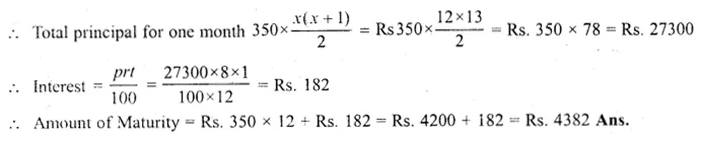
Shweta deposits Rs. 350 per month in a recurring deposit account for one year at the rate of 8% p.a. Find the amount she will receive at the time of maturity.
Solution:
Deposit per month = Rs 350,
Rate of interest = 8% p.a.
Period (x) = 1 year
= 12 months
ML Aggarwal Class 10 Solutions for ICSE Maths Chapter 2 Banking Ex 2 Q1.1

Question 2.
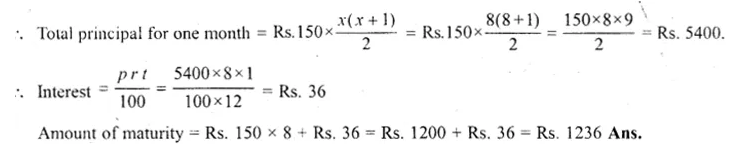
Salom deposited Rs 150 per month in a bank for 8 months under the Recurring Deposit Scheme. ‘What will be the maturity value of his deposit if the rate of interest is 8% per annum ?
Solution:
Deposit per month = Rs. 150
Rate of interest = 8% per
Period (x) = 8 month
ML Aggarwal Class 10 Solutions for ICSE Maths Chapter 2 Banking Ex 2 Q2.1

Question 3.
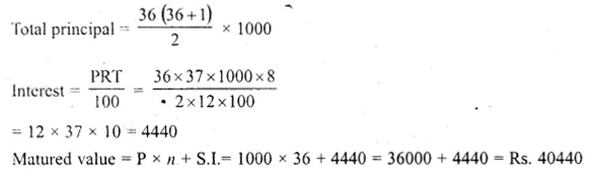
Mrs. Goswami deposits Rs. 1000 every month in a recurring deposit account for 3 years at 8% interest per annum. Find the matured value. (2009)
Solution:
Deposit per month (P) = Rs. 1000
Period = 3 years = 36 months
Rate = 8%
ML Aggarwal Class 10 Solutions for ICSE Maths Chapter 2 Banking Ex 2 Q3.1

Question 4.
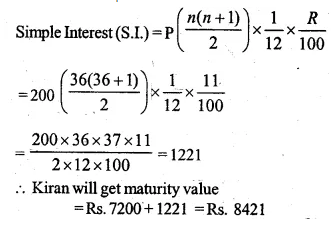
Kiran deposited Rs. 200 per month for 36 months in a bank’s recurring deposit account. If the banks pays interest at the rate of 11% per annum, find the amount she gets on maturity ?
Solution:
Amount deposited month (P) = Rs. 200
Period (n) = 36 months,
Rate (R) = 11% p.a.
Now amount deposited in 36 months = Rs. 200 x 36 = Rs 7200
ML Aggarwal Class 10 Solutions for ICSE Maths Chapter 2 Banking Ex 2 Q4.1

Question 5.
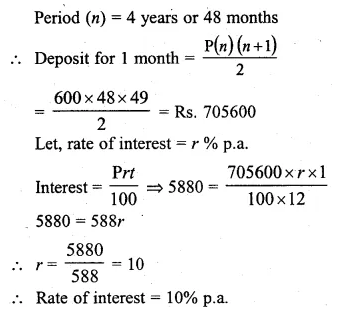
Haneef has a cumulative bank account and deposits Rs. 600 per month for a period of 4 years. If he gets Rs. 5880 as interest at the time of maturity, find the rate of interest.
Solution:
Interest = Rs. 58800
Monthly deposit (P) = Rs. 600
ML Aggarwal Class 10 Solutions for ICSE Maths Chapter 2 Banking Ex 2 Q5.1

Question 6.
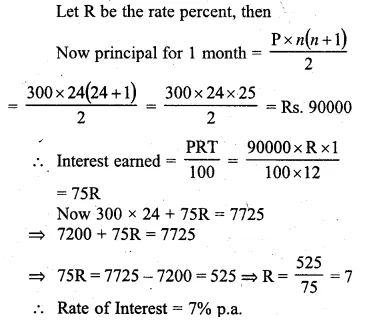
David opened a Recurring Deposit Account in a bank and deposited Rs. 300 per month for two years. If he received Rs. 7725 at the time of maturity, find the rate of interest per annum. (2008)
Solution:
Deposit during one month (P) = Rs. 300
Period = 2 years = 24 months.
Maturity value = Rs. 7725
ML Aggarwal Class 10 Solutions for ICSE Maths Chapter 2 Banking Ex 2 Q6.1

Question 7.
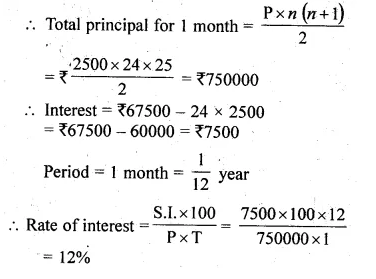
Mr. Gupta-opened a recurring deposit account in a bank. He deposited Rs. 2500 per month for two years. At the time of maturity he got Rs. 67500. Find :
(i) the total interest earned by Mr. Gupta.
(ii) the rate of interest per annum.
Solution:
Deposit per month = Rs. 2500
Period = 2 years = 24 months
Maturity value = Rs. 67500
ML Aggarwal Class 10 Solutions for ICSE Maths Chapter 2 Banking Ex 2 Q7.1

Question 8.
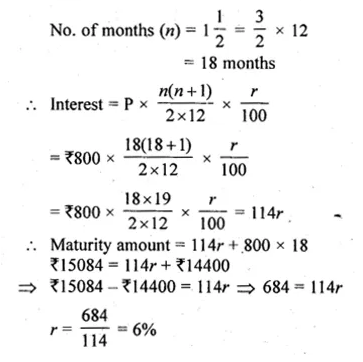
Shahrukh opened a Recurring Deposit Account in a bank and deposited Rs 800 per month for \(1 \frac { 1 }{ 2 } \) years. If he received Rs 15084 at the time of maturity, find the rate of interest per annum.
Solution:
Money deposited by Shahrukh per month (P)= Rs 800
r = ?
ML Aggarwal Class 10 Solutions for ICSE Maths Chapter 2 Banking Ex 2 Q8.1

Question 9.
Mohan has a recurring deposit account in a bank for 2 years at 6% p.a. simple interest. If he gets Rs 1200 as interest at the time of maturity, find:
(i) the monthly instalment
(ii) the amount of maturity. (2016)
Solution:
Interest = Rs 1200
Period (n) = 2 years = 24 months
Rate (r) = 6% p.a.
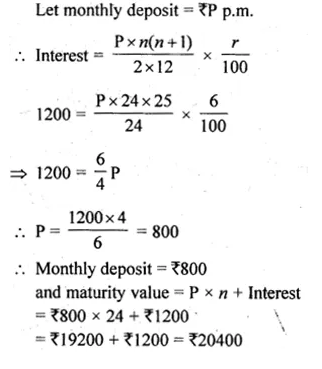
ML Aggarwal Class 10 Solutions for ICSE Maths Chapter 2 Banking Ex 2 Q9.1

Question 10.
Mr. R.K. Nair gets Rs 6,455 at the end of one year at the rate of 14% per annum in a recurring deposit account. Find the monthly instalment.
Solution:
Let monthly instalment is Rs P
here n = 1 year = 12 months
n = 12
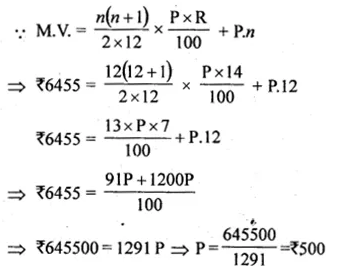
ML Aggarwal Class 10 Solutions for ICSE Maths Chapter 2 Banking Ex 2 Q10.1

Question 11.
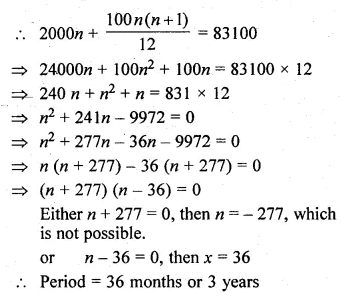
Samita has a recurring deposit account in a bank of Rs 2000 per month at the rate of 10% p.a. If she gets Rs 83100 at the time of maturity. Find the total time for which the account was held.
Solution:
Deposit per month = Rs 2000,
Rate of interest = 10%, Let period = n months
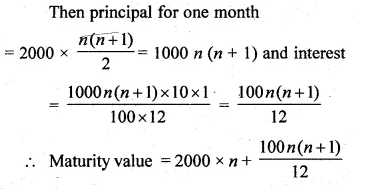
ML Aggarwal Class 10 Solutions for ICSE Maths Chapter 2 Banking Ex 2 Q11.1
ML Aggarwal Class 10 Solutions for ICSE Maths Chapter 2 Banking Ex 2 Q11.2

Hope given ML Aggarwal Class 10 Solutions for ICSE Maths Chapter 2 Banking Ex 2 are helpful to complete your math homework.

If you have any doubts, please comment below. Learn Insta try to provide online math tutoring for you.
ML Aggarwal Class 10 Solutions for ICSE Maths Chapter 1 Value Added Tax Chapter Test

ML Aggarwal Class 10 Solutions for ICSE Maths Chapter 1 Value Added Tax Chapter Test

These Solutions are part of ML Aggarwal Class 10 Solutions for ICSE Maths. Here we have given ML Aggarwal Class 10 Solutions for ICSE Maths Chapter 1 Value Added Tax Chapter Test

More Exercises

Question 1.
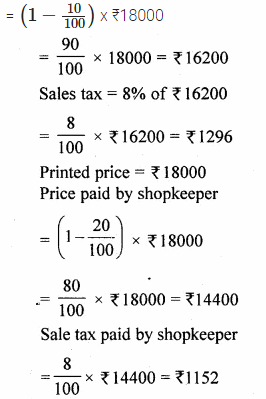
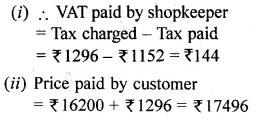
1. A shopkeeper bought a washing machine at a discount of 20% from a wholesaler, the printed price of the washing machine being ₹ 18000. The shopkeeper sells it to a consumer at a discount of 10% on the printed price. If the rate of sales tax is 8%, find:
(i) the VAT paid by the shopkeeper. .
(ii) the total amount that the consumer pays for the washing machine.
Solution:
(i) S.P. of washing machine
= \(\left( 1-\frac { 10 }{ 100 } \right) \) x ₹18000
ML Aggarwal Class 10 Solutions for ICSE Maths Chapter 1 Value Added Tax Chapter Test Q1.1
ML Aggarwal Class 10 Solutions for ICSE Maths Chapter 1 Value Added Tax Chapter Test Q1.2

Question 2.
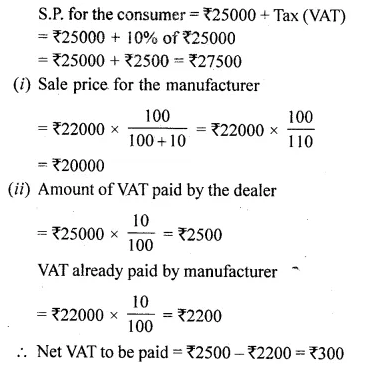
A manufacturing company sold an article to its distributor for ₹22000 including VAT. The distributor sold the article to a dealer for ₹22000 excluding tax and the dealer sold it to a consumer for ₹25000 plus tax (under VAT). If the rate of sales tax (under VAT) at each stage is 10%, find :
(i) the sale price of the article for the manufacturing company.
(ii) the amount of VAT paid by the dealer.
Solution:
S.P. of an article for a manufacturer = ₹22000 including VAT
C.P. for the distributor = ₹22000
Rate of VAT = 10%
S.P. for the distributor of ₹22000 excluding VAT
ML Aggarwal Class 10 Solutions for ICSE Maths Chapter 1 Value Added Tax Chapter Test Q2.1

Question 3.
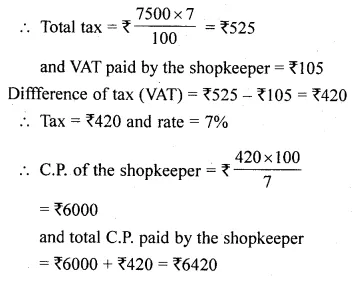
The marked price of an article is ₹7500. A shopkeeper sells the article to a consumer at the marked prices and charges sales tax at . the rate of 7%. If the shopkeeper pays a VAT of ₹105, find the price inclusive of sales tax of the article which the shopkeeper paid to the wholesaler.
Solution:
Marked price of an article = ₹7500
Rate of S.T. = 7%
ML Aggarwal Class 10 Solutions for ICSE Maths Chapter 1 Value Added Tax Chapter Test Q3.1

Question 4.
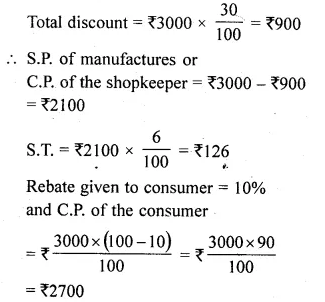
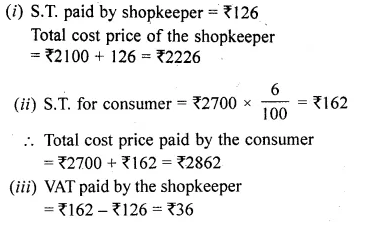
A shopkeeper buys an article at a discount of 30% and pays sales tax at the rate of 6%. The shopkeeper sells the article to a consumer at 10% discount on the list price and charges sales tax at the’ same rate. If the list price of the article is ₹3000, find the price inclusive of sales tax paid by the shopkeeper.
Solution:
List price of an article = ₹3000
Rate of discount = 30%
and rate of S.T. = 6%
ML Aggarwal Class 10 Solutions for ICSE Maths Chapter 1 Value Added Tax Chapter Test Q4.1
ML Aggarwal Class 10 Solutions for ICSE Maths Chapter 1 Value Added Tax Chapter Test Q4.2

Question 5.
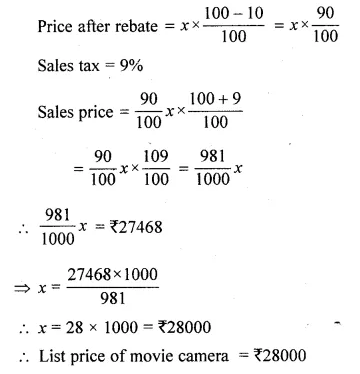
Mukerjee purchased a movie camera for ₹27468. which includes 10% rebate on the list price and then 9% sales tax (under VAT) on the remaining price. Find the list price of the movie camera.
Solution:
Let list price of the movie camera = x
Rebate = 10%
ML Aggarwal Class 10 Solutions for ICSE Maths Chapter 1 Value Added Tax Chapter Test Q5.1

Question 6.
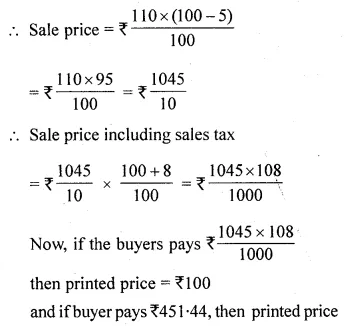
A retailer buys an article at a discount of 15% on the printed price from a wholesaler. He marks up the price by 10%. Due to competition in the market, he allows a discount of 5% to a buyer. If the buyer pays ₹451.44 for the article inclusive of sales tax (under VAT) at 8%, find :
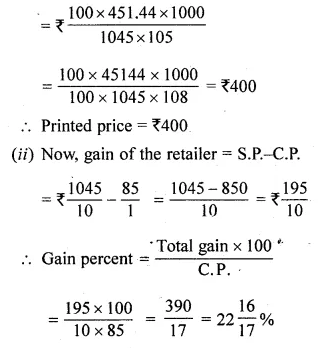
(i) the printed price of the article
(ii) the profit percentage of the retailer.
Solution:
(i) Let the printed price of the article = ₹100
Then, retailer’s cost price
= ₹100-₹15 = ₹85
Now, marked price for the retailer
= ₹100 + ₹10 = ₹110
Rate of discount allowed = 5%
ML Aggarwal Class 10 Solutions for ICSE Maths Chapter 1 Value Added Tax Chapter Test Q6.1
ML Aggarwal Class 10 Solutions for ICSE Maths Chapter 1 Value Added Tax Chapter Test Q6.2

Hope given ML Aggarwal Class 10 Solutions for ICSE Maths Chapter 1 Value Added Tax Chapter Test are helpful to complete your math homework.

If you have any doubts, please comment below. Learn Insta try to provide online math tutoring for you.
ML Aggarwal Class 10 Solutions for ICSE Maths Chapter 1 Value Added Tax MCQS

ML Aggarwal Class 10 Solutions for ICSE Maths Chapter 1 Value Added Tax MCQS

These Solutions are part of ML Aggarwal Class 10 Solutions for ICSE Maths. Here we have given ML Aggarwal Class 10 Solutions for ICSE Maths Chapter 1 Value Added Tax MCQS

More Exercises

A retailer purchases a fan for ₹ 1200 from a wholesaler and sells it to a consumer at 15% profit. If the rate of sales tax (under VAT) at every stage is 8%, then choose the correct answer from the given four options for questions 1 to 5 :

Question 1.
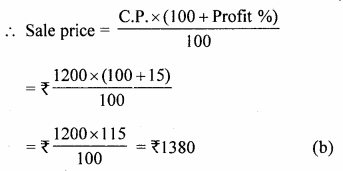
The selling price of the fan by the retailer (excluding tax) is
(a) ₹ 1200
(b) ₹ 1380
(c) ₹ 1490.40
(d) ₹ 11296
Solution:
Cost price of a fan = ₹ 1200
Profit = 15%
ML Aggarwal Class 10 Solutions for ICSE Maths Chapter 1 Value Added Tax MCQS Q1.1

Question 2.
VAT paid by the wholesaler is
(a) ₹ 96
(b) ₹ 14.40
(c) ₹ 110.40
(d) ₹ 180
Solution:
Rate of VAT =8%
.’. VAT paid by wholesaler = ₹ 1200 x \(\\ \frac { 8 }{ 100 } \)
= ₹ 96 (a)

Question 3.
VAT paid by the retailer
(a) ₹ 180
(b) ₹ 110.40
(c) ₹ 96
(d) ₹ 14.40
Solution:
VAT deducted by the retailer = ₹ \(\\ \frac { 1380\times 8 }{ 100 } \)
VAT paid by wholesalers = ₹ 96 .
Net VAT paid by his = ₹ 110.40 – 96.00
= ₹14.40 (d)

Question 4.
VAT collected by the Government on the sale of fan is
(a) ₹14.40
(b) ₹96
(c) ₹110.40
(d) ₹180
Solution:
VAT collected by the govt, on the sale of fan
= ₹ \(\\ \frac { 11040 }{ 100 } \)
= ₹110.40 (c)

Question 5.
The cost of the fan to the consumer inclusive of tax is
(a) ₹1296
(b) ₹1380
(c) ₹1310.40
(d) ₹1490.40
Solution:
Cost of fan to the consumer inclusive tax
= ₹1380 + 110.40
= ₹ 1490.40 (d)

A shopkeeper bought a TVfrom a distributor at a discount of 25% of the listed price of ₹ 32000. The shopkeeper sells the TV to a consumer at the listed price. If the sales tax (under VAT) is 6% at every stage, then choose the correct answer from the given four options for questions 6 to 8 :

Question 6.
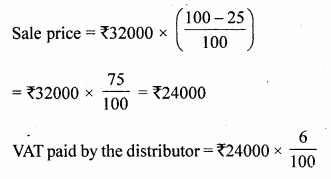
VAT paid by the distributor is
(a) ₹1920
(b) ₹1400
(c) ₹480
(d) ₹8000
Solution:
List price of T.V. set = ₹32000
Discount = 25%
Rate of VAT = 6%
ML Aggarwal Class 10 Solutions for ICSE Maths Chapter 1 Value Added Tax MCQS Q6.1
= ₹1440 (b)

Question 7.
VAT paid by the shopkeeper is
(a) ₹480
(b) ₹1440
(c) ₹1920
(d) ₹8000
Solution:
Total VAT charged by the shopkeeper
= ₹32000 x \(\\ \frac { 6 }{ 100 } \)
= ₹1920
VAT already paid by distributor = ₹ 1440
Net VAT paid by shopkeeper
= ₹1920 – ₹1440
= ₹480 (a)

Question 8.
The cost of the TV to the consumer inclusive of tax is
(a) ₹8000
(b) ₹32000
(c) ₹33920
(d) none of these
Solution:
Cost of T.V. to the consumer inclusive of VAT = ₹32000 + 1920
= ₹33920 (c)

A wholesaler buys a computer from a manufacturer for ₹ 40000. He marks the price of the computer 20% above his cost price and sells it to a retailer at a discount of 10% on the marked price. The retailer sells the computer to a consumer at the marked price. If the rate of sales tax (under VAT) is 10% at every stage, then choose the correct answer from the given four options for questions 9 to 15 :

Question 9.
The marked price of the computer is
(a) ₹40000
(b) ₹48000
(c) ₹50000
(d) none of these
Solution:
C.R of computer for manufacturer = ₹40000
After marking 20% above the C.R, the price
= ₹40000 x \(\\ \frac { 100+20 }{ 100 } \)
= ₹40000 x \(\\ \frac { 120 }{ 100 } \)
= ₹48000 (b)

Question 10.
Cost of the computer to the retailer (excluding tax) is
(a) ₹36000
(b) ₹40000
(c) ₹43200
(d) ₹47520
Solution:
Rate of discount = 10%
.’. Sales price after discount
= ₹48000 x \(\\ \frac { 100-10 }{ 100 } \)
= ₹48000 x \(\\ \frac { 90 }{ 100 } \)
= ₹43200 (c)

Question 11.
Cost of the computer to the retailer inclusive of tax is
(a) ₹47520
(b) 43200
(c) 44000
(d) none of these
Solution:
Rate of sales tax (VAT) = 10%
Sales tax charged = ₹43200 x \(\\ \frac { 10 }{ 100 } \)
= ₹4320
Cost price of T.V. including S.T.
= ₹43200 + ₹4320
= ₹47520 (a)

Question 12.
VAT paid by the manufacturer is
(a) ₹4000
(b) ₹4320
(c) ₹320
(d) none of these
Solution:
VAT paid by the manufacturer
= ₹40000 x \(\\ \frac { 10 }{ 100 } \)
= ₹4000 (a)

Question 13.
VAT paid by the wholesaler is
(a) ₹4000
(b) ₹4320
(c) ₹320
(d) ₹480
Solution:
VAT paid by the wholesaler = ₹43200 x \(\\ \frac { 10 }{ 100 } \)
= ₹4320
VAT already paid = ₹4000
Net VAT paid by = ₹4320 – ₹4000
= ₹320 (c)

Question 14.
VAT paid by the retailer is
(a) ₹4000
(b) ₹4320
(c) ₹320
(d) ₹480
Solution:
VAT paid by retailer = 48000 x \(\\ \frac { 10 }{ 100 } \) = ₹4800
VAT already paid = ₹4320
Net VAT to be paid = ₹4800 – 4320
= ₹480 (d)

Question 15.
Consumer’s cost price inclusive of VAT is
(a) ₹47520
(b) ₹48000
(c) ₹52800
(d) ₹44000
Solution:
Sol. Sale price to consumer = ₹4800
VAT paid by the consumer = ₹48000 x \(\\ \frac { 10 }{ 100 } \)
= ₹4800
Consumers cost price inclusive of VAT = ₹48000 + ₹4800
= ₹52800 (c)

Hope given ML Aggarwal Class 10 Solutions for ICSE Maths Chapter 1 Value Added Tax MCQS are helpful to complete your math homework.

If you have any doubts, please comment below. Learn Insta try to provide online math tutoring for you.
CA Foundation Business & Commercial Knowledge Study Material – Objectives of Business

CA Foundation Business & Commercial Knowledge Study Material Chapter 1 Introduction to Business – Objectives of Business

Every business enterprise has certain objectives which regulate and generate its activities. Objectives are needed in every area where performance and results directly affect survival and prosperity of a business. Various objectives of business may be classified into four broad categories as follows:

ca-foundation-business-commercial-knowledge-study-material-objectives-of-business-1

Economic Objectives

Business is basically an economic activity. Therefore, its primary objectives are economic in nature.

The main economic objectives of business are as follows:

  1. Earning profits –
    A business enterprise is established for earning some income. It is the hope of earning profits that inspires people to start business. Profit is essential for the survival of every business unit. Just as a person cannot live without food, a business firm cannot survive without profit. Profits enable a businessman to stay in business by maintaining intact the wealth producing capacity of its resources. Profit is also necessary for the expansion and growth of business. Profits ensure continuous flow of capital for the modernisation and extension of business operations in future. Profit also serves as the barometer of stability, efficiency and progress of a business enterprise.
  2. Creating customers –
    Profits are not created by God or by the force of nature. They arise from the businessman’s efforts to satisfy the needs and wants of customers. A businessman can earn profits only when there are enough customers to buy and pay for his goods and services. In the words of Drucker, “There is only one valid definition of business purpose; to create a customer. The customer is the foundation of business and keeps it in existence. It is to supply the customer that society entrusts wealth-producing resources to a business enterprise”. No business can succeed without providing customers value for their money. Business exists to satisfy the wants, tastes and preferences of customers. In order to earn profit, business must supply better, quality goods and services at reasonable prices. Therefore, creation and satisfaction of customers is an important economic objective of business. Business creates customers through advertising and salesmanship. It satisfies the needs of customers by producing the required goods and services and by creating utilities.
  3. Innovations –
    Business is an organ of dynamism and change. In these days of competition a business can be successful only when it creates new designs, better machines, improved techniques, new varieties, etc. Modern science and technology have created a great scope for innovation in the business world. Innovation is not confined to the invention of a new machine. It comprises all efforts made in perfecting the product, minimising the costs and maximising benefits to customers. It involves improvements in management, production, selling servicing, methods of personnel and accounting, etc. Business firms invest money, time and efforts in Research and Development (R&D) to introduce innovations. They develop new technology, introduce new designs and new tools and processes to minimise costs and to satisfy ever increasing wants of customers. In order to create customers business has to explore new markets and attract more customers. It has also to retain old customers by providing better services to them.

Social Objectives

Business does not exist in a vacuum. It is a part of society. It cannot survive and grow without the support of society. Business must therefore discharge social responsibilities in addition to earning profits. According to Henry Ford, “the primary aim of business should be service and subsidiary aim should be earning of profit”.

The social objectives of business are as follows:

  1. Supplying desired goods at reasonable prices –
    Business is expected to supply the goods and
    services required by the society. Goods and services should be of good quality and these should be supplied at reasonable prices. It is also the social obligation of business to avoid malpractices like hoarding, black marketing and misleading advertising.
  2. Fair Remuneration to employees –
    Employees must be given fair compensation for their work. In addition to wages and salary a reasonable part of profits should be distributed among employees in recognition of their contributions. Such sharing of profits will help to increase the motivation and efficiency of employees. It is the obligation of business to provide healthy and safe work environment for employees. Good working conditions are beneficial to the organisation because these help to improve the productivity of employees and thereby the profits of business. Employees work day and night to ensure smooth functioning of business. It is, therefore, the duty of employers to provide hygienic working and living conditions for workers.
  3. Employment Generation –
    Business should provide opportunities for gainful employment to members of the society. In a country like India unemployment has become a serious problem and the Government is unable to offer jobs to all. Therefore, provision of adequate and full employment opportunities is a significant service to society. If unemployment problem increases, the socio-economic environment cannot be congenial for the growth of business activities.
  4. Fair return to investor –
    Business is expected to pay fair return to shareholders and creditors in the form of dividend and interest. Investors also expect safety and appreciation of their investment. They should be kept informed about the financial health and future prospects of business.
  5. Social welfare –
    Business should provide support to social, cultural and religious organisations. Business enterprises can build schools, colleges, libraries, dharamshalas, hospitals, sports bodies and research institutions. They can help non-government organisations (NGOs) like CRY, Help Age, and others which render services to weaker sections of society.
  6. Payment of Government Dues –
    Every business enterprise should pay tax dues (income tax, GST, excise duty, customs duty, etc.) to the Government honestly and at the right time. These direct and indirect taxes provide revenue to the Government for spending on public welfare. Business should also abide faithfully by the laws of the country.
    Thus, businessmen should pursue those policies and take those actions which are desirable in terms of the objectives and values of our society.

Human Objectives

Business is run by people and for people. Labour is a valuable human element in business. Human objectives of business are concerned with the well-being of labour. These objectives help in achieving economic and social objectives of business. Human objectives of business are given below:

  1. Labour welfare –
    Business must recognise the dignity of labour and human factor should be given due recognition. Proper opportunities should be provided for utilising individual talents and satisfying aspirations of workers. Adequate provisions should be made for their health, safely and social security. Business should ensure job satisfaction and sense of belonging to workers.
  2. Developing human resources –
    Employees must be provided the opportunities for developing new skills and attitudes. Human resources are the most valuable asset of business and their development will help in the growth of business. Business can facilitate self-development of workers by encouraging creativity and innovation among them. Development of skilled manpower is necessary for the economic development of the country.
  3. Participative management –
    Employees should be allowed to take part in decision making process of business. This will help in the development of employees. Such participation will also provide valuable information to management for improving the quality of decisions. Workers’ participation in management will usher in industrial democracy.
  4. Labour management cooperation –
    Business should strive for creating and maintaining cor¬dial employer-employee relations so as to ensure peace and progress in industry. Employees should be treated as honourable individuals and should be kept informed.

National Objectives

National objectives of business are as follows:

  1. Optimum utilisation of resources –
    Business should use the nation’s resources in the best possible manner. Judicious allocation and optimum utilisation of scarce resources is essential for rapid and balanced economic growth of the country. Business should produce goods in accordance with national priorities and interests. It should minimise the wastage of scarce natural resources.
  2. National self-reliance –
    It is the duty of business to help the Government in increasing exports and in reducing dependence on imports. This will help a country to achieve economic independence. This requires development of new technology and its application in industry.
  3. Development of small scale industries –
    Big business firms are expected to encourage growth of small scale industries which are necessary for generating employment. Small scale firms can be developed as ancillaries which provide inputs to large scale industries.
  4. Development of backward areas –
    Business is expected to give preference to the industriali-sation of backward regions of the country. Balanced regional development is necessary for peace and progress in the country. It will also help to raise standard of living in backward areas. Government offers specific incentives to the businessmen who set up factories in notified backward areas.
  5. Control over pollution –
    Rapid industrialisation has resulted in air, water and noise pollution. Business is responsible for reducing the adverse effect of business on the quality of life. It must make proper arrangements for the disposal of smoke, effluents, wastes, etc. to protect the health and life of people, animals and birds.

BUSINESS OBJECTIVES AT A GLANCE

Economic Objectives

  1. Earning Profit
  2. Creating customers
  3. Innovations

Social objectives

  1. Quality goods at fair prices
  2. Fair remuneration to employees
  3. Generating employment
  4. Fair return to investors
  5. Social welfare
  6. Payments of taxes

Human Objectives

  1. Labour welfare
  2. Developing Human Resources
  3. Participative management
  4. Labour management Cooperation

National Objectives

  1. Optimum utilisation of resources
  2. National self-reliance
  3. Development of small scale units
  4. Development of backward areas
  5. Pollution control

Role of Profit in Business

Profit earning is essential in business due to the following reasons:

  1. Incentive – Profit is the driving force behind every business. It inspires people to start an enterprise and to work hard for making it successful. Profit is the reward for, undertaking the risk of business.
  2. Survival – Profit is essential for the survival of business and it ensures the continuity of an enterprise. In the absence of profits, an enterprise will eat up its own capital and ultimately close down. With the help of profits business can replace obsolete machinery and equipment and thereby maintain its capacity to create wealth. According to Drucker, “profit is the risk premium that covers the costs of staying in business”. Profits help business to face trade cycles and other shocks. Profits are also required to reward various factors of production.
  3. Growth – Profits is the biggest source of capital for expansion and growth of business. It serves as a means of self-financing. In addition, profits enable business to attract capital from outside. Nobody likes to invest money in a loss making enterprise.
  4. Measure of efficiency – Profit is considered to be the index of success in business. People judge the performance of an enterprise on the basis of profits earned by it.
  5. Prestige and recognition – A loss making business enjoys no goodwill. Profits provide economic power and status to businessmen. Higher profits increase the bargaining strength and credit worthiness of business. Moreover, only a profit making business can provide service to society.

ca-foundation-business-commercial-knowledge-study-material-objectives-of-business-2

Thus, profit earning is an essential and desirable objective of every business. But mere money chasing is not business. According to Drucker, “the problem of any business is not the maximisation of profit but the achievement of sufficient profits to cover the risks of economic activity, and thus, to avoid loss. The businessmen who keep their customers, employees, investors and the society satisfied, will definitely earn good profits”. Urwick has very aptly summed up the relevance of profit motive in business as “earning of profits cannot be the objective of a business any more than eating is the objective of living”. A business cannot survive without profit just as a person cannot live without food. But profits cannot be the sole purpose of business just as eating is not the aim of life. However, profits must be earned by satisfying the wants of customers and after paying workers their dues. In the words of Arvind Mafatlal, “no business or industry is run philanthropically. It has to make a profit for further growth. But this profit cannot be at the expense of labour and the community at large”.

Economic and social objectives of business are not contradictory. They go hand in hand in the long run. No business can earn profits without satisfying customers and other sections of society.

Similarly, business cannot render service without earning profits. Thus, the real objective of business is to earn profit by serving the interests of consumers, employees, investors, Government and the society as a whole.

Objections against Profit Maximisation

Despite their indispensable role in business, profits cannot be the be-all and end-all of business.

The profit maximisation objective is undesirable on account of the following reasons:

  • Profit maximisation overstresses the end result and overlooks the means employed to achieve the profits. It considers profit as the ultimate goals of business rather than a means to the real end. The ultimate aim of business should be social welfare. If profit maximisation is considered as the ultimate aim of business, businessmen might try to maximise profits by socially undesirable means such as profiteering, black-marketing, hoarding, exploitation of workers and consumers, etc.
  • Profit maximisation overstresses the reward for owners and ignores the interests of other stakeholders. Profit is the reward for capital and profit maximisation gives the impression that a business concern is the domain only of owners. In reality, no business can succeed without the fullest co-operation of labour, consumers, Government and the community at large. Profit maximisation objective overlooks the stake of these groups in business.
  • Profit maximisation misguides managers to the point where they may endanger the survival of the business. In order to maximise current profits, managers may undermine the firm’s future. They may ignore research and development, executive development, pushing of the most easily saleable products, and other long-term investments. Such activities threaten the long-term success of the enterprise.
  • Profit maximisation has capitalistic overtones. The advocates of socialism decry the goal of profit maximisation on the ground that profit maximisation results in the exploitation of poor by the rich. It also accentuates inequalities in the distribution of income and wealth.
  • Profit maximisation is inconsistent with the modern trends in business. Diffusion of share
    ownership, professionalisation of management, growth of institutional shareholding and the emergency of a distinctive technostructure are some of these trends. The main goal of the technostructure (control by managers and technologists), is survival and growth of business. Profit maximisation may endanger long term growth and, therefore, the technostructure prefers long-term growth. These professionals regard profit maximisation as unrealistic, inappropriate and even immoral.

A truly successful business can be built only if the objective of service to the society is constantly followed. If this is done profits will come automatically, but if the whole emphasis is on making money business may not survive and succeed for a long period. The guiding principle of business should be profit through service. Every business should provide a proper balance between profit motive and social service.

CA Foundation Business & Commercial Knowledge Study Material – Nature of Business, Profession and Employment

CA Foundation Business & Commercial Knowledge Study Material Chapter 1 Introduction to Business – Nature of Business, Profession and Employment

NATURE OF BUSINESS, PROFESSION AND EMPLOYMENT

Meaning and Nature of Business

Business is an activity, in which different persons exchange something of value, whether goods or services, for mutual gain or profit. It is an organised or systematic activity involving the satisfaction of human wants. Business involves regular or recurring purchase and sale of goods and services with the purpose of earning profits through the satisfaction of human needs. Repeated dealings rather than a single isolated transaction constitute business. Business may be distinguished from other activities by the fact that goods and services created or purchased are meant for sale and not for personal consumption.
Various experts have defined business in different ways. Some of the popular definitions of business are given below:

  • L.H. Haney : “Business may be defined as human activity directed towards producing or acquiring wealth through buying and selling of goods”.
  • B.O. Wheeler – “Business is an institution organised and operated to provide goods and services to society under the incentive of private gain.”
  • L.R. Dicksee – “Business is a form of activity pursued primarily with the objective of earning profits for the benefit of those on whose behalf the activity is conducted.”
  • James Stephenson – “Economic activities performed for earning profits are termed as Business”.
  • Keith and Carlo – “Business is a sum of all activities involved in the production and distribution of goods and services for private profits”.
  • Urwick and Hunt – “Business is any enterprise which makes, distributes or provides any article or service which the other members of the community need and are able and willing to pay for.”
  • R.N. Owens – “Business is any enterprise engaged in the production and distribution of goods for sale in market or rendering services for a price.”

The salient features of business are given below:

  1. Creation of utilities – Business makes goods more useful to satisfy human wants. It adds time, place, form and possession utilities to various types of goods. In the words of Roger, “a business exists to create and deliver value satisfaction to customers at a profit”. Business enables people to satisfy their wants more effectively and economically. It carries goods from place of surplus to the place of scarcity (place utility). It makes goods available for use in future through storage (time utility).
  2. Dealings in goods and services – Every business enterprise produces and/or buys goods and services for selling them to others. Goods may be consumer goods or producer goods. Consumer goods are meant for direct use by the ultimate consumers, e.g., bread, tea, shoes, etc. Producer goods are used for the production of consumer or capital goods like raw materials, machinery, etc. Services like transport, warehousing, banking, insurance, etc. may be considered as intangible and invisible goods. Services facilitate buying and selling of goods by overcoming various hindrances in trade.
  3. Continuity in dealings – Dealings in goods and services become business only if undertaken on a regular basis. According to Peterson and Plowman, “a single isolated transaction of purchase and sale will not constitute business. Recurring or repeated transaction of purchase and sale alone mean business.” For instance, if a person sells his old scooter or car it is not business though the seller gets money in exchange. But if he opens a shop and sells scooters or cars regularly, it will become business. Therefore, regularity of dealings is an essential feature of business.
  4. Sale, transfer or exchange – All business activities involve transfer or exchange of goods and services for some consideration. The consideration called price is usually expressed in terms of money. Business delivers goods and services to those who need them and are able and willing to pay for them. For example, if a person cooks and serves food to his family, it is not business. But when he cooks food and sells it to others for a price, it becomes business. According to Peter Drucker “any organisation that fulfills itself through marketing a product or service is a business”.
  5. Profit motive – The primary aim of business is to earn profits. Profits are essential for the survival as well as growth of business. Profits must, however, be earned through legal and fair means. Business should never exploit society to make money.
  6. Element of risk – Profit is the reward for assuming risk. Risk implies the uncertainty of profit or the possibility of loss. Risk is a part and parcel of business. Business enterprises function in uncertain and uncontrollable environment. Changes in customers’ tastes and fashions, demand, competition, Government policies, etc. create risk. Food, fire, earthquake, strike by employees, theft, etc. also cause loss. A businessman can reduce risks through correct forecasting and insurance. But all risks cannot be eliminated.
  7. Economic activity – Business is primarily an economic activity as it involves production and distribution of goods and services for earning money. However, business is also a social institution because it helps to improve the living standards of people through effective utilisation of scarce resources of the society. Only economic activities are included in business. Non-economic activities do not form a part of business.
  8. Art as well as science – Business is an art because it requires personal skills and experience. It is also a science because it is based on certain principles and laws.

Meaning and Nature of Profession

The term profession means an occupation which involves application of specialised knowledge and skills to earn a living. The persons who are engaged in profession are called professionals. They render personal services of a specialised nature to their clients. The service is based on professional education, training and experience. Professionals receive fee for their services. Chartered Accountancy, medicine, law, tax consultancy are examples of professions. .

The main features of a profession are as follows :

  1. Specialised body of knowledge – Every profession has a specialised and systematised body of knowledge. Members of the profession are required to learn this knowledge.
    Restricted entry – Entry to a profession is allowed only to those who have completed the prescribed education and have passed the specified examination.
  2. Formal training – A profession provides facilities for formal education and training to those who want to acquire professional qualification.
  3. Professional association – Every profession has its own association. A professional associa¬tion is a statutory body and its membership is essential. The association regulates entry in the profession, grants certificate of practice, formulates and enforces code of conduct. For example, The Institute of Chartered Accountants of India (ICAI) regulates the accountancy profession in India.
  4. Service motive – Professionals are expected to emphasise services to their clients rather than economic gain.
  5. Code of conduct – The activities of a professional are regulated by a formal code of conduct. The code is prescribed by the professional association of which he is a member.

Names of various Professions and their Respective Associations are given below:

S.No.ProfessionsProfessionalProfessional associations
1.Medical ProfessionDoctorsMedical Council of India
2.Law ProfessionLawyersBar Council of India
3.Accounting ProfessionChartered AccountantsThe Institute of Chartered Accountants of India (ICAI)
4.Company Secretary ProfessionCompany SecretariesThe Institute of Company Secretaries of India (ICSI)
5.Cost Accounting ProfessionCost AccountantsThe Institute of Cost and Works Accountants of India (ICWAI)
6.Engineering ProfessionEngineersThe Institution of Engineers (India)

Meaning and Nature of Employment

Employment means an economic activity, where people work for others in exchange for some remuneration. The persons who work for others are called ’employees’. The persons or organisations which engage others to work for them are called ‘employers’. The remuneration by an employer to his employee is known as wages or salary. The employee performs the work assigned to him by his employer as per the terms and conditions of employment. There is an oral or written agreement between the employer and the employee. The employee acts under the guidance and control of his employer. The employer may be a Government (department) undertaking or a private firm. Employment thus includes all types of jobs in Government offices and private enterprises. When a professionally qualified person works as an employee he is also said to be in employment. For example, a doctor may be employed in a hospital, a chartered accountant may be working as an accountant in a company and a lawyer may serve as a law officer in a bank.

The main features of employment are as follows:

  • In employment, a person works for others called employer.
  • An employee provides personal service.
  • There is a service agreement or contract between the employee and the employer. It contains the terms and conditions of employment.
  • The employee has to obey the order of the employer.
  • No capital investment is made by the employee.
  • The employee gets wage or salary for his/her service.

Various examples of employment are as follows:

  • A teacher teaching in a school or college.
  • An engineer employed in Municipal Corporation of Delhi.
  • An accountant working in the accounts department of a company.
  • A person working as the plant manager of a factory.
  • A nurse or doctor working in a hospital.

Distinction between Business, Profession and Employment

  1. Mode of establishment – A business enterprise is established when an entrepreneur takes a decision to carry on some business activity. In a profession, on the other hand, the membership or enrollment of a recognised professional association or institution is essential. In order to take up employment, a person has to enter into a contract of service.
  2. Nature of work – A business exists to provide goods and services to satisfy human wants. On the other hand, a professional renders personalised service of a specialised nature to his clients. An employee performs the work assigned by the employer under the contract of service.
  3. Qualifications – No formal education is compulsory in order to carry on a business. But for a profession, specialised knowledge and training are essential. Minimum educational qualifications are prescribed for every profession. In case of employment, the qualifications required depend upon the nature of the job. .
  4. Main objective – In business, the basic motive is to earn profits. A professional, on the other hand, is expected to emphasise the service motive and sense of mission. That is why, a rigorous code of ethical behaviour is laid down in every profession. In case of service, the motive of an employee is to earn salary and receive other benefits.
  5. Investment – Every business requires capital depending upon the nature and scale of operations. A professional also has to invest some capital to establish an office for rendering services. There is no need for capital in case of employment.
  6. Risk – There is an inherent element of risk in business and profession but practically no risk is involved in case of employment. There can be loss in business but in profession and employment return is never negative.
  7. Reward – Profit is the reward of a businessman while professional fee is the reward of a professional. The reward in case of employment is wage or salary. Wage/salary and fee are more regular and fixed than profits.
  8. Transfer of interest – It is possible to transfer ownership interest in business. But no such transfer is possible in case of profession and employment.
  9. Public advertisement – The success of a business depends upon public advertisements. But professionals are prohibited from giving public advertisements. There is no need for public advertisements in case of service.
    In spite of the above differences, there is a closed inter-relationship between business, profession and service. A large business enterprise employs a large number of persons in order to achieve its objectives. It also requires the services of professional experts such as chartered accountants, lawyers, architects, cost accountants, etc. Modern business has become very complex. Trained and experienced managers and other experts are required for efficient business operations. Professionals and other employees provide the necessary manpower for efficient running of business concerns. Thus, business, profession and employment are complementary to one another.