Selina Concise Mathematics Class 6 ICSE Solutions Chapter 6 Negative Numbers and Integers

Selina Concise Mathematics Class 6 ICSE Solutions Chapter 6 Negative Numbers and Integers

Selina Publishers Concise Mathematics Class 6 ICSE Solutions Chapter 6 Negative Numbers and Integers

Negative Numbers and Integers Exercise 6 – Selina Concise Mathematics Class 6 ICSE Solutions

Question 1.
Fill in the blanks :
(i) Negative of -20 is ……….
(ii) Negative of 0 is …………
(iii) Negative of 8 is ………..
(iv) If 10 represents gain of ₹ 10, then -10 represents …………..
(v) If going south is negative then going north is …………
(vi) Because 5 < 7, therefore -5 ……….. -7. (vii) If 3 > -2, then 3 is on the ………….. of -2.
(viii) If -8 < -6, then -8 is on the …………. of-6.
Solution:

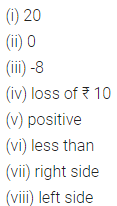
Selina Concise Mathematics Class 6 ICSE Solutions Chapter 6 Negative Numbers and Integers 1

Question 2.
Use a number line to write the following integers in ascending (increasing) order :
(i) -5, 8, 0, -9, 4, -14 and 12
(ii) -6, 7, 0, -9, 5 and 9
Solution:
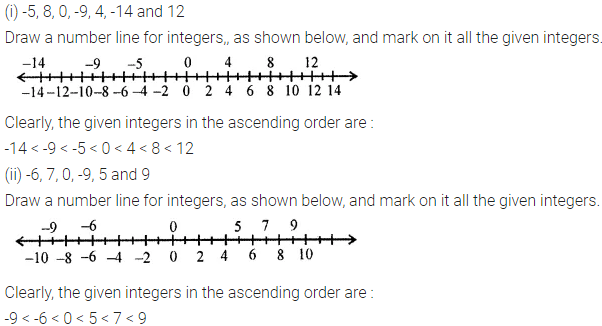
Selina Concise Mathematics Class 6 ICSE Solutions Chapter 6 Negative Numbers and Integers 2

Question 3.
Use a number line to write the following integers in descending (decreasing) order :
(i) -10, 0, 3, -4, 12, 11, -1 and 5
(ii) -4, 3, -8, -12, -7 and 6.
Solution:
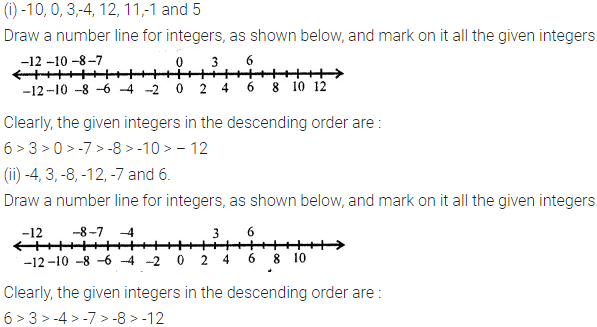
Selina Concise Mathematics Class 6 ICSE Solutions Chapter 6 Negative Numbers and Integers 3

Question 4.
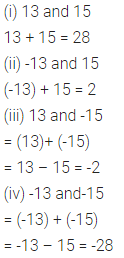
Add:
(i) 13 and 15
(ii) -13 and 15
(iii) 13 and -15
(iv) -13 and -15
Solution:
Selina Concise Mathematics Class 6 ICSE Solutions Chapter 6 Negative Numbers and Integers 4

Question 5.
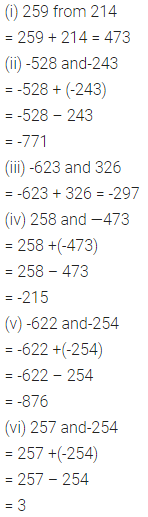
Add:
(i) 259 from 214
(ii) -528 and -243
(iii) -623 and 326
(iv) 258 and -473
(v) -622 and -254
(vi) 257 and -254
Solution:
Selina Concise Mathematics Class 6 ICSE Solutions Chapter 6 Negative Numbers and Integers 5

Question 6.
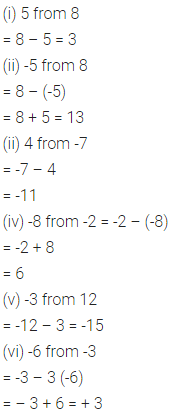
Subtract :
(i) 5 from 8
(ii) -5 from 8
(iii) 4 from -7
(iv) -8 from -2
(v) -3 from 12
(vi) -6 from -3
Solution:
Selina Concise Mathematics Class 6 ICSE Solutions Chapter 6 Negative Numbers and Integers 6

Question 7.
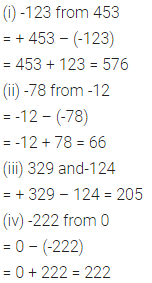
Subtract:
(i) -123 from 453
(ii) -78 from -12
(iii) 329 and -124
(iv) -222 from 0
Solution:
Selina Concise Mathematics Class 6 ICSE Solutions Chapter 6 Negative Numbers and Integers 7

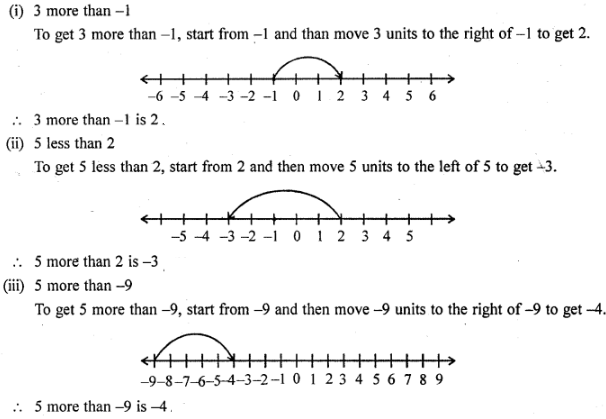
Question 8.
Using a number line, find the integer which is :
(i) 3 more than -1
(ii) 5 less than 2
(iii) 5 more than -9
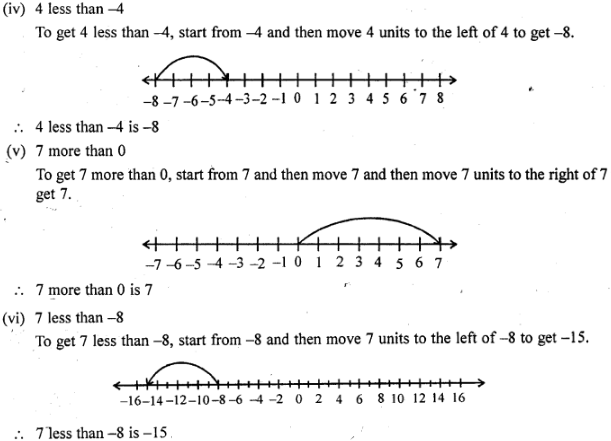
(iv) 4 less than -4
(v) 7 more than 0
(vi) 7 less than -8
Solution:
Selina Concise Mathematics Class 6 ICSE Solutions Chapter 6 Negative Numbers and Integers 8
Selina Concise Mathematics Class 6 ICSE Solutions Chapter 6 Negative Numbers and Integers 9

Selina Concise Mathematics Class 6 ICSE Solutions

Selina Concise Mathematics Class 6 ICSE Solutions Chapter 5 Natural Numbers and Whole Numbers

Selina Concise Mathematics Class 6 ICSE Solutions Chapter 5 Natural Numbers and Whole Numbers (Including Patterns)

Selina Publishers Concise Mathematics Class 6 ICSE Solutions Chapter 5 Natural Numbers and Whole Numbers (Including Patterns)

Natural Numbers and Whole Numbers Exercise 5A – Selina Concise Mathematics Class 6 ICSE Solutions

Question 1.
Fill in the blanks :
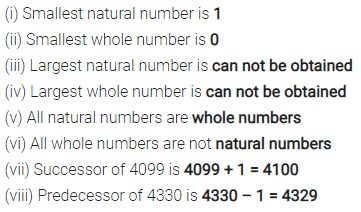
(i) Smallest natural number is …………..
(ii) Smallest whole number is …………
(iii) Largest natural number is …………
(iv) Largest whole number is ………..
(v) All natural numbers are …………
(vi) All whole numbers are not …………
(vii) Successor of 4099 is …………..
(viii) Predecessor of 4330 is …………….
Solution:
Selina Concise Mathematics Class 6 ICSE Solutions Chapter 5 Natural Numbers and Whole Numbers 1

Question 2.
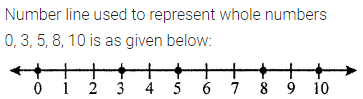
Represent the following whole numbers on a number line :
0, 3, 5, 8, 10
Solution:
Selina Concise Mathematics Class 6 ICSE Solutions Chapter 5 Natural Numbers and Whole Numbers 2

Question 3.
State, true or false :
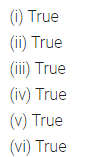
(i) Whole number are closed for addition.
(ii) If a and b are any two whole numbers, then a + b is not a whole number.
(iii) If a and b are any two whole numbers, then a + b = b + a
(iv) 0 + 18= 18 + 0
(v) Addition of whole numbers is associative.
(vi) 10 + 12 + 16 = (10 + 12) + 16 = 10 + (12 + 16)
Solution:
Selina Concise Mathematics Class 6 ICSE Solutions Chapter 5 Natural Numbers and Whole Numbers 3

Question 4.
Fill in the blanks :
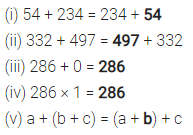
(i) 54 + 234 = 234 + …………
(ii) 332 + 497 = ………… + 332
(iii) 286 + 0 = ………..
(iv) 286 x 1 = ……….
(v) a + (b + c) = (a + ………) + c
Solution:
Selina Concise Mathematics Class 6 ICSE Solutions Chapter 5 Natural Numbers and Whole Numbers 4

Question 5.
By re-arranging the given numbers, evaluate :
(i) 237 + 308 + 163
(ii) 162 + 253 +338 + 47
(iii) 21 + 22 + 23 + 24 + 25 + 75 + 76 + 77 + 78 + 79
(iv) 1 + 2 + 3 + 4 + 596 + 597 + 598 + 599
Solution:
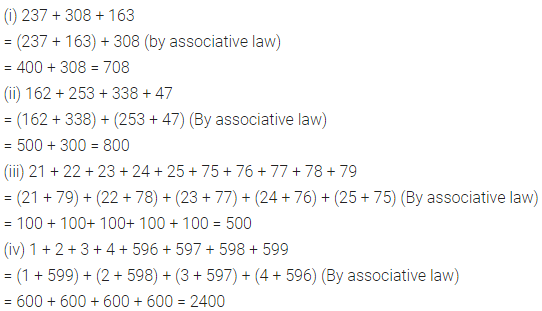
Selina Concise Mathematics Class 6 ICSE Solutions Chapter 5 Natural Numbers and Whole Numbers 5

Question 6.
Is a + b + c = a + (b + c) = (b + a) + c ?
Solution:

Selina Concise Mathematics Class 6 ICSE Solutions Chapter 5 Natural Numbers and Whole Numbers 6

Question 7.
Which property of addition is satisfied by :
(i) 8 + 7 = 15
(ii) 3+ (5 + 4) = (3 + 5)+ 4
(iii) 8 x (8 + 0) = 8 x 8 + 8 x 0
(iv) (7 + 6) x 10 = 7 x 10 + 6 x 10
(v) (15 – 12) x 18 = 15 x 18 – 12 x 18
(vi) 16 + 0= 16
(vii) 23 + (-23) = 0
Solution:
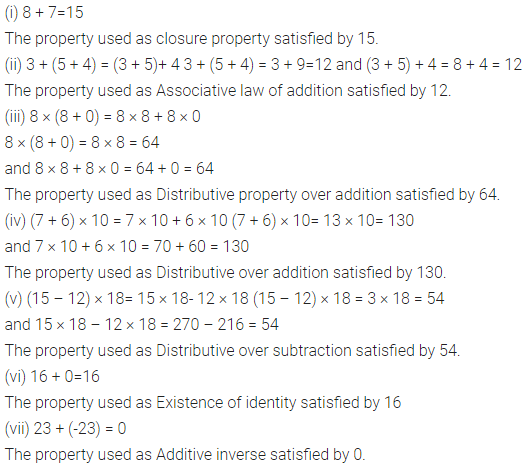
Selina Concise Mathematics Class 6 ICSE Solutions Chapter 5 Natural Numbers and Whole Numbers 7

Question 8.
State, True or False :
(i) The sum of two odd numbers is an odd number.
(ii) The sum of two odd numbers is an even number.
(iii) The sum of two even numbers is an even number.
(iv) The sum of two even numbers is an odd number.
(v) The sum of an even number and an odd number is odd number.
(vi) Every whole number is a natural number.
(vii) Every natural number is a whole number.
(viii) Every whole number + 0 = The whole number itself.
(ix) Every whole number x 1 = The whole number itself.
(x) Commutativity and associativity are properties of natural numbers and whole numbers both.
(xi) Commutativity and associativity are properties of addition for natural numbers and whole numbers both.
(xii) If x is a whole number then -x is also a whole number.
Solution:
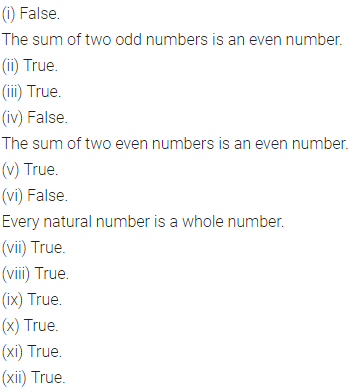
Selina Concise Mathematics Class 6 ICSE Solutions Chapter 5 Natural Numbers and Whole Numbers 8

Natural Numbers and Whole Numbers Exercise 5B – Selina Concise Mathematics Class 6 ICSE Solutions

Question 1.
Consider two whole numbers a and b such that a is greater than b.
(i) Is a – b a whole number? Is this result always true?
(ii) b – a a whole number? Is this result always true?
Solution:
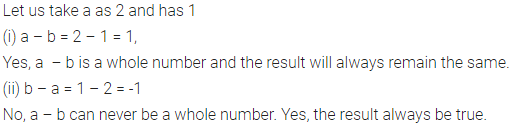
Selina Concise Mathematics Class 6 ICSE Solutions Chapter 5 Natural Numbers and Whole Numbers 9

Question 2.
Fill in the blanks :
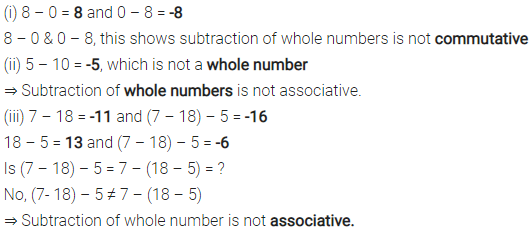
(i) 8 – 0 = ……….. and 0 – 8 = ……….
8 – 0 ≠ 0 – 8, this shows subtraction of whole numbers is not ………..
(ii) 5 – 10 = ………., which is not a …………
⇒ Subtraction of ……….. is not closed.
(iii) 7 – 18 = ……….. and (7 – 18) – 5 = …………..
18 – 5 = …………. and (7 – 18) – 5 = ………….
Is (7 – 18) – 5 = 7 – (18 – 5) ?
⇒ Subtraction of whose numbers is not ………….
Solution:
Selina Concise Mathematics Class 6 ICSE Solutions Chapter 5 Natural Numbers and Whole Numbers 10

Question 3.
Write the identify number, if possible for subtraction.
Solution:

Selina Concise Mathematics Class 6 ICSE Solutions Chapter 5 Natural Numbers and Whole Numbers 11

Question 4.
Write the inverse, if possible for subtraction of whole numbers ?
Solution:

Selina Concise Mathematics Class 6 ICSE Solutions Chapter 5 Natural Numbers and Whole Numbers 12

Question 5.
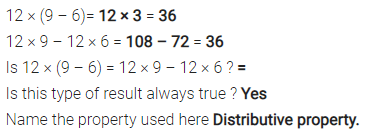
12 × (9 – 6) = ………….. = ………….
12 × 9 – 12 × 6 = …………. = …………….
Is 12 × (9 – 6) = 12 × 9 – 12 × 6 ? ………….
Is this type of result always true ? ……………
Name the property used here …………..
Solution:
Selina Concise Mathematics Class 6 ICSE Solutions Chapter 5 Natural Numbers and Whole Numbers 13

Question 6.
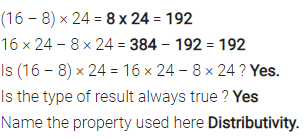
(16 – 8) × 24 = ………….. = …………..
16 × 24 – 8 × 24 = …….. – ……….. = ………..
Is (16 – 8) × 24 = 16 × 24 – 8 × 24 ? …………..
Is the type of result always true? ………….
Name the property used here ………………
Solution:
Selina Concise Mathematics Class 6 ICSE Solutions Chapter 5 Natural Numbers and Whole Numbers 14

Natural Numbers and Whole Numbers Exercise 5C – Selina Concise Mathematics Class 6 ICSE Solutions

Question 1.
Fill in the blanks :
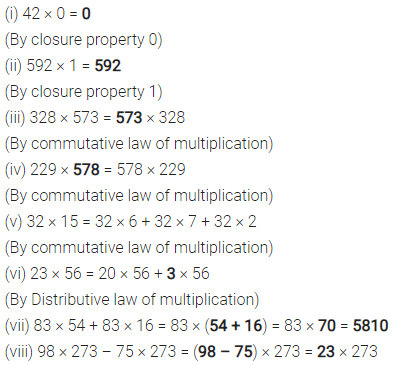
(i) 42 × o = ……….
(ii) 592 × 1 = ………..
(iii) 328 × 573 = ……….. × 328
(iv) 229 × ………… = 578 × 229
(v) 32 × 15 = 32 × 6 + 32 × 7 + 32 × ……….
(vi) 23 × 56 = 20 × 56 + ……… × 56
(vii) 83 × 54 + 83 × 16 = 83 × ( ……….. ) = 83 × ………….. = …………
(viii) 98 × 273 – 75 × 273 = ( …………. ) × 273 = ………… × 273
Solution:
Selina Concise Mathematics Class 6 ICSE Solutions Chapter 5 Natural Numbers and Whole Numbers 15

Question 2.
By re-arranging the given numbers, evaluate :
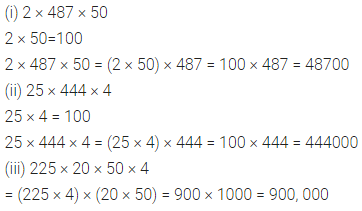
(i) 2 × 487 × 50
(ii) 25 × 444 × 4
(iii) 225 × 20 × 50 × 4
Solution:
Selina Concise Mathematics Class 6 ICSE Solutions Chapter 5 Natural Numbers and Whole Numbers 16

Question 3.
Use distributive law to evaluate :
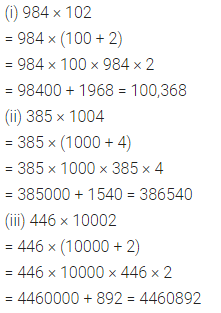
(i) 984 × 102
(ii) 385 × 1004
(iii) 446 × 10002
Solution:
Selina Concise Mathematics Class 6 ICSE Solutions Chapter 5 Natural Numbers and Whole Numbers 17

Question 4.
Evaluate using properties :
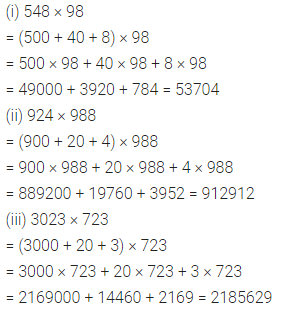
(i) 548 × 98
(ii) 924 × 988
(iii) 3023 × 723
Solution:
Selina Concise Mathematics Class 6 ICSE Solutions Chapter 5 Natural Numbers and Whole Numbers 18

Question 5.
Evaluate using properties :
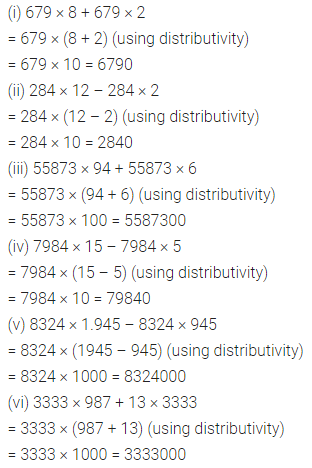
(i) 679 × 8 + 679 × 2
(ii) 284 × 12 – 284 × 2
(iii) 55873 × 94 + 55873 × 6
(iv) 7984 × 15 – 7984 × 5
(v) 8324 × 1945 – 8324 × 945
(vi) 3333 × 987 + 13 × 3333
Solution:
Selina Concise Mathematics Class 6 ICSE Solutions Chapter 5 Natural Numbers and Whole Numbers 19

Question 6.
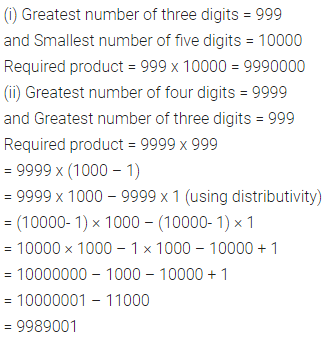
Find the product of the :
(i) greatest number of three digits and smallest number of five digits.
(ii) greatest number of four digits and the greatest number of three digits.
Solution:
Selina Concise Mathematics Class 6 ICSE Solutions Chapter 5 Natural Numbers and Whole Numbers 20

Question 7.
Fill in the blanks :
(i) (437 + 3) × (400 – 3) = 397 × ……….
(ii) 66 + 44 + 22 = 11 × (………..) = 11 × ……….
Solution:

Selina Concise Mathematics Class 6 ICSE Solutions Chapter 5 Natural Numbers and Whole Numbers 21

Question 8.
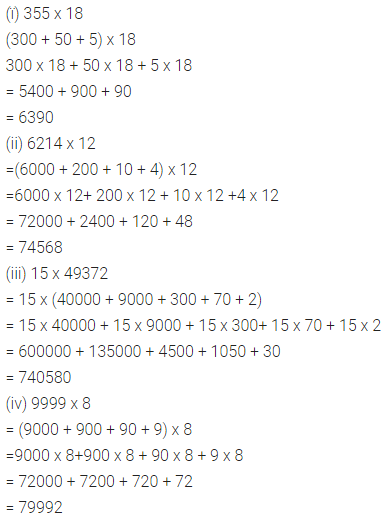
Evaluate :
(i) 355 × 18
(ii) 6214 × 12
(iii) 15 × 49372
(iv) 9999 × 8
Solution:
Selina Concise Mathematics Class 6 ICSE Solutions Chapter 5 Natural Numbers and Whole Numbers 22

Natural Numbers and Whole Numbers Exercise 5D – Selina Concise Mathematics Class 6 ICSE Solutions

Question 1.
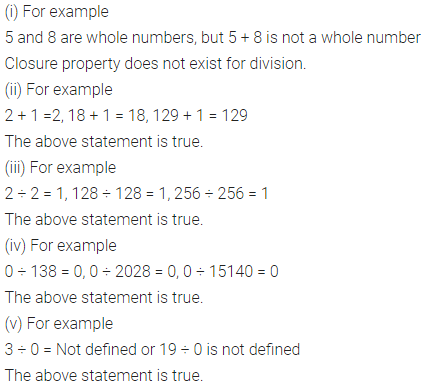
Show that :
(i) division of whole numbers is not closed
(ii) any whole number divided by 1, always gives the number itself.
(iii) every non-zero whole number divided by itself gives 1 (one).
(iv) zero divided by any non-zero number is zero only.
(v) a whole number divided by 0 is not defined.
For each part, given above, give an example.
Solution:
Selina Concise Mathematics Class 6 ICSE Solutions Chapter 5 Natural Numbers and Whole Numbers 23

Question 2.
If x is a whole number such that x ÷ x = x, state the value of x.
Solution:

Selina Concise Mathematics Class 6 ICSE Solutions Chapter 5 Natural Numbers and Whole Numbers 24

Question 3.
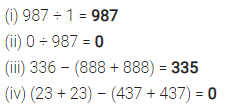
Fill in the blanks :
(i) 987 + 1 = …………
(ii) 0 + 987 = ……….
(iii) 336 – (888 + 888) = ……….
(iv) (23 + 23) – (437 + 437) = ………
Solution:
Selina Concise Mathematics Class 6 ICSE Solutions Chapter 5 Natural Numbers and Whole Numbers 25

Question 4.
Which of the following statements are true ?
(i) 12 ÷ (6 × 2) = (12 ÷ 6) × (12 ÷ 2)
(ii) a ÷ (b – c) = \(\frac { a }{ b } -\frac { a }{ c }\)
(iii) (a – b) ÷ c = \(\frac { a }{ c } -\frac { b }{ c }\)
(vi) (15 – 13) ÷ 8 = (15 ÷ 8) – (13 ÷ 8)
(v) 8 ÷ (15 – 13) = \(\frac { 8 }{ 15 } -\frac { 8 }{ 13 }\)
Solution:

Selina Concise Mathematics Class 6 ICSE Solutions Chapter 5 Natural Numbers and Whole Numbers 26

Natural Numbers and Whole Numbers Exercise 5E – Selina Concise Mathematics Class 6 ICSE Solutions

Question 1.
Find the difference between the largest number of four digits and the smallest number of six digits.
Solution:

Selina Concise Mathematics Class 6 ICSE Solutions Chapter 5 Natural Numbers and Whole Numbers 27

Question 2.
Find the difference between the smallest number of eight digits and the largest number of five digits.
Solution:
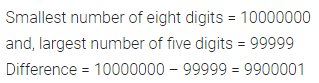
Selina Concise Mathematics Class 6 ICSE Solutions Chapter 5 Natural Numbers and Whole Numbers 28

Question 3.
The product of two numbers is 528. If the product of their unit’s digits is 8 and the product of their ten’s digits is 4 ; find the numbers.
Solution:
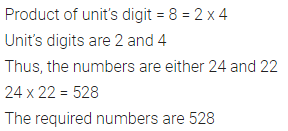
Selina Concise Mathematics Class 6 ICSE Solutions Chapter 5 Natural Numbers and Whole Numbers 29

Question 4.
Does there exist a number a such that a ÷ a = a?
Solution:
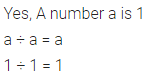
Selina Concise Mathematics Class 6 ICSE Solutions Chapter 5 Natural Numbers and Whole Numbers 30

Question 5.
Divide 5936 by 43 to find the quotient and remainder. Also, check your division by using the formula,
dividend = divisor × quotient + remainder.
Solution:
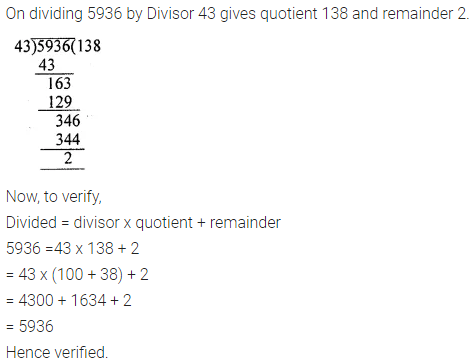
Selina Concise Mathematics Class 6 ICSE Solutions Chapter 5 Natural Numbers and Whole Numbers 31

Natural Numbers and Whole Numbers Exercise 5F – Selina Concise Mathematics Class 6 ICSE Solutions

Question 1.
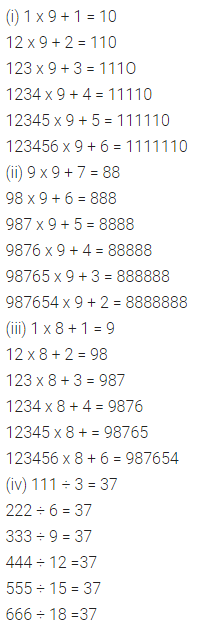
(i) 1 × 9 + 1 = 10
12 × 9 + 2 = 110
123 × 9 + 3 = 1110
(ii) 9 × 9 + 7 = 88
98 × 9 + 6 = 888
987 × 9 + 5 = 8888
(iii) 1 × 8 + 1 = 9
12 × 8 + 2 = 98
123 × 8 + 3 = 987
(iv) 111 ÷ 3 = 37
222 ÷ 6 = 37
333 ÷ 9 = 37
Solution:
Selina Concise Mathematics Class 6 ICSE Solutions Chapter 5 Natural Numbers and Whole Numbers 32

Question 2.
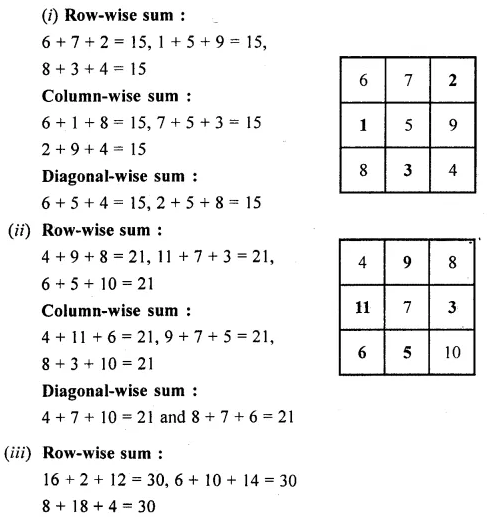
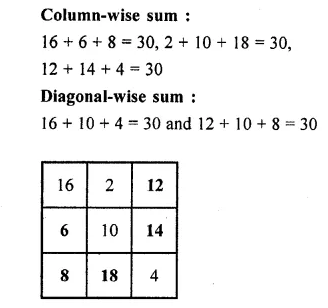
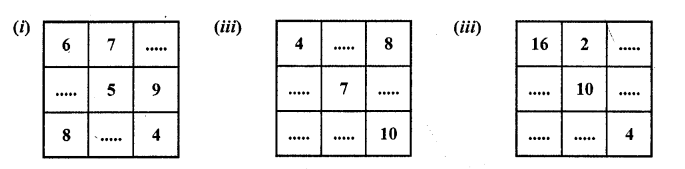
Complete each of the following magic squares :
Selina Concise Mathematics Class 6 ICSE Solutions Chapter 5 Natural Numbers and Whole Numbers 39
Solution:
Selina Concise Mathematics Class 6 ICSE Solutions Chapter 5 Natural Numbers and Whole Numbers 33
Selina Concise Mathematics Class 6 ICSE Solutions Chapter 5 Natural Numbers and Whole Numbers 34

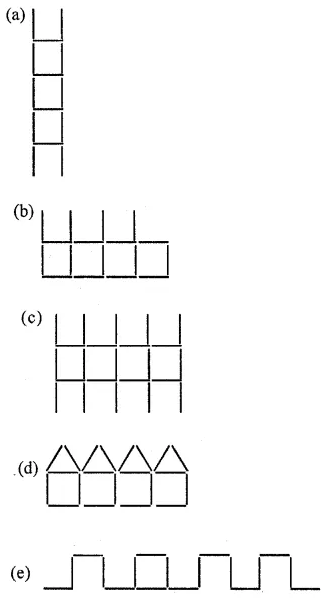
Question 3.
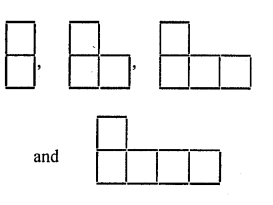
See the following pattern carefully :
Selina Concise Mathematics Class 6 ICSE Solutions Chapter 5 Natural Numbers and Whole Numbers 40
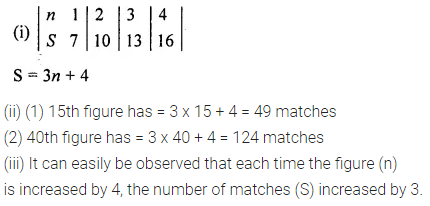
(i) If n denotes the number of figure and S denotes the number of matches ; find S in terms of n.
(ii) Find how many matches are required to make the :
(1) 15th figure
(2) 40th figure
(iii) Write a discretion of the pattern in words.
Solution:
Selina Concise Mathematics Class 6 ICSE Solutions Chapter 5 Natural Numbers and Whole Numbers 35

Question 4.
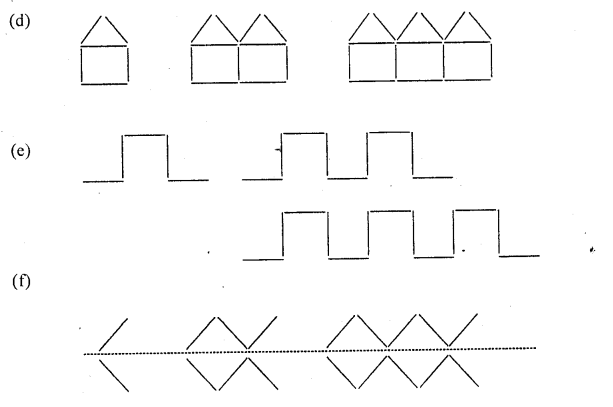
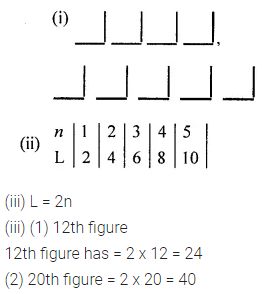
(i) In the following pattern, draw the next two figures.

Selina Concise Mathematics Class 6 ICSE Solutions Chapter 5 Natural Numbers and Whole Numbers 41
(ii) Construct a table to describe the figures in the above pattern.
(iii) If n denotes the number of figure and L denotes the number of matches, find L in terms of n.
(iv) Find how may matches are required to make the :
(1) 12th figure
(2) 20th figure
Solution:
Selina Concise Mathematics Class 6 ICSE Solutions Chapter 5 Natural Numbers and Whole Numbers 36

Question 5.
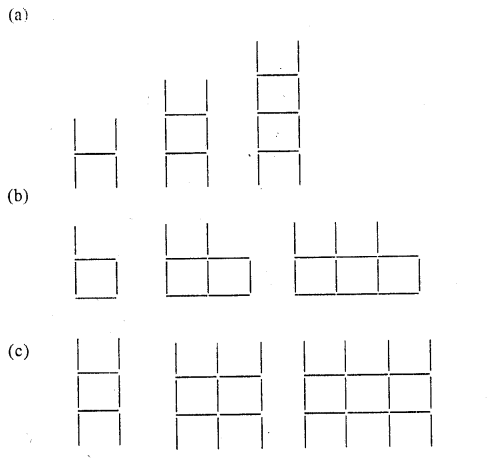
In each of the following patterns, construct next figure.
(i) In each case, if n denotes the number of figure and F denotes the number of matchsticks used, find F in terms of n.
(ii) Also find, in each case, how many matches are required to make the : 16th figure and 30th figure.
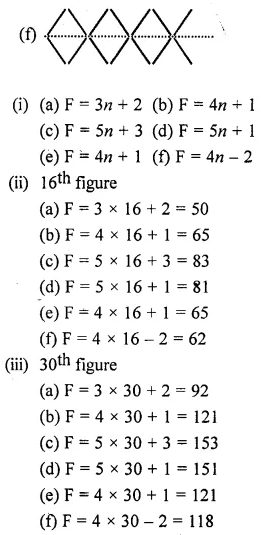
Selina Concise Mathematics Class 6 ICSE Solutions Chapter 5 Natural Numbers and Whole Numbers 42
Selina Concise Mathematics Class 6 ICSE Solutions Chapter 5 Natural Numbers and Whole Numbers 43
Solution:
Selina Concise Mathematics Class 6 ICSE Solutions Chapter 5 Natural Numbers and Whole Numbers 37
Selina Concise Mathematics Class 6 ICSE Solutions Chapter 5 Natural Numbers and Whole Numbers 38

Selina Concise Mathematics Class 6 ICSE Solutions

Selina Concise Mathematics Class 6 ICSE Solutions Chapter 4 Place Value

Selina Concise Mathematics Class 6 ICSE Solutions Chapter 4 Place Value

Selina Publishers Concise Mathematics Class 6 ICSE Solutions Chapter 4 Place Value

Place Value Exercise 4A – Selina Concise Mathematics Class 6 ICSE Solutions

Question 1.
Fill in the blanks :
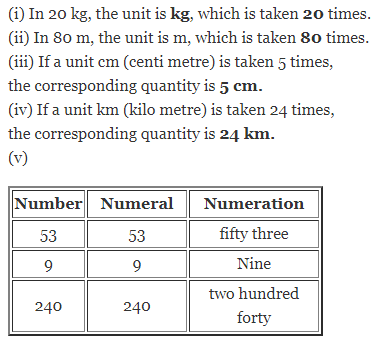
(i) In 20 kg, the unit is ………….., which is taken …………. times.
(ii) In 80 m, the unit is …………., which is taken …………. times.
(iii) If a unit cm (centimetre) is taken 5 times, the corresponding quantity is …………….
(iv) If a unit km (kilometre) is taken 24 times, the corresponding quantity is ……………
(v)

NumberNumeralNumeration
53 …………. ……….
 ………9 …………
240 ………….. ………..

Solution:
Selina Concise Mathematics Class 6 ICSE Solutions Chapter 4 Place Value 1

Question 2.
Fill in the blanks :
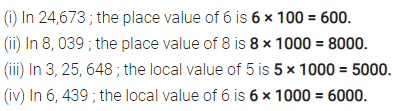
(i) In 24,673 ; the place value of 6 is ………..
(ii) In 8,039 ; the place value of 8 is …………..
(iii) In 3,25,648; the local value of 5 is ……………
(iv) In 6,439 ; the local value of 6 is ……….
Solution:
Selina Concise Mathematics Class 6 ICSE Solutions Chapter 4 Place Value 2

Question 3.
Find the difference between the place values of 3 and 5 in the number 3945.
Solution:
Selina Concise Mathematics Class 6 ICSE Solutions Chapter 4 Place Value 3

Question 4.
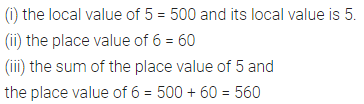
In the number 40562
(i) the local value of 5 = …………..
(ii) the place value of 6 = ………..
(iii) the sum of the place value of 5 and the place value of 6 = …………
Solution:
Selina Concise Mathematics Class 6 ICSE Solutions Chapter 4 Place Value 4

Question 5.
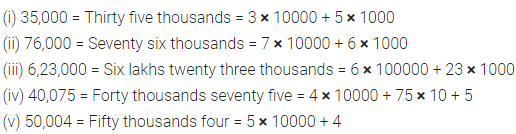
Read and write the following numbers in words and also in expanded form :
(i) 35,000 = …………
(ii) 76,000 = ……………
(iii) 6,23,000 = ………….
(iv) 40,075 = …………….
(v) 50,004 = ………..
Solution:
Selina Concise Mathematics Class 6 ICSE Solutions Chapter 4 Place Value 5

Question 6.
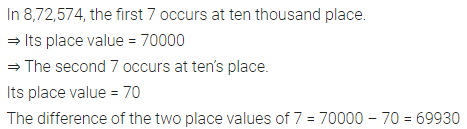
Find the difference in the place values of two sevens in the number 8, 72, 574.
Solution:
Selina Concise Mathematics Class 6 ICSE Solutions Chapter 4 Place Value 6

Place Value Exercise 4B – Selina Concise Mathematics Class 6 ICSE Solutions

Question 1.
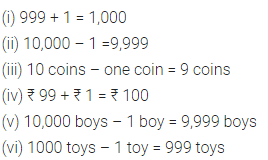
Fill in the blanks :
(i) 999 + 1 = …………
(ii) 10,000 – 1 = …………
(iii) 10 coins – one coin = …………
(iv) ₹ 99 + ₹ 1 = ………..
(v) 10,000 boys – 1 boy = ………..
(vi) 1000 toys – 1 toy = ……….
Solution:
Selina Concise Mathematics Class 6 ICSE Solutions Chapter 4 Place Value 7

Question 2.
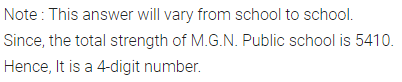
Would the number of students in your school be a 3-digit number or a 4-digit number or a 5-digit number ?
Solution:
Selina Concise Mathematics Class 6 ICSE Solutions Chapter 4 Place Value 8

Question 3.
Write the smallest number which is just more than 9, 99, 999.
Solution:
Selina Concise Mathematics Class 6 ICSE Solutions Chapter 4 Place Value 9

Question 4.
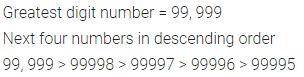
Starting from the greatest 5-digit number, write the previous five numbers in descending order.
Solution:
Selina Concise Mathematics Class 6 ICSE Solutions Chapter 4 Place Value 10

Question 5.
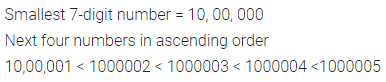
Starting from the smallest 7-digit number, write the next four numbers in ascending order.
Solution:

Selina Concise Mathematics Class 6 ICSE Solutions Chapter 4 Place Value 11

Question 6.
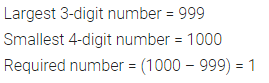
How many numbers lie between the largest 3-digit number and the smallest 4-digit number ?
Solution:

Selina Concise Mathematics Class 6 ICSE Solutions Chapter 4 Place Value 12

Question 7.
How many 5-digit numbers are there in all?
Solution:

Selina Concise Mathematics Class 6 ICSE Solutions Chapter 4 Place Value 13

Selina Concise Mathematics Class 6 ICSE Solutions

Selina Concise Mathematics Class 6 ICSE Solutions Chapter 3 Numbers in India and International System

Selina Concise Mathematics Class 6 ICSE Solutions Chapter 3 Numbers in India and International System (With Comparison)

Selina Publishers Concise Mathematics Class 6 ICSE Solutions Chapter 3 Numbers in India and International System (With Comparison)

Numbers in India and International System Exercise 3 – Selina Concise Mathematics Class 6 ICSE Solutions

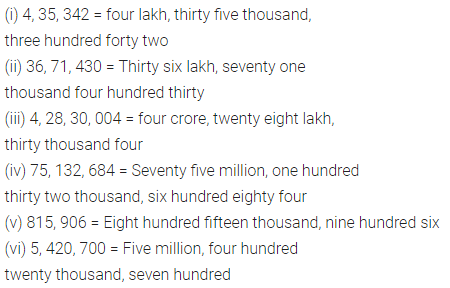
Question 1.
Write the following numerals using Indian System words or International system (as required in words) :
(i) 4, 35, 342 = …………..
(ii) 36, 71, 430 = …………..
(iii) 4, 28, 30, 004 = …………..
(iv) 75, 132, 684 = ……………
(v) 815, 906 = …………….
(vi) 5, 420, 700 = ……………..
Solution:

Selina Concise Mathematics Class 6 ICSE Solutions Chapter 3 Numbers in India and International System 1

Question 2.
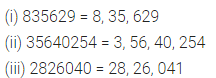
Write the following numbers, placing the commas, according to Indian system :
(i) 835629 = …………
(ii) 35640254 = …………
(iii) 2826040 = ………
Solution:
Selina Concise Mathematics Class 6 ICSE Solutions Chapter 3 Numbers in India and International System 2

Question 3.
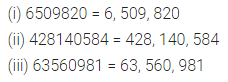
Write the following numbers, by placing the commas, according to International system :
(i) 6509820 = ………..
(ii) 428140584 = …………
(iii) 63560981 = ……….
Solution:
Selina Concise Mathematics Class 6 ICSE Solutions Chapter 3 Numbers in India and International System 3

Question 4.
Fill in the blanks :
(i) Four lakh sixty seven thousand three hundred six.
= ……………… (In numeral form)
= …………… (In International System)
= ……………. (In International numeration)
(ii) Thirteen lakh forty five.
= ……………. (In numeral form)
= ……………. (In International System)
= ……………. (In International numerals)
Solution:
Selina Concise Mathematics Class 6 ICSE Solutions Chapter 3 Numbers in India and International System 4

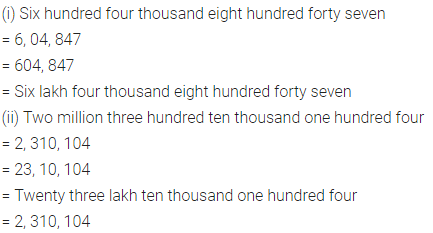
Question 5.
Fill in the blanks :
(i) Six hundred four thousand eight hundred forty seven.
= ……………. (In numeral form)
= ……………. (In Indian System)
= ……………… (Number name in Indian System)
(ii) Two million three hundred ten thousand one hundred four
= …………….. (In numeral form)
= …………… (In Indian System)
= ……………. (In Indian numeration)
= …………….. (In international numerals)
Solution:
Selina Concise Mathematics Class 6 ICSE Solutions Chapter 3 Numbers in India and International System 5

Selina Concise Mathematics Class 6 ICSE Solutions

Selina Concise Mathematics Class 6 ICSE Solutions Chapter 2 Estimation

Selina Concise Mathematics Class 6 ICSE Solutions Chapter 2 Estimation

Selina Publishers Concise Mathematics Class 6 ICSE Solutions Chapter 2 Estimation

Estimation Exercise 2A – Selina Concise Mathematics Class 6 ICSE Solutions

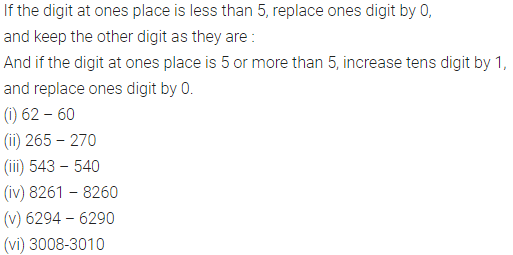
Question 1.
Round off each of the following to the nearest ten :
(i) 62
(ii) 265
(iii) 543
(iv) 8261
(v) 6294
(vi) 3008
(vii) 72326
Solution:

Selina Concise Mathematics Class 6 ICSE Solutions Chapter 2 Estimation 1

Question 2.
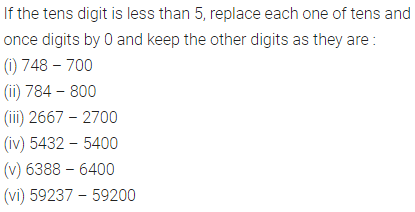
Round off each of the following to the nearest hundred :
(i) 748
(ii) 784
(iii) 2667
(iv) 5432
(v) 6388
(vi) 59237
Solution:
Selina Concise Mathematics Class 6 ICSE Solutions Chapter 2 Estimation 2

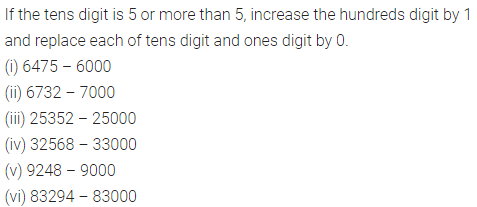
Question 3.
Round off each of the following to the nearest thousand :
(i) 6475
(ii) 6732
(iii) 5352
(iv) 32568
(v) 9248
(vi) 83294
Solution:
Selina Concise Mathematics Class 6 ICSE Solutions Chapter 2 Estimation 3

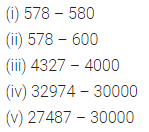
Question 4.
Round off
(i) 578 to the nearest ten.
(ii) 578 to the nearest hundred.
(iii) 4327 to the nearest thousand.
(iv) 32974 to the nearest ten-thousand.
(v) 27487 to the nearest ten-thousand.
Solution:
Selina Concise Mathematics Class 6 ICSE Solutions Chapter 2 Estimation 4

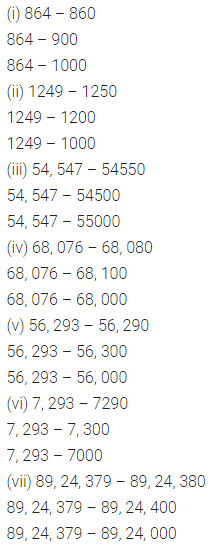
Question 5.
Round off each of the following to the nearest tens, hundreds and thousands.
(i) 864
(ii) 1249
(iii) 54, 547
(iv) 68, 076
(v) 56, 293
(vi) 7, 293
(vii) 89, 24, 379
Solution:
Selina Concise Mathematics Class 6 ICSE Solutions Chapter 2 Estimation 5

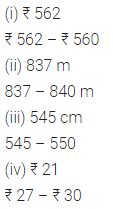
Question 6.
Round off the following to the nearest tens ;
(i) ₹ 562
(ii) 837 m
(iii) 545 cm
(iv) ₹ 27
Solution:
Selina Concise Mathematics Class 6 ICSE Solutions Chapter 2 Estimation 6

Question 7.
List all the numbers which can be round off to 30.
Solution:
Selina Concise Mathematics Class 6 ICSE Solutions Chapter 2 Estimation 7

Question 8.
List all the numbers which can be rounded off to 50.
Solution:
Selina Concise Mathematics Class 6 ICSE Solutions Chapter 2 Estimation 8

Question 9.
Write the smallest and the largest numbers which are rounded off to 80.
Solution:
Selina Concise Mathematics Class 6 ICSE Solutions Chapter 2 Estimation 9

Question 10.
Write the smallest and the largest numbers which are rounded off to 130.
Solution:
Selina Concise Mathematics Class 6 ICSE Solutions Chapter 2 Estimation 10

Estimation Exercise 2B – Selina Concise Mathematics Class 8 ICSE Solutions

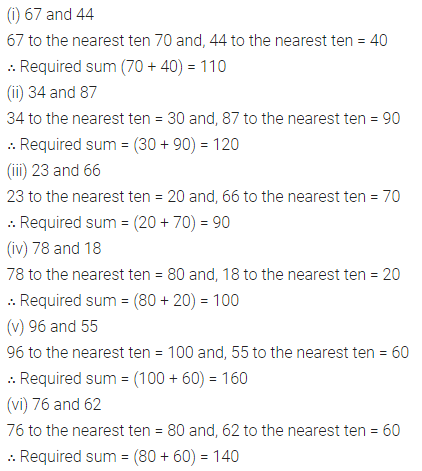
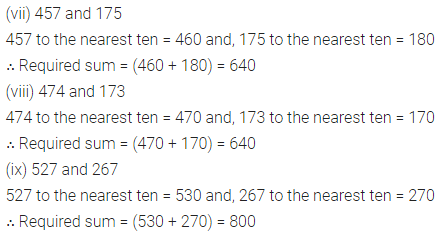
Question 1.
Estimate the sum of each pair of numbers to the nearest ten :
(i) 67 and 44
(ii) 34 and 87
(iii) 23 and 66
(iv) 78 and 18
(v) 96 and 55
(vi) 76 and 62
(vii) 457 and 175
(viii) 474 and 173
(ix) 527 and 267
Solution:
Selina Concise Mathematics Class 6 ICSE Solutions Chapter 2 Estimation 11
Selina Concise Mathematics Class 6 ICSE Solutions Chapter 2 Estimation 12

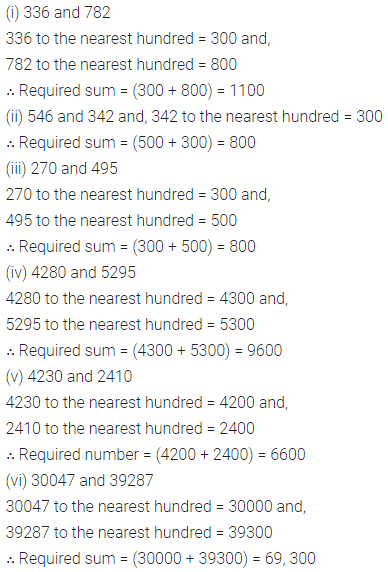
Question 2.
Estimate the sum of each pair of numbers to the nearest hundred :
(i) 336 and 782
(ii) 546 and 342
(iii) 270 and 495
(iv) 4280 and 5295
(v) 4230 and 2410
(vi) 30047 and 39287
Solution:
Selina Concise Mathematics Class 6 ICSE Solutions Chapter 2 Estimation 13

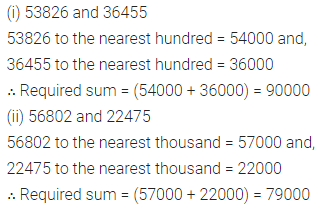
Question 3.
Estimate the sum of the following pair of numbers to the nearest thousand:
(i) 53826 and 36455
(ii) 56802 and 22475
Solution:
Selina Concise Mathematics Class 6 ICSE Solutions Chapter 2 Estimation 14

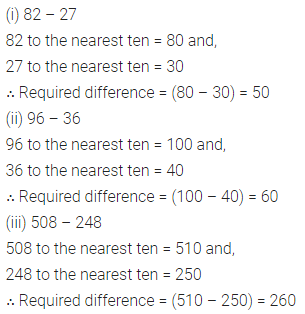
Question 4.
Estimate the following differences correct to nearest ten :
(i) 82 – 27
(ii) 96 – 36
(iii) 508 – 248
Solution:
Selina Concise Mathematics Class 6 ICSE Solutions Chapter 2 Estimation 15

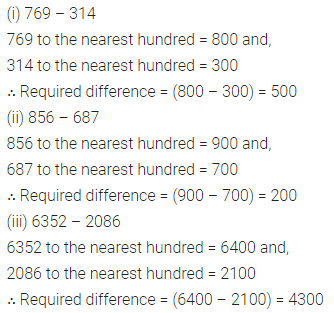
Question 5.
Estimate each difference to the nearest hundred :
(i) 769 – 314
(ii) 856 – 687
(iii) 6352 – 2086
Solution:
Selina Concise Mathematics Class 6 ICSE Solutions Chapter 2 Estimation 16

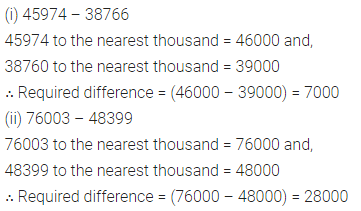
Question 6.
Estimate each difference to the nearest thousand :
(i) 45974 – 38766
(ii) 76003 – 48399
Solution:
Selina Concise Mathematics Class 6 ICSE Solutions Chapter 2 Estimation 17

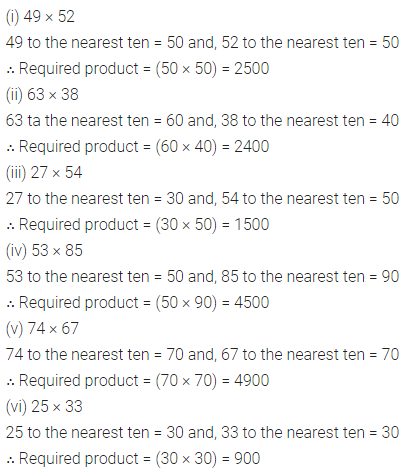
Question 7.
Estimate each of the following products by rounding of each number to the nearest ten :
(i) 49 x 52
(ii) 63 x 38
(iii) 27 x 54
(iv) 53 x 85
(v) 74 x 67
(vi) 25 x 33
Solution:
Selina Concise Mathematics Class 6 ICSE Solutions Chapter 2 Estimation 18

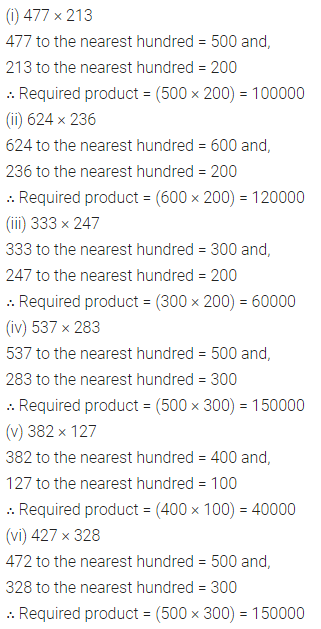
Question 8.
Estimate each of the following products by rounding off each number to the nearest hundred :
(i) 477 x 213
(ii) 624 x 236
(iii) 333 x 247
(iv) 537 x 283
(v) 382 x 127
(vi) 427 x 328
Solution:
Selina Concise Mathematics Class 6 ICSE Solutions Chapter 2 Estimation 19

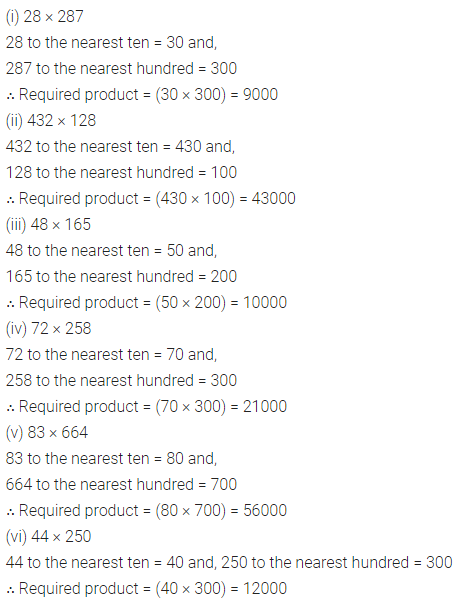
Question 9.
Estimate each of the following products by rounding off the first number correct to nearest ten and the other number correct to nearest hundred :
(i) 28 x 287
(ii) 432 x 128
(iii) 48 x 165
(iv) 72 x 258
(v) 83 x 664
(vi) 44 x 250
Solution:
Selina Concise Mathematics Class 6 ICSE Solutions Chapter 2 Estimation 20

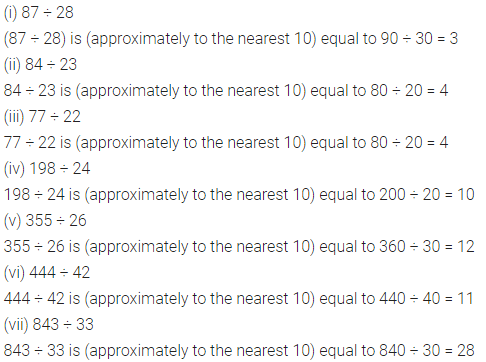
Question 10.
Estimate each of the following quotients by converting each number to the nearest ten :
(i) 87 ÷ 28
(ii) 84 ÷ 23
(iii) 77 ÷ 22
(iv) 198 ÷ 24
(v) 355 ÷ 26
(vi) 444 ÷ 42
(vii) 843 ÷ 33
Solution:
Selina Concise Mathematics Class 6 ICSE Solutions Chapter 2 Estimation 21

Selina Concise Mathematics Class 6 ICSE Solutions