ML Aggarwal Class 8 Solutions for ICSE Maths Chapter 3 Squares and Square Roots Ex 3.2

ML Aggarwal Class 8 Solutions for ICSE Maths Chapter 3 Squares and Square Roots Ex 3.2

Question 1.
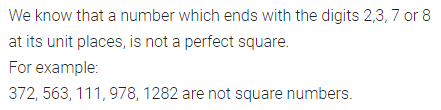
Write five numbers which you can decide by looking at their one’s digit that they are not square numbers.
Solution:
ML Aggarwal Class 8 Solutions for ICSE Maths Chapter 3 Squares and Square Roots Ex 3.2 1

Question 2.
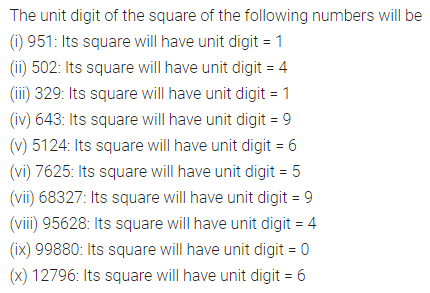
What will be the unit digit of the squares of the following numbers?
(i) 951
(ii) 502
(iii) 329
(iv) 643
(v) 5124
(vi) 7625
(vii) 68327
(viii) 95628
(ix) 99880
(x) 12796
Solution:
ML Aggarwal Class 8 Solutions for ICSE Maths Chapter 3 Squares and Square Roots Ex 3.2 2

Question 3.
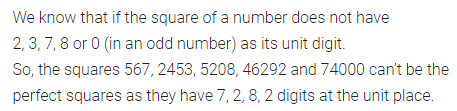
The following numbers are obviously not perfect. Give reason.
(i) 567
(ii) 2453
(iii) 5298
(iv) 46292
(v) 74000
Solution:
ML Aggarwal Class 8 Solutions for ICSE Maths Chapter 3 Squares and Square Roots Ex 3.2 3

Question 4.
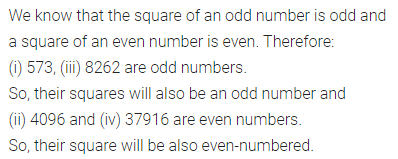
The square of which of the following numbers would be an odd number or an even number? Why?
(i) 573
(ii) 4096
(iii) 8267
(iv) 37916
Solution:
ML Aggarwal Class 8 Solutions for ICSE Maths Chapter 3 Squares and Square Roots Ex 3.2 4

Question 5.
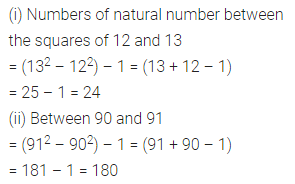
How many natural numbers lie between the square of the following numbers?
(i) 12 and 13
(ii) 90 and 91
Solution:
ML Aggarwal Class 8 Solutions for ICSE Maths Chapter 3 Squares and Square Roots Ex 3.2 5

Question 6.
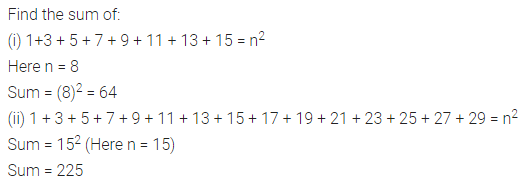
Without adding, find the sum.
(i) 1 + 3 + 5 + 7 + 9 + 11 + 13 + 15
(ii) 1 + 3 + 5 + 7 + 9 + 11 + 13 + 15 + 17 + 19 + 21 + 23 + 25 + 27 + 29
Solution:
ML Aggarwal Class 8 Solutions for ICSE Maths Chapter 3 Squares and Square Roots Ex 3.2 6

Question 7.
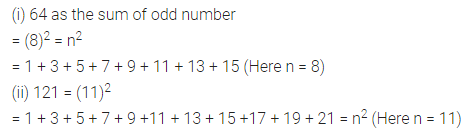
(i) Express 64 as the sum of 8 odd numbers.
(ii) 121 as the sum of 11 odd numbers.
Solution:
ML Aggarwal Class 8 Solutions for ICSE Maths Chapter 3 Squares and Square Roots Ex 3.2 7

Question 8.
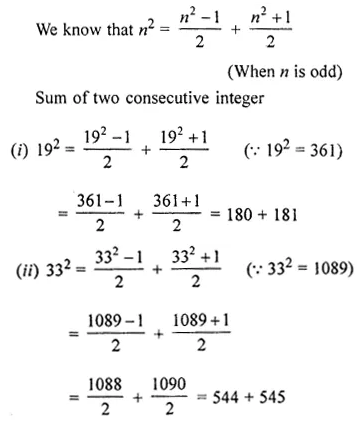
Express the following as the sum of two consecutive integers:
(i) 192
(ii) 332
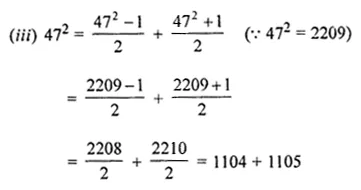
(iii) 472
Solution:
ML Aggarwal Class 8 Solutions for ICSE Maths Chapter 3 Squares and Square Roots Ex 3.2 8
ML Aggarwal Class 8 Solutions for ICSE Maths Chapter 3 Squares and Square Roots Ex 3.2 9

Question 9.
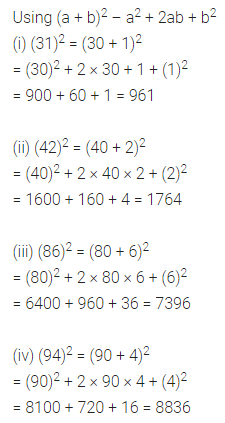
Find the squares of the following numbers without actual multiplication:
(i) 31
(ii) 42
(iii) 86
(iv) 94
Solution:
ML Aggarwal Class 8 Solutions for ICSE Maths Chapter 3 Squares and Square Roots Ex 3.2 10

Question 10.
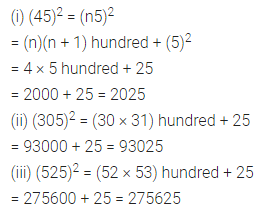
Find the squares of the following numbers containing 5 in unit’s place:
(i) 45
(ii) 305
(iii) 525
Solution:
ML Aggarwal Class 8 Solutions for ICSE Maths Chapter 3 Squares and Square Roots Ex 3.2 11

Question 11.
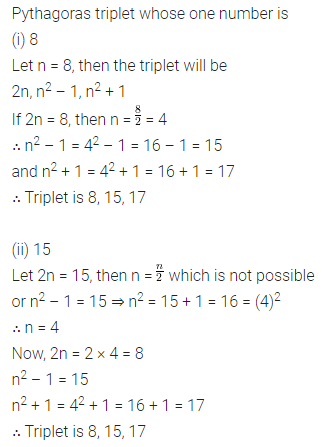
Write a Pythagorean triplet whose one number is
(i) 8
(ii) 15
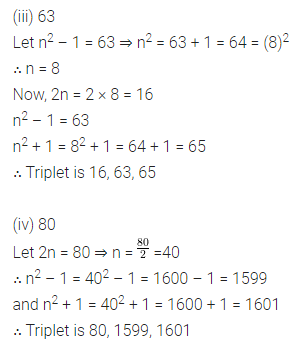
(iii) 63
(iv) 80
Solution:
ML Aggarwal Class 8 Solutions for ICSE Maths Chapter 3 Squares and Square Roots Ex 3.2 12
ML Aggarwal Class 8 Solutions for ICSE Maths Chapter 3 Squares and Square Roots Ex 3.2 13

Question 12.
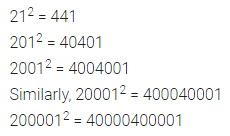
Observe the following pattern and find the missing digits:
212 = 441
2012 = 40401
20012 = 4004001
200012 = 4 – – – 4 – – – 1
2000012 = ————–
Solution:
ML Aggarwal Class 8 Solutions for ICSE Maths Chapter 3 Squares and Square Roots Ex 3.2 14

Question 13.
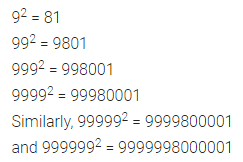
Observe the following pattern and find the missing digits:
92 = 81
992 = 9801
9992 = 998001
99992 = 99980001
999992 = 9——–8———01
9999992 = 9——–0———1
Solution:
ML Aggarwal Class 8 Solutions for ICSE Maths Chapter 3 Squares and Square Roots Ex 3.2 15

Question 14.
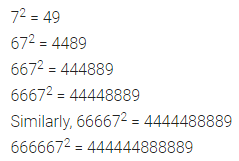
Observe the following pattern and find the missing digits:
72 = 49
672 = 4489
6672 = 444889
66672 = 44448889
666672 = 4 ———–8 ————– 9
6666672 = 4———–8————8 –
Solution:
ML Aggarwal Class 8 Solutions for ICSE Maths Chapter 3 Squares and Square Roots Ex 3.2 16

ML Aggarwal Class 8 Solutions for ICSE Maths

ML Aggarwal Class 8 Solutions for ICSE Maths Chapter 3 Squares and Square Roots Ex 3.1

ML Aggarwal Class 8 Solutions for ICSE Maths Chapter 3 Squares and Square Roots Ex 3.1

Question 1.
Which of the following natural numbers are perfect squares? Give reasons in support of your answer.
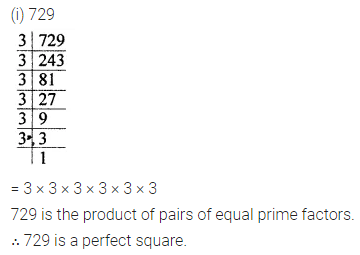
(i) 729
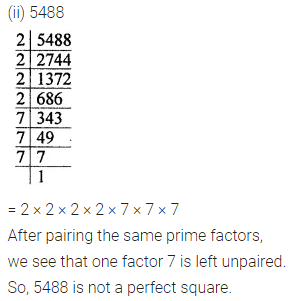
(ii) 5488
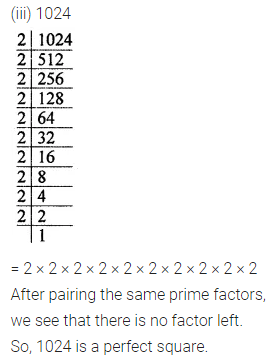
(iii) 1024
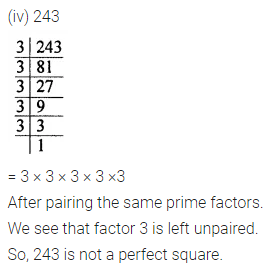
(iv) 243
Solution:
ML Aggarwal Class 8 Solutions for ICSE Maths Chapter 3 Squares and Square Roots Ex 3.1 1
ML Aggarwal Class 8 Solutions for ICSE Maths Chapter 3 Squares and Square Roots Ex 3.1 2
ML Aggarwal Class 8 Solutions for ICSE Maths Chapter 3 Squares and Square Roots Ex 3.1 3
ML Aggarwal Class 8 Solutions for ICSE Maths Chapter 3 Squares and Square Roots Ex 3.1 4

Question 2.
Show that each of the following numbers is a perfect square. Also, find the number whose square is the given number.
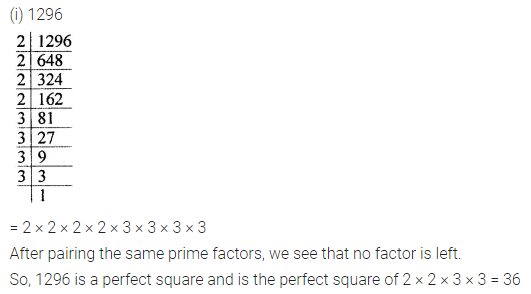
(i) 1296
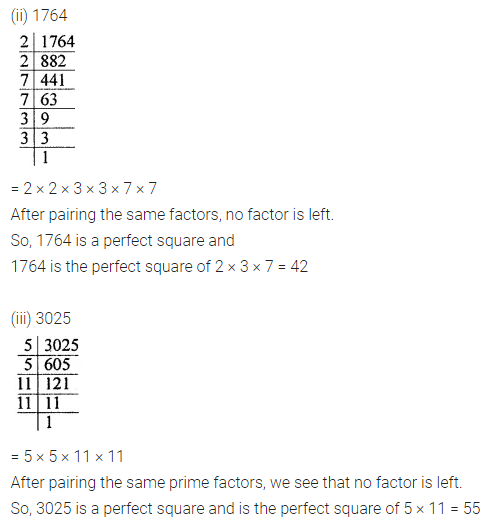
(ii) 1764
(iii) 3025
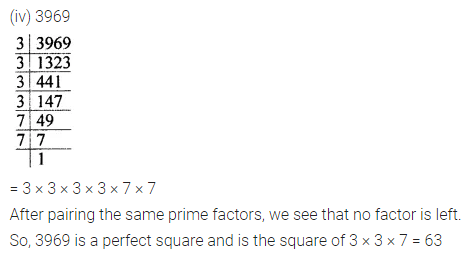
(iv) 3969
Solution:
ML Aggarwal Class 8 Solutions for ICSE Maths Chapter 3 Squares and Square Roots Ex 3.1 5
ML Aggarwal Class 8 Solutions for ICSE Maths Chapter 3 Squares and Square Roots Ex 3.1 6
ML Aggarwal Class 8 Solutions for ICSE Maths Chapter 3 Squares and Square Roots Ex 3.1 7

Question 3.
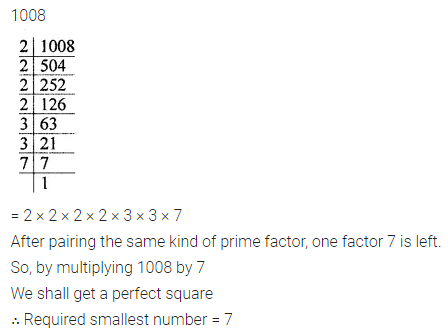
Find the smallest natural number by which 1008 should be multiplied to make it a perfect square.
Solution:
ML Aggarwal Class 8 Solutions for ICSE Maths Chapter 3 Squares and Square Roots Ex 3.1 8

Question 4.
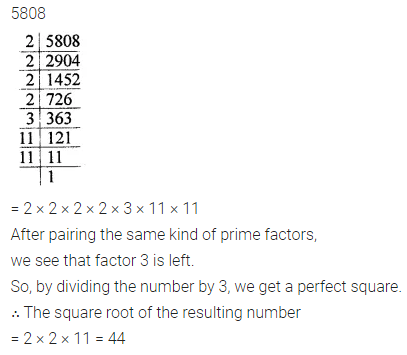
Find the smallest natural number by which 5808 should be divided to make it a perfect square. Also, find the number whose square is the resulting number.
Solution:
ML Aggarwal Class 8 Solutions for ICSE Maths Chapter 3 Squares and Square Roots Ex 3.1 9

ML Aggarwal Class 8 Solutions for ICSE Maths

ML Aggarwal Class 8 Solutions for ICSE Maths Chapter 2 Exponents and Powers Check Your Progress

ML Aggarwal Class 8 Solutions for ICSE Maths Chapter 2 Exponents and Powers Check Your Progress

Question 1.
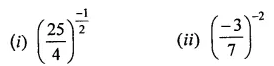
Evaluate:
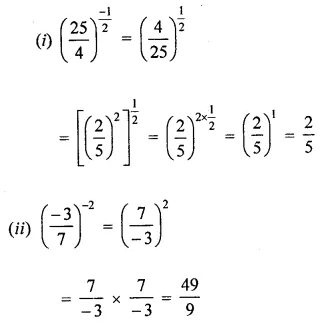
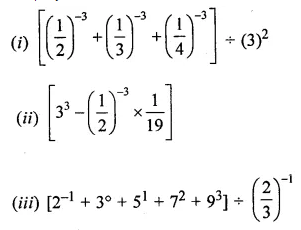
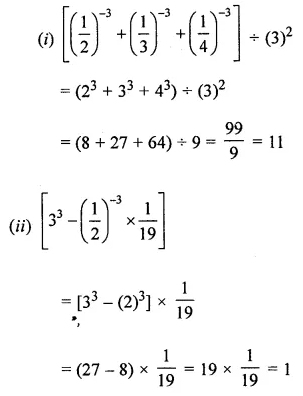
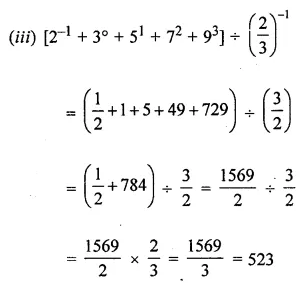
ML Aggarwal Class 8 Solutions for ICSE Maths Chapter 2 Exponents and Powers Check Your Progress 1
Solution:

ML Aggarwal Class 8 Solutions for ICSE Maths Chapter 2 Exponents and Powers Check Your Progress 2

Question 2.
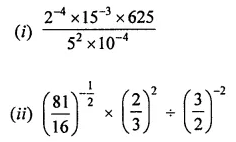
Simplify:
ML Aggarwal Class 8 Solutions for ICSE Maths Chapter 2 Exponents and Powers Check Your Progress 3
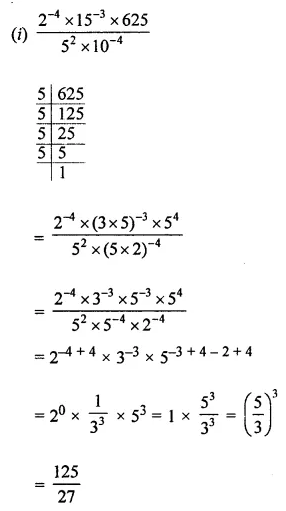
Solution:
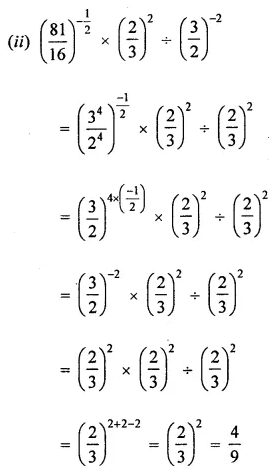
ML Aggarwal Class 8 Solutions for ICSE Maths Chapter 2 Exponents and Powers Check Your Progress 4
ML Aggarwal Class 8 Solutions for ICSE Maths Chapter 2 Exponents and Powers Check Your Progress 5

Question 3.
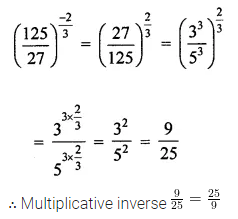
Find the multiplicative inverse of \(\left(\frac{125}{27}\right)^{\frac{-2}{3}}\)
Solution:
ML Aggarwal Class 8 Solutions for ICSE Maths Chapter 2 Exponents and Powers Check Your Progress 6

Question 4.
Simplify and write in exponential form:
ML Aggarwal Class 8 Solutions for ICSE Maths Chapter 2 Exponents and Powers Check Your Progress 7
Solution:
ML Aggarwal Class 8 Solutions for ICSE Maths Chapter 2 Exponents and Powers Check Your Progress 8
ML Aggarwal Class 8 Solutions for ICSE Maths Chapter 2 Exponents and Powers Check Your Progress 9

Question 5.
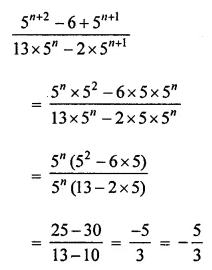
Simplify: \(\frac{5^{n+2}-6+5^{n+1}}{13 \times 5^{n}-2 \times 5^{n+1}}\)
Solution:
ML Aggarwal Class 8 Solutions for ICSE Maths Chapter 2 Exponents and Powers Check Your Progress 10

Question 6.
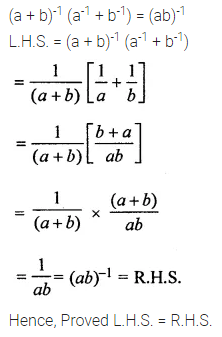
Prove that (a + b)-1 (a-1 + b-1) = (ab)-1.
Solution:
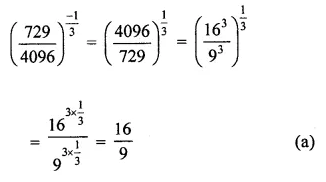
ML Aggarwal Class 8 Solutions for ICSE Maths Chapter 2 Exponents and Powers Check Your Progress 11

Question 7.
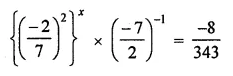
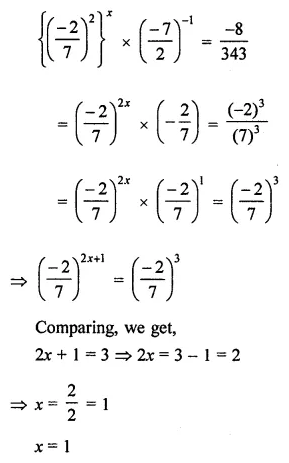
Find the value of x for which
ML Aggarwal Class 8 Solutions for ICSE Maths Chapter 2 Exponents and Powers Check Your Progress 12
Solution:
ML Aggarwal Class 8 Solutions for ICSE Maths Chapter 2 Exponents and Powers Check Your Progress 13

Question 8.
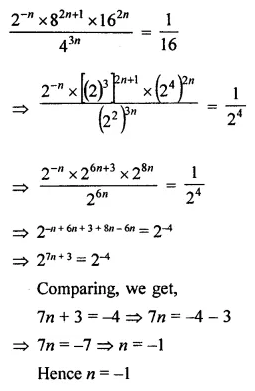
If \(\frac{2^{-n} \times 8^{2 n+1} \times 16^{2 n}}{4^{3 n}}=\frac{1}{16}\), find the value of n.
Solution:
ML Aggarwal Class 8 Solutions for ICSE Maths Chapter 2 Exponents and Powers Check Your Progress 14

Question 9.
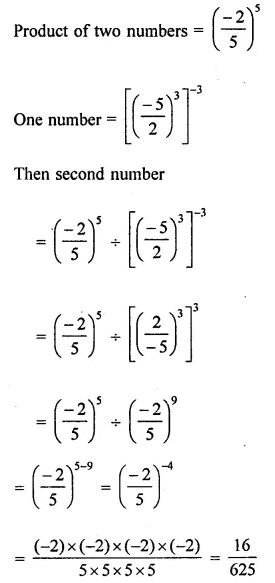
By what number should \(\left[\left(\frac{-5}{2}\right)^{3}\right]^{-3}\) be multiplied to get \(\left(\frac{-2}{5}\right)^{5}\)?
Solution:
ML Aggarwal Class 8 Solutions for ICSE Maths Chapter 2 Exponents and Powers Check Your Progress 15

Question 10.
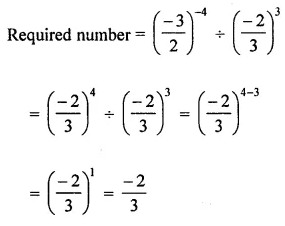
By what number should \(\left(\frac{-3}{2}\right)^{-4}\) be divided to get \(\left(\frac{-2}{3}\right)^{3}\)?
Solution:
ML Aggarwal Class 8 Solutions for ICSE Maths Chapter 2 Exponents and Powers Check Your Progress 16

Question 11.
Express the following numbers in standard form:
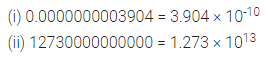
(i) 0.0000000003904
(ii) 12730000000000
Solution:
ML Aggarwal Class 8 Solutions for ICSE Maths Chapter 2 Exponents and Powers Check Your Progress 17

Question 12.
Express the following numbers in the usual form:
(i) 5.73 × 10⁻¹¹
(ii) 3.895 × 10¹⁵.
Solution:
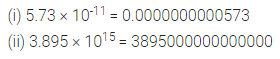
ML Aggarwal Class 8 Solutions for ICSE Maths Chapter 2 Exponents and Powers Check Your Progress 18

Question 13.
If \(\left(\frac{9}{4}\right)^{-4} \times\left(\frac{2}{3}\right)^{3}=\left(\frac{p}{q}\right)^{11}\), then find the value of \(\left(\frac{p}{q}\right)^{-2}\).
Solution:
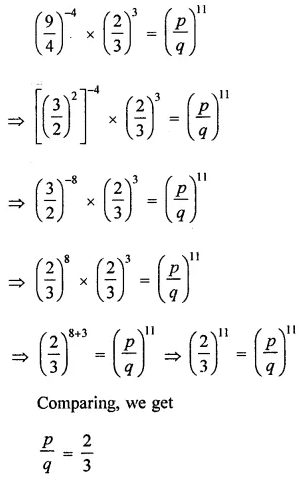
ML Aggarwal Class 8 Solutions for ICSE Maths Chapter 2 Exponents and Powers Check Your Progress 19

Question 14.
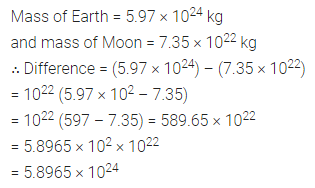
Mass of the Earth is 5.97 × 1024 kg and mass of the Moon is 7.35 × 10²² kg. What is the difference of their masses?
Solution:
ML Aggarwal Class 8 Solutions for ICSE Maths Chapter 2 Exponents and Powers Check Your Progress 20

ML Aggarwal Class 8 Solutions for ICSE Maths

ML Aggarwal Class 8 Solutions for ICSE Maths Chapter 2 Exponents and Powers Objective Type Questions

ML Aggarwal Class 8 Solutions for ICSE Maths Chapter 2 Exponents and Powers Objective Type Questions

Mental Maths

Question 1.
Fill in the blanks:
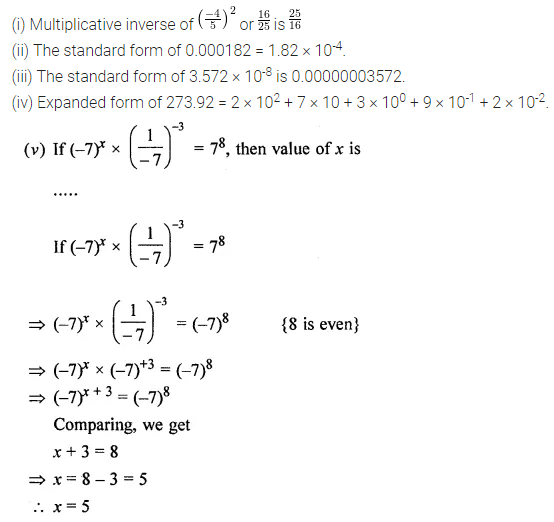
(i) Multiplicative inverse of \(\left( \frac { -4 }{ 5 } \right) ^{ 2 }\) = ……..
(ii) The standard form of 0.000182 = ………
(iii) The standard form of ……….. is 0.00000003572.
(iv) Expanded form of 273.92 = ………..
(v) If (-7)x × \(\left( \frac { 1 }{ -7 } \right) ^{ -3 }\) = 78, then value of x is …….
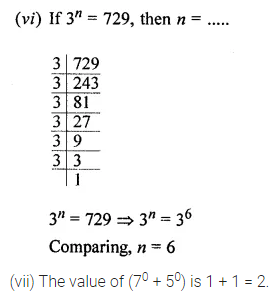
(vi) If 3n = 729, then n = ……
(vii) The value of (70 + 50) is ……..
Solution:
ML Aggarwal Class 8 Solutions for ICSE Maths Chapter 2 Exponents and Powers Objective Type Questions 1
ML Aggarwal Class 8 Solutions for ICSE Maths Chapter 2 Exponents and Powers Objective Type Questions 2

Question 2.
State whether the following statements are true (T) or false (F):
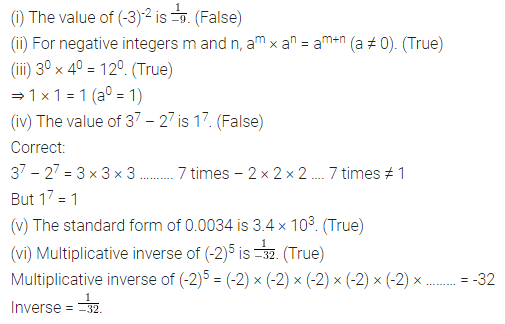
(i) The value of (-3)-2 is \(\frac { 1 }{ -9 }\).
(ii) For negative integers m and n, am × an = am+n (a ≠ 0).
(iii) 30 × 40 = 120.
(iv) The value of 37 – 27 is 17.
(v) The standard form of 0.0034 is 3.4 × 10³.
(vi) Multiplicative inverse of (-2)5 is \(\frac { 1 }{ -32 }\).
Solution:
ML Aggarwal Class 8 Solutions for ICSE Maths Chapter 2 Exponents and Powers Objective Type Questions 3

Multiple Choice Questions

Choose the correct answer from the given four options (3 to 12):
Question 3.
\(\left( \frac { 1 }{ 2 } \right) ^{ -5 }\) is equal to
(a) 32
(b) \(\frac { 1 }{ 32 }\)
(c) -32
(d) \(\frac { -1 }{ 32 }\)
Solution:
ML Aggarwal Class 8 Solutions for ICSE Maths Chapter 2 Exponents and Powers Objective Type Questions 4

Question 4.
ML Aggarwal Class 8 Solutions for ICSE Maths Chapter 2 Exponents and Powers Objective Type Questions 5
Solution:
ML Aggarwal Class 8 Solutions for ICSE Maths Chapter 2 Exponents and Powers Objective Type Questions 6

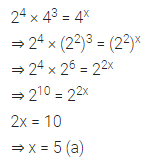
Question 5.
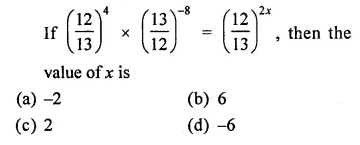
If 24 × 43 = 4x, then the value of x is
(a) 5
(b) 7
(c) 4
(d) -5
Solution:
ML Aggarwal Class 8 Solutions for ICSE Maths Chapter 2 Exponents and Powers Objective Type Questions 7

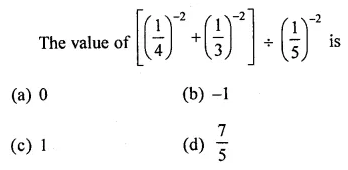
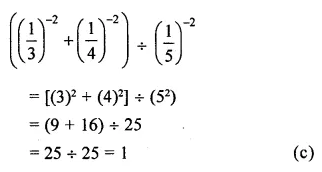
Question 6.
ML Aggarwal Class 8 Solutions for ICSE Maths Chapter 2 Exponents and Powers Objective Type Questions 8
Solution:
ML Aggarwal Class 8 Solutions for ICSE Maths Chapter 2 Exponents and Powers Objective Type Questions 9

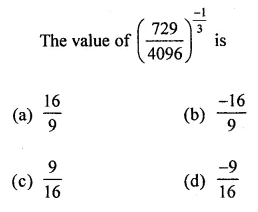
Question 7.
ML Aggarwal Class 8 Solutions for ICSE Maths Chapter 2 Exponents and Powers Objective Type Questions 10
Solution:
ML Aggarwal Class 8 Solutions for ICSE Maths Chapter 2 Exponents and Powers Objective Type Questions 11

Question 8.
Standard form of 0.000000789 is
(a) 78.9 × 10⁻⁸
(b) 789 × 10-9
(c) 7.89 × 10⁻⁷
(d) None
Solution:
ML Aggarwal Class 8 Solutions for ICSE Maths Chapter 2 Exponents and Powers Objective Type Questions 12

Question 9.
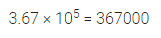
The usual form of 3.67 × 10⁵ is
(a) 3670000
(b) 367000
(c) 36700
(d) 3670
Solution:
ML Aggarwal Class 8 Solutions for ICSE Maths Chapter 2 Exponents and Powers Objective Type Questions 13

Question 10.
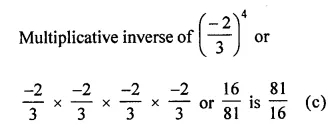
Multiplicative inverse of \(\left( \frac { -2 }{ 3 } \right) ^{ 4 }\) is
(a) \(\frac { 16 }{ 81 }\)
(b) \(\frac { -16 }{ 81 }\)
(c) \(\frac { 81 }{ 16 }\)
(d) \(\frac { -81 }{ 16 }\)
Solution:
ML Aggarwal Class 8 Solutions for ICSE Maths Chapter 2 Exponents and Powers Objective Type Questions 14

Question 11.
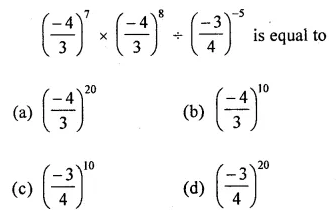
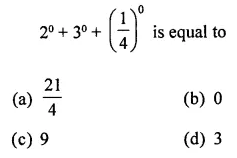
ML Aggarwal Class 8 Solutions for ICSE Maths Chapter 2 Exponents and Powers Objective Type Questions 15
Solution:
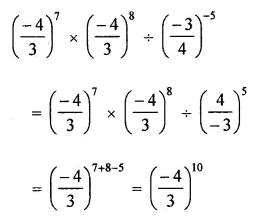
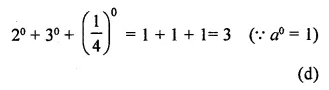
ML Aggarwal Class 8 Solutions for ICSE Maths Chapter 2 Exponents and Powers Objective Type Questions 16

Question 12.
ML Aggarwal Class 8 Solutions for ICSE Maths Chapter 2 Exponents and Powers Objective Type Questions 17
Solution:
ML Aggarwal Class 8 Solutions for ICSE Maths Chapter 2 Exponents and Powers Objective Type Questions 18

Value Based Questions

Question 1.
Anaemia causes due to deficiency of Red Blood cells. The size of a red blood cell is 0.000000007 mm. Express it in standard form. Rahul is suffering from anemia, his doctor adviced him to take healthy food regularly and avoid junk food.
Why should we eat healthy food? What values are being promoted?
Solution:
ML Aggarwal Class 8 Solutions for ICSE Maths Chapter 2 Exponents and Powers Objective Type Questions 19

Higher Order Thinking Skills (HOTS)

Question 1.
Find the multiplicative inverse of (50 + 30) (50 – 30).
Solution:
ML Aggarwal Class 8 Solutions for ICSE Maths Chapter 2 Exponents and Powers Objective Type Questions 20

Question 2.
ML Aggarwal Class 8 Solutions for ICSE Maths Chapter 2 Exponents and Powers Objective Type Questions 21
Solution:
ML Aggarwal Class 8 Solutions for ICSE Maths Chapter 2 Exponents and Powers Objective Type Questions 22

Question 3.
ML Aggarwal Class 8 Solutions for ICSE Maths Chapter 2 Exponents and Powers Objective Type Questions 23
Solution:
ML Aggarwal Class 8 Solutions for ICSE Maths Chapter 2 Exponents and Powers Objective Type Questions 24

ML Aggarwal Class 8 Solutions for ICSE Maths

ML Aggarwal Class 8 Solutions for ICSE Maths Chapter 2 Exponents and Powers Ex 2.2

ML Aggarwal Class 8 Solutions for ICSE Maths Chapter 2 Exponents and Powers Ex 2.2

Question 1.
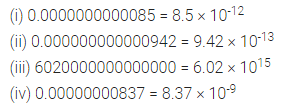
Express the following numbers in standard form:
(i) 0.0000000000085
(ii) 0.000000000000942
(iii) 6020000000000000
(iv) 0.00000000837
Solution:
ML Aggarwal Class 8 Solutions for ICSE Maths Chapter 2 Exponents and Powers Ex 2.2 1

Question 2.
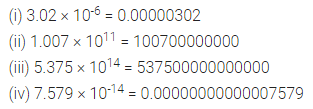
Express the following numbers in the usual form:
(i) 3.02 × 10⁻⁶
(ii) 1-007 × 1011
(iii) 5.375 × 10¹⁴
(iv) 7.579 × 10⁻¹⁴
Solution:
ML Aggarwal Class 8 Solutions for ICSE Maths Chapter 2 Exponents and Powers Ex 2.2 2

Question 3.
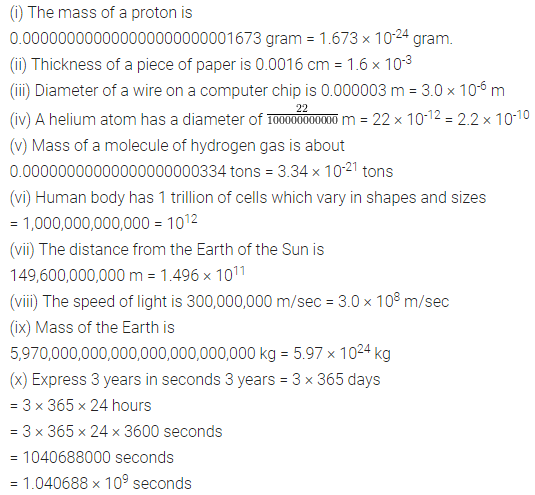
Express the number appearing in the following statements in standard form:
(i) The mass of a proton is 0.000000000000000000000001673 gram.
(ii) The thickness of a piece of paper is 0.0016 cm.
(iii) The diameter of a wire on a computer chip is 0.000003 m.
(iv) A helium atom has a diameter of \(\frac { 22 }{ 100000000000 }\) m
(v) Mass of a molecule of hydrogen gas is about 0.00000000000000000000334 tons.
(vi) The human body has 1 trillion cells which vary in shapes and sizes.
(vii) The distance from the Earth of the Sun is 149,600,000,000 m.
(viii) The speed of light is 300,000,000 m/sec.
(ix) Mass of the Earth is 5,970,000,000,000,000,000,000,000 kg.
(x) Express 3 years in seconds.
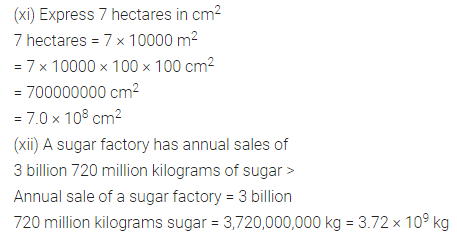
(xi) Express 7 hectares in cm2.
(xii) A sugar factory has annual sales of 3 billion 720 million kilograms of sugar.
Solution:
ML Aggarwal Class 8 Solutions for ICSE Maths Chapter 2 Exponents and Powers Ex 2.2 3
ML Aggarwal Class 8 Solutions for ICSE Maths Chapter 2 Exponents and Powers Ex 2.2 4

Question 4.
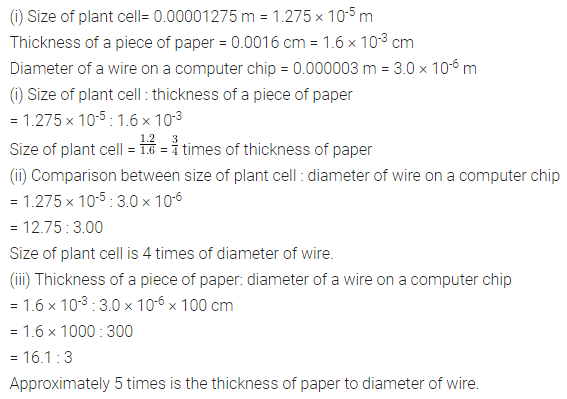
Compare the following:
(i) Size of a plant cell to the thickness of a piece of paper.
(ii) Size of a plant cell to the diameter of a wire on a computer chip.
(iii) The thickness of a piece of paper to the diameter of a wire on a computer chip.
Given size of plant cell = 0.00001275 m
Thickness of a piece of paper = 0.0016 cm
Diameter of a wire on a computer chip = 0.000003 m
Solution:
ML Aggarwal Class 8 Solutions for ICSE Maths Chapter 2 Exponents and Powers Ex 2.2 5

Question 5.
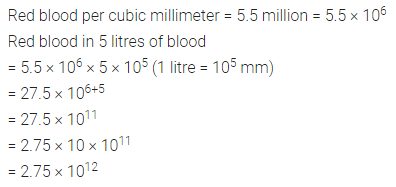
The number of red blood cells per cubic millimetre of blood is approximately 5.5 million. If the average body contains 5 litres of blood, what is the total number of red cell in the body? (1 litre = 1,00,000 mm3)
Solution:
ML Aggarwal Class 8 Solutions for ICSE Maths Chapter 2 Exponents and Powers Ex 2.2 6

Question 6.
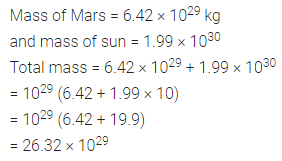
Mass of Mars is 6.42 × 1029 kg and the mass of the sun is 1.99 × 1030 kg. What is the total mass?
Solution:
ML Aggarwal Class 8 Solutions for ICSE Maths Chapter 2 Exponents and Powers Ex 2.2 7

Question 7.
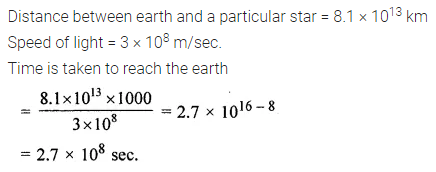
A particular star is at a distance of about 8.1 × 10¹³ km from the Earth. Assuming that the light travels at 3 × 10⁸ m/sec, find how long does light take from that star to reach the Earth.
Solution:
ML Aggarwal Class 8 Solutions for ICSE Maths Chapter 2 Exponents and Powers Ex 2.2 8

ML Aggarwal Class 8 Solutions for ICSE Maths