ML Aggarwal Class 8 Solutions for ICSE Maths Chapter 6 Operation on Sets Venn Diagrams Ex 6.2

ML Aggarwal Class 8 Solutions for ICSE Maths Chapter 6 Operation on Sets Venn Diagrams Ex 6.2

Question 1.
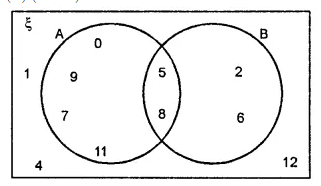
From the adjoining Venn diagram, find the following sets :
(i) A
(ii) B
(iii) ξ
(iv) A’
(v) B’
(vi) A ∪ B
(vii) A ∩ B
(viii) (A ∪ B)’
(ix) (A ∩ B)’
ML Aggarwal Class 8 Solutions for ICSE Maths Chapter 6 Operation on Sets Venn Diagrams Ex 6.2 1
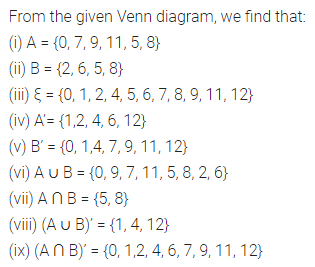
Solution:
ML Aggarwal Class 8 Solutions for ICSE Maths Chapter 6 Operation on Sets Venn Diagrams Ex 6.2 2

Question 2.
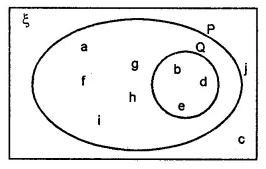
From the adjoining Venn diagram, find the following sets :
ML Aggarwal Class 8 Solutions for ICSE Maths Chapter 6 Operation on Sets Venn Diagrams Ex 6.2 3
(i) P
(ii) Q
(iii) ξ
(iv) P’
(v) Q’
(vi) P ∪ Q
(vii) P ∩ Q
(viii) (P ∪ Q)’
(ix) (P ∩ Q)’
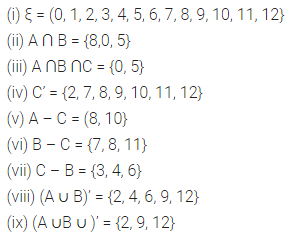
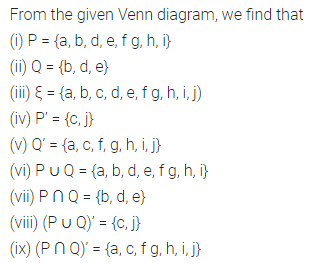
Solution:
ML Aggarwal Class 8 Solutions for ICSE Maths Chapter 6 Operation on Sets Venn Diagrams Ex 6.2 4

Question 3.
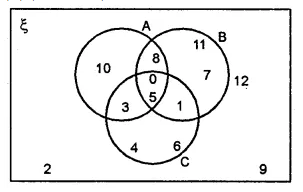
From the adjoining Venn diagram, find the following sets :
(i) ξ
(ii) A ∩ B
(iii) A ∩ B ∩ C
(iv) C’
(v) A – C
(vi) B – C
(vii) C – B
(viii) (A ∪ B)’
(ix) (A ∪ B ∪ C)’
ML Aggarwal Class 8 Solutions for ICSE Maths Chapter 6 Operation on Sets Venn Diagrams Ex 6.2 5
Solution:
ML Aggarwal Class 8 Solutions for ICSE Maths Chapter 6 Operation on Sets Venn Diagrams Ex 6.2 6

Question 4.
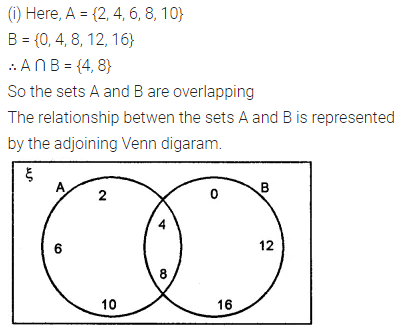
Draw Venn diagrams to show the relationship between the following pairs of sets :
(i) A = {x | x ϵ N, x = 2n, n ≤ 5} and
B = {x | x ϵ W, x = 4n, n < 5}
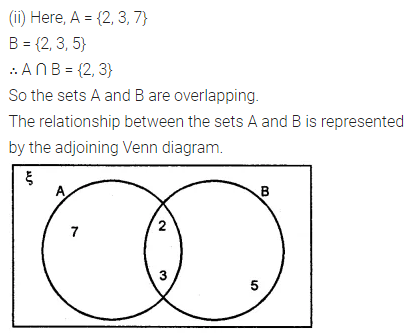
(ii) A = {prime factors of 42} and
B = {prime factors of 60}
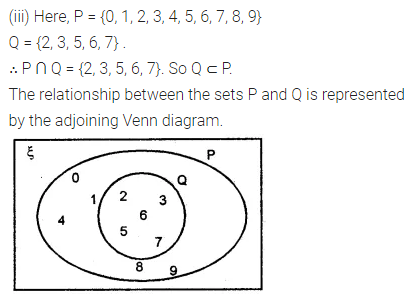
(iii) P = {x | x ϵ W, x < 10} and
Q = {prime factors of 210}
Solution:
ML Aggarwal Class 8 Solutions for ICSE Maths Chapter 6 Operation on Sets Venn Diagrams Ex 6.2 7
ML Aggarwal Class 8 Solutions for ICSE Maths Chapter 6 Operation on Sets Venn Diagrams Ex 6.2 8
ML Aggarwal Class 8 Solutions for ICSE Maths Chapter 6 Operation on Sets Venn Diagrams Ex 6.2 9

Question 5.
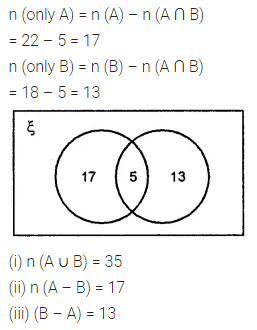
Draw a Venn diagram to illustrate the following information:
n (A) = 22, n (B) = 18 and n (A ∩ B) = 5.
Hence find:
(i) n (A ∩ B)
(ii) n (A – B)
(iii) n (B – A)
Solution:
ML Aggarwal Class 8 Solutions for ICSE Maths Chapter 6 Operation on Sets Venn Diagrams Ex 6.2 10

Question 6.
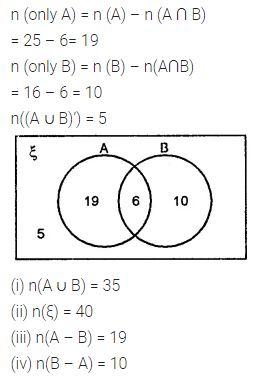
Draw a Venn diagram to illustrate the following information: n (A) = 25, n (B) = 16, n (A ∩ B) = 6 and n ((A ∪ B)’) = 5
Hence find:
(i) n (A ∪ B)
(ii) n (ξ)
(iii) n (A – B)
(iv) n (B – A)
Solution:
ML Aggarwal Class 8 Solutions for ICSE Maths Chapter 6 Operation on Sets Venn Diagrams Ex 6.2 11

Question 7.
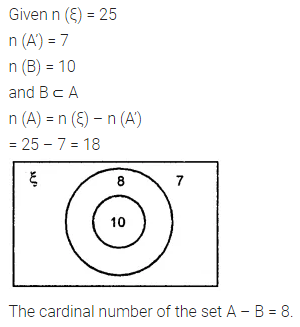
Given n(ξ) = 25, n (A’) = 7, n (B) = 10 and B ⊂ A. Draw a Venn diagram to illustrate this information. Hence, find the cardinal number of the set A – B.
Solution:
ML Aggarwal Class 8 Solutions for ICSE Maths Chapter 6 Operation on Sets Venn Diagrams Ex 6.2 12

Question 8.
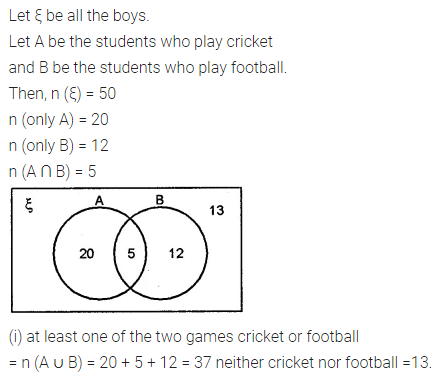
In a group of 50 boys, 20 play only cricket, 12 play only football and 5 boys play both the games. Draw a Venn diagram and find the number of boys who play
(i) at least one of the two games cricket or football.
(ii) neither cricket nor football.
Solution:
ML Aggarwal Class 8 Solutions for ICSE Maths Chapter 6 Operation on Sets Venn Diagrams Ex 6.2 13

Question 9.
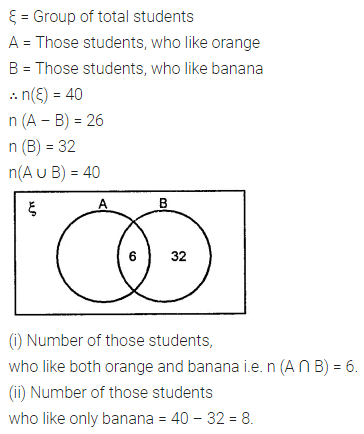
In a group of 40 students, 26 students like orange but not banana, while 32 students like orange. If all the students like atleast one of the two fruits, find the number of students who like
(i) both orange and banana
(ii) only banana.
Draw a Venn diagram to represent the data.
Solution:
ML Aggarwal Class 8 Solutions for ICSE Maths Chapter 6 Operation on Sets Venn Diagrams Ex 6.2 14

Question 10.
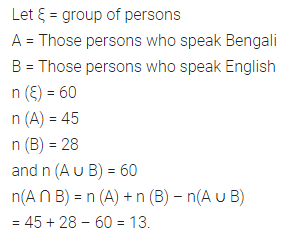
In a group of 60 persons, 45 speak Bengali, 28 speak English and all the persons speak atleast one language. Find how many people speak both Bengali and English. Draw a Venn diagram.
Solution:
ML Aggarwal Class 8 Solutions for ICSE Maths Chapter 6 Operation on Sets Venn Diagrams Ex 6.2 15

ML Aggarwal Class 8 Solutions for ICSE Maths

ML Aggarwal Class 8 Solutions for ICSE Maths Chapter 6 Operation on sets Venn Diagrams Ex 6.1

ML Aggarwal Class 8 Solutions for ICSE Maths Chapter 6 Operation on sets Venn Diagrams Ex 6.1

Question 1.
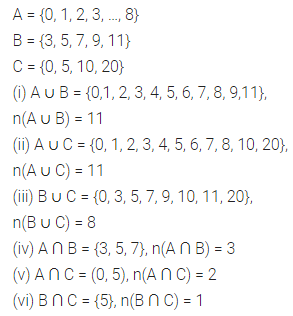
If A = {0, 1, 2, 3, …….., 8}, B = {3, 5, 7, 9, 11} and C = {0, 5, 10, 20}, find
(i) A ∪ B
(ii) A ∪ C
(iii) B ∪ C
(iv) A ∩ B
(v) A ∩ C
(vi) B ∩ C
Also find the cardinal number of the sets B ∪ C, A ∪ B, A ∩ C and B ∩ C.
Solution:
ML Aggarwal Class 8 Solutions for ICSE Maths Chapter 6 Operation on sets Venn Diagrams Ex 6.1 1

Question 2.
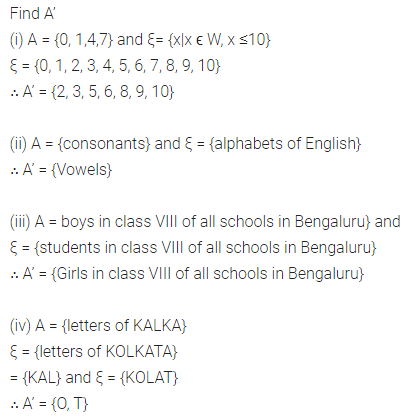
Find A’ when
(i) A= {0, 1, 4, 7} and E, = {x | x ϵ W, x ≤ 10}
(ii) A = {consonants} and ξ = {alphabets of English}
(iii) A = boys in class VIII of all schools in Bengaluru} and ξ = {students in class VIII of all schools in Bengaluru}
(iv) A = {letters of KALKA} and ξ = {letters of KOLKATA}
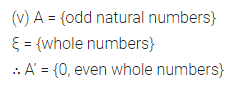
(v) A = {odd natural numbers} and ξ = {whole numbers}.
Solution:
ML Aggarwal Class 8 Solutions for ICSE Maths Chapter 6 Operation on sets Venn Diagrams Ex 6.1 2
ML Aggarwal Class 8 Solutions for ICSE Maths Chapter 6 Operation on sets Venn Diagrams Ex 6.1 3

Question 3.
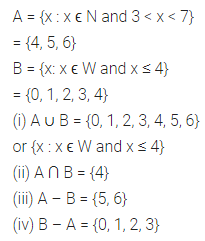
If A {x : x ϵ N and 3 < x < 1} and B = {x : x ϵ Wand x ≤ 4}, find
(i) A ∪ B
(ii) A ∩ B
(iii) A – B
(iv) B – A
Solution:
ML Aggarwal Class 8 Solutions for ICSE Maths Chapter 6 Operation on sets Venn Diagrams Ex 6.1 4

Question 4.
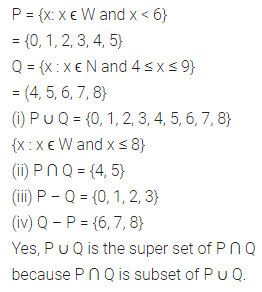
If P = {x : x ϵ W and x < 6} and Q = {x : x ϵ N and 4 ≤ x ≤ 9}, find
(i) P ∪ Q
(ii) P ∩ Q
(iii) P – Q
(iv) Q – P
Is P ∪ Q a proper superset of P ∩ Q ?
Solution:
ML Aggarwal Class 8 Solutions for ICSE Maths Chapter 6 Operation on sets Venn Diagrams Ex 6.1 5

Question 5.
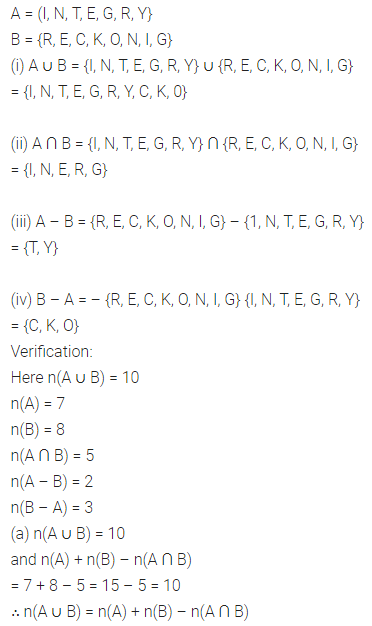
If A = (letters of word INTEGRITY) and B = (letters of word RECKONING), find
(i) A ∪ B
(ii) A ∩ B
(iii) A – B
(iv) B – A
Also verify that:
(a) n(A ∪ B) = n(A) + n(B) – n(A ∩ B)
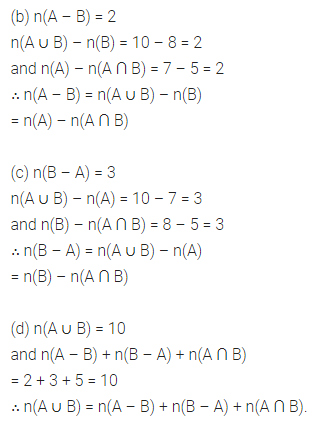
(b) n(A – B) = n(A ∪ B) – n(B)
= n(A) – n(A ∪ B)
(c) n(B – A) = n(A ∪ B) – n(A)
= n(B) – n(A ∩ B)
(d) n(A ∪ B) = n(A – B) + n(B – A) + n(A ∩ B).
Solution:
ML Aggarwal Class 8 Solutions for ICSE Maths Chapter 6 Operation on sets Venn Diagrams Ex 6.1 6
ML Aggarwal Class 8 Solutions for ICSE Maths Chapter 6 Operation on sets Venn Diagrams Ex 6.1 7

Question 6.
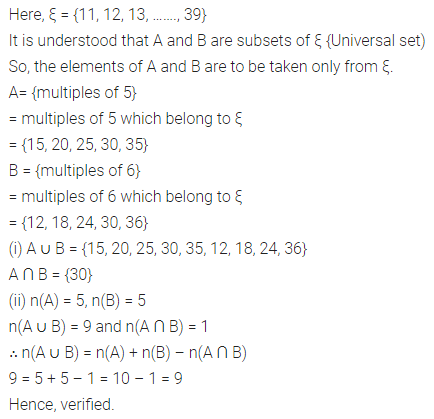
If ξ = {natural numbers between 10 and 40}
A = {multiples of 5} and
B = {multiples of 6}, then
(i) find A ∪ B and A ∩ B
(ii) verify that
n(A ∪ B) = B (A) + n(B) – n(A ∩ B).
Solution:
ML Aggarwal Class 8 Solutions for ICSE Maths Chapter 6 Operation on sets Venn Diagrams Ex 6.1 8

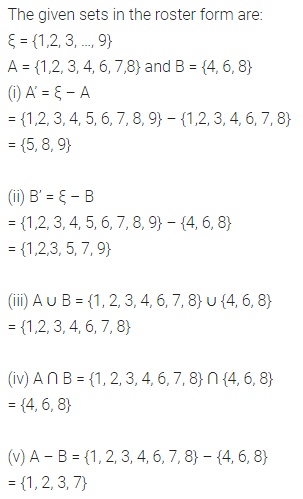
Question 7.
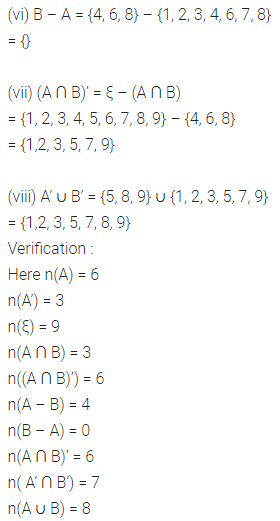
If ξ ={1,2, 3, …. 9}, A = {1, 2, 3, 4, 6, 7, 8} and B = {4, 6, 8}, then find.
(i) A’
(ii) B’
(iii) A ∪ B
(iv) A ∩ B
(v) A – B
(vi) B – A
(vii) (A ∩ B)’
(viii) A’ ∪ B’
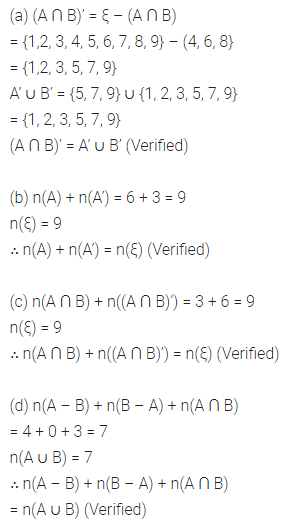
Also verify that:
(a) (A ∩ B)’ = A’ ∪ B’
(b) n(A) + n(A’) = n(ξ)
(c) n(A ∩ B) + n((A ∩ B)’) = n(ξ)
(d) n(A – B) + n(B – A) + n(A ∩ B)
= n(A ∪ B).
Solution:

ML Aggarwal Class 8 Solutions for ICSE Maths Chapter 6 Operation on sets Venn Diagrams Ex 6.1 9
ML Aggarwal Class 8 Solutions for ICSE Maths Chapter 6 Operation on sets Venn Diagrams Ex 6.1 10
ML Aggarwal Class 8 Solutions for ICSE Maths Chapter 6 Operation on sets Venn Diagrams Ex 6.1 11

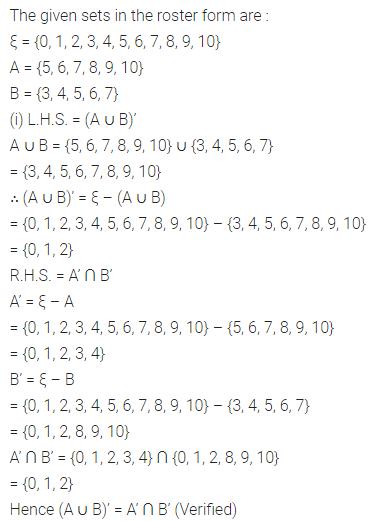
Question 8.
If 4 = {x : x ϵ W, x ≤ 10}, A. = {x : x ≥ 5} and B = {x : 3 ≤ x < 8}, then verify that:
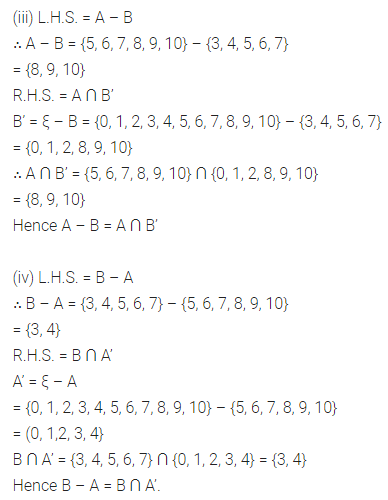
(i) (A ∪ B)’ = A’ ∩ B’
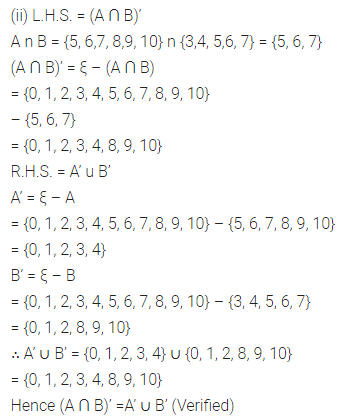
(ii) (A ∩ B)’= A’ ∪ B’
(iii) A – B = A ∩ B’
(iv) B – A = B ∩ A’
Solution:

ML Aggarwal Class 8 Solutions for ICSE Maths Chapter 6 Operation on sets Venn Diagrams Ex 6.1 12
ML Aggarwal Class 8 Solutions for ICSE Maths Chapter 6 Operation on sets Venn Diagrams Ex 6.1 13
ML Aggarwal Class 8 Solutions for ICSE Maths Chapter 6 Operation on sets Venn Diagrams Ex 6.1 14

Question 9.
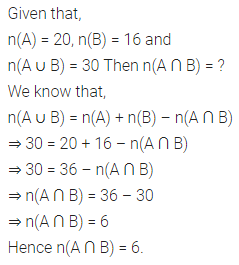
If n(A) = 20, n(B) = 16 and n(A ∪ B) = 30, find n(A ∩ B).
Solution:
ML Aggarwal Class 8 Solutions for ICSE Maths Chapter 6 Operation on sets Venn Diagrams Ex 6.1 15

Question 10.
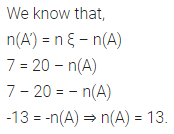
If n ξ = 20 and n(A’) = 7, then find n(A).
Solution:

ML Aggarwal Class 8 Solutions for ICSE Maths Chapter 6 Operation on sets Venn Diagrams Ex 6.1 16

Question 11.
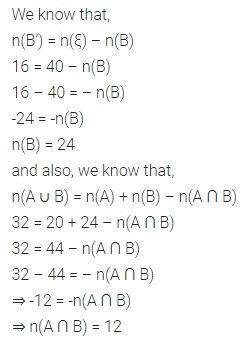
If n(ξ) = 40, n(A) = 20, n(B’) = 16 and n(A ∪ B) = 32, then find n(B) and n(A ∩ B).
Solution:

ML Aggarwal Class 8 Solutions for ICSE Maths Chapter 6 Operation on sets Venn Diagrams Ex 6.1 17

Question 12.
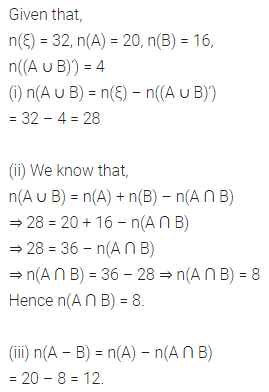
If n(ξ) = 32, n(A) = 20, n(B) = 16 and n((A ∪ B)’) = 4, find :
(i) n(A ∪ B)
(ii) n(A ∩ B)
(iii) n(A – B)
Solution:
ML Aggarwal Class 8 Solutions for ICSE Maths Chapter 6 Operation on sets Venn Diagrams Ex 6.1 18

Question 13.
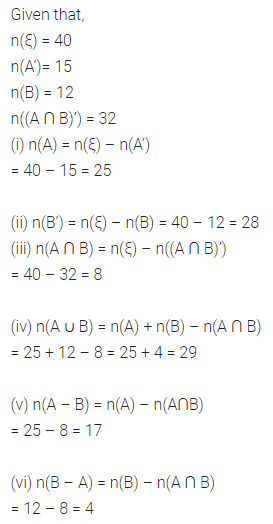
If n(ξ) = 40, n(A’) = 15, n(B) = 12 and n((A ∩ B)’) = 32, find :
(i) n(A)
(ii) n(B’)
(iii) n(A ∩ B)
(iv) n(A ∪ B)
(v) n(A – B)
(vi) n(B – A)
Solution:
ML Aggarwal Class 8 Solutions for ICSE Maths Chapter 6 Operation on sets Venn Diagrams Ex 6.1 19

Question 14.
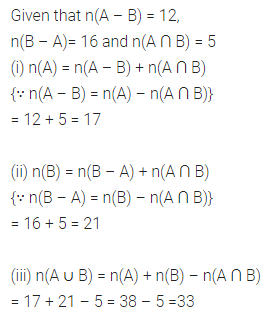
If n(A – B) = 12, n(B – A) = 16 and n(A ∩ B) = 5, find:
(i) n(A)
(ii) n(B)
(iii) n(A ∪ B)
Solution:
ML Aggarwal Class 8 Solutions for ICSE Maths Chapter 6 Operation on sets Venn Diagrams Ex 6.1 20

ML Aggarwal Class 8 Solutions for ICSE Maths

ML Aggarwal Class 8 Solutions for ICSE Maths Chapter 5 Playing with Numbers Check Your Progress

ML Aggarwal Class 8 Solutions for ICSE Maths Chapter 5 Playing with Numbers Check Your Progress

Question 1.
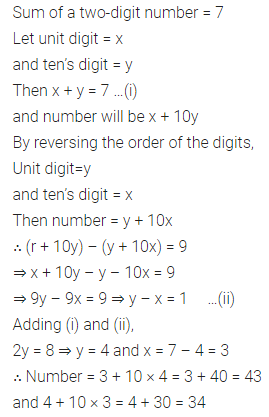
In a 2-digit number, sum of digits is 7. If the difference of 2 digit number and number obtained by reversing the digits is 9, then find the number.
Solution:
ML Aggarwal Class 8 Solutions for ICSE Maths Chapter 5 Playing with Numbers Check Your Progress 1

Question 2.
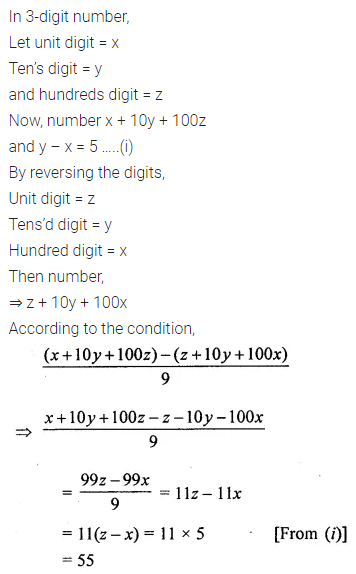
In a 3 digit number, the difference of hundred’s digit and unit’s digit is 5. Find the quotient when difference of 3-digit number and number obtained by reversing the digits is divided by 9.
Solution:
ML Aggarwal Class 8 Solutions for ICSE Maths Chapter 5 Playing with Numbers Check Your Progress 2

Question 3.
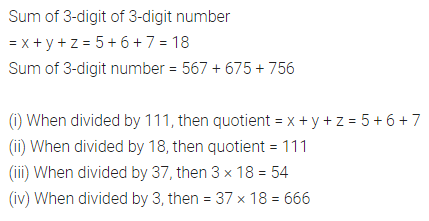
Without actual calculation, write the quotient when sum of 3 digit numbers 567, 675 and 756 is divided by
(i) 111
(ii) 18
(iii) 37
(iv) 3
Solution:
ML Aggarwal Class 8 Solutions for ICSE Maths Chapter 5 Playing with Numbers Check Your Progress 3

Question 4.
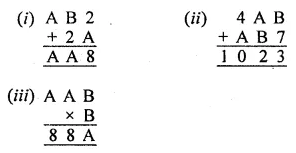
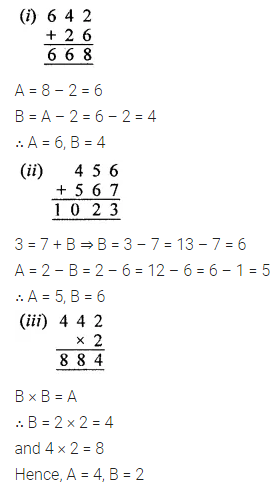
Find the values of the letters in each of the following and give reasons for the steps involved:
ML Aggarwal Class 8 Solutions for ICSE Maths Chapter 5 Playing with Numbers Check Your Progress 4
Solution:
ML Aggarwal Class 8 Solutions for ICSE Maths Chapter 5 Playing with Numbers Check Your Progress 5

Question 5.
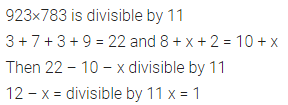
If 923×783 is divisible by 11, what is the value of digit x?
Solution:
ML Aggarwal Class 8 Solutions for ICSE Maths Chapter 5 Playing with Numbers Check Your Progress 6

Question 6.
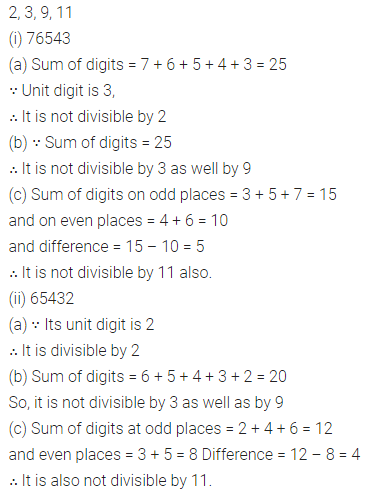
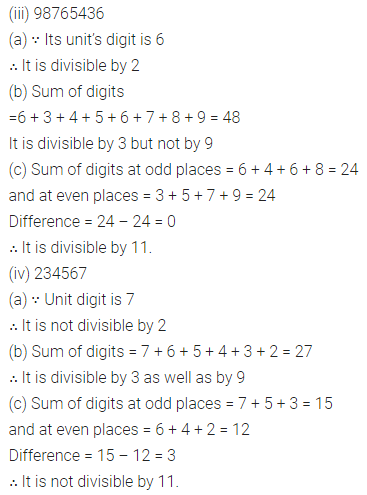
Check the divisibility of following numbers by 2, 3, 9 and 11:
(i) 76543
(ii) 65432
(iii) 98765436
(iv) 234567
Solution:
ML Aggarwal Class 8 Solutions for ICSE Maths Chapter 5 Playing with Numbers Check Your Progress 7
ML Aggarwal Class 8 Solutions for ICSE Maths Chapter 5 Playing with Numbers Check Your Progress 8

Question 7.
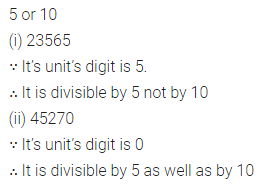
Check the divisibility of the following numbers by 5 or 10:
(i) 23565
(ii) 45270
Solution:
ML Aggarwal Class 8 Solutions for ICSE Maths Chapter 5 Playing with Numbers Check Your Progress 9

Question 8.
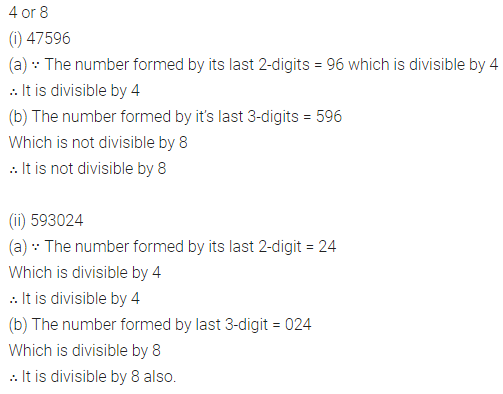
Check the divisibility of the following numbers by 4 or 8:
(i) 47596
(ii) 593024
Solution:
ML Aggarwal Class 8 Solutions for ICSE Maths Chapter 5 Playing with Numbers Check Your Progress 10

ML Aggarwal Class 8 Solutions for ICSE Maths

ML Aggarwal Class 8 Solutions for ICSE Maths Chapter 5 Playing with Numbers Objective Type Questions

ML Aggarwal Class 8 Solutions for ICSE Maths Chapter 5 Playing with Numbers Objective Type Questions

Mental Maths
Question 1.
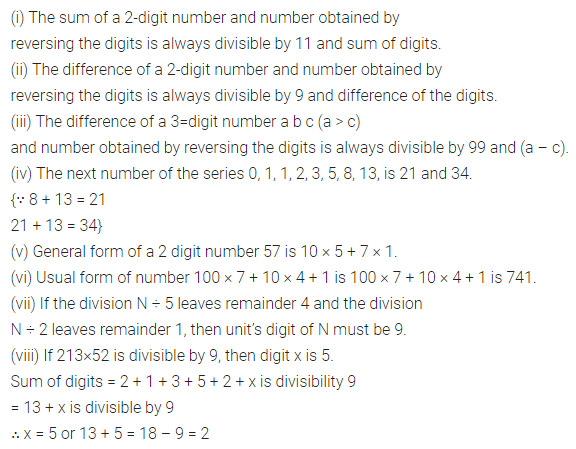
Fill in the blanks:
(i) The sum of a 2-digit number and number obtained by reversing the digits is always divisible by 11 and ……….
(ii) The difference of a 2-digit number and number obtained by reversing the digits is always divisible by ………. and ……….
(iii) The difference of a 3=digit number a b c (a > c) and the number obtained by reversing the digits is always divisible by ………. and ……….
(iv) The next number of the series 0, 1, 1, 2, 3, 5, 8, 13, ………. is ……….
(v) General form of a 2 digit number 57 is ……….
(vi) Usual form of number 100 × 7 + 10 × 4 + 1 is ……….
(vii) If the division N ÷ 5 leaves remainder 4 and the division N ÷ 2 leaves remainder 1, then unit’s digit of N must be ……….
(viii)If 213×52 is divisible by 9, then digit x is ……….
Solution:
ML Aggarwal Class 8 Solutions for ICSE Maths Chapter 5 Playing with Numbers Objective Type Questions 1

Question 2.
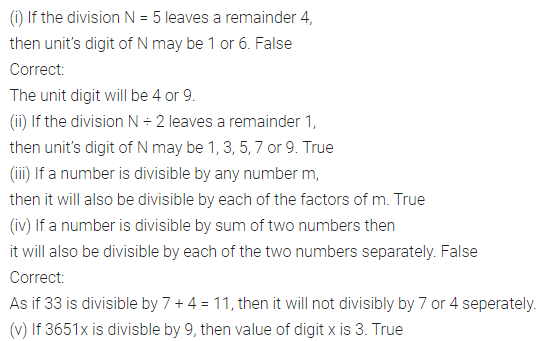
State whether the following statements are true (T) or false (F):
(i) If the division N ÷ 5 leaves a remainder 4, then unit’s digit of N may be 1 or 6.
(ii) If the division N ÷ 2 leaves a remainder 1, then unit’s digit of N may be 1, 3, 5, 7 or 9.
(iii) If a number is divisible by any number m, then it will also be divisible by each of the factors of m.
(iv) If a number is divisible by sum of two numbers then it will also be divisible by each of the two numbers separately.
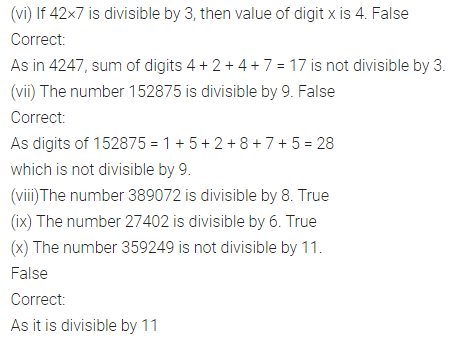
(v) If 3651x is divisble by 9, then value of digit x is 3.
(vi) If 42×7 is divisible by 3, then value of digit x is 4.
(vii) The number 152875 is divisible by 9.
(viii)The number 389072 is divisible by 8.
(ix) The number 27402 is divisible by 6.
(x) The number 359249 is not divisible by 11.
Solution:
ML Aggarwal Class 8 Solutions for ICSE Maths Chapter 5 Playing with Numbers Objective Type Questions 2
ML Aggarwal Class 8 Solutions for ICSE Maths Chapter 5 Playing with Numbers Objective Type Questions 3

Multiple Choice Questions
Choose the correct answer from the given four options (3 to 13):
Question 3.
When the sum of a 2-digit number ab and number obtained by reversing the digits is divided by (a + b), the quotient is
(a) a – b
(b) 9
(c) 11
(d) None of these
Solution:
ML Aggarwal Class 8 Solutions for ICSE Maths Chapter 5 Playing with Numbers Objective Type Questions 4

Question 4.
When the sum of a 3-digit number abc and numbers obtained by changing the order of the digits cyclically is divided by 111, then the quotient is
(a) 37
(b) a – b + c
(c) a + b + c
(d) 3
Solution:
ML Aggarwal Class 8 Solutions for ICSE Maths Chapter 5 Playing with Numbers Objective Type Questions 5

Question 5.
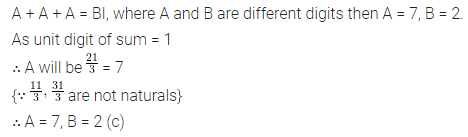
If A + A + A = BI, where A and B are different digits, then
(a) A = 1, B = 5
(b) A = 5, B = 2
(c) A = 5, B = 1
(d) A = 7, B = 2
Solution:
ML Aggarwal Class 8 Solutions for ICSE Maths Chapter 5 Playing with Numbers Objective Type Questions 6

Question 6.
Which of the following numbers is not divisible by 2?
(a) 437218
(b) 437821
(c) 437812
(d) 437182
Solution:
ML Aggarwal Class 8 Solutions for ICSE Maths Chapter 5 Playing with Numbers Objective Type Questions 7

Question 7.
Which of the following numbers is not divisible by 10?
(a) 32570
(b) 32750
(c) 32500
(d) 32075
Solution:
ML Aggarwal Class 8 Solutions for ICSE Maths Chapter 5 Playing with Numbers Objective Type Questions 8

Question 8.
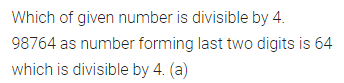
Which of the following numbers is divisible by 4?
(a) 98764
(b) 98746
(c) 98674
(d) 98647
Solution:
ML Aggarwal Class 8 Solutions for ICSE Maths Chapter 5 Playing with Numbers Objective Type Questions 9

Question 9.
Which of the following numbers is divisible by 8?
(a) 32466
(b) 32476
(c) 32486
(d) 32456
Solution:
ML Aggarwal Class 8 Solutions for ICSE Maths Chapter 5 Playing with Numbers Objective Type Questions 10

Question 10.
Which of the following numbers is divisible by 11?
(a) 725824
(b) 752824
(c) 725842
(d) 725482
Solution:
ML Aggarwal Class 8 Solutions for ICSE Maths Chapter 5 Playing with Numbers Objective Type Questions 11

Question 11.
Which of the following numbers is not divisible by 9?
(a) 24354
(b) 24453
(c) 24534
(d) 24564
Solution:
ML Aggarwal Class 8 Solutions for ICSE Maths Chapter 5 Playing with Numbers Objective Type Questions 12

Question 12.
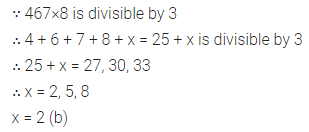
If 467×8 is divisible by 3, then the value of x
(a) 1
(b) 2
(c) 3
(d) 4
Solution:
ML Aggarwal Class 8 Solutions for ICSE Maths Chapter 5 Playing with Numbers Objective Type Questions 13

Question 13.
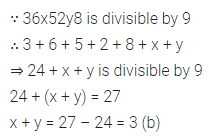
If 36x52y8 is divisible by 9, then x + y is
(a) 2
(b) 3
(c) 4
(d) 5
Solution:
ML Aggarwal Class 8 Solutions for ICSE Maths Chapter 5 Playing with Numbers Objective Type Questions 14

Value Based Question
Question 1.
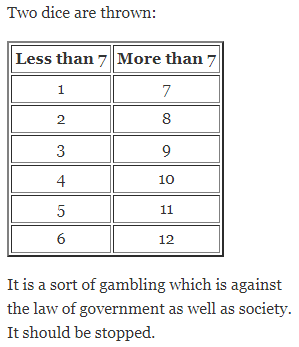
Rishabh plays a game with two dice in a fete. He draws three columns on a chart paper. In the left-most column, he writes the digits less than 7 and in the rightmost column he writes the numbers greater than 7. In the middle column, he writes digit 7 only. He offers people to keep money on any one of the columns. He throws two dice together if the sum of the digits on the two dice is less than 7, he doubles the money kept on the left-most column and collect the money kept on the remaining two columns. Similarly, he doubles the money on a rightmost column if the sum of digits is greater than 7 and triples on the middle column if the sum of the digits is 7. What digits should he write on leftmost and rightmost columns?
Is this game a sort of gambling? Is gambling a good way of earning money?
Solution:
ML Aggarwal Class 8 Solutions for ICSE Maths Chapter 5 Playing with Numbers Objective Type Questions 15

Higher Order Thinking Skills (Hots)
Question 1.
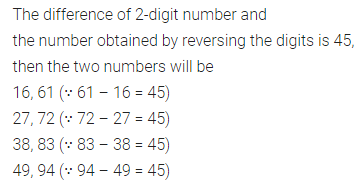
If the difference of two-digit number and number obtained by reversing the digits is 45, then write all possible 2-digit numbers.
Solution:
ML Aggarwal Class 8 Solutions for ICSE Maths Chapter 5 Playing with Numbers Objective Type Questions 16

ML Aggarwal Class 8 Solutions for ICSE Maths

ML Aggarwal Class 8 Solutions for ICSE Maths Chapter 5 Playing with Numbers Ex 5.3

ML Aggarwal Class 8 Solutions for ICSE Maths Chapter 5 Playing with Numbers Ex 5.3

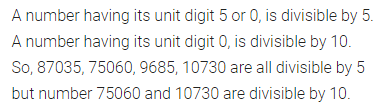
Question 1.
Which of the following numbers are divisible by 5 or by 10:
(i) 87035
(ii) 75060
(iii) 9685
(iv) 10730
Solution:
ML Aggarwal Class 8 Solutions for ICSE Maths Chapter 5 Playing with Numbers Ex 5.3 1

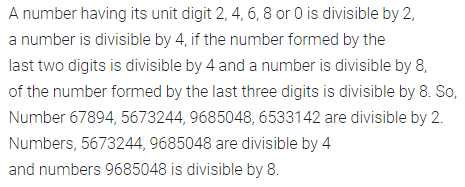
Question 2.
Which of the following numbers are divisible by 2, 4 or 8:
(i) 67894
(ii) 5673244
(iii) 9685048
(iv) 6533142
(v) 75379
Solution:
ML Aggarwal Class 8 Solutions for ICSE Maths Chapter 5 Playing with Numbers Ex 5.3 2

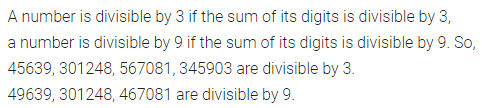
Question 3.
Which of the following numbers are divisible by 3 or 9:
(i) 45639
(ii) 301248
(iii) 567081
(iv) 345903
(v) 345046
Solution:
ML Aggarwal Class 8 Solutions for ICSE Maths Chapter 5 Playing with Numbers Ex 5.3 3

Question 4.
Which of the following numbers are divisible by 11:
(i) 10835
(ii) 380237
(iii) 504670
(iv) 28248
Solution:
ML Aggarwal Class 8 Solutions for ICSE Maths Chapter 5 Playing with Numbers Ex 5.3 4

Question 5.
Which of the following numbers are divisible by 6:
(i)15414
(ii) 213888
(iii) 469876
Solution:
ML Aggarwal Class 8 Solutions for ICSE Maths Chapter 5 Playing with Numbers Ex 5.3 5

Question 6.
Which of the following numbers are divisible by 7:
(i) 46f8894875
(ii) 3794856
(iii) 39823
Solution:
ML Aggarwal Class 8 Solutions for ICSE Maths Chapter 5 Playing with Numbers Ex 5.3 6

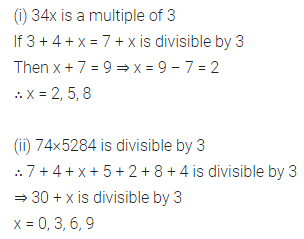
Question 7.
(i) If 34x is a multiple of 3, where x is a digit, what is the value of x?
(ii) If 74×5284 is a multiple of 3, where x is a digit, find the value(s) of x.
Solution:
ML Aggarwal Class 8 Solutions for ICSE Maths Chapter 5 Playing with Numbers Ex 5.3 7

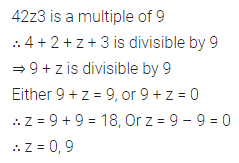
Question 8.
If 42z3 is a multiple of 9, where z is a digit, what is the value of z?
Solution:
ML Aggarwal Class 8 Solutions for ICSE Maths Chapter 5 Playing with Numbers Ex 5.3 8

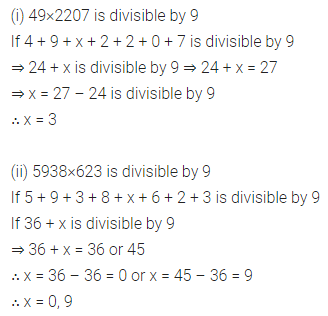
Question 9.
In each of the following replace * by a digit so that the number formed is divisible by 9:
(i) 49 * 2207
(ii) 5938 * 623
Solution:
ML Aggarwal Class 8 Solutions for ICSE Maths Chapter 5 Playing with Numbers Ex 5.3 9

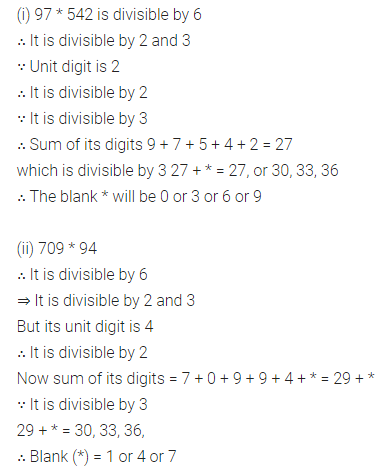
Question 10.
In each of the following replace * by a digit so that the number formed is divisible by 6:
(i) 97 * 542
(ii) 709 * 94
Solution:
ML Aggarwal Class 8 Solutions for ICSE Maths Chapter 5 Playing with Numbers Ex 5.3 10

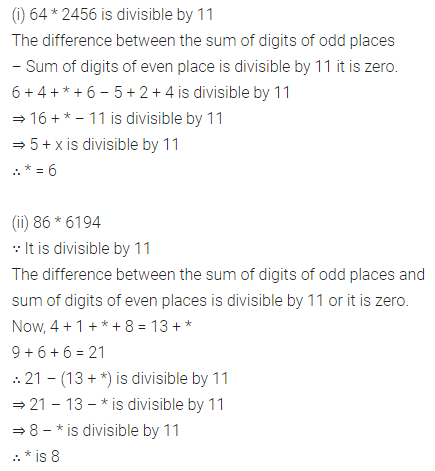
Question 11.
In each of the following replace * by a digit so that the number formed is divisible by 11:
(i) 64*2456
(ii) 86*6194
Solution:
ML Aggarwal Class 8 Solutions for ICSE Maths Chapter 5 Playing with Numbers Ex 5.3 11

ML Aggarwal Class 8 Solutions for ICSE Maths