ML Aggarwal Class 8 Solutions for ICSE Maths Chapter 9 Direct and Inverse Variation Ex 9.2

ML Aggarwal Class 8 Solutions for ICSE Maths Chapter 9 Direct and Inverse Variation Ex 9.2

Question 1.
Which of the following are in inverse variation?
(i) The number of students in a hostel and the consumption of food.
(ii) Time is taken by a train to cover a fixed distance and the speed of the train.
(iii) Area of land and its cost.
(iv) The number of people working and the time to complete the work.
(v) The quantity of rice and its cost.
Solution:

ML Aggarwal Class 8 Solutions for ICSE Maths Chapter 9 Direct and Inverse Variation Ex 9.2 1

Question 2.
Observe the following tables and find which pair of variables (here x and y) are in inverse variation:
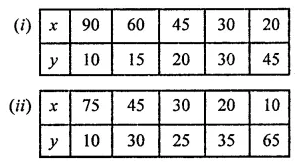
ML Aggarwal Class 8 Solutions for ICSE Maths Chapter 9 Direct and Inverse Variation Ex 9.2 2
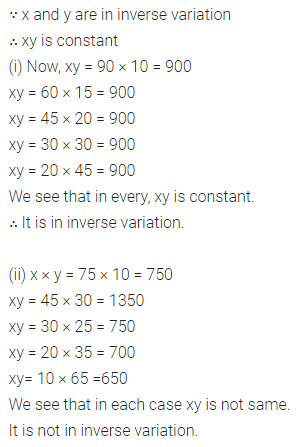
Solution:
ML Aggarwal Class 8 Solutions for ICSE Maths Chapter 9 Direct and Inverse Variation Ex 9.2 3

Question 3.
Under the condition that the temperature remains constant, the volume of gas is inversely proportional to its pressure. If the volume of gas is 630 cubic centimetres at a pressure of 360 mm of mercury, then what will be the pressure of the gas, if its volume is 720 cubic centimetres at the same temperature?
Solution:
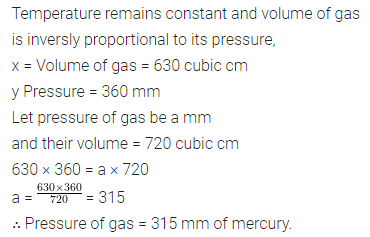
ML Aggarwal Class 8 Solutions for ICSE Maths Chapter 9 Direct and Inverse Variation Ex 9.2 4

Question 4.
A packet of sweets was distributed among 20 children and each of them received 4 sweets. How many sweets will each child get, if the number of children is reduced by 4?
Solution:
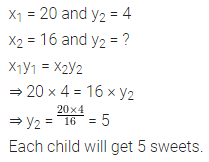
ML Aggarwal Class 8 Solutions for ICSE Maths Chapter 9 Direct and Inverse Variation Ex 9.2 5

Question 5.
Pooja has enough money to buy 36 oranges at the rate of ₹4.50 per orange. How many oranges she can buy if the price of each orange is increased by 90 paise?
Solution:
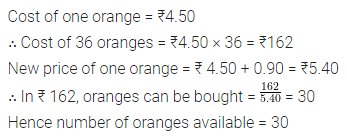
ML Aggarwal Class 8 Solutions for ICSE Maths Chapter 9 Direct and Inverse Variation Ex 9.2 6

Question 6.
It takes 8 days for 12 men to construct a wall. How many men should be put on the job if it is required to be constructed in 6 days.?
Solution:
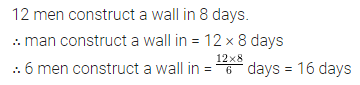
ML Aggarwal Class 8 Solutions for ICSE Maths Chapter 9 Direct and Inverse Variation Ex 9.2 7

Question 7.
Eight taps through which water flows at the same rate can fill a tank in 27 minutes. If two taps go out of order, how long will the remaining taps take to fill the tank?
Solution:
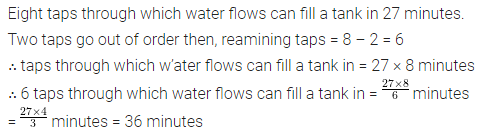
ML Aggarwal Class 8 Solutions for ICSE Maths Chapter 9 Direct and Inverse Variation Ex 9.2 8

Question 8.
A contractor undertook a contract to complete a part of a stadium in 9 months with a team of 560 persons. Later on, it was required to complete the job in 5 months. How many extra persons should he employ to complete the work?
Solution:
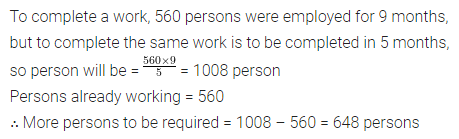
ML Aggarwal Class 8 Solutions for ICSE Maths Chapter 9 Direct and Inverse Variation Ex 9.2 9

Question 9.
A batch of bottles were packed in 30 boxes with 10 bottles in each box. If the same batch is packed using 12 bottles in each box, how many boxes would be filled?
Solution:

ML Aggarwal Class 8 Solutions for ICSE Maths Chapter 9 Direct and Inverse Variation Ex 9.2 10

Question 10.
Vandana takes 24 minutes to reach her school if she goes at a speed of 5 km/h. If she wants to reach school in 20 minutes, what should be her speed?
Solution:

ML Aggarwal Class 8 Solutions for ICSE Maths Chapter 9 Direct and Inverse Variation Ex 9.2 11

Question 11.
A fort is provided with food for 80 soldiers to last for 60 days. Find how long would the food last if 20 additional soldiers join after 15 days.
Solution:
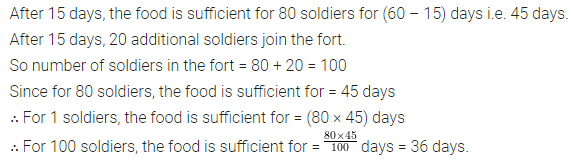
ML Aggarwal Class 8 Solutions for ICSE Maths Chapter 9 Direct and Inverse Variation Ex 9.2 12

Question 12.
1200 soldiers in a fort had enough food for 28 days. After 4 days, some soldiers were sent to another fort and thus, the food lasted for 32 more days. How many soldiers left the fort?
Solution:
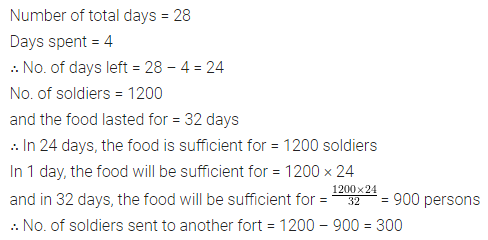
ML Aggarwal Class 8 Solutions for ICSE Maths Chapter 9 Direct and Inverse Variation Ex 9.2 13

ML Aggarwal Class 8 Solutions for ICSE Maths

ML Aggarwal Class 8 Solutions for ICSE Maths Chapter 9 Direct and Inverse Variation Ex 9.1

ML Aggarwal Class 8 Solutions for ICSE Maths Chapter 9 Direct and Inverse Variation Ex 9.1

Question 1.
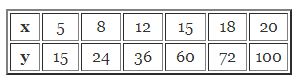
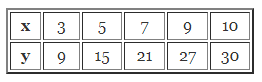
Observe the following tables and find if x and y are directly proportional:
(i)
ML Aggarwal Class 8 Solutions for ICSE Maths Chapter 9 Direct and Inverse Variation Ex 9.1 1
(ii)
ML Aggarwal Class 8 Solutions for ICSE Maths Chapter 9 Direct and Inverse Variation Ex 9.1 2
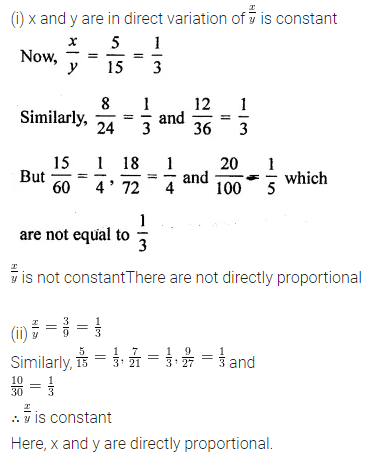
Solution:
ML Aggarwal Class 8 Solutions for ICSE Maths Chapter 9 Direct and Inverse Variation Ex 9.1 3

Question 2.
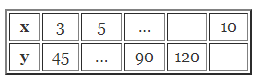
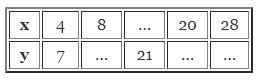
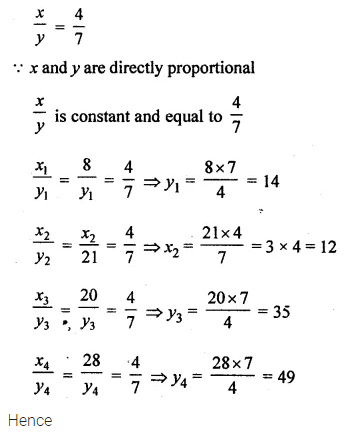
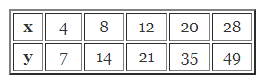
If x and y are in direct variation, complete the following tables:
(i)
ML Aggarwal Class 8 Solutions for ICSE Maths Chapter 9 Direct and Inverse Variation Ex 9.1 4
(ii)
ML Aggarwal Class 8 Solutions for ICSE Maths Chapter 9 Direct and Inverse Variation Ex 9.1 5
Solution:
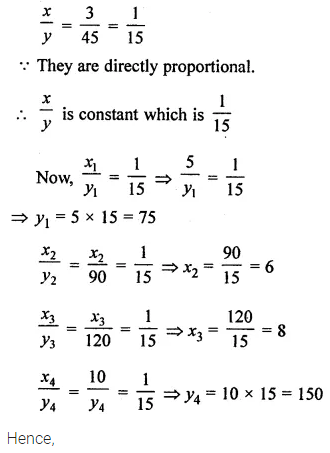
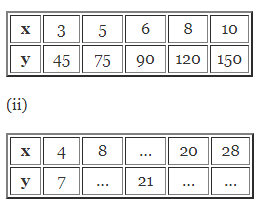
ML Aggarwal Class 8 Solutions for ICSE Maths Chapter 9 Direct and Inverse Variation Ex 9.1 6
ML Aggarwal Class 8 Solutions for ICSE Maths Chapter 9 Direct and Inverse Variation Ex 9.1 7
ML Aggarwal Class 8 Solutions for ICSE Maths Chapter 9 Direct and Inverse Variation Ex 9.1 8
ML Aggarwal Class 8 Solutions for ICSE Maths Chapter 9 Direct and Inverse Variation Ex 9.1 9

Question 3.
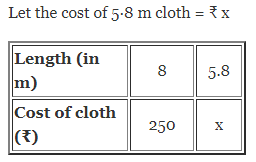
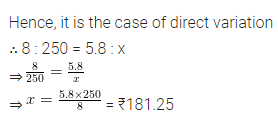
If 8 metres cloth costs ₹250, find the cost of 5·8 metres of the same cloth.
Solution:
ML Aggarwal Class 8 Solutions for ICSE Maths Chapter 9 Direct and Inverse Variation Ex 9.1 10
ML Aggarwal Class 8 Solutions for ICSE Maths Chapter 9 Direct and Inverse Variation Ex 9.1 11

Question 4.
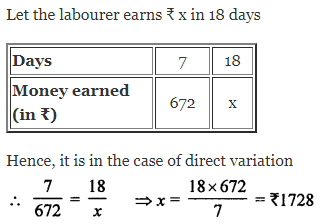
If a labourer earns ₹672 per week, how much will he earn in 18 days?
Solution:
ML Aggarwal Class 8 Solutions for ICSE Maths Chapter 9 Direct and Inverse Variation Ex 9.1 12

Question 5.
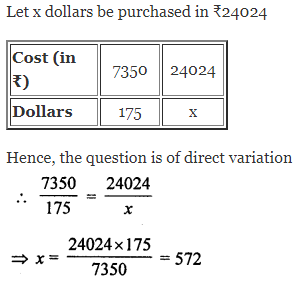
If 175 dollars cost ₹7350, how many dollars can be purchased in ₹24024?
Solution:
ML Aggarwal Class 8 Solutions for ICSE Maths Chapter 9 Direct and Inverse Variation Ex 9.1 13

Question 6.
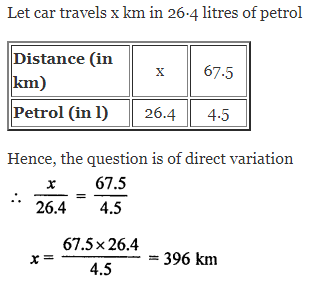
If a car travels 67·5 km in 4·5 litres of petrol, how many kilometres will it travel in 26-4 litres of petrol?
Solution:
ML Aggarwal Class 8 Solutions for ICSE Maths Chapter 9 Direct and Inverse Variation Ex 9.1 14

Question 7.
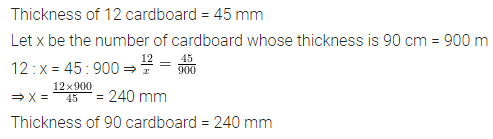
If the thickness of a pile of 12 cardboard sheets is 45 mm, then how many sheets of the same cardboard would be 90 cm thick?
Solution:
ML Aggarwal Class 8 Solutions for ICSE Maths Chapter 9 Direct and Inverse Variation Ex 9.1 15

Question 8.
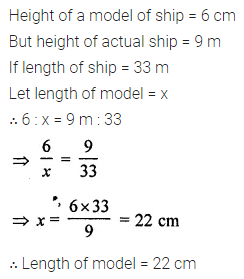
In a model of a ship, the mast (flagstaff) is 6 cm high, while the mast of the actual ship is 9 m high. If the length of the ship is 33 m, how long is the model of the ship?
Solution:
ML Aggarwal Class 8 Solutions for ICSE Maths Chapter 9 Direct and Inverse Variation Ex 9.1 16

Question 9.
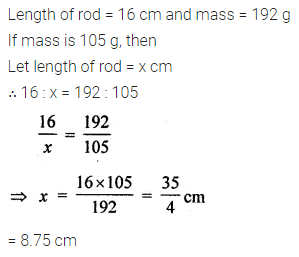
The mass of an aluminium rod varies directly with its length. If a 16 cm long rod has a mass of 192 g, find the length of the rod whose mass is 105 g.
Solution:
ML Aggarwal Class 8 Solutions for ICSE Maths Chapter 9 Direct and Inverse Variation Ex 9.1 17

Question 10.
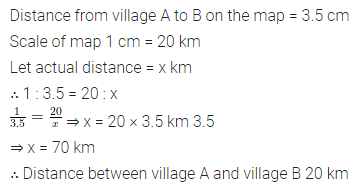
Anita has to drive from village A to village B. She measures a distance of 3.5 cm between these villages on the map. What is the actual distance between the villages if the map scale is 1 cm = 20 km?
Solution:
ML Aggarwal Class 8 Solutions for ICSE Maths Chapter 9 Direct and Inverse Variation Ex 9.1 18

Question 11.
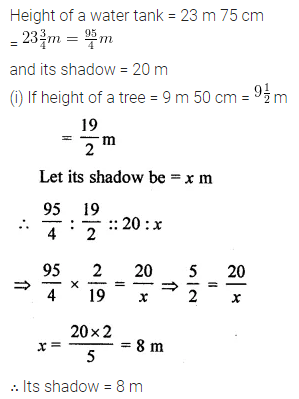
A 23 m 75 cm high water tank casts a shadow 20 m long. Find at the same time;
(i) the length of the shadow cast by a tree 9 m 50 cm high.
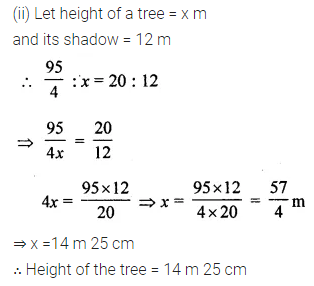
(ii) the height of the tree if the length of the shadow is 12 m.
Solution:
ML Aggarwal Class 8 Solutions for ICSE Maths Chapter 9 Direct and Inverse Variation Ex 9.1 19
ML Aggarwal Class 8 Solutions for ICSE Maths Chapter 9 Direct and Inverse Variation Ex 9.1 20

Question 12.
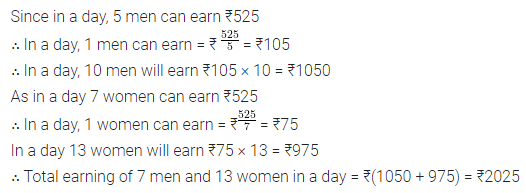
If 5 men or 7 women can earn ₹525 per day, how much would 10 men and 13 women will earn per day.
Solution:
ML Aggarwal Class 8 Solutions for ICSE Maths Chapter 9 Direct and Inverse Variation Ex 9.1 21

ML Aggarwal Class 8 Solutions for ICSE Maths

ML Aggarwal Class 8 Solutions for ICSE Maths Chapter 8 Simple and Compound Interest Check Your Progress

ML Aggarwal Class 8 Solutions for ICSE Maths Chapter 8 Simple and Compound Interest Check Your Progress

Question 1.
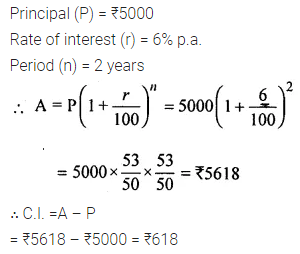
Find the amount and the compound interest on ₹5000 for 2 years at 6% per annum interest payable yearly.
Solution:
ML Aggarwal Class 8 Solutions for ICSE Maths Chapter 8 Simple and Compound Interest Check Your Progress 1

Question 2.
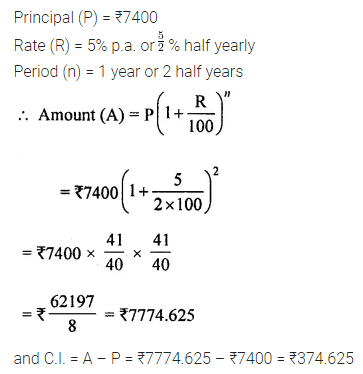
Find the amount and the compounded interest on ₹7400 for 1 year at 5% per annum, interest payable half-yearly.
Solution:
ML Aggarwal Class 8 Solutions for ICSE Maths Chapter 8 Simple and Compound Interest Check Your Progress 2

Question 3.
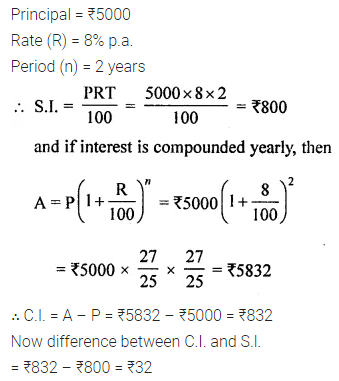
Find the difference between C.I. and S.l. on a sum of ₹5000 for 2 years at 8% per annum payable yearly.
Solution:
ML Aggarwal Class 8 Solutions for ICSE Maths Chapter 8 Simple and Compound Interest Check Your Progress 3

Question 4.
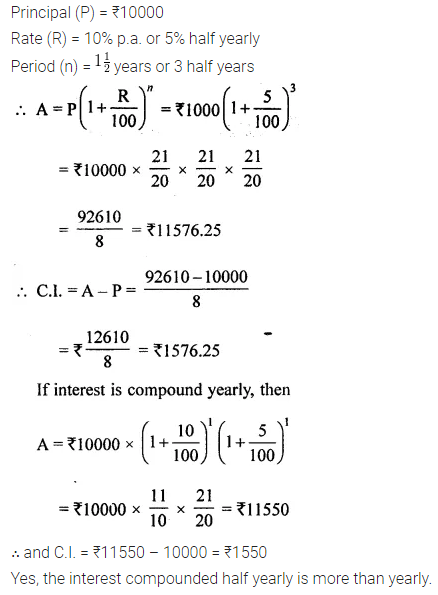
Find the amount and compound interest on ₹10000 for \(1 \frac{1}{2}\) years at 10% per annum, compounded half yearly. Would this interest be more than the interest he would get if it was compounded annually?
Solution:
ML Aggarwal Class 8 Solutions for ICSE Maths Chapter 8 Simple and Compound Interest Check Your Progress 4

Question 5.
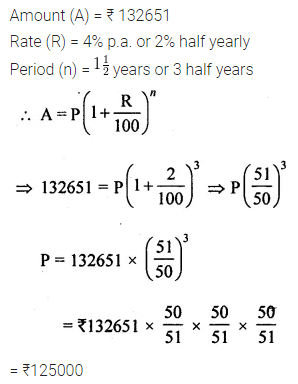
What sum invested for \(1 \frac{1}{2}\) years compounded half-yearly at the rate of 4% p.a. will amount to ₹ 132651?
Solution:
ML Aggarwal Class 8 Solutions for ICSE Maths Chapter 8 Simple and Compound Interest Check Your Progress 5

Question 6.
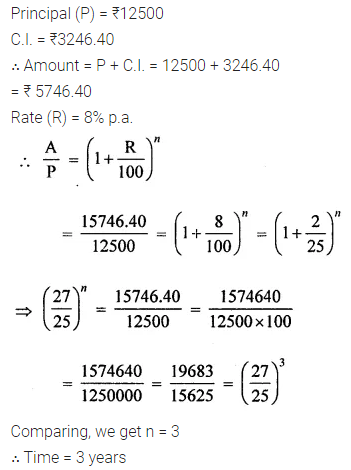
Find the time (in years) in which ₹ 12500 will produce ₹3246.40 as compound interest at 8% per annum, compounded annually.
Solution:
ML Aggarwal Class 8 Solutions for ICSE Maths Chapter 8 Simple and Compound Interest Check Your Progress 6

Question 7.
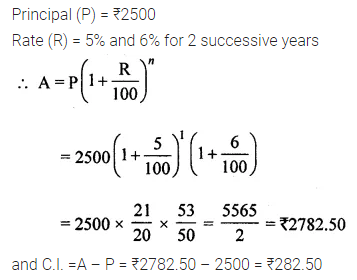
Find the amount and compound interest on ₹2500 in 2 years if the rate are 5% and 6% for the successive years.
Solution:
ML Aggarwal Class 8 Solutions for ICSE Maths Chapter 8 Simple and Compound Interest Check Your Progress 7

ML Aggarwal Class 8 Solutions for ICSE Maths

ML Aggarwal Class 8 Solutions for ICSE Maths Chapter 8 Simple and Compound Interest Objective Type Questions

ML Aggarwal Class 8 Solutions for ICSE Maths Chapter 8 Simple and Compound Interest Objective Type Questions

Mental Maths
Question 1.
Fill in the blanks:
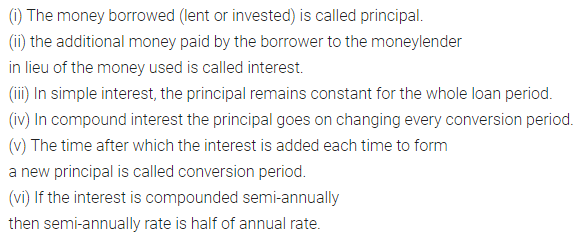
(i) The money borrowed (lent or invested) is called …………
(ii) the additional money paid by the borrower to the moneylender in lieu of the money used is called …………
(iii) In simple interest, the principal ………… for the whole loan period.
(iv) In compound interest the ………… goes on changing every conversion period.
(v) The time after which the interest is added each time to form a new principal is called …………
(vi) If the interest is compounded semi-annually then semi-annually rate is ………… of the annual rate.
Solution:
ML Aggarwal Class 8 Solutions for ICSE Maths Chapter 8 Simple and Compound Interest Objective Type Questions 1

Question 2.
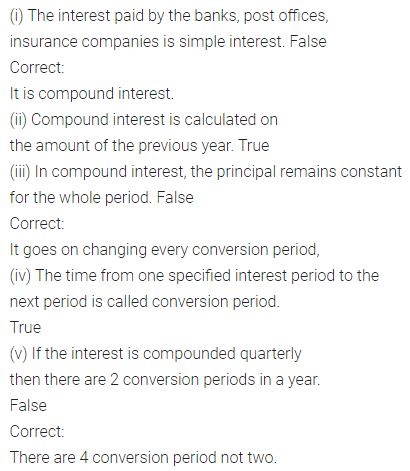
State whether the following statements are true (T) or false (F):
(i) The interest paid by the banks, post offices, insurance companies is simple interest.
(ii) Compound interest is calculated on the amount of the previous year.
(iii) In compound interest, the principal remains constant for the whole period.
(iv) The time from one specified interest period to the next period is called the conversion period.
(v) If the interest is compounded quarterly then there are 2 conversion periods in a year.
Solution:
ML Aggarwal Class 8 Solutions for ICSE Maths Chapter 8 Simple and Compound Interest Objective Type Questions 2

Multiple Choice Questions
Choose the correct answer from the given four options (3 to 9):
Question 3.
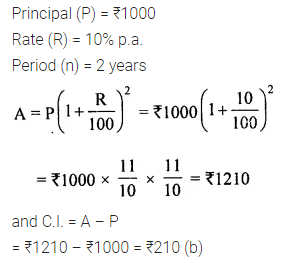
The compound interest on ^1000 at 10% p.a. for 2 years is
(a) ₹190
(b) ₹210
(c) ₹1210
(d) ₹200
Solution:
ML Aggarwal Class 8 Solutions for ICSE Maths Chapter 8 Simple and Compound Interest Objective Type Questions 3

Question 4.
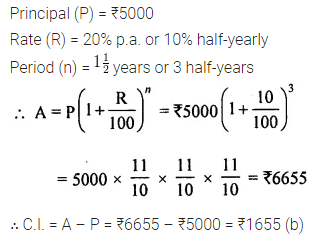
The compound interest on ₹5000 at 20% per annum for \(1 \frac{1}{2}\) years compounded half yearly is
(a) ₹6655
(b) ₹1655
(c) ₹50
(d) ₹1000
Solution:
ML Aggarwal Class 8 Solutions for ICSE Maths Chapter 8 Simple and Compound Interest Objective Type Questions 4

Question 5.
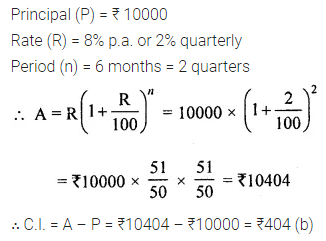
The compound interest on ₹10000 at 8% per annum for 6 months compounded quarterly is
a) ₹408
(b) ₹10404
(c) ₹404
(d) ₹400
Solution:
ML Aggarwal Class 8 Solutions for ICSE Maths Chapter 8 Simple and Compound Interest Objective Type Questions 5

Question 6.
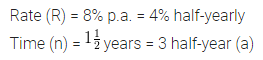
The time periods and rate for a sum taken at 8% p.a. for \(1 \frac{1}{2}\) years compounded half yearly are
(a) n = 3, R = 4%
(b) n = 6, R = 2%
(c) n = 3, R = 2%
(d) n = 6, R = 4%
Solution:
ML Aggarwal Class 8 Solutions for ICSE Maths Chapter 8 Simple and Compound Interest Objective Type Questions 6

Question 7.
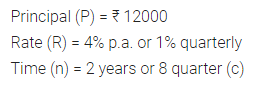
If ₹12000 taken for 2 years at 4% per annum compounded quarterly, then time period and rate is
(a) n = 2, R = 16%
(b) n = 4, R = 1 %
(c) n = 8, R = 1%
(d) n = 8, R = 16%
Solution:
ML Aggarwal Class 8 Solutions for ICSE Maths Chapter 8 Simple and Compound Interest Objective Type Questions 7

Question 8.
If the number of conversion periods ≥ 2, then compound interest is
(a) less than or equal to the simple interest
(b) greater than or equal to the simple interest
(c) less than simple interest
(d) greater than simple interest
Solution:
ML Aggarwal Class 8 Solutions for ICSE Maths Chapter 8 Simple and Compound Interest Objective Type Questions 8

Question 9.
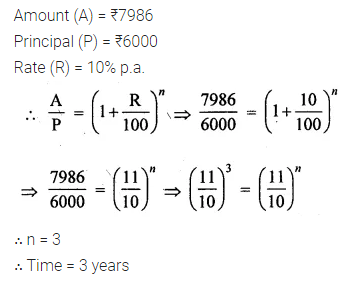
The time in which ₹6000 amounts to ₹7986 at 10% p.a. compounded annually is
(a) 2 years
(b) 3 years
(c) 4 years
(d) 5 years
Solution:
ML Aggarwal Class 8 Solutions for ICSE Maths Chapter 8 Simple and Compound Interest Objective Type Questions 9

Value Based Question
Question 1.
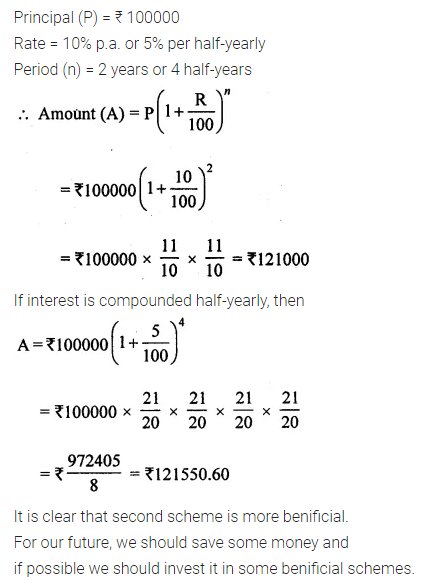
A person wants to invest ₹ 100000 in fixed deposit scheme for 2 years. His financial advisor explained to him two types of schemes first is yielding 10% p.a. compounded annually, second is yielding 10% p.a. compounded semi-annually. Which scheme is better and why? Why investment is important for future life?
Solution:
ML Aggarwal Class 8 Solutions for ICSE Maths Chapter 8 Simple and Compound Interest Objective Type Questions 10

Higher Order Thinking Skills (Hots)
Question 1.
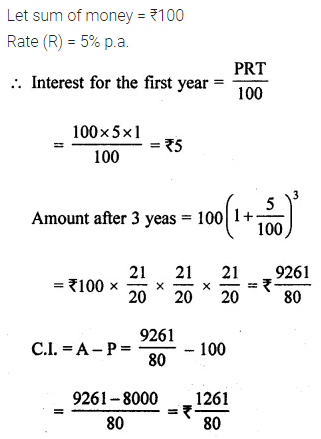
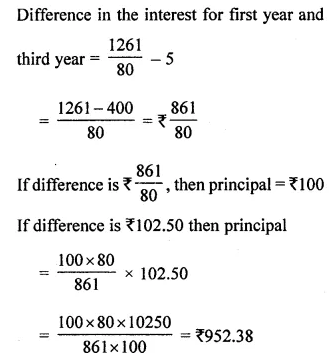
A certain sum of money is invested at the rate of 5% per annum compound interest, the interest compounded annually. If the difference between the interests of the third year and the first year is ₹102.50. Find the sum.
Solution:
ML Aggarwal Class 8 Solutions for ICSE Maths Chapter 8 Simple and Compound Interest Objective Type Questions 11
ML Aggarwal Class 8 Solutions for ICSE Maths Chapter 8 Simple and Compound Interest Objective Type Questions 12

Question 2.
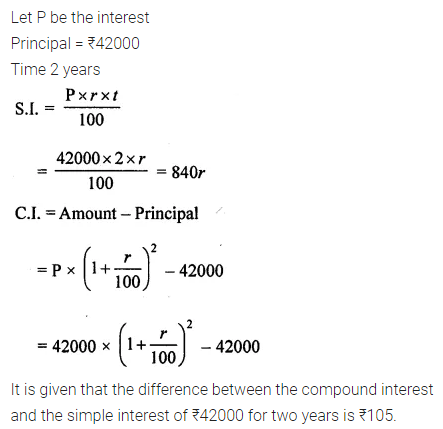
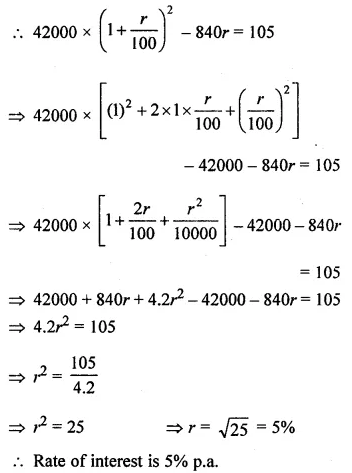
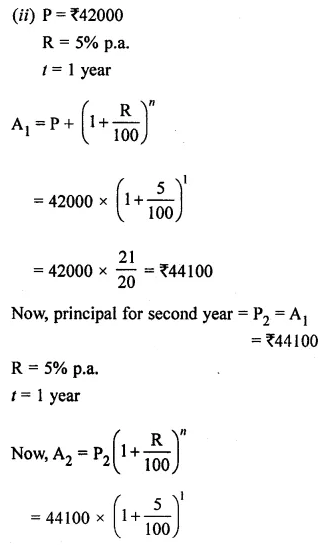
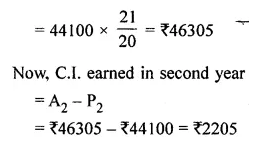
The difference between the compound interest and the simple interest on ₹42000 for two years is ₹105 at the same rate of interest per annum. Find
(i) the rate of interest
(ii) the compound interest earned in the second year.
Solution:
ML Aggarwal Class 8 Solutions for ICSE Maths Chapter 8 Simple and Compound Interest Objective Type Questions 13
ML Aggarwal Class 8 Solutions for ICSE Maths Chapter 8 Simple and Compound Interest Objective Type Questions 14
ML Aggarwal Class 8 Solutions for ICSE Maths Chapter 8 Simple and Compound Interest Objective Type Questions 15
ML Aggarwal Class 8 Solutions for ICSE Maths Chapter 8 Simple and Compound Interest Objective Type Questions 16

ML Aggarwal Class 8 Solutions for ICSE Maths

ML Aggarwal Class 8 Solutions for ICSE Maths Chapter 8 Simple and Compound Interest Ex 8.3

ML Aggarwal Class 8 Solutions for ICSE Maths Chapter 8 Simple and Compound Interest Ex 8.3

Question 1.
Calculate the amount and compound interest on
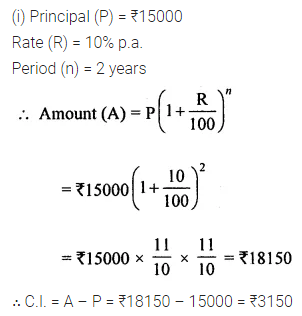
(i) ₹15000 for 2 years at 10% per annum compounded annually.
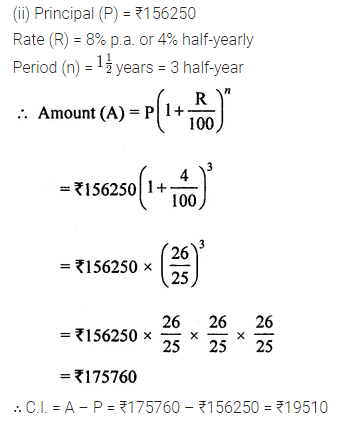
(ii) ₹156250 for \(1 \frac{1}{2}\) years at 8% per annum compounded half-yearly.
(iii) ₹ 100000 for 9 months at 4% per annum compounded quarterly.
Solution:
ML Aggarwal Class 8 Solutions for ICSE Maths Chapter 8 Simple and Compound Interest Ex 8.3 1
ML Aggarwal Class 8 Solutions for ICSE Maths Chapter 8 Simple and Compound Interest Ex 8.3 2

Question 2.
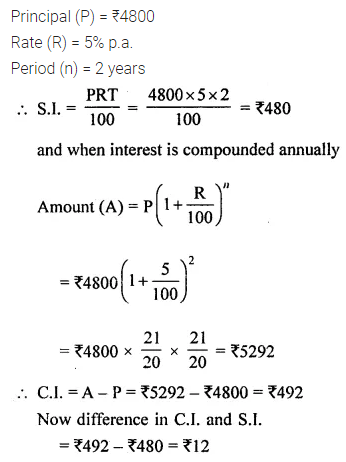
Find the difference between the simple interest and compound interest on ₹4800 for 2 years at 5% per annum, compound interest being reckoned annually.
Solution:
ML Aggarwal Class 8 Solutions for ICSE Maths Chapter 8 Simple and Compound Interest Ex 8.3 3

Question 3.
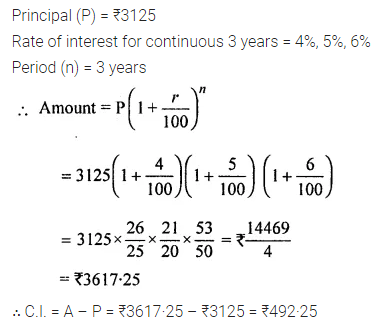
Find the compound interest on ₹3125 for 3 years if the rates of interest for the first, second and third year are respectively 4%, 5% and 6% per annum.
Solution:
ML Aggarwal Class 8 Solutions for ICSE Maths Chapter 8 Simple and Compound Interest Ex 8.3 4

Question 4.
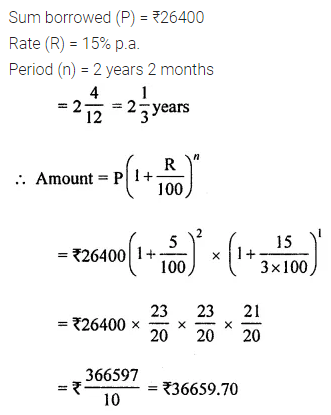
Kamla borrowed ₹26400 from a Bank to buy a scooter at a rate of 15% p.a. compounded yearly. What amount will she pay at the end of 2 years and 4 months to clear the loan?
Solution:
ML Aggarwal Class 8 Solutions for ICSE Maths Chapter 8 Simple and Compound Interest Ex 8.3 5

Question 5.
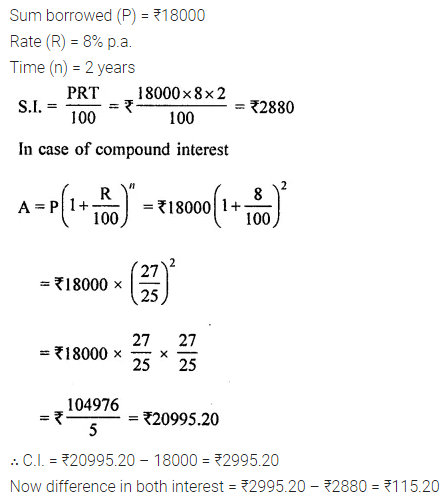
Anil borrowed ₹18000 from Rakesh at 8% per annum simple interest for 2 years. If Anil had borrowed this sum at 8% per annum compound interest, what extra amount would he has to pay?
Solution:
ML Aggarwal Class 8 Solutions for ICSE Maths Chapter 8 Simple and Compound Interest Ex 8.3 6

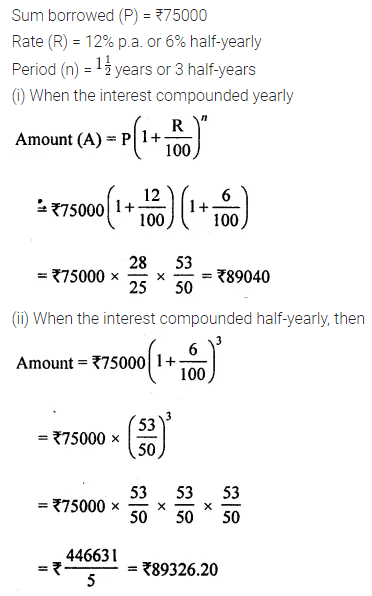
Question 6.
Mukesh borrowed 775000 from a bank. If the rate of interest is 12% per annum, find the amount he would be paying after \(1 \frac{1}{2}\) years if the interest is
(i) compounded annually
(ii) compounded half-yearly.
Solution:
ML Aggarwal Class 8 Solutions for ICSE Maths Chapter 8 Simple and Compound Interest Ex 8.3 7

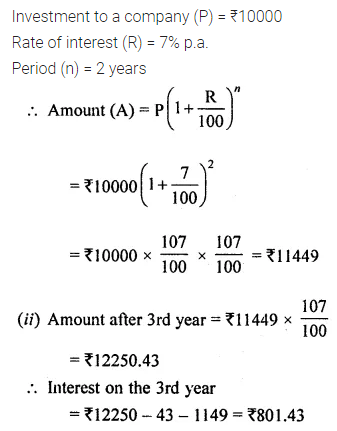
Question 7.
Aryaman invested ₹10000 in a company, he would be paid interest at 7% per annum compounded annually. Find
(i) the amount received by him at the end of 2 years.
(ii) the interest for the 3rd year.
Solution:
ML Aggarwal Class 8 Solutions for ICSE Maths Chapter 8 Simple and Compound Interest Ex 8.3 8

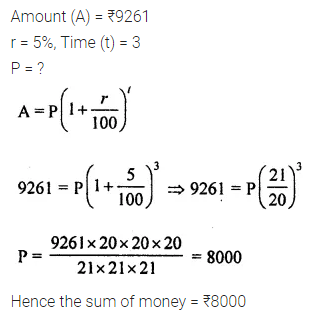
Question 8.
What sum of money will amount to ₹9261 in 3 years at 5% per annum compound interest?
Solution:
ML Aggarwal Class 8 Solutions for ICSE Maths Chapter 8 Simple and Compound Interest Ex 8.3 9

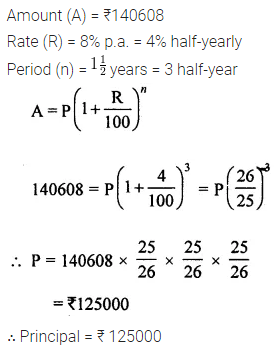
Question 9.
What sum invested for \(1 \frac{1}{2}\) years compounded half-yearly at the rate 8% p.a. will amount to ₹ 140608?
Solution:
ML Aggarwal Class 8 Solutions for ICSE Maths Chapter 8 Simple and Compound Interest Ex 8.3 10

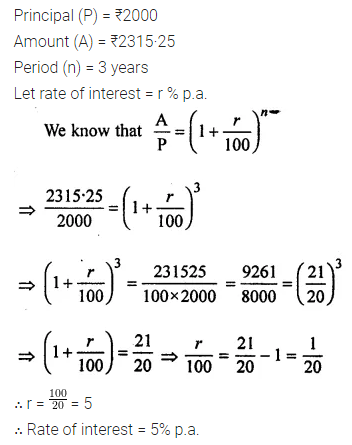
Question 10.
At what rate percent will ₹2000 amount to ₹2315·25 in 3 years at compound interest?
Solution:
ML Aggarwal Class 8 Solutions for ICSE Maths Chapter 8 Simple and Compound Interest Ex 8.3 11

Question 11.
If ₹40000 amounts to ₹46305 in \(1 \frac{1}{2}\) years, compound interest payable half-yearly, find the rate of interest per annum.
Solution:
ML Aggarwal Class 8 Solutions for ICSE Maths Chapter 8 Simple and Compound Interest Ex 8.3 12

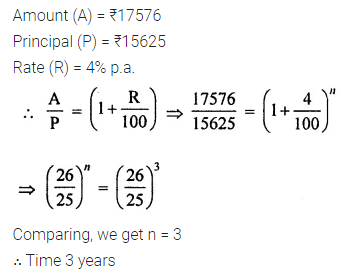
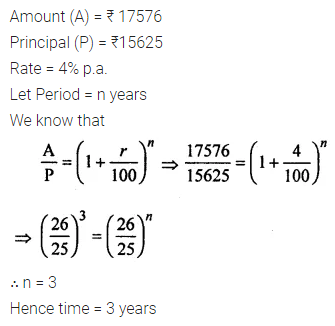
Question 12.
In what time will ₹15625 amount to ₹ 17576 at 4% per annum compound interest?
Solution:
ML Aggarwal Class 8 Solutions for ICSE Maths Chapter 8 Simple and Compound Interest Ex 8.3 13

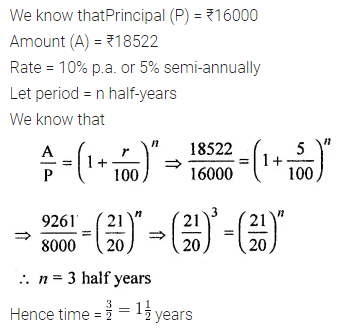
Question 13.
₹ 16000 invested at 10% p.a. compounded semi-annually, amounts to ₹18522. Find the time period of investment.
Solution:
ML Aggarwal Class 8 Solutions for ICSE Maths Chapter 8 Simple and Compound Interest Ex 8.3 14

ML Aggarwal Class 8 Solutions for ICSE Maths