ML Aggarwal Class 8 Solutions for ICSE Maths Chapter 10 Algebraic Expressions and Identities Ex 10.2

ML Aggarwal Class 8 Solutions for ICSE Maths Chapter 10 Algebraic Expressions and Identities Ex 10.2

Question 1.
Find the product of:
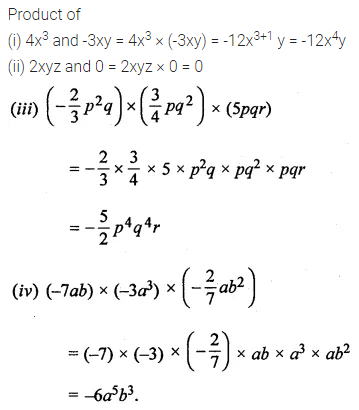
(i) 4x3 and -3xy
(ii) 2xyz and 0
(iii) –\(\frac{2}{3}\)p2q, \(\frac{3}{4}\)pq2 and 5pqr
(iv) -7ab,-3a3 and –\(\frac{2}{7}\)ab2
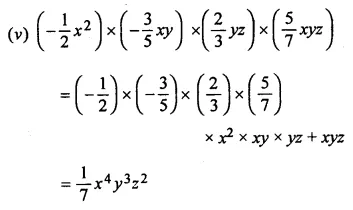
(v) –\(\frac{1}{2}\)x2 – \(\frac{3}{5}\)xy, \(\frac{2}{3}\)yz and \(\frac{5}{7}\)xyz
Solution:
ML Aggarwal Class 8 Solutions for ICSE Maths Chapter 10 Algebraic Expressions and Identities Ex 10.2 1
ML Aggarwal Class 8 Solutions for ICSE Maths Chapter 10 Algebraic Expressions and Identities Ex 10.2 2

Question 2.
Multiply:
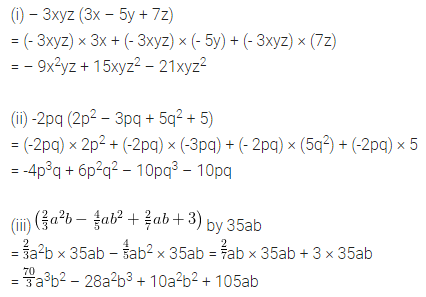
(i) (3x – 5y + 7z) by – 3xyz
(ii) (2p2 – 3pq + 5q2 + 5) by – 2pq
(iii) (\(\frac{2}{3}\)a2b – \(\frac{4}{5}\)ab2 + \(\frac{2}{7}\)ab + 3) by 35ab
(iv) (4x2 – 10xy + 7y2 – 8x + 4y + 3) by 3xy
Solution:
ML Aggarwal Class 8 Solutions for ICSE Maths Chapter 10 Algebraic Expressions and Identities Ex 10.2 3
ML Aggarwal Class 8 Solutions for ICSE Maths Chapter 10 Algebraic Expressions and Identities Ex 10.2 4

Question 3.
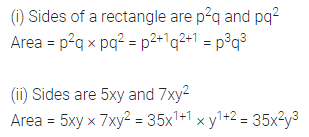
Find the areas of rectangles with the following pairs of monomials as their lengths and breadths respectively:
(i) (p2q, pq2)
(ii) (5xy, 7xy2)
Solution:
ML Aggarwal Class 8 Solutions for ICSE Maths Chapter 10 Algebraic Expressions and Identities Ex 10.2 5

Question 4.
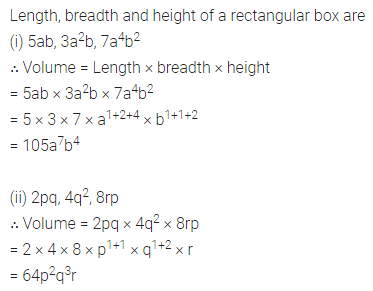
Find the volume of rectangular boxes with the following length, breadth and height respectively:
(i) 5ab, 3a2b, 7a4b2
(ii) 2pq, 4q2, 8rp
Solution:
ML Aggarwal Class 8 Solutions for ICSE Maths Chapter 10 Algebraic Expressions and Identities Ex 10.2 6

Question 5.
Simplify the following expressions and evaluate them as directed:
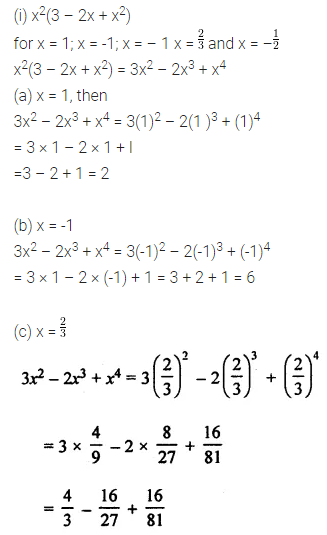
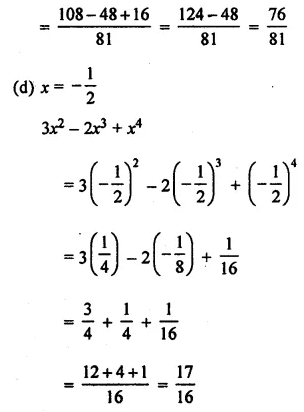
(i) x2(3 – 2x + x2) for x = 1; x = -1; x = \(\frac{2}{3}\) and x = –\(\frac{1}{2}\)
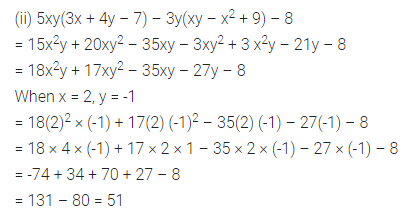
(ii) 5xy(3x + 4y – 7) – 3y(xy – x2 + 9) – 8 for x = 2, y = -1
Solution:
ML Aggarwal Class 8 Solutions for ICSE Maths Chapter 10 Algebraic Expressions and Identities Ex 10.2 7
ML Aggarwal Class 8 Solutions for ICSE Maths Chapter 10 Algebraic Expressions and Identities Ex 10.2 8
ML Aggarwal Class 8 Solutions for ICSE Maths Chapter 10 Algebraic Expressions and Identities Ex 10.2 9

Question 6.
Add the following:
(i) 4p(2 – p2) and 8p3 – 3p
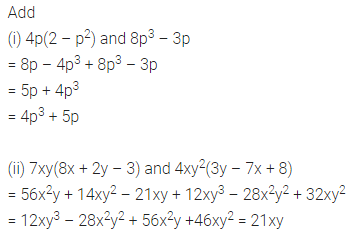
(ii) 7xy(8x + 2y – 3) and 4xy2(3y – 7x + 8)
Solution:
ML Aggarwal Class 8 Solutions for ICSE Maths Chapter 10 Algebraic Expressions and Identities Ex 10.2 10

Question 7.
Subtract:
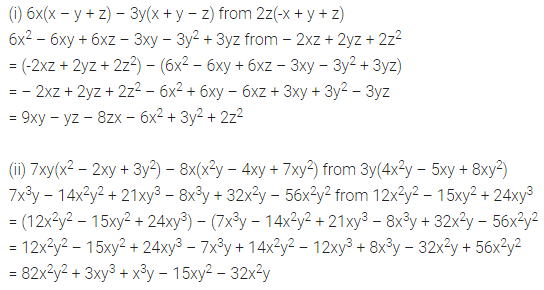
(i) 6x(x – y + z)- 3y(x + y – z) from 2z(-x + y + z)
(ii) 7xy(x2 -2xy + 3y2) – 8x(x2y – 4xy + 7xy2) from 3y(4x2y – 5xy + 8xy2)
Solution:
ML Aggarwal Class 8 Solutions for ICSE Maths Chapter 10 Algebraic Expressions and Identities Ex 10.2 11

ML Aggarwal Class 8 Solutions for ICSE Maths

ML Aggarwal Class 8 Solutions for ICSE Maths Chapter 10 Algebraic Expressions and Identities Ex 10.1

ML Aggarwal Class 8 Solutions for ICSE Maths Chapter 10 Algebraic Expressions and Identities Ex 10.1

Question 1.
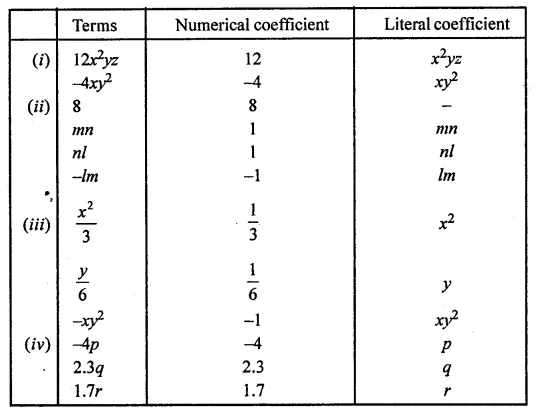
Identify the terms, their numerical as well as literal coefficients in each of the following expressions:
(i) 12x2yz – 4xy2
(ii) 8 + mn + nl – lm
Solution:
ML Aggarwal Class 8 Solutions for ICSE Maths Chapter 10 Algebraic Expressions and Identities Ex 10.1 1

Question 2.
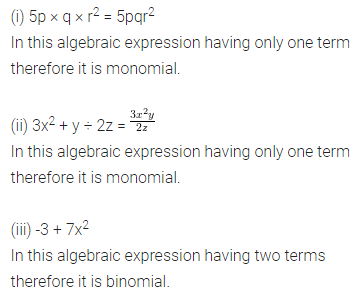
Identify monomials, binomials, and trinomials from the following algebraic expressions :
(i) 5p × q × r2
(ii) 3x2 + y ÷ 2z
(iii) -3 + 7x2
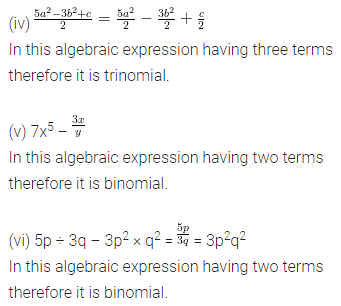
(iv) \(\frac{5 a^{2}-3 b^{2}+c}{2}\)
(v) 7x5 – \(\frac{3 x}{y}\)
(vi) 5p ÷ 3q – 3p2 × q2
Solution:
ML Aggarwal Class 8 Solutions for ICSE Maths Chapter 10 Algebraic Expressions and Identities Ex 10.1 2
ML Aggarwal Class 8 Solutions for ICSE Maths Chapter 10 Algebraic Expressions and Identities Ex 10.1 3

Question 3.
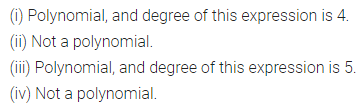
Identify which of the following expressions are polynomials. If so, write their degrees.
(i) \(\frac{2}{5}\)x4 – \(\sqrt{3}\)x2 + 5x – 1
(ii) 7x3 – \(\frac{3}{x^{2}}\) + \(\sqrt{5}\)
(iii) 4a3b2 – 3ab4 + 5ab + \(\frac{2}{3}\)
(iv) 2x2y – \(\frac{3}{x y}\) + 5y3 + \(\sqrt{3}\)
Solution:
ML Aggarwal Class 8 Solutions for ICSE Maths Chapter 10 Algebraic Expressions and Identities Ex 10.1 4

Question 4.
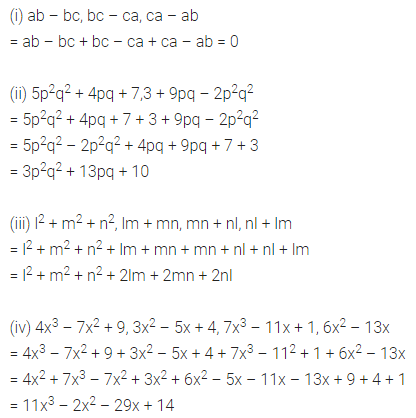
Add the following expressions:
(i) ab – bv, bv – ca, ca – ab
(ii) 5p2q2 + 4pq + 7,3 + 9pq – 2p2q
(iii) l2 + m2 + n2, lm + mn, mn + nl, nl + lm
(iv) 4x3 – 7x2 + 9, 3x2 – 5x + 4, 7x3 – 11x + 1, 6x2 – 13x
Solution:
ML Aggarwal Class 8 Solutions for ICSE Maths Chapter 10 Algebraic Expressions and Identities Ex 10.1 5

Question 5.
Subtract:
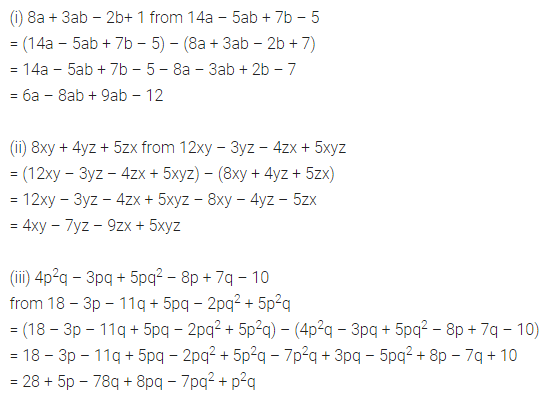
(i) 8a + 3ab – 2b + 7 from 14a – 5ab + 7b – 5
(ii) 8xy + 4yz + 5zx from 12xy – 3yz – 4zx + 5xyz
(iii) 4p2q – 3pq + 5pq2 – 8p + 7q -10 from 18 – 3p – 11q + 5pq – 2pq2 + 5p2q
Solution:
ML Aggarwal Class 8 Solutions for ICSE Maths Chapter 10 Algebraic Expressions and Identities Ex 10.1 6

Question 6.
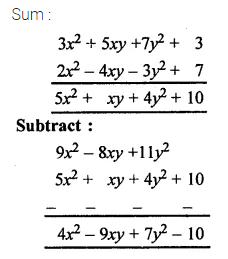
Subtract the sum of 3x2 + 5xy + 7y2 + 3 and 2x2 – 4xy – 3y2 + 7 from 9x2 – 8xy + 11y2
Solution:
ML Aggarwal Class 8 Solutions for ICSE Maths Chapter 10 Algebraic Expressions and Identities Ex 10.1 7

Question 7.
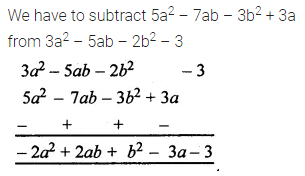
What must be subtracted from 3a2 – 5ab – 2b2 – 3 to get 5a2 – 7ab – 3b2 + 3a ?
Solution:
ML Aggarwal Class 8 Solutions for ICSE Maths Chapter 10 Algebraic Expressions and Identities Ex 10.1 8

Question 8.
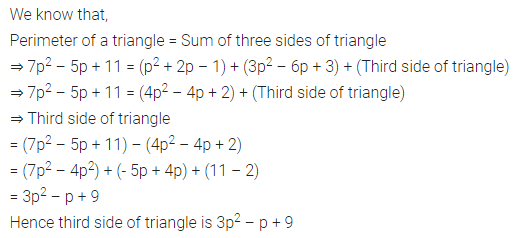
The perimeter of a triangle is 7p2 – 5p + 11 and two of its sides are p2 + 2p – 1 and 3p2 – 6p + 3. Find the third side of the triangle.
Solution:
ML Aggarwal Class 8 Solutions for ICSE Maths Chapter 10 Algebraic Expressions and Identities Ex 10.1 9

ML Aggarwal Class 8 Solutions for ICSE Maths

ML Aggarwal Class 8 Solutions for ICSE Maths Chapter 9 Direct and Inverse Variation Check Your Progress

ML Aggarwal Class 8 Solutions for ICSE Maths Chapter 9 Direct and Inverse Variation Check Your Progress

Question 1.
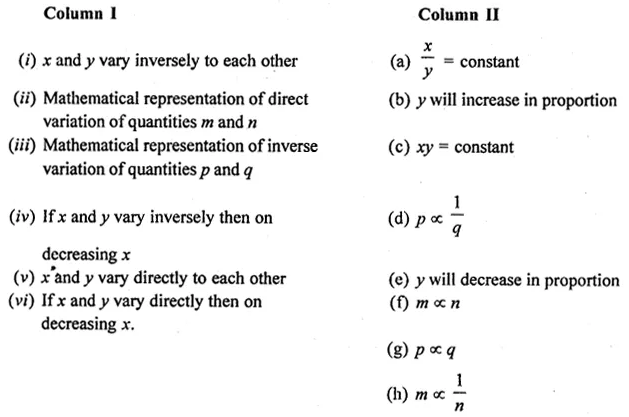
Match each of the entries in column I with the appropriate entry in column II.
ML Aggarwal Class 8 Solutions for ICSE Maths Chapter 9 Direct and Inverse Variation Check Your Progress 1
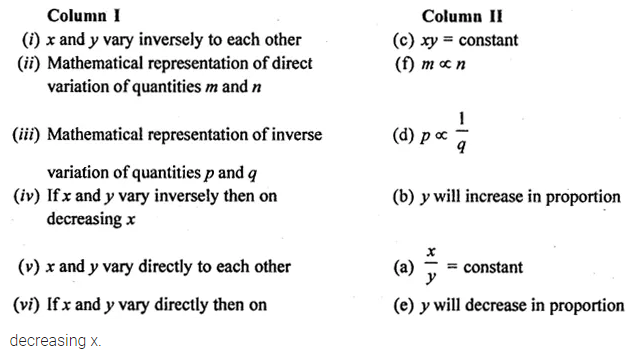
Solution:
ML Aggarwal Class 8 Solutions for ICSE Maths Chapter 9 Direct and Inverse Variation Check Your Progress 2

Question 2.
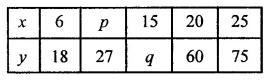
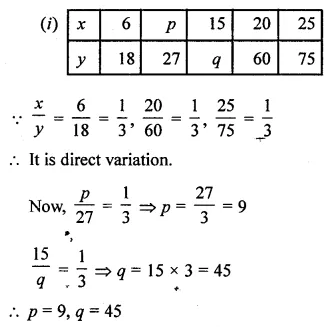
(i) From the following table, determines and q if x and y vary directly:
ML Aggarwal Class 8 Solutions for ICSE Maths Chapter 9 Direct and Inverse Variation Check Your Progress 3
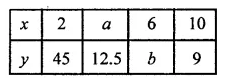
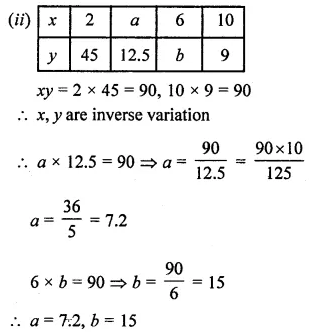
(ii) From the following table, determine a and b if x and y vary inversely:
ML Aggarwal Class 8 Solutions for ICSE Maths Chapter 9 Direct and Inverse Variation Check Your Progress 4
Solution:
ML Aggarwal Class 8 Solutions for ICSE Maths Chapter 9 Direct and Inverse Variation Check Your Progress 5
ML Aggarwal Class 8 Solutions for ICSE Maths Chapter 9 Direct and Inverse Variation Check Your Progress 6

Question 3.
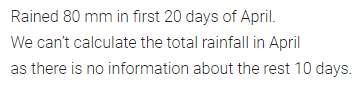
It rained 80 mm in the first 20 days of April. What would be the total rainfall in April?
Solution:
ML Aggarwal Class 8 Solutions for ICSE Maths Chapter 9 Direct and Inverse Variation Check Your Progress 7

Question 4.
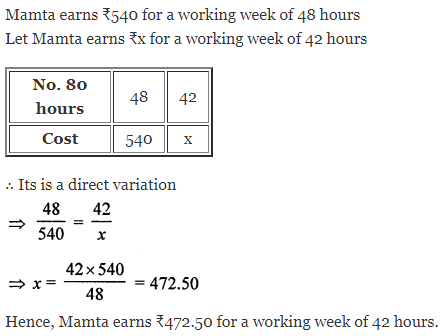
Mamta earns ₹540 for a working week of 48 hours. If she was absent for 6 hours, how much did she earn?
Solution:
ML Aggarwal Class 8 Solutions for ICSE Maths Chapter 9 Direct and Inverse Variation Check Your Progress 8

Question 5.
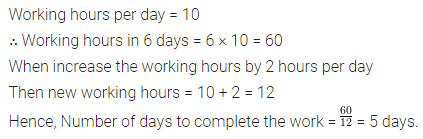
Navjot can do a piece of work in 6 days working 10 hours per day. In how many days can he do the same work if he increases his working hours by 2 hours per day?
Solution:
ML Aggarwal Class 8 Solutions for ICSE Maths Chapter 9 Direct and Inverse Variation Check Your Progress 9

Question 6.
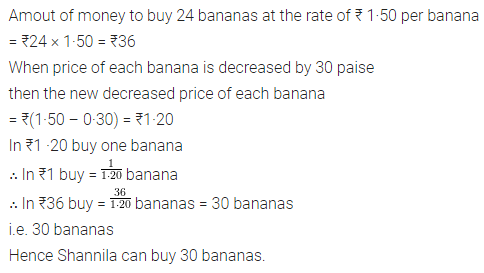
Sharmila has enough money to buy 24 bananas at the rate of ₹ 1·50 per banana. How many bananas she can buy if the price of each orange is decreased by 30 paise?
Solution:
ML Aggarwal Class 8 Solutions for ICSE Maths Chapter 9 Direct and Inverse Variation Check Your Progress 10

Question 7.
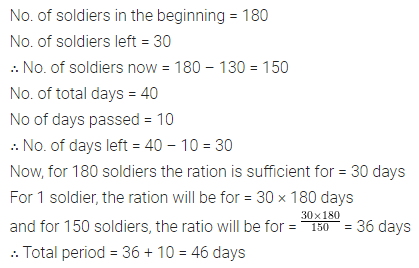
A fort has rations for 180 soldiers for 40 days. After 10 days, 30 soldiers leave the fort. Find the total number of days for which the food will last.
Solution:
ML Aggarwal Class 8 Solutions for ICSE Maths Chapter 9 Direct and Inverse Variation Check Your Progress 11

Question 8.
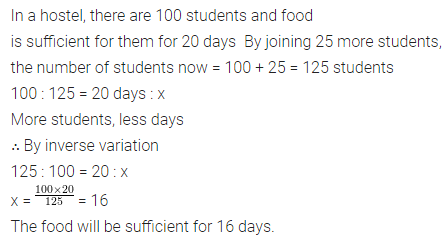
There are 100 students in a hostel. Food provision for them is for 20 days. How long will these provisions last, if 25 more students join the group?
Solution:
ML Aggarwal Class 8 Solutions for ICSE Maths Chapter 9 Direct and Inverse Variation Check Your Progress 12

Question 9.
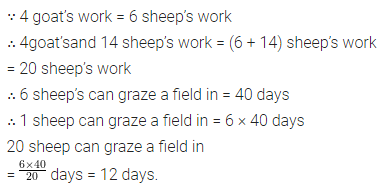
If 4 goats or 6 sheep can graze a field in 40 days, how many days will 4 goats and 14 sheep take to graze the same field?
Solution:
ML Aggarwal Class 8 Solutions for ICSE Maths Chapter 9 Direct and Inverse Variation Check Your Progress 13

Question 10.
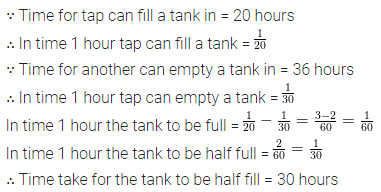
A tap can fill a tank in 20 hours, while the other can empty it in 30 hours. The tank is empty and if both taps are opened together, how long will it take for the tank to be half full?
Solution:
ML Aggarwal Class 8 Solutions for ICSE Maths Chapter 9 Direct and Inverse Variation Check Your Progress 14

Question 11.
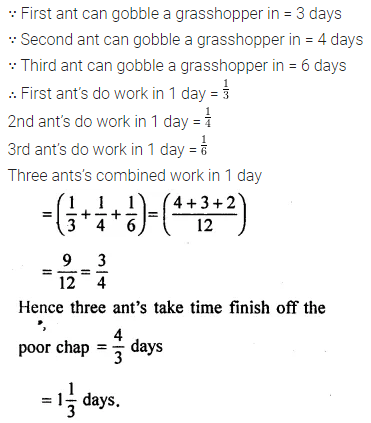
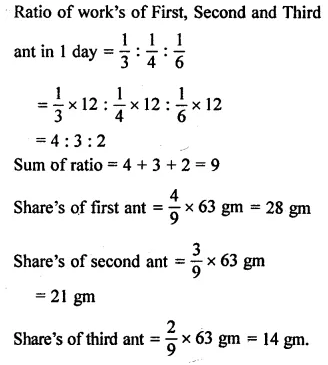
Three ants separately can gobble a grasshopper in 3,4, and 6 days respectively. How many days will they take together to finish off the poor chap? If the grasshopper weighs 63 gram, find the share of each.
Solution:
ML Aggarwal Class 8 Solutions for ICSE Maths Chapter 9 Direct and Inverse Variation Check Your Progress 15
ML Aggarwal Class 8 Solutions for ICSE Maths Chapter 9 Direct and Inverse Variation Check Your Progress 16

Question 12.
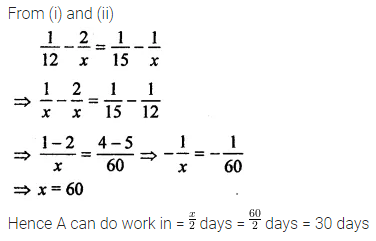
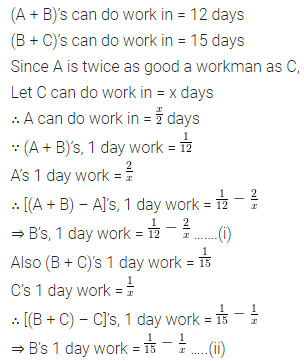
A and B together can do a piece of work in 12 days; B and C together can do it in 15 days. If A is twice as good a workman as C, in how many days A alone will do the same work?
Solution:
ML Aggarwal Class 8 Solutions for ICSE Maths Chapter 9 Direct and Inverse Variation Check Your Progress 17
ML Aggarwal Class 8 Solutions for ICSE Maths Chapter 9 Direct and Inverse Variation Check Your Progress 18

ML Aggarwal Class 8 Solutions for ICSE Maths

ML Aggarwal Class 8 Solutions for ICSE Maths Chapter 9 Direct and Inverse Variation Objective Type Questions

ML Aggarwal Class 8 Solutions for ICSE Maths Chapter 9 Direct and Inverse Variation Objective Type Questions

Mental Maths
Question 1.
Fill in the blanks:
(i) Two quantities are said to be in direct variation if the increase (or decrease) in one quantity causes in ………….. other quantity.
(ii) Two quantities X and Y are said to be in inverse variation if XY is …………..
(iii) The total cost of articles varies ………….. to the number of articles purchased.
(iv) More work is done in ………….. time.
(v) The time taken to finish work varies ………….. to the number of men at work.
(vi) The speed of a moving object varies inversely to the ………….. to cover a certain distance.
(vii) The number of articles varies ………….. with the cost per article if a fixed amount is available.
(viii)Remuneration is in ………….. of work done.
Solution:
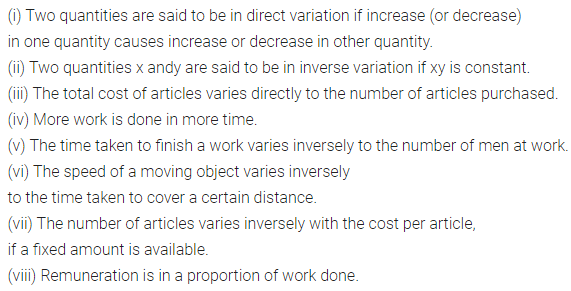
ML Aggarwal Class 8 Solutions for ICSE Maths Chapter 9 Direct and Inverse Variation Objective Type Questions 1

Question 2.
State whether the following statements are true (T) or false (F):
(i) Two quantities x andy are said to be in inverse variation if \(\frac{x}{y}\) is constant.
(ii) Number of days needed to complete the work = \(\frac{1}{\text { one day’s work }}\)
(iii) Two quantities x andy are said to be in direct variation if x = ky, where k is constant of variation.
(iv) The work done varies inversely to the number of men at work.
(v) In the given time, the distance covered by a moving object varies directly to its speed.
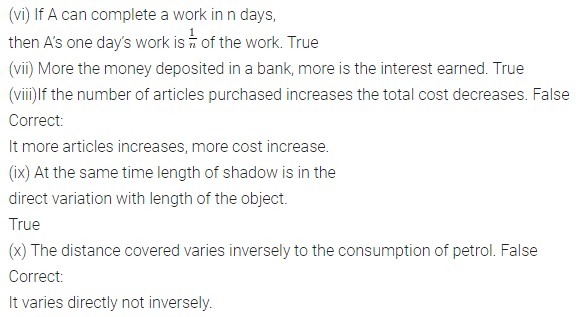
(vi) If A can complete a work in n days, then A’s one day’s work is \(\frac{1}{n}\) of the work, n
(vii) More the money deposited in a bank, more is the interest earned.
(viii) If the number of articles purchased increases the total cost decreases.
(ix) At the same time length of shadow is in direct variation with length of the object.
(x) The distance covered varies inversely to the consumption of petrol.
Solution:
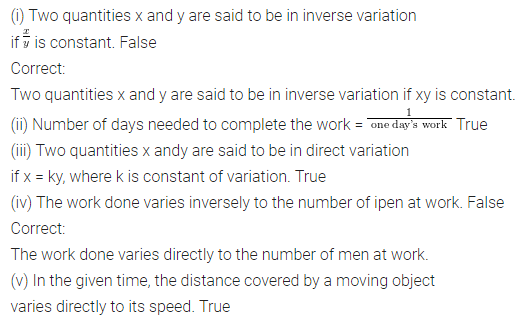
ML Aggarwal Class 8 Solutions for ICSE Maths Chapter 9 Direct and Inverse Variation Objective Type Questions 2
ML Aggarwal Class 8 Solutions for ICSE Maths Chapter 9 Direct and Inverse Variation Objective Type Questions 3

Multiple Choice Questions
Choose the correct answer from the given four options (3 to 13):
Question 3.
Two quantities x and y are said to be in inverse variation if
(a) xy = k
(b) x ∝ \(\frac{1}{y}\)
(c) x = \(\frac{k}{y}\)
(d) all of these
Solution:
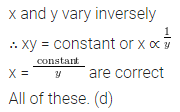
ML Aggarwal Class 8 Solutions for ICSE Maths Chapter 9 Direct and Inverse Variation Objective Type Questions 4

Question 4.
If 12-metre wire costs ₹24, then the cost of 8-metre wire is
(a) ₹16
(b) ₹20
(c) ₹12
(d) ₹18
Solution:
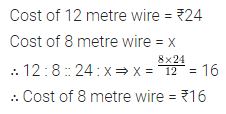
ML Aggarwal Class 8 Solutions for ICSE Maths Chapter 9 Direct and Inverse Variation Objective Type Questions 5

Question 5.
If 5 kg wheat cost ₹60, then cost of 20 kg wheat is
(a) ₹200
(b) ₹210
(c) ₹220
(d) ₹240
Solution:
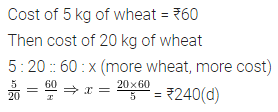
ML Aggarwal Class 8 Solutions for ICSE Maths Chapter 9 Direct and Inverse Variation Objective Type Questions 6

Question 6.
If 10-men can complete a work in 6 days, then 30 men can complete the same work in
(a) 2 days
(b) 3 days
(c) 4 days
(d) 5 days
Solution:
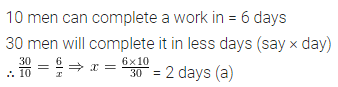
ML Aggarwal Class 8 Solutions for ICSE Maths Chapter 9 Direct and Inverse Variation Objective Type Questions 7

Question 7.
A car travels 80 km in 5 litres of petrol, then the distance covered by it in 15 litres of petrol is
(a) 400 km
(b) 240 km
(c) 200 km
(d) 100 km
Solution:
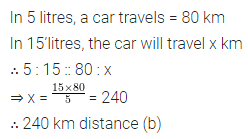
ML Aggarwal Class 8 Solutions for ICSE Maths Chapter 9 Direct and Inverse Variation Objective Type Questions 8

Question 8.
In a mess, there was enough food for 200 students for 20 days. If 50 new students joined them, then the food will last for
(a) 15 days
(b) 16 days
(c) 17 days
(d) 18 days
Solution:
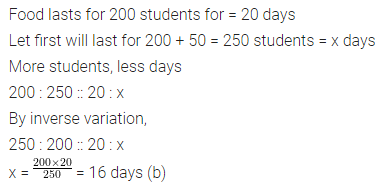
ML Aggarwal Class 8 Solutions for ICSE Maths Chapter 9 Direct and Inverse Variation Objective Type Questions 9

Question 9.
3 persons can paint a house in 8 days, then 4 persons can paint the same house in
(a) 5 days
(b) 6 days
(c) 7 days
(d) none of these
Solution:
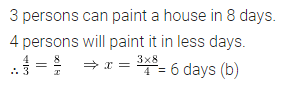
ML Aggarwal Class 8 Solutions for ICSE Maths Chapter 9 Direct and Inverse Variation Objective Type Questions 10

Question 10.
A photograph of bacteria is enlarged 100000 times attains a length of 5 cm, then actual length of the bacteria is
(a) 0.00005 cm
(b) 5 × 10⁻⁵
(c) 5 × 10⁻⁷
(d) all of these
Solution:

ML Aggarwal Class 8 Solutions for ICSE Maths Chapter 9 Direct and Inverse Variation Objective Type Questions 11

Question 11.
A tree 12 metre high casts a shadow of length 8 metre. Height of the tree whose shadow is 6 metre in length is
(a) 6 m
(b) 9 m
(c) 15 m
(d) none of these
Solution:
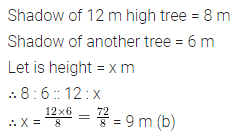
ML Aggarwal Class 8 Solutions for ICSE Maths Chapter 9 Direct and Inverse Variation Objective Type Questions 12

Question 12.
If 5 pipes can fill the tank in 1 hour, then 4 pipes will fill the tank in
(a) 75 minutes
(b) 70 minutes
(c) 65 minutes
(d) none of these
Solution:
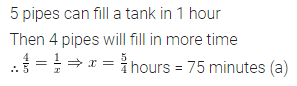
ML Aggarwal Class 8 Solutions for ICSE Maths Chapter 9 Direct and Inverse Variation Objective Type Questions 13

Question 13.
A tap fills a tank in 8 hours and another tap at the bottom empties it in 10 hours. If both work together, the tank will be filled in
(a) 18 hours
(b) 24 hours
(c) 36 hours
(d) 40 hours
Solution:
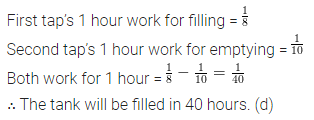
ML Aggarwal Class 8 Solutions for ICSE Maths Chapter 9 Direct and Inverse Variation Objective Type Questions 14

Value-Based Questions
Question 1.
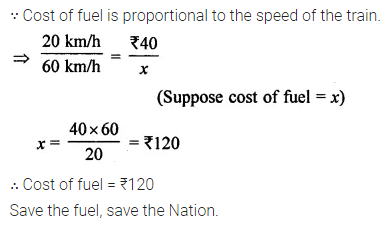
The cost of fuel for running a train is proportional to the speed generated in km/h. It costs ₹40 per hour when train is moving with 20 km/h. What would be the cost of fuel per hour, if the train is moving with 60 km/h?
Keeping the safety and fuel prices in mind, state the values promoted in the question.
Solution:
ML Aggarwal Class 8 Solutions for ICSE Maths Chapter 9 Direct and Inverse Variation Objective Type Questions 15

Question 2.
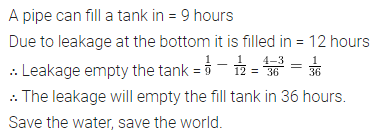
A pipe can fill a tank in 9 hours. There is a leakage in the bottom of the tank due to which tank is filled in 12 hours. If the tank is full, how much time will leakage take to empty the tank? Should we repair the leakage tank? Should we repair the leakage of the tank immediately? What values are being promoted?
Solution:
ML Aggarwal Class 8 Solutions for ICSE Maths Chapter 9 Direct and Inverse Variation Objective Type Questions 16

Higher Order Thinking Skills (Hots)
Question 1.
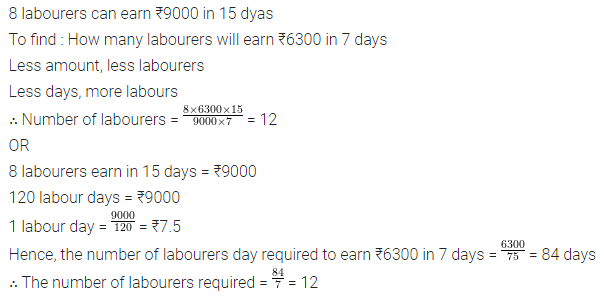
If 8 labourers can earn ₹9000 in 15 days, how many labourers can earn ₹6300 in 7 days?
Solution:
ML Aggarwal Class 8 Solutions for ICSE Maths Chapter 9 Direct and Inverse Variation Objective Type Questions 17

Question 2.
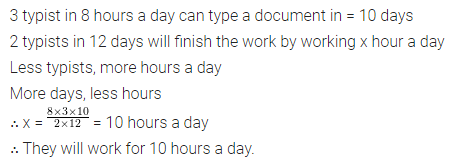
Three typists working 8 hours a day type a document in 10 days. If only 2 typists are working, how many hours a day should they work to finish the job in 12 days?
Solution:
ML Aggarwal Class 8 Solutions for ICSE Maths Chapter 9 Direct and Inverse Variation Objective Type Questions 18

ML Aggarwal Class 8 Solutions for ICSE Maths

ML Aggarwal Class 8 Solutions for ICSE Maths Chapter 9 Direct and Inverse Variation Ex 9.3

ML Aggarwal Class 8 Solutions for ICSE Maths Chapter 9 Direct and Inverse Variation Ex 9.3

Question 1.
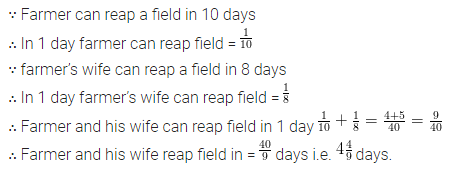
A farmer can reap a field in 10 days while his wife can do it in 8 days (she does not waste time in smoking). If they work together, in how much time can they reap the field?
Solution:
ML Aggarwal Class 8 Solutions for ICSE Maths Chapter 9 Direct and Inverse Variation Ex 9.3 1

Question 2.
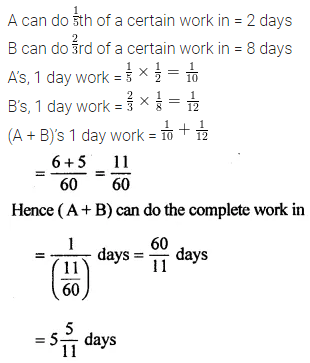
A can-do \(\frac{1}{5}\)th of a certain work in 2 days and B can do \(\frac{2}{3}\)rd of it in 8 days. In how much time can they together complete the work?
Solution:
ML Aggarwal Class 8 Solutions for ICSE Maths Chapter 9 Direct and Inverse Variation Ex 9.3 2

Question 3.
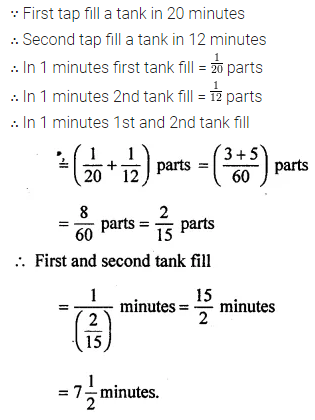
One tap fills a tank in 20 minutes and another tap fills it in 12 minutes. The tank being empty and if both taps are opened together, in how many minutes the tank will be full?
Solution:
ML Aggarwal Class 8 Solutions for ICSE Maths Chapter 9 Direct and Inverse Variation Ex 9.3 3

Question 4.
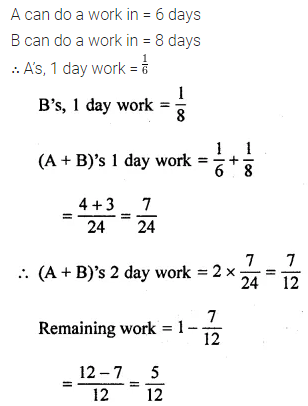
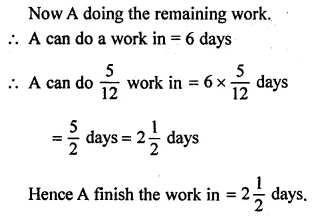
A can do a work in 6 days and B can do it in 8 days. They worked together for 2 days and then B left the work. How many days will A require to finish the work?
Solution:
ML Aggarwal Class 8 Solutions for ICSE Maths Chapter 9 Direct and Inverse Variation Ex 9.3 4
ML Aggarwal Class 8 Solutions for ICSE Maths Chapter 9 Direct and Inverse Variation Ex 9.3 5

Question 5.
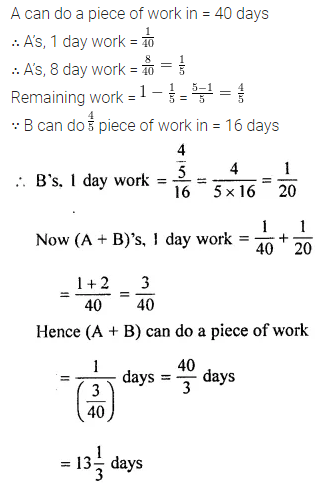
A can do a piece of work in 40 days. He works at it for 8 days and then B finishes the remaining work in 16 days. How long will they take to complete the work if they do it together?
Solution:
ML Aggarwal Class 8 Solutions for ICSE Maths Chapter 9 Direct and Inverse Variation Ex 9.3 6

Question 6.
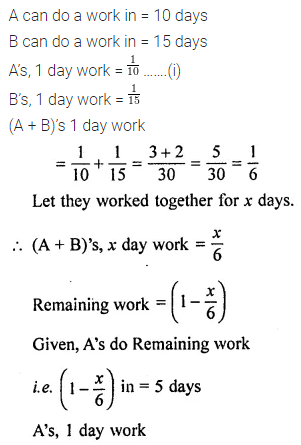
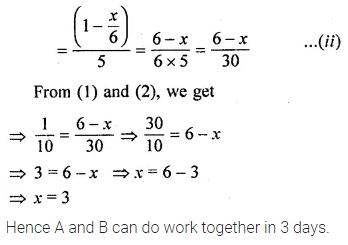
A and B separately do a work in 10 and 15 Solution: days respectively. They worked together for some days and then A completed the remaining work in 5 days. For how many days had A and B worked together?
Solution:
ML Aggarwal Class 8 Solutions for ICSE Maths Chapter 9 Direct and Inverse Variation Ex 9.3 7
ML Aggarwal Class 8 Solutions for ICSE Maths Chapter 9 Direct and Inverse Variation Ex 9.3 8

Question 7.
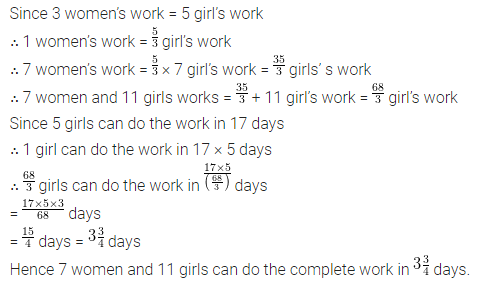
If 3 women or 5 girls take 17 days to complete a piece of work, how long will 7 women and 11 girls working together take to complete the work?
Solution:
ML Aggarwal Class 8 Solutions for ICSE Maths Chapter 9 Direct and Inverse Variation Ex 9.3 9

Question 8.
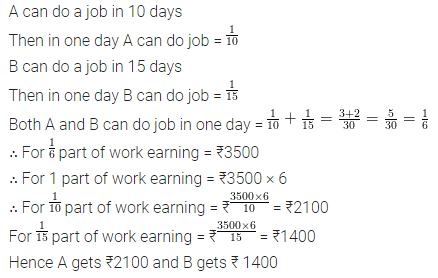
A can do a job in 10 days while B can do it in 15 days. If they work together and earn ₹3500, how should they share the money?
Solution:
ML Aggarwal Class 8 Solutions for ICSE Maths Chapter 9 Direct and Inverse Variation Ex 9.3 10

Question 9.
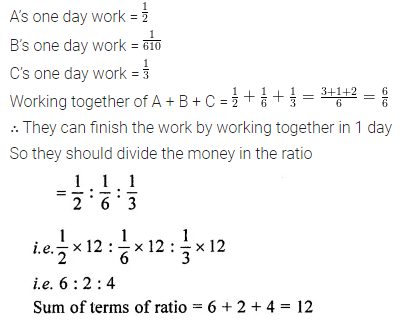
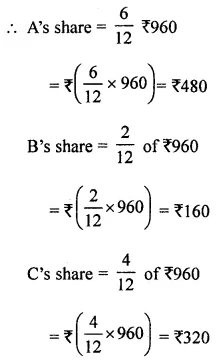
A, B and C can separately do a work in 2, 6 and 3 days respectively. Working together, how much time would they require to do it? If the work earns them ₹1960, how should they divide the money?
Solution:
ML Aggarwal Class 8 Solutions for ICSE Maths Chapter 9 Direct and Inverse Variation Ex 9.3 11
ML Aggarwal Class 8 Solutions for ICSE Maths Chapter 9 Direct and Inverse Variation Ex 9.3 12

Question 10.
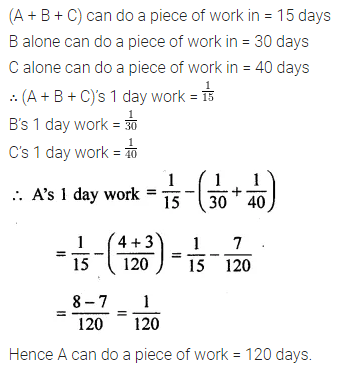
A, B and C together can do a piece of work in 15 days, B alone can do it in 30 days and C alone can do it in 40 days. In how many days will A alone do the work?
Solution:
ML Aggarwal Class 8 Solutions for ICSE Maths Chapter 9 Direct and Inverse Variation Ex 9.3 13

Question 11.
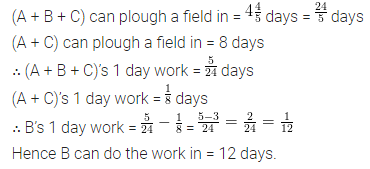
A, B and C working together can plough a field in \(4 \frac{4}{5}\) days. A and C together can do it in 8 days. How long would B working alone take to plough the field?
Solution:
ML Aggarwal Class 8 Solutions for ICSE Maths Chapter 9 Direct and Inverse Variation Ex 9.3 14

Question 12.
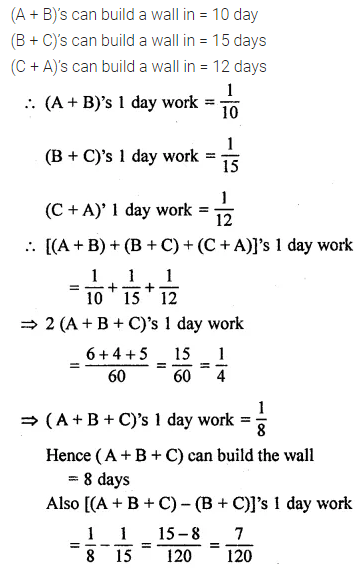
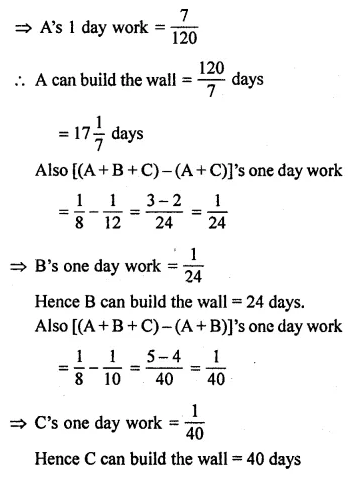
A and B together can build a wall in 10 days; B and C working together can do it in 15 days; C and A together can do it in 12 days. How long will they take to finish the work, working altogether? Also find the number of days taken by each to do the ^ame work, working alone.
Solution:
ML Aggarwal Class 8 Solutions for ICSE Maths Chapter 9 Direct and Inverse Variation Ex 9.3 15
ML Aggarwal Class 8 Solutions for ICSE Maths Chapter 9 Direct and Inverse Variation Ex 9.3 16

Question 13.
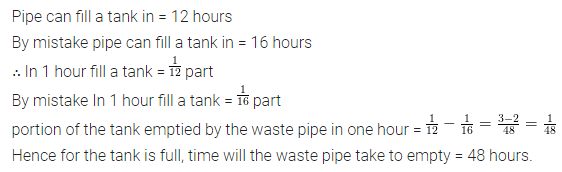
A pipe can fill a tank in 12 hours. By mistake, a waste pipe in the bottom is left opened and the tank is filled in 16 hours. If the tank is full, how much time will the waste pipe take to empty it?
Solution:.
ML Aggarwal Class 8 Solutions for ICSE Maths Chapter 9 Direct and Inverse Variation Ex 9.3 17

ML Aggarwal Class 8 Solutions for ICSE Maths