ML Aggarwal Class 8 Solutions for ICSE Maths Chapter 12 Linear Equations and Inequalities in one Variable Ex 12.3

ML Aggarwal Class 8 Solutions for ICSE Maths Chapter 12 Linear Equations and Inequalities in One Variable Ex 12.3

Question 1.
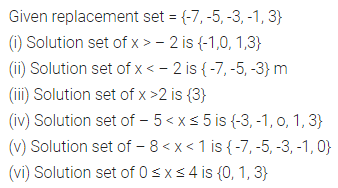
If the replacement set = {-7, -5, -3, – 1, 3}, find the solution set of:
(i) x > – 2
(ii) x < – 2
(iii) x > 2
(iv) -5 < x ≤ 5
(v) -8 < x < 1
(vi) 0 ≤ x ≤ 4
Solution:
ML Aggarwal Class 8 Solutions for ICSE Maths Chapter 12 Linear Equations and Inequalities in one Variable Ex 12.3 1

Question 2.
Represent the solution of the following inequalities graphically:
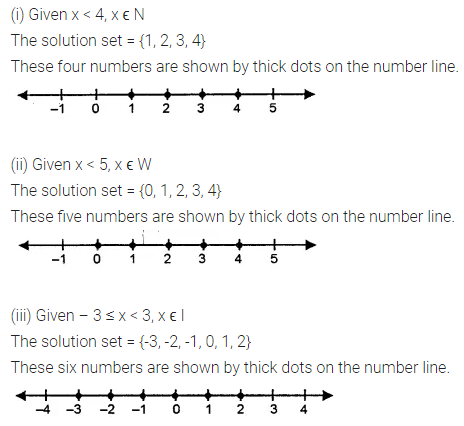
(i) x ≤ 4, x ϵ N
(ii) x < 5, x ϵ W
(iii) -3 ≤ x < 3, x ϵ I
Solution:
ML Aggarwal Class 8 Solutions for ICSE Maths Chapter 12 Linear Equations and Inequalities in one Variable Ex 12.3 2

Question 3.
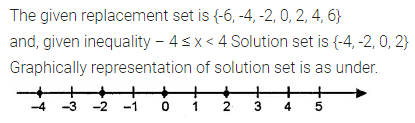
If the replacement set is {-6, -4, -2, 0, 2, 4, 6}, then represent the solution set of the inequality – 4 ≤ x < 4 grahically.
Solution:
ML Aggarwal Class 8 Solutions for ICSE Maths Chapter 12 Linear Equations and Inequalities in one Variable Ex 12.3 3

Question 4.
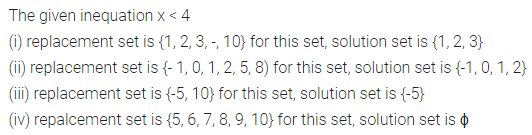
Find the solution set of the inequality x < 4 if the replacement set is
(i) {1, 2, 3, ………..,10}
(ii) {-1, 0, 1, 2, 5, 8}
(iii) {-5, 10}
(iv) {5, 6, 7, 8, 9, 10}
Solution:
ML Aggarwal Class 8 Solutions for ICSE Maths Chapter 12 Linear Equations and Inequalities in one Variable Ex 12.3 4

Question 5.
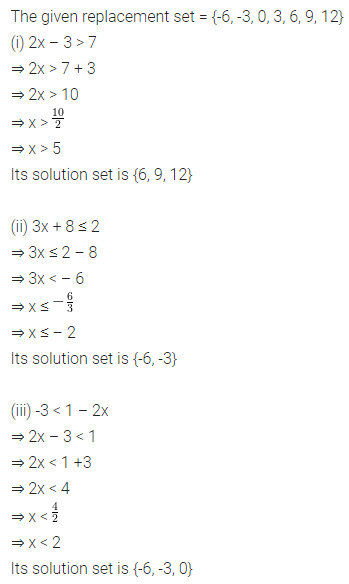
If the replacement set = {-6, -3, 0, 3, 6, 9, 12}, find the truth set of the following.:
(i) 2x – 3 > 7
(ii) 3x + 8 ≤ 2
(iii) -3 < 1 – 2x
Solution:
ML Aggarwal Class 8 Solutions for ICSE Maths Chapter 12 Linear Equations and Inequalities in one Variable Ex 12.3 5

Question 6.
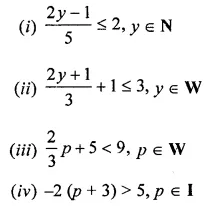
Solve the following inequations:
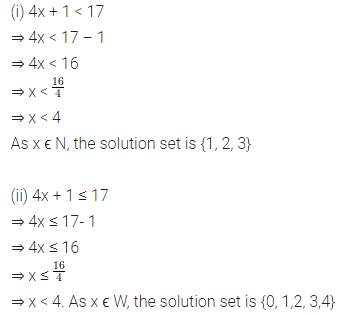
(i) 4x + 1 < 17, x ϵ N
(ii) 4x + 1 ≤ 17, x ϵ W
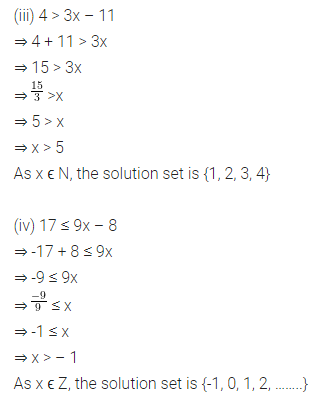
(iii) 4 > 3x – 11, x ϵ N
(iv) -17 ≤ 9x – 8, x 6ϵ Z
Solution:
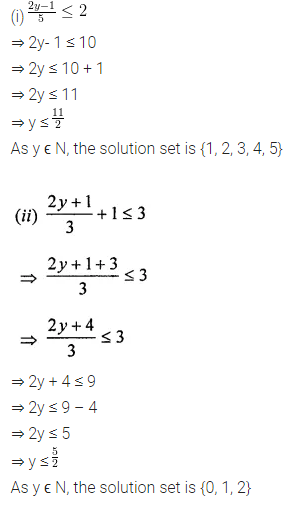
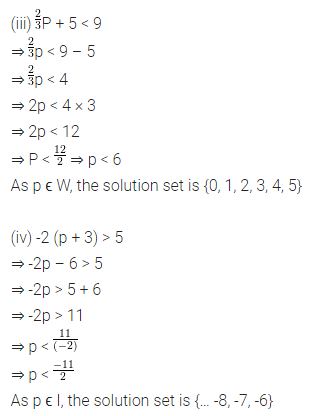
ML Aggarwal Class 8 Solutions for ICSE Maths Chapter 12 Linear Equations and Inequalities in one Variable Ex 12.3 6
ML Aggarwal Class 8 Solutions for ICSE Maths Chapter 12 Linear Equations and Inequalities in one Variable Ex 12.3 7

Question 7.
Solve the following inequations :
ML Aggarwal Class 8 Solutions for ICSE Maths Chapter 12 Linear Equations and Inequalities in one Variable Ex 12.3 8
Solution:
ML Aggarwal Class 8 Solutions for ICSE Maths Chapter 12 Linear Equations and Inequalities in one Variable Ex 12.3 9
ML Aggarwal Class 8 Solutions for ICSE Maths Chapter 12 Linear Equations and Inequalities in one Variable Ex 12.3 10

Question 8.
Solve the following inequations:
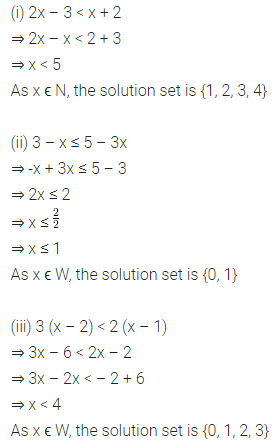
(i) 2x – 3 < x + 2, x ϵ N
(ii) 3 – x ≤ 5 – 3x, x ϵ W
(iii) 3 (x – 2) < 2 (x -1), x ϵ W
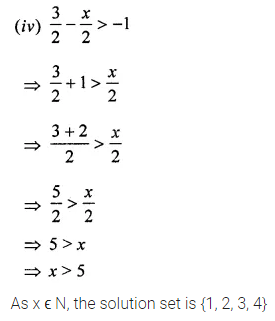
(iv) \(\frac{3}{2}-\frac{x}{2}\) > -1, x ϵ N
Solution:
ML Aggarwal Class 8 Solutions for ICSE Maths Chapter 12 Linear Equations and Inequalities in one Variable Ex 12.3 11
ML Aggarwal Class 8 Solutions for ICSE Maths Chapter 12 Linear Equations and Inequalities in one Variable Ex 12.3 12

Question 9.
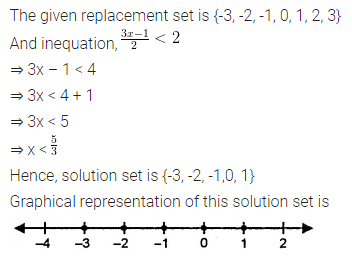
If the replacement set is {-3, -2, -1,0, 1, 2, 3} , solve the inequation \(\frac{3 x-1}{2}<2\). represent its solution on the number line.
Solution:
ML Aggarwal Class 8 Solutions for ICSE Maths Chapter 12 Linear Equations and Inequalities in one Variable Ex 12.3 13

Question 10.
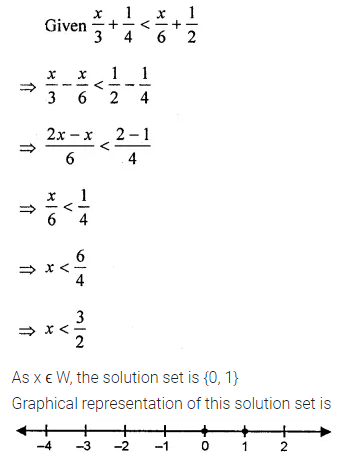
Solve \(\frac{x}{3}+\frac{1}{4}<\frac{x}{6}+\frac{1}{2}\), x ϵ W. Also represent its solution on the number line.
Solution:
ML Aggarwal Class 8 Solutions for ICSE Maths Chapter 12 Linear Equations and Inequalities in one Variable Ex 12.3 14

Question 11.
Solve the following inequations and graph their solutions on a number line
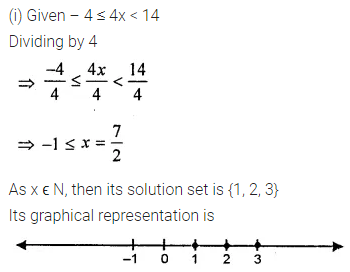
(i) -4 ≤ 4x < 14, x ϵ N
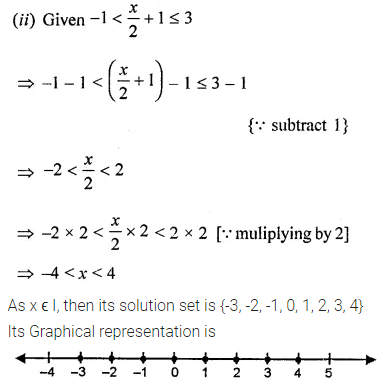
(ii) -1 < \(\frac{x}{2}\) + 1 ≤ 3, x ϵ I
Solution:
ML Aggarwal Class 8 Solutions for ICSE Maths Chapter 12 Linear Equations and Inequalities in one Variable Ex 12.3 15
ML Aggarwal Class 8 Solutions for ICSE Maths Chapter 12 Linear Equations and Inequalities in one Variable Ex 12.3 16

ML Aggarwal Class 8 Solutions for ICSE Maths

ML Aggarwal Class 8 Solutions for ICSE Maths Chapter 12 Linear Equations and Inequalities in one Variable Ex 12.2

ML Aggarwal Class 8 Solutions for ICSE Maths Chapter 12 Linear Equations and Inequalities in One Variable Ex 12.2

Question 1.
Three more than twice a number is equal to four less than the number. Find the number.
Solution:
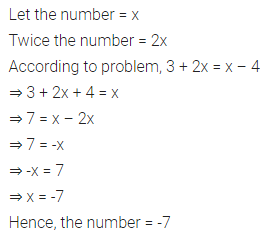
ML Aggarwal Class 8 Solutions for ICSE Maths Chapter 12 Linear Equations and Inequalities in one Variable Ex 12.2 1

Question 2.
When four consecutive integers are added, the sum is 46. Find the integers.
Solution:
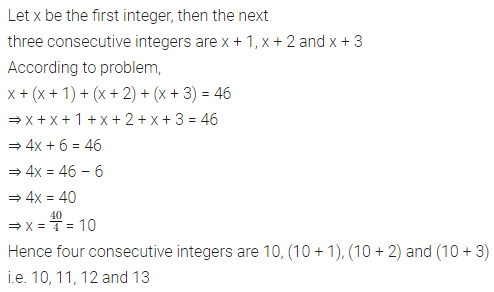
ML Aggarwal Class 8 Solutions for ICSE Maths Chapter 12 Linear Equations and Inequalities in one Variable Ex 12.2 2

Question 3.
Manjula thinks a number and subtracts \(\frac{7}{3}\) from it. She multiplies the result by 6. The result now obtained is 2 less than twice the same number she thought of. What is the number?
Solution:
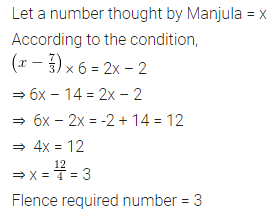
ML Aggarwal Class 8 Solutions for ICSE Maths Chapter 12 Linear Equations and Inequalities in one Variable Ex 12.2 3

Question 4.
A positive number is 7 times another number. If 15 is added to both the numbers, then one of the new numbers becomes \(\frac{5}{2}\) times the other new number. What are the numbers?
Solution:
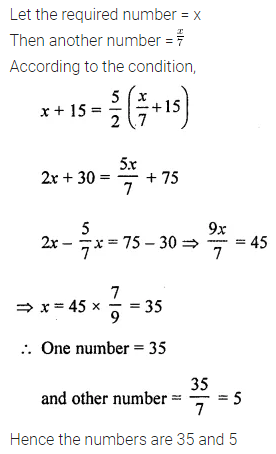
ML Aggarwal Class 8 Solutions for ICSE Maths Chapter 12 Linear Equations and Inequalities in one Variable Ex 12.2 4

Question 5.
When three consecutive even integers are added, the sum is zero. Find the integers.
Solution:
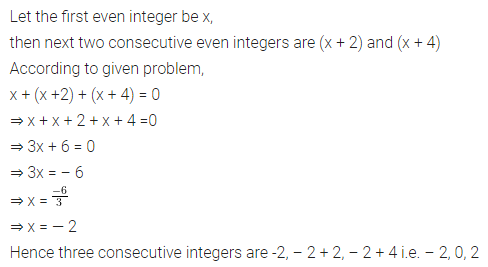
ML Aggarwal Class 8 Solutions for ICSE Maths Chapter 12 Linear Equations and Inequalities in one Variable Ex 12.2 5

Question 6.
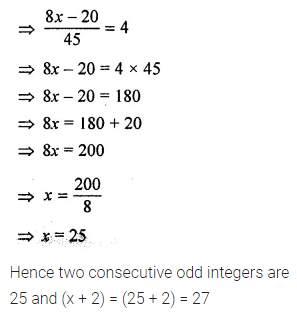
Find two consecutive odd integers such that two-fifth of the smaller exceeds two-ninth of the greater by 4.
Solution:
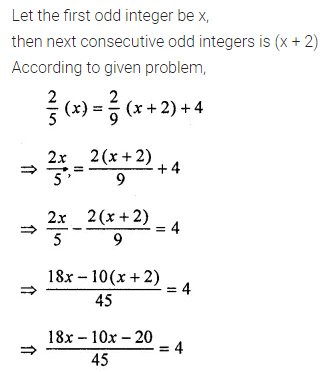
ML Aggarwal Class 8 Solutions for ICSE Maths Chapter 12 Linear Equations and Inequalities in one Variable Ex 12.2 6
ML Aggarwal Class 8 Solutions for ICSE Maths Chapter 12 Linear Equations and Inequalities in one Variable Ex 12.2 7

Question 7.
The denominator of a fraction is 1 more than twice its numerator. If the numerator and denominator are both increased by 5, it becomes \(\frac{3}{5}\). Find the original fraction.
Solution:
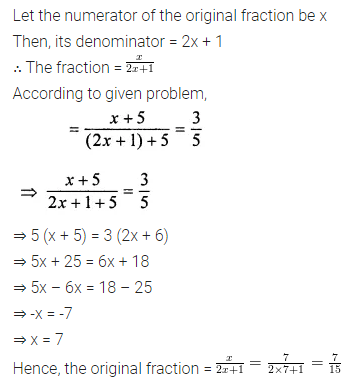
ML Aggarwal Class 8 Solutions for ICSE Maths Chapter 12 Linear Equations and Inequalities in one Variable Ex 12.2 8

Question 8.
Find two positive numbers in the ratio 2 : 5 such that their difference is 15.
Solution:
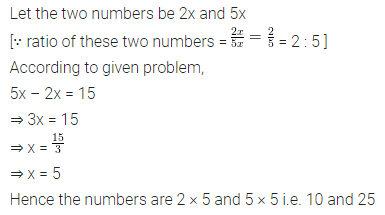
ML Aggarwal Class 8 Solutions for ICSE Maths Chapter 12 Linear Equations and Inequalities in one Variable Ex 12.2 9

Question 9.
What number should be added to each of the numbers 12, 22, 42 and 72 so that the resulting numbers may be in proportion?
Solution:
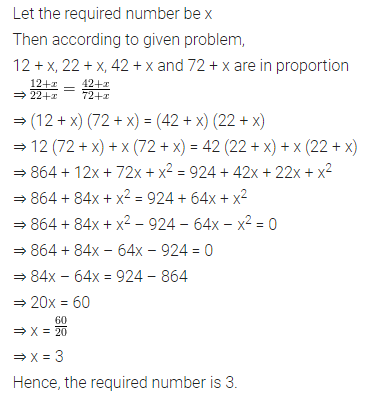
ML Aggarwal Class 8 Solutions for ICSE Maths Chapter 12 Linear Equations and Inequalities in one Variable Ex 12.2 10

Question 10.
The digits of a two-digit number differ by 3. If the digits are interchanged and the resulting number is added to the original number, we get 143. What can be the original number?
Solution:
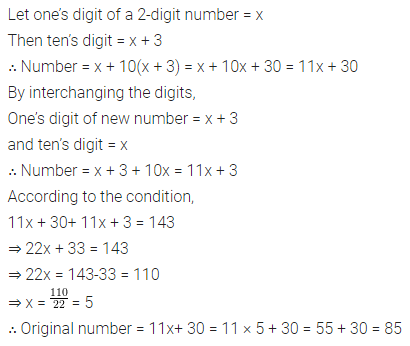
ML Aggarwal Class 8 Solutions for ICSE Maths Chapter 12 Linear Equations and Inequalities in one Variable Ex 12.2 11

Question 11.
Sum of the digits of a two-digit number is 11. When we interchange the digits, it is found that the resulting new number is greater than the original number by 63. Find the two-digit number.
Solution:
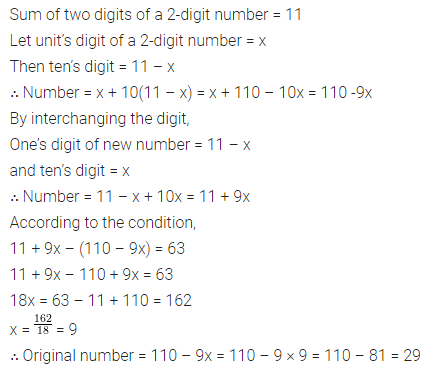
ML Aggarwal Class 8 Solutions for ICSE Maths Chapter 12 Linear Equations and Inequalities in one Variable Ex 12.2 12

Question 12.
Ritu is now four times as old as his brother Raju. In 4 years time, her age will be twice of Raju’s age. What are their present ages?
Solution:
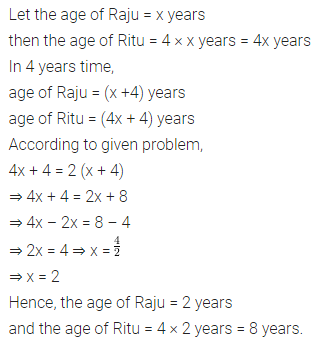
ML Aggarwal Class 8 Solutions for ICSE Maths Chapter 12 Linear Equations and Inequalities in one Variable Ex 12.2 13

Question 13.
A father is 7 times as old as his son. Two years ago, the father was 13 times as old as his son. How old are they now?
Solution:
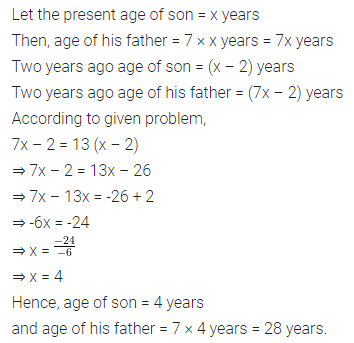
ML Aggarwal Class 8 Solutions for ICSE Maths Chapter 12 Linear Equations and Inequalities in one Variable Ex 12.2 14

Question 14.
The ages of Sona and Sonali are in the ratio 5 : 3. Five years hence, the ratio of their ages will be 10 : 7. Find their present ages.
Solution:
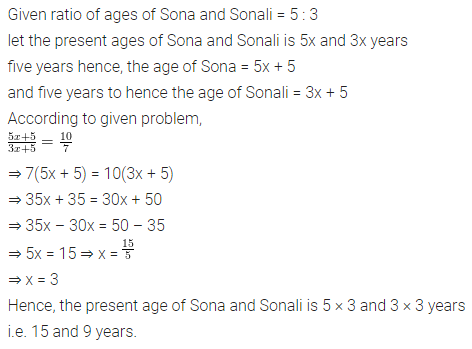
ML Aggarwal Class 8 Solutions for ICSE Maths Chapter 12 Linear Equations and Inequalities in one Variable Ex 12.2 15

Question 15.
An employee works in a company on a contract of 30 days on the condition that he will receive ₹200 for each day he works and he will be fined ₹20 for each day he is absent. If he receives ₹3800 in all, for how many days did he remain absent?
Solution:
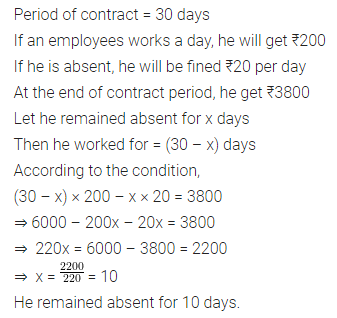
ML Aggarwal Class 8 Solutions for ICSE Maths Chapter 12 Linear Equations and Inequalities in one Variable Ex 12.2 16

Question 16.
I have a total of ₹300 in coins of denomination ₹1, ₹2 and ₹5. The number of coins is 3 times the number of ₹5 coins. The total number of coins is 160. How many coins of each denomination are with me?
Solution:
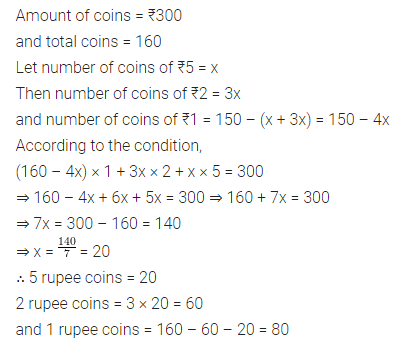
ML Aggarwal Class 8 Solutions for ICSE Maths Chapter 12 Linear Equations and Inequalities in one Variable Ex 12.2 17

Question 17.
A local bus is carrying 40 passengers, some with ₹5 tickets and the remaining with ₹7.50 tickets. If the total receipts from these passengers are ₹230, find the number of passengers with ₹5 tickets.
Solution:
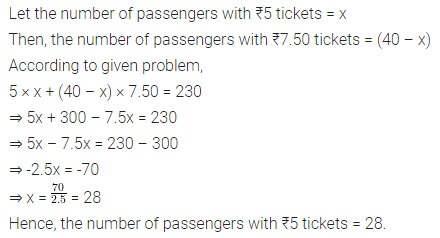
ML Aggarwal Class 8 Solutions for ICSE Maths Chapter 12 Linear Equations and Inequalities in one Variable Ex 12.2 18

Question 18.
On a school picnic, a group of students agree to pay equally for the use of a full boat and pay ₹10 each. If there had been 3 more students in the group, each would have paid ₹2 less. How many students were there in the group?
Solution:
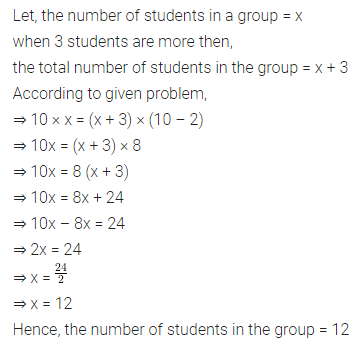
ML Aggarwal Class 8 Solutions for ICSE Maths Chapter 12 Linear Equations and Inequalities in one Variable Ex 12.2 19

Question 19.
Half of a herd of deer are grazing in the field and three-fourths of the remaining are playing nearby. The rest 9 are drinking water from the pond. Find the number of deer in the herd.
Solution:
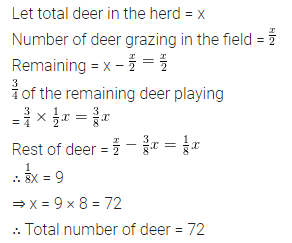
ML Aggarwal Class 8 Solutions for ICSE Maths Chapter 12 Linear Equations and Inequalities in one Variable Ex 12.2 20

Question 20.
Sakshi takes some flowers in a basket and visits three temples one by one. At each temple, she offers one-half of the flowers from the basket. If she is left with 6 flowers at the end, find the number of flowers she had in the beginning.
Solution:
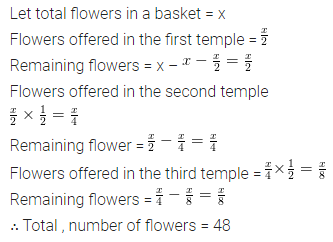
ML Aggarwal Class 8 Solutions for ICSE Maths Chapter 12 Linear Equations and Inequalities in one Variable Ex 12.2 21

Question 21.
Two supplementary angles differ by 50°. Find the measure of each angle.
Solution:
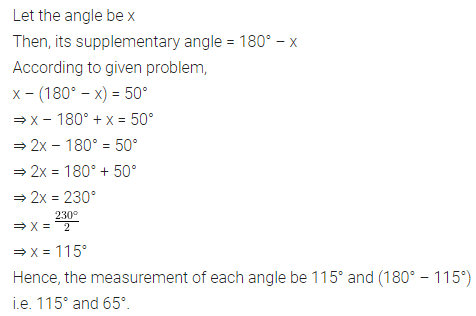
ML Aggarwal Class 8 Solutions for ICSE Maths Chapter 12 Linear Equations and Inequalities in one Variable Ex 12.2 22

Question 22.
If the angles of a triangle are in the ratio 5 : 6 : 7, find the angles.
Solution:
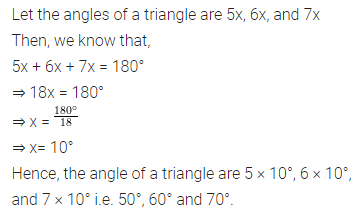
ML Aggarwal Class 8 Solutions for ICSE Maths Chapter 12 Linear Equations and Inequalities in one Variable Ex 12.2 23

Question 23.
Two equal sides of an isosceles triangle are 3x – 1 and 2x + 2 units. The third side is 2x units. Find x and the perimeter of the triangle.
Solution:
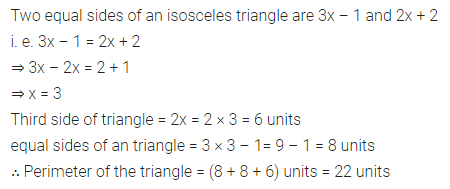
ML Aggarwal Class 8 Solutions for ICSE Maths Chapter 12 Linear Equations and Inequalities in one Variable Ex 12.2 24

Question 24.
If each side of a triangle is increased by 4 cm, the ratio of the perimeters of the new triangle and the given triangle is 7 : 5. Find the perimeter of the given triangle.
Solution:
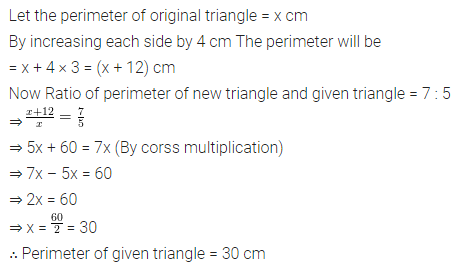
ML Aggarwal Class 8 Solutions for ICSE Maths Chapter 12 Linear Equations and Inequalities in one Variable Ex 12.2 25

Question 25.
The length of a rectangle is 5 cm less than twice its breadth. If the length is decreased by 3 cm and breadth increased by 2 cm, the perimeter of the resulting rectangle is 72 cm. Find the area of the original rectangle.
Solution:
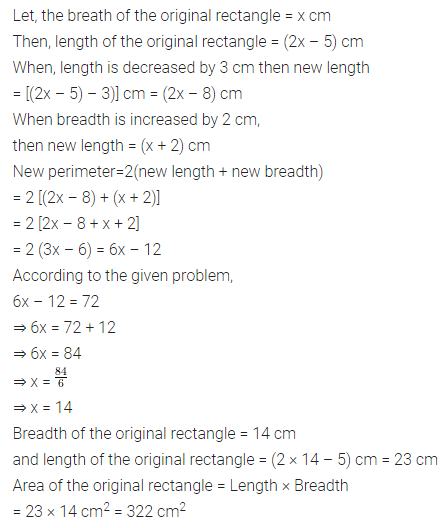
ML Aggarwal Class 8 Solutions for ICSE Maths Chapter 12 Linear Equations and Inequalities in one Variable Ex 12.2 26

Question 26.
A rectangle is 10 cm long and 8 cm wide. When each side of the rectangle is increased by x cm, its perimeter is doubled. Find the equation in x and hence find the area of the new rectangle.
Solution:
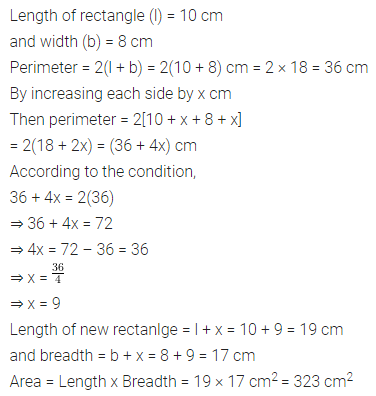
ML Aggarwal Class 8 Solutions for ICSE Maths Chapter 12 Linear Equations and Inequalities in one Variable Ex 12.2 27

Question 27.
A steamer travels 90 km downstream in the same time as it takes to travel 60 km upstream. If the speed of the stream is 5 km/hr, find the speed of the streamer in still water.
Solution:
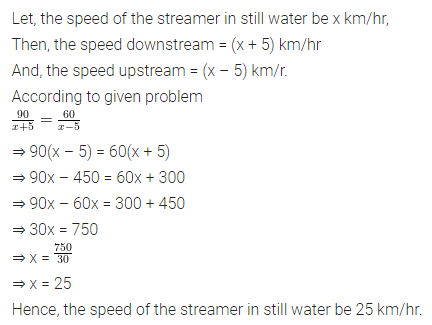
ML Aggarwal Class 8 Solutions for ICSE Maths Chapter 12 Linear Equations and Inequalities in one Variable Ex 12.2 28

Question 28.
A steamer goes downstream and covers the distance between two ports in 5 hours while it covers the same distance upstream in 6 hours. If the speed of the stream is 1 km/h, find the speed of the streamer in still water and the distance between two ports.
Solution:
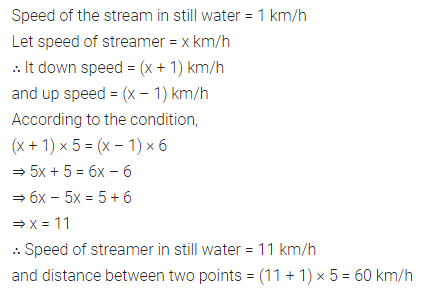
ML Aggarwal Class 8 Solutions for ICSE Maths Chapter 12 Linear Equations and Inequalities in one Variable Ex 12.2 29

Question 29.
Distance between two places A and B is 350 km. Two cars start simultaneously from A and B towards each other and the distance between them after 4 hours is 62 km. If the speed of one car is 8 km/h less than the speed of other cars, find the speed of each car.
Solution:
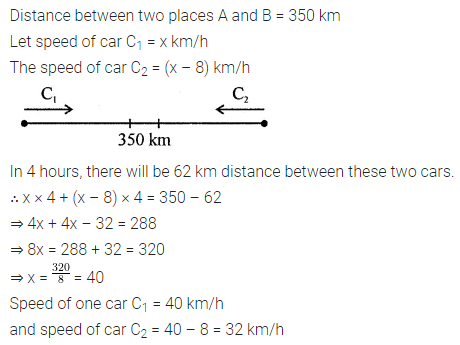
ML Aggarwal Class 8 Solutions for ICSE Maths Chapter 12 Linear Equations and Inequalities in one Variable Ex 12.2 30

ML Aggarwal Class 8 Solutions for ICSE Maths

ML Aggarwal Class 8 Solutions for ICSE Maths Chapter 12 Linear Equations and Inequalities in one Variable Ex 12.1

ML Aggarwal Class 8 Solutions for ICSE Maths Chapter 12 Linear Equations and Inequalities in one Variable Ex 12.1

Solve the following equations (1 to 12):
Question 1.
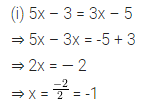
(i) 5x – 3 = 3x – 5
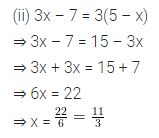
(ii) 3x – 7 = 3(5 – x)
Solution:
ML Aggarwal Class 8 Solutions for ICSE Maths Chapter 12 Linear Equations and Inequalities in one Variable Ex 12.1 1
ML Aggarwal Class 8 Solutions for ICSE Maths Chapter 12 Linear Equations and Inequalities in one Variable Ex 12.1 2

Question 2.
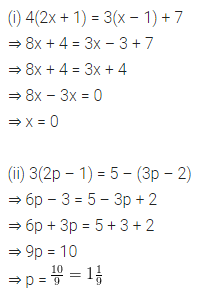
(i) 4(2x + 1) = 3(x – 1) + 7
(ii) 3(2p – 1) = 5 – (3p – 2)
Solution:
ML Aggarwal Class 8 Solutions for ICSE Maths Chapter 12 Linear Equations and Inequalities in one Variable Ex 12.1 3

Question 3.
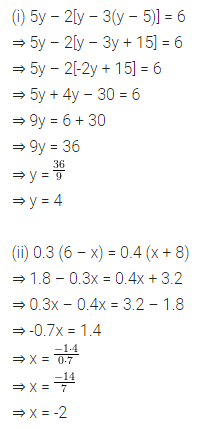
(i) 5y – 2[y – 3(y – 5)] = 6
(ii) 0.3(6 – x) = 0.4(x + 8)
Solution:
ML Aggarwal Class 8 Solutions for ICSE Maths Chapter 12 Linear Equations and Inequalities in one Variable Ex 12.1 4

Question 4.
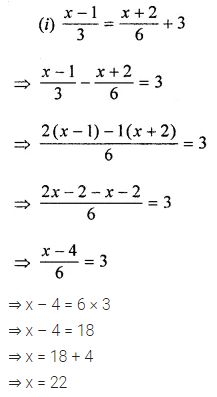
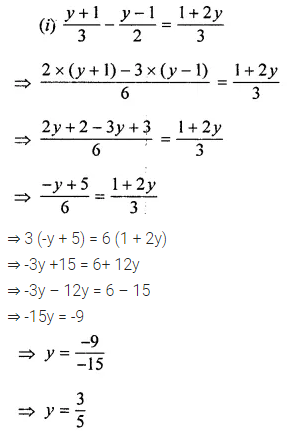
(i) \(\frac{x-1}{3}=\frac{x+2}{6}+3\)
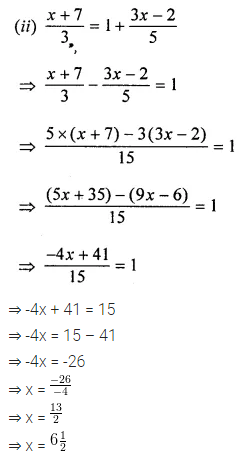
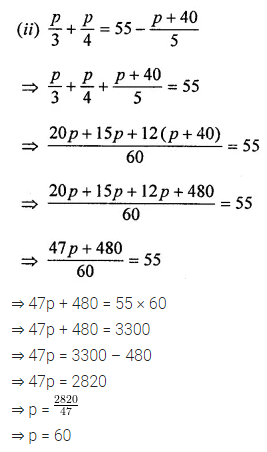
(ii) \(\frac{x+7}{3}=1+\frac{3 x-2}{5}\)
Solution:
ML Aggarwal Class 8 Solutions for ICSE Maths Chapter 12 Linear Equations and Inequalities in one Variable Ex 12.1 5
ML Aggarwal Class 8 Solutions for ICSE Maths Chapter 12 Linear Equations and Inequalities in one Variable Ex 12.1 6

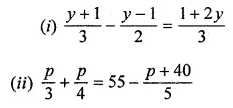
Question 5.
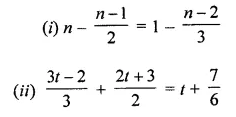
ML Aggarwal Class 8 Solutions for ICSE Maths Chapter 12 Linear Equations and Inequalities in one Variable Ex 12.1 7
Solution:
ML Aggarwal Class 8 Solutions for ICSE Maths Chapter 12 Linear Equations and Inequalities in one Variable Ex 12.1 8
ML Aggarwal Class 8 Solutions for ICSE Maths Chapter 12 Linear Equations and Inequalities in one Variable Ex 12.1 9

Question 6.
ML Aggarwal Class 8 Solutions for ICSE Maths Chapter 12 Linear Equations and Inequalities in one Variable Ex 12.1 10
Solution:
ML Aggarwal Class 8 Solutions for ICSE Maths Chapter 12 Linear Equations and Inequalities in one Variable Ex 12.1 11

Question 7.
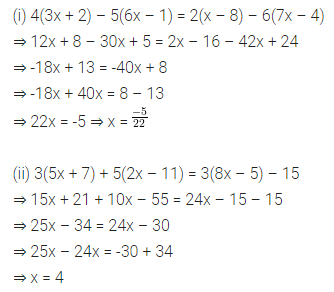
(i) 4(3x + 2) – 5(6x – 1) = 2(x – 8) – 6(7x – 4)
(ii) 3(5x + 7) + 5(2x – 11) = 3(8x – 5) – 15
Solution:
ML Aggarwal Class 8 Solutions for ICSE Maths Chapter 12 Linear Equations and Inequalities in one Variable Ex 12.1 12

Question 8.
ML Aggarwal Class 8 Solutions for ICSE Maths Chapter 12 Linear Equations and Inequalities in one Variable Ex 12.1 13
Solution:
ML Aggarwal Class 8 Solutions for ICSE Maths Chapter 12 Linear Equations and Inequalities in one Variable Ex 12.1 14

Question 9.
ML Aggarwal Class 8 Solutions for ICSE Maths Chapter 12 Linear Equations and Inequalities in one Variable Ex 12.1 15
Solution:
ML Aggarwal Class 8 Solutions for ICSE Maths Chapter 12 Linear Equations and Inequalities in one Variable Ex 12.1 16

Question 10.
ML Aggarwal Class 8 Solutions for ICSE Maths Chapter 12 Linear Equations and Inequalities in one Variable Ex 12.1 17
Solution:
ML Aggarwal Class 8 Solutions for ICSE Maths Chapter 12 Linear Equations and Inequalities in one Variable Ex 12.1 18
ML Aggarwal Class 8 Solutions for ICSE Maths Chapter 12 Linear Equations and Inequalities in one Variable Ex 12.1 19

Question 11.
ML Aggarwal Class 8 Solutions for ICSE Maths Chapter 12 Linear Equations and Inequalities in one Variable Ex 12.1 20
Solution:
ML Aggarwal Class 8 Solutions for ICSE Maths Chapter 12 Linear Equations and Inequalities in one Variable Ex 12.1 21

Question 12.
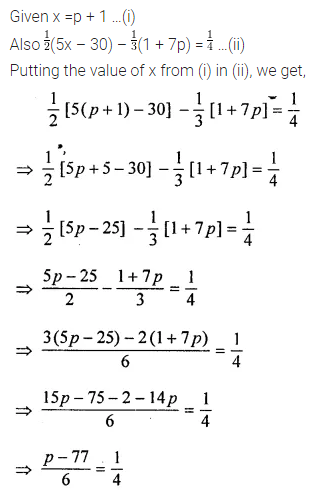
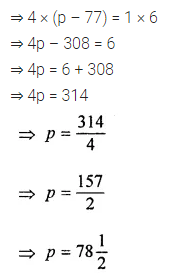
If x = p + 1, find the value of p from the equation \(\frac{1}{2}\) (5x – 30) – \(\frac{1}{3}\) (1 + 7p) = \(\frac{1}{4}\)
Solution:
ML Aggarwal Class 8 Solutions for ICSE Maths Chapter 12 Linear Equations and Inequalities in one Variable Ex 12.1 22
ML Aggarwal Class 8 Solutions for ICSE Maths Chapter 12 Linear Equations and Inequalities in one Variable Ex 12.1 23

Question 13.
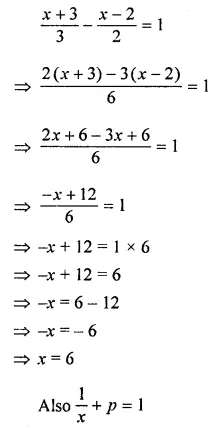
Solve \(\frac{x+3}{3}-\frac{x-2}{2}=1\), Hence find p if \(\frac{1}{x}+p\) = 1.
Solution:
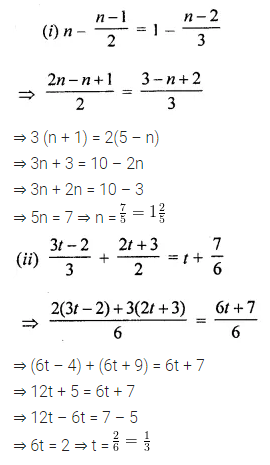
ML Aggarwal Class 8 Solutions for ICSE Maths Chapter 12 Linear Equations and Inequalities in one Variable Ex 12.1 24

ML Aggarwal Class 8 Solutions for ICSE Maths

ML Aggarwal Class 8 Solutions for ICSE Maths Chapter 11 Factorisation Check Your Progress

ML Aggarwal Class 8 Solutions for ICSE Maths Chapter 11 Factorisation Check Your Progress

Question 1.
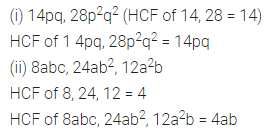
Find the HCF of the given polynomials:
(i) 14pq, 28p2q2
(ii) 8abc, 24ab2, 12a2b
Solution:
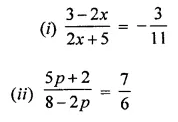
ML Aggarwal Class 8 Solutions for ICSE Maths Chapter 11 Factorisation Check Your Progress 1

Question 2.
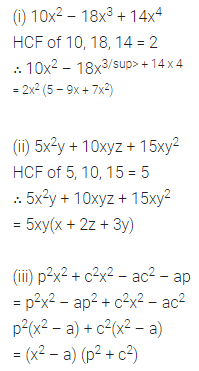
Factorise the following:
(i) 10x2 – 18x3 + 14x4
(ii) 5x2y + 10xyz + 15xy2
(iii) p2x2 + c2x2 – ac2 – ap2
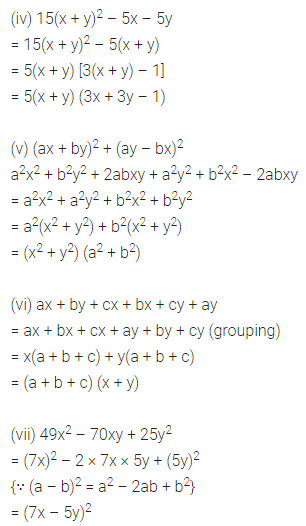
(iv) 15(x + y)2 – 5x – 5y
(v) (ax + by)2 + (ay – bx)2
(vi) ax + by + cx + bx + cy + ay
(vii) 49x2 – 70xy + 25y2
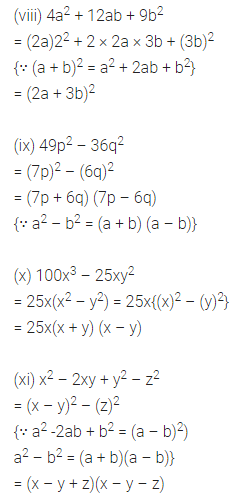
(viii) 4a2 + 12ab + 9b2
(ix) 49p2 – 36q2
(x) 100x3 – 25xy2
(xi) x2 – 2xy + y2 – z2
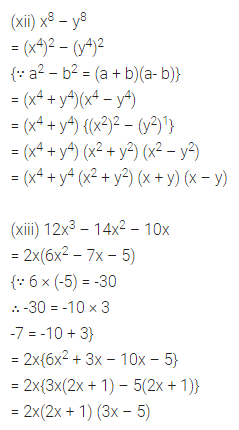
(xii) x8 – y8
(xiii) 12x3 – 14x2 – 10x
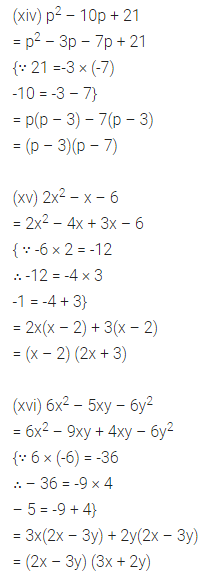
(xiv) p2 – 10p + 21
(xv) 2x2 – x – 6
(xvi) 6x2 – 5xy – 6y2
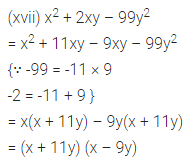
(xvii) x2 + 2xy – 99y2
Solution:
ML Aggarwal Class 8 Solutions for ICSE Maths Chapter 11 Factorisation Check Your Progress 2
ML Aggarwal Class 8 Solutions for ICSE Maths Chapter 11 Factorisation Check Your Progress 3
ML Aggarwal Class 8 Solutions for ICSE Maths Chapter 11 Factorisation Check Your Progress 4
ML Aggarwal Class 8 Solutions for ICSE Maths Chapter 11 Factorisation Check Your Progress 5
ML Aggarwal Class 8 Solutions for ICSE Maths Chapter 11 Factorisation Check Your Progress 6
ML Aggarwal Class 8 Solutions for ICSE Maths Chapter 11 Factorisation Check Your Progress 7

Question 3.
Divide as directed:
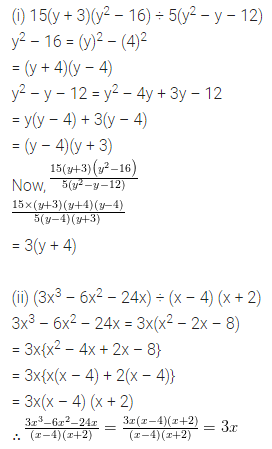
(i) 15(y + 3)(y2 – 16) ÷ 5(y2 – y – 12)
(ii) (3x3 – 6x2 – 24x) ÷ (x – 4) (x + 2)
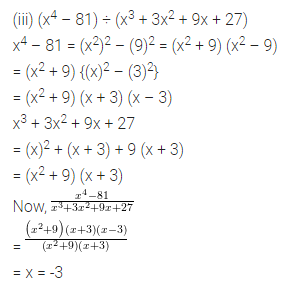
(iii) (x4 – 81) ÷ (x3 + 3x2 + 9x + 27)
Solution:
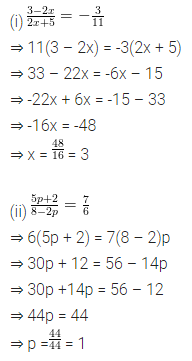
ML Aggarwal Class 8 Solutions for ICSE Maths Chapter 11 Factorisation Check Your Progress 8
ML Aggarwal Class 8 Solutions for ICSE Maths Chapter 11 Factorisation Check Your Progress 9

ML Aggarwal Class 8 Solutions for ICSE Maths

ML Aggarwal Class 8 Solutions for ICSE Maths Chapter 11 Factorisation Objective Type Questions

ML Aggarwal Class 8 Solutions for ICSE Maths Chapter 11 Factorisation Objective Type Questions

Mental Maths
Question 1.
Fill in the blanks:
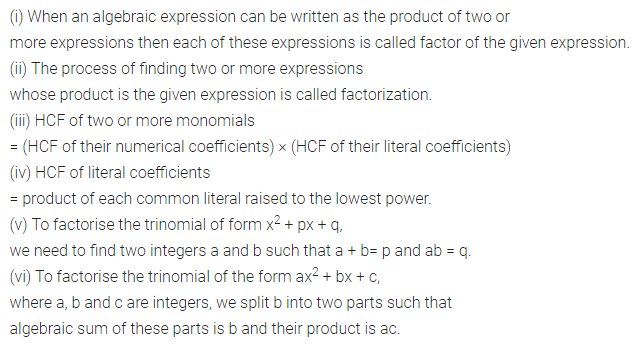
(i) When an algebraic expression can be written as the product of two or more expressions then each of these expressions is called ……….. of the given expression.
(ii) The process of finding two or more expressions whose product is the given expression is called ………..
(iii) HCF of two or more monomials = (HCF of their ……….. coefficients) × (HCF of their literal coefficients)
(iv) HCB of literal coefficients = product of each common literal raised to the ……….. power.
(v) To factorise the trinomial of the form x2 + px + q, we need to find two integers a and b such that a + b = ……….. and ab = ………..
(vi) To factorise the trinomial of the form ax2 + bx + c, where a, b and c are integers, we split b into two parts such that ……….. of these parts is b and there is ……….. ac.
Solution:
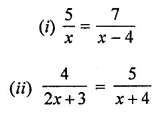
ML Aggarwal Class 8 Solutions for ICSE Maths Chapter 11 Factorisation Objective Type Questions 1

Question 2.
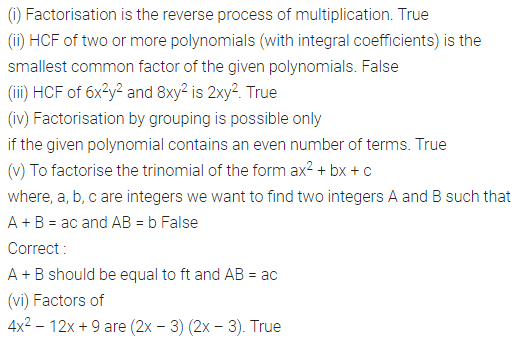
State whether the following statements are true (T) or false (F):
(i) Factorisation is the reverse process of multiplication.
(ii) HCF of two or more polynomials (with integral coefficients) is the smallest common factor of the given polynomials.
(iii) HCF of 6x2y2 and 8xy3 is 2xy2.
(iv) Factorisation by grouping is possible only if the given polynomial contains an even number of terms.
(v) To factorise the trinomial of the form ax2 + bx + c where, a, b, c are integers we want to find two integers A and B such that
A + B = ac and AB = b
(vi) Factors of 4x2 – 12x + 9 are (2x – 3) (2x – 3).
Solution:
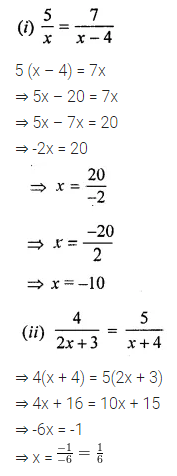
ML Aggarwal Class 8 Solutions for ICSE Maths Chapter 11 Factorisation Objective Type Questions 2

Multiple Choice Questions
Choose the correct answer from the given four options (3 to 14):
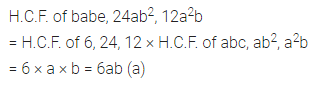
Question 3.
H.C.F. of 6abc, 24ab2, 12a2b is
(a) 6ab
(b) 6ab2
(c) 6a2b
(d) 6abc
Solution:
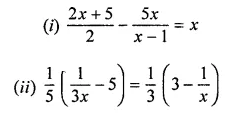
ML Aggarwal Class 8 Solutions for ICSE Maths Chapter 11 Factorisation Objective Type Questions 3

Question 4.
Factors of 12a2b + 15ab2 are
(a) 3a(4ab + 5b2)
(b) 3ab(4a + 5b)
(c) 3b(4a2 + 5ab)
(d) none of these
Solution:
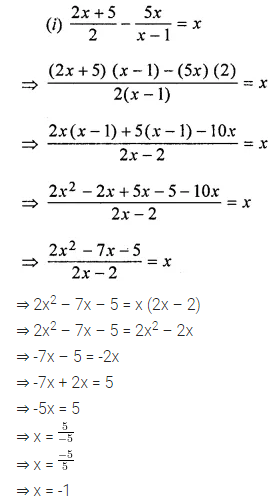
ML Aggarwal Class 8 Solutions for ICSE Maths Chapter 11 Factorisation Objective Type Questions 4

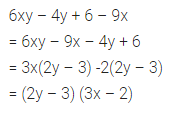
Question 5.
Factors of 6xy – 4y + 6 – 9x are
(a) (3y – 2) (2x – 3)
(b) (3x – 2) (2y – 3)
(c) (2y – 3) (2 – 3x)
(d) none of these
Solution:
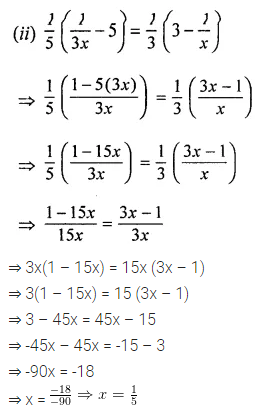
ML Aggarwal Class 8 Solutions for ICSE Maths Chapter 11 Factorisation Objective Type Questions 5

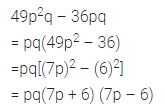
Question 6.
Factors of 49p3q – 36pq are
(a) p(7p + 6q) (7p – 6q)
(b) q(7p – 6) (7p + 6)
(c) pq(7p + 6) (7p – 6)
(d) none of these
Solution:
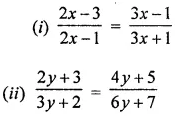
ML Aggarwal Class 8 Solutions for ICSE Maths Chapter 11 Factorisation Objective Type Questions 6

Question 7.
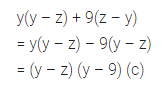
Factors of y(y – z) + 9(z – y) are
(a) (y – z) (y + 9)
(b) (z – y) (y + 9)
(c) (y – z) (y – 9)
(d) none of these
Solution:
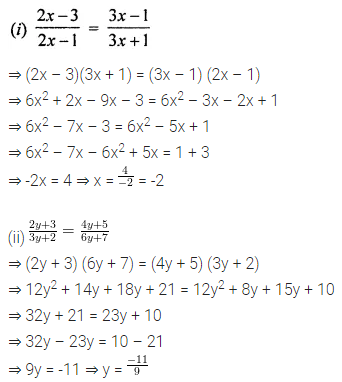
ML Aggarwal Class 8 Solutions for ICSE Maths Chapter 11 Factorisation Objective Type Questions 7

Question 8.
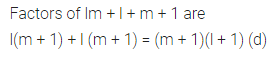
Factors of (lm + l) + m + 1 are
(a) (lm + l )(m + l)
(b) (lm + m)(l + 1)
(c) l(m + 1)
(d) (l + 1)(m + 1)
Solution:
ML Aggarwal Class 8 Solutions for ICSE Maths Chapter 11 Factorisation Objective Type Questions 8

Question 9.
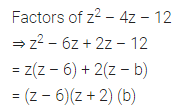
Factors of z2 – 4z – 12 are
(a) (z + 6)(z – 2)
(b) (z – 6)(z + 2)
(c) (z – 6)(z – 2)
(d) (z + 6)(z + 2)
Solution:
ML Aggarwal Class 8 Solutions for ICSE Maths Chapter 11 Factorisation Objective Type Questions 9

Question 10.
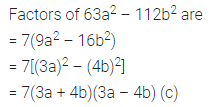
Factors of 63a2 – 112b2 are
(a) 63 (a – 2b)(a + 2b)
(b) 7(3a + 2b)(3a – 2b)
(c) 7(3a + 4b)(3a – 4b)
(d) none of these
Solution:
ML Aggarwal Class 8 Solutions for ICSE Maths Chapter 11 Factorisation Objective Type Questions 10

Question 11.
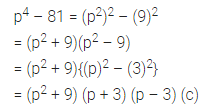
Factors of p4 – 81 are
(a) (p2 – 9)(p2 + 9)
(b) (p + 3)2 (p – 3)2
(c) (p + 3) (p – 3) (p2 + 9)
(d) none of these
Solution:
ML Aggarwal Class 8 Solutions for ICSE Maths Chapter 11 Factorisation Objective Type Questions 11

Question 12.
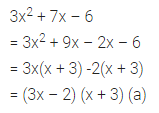
Factors of 3x + 7x – 6 are
(a) (3x – 2)(x + 3)
(b) (3x + 2) (x – 3)
(c) (3x – 2)(x – 3)
(d) (3x + 2) (x + 3)
Solution:
ML Aggarwal Class 8 Solutions for ICSE Maths Chapter 11 Factorisation Objective Type Questions 12

Question 13.
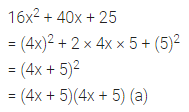
Factors of 16x2 + 40x + 25 are
(a) (4x + 5)(4x + 5)
(b) (4x + 5)(4x – 5)
(c) (4x + 5)(4x + 8)
(d) none of these
Solution:
ML Aggarwal Class 8 Solutions for ICSE Maths Chapter 11 Factorisation Objective Type Questions 13

Question 14.
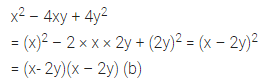
Factors of x2 – 4xy + 4y2 are
(a) (x – 2y)(x + 2y)
(b) (x-2y)(x-2y)
(c) (x + 2y)(x + 2y)
(d) none of these
Solution:
ML Aggarwal Class 8 Solutions for ICSE Maths Chapter 11 Factorisation Objective Type Questions 14

Higher Order Thinking Skills (Hots)
Factorise the following
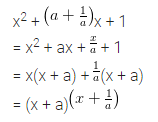
Question 1.
x2 + \(\left(a+\frac{1}{a}\right)\)x + 1
Solution:
ML Aggarwal Class 8 Solutions for ICSE Maths Chapter 11 Factorisation Objective Type Questions 15

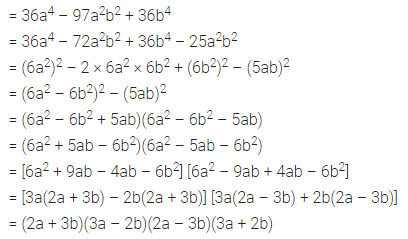
Question 2.
36a4 – 97a2b2 + 36b4
Solution:
ML Aggarwal Class 8 Solutions for ICSE Maths Chapter 11 Factorisation Objective Type Questions 16

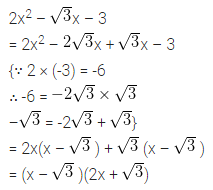
Question 3.
2x2 – \(\sqrt{3}\)x – 3
Solution:
ML Aggarwal Class 8 Solutions for ICSE Maths Chapter 11 Factorisation Objective Type Questions 17

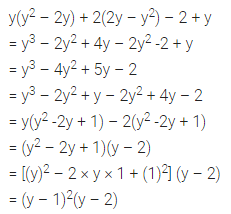
Question 4.
y(y2 – 2y) + 2(2y – y2) – 2 + y
Solution:
ML Aggarwal Class 8 Solutions for ICSE Maths Chapter 11 Factorisation Objective Type Questions 18

ML Aggarwal Class 8 Solutions for ICSE Maths