ML Aggarwal Class 8 Solutions for ICSE Maths Chapter 14 Constructions of Quadrilaterals Objective Type Questions

ML Aggarwal Class 8 Solutions for ICSE Maths Chapter 14 Constructions of Quadrilaterals Objective Type Questions

Higher Order Thinking Skills (Hots)
Question 1.
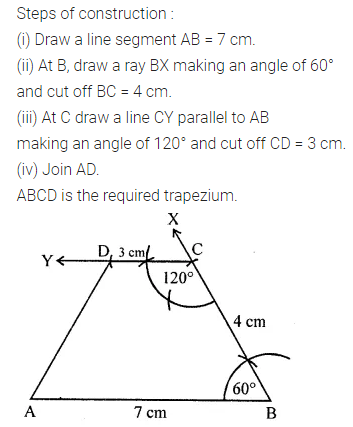
Construct a trapezium ABCD in which AB = 7 cm, BC = 4 cm, CD = 3 cm, ∠B = 60° and AB || DC.
Solution:
ML Aggarwal Class 8 Solutions for ICSE Maths Chapter 14 Constructions of Quadrilaterals Objective Type Questions 1

Question 2.
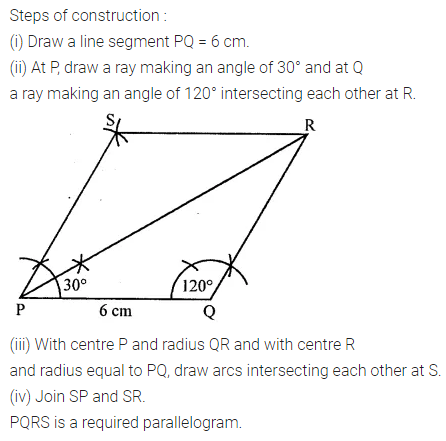
Construct a parallelogram PQRS in which PQ = 6 cm, ∠Q = 120° and ∠RPQ = 30°.
Solution:
ML Aggarwal Class 8 Solutions for ICSE Maths Chapter 14 Constructions of Quadrilaterals Objective Type Questions 2

Question 3.
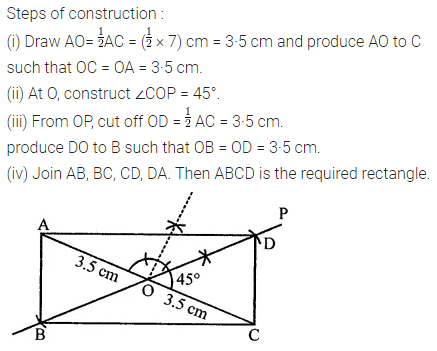
Construct a rectangle ABCD in which diagonal AC = 7 cm and the diagonals BD and AC intersect at O such that ∠BOC = 45°.
Solution:
ML Aggarwal Class 8 Solutions for ICSE Maths Chapter 14 Constructions of Quadrilaterals Objective Type Questions 3

ML Aggarwal Class 8 Solutions for ICSE Maths

ML Aggarwal Class 8 Solutions for ICSE Maths Chapter 14 Constructions of Quadrilaterals Ex 14.2

ML Aggarwal Class 8 Solutions for ICSE Maths Chapter 14 Constructions of Quadrilaterals Ex 14.2

Question 1.
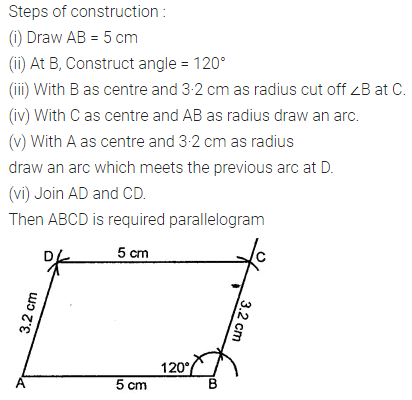
Construct a parallelogram ABCD such that AB = 5 cm, BC = 3·2 cm and ∠B 120°.
Solution:
ML Aggarwal Class 8 Solutions for ICSE Maths Chapter 14 Constructions of Quadrilaterals Ex 14.2 1

Question 2.
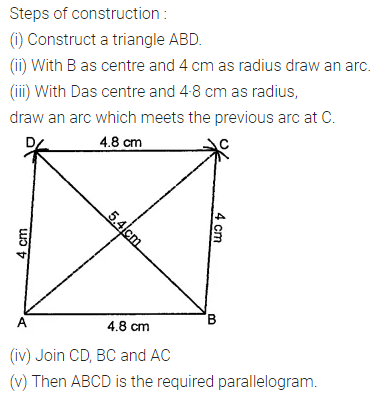
Construct a parallelogram ABCD such that AB = 4·8 cm, BC = 4 cm and diagonal BD = 5·4 cm.
Solution:
ML Aggarwal Class 8 Solutions for ICSE Maths Chapter 14 Constructions of Quadrilaterals Ex 14.2 2

Question 3.
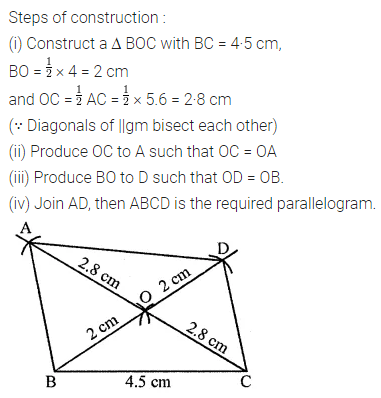
Construct a parallelogram ABCD such that BC = 4·5 cm, BD = 4 cm and AC = 5·6 cm.
Solution:
ML Aggarwal Class 8 Solutions for ICSE Maths Chapter 14 Constructions of Quadrilaterals Ex 14.2 3

Question 4.
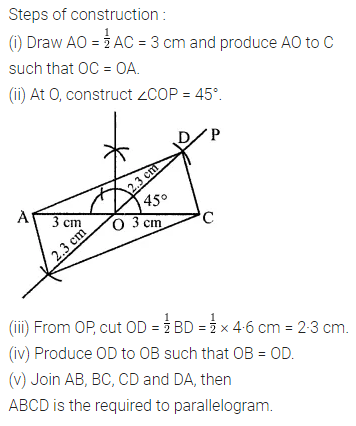
Construct a parallelogram ABCD such that AC = 6 cm, BD = 4·6 cm and angle between them is 45°.
Solution:
ML Aggarwal Class 8 Solutions for ICSE Maths Chapter 14 Constructions of Quadrilaterals Ex 14.2 4

Question 5.
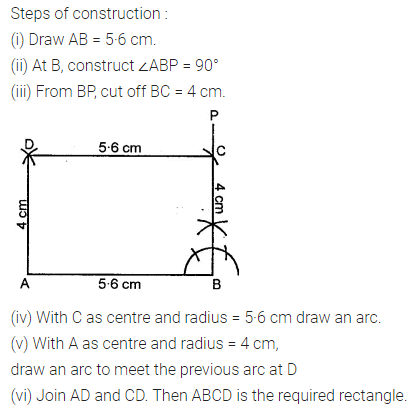
Construct a rectangle whose adjacent sides are 5·6 cm and 4 cm.
Solution:
ML Aggarwal Class 8 Solutions for ICSE Maths Chapter 14 Constructions of Quadrilaterals Ex 14.2 5

Question 6.
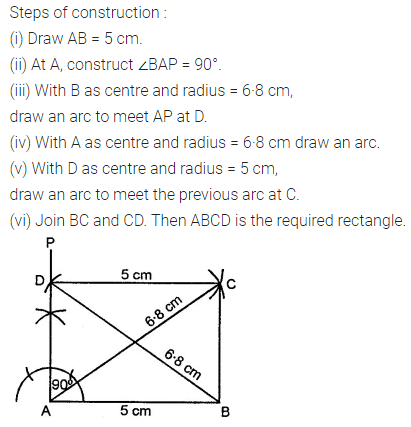
Construct a rectangle such that one side is 5 cm and one diagonal is 6·8 cm.
Solution:
ML Aggarwal Class 8 Solutions for ICSE Maths Chapter 14 Constructions of Quadrilaterals Ex 14.2 6

Question 7.
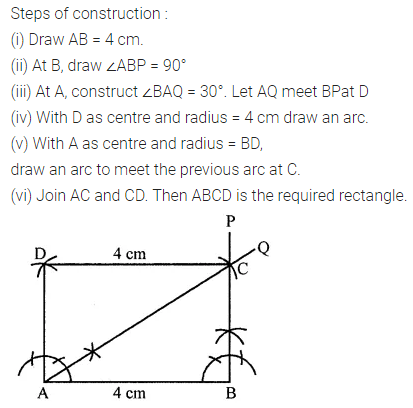
Construct a rectangle ABCD such that AB = 4 cm and ∠BAC = 60°.
Solution:
ML Aggarwal Class 8 Solutions for ICSE Maths Chapter 14 Constructions of Quadrilaterals Ex 14.2 7

Question 8.
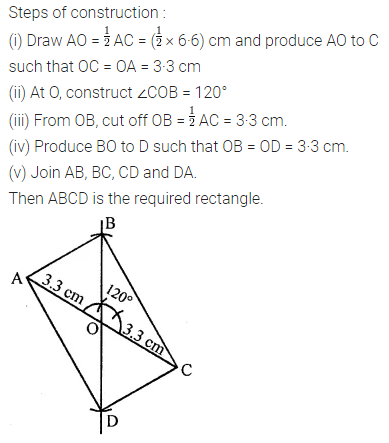
Construct a rectangle such that one diagonal is 6-6 cm and the angle between two diagonals is 120°.
Solution:
ML Aggarwal Class 8 Solutions for ICSE Maths Chapter 14 Constructions of Quadrilaterals Ex 14.2 8

Question 9.
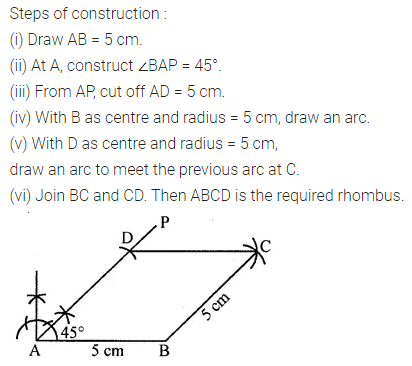
Construct a rhombus whose one side is 5 cm and one angle is 45°
Solution:
ML Aggarwal Class 8 Solutions for ICSE Maths Chapter 14 Constructions of Quadrilaterals Ex 14.2 9

Question 10.
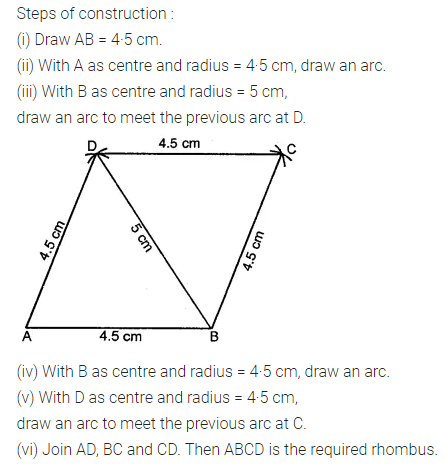
Construct a rhombus whose one side is 4·5 cm and one diagonal is 5 cm.
Solution:
ML Aggarwal Class 8 Solutions for ICSE Maths Chapter 14 Constructions of Quadrilaterals Ex 14.2 10

Question 11.
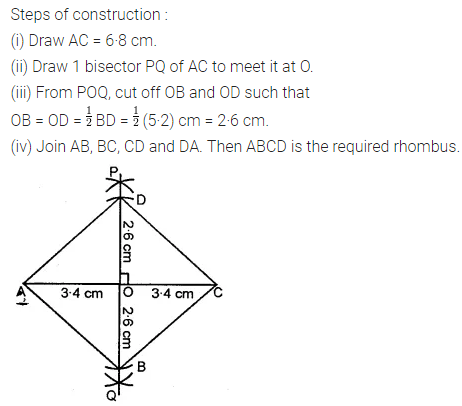
Construct a rhombus whose diagonals are 6·8 cm and 5·2 cm.
Solution:
ML Aggarwal Class 8 Solutions for ICSE Maths Chapter 14 Constructions of Quadrilaterals Ex 14.2 11

Question 12.
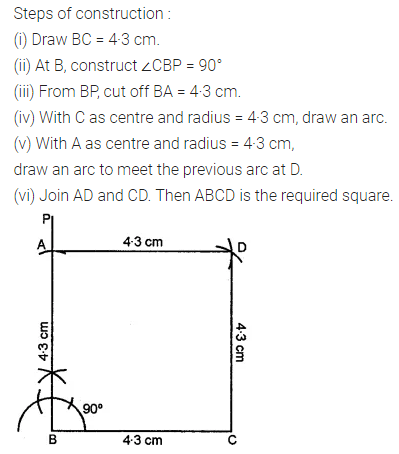
Construct a square whose one side is 4·3 cm.
Solution:
ML Aggarwal Class 8 Solutions for ICSE Maths Chapter 14 Constructions of Quadrilaterals Ex 14.2 12

Question 13.
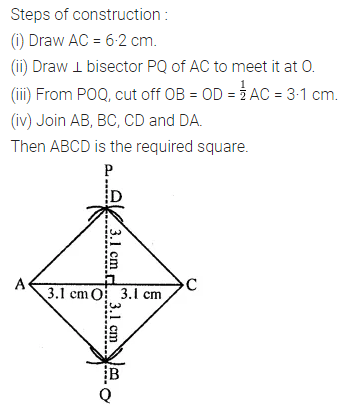
Construct a square whose one diagonal is 6·2 cm.
Solution:
ML Aggarwal Class 8 Solutions for ICSE Maths Chapter 14 Constructions of Quadrilaterals Ex 14.2 13

ML Aggarwal Class 8 Solutions for ICSE Maths

ML Aggarwal Class 8 Solutions for ICSE Maths Chapter 14 Constructions of Quadrilaterals Ex 14.1

ML Aggarwal Class 8 Solutions for ICSE Maths Chapter 14 Constructions of Quadrilaterals Ex 14.1

Question 1.
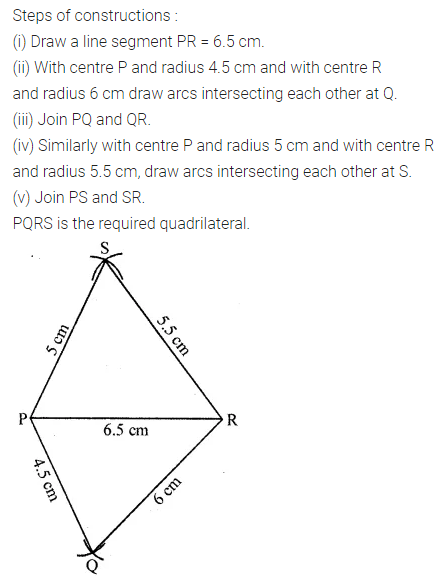
Construct a quadrilateral PQRS where PQ = 4.5 cm, QR = 6 cm, RS = 5.5 cm, PS = 5 cm and PR = 6.5 cm.
Solution:
ML Aggarwal Class 8 Solutions for ICSE Maths Chapter 14 Constructions of Quadrilaterals Ex 14.1 1

Question 2.
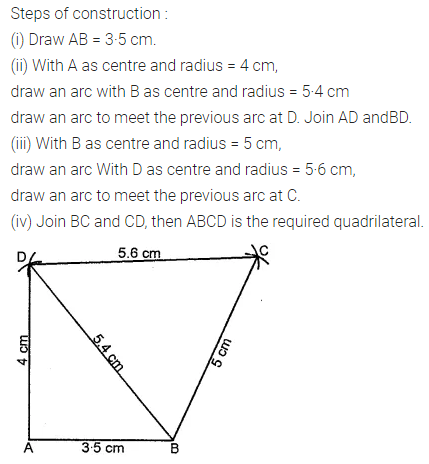
Construct a quadrilateral ABCD in which AB = 3·5 cm, BC = 5 cm, CD = 5·6 cm, DA = 4 cm and BD = 5·4 cm
Solution:
ML Aggarwal Class 8 Solutions for ICSE Maths Chapter 14 Constructions of Quadrilaterals Ex 14.1 2

Question 3.
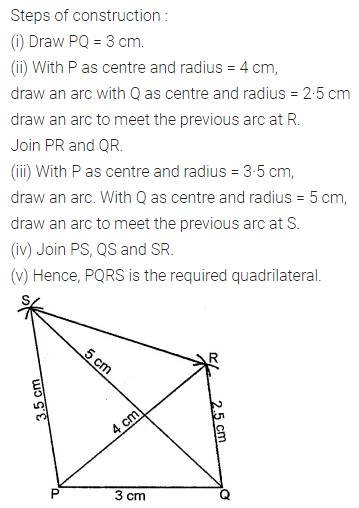
Construct a quadrilateral PQRS in which PQ = 3 cm, QR = 2·5 cm, PS = 3·5 cm, PR = 4 cm and QS = 5 cm.
Solution:
ML Aggarwal Class 8 Solutions for ICSE Maths Chapter 14 Constructions of Quadrilaterals Ex 14.1 3

Question 4.
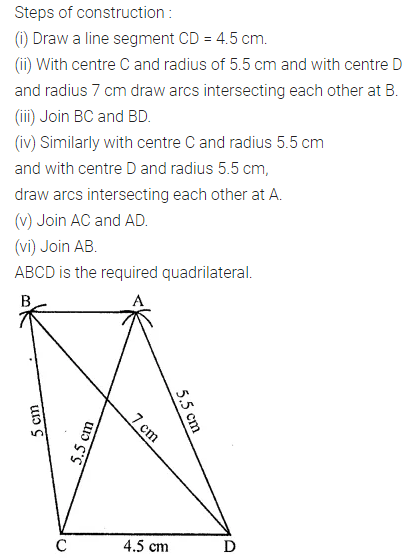
Construct a quadrilateral ABCD such that BC = 5 cm, AD = 5.5 cm, CD = 4.5 cm, AC = 7 cm, and BC = 5.5 cm.
Solution:
ML Aggarwal Class 8 Solutions for ICSE Maths Chapter 14 Constructions of Quadrilaterals Ex 14.1 4

Question 5.
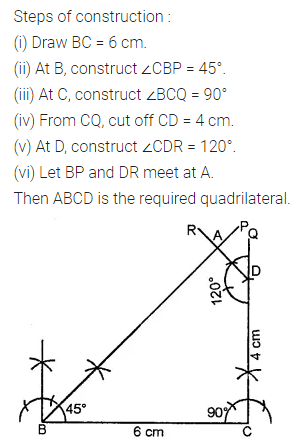
Construct a quadrilateral ABCD given that BC = 6 cm, CD = 4 cm, ∠B = 45°, ∠C = 90° and ∠D = 120°.
Solution:
ML Aggarwal Class 8 Solutions for ICSE Maths Chapter 14 Constructions of Quadrilaterals Ex 14.1 5

Question 6.
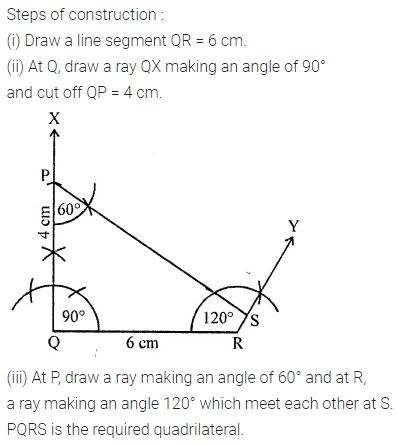
Construct a quadrilateral PQRS where PQ = 4 cm, QR = 6 cm, ∠P = 60°, ∠Q = 90° and ∠R = 120°.
Solution:
ML Aggarwal Class 8 Solutions for ICSE Maths Chapter 14 Constructions of Quadrilaterals Ex 14.1 6

Question 7.
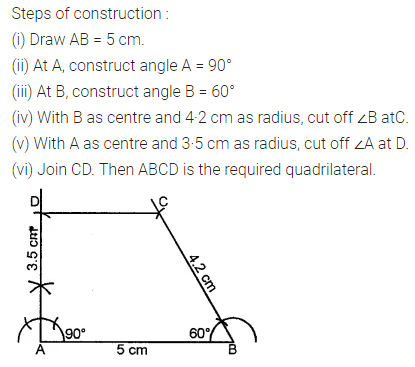
Construct a quadrilateral ABCD such that AB = 5 cm, BC = 4·2 cm, AD = 3·5 cm, ∠A = 90°, and ∠B = 60°
Solution:
ML Aggarwal Class 8 Solutions for ICSE Maths Chapter 14 Constructions of Quadrilaterals Ex 14.1 7

Question 8.
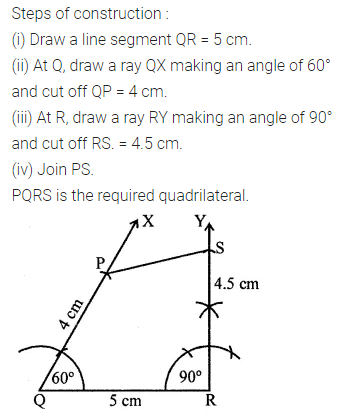
Cosntruct a quadrilateral PQRS where PQ = 4 cm, QR = 5 cm, RS = 4.5 cm, ∠Q = 60° and ∠R = 90°.
Solution:
ML Aggarwal Class 8 Solutions for ICSE Maths Chapter 14 Constructions of Quadrilaterals Ex 14.1 8

Question 9.
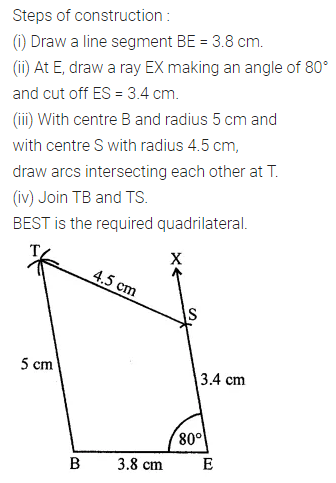
Construct a quadrilateral BEST where BE = 3.8 cm, ES = 3.4 cm, ST = 4.5 cm, TB = 5 cm and ∠E = 80°.
Solution:
ML Aggarwal Class 8 Solutions for ICSE Maths Chapter 14 Constructions of Quadrilaterals Ex 14.1 9

Question 10.
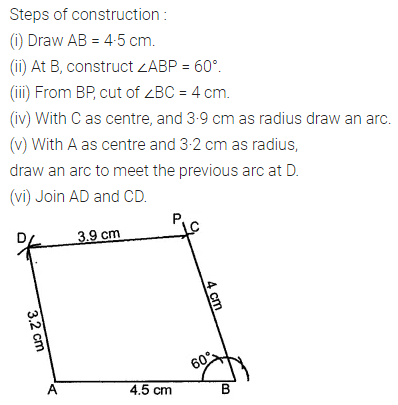
Construct a quadrilateral ABCD where AB = 4·5 cm, BC = 4 cm, CD = 3·9 cm, AD = 3·2 cm and ∠B = 60°.
Solution:
ML Aggarwal Class 8 Solutions for ICSE Maths Chapter 14 Constructions of Quadrilaterals Ex 14.1 10

ML Aggarwal Class 8 Solutions for ICSE Maths

ML Aggarwal Class 8 Solutions for ICSE Maths Chapter 13 Understanding Quadrilaterals Check Your Progress

ML Aggarwal Class 8 Solutions for ICSE Maths Chapter 13 Understanding Quadrilaterals Check Your Progress

Question 1.
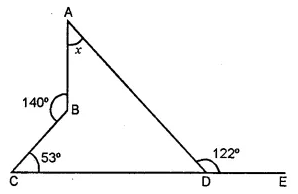
From the given diagram, find the value of x.
ML Aggarwal Class 8 Solutions for ICSE Maths Chapter 13 Understanding Quadrilaterals Check Your Progress 1
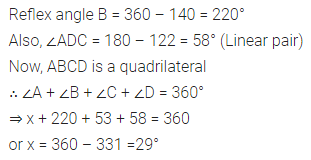
Solution:
ML Aggarwal Class 8 Solutions for ICSE Maths Chapter 13 Understanding Quadrilaterals Check Your Progress 2

Question 2.
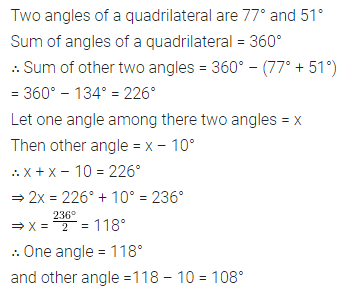
If two angles of a quadrilateral are 77° and 51°, and out of the remaining two angles, one angle is 10° smaller than the other, find these angles.
Solution:
ML Aggarwal Class 8 Solutions for ICSE Maths Chapter 13 Understanding Quadrilaterals Check Your Progress 3

Question 3.
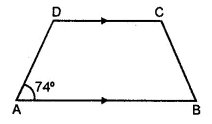
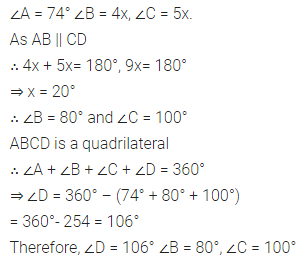
In the given figure, AB || DC, ∠A = 74° and ∠B : ∠C = 4 : 5. Find
(i) ∠D
(ii) ∠B
(iii) ∠C
ML Aggarwal Class 8 Solutions for ICSE Maths Chapter 13 Understanding Quadrilaterals Check Your Progress 4
Solution:
ML Aggarwal Class 8 Solutions for ICSE Maths Chapter 13 Understanding Quadrilaterals Check Your Progress 5

Question 4.
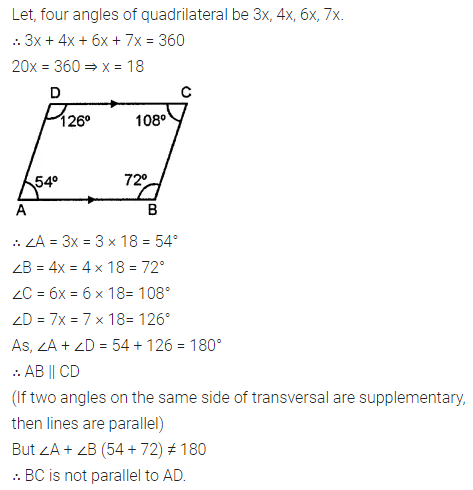
In quadrilateral ABCD, ∠A : ∠B : ∠C : ∠D = 3 : 4 : 6 : 7. Find all the angles of the quadrilateral. Hence, prove that AB and DC are parallel. Is BC also parallel to AD?
Solution:
ML Aggarwal Class 8 Solutions for ICSE Maths Chapter 13 Understanding Quadrilaterals Check Your Progress 6

Question 5.
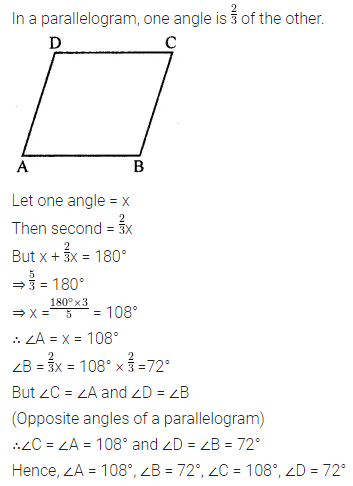
One angle of a parallelogram is two-third of the other. Find the angles of the parallelogram.
Solution:
ML Aggarwal Class 8 Solutions for ICSE Maths Chapter 13 Understanding Quadrilaterals Check Your Progress 7

Question 6.
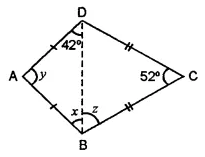
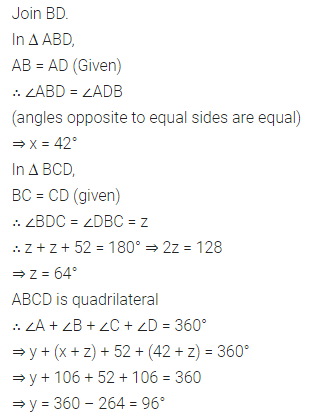
In the given figure, ABCD is a kite. If ∠BCD = 52° and ∠ADB = 42°, find the values of x, y, and z.
ML Aggarwal Class 8 Solutions for ICSE Maths Chapter 13 Understanding Quadrilaterals Check Your Progress 8
Solution:
ML Aggarwal Class 8 Solutions for ICSE Maths Chapter 13 Understanding Quadrilaterals Check Your Progress 9

Question 7.
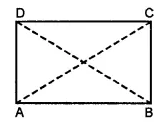
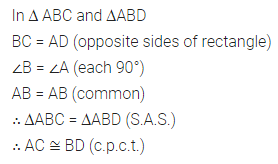
In the given figure, ABCD is a rectangle. Prove that AC = BD.
ML Aggarwal Class 8 Solutions for ICSE Maths Chapter 13 Understanding Quadrilaterals Check Your Progress 10
Solution:
ML Aggarwal Class 8 Solutions for ICSE Maths Chapter 13 Understanding Quadrilaterals Check Your Progress 11

Question 8.
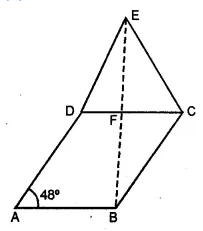
In the given figure, ABCD is a rhombus and EDC is an equilateral triangle. If ∠DAB = 48°, find
(i) ∠BEC
(ii) ∠DEB
(iii) ∠BFC
ML Aggarwal Class 8 Solutions for ICSE Maths Chapter 13 Understanding Quadrilaterals Check Your Progress 12
Solution:
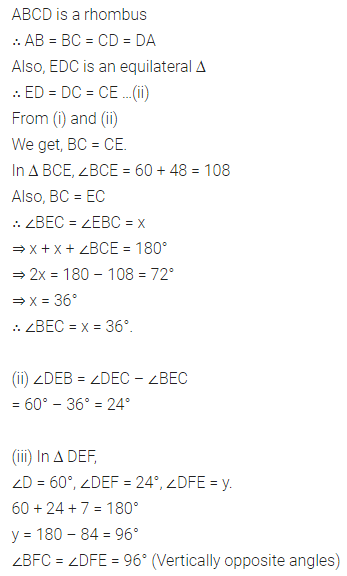
ML Aggarwal Class 8 Solutions for ICSE Maths Chapter 13 Understanding Quadrilaterals Check Your Progress 13

Question 9.
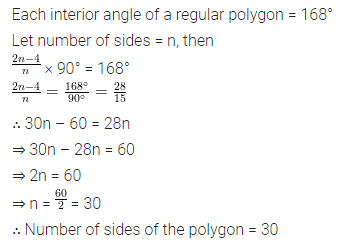
Find the number of sides of a regular polygon if each of its interior angles is 168°.
Solution:
ML Aggarwal Class 8 Solutions for ICSE Maths Chapter 13 Understanding Quadrilaterals Check Your Progress 14

Question 10.
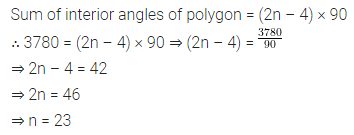
If the sum of interior angles of a polygon is 3780° find the number of sides.
Solution:
ML Aggarwal Class 8 Solutions for ICSE Maths Chapter 13 Understanding Quadrilaterals Check Your Progress 15

Question 11.
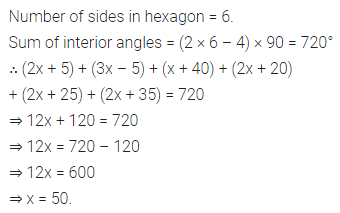
The angles of a hexagon are (2x + 5)°, (3x – 5)°, (x + 40)°, (2x + 20)°, (2x + 25)° and (2x + 35)°. Find the value of x.
Solution:
ML Aggarwal Class 8 Solutions for ICSE Maths Chapter 13 Understanding Quadrilaterals Check Your Progress 16

Question 12.
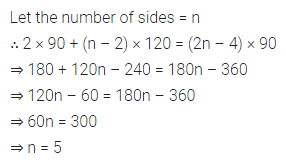
Two angles of a polygon are right angles and every other angle is 120°. Find the number of sides of the polygon.
Solution:
ML Aggarwal Class 8 Solutions for ICSE Maths Chapter 13 Understanding Quadrilaterals Check Your Progress 17

Question 13.
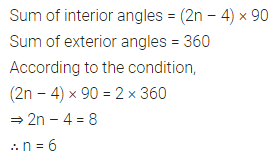
The sum of interior angles of a regular polygon is twice the sum of its exterior angles. Find the number of sides of the polygon.
Solution:
ML Aggarwal Class 8 Solutions for ICSE Maths Chapter 13 Understanding Quadrilaterals Check Your Progress 18

Question 14.
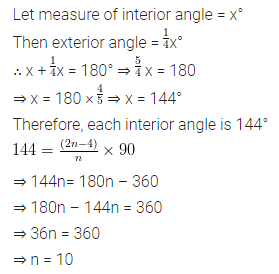
An exterior angle of a regular polygon is one- fourth of its interior angle. Find the number of sides in the polygon.
Solution:
ML Aggarwal Class 8 Solutions for ICSE Maths Chapter 13 Understanding Quadrilaterals Check Your Progress 19

ML Aggarwal Class 8 Solutions for ICSE Maths

ML Aggarwal Class 8 Solutions for ICSE Maths Chapter 13 Understanding Quadrilaterals Objective Type Questions

ML Aggarwal Class 8 Solutions for ICSE Maths Chapter 13 Understanding Quadrilaterals Objective Type Questions

Mental Maths
Question 1.
Fill in the blanks:
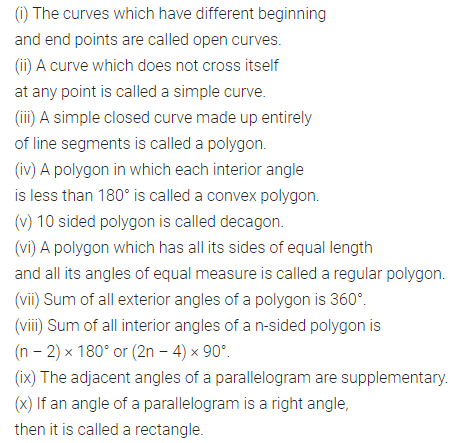
(i) The curves which have different beginning and endpoints are called …………
(ii) A curve which does not cross itself at any point is called a …………
(iii) A simple closed curve made up entirely of line segments is called a …………
(iv) A polygon in which each interior angle is less than 180° is called a …………
(v) 10 sided polygon is called …..
(vi) A polygon which has all its sides of equal length and all its angles of equal measure is called a …………
(vii) Sum of all exterior angles of a polygon is …………
(vi) A polygon which has all its sides of equal length and all its angles of equal measure is called a …………
(vii) Sum of all exterior angles of a polygon is …………
(viii) Sum of all interior angles of a n-sided polygon is …………
(ix) The adjacent angles of a parallelogram are …………
(x) If an angle of a parallelogram is a right angle, then it is called a …………
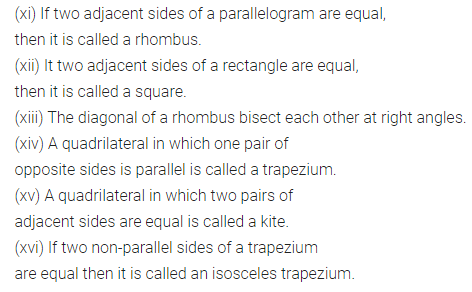
(xi) If two adjacent sides of a parallelogram are equal, then it is called a …………
(xii) It two adjacent sides of a rectangle are equal, then it is called a …………
(xiii) The diagonal of a rhombus bisect each other at …………
(xiv) A quadrilateral in which one pair of opposite sides is parallel is called a …………
(xv) A quadrilateral in which two pairs of adjacent sides are equal is called a …………
(xvi) If two non-parallel sides of a trapezium are equal then it is called …………
Solution:
ML Aggarwal Class 8 Solutions for ICSE Maths Chapter 13 Understanding Quadrilaterals Objective Type Questions 1
ML Aggarwal Class 8 Solutions for ICSE Maths Chapter 13 Understanding Quadrilaterals Objective Type Questions 2

Question 2.
State whether the following statements are true (T) or false (F):
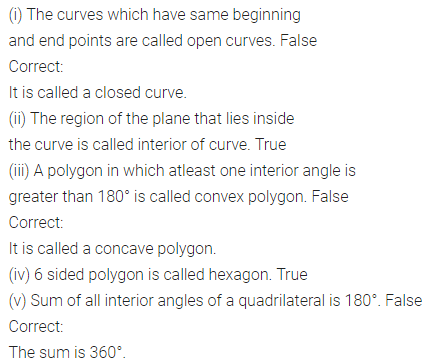
(i) The curves which have the same beginning and endpoints are called open curves.
(ii) The region of the plane that lies inside the curve is called the interior of the curve.
(iii) A polygon in which at least one interior angle is greater than 180° is called convex polygon.
(iv) 6 sided polygon is called hexagon.
(v) Sum of all interior angles of a quadrilateral is 180°.
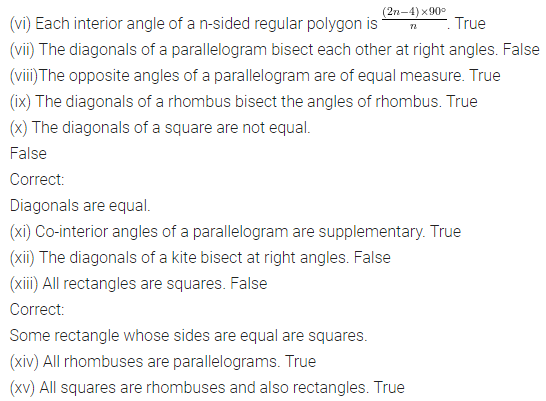
(vi) Each interior angle of a n-sided regular polygon is \(\frac{(2 n-4) \times 90^{\circ}}{n}\).
(vii) The diagonals of a parallelogram bisect each other at right angles.
(viii) The opposite angles of a parallelogram are of equal measure.
(ix) The diagonals of a rhombus bisect the angles of a rhombus.
(x) The diagonals of a square are not equal.
(xi) Co-interior angles of a parallelogram are supplementary.
(xii) The diagonals of a kite bisect at right angles.
(xiii) All rectangles are squares.
(xiv) All rhombuses are parallelograms.
(xv) All squares are rhombuses and also rectangles.
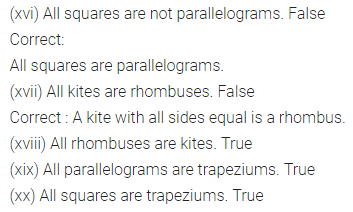
(xvi) All squares are not parallelograms.
(xvii) All kites are rhombuses.
(xviii) All rhombuses are kites.
(xix) All parallelograms are trapeziums.
(xx) All squares are trapeziums.
Solution:
ML Aggarwal Class 8 Solutions for ICSE Maths Chapter 13 Understanding Quadrilaterals Objective Type Questions 3
ML Aggarwal Class 8 Solutions for ICSE Maths Chapter 13 Understanding Quadrilaterals Objective Type Questions 4
ML Aggarwal Class 8 Solutions for ICSE Maths Chapter 13 Understanding Quadrilaterals Objective Type Questions 5

Multiple Choice Questions
Choose the correct answer from the given four options (3 to 19):
Question 3.
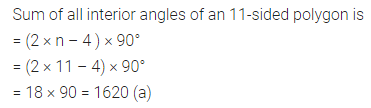
Sum of all interior angles of an 11-sided polygon is
(a) 1620°
(b) 1440°
(c) 1260v
(d) none of these
Solution:
ML Aggarwal Class 8 Solutions for ICSE Maths Chapter 13 Understanding Quadrilaterals Objective Type Questions 6

Question 4.
If each interior angle of a regular polygon is 144°, then number of sides of polygon is
(a) 8
(b) 9
(c) 10
(d) 11
Solution:
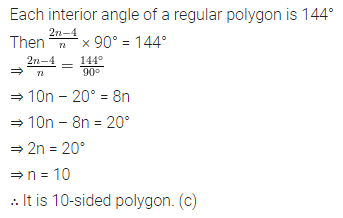
ML Aggarwal Class 8 Solutions for ICSE Maths Chapter 13 Understanding Quadrilaterals Objective Type Questions 7

Question 5.
If the sum of all interior angles of a polygon is 1260°, then number of sides of polygon is
(a) 6
(b) 7
(c) 8
(d) 9
Solution:
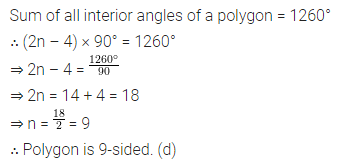
ML Aggarwal Class 8 Solutions for ICSE Maths Chapter 13 Understanding Quadrilaterals Objective Type Questions 8

Question 6.
The sum of all exterior angles of a pentagon is
(a) 590°
(b) 360°
(c) 180°
(d) none of these
Solution:

ML Aggarwal Class 8 Solutions for ICSE Maths Chapter 13 Understanding Quadrilaterals Objective Type Questions 9

Question 7.
If the ratio between an exterior and interior angle of a regular polygon is 1 : 5, then the number of sides of the polygon is
(a) 11
(b) 12
(c) 13
(d) 14
Solution:
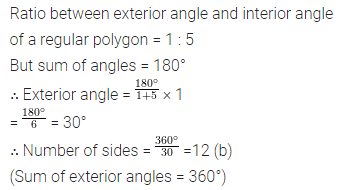
ML Aggarwal Class 8 Solutions for ICSE Maths Chapter 13 Understanding Quadrilaterals Objective Type Questions 10

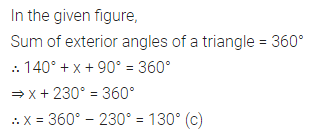
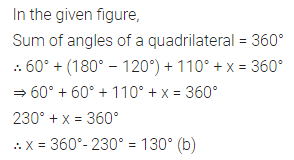
Question 8.
In the given figure, the value of x is
(a) 140°
(b) 50°
(c) 130°
(d) 40°
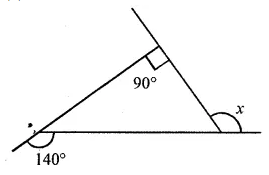
ML Aggarwal Class 8 Solutions for ICSE Maths Chapter 13 Understanding Quadrilaterals Objective Type Questions 11
Solution:
ML Aggarwal Class 8 Solutions for ICSE Maths Chapter 13 Understanding Quadrilaterals Objective Type Questions 12

Question 9.
In the given figure, the value of x is
(a) 120°
(b) 130°
(c) 140°
(d) 150°
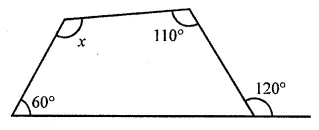
ML Aggarwal Class 8 Solutions for ICSE Maths Chapter 13 Understanding Quadrilaterals Objective Type Questions 13
Solution:
ML Aggarwal Class 8 Solutions for ICSE Maths Chapter 13 Understanding Quadrilaterals Objective Type Questions 14

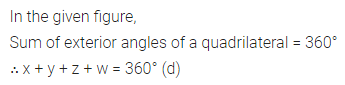
Question 10.
In the given figure, the value of x + y + z + w is
(a) 180°
(b) 270°
(c) 300°
(d) 360°
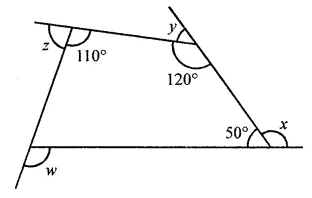
ML Aggarwal Class 8 Solutions for ICSE Maths Chapter 13 Understanding Quadrilaterals Objective Type Questions 15
Solution:
ML Aggarwal Class 8 Solutions for ICSE Maths Chapter 13 Understanding Quadrilaterals Objective Type Questions 16

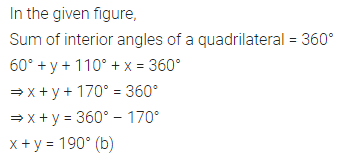
Question 11.
In the given figure, the value of x + y is
(a) 180°
(b) 190°
(c) 170°
(d) 160°
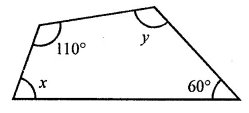
ML Aggarwal Class 8 Solutions for ICSE Maths Chapter 13 Understanding Quadrilaterals Objective Type Questions 17
Solution:
ML Aggarwal Class 8 Solutions for ICSE Maths Chapter 13 Understanding Quadrilaterals Objective Type Questions 18

Question 12.
The lengths of two adjacent sides of a parallelogram are in the ratio 1 : 2. If the perimeter of a parallelogram is 60 cm, then the length of its sides are
(a) 6 cm, 12 cm
(b) 8 cm, 16 cm
(c) 9 cm, 18 cm
(d) 10 cm, 20 cm
Solution:
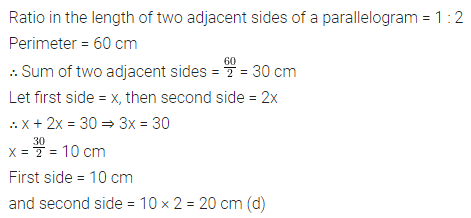
ML Aggarwal Class 8 Solutions for ICSE Maths Chapter 13 Understanding Quadrilaterals Objective Type Questions 19

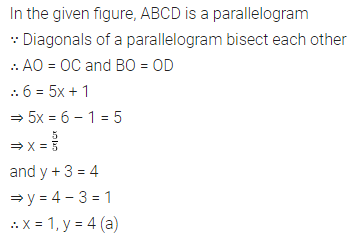
Question 13.
In the given figure, ABCD is a parallelogram, the values of x and y respectively are
(a) 1 cm, 1 cm
(b) 2 cm, 1 cm
(c) 1 cm, 2 cm
(d) 2 cm, 2 cm
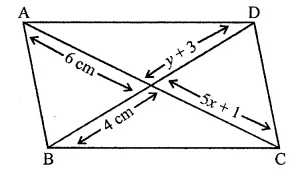
ML Aggarwal Class 8 Solutions for ICSE Maths Chapter 13 Understanding Quadrilaterals Objective Type Questions 20
Solution:
ML Aggarwal Class 8 Solutions for ICSE Maths Chapter 13 Understanding Quadrilaterals Objective Type Questions 21

Question 14.
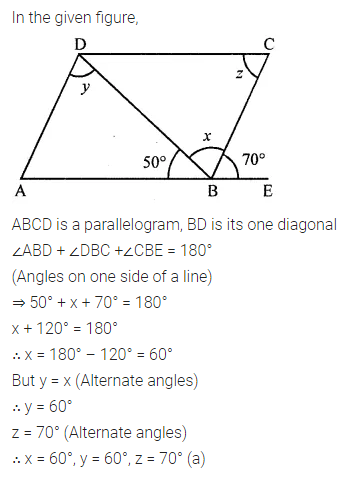
In the given figure, ABCD is a parallelogram, the values of x, y and z respectively are
(a) 60°, 60°, 70°
(b) 60°, 70°, 60°
(c) 70°, 60°, 60°
(d) none of these
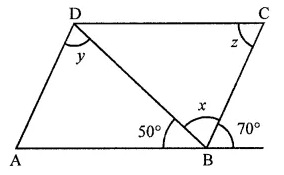
ML Aggarwal Class 8 Solutions for ICSE Maths Chapter 13 Understanding Quadrilaterals Objective Type Questions 22
Solution:
ML Aggarwal Class 8 Solutions for ICSE Maths Chapter 13 Understanding Quadrilaterals Objective Type Questions 23

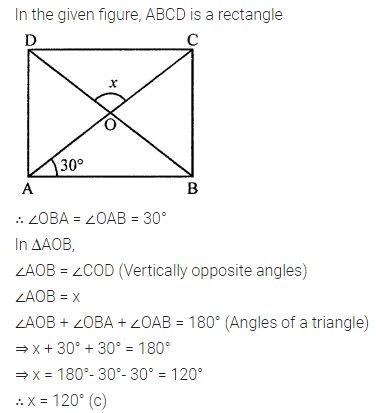
Question 15.
In the given figure, ABCD is a rectangle, the value of angle x is
(a) 60°
(b) 90°
(c) 120°
(d) none of these
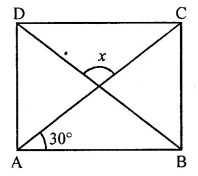
ML Aggarwal Class 8 Solutions for ICSE Maths Chapter 13 Understanding Quadrilaterals Objective Type Questions 24
Solution:
ML Aggarwal Class 8 Solutions for ICSE Maths Chapter 13 Understanding Quadrilaterals Objective Type Questions 25

Question 16.
In a rhombus ABCD, the diagonals AC and BD are respectively 8 cm and 6 cm. The length of each side of the rhombus is
(a) 7 cm
(b) 5 cm
(c) 6 cm
(d) 8 cm
Solution:
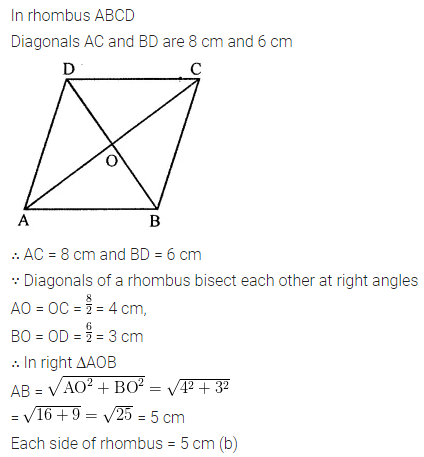
ML Aggarwal Class 8 Solutions for ICSE Maths Chapter 13 Understanding Quadrilaterals Objective Type Questions 26

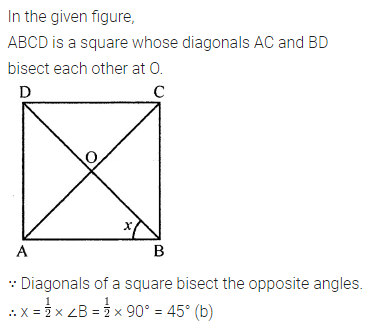
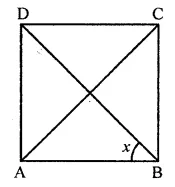
Question 17.
In the given figure, ABCD is a square, the value of angle x is
(a) 30°
(b) 45°
(c) 60°
(d) not possible to find
ML Aggarwal Class 8 Solutions for ICSE Maths Chapter 13 Understanding Quadrilaterals Objective Type Questions 27
Solution:
ML Aggarwal Class 8 Solutions for ICSE Maths Chapter 13 Understanding Quadrilaterals Objective Type Questions 28

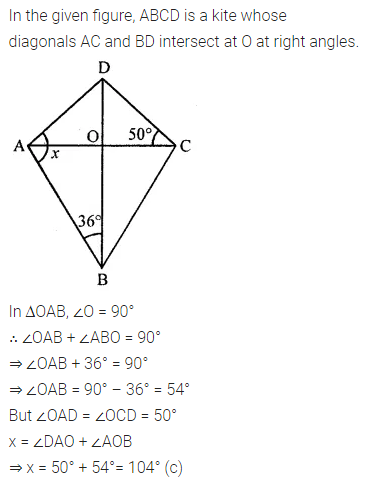
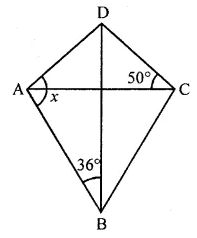
Question 18.
In the given figure, ABCD is a kite, the value of angle x is
(a) 86°
(b) 100°
(c) 104°
(d) none of these
ML Aggarwal Class 8 Solutions for ICSE Maths Chapter 13 Understanding Quadrilaterals Objective Type Questions 29
Solution:
ML Aggarwal Class 8 Solutions for ICSE Maths Chapter 13 Understanding Quadrilaterals Objective Type Questions 30

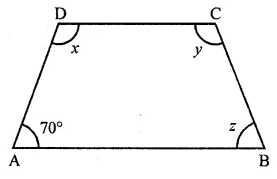
Question 19.
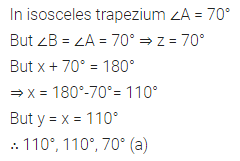
In the given figure, ABCD is an isosceles trapezium. The values of x, y and z respectively are
(a) 110°, 110°, 70°
(b) 110°, 70°, 110°
(c) 70°, 110°, 110°
(d) none of these
ML Aggarwal Class 8 Solutions for ICSE Maths Chapter 13 Understanding Quadrilaterals Objective Type Questions 31
Solution:
ML Aggarwal Class 8 Solutions for ICSE Maths Chapter 13 Understanding Quadrilaterals Objective Type Questions 32

Higher Order Thinking Skills (Hots)
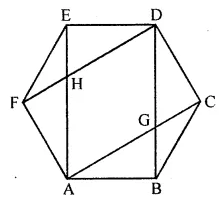
Question 1.
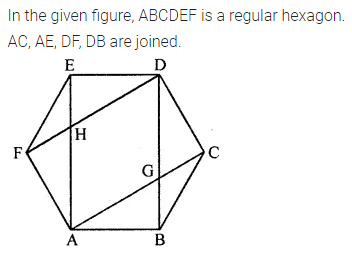
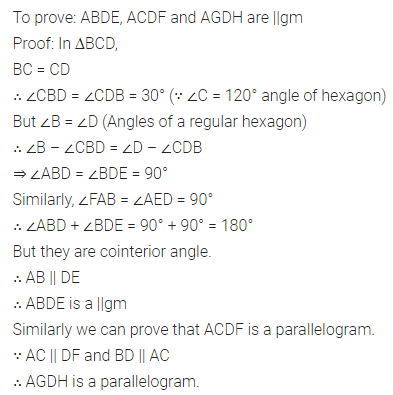
In the given figure, ABCDEF is a regular hexagon. Prove that quadrilaterals ABDE and ACDF are parallelograms. Also prove that quadrilateral AGDH is a parallelogram.
ML Aggarwal Class 8 Solutions for ICSE Maths Chapter 13 Understanding Quadrilaterals Objective Type Questions 33
Solution:
ML Aggarwal Class 8 Solutions for ICSE Maths Chapter 13 Understanding Quadrilaterals Objective Type Questions 34
ML Aggarwal Class 8 Solutions for ICSE Maths Chapter 13 Understanding Quadrilaterals Objective Type Questions 35

Question 2.
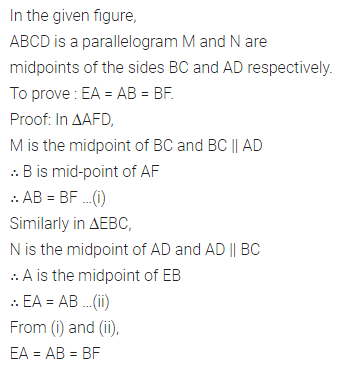
In the given figure, ABCD is a parallelogram and M, N are the mid-points of sides BC, AD respectively. Prove that EA = AB = BF.
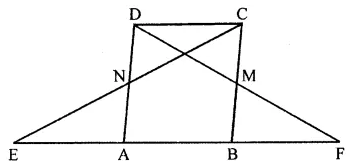
ML Aggarwal Class 8 Solutions for ICSE Maths Chapter 13 Understanding Quadrilaterals Objective Type Questions 36
Solution:
ML Aggarwal Class 8 Solutions for ICSE Maths Chapter 13 Understanding Quadrilaterals Objective Type Questions 37

Question 3.
Prove that the quadrilateral formed by joining the mid-points of the adjacent sides of a rectangle is a parallelogram.
Solution:
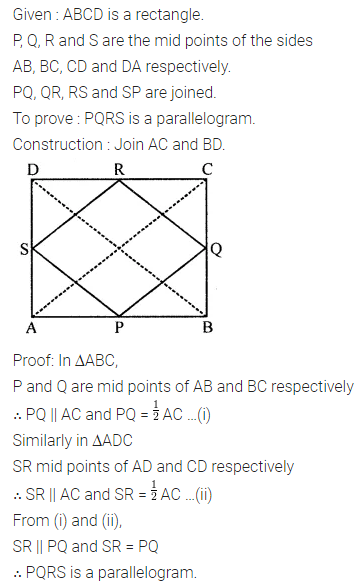
ML Aggarwal Class 8 Solutions for ICSE Maths Chapter 13 Understanding Quadrilaterals Objective Type Questions 38

ML Aggarwal Class 8 Solutions for ICSE Maths