ML Aggarwal Class 8 Solutions for ICSE Maths Chapter 19 Data Handling Ex 19.3

ML Aggarwal Class 8 Solutions for ICSE Maths Chapter 19 Data Handling Ex 19.3

Question 1.
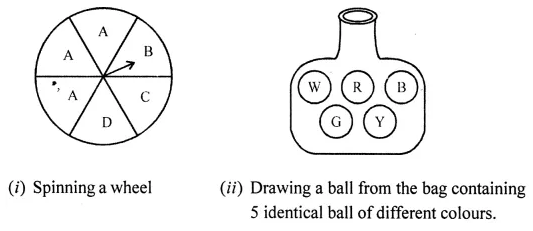
List the outcomes you can see in these experiments.
ML Aggarwal Class 8 Solutions for ICSE Maths Chapter 19 Data Handling Ex 19.3 1
Solution:
ML Aggarwal Class 8 Solutions for ICSE Maths Chapter 19 Data Handling Ex 19.3 2

Question 2.
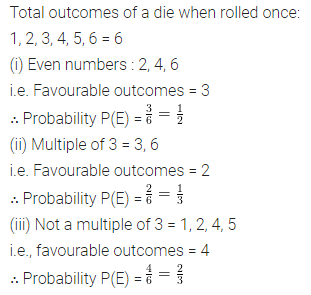
A die is rolled once. Find the probability of getting
(i) an even number
(ii) a multiple of 3
(iii) not a multiple of 3
Solution:
ML Aggarwal Class 8 Solutions for ICSE Maths Chapter 19 Data Handling Ex 19.3 3

Question 3.
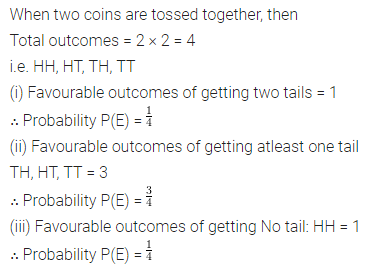
Two coins are tossed together. Find the probability of getting
(i) two tails
(ii) atleast one tail
(iii) no tail
Solution:
ML Aggarwal Class 8 Solutions for ICSE Maths Chapter 19 Data Handling Ex 19.3 4

Question 4.
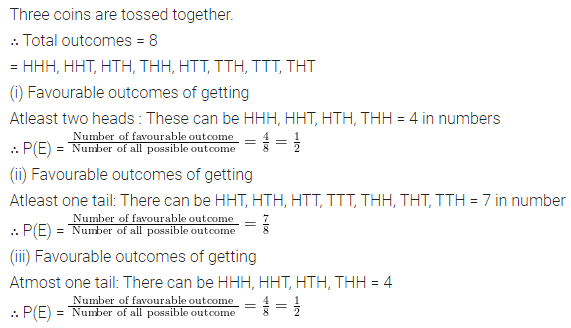
Three coins are tossed together. Find the probability of getting
(i) atleast two heads
(ii) atleast one tail
(iii) atmost one tail.
Solution:
ML Aggarwal Class 8 Solutions for ICSE Maths Chapter 19 Data Handling Ex 19.3 5

Question 5.
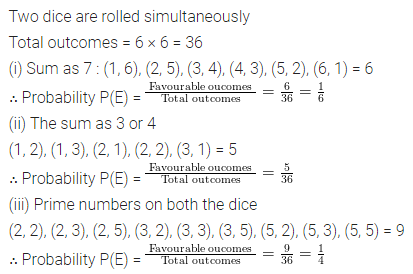
Two dice are rolled simultaneously. Find the probability of getting
(i) the sum as 7
(ii) the sum as 3 or 4
(iii) prime numbers on both the dice.
Solution:
ML Aggarwal Class 8 Solutions for ICSE Maths Chapter 19 Data Handling Ex 19.3 6

Question 6.
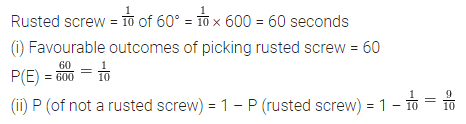
A fcox contains 600 screws, one tenth are rusted. One screw is taken out at random from the box. Find the probability that it is
(i) a rusted screw
(ii) not a rusted screw
Solution:
ML Aggarwal Class 8 Solutions for ICSE Maths Chapter 19 Data Handling Ex 19.3 7

Question 7.
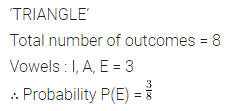
A letter is chosen from the word ‘TRIANGLE’. What is the probability that it is a vowel?
Solution:
ML Aggarwal Class 8 Solutions for ICSE Maths Chapter 19 Data Handling Ex 19.3 8

Question 8.
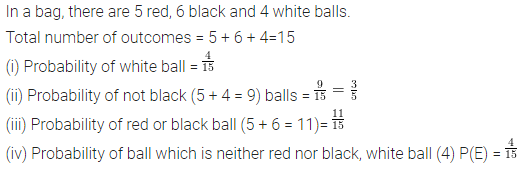
A bag contains 5 red, 6 black and 4 white balls. A ball is drawn at random from the bag, find the probability the ball is drawn is
(i) white
(ii) not black
(iii) red or black
(iv) neither red nor black
Solution:
ML Aggarwal Class 8 Solutions for ICSE Maths Chapter 19 Data Handling Ex 19.3 9

Question 9.
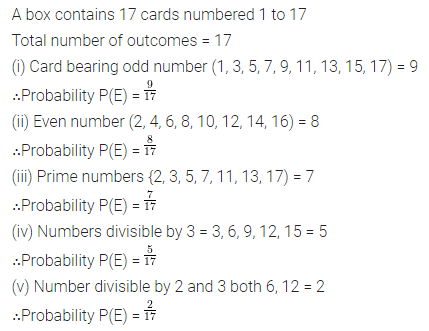
A box contains 17 cards numbered 1, 2, 3, ……….,17 and are mixed thoroughly. A card is drawn at random from the box. Find the probability that the number on the card is
(i) odd
(ii) even
(iii) prime
(iv) divisible by 3
(v) divisible by 2 and 3 both
Solution:
ML Aggarwal Class 8 Solutions for ICSE Maths Chapter 19 Data Handling Ex 19.3 10

Question 10.
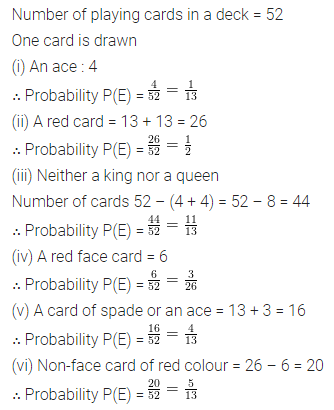
A card is drawn from a well-shuffled pack of 52 cards. Find the probability that the card drawn is:
(i) an ace
(ii) a red card
(iii) neither a king nor a queen
(iv) a red face card or an ace
(v) a card of spade
(vi) non-face card of red colour.
Solution:
ML Aggarwal Class 8 Solutions for ICSE Maths Chapter 19 Data Handling Ex 19.3 11

Question 11.
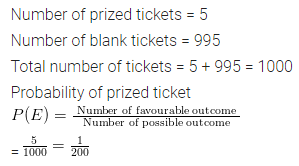
In a lottery, there are 5 prized tickets and 995 blank tickets. A person buys a lottery ticket. Find the probability of his winning a prize.
Solution:
ML Aggarwal Class 8 Solutions for ICSE Maths Chapter 19 Data Handling Ex 19.3 12

ML Aggarwal Class 8 Solutions for ICSE Maths

ML Aggarwal Class 8 Solutions for ICSE Maths Chapter 19 Data Handling Ex 19.2

ML Aggarwal Class 8 Solutions for ICSE Maths Chapter 19 Data Handling Ex 19.2

Question 1.
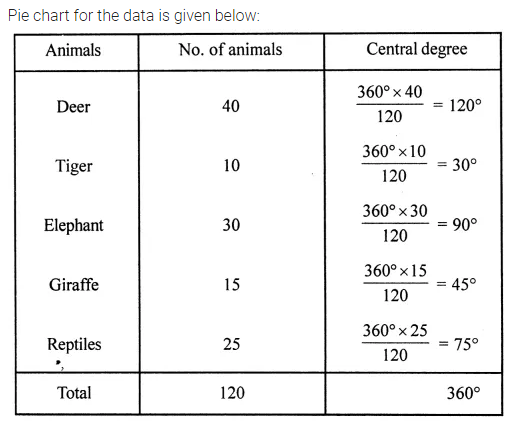
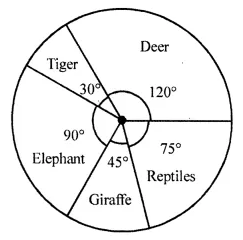
The following data represents the different number of animals in a zoo. Prepare a pie chart for the given data.
ML Aggarwal Class 8 Solutions for ICSE Maths Chapter 19 Data Handling Ex 19.2 1
Solution:
ML Aggarwal Class 8 Solutions for ICSE Maths Chapter 19 Data Handling Ex 19.2 2
ML Aggarwal Class 8 Solutions for ICSE Maths Chapter 19 Data Handling Ex 19.2 3

Question 2.
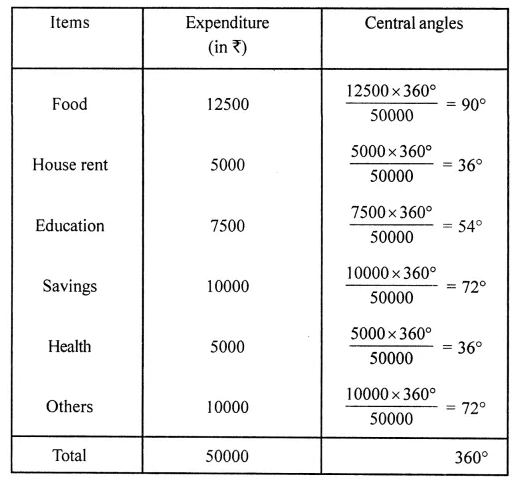
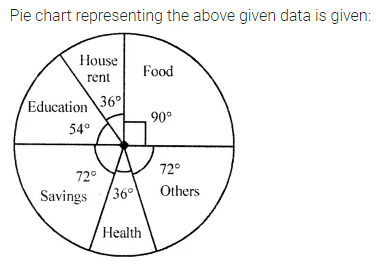
The following data represents the monthly expenditure of a family (in T) on various items. Draw a pie chart to represent this data.
ML Aggarwal Class 8 Solutions for ICSE Maths Chapter 19 Data Handling Ex 19.2 4
Solution:
ML Aggarwal Class 8 Solutions for ICSE Maths Chapter 19 Data Handling Ex 19.2 5
ML Aggarwal Class 8 Solutions for ICSE Maths Chapter 19 Data Handling Ex 19.2 6

Question 3.
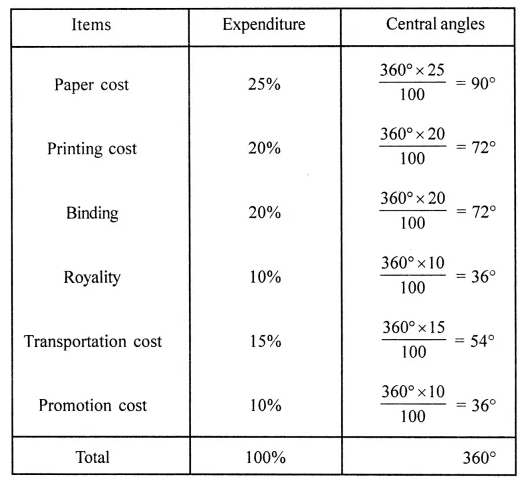
The following data represents the percentage distribution of the expenditure incurred in publishing a book.
ML Aggarwal Class 8 Solutions for ICSE Maths Chapter 19 Data Handling Ex 19.2 7
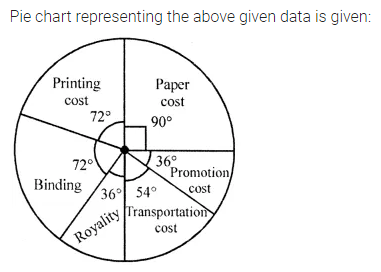
Draw a pie chart to represent this data.
Solution:
ML Aggarwal Class 8 Solutions for ICSE Maths Chapter 19 Data Handling Ex 19.2 8
ML Aggarwal Class 8 Solutions for ICSE Maths Chapter 19 Data Handling Ex 19.2 9

Question 4.
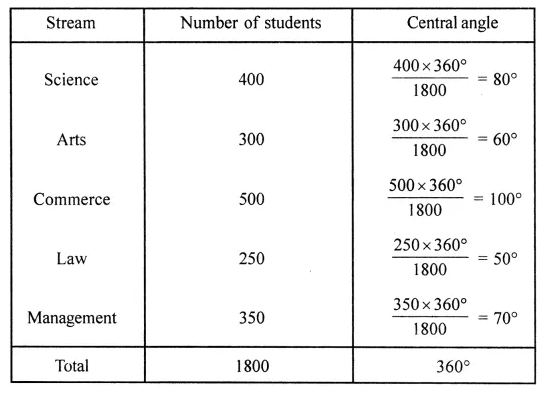
The following data represents the number of students got admission in different streams of a college:
ML Aggarwal Class 8 Solutions for ICSE Maths Chapter 19 Data Handling Ex 19.2 10
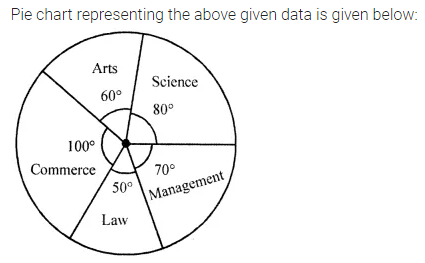
Draw a pie chart to represent this data.
Solution:
ML Aggarwal Class 8 Solutions for ICSE Maths Chapter 19 Data Handling Ex 19.2 11
ML Aggarwal Class 8 Solutions for ICSE Maths Chapter 19 Data Handling Ex 19.2 12

Question 5.
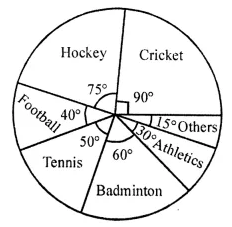
The adjoining pie chart shows the expenditure of a country on various sports during year 2012. Study the pie chart carefully and answer the following questions:
ML Aggarwal Class 8 Solutions for ICSE Maths Chapter 19 Data Handling Ex 19.2 13
(i) What percent of total expenditure is spent on cricket?
(ii) How much percent more is spent on hockey than that on tennis?
(iii) If the total amount spent on sports in 2012 is ₹1,80,00,000, then find amount spent on Badminton,
(iv) If the total amount spent on sports in 2012 is ₹2,40,00,000 then find the amount spent on cricket and hockey together.
Solution:
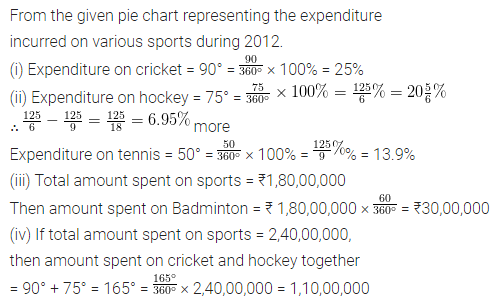
ML Aggarwal Class 8 Solutions for ICSE Maths Chapter 19 Data Handling Ex 19.2 14

Question 6.
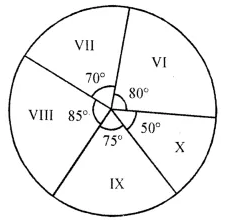
The adjoining pie chart shows the number of students enrolled in class VI to class X of a school.
ML Aggarwal Class 8 Solutions for ICSE Maths Chapter 19 Data Handling Ex 19.2 15
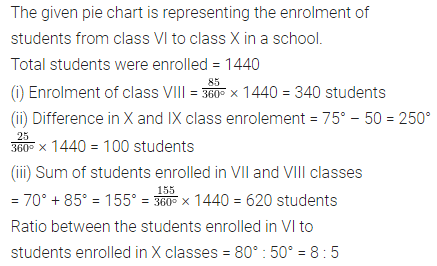
If 1440 students are enrolled from VI to X, then answer the following questions:
(i) How many students are enrolled in class VIII?
(ii) How many students are more in class IX than in class X?
(iii) What is the sum of students enrolled in VII and VIII?
(iv) Find the ratio of students enrolled in VI to students enrolled in X.
Solution:
ML Aggarwal Class 8 Solutions for ICSE Maths Chapter 19 Data Handling Ex 19.2 16

ML Aggarwal Class 8 Solutions for ICSE Maths

ML Aggarwal Class 8 Solutions for ICSE Maths Chapter 19 Data Handling Ex 19.1

ML Aggarwal Class 8 Solutions for ICSE Maths Chapter 19 Data Handling Ex 19.1

Question 1.
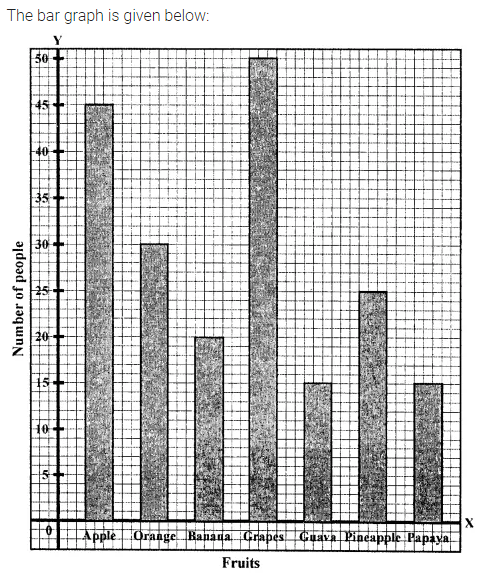
The result of a survey of 200 people about their favourite fruit is given below:

ML Aggarwal Class 8 Solutions for ICSE Maths Chapter 19 Data Handling Ex 19.1 1
Represent the above data by a bar graph.
Solution:

ML Aggarwal Class 8 Solutions for ICSE Maths Chapter 19 Data Handling Ex 19.1 2
ML Aggarwal Class 8 Solutions for ICSE Maths Chapter 19 Data Handling Ex 19.1 3

Question 2.
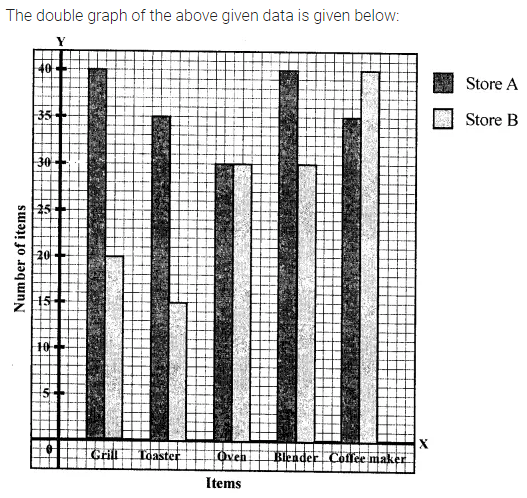
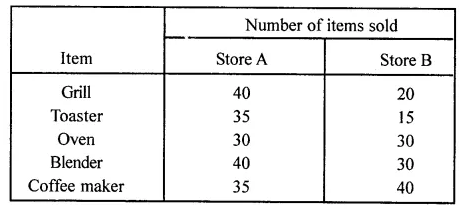
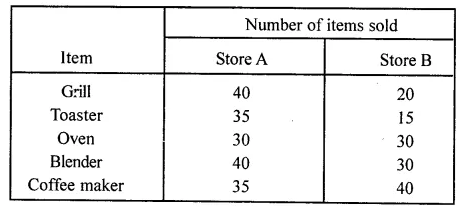
Mr Khurana has two kitchen appliance stores. He compares the sales of two stores during a month and recovered as given below:
ML Aggarwal Class 8 Solutions for ICSE Maths Chapter 19 Data Handling Ex 19.1 4
Represent the above data by a double bar graph.
Solution:
ML Aggarwal Class 8 Solutions for ICSE Maths Chapter 19 Data Handling Ex 19.1 5
ML Aggarwal Class 8 Solutions for ICSE Maths Chapter 19 Data Handling Ex 19.1 6

Question 3.
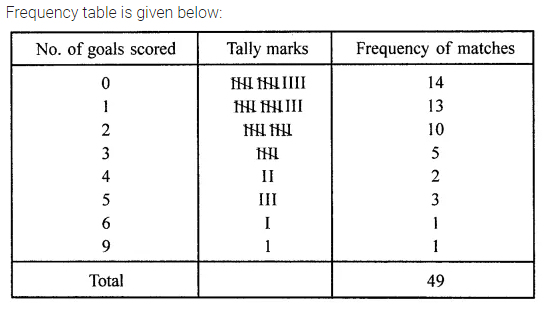
The number of goals scored by a football team in different matches is given below:
3, 1, 0, 4, 6, 0, 0, 1, 1, 2, 2, 3, 5, 1, 2, 0, 1, 0, 2, 3, 9, 2, 0, 1, 0, 1, 4, 1, 0, 2, 5, 1, 2, 2, 3, 1, 0, 0, 0, 1, 1, 0, 2, 3, 0, 1, 5, 2, 0
Make a frequency distribution table using tally marks.
Solution:
ML Aggarwal Class 8 Solutions for ICSE Maths Chapter 19 Data Handling Ex 19.1 7

Question 4.
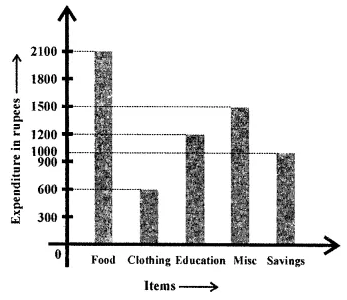
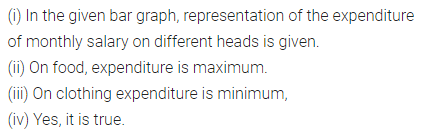
Given below a bar graph:
ML Aggarwal Class 8 Solutions for ICSE Maths Chapter 19 Data Handling Ex 19.1 8
Read the bar graph carefully and answer the following questions:
(i) What is the information given by the bar graph?
(ii) On which item the expenditure is maximum?
(iii) On which item the expenditure is minimum?
(iv) State whether true or false:
Expenditure on education is twice the expenditure on clothing.
Solution:
ML Aggarwal Class 8 Solutions for ICSE Maths Chapter 19 Data Handling Ex 19.1 9

Question 5.
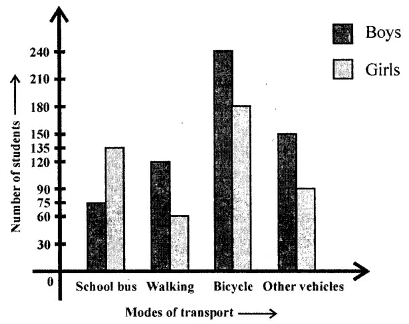
Given below a double bar graph.
ML Aggarwal Class 8 Solutions for ICSE Maths Chapter 19 Data Handling Ex 19.1 10
Read the double bar graph carefully and answer the following questions:
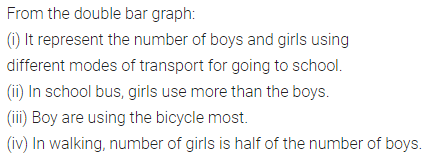
(i) What is the information given by the double graph?
(ii) Which mode of transport girls using more than the boys?
(iii) Which mode of transport boys using the most?
(iv) In which mode of transport number of girls is half the number of boys?
Solution:
ML Aggarwal Class 8 Solutions for ICSE Maths Chapter 19 Data Handling Ex 19.1 11

Question 6.
Using class intervals 0-5, 5-10, construct the frequency distribution table for the following
data:
13, 6, 12, 9, 11, 14, 2, 8, 18, 16, 9, 13, 17, 11, 19, 6, 7, 12, 22, 21, 18, 1, 8, 12, 18.
Solution:
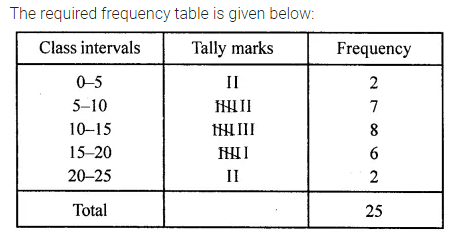
ML Aggarwal Class 8 Solutions for ICSE Maths Chapter 19 Data Handling Ex 19.1 12

Question 7.
Given below are the marks secured by 35 students in a surprise test:
41, 32, 35, 21, 11, 47, 42, 00, 05, 18, 25, 24, 29, 38, 30, 04, 14, 24, 34, 44, 48, 33, 36, 38, 41, 48, 08, 34, 39, 11, 13, 27, 26, 43, 03.
Taking class intervals 0-10, 10-20, …….. construct frequency distribution table. Find the number
of students obtaining below 20 marks.
Solution:
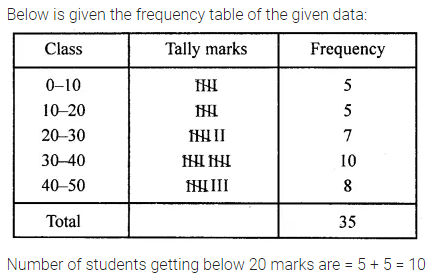
ML Aggarwal Class 8 Solutions for ICSE Maths Chapter 19 Data Handling Ex 19.1 13

Question 8.
The electricity bills (in ?) of 40 houses in a locality are given below:
78, 87,81,52, 59, 65, 101, 108, 115, 95, 98, 65,62, 121, 128, 63,76, 84, 89,91,65, 101,95,81, 87, 105, 129, 92, 75, 105, 78, 72, 107, 116, 127, 100, 80, 82, 61, 118 Construct a grouped frequency distribution table of class size 10.
Class intervals (Electricity bill in ?) Tally marks Frequency (Number of houses)
Solution:
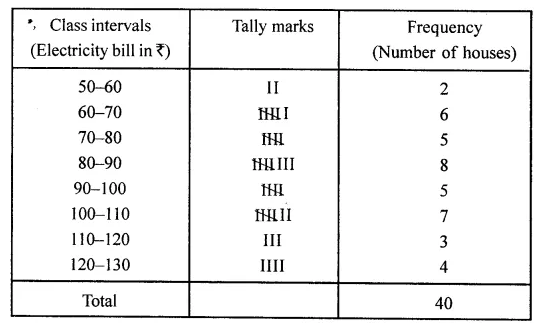
ML Aggarwal Class 8 Solutions for ICSE Maths Chapter 19 Data Handling Ex 19.1 14

Question 9.
Draw a histogram for the frequency table made for data in Question 8, and answer the following questions:
(i) Which group has the maximum number of houses?
(ii) How many houses pay less than ₹ 100?
(iii) How many houses pay ₹ 100 or more?
Solution:
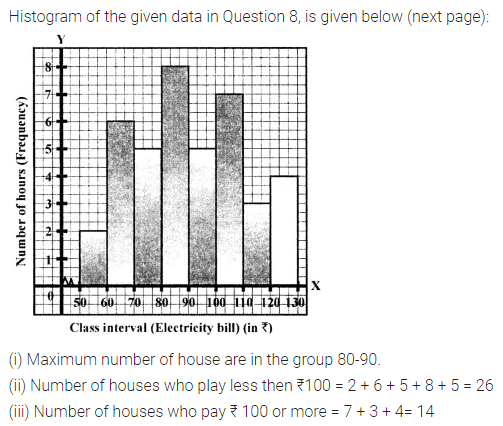
ML Aggarwal Class 8 Solutions for ICSE Maths Chapter 19 Data Handling Ex 19.1 15

Question 10.
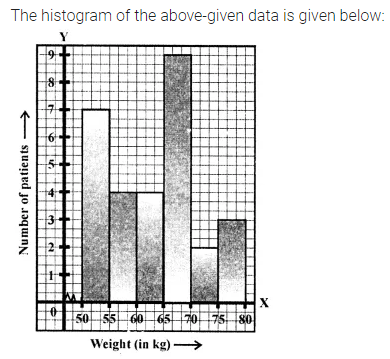
The weights of 29 patients in a hospital were recorded as follows:

ML Aggarwal Class 8 Solutions for ICSE Maths Chapter 19 Data Handling Ex 19.1 16
Draw a histogram to represent this data visually.
Solution:

ML Aggarwal Class 8 Solutions for ICSE Maths Chapter 19 Data Handling Ex 19.1 17
ML Aggarwal Class 8 Solutions for ICSE Maths Chapter 19 Data Handling Ex 19.1 18

Question 11.
In a study of diabetic patients, the following data was obtained:

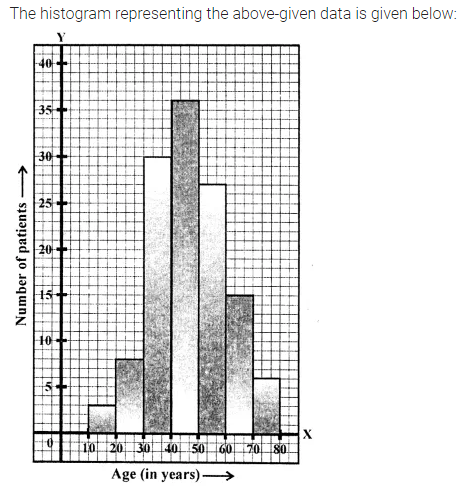
ML Aggarwal Class 8 Solutions for ICSE Maths Chapter 19 Data Handling Ex 19.1 19
Represent the above data by a histogram.
Solution:

ML Aggarwal Class 8 Solutions for ICSE Maths Chapter 19 Data Handling Ex 19.1 20
ML Aggarwal Class 8 Solutions for ICSE Maths Chapter 19 Data Handling Ex 19.1 21

Question 12.
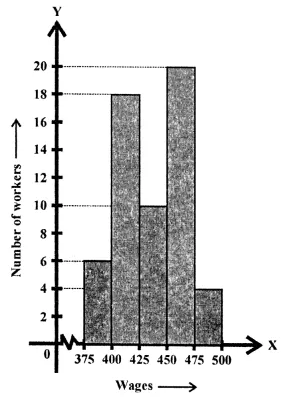
The histogram showing the weekly wages (in ₹) of workers in a factory is given alongside:
ML Aggarwal Class 8 Solutions for ICSE Maths Chapter 19 Data Handling Ex 19.1 22
Answer the following:
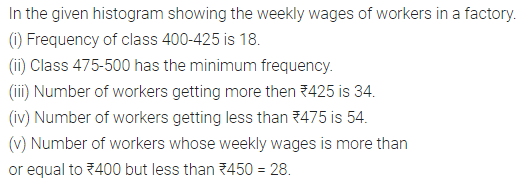
(i) What is the frequency of class 400-425?
(ii) What is the class having a minimum frequency?
(iii) How many workers get more than ₹425?
(iv) How many workers get less than ₹475?
(v) Number of workers whose weekly wages are more than or equal to ₹400 but less than ₹450.
Solution:
ML Aggarwal Class 8 Solutions for ICSE Maths Chapter 19 Data Handling Ex 19.1 23

Question 13.
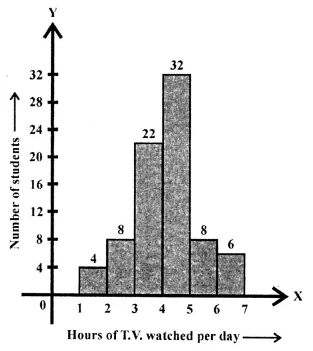
The number of hours for which students of a particular class watched television during holidays is shown in the histogram below.
ML Aggarwal Class 8 Solutions for ICSE Maths Chapter 19 Data Handling Ex 19.1 24
Answer the following:
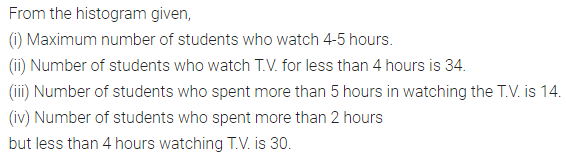
(i) For how many hours did the maximum number of students watch T.V.?
(ii) How many students watched T.V. for less than 4 hours?
(iii) How many students spent more than 5 hours in watching T.V.?
(iv) How many students spent more than 2 hours but less than 4 hours in watching T.V.?
Solution:
ML Aggarwal Class 8 Solutions for ICSE Maths Chapter 19 Data Handling Ex 19.1 25

Question 14.
The number of literate females in the age group of 10 to 40 years in a town is shown in the histogram alongside.
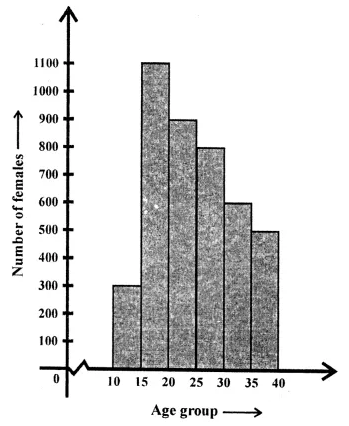
ML Aggarwal Class 8 Solutions for ICSE Maths Chapter 19 Data Handling Ex 19.1 26
Answer the following questions:
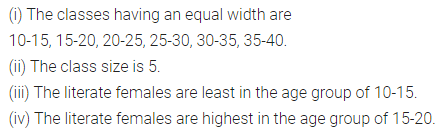
(i) Write the classes assuming all the classes are of equal width.
(ii) What is the class size?
(iii) In which age group are the literate females the least?
(iv) In which age group is the number of literate females the highest?
Solution:
ML Aggarwal Class 8 Solutions for ICSE Maths Chapter 19 Data Handling Ex 19.1 27

ML Aggarwal Class 8 Solutions for ICSE Maths

ML Aggarwal Class 8 Solutions for ICSE Maths Chapter 18 Mensuration Check Your Progress

ML Aggarwal Class 8 Solutions for ICSE Maths Chapter 18 Mensuration Check Your Progress

Question 1.
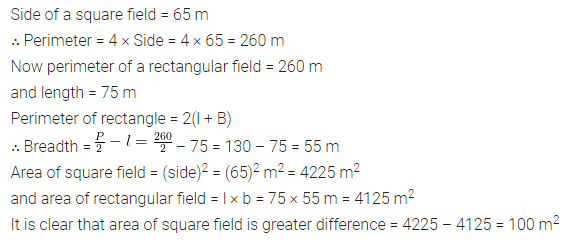
A square field of side 65 m and rectangular field of length 75 m have the same perimeter. Which field has a larger area and by how much?
Solution:
ML Aggarwal Class 8 Solutions for ICSE Maths Chapter 18 Mensuration Check Your Progress 1

Question 2.
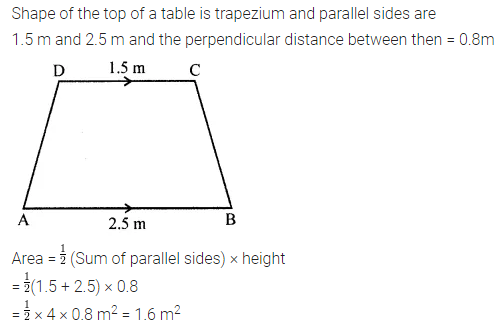
The shape of a top surface of the table is a trapezium. Find the area if its parallel sides are 1.5 m and 2.5 m and the perpendicular distance between them is 0.8 m.
Solution:
ML Aggarwal Class 8 Solutions for ICSE Maths Chapter 18 Mensuration Check Your Progress 2

Question 3.
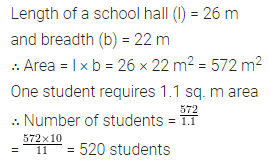
The length and breadth of a hall of a school are 26 m and 22 m respectively. If one student requires 1.1 sq. m area, then find the maximum number of students to be seated in this hall.
Solution:
ML Aggarwal Class 8 Solutions for ICSE Maths Chapter 18 Mensuration Check Your Progress 3

Question 4.
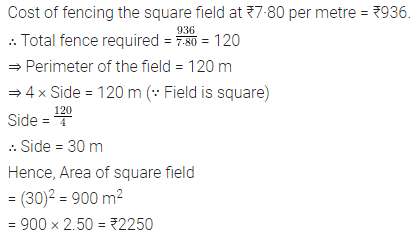
It costs ₹936 to fence a square field at ₹7·80 per metre. Find the cost of levelling the field at ₹2.50 per square metre.
Solution:
ML Aggarwal Class 8 Solutions for ICSE Maths Chapter 18 Mensuration Check Your Progress 4

Question 5.
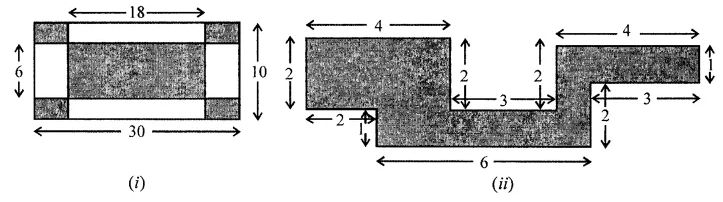
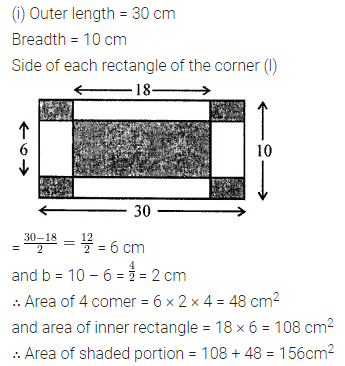
Find the area of the shaded portion in the following figures all measurements are given in cm.
ML Aggarwal Class 8 Solutions for ICSE Maths Chapter 18 Mensuration Check Your Progress 5
Solution:
ML Aggarwal Class 8 Solutions for ICSE Maths Chapter 18 Mensuration Check Your Progress 6
ML Aggarwal Class 8 Solutions for ICSE Maths Chapter 18 Mensuration Check Your Progress 7

Question 6.
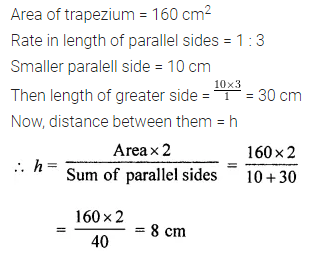
Area of a trapezium is 160 sq. cm. Lengths of parallel sides are in the ratio 1:3. If smaller of the parallel sides is 10 cm in length, then find the perpendicular distance between them.
Solution:
ML Aggarwal Class 8 Solutions for ICSE Maths Chapter 18 Mensuration Check Your Progress 8

Question 7.
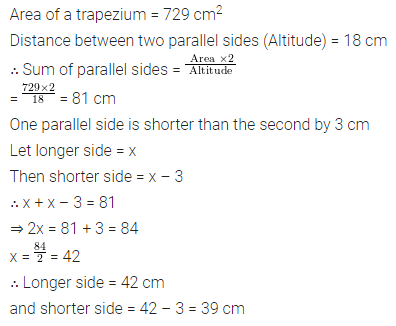
The area of a trapezium is 729 cm2 and the distance between two parallel sides is 18 cm. If one of its parallel sides is 3 cm shorter than the other parallel side, find the lengths of its parallel sides.
Solution:
ML Aggarwal Class 8 Solutions for ICSE Maths Chapter 18 Mensuration Check Your Progress 9

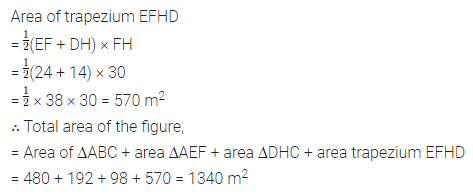
Question 8.
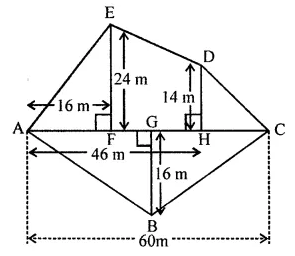
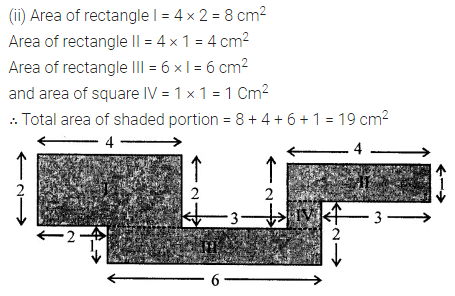
Find the area of the polygon given in the figure:
ML Aggarwal Class 8 Solutions for ICSE Maths Chapter 18 Mensuration Check Your Progress 10
Solution:
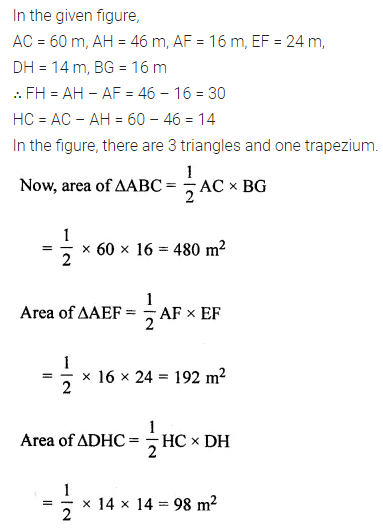
ML Aggarwal Class 8 Solutions for ICSE Maths Chapter 18 Mensuration Check Your Progress 11
ML Aggarwal Class 8 Solutions for ICSE Maths Chapter 18 Mensuration Check Your Progress 12

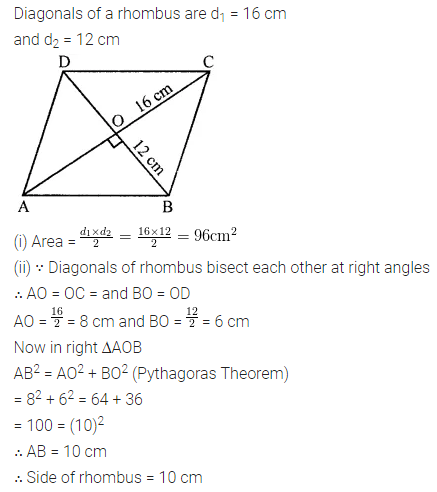
Question 9.
The diagonals of a rhombus are 16 m and 12 m, find:
(i) it’s area
(ii) length of a side
(iii) perimeter.
Solution:
ML Aggarwal Class 8 Solutions for ICSE Maths Chapter 18 Mensuration Check Your Progress 13

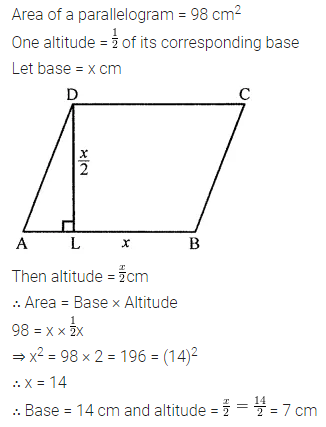
Question 10.
The area of a parallelogram is 98 cm2. If one altitude is half the corresponding base, determine the base and the altitude of the parallelogram.
Solution:
ML Aggarwal Class 8 Solutions for ICSE Maths Chapter 18 Mensuration Check Your Progress 14

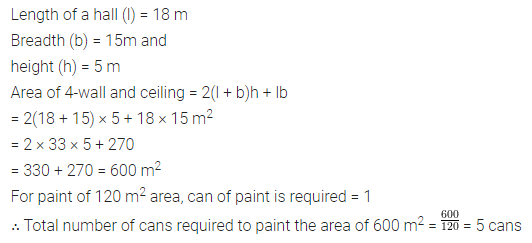
Question 11.
Preeti is painting the walls and ceiling of a hall whose dimensions are 18 m × 15 m × 5 m. From each can of paint 120 m2 of area is painted. How many cans of paint does she need to paint the hall?
Solution:
ML Aggarwal Class 8 Solutions for ICSE Maths Chapter 18 Mensuration Check Your Progress 15

Question 12.
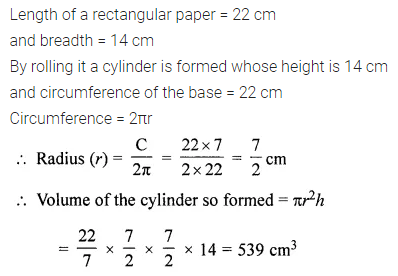
A rectangular paper is size 22 cm × 14 cm is rolled to form a cylinder of height 14 cm, find the volume of the cylinder. (Take π = \(\frac{22}{7}\))
Solution:
ML Aggarwal Class 8 Solutions for ICSE Maths Chapter 18 Mensuration Check Your Progress 16

Question 13.
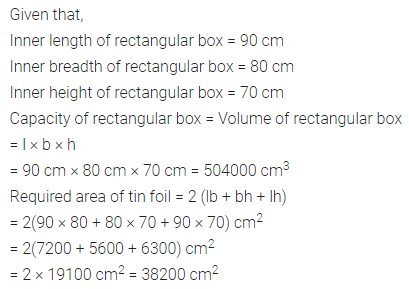
A closed rectangular wooden box has inner dimensions 90 cm by 80 cm by 70 cm. Compute its capacity and the area of the tin foil needed to line its inner surface.
Solution:
ML Aggarwal Class 8 Solutions for ICSE Maths Chapter 18 Mensuration Check Your Progress 17

Question 14.
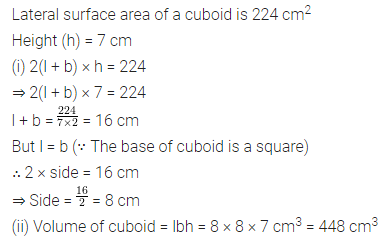
The lateral surface area of a cuboid is 224 cm2. Its height is 7 cm and the base is a square. Find
(i) side of the square base
(ii) the volume of the cuboid.
Solution:
ML Aggarwal Class 8 Solutions for ICSE Maths Chapter 18 Mensuration Check Your Progress 18

Question 15.
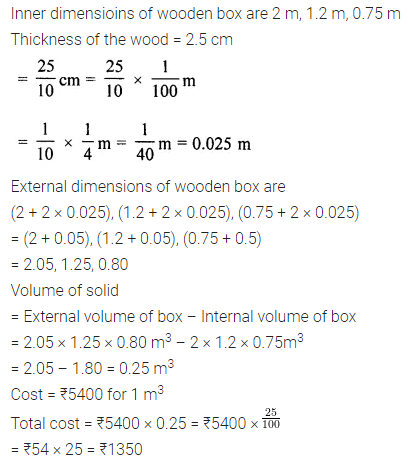
The inner dimensions of a closed wooden box are 2 m by 1.2 m by 0.75 m. The thickness of the wood is 2.5 cm. Find the cost of wood required to make the box if 1 m3 of wood costs ₹5400.
Solution:
ML Aggarwal Class 8 Solutions for ICSE Maths Chapter 18 Mensuration Check Your Progress 19

Question 16.
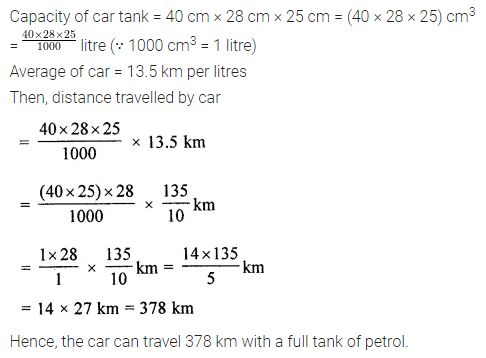
A car has a petrol tank 40 cm long, 28 cm wide and 25 cm deep. If the ful consumption of the car averages 13.5 km per litre, how far can the car travel with a full tank of petrol?
Solution:
ML Aggarwal Class 8 Solutions for ICSE Maths Chapter 18 Mensuration Check Your Progress 20

Question 17.
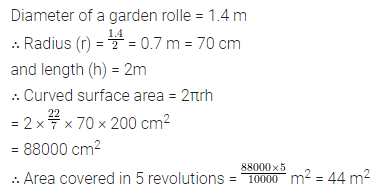
The diameter of a garden roller is 1.4 m and it is 2 m long. How much area it will cover in 5 revolutions?
Solution:
ML Aggarwal Class 8 Solutions for ICSE Maths Chapter 18 Mensuration Check Your Progress 21

Question 18.
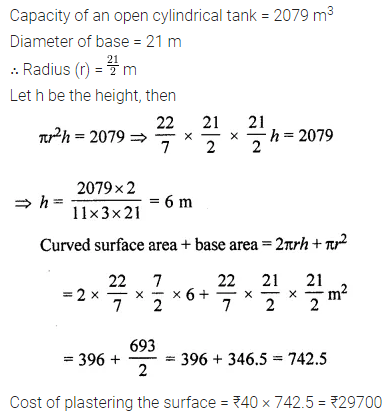
The capacity of an open cylindrical tank is 2079 m3 and the diameter of its base is 21m. Find the cost of plastering its inner surface at ₹40 per square metre.
Solution:
ML Aggarwal Class 8 Solutions for ICSE Maths Chapter 18 Mensuration Check Your Progress 22

Question 19.
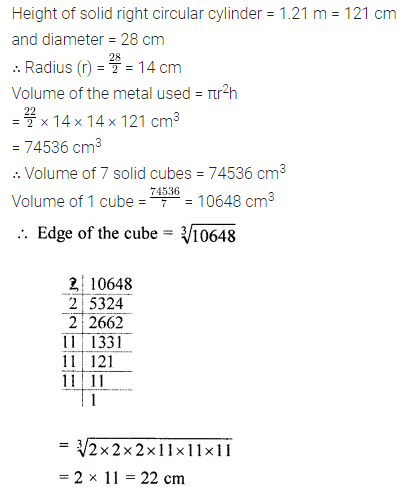
A solid right circular cylinder of height 1.21 m and diameter 28 cm is melted and recast into 7 equal solid cubes. Find the edge of each cube.
Solution:
ML Aggarwal Class 8 Solutions for ICSE Maths Chapter 18 Mensuration Check Your Progress 23

Question 20.
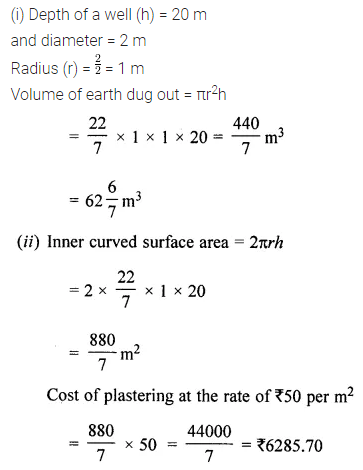
(i) How many cubic metres of soil must be dug out to make a well 20 m deep and 2 m in diameter?
(ii) If the inner curved surface of the well in part (i) above is to be plastered at the rate of ₹50 per m2, find the cost of plastering.
Solution:
ML Aggarwal Class 8 Solutions for ICSE Maths Chapter 18 Mensuration Check Your Progress 24

ML Aggarwal Class 8 Solutions for ICSE Maths

ML Aggarwal Class 8 Solutions for ICSE Maths Chapter 18 Mensuration Objective Type Questions

ML Aggarwal Class 8 Solutions for ICSE Maths Chapter 18 Mensuration Objective Type Questions

Mental Maths
Question 1.
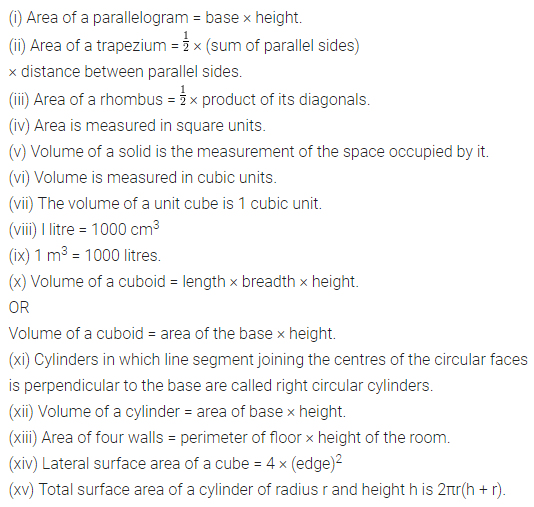
Fill in the blanks:
(i) Area of a parallelogram = base × …….
(ii) Area of a trapezium = \(\frac{1}{2}\) × ……….. × distance between parallel sides.
(iii) Area of a rhombus = \(\frac{1}{2}\) × product of ……..
(iv) Area is measured in ……….. units.
(v) Volume of a solid is the measurement of ………… occupied by it.
(vi) Volume is measured in ………… units.
(vii) The volume of a unit cube is ……….
(viii) 1 litre = …………… cm3
(ix) 1 m3 = ………… litres
(x) Volume of a cuboid = ……….. × height.
(xi) Cylinders in which line segment joining the centres of the circular faces is perpendicular to the base are called ……….
(xii) Volume of a cylinder = area of base × ………..
(xiii) Area of four walls = perimeter of floor × …….
(xiv) Lateral surface area of a cube = 4 × (…………)2
(xv) Total surface area of a cylinder of radius r and height h is ………..
Solution:
ML Aggarwal Class 8 Solutions for ICSE Maths Chapter 18 Mensuration Objective Type Questions 1

Question 2.
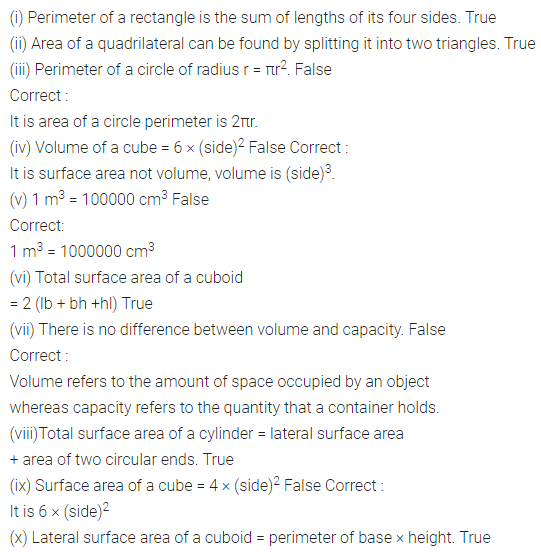
State which of the following statements are true (T) or false (F):
(i) Perimeter of a rectangle is the sum of lengths of its four sides.
(ii) Area of a quadrilateral can be found by splitting it into two triangles.
(iiii) Perimeter of a circle of radius r = πr2.
(iv) Volume of a cube = 6 × (side)2
(v) 1 m3 = 100000 cm3
(vi) Total surface area of a cuboid
= 2 (lb + bh + hl)
(vii) There is no difference between volume and capacity.
(viii)Total surface area of a cylinder = lateral surface area + area of two circular ends.
(ix) Surface area of a cube = 4 × (side)2
(x) Lateral surface area of a cuboid = perimeter of base × height.
Solution:
ML Aggarwal Class 8 Solutions for ICSE Maths Chapter 18 Mensuration Objective Type Questions 2

Multiple Choice Questions
Choose the correct answer from the given four options (3 to 17):
Question 3.
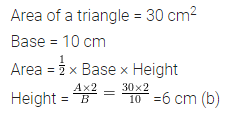
Area of a triangle is 30 cm2. If its base is 10 cm, then its height is
(a) 5 cm
(b) 6 cm
(c) 7 cm
(d) 8 cm
Solution:
ML Aggarwal Class 8 Solutions for ICSE Maths Chapter 18 Mensuration Objective Type Questions 3

Question 4.
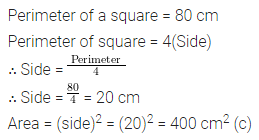
If the perimeter of a square is 80 cm, then its area is
(a) 800 cm2
(b) 600 cm2
(c) 400 cm2
(d) 200 cm2
Solution:
ML Aggarwal Class 8 Solutions for ICSE Maths Chapter 18 Mensuration Objective Type Questions 4

Question 5.
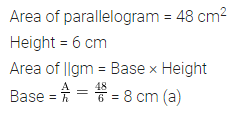
Area of a parallelogram is 48 cm2. If its height is 6 cm then its base is
(a) 8 cm
(b) 4 cm
(c) 16 cm
(d) none of these
Solution:
ML Aggarwal Class 8 Solutions for ICSE Maths Chapter 18 Mensuration Objective Type Questions 5

Question 6.
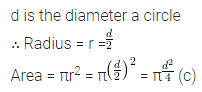
If d is the diameter of a circle, then its area is
(a) πd2
(b) \(\frac{\pi d^{2}}{2}\)
(c) \(\frac{\pi d^{2}}{4}\)
(d) 2πd2
Solution:
ML Aggarwal Class 8 Solutions for ICSE Maths Chapter 18 Mensuration Objective Type Questions 6

Question 7.
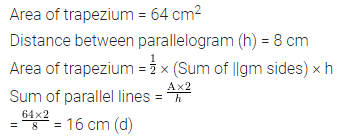
If the area of a trapezium is 64 cm2 and the distance between parallel sides is 8 cm, then sum of its parallel sides is
(a) 8 cm
(b) 4 cm
(c) 32 cm
(d) 16 cm
Solution:
ML Aggarwal Class 8 Solutions for ICSE Maths Chapter 18 Mensuration Objective Type Questions 7

Question 8.
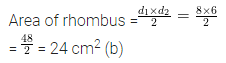
Area of a rhombus whose diagonals are 8 cm and 6 cm is
(a) 48 cm2
(b) 24 cm2
(c) 12 cm2
(d) 96 cm2
Solution:
ML Aggarwal Class 8 Solutions for ICSE Maths Chapter 18 Mensuration Objective Type Questions 8

Question 9.
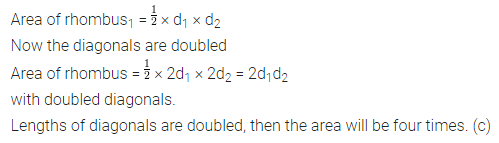
If the lengths of diagonals of a rhombus is doubled, then area of rhombus will be
(a) doubled
(b) tripled
(c) four times
(d) remains same
Solution:
ML Aggarwal Class 8 Solutions for ICSE Maths Chapter 18 Mensuration Objective Type Questions 9

Question 10.
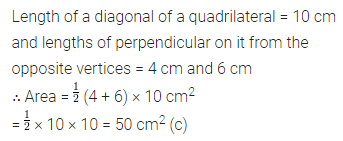
If the length of a diagonal of a quadrilateral is 10 cm and lengths of the perpendiculars on it from opposite vertices are 4 cm and 6 cm, then area of quadrilateral is
(a) 100 cm2
(b) 200 cm2
(c) 50 cm2
(d) none of these
Solution:
ML Aggarwal Class 8 Solutions for ICSE Maths Chapter 18 Mensuration Objective Type Questions 10

Question 11.
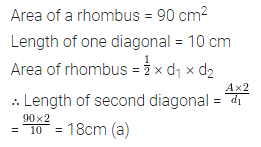
Area of a rhombus is 90 cm2. If the length of one diagonal is 10 cm then the length of other diagonal is
(a) 18 cm
(b) 9 cm
(c) 36 cm
(d) 4.5 cm
Solution:
ML Aggarwal Class 8 Solutions for ICSE Maths Chapter 18 Mensuration Objective Type Questions 11

Question 12.
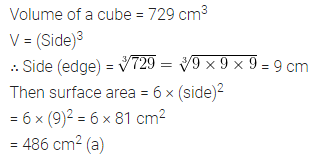
If the volume of a cube is 729 cm3, then its surface area is
(a) 486 cm2
(b) 324 cm2
(c) 162 cm2
(d) none of these
Solution:
ML Aggarwal Class 8 Solutions for ICSE Maths Chapter 18 Mensuration Objective Type Questions 12

Question 13.
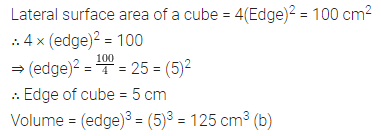
If the lateral surface area of a cube is 100 cm2, then its volume is
(a) 25 cm3
(b) 125 cm3
(c) 625 cm3
(d) none of these
Solution:
ML Aggarwal Class 8 Solutions for ICSE Maths Chapter 18 Mensuration Objective Type Questions 13

Question 14.
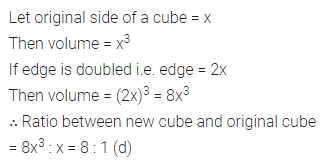
If the length of side of a cube is doubled, then the ratio of volumes of new cube and original cube is
(a) 1 : 2
(b) 2 : 1
(c) 4 : 1
(d) 8 : 1
Solution:
ML Aggarwal Class 8 Solutions for ICSE Maths Chapter 18 Mensuration Objective Type Questions 14

Question 15.
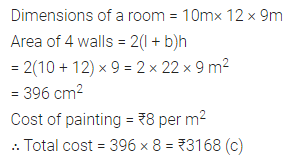
If the dimensions of a rectangular room are 10m × 12m × 9m, then the cost of painting its four walls at the rate of ₹8 per m2 is
(a) ₹3186
(b) ₹3618
(c) ₹3168
(d) none of these
Solution:
ML Aggarwal Class 8 Solutions for ICSE Maths Chapter 18 Mensuration Objective Type Questions 15

Question 16.
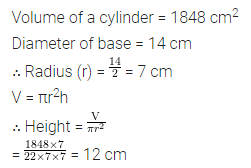
Volume of a cylinder is 1848 cm2. If the diameter of its base is 14 cm, then the height of the cylinder is
(a) 12 cm
(b) 6 cm
(c) 3 cm
(d) none of these
Solution:
ML Aggarwal Class 8 Solutions for ICSE Maths Chapter 18 Mensuration Objective Type Questions 16

Question 17.
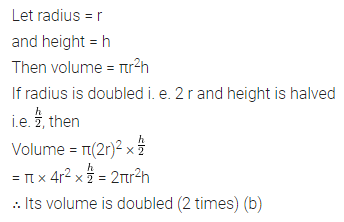
If the radius of a cylinder is doubled and height is halved, then new volume is
(a) same
(b) 2 times
(c) 4 times
(d) 8 times
Solution:
ML Aggarwal Class 8 Solutions for ICSE Maths Chapter 18 Mensuration Objective Type Questions 17

Value Based Questions
Question 1.
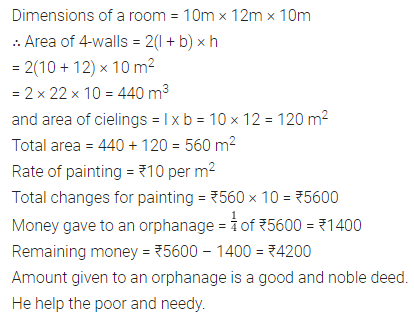
Pulkit painted four walls and roof of a rectangular room of size 10m × 12m × 12m. He got ₹10 per m2 for his work. How much money did he earn? He always gives one-fourth of his income to an orphanage. Find how much money he gave to the orphanage? What values are being promoted?
Solution:
ML Aggarwal Class 8 Solutions for ICSE Maths Chapter 18 Mensuration Objective Type Questions 18

Question 2.
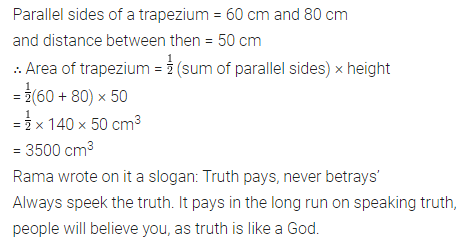
In a slogan writing competition in a school, Rama wrote the slogan ‘Truth pays, never betrays’ on a trapezium shaped cardboard. If the lengths of parallel sides of trapezium are 60 cm and 80 cm and the distance between them is 50 cm, find the area of trapezium. What are the advantages of speaking truth?
Solution:
ML Aggarwal Class 8 Solutions for ICSE Maths Chapter 18 Mensuration Objective Type Questions 19

Higher Order Thinking Skills (Hots)
Question 1.
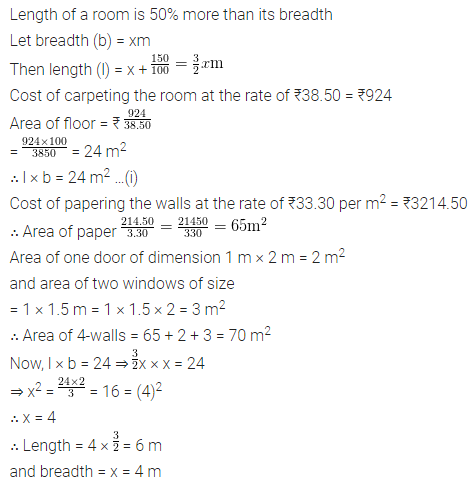
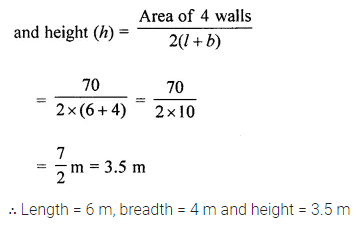
The length of a room is 50% more than its breadth. The cost of carpeting the room at the rate of ₹38.50 m2 is ₹924 and the cost of papering the walls at ₹3.30 m2 is ₹214.50. If the room has one door of dimensions 1 m × 2 m and two windows each of dimensions 1 m × 1.5 m, find the dimensions of the room.
Solution:
ML Aggarwal Class 8 Solutions for ICSE Maths Chapter 18 Mensuration Objective Type Questions 20
ML Aggarwal Class 8 Solutions for ICSE Maths Chapter 18 Mensuration Objective Type Questions 21

Question 2.
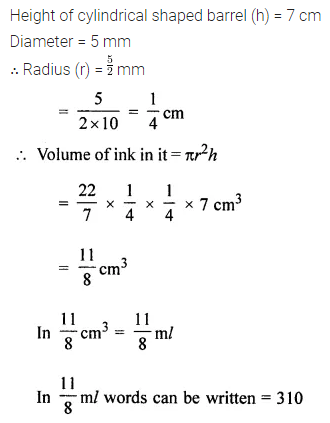
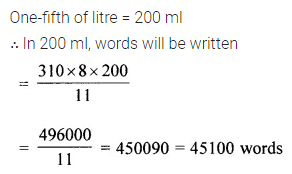
The barrel of a fountain pen, cylindrical in shape, is 7 cm long and 5 mm in diameter. A full barrel of ink in the pen will be used up when writing 310 words on an average. How many words would use up a bottle of ink containing one-fifth of a litre? Answer correct to the nearest 100 words.
Solution:
ML Aggarwal Class 8 Solutions for ICSE Maths Chapter 18 Mensuration Objective Type Questions 22
ML Aggarwal Class 8 Solutions for ICSE Maths Chapter 18 Mensuration Objective Type Questions 23

Question 3.
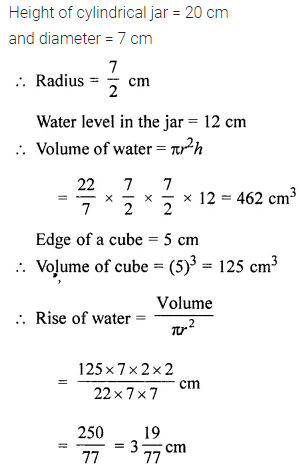
A cylindrical jar is 20 cm high with an internal diameter 7 cm. An iron cube of edge 5 cm is immersed in the jar completely in the water which was originally 12 cm high. Find the rise in the level of water.
Solution:
ML Aggarwal Class 8 Solutions for ICSE Maths Chapter 18 Mensuration Objective Type Questions 24

Question 4.
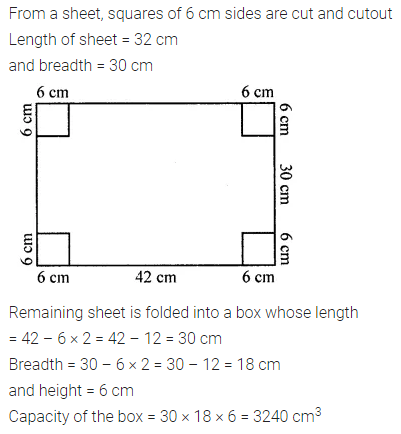
Squares each of side 6 cm are cut off from the four comers of a sheet of tin measuring 42 cm by 30 cm. The remaining portion of the tin sheet is made into an open box by folding up the flaps. Find the capacity of the box.
Solution:
ML Aggarwal Class 8 Solutions for ICSE Maths Chapter 18 Mensuration Objective Type Questions 25

ML Aggarwal Class 8 Solutions for ICSE Maths