ML Aggarwal Class 8 Solutions for ICSE Maths Model Question Paper 3

ML Aggarwal Class 8 Solutions for ICSE Maths Model Question Paper 3

Questions 1 to 8 is of 1 mark each.
Question 1.
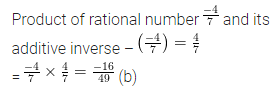
Product of rational number \(\frac{-4}{7}\) and itsadditive inverse is
(a) \(\frac{16}{49}\)
(b) \(\frac{-16}{49}\)
(c) 1
(d) 0
Solution:
ML Aggarwal Class 8 Solutions for ICSE Maths Model Question Paper 3 1

Question 2.
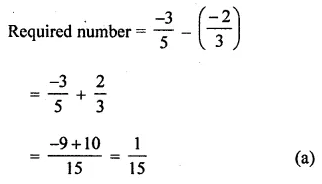
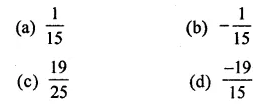
What should be subtracted from \(\frac{-3}{5}\) to get \(\frac{-2}{3}\)?
ML Aggarwal Class 8 Solutions for ICSE Maths Model Question Paper 3 2
Solution:
ML Aggarwal Class 8 Solutions for ICSE Maths Model Question Paper 3 3

Question 3.
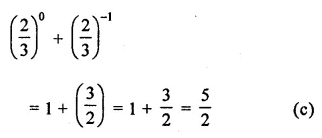
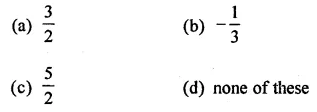
The value of \(\left(\frac{2}{3}\right)^{0}+\left(\frac{2}{3}\right)^{-1}\) is
ML Aggarwal Class 8 Solutions for ICSE Maths Model Question Paper 3 4
Solution:
ML Aggarwal Class 8 Solutions for ICSE Maths Model Question Paper 3 5

Question 4.
Standard form of 0.00000000234 is
(a) 2.34 × 10⁻⁸
(b) 23.4 × 10⁻¹⁰
(c) 2.34 × 10⁻⁹
(d) 234 × 10-1
Solution:

ML Aggarwal Class 8 Solutions for ICSE Maths Model Question Paper 3 6

Question 5.
The volume of a cube is 216 m3. Length of its side is
(a) 3 m
(b) 6 m
(c) 9 m
(d) 12 m
Solution:
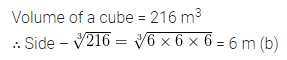
ML Aggarwal Class 8 Solutions for ICSE Maths Model Question Paper 3 7

Question 6.
When the difference of a 2-digit number ab (a > b) and the number obtained by reversing the digits is divided by 9, then quotient is
(a) a + b
(b) b – a
(c) a – b
(d) none of these
Solution:

ML Aggarwal Class 8 Solutions for ICSE Maths Model Question Paper 3 8

Question 7.
Amar buys a toy for ₹ 120 and sells it for ₹ 144, his profit % is
(a) 5%
(b) 10%
(c) 20%
(d) 24%
Solution:
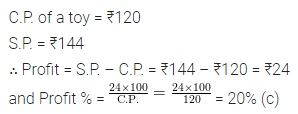
ML Aggarwal Class 8 Solutions for ICSE Maths Model Question Paper 3 9

Question 8.
If 567×8 is divisible by 9, then value of x is
(a) 1
(b) 2
(c) 3
(d) 4
Solution:
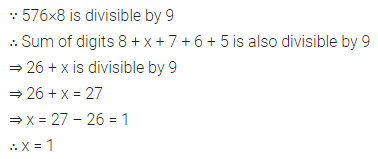
ML Aggarwal Class 8 Solutions for ICSE Maths Model Question Paper 3 10

Section-B
Questions 9 to 14 are of 2 marks each.
Question 9.
Ramesh bought a fan for ₹ 1320 including 10% VAT. Find the price of the fan before VAT was added.
Solution:
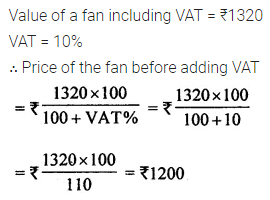
ML Aggarwal Class 8 Solutions for ICSE Maths Model Question Paper 3 11

Question 10.
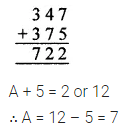
Find A in the addition
ML Aggarwal Class 8 Solutions for ICSE Maths Model Question Paper 3 12
Solution:
ML Aggarwal Class 8 Solutions for ICSE Maths Model Question Paper 3 13

Question 11.
Find the value of x for which \(\left(-\frac{4}{5}\right)^{2} \times\) \(\left(-\frac{5}{4}\right)^{2 x}=\frac{625}{256}\).
Solution:
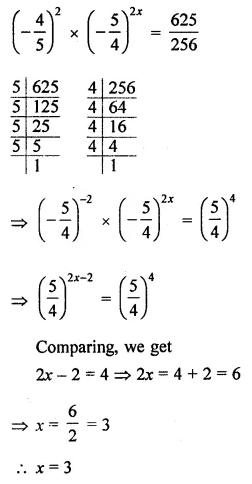
ML Aggarwal Class 8 Solutions for ICSE Maths Model Question Paper 3 14

Question 12.
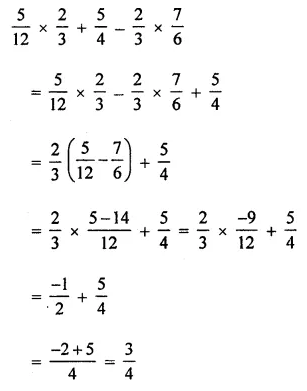
Using appropriate properties of operations of rational numbers, evaluate:
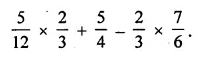
ML Aggarwal Class 8 Solutions for ICSE Maths Model Question Paper 3 15
Solution:
ML Aggarwal Class 8 Solutions for ICSE Maths Model Question Paper 3 16

Question 13.
What number should be subtracted from the sum of \(\frac{-5}{12}\) and \(\frac{2}{3}\) to get \(\frac{5}{4}\) ?
Solution:
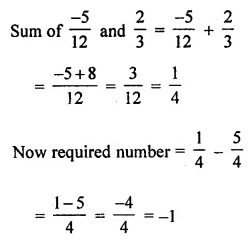
ML Aggarwal Class 8 Solutions for ICSE Maths Model Question Paper 3 17

Question 14.
If n(ξ) = 40, n(A) = 23, n(B’) = 28 and n(A ∪ B’) = 9, find n(A ∩ B).
Solution:
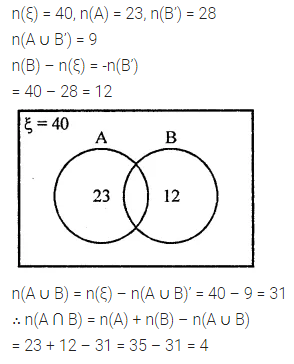
ML Aggarwal Class 8 Solutions for ICSE Maths Model Question Paper 3 18

Section-C
Questions 15 to 24 are of 4 marks each.
Question 15.
In an auditorium, the number of rows is equal to the number of chairs in each row. If there are 5184 chairs in the auditorium, find the number of rows.
Solution:
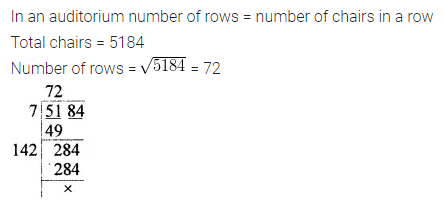
ML Aggarwal Class 8 Solutions for ICSE Maths Model Question Paper 3 19

Question 16.
Insert 5 rational numbers between \(\frac{1}{3}\) and \(\frac{1}{2}\).
Solution:
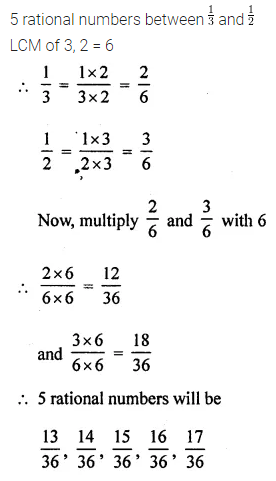
ML Aggarwal Class 8 Solutions for ICSE Maths Model Question Paper 3 20

Question 17.
Find the smallest number by which 10584 should be multiplied so that product is a perfect cube. Also find the cube root of the product.
Solution:
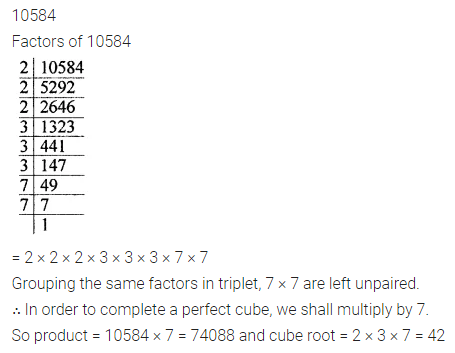
ML Aggarwal Class 8 Solutions for ICSE Maths Model Question Paper 3 21

Question 18.
In a 3-digit number unit’s digit is 2 less than hundred’s digit and hundred’s digit is 3 less than the ten’s digit. If the sum of the original number and number obtained by reversing the digits is 968, find the number.
Solution:
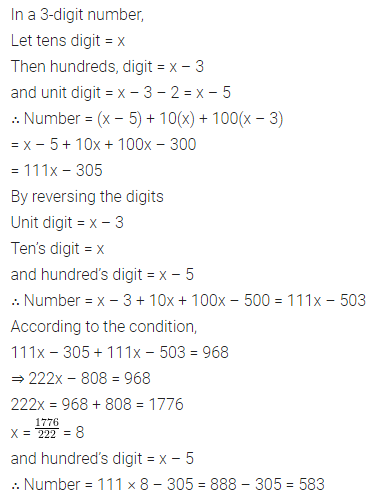
ML Aggarwal Class 8 Solutions for ICSE Maths Model Question Paper 3 22

Question 19.
Rohit purchased some oranges at 3 for ₹5 and sold them at 5 for ₹12. Thus he gained ₹143 in all. How many oranges did he purchase?
Solution:
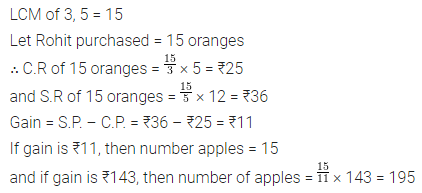
ML Aggarwal Class 8 Solutions for ICSE Maths Model Question Paper 3 23

Question 20.
How much per cent above the cost price should a shopkeeper mark his goods so that after allowing a discount of 20% he still earns a profit of 20%?
Solution:
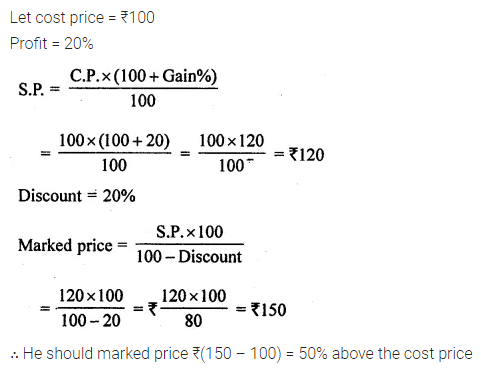
ML Aggarwal Class 8 Solutions for ICSE Maths Model Question Paper 3 24

Question 21.
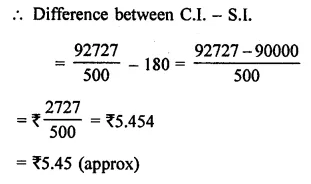
Find the difference between S.I. and C.I. on ₹2000 for \(1 \frac{1}{2}\) years at 6% p.a., compound interest being reckoned half-yearly.
Solution:
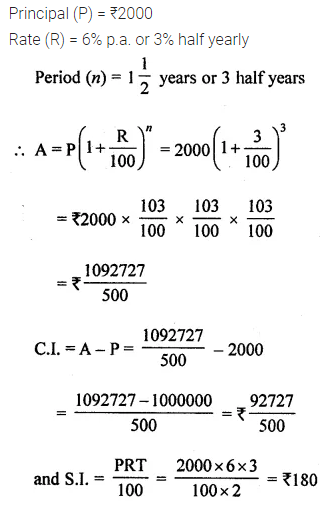
ML Aggarwal Class 8 Solutions for ICSE Maths Model Question Paper 3 25
ML Aggarwal Class 8 Solutions for ICSE Maths Model Question Paper 3 26

Question 22.
If 5 men or 7 women can earn ₹903 in a day, how much will 10 men and 5 women earn in a day?
Solution:
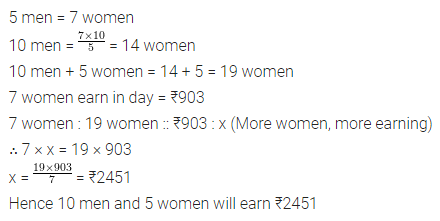
ML Aggarwal Class 8 Solutions for ICSE Maths Model Question Paper 3 27

Question 23.
A hostel had rations for 150 students for 60 days. After 12 days, 30 more students join the hostel. How long will the remaining rations last?
Solution:
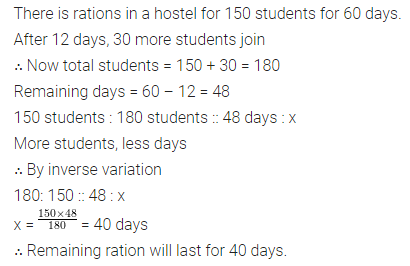
ML Aggarwal Class 8 Solutions for ICSE Maths Model Question Paper 3 28

Question 24.
Simplify the following expression and write in the exponential form:
3-5 × 32 ÷ 36 × (22 × 3)2 + \(\left(\frac{2}{3}\right)^{-1}\) + 2-1 + \(\left(\frac{1}{19}\right)^{-1}\).
Solution:
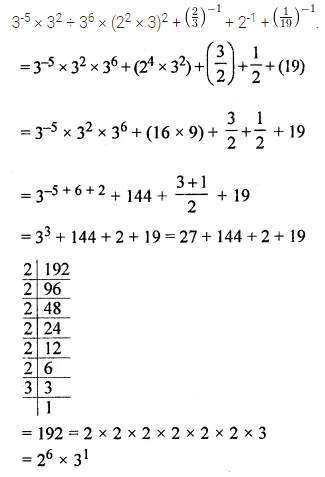
ML Aggarwal Class 8 Solutions for ICSE Maths Model Question Paper 3 29

Section-D
Questions 25 to 29 are of 6 marks each.
Question 25.
Ramesh scored 30% marks in an exam and failed by 20 marks, while Suresh scored 40% marks and got 40 marks more than the minimum marks required to pass the exam. Find the maximum marks and pass percentage.
Solution:
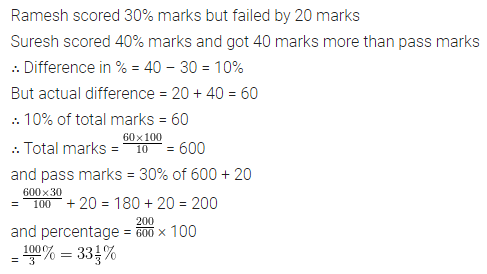
ML Aggarwal Class 8 Solutions for ICSE Maths Model Question Paper 3 30

Question 26.
If ξ = {x | x ϵ W, x < 20}, A = {factors of 18} and B = {multiples of 3}, find
(i) A ∪ B
(ii) A ∩ B
(iii) (A ∪ B)’.
Also verify that n(A ∪ B) = n(A) + n(B) – n(A ∩ B).
Solution:
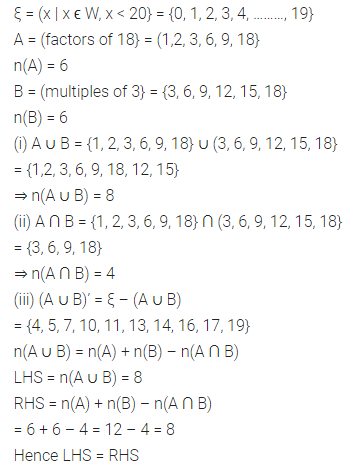
ML Aggarwal Class 8 Solutions for ICSE Maths Model Question Paper 3 31

Question 27.
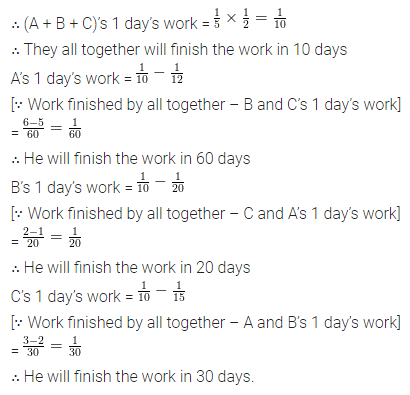
A and B together can do a piece of work in 15 days; B and C together can do it in 12 days; C and A can do it in 20 days. How long will they take to finish the work, working together? Also find the number of days taken by each to do the same work, working alone.
Solution:
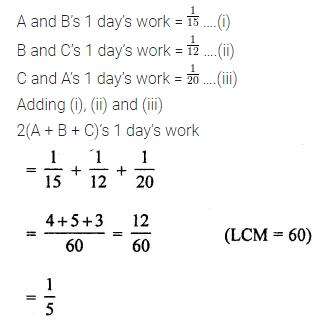
ML Aggarwal Class 8 Solutions for ICSE Maths Model Question Paper 3 32
ML Aggarwal Class 8 Solutions for ICSE Maths Model Question Paper 3 33

Question 28.
Is 31104 a perfect square number? If not then find the smallest number by which 31104 should be divided so that quotient is a perfect square. Also, find the square root of the quotient.
Solution:
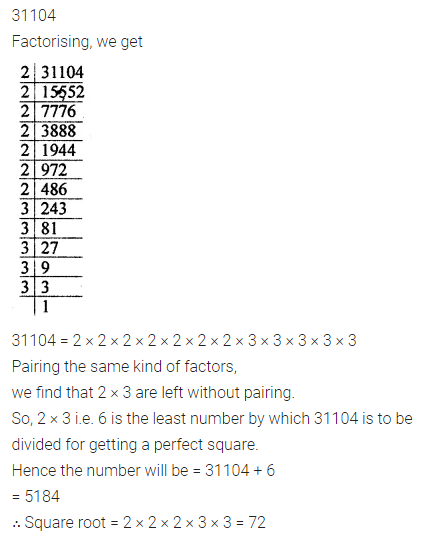
ML Aggarwal Class 8 Solutions for ICSE Maths Model Question Paper 3 34

Question 29.
Three numbers are in the ratio 1:3:5 and sum of their cubes is 52479. Find the numbers.
Solution:
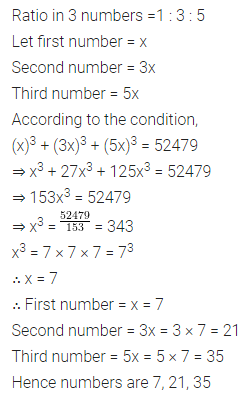
ML Aggarwal Class 8 Solutions for ICSE Maths Model Question Paper 3 35

ML Aggarwal Class 8 Solutions for ICSE Maths

ML Aggarwal Class 8 Solutions for ICSE Maths Model Question Paper 2

ML Aggarwal Class 8 Solutions for ICSE Maths Model Question Paper 2

Choose the correct answer from the given four options (1-2):
Question 1.
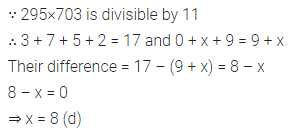
If 295×703 is divisible by 11, then value of x is
(a) 5
(b) 6
(c) 7
(d) 8
Solution:
ML Aggarwal Class 8 Solutions for ICSE Maths Model Question Paper 2 1

Question 2.
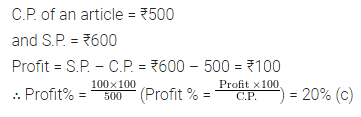
If C.P. of an article is ₹500 and S.P. is ₹600, then, his profit % is
(a) 10%
(b) 15%
(c) 20%
(d) 25%
Solution:
ML Aggarwal Class 8 Solutions for ICSE Maths Model Question Paper 2 2

Question 3.
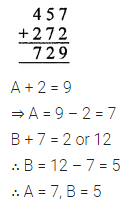
Find the values of the letters in the following and give reasons for the steps involved:
ML Aggarwal Class 8 Solutions for ICSE Maths Model Question Paper 2 3
Solution:
ML Aggarwal Class 8 Solutions for ICSE Maths Model Question Paper 2 4

Question 4.
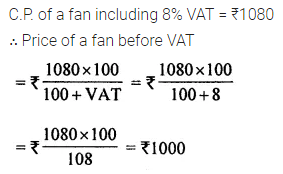
Ramu bought a fan for ₹1080 including 8% VAT. Find the price of fan before VAT was added.
Solution:
ML Aggarwal Class 8 Solutions for ICSE Maths Model Question Paper 2 5

Question 5.
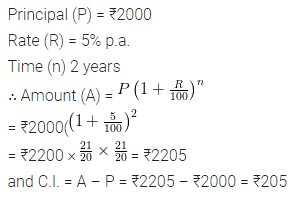
Find the amount and compound interest on ₹2000 for 2 years at 5% per annum, interest payable yearly.
Solution:
ML Aggarwal Class 8 Solutions for ICSE Maths Model Question Paper 2 6

Question 6.
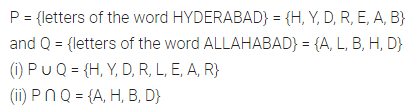
If P = {letters of the word HYDERABAD} and Q= {letters ofthewordALLAHABAD}, find
(i) P ∪ Q
(ii) P ∩ Q
Also verify that
n(P ∪ Q) = n(P) + n(Q) – n(P ∩ Q).
Solution:
ML Aggarwal Class 8 Solutions for ICSE Maths Model Question Paper 2 7

Question 7.
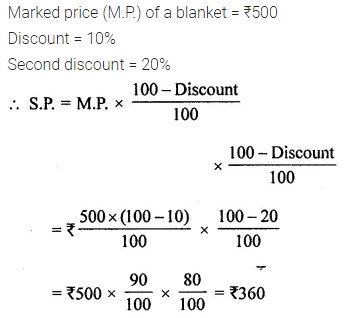
A blanket was marked for ₹500. A shopkeeper allows a discount of 10%. But due to partial damage in the blanket he has to give an extra discount of 20%. Find the S.P. of the blanket.
Solution:
ML Aggarwal Class 8 Solutions for ICSE Maths Model Question Paper 2 8

Question 8.
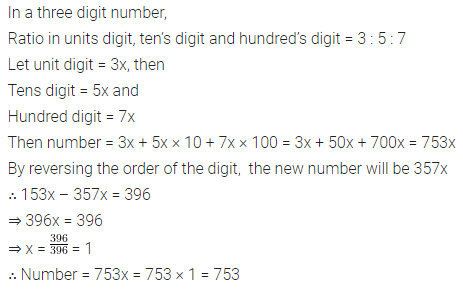
In a 3 digit number unit’s digit, ten’s digit and hundred’s digit are in the ratio 3 : 5 : 7. If the difference of original number and number obtained by reversing the digits is 396, find the number.
Solution:
ML Aggarwal Class 8 Solutions for ICSE Maths Model Question Paper 2 9

Question 9.
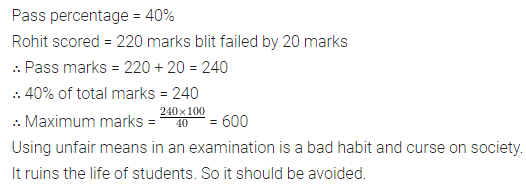
In an exam atleast 40% marks are required to pass the exam. Rohit uses unfair means to pass the exam but fails by 20 marks. If he scored 220 marks, then find the maximum marks.
Is using unfair means in exam is good? Why should we not use unfair means?
Solution:
ML Aggarwal Class 8 Solutions for ICSE Maths Model Question Paper 2 10

Question 10.
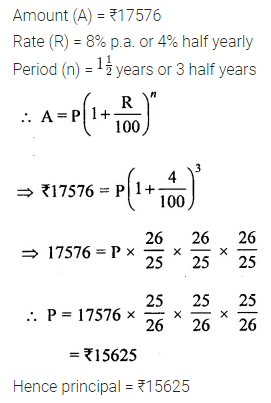
Find the sum invested for \(1 \frac{1}{2}\) years compounded half-yearly at the rate of 8% p.a. that will amount to ₹ 17576.
Solution:
ML Aggarwal Class 8 Solutions for ICSE Maths Model Question Paper 2 11

ML Aggarwal Class 8 Solutions for ICSE Maths

ML Aggarwal Class 8 Solutions for ICSE Maths Model Question Paper 1

ML Aggarwal Class 8 Solutions for ICSE Maths Model Question Paper 1

Choose the correct answer from the given four options (1-2):
Question 1.
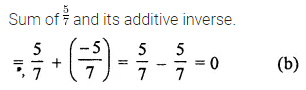
Sum of rational number \(\frac { 5 }{ 7 }\) and its additiveinverse is
(a) 1
(b) 0
(c) -1
(d) none of these
Solution:
ML Aggarwal Class 8 Solutions for ICSE Maths Model Question Paper 1 1

Question 2.
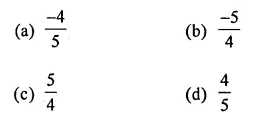
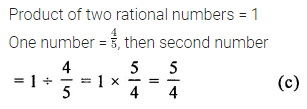
Product of two rational numbers is 1. If one of them is \(\frac { 4 }{ 5 }\), then other is
ML Aggarwal Class 8 Solutions for ICSE Maths Model Question Paper 1 2
Solution:
ML Aggarwal Class 8 Solutions for ICSE Maths Model Question Paper 1 3

Question 3.
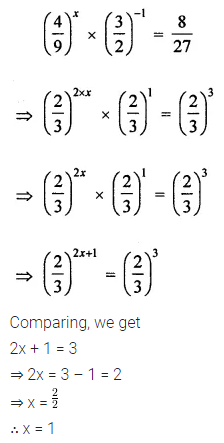
Find the value of x for which \(\left(\frac{4}{9}\right)^{x} \times\left(\frac{3}{2}\right)^{-1}\) = \(\frac{8}{27}\).
Solution:
ML Aggarwal Class 8 Solutions for ICSE Maths Model Question Paper 1 4

Question 4.
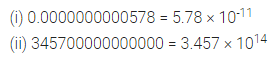
Express the following numbers in standard form:
(i) 0.0000000000578
(ii) 345700000000000
Solution:
ML Aggarwal Class 8 Solutions for ICSE Maths Model Question Paper 1 5

Question 5.
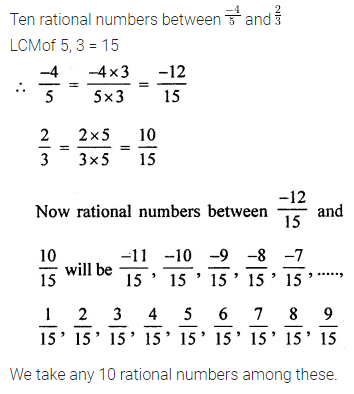
Insert ten rational numbers between \(\frac{-4}{5}\) and \(\frac{2}{3}\).
Solution:
ML Aggarwal Class 8 Solutions for ICSE Maths Model Question Paper 1 6

Question 6.
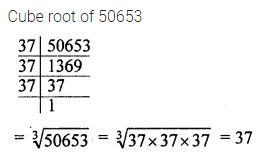
Find the cube root of 50653.
Solution:
ML Aggarwal Class 8 Solutions for ICSE Maths Model Question Paper 1 7

Question 7.
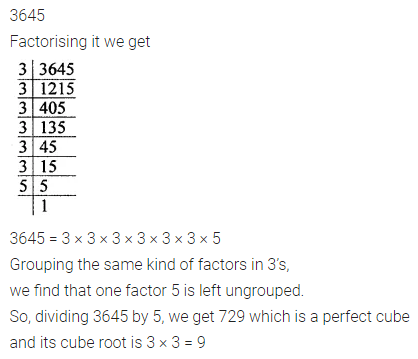
Find the smallest number by which 3645 should be divided so that quotient is a perfect cube.
Solution:
ML Aggarwal Class 8 Solutions for ICSE Maths Model Question Paper 1 8

Question 8.
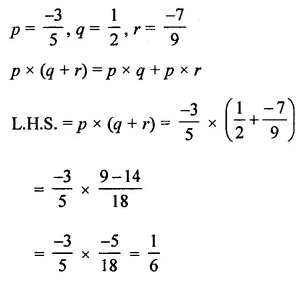
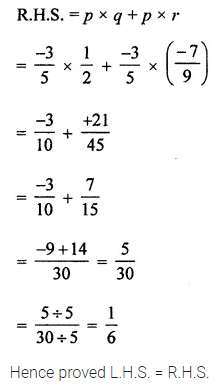
If p = \(\frac{-3}{5}\), q = \(\frac{1}{2}\), r= \(\frac{-7}{9}\),then verify p × (q + r) = p × q + p × r.
Solution:
ML Aggarwal Class 8 Solutions for ICSE Maths Model Question Paper 1 9
ML Aggarwal Class 8 Solutions for ICSE Maths Model Question Paper 1 10

Question 9.
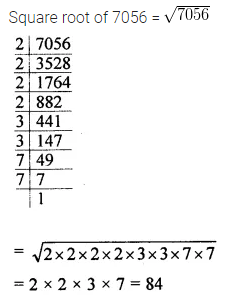
Find the square root of 7056 by prime factorisation method.
Solution:
ML Aggarwal Class 8 Solutions for ICSE Maths Model Question Paper 1 11

Question 10.
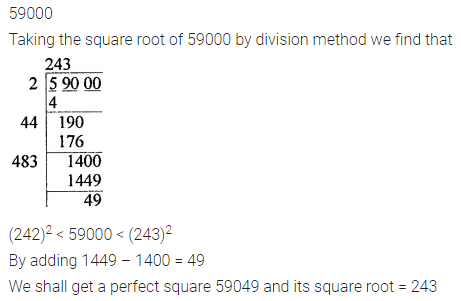
Find the least number which must be added to 59000 to make it a perfect square.
Solution:
ML Aggarwal Class 8 Solutions for ICSE Maths Model Question Paper 1 12

ML Aggarwal Class 8 Solutions for ICSE Maths

ML Aggarwal Class 8 Solutions for ICSE Maths Chapter 19 Data Handling Check Your Progress

ML Aggarwal Class 8 Solutions for ICSE Maths Chapter 19 Data Handling Check Your Progress

Question 1.
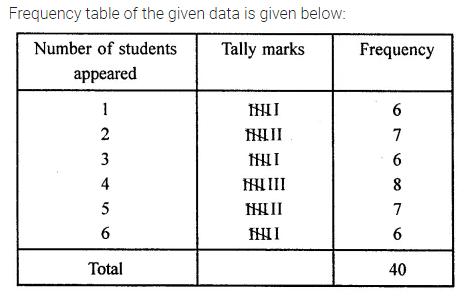
Each student from the group of 40 students was asked to roll a dice independently. The results are given below:
2, 3, 3, 4, 1, 5, 2, 6, 1, 4, 2, 3, 4, 4, 6, 1, 5, 5, 2, 4, 5, 5, 3, 1, 6, 5, 4, 2, 3, 6, 1, 1, 4, 4, 5, 3, 2, 2, 6,6
Make a frequency distribution table for the same.
Solution:
ML Aggarwal Class 8 Solutions for ICSE Maths Chapter 19 Data Handling Check Your Progress 1

Question 2.
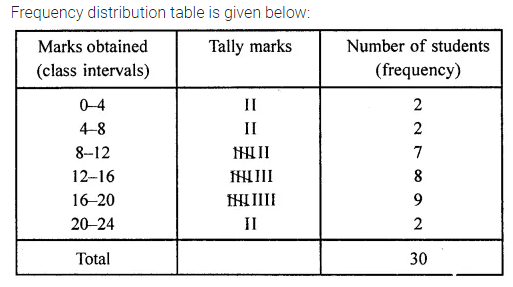
The marks obtained by 30 students of a class in a test of maximum marks 20 are as follows:
15, 11, 12, 10, 9, 8, 19, 13, 16, 3, 2, 17, 18, 19, 14, 6, 20, 15, 16, 12, 10, 4, 9, 8, 12, 17, 18, 20, 19, 12.
Prepare a frequency distribution table for the above data using class intervals 0-4, 4-8 and so on.
Solution:
ML Aggarwal Class 8 Solutions for ICSE Maths Chapter 19 Data Handling Check Your Progress 2

Question 3.
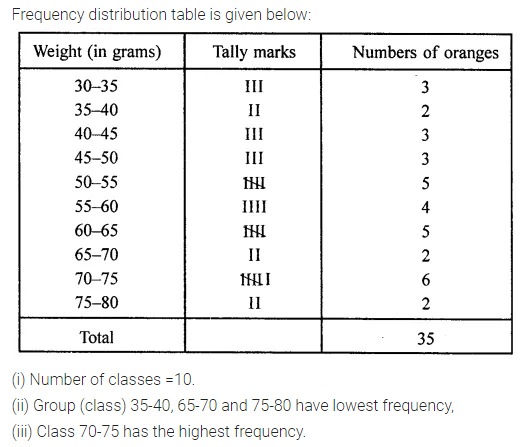
Construct a frequency distribution table for the following weights (in grams) of 35 oranges, using class intervals 40—45, 45-50 and so on.
30, 40, 45, 32, 43, 50, 55, 63, 72, 73, 62, 61, 54, 53, 50, 43, 76, 38, 54, 55, 66, 70, 74, 75, 45, 47, 59, 58, 60, 63, 74, 33, 35, 70, 68.
(i) How many classes are there in the frequency distribution table?
(ii) Which weight group has the lowest frequency?
(iii) Which weight group has the highest frequency?
Solution:
ML Aggarwal Class 8 Solutions for ICSE Maths Chapter 19 Data Handling Check Your Progress 3

Question 4.
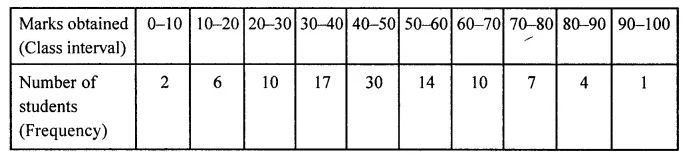
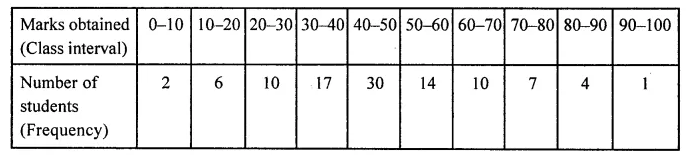
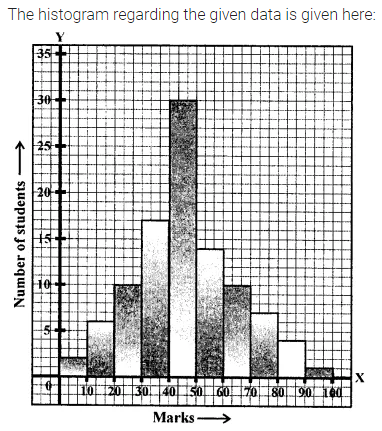
Draw a histogram of the following data:
Marks obtained by students in a Mathematics Paper of maximum marks 100.
ML Aggarwal Class 8 Solutions for ICSE Maths Chapter 19 Data Handling Check Your Progress 4
Solution:
ML Aggarwal Class 8 Solutions for ICSE Maths Chapter 19 Data Handling Check Your Progress 5
ML Aggarwal Class 8 Solutions for ICSE Maths Chapter 19 Data Handling Check Your Progress 6

Question 5.
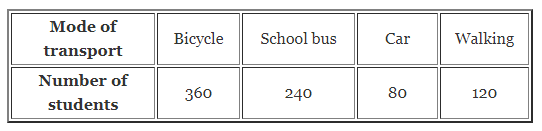
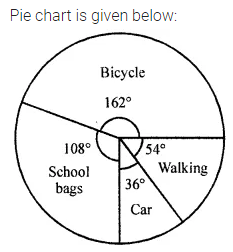
The following data represents the number of students using a different mode of transportation to come to school.
ML Aggarwal Class 8 Solutions for ICSE Maths Chapter 19 Data Handling Check Your Progress 7
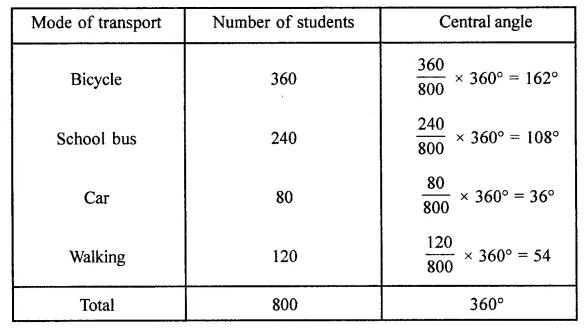
Draw a pie chart to represent this data Pie chart is given below:
Solution:
ML Aggarwal Class 8 Solutions for ICSE Maths Chapter 19 Data Handling Check Your Progress 8
ML Aggarwal Class 8 Solutions for ICSE Maths Chapter 19 Data Handling Check Your Progress 9

Question 6.
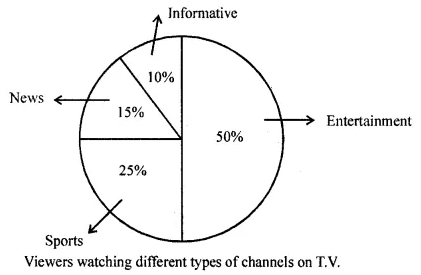
Answer the following questions based on the pie chart given below:
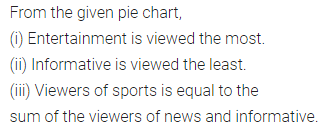
(i) Which type of programmes are viewed the most?
(ii) Which type of programmes are viewed the least?
(iii) Which two types of programmes have number of viewers equal to those watching sports channels?
ML Aggarwal Class 8 Solutions for ICSE Maths Chapter 19 Data Handling Check Your Progress 10
Solution:
ML Aggarwal Class 8 Solutions for ICSE Maths Chapter 19 Data Handling Check Your Progress 11

Question 7.
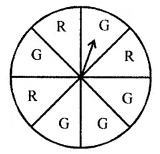
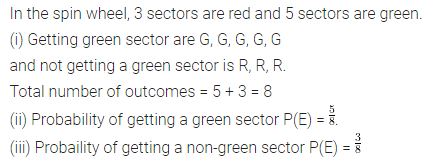
Suppose you spin the wheel shown in adjoining figure.
(i) List the outcomes of getting a green sector and not getting a green sector on this wheel.
(ii) Find the probability of getting a green sector.
(iii) Find the probability of not getting a green sector.
ML Aggarwal Class 8 Solutions for ICSE Maths Chapter 19 Data Handling Check Your Progress 12
Solution:
ML Aggarwal Class 8 Solutions for ICSE Maths Chapter 19 Data Handling Check Your Progress 13

Question 8.
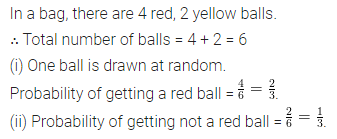
A bag has 4 red and 2 yellow balls. A ball is drawn from the bag without looking into the bag. What is the probability of getting
(i) a red ball?
(ii) not a red ball?
Solution:
ML Aggarwal Class 8 Solutions for ICSE Maths Chapter 19 Data Handling Check Your Progress 14

Question 9.
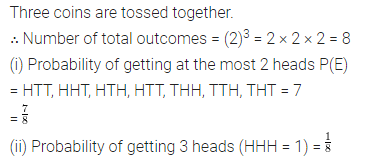
Three coins are tossed together, find the probability of getting
(i) atmost 2 heads
(ii) 3 heads.
Solution:
ML Aggarwal Class 8 Solutions for ICSE Maths Chapter 19 Data Handling Check Your Progress 15

Question 10.
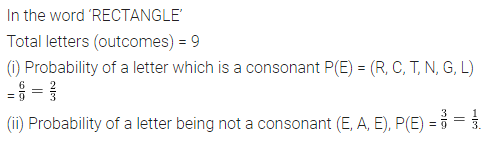
A letter is chosen from the word ‘RECTANGLE’. What is the probability that it is
(i) a consonant
(ii) not a consonant.
Solution:
ML Aggarwal Class 8 Solutions for ICSE Maths Chapter 19 Data Handling Check Your Progress 16

ML Aggarwal Class 8 Solutions for ICSE Maths

ML Aggarwal Class 8 Solutions for ICSE Maths Chapter 19 Data Handling Objective Type Questions

ML Aggarwal Class 8 Solutions for ICSE Maths Chapter 19 Data Handling Objective Type Questions

Mental Maths
Question 1.
Fill in the blanks:
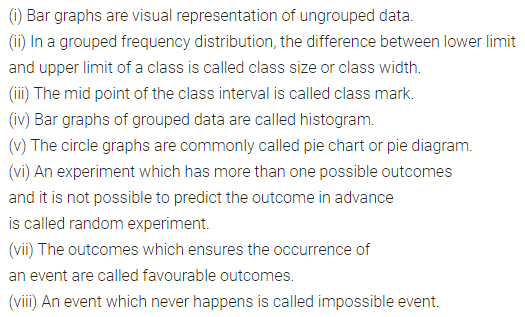
(i) Bar graphs are ……….. representation of ungrouped data.
(ii) In a grouped frequency distribution, the difference between lower limit and upper limit of a class is called ………..
(iii) The mid point of the class interval is called ………..
(iv) Bar graphs of grouped data are called ………..
(v) The circle graphs are commonly called ………..
(vi) An experiment which has more than one possible outcomes and it is not possible to predict the outcome in advance is called ………..
(vii) The outcomes which ensures the occurrence of an event are called ………..
(viii) An event which never happens is called ………..
Solution:
ML Aggarwal Class 8 Solutions for ICSE Maths Chapter 19 Data Handling Objective Type Questions 1

Question 2.
State whether the following statements are true (T) or false (F):
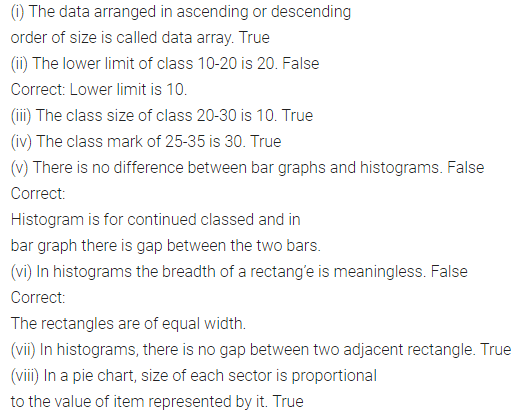
(i) The data arranged in ascending or descending order of size is called data array.
(ii) The lower limit of class 10-20 is 20.
(iii) The class size of class 20-30 is 10.
(iv) The class mark of 25-35 is 30.
(v) There is no difference between bar graphs and histograms.
(vi) In histograms the breadth of a rectangle is meaningless.
(vii) In histograms, there is no gap between two adjacent rectangle.
(viii) In a pie chart, size of each sector is proportional to the value of item represented by it.
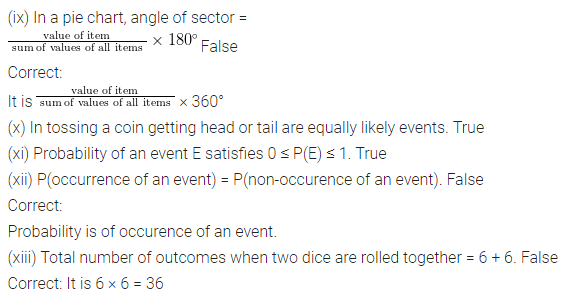
(ix) In a pie chaiangle of sector
= \(\frac{\text { value of item }}{\text { sum of values of all items }} \times 180^{\circ}\)
(x) In tossing a coin getting head or tail are equally likely events.
(xi) Probability of an event E satisfies 0 ≤ P(E) ≤ 1.
(xii) P(occurrence of an event) = P(non occurence of an event).
(xiii) Total number of outcomes when two dice are rolled togehter = 6 + 6.
Solution:
ML Aggarwal Class 8 Solutions for ICSE Maths Chapter 19 Data Handling Objective Type Questions 2
ML Aggarwal Class 8 Solutions for ICSE Maths Chapter 19 Data Handling Objective Type Questions 3

Multiple Choice Questions
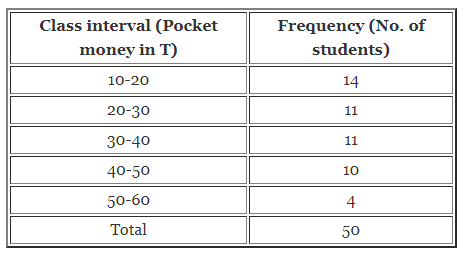
Study the following frequency distribution table:
The table shows the pocket money (in ?) per month of 50 students. Choose the correct answer from the given four options for questions 3 to 7;
ML Aggarwal Class 8 Solutions for ICSE Maths Chapter 19 Data Handling Objective Type Questions 4

Question 3.
Size of the class-intervals is
(a) 50
(b) 20
(c) 10
(d) 30
Solution:
ML Aggarwal Class 8 Solutions for ICSE Maths Chapter 19 Data Handling Objective Type Questions 5

Question 4.
The class having the maximum frequency is
(a) 10-20
(b) 20-30
(c) 30-40
(d) 40-50
Solution:
ML Aggarwal Class 8 Solutions for ICSE Maths Chapter 19 Data Handling Objective Type Questions 6

Question 5.
The upper limit of the class having minimum frequency is
(a) 30
(b) 40
(c) 50
(d) 60
Solution:
ML Aggarwal Class 8 Solutions for ICSE Maths Chapter 19 Data Handling Objective Type Questions 7

Question 6.
Which two are classes having the same frequency?
(a) 10-20 and 20-30
(b) 20-30 and 30-40
(c) 30-40 and 50-60
(d) 40-50 and 50-60
Solution:
ML Aggarwal Class 8 Solutions for ICSE Maths Chapter 19 Data Handling Objective Type Questions 8

Question 7.
The frequency of class whose class mark is 25 is
(a) 14
(b) 11
(c) 10
(d) 4
Solution:
ML Aggarwal Class 8 Solutions for ICSE Maths Chapter 19 Data Handling Objective Type Questions 9

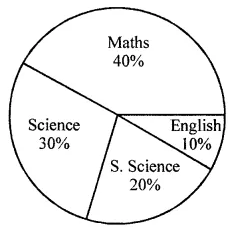
The pie graph shown in the adjoining figure representing the different subjects liked by the students of class VIII. Study the pie graph carefully and choose the correct answer from the given four options for questions 8 to 11.
ML Aggarwal Class 8 Solutions for ICSE Maths Chapter 19 Data Handling Objective Type Questions 10

Question 8.
Which subject is liked by the maximum number of students
(a) Maths
(b) Science
(c) S. Science
(d) English
Solution:
ML Aggarwal Class 8 Solutions for ICSE Maths Chapter 19 Data Handling Objective Type Questions 11

Question 9.
Which subject is liked by the minimum number of students
(a) Maths
(b) Science
(c) S. Science
(d) English
Solution:
ML Aggarwal Class 8 Solutions for ICSE Maths Chapter 19 Data Handling Objective Type Questions 12

Question 10.
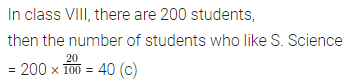
If there are 200 students in class VIII then the number of students who like S. Science
(a) 10
(b) 20
(c) 40
(d) 80
Solution:
ML Aggarwal Class 8 Solutions for ICSE Maths Chapter 19 Data Handling Objective Type Questions 13

Question 11.
Number of students who like Science
(a) 20
(b) 40
(c) 60
(d) 80
Solution:
ML Aggarwal Class 8 Solutions for ICSE Maths Chapter 19 Data Handling Objective Type Questions 14

Choose the correct answer from the given four options (12 to 17):
Question 12.
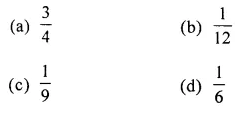
Probability of getting the sum as 4 when a pair of dice is rolled
ML Aggarwal Class 8 Solutions for ICSE Maths Chapter 19 Data Handling Objective Type Questions 15
Solution:
ML Aggarwal Class 8 Solutions for ICSE Maths Chapter 19 Data Handling Objective Type Questions 16

Question 13.
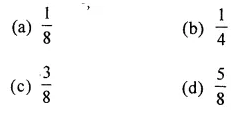
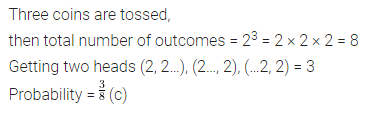
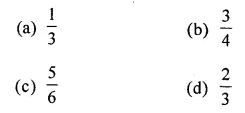
Probability of getting exactly 2 heads when three coins are tossed together
ML Aggarwal Class 8 Solutions for ICSE Maths Chapter 19 Data Handling Objective Type Questions 17
Solution:
ML Aggarwal Class 8 Solutions for ICSE Maths Chapter 19 Data Handling Objective Type Questions 18

Question 14.
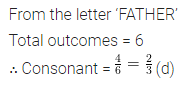
Probability of selecting a consonant from the letters of the word ‘FATHER’
ML Aggarwal Class 8 Solutions for ICSE Maths Chapter 19 Data Handling Objective Type Questions 19
Solution:
ML Aggarwal Class 8 Solutions for ICSE Maths Chapter 19 Data Handling Objective Type Questions 20

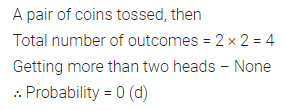
Question 15.
Probability of getting more than 2 heads when a pair of coins is tossed.
(a) 1
(b) \(\frac{1}{2}\)
(c) \(\frac{1}{3}\)
(d) 0
Solution:
ML Aggarwal Class 8 Solutions for ICSE Maths Chapter 19 Data Handling Objective Type Questions 21

Question 16.
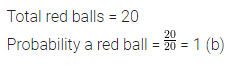
Probability of getting a red ball from a bag containing 20 red balls
(a) 0
(b) 1
(c) \(\frac{1}{20}\)
(d) \(\frac{1}{2}\)
Solution:
ML Aggarwal Class 8 Solutions for ICSE Maths Chapter 19 Data Handling Objective Type Questions 22

Question 17.
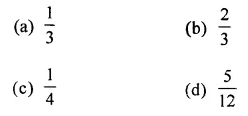
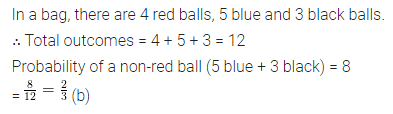
Probability of getting a non-red ball from a bag containing 4 red, 5 blue and 3 black balls is
ML Aggarwal Class 8 Solutions for ICSE Maths Chapter 19 Data Handling Objective Type Questions 23
Solution:
ML Aggarwal Class 8 Solutions for ICSE Maths Chapter 19 Data Handling Objective Type Questions 24

Value Based Questions
Question 1.
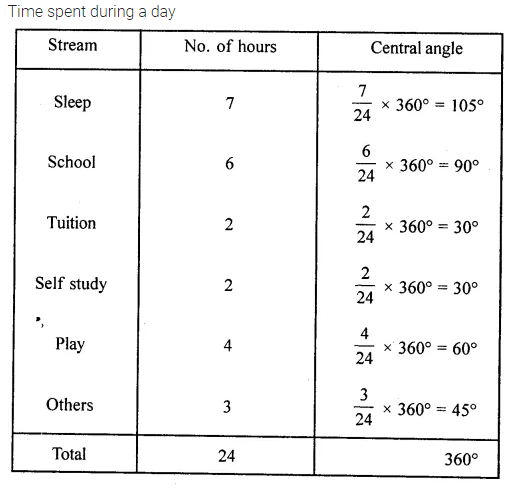
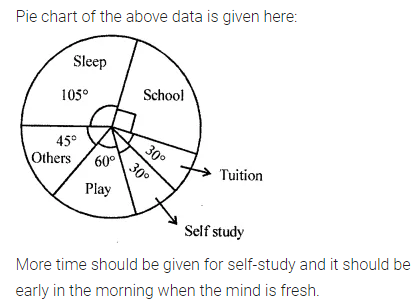
Draw a pie chart of the data given below:
The time spent by a Class VIII student during a day.
ML Aggarwal Class 8 Solutions for ICSE Maths Chapter 19 Data Handling Objective Type Questions 25
Should a student of class VIII study for just 2 hours daily? Which time is considered the best time for self-study?
Solution:
ML Aggarwal Class 8 Solutions for ICSE Maths Chapter 19 Data Handling Objective Type Questions 26
ML Aggarwal Class 8 Solutions for ICSE Maths Chapter 19 Data Handling Objective Type Questions 27

Question 2.
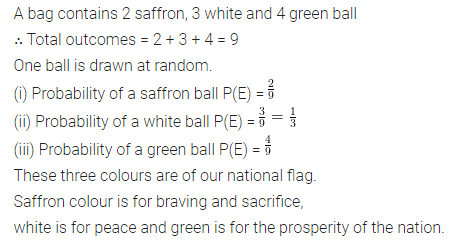
From a bag containing 2 saffron, 3 white and 4 green balls a ball is drawn at random. Find the probability that ball drawn is
(i) Saffron
(ii) White
(iii) Green
Which are three colours in our National Flag? What values did they indicate? What values are being promoted?
Solution:
ML Aggarwal Class 8 Solutions for ICSE Maths Chapter 19 Data Handling Objective Type Questions 28

Question 3.
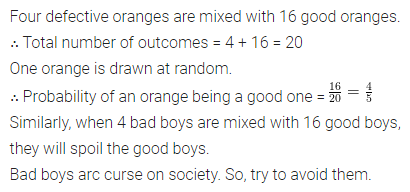
Four defective oranges are accidentally mixed with 16 good ones. One orange is drawn at random. Find the probability that the orange drawn is good one.
What will happen if 4 bad persons are mixed with 16 good ones?
Solution:
ML Aggarwal Class 8 Solutions for ICSE Maths Chapter 19 Data Handling Objective Type Questions 29

Higher Order Thinking Skills (Hots)
Question 1.
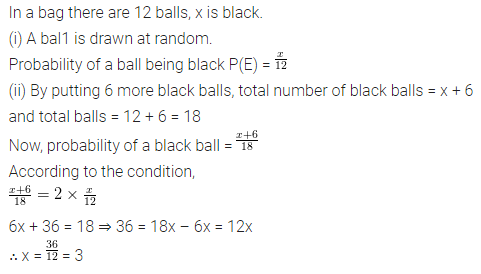
A bag contains 12 balls out of which x are black.
(i) If a ball drawn at random, what is the probability that it will be a black ball?
(ii) If 6 more black balls are put in the bag, the probability of drawing a black ball will be double than that of (i). Find the value of x.
Solution:
ML Aggarwal Class 8 Solutions for ICSE Maths Chapter 19 Data Handling Objective Type Questions 30

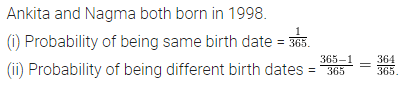
Question 2.
Ankita and Nagma are friends. They were both born in 1998. What is the probability that they have
(i) same birthday?
(ii) different birthday?
Solution:
ML Aggarwal Class 8 Solutions for ICSE Maths Chapter 19 Data Handling Objective Type Questions 31

ML Aggarwal Class 8 Solutions for ICSE Maths