CBSE Sample Papers for Class 10 Maths Paper 4

CBSE Sample Papers for Class 10 Maths Paper 4 is part of CBSE Sample Papers for Class 10 Maths . Here we have given CBSE Sample Papers for Class 10 Maths Paper 4. According to new CBSE Exam Pattern, MCQ Questions for Class 10 Maths Carries 20 Marks.

CBSE Sample Papers for Class 10 Maths Paper 4

BoardCBSE
ClassX
SubjectMaths
Sample Paper SetPaper 4
CategoryCBSE Sample Papers

Students who are going to appear for CBSE Class 10 Examinations are advised to practice the CBSE sample papers given here which is designed as per the latest Syllabus and marking scheme as prescribed by the CBSE is given here. Paper 4 of Solved CBSE Sample Papers for Class 10 Maths is given below with free PDF download solutions.

Time: 3 Hours
Maximum Marks: 80

GENERAL INSTRUCTIONS:

  • All questions are compulsory.
  • This question paper consists of 30 questions divided into four sections A, B, C and D.
  • Section A comprises of 6 questions of 1 mark each, Section B comprises of 6 questions of 2 marks each, Section C comprises of 10 questions of 3 marks each and Section D comprises of 8 questions 1 of 4 marks each.
  • There is no overall choice. However, internal choice has been provided in one question of 2 marks, 1 three questions of 3 marks each and two questions of 4 marks each. You have to attempt only one of the alternatives in all such questions.
  • In question of construction, drawings shall be neat and exactly as per the given measurements.
  • Use of calculators is not permitted. However, you may ask for mathematical tables.

SECTION A

Question numbers 1 to 6 carry 1 mark each.

Question 1.
The decimal expansion of the rational number \(\frac { 11 }{ { 2 }^{ 3 }\times { 5 }^{ 2 } } \) will terminate after how many places of decimal?

Question 2.
Is x = -2 a solution of the equation x² – 2x + 8 = 0?

Question 3.
In the adjoining figure, P and Q are points on the sides of AB and AC respectively of ∆ABC such that AP = 3.5 cm, PB = 7 cm, QC = 6 cm. Prove that PQ || BC.a
CBSE Sample Papers for Class 10 Maths Paper 4 3

Question 4.
If tan θ = cot (30° + θ), find the value of θ.

Question 5.
A cylinder and a cone are of same base radius and c the ratio of volume of cylinder to that of the cone.

Question 6.
Two coins are tossed simultaneously. Find the probability of getting exactly one head.

SECTION B

Question numbers 7 to 12 carry 2 marks each.

Question 7.
Complete the following factor tree and find the numbers x, y and z.
CBSE Sample Papers for Class 10 Maths Paper 4 7

Question 8.
If α and β are zeroes of the polynomial f(x) = x² – x – k such that α – β = 9, find k.

Question 9.
The coordinates of the vertices of ∆ABC are A(4, 1), B(-3, 2) and C(0, k). Given that the area of ∆ABC is 12 unit², find the value of k. .

Question 10.
Without using trigonometric tables, evaluate the following:
CBSE Sample Papers for Class 10 Maths Paper 4 10

Question 11.
Prove that
CBSE Sample Papers for Class 10 Maths Paper 4 11

Question 12.
Area of a sector of a circle of radius 36 cm is 54π cm². Find the length of the corresponding arc of the sector.

SECTION C

Question numbers 13 to 22 carry 3 marks each.

Question 13.
The HCF of 65 and 117 is expressible in the form 65m – 117. Find the value of m. Also find the LCM of 65 and 117 using prime factorization

Question 14.
Solve the following pair of linear equations: px + qy = p – q;qx – py = p + q.
OR
In the given figure, ABCDE is a pentagon with BE || CD and BC || ED. BC is perpendicular to CD. If the perimeter of pentagon ABCDE is 21 cm, find the values of x and y.
CBSE Sample Papers for Class 10 Maths Paper 4 14

Question 15.
Find the roots of the following equation
CBSE Sample Papers for Class 10 Maths Paper 4 15

Question 16.
A contract on construction job specifies a penalty for delay of completion beyond a certain date as follows: Rs 200 for the first day, Rs 250 for the second day, Rs 300 for the third day, etc., the penalty for each succeeding day being Rs 50 more than for the preceding day. How much money the contractor has to pay as penalty, if he has delayed the work for 30 days?
OR
Jaspal Singh repays his total loan of Rs 118000 by paying every month starting with the first instalment of Rs 1000. If he increases the instalment by Rs 100 every month, what amount will be paid by him in the 30th instalment? What amount of loan does he still to pay after the 30th instalment?

Question 17.
Prove that : sin θ(1 + tan θ) + cos θ(1 + cot θ) = sec θ + cosec θ.

Question 18.
D and E are points on the sides CA and CB respectively of a triangle ABC right angled at C. Prove that AE² + BD² = AB² + DE².
OR
In the adjoining figure, DB ⊥ BC, DE ⊥ AB
and AC ⊥ BC. Prove that \(\frac { BE }{ DE } =\frac { AC }{ BC } \)
CBSE Sample Papers for Class 10 Maths Paper 4 18

Question 19.
In the adjoining figure, a triangle ABC is drawn to circumscribe a circle of radius 2 cm such that the segments BD and DC into which BC is divided by the point of contact D are of lengths 4 cm and 3 cm respectively. If area of ∆ABC = 21 cm², then find the lengths of sides AB and AC.
CBSE Sample Papers for Class 10 Maths Paper 4 19

Question 20.
In the adjoining figure, APB and CQD are semicircles of diameter 7 cm each, while ARC and BSD are semicircles of diameter 14 cm each. Find the perimeter of the shaded region.
CBSE Sample Papers for Class 10 Maths Paper 4 20

Question 21.
Two different dice are rolled together. Find the probability of getting:
(i) the sum of numbers on two dice as 5.
(ii) even numbers on both dice.
OR
The probability of selecting a red ball at random from a jar that contains only red, blue and orange balls is \(\frac { 1 }{ 4 }\). The probability of selecting a blue ball at random from the same jar is \(\frac { 1 }{ 3 }\). If the jar contains 10 orange balls, find the total number of balls in the jar.

Question 22.
Find the value of p for the following distribution whose mean is 10:
CBSE Sample Papers for Class 10 Maths Paper 4 22

SECTION D

Question numbers 23 to 30 carry 4 marks each.

Question 23.
If pth, qth and rth terms of an AP are a, b and c respectively, then show that (a – b) r + (b – c) p + (c – a) q = 0.

Question 24.
An icecream seller sells his icecreams in two ways:
(A) In a cone of r = 5 cm, h – 8 cm with hemispherical top.
(B) In a cup in shape of cylinder with r – 5 cm, h – 8 cm.
He charges the same price both but prefers to sell his icecream in a cone.
(a) Find the volume of the cone and the cup.
(b) Which out of the two has more capacity?
(c) By choosing a cone, which value is not followed by the icecream seller?
CBSE Sample Papers for Class 10 Maths Paper 4 24

Question 25.
Solve the following pair of linear equations graphically:
x + 3y = 6; 2x – 3y = 12
Also find the area of the triangle formed by the lines representing the given equations with y-axis.

Question 26.
If the centroid of ∆ABC, in which A(a, b), B(b, c), C(c, a) is at the origin, then calculate the value of (a³ + b³ + c³).
OR
The three vertices of a parallelogram ABCD are A(3, -4), B(-1, -3) and C(-6, 2). Find the coordinates of vertex D and find the area of parallelogram ABCD.

Question 27.
From the top of a tower 100 m high, a man observes two cars on the opposite sides of the tower with angles of depression 30° and 45° respectively. Find the distance between the cars. (Use √3 = 1.73)
OR
A straight highway leads to the foot of a tower. A man standing at the top of the tower observes a car at an angle of depression of 30°, which is approaching the foot of the tower with a uniform speed. Six seconds later, the angle of depression of the car is found to be 60°. Find the time taken by the car to reach the foot of the tower from this point.

Question 28.
Prove that the lengths of tangents drawn from an external point to a circle are equal.
OR
Two circles with centres O and O’ of radii 3 cm and 4 cm, respectively intersect at two points P and Q such that OP and O’P are tangents to the two circles. Find the length of the common chord PQ.

Question 29.
Draw an isosceles triangle ABC in which AB = AC = 6 cm and BC = 5 cm. Construct a triangle PQR similar to ∆ABC in which PQ = 8 cm. Also justify the construction.

Question 30.
Size of agriculture holding in a survey of 200 families is given in the following table:
CBSE Sample Papers for Class 10 Maths Paper 4 30
Compute the median and mode size of holding.

Answers

Answer 1.
CBSE Sample Papers for Class 10 Maths Paper 4 1
Hence, the decimal expansion of given rational number will terminate after 3 places of decimal.

Answer 2.
(-2)² – 2 x (-2) + 8 = 4 + 4 + 8 = 16≠0
∴ x = -2 is not a solution of the equation x² – 2x + 8 = 0.

Answer 3.
CBSE Sample Papers for Class 10 Maths Paper 4 3
∴ By the converse of B.P.T., PQ || BC.

Answer 4.
tan θ = cot (30° + θ)
= tan [90° – (30° + θ)]
= tan (60° – θ)
θ = 60° – θ => 2θ = 60° => θ = 30°.

Answer 5.
Let r be the base radius of cylinder and cone and h be their heights.
CBSE Sample Papers for Class 10 Maths Paper 4 5
Hence, the ratio of volume of cylinder to that of cone = 3:1.

Answer 6.
When two coins are tossed simultaneously, then the outcomes are HH, HT, TH, TT.
So total number of outcomes = 4.
The outcomes favourable to the event ‘getting exactly one head’ are HT and TH.
∴The number of outcomes favourable to the event = 2.
∴ P(exactly one head) = \(\frac { 2 }{ 4 } =\frac { 1 }{ 2 } \)

Answer 7.
x = 3381 x 2 = 6762
y = 161 x 7 = 1127
and z = \(\frac { 161 }{ 7 }\) = 23.

Answer 8.
Given f(x) = x² – x – k
CBSE Sample Papers for Class 10 Maths Paper 4 8

Answer 9.
Area of ∆ABC = \(\frac { 1 }{ 2 }\)| 14(2 – k) – 3(k – 1) + 0(1 – 2) |
=> 12 = \(\frac { 1 }{ 2 }\)|8 – 4k – 3k + 3|
=> 24 = |11 – 7k|
=> 11 – 7k = ±24
=> 11 – 7k = 24 or 11 – 7k = -24
=> 7k = -13 or 7k = 35
=> k = \(-\frac { 13 }{ 7 }\) or k = 5
Hence, k = \(-\frac { 13 }{ 7 }\) or k = 5

Answer 10.
CBSE Sample Papers for Class 10 Maths Paper 4 10

Answer 11.
CBSE Sample Papers for Class 10 Maths Paper 4 11

Answer 12.
Let the central angle (in degrees) be θ, then
CBSE Sample Papers for Class 10 Maths Paper 4 12
Hence, the length of the corresponding arc of the sector = 3π cm.

Answer 13.
By Euclid’s division algorithm, we have
117 = 65 x 1 + 52; 65 = 52 x 1 + 13; 52 = 13 x 4 + 0
∴ HCF of 65 and 117 = 13
∴ 65m – 117 = 13 => 65m = 130 => m = 2.
Prime factorisation of 65 and 117 are as follows:
65 = 5 x 13 and 117 = 3 x 3 x 13
∴ LCM of 65 and 117 = 3 x 3 x 5 x 13 = 585.

Answer 14.
Given equations are
px + qy = p – q …(i)
qx – py = p + q …(ii)
Multiplying (i) by p and (ii) by q, we get
p²x + pqy = p² – pq …(iii)
and q²x – pqy – pq + q² …(iv)
On adding (iii) and (iv), we have
CBSE Sample Papers for Class 10 Maths Paper 4 14
Putting x = 1 in equation (i), we have
p x 1 + qy = p – q => qy = -q => y = -1
∴ x = 1 ,y = -1.
OR
Given BE || CD and BC || ED, also BC ⊥ CD
=> BCDE is a rectangle
CD = BE
=> x + y = 5
Again, given perimeter of pentagon ABCDE = 21 cm
=> AB + BC + CD + DE + EA = 21 cm
=> 3 + x – y + x + y + BC + 3 = 21cm
=> 2x + x – y = 21 – 6
=> 3x – y = 15
Adding (i) and (ii), we get
4x = 20 => x = \(\frac { 20 }{ 4 }\) => x = 5
Putting x = 5 in (i), we get
5 + y = 5 =>y = 0
Hence, x = 5, y = 0.

Answer 15.
Given
CBSE Sample Papers for Class 10 Maths Paper 4 15
(x + 4) (x – 7) = -30 => x² – 7x + 4x – 28 = -30
=> x² – 3x + 2 = 0 => x² – 2x – x + 2 = 0
=> x(x – 2) – 1(x – 2) = 0 => (x – 2) (x – 1) = 0
=> x – 2 = 0 or x – 1 = 0 => x = 2 or x = 1.
Hence, the roots of the given equation are 2 and 1.

Answer 16.
200, 250, 300, … is in AP.
whose first term = 200 and common difference = 50.
Let the number of days for which work is delayed be n, then
CBSE Sample Papers for Class 10 Maths Paper 4 16
=> n[200 + 25 (n- 1)] = 27750
=> 25n² + 175n = 27750
=> n² + 7n – 1110 = 0
=> n² + 37n – 30n – 1110 = 0
=> n(n + 37) – 30(n + 37) = 0
=> (n + 37) (n – 30) = 0
=> n = -37 or n = 30
But n cannot be negative
∴ n = 30
Hence, the work was delayed by 30 days.
OR
Jaspal Singh starts repaying loan with first instalment of Rs 1000 and increases the instalment every month by Rs 100, so the numbers involved in instalments are 1000, 1100, 1200, …
These numbers form an AP with a = 1000 and d = 100.
30th term = a + 29d = 1000 + 29 x 100 = 3900.
Hence, his 30th instalment = Rs 3900
Sum of 30 terms = \(\frac { 30 }{ 2 }\) (100 + 3900)
= 15 x 4900 = 73500.
∴ The total amount of loan repaid = Rs 73500.
∴ Amount of loan still to be paid = Amount of total loan – amount of loan repaid
= Rs 118000 – Rs 73500 = Rs 44500.

Answer 17.
CBSE Sample Papers for Class 10 Maths Paper 4 17

Answer 18.
CBSE Sample Papers for Class 10 Maths Paper 4 18
In ∆ABC, ∠C = 90°
∴ AB² = AC² + BC²
In AECD, ∠ECD = 90°
∴ DE² = CD² + EC²
In ∆AEC, ∠ACE = 90°
∴ AE² = AC² + EC²
In ∆BCD, ∠BCD = 90°
∴ BD² = BC² + CD²
Adding (iii) and (iv), we get
AE² + BD² = (AC² + BC²) + (CD² + EC²)
= AB² + DE²
OR
CBSE Sample Papers for Class 10 Maths Paper 4 18.1
Given, DB ⊥ BC, AC ⊥ BC
=> ∠DBC = ∠ACB = 90°
∴ AC || DB(sum of interior ∠s on the same side of BC is 180°)
∠ABD = ∠BAC (alt ∠s)
Now, in ABED and AACB,
∠EBD = ∠ABD = ∠BAC
∠C = ∠E (each = 90°)
∴ ∆BED ~ ∆ACB (AA similarity)
CBSE Sample Papers for Class 10 Maths Paper 4 18.2

Answer 19.
Since tangents drawn from an external point to a circle are equal.
∴BF = BD = 4 cm (given)
and CE = CD = 3 cm (given)
Let AF = AE = x cm
CBSE Sample Papers for Class 10 Maths Paper 4 19
Now, area (∆ABC) = area (∆AOB) + area (∆BOC) + area (∆AOC)
21 = \(\frac { 1 }{ 2 }\)AB x OF + \(\frac { 1 }{ 2 }\)BC x OD + \(\frac { 1 }{ 2 }\)AC x OE
=> 21 = \(\frac { 1 }{ 2 }\)(AF + BF) x 2 + \(\frac { 1 }{ 2 }\)(BD + CD) x 2 + \(\frac { 1 }{ 2 }\)(AE + CE) x 2
=> 21 = (x + 4) + (4 + 3) + (x + 3)
=> 21 = 2x + 14 => 2x = 7 => x = \(\frac { 7 }{ 2 }\) =>x = 3.5
AB = x + 4 = (3.5 + 4) cm = 7.5 cm
and AC = x + 3 = (3.5 + 3) cm = 6.5 cm.

Answer 20.
Given BC = R = 7 cm
and AE = CF = \(\frac { 7 }{ 2 }\) cm = r (say)
The perimeter of the shaded region
= perimeter of semicircle APB + perimeter of semicircle BSD + perimeter of semicircle DQC + perimeter of semicircle CRA
CBSE Sample Papers for Class 10 Maths Paper 4 20

Answer 21.
Total possible outcomes = 6 x 6 = 36.
(i) The possible outcomes favourable to the event ‘sum of numbers on two dice is 5’ are (2, 3), (3, 2), (1, 4), (4, 1) i.e. 4 in number.
∴ Required probability = \(\frac { 4 }{ 36 } =\frac { 1 }{ 9 } \)
(ii) The possible outcomes favourable to the event ‘even numbers on both dice’ are (2, 2), (2, 4), – (2, 6), (4, 2), (4, 4), (4, 6), (6, 2), (6, 4), (6, 6) i.e. 9 in number.
∴ Required probability = \(\frac { 9 }{ 36 } =\frac { 1 }{ 4 } \)
We know that the sum of probabilities of all elementary events = 1
=> P(red ball) + P(blue ball) + P(orange ball) = 1
CBSE Sample Papers for Class 10 Maths Paper 4 21
=> x = 24.
Hence, the total number of balls in the jar = 24.

Answer 22.
CBSE Sample Papers for Class 10 Maths Paper 4 22

Answer 23.
Let A be the first term and D be the common difference of the AP.
Given,
a = pth term => a = A + (p – 1)D ….(i)
b = qth term => b = A +(q – 1)D ….(ii)
c = rth term => c = A + (r – 1)D ….(iii)
Subtracting (ii) from (i), we get
a – b = (p – q) D ….(iv)
Similarly, b – c = (q – r) D ….(v)
and c – a = (r – p) D ….(vi)
∴ (a – b) r + (b – c) p + (c – a) q = [(p – q) r + (q – r) p + (r – p)q] D
= (pr – qr + pq + qr – pq) D
= 0 x D = 0.

Answer 24.
Volume of type A = Volume of cone + Volume of hemisphere
CBSE Sample Papers for Class 10 Maths Paper 4 24
CBSE Sample Papers for Class 10 Maths Paper 4 24.1

Answer 25.
The given equations can be written as
CBSE Sample Papers for Class 10 Maths Paper 4 25
Select the coordinate axes. Take 1 cm = 1 unit on both axes.
Plot the points (0, 2) and (3, 1) on the graph paper and join these points by a straight line. Plot the points (3, -2) and (6, 0) on the same graph paper and join these points by a straight line.
The given lines intersect at the point P(6, 0). Therefore, the solution of the given pair of linear equations is x = 6, y = 0.
The area bounded by the given lines and y-axis has been shaded.
CBSE Sample Papers for Class 10 Maths Paper 4 25.1
From the figure AB = 6 units and OP = 6 units
The area of shaded region = area of ∆ABP
= \(\frac { 1 }{ 2 }\) x AB x OP = \(\frac { 1 }{ 2 }\) x 6 x 6
= 18 sq. units

Answer 26.
Given vertices of ∆ABC as A (a, b), B (b, c), C (c, a) and the centroid of ∆ABC is G(0, 0).
As we know that centroid of A whose vertices are (x1 y1), (x2, y2) and (x3, y3)
CBSE Sample Papers for Class 10 Maths Paper 4 26
CBSE Sample Papers for Class 10 Maths Paper 4 26.1

Answer 27.
Let AB be a tower 100 m high. P and Q be the position of two cars.
Angles of depressions are shown in adjoining figure.
∴∠APB = 90° and ∠AQB = 45°.
In ∆APB, ∠ABP = 90°
30° = \(\frac { AB }{ PB }\)
CBSE Sample Papers for Class 10 Maths Paper 4 27
CBSE Sample Papers for Class 10 Maths Paper 4 27.1
CBSE Sample Papers for Class 10 Maths Paper 4 27.2

Answer 28.
Given: P is an external point to a circle with centre O. PA and PB are two tangents drawn from P to the circle, A and B being points of contact.
To prove: PA = PB
Construction: Join OA, OB and OP.
Proof: Since the tangent at any point of a circle is perpendicular to the radius through the point of contact.
∠OAP = 90° and ∠OBP = 90°
Now, in ∆OAP and ∆OBP,
OA = OB (radii of same circle)
OP = OP (common)
∠OAP = ∠OBP (each 90°)
CBSE Sample Papers for Class 10 Maths Paper 4 28
CBSE Sample Papers for Class 10 Maths Paper 4 28.1

Answer 29.
As ∆PQR ~ ∆ABC, so the side PQ of ∆PQR is the corresponding side AB of ∆ABC.
Given AB = 6 cm and we need PQ to be 8 cm, so \(\frac { PQ }{ AB } =\frac { 8 }{ 6 } =\frac { 4 }{ 3 } \)
Thus, we are required to construct ∆PQR similar to ∆ABC such that sides of ∆PQR are \(\frac { 4 }{ 3 }\) times of the corresponding sides of ∆ABC.
Steps of construction:
1. Draw AB = 6 cm.
2. With A as centre and radius 6 cm, draw an arc.
3. With B as centre and radius 5 cm, draw an arc to meet the previous arc at C.
4. Join AC and BC, then ABC is an isosceles triangle with AB = AC = 6 cm and BC = 5 cm.
5. Take points A and P same.
6. Draw any ray AX making an acute angle with AB on the side opposite to the vertex C.
CBSE Sample Papers for Class 10 Maths Paper 4 29
7. Locate 4 (the greater of 4 and 3) points A1, A2, A3 and A4 on AX such that AA1 = A1A2 = A2A3 = A3A4.
8. Join A3B.
9. Through A4, draw a line parallel to A3B (making an angle equal to ∠AA3B) to intersect the extended line segment AB at Q.
10. Through Q, draw a line parallel to BC (making an angle equal to ∠ABC) to intersect the extended line segment AC at R.
Then AQR i.e. PQR is the required triangle.
Justification:
CBSE Sample Papers for Class 10 Maths Paper 4 29.1

Answer 30.
Construct the cumulative frequency distribution table as under:
CBSE Sample Papers for Class 10 Maths Paper 4 30
CBSE Sample Papers for Class 10 Maths Paper 4 30.1

We hope the CBSE Sample Papers for Class 10 Maths Paper 4 help you. If you have any query regarding CBSE Sample Papers for Class 10 Maths Paper 4, drop a comment below and we will get back to you at the earliest.
NIOS Date Sheet 2019 for Class 10 and Class 12 (Released) | Download @ nios.ac.in

NIOS Date Sheet for Class 10 and 12: National Institute of Open Schooling (NIOS) has released the date sheet for class 10 and class 12 students for the academic year of 2019-20. NIOS admissions are open for all types of students, working employees, etc., NIOS examination will conduct twice in a year. NIOS provides nine examination chances to every student for every five years. For students of NIOS minimum age requirement for Secondary course is 14 years and for the senior secondary course is 15 years and there is no upper age limit. In this article, we are providing information regarding NIOS Date sheet 2019 10th Class and NIOS Date sheet 2019 12th Class.
NIOS Date Sheet 2019 for Class 10 and 12

NIOS provides the learner the opportunity to take admission in one or more subjects but not more than four subjects. On passing, the learner will be issued only the Marksheet. Date Sheet 2019 for Class 10 and Class 12 are listed below.

Theory Exam Dates

DateClass 10Class 12
Exam Start Date04 October 201903 October 2019
Exam End Date01 November 201901 November 2019

Practical Exam Dates

DateClass 10Class 12
Exam Start Date16 September 201916 September 2019
Exam End Date30 September 201930 September 2019

How to Download NIOS Date Sheet

Follow the below steps to download NIOS Date Sheet:

  • Step – 1: Go to nios.ac.in or you can click on the link given above.
  • Step – 2: At the homepage, there will be a link mentioning “Date Sheet For Secondary (Class-X)/ Sr. Secondary (Class-XII) Examinations, Sept-Oct, 2019 (All INDIA Centers).”
  • Step – 3: Click on that link.
  • Step – 4: A downloadable PDF file containing Date sheet will appear on the screen.
  • Step – 5: Download the PDF file and print it out for future reference.

NIOS Date Sheet – General Instructions

  • All the Practical Examinations will be held at respective AIs where students enrolled at the time of admission.
  • Practical Examinations will be conducted as per the above schedule.
  • The Mark Sheet, Provisional Certificate, and Migration-cum- Transfer certificate will be issued by respective AIs.
  • There will be no change in the dates of examination.
  • The result of the examination is likely to be declared 6 weeks after the last date of examination.
  • For practical examinations, the candidates at AIs will be divided into the required number of batches according to the capacity of the laboratory.

About NIOS

National Institute of Open Schooling is an autonomous Institute under MHRD, Government of India which aims to provide education through Distance learning programs. NIOS aims to reach the unreached. The Government of India has bestowed NIOS with the authority to conduct Public Examinations and provide the Secondary and the Senior Secondary level certificates, which are equivalent to the certificates provided by any other Board of School Education. NIOS is the largest Open Schooling system in the world with the cumulative enrolment of 4.3 million (during the last 5 years).

ML Aggarwal Class 8 Solutions for ICSE Maths Model Question Paper 6

ML Aggarwal Class 8 Solutions for ICSE Maths Model Question Paper 6

Questions 1 to 8 is of 1 mark each.
Question 1.
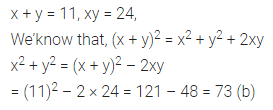
If x + y = 11 and xy = 24, then x2 + y2 =
(a) 121
(b) 73
(c) 48
(d) none of these
Solution:
ML Aggarwal Class 8 Solutions for ICSE Maths Model Question Paper 6 1

Question 2.
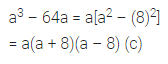
Factors of a3 – 64a are
(a) a(a – 8)2
(b) (a + 8) (a – 8)
(c) a(a + 8) (a – 8)
(d) a(a + 8)2
Solution:
ML Aggarwal Class 8 Solutions for ICSE Maths Model Question Paper 6 2

Question 3.
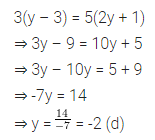
If 3(y – 3) = 5(2y + 1) then y is equal to
(a) 3
(b) -3
(c) 2
(d) -2
Solution:
ML Aggarwal Class 8 Solutions for ICSE Maths Model Question Paper 6 3

Question 4.
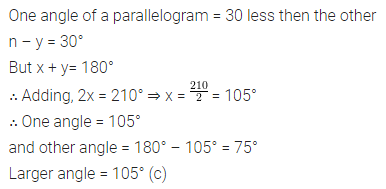
If one angle of a parallelogram is 30° less than other angles, then the larger angle is
(a) 150°
(b) 75°
(c) 105°
(d) 210°
Solution:
ML Aggarwal Class 8 Solutions for ICSE Maths Model Question Paper 6 4

Question 5.
A polyhedron has 7 faces, 10 vertices and 15 edges. Name of the polyhedron is
(a) hexagonal prism
(b) pentagonal prism
(c) hexagonal pyramid
(d) none of these
Solution:
ML Aggarwal Class 8 Solutions for ICSE Maths Model Question Paper 6 5

Question 6.
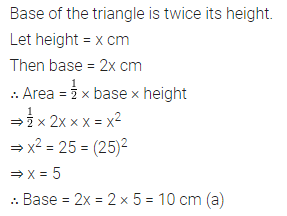
The base of a triangle is twice its height. If the area of the triangle is 25 cm2, then the base is
(a) 10 cm
(b) 20 cm
(c) 5 cm
(d) 25 cm
Solution:
ML Aggarwal Class 8 Solutions for ICSE Maths Model Question Paper 6 6

Question 7.
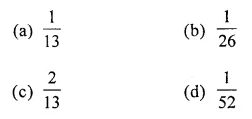
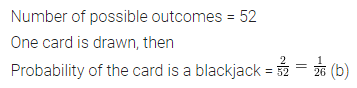
From a well-shuffled deck of 52 playing cards, one card is drawn at random then the probability that card drawn is a blackjack
ML Aggarwal Class 8 Solutions for ICSE Maths Model Question Paper 6 7
Solution:
ML Aggarwal Class 8 Solutions for ICSE Maths Model Question Paper 6 8

Question 8.
Amongst the following digits, the one having exactly one line of symmetry is
(a) 0
(b) 3
(c) 6
(d) 8
Solution:
ML Aggarwal Class 8 Solutions for ICSE Maths Model Question Paper 6 9

Section-B
Questions 9 to 14 are of 2 marks each.
Question 9.
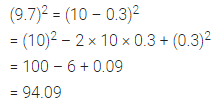
Using a suitable identity, evaluate (9.7)2.
Solution:
ML Aggarwal Class 8 Solutions for ICSE Maths Model Question Paper 6 10

Question 10.
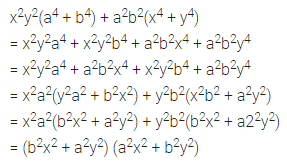
Factorize x2y2(a4 + b4) + a2b2(x4 + y4).
Solution:
ML Aggarwal Class 8 Solutions for ICSE Maths Model Question Paper 6 11

Question 11.
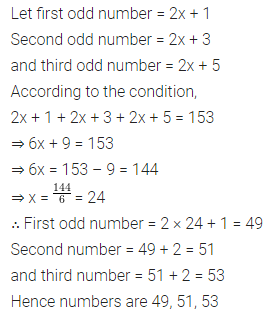
Sum of three consecutive odd numbers is 153. Find the numbers.
Solution:
ML Aggarwal Class 8 Solutions for ICSE Maths Model Question Paper 6 12

Question 12.
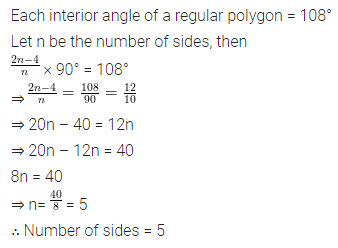
If each interior angle of a regular polygon is 108°, then find the number of sides of the polygon.
Solution:
ML Aggarwal Class 8 Solutions for ICSE Maths Model Question Paper 6 13

Question 13.
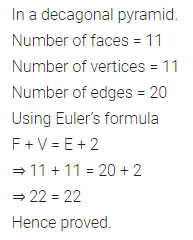
Verify Euler’s formula for a decagonal pyramid.
Solution:
ML Aggarwal Class 8 Solutions for ICSE Maths Model Question Paper 6 14

Question 14.
A cuboid is of dimensions 24 cm × 30 cm × 36 cm. How many small cubes with side 6 cm can be placed in the cuboid?
Solution:
ML Aggarwal Class 8 Solutions for ICSE Maths Model Question Paper 6 15

Section-C
Questions 15 to 24 are of 4 marks each.
Question 15.
Simplify the following expressions and evaluate it when x = 1, y = -1
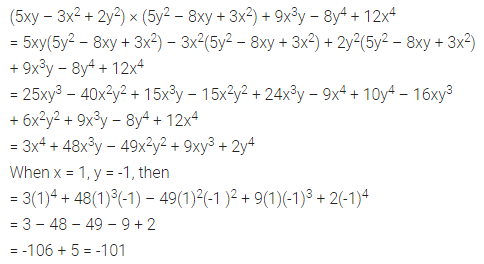
(5xy – 3x2 + 2y2) × (5y2 – 8xy + 3x2) + 9x3y – 8y4 + 12x4
Solution:
ML Aggarwal Class 8 Solutions for ICSE Maths Model Question Paper 6 16

Question 16.
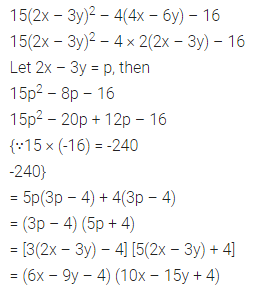
Factorize: 15(2x – 3y)2 – 4(4x – 6y) – 16
Solution:
ML Aggarwal Class 8 Solutions for ICSE Maths Model Question Paper 6 17

Question 17.
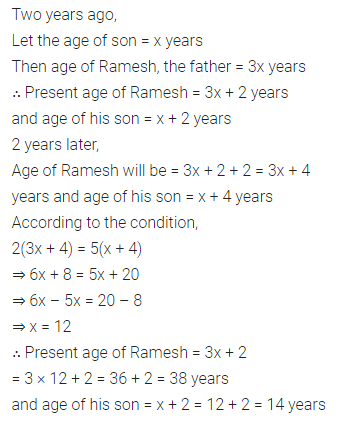
Two years ago Ramesh was three times as old as his son. Two years later, twice of his age will be equal to the five times that of his son’s age. Find their present ages.
Solution:
ML Aggarwal Class 8 Solutions for ICSE Maths Model Question Paper 6 18

Question 18.
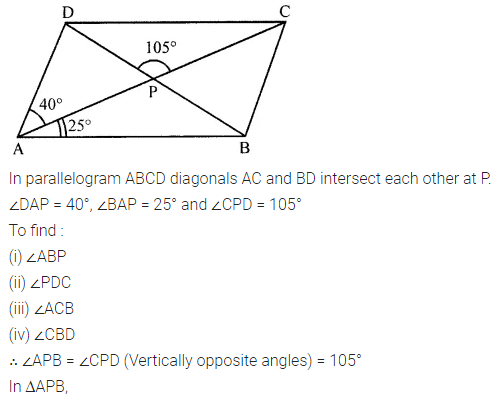
In the given figure ABCD is a parallelogram in which ∠DAP = 40°, ∠BAP = 25° and ∠CPD = 105°, find
(i) ∠ABP
(ii) ∠PDC
(iii) ∠ACB
(iv) ∠CBD
Solution:
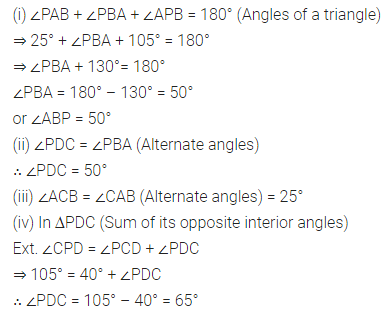
ML Aggarwal Class 8 Solutions for ICSE Maths Model Question Paper 6 19
ML Aggarwal Class 8 Solutions for ICSE Maths Model Question Paper 6 20

Question 19.
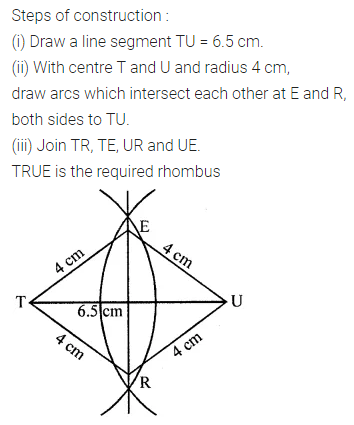
Construct a rhombus TRUE whose one side TR = 4 cm and diagonal TU = 6.5 cm.
Solution:
ML Aggarwal Class 8 Solutions for ICSE Maths Model Question Paper 6 21

Question 20.
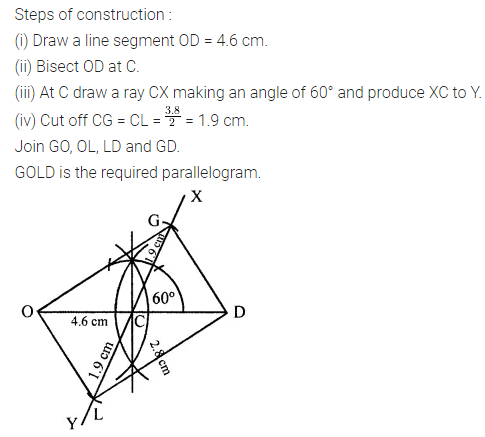
Construct a parallelogram GOLD in which diagonal GL = 3.8 cm, diagonal OD = 4.6 cm and angle between diagonals is 60°.
Solution:
ML Aggarwal Class 8 Solutions for ICSE Maths Model Question Paper 6 22

Question 21.
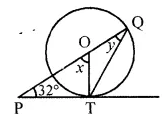
In the given figure, O is the centre of the circle. If PT is tangent to the circle at point T, find the size of each lettered angle.
ML Aggarwal Class 8 Solutions for ICSE Maths Model Question Paper 6 23
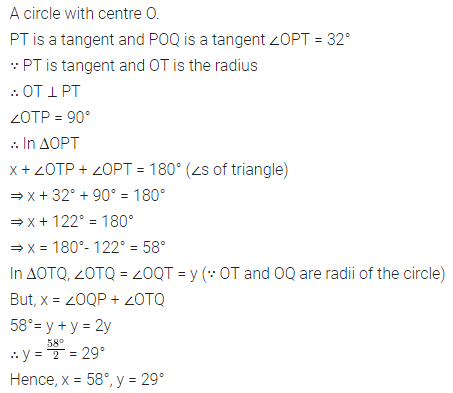
Solution:
ML Aggarwal Class 8 Solutions for ICSE Maths Model Question Paper 6 24

Question 22.
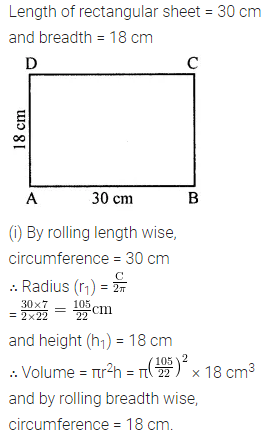
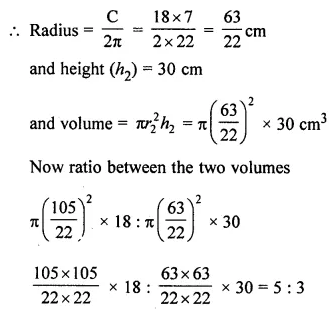
A rectangular sheet of tin foil of size 30 cm × 18 cm can be rolled to form a cylinder two ways along length and breadth. Find the ratio of volumes of the two cylinders thus formed.
Solution:
ML Aggarwal Class 8 Solutions for ICSE Maths Model Question Paper 6 25
ML Aggarwal Class 8 Solutions for ICSE Maths Model Question Paper 6 26

Question 23.
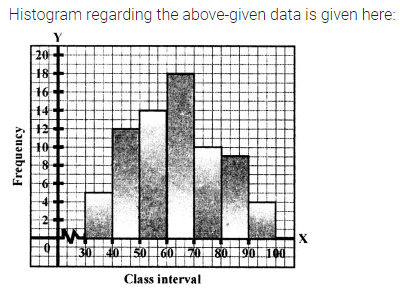
Construct a histogram for the following data:
ML Aggarwal Class 8 Solutions for ICSE Maths Model Question Paper 6 27
Solution:
ML Aggarwal Class 8 Solutions for ICSE Maths Model Question Paper 6 28
ML Aggarwal Class 8 Solutions for ICSE Maths Model Question Paper 6 29

Question 24.
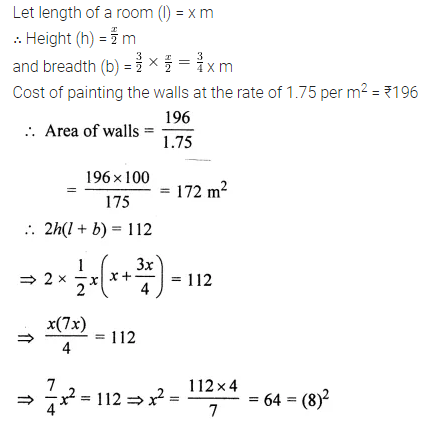
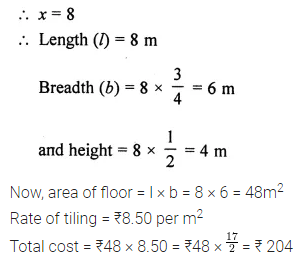
Height of a room is half of its length and its breadth is \(\frac{3}{2}\) of the height. If the cost of painting its four walls at the rate of ₹1.75 per m2 is ₹ 196, then find the cost of tiling the floor of the room at the rate of ₹8.50 per m2.
Solution:
ML Aggarwal Class 8 Solutions for ICSE Maths Model Question Paper 6 30
ML Aggarwal Class 8 Solutions for ICSE Maths Model Question Paper 6 31

Section-D
Questions 25 to 29 are of 6 marks each.
Question 25.
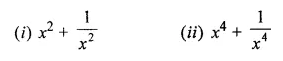
If \(x+\frac{1}{x}=5\), them find
ML Aggarwal Class 8 Solutions for ICSE Maths Model Question Paper 6 32
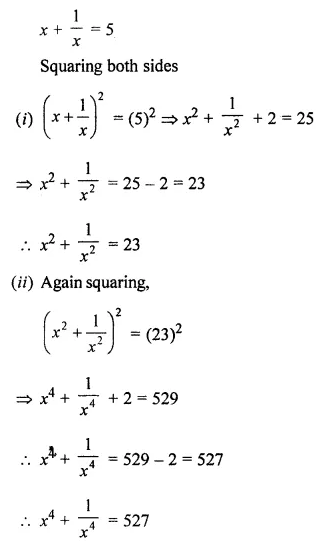
Solution:
ML Aggarwal Class 8 Solutions for ICSE Maths Model Question Paper 6 33

Question 26.
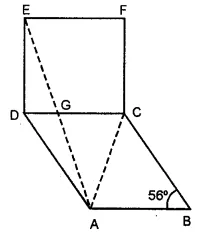
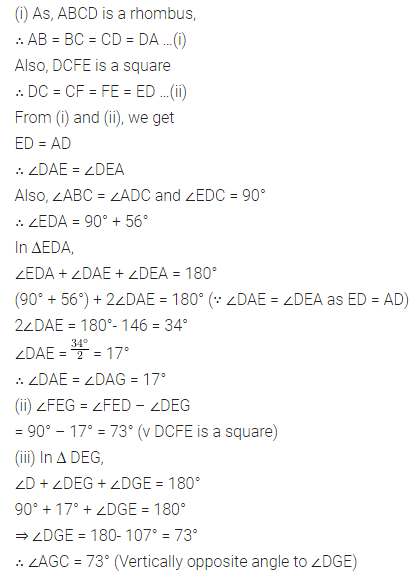
In the given figure, ABCD is a rhombus and DCFE is a square, If ∠ABC = 56°, find
(i) ∠DAG
(ii) ∠FEG
(iii) ∠AGC
ML Aggarwal Class 8 Solutions for ICSE Maths Model Question Paper 6 34
Solution:
ML Aggarwal Class 8 Solutions for ICSE Maths Model Question Paper 6 35

Question 27.
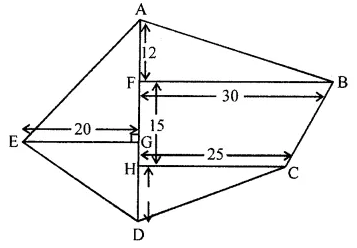
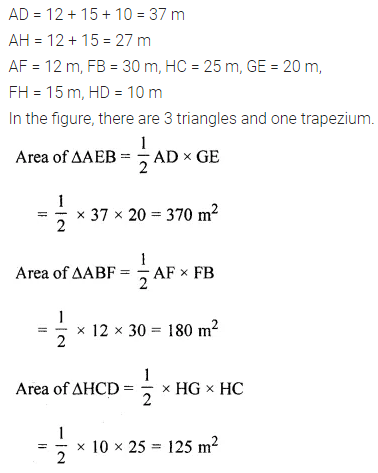
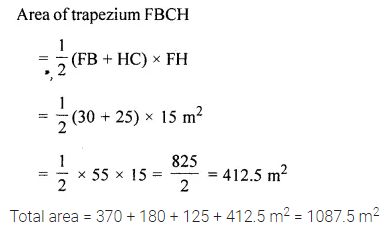
The figure given below shows a field with the measurement given in metres. Find the area of the field.
ML Aggarwal Class 8 Solutions for ICSE Maths Model Question Paper 6 36
Solution:
ML Aggarwal Class 8 Solutions for ICSE Maths Model Question Paper 6 37
ML Aggarwal Class 8 Solutions for ICSE Maths Model Question Paper 6 38

Question 28.
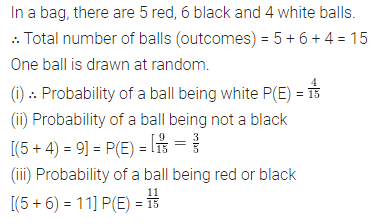
A bag contains 5 red, 6 black and 4 white balls. A ball is drawn at random from the bag. Find the probability that the ball drawn is
(i) white
(ii) not black
(iii) red or black
Solution:
ML Aggarwal Class 8 Solutions for ICSE Maths Model Question Paper 6 39

Question 29.
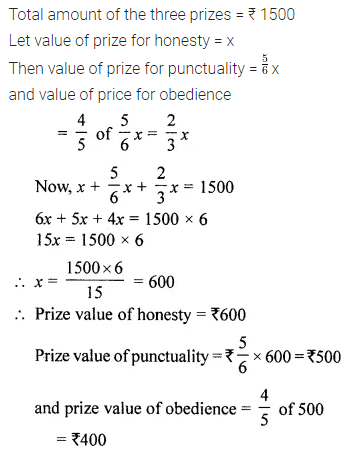
A school decided to award prizes to their students for three values, honesty, punctuality and obedience. The value of prize for punctuality is \(\frac{5}{6}\) of the value of prize for honesty and value of prize for obedience is \(\frac{4}{5}\) of the value of prize for punctuality. If the total value of the three prizes is ₹1500, find the value of each prize. Which quality you prefer to be rewarded most and why? What values are being promoted?
Solution:
ML Aggarwal Class 8 Solutions for ICSE Maths Model Question Paper 6 40

ML Aggarwal Class 8 Solutions for ICSE Maths

ML Aggarwal Class 8 Solutions for ICSE Maths Model Question Paper 5

ML Aggarwal Class 8 Solutions for ICSE Maths Model Question Paper 5

Choose the correct answer from the given four options (1-2):
Question 1.
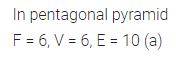
In a pentagonal pyramid number of faces, vertices and edges are
(a) F = 6, V = 6, E = 10
(b) F = 7, V = 7, E = 12
(c) F = 6, V = 8, E = 12
(d) none of these.
Solution:
ML Aggarwal Class 8 Solutions for ICSE Maths Model Question Paper 5 1

Question 2.
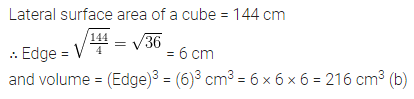
If the lateral surface area of a cube is 144 cm, then its volume is
(a) 36cm3
(b) 216 cm3
(c) 288 cm3
(d) none of these
Solution:
ML Aggarwal Class 8 Solutions for ICSE Maths Model Question Paper 5 2

Question 3.
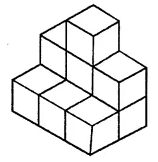
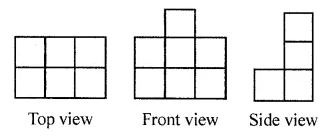
Draw the top, front and side views of the given solid.
ML Aggarwal Class 8 Solutions for ICSE Maths Model Question Paper 5 3
Solution:
ML Aggarwal Class 8 Solutions for ICSE Maths Model Question Paper 5 4

Question 4.
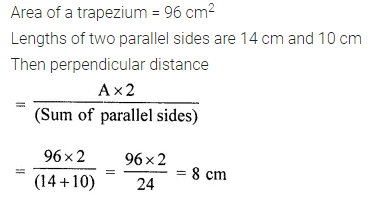
The area of a trapezium is 96 cm2. If the lengths of its two parallel sides are 14 cm and 10 cm, then find the perpendicular distance between parallel sides.
Solution:
ML Aggarwal Class 8 Solutions for ICSE Maths Model Question Paper 5 5

Question 5.
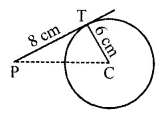
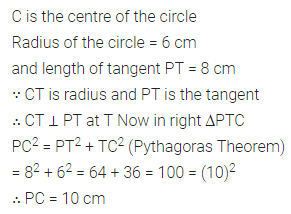
In the given figure, C is the centre of the circle. The tangent to the circle of radius 6 cm from a point P outside the circle is of length 8 cm. Find the distance of the point P from the farthest point of the circumference.
ML Aggarwal Class 8 Solutions for ICSE Maths Model Question Paper 5 6
Solution:
ML Aggarwal Class 8 Solutions for ICSE Maths Model Question Paper 5 7

Question 6.
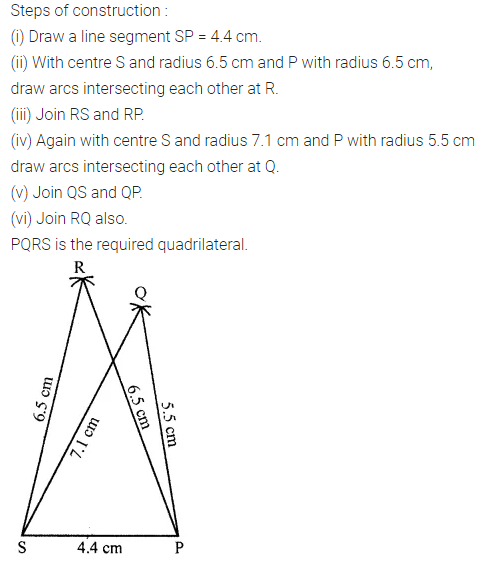
Construct a quadrilateral PQRS in which PQ = 5.5 cm, RS = 6.5 cm, PS = 4.4 cm, PR = 6.5 cm and QS = 7.1 cm.
Solution:
ML Aggarwal Class 8 Solutions for ICSE Maths Model Question Paper 5 8

Question 7.
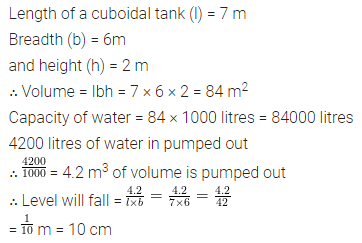
The length, breadth and height of cuboidal water tank is 7 m, 6 m and 2 m respectively. If 4200 litre of water is pumped out from the tank. Find the fall in water level in the tank.
Solution:
ML Aggarwal Class 8 Solutions for ICSE Maths Model Question Paper 5 9

Question 8.
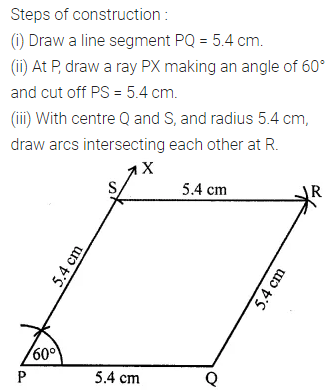
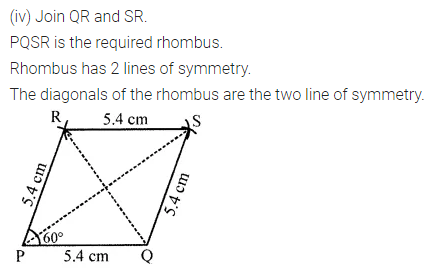
Construct a rhombus PQRS such that PQ = 5.4 cm and ∠P = 60°. Also, draw its lines of symmetry.
Solution:
ML Aggarwal Class 8 Solutions for ICSE Maths Model Question Paper 5 10
ML Aggarwal Class 8 Solutions for ICSE Maths Model Question Paper 5 11

Question 9.
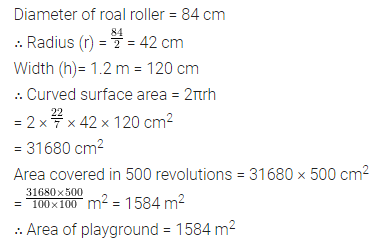
A road roller has a diameter 84 cm and its width is 1.2 m. If it takes 500 complete revolutions to level a playground. Find the area of the playground. Also, find the cost of levelling the playground at a rate of 50 paise per m2.
Solution:
ML Aggarwal Class 8 Solutions for ICSE Maths Model Question Paper 5 12

Question 10.
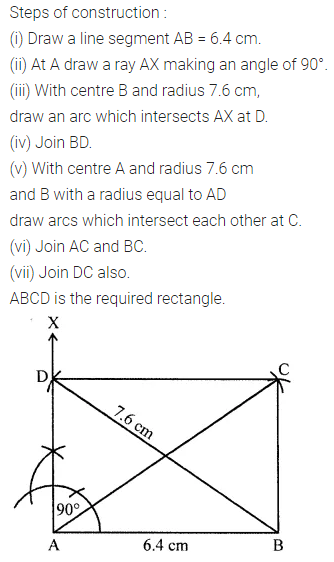
Construct a rectangle ABCD, such that AB = 6.4 cm and BD = 7.6 cm.
Solution:
ML Aggarwal Class 8 Solutions for ICSE Maths Model Question Paper 5 13

ML Aggarwal Class 8 Solutions for ICSE Maths

ML Aggarwal Class 8 Solutions for ICSE Maths Model Question Paper 4

ML Aggarwal Class 8 Solutions for ICSE Maths Model Question Paper 4

Choose the correct answer from the given four options (1-2):
Question 1.
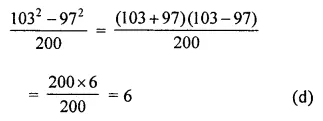
\(\frac{103^{2}-97^{2}}{200}\) is equal to
(a) 3
(b) 4
(c) 5
(d) 6
Solution:
ML Aggarwal Class 8 Solutions for ICSE Maths Model Question Paper 4 1

Question 2.
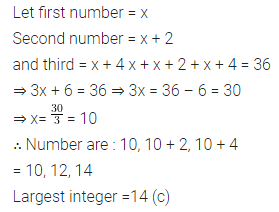
If the’ sum of three consecutive even integers is 36, then the largest integer is
(a) 10
(b) 12
(c) 14
(d) 16
Solution:
ML Aggarwal Class 8 Solutions for ICSE Maths Model Question Paper 4 2

Question 3.
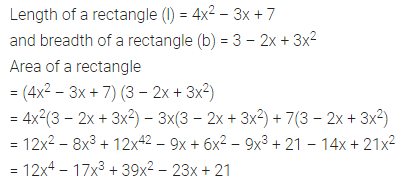
Find the area of rectangle whose length and breadth are respectively (4x2 – 3x + 7) and (3 – 2x + 3x2).
Solution:
ML Aggarwal Class 8 Solutions for ICSE Maths Model Question Paper 4 3

Question 4.
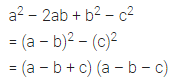
Factorize: a2 – c2 – 2ab + b2.
Solution:
ML Aggarwal Class 8 Solutions for ICSE Maths Model Question Paper 4 4

Question 5.
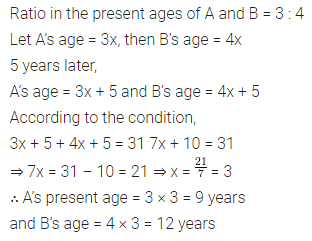
The ages of A and B are in the ratio 3 : 4. Five years later the sum of their ages will be 31 years. What are their present ages?
Solution:
ML Aggarwal Class 8 Solutions for ICSE Maths Model Question Paper 4 5

Question 6.
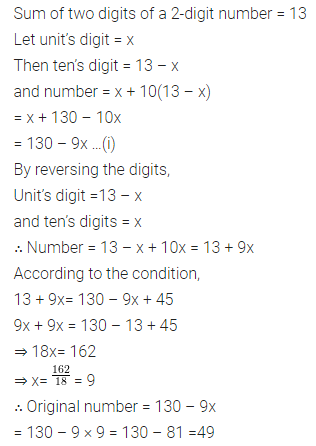
The sum of the digits of a two-digit number is 13. If the number obtained by reversing the digits is 45 more than the original number. Find the original number.
Solution:
ML Aggarwal Class 8 Solutions for ICSE Maths Model Question Paper 4 6

Question 7.
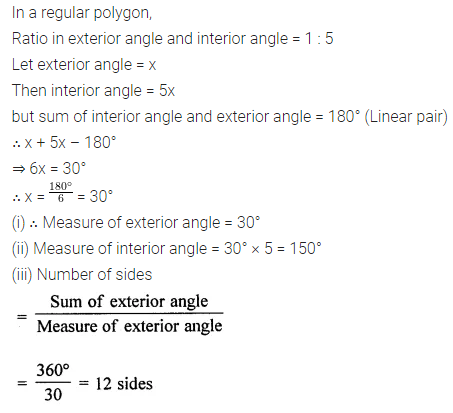
The ratio between an exterior angle and interior angle of a regular polygon is 1 : 5, find:
(i) the measure of each exterior angle,
(ii) the measure of each interior angle.
(iii) the number of sides of the polygon.
Solution:
ML Aggarwal Class 8 Solutions for ICSE Maths Model Question Paper 4 7

Question 8.
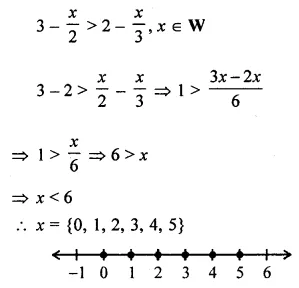
Solve the inequality: 3 – \(\frac{x}{2}\) > 2 – \(\frac{x}{3}\) , x ϵ W.
Also represent its solution set on the number line.
Solution:
ML Aggarwal Class 8 Solutions for ICSE Maths Model Question Paper 4 8

Question 9.
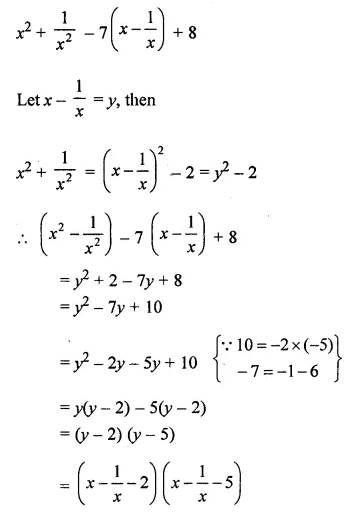
Factorise: x2 + \(\frac{1}{x^{2}}-7\left(x-\frac{1}{x}\right)\) + 8.
Solution:
ML Aggarwal Class 8 Solutions for ICSE Maths Model Question Paper 4 9

Question 10.
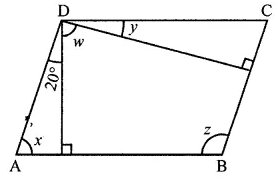
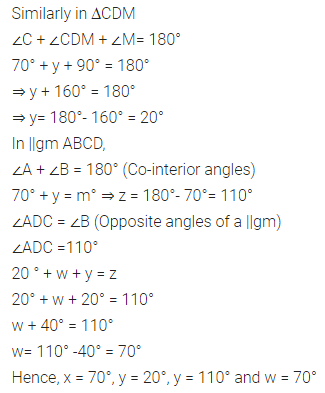
In the given figure, ABCD is a parallelogram. Find x, y, z and w.
ML Aggarwal Class 8 Solutions for ICSE Maths Model Question Paper 4 10
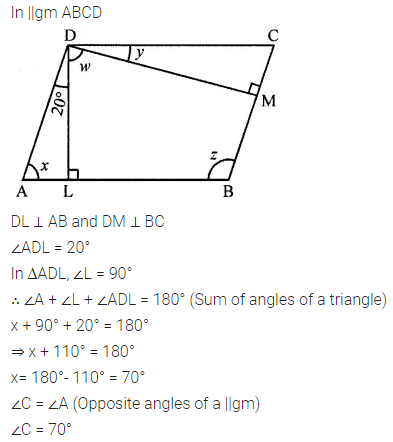
Solution:
ML Aggarwal Class 8 Solutions for ICSE Maths Model Question Paper 4 11
ML Aggarwal Class 8 Solutions for ICSE Maths Model Question Paper 4 12

ML Aggarwal Class 8 Solutions for ICSE Maths