ML Aggarwal Class 7 Solutions for ICSE Maths Chapter 5 Sets Ex 5.1

ML Aggarwal Class 7 Solutions Chapter 5 Sets Ex 5.1 for ICSE Understanding Mathematics acts as the best resource during your learning and helps you score well in your exams.

ML Aggarwal Class 7 Solutions for ICSE Maths Chapter 5 Sets Ex 5.1

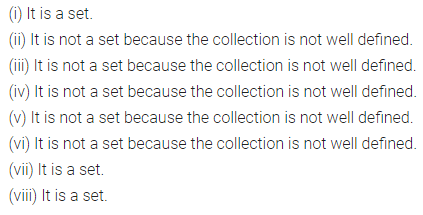
Question 1.
State which of the following collections are set:
(i) All states of India.
(ii) Four cities of India having more than one lac population.
(iii) All tall students of your school.
(iv) Four colours of a rainbow.
(v) All the beautiful flowers.
(vi) All clever people of Lucknow.
(vii) Last three days of a week.
(viii)All months of a year having at least 30 days.
Solution:
ML Aggarwal Class 7 Solutions for ICSE Maths Chapter 5 Sets Ex 5.1 1

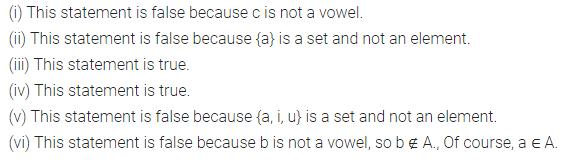
Question 2.
Let A = {vowels of English alphabet}, then which of the following statements are true. In case a statement is incorrect, mention why.
(i) c ∈ A
(ii) {a} ∈ A
(iii) a, i, u, ∈A
(iv) {a, u} ∉ A
(v) {a, i, u } ∈ A
(vi) a, b, ∈ A
Solution:
ML Aggarwal Class 7 Solutions for ICSE Maths Chapter 5 Sets Ex 5.1 2

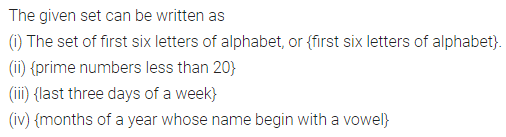
Question 3.
Describe the following sets:
(i) {a, b, c, d, e, f}
(ii) {2, 3, 5, 7, 11, 13, 17, 19}
(iii) {Friday, Saturday, Sunday}
(iv) {April, August, October}
Solution:
ML Aggarwal Class 7 Solutions for ICSE Maths Chapter 5 Sets Ex 5.1 3

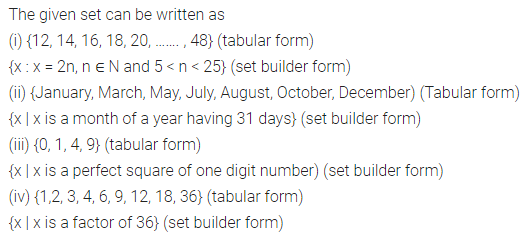
Question 4.
Write the following sets in tabular form and also in set builder form:
(i) The set of even whole numbers which lie between 10 and 50.
(ii) {months of a year having more than 30 days}
(iii) The set of single-digit whole numbers which are a perfect square.
(iv) The set of factors of 36.
Solution:
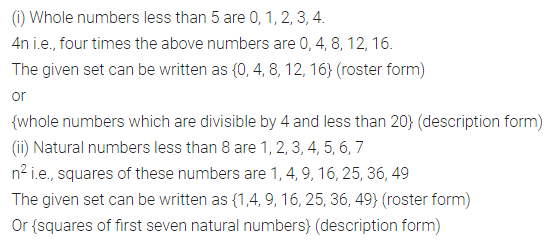
ML Aggarwal Class 7 Solutions for ICSE Maths Chapter 5 Sets Ex 5.1 4

Question 5.
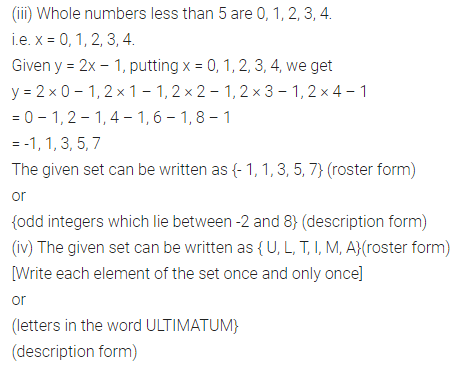
Write the following sets in roster form and also in description form:
(i) {x | x = 4n, n ∈ W and n < 5}
(ii) {x : x = n2, n ∈ N and n < 8}
(iii) y : y = 2x – 1, x ∈ W and x < 5}
(iv) {x : x is a letter in word ULTIMATUM}
Solution:
ML Aggarwal Class 7 Solutions for ICSE Maths Chapter 5 Sets Ex 5.1 5
ML Aggarwal Class 7 Solutions for ICSE Maths Chapter 5 Sets Ex 5.1 6

Question 6.
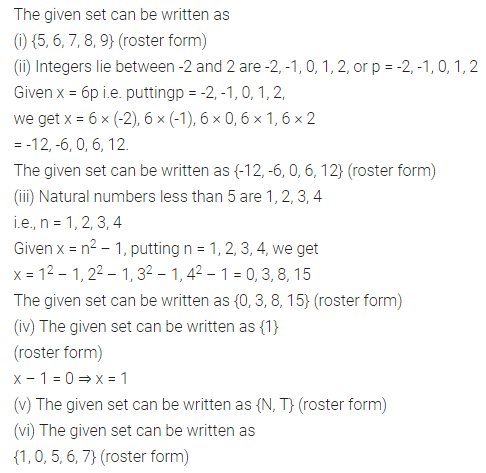
Write the following sets in roster form:
(i) {x | x ∈ N, 5 ≤ x < 10 }
(ii) {x | x = 6 p, p ∈ I and – 2 ≤ p ≤ 2}
(iii) {x | x = n2 – 1, n ∈ N and n < 5}
(iv) {x | x – 1 = 0}
(v) {x | x is a consonant in word NOTATION}
(vi) {x | x is a digit in the numeral 11056771}
Solution:
ML Aggarwal Class 7 Solutions for ICSE Maths Chapter 5 Sets Ex 5.1 7

Question 7.
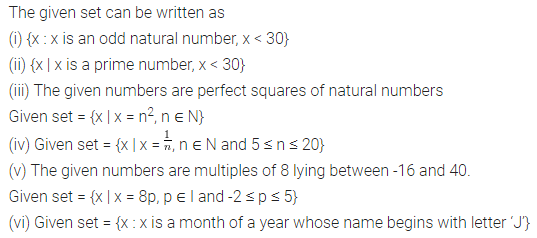
Write the following sets in set builder form:
(i) (1, 3, 5, 7, …….. 29}
(ii) {2, 3, 5, 7, 11, 13, 17, 19, 23, 29}
(iii) {1, 4, 9, 16, 25, ………}
(iv) {\(\frac { 1 }{ 5 }\), \(\frac { 1 }{ 6 }\), \(\frac { 1 }{ 7 }\), …… \(\frac { 1 }{ 20 }\)}
(v) {-16, -8, 0, 8, 16, 24, 32, 40}
(vi) {January, June, July}
Solution:
ML Aggarwal Class 7 Solutions for ICSE Maths Chapter 5 Sets Ex 5.1 8

Question 8.
If V is the set of vowels in the word COMPETITION, write the given set in
(i) description form
(ii) set builder form
(iii) roster form
Solution:
ML Aggarwal Class 7 Solutions for ICSE Maths Chapter 5 Sets Ex 5.1 9

ML Aggarwal Class 7 Solutions for ICSE Maths Chapter 4 Exponents and Powers Check Your Progress

ML Aggarwal Class 7 Solutions Chapter 4 Exponents and Powers Check Your Progress for ICSE Understanding Mathematics acts as the best resource during your learning and helps you score well in your exams.

ML Aggarwal Class 7 Solutions for ICSE Maths Chapter 4 Exponents and Powers Check Your Progress

Question 1.
Find the value of each of the following:
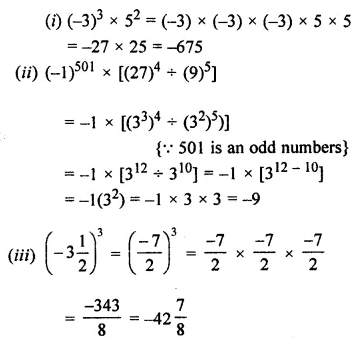
(i) (-3)3 × 52
(ii) (-1)501 × [(27)4 ÷ (9)5]
(iii) \(\left( -3\frac { 1 }{ 2 } \right) ^{ 3 }\)
Solution:
ML Aggarwal Class 7 Solutions for ICSE Maths Chapter 4 Exponents and Powers Check Your Progress 1

Question 2.
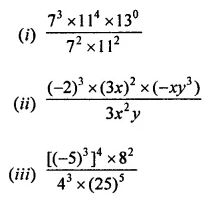
Simplify the following:
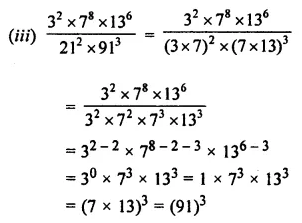
ML Aggarwal Class 7 Solutions for ICSE Maths Chapter 4 Exponents and Powers Check Your Progress 2
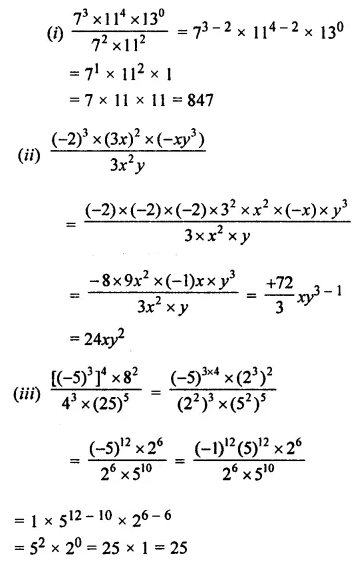
Solution:
ML Aggarwal Class 7 Solutions for ICSE Maths Chapter 4 Exponents and Powers Check Your Progress 3

Question 3.
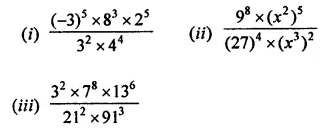
Simplify and write the following in exponential form:
ML Aggarwal Class 7 Solutions for ICSE Maths Chapter 4 Exponents and Powers Check Your Progress 4
Solution:
ML Aggarwal Class 7 Solutions for ICSE Maths Chapter 4 Exponents and Powers Check Your Progress 5
ML Aggarwal Class 7 Solutions for ICSE Maths Chapter 4 Exponents and Powers Check Your Progress 6

Question 4.
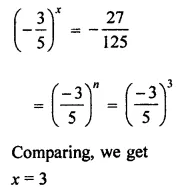
ML Aggarwal Class 7 Solutions for ICSE Maths Chapter 4 Exponents and Powers Check Your Progress 7
Solution:
ML Aggarwal Class 7 Solutions for ICSE Maths Chapter 4 Exponents and Powers Check Your Progress 8

Question 5.
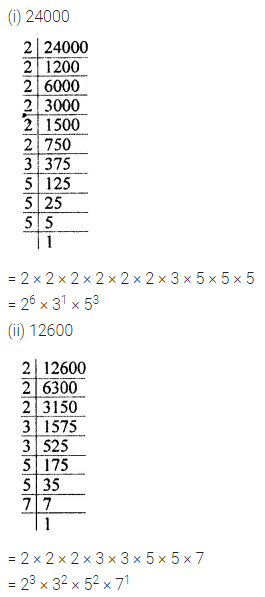
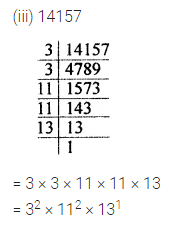
Write the prime factorisation of the following numbers in the exponential form:
(i) 24000
(ii) 12600
(iii) 14157
Solution:
ML Aggarwal Class 7 Solutions for ICSE Maths Chapter 4 Exponents and Powers Check Your Progress 9
ML Aggarwal Class 7 Solutions for ICSE Maths Chapter 4 Exponents and Powers Check Your Progress 10

Question 6.
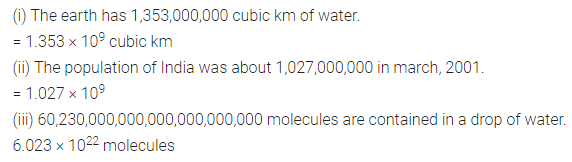
Express the numbers appearing in the following statements in scientific notation:
(i) The earth has 1,353,000,000 cubic km of water.
(ii) The population of India was about 1,027,000,000 in march, 2001.
(iii) 60,230,000,000,000,000,000,000 molecules are contained in a drop of water.
Solution:
ML Aggarwal Class 7 Solutions for ICSE Maths Chapter 4 Exponents and Powers Check Your Progress 11

Question 7.
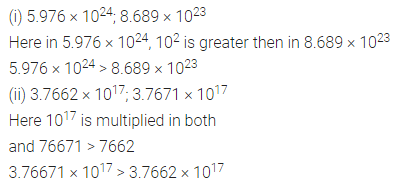
Compare the following numbers:
(i) 5.976 × 1024; 8.689 × 10²³
(ii) 3.7662 × 10¹⁷; 3.7671 × 10¹⁷
Solution:
ML Aggarwal Class 7 Solutions for ICSE Maths Chapter 4 Exponents and Powers Check Your Progress 12

From the Diary of Anne Frank Extra Questions and Answers Class 10 English First Flight

Here we are providing From the Diary of Anne Frank Extra Questions and Answers Class 10 English First Flight, Extra Questions for Class 10 English was designed by subject expert teachers.

From the Diary of Anne Frank Extra Questions and Answers Class 10 English First Flight

From the Diary of Anne Frank Extra Questions and Answers Very Short Answer Type

Question 1.
What name was given by Anne to her friend?
Answer:
‘Kitty’

Question 2.
Why did Anne want to write a diary?
Answer:
Anne wanted to write a diary because she was devoid of a single friend.

Question 3.
When the little girl started her diary, what was her age?
Answer:
Anne was thirteen years old, when she started her diary.

Question 4.
What did Anne say about her family?
Answer:
Anne said that she had loving parents, a sixteen year old sister, and about thirty people as her friends.

Question 5.
Why did Anne stay with her grandmother?
Answer:
Anne had to stay with her grandmother since her parents had gone to Holland.

Question 6.
How many sisters Anne had?
Answer:
Anne had a sister named Margot.

Question 7.
What happened to the grandmother of Anne?
Answer:
The grandmother became ill in the summer of 1941.

Question 8.
Why was the whole class feeling nervous?
Answer:
The whole class was feeling nervous about their result.

Question 9.
What had some of the students done?
Answer:
Some of the students had staked their savings in the bet.

Question 10.
Why was Anne most worried?
Answer:
Anne was most worried about her maths result.

Question 11.
What did Anne think of her father?
Answer:
Anne thought that her father was the most adorable person.

Question 12.
When did Anne’s father marry?
Answer:
Anne’s father married when he was thirty six years hid.

Question 13.
What was the name of Anne’s mother?
Answer:
Edith Hollander Frank.

Question 14.
When did Anne’s father emigrate to Holland?
Answer:
1933.

Question 15.
Why did the maths teacher punish Anne?
Answer:
The maths teacher punished Anne for her talkative nature.

Question 16.
What idea do you form of Mr Keesing?
Answer:
Mr Keesing was a hard and strict person.

Question 17.
How did Sanne help Anne?
Answer:
Sanne wrote a long poem for Anne.

Question 18.
What did Anne feel about paper?
Answer:
Anne thought that paper had more patience than people.

Question 19.
What were Anne’s views about teachers?
Answer:
Anne’s views about teachers were that they were the most unpredictable creatures on the earth.

Question 20.
What was the punishment for Anne’s talkative nature?
Answer:
To write an essay on ‘A Chatterbox’.

From the Diary of Anne Frank Extra Questions and Answers Short Answer Type

Question 1.
In what way did Anne’s diary become the most widely read books?
Answer:
The diary of Anne provides a close examination of her daily life. Her original work was in Dutch language. Then there came several films, television and theatrical production of her diary.

Question 2.
Why did Anne feel like writing?
Answer:
Anne had no real friend. Even she had a greater need to get all kinds of things off her chest. So she felt like writing. Though she had a whim that none would take interest in her views because of her small age.

Question 3.
Anne was not alone in this world. How?
Answer:
Anne was not alone in this world. She had loving parents and a sixteen year old sister. She had a deep intimacy with thirty people. She could call them friends. She had a family, loving aunts and a sweet home.

Question 4.
What did Anne think of having a true friend?
Answer:
Anne thought that one could have good time with a true friend. Friendship brings closeness and helps in confiding in each other. Though we can talk about ordinary things with anybody else too.

Question 5.
What did Anne tell about her father?
Answer:
Anne said that her father was the most adorable man. He married at the age of thirty six and her mother was twenty five.

Question 6.
What shows that Anne was deeply in love with her grandmother?
Answer:
Anne loved her grandmother from the core of her heart. She died in January 1942, but Anne still went on loving her. When the birthday of Anne was being celebrated in 1942, a special candle was lit for her.

Question 7.
Why was Anne’s entire class quacking in the boots?
Answer:
Anne’s entire class was shaking with fear and nervousness because of the forthcoming teacher’s meeting. The teachers had to decide who would move up to the next grade and who would be kept back or not promoted.

Question 8.
Why was Anne in tears when she left the Montessori school?
Answer:
Anne studied at the Montessary school. She stayed there till she was in the sixth form. She was very much attached to her teacher and headmistress Mrs Kuperus. At the end of the year they were both in tears as they bid ‘a heartbreaking farewell’.

Question 9.
Where did Anne stay before going to Holland?
Answer:
Anne’s father emigrated to Holland in 1933 and her mother went with him in September. Anne and her sister did not go with their parents. They were sent to Aachen to stay with their grandmother.

Question 10.
Why did Anne feet alone?
Answer:
Anne felt alone though she had loving parents, relatives and thirty friends. It was because she could not confide in them. Though she enjoyed their company, yet she could not get close to any one of them.

Question 11.
How did Mr Keesing stop punishing her?
Answer:
Mr Keesing read the poem by Anne. In this poem, a father swan bit his three ducklings to death. He could not bear their excessive quacking. Mr Keesing took the jokes. He read the poem to the class. He never punished her after that.

Question 12.
Why did Anne jump with joy?
Answer:
Anne had already written two essays as punishment. She had exhausted all her views about chatterboxes. When she got a third essay to write, she was at a loss. She wanted something original. Her friend Sanne offered to write it in verse. Anne jumped with joy.

Question 13.
What arguments did Mr Keesing laugh at?
Answer:
The arguments that talking was a student’s trait and she could not do much about it since she had inherited it from her mother.

Question 14.
What punishment was given to Anne?
Answer:
Anne was a talkative girl. Her maths teacher was annoyed at her talkative nature. So he gave her an essay “A Chatterbox’ to write as a punishment.

Question 15.
What makes writing in a diary a strange experience for Anne Frank?
Answer:
Writing in a diary is a strange experience for Anne. It is because she has never written anything earlier. Also she thinks that none will take interest in the musings of a thirteen year old school girl.

Question 16.
Why does Anne want to keep a diary?
Answer:
Anne has got no friend with whom she can confide in (her secrets) and pass time. She feels herself alone in this world.

Question 17.
Why did Anne think she could confide more in her diary than in people?
Answer:
It is because of the fact that she can have a good time with her diary. She may be able to confide more with her diary by remaining quite close with it. She can even have heart to heart talk with her.

Question 18.
Why does Anne provide a brief sketch of her life?
Answer:
Anne has named her diary ‘Kitty’. She is her friend now. She will address and talk to her throughout. No one would understand her directly if she fails to give her brief sketch to the people.

Question 19.
What tells you that Anne loved her grandmother?
Answer:
When the parents of Anne went to Holland, she and her elder sister, Margot went to stay with their grandmother. She loved her very much. She was thinking of her. On Anne’s birthday, a special candle I for the grandma was also lit.

Question 20.
Why was Mr Keesing annoyed with Anne? What did he ask her to do?
OR
Why was Mr Keesing annoyed with Anne and what extra homework did he give to her after several warnings?
Answer:
Mr Keesing was her maths teacher. By nature Anne was very talkative. He did not like this. As a I punishment he gave an essay to write on the topic “A chatterbox” to Anne.

Question 21.
How did Anne justify her being a chatterbox in her essay?
Answer:
Anne was an intelligent girl. She explained in writing the necessity of talking. She argued that talking ^ is a student’s trait. She tried to control it but she was helpless since her mother was more talkative than her. It was her inherited trait.

Question 22.
Do you think Mr Keesing was a strict teacher?
Answer:
In the beginning Mr Keesing seems to be a hard task master. He wants to ridicule Anne but he himself becomes the victim. Since then he starts participating in jokes with the students.

Question 23.
What made Mr Keesing allow Anne to talk in-class?
Answer:
Mr Keesing thrice gave Anne a writing job on her talkative nature. On all the three occasions she came out successful. In the third attempt the ball fell on the teacher and he became her victim. Finding himself unsuccessful, he allowed Anne to talk in the class.

From the Diary of Anne Frank Extra Questions and Answers Long Answer Type

Question 1.
What punishment did Mr Keesing give to Anne Frank? How did she finally stop him from punishing?
Answer:
Mr Keesing was an old-fashioned maths teacher. Anne talked too much during Mr Keesing’s class and this annoyed him. He gave her several warnings but that did not keep Anne away, from talking in the class. So Mr Keesing had to punish her time and again.Mr Keesing assigned her some extra homework as a punishment for talking in the class.

He asked her to write an essay on the subject ‘A Chatterbox’. On the second occasion, she was asked to write an essay, on the subject ‘An Incorrigible Chatterbox’. On the third occasion, Mr Keesing assigned her a more difficult topic. It was “Quack, Quack, Quack, Said Mistress Chatterbox”.

Mr Keesing was trying to play a joke on her when he asked her to write an essay entitled “Quack, Quack, Quack, Said Mistress Chatterbox” so she decided to play a joke on Mr Keesing himself. She had nearly exhausted her ingenuity on the topic of chatterboxes. Her friend Sanne suggested her to write the essay in a poetic form.

She wrote about a mother duck and a father swan with three baby ducklings who were bitten to death by father because they quacked too much. Mr Keesing took the poem in the right way and understood the joke. After that he never assigned any extra homework to Anne for talking in the class. On the contrary, he was always making jokes in the class.

Question 2.
What do you know about Mr Keesing? How did he punish Anne?
Answer:
Mr Keesing was an old-fashioned maths teacher. Anne talked too much during Mr Keesing’s class and this annoyed him. He gave her several warnings but that did not keep Anne away, from talking in the class. So Mr Keesing had to punish her time and again.Mr Keesing assigned her some extra homework as a punishment for talking in the class.

He asked her to write an essay on the subject ‘A Chatterbox’. On the second occasion, she was asked to write an essay, on the subject ‘An Incorrigible Chatterbox’. On the third occasion, Mr Keesing assigned her a more difficult topic. It was “Quack, Quack, Quack, Said Mistress Chatterbox”.

Mr Keesing was trying to play a joke on her when he asked her to write an essay entitled “Quack, Quack, Quack, Said Mistress Chatterbox” so she decided to play a joke on Mr Keesing himself. She had nearly exhausted her ingenuity on the topic of chatterboxes. Her friend Sanne suggested her to write the essay in a poetic form.

She wrote about a mother duck and a father swan with three baby ducklings who were bitten to death by father because they quacked too much. Mr Keesing took the poem in the right way and understood the joke. After that he never assigned any extra homework to Anne for talking in the class. On the contrary, he was always making jokes in the class.

Question 3.
Why was Anne’s teacher annoyed with her? How was she able to bring about a change in his attitude towards her?
Answer:
Mr. Keesing, her maths teacher, was annoyed with Anne because she talked too much. When she did not improve, despite several warnings, he punished her. The punishment was extra homework. She was supposed to write an essay on “A Chatterbox”, then an essay on “An Incorrigible Chatterbox” and finally “Quack, Quack, Quack, Said Mistress Chatterbox”.

In her first essay Anne argued that talking was a student’s trait and her mother talked too much. She could not do anything with an inherited trait. Finally, Anne wrote the third essay in verse form. After reading the poem Mr Keesing read it to the class. It was about three ducklings bitten to death by their father swan because they quacked too much. After that Mr Keesing never gave her any punishment.

Question 4.
Write the character sketch of Anne Frank.
OR
How do you assess Anne’s character?
Answer:
Anne was a sensible, 13 year old girl. Though she had loving parents and thirty friends, she was lonely. She could not share her innermost thoughts and feelings with her friends. She knew that no one would understand her need to keep a diary. Anne was very caring and loving. She adored her father. She loved her grandma and often thought of her after her death. She was quite mature for her age, for she knew that no one would have time for the thoughts of a 13-years old. It was because of this maturity that she could not confide in her friends.

She was very talkative and was often punished by her maths teacher. Yet she was intelligent and had a good sense of humour. She convinced her teacher with her arguments, ultimately, he took the joke and did not punish her any more.

Question 5.
Was Anne an intelligent girl? Give instances in support of your answer.
Answer:
I think Anne was not only an intelligent girl, but she was far mature than her age. The very fact that
she thought so much that she needed to write a diary shows that she was intelligent. Anne was also intelligent enough to realise that no one would be interested in her musings. Anne believed that paper had more patience than people. She knew that she had friends with whom she could enjoy.

Yet, she could not confide in them. She realised that things would not change. She was quite a popular student. She knew that she would be promoted though Maths was her weak point. She also took her punishment of writing essays good humouredly. Ultimately she convinced Mr Keesing with her arguments and she got rid of her punishments.

Question 6.
“Paper has more patience than people’. Do you agree with the statement?
OR
Paper has more patience than people’. Explain with reference to “From the Diary of Anne Frank”.
Answer:
Anne Frank thought of a saying ‘Paper has more patience than people’. It requires a lot of patience to listen to someone’s private feelings and problems. It is not the listening that is important but the more important thing is to keep another’s secrets to oneself. It is a human tendency that after knowing someone’s’secrets, we pass them over to others. There is limit for listening to someone’s problems.

After some time, one is fed up with the person and tries to avoid him. But paper is a lifeless thing. It is never fed up with one’s problems. One can confide as much as one likes on a paper. Paper never becomes impatient. One can write on it as much as one desires and for as long as one wants to. As long as anyone else does not read it, the secret remains a secret.

Question 7.
“Our entire class is quacking in its boots”. Explain with reference to “From the Diary of Anne Frank”.
Answer:
Anne Frank was sent to Montessori nursery school. There she stayed till the sixth form. Her teacher Mrs. Kuperus was the headmistress. At the end of the year, the farewell function was arranged. It was a tearful farewell with the headmistress. Then Anne was admitted in a school. There were nine teachers. Among them two were females and rest were the male teachers.

The meeting was going on among the teachers. They had to decide who would be moved up to the next form and who would be kept back. This was a movement of nervousness for the entire class. They were uncertain for their fate. Even some of the students had staked their savings in bets. There were some of the dummies who could be kept back. All the students were confused about themselves. Even Anne was not sure due to mathematics. So the entire class was quacking in its boots.

Question 8.
“From the Diary of Anne Frank” throws light on teacher-student relationship, class atmosphere and discipline. Discuss.
OR
Write a paragraph on, the values of these aspects of school and how far these values are necessary for learning and life.
Answer:
From the Diary of Anne Frank’ describes the teacher-student relationship, class atmosphere and discipline. Anne Frank who talks a lot in the class gets punished by Mr Keesing, her maths teacher. He asks her to write essays as punishment is learning in disguise because he wanted her to focus on studies. He cannot be blamed for the punishment as he did it for the development of Anne.

The teacher student relationship is very respectful and sacred. It is about discipline and classroom manners which is essential for every student as well as teacher, otherwise both teaching or learning could hamper. This relationship is clearly shown in Mr Keesing and Anne Frank actions as they both try to joke with each other but in very humorous and healthy manner. So this healthy relationship is needed everywhere in the class for effective teaching and learning.

Question 9.
“I hope I will be able to confide everything to you, as I have never been able to confide in anyone, and I hope you will be a great source of comfort and support.” Explain.
Answer:
Anne writes this on the inside cover of her diary just after she receives it for her thirteenth birthday. At the time, she feels that she does not have any true confidants, which makes her feel lonely and misunderstood. Anne does, however, have many friends and admirers, and she is a playful, amusing, and social young girl. Thus, her sentiments in this passage may seem odd and a bit exaggerated,but she later explains that even though she has friends, she is never fully able to open up to them.

Anne finds that she and her friends talk only about trivial things, even when she has deeper things on her mind that she wishes to share. For example, she never broaches the subjects of her developing body or Germany’s occupation of Holland. Having a diary—which she addresses as “Kitty,” like a friend— enables her to express her thoughts without fear of being criticized by others. Anne’s relationship with her diary helps in comforting her through her insecure, lonely, and fearful time in the hiding.

Question 10.
Was Anne right when she said that the world would not be interested in the musings of a , thirteen year old girl?
Answer:
Anne was not at all right in having such a view about her musings. Her writings were translated in different languages under the title “The Diary of a Young Girl”. Her work became one of the world’s most widely read books. They are available in films.

Question 11.
There are some examples of diary or journal entries in the ‘Before You Read’ section. Compare these with what Anne writes in her diary. What language was the diary originally written in? In what way is Anne’s diary different?
Answer:
If we compare them with the diary of Anne, we get a difference. Anne gives minute details of all actions and feelings. The diary is written in Dutch language. Anne’s diary is different because she calls her diary her friend. All writings are referred to her friend ‘Kitty’, the name given to her diary.

Question 12.
Why does Anne need to give a brief sketch about her family? Does she treat ‘Kitty’ as an insider or an outsider?
Answer:
Anne says that none will understand a word of her stories in case she starts writing directly in ‘Kitty’ since she is her friend in the shape of a diary. She is a non-living organism. So she gives a brief description of her family. Anne does not think her diary as an outsider. She is an insider to her.

Question 13.
How does Anne feel about her father, her grandmother, Mrs Kuperus and Mr Keesing? What do these tell you about her?
Answer:
For Anne, her father is the most adorable man. Her grandmother is very lovely for her. She is very much attached with Mrs Kuperus and her farewell is full of tears. Mr Keesing is a hard task master. Her father has a high affection for Anne. The grandmother loves her much. The headmistress has good relations with Anne. Keesing calls her talkative.

Question 14.
What does Anne write in her first essay?
Answer:
Anne writes her first essay on ‘A Chatterbox’. She states that talking is a trait of students. She tries to control but she has inherited this trait from her mother. She is more talkative then Anne.

Question 15.
Anne says teachers are most unpredictable. Is Mr Keesing unpredictable? How?
Answer:
Anne is right in saying that most of the teachers are unpredictable. Mr Keesing is quite like this. None can tell about him. It is he who assigns different topics to Anne about which none can even think of. About the result the teachers have their own whims.

Question 7.
What do these statements tell you about Anne Frank as a person?
(i) We don’t seem to be able to get any closer, and that’s the problem. May be it’s my fault that we don’t confide in each other.
(ii) I don’t want to jot down the facts in this diary the way most people would, but I want the diary to be my friend.
(iii) Margot went to Holland in December, and I followed in February when I was plunked down on the table as a birthday present for Margot.
(iv) If you ask me, there are so many dummies that about a quarter of the class should be kept back, but teachers are the most unpredictable creatures on earth.
(v) Anyone could ramble on and leave big spaces between the words, but the trick was to come up with convincing arguments to prove the necessity of talking.
Answer:
To Anne as a person these statements have different meanings. The first statement speaks the importance of having the need of a real friend. The second statement speaks of Anne’s conviction of considering the diary as her real friend. The third statement shows her profound love* for her elder sister. About teacher she forms an opinion that they are unpredictable. The last statement points out her skill in writing an essay. Thus Anne was a skilled girl having the decent qualities of mind, body and soul.

From the Diary of Anne Frank Extra Questions and Answers Reference to Context

Read the following passages and answer the questions that follow:

Question 1.
Writing in a diary is a really strange experience for someone like me. Not only because I’ve never written anything before, but also because it seems to me that later on neither I nor anyone else will be interested in the musings of a thirteen-year-old school girl. Oh well, it doesn’t matter. I feel like writing, and I have an even greater need to get all kinds of things off my chest.
(i) Who is T in the passage?
(ii) Has she written something before?
(ii) Why does she think that no one will be interested in her musings? ,
(iv) Pick out the word from the passage which means the same as ‘thoughts’:
Answer:
(i) T in the passage is Anne Frank.
(ii) No, she has not written anything before.
(iii) She thinks that no one will be interested in her musings because she is just a thirteen year old school girl.
(iv) Musings.

Question  2.
‘Paper has more patience than people.’ I thought of this saying on one of those days when I was feeling a little depressed and was sitting at home with my chin in my hands, bored and listless, wondering whether to stay in or go out. I finally stayed where I was, brooding: Yes, paper does have more patience, and since I’m not planning to let anyone else read this stiff-backed notebook grandly referred to as a ‘diary’, unless I should ever find a real friend, it probably won’t make a bit of difference. Now I’m back to the point that prompted me to keep a diary in the first place: I don’t have a friend.
(i) Who has more patience than people according to Anne Frank?
(ii) What was her plan about her diary?
(iii) What prompted her to keep a diary?
(iv) Pick out the word from the passage which means the same as ‘low in spirit’
Answer:
(i) According to Anne Frank paper has more patience than people.
(ii) She planned that she would not let anyone else read that diary unless she got a real friend.
(iii) She did not have any friend that prompted her to keep a diary.
(iv) Depressed.

Question  3.
Let me put it more clearly, since no one will believe that a thirteen-year-old girl is completely alone in the world. And I’m not. I have loving parents and a sixteen-year-old sister, and there are about thirty people I can call friends. I have a family, loving aunts and a good home. No, on the surface I seem to have everything, except my one true friend. All I think about when I’m with friends is having a good time. I can’t bring myself to talk about anything but ordinary everyday things. We don’t seem to be able to get any closer, and that’s the problem. Maybe it’s my fault that we don’t confide in each other. In any case, that’s just how things are, and unfortunately they’re not liable to change. This is why I’ve started the diary.
(i) What did she want to clear?
(ii) Who were there in her family?
(iii) What was the problem?
(iv) Pick out the word from the passage which means the same as ‘bound to do something’.
Answer:
(i) She wanted to clear that she was not completely alone.
(ii) She had loving parents and a sixteen year old sister.
(iii) The problem was that she could not confide in her friends.
(iv) Liable.

Question 4.
To enhance the image of this long-awaited friend in my imagination, I don’t want to jot down the facts in this diary the way most people would do, but I want the diary to be my friend, and I’m going to call this friend ‘Kitty’. Since no one would understand a word of my stories to Kitty if I were to plunge right in, I’d better provide a brief sketch of my life, much as I dislike doing so.
(i) Who is T in the above passage?
(ii) What do most people write in their diary?
(iii) Who is ‘Kitty’?
(iv) Pick out the word from the passage which means the same as (i) ‘write down’, (ii) ‘to begin immediately’.
Answer:
(i) Anne Frank is ‘I’ in the passage.
(ii) Most people write facts in their diary.
(iii) ‘Kitty1 is the name of the diary of Anne Frank
(iv) jot down, plunge.

Question 5.
My father, the most adorable father I’ve ever seen, didn’t marry my mother until he was thirty-six and she was twenty-five. My sister, Margot, was born in Frankfurt in Germany in 1926. I was born on 12 June 1929. I lived in Frankfurt until I was four. My father emigrated to Holland in 1933. My mother, Edith Hollander Frank, went with him to Holland in September, while Margot and I were sent to Aachen to stay with our grandmother. Margot went to Holland in September, and I followed in February, when I was plunked down on the table as a birthday present for Margot.
(i) How old were her parents when they got married?
(ii) When and where was Margot born?
(iii) Where did she live until she was four?
(iv) Pick out a word from the passage which means same as ‘sat down hurriedly’.
Answer:
(i) Her father was thirty six and mother was twenty five year old when they got married.
(ii) Margot was born in Frankfurt in Germany in 1926.
(iii) She lived in Frankfurt until she was four.
(iv) Plunked down.

Question 6.
I started right away at the Montessori nursery school. I stayed there until I was six, at which time I started in the first form. In the sixth form my teacher was Mrs Kuperus, the headmistress. At the end of the year we were both in tears as we said a heart breaking farewell. In the summer of 1941 Grandma fell ill and had to have an operation, so my birthday passed with little celebration.Grandma died in January 1942. No one knows how often I think of her and still love her. This birthday celebration in 1942 was intended to make up for the other, and Grandma’s candle was lit along with the rest. The four of us are still doing well, and that brings me to the present date of 20 June 1942, and the solemn dedication of my diary.
(i) Where did she stay until she was six?
(ii) Why did her birthday pass with little celebrations?
(iii) Who was the headmistress? Why was the farewell full of tears?
(iv) Write the verb form of‘operation’.
Answer:
(i) She stayed in the Montessori nursery school until she was six.
(ii) Her birthday passed with little celebrations because her grandma had died.
(iii) Mrs Kuperus was the headmistress. The farewell was full of tears since both the girl and the head mistress had developed great attachment.
(iv) Operate.

Question 7.
I’m not so worried about my girlfriends and myself. We’ll make it. The only subject I’m not sure about is maths. Anyway, all we can do is wait. Until then, we keep telling each other not to lose heart. I get along pretty well with all my teacher?. There are nine of them, seven men and two women. Mr Keesing, the old fogey who teaches maths, was annoyed with me for ages because I talked so much. After several warnings, he assigned me extra homework. An essay on the subject, ‘A Chatterbox’. A chatterbox -what can you write about that? I’d worry about that later, I decided. I jotted down the title in my notebook, tucked it in my bag and tried to keep quiet.
(i) Anne Frank is not sure about passing in one subject. What was it?
(ii) How many teachers did she have in her school?
(iii) Who taught her maths?
(iv) Pick out the words from the passage which mean the same as—an old fashioned man, to get angry
Answer:
(i) Anne Frank was not sure about maths subject.
(ii) She had nine teachers in her school.
(iii) Mr Keesing taught her maths.
(iv) Fogey, Annoyed.

Question 8.
That evening, after I’d finished the rest of my homework, the note about the essay caught my eye. I began thinking about the subject while chewing the tip of my fountain pen. Anyone could ramble on and leave big spaces between the words, but the trick was to come up with convincing arguments to prove the necessity of talking. I thought and thought, and suddenly I had an idea. I wrote the three pages Mr Keesing had assigned me and was satisfied. I argued that talking is a student’s trait and that I would do my best to keep it under control, but that I would never be able to cure myself of the habit since my mother talked as much as I did if not more, and that there’s not much you can do about inherited traits. (Pages 52-53)
(i) Who had asked her to write an essay?
(ii) What did she want to emphasise in the essay?
(iii) What did she write in her defence?
(iv) Pick out the word from the passage which means the same as—to write in a confused way.
Answer:
(i) Her maths teacher, Mr Keesing had asked her to write an essay.
(ii) She wanted to prove the necessity of talking.
(iii) She wrote that talking is a student’s trait.
(iv) Ramble.

Question 9.
Mr Keesing had a good laugh at my arguments, but when I proceeded to talk my way through the next lesson, he assigned me a second essay. This time it was supposed to be on ‘An Incorrigible Chatterbox’. I handed it in, and Mr Keesing had nothing to complain about for two whole lessons. However, during the third lesson he’d finally had enough. “Anne Frank, as punishment for talking in class, write an essay entitled – Quack, Quack, Quack, Said Mistress Chatterbox”.
(i) How did Mr Keesing take Anne’s essay?
(ii) Why did Mr Keesing assign her second essay?
(iii) Who was punished by Mr Keesing?
(iv) Pick out the word from the passage which means same as—‘which cannot be correct’.
Answer:
(i) He took it lightly and laughed.
(ii) Mr Keesing assigned her second essay as a punishment for talking too much in the class through the next lesson.
(iii) Mr Keesing punished Anne Frank.
(iv) incorrigible.

Question 10.
The class roared. I had to laugh too, though I’d nearly exhausted my ingenuity on the topic of chatterboxes. It was time to come up with something else, something original. My friend, Sanne, who’s good at poetry, offered to help me write the essay from beginning to end in verse and I jumped for joy. Mr Keesing was trying to play a joke on me with this ridiculous subject, but I’d make sure the joke was on him.
(i) Why did the class roar?
(ii) Who was Sanne? What did he offer?
(iii) What was Mr Keesing trying to do?
(iv) Pick out words from the passage which mean the same as ‘very silly, ability to think cleverly’.
Answer:
(i) The class roared with laughter at the topic given to Anne Frank by Mr Keesing.
(ii) Sanne was the friend of Anne, who offered to help her in writing the essay.
(iii) Mr Keesing was trying to play a joke on Anne.
(iv) Ridiculous, ingenuity.

Question 11.
I finished my poem, and it was beautiful! It was about a mother duck and a father swan with three baby ducklings who were bitten to death by the father because they quacked too much. Luckily, Mr Keesing took the joke the right way. He read the poem to the class, adding his own comments, and to several other classes as well. Since then I’ve been allowed to talk and haven’t been assigned any extra homework. On the contrary, Mr Keesing’s always making jokes these days.
(i) Who wrote the poem about the ducks?
(ii) Who do you think that the ducklings in the poem have been compared with?
(iii) How did Mr Keesing react to the poem?
(iv) Who was Mr Keesing?
Answer:
(i) Anne Frank wrote the poem about the ducks.
(ii) The ducklings in the poem have been compared with the students in Mr Keesing’s class.
(iii) Mr Keesing took the poem in a right way. He appreciated the poem and read to the class and various other classes, adding his own comments.
(iv) Mr Keesing was Anne Frank’s maths teacher.

ML Aggarwal Class 7 Solutions for ICSE Maths Chapter 4 Exponents and Powers Objective Type Questions

ML Aggarwal Class 7 Solutions Chapter 4 Exponents and Powers Objective Type Questions for ICSE Understanding Mathematics acts as the best resource during your learning and helps you score well in your exams.

ML Aggarwal Class 7 Solutions for ICSE Maths Chapter 4 Exponents and Powers Objective Type Questions

Mental Maths

Question 1.
Fill in the blanks:
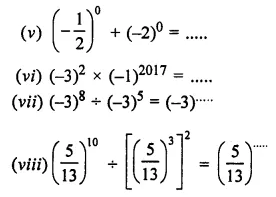
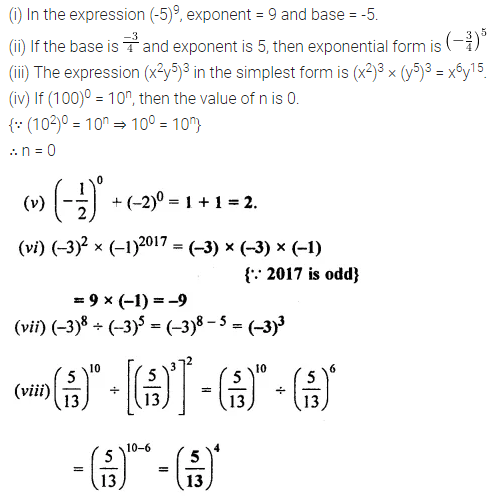
(i) In the expression (-5)9, exponent = ……… and base = ………..
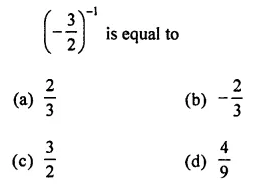
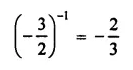
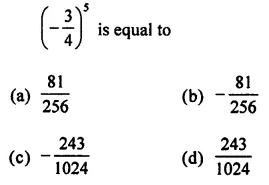
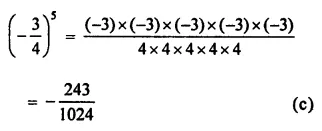
(ii) If the base is \(\frac { -3 }{ 4 }\) and exponent is 5, then exponential form is ………
(iii) The expression (x2y5)3 in the simplest form is ………
(iv) If (100)0 = 10n, then the value of n is ……..
ML Aggarwal Class 7 Solutions for ICSE Maths Chapter 4 Exponents and Powers Objective Type Questions 1
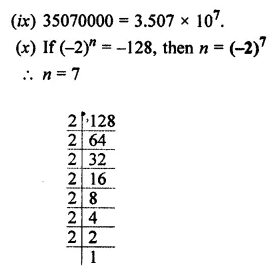
(ix) 35070000 = 3.507 × 10….
(x) If (-2)n = -128, then n = ……..
Solution:
ML Aggarwal Class 7 Solutions for ICSE Maths Chapter 4 Exponents and Powers Objective Type Questions 2

Question 2.
State whether the following statements are true (T) or false (F):
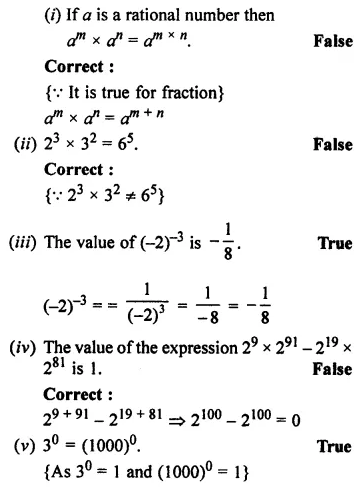
(i) If a is a rational number then am × an = am×n
(ii) 23 × 32 = 65.
(iii) The value of (-2)-3 is \(\frac { -1 }{ 8 }\).
(iv) The value of the expression 29 × 291 – 219 × 281 is 1.
(v) 30 = (1000)0.
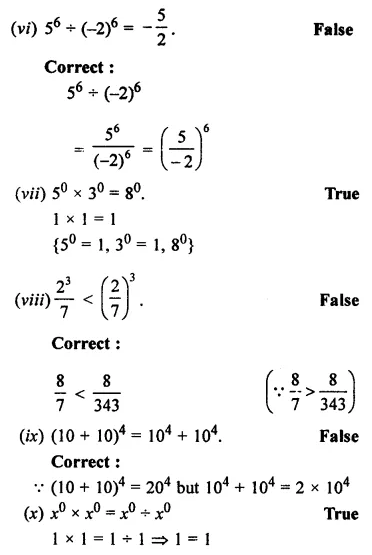
(vi) 56 ÷ (-2)6 = \(\frac { -5 }{ 2 }\)
(vii) 50 × 30 = 80
(viii) \(\frac { { 2 }^{ 3 } }{ 7 } <\left( \frac { 2 }{ 7 } \right) ^{ 3 }\)
(ix) (10 + 10)4 = 104 + 104.
(x) x0 × x0 = x0 ÷ x0, where x is a non-zero rational number.
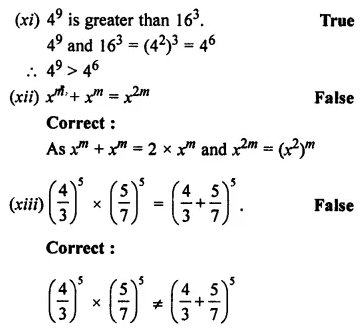
(xi) 49 is greater than 163.
(xii) xm + xm = x2m, where x is a non-zero rational number and m is a positive integer.
(xiii) \(\left( \frac { 4 }{ 3 } \right) ^{ 5 }\times \left( \frac { 5 }{ 7 } \right) ^{ 5 }=\left( \frac { 4 }{ 3 } +\frac { 5 }{ 7 } \right) ^{ 5 }\)
Solution:
ML Aggarwal Class 7 Solutions for ICSE Maths Chapter 4 Exponents and Powers Objective Type Questions 4
ML Aggarwal Class 7 Solutions for ICSE Maths Chapter 4 Exponents and Powers Objective Type Questions 5
ML Aggarwal Class 7 Solutions for ICSE Maths Chapter 4 Exponents and Powers Objective Type Questions 6

Multiple Choice Questions

Choose the correct answer from the given four options (3 to 18):
Question 3.
a × a × a × b × b × b is equal to
(a) a3b2
(b) a2b3
(c) (ab)3
(d) a6b6
Solution:
ML Aggarwal Class 7 Solutions for ICSE Maths Chapter 4 Exponents and Powers Objective Type Questions 7

Question 4.
(-2)3 × (-3)2 is equal to
(a) 65
(b) (-6)6
(c) 72
(d) -72
Solution:
ML Aggarwal Class 7 Solutions for ICSE Maths Chapter 4 Exponents and Powers Objective Type Questions 8

Question 5.
The expression (pqr)3 is equal to
(a) p3qr
(b) pq3r
(c) pqr3
(d) p3q3r3
Solution:
ML Aggarwal Class 7 Solutions for ICSE Maths Chapter 4 Exponents and Powers Objective Type Questions 9

Question 6.
ML Aggarwal Class 7 Solutions for ICSE Maths Chapter 4 Exponents and Powers Objective Type Questions 10
Solution:
ML Aggarwal Class 7 Solutions for ICSE Maths Chapter 4 Exponents and Powers Objective Type Questions 11

Question 7.
ML Aggarwal Class 7 Solutions for ICSE Maths Chapter 4 Exponents and Powers Objective Type Questions 12
Solution:
ML Aggarwal Class 7 Solutions for ICSE Maths Chapter 4 Exponents and Powers Objective Type Questions 13

Question 8.
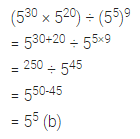
The value of (530 × 520) ÷ (55)9 in the exponential form is
(a) 5-5
(b) 55
(c) 550
(d) 595
Solution:
ML Aggarwal Class 7 Solutions for ICSE Maths Chapter 4 Exponents and Powers Objective Type Questions 14

Question 9.
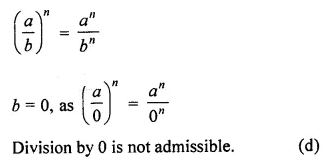
The law \(\left( \frac { a }{ b } \right) ^{ n }=\frac { { a }^{ n } }{ b^{ n } }\) does not hold when
(a) a = 3, b = 2
(b) a = -2, b = 3
(c) n = 0
(d) b = 0
Solution:
ML Aggarwal Class 7 Solutions for ICSE Maths Chapter 4 Exponents and Powers Objective Type Questions 15

Question 10z
ML Aggarwal Class 7 Solutions for ICSE Maths Chapter 4 Exponents and Powers Objective Type Questions 16
Solution:
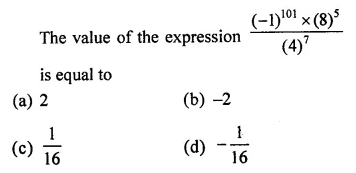
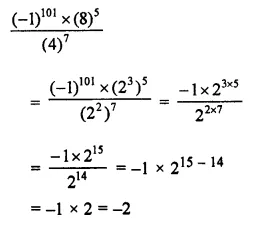
ML Aggarwal Class 7 Solutions for ICSE Maths Chapter 4 Exponents and Powers Objective Type Questions 17

Question 11.
ML Aggarwal Class 7 Solutions for ICSE Maths Chapter 4 Exponents and Powers Objective Type Questions 18
Solution:
ML Aggarwal Class 7 Solutions for ICSE Maths Chapter 4 Exponents and Powers Objective Type Questions 19

Question 12.
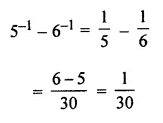
The value of 5-1 – 6-1 is
(a) \(\frac { 1 }{ 30 }\)
(b) \(\frac { -1 }{ 30 }\)
(c) 30
(d) -30
Solution:
ML Aggarwal Class 7 Solutions for ICSE Maths Chapter 4 Exponents and Powers Objective Type Questions 20

Question 13.
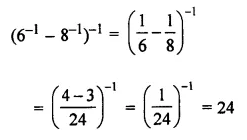
The value of (6-1 – 8-1)-1 is
(a) \(\frac { -1 }{ 2 }\)
(b) -2
(c) \(\frac { 1 }{ 24 }\)
(d) 24
Solution:
ML Aggarwal Class 7 Solutions for ICSE Maths Chapter 4 Exponents and Powers Objective Type Questions 21

Question 14.
ML Aggarwal Class 7 Solutions for ICSE Maths Chapter 4 Exponents and Powers Objective Type Questions 22
Solution:
ML Aggarwal Class 7 Solutions for ICSE Maths Chapter 4 Exponents and Powers Objective Type Questions 23

Question 15.
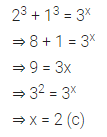
If 23 + 13 = 3x, then the value of x is
(a) 0
(b) 1
(c) 2
(d) 3
Solution:
ML Aggarwal Class 7 Solutions for ICSE Maths Chapter 4 Exponents and Powers Objective Type Questions 24

Question 16.
The standard form of 751.65 is
(a) 7.5165 × 10²
(b) 75.165 × 101
(c) 7.5165 × 10⁴
(d) 7.51 × 10²
Solution:
ML Aggarwal Class 7 Solutions for ICSE Maths Chapter 4 Exponents and Powers Objective Type Questions 25

Question 17.
The usual form of 5.658 × 10⁵ is
(a) 5658
(b) 56580
(c) 565800
(d) 5658000
Solution:
ML Aggarwal Class 7 Solutions for ICSE Maths Chapter 4 Exponents and Powers Objective Type Questions 26

Question 18.
Which of the following numbers is in the standard form?
(a) 26.57 × 10⁴
(b) 2.657 × 10⁴
(c) 265.7 × 10³
(d) 0.2657 × 10⁶
Solution:
ML Aggarwal Class 7 Solutions for ICSE Maths Chapter 4 Exponents and Powers Objective Type Questions 27

Value Based Questions

Question 1.
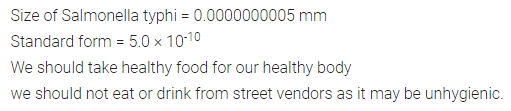
Typhoid is caused by bacteria Salmonella typhi. The size of Salmonella typhi is about 0.0000000005 mm. Express it in standard form. Vinay is suffering from typhoid, his doctor advised him to take healthy food and avoid eating food or drinking beverages from street vendors.
Why should we eat healthy food and why should we not eat food from street vendors?
Solution:
ML Aggarwal Class 7 Solutions for ICSE Maths Chapter 4 Exponents and Powers Objective Type Questions 28

Higher Order Thinking Skills (HOTS)

Question 1.
ML Aggarwal Class 7 Solutions for ICSE Maths Chapter 4 Exponents and Powers Objective Type Questions 29
Solution:
ML Aggarwal Class 7 Solutions for ICSE Maths Chapter 4 Exponents and Powers Objective Type Questions 30

Question 2.
ML Aggarwal Class 7 Solutions for ICSE Maths Chapter 4 Exponents and Powers Objective Type Questions 31
Solution:
ML Aggarwal Class 7 Solutions for ICSE Maths Chapter 4 Exponents and Powers Objective Type Questions 32

Two Stories about Flying Extra Questions and Answers Class 10 English First Flight

Here we are providing Two Stories about Flying Extra Questions and Answers Class 10 English First Flight, Extra Questions for Class 10 English was designed by subject expert teachers.

Two Stories about Flying Extra Questions and Answers Class 10 English First Flight

Two Stories about Flying Extra Questions and Answers Very Short Answer Type

Question 1.
Why was the young seagull alone?
Answer:
The young seagull was alone because his two brothers and sister had already flown.

Question 2.
Why did he not fly with his brothers and sister?
Answer:
He did not fly because he was afraid.

Question 3.
Where did he sleep that night?
Answer:
He slept in a little hole under the ledge.

Question 4.
Where did young seagull live?
Answer:
The young seagull lived alone on his ledge.

Question 5.
Why was be afraid to fly?
Answer:
He was afraid to fly because his wings would never support him.

Question 6.
What did he see throughout the day?
Answer:
He saw his parents perfecting his brothers and sister in the art of flying.

Question 7.
How’ did they taunt him?
Answer:
They taunted him with his cowardice.

Question 8.
Who took pity on the young seagull?
Answer:
His mother pitied on the young seagull.

Question 9.
Who had already landed on the green flooring?
Answer:
His parents, brothers and sister had already landed on the green flooring.

Question 10.
How did the family show their happiness for the young seagull?
Answer:
They offered him scraps of dog fish through their beaks.

Two Stories about Flying Extra Questions and Answers Short Answer Type

Question 1.
Why was the young seagull afraid to fly?
Answer:
Whenever the young seagull took a little run forward to the extreme edge of the ledge and attempted, to flap his wings, he became afraid. Seeing the vast area of the sea, he thought his wings would never support him.

Question 2.
How were Seagull’s parents helping his brothers and sister for “perfecting them in the art of flight”?
Answer:
The young seagull was afraid of flying, but his two brothers and a sister had started flying. But his parents were teaching them to be perfect in the art of flying. They were teaching them how to skim the waves and how to dive for fish.

Question 3.
‘He felt the heat because he had not. eaten since the previous nightfall’. What did the young seagull do to satisfy his hunger?
Answer:
The seagull was feeling hungry because he could not fly and his family had left him alone for it. To satisfy his hunger, he was forced to eat whatever he found.

Question 4.
Why- could the young seagull not reach his parents without flying?
Answer:
He could not reach his parents without flying because on each side of him the edge ended in a sheer fall in a verticle cliff, with the sea below. Then, between him and his parents there was a deep and wide crack in the land.

Question 5.
“Still they- took no notice of him.” What did the seagull do to draw the attention of his family?
Answer:
The young seagull stepped slowly out to the extreme edge of the ledge. He was standing on one leg with the other leg hidden under his wing. He closed one eye, then the other and pretended to be asleep and they look no notice of him.

Question 6.
What was his family doing on the plateau when seagull failed to draw their attention?
Answer:
The two brothers and the sister of the young seagull were half asleep with their heads sunk into their necks. His father was preening the feathers with his beak on his white back. Only his mother, standing on a little mound on the plateau, was looking at him.

Question 7.
“But he kept calling plaintively, and after a minute or so he uttered a joyful scream.” Why did the young seagull utter a joyful scream?
Answer:
The young seagull was desperately hungry. So, he screamed with joy when he saw his mother flying across to him with a piece of fish in her beak. He leaned out eagerly, tapping the rock with his feet trying to get nearer to her.

Question 8.
“Ga, ga, ga,” he cried begging her to bring him some food. To whom was the young seagull begging and did she respond?
Answer:
The young seagull was begging his mother to bring some food to him. But his mother’s motive was to teach him flying. So, she stopped flying when she reached near him so that he might attempt to fly.

Question 9.
How did the young seagull start flying?
Answer:
The young seagull was ‘maddened by hunger” when he dived at the piece of fish in his mother’s beak. But he fell outwards and downwards with a loud scream. When his mother swooped upwards, he followed her and thus he started flying.

Question 10.
“He dropped his legs to stand on the green sea.” How did his family react when he did so?
Answer:
Being tired and weak with hunger, the young seagull dropped his legs to stand on the green sea. His entire family came around him screaming, praising him and their beaks were offering him scraps of dog-fish.

Question 11.
When did the seagull’s flight begin? Where did it end?
Answer:
The seagull’s flight began when he moved to the brink of the ledge. He dived at the fish, which was in his mother’s beak. His fight ended when, after being tired of his first flight and being weak, he dropped himself on the surface of the sea and floated on it.

Question 12.
How did the seagull get over his fear of the water?
Answer:
After his first flight, the seagull was tired of his strange experience. He dropped his two legs to stand on the green sea. He screamed fearfully and attempted to rise again flapping his wings. He overcame his fear of the water by floating on it.

Question 13.
Do you sympathise with the seagull? Why?
Answer:
We sympathise with the seagull because, due to his fear of flying, he had to remain lonely and hungry, after his family had left him to suffer. He could not muster courage to fly like his brothers and sister.

Question 14.
How did the seagull express his excitement when he saw his mother bringing food for him?
Answer:
The young seagull uttered a joyful scream when he saw his mother picking up a piece of the fish and flying across to him with it. He leaned out eagerly, tapping the rock with his feet.

Question 15.
How did the young seagull’s parents teach their children the ait of flying?
Answer:
The seagull’s parents had taught their children how to skim the waves and how to dive for the fish. They encouraged them raising of loud shrill sound when their older son caught his first herring and ate it greedly.

Two Stories about Flying Extra Questions and Answers Long Answer Type

Question 1.
Why was the young seagull left alone in the ledge by his family?
Answer:
The young seagull was afraid to fly. His father and mother wanted him to go and fly with them. But whenever he had taken a little run forward to the extreme edge of the ledge and tried to move his wings he became afraid. He failed to muster up courage to thrust himself forcibly in the space, and started flying.

His two brothers and his sister had the wings shorter than him but they started flying. But the young seagull somehow thought that his wings would notsupport him for it. For this, he was scolded by his parents, who gave a threat to him and he was left alone in the ledge.

Question 2.
How did the young seagull learn floating on the sea?
Answer:
After flying for sometime, the young seagull came near the sea. He was a flying straight over it. He saw, a vast green sea beneath him, with little ridges moving over it. His brothers and sister had landed on the sea and they were calling in a shrill voice and beckoning to him. He dropped his legs to stand on the green sea. His legs sank into water. He screamed with fright and attempted to rise again flapping his wings.

But he was tired and weak with hunger. He was exhausted due to flying for so long. His feet sank into the green sea, and then his belly touched it and he sank no farther. He was floating on it, and around him his family was screaming, praising him and offering him food from their beaks. This is how he learnt floating on the sea.

Question 3.
How do you find the seagulls in the beginning and at the end of the lesson?
Answer:
In the beginning we find the young seagull too frightened and terrified to fly. He had bigger wings as compared to his two brothers and sister. But still he was afraid even to attempt flying. When they flew away, he could gather courage to thrust himself forcibly in space, which made him scared and desperate.

When he was starving for a day, his mother came across to him with a piece of fish in her beak. When she reached near him, she stopped and ‘maddened by hunger,’ he dived at the fish. But his mother had swooped upward. He found his wings spread and was more confident now. In the end we see him flying till he was tired and dropped himself on the surface of the sea.

Question 4.
What methods were used by the seagull’s family to help him overcome his fear of flying?
Answer:
The young seagull was scared of flying. His brothers and sister had started flying but he could not muster courage to do so. His parents scolded him shrilly and threatened to let him starve on the ledge unless he flew away. When his family left him, he felt the pangs of hunger. Next day, when he saw his mother with a piece of fish in her beak, be begged her for food. She flew across to him, but halted when the piece of fish in her beak was just within reach of the young seagull. The young seagull dived at the fish, but now her mother swooped upwards. Gradually his fear of flying was over and he enjoyed it now.

Question 5.
The young seagull was “trying to find some means of reacting his parents without having to fly”. Was he successful in doing so?
Answer:
After being left alone by his family, the young seagull was hungry. So he wanted to join his family on the plateau. But he could not do so unless he tried to fly. As he was afraid of flying he was trying to find some other means to reach them. But on each side of him the ledge ended in a steep fall in a vertical cliff, with the sea below.

Moreover, between him and his parents there was a deep and wide crack in the earth. He could reach them without flying if he could only move towards north along with the steep rock. There was no ledge and he could not fly. And above him he could see nothing. The vertical cliff was very steep, and the top of it was perhaps farther away than the sea beneath him. So he was not able to reach them without flying.

Question 6.
Do you think hunger was a good motivation for the young seagull in his first flight? Comment.
Answer:
Yes, I do think that hunger played a vital role in the young seagull’s attempt to start flying. He was left
alone on the ledge by his family because he would not try to fly with them. His parents scolded him in a shrill voice and threatened him of starvation, but he still was afraid to fly. Then they left him alone.

He was so hungry that he had to live on whatever he could find there. When he saw his mother with a piece of fish in her beak, he begged her for food. Then he uttered a joyful scream when he saw his mother flying across to him with a piece of fish in her beak. But she stopped when she came opposite to him.

When the young seagull realised that she won’t come nearer, and “maddened by hunger,” he dived at the fish. This was his first attempt to fly. Gradually when his hesitation and fear were removed, he started flying which he enjoyed very much.

Question 7.
“Then he completely forgot that he had not always been able to fly.” Comment on the young seagull’s first flight in light of this statement.
Answer:
The young seagull was suffering from the pangs of hunger after his family left him. Next day when he saw them on the plateau, he tried to draw their attention. Then his mother flew across to him with a piece of fish in her beak. But she stopped opposite him with her motionless wings. He could no more tolerate the hunger and “maddened by hunger, he dived at the fish” though terrified, he felt his wings spread outwards.

He could feel the tips of his wjngs cutting through the air. Now he was soaring gradually downwards and outwards. He was no more afraid of flying now. He flapped his wings once and he soared upwards. He screamed to encourage himself and share his happiness. He forgot that previously he was not able to fly.

Question 8.
Fear and lack of confidence stop one from learning new things. Do you agree? How did these two traits of the young seagull make him coward? How did he overcome these shortcomings.
Answer:
Yes, it is true that fear and lack of confidence stop one from learning new things as in the story, the young seagull lacked the value of courage and confidence in his character. He was too scared of flying.

His family tried hard to make him fly but he refused to do so because of his fear of sinking in the seawater. They even scolded him for his cowardice. They tried to tempt him with food but he was not willing to learn flying. Once he dived, his fear disappeared and he enjoyed his first fight. It is a fact that unless we try for something and overcome our fear, we cannot learn any thing. Confidence and motivation are the two most important traits that make any learning possible.

Question 9.
“Hunger made the young seagull mad and gave him success.” How can you explain it and justify with the story?
OR
Hunger is a great motivational force. It is true that a person can take any extreme step for food. How far do you agree?
Answer:
It is a fact that hunger makes us mad and every person works for food. It is only hunger that encourages and forces us to do work. If it is not in our life, all the boundation of work will automatically be finished. Every person works for food and to satisfy his hunger. No one in this universe can remain hungry. This hunger makes us work day and night. It can change the mentality of any human being as well as any creature.

We find that young seagull did not gather courage to fly; when he saw fish in the mouth of his mother, he gathered courage and flew over the ledge. He could not control himself at the sight of the food and jumped at the fish. He fell from the ledge and tried to flap his wings. Thus he found himself flying into the air.

Question 10.
“Mother is the first teacher”. Do you agree with this statement? Explain with reference to the young seagull.
Answer:
Yes, it is true that mother is the first teacher. It is a well known point for all. A baby takes birth and first of all sees mother’s face. It is mother who gives him a new life by feeding him. The mother helps a baby to walk him first step. The mother introduces him to this world, gives him knowledge of relations. She teaches him how to speak. She gives him power and strength to face the difficulties of life.

The same thing we find in this story, when no one could encourage the young seagull to fly, his mother thought out a plan and took a piece of fish near him, but she did not go nearer and her plan worked.

Question 11.
Why was the young seagull afraid to fly? Do you think all young birds are afraid to make their first flight, or are some birds more timid than others? Do you think a human baby also finds it a challenge to take its first steps?
Answer:
The young seagull was afraid to fly because he felt that his wings could not support him. Yes, I think that all young birds are afraid to make their first flight. It’s new experience for them. However, some of the birds are more timid than others. They take some time to muster the courage to begin their first flight. It is true in case of a human baby also. They find it a challenge to take their first step.

Question 12.
“The sight of the food maddened him.” What does this suggest? What compelled the young seagull to finally fly?
Answer:
The sight of the food maddened him. He had been hungry for 24 hours. He was impatient and desperate. He dived at the fish in his mother’s beak. She flew upwards. He fell downwards. His wings spread outwards, cutting though the air. Thus began his flight.

Question 13.
“They were beckoning to him, calling shrilly.” Why did the seagull’s father and mother threaten him and cajole him to fly?
Answer:
The young seagull was afraid to fly. He was alone on his ledge. His two brothers and his sister had already flown away the day before. But he was too timid to fly. He felt that his small wings would never support him. His father and mother came around calling to him shrilly. They threatened him to starve on his ledge unless he flew away. They wanted him to take his first flight.

Question 14.
Have you ever had a similar experience, where your parents encouraged you to do something that you were too scared to try? Discuss this in pairs or group.
Answer:
Group activity.

Question 15.
In the case of a bird flying, it seems a natural act, and a foregone conclusion that it should succeed. In the examples you have given in answer to the previous question, was your success guaranteed, or was it important for you to try, regardless of a possibility of failure?
Answer:
In the case of bird flying, it seems a natural act, and a foregone conclusion that it should succeed. But in case of learning something, success is never guaranteed. To succeed, one has to put in hard work and continuous practice. When a child learns to step, to run, to speak success is almost guaranteed because these are natural acts but when one learns a skill, it is not a natural act. Success is not guaranteed. One has to try regardless of a possibility of failure.

Two Stories about Flying Extra Questions and Answers Reference to Context

Read the following passages and answer the questions that follow:

Question 1.
The young seagull was alone on his ledge. His two brothers and his sister had already flown away the day before. He had been afraid to fly with them. Somehow when he had taken a little run forward to the brink of the ledge and attempted to flap his wings he became afraid. The great expanse of sea stretched down beneath, and it was such a long way down – miles down. He felt certain that his wings would never support him; so he bent his head and ran away back to the little hole under the ledge where he slept at night. Even when each of his brothers and his little sister, whose wings were far shorter than his own, ran to the brink, flapped their wings, and flew away, he failed to muster up courage to take that plunge which appeared to him so desperate. His father and mother had come around calling to him shrilly, upbraiding him, threatening to let him starve on his ledge unless he flew away. But for the life of him he could not move.
(i) Why was the young seagull alone?
(ii) Why did he not fly with his brothers and sister?
(iii) Where did he sleep that night?
(iv) How did his parents try to make him fly?
Answer:
(i) The young seagull was alone because his two brothers and sister had already flown away the day before.
(ii) He did not fly with his brothers and sister because he was afraid.
(iii) He slept in a little hole under the ledge.
(iv) They invited him encouragingly. They also threated him that he would die of hunger if he did not fly.

Question 2.
That was twenty-four hours ago. Since then nobody had come near him. The day before, all day long, he had watched his parents flying about with his brothers and sister, perfecting them in the art of flight, teaching them how to skim the waves and how to dive for fish. He had, in fact, seen his older brother catch his first herring and devour it, standing on a rock, while his parents circled around raising a proud cackle. And all the morning the whole family had walked about on the big plateau midway down the opposite cliff taunting him for his cowardice. (Page 33)
(i) What had happened twenty four hours ago?
(ii) What did the young seagull watch all day?
(iii) What did his brothers do?
(iv) Why did his family taunt the young seagull?
Answer:
(i) Twenty four hours ago, the young seagull was left alone. His parents, brothers, and sister had flown away.
(ii) The young seagull watched all day his brother and sister flying over the sea.
(iii) His brother caught his first fish.
(iv) His family taunted the young seagull for his cowardice.

Question 3.
The sun was now ascending the sky, blazing on his ledge that faced the south. He felt the heat because he had not eaten since the previous nightfall.He stopped slowly out to the brink of the ledge, and standing on one leg with the other leg hidden under his wing, he closed one eye, then the other, and pretended to be falling asleep. Still they took no notice of him. He saw his two brothers and his sister lying on the plateau dozing with their heads sunk into their necks. His father was preening the feathers on his white back. Only his mother was looking at him. She was standing on a little high hump on the plateau, her white breast thrust forward. Now and again, she tore at a piece of fish that lay at her feet and then scrapped each side of her beak on the rock. The sight of the food maddened him. How he loved to tear food that way, scrapping his beak now and again to whet it. (Pages 33-34)
(i) Who was looking at the young seagull?
(ii) What were his brothers doing?
(iii) What was the condition of the seagull?
(iv) What did he like to do?
Answer:
(i) The mother of the young seagull was looking at him.
(ii) His brothers were dozing with their heads sunk into their necks.
(iii) His condition was troubled due to keen hunger.
(iv) He loved to tear the food and scrape his beak now and then to whet it.

Question 4.
“Ga, ga, ga,” he cried begging her to bring him some food. “Gaw-col-ah,” she screamed back derisively. But he kept calling plaintively, and after a minute or so he uttered a joyful scream. His mother had picked up a piece of the fish and was flying across to him with it. He leaned out eagerly, tapping the rock with his feet, trying to get nearer to her as she flew across. But when she was just opposite to him, she halted, her wings motionless, the piece of fish in her beak almost within reach of his beak. He waited a moment in surprise, wondering why she did not come nearer, and then, maddened by hunger, he dived at the fish. (Pages 34-35)
(i) What did the young seagull cry for?
(ii) Did her mother pay attention to his request?
(iii) Why did the young seagull utter a joyful scream?
(iv) What was the real intention of the mother?
Answer:
(i) The young seagull cried for food.
(ii) No, the mother did not pay attention to his request.
(iii) When he saw her mother coming towards him with a piece of fish, he uttered a joyful scream.
(iv) The mother wanted him to fly. She tempted him to dive for the food and fly.

Question 5.
With a loud scream he fell outwards and downwards into space. Then a monstrous terror seized him and his heart stood still. He could hear nothing. But it only lasted a minute. The next moment he felt his wings spread outwards. The wind rushed against his breast feathers, then under his stomach, and against his wings. He could feel the tips of his wings cutting through the air. He was not falling headlong now. He was soaring gradually downwards and outwards. He was no longer afraid. He just felt a bit dizzy. (Page 35)
(i) Why did he fall outward?
(ii) Did he fly intentionally?
(iii) What did he feel when he fell into the space?
(iv) What happened the next moment?
Answer:
(i) He fell outwards when he tried to snatch food from his mother’s beak.
(ii) No, he did not fly intentionally.
(iii) When he fell into the space a monstrous terror seized him and his heart stood still.
(iv) The next moment he felt his wings spread outwards.

Question 6.
Then he flapped his wings once and he soared upwards. “Ga, ga, ga, Ga, ga, ga, Gaw-col-ah,” his mother swooped past him, her wings making a loud noise. He answered her with another scream. Then his father flew over him screaming. He saw his two brothers and his sister flying around him curveting and banking and soaring and diving.
Then he completely forgot that he had not always been able to fly, and commended himself to dive and soar and curve, shrieking shrilly.
He was near the sea now, flying straight over it, facing straight out over the ocean. He saw a vast green sea beneath him, with little ridges moving over it and he turned his beak sideways and cawed amusedly.
(i) How did his mother respond?
(ii) Why were they happy?
(iii) What did he forget completely?
(iv) Why did he commend himself?
Answer:
(i) His mother uttered Ga, Ga, Ga and flew over him.
(ii) They were happy because the young seagull had learnt flying.
(iii) He forgot completely that he was afraid of flying.
(iv) He commended himself for his ability to fly successfully.

Question 7.
His parents and his brothers and sister had landed on this green flooring ahead of him. They were beckoning to him, calling shrilly. He dropped his legs to stand on the green sea. His legs sank into it. He screamed with fright and attempted to rise again flapping his wings. But he was tired and weak with hunger and he could not rise, exhausted by the strange exercise. His feet sank into the green sea, and then his belly touched it and he sank no farther. He was floating on it, and around him his family was screaming, praising him and their beaks were offering him scraps of dog-fish.
He had made his first flight.
(i) Where were his parents and brothers?
(ii) Why did the young seagull scream?
(iii) What did the young seagull learn?
(iv) How was he rewarded by his family members?
Answer:
(i) His parents and brothers had landed on the surface of the sea.
(ii) The young seagull screamed because he felt himself sinking into the water.
(iii) The young seagull learnt two things-flying and floating.
(iv) He was offered scraps of dog fish by the member of his family.

The Black Aeroplane

Two Stories about Flying Extra Questions and Answers Very Short Answer Type

Question 1.
Where was the speaker going and how?
Answer:
The speaker was going to England and he was flying his old Dakota aeroplane.

Question 2.
What happened to his aeroplane?
Answer:
His aeroplane twisted and jumped in the air.

Question 3.
What was the advice given to him from Paris Control?
Answer:
Paris Control advised him to turn twelve degrees west.

Question 4.
How did the clouds look?
Answer:
The clouds looked like black mountains.

Question 5.
What was the trouble in flying to the North or South?
Answer:
His Dakota aeroplane was having short fuel.

Question 6.
What was there inside the clouds?
Answer:
Inside the clouds everything was black.

Question 7.
What had happened to other instruments?
Answer:
Others instruments became dead.

Question 8.
How did his compass work?
Answer:
His compass became dead.

Question 9.
What did the speaker see suddenly?
Answer:
The speaker saw suddenly an another aeroplane in the black clouds.

Question 10.
How did the another pilot conduct?
Answer:
The another pilot turned towards him and waved his hand.

Two Stories about Flying Extra Questions and Answers Short Answer Type

Question 1.
Describe the author’s feeling while he was flying his aeroplane back to England?
Answer:
The author was very excited while he was flying his aeroplane back to England because he wanted to spend his holiday with his family at home.

Question 2.
How much fuel was there in the aeroplane when the writer started flying?
Answer:
There was sufficient fuel in the tanks of the aeroplane to reach England safely when the writer started flying.

Question 3.
What risk did the writer take while flying? Why?
Answer:
The writer decided to risk to fly through the storm clouds because he wanted to enjoy his holiday with his family back in England.

Question 4.
What did the writer feel inside the clouds?
Answer:
When the writer entered the clouds, it became impossible to see outside the aeroplane. The aeroplane jumped and twisted in the air and all the instruments like compass, etc stopped working due to the weather conditions.

Question 5.
What did the writer see inside the black clouds?
Answer:
The writer saw a black aeroplane which had no lights on its wings. The writer could see the face of the pilot in the black clouds who was waving and signalling him to follow to get out of the storm.

Question 6.
Why did the writer follow the pilot of another aeroplane? ‘
Answer:
The writer followed another aeroplane because he had lost the way in the storm and was unable to see
anything. The pilot of another aeroplane was helping him to get out of the storm and land safely.

Question 7.
Why did the woman in control room get shocked when the writer asked about another aeroplane?
Answer:
The woman in the control room was shocked when the writer asked about another aeroplane because there was no such plane flying in the sky that night as she saw on the radar.

Question 8.
Why did the writer want to meet the pilot of the black aeroplane?
Answer:
The writer wanted to meet the pilot of the black aeroplane to thank him as he saved his life by helping him to come out from the storm.

Two Stories about Flying Extra Questions and Answers Long Answer Type

Question 1.
How did the writer get out of the storm in the night to land safely?
Answer:
The writer was flying his old Dakota aeroplane when he saw the black clouds. He was lost in the storm. Suddenly, he saw a black aeroplane by his side, which had no lights, on its wings.

The pilot instructed the writer to follow as he had lost the way. He obeyed him like a child. He was very happy to follow him. After some time the pilot of another plane started to land. The writer followed him blindly through the storm and came out of the clouds. He saw the lights of the runway and landed safely.

Question 2.
Why was the writer happy when he decided to fly in the night?
Answer:
The writer was very happy when he decided to fly that night because he was going home to his family to – enjoy his holiday. When he started, everything seemed to be perfect. The sky was clear, no clouds could be seen. He was flying back to England in his old Dakota aeroplane over France. He was happy being alone in the sky and was dreaming of his holiday.

Question 3.
“The Black Aeroplane’ is a mystery Story. Explain.
OR
Do you agree that the story ‘The Black Aeroplane’ is a mystery? Justify your answer with reasons.
Answer:
Yes, ‘The Black Aeroplane’ is a mystery story. The pilot of old Dakota was caught in the storm. He was helpless as his instruments had stopped functioning. He did not know what to do. Suddenly he saw a black Aeroplane flying next to him. It was a strange plane flying in the storm without lights.

The pilot of the black aeroplane helped him in landing safely. On landing he turned back to look for the friend but he had disappeared. The black aeroplane had gone, the lady in control centre told him that he was the only one flying that night. There was no other plane. He could not understand who helped him. It was really a big mystery.
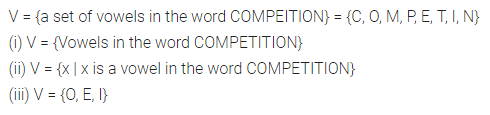
Question 4.
Define the values that reflect from the action of the pilot of old Dakota aeroplane when he wanted to thank the pilot of the Black aeroplane.
OR
The pilot wanted to thank another pilot after his safe landing. Why? What values of the writer are reflected from his action?
Answer:
The pilot of the Old Dakota was caught in the storm. He lost his contact with the control room. In this troubling situation, his fuel tank was also empty. He lost all his hopes but suddenly a black strange plane appeared.

The pilot of the black plane asked the writer to follow him. The writer landed safely. After his safe landing, he wanted to thank the pilot of black plane. This shows his gratitude towards the pilot of black plane. He was thankful to him for saving his life. It shows that the pilot of Dakota had a value of gratefulness

Thinking about the Text

Question 1.
“I”ll take the risk.” What is the risk? Why does the narrator take it?
Answer:
The narrator was on his way to England. Paris was about 150 kilometres when he saw storm clouds. He could not fly up and over them. He did not have enough fuel to fly around them. He ought to go back to Paris. But he took the risk of flying straight into the storm because he wanted to get home and have a good breakfast with his family.

Question 2.
Describe the narrator’s experience as he flew the aeroplane into them.
Answer:
The narrator saw huge black storm clouds. He took the risk and flew straight into them. Inside the- clouds everything suddenly went back. He could not see anything outside the plane. His plane was jumping and twisting in the clouds. The compass was dead. Other Instruments also stopped functioning. The narrator was lost in the storm clouds.

Question 3.
Why does the narrator say, “I landed and was not sorry to walk awa> ..n: the old Dakota…”?
Answer:
The narrator took the risk of flying straight into the storm clouds. He was lost there. His instrument did not help him as they had stopped functioning. Suddenly he saw a back plane flying near him. The pilot of that plane waved at him and asked him to follow the black plane. The narrator followed him like an obedient child. He landed safely. He was not sorry for the risk he had taken. He had confidence in his old Dakota. He remarked at the end, “I landed and was not sorry to walk away from the old Dakota…”

Question 4.
What made the woman in the control centre look at the narrator strangely?
Answer:
The narrator was helped by the pilot of the black plane in safe landing. He wanted to thank him. He went to the women in the control room and asked about the pilot of another plane. She looked at him strangely and told him that there was no other plane flying that night. His was the only plane that could be seen on the radar.

Question 5.
Who do you think helped the narrator to reach safely? Discuss this among yourselves and give reasons for your answer.
Answer:
The narrator was lost in the storm. His plane’s instruments had stopped functioning. He was scared. Suddenly, a strange black plane appeared near him. He was happy to see the plane. The pilot of the second plane waved his hand and asked him to follow him. He helped the narrator in landing safely. After his safe landing the narrator wanted to thank the second pilot. He was told by the woman at control centre that his was the only plane flying in the sky that night. There was no other plane or pilot.

He was surprised. He could not understand who the pilot was on the strange plane. It was a mystery. Perphaps it was his imagination only. But the question arises if it was his imagination then how could he land safely without a compass and other instruments! I think it was his third sense that helped him. Sometimes it happens that when our active senses do not work, our latent power helps us. I think, it was his latent power which created an imaginary plane and pilot to help him in landing safely

Two Stories about Flying Extra Questions and Answers Reference to Context

Read the following passages and answer the questions that follow:

Question 1.
The moon was coming up in the east, behind me, and stars were shining in the clear sky above me. There wasn’t a cloud in the sky. I was happy to be alone high up above the sleeping countryside. I was flying my old Dakota aeroplane over France back to England. I was dreaming of my holiday and looking forward to being with my family. I looked at my watch: one thirty in the morning.
(i) Who is ‘Me’ and T in the passage?
(ii) What does he mean by “the clear sky”?
(iii) What was he dreaming about?
(iv) Where was he flying the old Dakota?
Answer:
(i) ‘Me’ and ‘I’ refer to the pilot flying the Dakota Aeroplane, who is the author himself.
(ii) By clear sky, he means that the stars were shining and there were no clouds in the sky.
(iii) He was dreaming about his pleasant holiday and how he will be with his family soon.
(iv) He was flying the old Dakota over France back to England.

Question 2.
‘I should call Paris Control soon,’ I thought. As I looked down past the nose of the aeroplane, I saw the lights of a big city in front of me. I switched on the radio and said, “Paris Control, Dakota DS 088 here. Can you hear me? I’m on my way to England. Over.” The Voice from the radio answered me immediately: “DS 088,1 can hear you. You ought to turn twelve degrees west now, DS 088. Over.” I checked the map and the compass, switched over to my second and last fuel tank, and turned the Dakota twelve degrees west towards England.
(i) Why did he make a call to Paris Control room?
(ii) What advice did he get from the Control room?
(iii) How many fuel tanks were there is his plane?
(iv) What did he see in front of him?
Answer:
(i) He made a call to Paris Control room to inform about his flight.
(ii) The Control room advised him to turn twelve degrees west.
(iii) He had two fuel tanks in his aeroplane.
(iv) He saw the light of a big city in front of him.

Question 3.
‘I’ll be in time for breakfast, ‘I thought. A good big English breakfast! Everything was going well—it was an easy flight. Paris was about 150 kilometres behind me when I saw the clouds. Storm clouds. They were huge. They looked like black mountains standing in front of me across the sky. I knew I could not fly up and over them, and I did not have enough fuel to fly around them to the north or south.  “I ought to go back to Paris,” I thought, but I wanted to get home. I wanted that breakfast. Til take the risk,’ I thought, and flew that old Dakota straight into the storm.
(i) Why did he call it ‘an easy flight’?
(ii) What was he thinking?
(iii) What did he see suddenly in front of him?
(iv) Pick out a word from the passage which means ‘Strong Wind’.
Answer:
(i) He called it an easy flight because it was a clear sky and there was no disturbance. Everything was going well.
(ii) He was thinking that he would reach his home in time and get a rich breakfast.
(iii) Suddenly, he saw huge storm clouds in front of him. They looked like a black mountain.
(iv) Storm.

Question 4.
Inside the clouds, everything was suddenly black. It was impossible to see anything outside the aeroplane. The old aeroplane jumped and twisted in the air. I looked at the compass. I couldn’t believe my eyes: the compass was turning round and round. It was dead. It would not work! The other instruments were suddenly dead, too. I tried the radio.“Paris Control? Paris Control? Can you hear me?” There was no answer. The radio was dead too. I had no radio, no compass, and I could not see where I was. I was lost in the storm.
(i) What was it like inside the clouds?
(ii) Was the plane flying smoothly?
(iii) Why could he not contact the Paris Control?
(iv) Pick out a word from the passage which means ‘turned’.
Answer:
(i) Inside the clouds it was blackness and it was not possible to see anything outside the plane.
(ii) No, the plane was jumping and twisting in the air.
(iii) He could not contact the Paris Control because the compass was not working and radio was dead.
(iv) Twisted.

Question 5.
Then, in the black clouds quite near me, I saw another aeroplane. It had no lights on its wings, but I could see it flying next to me through the storm. I could see the pilot’s face—turned towards me. I was very glad to see another person. He lifted one hand and waved. “Follow me,” he was saying. “Follow me.” ‘He knows that I am lost,’ I thought. ‘He’s trying to help me.’
(i) What did he see in the black clouds?
(ii) What was strange about the second plane?
(iii) What did the pilot of the other plane indicate?
(iv) What did the narrator think about the pilot of the other plane?
Answer:
(i) He saw another aeroplane in the black clouds. ‘
(ii) The second aeroplane had no lights on its wings.
(iii) The pilot of the other plane waved and indicated the narrator to follow him.
(iv) The narrator thought that the pilot of the other plane wanted to help him.

Question 6.
He turned his aeroplane slowly to the north, in front of my Dakota, so that it would be easier for me to follow him. I was very happy to go behind the strange aeroplane like an obedient child.
After half an hour the strange black aeroplane was still there in front of me in the clouds. Now there was only enough fuel in the old Dakota’s last tank to fly for five or ten minutes more. I was starting to feel frightened again. But then he started to go down and I followed through the storm.
(i) Why did he turn his aeroplane?
(ii) How did the author behave?
(iii) How much fuel was left in his plane?
(iv) Pick out a word from the passage which means the same as ‘submissive’.
Answer:
(i) He turned his aeroplane slowly to the north so that the author might follow him easily.
(ii) The author behaved as an obedient child.
(iii) There was only enough fuel to fly for five or ten minutes more.
(iv) Obedient.

Question 7.
Suddenly I came out of the clouds and saw two long straight lines of lights in front of me. It was a runway! An airport! I was safe! I turned to look for my friend in the black aeroplane, but the sky was empty. There was nothing there. The black aeroplane was gone. I could not see it anywhere. I landed and was not sorry to walk away from the old Dakota near the control tower. I went and asked a woman in the control centre where I was and who the other pilot was. I wanted to say ‘Thank you’.
(i) What did the narrator see after coming out of the clouds?
(ii) What is a runway?
(iii) Why did he turn back?
(iv) Whom did he want to thank and why?
Answer:
(i) After coming out of the clouds, the narrator saw two straight lines of lights which was a runway.
(ii) A runway is a track of landing and taking off for aeroplane.
(iii) He turned back to see his friend in the black aeroplane who had guided him in landing safely.
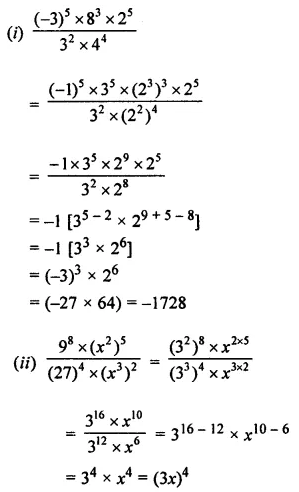
(iv) He wanted to thank the pilot of another plane who had helped him in landing safely.