ML Aggarwal Class 7 Solutions for ICSE Maths Chapter 12 Congruence of Triangles Ex 12.1

ML Aggarwal Class 7 Solutions Chapter 12 Congruence of Triangles Ex 12.1 for ICSE Understanding Mathematics acts as the best resource during your learning and helps you score well in your exams.

ML Aggarwal Class 7 Solutions for ICSE Maths Chapter 12 Congruence of Triangles Ex 12.1

Question 1.
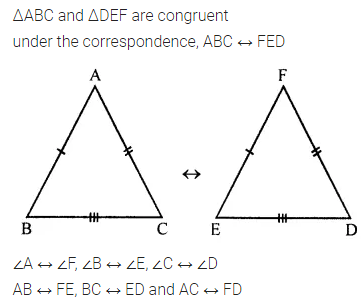
If ΔABC and ΔDEF are congruent under the correspondence ABC ↔ FED, write all the corresponding congruent parts of the triangles.
Solution:
ML Aggarwal Class 7 Solutions for ICSE Maths Chapter 12 Congruence of Triangles Ex 12.1 1

Question 2.
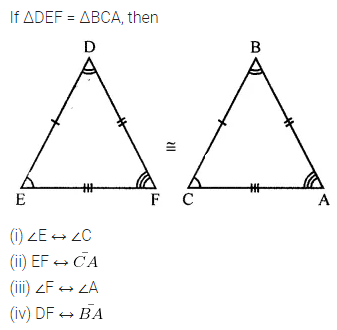
If ΔDEF = ΔBCA, then write the part(s) of ΔBCA that correspond to
(i) ∠E
(ii) \(\bar { EF }\)
(iii) ∠F
(iv) \(\bar { DF }\)
Solution:
ML Aggarwal Class 7 Solutions for ICSE Maths Chapter 12 Congruence of Triangles Ex 12.1 2

Question 3.
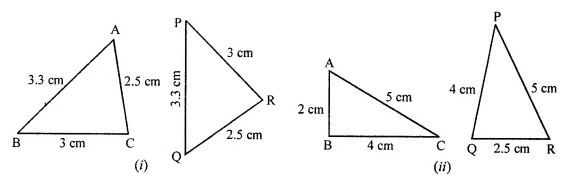
In the figure given below, the lengths of the sides of the triangles are indicated. By using SSS congruency rule, state which pairs of triangles are congruent. In the case of congruent triangles, write the result in symbolic form:
ML Aggarwal Class 7 Solutions for ICSE Maths Chapter 12 Congruence of Triangles Ex 12.1 3
Solution:
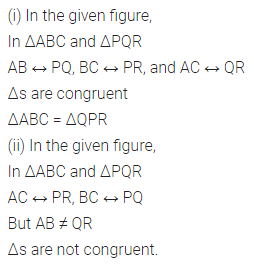
ML Aggarwal Class 7 Solutions for ICSE Maths Chapter 12 Congruence of Triangles Ex 12.1 4

Question 4.
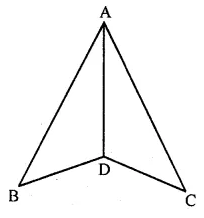
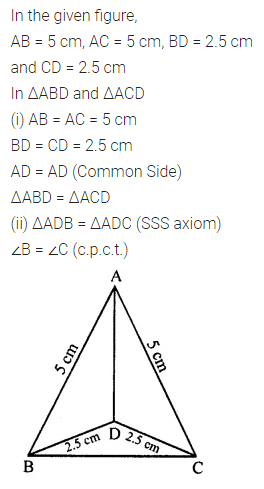
In the given figure, AB = 5 cm, AC = 5 cm, BD = 2.5 cm and CD = 2.5 cm
(i) State the three pairs of equal parts in ΔADB and ΔADC
(ii) Is ΔADB = ΔADC? Give reasons.
(iii) Is ∠B = ∠C? Why?
ML Aggarwal Class 7 Solutions for ICSE Maths Chapter 12 Congruence of Triangles Ex 12.1 5
Solution:
ML Aggarwal Class 7 Solutions for ICSE Maths Chapter 12 Congruence of Triangles Ex 12.1 6

Question 5.
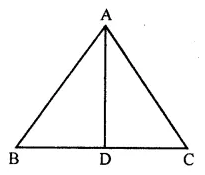
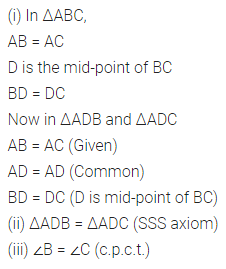
In the given figure, AB = AC and D is the mid-point of \(\bar { BC }\).
(i) State the three pairs of equal parts in ΔADB and ΔADC.
(ii) Is ΔADB = ΔADC? Give reasons.
(iii) Is ∠B = ∠C? Why?
ML Aggarwal Class 7 Solutions for ICSE Maths Chapter 12 Congruence of Triangles Ex 12.1 7
Solution:
ML Aggarwal Class 7 Solutions for ICSE Maths Chapter 12 Congruence of Triangles Ex 12.1 8

Question 6.
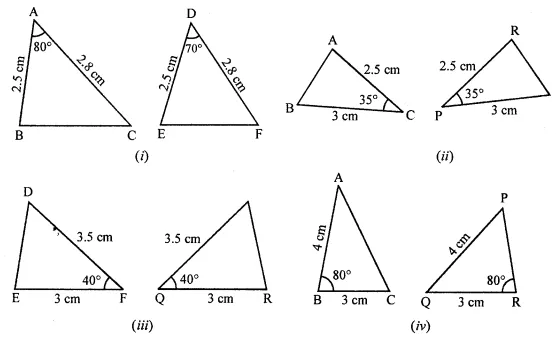
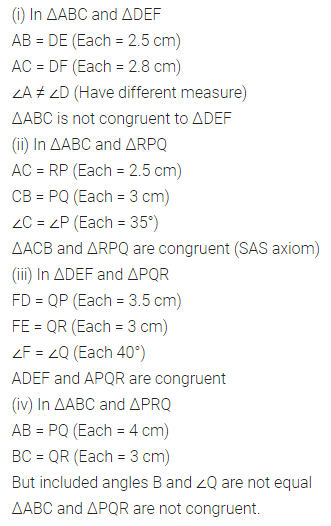
In the figure given below, the measures of some parts of the triangles are indicated. By using SAS rule of congruency, state which pairs of triangles are congruent. In the case of congruent triangles, write the result in symbolic form.
ML Aggarwal Class 7 Solutions for ICSE Maths Chapter 12 Congruence of Triangles Ex 12.1 9
Solution:
ML Aggarwal Class 7 Solutions for ICSE Maths Chapter 12 Congruence of Triangles Ex 12.1 10

Question 7.
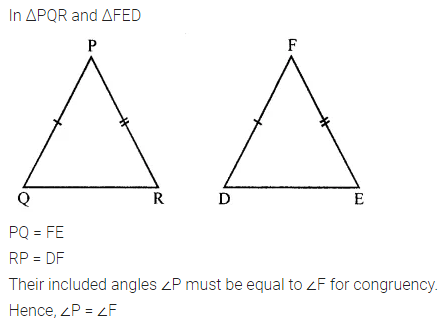
By applying SAS congruence rule, you want to establish that ΔPQR = ΔFED. If is given that PQ = EF and RP = DF. What additional information is needed to establish the congruence?
Solution:
ML Aggarwal Class 7 Solutions for ICSE Maths Chapter 12 Congruence of Triangles Ex 12.1 11

Question 8.
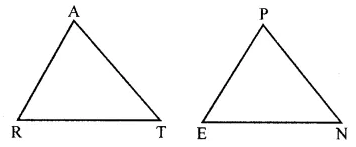
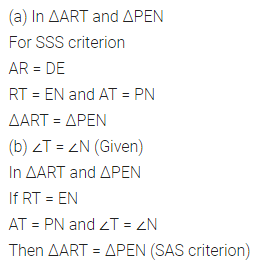
You want to show that ΔART = ΔPEN
ML Aggarwal Class 7 Solutions for ICSE Maths Chapter 12 Congruence of Triangles Ex 12.1 12
(a) If you have to use SSS criterion, then you need to show
(i) AR = ……….
(ii) RT = ……….
(iii) AT = …………
(b) If it is given that ∠T = ∠N and you are to use the SAS criterion, you need to have
(i) RT = ………. and (ii) PN = ……….
Solution:
ML Aggarwal Class 7 Solutions for ICSE Maths Chapter 12 Congruence of Triangles Ex 12.1 13

Question 9.
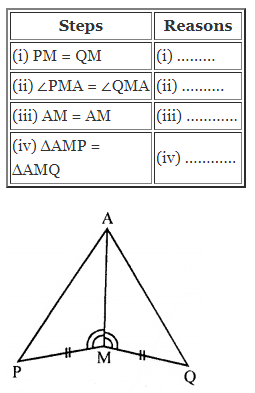
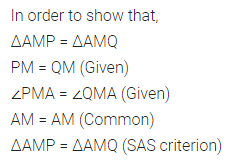
You have to show that ΔAMP = ΔAMQ.
In the following proof, supply the missing reasons.
ML Aggarwal Class 7 Solutions for ICSE Maths Chapter 12 Congruence of Triangles Ex 12.1 14
Solution:
ML Aggarwal Class 7 Solutions for ICSE Maths Chapter 12 Congruence of Triangles Ex 12.1 15

Question 10.Solution:
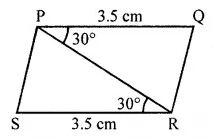
In the given figure:
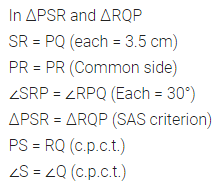
(i) State three pairs of equal parts in ΔPSR and ΔRQP.
(ii) Is ΔPSR = ΔRQP? Give reasons
(iii) Is PS = RQ? Why?
(iv) Is ∠S = ∠Q? Why?
ML Aggarwal Class 7 Solutions for ICSE Maths Chapter 12 Congruence of Triangles Ex 12.1 16
Solution:
ML Aggarwal Class 7 Solutions for ICSE Maths Chapter 12 Congruence of Triangles Ex 12.1 17

Question 11.
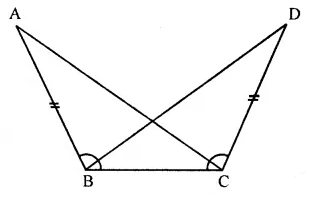
In the given figure, AB = DC and ∠ABC = ∠DCB.
(i) State three pairs of equal parts in AABC and ADCB.
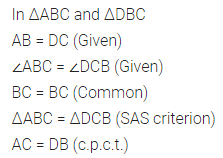
(ii) Is ΔABC = ΔDCB? Give reasons.
(iii) Is AC = DB? Why?
ML Aggarwal Class 7 Solutions for ICSE Maths Chapter 12 Congruence of Triangles Ex 12.1 18
Solution:
ML Aggarwal Class 7 Solutions for ICSE Maths Chapter 12 Congruence of Triangles Ex 12.1 19

Question 12.
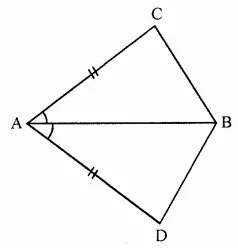
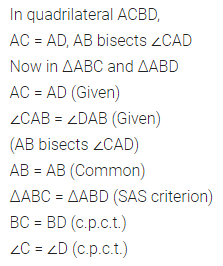
In the quadrilateral, AC = AD, and AB bisect ∠CAD.
(i) State three pairs of equal parts in ΔABC and ΔABD.
(ii) Is ΔABC = ΔABD? Give reasons.
(iii) Is BC = BD? Why?
(iv) Is ∠C = ∠D? Why?
ML Aggarwal Class 7 Solutions for ICSE Maths Chapter 12 Congruence of Triangles Ex 12.1 20
Solution:
ML Aggarwal Class 7 Solutions for ICSE Maths Chapter 12 Congruence of Triangles Ex 12.1 21

ML Aggarwal Class 7 Solutions for ICSE Maths Chapter 11 Triangles and its Properties Check Your Progress

ML Aggarwal Class 7 Solutions Chapter 11 Triangles and its Properties Check Your Progress for ICSE Understanding Mathematics acts as the best resource during your learning and helps you score well in your exams.

ML Aggarwal Class 7 Solutions for ICSE Maths Chapter 11 Triangles and its Properties Check Your Progress

Question 1.
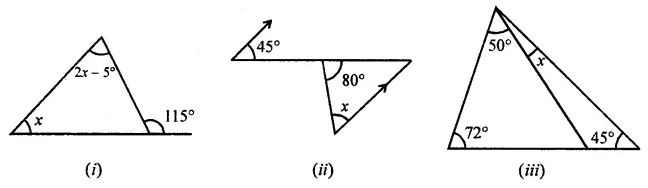
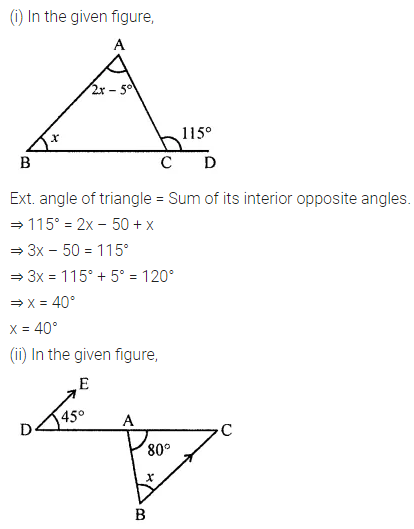
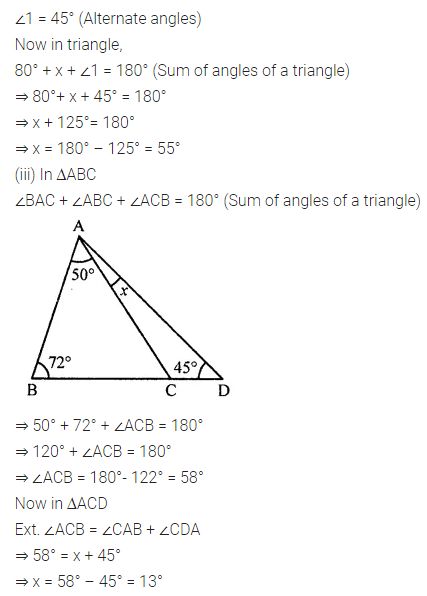
Find the value of x in each of the following diagrams:
ML Aggarwal Class 7 Solutions for ICSE Maths Chapter 11 Triangles and its Properties Check Your Progress 1
Solution:
ML Aggarwal Class 7 Solutions for ICSE Maths Chapter 11 Triangles and its Properties Check Your Progress 2
ML Aggarwal Class 7 Solutions for ICSE Maths Chapter 11 Triangles and its Properties Check Your Progress 3

Question 2.
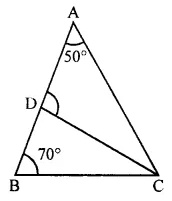
In the given figure, ∠B = 70° and ∠A = 50°. If the bisector of ∠C meets AB in D, then find ∠ADC.
ML Aggarwal Class 7 Solutions for ICSE Maths Chapter 11 Triangles and its Properties Check Your Progress 4
Solution:
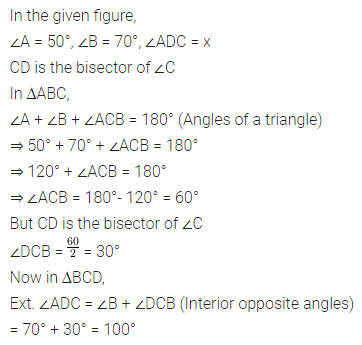
ML Aggarwal Class 7 Solutions for ICSE Maths Chapter 11 Triangles and its Properties Check Your Progress 5

Question 3.
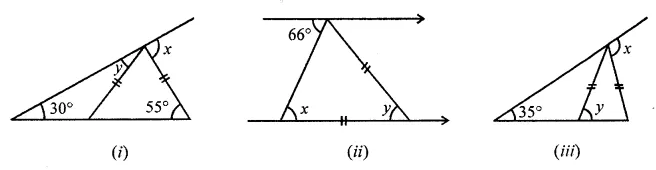
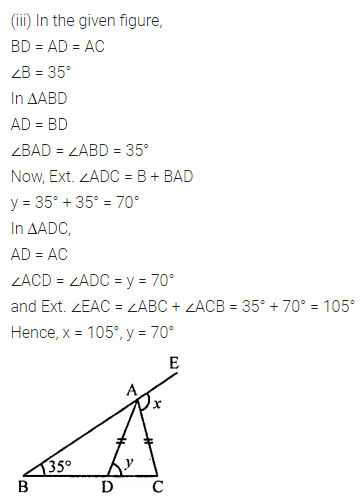
Find the values of x and y in each of the following figures:
ML Aggarwal Class 7 Solutions for ICSE Maths Chapter 11 Triangles and its Properties Check Your Progress 6
Solution:
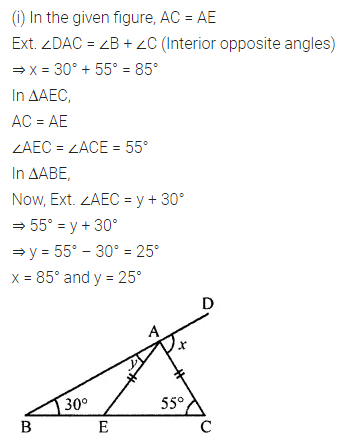
ML Aggarwal Class 7 Solutions for ICSE Maths Chapter 11 Triangles and its Properties Check Your Progress 7
ML Aggarwal Class 7 Solutions for ICSE Maths Chapter 11 Triangles and its Properties Check Your Progress 8
ML Aggarwal Class 7 Solutions for ICSE Maths Chapter 11 Triangles and its Properties Check Your Progress 9

Question 4.
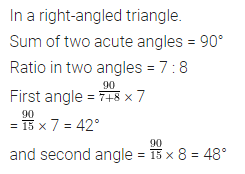
If the two acute angles of a right-angled triangle are in the ratio 7 : 8, find these angles.
Solution:
ML Aggarwal Class 7 Solutions for ICSE Maths Chapter 11 Triangles and its Properties Check Your Progress 10

Question 5.
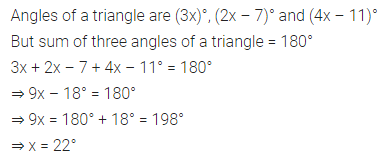
If the angles of a triangle are (3x)°, (2x – 7)° and (4x – 11)°, then find the value of x.
Solution:
ML Aggarwal Class 7 Solutions for ICSE Maths Chapter 11 Triangles and its Properties Check Your Progress 11

Question 6.
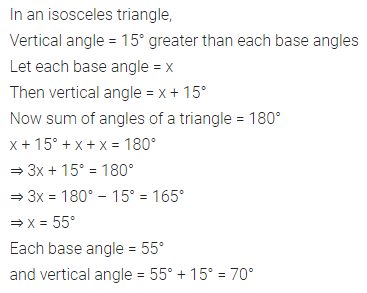
In an isosceles triangle, the vertical angle is 15° greater than each of its base angles. Find all the angles of the triangle.
Solution:
ML Aggarwal Class 7 Solutions for ICSE Maths Chapter 11 Triangles and its Properties Check Your Progress 12

Question 7.
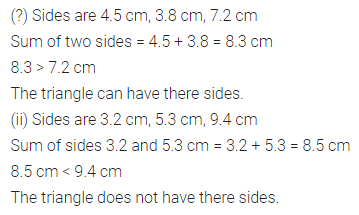
Can a triangle have three sides whose lengths are
(i) 4.5 cm, 3.8 cm, 7.2 cm?
(ii) 3.2 cm, 5.3 cm, 9.4 cm?
Solution:
ML Aggarwal Class 7 Solutions for ICSE Maths Chapter 11 Triangles and its Properties Check Your Progress 13

Question 8.
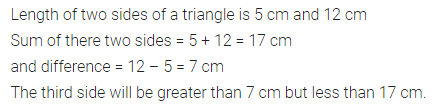
If the lengths of two sides of a triangle are 5 cm and 12 cm, then what can be the length of the third side?
Solution:
ML Aggarwal Class 7 Solutions for ICSE Maths Chapter 11 Triangles and its Properties Check Your Progress 14

Question 9.
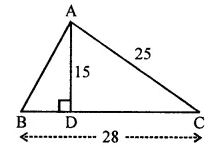
In the given figure, all measurements are in centimeters. If AD is perpendicular to BC, find the length of AB.
ML Aggarwal Class 7 Solutions for ICSE Maths Chapter 11 Triangles and its Properties Check Your Progress 15
Solution:
ML Aggarwal Class 7 Solutions for ICSE Maths Chapter 11 Triangles and its Properties Check Your Progress 16

Question 10.
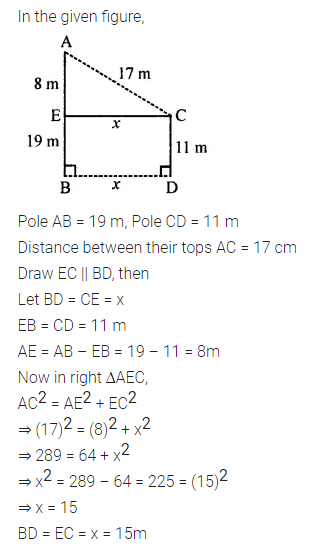
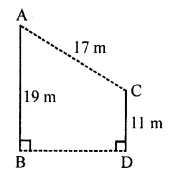
In the given figure, AB and CD are two vertical poles of height 19 m and 11 m respectively. If the shortest distance between their tops is 17 m, find how far apart they are?
ML Aggarwal Class 7 Solutions for ICSE Maths Chapter 11 Triangles and its Properties Check Your Progress 17
Solution:
ML Aggarwal Class 7 Solutions for ICSE Maths Chapter 11 Triangles and its Properties Check Your Progress 18

A Question of Trust Extra Questions and Answers Class 10 English Footprints Without Feet

Here we are providing A Question of Trust Extra Questions and Answers Class 10 English Footprints Without Feet, Extra Questions for Class 10 English was designed by subject expert teachers.

A Question of Trust Extra Questions and Answers Class 10 English Footprints Without Feet

A Question of Trust Extra Questions and Answers Short Answer Type

Question 1.
What did Horace Danby hear from the doorway?
Answer:
Horace Danby heard a voice from the doorway. It was the voice of a lady. As Horace Danby has sneezed loudly, therefore the lady asked what it was and he replied that it was due to hay fever.

Question 2.
How did the lady in red convince Horace Danby to open the lock?
Answer:
The lady told Horace Danby that she had promised her husband to take her jewels to the hank but she left them in the safe. She had forgotten the numbers to open the safe and wanted to wear the jewels to a party. Horace Danby believed her and opened the safe for her.

Question 3.
Was Horace Danby a typical thief?
Answer:
Horace Danby was not a typical thief. He made locks and was successful in his business. He loved rare and expensive books. To purchase these books he used to rob only one safe every year.

Question 4.
What advice did the lady give Horace Danby about his. hay fever?
Answer:
The lady advised him that he could cure his hay fever with a special treatment, if he could find out just. what plant gave him the disease. She said sympathetically that he had better see a doctor if he was serious about his work.

Question 5.
Why did Horace Danby feel sure of his success in that year’s robbery?
Answer:
Horace Danby felt sure of his success in that year’s robbery as he had been studying room, paths and gardens of the house at Shot over Grange for two weeks. He knew that the family was in London and two servants who lived in the house had gone to watch a movie that afternoon.

Question 6.
Did Horace Danby get the jewels from the Grange safe? Then why did the Police arrest him?
Answer:
Horace Danby did not get the jewels from the Grange safe but he was arrested by the police as his fingerprints were traced on the lighter which he gave to the lady to light the cigarette. He was eager to please the lady to win her favour.

Question 7.
What story did the lady tell Horace Danby to get the jewels?
Answer:
The lady made up a story that before going to London, she promised her husband to take her jewels to their bank, but she left them there in the safe. She wished to put on the jewels to a party that night. Above all she had forgotten the numbers to open the safe. Thus she convinced Horace Danby to open the safe.

Question 8.
Why was it not difficult for Horace to open the safe?
Answer:
It was not difficult for Horace Danby to open the safe because he had lived with locks and safes all his life. The burglar alarm was poorly built. He cut the wire without any difficulty.

Question 9.
What does the author tell us about Horace Danby’s life?
Answer:
Horace Danby was unmarried and fifty year old and lived with a housekeeper who bothered about his health. He had hay fever. He made locks and was successful in his business. He was good and respectable but not honest.

Question 10.
How often did Horace Danby commit a robbery every year? What did he do with the stolen money?
Answer:
Horace Danby committed only one robbery every year. He was fond of collecting rare and expensive books. He used to buy these books with stolen money through an agent secretly.

Question 11.
What does Horace Danby like to collect?
Answer:
Horace Danby likes to collect rare and expensive books.

Question 12.
Why does he steal every year?
Answer:
He used to steal every year so that he could buy the rare and expensive books that he loved to collect. He planned meticulously before attempting a burglary, stole enough to last twelve months and secretly bought the books through an agent.

Question 13.
Who is speaking to Horace Danby?
Answer:
A lady standing in the doorways is speaking to Horace Danby. She is young and pretty, and is dressed in red. She said she had come just in time, or else her family would have been robbed by Horace. She, thus, pretended to be one of the members of the family living at Shotover Grange.

Question 14.
Who is the real culprit in the story?
Answer:
The real culprit is the woman who pretended to be a member of the family living at Shotover Grange. She tricked Horace into believing her, and cleverly took away all the jewels that were kept in the safe.

A Question of Trust Extra Questions and Answers Long Answer Type

Question 1.
What do you think is the meaning of the phrase ‘honour among thieves’? Which of the two thieves lack the honour?
OR
Which of the two thieves lacked ‘honour’ in the story ‘A Question of Trust’?
Answer:
“There is honour among Thieves” means that ‘dishonest people may have certain standards of behaviour which they will respect’. The young lady pretended to be the owner of the house and innocently asked Horace Danby to-open the safe as she would need the jewels to wear to the party that day. Horace Danby found himself trapped in a tricky situation and could not make out how to escape. He readily opened the safe unwittingly leaving his fingerprints. He was arrested and nobody believed that the lady of the house asked him to open the safe.

Question 2.
At times we keep on planning things but our plans fail, we are not always responsible for the failure. Explain with reference to the story ‘A Question of Trust’.
OR
In the story ‘A Questions of Trust’, Horace Danby carefully planned his theft, but was outwitted by another thief‘The lady in red’. Would you agree that over confidence may prove fatal one day? Discuss.
Answer:
It is true that we keep on planning things in our life. We wish thing would materialise as we had planned but Man proposes God disposes. Horace Danby was a very careful planner. He made all plans very carefully before the robbery. He drew picture of wirihg of electricity and even took every efforts of befriending pets. But fate had planned something different. Lady in red turned out to be smarter and duped him. Horace, without any suspicion, opened the safe without gloves. This mistake landed him in prison. So one lesson that we learn that we should not trust anyone.

Question 3.
“Lying and stealing are next door neighbours”. Comment.
Answer:
A path of truthfulness and honesty is always better than an easy path of deceit. Horace Danby was a thief, he robbed safe every year. But, in the end he was be fooled by another thief and was arrested by the police. Stealing or lying cannot bring happiness or success. A truthful and honest person always leads a happy and peaceful life. He does not have to live with any kind of guilt. Stealing or lying robs one of peace. Those who are honest do not live a life of tension and are able to get peace of mind too.

Question 4.
Our sins never go unpunished. Horace Danby ultimately had to go to prison. This shows that inspite of planning a crime intelligently and carefully a criminal can’t escape the law— Explain / discuss.
Answer:
A path of truthfulness and honesty is always better than an easy path of deceit. Horace Danby was a thief, he robbed safe every year. But, in the end he was befooled by another thief and was arrested by the police. Stealing or lying cannot bring happiness or success. A truthful and honest person always leads a happy and peaceful life. He does not have to live with any kind of guilt. Stealing or lying robs one of peace. Those who are honest do not live a life of tension and are able to get peace of mind too.

Question 5.
“Horace Danby was clever but the young woman was cleverer”. Discuss.
OR
How did the lady in red turn out to be smarter than Horace Danby?
Answer:
Horace Danby was a cleaver thief. He lived a life of a respectable and successful businessman. He used to make locks. He was fond of rare and expensive books. He did not have enough money to buy these books. He used to rob a safe for this once in an year. He was very clever. He made his plan in such a way that he was never caught. He spent a lot of time in planning his mission. He never left any sign of theft but the lady who was another thief proved herself cleverer than Danby. She was a great actress as well.

She pretended to be the owner of the house. She tricked Danby who opened the safe for her and ‘ handed over the jewels. Horace was so nervous that he did not realise that he had no gloves in his hand. The lady had no tools, no gloves but managed to rob the safe without leaving any evidence against her. Thus, we can say that the lady was cleverer than Danby.

Question 6.
Did you begin to suspect, before the end of the story, that the lady was not the person Horace Danby took her to be? If so, at what point did you realize this, and how?
Answer:
Yes, one does begin to suspect before the end of the story that the lady was not the person Horace Danby took her to be. She was unusually calm on seeing Horace. This seemed strange enough. When she did not call the police, and instead asked Horace to break open the safe and take out all the jewels from it. It seemed suspicious. Moreover, it also seemed unlikely that she would forget the code to open the safe. Therefore, it was evident, before the story ended, that she was not the person Horace had taken her to be.

Question 7.
What are the subtle ways in which the lady manages to deceive Horace Danby into thinking she is the lady of the house? Why doesn’t Horace suspect that something is wrong?
Answer:
Her confident walk, her act of touching up her make-up and the ease with which she picks cigarette at the right place, are enough to deceive anybody. Horace was too frightened to think properly so he didn’t suspect anything.

Question 8.
“Horace Danby was good and respectable but not completely honest”. Why do you think this description is apt for Horace? Why can’t he be.categorized as a typical thief?
Answer:
“Horace Danby was good and respectable—but not completely honest”. This description is apt for Horace. He was about fifty years old. He robbed only from rich people. His purpose of stealing money was only to buy rare and expensive books. He stole only once every year. His intention to use the booty in buying books was good. However, the fact that he stole to achieve this intention showed that he was not completely honest.

He cannot be categorized as a typical thief because he did not steal to eat or drink and was not a regular offender. He did not harm anybody during the act. He had a house. He made locks, had two people to help him, and was successful in his business. He only stole enough money to buy the books. For a couple of days, he even kept his promises to the lady he met at Shotover Grange by not stealing or planning any robbery.

Question 9.
Horace Danby was a meticulous planner but still he faltered. Where did he go wrong and why?
Answer:
Horace Danby failed to get enough information about real occupants of the house. He seemed to be too occupied with collecting other little details and information about house map, wiring and location of valuable things. Although he was smart enough to know the dog’s actual name but overlooked getting identity of each and every occupant of the house. Once he was in problem then probably his clever mind gave way to carelessness leading him to open the safe without wearing gloves.

Question 10.
Do you think Horace Danby was unfairly punished, or that he deserved what he got?
Answer:
He deserved what he got. A crime is a crime no matter what the thief does with the booty. Whether it is committed a hundred times or just once, or even if nobody gets harmed still it is a punishable act.

Question 11.
Do intentions justify actions? Would you, like Horace Danby, do something wrong if you thought your ends justified the means? Do you think that there are situations in which it is excusable to act less than honestly?
Answer:
“Ends do not justify means”, this is a very old saying and has been tested many a times. Nobody should harm others for his own benefit. But this world doesn’t function on idealism. There are many examples of people duping others for quick gains and earning easy money. But crime is crime even if done for something good. These acts should be deplored and dealt with severely.

The Midnight Visitor Extra Questions and Answers Class 10 English Footprints Without Feet

Here we are providing The Midnight Visitor Extra Questions and Answers Class 10 English Footprints Without Feet, Extra Questions for Class 10 English was designed by subject expert teachers.

The Midnight Visitor Extra Questions and Answers Class 10 English Footprints Without Feet

The Midnight Visitor Extra Questions and Answers Short Answer Type

Question 1.
How is Ausable different from other Secret Agents?
Answer:
Ausable was very fat. He looked very slow. He had an American accent. He had no pistol or any other arms. So, he was different from the others.

Question 2.
Who is Fowler and what is his first authentic thrill of the day?
Answer:
Fowler is a writer. His authentic thrill of the day is finding a man with pistol in Ausable’s locked room.

Question 3.
How has Max got in?
Answer:
Max has a pass key. He has got in through the main door.

Question 4.
How does Ausable say he got in?
Answer:
Ausable says that he got in through the balcony of the room.

Question 5.
Why did Fowler want to meet Ausable? Why was he disappointed?
Answer:
Fowler was a young romantic writer. He had a fine imagination about spying and secret agents. He loved adventure and thrill. So he wanted to meet Ausable who was engaged in collecting sensitive information. He was disappointed after spending a dull evening in a French music hall with a fat, sloppy man as there was nothing mysterious or romantic about him.

Question 6.
How cap you show that Ausable showed great presence of mind in situation of danger and surprise?
Answer:
Ausable showed a great presence of mind when Max pointed gun at him when he entered note room with Fowler. Though his looks were not mysterious but with his presence of mind he cooked up the story of non-existent balcony. Max, though smart, was befooled by Ausable and even lost his life.

Question 7.
Who actually had knocked at the door of Ausable’s room? Why did he come there?
Answer:
Henry, the waiter was knocking at the door in hotel. Infact, Ausable had ordered for a bottle of wine and two glasses. When there was a knock at the door he reached as if policeman was at the door. He had come there as Ausable had ordered drinks before coming into the room.

Question 8.
Where and why did Ausable take Fowler?
Answer:
Ausable brought Fowler in his room which was on the sixth floor in a hotel. He wanted Fowler to have some thrill and excitement as he was expecting some important papers to be delivered there.

Question 9.
For what purpose had Max entered Ausable’s room?
OR
Why and how did Max enter Ausable’s room?
Answer:
Max wanted those important papers from Ausable so he entered his room secretly from the main door. He had managed to get the pass key to open the door.

Question 10.
What story did Ausable frame about calling the police?
Answer:
As soon as there was a knock at the door, Max enquired of it. Ausable told him that he had already informed the police to check if everything was okay at intervals because of the important papers. Ausable told Max that they were on their duty to check.

Question 11.
How is Ausable different from other secret agents?
Answer:
Ausable is different from other secret agents in more than one way. He has a small room in the musty corridor of a gloomy French hotel. It was the sixth and topmost floor and it was scarcely the setting for a romantic adventure. Ausable was extremely fat. Inspite of living in Paris for over twenty years, he spoke French and German moderately and had an American accent. Instead of getting messages slipped into his hands by dark-eyed beauties, he got only a telephone call making an appointment. In these ways, he was different from the conventional notion of a spy.

Question 12.
Who is Fowler and what is his first authentic thrill of the day?
Answer:
Fowler is a writer and he had come to meet Ausable. Fowler’s first authentic thrill of the day came when he saw a man in Ausable’s room pointing a pistol towards Ausable and himself.

Question 13.
How did Max get in?
Answer:
Max got into the room with a passkey or a master key.

Question 14.
How does Ausable say he got in?
Answer:
Ausable says that he thought Max had got into the room through the balcony. He said that it was the second time in a month that somebody had got into his room this way.

The Midnight Visitor Extra Questions and Answers Long Answer Type

Question 1.
Presence of mind is basically mental preparedness or the ability to think and act wisely in a dangerous or surprising situation”. Explain/Discuss with reference the story.
OR
“Presence of mind and intelligence are more powerful than gun”. How far is it true in case | • of Ausable, the secret agent?
Answer:
Ausable did not at all have the conventional image of a secret agent. He was short and very fat. However Ausable had a very sharp and active mind. When he entered his hotel room with Fowler he found Max with a gun in his room. Max was an agent of another organisation. Ausable, with presence of mind, invented a story of non-existent balcony. Max was convinced about existence of balcony and this led to r his tragic end. Ausable did not use physical strength but only his presence of mind.

Question 2.
“Telling a lie is sin and killing someone is a crime”. Why then Ausable told lies more than once and killed Max?
Answer:
Of course, morally Ausable had done wrong. But his profession allowed him to take such steps when the security and integrity of the nation were at stake. He did not tell lies and killed Max for his own sake but for his country. He is a true soldier to protect the country from inside.

Question 3.
“A procrastinatist is one who delays action and invites a tragedy to happen with him”. Is Max a procrastinatist, why, why not?
Answer:
No, Max is not a proceastinatist. He did not delay the action of his own. He had to wait until the paper he was seeking, arrived. He was overconfident and foolish enough to be duped by Ausable so simply and easily. He believed Ausable and did not confirm anything himself.

Question 4.
What was Ausable’s problem? How did he solve it?
Answer:
Ausable was a secret agent in an organisation. He had gone out with Fowler to spend the evening in a French music hall. When they returned to Ausable’s room in the hotel, they found Max standing in the middle of the room. He had a revolver in his hand. Ausable did not lose his calm. With unique presence of mind, he fabricated a story. He said that it was the second time someone had entered his room through the balcony under the window. Max took the concocted story as true.

Instantly, there was a knocking on the door. Max got panic stricken when Ausable remarked that there was the police. He had requested them to provide him extra security. Max was bewildered. He went towards the window and jumped on the non-existing balcony from the sixth floor. Max met with his death. Thus, Ausable’s problem was solved.

Question 5.
What impression do you form of Ausable as a secret agent after reading the story “The Mid night Visitor”?
Answer:
Ausable was a determined secret agent. He was dedicated to his work. He was agile in action even though he was a sloppy fat man. He was sane and shrewd. Being calm and cool headed by nature he did not lose his presence of mind when he found Max in his room with a revolver. It was midnight. He cooked up a false story of a balcony existing under the window just to befool the intruder.

Instantly they heard a knock at the door. Ausable remarked that the police had come to check on him and to provide him security. Getting nervous, Max rushed towards the window. He dropped to the balcony and fell down dead. He was patient, fearless, courageous, ready-witted and resourceful.

Question 6.
How did Max attempt but failed to acquire the secret paper from Ausable?
Answer:
Max’s organisation had ordered him to grab the secret report on missiles which the people of Ausable’s organisation had managed to get. He used a passkey and entered Ausable’s hotel room at midnight. He was holding a revolver in his hand since he intended to grab the report at pistol point. Ausable invented the fake story of a balcony extending under his window just to embarrass Max.

He remarked that it was the second time in the month that somebody had got into his room through that’ balcony. Instantly there was a knock at the door. Ausable’s remark that police had arrived to check on him unnerved Max.- To save his life, Max rushed towards the window. In hot haste, Max dropped to the non-existent balcony and met his tragic end. Thus he failed to acquire the secret paper.

Question 7.
“Ausable did not fit any description of a secret agent Fowler had ever read.” What do secret agents in books and films look like, in your opinion? Discuss in groups or in class some stories
or
movies featuring spies, detectives and secret agents, and compare their appearance with that of Ausable in this story. (You may mention characters from fiction in languages other ‘ than English. In English fiction you may have come across Sherlock Holmes, Hercule Poirot,
or
Miss Marple. Have you watched any movies featuring James Bond?)
Answer:
Secret agents in fiction are projected like ideal men, “Tall dark and handsome’. They are usually well built and have beautiful women to accompany them. They would always smoke pipe or cigar and do death ‘ defying stunts. James Bond is a very famous character by Ian Fleming. Movies based on James Bond show hi-tech gizmos which assist the detective in countering villains. But there are some exceptions as well.

There is a character named Feluda which was created by Satyajit Ray, the famous Bangla filmmaker. Feluda despite being a strongly built man and adept in martial arts, relies mostly upon his superb analytical ability and observation skill, mostly referred to as the Magajastra or brain-weapon to solve cases instead of using physical strength or weapons.

Question 8.
How does Ausable manage to make Max believe that there is a balcony attached to his room?
Look back at his detailed description of it. What makes it a convincing story?
Answer:
Ausable tells Max that someone entered his room through the balcony earlier also. He also told him that ^ he had asked police to give him protection as he had some important papers with him. On listening this, Max became nervous and just wanted to escape from police and as a result, without noticing, he jumped . out of the window and fell down. Ausable’s ability to think quickly and calmly in a situation of panic, makes it convincing.

Question 9.
Looking back at the story, when do you think Ausable thought up his plan for getting rid of Max? Do you think he had worked out his plan in detail right from the beginning? Or did he make up a plan taking advantage of events as they happened?
Answer:
No, I don’t think that he had worked out his plan in detail right from the very beginning. He took advantage of the events as they happened. Ausable made a story of the balcony outside the room and as there was a knock at the door at the same time, he told it would be police. All these events threatened Max. He became restless and without seeing, jumped out of the window hurriedly.

Question 10.
In this story, Ausable shows great ‘presence of mind’ or the ability to think quickly and act calmly and wisely, in a situation of danger and surprise. Give examples from your own experience, or narrate a story, which shows someone’s presence of mind.
Answer:
This story is in reference to the play ‘If I Were You’. Gerrard was captured by a criminal and when he pointed a gun towards him, Gerrard treated the criminal as a guest and trapped him in his confidence. He succeeded in making the criminal to run away as police was behind him. He told the criminal to run I through the exit door, which was actually a cupboard door. The criminal exited through the door and was caught in the cupboard.

Question 11.
Discuss what you would do in the situations described below. Remember that presence of mind comes out of a state of mental preparedness. If you have thought about possible problems or dangers, and about how to act in such situations. You have a better chance of dealing with such situation if they do arise.
1. A small fire starts in your kitchen.
2. A child starts to choke on a piece of food.
3. An electrical appliance starts to hiss and gives out sparks.
4. A bicycle knocks down a pedestrian.
5. It rains continuously for more than twenty-four hours.
6. A member of your family does not return home at the usual or expected time.
You may suggest other situations.
Answer:

  1. If a small fire starts in your kitchen a bucket of water may be poured on it.
  2. If a child starts to choke on a piece of food, his back should be patted and he should be taken to doctor.
  3. If an electrical appliance starts to hiss and gives out spark, the main power switch should be. turned off and electrician should be called.
  4. If a bicycle knocks down a pedestrian, he should be taken to the nearest hospital for first aid.
  5. If it rains continuously, we should take care of our drainage system.
  6. If a member of our family does not return home at the usual time we should contact immediately to know about him. If we do not get a clue we should take the help of police.

The Thief’s Story Extra Questions and Answers Class 10 English Footprints Without Feet

Here we are providing The Thief’s Story Extra Questions and Answers Class 10 English Footprints Without Feet, Extra Questions for Class 10 English was designed by subject expert teachers.

The Thief’s Story Extra Questions and Answers Class 10 English Footprints Without Feet

The Thief’s Story Extra Questions and Answers Short Answer Type

Question 1.
When and how did Hari Singh meet Anil?
Answer:
Hari Singh met Anil when he was watching a wrestling match. Hari Singh tried to befriend Anil.
Question 2.
How did Hari Singh succeed in his profession?
Answer:
He would frequently change his name to dupe the police. He would find out a kind and simple person for his target. He could wait until he had a favourable chance.

Question 3.
Why did Hari Singh change his name every month?
Answer:
Hari Singh was a fifteen year old boy who introduces himself to Anil as Hari Singh. He was an experienced thief. He changed his name every month for his own safety from the police and his former employers.

Question 4.
Why did Anil agree to feed Hari Singh?
Answer:
Anil needed a helping hand who could cook for him. When Hari Singh said that he could copk well, Anil agreed to feed him.

Question 5.
How did the thief realise that Anil knew that he was robbed?
Answer:
When Anil gave him a fifty-rupees note it was still damp. The damp note was telling the whole story. Hari Singh knew that Anil was intelligent enough to understand what had happened in the rainy night.

Question 6.
Why was it not easy for the thief to rob Anil?
Answer:
It was not easy for the thief to rob Anil as he was the most trusting person he had ever seen. The thief knew that it was easy to rob a greedy man because he could afford to be robbed. But to rob a careless man like Anil sometimes gave no pleasure of the work as he even did not notice that he had been robbed.

Question 7.
What was the thief s reaction when he took Anil’s money?
Answer:
As the thief got the money he quickly crawled out of the room. When he was on the road, he began to run. He had the notes at his waist, held them by the string of his pyjamas. Later on he slowed down to walk and counted the notes. He thought that with those 600 rupees he could lead a luxurious life like an oil-rich Arab at least for a week.

Question 8.
How, according to Hari Singh, would the greedy man, the rich man and the poor man react. when they had lost their goods?
Answer:
Hari Singh had made a study of men’s faces when they had lost their goods. According to the thief, on losing their goods a greedy man’s face would show fear, the rich man’s face would show anger and the poor man’s face would show acceptance.

Question 9.
How did Hari Singh know that Anil had forgiven him?
Answer:
It seems Anil knew about theft but neither his lips nor his eyes showed anything. He gave him fifty rupees and told him that now he would be paid regularly. He informed him that he would teach him to write sentences. It shows that Anil had forgiven him.

Question 10.
Why did the thief smile without any effect towards the end of the story?
Answer:
The thief smiled at Anil towards the end of the story in his most appealing way. But unlike as on previous occasions, this smile was natural and from the innermost comer of his heart. Being spontaneous, the smile was “without any effect”.

Question 11.
Who does ‘I’ refer to in this story?
Answer:
In this story, T refers to the thief.

Question 12.
What is he “a fairly successful hand” at?
Answer:
He is “a fairly successful hand” at stealing and robbing people.

Question 13.
What does he get from Anil in return for his work?
Answer:
When Hari asks Anil if he could work for him, Anil replies that he could not pay him. Finally, they reach an agreement that if he would cook, then Anil would feed him. However, Anil soon found out that he did not know how to cook. So, he taught him how to cook and later, how to write his name. He promised he would teach him how to write whole sentences and also how to add numbers. Apart from this, when Hari went out to buy the day’s supplies, he would make a profit of a rupee a day.

Question 14.
How does the thief think Anil will react to the theft?
Answer:
The thief thinks that on discovering the theft, Anil’s face would show a touch of sadness. The sadness would not be for the loss of money, but for the loss of trust.

Question 15.
What does he say about the different reactions of people when they are robbed?
Answer:
In his short career as a thief, he has studied reactions of so many people when they are robbed off their belongings. He has Observed that the greedy people showed fear; the rich showed anger and the poor people showed acceptance.

Question 16.
Does Anil realize that he has been robbed?
Answer:
Yes, Anil has realized that he has been robbed. He knew this probably because all the notes were wet and damp because of rain. However, he did not say anything to the thief and behaved normally.

The Thief’s Story Extra Questions and Answers Long Answer Type

Question 1.
“Everyone must have a chance to reform”. How did Anil worked upon these values and succeeded?
Answer:
Hari Singh had all the sharp wickedness to rob a person. He knew how to rob and whom to rob. He chose Anil for his purpose because the later was simple and easy, to approach. But when Anil started teaching him how to write words and then sentences and adding numbers, a good man in Hari Singh started dreaming of a life full of honestly and dignity. He got the chance to rob, he robed but the dream of being educated did not let him go. He returned to be educated.

Question 2.
‘Money cannot make a man as much as education can’. Elucidate this statement.
Answer:
Hari Singh had all the sharp wickedness to rob a person. He knew hdw to rob and whom to rob. He chose Anil for his purpose because the later was simple and easy, to approach. But when Anil started teaching him how to write words and then sentences and adding numbers, a good man in Hari Singh started dreaming of a life full of honestly and dignity. He got the chance to rob, he robed but the dream of being educated did not let him go. He returned to be educated.

Question 3.
“Love, trust and compassion transformed Hari Singh”. Explain with reference to the story “The Thief s story”.
Answer:
It is love and sympathy which has transformed Hari Singh into a respectable person. Anil Singh’s job was to write for a magazine. His income was not regular. He led an easygoing life. Anil can easily understand that he had been robbed when he found the notes wet. Anil does not react but rather offers him fifty rupees in the morning. Initially also Anil promised Hari Singh to teach him cooking as well as to write sentences. It was thus good action of Anil that helped Hari Singh to forget about the money and gave more importance to education.

Question 4.
How did Hari Singh happen to stay with Anil? How did he stay with Anil before he tried to rob him?
Answer:
Though Hari Singh was only fifteen years old yet he was a seasoned and successful thief. He met Anil at a wrestling match. He decided to rob him. He got himself introduced to Anil. He lied that he could cook. Anil allowed Hari Singh to stay with him. He would not pay but feed him. Anil did not turn him away though he cooked hopeless food. Anil promised to teach Hari Singh to cook as well as to write.

Due to lack of a regular income, Anil did not pay him any money. Hari Singh prepared the morning tea. He cheated Anil in the shopping and made about a rupee a day. Anil trusted him completely though he knew everything. It was quite difficult to rob Anil, a trusting and careless person. Anyhow he tried to rob him because his thievish nature urged him to do so.

Question 5.
Why did. Hari Singh decide to return stolen money? What light does it throw on his character?
Answer:
After stealing the money Hari Singh rushed to the railway station to catch 10.30 Express to Lucknow. But for some inexplicable reason he did not board the train. He decided to return to the man whom he had robbed. He sat down in the shelter of the Clock Tower and began to reflect upon his life. Suddenly he realised that Anil was helping him to learn reading and writing and that could change his life once and for all.

In his further mediation he made up his mind to return.It shows Hari Singh was grateful to Anil for helping him learn read and write. It also shows that deep in heart he had a- desire to change the course of his life. He wanted to give up theft and wanted to lead a life of a respectable person.

Question 6.
If you were Anil, would you have pardoned the thief? If Yes/No why?
Answer:
Once Hari Singh, a seasonal thief met Anil at a wrestling match. He gave Anil an artificial smile and asked for work in case he could feed him. Anil agreed but on every purchase Hari Singh made a profit. One day Hari Singh stole Anil’s money which was kept-under the mattress and left for the station. But the train left. In between, a good sense prevailed on Hari Singh. He slipped the money under the mattress and slept.

After tea, Anil gave Hari Singh a fifty rupee not and promised to pay him regularly. The note was still wet. Anil understood everything but did not expose the thief s doing. If I had been Anil, I would have pardoned him and traced the reasons for his thievish nature. I would give him an opportunity to mend his ways after serving a warning on the thief.

Question 7.
“A thief in Hari Singh changed into a good human being”. How far was Anil’s considerate nature responsible for this transformation?
Answer:
Hari Singh was an experienced thief who had robbed many people at such a tender age of fifteen years.’ He joined Anil as a cook with a motive of stealing money. But Anil was a kind and considerate person. He employed Hari Singh and taught him how to cook. He trusted him like his younger brother. He was always sympathetic towards him. Hari Singh found it was very difficult to rob such a good human being. He stole money but his conscience did not allow him to run away. He came back and became a . good human being. There was a change in his heart. Thus, it was Anil’s considerate nature which was responsible for this transformation.

Question 8.
What are Hari Singh’s reactions to the prospect of receiving an education? Do they change over time? (Hint’, compare, for example, the thought: “I knew that once I could write like an educated man there would be no limit to what I could not achieve” with these later thought: ‘Whole sentences, I knew, cloud one day bring me more than a few hundred rupees. It was a simple matter to steal—and sometimes just as simple to be caught. But to be a really big man, a clever and respected man, was something else.”)
What makes him return to Anil?
Answer:
When Anil offered to educate him, he thought of it as a bright career prospect for him. Hari knew that once he learnt to read and write, he would achieve more because the motivation behind it was robbing people and becoming a more cunning cheat. But soon Hari Singh’sf reaction to the prospect of receiving education changed and there was a change in his heayt. Probably because he got influenced by the calm in Anil’s life.

Now he also wanted to earn respect and developed a desire to be part of the civilized society. Although, both of them depended on irregular sources of income, but Anil seems to be more satisfied. This motivation was enough for him to return to Anil.

Question 9.
Why does not Anil hand the thief over to the police? Do you think most people would have done so? In what ways is Anil different from such employers?
Answer:
Anil does not hand over the thief to the police because he realized that Hari has already learnt a lesson and he has changed for the better now. Otherwise he would have never put the money back in its place. Though Anil knew how Hari cheated him of a rupee while buying the daily supplies but he never made it obvious in front of him.

Anil wants to give Hari one more chance to mend his ways and thus forgives him. Hari’s case is such that nobody would have forgiven him and straightway handed him over to the police. But Anil is a little different from such employers because he is modest in nature and does not want another person to suffer without giving him a chance to become a better person.

Question 10.
Do you think people like Anil and Hari Singh are found only in fiction, or are there such people in real life?
Answer:
I don’t think that people like Anil and Hari Singh are found only in fiction. There are such people in real life also. Although they are rare in today’s society but yes, they do exist. The first reaction of people, if someone is caught stealing, is that they will try to punish him and then hand him over to the police. But it should be realized that humans are bound to make errors but that shouldn’t let them loose a chance to rectify their mistake and change for good. At least a chance to reform should be given to that person. This is the only way to bring anyone to right path rather than punishing severely and thus making him a criminal forever.

Question 11.
Do you think there is a significant detail in the story that Anil is a struggling writer? Does this explain his behavior in any way?
Answer:
Hari Singh’s observation about Anil having irregular income and Anil’s statement about his sale of a book to a publisher indicates that he is a struggling writer. He lives life according to the amount of money he gets at a given time. When he has the money he enjoys eating out with his friends. When he is having less money then he even doesn’t pay salary to Hari Singh. This shows that he easily makes adjustments in his life without letting anything bother him.

Question 12.
Have you met anyone like Hari Singh? Can you think and imagine the circumstances that can turn a fifteen years old boy into a thief?
Answer:
Yes I know of a boy who was spoilt. His father was a driver and his mother was doing household work in various houses. He was sent to school but he started stealing something or the other from the student’s bags. So he was turned out of the school. He was beaten many times by his parents but he did not give up stealing. One day he ran from his house. After seven months he came back home. Difficulties faced by him made him a changed boy. He rejoined the school and is doing well with his studies.

I think the circumstances that can turn a fifteen year old boy into a thief may vary from person to person. But poverty, lack of education, unemployment, lack of food, negligence of parents and lack of pocket money, bad company and various allurements to buy something or others when there is no sufficient money may be some of the reasons for this.

Question 13.
Where is the story set? (You can get clues from the names of the persons and places mentioned in it). Which languages or languages are spoken in these places? Do you think the characters in the story spoke to each other in English?
Answer:
I think the story is set in old Delhi. Names like Hari Singh and Anil are very common in Delhi. The name (Jumna sweet shop’ indicates that the city must be on the bank of river yamuna. We find small residential houses in markets over the shops in old Delhi. Anil lived in such a house. The old Delhi railway station is adjacent to old Delhi Farm where Hari Singh decided to take Lucknow Express. His house must be very close to the railway station as he went there on foot. These clues from the story suggest that this story is set in old Delhi only. Hindi is spoken in old Delhi. No, the characters do not speak to each other in English.