ML Aggarwal Class 6 Solutions for ICSE Maths Chapter 7 Decimals Check Your Progress

ML Aggarwal Class 6 Solutions Chapter 7 Decimals Check Your Progress for ICSE Understanding Mathematics acts as the best resource during your learning and helps you score well in your exams.

ML Aggarwal Class 6 Solutions for ICSE Maths Chapter 7 Decimals Check Your Progress

Question 1.
Convert the following decimal numbers into fractions (in lowest terms).
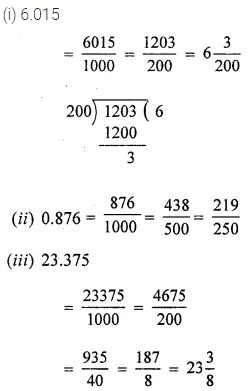
(i) 6.015
(ii) 0.876
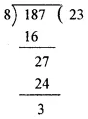
(iii) 23.375
Solution:
ML Aggarwal Class 6 Solutions for ICSE Maths Chapter 7 Decimals Check Your Progress 1
ML Aggarwal Class 6 Solutions for ICSE Maths Chapter 7 Decimals Check Your Progress 2

Question 2.
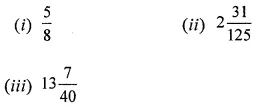
Write the following fractions as decimals numbers:
ML Aggarwal Class 6 Solutions for ICSE Maths Chapter 7 Decimals Check Your Progress 3
Solution:
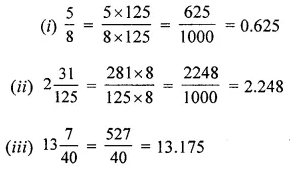
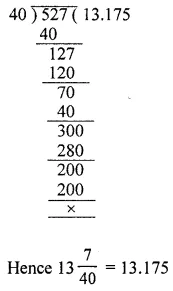
ML Aggarwal Class 6 Solutions for ICSE Maths Chapter 7 Decimals Check Your Progress 4
ML Aggarwal Class 6 Solutions for ICSE Maths Chapter 7 Decimals Check Your Progress 5

Question 3.
Arrange the following decimal numbers in ascending order:
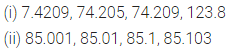
(i) 123.8, 74.205, 74.209, 7.4209
(ii) 85.01, 85.1, 85.001, 85.103
Solution:
ML Aggarwal Class 6 Solutions for ICSE Maths Chapter 7 Decimals Check Your Progress 6

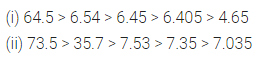
Question 4.
Arrange the following decimal numbers in desending order:
(i) 6.45, 4.65, 6.405, 64.5, 6.54
(ii) 73.5, 35.7, 7.35, 7.53, 7.035
Solution:
ML Aggarwal Class 6 Solutions for ICSE Maths Chapter 7 Decimals Check Your Progress 7

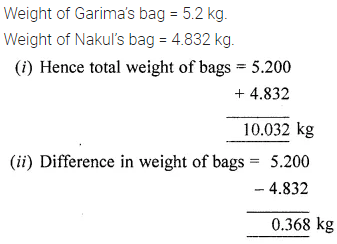
Question 5.
If the school bags of Garima and Nakul weigh 5.2 kg and 4.832 kg respectively, find
(i) the total weight.
(ii) the difference in weight of the bags.
Solution:
ML Aggarwal Class 6 Solutions for ICSE Maths Chapter 7 Decimals Check Your Progress 8

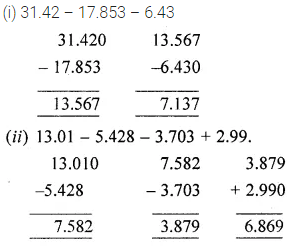
Question 6.
Evaluate the following:
(i) 31.42 – 17.853 -6.43
(ii) 13.01 – 5.428 – 3.703 + 2.99.
Solution:
ML Aggarwal Class 6 Solutions for ICSE Maths Chapter 7 Decimals Check Your Progress 9

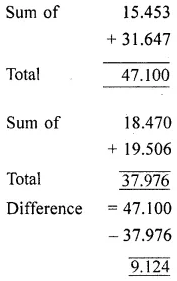
Question 7.
By how much does the sum of 15.453 and 31.647 exceed the sum of 18.47 and 19.506?
Solution:
ML Aggarwal Class 6 Solutions for ICSE Maths Chapter 7 Decimals Check Your Progress 10

Question 8.
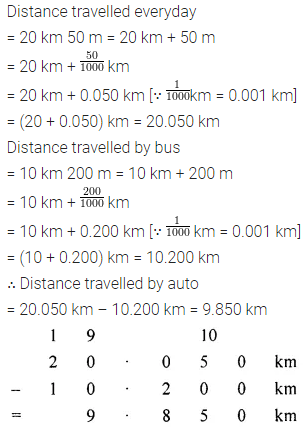
Namita travels 20 km 50 m every day. Out of this she travels 10 km 200 m by bus and the rest by auto. How much distance does she travel by auto?
Solution:
ML Aggarwal Class 6 Solutions for ICSE Maths Chapter 7 Decimals Check Your Progress 11

Question 9.
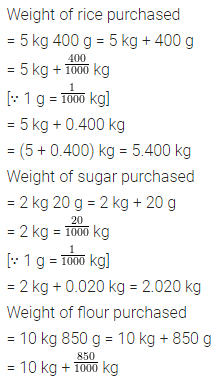
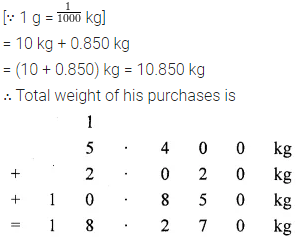
Ravi purchased 5 kg 400 g rice, 2 kg 20 g sugar and 10 kg 850 g flour (aata). Find the total weight of his purchases.
Solution:
ML Aggarwal Class 6 Solutions for ICSE Maths Chapter 7 Decimals Check Your Progress 12
ML Aggarwal Class 6 Solutions for ICSE Maths Chapter 7 Decimals Check Your Progress 13

Question 10.
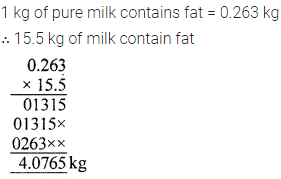
1 kg of pure milk contains 0.263 kg of fat. How much fat is there 15.5 kg of milk?
Solution:
ML Aggarwal Class 6 Solutions for ICSE Maths Chapter 7 Decimals Check Your Progress 14

Question 11.
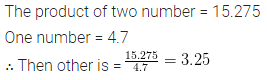
The product of two numbers is 15.275. If one number is 4.7, find the other.
Solution:
ML Aggarwal Class 6 Solutions for ICSE Maths Chapter 7 Decimals Check Your Progress 15

ML Aggarwal Class 6 Solutions for ICSE Maths Chapter 7 Decimals Objective Type Questions

ML Aggarwal Class 6 Solutions Chapter 7 Decimals Objective Type Questions for ICSE Understanding Mathematics acts as the best resource during your learning and helps you score well in your exams.

ML Aggarwal Class 6 Solutions for ICSE Maths Chapter 7 Decimals Objective Type Questions

Mental Maths
Question 1.
Fill in the blanks:
(i) The decimal point in a decimal number is placed between ones digit and ……….. digit.
(ii) The place value of the digit 3 in the decimal number 15.437 is ………
(iii) The decimal number 27.025 has ………. decimal places.
(iv) The decimal number 5.06 is read as five point
(v) If an object is divided into 1000 equal parts, then its 27 parts are represented by ………
(vi) Two decimal numbers having different number of …………. are called unlike decimal numbers.
(vii) 4 tens, 3 ones, 2 tenths, 0 hundredths and 5 thousandths in decimal form is written as ……
(viii)The smallest decimal number upto three decimal places is ……….
Solution:
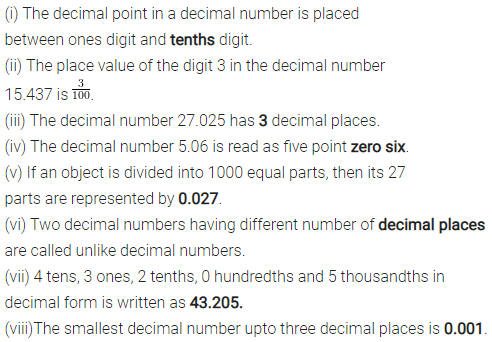
ML Aggarwal Class 6 Solutions for ICSE Maths Chapter 7 Decimals Objective Type Questions 1

Question 2.
State whether the following statements are true (T) or false (F):
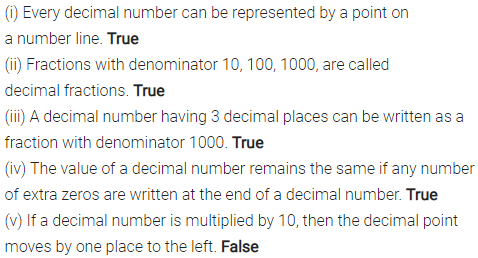
(i) Every decimal number can be represented by a point on a number line.
(ii) Fractions with denominator 10, 100, 1000, are called decimal fractions.
(iii) A decimal number having 3 decimal places can be written as a fraction with denominator 1000.
(iv) The value of a decimal number remains the same if any number of extra zeros are written at the end of a decimal number.
(v) If a decimal number is multiplied by 10, then the decimal point moves by one place to the left.
Solution:
ML Aggarwal Class 6 Solutions for ICSE Maths Chapter 7 Decimals Objective Type Questions 2

Multiple Choice Questions
Choose the correct answer from the given four options (3 to 23):
Question 3.
Five and seven hundredths is equal to
(a) 5.7
(b) 5.07
(c) 5.70
(d) 0.57
Solution:
ML Aggarwal Class 6 Solutions for ICSE Maths Chapter 7 Decimals Objective Type Questions 3

Question 4.
Sicty three thousandths is equal to
(a) 0.63
(b) 0.603
(c) 0.063
(d) 0.630
Solution:
ML Aggarwal Class 6 Solutions for ICSE Maths Chapter 7 Decimals Objective Type Questions 4

Question 5.
\(3 \frac{7}{100}\) is equal to :
(a) 3.07
(b) 3.7
(c) 3.70
(d) 3.007
Solution:

ML Aggarwal Class 6 Solutions for ICSE Maths Chapter 7 Decimals Objective Type Questions 5

Question 6.
\(5 \frac{3}{1000}\) is equal to
(a) 5.03
(b) 5.3
(c) 5.003
(d) 5.0003
Solution:
ML Aggarwal Class 6 Solutions for ICSE Maths Chapter 7 Decimals Objective Type Questions 6

Question 7.
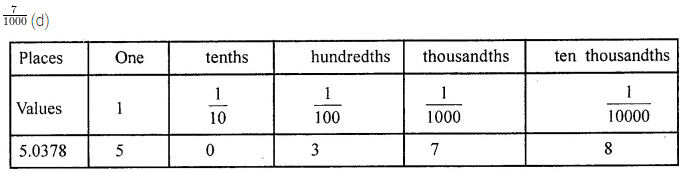
The place value of the digit 7 in the decimal number 5.0378 is

ML Aggarwal Class 6 Solutions for ICSE Maths Chapter 7 Decimals Objective Type Questions 7
Solution:
ML Aggarwal Class 6 Solutions for ICSE Maths Chapter 7 Decimals Objective Type Questions 8

Question 8.
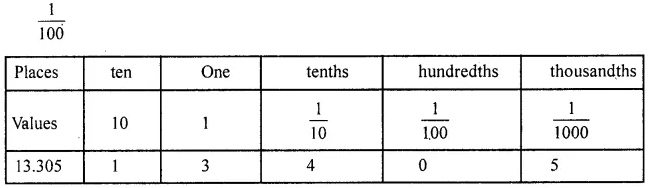
The place value of the digit 0 in the decimal number 13.405 is

ML Aggarwal Class 6 Solutions for ICSE Maths Chapter 7 Decimals Objective Type Questions 9
Solution:
ML Aggarwal Class 6 Solutions for ICSE Maths Chapter 7 Decimals Objective Type Questions 10

Question 9.
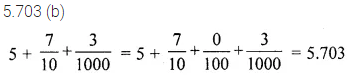
The value of \(5+\frac{7}{10}+\frac{3}{1000}\) is
(a) 5.73
(b) 5.703
(c) 5.073
(d) 0.753
Solution:
ML Aggarwal Class 6 Solutions for ICSE Maths Chapter 7 Decimals Objective Type Questions 11

Question 10.
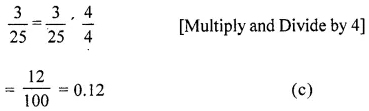
The value of \(\frac{3}{25}\) is
(a) 1.2
(b) 0.012
(c) 0.12
(d) none of these
Solution:
ML Aggarwal Class 6 Solutions for ICSE Maths Chapter 7 Decimals Objective Type Questions 12

Question 11.
The value of \(5 \frac{1}{25}\) is
(a) 5.4
(b) 5.25
(c) 5.04
(d) 5.004
Solution:

ML Aggarwal Class 6 Solutions for ICSE Maths Chapter 7 Decimals Objective Type Questions 13

Question 12.
The decimal number not equivalent to 5.7 is
(a) 5.70
(b) 5.07
(c) 5.700
(d) 5.7000
Solution:
ML Aggarwal Class 6 Solutions for ICSE Maths Chapter 7 Decimals Objective Type Questions 14

Question 13.
1 g is equal to
(a) 0.1 kg
(b) 0.01 kg
(c) 0.001 kg
(d) 0.0001 kg
Solution:
ML Aggarwal Class 6 Solutions for ICSE Maths Chapter 7 Decimals Objective Type Questions 15

Question 14.
2 km 7 m is equal to
(a) 2.7 km
(b) 2.07 km
(c) 2.007 km
(d) 2.0007 km
Solution:

ML Aggarwal Class 6 Solutions for ICSE Maths Chapter 7 Decimals Objective Type Questions 16

Question 15.
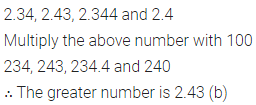
Among 2.34, 2 .43, 2.344 and 2.4, the greatest number is
(a) 2.34
(b) 2.43
(c) 2.344
(d) 2.4
Solution:
ML Aggarwal Class 6 Solutions for ICSE Maths Chapter 7 Decimals Objective Type Questions 17

Question 16.
5.2 – 3.6 is equal to
(a) 0.16
(b) 2.6
(c) 0.26
(d) 1.6
Solution:

ML Aggarwal Class 6 Solutions for ICSE Maths Chapter 7 Decimals Objective Type Questions 18

Question 17.
A decimal number lying between 2.2 and 2.22 is
(a) 2.12
(b) 2.23
(c) 2.219
(d) 2.3
Solution:
ML Aggarwal Class 6 Solutions for ICSE Maths Chapter 7 Decimals Objective Type Questions 19

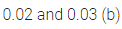
Question 18.
0.023 lies between
(a) 0.2 and 0.3
(b) 0.02 and 0.03
(c) 0.029 and 0.03
(d) 0.026 and 0.024
Solution:
ML Aggarwal Class 6 Solutions for ICSE Maths Chapter 7 Decimals Objective Type Questions 20

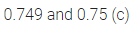
Question 19.
0.7499 lies between
(a) 0.7 and 0.74
(b) 0.759 and 0.799
(c) 0.749 and 0.75
(d) 0.74992 and 0.75
Solution:
ML Aggarwal Class 6 Solutions for ICSE Maths Chapter 7 Decimals Objective Type Questions 21

Question 20.
Which of the following decimal numbers is the greatest?
(a) 0.182
(b) 0.038
(c) 0.219
(d) 0.291
Solution:
ML Aggarwal Class 6 Solutions for ICSE Maths Chapter 7 Decimals Objective Type Questions 22

Question 21.
Which of the following decimal numbers is the smallest?
(a) 0.108
(b) 1.08
(c) 0.801
(d) 0.81
Solution:
ML Aggarwal Class 6 Solutions for ICSE Maths Chapter 7 Decimals Objective Type Questions 23

Question 22.
0.003 × 0.2 is equal to
(a) 0.6
(b) 0.06
(c) 0.006
(d) 0.0006
Solution:
ML Aggarwal Class 6 Solutions for ICSE Maths Chapter 7 Decimals Objective Type Questions 24

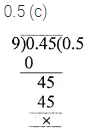
Question 23.
0.45 + 0.9 is equal to
(a) 50
(b) 5
(c) 0.5
(d) 0.05
Solution:
ML Aggarwal Class 6 Solutions for ICSE Maths Chapter 7 Decimals Objective Type Questions 25

Higher Order Thinking Skills(Hots)
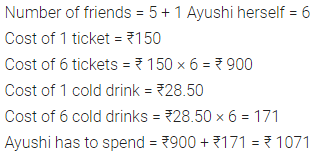
Question 1.
On her birthday, Ayushi is taking her 5 friends to a movie and treats them with cold costs. The cost of a ticket is ₹150 and a cold drink cost ₹28.50. How much Ayushi has to spend?
Solution:
ML Aggarwal Class 6 Solutions for ICSE Maths Chapter 7 Decimals Objective Type Questions 26

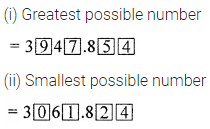
Question 2.
Write digits in the boxes of the number : \(3 \square 6 \square .8 \square \square\) to obtain
(i) greatest possible number
(ii) smallest possible number. Repetition of digits in a number is not allowed.
Solution:
ML Aggarwal Class 6 Solutions for ICSE Maths Chapter 7 Decimals Objective Type Questions 27

ML Aggarwal Class 6 Solutions for ICSE Maths Chapter 7 Decimals Ex 7.5

ML Aggarwal Class 6 Solutions Chapter 7 Decimals Ex 7.5 for ICSE Understanding Mathematics acts as the best resource during your learning and helps you score well in your exams.

ML Aggarwal Class 6 Solutions for ICSE Maths Chapter 7 Decimals Ex 7.5

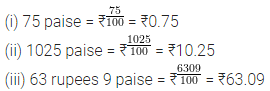
Question 1.
Express as rupees using decimals:
(i) 75 paise
(ii) 1025 paise
(ii) 63 rupees 9 paise
Solution:
ML Aggarwal Class 6 Solutions for ICSE Maths Chapter 7 Decimals Ex 7.5 1

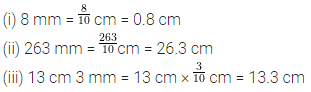
Question 2.
Express as cm using decimals:
(i) 8 mm
(ii) 263 mm
(iii) 13 cm 3 mm
Solution:
ML Aggarwal Class 6 Solutions for ICSE Maths Chapter 7 Decimals Ex 7.5 2

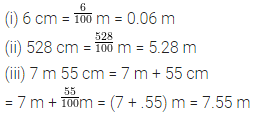
Question 3.
Express as metres using decimals:
(i) 6 cm
(ii) 528 cm
(iii) 7 m 55 cm
Solution:
ML Aggarwal Class 6 Solutions for ICSE Maths Chapter 7 Decimals Ex 7.5 3

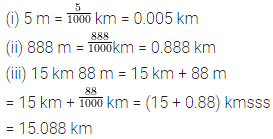
Question 4.
Express as km using decimals:
(i) 5 m
(ii) 888 m
(iii) 15 km 88 m
Solution:
ML Aggarwal Class 6 Solutions for ICSE Maths Chapter 7 Decimals Ex 7.5 4

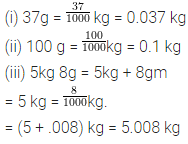
Question 5.
Express as kg using decimals:
(i) 37 g
(ii) 100 g
(iii) 5 kg 8 g
Solution:
ML Aggarwal Class 6 Solutions for ICSE Maths Chapter 7 Decimals Ex 7.5 5

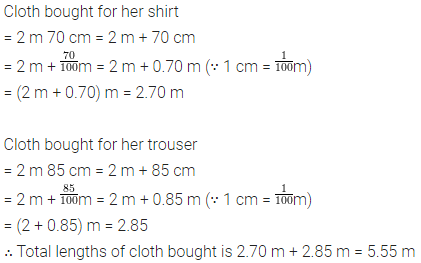
Question 6.
Anita bought 2 m 70 cm cloth for her shirt and 2 m 85 cm cloth for her trouser. Find the total length of the cloth bought by her.
Solution:
ML Aggarwal Class 6 Solutions for ICSE Maths Chapter 7 Decimals Ex 7.5 6

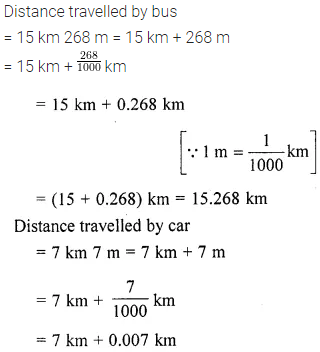
Question 7.
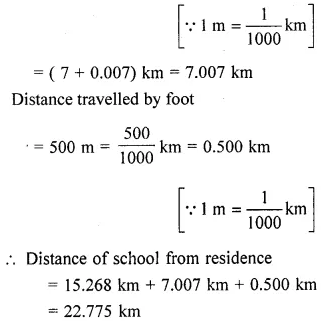
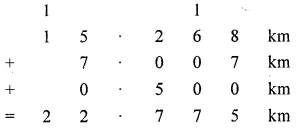
Sunita travelled 15 km 268 m by bus, 7 km 7 m by car and 500 m on foot in order to reach her school. How far is her school from her residence?
Solution:
ML Aggarwal Class 6 Solutions for ICSE Maths Chapter 7 Decimals Ex 7.5 7
ML Aggarwal Class 6 Solutions for ICSE Maths Chapter 7 Decimals Ex 7.5 8
ML Aggarwal Class 6 Solutions for ICSE Maths Chapter 7 Decimals Ex 7.5 9

Question 8.
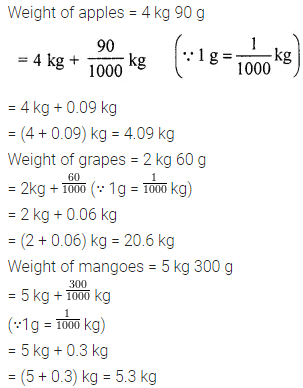
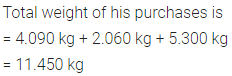
Rahul bought 4 kg 90 g apples, 2 kg 60 g grapes and 5 kg 300 g mangoes. Find the total weight of all the fruits he bought.
Solution:
ML Aggarwal Class 6 Solutions for ICSE Maths Chapter 7 Decimals Ex 7.5 10
ML Aggarwal Class 6 Solutions for ICSE Maths Chapter 7 Decimals Ex 7.5 11

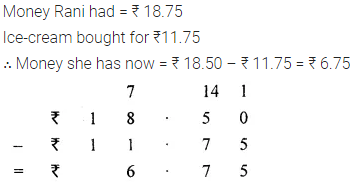
Question 9.
Rani had ₹18.50. She bought one ice¬cream for ₹11.75. How much money does she have now?
Solution:
ML Aggarwal Class 6 Solutions for ICSE Maths Chapter 7 Decimals Ex 7.5 12

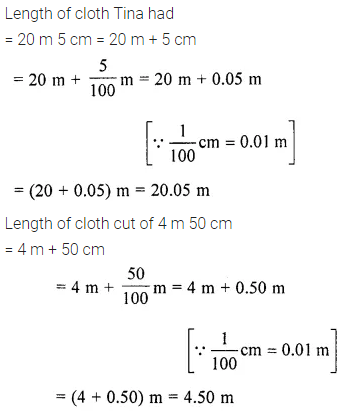
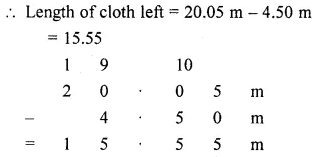
Question 10.
Tina had 20 m 5 cm long cloth. She cuts 4m 50 cm length of cloth from this for making a curtain. How much cloth is left with her?
Solution:
ML Aggarwal Class 6 Solutions for ICSE Maths Chapter 7 Decimals Ex 7.5 13
ML Aggarwal Class 6 Solutions for ICSE Maths Chapter 7 Decimals Ex 7.5 14

Question 11.
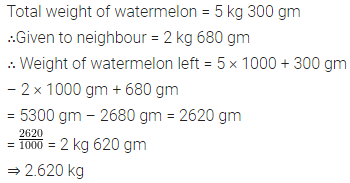
Ruby bought a watermelon weighing 5 kg 300 g. Out of which she gave 2 kg 680 g to her neighbour. What is the weight of the watermelon left with Ruby?
Solution:
ML Aggarwal Class 6 Solutions for ICSE Maths Chapter 7 Decimals Ex 7.5 15

Question 12.
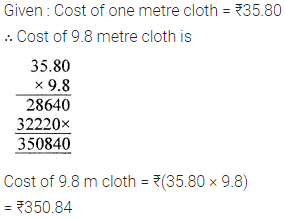
The cost of 1 metre of cloth is ₹35.80. What will be cost of 9.8 metres of cloth?
Solution:
ML Aggarwal Class 6 Solutions for ICSE Maths Chapter 7 Decimals Ex 7.5 16

Question 13.
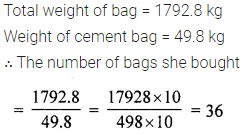
Farida bought some bags of cement, each weighing 49.8 kg. If the total weight of all the bags is 1792.8 kg, how many bags did she buy?
Solution:
ML Aggarwal Class 6 Solutions for ICSE Maths Chapter 7 Decimals Ex 7.5 17

ML Aggarwal Class 6 Solutions for ICSE Maths Chapter 7 Decimals Ex 7.4

ML Aggarwal Class 6 Solutions Chapter 7 Decimals Ex 7.4 for ICSE Understanding Mathematics acts as the best resource during your learning and helps you score well in your exams.

ML Aggarwal Class 6 Solutions for ICSE Maths Chapter 7 Decimals Ex 7.4

Question 1.
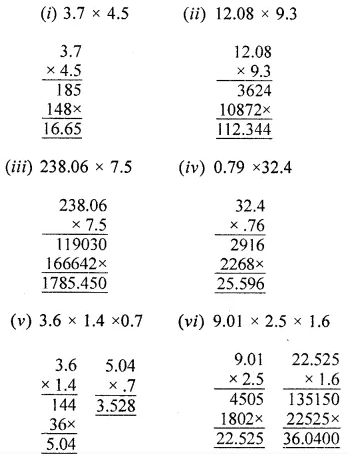
Evaluate the following:
(i) 3.7 × 4.5
(ii) 12.08 × 9.3
(iii) 238.06 × 7.5
(iv) 0.79 × 32.4
(v) 3.6 × 1.4 × 0.7
(vi) 9.01 × 2.5 × 1.6
Solution:
ML Aggarwal Class 6 Solutions for ICSE Maths Chapter 7 Decimals Ex 7.4 1

Question 2.
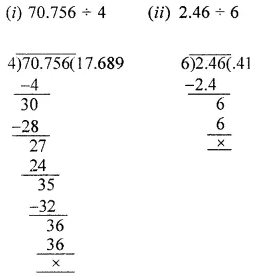
Work out the following:
(i) 70.756 ÷ 4
(ii) 2.46 ÷ 6
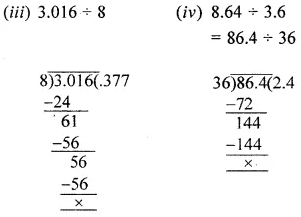
(iii) 3.016 ÷ 8
(iv) 8.64 ÷ 3.6
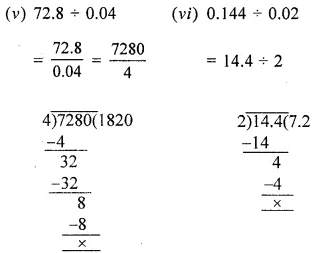
(v) 72.8 ÷ 0.04
(vi) 0.144 ÷ 0.02
Solution:
ML Aggarwal Class 6 Solutions for ICSE Maths Chapter 7 Decimals Ex 7.4 2
ML Aggarwal Class 6 Solutions for ICSE Maths Chapter 7 Decimals Ex 7.4 3
ML Aggarwal Class 6 Solutions for ICSE Maths Chapter 7 Decimals Ex 7.4 4

Question 3.
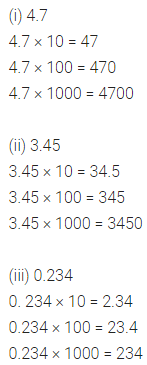
Multiply each of the following numbers by 10, 100 and 1000 orally ;
(i) 4.7
(ii) 3.45
(iii) 23.01
Solution:
ML Aggarwal Class 6 Solutions for ICSE Maths Chapter 7 Decimals Ex 7.4 5

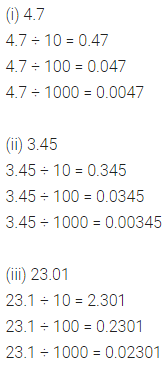
Question 4.
Divide each of the following numbers by 10, 100 and 1000 (orally):
(i) 4.7
(ii) 3.45
(iii) 23.01
Solution:
ML Aggarwal Class 6 Solutions for ICSE Maths Chapter 7 Decimals Ex 7.4 6

ML Aggarwal Class 6 Solutions for ICSE Maths Chapter 7 Decimals Ex 7.3

ML Aggarwal Class 6 Solutions Chapter 7 Decimals Ex 7.3 for ICSE Understanding Mathematics acts as the best resource during your learning and helps you score well in your exams.

ML Aggarwal Class 6 Solutions for ICSE Maths Chapter 7 Decimals Ex 7.3

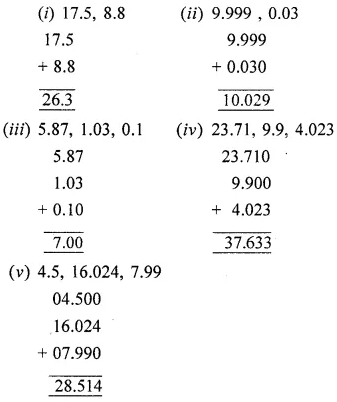
Question 1.
Add:
(i) 17.5 , 8.8
(ii) 9.999 , 0.03
(iii) 5.87 , 1.03 , 0.1
(iv) 23.71, 9.9, 4.023
(v) 4.5, 16.024, 7.99
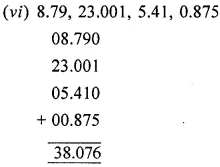
(vi) 8.79, 23.001 , 5.41, 0.875
Solution:
ML Aggarwal Class 6 Solutions for ICSE Maths Chapter 7 Decimals Ex 7.3 1
ML Aggarwal Class 6 Solutions for ICSE Maths Chapter 7 Decimals Ex 7.3 2

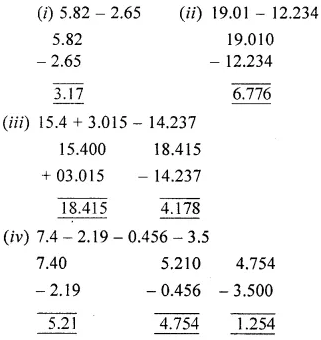
Question 2.
Work out:
(i) 5.82 – 2.65
(ii) 19.01 – 12.234
(iii) 15.4 + 3.015 – 14.237
(iv) 7.4 – 2.19 – 0.456 – 3.5
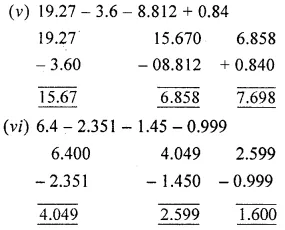
(v) 19.27 – 3.6 – 8.812 + 0.84
(vi) 6.4 – 2.351 – 1.45 – 0.999
Solution:
ML Aggarwal Class 6 Solutions for ICSE Maths Chapter 7 Decimals Ex 7.3 3
ML Aggarwal Class 6 Solutions for ICSE Maths Chapter 7 Decimals Ex 7.3 4

Question 3.
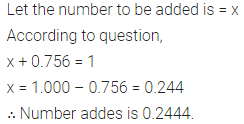
What number added to 0.756 gives 1?
Solution:
ML Aggarwal Class 6 Solutions for ICSE Maths Chapter 7 Decimals Ex 7.3 5

Question 4.
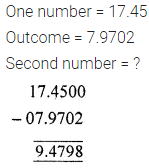
By how much should 17.45 be decreased to get 7.9702?
Solution:
ML Aggarwal Class 6 Solutions for ICSE Maths Chapter 7 Decimals Ex 7.3 6