Decimals Class 6 Notes Maths Chapter 8

On this page, you will find Decimals Class 6 Notes Maths Chapter 8 Pdf free download. CBSE NCERT Class 6 Maths Notes Chapter 8 Decimals will seemingly help them to revise the important concepts in less time.

CBSE Class 6 Maths Chapter 8 Notes Decimals

Decimals Class 6 Notes Conceptual Facts

1. Fractions with denominators 10, 100 and 1000, etc., can be represented as decimal fractions.
For example:\( \frac{7}{10}, \frac{21}{100} \text { and } \frac{223}{1000}\)etc., are all decimal fractions.

2. If a whole number is divided into 10 equal parts, then each part is called one-tenth of a unit and written
as \(\frac{1}{10}\) and 0.1 in decimal notations.

3. If a whole number is divided into 100 equal parts, then each part is called one-hundredth of a unit and written as \(\frac{1}{100}\) and 0.01 in decimal notation.

4. In standard form, the decimal is always put between the unit place and tenths-place.

5. In the place value chart, as we go from left to the right, the multiplying factor becomes factor \(\frac{1}{10}\) of the previous factor.

6. All decimals can also be represented on number line.

7. Decimals are used in many way in our lives. For example, in representing units of money, length and weight.

8. Decimal numbers having the same number of decimal places are called ‘Like decimals’.
For example: 0.23, 1.26, 3.65 are all like decimals.

9. Decimal numbers having different number of decimal places are called ‘unlike decimals’.
For example: 2.34, 5.650, 4.2350 are all unlike decimals.


Fractions Class 6 Notes Maths Chapter 7

On this page, you will find Fractions Class 6 Notes Maths Chapter 7 Pdf free download. CBSE NCERT Class 6 Maths Notes Chapter 7 Fractions will seemingly help them to revise the important concepts in less time.

CBSE Class 6 Maths Chapter 7 Notes Fractions

Fractions Class 6 Notes Conceptual Facts

1. A fraction is a part of a whole number having numerator and denominator.
For example: \(\frac{5}{7}\) where 5 is numerator and 7 is the denominator.

2. Representation of a fraction on a number line.
For example: \(\frac{2}{3}\)
Fractions Class 6 Notes Maths Chapter 7

3. Proper fractions: Numerator is less than the denominator.
For example: \(\frac{2}{3}, \frac{5}{8} \text { and } \frac{1}{5}\)

4. Improper fractions: Numerator is bigger than the denominator.
For example: \(\frac{5}{2}, \frac{7}{5}, \frac{10}{3} \text { and } \frac{6}{5}\)

5. Mixed fractions: It is represented by Quotient \(\frac{\text { Remainder }}{\text { Divisor }}\)
For example: \(5 \frac{1}{7}, 3 \frac{2}{3} \text { and } 4 \frac{5}{7}\)

6. Equivalent fractions: Two or more fractions are said to be equivalent fractions, if they represent the same quantity.
For example: \(\frac{2}{5}, \frac{6}{15}, \frac{4}{10} \text { and } \frac{8}{20}\)

7. Simplest form of a fraction: A fraction is said to be simple if numerator and the denominator have no common factor except 1.
For example: Simplest form of \(\frac{15}{20} \text { is } \frac{3}{4}\)

8. Like fractions: Two or more fractions having same denominators are called like fractions.
For example: \(\frac{2}{5}, \frac{3}{5}, \frac{4}{5}, \frac{6}{5}\)

9. Unlike fractions: Two or more fractions having different denominators are called unlike fractions.
For example: \(\frac{8}{9}, \frac{5}{7}, \frac{6}{5}, \frac{7}{10}\)

Integers Class 6 Notes Maths Chapter 6

On this page, you will find Integers Class 6 Notes Maths Chapter 6 Pdf free download. CBSE NCERT Class 6 Maths Notes Chapter 6 Integers will seemingly help them to revise the important concepts in less time.

CBSE Class 6 Maths Chapter 6 Notes Integers

Integers Class 6 Notes Conceptual Facts

1. On a number line, the numbers left to 0 are called negative numbers.

Integers Class 6 Notes Maths Chapter 6 .1

2. Natural numbers are 1, 2, 3, 4, ……….

3. Whole numbers are 0, 1, 2, 3, 4, ……….

4. Negative numbers are , – 4, – 3, – 2, – 1.

5. Integers are , – 4, – 3, – 2, – 1, 0, 1, 2, 3, 4,………..

6. 0 is simply called an integer. It has no sign.

Integers Class 6 Notes Maths Chapter 6 .2

7. Positive and negative integers are used in daily life for profit and loss, rise and fall, above and below, etc.

8. Negative of a negative integer = positive integer, i.e., – (- x) – x

9. Every positive number is larger than every negative number.

10. Farther a number from zero on the right, larger is its value.

11. Farther a number from zero on the left, smaller is its value.

12. Absolute value is a numerical value of a number which is represented by ||.

13. The absolute value of+ 5= | + 5| = 5

  • Absolute value of — 5 = | — 5 | =5
  • Absolute value of 0 is 0 i.e., | 0 | =0

Understanding Elementary Shapes Class 6 Notes Maths Chapter 5

On this page, you will find Understanding Elementary Shapes Class 6 Notes Maths Chapter 5 Pdf free download. CBSE NCERT Class 6 Maths Notes Chapter 5 Understanding Elementary Shapes will seemingly help them to revise the important concepts in less time.

CBSE Class 6 Maths Chapter 5 Notes Understanding Elementary Shapes

Understanding Elementary Shapes Class 6 Notes Conceptual Facts

1. The distance between the end points of a line segment is called its length.

2. The length of a line segment is measured by graduated ruler.

3. The length of two line segments is compared by the divider.

4. An angle is formed by two arms (rays) with the same initial point.

5. An angle is measured in ‘degrees’.

6. An angle is measured by ‘protractor’.

7. Measure of one complete angle is 360°.

8. Measure of straight angle is 180°.

9. Measure of right angle is 90°.

10. An angle-less than 90° is called acute angle.

11. An angle more than 90° but less than 180° is called obtuse angle.

12. An angle greater than straight angle is called ‘reflex’ angle.

13. Two lines are said to be perpendicular to each other if the angle between them is 90°.

14. Two lines are parallel if they do not intersect each other even on producing to any extent.

15. Types of triangle on the basis of sides:

  • Scalene: all the three sides are unequal in length.
  • Isosceles: any two sides are equal in length.
  • Equilateral: all the three sides are equal in length.

16. Types of triangle on the basis of angles:

  • Acute triangle: each angles is less than 90° (acute)
  • Right angled triangle: one of the three angles is (90°)
  • Obtuse angled triangle : one of the three angle is more than 90°.

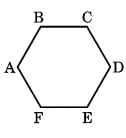
17. Polygon is a closed figure bounded by a certain number of line segments:

  • Triangle: bounded by 3 sides.
  • Quadrilateral: bounded by 4 sides.
  • Pentagon: bounded by 5 sides.
  • Hexagon: bounded by 6 sides.
  • Heptagon: bounded by 7 sides.
  • Octagon: bounded by 8 sides.

18. Types of quadrilateral:

  • Parallelogram: Pair of opposite sides are equal and parallel.
  • Square: each angle is 90° and all sides are equal.
  • Rectangle: each angle is 90° and opposite sides are equal.
  • Rhombus: a parallelogram with all equal sides.
  • Trapezium: a pair of opposite sides are parallel.
  • 3-D shapes: faces, edges and vertices are the elements of 3-D figures.

Basic Geometrical Ideas Class 6 Notes Maths Chapter 4

On this page, you will find Basic Geometrical Ideas Class 6 Notes Maths Chapter 4 Pdf free download. CBSE NCERT Class 6 Maths Notes Chapter 4 Basic Geometrical Ideas will seemingly help them to revise the important concepts in less time.

CBSE Class 6 Maths Chapter 4 Notes Basic Geometrical Ideas

Basic Geometrical Ideas Class 6 Notes Conceptual Facts

1. Basic Geometrical Elements are points, lines and planes.

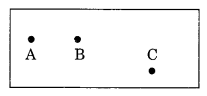
2. Point determines a location. It does not have length, breadth and thickness. It is usually denoted by a capital letter.
Basic Geometrical Ideas Class 6 Notes Maths Chapter 4.1

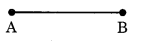
3. Line segment is the shortest distance between two points. Line segment joining points A and B is denoted by AB. AB and BA denote the same line segment.
\(\overline{\mathrm{AB}} \cdot \overline{\mathrm{AB}} \text { and } \overline{\mathrm{BA}}\)
Basic Geometrical Ideas Class 6 Notes Maths Chapter 4.2

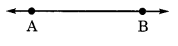
4. When a line segment is extended on both sides infinitely we get a line and it is denoted by \(\overline{\mathrm{AB}}\).
Basic Geometrical Ideas Class 6 Notes Maths Chapter 4.3

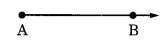
5. A ray is a portion of line starting at a point and extending in one direction endlessly. It is denoted by\(\overline{\mathrm{AB}}\).
Basic Geometrical Ideas Class 6 Notes Maths Chapter 4.4

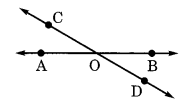
6. Two distinct lines which meet at a point are called intersecting lines.
Basic Geometrical Ideas Class 6 Notes Maths Chapter 4.5

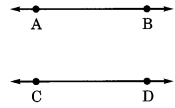
7. Two distinct lines which do not meet at any point, are called parallel lines and denoted by
|| i.e., \(\overline{\mathrm{AB}} \| \overline{\mathrm{CD}}\)

Basic Geometrical Ideas Class 6 Notes Maths Chapter 4.6

8. Any drawing (straight or non-straight) drawn without lifting the pencil is called a curve.
Basic Geometrical Ideas Class 6 Notes Maths Chapter 4.7

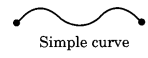
9. Simple curve does not intersects itself.

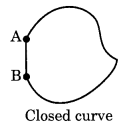
10. If the end points of a simple curve are joined, then it is called as closed curve.
Basic Geometrical Ideas Class 6 Notes Maths Chapter 4.8

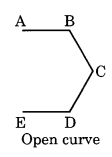
11. If the end points of a curve are not joined, then it is called as open curve.
Basic Geometrical Ideas Class 6 Notes Maths Chapter 4.9

12. Polygon is a simple closed curve made up of line segments.
Basic Geometrical Ideas Class 6 Notes Maths Chapter 4.10

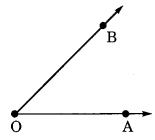
13. An angle is made up of two rays starting from a common end point. It is read as ∠BOA or ∠AOB.
Basic Geometrical Ideas Class 6 Notes Maths Chapter 4.11

14. Angle has three regions: On the angle, the interior of the angle and the exterior of the angle.

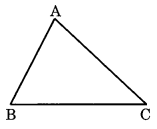
15. Triangle is a polygon of three sides denoted by ΔABC.
Basic Geometrical Ideas Class 6 Notes Maths Chapter 4.12

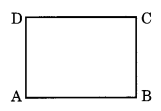
16. Quadrilateral is polygon of four sides.
Basic Geometrical Ideas Class 6 Notes Maths Chapter 4.13

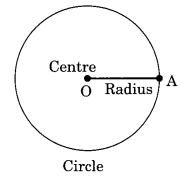
17. Circle is a path of a point moving at the same distance from a fixed point known as centre and the distance between the fixed point and the moving point is called radius.
Basic Geometrical Ideas Class 6 Notes Maths Chapter 4.14

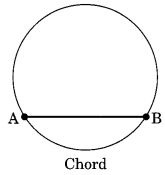
18. Chord of a circle is a line segment obtained by joining any two points on the circle. It divides the circle into two segments, minor segment and major segment.
Basic Geometrical Ideas Class 6 Notes Maths Chapter 4.15

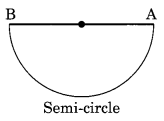
19. Diameter is the longest chord of a circle which passes through the centre and divides the circle into two semi-circles.
Basic Geometrical Ideas Class 6 Notes Maths Chapter 4.16