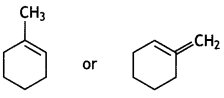
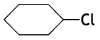
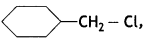
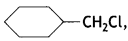
Haloalkanes and Haloarenes Class 12 Important Extra Questions Chemistry Chapter 10

Here we are providing Class 12 Chemistry Important Extra Questions and Answers Chapter 10 Haloalkanes and Haloarenes.  Class 12 Chemistry Important Questions are the best resource for students which helps in Class 12 board exams.

Class 12 Chemistry Chapter 10 Important Extra Questions Haloalkanes and Haloarenes

Haloalkanes and Haloarenes Important Extra Questions Very Short Answer Type

Question 1.
Define ambident nucleophile with an example. (CBSE Delhi 2019)
Answer:
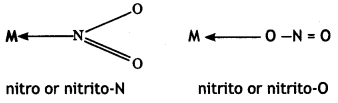
The nucleophile which has two sites through which it can attack is called ambident nucleophile, for example, nitrite ion (NO2). It can attack either through 0 (-O -N = O) or through N
Class 12 Chemistry Important Questions Chapter 10 Haloalkanes and Haloarenes 1
Question 2.
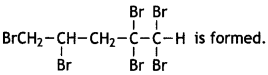
What happens when bromine attacks CH2 = CH – CH2 -C ≡ CH? (CBSE AI2012)
Answer:
The Colour of bromine gets discharged.
Class 12 Chemistry Important Questions Chapter 10 Haloalkanes and Haloarenes 2
Question 3.
What happens when CH3 – Br is treated with KCN? (CBSE Delhi 2013)
Answer:
Ethane nitrile is formed.
CH3Br + KCN → CH3C ≡ N + KBr (Ethane nitrile)

Question 4.
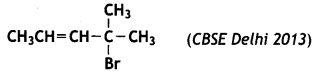
Write the IUPAC name of
Class 12 Chemistry Important Questions Chapter 10 Haloalkanes and Haloarenes 3
Answer:
4-Bromo-4-methylpent-2-ene

Question 5.
What happens when ethyl chloride is treated with aqueous KOH? (CBSE Delhi 2013)
Answer:
Ethyl alcohol is formed.
CH3CH2Cl + KOH(aq) → CH3CH2OH + KCl Ethyl alcohol

Question 6.
Write the IUPAC name of (CH3)2CH.CH(Cl)CH3. (CBSE Delhi 2013)
Answer:
2-Chloro-3-methyl butane

Question 7.
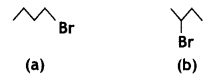
Which compound in the following pair undergoes a faster SN1 reaction? (CBSE Delhi 2013)
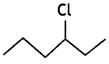
Class 12 Chemistry Important Questions Chapter 10 Haloalkanes and Haloarenes 4
Answer:
Class 12 Chemistry Important Questions Chapter 10 Haloalkanes and Haloarenes 5

Question 8.
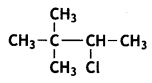
Write the IUPAC name of the following compound: (CBSE AI 2013)
Class 12 Chemistry Important Questions Chapter 10 Haloalkanes and Haloarenes 6
Answer:
3-Chloro-2, 2-dimethylbutane

Question 9.
Which aerosol depletes the ozone layer? (CBSE AI 2013)
Answer:
Chlorofluoro compounds of methane (CCl2F2) called freons.

Question 10.
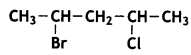
Write the IUPAC name of the following compound: (CBSE AI 2013)
Class 12 Chemistry Important Questions Chapter 10 Haloalkanes and Haloarenes 7
Answer:
2-Bromo-4-chloropentane

Question 11.
Why is CH2 = CH – CH2 – Cl more easily hydrolysed than CH3 – CH2 – CH2 – Cl? (CBSE AI 2019)
Answer:
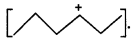
CH2 = CH – CH2 – Cl gives allylic carbocation as intermediate, which is resonance stabilised.
Class 12 Chemistry Important Questions Chapter 10 Haloalkanes and Haloarenes 8
Therefore, CH2 = CH – CH2 – Cl is more readily hydrolysed.

Question 12.
Write the IUPAC name of the following compound:
CH2 = CHCH2Br (CBSE 2011)
Answer:
3-Bromoprop-1-ene

Question 13.
Write the IUPAC name of the following compound: (CH2 )3CCH2Br (CBSE 2011)
Answer:
1 -Bromo 2,2-dimethylpropane

Question 14.
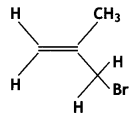
Write the IUPAC name of the following: (CBSE 2012)
Class 12 Chemistry Important Questions Chapter 10 Haloalkanes and Haloarenes 9
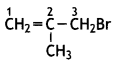
Answer:
Class 12 Chemistry Important Questions Chapter 10 Haloalkanes and Haloarenes 10
3-Bromo- 2-methylpropene

Question 15.
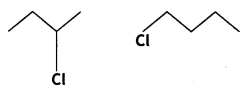
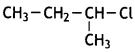
Identify the chiral molecule in the following pair: (CBSE 2014)
Class 12 Chemistry Important Questions Chapter 10 Haloalkanes and Haloarenes 11
Answer:
Class 12 Chemistry Important Questions Chapter 10 Haloalkanes and Haloarenes 12
2-Chlorobutane is a chiral molecule.

Question 16.
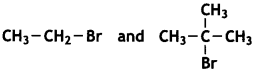
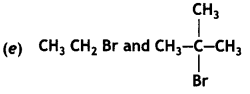
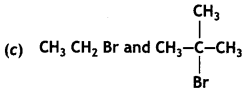
Which would undergo SN2 reaction faster in the following pair and why? (CBSE Delhi 2015)
Class 12 Chemistry Important Questions Chapter 10 Haloalkanes and Haloarenes 13
Answer:
CH3CH2Br would undergo SN2 reaction faster because of less steric hindrance.

Question 17.
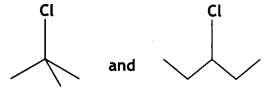
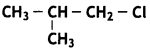
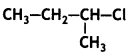
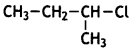
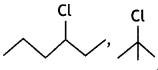
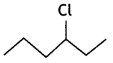
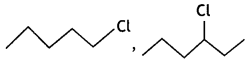
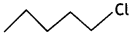
Out Class 12 Chemistry Important Questions Chapter 10 Haloalkanes and Haloarenes 14andClass 12 Chemistry Important Questions Chapter 10 Haloalkanes and Haloarenes 15 which is more reactive towards SN1 reaction and why? (CBSE Delhi 2016)
Answer:
Class 12 Chemistry Important Questions Chapter 10 Haloalkanes and Haloarenes 16 is more reactive.
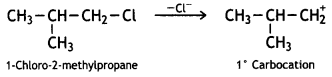
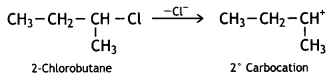
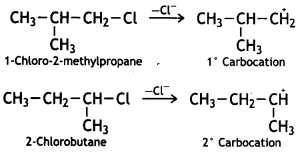
The SN1 reaction proceeds through the formation of a carbocation. The compound which forms a more stable carbocation will be more reactive.
Class 12 Chemistry Important Questions Chapter 10 Haloalkanes and Haloarenes 17
Class 12 Chemistry Important Questions Chapter 10 Haloalkanes and Haloarenes 18
Since 2° carbocation is more stable than 1° carbocation, 2-Chlorobutane will be more reactive towards the SN1 reaction.

Question 18.
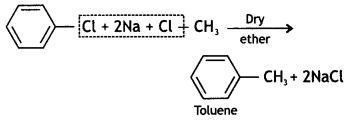
Write the structure of the product formed when chlorobenzene is treated with methyl chloride in the presence of sodium metal and dry ether. (CBSE Al 2018)
Answer:
Class 12 Chemistry Important Questions Chapter 10 Haloalkanes and Haloarenes 19

Question 19.
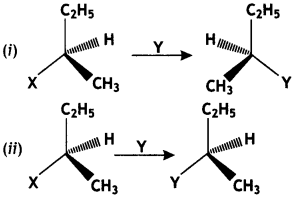
Which of the following two reactions is SN2 and why? (CBSE AI2016)
Class 12 Chemistry Important Questions Chapter 10 Haloalkanes and Haloarenes 20
Answer:
Reaction (i) is SN2 because it proceeds by inversion of configuration.

Question 20.
Why is chloroform kept in dark coloured bottles? (CBSE AI 2019)
Answer:
Chloroform reacts with atmospheric oxygen in presence of light to produce an extremely poisonous gas called phosgene.
Class 12 Chemistry Important Questions Chapter 10 Haloalkanes and Haloarenes 21
Chloroform is stored in dark coloured bottles so that it is not exposed to light and the formation of phosgene is prevented.

Question 21.
Write one stereochemical difference between SN1 and SN2 reactions. (CBSE Delhi 2019)
Answer:
SN1 reaction forms a racemic mixture while SN2 reaction results in inversion of configuration.

Question 22.
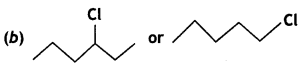
A solution of KOH hydrolyses CH3CHClCH2CH3 and CH3CH2CH2CH2Cl. Which one of these is more easily hydrolysed? (CBSE Delhi 2010)
Answer:
CH3CHClCH2CH3

Question 23.
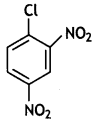
Write the structure of 2, 4-dinitrochlorobenzene. (CBSE Delhi 2017)
Answer:
Class 12 Chemistry Important Questions Chapter 10 Haloalkanes and Haloarenes 22

Question 24.
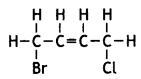
Write the structure of 1-Bromo-4- chlorobut-2-ene. (CBSE Delhi 2017)
Answer:
Class 12 Chemistry Important Questions Chapter 10 Haloalkanes and Haloarenes 23

Question 25.
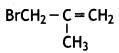
Write the structure of 3-Bromo-2- methylprop-1 -ene. (CBSE Delhi 2017)
Answer:
Class 12 Chemistry Important Questions Chapter 10 Haloalkanes and Haloarenes 24

Question 26.
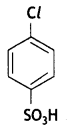
Write IUPAC name of the given compound: (CBSE Delhi 2019)
Class 12 Chemistry Important Questions Chapter 10 Haloalkanes and Haloarenes 25
Answer:
4-Chlorobenzene sulphonic acid

Question 27.
Out of chlorobenzene and benzyl chloride, which one gets easily hydrolysed by aqueous NaOH and why? (CBSE Sample paper 2018)
Answer:
Benzyl chloride;
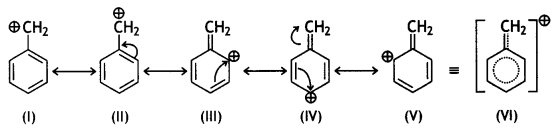
Due to resonance, stable benzyl carbocation is formed.

Haloalkanes and Haloarenes Important Extra Questions Short Answer Type

Question 1.
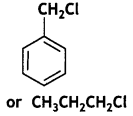
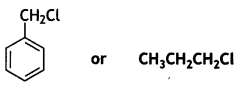
Which one of the following compounds will undergo hydrolysis at a faster rate by SN1 mechanism? Justify. (CBSE Sample Paper 2019)
Class 12 Chemistry Important Questions Chapter 10 Haloalkanes and Haloarenes 26
Answer:
The following compound will undergo SN1 faster:
Class 12 Chemistry Important Questions Chapter 10 Haloalkanes and Haloarenes 27
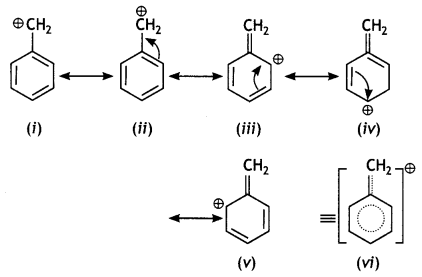
Greater the stability of the carbocation, greater will be its ease of formation from the corresponding halide and faster will be the rate of reaction. The benzylic carbocation formed gets stabilised through resonance.
Class 12 Chemistry Important Questions Chapter 10 Haloalkanes and Haloarenes 28
CH3CH2CH2Cl forms 1° carbocation, which is less stable than benzylic carbocation.

Question 2.
How would you differentiate between SN1 and SN2 mechanisms of substitution reactions? Give one example of each. (CBSE 2010)
Answer:
The SN1 reaction occurs in two steps and the reaction is of the first order.
The SN2 reaction occurs in one step and the reaction is of second order. These can also be distinguished as:

In SN1 reaction retention of the configuration takes place while in SN2 reaction inversion of the configuration takes place.

SN2 reaction:
Class 12 Chemistry Important Questions Chapter 10 Haloalkanes and Haloarenes 29

SN1 reaction:
Class 12 Chemistry Important Questions Chapter 10 Haloalkanes and Haloarenes 30

Question 3.
(i) State one use each of DDT and iodoform.
Answer:
DDT is used as an insecticide for killing mosquitoes and other insects. chloroform is used as an antiseptic.

(ii) Which compound in the following couples will react faster in SN2 displacement and why?
(a) I -Bromopentane or 2-bromopentane
Answer:
1-Bromopentane (1°) will react faster than 2-bromopentane (2°) by SN2 displacement because It is Less stericaLly hindered in the transition state.

(b) I-Bromo-2-methyl butane or 2-Bromo-2-methyl butane (CBSE Delhi 2010)
Answer:
1 -Bromo-2-methyl butane (1°) reacts faster than 2-bron,o-2-methyl butane (2°) because being primary, it will have Less steric hindrance.

Question 4.
Although chlorine Is an electron-withdrawing group, yet It Is ortho-, para-directing in electrophilic aromatic substitution reactions. Explain why Is It so? (CBSE 2012)
Answer:
Chlorine is an electron-withdrawing group, yet it is ortho-, para-directing in eLectrophiLic aromatic substitution reactions due to eLectron reLeasing resonance effect (+ R-effect).
Class 12 Chemistry Important Questions Chapter 10 Haloalkanes and Haloarenes 31
As can be seen from the above resonating structures that -Ct increases electron density at ortho- and para-positions due to the + R-effect. Therefore, the attack of electrophile takes pLace at ortho- and paro- positions and not at meta- positions.

Question 5.
(i) Which alkyl halide from the following pair Is chiral and undergoes a faster SN2 reaction? (CBSE Delhi 2014)
Class 12 Chemistry Important Questions Chapter 10 Haloalkanes and Haloarenes 32
Answer:
Class 12 Chemistry Important Questions Chapter 10 Haloalkanes and Haloarenes 33 is chiral

(ii) Out of SN1 and SN2 which reaction occurs with
(a) Inversion of configuration
Answer:
SN2

(b) Racemisation
Answer:
SN1

Question 6.
Draw the structure of major moon halo product In each of the following reactions: (CBSE Delhi 2014)
Class 12 Chemistry Important Questions Chapter 10 Haloalkanes and Haloarenes 34
Answer:
Class 12 Chemistry Important Questions Chapter 10 Haloalkanes and Haloarenes 35

Class 12 Chemistry Important Questions Chapter 10 Haloalkanes and Haloarenes 36
Answer:
Class 12 Chemistry Important Questions Chapter 10 Haloalkanes and Haloarenes 37

Question 7.
Propose the mechanism of the reaction taking place when
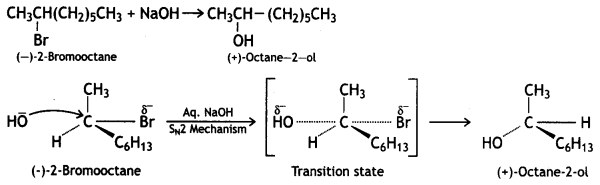
(i) (-) – 2 – Bromooctane reacts with sodium hydroxide to form (+) – octane-2-ol.
Answer:
Class 12 Chemistry Important Questions Chapter 10 Haloalkanes and Haloarenes 38

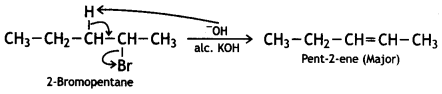
(ii) 2-Bromopentane is heated with (ale.) KOH to form alkenes. (CBSE Sample Paper 2011)
Answer:
Class 12 Chemistry Important Questions Chapter 10 Haloalkanes and Haloarenes 39

Question 8.
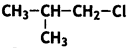
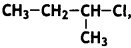
Out of Class 12 Chemistry Important Questions Chapter 10 Haloalkanes and Haloarenes 40 andClass 12 Chemistry Important Questions Chapter 10 Haloalkanes and Haloarenes 41 which is more reactive towards SN1 reaction
Answer:
Class 12 Chemistry Important Questions Chapter 10 Haloalkanes and Haloarenes 42 is more reactive.
The SN1 reaction proceeds through the formation of a carbocation. The compound which forms a more stable carbocation will be more reactive.
Class 12 Chemistry Important Questions Chapter 10 Haloalkanes and Haloarenes 43
Since 2° carbocation is more stable than 1° carbocation, 2-Chlorobutane will be more reactive towards the SN1 reaction.

Haloalkanes and Haloarenes Important Extra Questions Long Answer Type

Question 1.
(i) Out of (CH3)3C-Br, and (CH3)3C-I, which one is more reactive towards SN1 and why?
Answer:
(CH3)2 C-I, because it can readily form stable carbocation because the C – l bond is weaker than the C – Br bond.

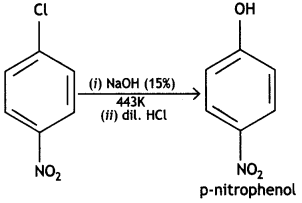
(ii) Write the product formed when p-nitro chlorobenzene is heated with aqueous NaOH at 443 K followed by acidification.
Answer:
Class 12 Chemistry Important Questions Chapter 10 Haloalkanes and Haloarenes 44

(iii) Why are dextro- and laevorotatory isomers of Butan-2-ol difficult to separate by fractional distillation? (CBSE Delhi 2019)
Answer:
Dextro- and laevorotatory isomers of butan-2-ol are enantiomers of each other and both have the same boiling point. Hence, these cannot be separated by fractional distillation.

Question 2.
Give reasons for the following:
(i) Ethyl iodide undergoes SN2 reaction faster than ethyl bromide.
Answer:
Ethyl iodide undergoes SN2 reaction faster than ethyl bromide because I- ion is a better leaving group than Br- ion.

(ii) (±) 2 – Butanol is optically inactive.
Answer:
(±) 2 – Butanol represents a racemic mixture of (+) 2-butanol and (-) 2-butanol which rotate the plane polarized light in different directions but to an equal extent. Therefore, the (±) compound is optically inactive.

(iii) C—X bond length in halobenzene is smaller than C—X bond length in CH3 — X. (CBSE 2013)
Answer:
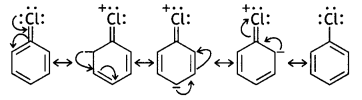
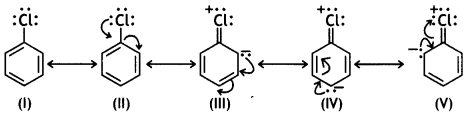
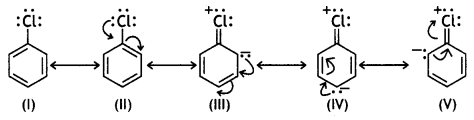
In halobenzene, there is delocalisation of electrons due to resonance. For example, chlorobenzene is considered to be a resonance hybrid of the following structures:
Class 12 Chemistry Important Questions Chapter 10 Haloalkanes and Haloarenes 45
It is evident that the contribution of structures III, IV and V imparts a partial double bond character to the carbon-chlorine bond. Therefore, the C-X bond length in halobenzene is less than the C-X bond length in CH3-X, which has only a single C-X bond.

Question 3.
(i) Draw the structures of major moon halo products in each of the following reactions:
Class 12 Chemistry Important Questions Chapter 10 Haloalkanes and Haloarenes 46
Answer:
Class 12 Chemistry Important Questions Chapter 10 Haloalkanes and Haloarenes 47

Class 12 Chemistry Important Questions Chapter 10 Haloalkanes and Haloarenes 48
Answer:
Class 12 Chemistry Important Questions Chapter 10 Haloalkanes and Haloarenes 49

(ii) Which halogen compound in each of the following pairs will react faster in SN2 reaction:
(a) CH3Br or CH3I
Answer:
CH3I

(b) (CH3)3C – Cl or CH3 – Cl (CBSE 2014)
Answer:
CH3Cl

Question 4.
How would you convert the following:
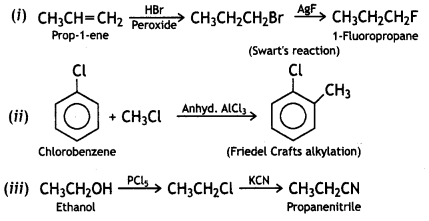
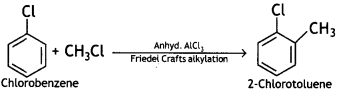
(i) Prop-1-ene to 1-fluoropropane
(ii) Chlorobenzene to 2-chlorotoluene
(iii) Ethanol to propanenitrile
OR
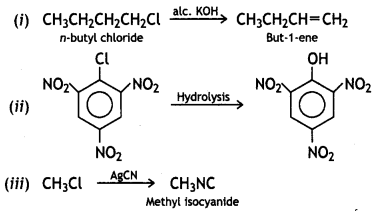
Write the main products when
(i) n-butyl chloride is treated with alcoholic KOH.
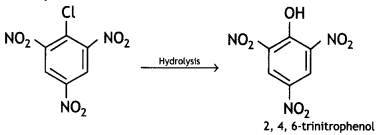
(ii) 2, 4, 6-trinitrochlorobenzene is subjected to hydrolysis.
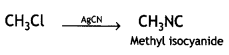
(iii) methyl chloride is treated with AgCN.
Answer:
Class 12 Chemistry Important Questions Chapter 10 Haloalkanes and Haloarenes 50
OR
Class 12 Chemistry Important Questions Chapter 10 Haloalkanes and Haloarenes 51

Question 5.
Give reasons:
(i) C – Cl bond length in chlorobenzene is shorter than C — Cl bond length in CH3 — Cl.
Answer:
In chlorobenzene, there is delocalisation of electrons due to resonance.
It is considered to be a resonance hybrid of the following structures.
Class 12 Chemistry Important Questions Chapter 10 Haloalkanes and Haloarenes 52
The contribution of structure III, IV and V imparts a partial double bond character to the C – Cl bond.

This is confirmed by X-ray analysis which shows that the C – Cl bond length in chlorobenzene is 1.69 whereas the C – Cl bond length in ethyl chloride is 1.82 A. There is no resonance in CH3Cl and hence no partial double bond character.

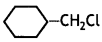
(ii) The dipole moment of chlorobenzene is lower than that of cyclohexyl chloride.
Answer:
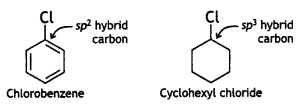
In chlorobenzene, the C of C-Cl bond is sp2-hybridised while the C of C-Cl bond in cyclohexyl chloride is sp3-hybridised.
Class 12 Chemistry Important Questions Chapter 10 Haloalkanes and Haloarenes 53
Therefore, the sp2-hybridised C of chlorobenzene has more s-character and hence more electronegative than the sp3-hybrid C of cyclohexyl chloride. As a result, the sp2 hybrid of the C-Cl bond in chlorobenzene has less tendency to release electrons to Cl than the sp3 hybrid carbon of cyclohexyl chloride. As a result, the C-Cl bond in chlorobenzene is less polar than in cyclohexyl chloride. Thus, chlorobenzene is less polar than cyclohexyl chloride.

(iii) SN1 reactions are accompanied by racemisation in optically active alkyl halides. (CBSE 2016)
Answer:
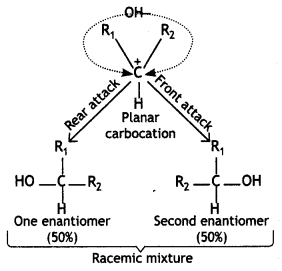
The SN1 reactions proceed through the formation of carbocations. In the case of optically active alkyl halides, the product formed is a racemic mixture. This is because the intermediate carbocation is planar species, therefore, the attack of the nucleophile, OFT ion can take place from both the faces (front and rear) with equal ease. As a result, a 50: 50 mixture of the two enantiomers (laevo and dextro) is formed. Thus, the product formed is a racemic mixture (±) which is optically inactive.
Class 12 Chemistry Important Questions Chapter 10 Haloalkanes and Haloarenes 54
For example, hydrolysis of optically active 2-bromobutane results in the formation of a racemic mixture (±)-butan-2-ol.

Question 6.
The following compounds are given to you:
2-Bromopentane, 2-Bromo-2-methyl butane, 1-Bromopentane
(i) Write the compound which is most reactive towards the SN2 reaction.
Answer:
1-Bromopentane

(ii) Write the compound which is optically active.
Answer:
2-Bromopentane

(iii) Write the compound which is most reactive towards the SN2 elimination reaction.
Answer:
2-Bromo-2-methyl butane

Question 7.
Explain why
(i) the dipole moment of chlorobenzene is lower than that of cyclohexyl chloride. (CBSE Delhi 2016)
Answer:
In chlorobenzene, the C of C-Cl bond is sp2-hybridised while the C of C-Cl bond in cyclohexyl chloride is sp3-hybridised.
Class 12 Chemistry Important Questions Chapter 10 Haloalkanes and Haloarenes 55
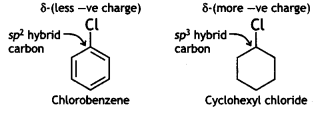
Therefore, the sp2-hybridised C of chlorobenzene has more s-character and hence more electronegative than the sp3-hybrid C of cyclohexyl chloride. As a result, the sp2 hybrid of the C-Cl bond in chlorobenzene has less tendency to release electrons to Cl than the sp3 hybrid carbon of cyclohexyl chloride. As a result, the C-Cl bond in chlorobenzene is less polar than in cyclohexyl chloride.

Thus, chlorobenzene is less polar than cyclohexyl chloride. In other words, the magnitude of negative charge (δ-) is less on the Cl atom of chlorobenzene than in cyclohexyl chloride. Further, due to the delocalisation of the lone pair of electrons of the Cl atom over the benzene ring due to resonance, the C-Cl bond in chlorobenzene acquires some double-bond character. On the other hand, the C-Cl bond in cyclohexyl chloride is a pure single bond.

Since dipole moment is a product of charge and distance, therefore, chlorobenzene has a lower dipole moment than cyclohexyl chloride due to the lower magnitude of charge (δ-) on Cl atom and small C-Cl distance.

(ii) alkyl halides, though polar, are immiscible with water,
Answer:
Alkyl halides are polar molecules and therefore, their molecules are held together by dipole-dipole forces. On the other hand, the molecules of H20 are held together by hydrogen bonds. When alkyl halides are added to water, the new forces of attraction between water and alkyl halide molecules are weaker than the forces of attraction already existing between alkyl halide-alkyl halide molecules and water-water molecules. Hence, alkyl halides are immiscible (not soluble) in water.

(iii) Grignard reagents should be prepared under anhydrous conditions? (CBSE Sample Paper 2011)
Answer:
Grignard reagents are very reactive. They react with the moisture present in the apparatus or the starting materials (RX or Mg).
RMgX + HOH → R-H + Mg(OH)X
Therefore, Grignard reagents must be prepared in anhydrous conditions.

Question 8.
Which one of the following compounds will undergo a faster hydrolysis reaction by the SN1 mechanism? Justify your answer.
Class 12 Chemistry Important Questions Chapter 10 Haloalkanes and Haloarenes 56
OR
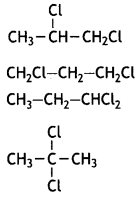
A compound is formed by the substitution of two chlorine atoms for two hydrogen atoms in propane. Write the structures of the isomers possible. Give the IUPAC name of the isomer which can exhibit enantiomerism. (CBSE Sample paper 2018-19)
Answer:
C6 H5CH2Cl will undergo SN1 reaction faster.

The carbocation formed by C6 H5CH2Cl gets stabilised through resonance.
Greater the stability of carbocation, greater will be its ease of formation from the respective halide.
Class 12 Chemistry Important Questions Chapter 10 Haloalkanes and Haloarenes 57
OR
Class 12 Chemistry Important Questions Chapter 10 Haloalkanes and Haloarenes 58
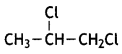
The following isomer will exhibit enantiomerism:
Class 12 Chemistry Important Questions Chapter 10 Haloalkanes and Haloarenes 59
IUPAC name: 1,2-Dichloropropane.

Question 9.
(i) Identify the chiral molecule in the following pair:
Class 12 Chemistry Important Questions Chapter 10 Haloalkanes and Haloarenes 60 andClass 12 Chemistry Important Questions Chapter 10 Haloalkanes and Haloarenes 62
Answer:
Class 12 Chemistry Important Questions Chapter 10 Haloalkanes and Haloarenes 61

(ii) Write the structure of the product when chlorobenzene is treated with methyl chloride in the presence of sodium metal and dry ether.
Answer:
Class 12 Chemistry Important Questions Chapter 10 Haloalkanes and Haloarenes 63

(iii) Write the structure of the alkene formed by dehydrohalogenation of 1-Bromo-1- methylcyclohexane with alcoholic KOH. (CBSE 2018)
Answer:
Class 12 Chemistry Important Questions Chapter 10 Haloalkanes and Haloarenes 64

Question 10.
(a) Out ofClass 12 Chemistry Important Questions Chapter 10 Haloalkanes and Haloarenes 65 andClass 12 Chemistry Important Questions Chapter 10 Haloalkanes and Haloarenes 66 which one is more reactive towards SN2 reaction and why?
Answer:
Class 12 Chemistry Important Questions Chapter 10 Haloalkanes and Haloarenes 67 because it is a primary halide and has less steric hindrance and therefore, undergoes SN2 action faster.

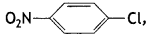
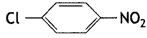
(b) Out ofClass 12 Chemistry Important Questions Chapter 10 Haloalkanes and Haloarenes 68 andClass 12 Chemistry Important Questions Chapter 10 Haloalkanes and Haloarenes 69 which one is more reactive towards nucleophilic substitution reaction and why?
Answer:
Class 12 Chemistry Important Questions Chapter 10 Haloalkanes and Haloarenes 70 is more reactive because of the presence of electron-withdrawing – NO2 group.

(c) Out ofClass 12 Chemistry Important Questions Chapter 10 Haloalkanes and Haloarenes 71 andClass 12 Chemistry Important Questions Chapter 10 Haloalkanes and Haloarenes 72 which one is optically active and why? (CBSE AI 2019)
Answer:
Class 12 Chemistry Important Questions Chapter 10 Haloalkanes and Haloarenes 73 is optically active because of the presence of chiral carbon. OH

Question 11.
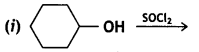
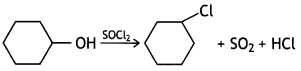
Write the products of the following reactions:
(i) CH3 CH2 -CH = CH2 + HCl →
Answer:
Class 12 Chemistry Important Questions Chapter 10 Haloalkanes and Haloarenes 74

(ii) Me2CHCH2OH Class 12 Chemistry Important Questions Chapter 10 Haloalkanes and Haloarenes 75
Answer:
Me2CHCH2OH Class 12 Chemistry Important Questions Chapter 10 Haloalkanes and Haloarenes 75 MeCHCH2Cl

Class 12 Chemistry Important Questions Chapter 10 Haloalkanes and Haloarenes 76
Answer:
Class 12 Chemistry Important Questions Chapter 10 Haloalkanes and Haloarenes 77

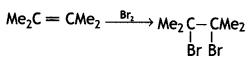
(iv) Me2C = CMe2 Class 12 Chemistry Important Questions Chapter 10 Haloalkanes and Haloarenes 78
Answer:
Class 12 Chemistry Important Questions Chapter 10 Haloalkanes and Haloarenes 79

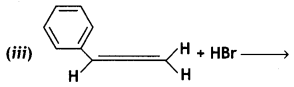
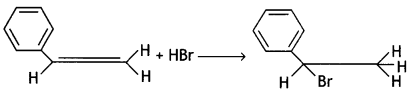
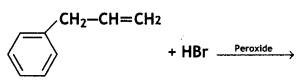
(v) Class 12 Chemistry Important Questions Chapter 10 Haloalkanes and Haloarenes 80 (CBSE AI 2016)
Answer:
Class 12 Chemistry Important Questions Chapter 10 Haloalkanes and Haloarenes 81

Question 12.
(i) In the following pairs of the halogen compounds, which would undergo SN2 faster?
Answer:
SN2 reaction proceeds through the formation of a transition state involving the bonding of carbon to five atoms or groups. The reactivity is decided by the stability of the transition state on the basis of steric hindrance. The reactivity follows the order: CH3 > 1° > 2° > 3° halide.
Therefore,

Class 12 Chemistry Important Questions Chapter 10 Haloalkanes and Haloarenes 82
Answer:
Class 12 Chemistry Important Questions Chapter 10 Haloalkanes and Haloarenes 83 is primary alkyl halide and hence undergoes SN2 reaction faster.

Class 12 Chemistry Important Questions Chapter 10 Haloalkanes and Haloarenes 84
Answer:
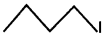
Class 12 Chemistry Important Questions Chapter 10 Haloalkanes and Haloarenes 85 I will undergo SN2 reaction faster because iodine is a better leaving group due to its large size and hence it will be released at a faster rate in the presence of incoming nucleophile.

Class 12 Chemistry Important Questions Chapter 10 Haloalkanes and Haloarenes 86
Answer:
Class 12 Chemistry Important Questions Chapter 10 Haloalkanes and Haloarenes 87 (1 -Bromo-2, 2-dimethylpentane) reacts faster because it is 1 ° alkyl halide.

Class 12 Chemistry Important Questions Chapter 10 Haloalkanes and Haloarenes 88 (CBSE AI 2009)
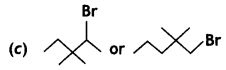
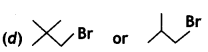
Answer:
Class 12 Chemistry Important Questions Chapter 10 Haloalkanes and Haloarenes 89 (2-Methyl-1-bromopropane) reacts faster because it has lesser steric hindrance in the transition state.

Class 12 Chemistry Important Questions Chapter 10 Haloalkanes and Haloarenes 90
Answer:
CH3 CH2 Br would undergo SN2 reaction faster because of less steric hindrance.

(ii) Which one of the following pairs undergoes SN1 substitution reaction faster and why?
Answer:
SN1 reaction occurs through the formation of a carbocation. Therefore, the greater the stability of the carbocation, the faster is the rate of an SN1 reaction. Since the stability of carbocation follows the order 3° > 2° > 1° > CH3, therefore,

Class 12 Chemistry Important Questions Chapter 10 Haloalkanes and Haloarenes 91
Answer:
Out of Class 12 Chemistry Important Questions Chapter 10 Haloalkanes and Haloarenes 92 orClass 12 Chemistry Important Questions Chapter 10 Haloalkanes and Haloarenes 93 reacts faster because it invoLves the formation of 3° -carbocationClass 12 Chemistry Important Questions Chapter 10 Haloalkanes and Haloarenes 94 while Class 12 Chemistry Important Questions Chapter 10 Haloalkanes and Haloarenes 95involves the formation of V -carbocationClass 12 Chemistry Important Questions Chapter 10 Haloalkanes and Haloarenes 96

Class 12 Chemistry Important Questions Chapter 10 Haloalkanes and Haloarenes 97(CBSE AI 2009)
Answer:
Out of Class 12 Chemistry Important Questions Chapter 10 Haloalkanes and Haloarenes 98or Class 12 Chemistry Important Questions Chapter 10 Haloalkanes and Haloarenes 99reacts faster because it forms 2° carbocation while Class 12 Chemistry Important Questions Chapter 10 Haloalkanes and Haloarenes 100involves 1° carbocation.

Class 12 Chemistry Important Questions Chapter 10 Haloalkanes and Haloarenes 101 (CBSE AI 2015)
Answer:
Class 12 Chemistry Important Questions Chapter 10 Haloalkanes and Haloarenes 102 undergoes SN1 reaction faster. This is because the carbocation derived from CH3(CH3)3 C Br is 3° carbocation and is more stable than carbocation (1°) obtained from CH3 CH2 Br.

Question 13.
(i) How would you convert the following:
(a) Prop-1-ene to 1-fluoropropane
Answer:
Class 12 Chemistry Important Questions Chapter 10 Haloalkanes and Haloarenes 103

(b) Chlorobenzene to 2-chlorotoluene
Answer:
Class 12 Chemistry Important Questions Chapter 10 Haloalkanes and Haloarenes 104

(ii) Write the main products when
(a) n-butyl chloride is treated with alcoholic KOH.
Answer:
Class 12 Chemistry Important Questions Chapter 10 Haloalkanes and Haloarenes 105

(b) 2, 4, 6-trinitrochlorobenzene is subjected to hydrolysis.
Answer:
Class 12 Chemistry Important Questions Chapter 10 Haloalkanes and Haloarenes 106

(c) methyl chloride is treated with AgCN. (CBSE AI2015)
Answer:
Class 12 Chemistry Important Questions Chapter 10 Haloalkanes and Haloarenes 107

Question 14.
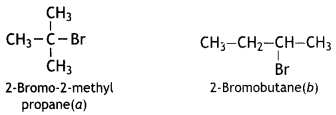
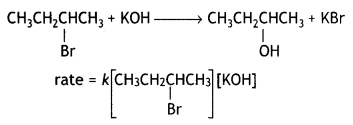
Compound ‘A’ with molecular formula C4H9Br is treated with aq. KOH solution. The rate of this reaction depends upon the concentration of the compound ‘A’ only. When another optically active isomer ‘B’ of this compound was treated with aq. KOH solution, the rate of reaction was found to be dependent on the concentration of compound and KOH both.
(i) Write down the structural formula of both compounds ‘A’ and ‘B’.
Answer:
The molecular formulae of isomers of C4H9Br are CH3
Class 12 Chemistry Important Questions Chapter 10 Haloalkanes and Haloarenes 108
Since the rate of reaction of the compound ‘A’ (C4H9Br) with aqueous KOH depends upon the concentration of compound ‘A’ only, therefore, the reaction occurs by SN1 mechanism and compound ‘A’ is tertiary bromide, i.e. 2-Bromo-2-methylpropane.
(CH3)3CBr + KOH(aq) → (CH3 )3COH + KBr rate = k[(CH3)3CBr]

(ii) Out of these two compounds, which one will be converted to the product with an inverted configuration. (NCERT Exemplar)
Answer:
Since compound ‘B’ is optically active and is an isomer of compound ‘A’ (C4H9Br), therefore, compound ‘B’ must be 2-bromobutane. Since the rate of reaction of compound ‘B’ with aqueous KOH depends upon the concentration of compound ‘B’ and KOH, therefore, the reaction occurs by SN2 mechanism and the product of hydrolysis will have inverted configuration.
Class 12 Chemistry Important Questions Chapter 10 Haloalkanes and Haloarenes 109
Compound ‘B’ will be converted with an inverted configuration.

Question 15.
(i) Draw other resonance structures related to the following structure and find out whether the functional group present in the molecule is ortho, para directing or meta directing.
Class 12 Chemistry Important Questions Chapter 10 Haloalkanes and Haloarenes 110
Answer:
It is clear from resonating structures that there is an increase in electron density at ortho and para positions. Therefore, the functional group ‘X’ is ortho and para directing.

(ii) Classify the following compounds as primary, secondary and tertiary halides.
(a) 1-Bromobut-2-ene
Answer:
Primary

(b) 4-Bromopent-2-ene
Answer:
secondary

(c) 2-Bromo-2-methylpropane (NCERT Exemplar)
Answer:
tertiary

Question 16.
tert-Butylbromide reacts with aq. NaOH by SN1 mechanism while n-butyl bromide reacts by an SN2 mechanism. Why?
Answer:
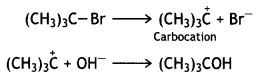
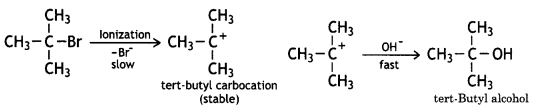
In general, the SN1 reaction proceeds through the formation of a carbocation. The tert-butyl bromide readily loses Br ion to form stable 3° carbocation.
Therefore, it reacts with aqueous KOH by SN1 mechanism as:
Class 12 Chemistry Important Questions Chapter 10 Haloalkanes and Haloarenes 111
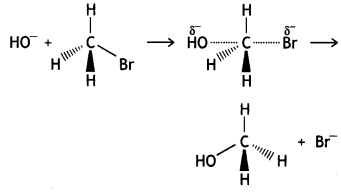
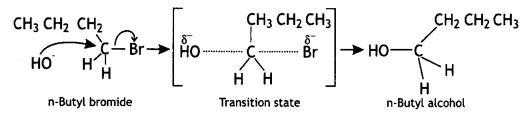
On the other hand, n-butyl bromide does not undergo ionisation to form n-butyl carbocation (1°) because it is not stable. Therefore, it prefers to undergo reaction by an SN2 mechanism, which occurs in one step through a transition state involving the nucleophilic attack of OH ion from the backside with simultaneous expulsion of Br ion from the front side.
Class 12 Chemistry Important Questions Chapter 10 Haloalkanes and Haloarenes 112
SN1 mechanism follows the reactivity order as 3° > 2° > 1° while the SN2 mechanism follows the reactivity order as 1° >2° >3°
Therefore, tert-butyl bromide (3°) reacts by SN1 mechanism while n-butyl bromide (1°) reacts by the SN2 mechanism.

Coordination Compounds Class 12 Important Extra Questions Chemistry Chapter 9

Here we are providing Class 12 Chemistry Important Extra Questions and Answers Chapter 9 Coordination Compounds.  Class 12 Chemistry Important Questions are the best resource for students which helps in Class 12 board exams.

Class 12 Chemistry Chapter 9 Important Extra Questions Coordination Compounds

Coordination Compounds Important Extra Questions Very Short Answer Type

Question 1.
Give an example of linkage isomerism. (CBSE Delhi 2010)
Answer:
[Co (NH3)5 (N02)] Cl2 and [Co (NH3)5 (ONO)]Cl2

Question 2.
Give an example of coordination isomerism. (CBSE Delhi 2010)
Answer:
[CO(NH3)6] [Cr(CN)6] and [Cr(NH3)6] [Co (CN)6]

Question 3.
Which of the following is more stable complex and why? (CBSE Delhi and Al 2014)
[CO(NH3)6]3+ and [Co(en)3]3+
Answer:
[Co(en)3]3+ because bidentate ligand (ethylenediamine) forms chelate which is more stable.

Question 4.
A coordination compound with molecular formula CrCl3.4H20 precipitates one mole of AgCl with AgN03 solution. Its molar conductivity is found to be equivalent to two ions. What is the structural formula and name of the compound? (CBSE Sample Paper 2017-18)
Answer:
[CrCl2(H20)4]Cl: Tetraaquadichloridochrom ium(III) chloride.

Question 5.
What is coordination isomerism? Give one example. (CBSE Delhi 2010)
Answer:
Coordination isomerism arises when both the cation and anion are complexes and the ligands are exchanged. For example, [CO(NH3)6] [Cr(CN)6] and [Cr(NH3)6] [Co(CN)6]

Question 6.
Write IUPAC name of the complex [Co(en)2(H20)(CN)]2+
OR
Using IUPAC norms, write the formula of Ammonium tetrafluoride cobaltates (II). (CBSE AI 2019)
Answer:
Aquacyanidobis (ethane-1,2-diamine) cobalt (III) ion
OR
(NH4)2[Co F4]

Question 7.
Write the IUPAC name of the complex K3[Cr(C204)3].
OR
Using IUPAC norms write the formula of Hexaamminecobalt(III) sulphate. (CBSE AI 2019)
Answer:
Potassium trioxalatochromate(III)
OR
[Co(NH3)6]2 (S04)3

Question 8.
Write IUPAC name of the complex [Co(en)2CI2]
OR
Using IUPAC norms, write the formula of Sodium tetrachloridonickelate(II). (CBSE AI 2019)
Answer:
Dichloridobis (ethylenediamine) cobalt(III) ion.
OR
Na2[NlCl4]

Question 9.
Predict the number of unpaired electrons in the square planar [Pt(CN)4]2- ion. (CBSE 2019C)
Or
Amongst [Fe(C204)3]3- and [Fe(NH3)6]3+ which is more stable and why?
Answer:
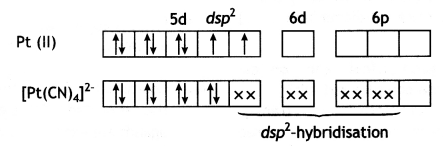
The Pt (II) ion has 5d8 electronic configuration. For square planar geometry, dsp2 hybridisation is involved. For this, one empty d-orbital is needed for hybridisation. Therefore, the pairing of electrons takes place in the remaining d-orbitals. Hence, there are no unpaired electrons in [Pt(CN)4]2- ion and it is diamagnetic.
Class 12 Chemistry Important Questions Chapter 9 Coordination Compounds 1
OR
[Fe(C204)3]3- is more stable because it is a chelate. C2042- is a didentate ligand.

When a didentate or a polydentate ligand uses its two or more donor atoms to bind to the same central metal atom or ion forming a ring structure it is called chelation.

The resulting complex has a ring structure and the ligand coordinating through two or more donor groups is called a chelating ligand. Some common examples of chelating ligands are carbonate ion, oxalate ion (ox2-), ethylenediamine (en), ortho-phenanthroline (ph) and ethylenediaminetetraacetate ion (EDTA).

Chelate ligands form more stable complexes than similar ordinary complexes in which the ligand acts as monodentate. This is called a chelate effect.

Coordination Compounds Important Extra Questions Short Answer Type

Question 1.
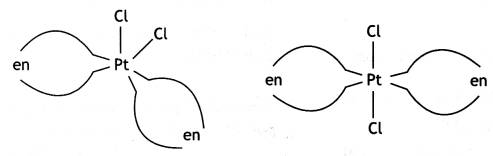
Write IUPAC name of the complex [Pt(en)2Cl2]. Draw structures of geometrical isomers for this complex.
OR
Using IUPAC norms write the formulae for the following:
(i) Hexaamminecobalt(III) sulphate
(ii) Potassium trioxalatochromate(III) (CBSE Delhi 2019)
Answer:
Dichlorido bis(ethane-1,2-diamine) platinum (II)
Geometrical isomers.
Class 12 Chemistry Important Questions Chapter 9 Coordination Compounds 2
OR
(i) [CO(NH3)6]2(S04)3
(ii) K3[Cr(ox)]3

Question 2.
Out of [COF6]3- and [Co(en)3]3+, which one complex is
(i) paramagnetic
Answer:
[CoF6]3- is paramagnetic due to the presence of 4 unpaired electrons.

(ii) more stable
Answer:
[Co(en)3]3+ is more stable because of chelation.

(iii) inner orbital complex and
Answer:
[Co(en)3]3+ forms inner orbital complex involving d2sp3 hybridisation.

(iv) high spin complex (Atomic no. of Co = 27) (CBSE Delhi 2019)
Answer:
[COF6]3- forms a high spin complex (sp3d2 hybridisation).

Question 3.
(i) Write down the IUPAC name of the following complex: (CBSE Delhi 2015)
[Cr(NH3)2Cl2 (en)]Cl
(en = ethylenediamine)
Answer:
Diamminedichlorido(ethane-1,2,- diamine)chromium(III) chloride

(ii) Write the formula for the following complex:
Pentaamminenitrito-O-cobalt (III).
Answer:
[Co(NH3)5 (ONO)]2+

Question 4.
(i) Write down the IUPAC name of the following complex [Co(NH3)5(N02)] (N03)2
Answer:
Pentaamminenitrito-N-cobalt(III) nitrate

(ii) Write the formula for the following complex: Potassium tetracyanonickelate (II) (CBSE 2015)
Answer:
K2[Ni(CN)4]

Question 5.
When a coordination compound CrCl3.6H20 is mixed with AgN03, 2 moles of AgCI are precipitated per mole of the compound. Write (CBSE Delhi 2016)
(i) Structural formula of the complex.
Answer:
For one mole of the compound, two moles of AgCI are precipitated with AgN03, which indicates two ionisable chloride ions in the complex. Hence structural formula is [CrCl(H20)5]Cl2. H20

(ii) IUPAC name of the complex.
Answer:
Pentaaquachloridochromium (III) chloride hydrate

Question 6.
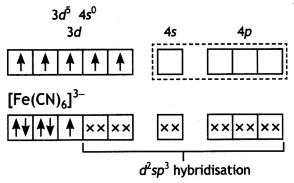
(i) For the complex [Fe(CN)6]3-, write the hybridisation type, magnetic character and spin nature of the complex. (At. number: Fe = 26).
Answer:
[Fe(CN)6]3-:
The oxidation state of Fe = +3
Fe(III)
Class 12 Chemistry Important Questions Chapter 9 Coordination Compounds 3
Hybridisation: d2sp3
Magnetic character: Paramagnetic
Spin type: Low spin complex

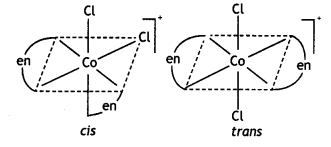
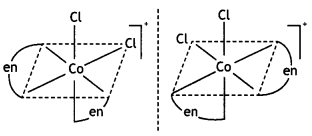
(ii) Draw one of the geometrical isomers of the complex [Pt(en)2Cl2]2+ which is optically active. (CBSE Delhi 2016)
Answer:
cis- form is optically active
Class 12 Chemistry Important Questions Chapter 9 Coordination Compounds 4

Question 7.
When a coordination compound NiCl2.6H20 is mixed with AgNO3, 2 moles of AgCI are precipitated per mole of the compound. Write (CBSE 2016)
(i) Structural formula of the complex
(ii) IUPAC name of the complex
Answer:
For one mole of the compound, 2 moles of AgCI are precipitated with AgNO3, which indicates 2 ionisable Cl” ions in the complex.

  1. Structural formula: [Ni (H20)6]Cl2
  2. IUPAC name: Hexaaquanickel (II) chloride

Question 8.
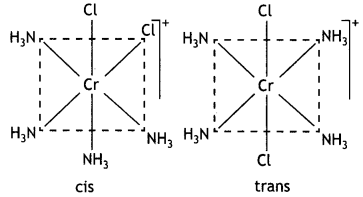
Write IUPAC name of the complex [Cr(NH3)4Cl2]+. Draw structures of geometrical isomers for this complex.
OR
Using IUPAC norms write the formulae for the following:
(i) Pentaamminenitrito-O-cobalt(III) chloride
(ii) Potassium tetracyanidonickelate(II) (CBSE Delhi 2019)
Answer:
IUPAC name: Tetramminedichloridochromi um(III) ion.
Geometrical isomers:
Class 12 Chemistry Important Questions Chapter 9 Coordination Compounds 5
OR
(i) [CO(NH3)5(ONO)]Cl2
(ii) K2[Ni(CN)4]

Question 9.
Write the hybridisation and magnetic character of the following complexes:
(i) [Fe(H2O)6]2+
(ii) [Fe(CO)5] (Atomic no. of Fe = 26) (CBSE Delhi 2019)
Answer:
[Fe(H20)6]2+
Hybridisation: sp3d2
Magnetic character: Paramagnetic due to 4 unpaired electrons.
Fe(C0)5
Hybridisation: dsp3
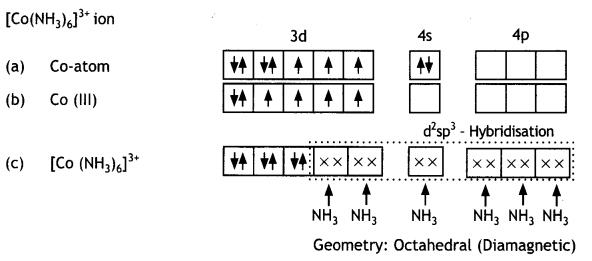
Magnetic character: It is diamagnetic.

Question 10.
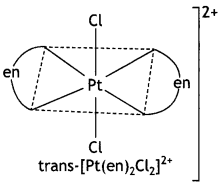
Draw one of the geometrical isomers of the complex [Pt(en)2Cl2]2+ which is optically inactive. Also, write the name of this entity according to the IUPAC nomenclature.
Or
Discuss the bonding in the coordination entity [Co(NH3)6 ]3+ on the basis of valence bond theory. Also, comment on the geometry and spin of the given entity. (Atomic no. of Co= 27) (CBSE Sample Paper 2019)
Answer:
Class 12 Chemistry Important Questions Chapter 9 Coordination Compounds 6
IUPAC Name of the entity:
Dichloridobis(ethane – 1,2-diamine) platinum(IV) ion
Or
Class 12 Chemistry Important Questions Chapter 9 Coordination Compounds 7

Coordination Compounds Important Extra Questions Long Answer Type

Question 1.
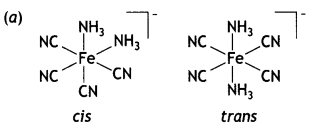
(a) Draw the structures of geometrical isomers of [Fe(NH3)2 (CN)4]
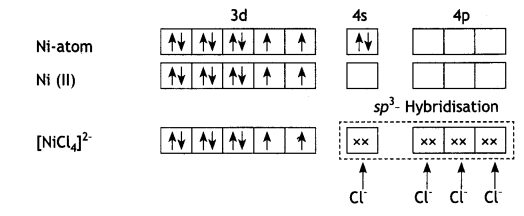
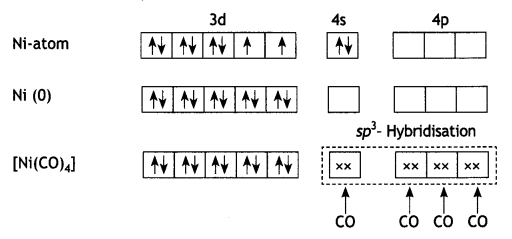
(b) [NiCl4]2- is paramagnetic while [Ni(CO)4] is diamagnetic though both are tetrahedral. Why? [Atomic number of Ni = 28]
OR
Define the following:
(a) Ambidentate ligands
(b) Spectra chemical series
(C) Heteroleptic complexes
Answer:
Class 12 Chemistry Important Questions Chapter 9 Coordination Compounds 8

(b) In the presence of strong field ligand CO, the unpaired d-electrons of Ni pair up so [Ni(CO)4] is diamagnetic but Cl being a weak ligand is unable to pair up the unpaired electrons, so [Ni(Cl4)]2- is paramagnetic.
Class 12 Chemistry Important Questions Chapter 9 Coordination Compounds 9
and
Class 12 Chemistry Important Questions Chapter 9 Coordination Compounds 10
OR
Answer:
(a) Ambidentate ligands: The monodentate ligands which can coordinate with the central atom through more than one site are called ambidentate ligands.
These ligands contain more than one coordinating atoms in their molecules.
For example, NO2 can coordinate to the metal atom through N or 0 as
Class 12 Chemistry Important Questions Chapter 9 Coordination Compounds 11
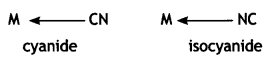
Similarly, CN can coordinate through C or N as
Class 12 Chemistry Important Questions Chapter 9 Coordination Compounds 12
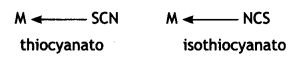
Thiocyanato (SCN) can coordinate through S or N
Class 12 Chemistry Important Questions Chapter 9 Coordination Compounds 13

(b) The arrangement of ligands in the increasing order of crystal field splitting is called spectrochemical series. This is shown below:
I < Br < SCN < Cl < F < OH < Ox2- < O2- < H20 < NCS < py = NH3 <en <NO2 < CN < CO.

Weak field ligands are those which cause less crystal field splitting. These form high spin complexes. For example, Cl, F, etc.

Strong field ligands are those which cause greater crystal field splitting. These form low spin complexes. For example, CN, NO2, CO.

(c) The complexes in which the metal is bound to more than one kind of donor groups (ligands) are called heteroleptic complexes. Some common examples of heteroleptic complexes are [NiCl2(H2O)4], [CoCl2(NH3)4]+, etc.

Question 2.
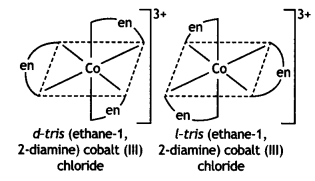
Write the structures and names of all the stereoisomers of the following compounds:
(i) [Co(en)3]Cl3
Answer:
Class 12 Chemistry Important Questions Chapter 9 Coordination Compounds 14

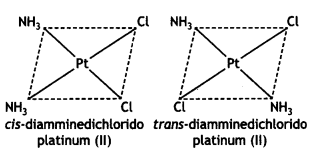
(ii) [Pt(NH3)2Cl2]
Answer:
Class 12 Chemistry Important Questions Chapter 9 Coordination Compounds 15

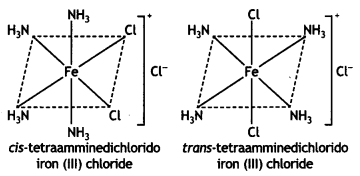
(iii) [Fe(NH3)4Cl2]Cl (CBSE 2011)
Answer:
Class 12 Chemistry Important Questions Chapter 9 Coordination Compounds 16

Question 3.
Write the name, stereochemistry and magnetic behaviour of the following:
(i) K4[Mn(CN)6]
(ii) [Co(NH3)2 C1]Cl2
(iii) K2[Ni(CN)4] (CBSE Delhi 2011)
Answer:

ComplexNameStereochemistryMagnetic behaviour
(i) K4[Mn(CN)6]Potassium hexacyanomanganate (I)OctahedralParamagnetic
(ii) [Co(NH3)5Cl]Cl2Pentaamminechtorido cobalt (III) chlorideOctahedralDiamagnetic
(iii) K2[Ni(CN)4)Potassium tetracyanonicketate (II)Square planarDiamagnetic

Question 4.
For the complex [Fe(en)2Cl2]Cl identify the following:
(i) Oxidation number of iron
Answer:
III.

(ii) Hybrid orbitals and shape of the complex
Answer:
d2sp3 hybridisation, octahedral

(iii) Magnetic behaviour of the complex
Answer:
Paramagnetic due to one unpaired electron

(iv) Number of its geometric isomers
Answer:
Two

(v) Whether there may be optical isomer also
Answer:
One optical, an isomer of cls-geometrical isomer.

(vi) Name the complex. (CBSE 2011)
Answer:
Dichloridobis(ethylenediamine) iron (III) chloride.

Question 5.
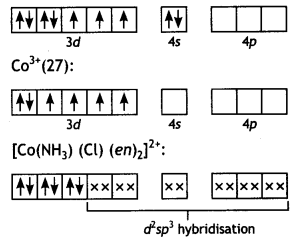
Give the formula of each of the following coordination entities:
(i) CO3+ ion is bound to one Cl, one NH3 molecule and two bidentate ethylene diamine (en) molecules.
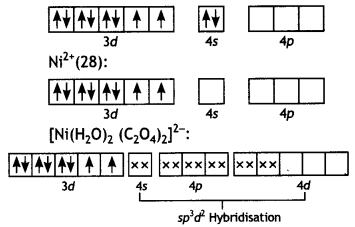
(ii) Ni2+ ¡on is bound to two water molecules and two oxalate ions. Write the name and magnetic behaviour of each of the above coordination entitles. (At. nos. CO = 27, Ni = 28) (CBSE 2012)
Answer:
(i) [Co(NH3) (Cl) (en)2]2+ Amminechtoriðo bls-(ethane -1, 2-diamine) cobalt (III) ion Co(27):
Class 12 Chemistry Important Questions Chapter 9 Coordination Compounds 17
Since there are no unpaired electrons,
complex is diamagnetic.

(ii) [Ni(H2O)2 (C2O4)2]2- Diaquadioxatatonickelate (II) ion Ni(28):
Class 12 Chemistry Important Questions Chapter 9 Coordination Compounds 18
The complex has two unpaired electrons, therefore, it will be paramagnetic.

Question 6.
State a reason for each of the following situations:
(i) CO2+ is easily oxidised to CO3+ in presence of a strong ligand.
Answer:
The configuration of CO2+ is t2g6 eg1 and for CO3+, it is t2g6. The crystal field stabilisation energy is more than compensated for the third ionisation enthalpy. Therefore, CO2+ is easily oxidised to CO3+ in the presence of a strong ligand.

(ii) CO is a stronger complexing reagent than NH3.
Answer:
CO is a stronger complexing ligand than NH3 because it contains both σ and π character and can form a back bond (M → CO) also. Therefore, CO forms a stronger bond with the metal. It is also called a strong field ligand.

(iii) The molecular shape of Ni(CO)4 is not the same as that of [Ni(CN)4]2-. (CBSE Delhi 2012)
Answer:
The molecular shape of [Ni(C0)4] is tetrahedral because this complex nickel involves sp3 hybridisation. In [Ni(CN)4]2-, nickel involves dsp2 and its shape is square planer.

Question 7.
Name the following coordination entities and draw the structures of their stereoisomers:
(i) [Co(en)2Cl2]+(en = ethane-1, 2-diamine)
Answer:
(Co(en)2Cl2]+
Name: Dichloridobis (ethane-1, 2-diamine) cobalt(III) ion. It shows two geometrical isomers cis- and trAnswer:c/s-shows optical isomerism.
Class 12 Chemistry Important Questions Chapter 9 Coordination Compounds 19
Class 12 Chemistry Important Questions Chapter 9 Coordination Compounds 20
c/s-[Co(en)2Cl2]+ is optically active.

(ii) [Cr(C204)3]3-
Answer:
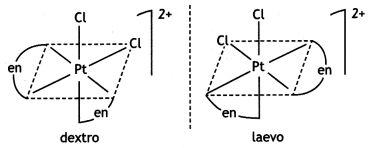
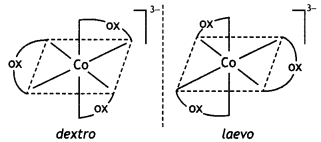
[Cr(C204)3]3-
Name: trioxalatochromate(III) ion. This complexion shows optical isomerism and their dextro and laevo forms are shown below:
Class 12 Chemistry Important Questions Chapter 9 Coordination Compounds 21

(iii) [CO(NH3)3Cl3]
(Atomic numbers Cr = 24, CO = 27) (CBSE 2012)
Answer:
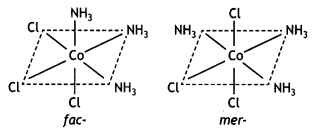
[Co(NH3)3Cl3]
Name Triamminetrichloridocobalt (III) It shows two geometrical isomers known as facial (fac) and meridional or merisomer as shown below:
Class 12 Chemistry Important Questions Chapter 9 Coordination Compounds 22

Question 8.
Name the following coordination entities and describe their structures:
(i) [Fe(CN)6]4-
(ii) [Cr(NH3)4Cl2]+
(iii) [Ni(CN)4]2-
(Atomic numbers Fe = 26, Cr = 24, Ni = 28) (CBSE 2012)
Answer:
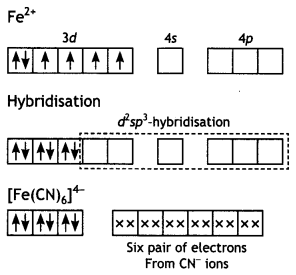
(i) [Fe(CN)6]4-: Hexacyanoferrate (II) ion.
Structure. In this case, iron is in a +2 oxidation state having the outer electronic configuration 3d6. To account for the diamagnetic character, all the electrons get paired leaving two vacant orbitals.

The hybridisation scheme and bonding are as shown below:
Class 12 Chemistry Important Questions Chapter 9 Coordination Compounds 23

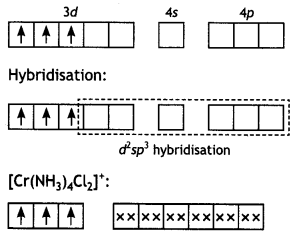
(ii) [Cr(NH3)4Cl2]+: Tetraamminedichlorido chromium (III) ion.

The chromium (Z = 24) has the electronic configuration 3d5 4s1. The chromium in this complex is in + 3 oxidation state and the ion is formed by the loss of one 4s and two of the 3d-electrons as shown in Fig. The inner d-orbitals are already vacant and two vacant 3d, one 4s and three 4p-orbitals are hybridised to form six d2sp3-hybrid orbitals. Six pairs of electrons one from each NH3 molecule and Cl- ions (shown by xx) occupy the six vacant hybrid orbitals. The molecule has octahedral geometry.

Since the complex contains three unpaired electrons, it is paramagnetic.
Cr (III):
Class 12 Chemistry Important Questions Chapter 9 Coordination Compounds 24

(iii) [Ni(CN)4]2-: Tetracyanonickelate (II) ion.
Class 12 Chemistry Important Questions Chapter 9 Coordination Compounds 8

Question 9.
Write the IUPAC names of the following compounds:
(i) [Cr(NH3)3Cl3]
Answer:
Triamminetrichloridochromium (III)

(ii) K3[Fe(CN)6]
Answer:
Potassium hexacyanoferrate (III)

(iii) [CoBr2(en)2]+, (en = ethylenediamine) (CBSE Delhi 2013)
Answer:
Dibromidobis(ethylenediamine) cobalt (III) ion

Question 10.
Write the types of isomerism exhibited by the following complexes:
(i) [Co(NH3)5Cl]S04
Answer:
ionisation isomerism

(ii) [Co(en)3]3+
Answer:
optical isomerism

(iii) [Co(NH3)6] [Cr(CN)6] (CBSE Delhi 2013)
Answer:
coordination isomerism

Question 11.
For the complex [NiCl4]2-, write
(i) the IUPAC name.
(ii) the hybridisation type.
(iii) the shape of the complex (Atomic no. of Ni = 28)
Or
What is meant by crystal field splitting energy? On the basis of crystal field theory, write the electronic configuration of d4 in terms to f2g and eg in an octahedral field when
(i) Δo > P
(ii) Δo < P (CBSE 2013)
Answer:
(i) Tetrachloridonickelate(II)ion
(ii) sp3 hybridisation
(iii) tetrahedral
OR
The difference between two sets of energy levels when the five degenerate d-orbitals splits in the presence of the electrical field of Ligands is called crystal field splitting energy. In the octahedral field, it is represented as Δo.

Electronic configurations of d4

  • When Δo >P;t2g4
  • When Δo < P; t2g3 eg1

Question 12.
Write the IUPAC name of the complex [Cr(NH3)4Cl2]. What type of Isomerism does it exhibit? (CBSE Delhi 2014)
Answer:
Tetraammlnedlchloridochromium( III) ion. It shows cis and trans isomerism and cis form shows optical isomerism.

Question 13.
(i) Write the IUPAC name of the complex [Cr(NH3)4 Cl2] Cl.
(ii) What type of Isomerism is exhibited by the complex [Co(en)3]3+?
(en = ethane-1, 2-diamine)
(iii) Why Is [NIC(412 paramagnetic but [Ni(CO)4] Is diamagnetic?
(At. nos.: Cr = 24, Co = 27, Ni = 28) (CBSE 2014)
Answer:
(i) TetraamminedichLorìdochromium (III) chloride.
(ii) Optical isomerism
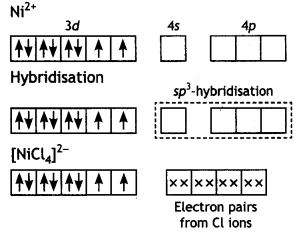
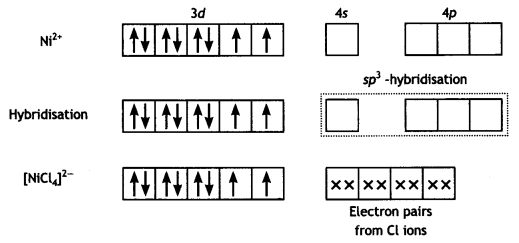
(iii) In [NICl4]2- complexion, nickel is in +2 oxidation state and the configuration is 3d8. Since the molecule is tetrahedral, it involves sp3 hybridisation as shown below:
Class 12 Chemistry Important Questions Chapter 9 Coordination Compounds 25
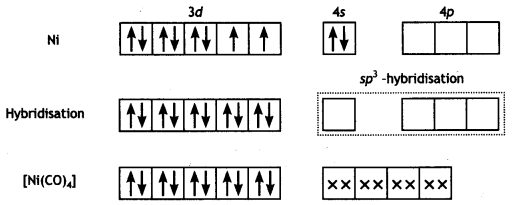
The molecule is paramagnetic because it contains two unpaired electrons. In [Ni(CO)4], nickel is in O oxidation state and has the configuration 4s2 3d8 or 3d10. The molecule is tetrahedral and involves sp3-hybridisation as given below:
Class 12 Chemistry Important Questions Chapter 9 Coordination Compounds 26

Each CO donates a pair of electrons forming four Ni—CO bond. The compound is diamagnetic since it contains no unpaired electron.

Question 14.
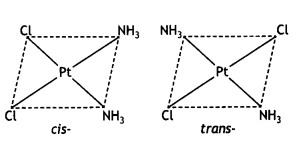
(i) Draw the geometrical isomers of the complex [Pt(NH3)2Cl2].
Answer:
Class 12 Chemistry Important Questions Chapter 9 Coordination Compounds 27
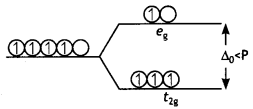
(ii) On the basis of crystal field theory, write the electronic configuration for d4 ion if Δ0 < P.
Answer:
t2g3 eg1

Class 12 Chemistry Important Questions Chapter 9 Coordination Compounds 28

(iii) Write the hybridization and magnetic behaviour of the complex [Ni(CO)4]. (At.no. of Ni = 28) (CBSE Delhi 2015)
Answer:
[Ni(CO)4] involves sp3 hybridization of nickel and the complex is tetrahedral. Magnetic behaviour: Diamagnetic
Class 12 Chemistry Important Questions Chapter 9 Coordination Compounds 8

Question 15.
(i) Draw the geometrical isomers of complex [Co(en)2Cl2]+.
Answer:
Geometrical isomers of complex [Co(en)2Cl2]+:
Class 12 Chemistry Important Questions Chapter 9 Coordination Compounds 29
(ii) On the basis of crystal field theory, write the electronic configuration for d4 ion if Δ0 > P.
Answer:
t2g4
Class 12 Chemistry Important Questions Chapter 9 Coordination Compounds 30

(iii) [NiCl4]2- is paramagnetic while [Ni(CO)4] is diamagnetic, though both are tetrahedral. Why? (Atomic number of Ni = 28) (CBSE 2015)
Answer:
In [NiCl4]2- complexion, nickel is in +2 oxidation state and the configuration is 3d8. Since the molecule is tetrahedral, it involves sp3 hybridisation as shown below:
Class 12 Chemistry Important Questions Chapter 9 Coordination Compounds 31
The molecule is paramagnetic because it contains two unpaired electrons.

In [Ni(CO)4], nickel is in 0 oxidation state and has the configuration 4s2 3d4 or 3d10. The molecule is tetrahedral and involves sp3-hybridisation as given below :
Class 12 Chemistry Important Questions Chapter 9 Coordination Compounds 32
Each CO donates a pair of electrons forming four Ni-CO bonds. The compound is diamagnetic since it contains no unpaired electron.

Question 16.
What type of isomerism is shown by the complex
(i) [Co (NH3)5 (SCN)]2+ (CBSE AI 2017)
Answer:
Linkage isomerism

(ii) [Co (NH3)6] [Cr (CN)6] (CBSE Delhi 2017)
Answer:
Coordination isomerism

(iii) [Co (en)3] Cl3 (CBSE AI 2014)
Answer:
Optical isomerism

Question 17.
A metal ion Mn+ having d4 valence electronic configuration combines with three bidentate ligands to form a complex compound. Assuming Δo > P:
(i) Write the electronic configuration of the d4 ion.
Answer:
t2g4 eg0

(ii) What type of hybridisation will Mn+ ion have?
Answer:
d2sp3

(iii) Name the type of isomerism exhibited by this complex. (CBSE Sample Paper 2017 – 18)
Answer:
Optical isomerism

Question 18.
Write the state of hybridisation, the shape and the magnetic behaviour of the following complex entities :
(a) [Cr(NH3)4Cl2] Cl
(b) [Co(en)3]Cl3
(c) K3[Ni(CN)4] (CBSE AI 2011)
Answer:

ComplexHybridisationShapeMagnetic behaviour
(a) [Cr(NH3)4Cl2]Cld2sp3OctahedralParamagnetic
(b) [Co(en)3]Cl3d2sp3OctahedralDiamagnetic
(c) K2[Ni(CN)4]dsp2Square planarDiamagnetic

Question 19.
(a) Give one chemical test as evidence to show that [Co(NH3)5Cl] S04 and [Co(NH3)55(S04)]Cl are ionisation isomers.
Answer:
When [Co(NH3)5(S04)]Cl is treated with silver nitrate solution, a white precipitate of AgCl is formed. But [Co(NH3)5Cl]S04 does not give white ppt with AgN03 solution.
[Co(NH3)5S03 ]Cl+AgN03 (Ag) → AgCl White ppt
[Co(NH3)5 Cl]S04 + AgN03 (Ag) → No white ppt

(b) [NiCl4]2- is paramagnetic while [Ni(C0)4] is diamagnetic though both are tetrahedral. Why? (Atomic no. of Ni = 28)
Answer:
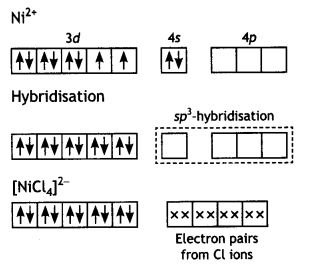
In [NiCl4]2-, the oxidation state of nickel is +2 and it has the electronic configuration: 3d8
Class 12 Chemistry Important Questions Chapter 9 Coordination Compounds 33

Cl ion is a weak field ligand and it causes the pairing of electrons. Since it has two unpaired electrons, it is paramagnetic. It undergoes sp3 hybridisation forming a tetrahedral structure.

In Ni (CO)4, the oxidation state of nickel is 0 and it has the electronic configuration: 3d8 4s2. CO is a strong field ligand and therefore, it causes the pairing of electrons as
Class 12 Chemistry Important Questions Chapter 9 Coordination Compounds 34
Since it has no unpaired electron, it is diamagnetic. It also undergoes sp3 hybridisation resulting in tetrahedral geometry of the complex,

(c) Write the electronic configuration of Fe(III) on the basis of crystal field theory when it forms an octahedral complex in the presence of (i) strong field ligand, and (ii) weak field ligand. (Atomic no. of Fe = 26) (CBSEAI2019)
Answer:
Fe (III): 3d5
(i) Strong field ligand: t2g5 eg0
(ii) Weak field ligand: t2g3 eg2

Question 20.
A metal complex having the composition Cr (NH3)4Cl2Br has been isolated in two forms A and B. Form A reacts with AgN03 to give a white precipitate readily soluble in dilute aqueous ammonia whereas B gives a pale yellow precipitate soluble in concentrated ammonia.
(i) Write the formulae of isomers A and B.
Answer:
Isomer A: [Cr(NH3)4 BrCl]Cl
Isomer B: [Cr (NH3)4 Cl2]Br

(ii) State the hybridisation of chromium in each of them.
Answer:
The hybridisation of Cr in isomer A and B is d2sp3.

(iii) Calculate the magnetic moment (spin only value) of the isomer A. (CBSE Sample Paper 2018)
Answer:
The number of unpaired electrons in Cr3+(3d3) is 3.
Magnetic moment = \(\sqrt{n(n+2)}\)
= \(\sqrt3(3 + 2)\) = 3.87 BM

Question 21.
(a) Write the formula of the following coordination compound: Iron(III) hexacyanoferrate(II)
Answer:
Fe4[Fe (CN)6]3

(b) What type of isomerism is exhibited by the complex [Co(NH3)5Cl]S04?
Answer:
Ionisation isomerism

(c) Write the hybridisation and number of unpaired electrons in the complex [COF6]3-. (Atomic No. of Co = 27) (CBSE 2018)
Answer:
sp3d2, 4

Question 22.
Write the IUPAC names of the following :
(a) [Ag(NH3)2][Ag(CN)2]
Answer:
diamminesilver(I)
dicyanidoargentate(I)

(b) K3[Fe(C204)3]
Answer:
potassium trioxalatoferrate(III)

(c) [CoCl2(en)2]Cl
Answer:
dichloridobis (ethane-1, 2-diamine) cobalt (III) chloride

(d) K3[Cr(C204)3]
Answer:
potassium trioxalatochromate(III)

(e) K4[Ni(CN)4]
Answer:
potassium tetracyanidonickelate (0)

(f) [Pt(NH3)2Cl(N02)]
Answer:
diamminechloridonitrito-N-platinum(II)

(g) [CoBr2(en)2]+ (CBSE Delhi 2012)
Answer:
dibromidobis (ethylenediamine) cobalt(III) ion

(h) [Co(NH3)5ONO]Cl2
Answer:
pentaamminenitrito-O-cobalt(III) chloride

(i) [Co(NH3)5(N02)](N03)2 (CBSE Al 2015)
Answer:
pentaamminenitrito-N-cobalt(III) nitrate

(j) [Cr(NH3)2Cl2 (en)]Cl (CBSE Delhi 2015)
Answer:
diamminedichlorido(ethane-1, 2-diamine)chromium (III) chloride

Question 23.
Write the formulae of the following coordination compounds:
(a) hexaamminecobalt(III) sulphate
Answer:
[CO(NH3)6]2(S04)3

(b) potassium tetrachloridopalladate(II)
Answer:
K2[PdCl4]

(c) diamminechloridonitrito -N- platinum(II)
Answer:
[Pt(NH3)2Cl(N02)]

(d) pentaamminenitrito -N- cobalt(III)
Answer:
[CO(N02)(NH3)5]2+

(e) pentaamminenitrito – 0- cobalt(III) (CBSE Delhi 2015)
Answer:
[CO(ONO)(NH3)5]2+

(f) sodium dicyanidoaurate(I) (CBSE AI 2017)
Answer:
Na [Au (CN)2]

(g) tetraamminechloridonitrito-N- platinum(IV) sulphate (CBSE AI 2017)
Answer:
[Pt(NH3)4Cl (N02)] S04

(h) potassium tetracyanidonickelate(II) (CBSE AI 2015)
Answer:
K2[Ni(CN)4]

(i) potassium trioxatatachromate(III)
Answer:
K3[Cr(ox)3]

(j) tetracarbonylnickel(O)
Answer:
[Ni(C0)4]

Question 24.
Write IUPAC names of the following :
(i) K3[AI(C204)3]
Answer:
Potassium trioxalatoaluminate (III)

(ii) [Ni(CO)4]
Answer:
tetracarbonylnickel(O)

(iii) Fe4[Fe(CN)6]3
Answer:
iron hexacyanidoferrate(III)

(iv) [CoCI(NH3)5]Cl2
Answer:
pentaamminechloridocobalt (III) chloride

(v) [PtCl2(C5H5N)(NH3)]
Answer:
amminedichlorido (pyridine) platinum(II)

(W) Na[PtBrCI(N02)(NH3)]
Answer:
sodium amminebromidochloridonitri- to-N-platinate(II)

(v/i) [Cr(NH3)3Cl3] (CBSE Delhi 2013)
Answer:
triamminetrichloridochromium (III)

(viii) K3[Fe(CN)6] (CBSE Delhi 2013)
Answer:
potassium hexacyanoferrate (III)

(ix) Na3[AlF6]
Answer:
sodium hexafluoridoaluminate (III).

(x) [Co(en)3]2(S04)3 (CBSE Delhi 2013)
Answer:
tris(ethylenediamine)cobalt(III) sulphate

Question 25.
For the complex [Fe(en)2Cl2]Cl, identify the following:
(i) Oxidation number of iron.
Answer:
III.

(ii) Hybrid orbitals and shape of the complex.
Answer:
d2sp2 hybridisation, octahedral.

(iii) Magnetic behaviour of the complex.
Answer:
Paramagnetic due to one unpaired electron.

(iv) Number of its geometrical isomers.
Answer:
Two.

(v) Whether there may be optical isomer also?
Answer:
An optical isomer of cis-geometrical isomer.

(vi) Name of the complex. (CBSE Delhi 2011)
Answer:
Dichloridobis (ethane-1, 2-diamine) iron (III) chloride.

The d-and f-Block Elements Class 12 Important Extra Questions Chemistry Chapter 8

Here we are providing Class 12 Chemistry Important Extra Questions and Answers Chapter 8 The d-and f-Block Elements. Class 12 Chemistry Important Questions are the best resource for students which helps in Class 12 board exams.

Class 12 Chemistry Chapter 8 Important Extra Questions The d-and f-Block Elements

The d-and f-Block Elements Important Extra Questions Very Short Answer Type

Question 1.
How would you account for the increasing oxidising power in the series:
V02+ < Cr207 2-< Mn04? (CBSE Sample Paper 2010)
Answer:
This is due to the increasing stability of the lower species to which they are reduced.

Question 2.
Which metal in the first transition series exhibits a +1 oxidation state most frequently and why? (CBSE Delhi 2013)
Answer:
Copper has electronic configuration 3cf104s1. It can easily lose one (4s1) electron to give stable 3d10 configuration.

Question 3.
The magnetic moments of a few transition metal ions are given below:

Metal ionMagnetic moment (BM)
Sc3+0.00
Cr2+4.90
Ni2+2.84
Ti3+1.73

(atomic no. Sc = 21, Ti = 22, Cr = 24, Ni = 28)
Which of the given metal ions:
(i) has the maximum number of unpaired electrons?
Answer:
Cr2+

(ii) forms colourless aqueous solution?
Answer:
Sc3+

(iii) exhibits the most stable +3 oxidation state? (CBSE Sample Paper 2017-18)
Answer:
Sc3+

Question 4.
Based on the data, arrange Fe2+, Mn2+ and Cr2+ in the increasing order of stability of +2 oxidation state:
Cr3+/Cr2+ = – 0.4 V, E°Mn3+/Mn2+ = 1.5 V, E°Fe3+/Fe2+ = 0.8 V (CBSE Sample Paper 2011)
Answer:
As the value of reduction potential increases, the stability of +2 oxidation state increases. Therefore, correct order of stability is Cr3+ | Cr2+ < Fe3+ | Fe2+ < Mn3+ | Mn2+.

Question 5.
(i) Name the element showing the maximum number of oxidation states among the first series of transition metals from Sc (Z = 21) to Zn (Z = 30).
Answer:
Manganese

(ii) Name the element which shows only +3 oxidation state. (CBSEAI2013)
Answer:
Scandium

Question 6.
Identify the oxoanion of chromium which is stable in an acidic medium. (CBSE Sample Paper 2017-18)
Answer:
Cr2072-

Question 7.
Actinoid contraction is greater from element to element than lanthanoid contraction. Why? (CBSE Delhi 2015)
Answer:
This is because of relatively poor shielding by 5f electrons in actinoids in comparison with shielding of 4f electrons in lanthanoids.

Question 8.
Name an important alloy that contains some of the Ianthanoid metals. (CBSE AI 2013)
Answer:
Misch metal

Question 9.
Identify the Ianthanoid element that exhibits a +4 oxidation state. (CBSE Sample Paper 2017-18)
Answer:
Cerium

Question 10.
Write the formula of an oxo-anion of chromium (Cr) in which it shows the oxidation state equal to its group number. (CBSE Delhi 2017)
Answer:
Cr2072-

The d-and f-Block Elements Important Extra Questions Short Answer Type

Question 1.
Assign reasons for the following:
(i) Cu(I) Is not known In an aqueous solution.
Answer:
Because of the Lesser hydration enthalpy of Cu(I), It Is unstable In an aqueous solution and therefore, It undergoes disproportionation.

(ii) Actinolds exhibit a greater range of oxidation states than lanthanoids. (CBSE AI 2011)
Answer:
Lanthanoids show Limited number of oxidation states, such as + 2, + 3 and + 4 + 3 is the principal oxidation state). This is because of the large energy gap between 5d and 4f subshells. On the other hand, actinoids also show a principal oxidation state of + 3 but show a number of other oxidation states also. For example, uranium (Z = 92) exhibits oxidation states of + 3, + 4, + 5, + 6 and + 7 and neptunium (Z = 94) shows oxidation states of + 3, +4, + 5, + 6 and + 7. This is because of the small energy difference between 5f and 6d orbitals.

Question 2.
Give reasons:
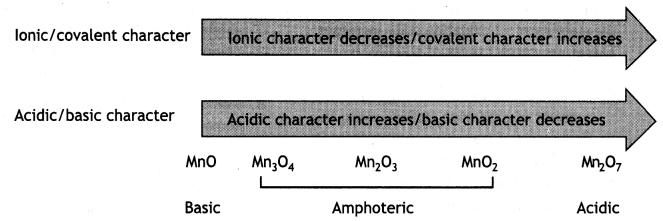
(a) MnO is basic whereas Mn2O7    is acidic in nature.
Answer:
When a metal is in a high oxidation state, its oxide Is acidic and when a metaL is in a low oxidation state its oxide is basic.
The oxides of manganese have the following behavior:

Class 12 Chemistry Important Questions Chapter 8 The d-and f-Block Elements 1
Class 12 Chemistry Important Questions Chapter 8 The d-and f-Block Elements 2
(b) Transition metals form alloys. (CBSE 2019C)
Answer:
The transition metals are quite similar in size and, therefore, the atoms of one metal can substitute the atoms of other metal in its crystal lattice. Thus, on cooling a mixture solution of two or more transition metals, solid alloys are formed which is shown in Fig.
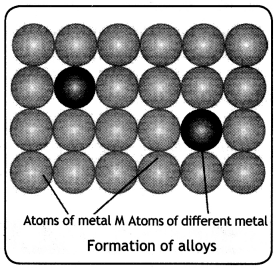
Class 12 Chemistry Important Questions Chapter 8 The d-and f-Block Elements 3
Question 3.
Explain why the Eθ value for the Mn3+/Mn2+ couple is much more positive than that for Cr3+/Cr2+ or Fe3+/Fe2+. (CBSE AI 2008, 2010, 2018)
Answer:
Mn2+ has 3d5 electronic configuration. It is stable because of the half-filled configuration of the d-subshell. Therefore, Mn has a very high third ionization enthalpy for the change from d5 to d4 and it is responsible for a much more positive Eθ value for Mn3+/Mn2+ couple in comparison to Cr3+/Cr2+ and Fe3+/ Fe2+ couples.

Question 4.
Complete the following chemical equations:
(i) Cr2O72++ H+ + I
Answer:
Cr2O72+ + 6I + 14H+ → 2Cr3+ + 3I2 + 7H2O

(ii) MnO4+ NO2+ H+ → (CBSE Delhi 2012)
Answer:
2MnO4+ 5N02+ 6H+ → 2Mn2+ + 5NO3+ 3H2O

Question 5.
(i) Which metal in the first transition series (3d series) exhibits +1 oxidatIon state most frequently and why?
Answer:
Copper, because it has [Ar] 3d104s1 electronic configuration. After losing one electron it gets completely filled electronic configuration (3d10).

(ii) Which of the following cations are colored in aqueous solutions and why?
Sc3+, V3+, Ti4+, Mn2+
(At. nos. Sc = 21, V = 23, Ti = 22, Mn = 25) (CBSE Delhi 2013)
Answer:
Sc3+: [Ar]  V3+: [Ar] 3d2
Ti4+: [Ar]  Mn2+: [Ar] 3d5
V3+ and Mn2+ cations are colored because they contain partially filled d-orbitals.

Question 6.
Why do transition elements exhibit higher enthalpies of atomization? (CBSE Delhi 2008, 2012)
Answer:
The high enthalpies of atomization are due to a large number of unpaired electrons in their atoms. Therefore, they have stronger interatomic interactions and hence, stronger bonding between atoms. Thus, they have high enthalpies of atomization.

Question 7.
(a) Actinoid contraction is greater than lanthanoid contraction. Give reason,
Answer:
This is due to poorer shielding by 5f electrons in actinoids as compared to shielding by 4f electrons in lanthanoids. In the Ianthanoid series, as we move from one element to another, the nuclear charge increases by one unit, and one electron are added. The new electrons are added to the same inner 4f-subshells. However, the 4f-electrons shield each other from the nuclear charge quite poorly because of the very diffused shapes of the f-orbitals.

The nuclear charge, however, increases by one at each step. Hence, with increasing atomic number and nuclear charge, the effective nuclear charge experienced by each 4f-electron increases. As a result, the whole of the 4f-electron shell contracts at each successive element, though the decrease is very small.

The actinoid contraction is due to the imperfect shielding of one 5felectron by another in the same subshell. Therefore, as we move along the series, the nuclear charge and the number of 5f-electrons increase by one unit at each step. However, due to imperfect shielding of 5f orbitals, the effective nuclear charge increases which results in contraction of the size.

(b) Out of Fe and Cu, which has a higher melting point and why? (CBSE 2019C)
Answer:
Fe has a higher melting point. The metallic bond is formed due to the interaction of electrons in the outermost orbitals. The strength of bonding is related to the number of unpaired electrons. Fe has more unpaired electrons leading to stronger metallic bonding. So, it has a higher melting point.

Question 8.
How would you account for the following:
(i) Cr2+ is reducing in nature while with the same d-orbital configuration (d4), Mn3+ is an oxidizing agent.
Answer:
Cr2+ is reducing as its configuration changes from d4 to d3, the latter having a half-filled t2g level. On the other hand, the change from Mn3+ to Mn2+ results in the half-filled (d5) configuration which has extra stability.

(ii) In a transition series of metals, the metal which exhibits the greatest number of oxidation states occurs in the middle of the series. (CBSE 2011)
Answer:
This is because, in the middle of the transition series, the maximum number of electrons are available for sharing with others. The small number of oxidation states at the extreme left side is due to the lesser number of electrons to lose or share. On the other hand, at the extreme right-hand side, due to a large number of electrons, only a few orbitals are available in which the electrons can share with others for higher valence.

Question 9.
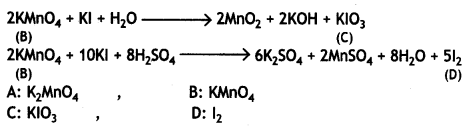
When MnO2 is fused with KOH in the presence of KNO3 as an oxidizing agent, it gives a dark green compound (A). Compound (A) disproportionates in an acidic solution to give a purple compound (B). An alkaline solution of compound (B) oxidizes Kl to compound (C), whereas an acidified solution of compound (B) oxidizes Kl to (D). Identify (A), (B), (C), and (D). (CBSE Delhi 2019)
Answer:
When MnO2 is fused with KOH in the presence of KNO3, as an oxidizing agent, it gives a dark green compound (A).
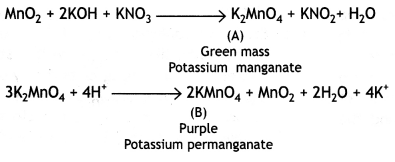
Class 12 Chemistry Important Questions Chapter 8 The d-and f-Block Elements 4
Class 12 Chemistry Important Questions Chapter 8 The d-and f-Block Elements 5

Question 10.
State reasons for the following:
(i) Cu(I) is not stable in an aqueous solution.
Answer:
Cu+ ion is not stable in an aqueous solution because of its less negative enthalpy of hydration than that of Cu2+ ion.

(ii) Unlike Cr3+, Mn2+, Fe3+ and the subsequent other M2+ ions of the 3d series of elements, the Ad and the 5d series metals generally do not form stable atomic species. (CBSE 2011)
Answer:
Because of lanthanoid contraction, the expected increase in size does not occur.

Question 11.
Assign reasons for each of the following:
(i) Transition metals generally form colored compounds.
Answer:
Most of the transition metal ions are colored both in the solid-state and in aqueous solutions. The color of these ions is attributed to the presence of an incomplete (n – 1) d-subshell. The electrons in these metal ions can be easily promoted from one energy level to another in the same d-subshell. The amount of energy required to excite the electrons to higher energy states within the same d-subshell corresponds to the energy of certain colors of visible light. Therefore, when white light falls on a transition metal compound, some of its energy corresponding to a certain color is absorbed causing the promotion of d-electrons. This is known as d-d transitions. The remaining colors of white light are transmitted and the compound appears colored.

(ii) Manganese exhibits the highest oxidation state of +7 among the 3d-series of transition elements. (CBSE Delhi 2011)
Answer:
Manganese has the electronic configuration [Ar] 3d5 4s2. It can lose seven electrons due to the participation of 3d and 4s electrons and therefore, exhibits the highest oxidation state of +7 in its compounds.

Question 12.
What are the transition elements? Write two characteristics of the transition elements. (CBSE Delhi 2015)
Answer:
Transition elements are those elements that have incompletely filled (partly filled) d-subshell in their ground state or in any one of their oxidation states.

Characteristics:

  1. Transition elements show variable oxidation states.
  2. They exhibit catalytic properties.

Question 13.
Though both Cr2+ and Mn3+ have d4 configurations, yet Cr2+ is reducing while Mn3+ is oxidizing. Explain why? (CBSE AI 2008, 2012, CBSE Delhi 2012)
Answer:
E° value for Cr3+/Cr2+ is negative (-0.41V), this means that Cr3+ ions are more stable than Cr2+. Therefore, Cr2+ can readily lose electrons to undergo oxidation to form Cr3+ ion, and hence Cr (II) is strongly reducing. On the other hand, the E° value for Mn3+ Mn2+ is positive (+1.57V), this means that Mn3+ ions can be readily reduced to Mn2+ and hence Mn (III) is strongly oxidizing.

Question 14.
Why are Mn2+ compounds more stable than Fe2+ towards oxidation to their +3 state? (CBSE Delhi 2012)
Answer:
The electronic configuration of Mn2+ is [Ar] 3d5 which is half-filled and hence it is stable. Therefore, the third ionization enthalpy is very high, i.e. the third electron1 cannot be easily removed. In the case of Fe2+, the electronic configuration is 3d6. Therefore, Fe2+ can easily lose one electron to acquire a 3d5 stable electronic configuration.

Question 15.
The E°M2+|M for copper is positive (0.34 V). Copper is the only metal in the first series of transition elements showing this behavior. Why? (CBSE Sample Paper 2012, CBSE AI2012)
Answer:
The E°M2+|M value for copper is positive and this shows that it is the least reactive metal among the elements of the first transition series. This is because copper has a high enthalpy of atomization and enthalpy of ionization. Therefore, the high energy required to convert Cu(s) to Cu2+ (aq) is not balanced by its hydration enthalpy.

Question 16.
Chromium is a typical hard metal while mercury is a liquid. (CBSE Sample Paper 2011)
Answer:
In chromium, the M-M interactions are strong due to the presence of six unpaired electrons in the 3d and 4s subshell. On the other hand, in mercury, all the electrons in the 5d and 6s subshell are paired and therefore, the M-M interactions are weak. Therefore, chromium is a typical hard metal while mercury is a liquid.

Question 17.
Silver is a transition metal but zinc is not. (CBSE Sample Paper 2011)
Answer:
According to the definition, transition elements are those which have partially filled d-subshell in their elementary state or in one of the oxidation states. Silver (Z = 47) can exhibit a +2 oxidation state in which it has an incompletely filled d-subshell (4d9 configuration). Hence, silver is regarded as a transition element.

On the other hand, zinc (Z = 30) has the configuration 3d10 4s2. It does not have partially filled d-subshells in its elementary form or in a commonly occurring oxidation state (Zn2+: 3d10). Therefore, it is not regarded as a transition element.

Question 18.
Name the ox metal anions of the first series of the transition metals in which the metal exhibits an oxidation state equal to its group number. (CBSE Delhi 2017)
Answer:
MnO4: Oxidation state of Mn = +7 (equal to its group number)
CrO42-: Oxidation state of Cr = +6 (equal to its group number)

Question 19.
Give reasons:
(a) Of the d4 species, Cr2+ is strongly reducing while Mn3+ is strongly oxidising.
Answer:
Because Cr is more stable in the +3 oxidation state due to the t2g3 configuration whereas Mn is more stable in the +2 oxidation state due to the half-filled 3d5 configuration.

E° value for Cr3+/Cr2+ is negative (-0.41 V); this means that Cr3+ ions are more stable than Cr2+. Therefore, Cr2+ can readily lose electrons to undergo oxidation to form a Cr3+ ion, and hence Cr (II) is strongly reducing. On the other hand, the E° value for Mn3+/ Mn2+ is positive (+1.57V), which means that Mn3+ ions can be readily reduced to Mn2+ and hence Mn (III) is strongly oxidizing.

(b) The d1 configuration is very unstable in ions. (CBSE 2019C)
Answer:
After the loss of ns electrons, d1 electron can easily be lost to give a stable configuration. Therefore, the elements having d1 configuration are either reducing or undergo disproportionation.

Question 20.
When chromite ore FeCr2O4 is fused, with NaOH in presence of air, a yellow-colored compound (A) is obtained, which on acidification with dilute sulphuric acid gives a compound (B). Compound (B) on reaction with KCI forms an orange colored crystalline compound (C).
(i) Write the formulae of the compounds (A), (B), and (C).
(ii) Write one use of the compound (C). (CBSE Delhi 2016)
OR
Complete the following chemical equations:
(i) 8MnO4+ 3S2O32-+ H2O →
(ii) Cr2O72-+ 3Sn2+ + 14H+
Answer:
Class 12 Chemistry Important Questions Chapter 8 The d-and f-Block Elements 6
Class 12 Chemistry Important Questions Chapter 8 The d-and f-Block Elements 7
(ii) Potassium dichromate (C) is used as a powerful oxidizing agent in redox titrations in the laboratories.
OR
(i) 8MnO4+ 3S2O32-+ H2O → 8MnO2 + 6SO42- + 2OH
(ii) Cr2O7 2+ + 3Sn2+ +14H+ → 2Cr3+ + 3Sn4+ + 7H2O

Question 21.
Why do the transition elements have higher enthalpies of atomization? In 3d series (Sc to Zn), which element has the lowest enthalpy of atomization and why? (CBSE 2015)
Answer:
The transition elements have high enthalpies of atomization because they have a large number of unpaired electrons in their atoms. Therefore, they have stronger interatomic interactions and hence, stronger bonding between atoms. Thus, they have high enthalpies of atomization.

Zinc has the lowest enthalpy of atomization because it has no unpaired electrons and hence weak metallic bonding.

The d-and f-Block Elements Important Extra Questions Long Answer Type

Question 1.
(i) Transition metals and their compounds are generally found to be good catalysts.
(ii) Metal-metal bonding is more frequent for the 4d and the 5d series of transition metals than that for the 3d series. (CBSE AI 2011)
Answer:
(i) Some transition metals and their compounds act as good catalysts for various reactions. This is due to their ability to show multiple oxidation states. The common examples are Fe, Co, Ni, V, Cr, Mn, Pt, etc.

The transition metals form reaction intermediates with the substrate by using empty d-orbitals. These intermediates give reaction paths of lower activation energy and therefore, increase the rate of reaction. For example, during the conversion of SO2 to SO3, V2O5 is used as a catalyst. Solid V2O; absorbs a molecule of SO2 on the surface forming V2O4 and the oxygen is given to SO2 to form S03. The divanadium tetraoxide is then converted to V2O5 by reaction with oxygen:
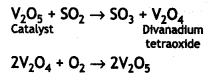
Class 12 Chemistry Important Questions Chapter 8 The d-and f-Block Elements 8
(ii) The second and third transition series metals show a great tendency to form strong M-M bonds than the first transition series elements. For example, rhenium easily forms ReCl84- which contains a strong Re-Re bond. It does not have a manganese analog.

Similarly, both Niobium and tantalum form M6X12n+ species and has no vanadium analogue.

Question 2.
Explain the following observations giving an appropriate reason for each.
(i) The enthalpies of atomization of transition elements are quite high.
Answer:
The high enthalpies of atomization are due to a large number of unpaired electrons in their atoms. Therefore, they have stronger interatomic interaction and hence, stronger bonding between atoms. Thus, they have high enthalpies of atomization.

(ii) There occurs much more frequent metal-metal bonding in compounds of heavy transition metals (i.e. 3rd series)
Answer:
The heavier transition metals of second and third transition series metals show a great tendency to form strong M-M bonds than first transition series elements. For example, rhenium easily forms ReCl84- which contains a strong Re-Re bond. It does not have a manganese analog. Similarly, both niobium and tantalum form M6X12n+ species and has no vanadium analog.

(iii) Mn2+ is much more resistant than Fe2+ towards oxidation. (CBSE Delhi 2012)
Answer:
Mn2+ is quite stable because it has a stable half-filled d5 electronic configuration and therefore, cannot be easily oxidized. On the other hand, Fe2+ has a less stable d6 electronic configuration and can be easily oxidized to a stable d5 configuration.

Question 3.
How would you account for the following?
(i) Transition metals exhibit variable oxidation states.
(ii) Zr (Z = 40) and Hf (Z = 72) have almost identical radii.
(iii) Transition metals and their compounds act as a catalyst.
OR
Complete the following chemical equations:
(i) Cr2072- + 6Fe2+ + 14H+
(ii) 2Cr042- + 2H+
(iii) 2Mn04 + 5C2042- + 16H+ → (CBSE Delhi 2013)
Answer:
(i) The transition elements exhibit variable oxidation states. The variable oxidation states of transition metals are due to the participation of ns and (n – 1) d-electrons. This is because of the very small difference between the energies of (n -1) d and ns orbitals. For the first five elements, the minimum oxidation state is equal to the number of electrons in the 4s orbitals and the other oxidation states are equal to the sum of 4s and some of the 3d-electrons. The highest oxidation state is equal to the sum of 4s and 3d electrons. For the remaining elements, the minimum oxidation state is equal to electrons in 4s-orbitals and the maximum oxidation state is not equal to the sum of 4s and 3d electrons.

In general, the oxidation state increases up to the middle and then decreases.

(ii) Due to lanthanoid contraction, the increase in radii from the second to third transition series vanishes. Therefore, Zr and Hf have almost the same radii.

(iii) Catalytic properties of transition metal ions. Some transition metals and their compounds act as good catalysts for various reactions. The common examples are Fe, Co, Ni, V, Cr, Mn, Pt, etc. For example, iron-molybdenum is used as a catalyst in Haber’s process for the manufacture of NH3. V205 is used for the oxidation of S02 to S03 in the Contact process for the manufacture of H2S04.

The transition metals form reaction intermediates with the substrate by using empty d-orbitals. These intermediates give reaction paths of lower activation energy and therefore, increase the rate of reaction. For example, during the conversion of SO2 to SO3, V2O5 is used as a catalyst. Solid V2O5 absorbs a molecule of SO2 on the surface forming V2O4 and the oxygen is given to SO2 to form SO3. The divanadium tetraoxide is then converted to V2O5 by reaction with oxygen:
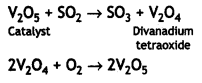
Class 12 Chemistry Important Questions Chapter 8 The d-and f-Block Elements 9
OR
(i) 6Fe2+ + Cr2072- + 14H+ → 6Fe3+ + 2Cr3+ + 7H2O
(ii) 2CrO42- + 2H+ → Cr2O72-+ H2O
(iii) 2MnO4 + 5C2O42 + 16H+ → 2Mn2+ + 8H2O + 10CO2

Question 4.
Give reasons for the following:
(i) Transition elements and their compounds act as catalysts.
Answer:
Transition metals and their compounds act as good catalysts because of their ability to show multiple oxidation states and form complexes, for example, Fe, Co, Ni, V, Cr, V2O5, etc.

(ii) E° value for (Mn2+|Mn) is negative whereas for (Cu2+| Cu) is positive.
Answer:
The negative value of E° (Mn2+| Mn) is due to the stability of the half-filled d-subshell in Mn2+(3d5). The positive E°(Cu2+|Cu) is due to the high ionization enthalpy and high enthalpy of atomization of copper. Therefore, the high energy required to convert Cu(s) to Cu2+(aq) is not balanced by its hydration enthalpy.

(iii) Actinoids show irregularities in their electronic configuration. (CBSE Delhi 2019)
Answer:
Actinoids have irregularities in the electronic configuration because of almost equal energy of 5f, 6d and 7s orbitals. Therefore, there are some irregularities in the filling of 5f, 6d, and 7s orbitals. The electron may enter either of these orbitals.

Question 5.
(a) Complete the following chemical reactions:
(i) Na2Cr2O7 + KCl →
(ii) 2MnO4+ 5 S032- + 6 H+
Answer:
(i) Na2Cr2O7 + KCl → K2Cr2O7 + 2 NaCl
(ii) 5 S032- + 2MnO4 + 6 H+ → 2Mn2+ + 3H2O + 5SO42-

(b) How does the colour of Cr2O72- change when treated with an alkali? (CBSE2019C)
Answer:
The orange color of Cr2O72- change to yellow due to the formation of chromate ion.
Cr2O72- + 2OH → 2Cr2O72-  + H2O (Yellow)

Question 6.
(a) Write chemical equations involved in the preparation of KMn04 from Mn02.
Answer:
2MnO2 + 4KOH + O2 → 2K2MnO4 + 2H2O
3MnO42-+ 4H+ → 2MnO+ MnO2 + 2H2O (or any other correct equation of preparation)

(b) Actinoids show wide range of oxidation states. Why? (CBSE 2019C)
Answer:
Lanthanoids show limited number of oxidation states, such as + 2, + 3 and + 4 (+ 3 is the principal oxidation state). This is because of large energy gap between 5d and 4f subshells. On the other hand, actinoids also show principal oxidation state of + 3 but show a number of other oxidation states also. For example, uranium (Z = 92) exhibits oxidation states of + 3, + 4, + 5 and + 6 and neptunium (Z = 93) shows oxidation states of + 3, + 4, + 5, + 6 and + 7.

This is because of the small energy difference between 5f, 6d, and 7s orbitals.

Question 7.
How would you account for the following?
(i) Many of the transition elements are known to form interstitial compounds.
Answer:
Transition metals form interstitial compounds. Transition metals have a unique character to form interstitial compounds with small non-metallic elements such as hydrogen, boron, carbon and nitrogen. The small atoms of these non-metallic elements (H, B, C, N, etc.) fit into the vacant spaces of the lattices of the transition metal atoms. As a result of the filling up of the interstitial spaces, the transition metals become rigid and hard.

These interstitial compounds have similar chemical properties as the parent metals but have different physical properties, particularly, density, hardness, and conductivity. For example, steel and cast iron are hard because of the formation of interstitial compounds with carbon. These interstitial compounds have a variable composition and cannot be expressed by a simple formula. Therefore, these are called nonstoichiometric compounds.

(ii) The metallic radii of the third (5d) series of transition metals are virtually the same as those of the corresponding group members of the second (4d) series.
Answer:
The metallic radii of the third (5d) series of transition metals are virtually the same as those of corresponding group members of the (4d) series due to the phenomenon of lanthanoid contraction. The steady decrease in atomic and ionic sizes of lanthanoid elements with increasing atomic numbers is known as lanthanoid contraction.

(iii) Lanthanoids form primarily +3 ions, white the actinoids usually have higher oxidation states in their compounds, +4 or even +6 being typical. (CBSE Delhi 2012)
Answer:
Lanthanoids form primarily +3 ions, while actinoids usually have higher oxidation states, +4 or even +6 in their compounds because in actinoids the 5f, 6d, and 7s energy levels are of comparable energies.

Therefore, all these three subshells can participate.

Question 8.
How would you account for the following:
(i) Among lanthanoids, Ln (III) compounds are predominant. However, occasionally in solutions or in solid compounds, +2 and +4 ions are also obtained.
Answer:
All lanthanoids exhibit a common stable oxidation state of +3. In addition, some lanthanoids show +2 and +4 oxidation states also in solution or in solid compounds. These are shown by these elements which by doing so attain the stable f (empty f-subshell), f (half-filled f-subshell), and f4 (filled f-subshell) configurations. For example,
(a) Ce and Tb exhibit +4 oxidation states. Cerium (Ce) and terbium (Tb) attain f and f configurations respectively when they get +4 oxidation state, as shown below:
Ce4+: [Xe] 4f°
Tb4+: [Xe] 4 f°

(b) Eu and Yb exhibit + 2 oxidation states.
Europium and ytterbium get f and f4 configurations in +2 oxidation state as shown below:
EU2+ : [Xe] 4 f7
Yb2+: [Xe] 4f14

(ii) The E°M2+/M for copper is positive (0.34 V). Copper is the only metal in the first series of transition elements showing this behavior.
Answer:
The E°(M2+/M) value for copper is positive and this shows that it is the least reactive metal out of the first transition series. This is because copper has a high enthalpy of atomization and enthalpy of ionization. Therefore, the high energy required to convert Cu(s) to Cu2+(aq) is not balanced by its hydration enthalpy.

(iii) The metallic radii of the third (5d) series of transition metals are nearly the same as those of the corresponding members of the second series. (CBSE 2012)
Answer:
The metallic radii of the third transition series elements are virtually the same as those of corresponding members of the second transition series because of the lanthanoid contraction. Due to the presence of lanthanoids between the second and third transition series, the expected increase in radii vanishes. Consequently, the pairs of elements Zr-Hf, Nb-Ta, Mo-W, etc have almost similar sizes.

Question 9.
Explain the following observations:
(i) Many of the transition elements are known to form interstitial compounds.
Answer:
Transition metals form interstitial compounds. Transition metals have a unique character to form interstitial compounds with small non-metallic elements such as hydrogen, boron, carbon, and nitrogen. The small atoms of these non-metallic elements (H, B, C, N, etc.) fit into the vacant spaces of the lattices of the transition metal atoms. As a result of the filling up of the interstitial spaces, the transition metals become rigid and hard.

These interstitial compounds have similar chemical properties as the parent metals but have different physical properties, particularly, density, hardness, and conductivity. For example, steel and cast iron are hard because of the formation of interstitial compounds with carbon. These interstitial compounds have a variable composition and cannot be expressed by a simple formula. Therefore, these are called nonstoichiometric compounds.

(ii) There is a general increase in density from titanium (Z = 22) to copper (Z = 29).
Answer:
There is a gradual increase in density from Ti to Cu because as we move along a transition series from left to right, the atomic radii decrease due to an increase in effective nuclear charge. Therefore, the atomic volume decreases but at the same time atomic mass increases. Therefore, density (mass/volume) increases.

(iii) The members of the actinoid series exhibit a larger number of oxidation states than the corresponding members of the lanthanoid series. (CBSE 2012)
Answer:
Lanthanoids show limited a number of oxidation states, such as + 2, + 3, and + 4 (+ 3 is the principal oxidation state). This is because of the large energy gap between 5d and 4/ subshells. On the other hand, actinoids also show a principal oxidation state of + 3 but show a number of other oxidation states also. For example, uranium (Z = 92) exhibits oxidation states of + 3, + 4, + 5 and + 6 and neptunium (Z = 93) shows oxidation states of + 3, + 4, + 5, + 6 and + 7. This is because of the small energy difference between 5f, 6d, and 7s orbitals.

Question 10.
Following are the transition metal ions of 3d series.
Ti4+, V2+, Mn3+, Cr3+
(Atomic numbers: Ti = 22, V = 23, Mn = 25, Cr = 24)
Answer the following:
(i) Which ion is most stable in an aqueous solution and why?
(ii) Which ion is a strong oxidizing agent and why?
(iii) Which ion is colorless and why? (CBSE AI 2017)
Answer:
(i) Cr3+ because of the half-filled t2g3 configuration.
(ii) Mn3+ due to stable d5 configuration of Mn2+
(iii) Ti4+ because it has no unpaired electrons.

Question 11.
Write chemical equations for the following reactions:
(i) Oxidation of nitrite ion by MnO4 in acidic medium.
(ii) Acidification of potassium chromate solution.
(iii) Disproportionation of manganese
(vi) in acidic solution. (CBSE Sample Paper 2011)
Answer:
(i) 5NO2– + 2MnO4+ 6H+ → 2Mn2+ + 3H2O + 5NO3
(ii) 2K2CrO44 + 2H+ → K2Cr2O7 + 2K+ + H2O
(iii) 3MnO42- + 4H+ → 2MnO4 + MnO2 + 2H2O

Question 12.
The actinoids exhibit a larger number of oxidation states than the corresponding members in the lanthanoid series. (CBSE AI 2012, CBSE Delhi 2012)
Answer:
Lanthanoids show a limited number of oxidation states, such as +2, +3, and +4 (+3 is the principal oxidation state). This is because of the large energy gap between 5d and 4f subshells. On the other hand, actinoids also show a principal oxidation state of +3 but show a number of other oxidation states also. For example, uranium (Z = 92) exhibits oxidation states of +3, +4, +5 and +6 and neptunium (Z = 93) and plutonium (Z = 94) show oxidation states of +3, +4, +5, +6 and +7. This is because of the small energy difference between 5f, 6d, and 7s orbitals.

Question 13.
Explain the following:
(i) Out of Sc3+, Co2+, and Cr3+ ions, only Sc3+ is colorless in aqueous solutions.
(Atomic no.: Co = 27; Sc = 21 and Cr = 24)
(iI) The E°Cu2+/Cu for copper metal is positive (+0.34), unlike the remaining members of the first transition series
(iiI) La(OH)3 is more basic than Lu(OH)3. (CBSE Sample paper 2018)
Answer:
(i) Co2+: [Ar]3d7, Sc3+: [Ar]3d°
Cr3+: [Ar]3d3
Co2+ and Cr3+ have unpaired electrons. Thus, they are colored in an aqueous solution. Sc3+ has no unpaired electron. Thus it is colorless.
(ii) Metal copper has a high enthalpy of atomization and enthalpy of ionization. Therefore the high energy required to convert Cu(s) to Cu2+(aq) is not balanced by its hydration enthalpy.
(iii) Due to lanthanoid contraction the size of lanthanoid ion decreases regularly with the increase in atomic size. Thus covalent character between lanthanoid ion and OH’ increases from La3+ to Lu3+. Thus the basic character of hydroxides decreases from La(OH)3 to Lu(OH)3

Question 14.
(a) Complete the following chemical reactions:
(i) 2MnO4+ 5 NO2+ 6 H+
(ii) 3Mn042- + 4 H+
Answer:
(i) 5NO2– + 2MnO4 + 6H+ → 2Mn2+ + 5NO3 + 3H2O
(ii) 3MnO42-+ 4H+ → 2MnO4+ MnO2 + 2H2O

(b) Name a member of the lanthanoid series which shows a +4 oxidation state. (CBSE 2019C)
Answer:
Cerium / Ce

Question 15.
Give reasons:
(i) E° value for Mn3+/Mn2+ couple is much more positive than that for Fe3+/Fe2+.
Answer:
The comparatively high value for Mn shows that Mn2+(d5) is particularly stable/Much larger third ionization energy of Mn (where the required change is from d5 to d4).

(ii) Iron has a higher enthalpy of atomization than copper.
Answer:
Due to the higher number of unpaired electrons.

(iii) Sc3+ is colorless in an aqueous solution whereas Ti3+ is colored. (CBSE 2018)
Answer:
The absence of unpaired d-electron in Sc3+ whereas in Ti3+ there is one unpaired electron or Ti3+ shows the d-d transition.

Question 16.
(i) Complete the following chemical equations for reactions:
(a) MnO4(aq) + S2O32- (aq) + H2O (I) →
(b) Cr2O7(aq) + H2S(g) + H+(aq) →
Answer:
(a) 8MnO4 (aq) + 3S2O32-  (aq) + H2O (l) → 8MnO2 (s) + 6SO42- (aq) + 2OH- (aq)
(b) Cr2O72- (aq) + 3H2S(g) + 8H+ (aq) → 2Cr3+(aq) + 3S(s) + 7H2O

(ii) Give an explanation for each of the following observations:
(a) The gradual decrease in size (actinoid contraction) from element to element is greater among the actinoids than that among the lanthanoids (lanthanoid contraction).
Answer:
(a) This is because of relatively poor shielding by 5f electrons in actinoids in comparison with shielding of 4f electrons in lanthanoids.

(b) The greatest number of oxidation states are exhibited by the members in the middle of a transition series.
Answer:
This is because, in the middle of the transition series, the maximum number of electrons are available for sharing with others. The small number of oxidation states at the extreme left side is due to a lesser number of electrons to lose or share. On the other hand, at the extreme right-hand side, due to a large number of electrons, only a few orbitals are available in which the electrons can share with others for higher valence.

(c) With the same d-orbital configuration (d4) Cr2+ ion is a reducing agent but the Mn3+ ion is an oxidizing agent. (CBSE Delhi 2009)
Answer:
Cr2+ is reducing as its configuration changes from d4 to d3, the latter having a half-filled t2g level. On the other hand, the change from Mn3+ to Mn2+ results in the half-filled (d5) configuration which has extra stability.

Question 17.
(i) Complete the following chemical reaction equations:
(a) Fe2+ (aq) + MnO4 (aq) + H+ (aq) →
(b) Cr2O72- (aq) + I (aq) + H+ (aq) →
Answer:
(a) 5Fe2+ (aq) + MnO4- (aq) + 8H+ (aq) → Mn2+ (aq) + 5Fe3+ (aq) + 4H2O(l)
(b) Cr2O72- (aq) + 6I (aq) + 14H+ (aq) → 2Cr3+(aq) + 3I2 (s) + 7H2O(l)

(ii) Explain the following observations:
(a) Transition elements are known to form many interstitial compounds.
Answer:
Transition metals form interstitial compounds. Transition metals have a unique character to form interstitial compounds with small non-metallic elements such as hydrogen, boron, carbon, and nitrogen. The small atoms of these non-metallic elements (H, B, C, N, etc.) fit into the vacant spaces of the lattices of the transition metal atoms. As a result of the filling up of the interstitial spaces, the transition metals become rigid and hard.

These interstitial compounds have similar chemical properties as the parent metals but have different physical properties, particularly, density, hardness, and conductivity. For example, steel and cast iron are hard because of the formation of interstitial compounds with carbon. These interstitial compounds have a variable composition and cannot be expressed by a simple formula. Therefore, these are called nonstoichiometric compounds.

(b) With the same d4 d-orbital configuration Cr2+ ion is reducing while the Mn3+ ion is oxidizing.
Answer:
Cr2+ is reducing as its configuration changes from d4 to d3, the latter having a half-filled t2g level. On the other hand, the change from Mn3+ to Mn2+ results in the half-filled (d5) configuration which has extra stability.

(c) The enthalpies of atomization of the transition elements are quite high. (CBSE Delhi 2009)
Answer:
The transition metals have strong interactions of electrons in the outermost orbitals and therefore, have high melting and boiling points. These suggest that the atoms of these elements are held together by strong forces and have high enthalpy of atomization.

Question 18.
(i) Complete the following chemical equations:
(a) MnO4(aq) + S2O32- (aq) + H2O(l) →
(b) Cr2O72- (aq) + Fe2+ (aq) + H+ (aq) →
Answer:
(a) 8MnO4 + 3S2O32- + H2O → 8MnO2 + 6SO42-+ 2OH-
(b) Cr2O72- + 14H+ + 6Fe2+ → 2Cr3+ +6Fe3+ + 7H2O

(ii) Explain the following observations:
(a) La3+ (Z = 57) and Lu3+ (Z = 71) do not show any colour in solutions.
Answer:
In La3+ there are no f-electrons and in Lu3+ the 4f sub-shell is complete (4/14). Therefore, there are no unpaired electrons and consequently, d-d transitions are not possible. Hence, La3+ and LU3+ do not show any color in solutions.

(b) Among the divalent cations in the first series of transition elements, manganese exhibits the maximum paramagnetism.
Answer:
Among the divalent cations in the first
transition series, Mn (Z = 25) exhibits the maximum paramagnetism because it has the maximum number of unpaired electrons (3d5): five unpaired electrons.

(c) Cu+ ion is not known in aqueous solutions. (CBSE 2010)
Answer:
In an aqueous solution, Cu+ undergoes disproportionation changing to Cu2+ ion.
2Cu+ → Cu2+ + Cu

Question 19.
(i) Give reasons for the following:
(a) Mn3+ is a good oxidizing agent.
(b) E°M2+/M values are not regular for first-row transition metals (3d series).
(c) Although ‘F’ is more electronegative than ‘O’, the highest Mn fluoride is MnF4, whereas the highest oxide is Mn207.
(ii) Complete the following equations:
(a) 2CrO42- + 2H+
(b) KMnO4 Class 12 Chemistry Important Questions Chapter 8 The d-and f-Block Elements 10
OR
(i) (a) Why do transition elements show variable oxidation states?
(b) Name the element showing a maximum number of oxidation states among the first series of transition metals from Sc(Z = 21) to Zn (Z = 30).
(c) Name the element which shows only the +3 oxidation state.
(ii) What is lanthanoid contraction? Name an important alloy that contains some of the lanthanoid metals. (CBSE2013)
Answer:
(i) (a) Mn3+ (3d4) on changing to Mn2+ (3d5) becomes stable, half-filled configuration has extra stability. Therefore, Mn3+ can be easily reduced and acts as a good oxidizing agent.

(b) E°(M2+/M) values are not regular in the first transition series metals because of irregular variation of ionization enthalpies (IE1 + IE2) and the sublimation energies.

(c) Among transition elements, the bonds formed in +2 and +3 oxidation states are mostly ionic. The compounds formed in higher oxidation states are generally formed by sharing of d-electrons. Therefore, Mn can form MnO4- which has multiple bonds also, while fluorine cannot form multiple bonds.

(ii) (a) 2CrO42- + 2H+ → Cr2O72- + H2O
(b) 2KMnO4 Class 12 Chemistry Important Questions Chapter 8 The d-and f-Block Elements 10 K2MnO4 + MnO2 + O2
OR
(i) (a) The transition elements show variable oxidation states because their atoms can lose a different number of electrons. This is due to the participation of inner (n -1). d-electrons in addition to outer ns electrons because the energies of the ns and (n – 1) d-subshells are almost equal.

(b) Manganese

(c) Scandium

(ii) The steady decrease in atomic and ionic sizes of lanthanide elements with increasing atomic numbers is called lanthanide contraction. In the lanthanoids, there is a regular decrease in the size of atoms and ions with an increase in atomic number. For example, the ionic radii decrease from Ce3+ (111 pm) to Lu3+ (93 pm).

Cause of lanthanoid contraction. As we move through the lanthanoid series, 4f-electrons are being added, one at each step. The mutual shielding effect of electrons is very little, even smaller than that of d-electrons. This is due to the shape of f-orbitals. The nuclear charge, however, increases by one at each step. Hence, the inward pull experienced by the 4f-electrons increases. This causes a reduction in the size of the entire 4f shell. The sum of the successive reductions gives the total lanthanoid contraction. The important alloy is mischmetal.

Question 20.
(i) How do you prepare:
(a) K2MnO4 from MnO2?
(b) Na2Cr2O7 from Na2CrO4?
(ii) Account for the following:
(a) Mn2+ is more stable than Fe2+ towards oxidation to +3 state.
(b) The enthalpy of atomization is lowest for Zn in the 3d series of the transition elements.
(c) Actinoid elements show a wide range of oxidation states.
OR
(a) Name the element of 3d transition series which shows a maximum number of oxidation states. Why does it show so?
(b) Which transition metal of 3d series has a positive E°(M2+/M) value and why?
(c) Out of Cr3+ and Mn3+, which is a stronger oxidizing agent and why?
(d) Name a member of the lanthanoid series which is well known to exhibit a +2 oxidation state.
(e) Complete the following equation:
Mn04+ 8H+ +5e → (CBSE Delhi 2014)
Answer:
(i) (a) When Mn02 is fused with caustic potash (KOH) or potassium carbonate in the presence of air, a green mass of potassium manganate is formed.
2MnO2 + 4KOH + O2 Class 12 Chemistry Important Questions Chapter 8 The d-and f-Block Elements 10 4 2K2MnO4 + 2H2O
Or
2MnO2 + 2K2CO2 + O2 → 2K2MnO4 + 2CO2.

(b) Na2Cr04 is acidified with dilute sulphuric acid to get Na2Cr2O7.
2Na2CrO4 + H2SO4 → Na2Cr2O7 + Na2SO4 + H2O

(ii) (a) Electronic configuration of Mn2+ is [Ar]Bd5 which is half-filled and hence is stable. Therefore, the third ionization enthalpy is very high, i.e. the third electron cannot be easily removed. In the case of Fe2+, the electronic configuration is 3d6. Therefore, Fe2+ can easily lose one electron to acquire a 3d5 stable configuration. Thus, Mn2+ is more stable than Fe2+ towards oxidation to + 3 states.

(b) The high enthalpies of atomization of transition elements are due to the participation of electrons (n – 1) d-orbitals in addition to ns electrons in the interatomic metallic bonding. In the case of zinc, no electrons from 3d-orbitals are involved in the formation of metallic bonds. On the other hand, in all other metals of 3d series electrons from d-orbitals are always involved in the formation of metallic bonds.

(c) Lanthanoids show a limited number of oxidation states, such as +2, +3, and +4 (+3 is the principal oxidation state). This is because of the large energy gap between 5d and 4/ subshells. On the other hand, actinoids also show a principal oxidation state of +3 but show a number of other oxidation states also. For example, uranium (Z = 92) exhibits oxidation states of +3, +4, +5 and +6 and neptunium (Z = 94) shows oxidation states of +3, +4, +5, +6 and +7. This is because of the small energy difference between 5f and 6d orbitals.
OR
(a) Manganese (Z = 25) shows the largest number of oxidation states because it has the maximum number of unpaired electrons. It shows oxidation states from +2 to +7, i.e. +2, +3, +4, +5, +6 and +7.

(b) The E°(M2+|M) value for copper is positive and this shows that it is the least reactive metal among the elements of the first transition series. This is because copper has a high enthalpy of atomization and enthalpy of ionization. Therefore, the high energy required to convert Cu(s) to Cu2+(aq) is not balanced by its hydration enthalpy.

(c) Mn3+ is a stronger oxidizing agent than Cr3+ because Mn3+(3d4) changes to stable half-filled (3d5) configuration while in the case of Cr3+ (3d5) is stable (half-filled) and it cannot be readily changed to Cr2+ (3d4).

(d) Europium.

(e) MnO4 + 8H+ + 5e → Mn2+ + 4H2O.

Question 21.
(a) Account for the following:
(i) Manganese shows the maximum number of oxidation states in 3d series.
(ii) E° value for Mn3+/Mn2+ couple is much more positive than that for Cr3+/Cr2+.
(iii) Ti4+ is colorless whereas V4+ is colored in an aqueous solution.
(b) Write the chemical equations for the preparation of KMn04 from Mn02. Why does the purple color of acidified permanganate solution decolorize when it oxidizes Fe2+ to Fe3+?
OR
(a) Write one difference between transition elements and p-block elements with reference to variability of oxidation states.
(b) Why do transition metals exhibit higher enthalpies of atomization?
(c) Name an element of the lanthanoid series which is well known to show a +4 oxidation state. Is it a strong oxidizing agent or a reducing agent?
(d) What is lanthanoid contraction? Write its one consequence.
(e) Write the ionic equation showing the oxidation of Fe(ll) salt by acidified dichromate solution. (CBSE Al 2019)
Answer:
(a) (i) Manganese has the electronic configuration: 3d5 4s2. It has a maximum number of unpaired electrons and hence shows maximum oxidation states.
(ii) Mn2+ has 3d5 electronic configuration. It is stable because of the half-filled configuration. Therefore, Mn3 easily gets reduced to Mn2+. Thus, E°(M3+/Mn2+) is positive. On the other hand, Cr3+ is more stable in the +3 oxidation state due to stable t2g3 configuration.
(iii) Ti4+ (3d°) does not have any d-electrons. Therefore, there are no d-d transitions whereas V4+, (3d1) has one electron in d-subshell and d-d transitions are possible and hence it is colored.

(b) 2MnO2 + 4KOH + O2 → 2K2MnO4 + 2H2O
3K2MnO4 + 4HCL → 2KMnO + MnO2 + 2H2O

When acidified KMnO4 oxidizes Fe2+ to Fe3+ its purple color gets decolorized due to the formation of Mn2+ from
MnO4– ion.
MnO4– + 5Fe2+ + 8W → Mn2+ + 5Fe3+ + 4H2O
Or
(a) Transition elements, in general, show variable oxidation states which differ by 1 unit, whereas p-block elements show variable oxidation states which differ by 2 units.

(b) Transition eLements have unpaired d-electron and therefore have strong metallic bonding between atoms. Hence, they have high enthalpies of atomization.

(c) Cerium. It is a strong oxidizing agent.

(d) The regular decrease In atomic and ionic radii of the Lanthanides with increasing atomic number is catted Lanthanoid contraction.

Consequence: 5d series elements have almost the same size as the 4d series.

(e) 6Fe2+ + Cr2O72- + 14H+ → 6Fe3+ + 2Cr3+ + 7H2O

Question 22.
(i) Account for the following:
(a) Mn shows the highest oxidation state of +7 with oxygen but with fluorine, it shows the highest oxidation state of +4.
(b) Zirconium and Hafnium exhibit similar properties.
(c) Transition metals act as catalysts.
(ii) Complete the following equations:
(a) 2MnO2 + 4KOH + O2 Class 12 Chemistry Important Questions Chapter 8 The d-and f-Block Elements 11
(b) Cr2O72- + 14H+ + 6I
Or
The elements of 3d transition series are given as:
Sc Ti V Cr Mn Fe Co Ni Cu Zn
Answer the following:
(a) Write the element which is not regarded as a transition element. Give reason.
(b) Which element has the highest m.p.?
(c) Write the element which can show an oxidation state of +1.
(d) Which element is a strong oxidizing agent in the +3 oxidation state and why? (CBSE 2016)
Answer:
(i) (a) Manganese shows the highest oxidation state of +7 with oxygen but +4 with fluorine. This is because oxygen has a tendency to form multiple bonds and hence stabilize the high oxidation state.
(b) Due to lanthanoid contraction, Zr and Hf show similar properties.
(c) The transition metals act as catalysts. This is due to their ability to show multiple oxidation states.

(ii) (a) 2MnO2 + 4KOH + O2 → 2K2MnO4 + 2H2O
(b) Cr2O72- + 14H+ + 6I → 2Cr3+ + 7H2O + 3I2
Or
(a) Zn because of not having partially filled d-orbitals in its ground state or ionic state.
(b) Chromium, Cr
(c) Copper, Cu
(d) Mn, because Mn2+ has extra stability due to half-filled d-subshell.
Mn: [Ar] 3d5 4s2; Mn2+: [Ar]3d5
Mn3+ has four electrons (3d4) in 3d subshell and requires only one electron to get a half-filled 3d subshell and therefore, acts as a strong oxidizing agent.

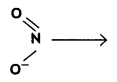
Semiconductor Electronics: Materials, Devices and Simple Circuits Class 12 Important Extra Questions Physics Chapter 14

Here we are providing Class 12 Physics Important Extra Questions and Answers Chapter 14 Semiconductor Electronics: Materials, Devices and Simple Circuits. Important Questions for Class 12 Physics with Answers are the best resource for students which helps in Class 12 board exams.

Class 12 Physics Chapter 14 Important Extra Questions Semiconductor Electronics: Materials, Devices and Simple Circuits

Semiconductor Electronics Important Extra Questions Very Short Answer Type

Question 1.
Draw the energy band diagram for a p-type semiconductor.
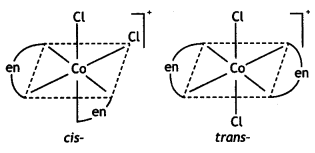
Answer:
The energy level diagram is shown below.
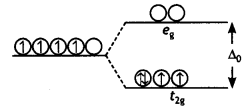
Class 12 Physics Important Questions Chapter 14 Semiconductor Electronics 1
Question 2.
Draw the voltage-current characteristic of a p-n junction diode in forwarding bias and reverse bias.
Answer:
The characteristics are as shown.
Class 12 Physics Important Questions Chapter 14 Semiconductor Electronics 2
Question 3.
Draw the voltage-current characteristic for a Zener diode.
Answer:
The V-l characteristic of the Zener diode is as shown.
Class 12 Physics Important Questions Chapter 14 Semiconductor Electronics 3
Question 4.
Draw the energy band diagram for n-type semiconductor.
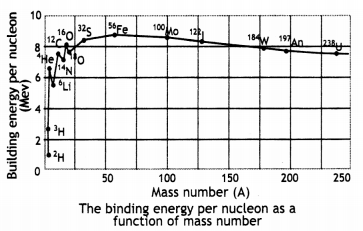
Answer:
The diagram is as shown.
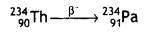
Class 12 Physics Important Questions Chapter 14 Semiconductor Electronics 4
Question 5.
An ac input signal of frequency 60 Hz is rectified by an
(i) Half wave and an
Answer:
The output frequency remains the same in a half-wave rectifier, i.e. 60 Hz.

(ii) Full-wave rectifier. Write the output frequency in each case.
Answer:
The output frequency becomes twice the input frequency in the case of the full-wave rectifier, i.e. 120 Hz.

Question 6.
Give the ratio of the number of holes and the number of conduction electrons in an intrinsic semiconductor.
Answer:
The ratio is one.

Question 7.
What is the depletion region in a p-n junction?
Answer:
It is a thin layer between p and n sections of the p-n junction which is devoid of free electrons and holes.

Question 8.
Name an impurity which when added to pure silicon makes it a
(i) p-type semiconductor
Answer:
Boron, aluminum, etc.

(ii) n-type semiconductor.
Answer:
Phosphorous, antimony, etc.

Question 9.
Which type of biasing gives a semiconductor diode very high resistance?
Answer:
Reverse biasing.

Question 10.
Identify the biasing in the figure given below.
Class 12 Physics Important Questions Chapter 14 Semiconductor Electronics 5
Answer:
Forward biasing.

Question 11.
Draw the circuit symbol of (a) photodiode, and (b) light-emitting diode.
Answer:
The circuit symbols are as shown below.
Class 12 Physics Important Questions Chapter 14 Semiconductor Electronics 6

Question 12.
What is the function of a photodiode? (CBSE AI 2013C)
Answer:
It functions as a detector of optical signals.

Question 13.
When a p-n junction diode is forward biased, how will its barrier potential be affected? (CBSEAI 2019)
Answer:
Potential barrier decreases in forwarding bias.

Question 14.
Name the junction diode whose l-V characteristics are drawn below: (CBSE Delhi 2017)
Class 12 Physics Important Questions Chapter 14 Semiconductor Electronics 7
Answer:
Solar cell.

Question 15.
How does the width of the depletion region of a p-n junction vary if the reverse bias applied to it decreases?
Answer:
With the increase in the reverse bias, the depletion layer increases.

Question 16.
How does the width of the depletion region of a p-n junction vary if the reverse bias applied to it decreases?
Answer:
If the reverse bias decreases, the width of the depletion layer also decreases.

Question 17.
Why is the conductivity of n-type semiconductors greater than that of p-type semiconductors even when both of these have the same level of doping?
Answer:
It is because in n-type the majority carriers are electrons, whereas in p-type they are holes. Electrons have greater mobility than holes.

Question 18.
How does the conductance of a semiconducting material change with rising in temperature?
Answer:
Increases with an increase in temperature.

Question 19.
How is a sample of an n-type semiconductor electrically neutral though it has an excess of negative charge carriers?
Answer:
It is because it contains an equal number of electrons and protons and is made by doping with a neutral impurity.

Question 20.
How is the bandgap, Eg, of a photodiode related to the maximum wavelength, λm, that can be detected by it?
Answer:
Eg = \(\frac{h c}{\lambda_{m}}\)

Question 21.
Zener diodes have higher dopant densities as compared to ordinary p-n junction diodes. How does it affect the
(i) Width of the depletion layer
Answer:
Junction width will be small and

(ii) Junction field?
Answer:
The junction field will be high.

Question 22.
Can the potential barrier across a p-n junction be measured by simply connecting a voltmeter across the junction? (NCERT Exemplar)
Answer:
No, because the voltmeter must have a resistance very high compared to the junction resistance, the latter being nearly infinite.

Semiconductor Electronics Important Extra Questions Short Answer Type

Question 1.
Draw a labeled circuit diagram of a full-wave rectifier using a p-n junction.
Answer:
The diagram is as shown.
Class 12 Physics Important Questions Chapter 14 Semiconductor Electronics 8
Question 2.
What is a solar cell? How does it work? Give one of its uses.
Answer:
It is a p-n junction used to convert light into electrical energy. In such a diode, one region either the p-type or the n-type is made so thin that light falling on the diode is not absorbed appreciably before reaching the junction. The thin region in the solar cell is called the emitter and the other is called the base. The magnitude of current depends upon the intensity of light reaching the junction. A solar cell can be used to charge storage batteries during the daytime, which can be used during the night.

These are used as power supplies for satellites and space vehicles.

Question 3.
Draw the output signal in a p-n junction diode when a square input signal of 10 V as shown in the figure is applied across it. (CBSE AI 2019)
Class 12 Physics Important Questions Chapter 14 Semiconductor Electronics 9
Answer:
The diode will conduct only when it is forward biased. Therefore, till the input voltage is + 5 V, we will get an output across R, accordingly the output waveform shown in the figure.
Class 12 Physics Important Questions Chapter 14 Semiconductor Electronics 10

Question 4.
The following diagrams, indicate which of the diodes are forward biased and which are reverse biased.
Class 12 Physics Important Questions Chapter 14 Semiconductor Electronics 11
Answer:
(a) Forward biased.
(b) Reverse biased.
(c) Forward biased,
(d) Reverse biased.

Question 5.
Mention the important considerations required while fabricating a p-n junction diode to be used as Light-Emitting Diode (LED). What should be the order of bandgap of an LED if it is required to emit light in the visible range? (CBSE Delhi 2013)
Answer:
The important considerations are

  • It should be heavily doped.
  • The diode should be encapsulated with a transparent cover so that emitted light can come out.

The semiconductor used for the fabrication of visible LEDs must at least have a bandgap of 1.8 eV.

Question 6.
In the given circuit diagram shown below, two p-n junction diodes D1 and D2 are connected with a resistance R and a dc battery E as shown. Redraw the diagram and indicate the direction of flow of appreciable current in the circuit. Justify your answer.
Class 12 Physics Important Questions Chapter 14 Semiconductor Electronics 12
Answer:
The redrawn diagram showing the flow of appreciable current is shown below.
Class 12 Physics Important Questions Chapter 14 Semiconductor Electronics 13
Here diode D2 is forward biased, hence it conducts. Therefore appreciable current will pass through it. However, diode 0, is reverse biased, hence negligible current will flow through it.

Question 7.
The diagram below shows a piece of pure semiconductor S in series with a variable resistor R and a source of constant voltage V. Would you increase or decrease the value of R to keep the reading of ammeter (A) constant when semiconductor S is heated? Give reason.
Class 12 Physics Important Questions Chapter 14 Semiconductor Electronics 14
Answer:
When a semiconductor is heated, its resistance decreases. As a result, the total resistance of the circuit will decrease. In order to maintain constant current flow, the total resistance of the circuit must remain constant. Hence, the external resistance has to be increased to compensate for the decrease of resistance of the semiconductor.

Question 8.
Two semiconductor materials X and Y showed in the figure are made by doping germanium crystal with indium and arsenic respectively. The two are joined end to end and connected to a battery as shown,
(i) Will the junction be forward or reverse biased?
(ii) Sketch a V-l graph for this arrangement.
Class 12 Physics Important Questions Chapter 14 Semiconductor Electronics 15
Answer:
Material X is p-type and material Y is n-type.
(i) The junction is reverse biased.
(ii) For the V-l graph
The characteristics are as shown.
Class 12 Physics Important Questions Chapter 14 Semiconductor Electronics 2
Question 9.
Draw the output waveform across the resistor (figure). (NCERT)
Class 12 Physics Important Questions Chapter 14 Semiconductor Electronics 16
Answer:
It is a half-wave rectifier, therefore only the positive cycle will be rectified. Thus the output waveform is as shown.
Class 12 Physics Important Questions Chapter 14 Semiconductor Electronics 17
Question 10.
(i) Name the type of a diode whose characteristics are shown in figure
(a) and figure (b).
(ii) What does point P in figure (a) represent?
(iii) What do the points P and Q in figure (b) represent? (NCERT Exemplar)
Class 12 Physics Important Questions Chapter 14 Semiconductor Electronics 18
Answer:
(i) Zener junction diode and solar cell.
(ii) Zener breakdown voltage
(iii) P-open circuit voltage.
Q-short circuit current

Question 11.
A Zener of power rating 1 W is to be used as a voltage regulator. If Zener has a breakdown of 5 V and it has to regulate voltage which fluctuated between 3 V and 7 V, what should be the value of R, for safe operation (figure)? (NCERT Exemplar)
Class 12 Physics Important Questions Chapter 14 Semiconductor Electronics 19
Answer:
Given P = 1 W, Vz = 5V, Vs = 7 V, Rs = ?
We know that
Class 12 Physics Important Questions Chapter 14 Semiconductor Electronics 20
Question 12.
Two material bars A and B of the equal area of the cross-section are connected in series to a dc supply. A is made of usual resistance wire and B of an n-type semiconductor.
(i) In which bar is the drift speed of free electrons greater?
(ii) If the same constant current continues to flow for a long time, how will the voltage drop across A and B be affected? Justify each answer. (CBSE Sample Paper 2018-19)
Answer:
(i) Drift speed in B (n-type semiconductor) is higher.
Reason: Since the two bars A and B are connected in series, the current through each is the same.
Now l = neAvd
Or
vd = \(\frac{1}{n e A}\) ⇒ vd ∝ \(\frac{1}{n}\) (As l and A are same).

As n is much lower in semiconductors, drift velocity will be more.

Question 13.
Explain how the width of the depletion layer in a p-n junction diode changes when the junction is (i) forward biased and (ii) reverse biased. (CBSE Delhi 2018C)
Answer:
The width of the depletion region in a p-n junction diode decreases when it is forward biased because the majority of charge carriers flow towards the junction. While it increases when the junction diode is reverse biased because the majority of charge carriers move away from the junction.

Semiconductor Electronics Important Extra Questions Long Answer Type

Question 1.
Define the terms ‘potential barrier’ and ‘depletion region’ for a p – n junction diode. State how the thickness of the depletion region will change when the p-n junction diode is (i) forward biased and (ii) reverse biased.
Answer:
Potential barrier: The potential barrier is the fictitious battery, which seems to be connected across the p-n junction with its positive terminal in the n-region and the negative terminal in the p-region.

Depletion region: The region around the junction, which is devoid of any mobile charge carriers, is called the depletion layer or region.

  1. When the p-n junction is forward biased, there is a decrease in the depletion region.
  2. When the p-n junction is reverse biased, there is an increase in the depletion region.

Question 2.
Explain (i) forward biasing and (ii) reverse biasing of a p-n junction diode.
Answer:
(i) A p-n junction is said to be forward-biased if its p-type is connected to the positive terminal and its n-type is connected to the negative terminal of a battery.
(ii) A p-n junction is said to be reverse-biased if its n-type is connected to the positive terminal and its p-type is connected to the negative terminal of a battery. The diagrams are as shown.

Question 3.
Draw V-l characteristics of a p-n junction diode. Answer the following questions, giving reasons:
(i) Why is the current under reverse bias almost independent of the applied potential up to a critical voltage?
(ii) Why does the reverse current show a sudden increase at the critical voltage? Name any semiconductor device which operates under the reverse bias in the breakdown region. (CBSEAI 2013)
Answer:
The characteristics are as shown.
Class 12 Physics Important Questions Chapter 14 Semiconductor Electronics 2
(i) This is because even a small voltage is sufficient to sweep the minority carriers from one side of the junction to the other side of the junction.

(ii) As the reverse bias voltage is increased, the electric field at the junction becomes significant. When the reverse bias voltage V = Vz critical voltage, then the electric field strength is high enough to pull valence electrons from the host atoms on the p-side which are accelerated to the n-side. These electrons account for the high current observed at the breakdown.

Zener diode operates under the reverse bias in the breakdown region.

Question 4.
Draw the energy band diagrams of (i) n-type and (ii) p-type semiconductor at temperature T > 0 K.
In the case of n-type Si semiconductors, the donor energy level is slightly below the bottom of the conduction band, whereas in p-type semiconductors, the acceptor energy level is slightly above the top of the valence band. Explain what role do these energy levels play in conduction and valence bands. (CBSE AI 2015 C)
Answer:
For energy bands
(i) The energy level diagram is shown below.
Class 12 Physics Important Questions Chapter 14 Semiconductor Electronics 1
(ii) The diagram is shown as
Class 12 Physics Important Questions Chapter 14 Semiconductor Electronics 4
In the energy band diagram of n-type Si semiconductor, the donor energy level EA is slightly below the bottom Ec of the conduction band and electrons from this level move into the conduction band with a very small supply of energy. At room temperature, most of the donor atoms get ionized but very few (-10-12) atoms of Si get ionized. So the conduction band will have most electrons coming from the donor impurities.

Similarly, for p-type semiconductors, the acceptor energy level EA is slightly above the top Ev of the valence band. With the very small supply of energy, an electron from the valence band can jump to the level EA and ionize the acceptor negatively. Alternately, we can also say that with a very small supply of energy, the hole from level EA sinks down into the valence band. Electrons rise up and holes fall down when they gain external energy.

Question 5.
Give reasons for the following:
(i) High reverse voltage does not appear across an LED.
Answer:
It is because the reverse breakdown voltage of LED is very low, i.e. nearly 5 V.

(ii) Sunlight is not always required for the working of a solar cell.
Answer:
Because solar cells can work with any light whose photon energy is more than the bandgap energy.

(iii) The electric field, of the junction of a Zener diode, is very high even for a small reverse bias voltage of about 5 V. (CBSE Delhi 2016C)
Answer:
The heavy doping of p and n sides of the p-n junction makes the depletion region very thin, hence for a small reverse bias voltage, the electric field is very high.

Question 6.
State the reason why the photodiode is always operated under reverse bias. Write the working principle of operation of a photodiode. The semiconducting material used to fabricate a photodiode has an energy gap of 1.2 eV. Using calculations, show whether it can detect light of a wavelength of 400 nm incident on it. (CBSE Al 2017C)
Answer:
It is easier to observe the change in the current with the change in the light intensity if a reverse bias is applied. Thus photodiode is used in the reverse bias mode even when the current in the forward bias is more the energy gap (Eg) of the semiconductor, then electron-hole pairs are generated due to the absorption of photons.

Due to the electric field of the junction, electrons and holes are separated before they recombine. The direction of the electric field is such that electrons reach the n-side and holes reach the p-side. Electrons are collected on the n-side and holes are collected on the p-side giving rise to an emf. When an external load is connected, current flows.

Given λ = 400 nm,
Energy of photon
E = \(\frac{h c}{\lambda}=\frac{6.63 \times 10^{-34} \times 3 \times 10^{8}}{400 \times 10^{-9} \times 1.6 \times 10^{-19}}\) = 3.105 eV

Since the bandgap is lesser than this energy, therefore it will be able to detect the wavelength.

Question 7.
Explain the two processes involved in the formation of a p-n junction diode. Hence define the term ‘barrier potential’. (CBSE Delhi 2017C)
Answer:
The two processes are
(i) Diffusion and
(ii) Drift

  • Diffusion: The holes diffuse from the p-side to the n-side and electrons diffuse from the n-side to the p-side.
  • Drift: The motion of charge carriers due to the applied electric field which results in the drifting of holes along the electric field and of electrons opposite to the electric field.


The potential barrier is the fictitious battery that seems to be connected across the junction with its positive end on the n-type and the negative end on the p-type.

Question 8.
Explain briefly how a photodiode operates.
Answer:
A Photodiode is again a special purpose p-n junction diode fabricated with a transparent window to allow light to fall on the diode. It is operated under reverse bias. When the photodiode is illuminated with light (photons) with energy (hv) greater than the energy gap (Eg) of the semiconductor, then electron-hole pairs are generated due to the absorption of photons. The diode is fabricated such that the generation of e-h pairs takes place in or near the depletion region of the diode.

Question 9.
Name the p-n junction diode which emits spontaneous radiation when forward biased. How do we choose the semiconductor, to be used in these diodes, if the emitted radiation is to be in the visible region?
Answer:
The p-n junction diode, which emits spontaneous radiation when forward biased, is the “light-emitting diode” or LED.

The visible tight is from 400 nm to 700 nm and the corresponding energy is between 2.8 eV to 1.8 eV. Therefore, the energy gap of the semiconductor to be used in LED, in order to have the emitted radiation be in the visible region, should be 1.8 eV. Phosphorous doped gallium arsenide and gallium phosphide are two such suitable semiconductors.

Question 10.
The figure shows the V-l characteristic of a semiconductor diode designed to operate under reverse bias. (CBSE Al 2019)
Class 12 Physics Important Questions Chapter 14 Semiconductor Electronics 23
(a) Identify the semiconductor diode used.
Answer:
The diode used is Zener diode

(b) Draw the circuit diagram to obtain the given characteristics of this device.
Answer:
The circuit diagram is as shown.

(c) Briefly explain one use of this device.
Answer:
The Zener diode can be used as a voltage regulator in its breakdown region. The Zener voltage remains constant even when the current through the Zener diode changes.

Question 11.
With the help of a diagram, show the biasing of a light-emitting diode (LED). Give its two advantages over conventional incandescent lamps.
Answer:
The biasing of a light-emitting diode (LED), has been shown below.
Class 12 Physics Important Questions Chapter 14 Semiconductor Electronics 25
Two main advantages of LED over conventional incandescent lamps are as follows:

  1. Low operational voltage and less power consumption.
  2. Fast action and no warm-up time required.
  3. The bandwidth of emitted light is 100 A to 500 A or in other words, it is nearly (but not exactly) monochromatic.
  4. Long life and ruggedness.
  5. Fast on-off switching capability.

Question 12.
(a) Writetheprincipleofasemiconductor device which is used as a voltage regulator.
Answer:
(a) Zener diode is used as a voltage regulator
Principle: It is based on the Principle that when breakdown voltage V2 takes place, there is a large change in the reverse current even with the insignificant change in the reverse bias voltage.

(b) With the help of a circuit diagram explain its working.
Answer:

Working: If the reverse voltage across a Zener diode is increased beyond the breakdown voltage Vz, the current increases sharply and large current lz flows through the Zener diode and the voltage drop across Rs increases maintaining the voltage drop across RL at constant value Vo = Vz.

On the other hand, if we keep the input voltage constant and decrease the load resistance RL, the current across the load will increase. The extra current cannot come from the source because drop-in Rs will not change as the Zener is within its regulating range. The additional load current will pass through the Zener diode and is known as Zener current lz so that the total current (lL + lz) remains constant.

(c) Draw its l-V characteristics. (CBSE 2019C)
Answer:
l-V Characteristics of Zener diode

Question 13.
With what considerations in view, a photodiode is fabricated? State its working with the help of a suitable diagram.
Even though the current in the forward bias is known to be more than in the reverse bias, yet the photodiode works in reverse bias. What is the reason? (CBSE Delhi 2015)
Answer:
It is fabricated with a transparent window to allow light to fall on the diode. It is fabricated such that the generation of e-h pairs takes place in or near the depletion region of the diode.

When the photodiode is illuminated with light (photons) with energy (hw) greater than the energy gap (Eg) of the semiconductor, then electron-hole pairs are generated due to the absorption of photons. The diode is fabricated such that the generation of e-h pairs takes place in or near the depletion region of the diode. Due to the electric field of the junction, electrons and holes are separated before they recombine.

The direction of the electric field is such that electrons reach the n-side and holes reach the p-side. Electrons are collected on the n-side and holes are collected on the p-side giving rise to an emf. When an external load is connected, current flows. The magnitude of the photocurrent depends on the intensity of incident light (photocurrent is proportional to incident light intensity). The diagram is as shown.

It is easier to observe the change in the current with a change in the light intensity if a reverse bias is applied. Thus photodiode is used in the reverse bias mode even when the current in the forward bias is more.
Class 12 Physics Important Questions Chapter 14 Semiconductor Electronics 28
Question 14.
Draw the circuit diagram of a full-wave rectifier and explain its working. Also, give the input and output waveforms. (CBSE Delhi 2019)
Answer:
The circuit diagram is as shown.
Class 12 Physics Important Questions Chapter 14 Semiconductor Electronics 29
The two ends S1 and S of a center-tapped secondary of a transformer are connected to the P sections of the two diodes D1 and D2 respectively. The n-sections of the two diodes are joined together and their com¬mon junction is connected to the central tap C of the secondary winding through a load resistance RL. The input is applied across the primary and the output is ob¬tained across the load resistance RL. The arrows show the direction of the current.

Assume that the end A of the secondary is positive during the first half cycle of the supply voltage. This makes diode D1 forward biased and diode D2 reverse biased. Thus diode D1 conducts and an output is obtained across the load RL.

During the second half cycle of the supply voltage, the polarities of the secondary windings reverse. A becomes negative and B becomes positive with respect to the central terminal C. This makes diode D2 forward biased. Hence it conducts and an output is obtained across RL.

The input-output waveforms are as shown.
Class 12 Physics Important Questions Chapter 14 Semiconductor Electronics 30
Question 14.
Draw the circuit diagram to show the use of a p-n junction diode as a half-wave rectifier. Also show the input and the output voltages, graphically. Explain its working.
Answer:
The diagram is as shown.
Class 12 Physics Important Questions Chapter 14 Semiconductor Electronics 31
The input and output waveforms are as shown.
Class 12 Physics Important Questions Chapter 14 Semiconductor Electronics 32
A p-n junction diode is used as a half-wave rectifier. Its work is based on the fact that the resistance of the p-n junction becomes low when forward biased and becomes high when reversing biased. These characteristics of a diode are used in rectification.

Question 15.
Distinguish between conductors, insulators, and semiconductors on the basis of the band theory of solids.
Answer:
The diagrams are as shown.
Class 12 Physics Important Questions Chapter 14 Semiconductor Electronics 33
Metals: A distinguishing character of all conductors, including metals, is that the valence band is partially filled or the conduction and the valence band overlap. Electrons in states near the top of the filled portion of the band have many adjacent unoccupied states available, and they can easily gain or lose small amounts of energy in response to an applied electric field. Therefore these electrons are mobile and can contribute to electrical and thermal conductivity. Metallic crystals always have partially filled bands figure (ii).

Insulators: In the case of insulators, there is a large energy gap of approximately 6 eV depending upon the nature of the crystal. Electrons, however, heated, find it difficult or practically impossible to jump this gap and thus never reach the conduction band. Thus electrical conduction is not possible through an insulator figure (iii).

Semiconductors: There is a separation between the valence band and the conduction band. The energy gap is of the order of 1 eV (0.67 eV for germanium and 1.12 eV for silicon). At absolute zero the electrons cannot gain this energy. But at room temperature, these electrons gain energy and move into the conduction band where they are free to move even under the effect of a weak electric field figure (i).

Question 16.
What is a Zener diode? How is it symbolically represented? With the help of a circuit diagram, explain the use of the Zener diode as a voltage stabilizer.
Answer:
It is a special diode made to work only in the reverse breakdown region.
Symbol:
Class 12 Physics Important Questions Chapter 14 Semiconductor Electronics 34
The figure below shows the use of the Zener diode in providing a constant voltage supply.
Class 12 Physics Important Questions Chapter 14 Semiconductor Electronics 35
This use of the Zener diode is based on the fact that in the reverse breakdown (or Zener) region, a very small change in voltage across the Zener diode produces a very large change in the current through the circuit. If voltage is increased beyond Zener voltage, the resistance of the Zener diode drops considerably. Consider that the Zener diode and a resistor R, called dropping resistor, are connected to a fluctuating voltage supply, such that the Zener diode is reverse biased.

Whenever voltage across the diode tends to increase, the current through the diode rises out of proportion and causes a sufficient increase in the voltage drop across the dropping resistor. As a result, the output voltage lowers back to the normal value. Similarly, when the voltage across the diode tends to decrease, the current through the diode goes down out of proportion, so that the voltage drop across the dropping resistor is much less and now the output voltage is raised to normal.

Question 17.
Explain briefly with the help of a circuit diagram how V-l characteristics of a p-n junction diode are obtained in (i) forward bias and (ii) reverse bias.
Answer:
Forward biased characteristics: A p-n junction is said to be forward-biased if its p-type is connected to the positive terminal and its n-type is connected to the negative terminal of a battery shows a circuit diagram that is used to study the forward characteristics of a p-n junction. The p-n junction is forward biased. Different readings are taken by changing the voltage and noting the corresponding milliammeter current.

Practically no current is obtained till the applied voltage becomes greater than the barrier potential. Above the potential barrier voltage, even a small change in potential causes a large change in current.

Reverse biased characteristics: In reverse biased characteristics, instead of a milliammeter, a microammeter is used. The voltage across the p-n junction is increased and the corresponding current is noted.

In the reverse bias, the diode current is very small. As the voltage has increased the current also increases. At a certain voltage, the current at once becomes very large. This voltage is called Breakdown voltage or Zener voltage. At this voltage, a large number of covalent bonds break releasing a large number of electrons and holes. Hence a large current is obtained. The characteristics are as shown.
Class 12 Physics Important Questions Chapter 14 Semiconductor Electronics 36
Question 18.
Explain how the heavy doping of the p and n sides of a p-n junction diode helps in internal field emission (or Zener breakdown), even with a reverse bias voltage of a few volts only. Draw the general shape of the V-I characteristics of a Zener diode. Discuss how the nature of these characteristics led to the use of a Zener diode as a voltage regulator.
Answer:
Consider a p-n junction where both p- and n-sides are heavily doped. Due to the high dopant densities, the depletion layer junction width is small and the junction field will be high. Under large reverse bias, the energy bands near the junction and the junction width decrease. Since the junction width is < 10-7 m, even a small voltage (say 4 V) may give a field as large as 4 × 10⁻⁷ Vm-1. The high junction field may strip an electron from the valence band which can tunnel to the n-side through the thin depletion layer. Such a mechanism of emission of electrons after a certain critical field or applied voltage V is termed as internal field emission which gives rise to a high reverse, current, or breakdown current.

The general shape of the V-l characteristics of a Zener diode is as shown in the figure.
Class 12 Physics Important Questions Chapter 14 Semiconductor Electronics 37
Suppose an unregulated dc input voltage (Vi) is applied to the Zener diode (whose breakdown voltage is Vz as shown in the figure. If the applied voltage Vi > Vz, then the Zener diode is in the breakdown condition. As a result of a wide range of values of load (RL), the current in the circuit or through the Zener diode may change but the voltage across it remains unaffected by the load. Thus, the output voltage across the Zener is a regulated voltage.

Question 19.
(i) Describe briefly with the help of a necessary circuit diagram, the working principle of a solar cell.
Answer:
Solar Cell: A solar cell is a junction diode that converts solar energy into electrical energy. In a solar cell, the n-region is very thin and transparent so that most of the incident light reaches the junction. The thin region is called the emitter and the other base. When light is incident on it, it passes through the crystal onto the junction. The electrons and holes are generated due to light (with hv > Eg). The electrons are kicked to the n-side and holes to the p-side due to the electric field of the depletion region. Thus p-side becomes positive and the n-side becomes negative giving rise to a photo-voltage. Thus it behaves as a cell.
Class 12 Physics Important Questions Chapter 14 Semiconductor Electronics 38
(ii) Why are Si and GaAs preferred materials for solar cells? Explain. (CBSE AI 2011C)
Answer:
Si and GaAs are preferred for solar cell fabrication due to the fact that their bandgap is ideal. Further, they have high electrical conductivity and high optical absorption.

Question 20.
Explain, with the help of a circuit diagram, the working of a photo-diode. Write briefly how it is used to detect optical signals. (CBSE Delhi 2013)
Answer:
When the photodiode is illuminated with light (photons) with energy (hv) greater than the energy gap (Eg) of the semiconductor, then – electron-hole pairs are generated due to the absorption of photons. The diode is fabricated such that the generation of e-h pairs takes place in or near the depletion region of the diode. Due to the electric field of the junction, electrons and holes are separated before they recombine. The direction of the electric field is such that electrons reach the n-side and holes reach the p-side. Electrons are collected on the n-side and holes are collected on the p-side giving rise to an emf. When an external load is connected, current flows.

The magnitude of the photocurrent depends on the intensity of incident light incident on it. This helps in detecting optical signals.
Class 12 Physics Important Questions Chapter 14 Semiconductor Electronics 39
Question 21.
(i) Explain with the help of a diagram, how depletion region and potential barrier are formed in a junction diode.
(ii) If a small voltage is applied to a p-n junction diode, how will the barrier potential be affected when it is (i) forward biased and (ii) reverse biased? (CBSE AI2015)
Answer:
(i) Since there is an excess of electrons in the n-type and excess of holes in the p-type, on the formation of a p-n junction the electrons from the n-type diffuse into the p-region, and the holes in the p-type diffuse into the n-region.
Class 12 Physics Important Questions Chapter 14 Semiconductor Electronics 40
The accumulation of electric charge of opposite polarities in the two regions across the junction establishes a potential difference between the two regions. This is called the potential barrier or junction barrier. The potential barrier developed across the junction opposes the further diffusion of the charge carriers from p to n and vice versa. There is a region on either side of the junction where there is a depletion of mobile charges and has only immobile charges. The region around the junction, which is devoid of any mobile charge carriers, is called the depletion layer or region.

(ii) (a) In forwarding bias the potential barrier decreases.
(b) In reverse bias the potential barrier increases.

Question 22.
Write the two processes that take place in the formation of a p-n junction. Explain with the help of a diagram, the formation of depletion region and barrier potential in a p-n junction. (CBSE Delhi 2017)
Answer:

  1. Drift and
  2. diffusion.

The n-type has an excess of electrons and the p-type has an excess of holes. When a p-n junction has formed the electrons from the n-type diffuse into the p-region and the holes in the p-type diffuse into the n-region. These diffusing electrons and holes combine near the junction. Each combination eliminates an electron and a hole. This results in the n-region near the junction becoming positively charged by losing its electrons and the p-region near the junction becoming negatively charged by losing its holes.

This accumulation of electric charge of opposite polarities in the two regions across the junction establishes a potential difference between the two regions. This is called the potential barrier or junction barrier.
The potential barrier developed across the junction opposes the further diffusion of the charge carriers from p to n and vice versa. As a result, a region develops on either side of the junction where there is a depletion of mobile charges and has only immobile charges. The region around the junction which is devoid of any mobile charge carriers is called the depletion layer or region.

Question 23.
(i) State briefly the processes involved in the formation of the p-n junction explaining clearly how the depletion region is formed.
Answer:
As we know that n-type semi-conductor has more concentration of electrons than that of a hole and a p-type semi-conductor has more concentration of holes than an electron. Due to the difference in concentration of charge carriers in the two regions of the p-n junction, the holes diffuse from p-side to n-side, and electrons diffuse from n-side to p-side. When an electron diffuses from n to p, it leaves behind it an ionized donor on the n-side. The ionized donor (+ve charge) is immobile as it is bound by the surrounding atoms. Therefore, a layer of positive charge is developed on the n-side of the junction. Similarly, a layer of negative charge is developed on the p-side.

Hence, a space-charge region is formed on either side of the junction, which has immobile ions and is devoid of any charge carrier, called depletion layer or depletion region.

The potential barrier is the fictitious battery which seems to be connected across the junction with its positive end on the n-type and the negative end on the p-type.

(ii) Using the necessary circuit diagrams, show how the V – l characteristics of a p-n junction are obtained in
(a) Forward biasing
(b) Reverse biasing
How these characteristics are made use of in rectification? (CBSE Delhi 2014)
Answer:
(a) p-n junction diode under forwarding bias: The p-side is connected to the positive terminal and the n-side to the negative terminal. Applied voltage drops across the depletion region. Electron in n-region moves towards the p-n junction and holes in the p-region move towards the junction. The width of the depletion layer decreases and hence, it offers less resistance. Diffusion of majority carriers takes place across the junction. This leads to the forward current.

(b) p-n junction diode under reverse bias: Positive terminal of the battery is connected to the n-side and negative terminal to p-side. Reverse bias supports the potential barrier. Therefore, the barrier height increases and the width of the depletion region also increases. Due to the majority of carriers, there is no conduction across the junction. A few minority carriers across the junction after being accelerated by the high reverse bias voltage. This constitutes a current that flows in opposite direction, which is called reverse current.

For V-l curves
Class 12 Physics Important Questions Chapter 14 Semiconductor Electronics 36

A p-n junction diode is used as a half-wave rectifier. Its work is based on the fact that the resistance of the p-n junction becomes low when forward biased and becomes high when reversing biased. These characteristics of the diode are used in rectification.

Question 24.
(i) Explain with the help of a suitable diagram, the two processes which occur during the formations of a p-n junction diode. Hence define the terms (i) depletion region and (ii) potential barrier.
(ii) Draw a circuit diagram of a p-n junction diode under forwarding bias ‘ and explain its working. (CBSE 2018C)
Answer:
(i) The two important processes are diffusion and drift.
Due to the concentration gradient, the electrons diffuse from the n-side to the p side, and holes diffuse from the n-side to the n side.
Class 12 Physics Important Questions Chapter 14 Semiconductor Electronics 41
Due to the diffusion, an electric field develops across the junction. Due to the field, an electron moves from the p-side to the n-side; a hole moves from the n-side to the p-side. The flow of the charge carriers due to the electric field is called drift.

(a) Depletion region: It is the space charge region on either side of the junction that gets depleted of free charges is known as the depletion region.
(b) Potential Barrier: The potential difference that gets developed across the junction and opposes the diffusion of charge carriers and brings about a condition of equilibrium, which is known as the barrier potential.

(ii) The circuit diagram is as shown
Class 12 Physics Important Questions Chapter 14 Semiconductor Electronics 42
Working:
In the forward bias condition, the direction of the applied voltage is opposite to the barrier potential. This reduces the width of the depletion layer as well as the height of the barrier. A current can, therefore, flow through the circuit. This current increases (non¬linearly) with the increase in the applied voltage.

Numerical Problems

Question 1.
(i) Three photodiodes D1, D2, and D3 are made of semiconductors having band gaps of 2.5 eV, 2 eV, and 3 eV respectively. Which of them will not be able to detect light of wavelength 600 nm? (CBSE Delhi 2019)
Answer:
λ = 600 nm
The energy of a photon of wavelength λ
E = \(\frac{h c}{\lambda}=\frac{6.63 \times 10^{-34} \times 3 \times 10^{8}}{600 \times 10^{-9} \times 1.6 \times 10^{-19}}\) = 2.08 eV

The bandgap energy of diode D2 (= 2eV) is less than the energy of the photon. Hence diode D2 will not be able to detect light of wavelength 600 nm.

(ii) Why photodiodes are required to operate in reverse bias? Explain.
Answer:
A photodiode when operated in reverse bias can measure the fractional change in minority carrier dominated reverse bias current with greater ease than when forward biased.

Question 2.
In half-wave rectification, what is the output frequency if the input frequency is 50 Hz? What is the output frequency of a full-wave rectifier for the same input frequency? (NCERT)
Answer:
The output frequency of the half-wave rectifier is the same as the input frequency, while that of the full-wave rectifier is double that of the input. Therefore the frequency is 50 Hz for half-wave and 100 Hz for full-wave.

Question 3.
A p-n photodiode is fabricated from a semiconductor with a bandgap of 2.8 eV. Can it detect a wavelength of 6000 nm? (NCERT)
Answer:
Given λ = 6000 nm,
Energy of photon
Class 12 Physics Important Questions Chapter 14 Semiconductor Electronics 43
Since the bandwidth is greater than this energy, it will not be able to detect the wavelength.

Question 4.
Three photodiodes D1, D2, and D3 are made of semiconductors having band gaps of 2.5 eV, 2 eV, and 3 eV, respectively. Which ones will be able to detect light of wavelength 600 nm? (NCERT Exemplar)
Answer:
The energy of an incident light photon is given by
Class 12 Physics Important Questions Chapter 14 Semiconductor Electronics 44
For the incident radiation to be detected by the photodiode, the energy of the incident radiation photon should be greater than the bandgap. This is true only for D2. Therefore, only D2 will detect this radiation.

Question 5.
If each diode in the figure has a forward bias resistance of 25 Ω and infinite resistance in reverse bias, what will be the values of the current l1 l2, l3, and l4? (NCERT Exemplar)
Class 12 Physics Important Questions Chapter 14 Semiconductor Electronics 45

nswer:
Current l3 is zero as the diode in that branch is reverse biased.

Resistance in the branches AB and EF is each (125 +25) Ω = 150 Ω
As AB and EF are identical paraLleL branches, their effective resistance is 150/2 = 75 Ω

Therefore net resistance in the circuit Is
Rnet =75 + 25 = 100 Ω

Therefore current l1 is
l1 = 5/100 = o.05 A

As resistance of branches AB and EF is equal, the current l1 will be equally shared by the two, hence
l2 = l4 = 0.05/2 = 0.025A
Hence l1 = 0.05 A, l2 = l4 = 0.025 A, l3 = 0

Question 6.
Assuming the ideal diode, draw the output waveform for the circuit given in the figure. ExplaIn the waveform. (NCERT Exemplar)
Class 12 Physics Important Questions Chapter 14 Semiconductor Electronics 46
Answer:
When input voltage Will is greater than 5 V, the diode wilt becomes forward biased and will conduct. When the input is Less than 5 V, the diode will be reverse biased and will not conduct, i.e. open circuit, hence the output is as shown.
Class 12 Physics Important Questions Chapter 14 Semiconductor Electronics 47

Nuclei Class 12 Important Extra Questions Physics Chapter 13

Here we are providing Class 12 Physics Important Extra Questions and Answers Chapter 13 Nuclei. Important Questions for Class 12 Physics with Answers are the best resource for students which helps in Class 12 board exams.

Class 12 Physics Chapter 13 Important Extra Questions Nuclei

Nuclei Important Extra Questions Very Short Answer Type

Question 1.
What will be the ratio of the radii of two nuclei of mass numbers A1 and A2?
Answer:
The ratio is \(\frac{R_{1}}{R_{2}}=\left(\frac{A_{1}}{A_{2}}\right)^{1 / 3}\)

Question 2.
Two nuclei have mass numbers in the ratio 1: 2. What is the ratio of their nuclear densities?
Answer:
The densities of both nuclei are equal as they do not depend upon mass number.

Question 3.
A nucleus of mass number A has a mass defect Δm. Give the formula, for the binding energy per nucleon of this nucleus.
Answer:
The formula is E = \(\frac{\Delta m \times c^{2}}{A}\)

Question 4.
Write the relation between half-life and decay constant of a radioactive sample.
The relation is T1/2 = \(\frac{0.693}{\lambda}\)

Question 5.
Write the nuclear decay process for β-decay of 1532P.
Answer:
The process is
Class 12 Physics Important Questions Chapter 13 Nuclei 1

Question 6.
State the relation between the mean life (τ) of a radioactive element and its decay constant λ.
Answer:
The two are related as τ = 1 / λ.

Question 7.
Write any two characteristic properties of nuclear force. (CBSE AI 2011)
Answer:

  1. Do not obey inverse square law and
  2. Spin-dependent.

Question 8.
How is the radius of a nucleus related to its mass number? (CBSE AI 2011C, AI 2013C)
Answer:
The radius R of the nucleus and mass number A is related as R = RoA1/3, where Ro is a constant.

Question 9.
A nucleus undergoes β – decay. How does
(i) the mass number,
(ii) atomic number change? (CBSE Delhi 2011C)
Answer:
During β – decay
(i) the mass number remains the same,
(ii) atomic number increases by one.

Question 10.
Define the activity of a given radioactive substance. Write its SI unit. (CBSE AI 2013)
Answer:
The rate of disintegration in a radioactive substance is known as its activity. SI unit is becquerel (Bq).

Question 11.
Why is it found experimentally difficult to detect neutrinos in nuclear β-decay? (CBSE AI 2014)
Answer:
They are very difficult to detect since they can penetrate a large quantity of matter (even earth) without any interaction.

Question 12.
Four nuclei of an element undergo fusion to form a heavier nucleus, with the release of energy. Which of the two — the parent or the daughter nucleus – would have higher binding energy per nucleon? (CBSE AI 2018, Delhi 2018)
Answer:
Daughter nucleus.

Question 13.
Why is nuclear fusion not possible In the laboratory?
Answer:
Because temperature as high as 107 K cannot be sustained in the laboratory.

Question 14.
Why is the penetrating power of gamma rays very large?
Answer:
Because they have high energy and are neutral.

Question 15.
Can it be concluded from beta decay that electrons exist inside the nucleus?
Answer:
No, the beta particle although an electron is actually created at the instant of beta decay and ejected at once. It cannot exist inside the nucleus as its de-Broglie wavelength is much larger than the dimensions of the nucleus.

Question 16.
Why is the ionizing power of α – parties greater than that of γ-rays?
Answer:
Because α – particles are heavy particles and their speed is comparatively small, so they collide more frequently with atoms of the medium and ionize them.

Question 17.
When a nucleus undergoes alpha decay, is the product atom electrically neutral in beta decay?
Answer:
No, in alpha decay, the atomic number decreases by 2 hence the atom is left with 2 extra orbital electrons. It, therefore, has a double negative charge. In beta decay, the atom is left with a net positive charge.

Question 18.
You are given two nuclides 37X and 34Y. Are they the isotopes of the same element? Why?
Answer:
Yes, because an atomic number of both nuclides is 3.

Question 19.
The variation of the decay rate of two radioactive samples A and B with time is shown in the figure. Which of the two has a greater decay constant? (NCERT Exemplar)
Class 12 Physics Important Questions Chapter 13 Nuclei 2
Answer:
The decay constant of A is greater than that of B but it does not always decay faster than B.

Question 20.
Does the ratio of neutrons to protons in a nucleus increase, decrease, or remain the same after the emission of an alpha particle? (NCERT Exemplar)
Answer:
The ratio of neutrons to protons in a nucleus increases after the emission of an alpha particle.

Question 21.
Which property of nuclear force explains the approximate constancy of binding energy per nucleon with mass number A for nuclei in the range 30 < A < 170? (CBSE2019C)
Answer:
The short-range nature of the nuclear force explains the approximate constancy of binding energy per nucleon with mass number A in the range 30 < A < 170.

Question 22.
Draw a graph showing the variation of decay rate with a number of active nuclei. (NCERT Exemplar)
Answer:
The graph is as shown.
Class 12 Physics Important Questions Chapter 13 Nuclei 3
Question 23.
Which sample, A or B, shown in the figure has a shorter mean-life? (NCERT Exemplar)
Class 12 Physics Important Questions Chapter 13 Nuclei 4
Answer:
B has shorter mean life as λ is greater forB.

Question 24.
Why do stable nuclei never have more protons than neutrons? (NCERT Exemplar)
Answer:
Protons are positively charged and repel one another electrically. This repulsion becomes so great in nuclei with more than 10 protons or so that an excess of neutrons, which produce only attractive forces, is required for stability.

Question 25.
Why does the process of spontaneous nuclear fission occur in heavy nuclei? (CBSE 2019C)
Answer:
Because heavy nuclei contain a large number of protons that exert strong repulsive forces on one another.

Nuclei Important Extra Questions Short Answer Type

Question 1.
Draw the curve showing the binding energy/nucleon with a mass number of different nuclei. Briefly state, how nuclear fusion and nuclear fission can be explained on the basis of this graph.
Answer:
The diagram is as shown.
Class 12 Physics Important Questions Chapter 13 Nuclei 5
Light nuclei have a small value of binding energy per nucleon, therefore to become more stable they fuse to increase their binding energy per nucleon.

A very heavy nucleus, say A 240, has Lower binding energy per nucLeon compared to that of a nucleus with A = 120. Thus if a nucleus A = 240 breaks into two A = 120 nuclei, nucleons get more tightLy bound. This implies energy would be released in the process.

Question 2.
Define decay constant for a radioactive sample. Which of the following radiations α, β, and γ rays
(i) are similar to X-rays,
(ii) are easily absorbed by matter, and
(iii) are similar in nature to cathode rays?
Answer:
The decay constant is defined as the reciprocal of that time duration for which the number of nuclei of the radioactive sample decays to 1 / e or 37 % of its original value.
(i) Gamma
(ii) Alpha
(iii) Beta

Question 3.
State the law of radioactive decay.
Plot a graph showing the number of undecayed nuclei as a function of time (t) for a given radioactive sample having a half-life T1/2.
Depict In the plot the number of undecayed nuclei at (i) t = 3T1/2 and (ii) t = 5 T1/2 (CBSE Delhi 2011)
Answer:
The number of nuclei disintegrating per second is proportional to the number of nuclei present at the time of disintegration and is independent of alt physical conditions like temperature, pressure, humidity, chemical composition, etc.

The plot is as shown.
Class 12 Physics Important Questions Chapter 13 Nuclei 6
Question 4.
Draw a plot of the potential energy of a pair of nucleons as a function of their separations. Mark the regions where the nuclear force is (i) attractive and (ii) repulsive. Write any two characteristic features of nuclear forces. (CBSE AI 2012)
Answer:
Class 12 Physics Important Questions Chapter 13 Nuclei 7
For r > r0 (attraction), For r < ro (repulsion)

  1. Strong attractive force (stronger than the repulsive electric force between the protons)
  2. Are short-range forces.

Question 5.
(a) Write the relation for binding energy (BE) (in MeV) of a nucleus of mass ZAM atomic number (Z) and mass number (A) in terms of the masses of its constituents – neutrons and protons.
Answer:
The required expression is
ΔE = (Zmp + (A – Z)mn – M) × 931 MeV

(b) Draw a plot of BE/A versus mass number A for 2 ≤ A ≤ 170. Use this graph to explain the release of energy in the process of nuclear fusion of two light nuclei. (CBSE Delhi 2014C)
Answer:
Class 12 Physics Important Questions Chapter 13 Nuclei 8
Since the binding energy of the smaller nuclei like hydrogen is less, therefore they fuse together to form helium in order to increase their binding energy per nucleon and become stable. This means that the final system is more tightly bound than the initial system. Again energy would be released in such a process of fusion.

Question 6.
If both the number of neutrons and the number of protons are conserved in each nuclear reaction, in what way is mass converted into energy (or vice versa) in a nuclear reaction? Explain. (CBSE AI2016C)
Answer:
We know that the binding energy of a nucleus gives a negative contribution to the mass of the nucleus (mass defect). Now, since proton number and neutron number are conserved in a nuclear reaction the total rest mass of neutrons and protons is the same on either side of a reaction. But the total binding energy of nuclei on the left side need not be the same as that on the right-hand side.

The difference in these binding energies appears as the energy released or absorbed in a nuclear reaction. Since binding energy contributes to mass, we say that the difference in the total mass of nuclei on the two sides gets converted into energy or vice-versa.

Question 7.
State two properties of nuclear forces. Write the relation between half-life and decay constant of a radioactive nucleus. (CBSE AI 2017C)
Answer:

  1. They are saturated forces.
  2. They are charge-independent.

The required relation is
T = \(\frac{\ln 2}{\lambda}=\frac{2.303 \log 2}{\lambda}=\frac{0.693}{\lambda}\)

Question 8.
(a) Draw a graph showing the variation of binding energy per nucleon (BE/A) vs mass number A for the nuclei in 20 ≤ A ≤ 170.
Answer:
Class 12 Physics Important Questions Chapter 13 Nuclei 8
Since the binding energy of the smaller nuclei like hydrogen is less, therefore they fuse together to form helium in order to increase their binding energy per nucleon and become stable. This means that the final system is more tightly bound than the initial system. Again energy would be released in such a process of fusion.

(b) A nucleus of mass number 240 and having binding energy/nucleon 7.6 MeV splits into two fragments Y, 1 of mass numbers 110 and 130 respectively. If the binding energy/ nucleon of Y, 1 is equal to 8.5 MeV each, calculate the energy released in the nuclear reaction. (CBSE Al 2017C)
Answer:
Energy released per fission
= (110 + 130) × 8.5 – 240 × 7.6
= 240 × (8.5 – 7.6) MeV
= 240 × 0.9
= 216.0 MeV

Question 9.
Explain with the help of an example, whether the neutron-proton ratio in a nucleus increases or decreases due to beta decay.
Answer:
Consider the following decay
Class 12 Physics Important Questions Chapter 13 Nuclei 9
Number of neutrons before beta decay
= 234-90 = 144
Number of neutrons after beta decay
= 234-91 =143
Number of protons before beta decay
= 90
Number of protons after beta decay
= 91
Neutron-proton ratio before beta decay
= \(\frac{144}{90}\) = 1.6

Neutron-proton ratio after beta decay
= \(\frac{143}{91}\) = 1.57

Thus neutron-proton ratio decreases during beta decay.

Question 10.
How is the size of a nucleus experimentally determined? Write the relation between the radius and mass number of the nucleus. Show that the density of the nucleus is independent of its mass number. (CBSE Delhi 2011C)
Answer:
The size of the nucleus can be determined by the Rutherford experiments on alpha particles scattering. The distance of the nearest approach is approximately the size of the nucleus. Here it is assumed that only coulomb repulsive force caused scattering. With alpha rays of 5.5 MeV, the size of the nucleus was found to be less than 4 × 10-14 m. By doing scattering experiments with fast electrons bombarding targets of different elements, the size of the nuclei of various elements determined accurately.

The required relation is
R = RoA1/3, where Ro = 1.2 × 10⁻¹⁵ m

The density of a nucleus of mass number A and radius R is given by
Class 12 Physics Important Questions Chapter 13 Nuclei 10
which is independent of the mass number A.

Question 11.
(a) What characteristic property of nuclear force explains the constancy of binding energy per nucleon (BE/A) in the range of mass number ‘A’ lying 30 < A < 170?
Answer:
The nuclear force between two nucleons falls rapidly to zero as their distance is more than a few femtometres. This leads to the saturation of forces in a medium or a large-sized nucleus, i.e. nuclei for which A is 30 < A < 170, which is the reason for the constancy of the binding energy per nucleon.

(b) Show that the density of nucleus over a wide range of nuclei is constant- independent of mass number A. (CBSE AI 2012)
Answer:
The size of the nucleus can be determined by the Rutherford experiments on alpha particles scattering. The distance of the nearest approach is approximately the size of the nucleus. Here it is assumed that only coulomb repulsive force caused scattering. With alpha rays of 5.5 MeV, the size of the nucleus was found to be less than 4 x 10-14 m. By doing scattering experiments with fast electrons bombarding targets of different elements, the size of the nuclei of various elements determined accurately.

The required relation is
R = RoA1/3, where Ro = 1.2 × 10⁻¹⁵ m

The density of a nucleus of mass number A and radius R is given by
Class 12 Physics Important Questions Chapter 13 Nuclei 10
which is independent of the mass number A.

Question 12.
A radioactive nucleus ‘A’ decays as given below:
Class 12 Physics Important Questions Chapter 13 Nuclei 11.
If the mass number and atomic number of A1 are 180 and 73 respectively, find the mass number and an atomic number of A and A2.
Answer:
For A : Z = 72 and A = 180
For A2: Z = 71 and A = 176

Question 13.
The sequence of stepwise decay of a radioactive nucleus isClass 12 Physics Important Questions Chapter 13 Nuclei 12. If the nucleon number and atomic number for D2 are 176 and 71 respectively, what are the corresponding values of D and D3? Justify your answer in each case.
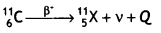
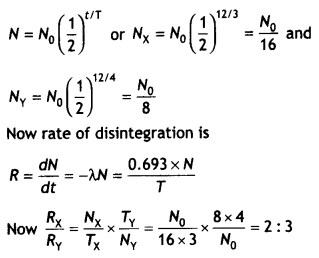
Answer:
For D: A = 180, Z = 72
For D3: A = 172, Z = 69

During alpha decay mass number decreases by 4 and the atomic number decreases by 2, while during beta decay the mass number remains the same, and the atomic number increases by 1.

Question 14.
Write symbolically the nuclear β+ decay process of 611C. Is the decayed product X an isotope or isobar of611C?
Given the mass values m (611C) = 11.011434 u and m (X) = 11.009305 u. (CBSE AI 2015)
Estimate the Q – value in this process.
Answer:
The required equation is
Class 12 Physics Important Questions Chapter 13 Nuclei 13
X is an isobar
Mass defect = m(C) – m(X)
= (11.011434- 11.009305) u = 0.002129 u

Therefore Q = Δm × 931.5 MeV
= 0.002129 × 931.5 = 1.98 MeV

Question 15.
Two radioactive samples, X, Y have the same number of atoms at t = 0. Their half¬lives are 3 h and 4 h respectively. Compare the rates of disintegration of the two nuclei after 12 hours. (CBSE AI 2017C)
Answer:
Let N0 be the nuclei present in X and Y at t = 0. Given Tx = 3 h and Ty = 4 h, t = 12 h.
The number of nuclei present in X and Y after 12 hours is
Class 12 Physics Important Questions Chapter 13 Nuclei 14
Question 16.
A radioactive sample has the activity of 10,000 disintegrations per second after 20 hours. After the next 10 hours, its activity reduces to 5,000 dis. sec-1. Find out its half-life and initial activity. (CBSE Delhi 2017C)
Answer:
Since activity reduces to half in 10 hours from 10000 dis. sec-1 to 5000 dis. sec-1, therefore half-life of the sample will be 10 years.
Class 12 Physics Important Questions Chapter 13 Nuclei 15
Question 17.
Why is the energy of the beta particles emitted during beta decay continuous?
Answer:
The phenomenon of beta decay arises due to the conversion of a neutron in the nucleus into a proton, electron, and an anti-neutrino. Because the energy available in beta decay is shared by the electron and the anti-neutrino in all possible ratios as they come out of the nucleus, therefore the beta ray energy spectrum is continuous in nature.

Question 18.
Explain, how radioactive nuclei can emit β-particles even though atomic nuclei do not contain these particles. Hence explain why the mass number of a radioactive nuclide does not change during β-decay.
Answer:
Beta-particles (or electrons) as such are not present inside a nucleus. However, in the case of a radioactive nuclide, sometimes a neutron decays into a proton, an electron, and an antineutrino as given by the following equation:
Class 12 Physics Important Questions Chapter 13 Nuclei 16
where mass and charge of antineutrino particle is zero. Out of the particles formed, the proton remains within the nucleus itself but electron along with antineutrino comes out of the nucleus. It is this electron that is being emitted as a beta-particle.

As in the process of β-emission, one proton is produced in the nucleus at the expense of a neutron and the mass number of both is the same, hence the mass number of the nuclide remains unchanged during p-decay.

Question 19.
Consider a radioactive nucleus A which decays to a stable nucleus C through the following sequence: A → B → C. Here B is an intermediate nucleus that is also radioactive. Considering that there are No atoms of A initially, plot the graph showing the variation of the number of atoms of A and B versus time. (NCERT Exemplar)
Answer:
At t = 0, NA = No while NB = 0. As time increases, NA falls off exponentially, while the number of atoms of B increases, becomes maximum, and finally decays to zero  ∞ (following exponential decay law).

Hence the graph is as shown.
Class 12 Physics Important Questions Chapter 13 Nuclei 17

Nuclei Important Extra Questions Long Answer Type

Question 1.
Define the terms: half-life period and decay constant of a radioactive sample. Derive the relation between these terms.
Answer:
The half-life is the time required for the number of radioactive nuclei to decrease to one-half the original number.

The decay constant is defined as the reciprocal of that time duration for which the number of nuclei of the radioactive sample decays to 1 / e or 37% of its original value.

To get the relation for half life T and decay constant λ we set N = \(\frac{N_{0}}{2}\) and t = T in the equation N = No e-λt, obtaining \(\frac{1}{2}\) = e-λt

Taking the logarithm of both sides and solving for T we have
T = \(\frac{\ln 2}{\lambda}=\frac{2.303 \log 2}{\lambda}=\frac{0.693}{\lambda}\)

Question 2.
(a) Draw a graph showing the variation of the potential energy of a pair of nucleons as a function of their separation. Indicate the regions in which nuclear force is (i) attractive, and (ii) repulsive.
Answer:
Graph showing the variation of potential energy U (in MeV) of a pair of nucleons as a function of their separation r (in fm) is shown here.
Class 12 Physics Important Questions Chapter 13 Nuclei 18

  1. In the graph region AD (r > ro) shows the region where nuclear force is strongly attractive.
  2. The region DE (r < ro) shows the region where nuclear force is strongly repulsive.

(b) Write two characteristic features of nuclear force which distinguish it from the Coulomb force.
Answer:
Two characteristics of nuclear forces which distinguish it from Coulomb’s force are

  • It is charge Independent.
  • It is an extremely short-range force and does not obey the inverse square law.

Question 3.
Prove that the Instantaneous rate of change of the activity of a radioactive substance is Inversely proportional to the square of Its half-life.
Answer:
The activity of a radioactive substance is
A = \(\frac{dN}{dt}\).

We know that the number of nuclei of a radioactive substance Left behind after time t is given by N = Noe-λt

Differentiating the above relation with respect to time we have
A = \(\frac{d N}{d t}=\frac{d}{d t}\)Noe-λt = – Noλe-λt

Differentiating the above equation with respect to time we have
Class 12 Physics Important Questions Chapter 13 Nuclei 19
Therefore the Instantaneous rate of change of the activity of a radioactive substance is inversely proportional to the square of Its half Life.

Question 4.
(a) Deduce the expression N = Noe-λt the law of radioactive decay.
(b) (i) Write symbolically the process expressing the β+ decay of, 1122Na Also write the basic nuclear process underlying this decay.
(ii) Is the nucleus formed in the decay of the nucleus 1122Na an Isotope or isobar? (CBSE Delhi 2014)
Answer:
(a) Let N0 be the number of nuclei present in a freshly separated sample of a radioactive substance. Let after time t the number of nuclei left behind be N. Let dN number of nuclei disintegrate in a small time interval dt. Then by the – decay law,
Class 12 Physics Important Questions Chapter 13 Nuclei 20
where λ  is a constant of proportionality.

Question 5.
(a) Complete the following nuclear reactions:
Class 12 Physics Important Questions Chapter 13 Nuclei 21
Answer:
Class 12 Physics Important Questions Chapter 13 Nuclei 22

(b) Write the basic process Involved in nuclei responsible for (i) β and (ii) β+ decay.
Answer:
The basic nuclear process underlying β decay is the conversion of the neutron to proton
n → p + e + v
while for v+ decay, it is the conversion of a proton into a neutron
p → n + e+ + v

(c) Why is it found experimentally difficult to detect neutrinos? (CBSE AI 2015 C)
Answer:
Neutrinos are neutral particles with very small (possibly, even zero) mass compared to electrons. They have only weak interaction with other particles. They are, therefore, very difficult to detect, since they can penetrate a large quantity of matter (even earth) without any interaction.

Question 6.
(a) Explain the processes of nuclear fission and nuclear fusion by using the plot of binding energy per nucleon (B.E./A) versus the mass number A.
Answer:
For the graph
Class 12 Physics Important Questions Chapter 13 Nuclei 5
From the plot, we note that

  • During nuclear fission: A heavy nucleus in the larger mass region (A > 200) breaks into two middle-level nuclei, resulting in an increase in B.E./ nucleon. This results in the release of energy,
  • During nuclear fusion: Light nuclei in the lower mass region (A < 20) fuse to form a nucleus having higher B.E. / nucleon. Hence Energy gets released.

(b) A radioactive Isotope has a half-life of 10 years. How long will It take for the activity to reduce to 3.125%? (CBSE AI2018)
Answer;
3.125% means that the number of nuclei decays to 1/32 of its original value.
Therefore,
\(\frac{N}{N_{0}}=\frac{1}{32}=\left(\frac{1}{2}\right)^{5}\)

Now we know that
N = N0\(\left(\frac{1}{2}\right)^{t / T}\)

Therefore we have
\(\left(\frac{1}{2}\right)^{5}=\left(\frac{1}{2}\right)^{t / T}\)

Therefore
t = 5T = 5 × 10 = 50 years

Question 7.
Group the following six nuclides into three pairs of (?) isotones, (ii) isotopes, and (iii) isobars: 612C, 23He, 80198Hg, 13H, 79197Au 614C. How does the size of the nucleus depend on its mass number? Hence explain why the density of nuclear matter should be independent of the size of the nucleus.
Answer:
(a) Isotones: 80198Hg, 79197Au
(6) Isotopes: 612C , 614C
(c) Isobars: 23He, 13H

The size of a nucleus depends upon its mass number as R = R0 A1/3

The nuclear density is given by the expression
Class 12 Physics Important Questions Chapter 13 Nuclei 23
The calculations show that the nuclear density is independent of the mass number.

Question 8.
Define the term ‘decay constant’ of a radioactive sample. The rate of disintegration of a given radioactive nucleus is 10,000 disintegrations/s and 5,000 disintegration/s after 20 hr and 30 hr respectively from start. Calculate the half-life and an initial number of nuclei at t = 0. (CBSE Delhi 2019)
Answer:
The decay constant of a radioactive element is the reciprocal of the time in which the number of its nuclei reduces to 1 /e of its original number.

We have R = λN
R(20hrs) = 100o0 = λN20
R(30hrs) = 5000 = λN30
\(\frac{N_{20}}{N_{30}}\) = 2

This means that the number of nuclei, of the given radioactive nucleus, gets halved in a time of (30 – 20) hours = 10 hours
Half-life = 10 hours

This means that in 20 hours (= 2 half-Lives), the original number of nuclei must have gone down by a factor of 4.
Hence rate of decay at t = 0
λ N0 = 4 λ N20
R0 = 4 × 10,000 = 40,000 disintegration per second
Class 12 Physics Important Questions Chapter 13 Nuclei 24
Question 9.
(a) Write the relation between half-life and an average life of a radioactive nucleus.
Answer:
The relation is τ = 1 .44T1/2

(b) In a given sample two isotopes A and B are initially present in the ratio of 1:2. Their half-lives are 60 years and 30 years respectively. How long will it take so that the sample has these isotopes in the ratio of 2:1? (CBSE Delhi 2019)
Answer:
Class 12 Physics Important Questions Chapter 13 Nuclei 25
Class 12 Physics Important Questions Chapter 13 Nuclei 26
Question 10.
Distinguish between nuclear fission and fusion. Show how in both these processes energy is released. Calculate the energy release in MeV in the deuterium-tritium fusion reaction:
Class 12 Physics Important Questions Chapter 13 Nuclei 27
Using the data m(21H) = 2.014102 u,
m(13H) = 3.016949u, m(24He) = 4.002603 u,
mn = 1.008665 u,1 u = 931.5 MeV/c2 (CBSE Delhi 2015)
Answer:
The distinction is shown in the table below.

Nuclear FissionNuclear Fusion
1. It is the splitting of a heavy nucleus into two or tighter unstable nuclei.1. It is the combining of two light nuclei into a heavier nucleus.
2. It may or may not be a chain reaction.2. It is always a chain reaction.
3. It is independent of temperature.3. It is temperature-dependent.
4. It can be controlled.4. It can’t be controlled.
5. Tremendous amount of energy is released.5. Energy released per unit mass is seven times the energy released during fission.
6. By-products are harmful.6. By-products are not harmful.
7. Example of reaction – The atom bomb.7. Example of reaction – Reaction in stars, hydrogen born

In both reactions, there is a mass defect that is converted into energy.
Now energy released in the reaction
Class 12 Physics Important Questions Chapter 13 Nuclei 28

Question 11.
(a) Draw a plot showing the variation of the potential energy of a pair of nucleons as a function of their separation. Mark the regions where the nuclear force is (a) attractive and (b) repulsive.
Answer:
Class 12 Physics Important Questions Chapter 13 Nuclei 30
For r > ro, the force is attractive For r < ro, the force is repulsive

(b) In the nuclear reaction
Class 12 Physics Important Questions Chapter 13 Nuclei 29
determine the values of a and b. (CBSE Delhi 2018 C)
Answer:
We have,
1 + 235 = a + 94 + 2 × 1
∴ a = 236 – 96 = 140

Also
0 + 92 = 54+ 6 + 2 × 0
∴ b = 92 – 54 = 38

Question 12.
Binding energy per nucleon versus mass number curve is as shown. ZAS, Z1A1w, Z2A2X, and Z3A3Y, are four nuclei indicated on the curve.
Class 12 Physics Important Questions Chapter 13 Nuclei 31
Based on the graph:
(а) Arrange X, W, and S in the increasing order of stability.
Answer:
(a) S, W, and X

(b) Write the relation between the relevant A and Z values for the following nuclear reaction. S → X + W
Answer:
The equation isClass 12 Physics Important Questions Chapter 13 Nuclei 32
Z = Z1 + Z2 and A = A1 + A2

(c) Explain why binding energy for heavy nuclei is low. (CBSE Sample Paper 2018-19)
Answer:
Reason for low binding energy: For heavier nuclei, the Coulomb repulsive force between protons increases considerably and offsets the attractive effects of the nuclear forces. This can result in such nuclei being unstable.

Question 13.
(a) Derive the law of radioactive decay,
viz. N = Noe-λt
Answer:
Let N0 be the number of nuclei present in a freshly separated sample of a radioactive substance. Let after time t the number of nuclei left behind be N. Let dN number of nuclei disintegrate in a small time interval dt. Then by the – decay law,
Class 12 Physics Important Questions Chapter 13 Nuclei 20
where λ is a constant of proportionality.

(b) Explain, giving necessary reactions, how energy is released during
(i) fission
Answer:
Nuclear Fission: It is a process in which a heavy nucleus splits up into two Lighter nucLei of nearly equal masses. It is found that the sum of the masses of the product nuclei and particles is less than the sum of the masses of the reactants, i.e. there is some mass defect. This mass defect appears as energy. One such fission reaction is given below:
Class 12 Physics Important Questions Chapter 13 Nuclei 33
The Q value of the above reaction is about 200 MeV. The sum of the masses of Ba, Kr, and 3 neutrons is less than the sum of the masses of U and one neutron.

(ii) fusion
Nuclear Fusion: It is the process in which two light nuclei combine together to form a heavy nucleus. For fusion very high temperature of l is required. One such fusion reaction is given below:
Class 12 Physics Important Questions Chapter 13 Nuclei 34
The Q value of this nuclear reaction is 24 MeV. It is the energy equivalent of the mass defect in the above reaction. The energy released in fusion is much less than in fission but the energy released per unit mass infusion is much greater than that released in fission.

Question 14.
(a) Distinguish between isotopes and isobars, giving one example for each.
(b) Why is the mass of a nucleus always less than the sum of the masses of its constituents? Write one example to justify your answer.
Or
(a) Classify the following six nuclides into (i) isotones, (ii) Isotopes, and (iii) isobars: (CBSEAI2019)
Class 12 Physics Important Questions Chapter 13 Nuclei 35
(b) How does the size of a nucleus depend on its mass number? Hence explain why the density of nuclear matter should be independent of the size of the nucleus.
Answer:
(a) Isotopes have the same atomic number while isobars have the same mass number
Examples of isotopes 612C, 614C
Examples of isobars 23He, 13H

(b) Mass of a nucleus is less than its constituents because in the bound state some mass is converted into binding energy which is energy equivalent of mass defect e.g., the mass of 1860 nucleus is less than the sum of masses of 8 protons and 8 neutrons
Or
(a) Isotones: 80198Hg, 79197Au
(6) Isotopes: 612C , 614C
(c) Isobars: 23He, 13H

(b) The radius of the nucleus is given by
R = RoA1/3

Volume of the nucleus \(\frac{4}{3}\)πR3 = \(\frac{4}{3}\)πRo3 A

If m is the average mass of the nucleon then the mass of the nucleus M = mA
Hence nuclear density
Class 12 Physics Important Questions Chapter 13 Nuclei 36
Which is independent of the A i.e., the size of the nucleus.

Numerical Problems:

  • Radius of the nucleus R = RoA1/3
  • Mass defect, Δm = Z mp + (A – Z) mn– M
  • Energy released ΔE = Δm × 931 MeV
    or
    ΔE = [Z mp + (A – Z) mn – M] × 931 MeV
  • Binding energy per nucleon BE/N = ΔE/A
  • Relation between original nuclei (N) and nuclei left (No) after time t N = Noe-λt
  • Relation between decay constant (λ) and half-life (T) = \(\frac{\ln 2}{\lambda}=\frac{2.303 \log 2}{\lambda}=\frac{0.693}{\lambda}\)
  • Half-life is also given by the expression N = No\(\left(\frac{1}{2}\right)^{n}\) where n = t/T
  • The average life is given by
    τ = \(\frac{1}{\lambda}=\frac{T}{\ln 2}=\frac{T}{0.693}\) = 1.44 T
  • Activity is given by A = -λN = \(\frac{0.693N}{T}\)

Question 1.
Calculate the binding energy per nucleon of Fe5626 Given mFe = 55.934939 u, mn = 1.008665 u and mp = 1.007825 u
Answer:
Number of protons Z = 26
Number of neutrons (A – Z) = 30
Now mass defect is given by
Δm = Z mp + (A – Z)mn – M
Δm = 26 × 1.007825 + 30 × 1.008665 – 55.934939
= 0.528461 u

Therefore binding energy
BE = Δm × 931 MeV = 0.528461 × 931
= 491.99 MeV

BE/nucleon = 491.99/56 = 8.785 MeV

Question 2.
The activity of a radioactive element drops to one-sixteenth of its initial value in 32 years. Find the mean life of the sample.
Answer:
Class 12 Physics Important Questions Chapter 13 Nuclei 37
Or
32/T = 4 or 7 = 32 / 4 = 8 years.
Therefore mean life of the sample is τ = 1.44 7 = 1.44 × 8 = 11.52 years.

Question 3.
A radioactive sample contains 2.2 mg of pure 116C which has a half-life period of 1224 seconds. Calculate (i) the number of atoms present initially and (ii) the activity when 5 pg of the sample will be left.
Answer:
Mass of sample = 2.2 pg
Now 11 g of the sample contains 6.023 × 10²³ nuclei, therefore the number of nuclei in 2.2 mg = 2.2 × 10⁻³ g are
Class 12 Physics Important Questions Chapter 13 Nuclei 38

Question 4.
The half-life of 238 92U is 4.5 × 10⁹ years. Calculate the activity of 1 g sample of 92238U.
Answer:
Given T = 4.5 × 10⁹ years.
Number of nuclei of U in 1 g
= N = \(\frac{6.023 \times 10^{23}}{238}\) = 2.5 × 10²¹

Therefore activity
Class 12 Physics Important Questions Chapter 13 Nuclei 39
Question 5.
The decay constant for a given radioactive sample is 0.3456 per day. What percentage of this sample will get decayed in a period of 4 days?
Answer:
Given λ = 0.3456 day-1
or
T1/2 = 0.693/λ = 0. 693/ 0.3456 = 2.894 days, t = 4 days.

Let N be the mass left behind, then N = Noe-λt
or
N = No e-0 3456 × 4
or
N = N0 e-1 3824 = No × 0.25

Therefore the percentage of undecayed is
Class 12 Physics Important Questions Chapter 13 Nuclei 40
Question 6.
It is observed that only 6.25 % of a given radioactive sample is left undecayed after a period of 16 days. What is the decay constant of this sample per day?
Answer:
Given N/No = 6.25 %, t = 16 days, λ = ?
Class 12 Physics Important Questions Chapter 13 Nuclei 41
Or
16/ T = 4 or T = 4 days.

Therefore λ = 1/T = 1/4 = 0.25 day-1

Question 7.
A radioactive substance decays to 1/32th of its initial value in 25 days. Calculate its half-life.
Answer:
Given t = 25 days, N = No / 32, using
Class 12 Physics Important Questions Chapter 13 Nuclei 42
Or
25/7= 5 or T= 25 / 5 = 5 days.

Question 8.
The half-life of a radioactive sample is 30 s.
Calculate
(i) the decay constant, and
Answer:
Given T1/2 = 30 s, N = 3No / 4, λ = ?, t = ?
(i) Decay constant
λ = \(\frac{0.693}{T_{1 / 2}}=\frac{0.693}{30}\) = 0.0231 s-1

(ii) time taken for the sample to decay to 3/4 th of its initial value.
Answer:
Using N = Noe-λt we have
Class 12 Physics Important Questions Chapter 13 Nuclei 43
Question 9.
The half-life of 14 6C is 5700 years. What does it mean?
Two radioactive nuclei X and Y initially contain an equal number of atoms. Their half-lives are 1 hour and 2 hours respectively. Calculate the ratio of their rates of disintegration after 2 hours.
Answer:
It means that in 5700 years the number of nuclei of carbon decay to half their original value.
Given Nox = NoY, TX = 1 h, TY = 2 h, therefore
\(\frac{\lambda_{X}}{\lambda_{Y}}=\frac{2}{1}\) = 2

Now after 2 hours X will reduce to one- fourth and Y will reduce to half their original value.
If activities at t = 2 h are Rx and Ry respectively, then
Class 12 Physics Important Questions Chapter 13 Nuclei 44
Thus their rate of disintegration after 2 hours is the same.

Question 10.
A star converts all its hydrogen to helium achieving 100% helium composition. It then converts helium to carbon via the reaction.
Class 12 Physics Important Questions Chapter 13 Nuclei 45
The mass of the star is 5 × 1032 kg and it generates energy at the rate of 5 × 1030 watt. How long will it take to convert all the helium to carbon at this rate?

As 4 × 10⁻³ kg of He consists of 6.023 × 10²³ He nuclei so 5 × 1032 kg He will contain
\(\frac{6.023 \times 10^{23} \times 5 \times 10^{32}}{4 \times 10^{-3}}\) = 7.5 × 1058 nuclei

Now three nuclei of helium produce 7.27 × 1.6 × 10-13 J of energy
So all nuclei in the star will produce
E = \(\frac{7.27 \times 1.6 \times 10^{-13}}{3}\) × 7.5 × 1058
= 2.9 × 1046 J

As power generated is P = 5 × 1030 W, therefore time taken to convert all He nuclei into carbon is
t = \(\frac{E}{P}=\frac{2.9 \times 10^{46}}{5 \times 10^{30}}\) = 5.84 × 10¹⁵ s
or
1.85 × 10⁸ years

Question 11.
Radioactive material is reduced to (1/16)th of its original amount in 4 days. How much material should one begin with so that 4 × 10⁻³ kg of the material is left after 6 days?
Answer:
N = No / 16, t = 4 days,
N = 4 × 10⁻³ kg,
t = 6 days

To calculate half-life of the material we have
Class 12 Physics Important Questions Chapter 13 Nuclei 46
Now using the expression 4 × 10-3 = No\(\left(\frac{1}{2}\right)^{6 / 1}\)
Solving we have No = 0.256 kg

Question 12.
Two different radioactive elements with half-lives T1 and T2 have N1 and N2 (undecayed) atoms respectively present at a given instant. Determine the ratio of their activities at this instant.
Answer:
The activity of a radioactive sample is given by the relation
A = – λN

Therefore the ratio of activity of these two radioactive elements is
\(\frac{A_{1}}{A_{2}}=\frac{-\lambda_{1} N_{1}}{-\lambda_{2} N_{2}}=\frac{T_{2} N_{1}}{T_{1} N_{2}}\)

Question 13.
Given the mass of the iron nucleus as 55.85 u and A = 56. Find the nuclear density? (NCERT)
Answer:
Given mFe = 55.85 u = 9.27 × 10⁻²⁶kg
Class 12 Physics Important Questions Chapter 13 Nuclei 47
The density of matter in neutron stars (an astrophysical object) is comparable to this density. This shows that matter in these Neutron stars has been compressed to such an extent that they resemble a big nucleus.

Question 14.
We are given the following atomic masses: 92238U = 238.05079 u, 24He = 4.00260 u, 90234Th = 234.04363 u 11H = 1.00783 u, 91237Pa =237.05121 u Here the symbol Pa is for the element protactinium (Z = 91). (a) Calculate the energy released during the alpha decay of 92238U. (b) Show that cannot spontaneously emit a proton. (NCERT)
Answer:
(i) The alpha decay of 92238Uis given by
Class 12 Physics Important Questions Chapter 13 Nuclei 48
The energy released in this process is given by
Q= (Mu – MTh – MHe) × 931.5 MeV

Substituting the atomic masses as given in the data we find that
Q = (238.05079 – 234.04363 – 4.00260) × 931.5 MeV ⇒ Q = 4.25 MeV.

(ii) If 29®U spontaneously emits a proton, the decay process would be
Class 12 Physics Important Questions Chapter 13 Nuclei 49
The Q for this process to happen is Q = (Mu – Mpa – MH) × 931.5 MeV
Q = (238.05079 – 237.05121 – 1.00783) × 931.5 MeV ⇒ Q = – 7.68 MeV

Thus the Q of the process is negative and therefore it cannot proceed spontaneously. We will have to supply energy of 7.68 MeV to the 92238U nucleus to make it emit a proton.

Question 15.
The half-life of 90Sr is 28 years. What is the disintegration rate of 15 mg of this isotope? (NCERT)
Answer:
Given T1/2 = 28 years, m = 15 mg
Now the rate of disintegration is given by
Class 12 Physics Important Questions Chapter 13 Nuclei 50