Isomerism in Coordination Compounds

Find free online Chemistry Topics covering a broad range of concepts from research institutes around the world.

Isomerism in Coordination Compounds

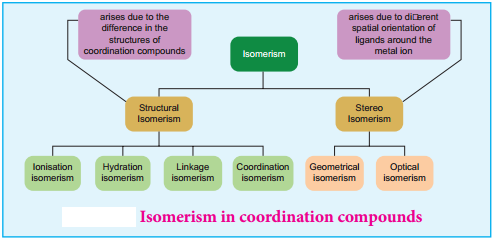
We have already learnt the concept of isomerism in the context of organic compounds, in the previous year  chemistry classes. Similarly, coordination compounds also exhibit isomerism. Isomerism is the phenomenon in which more than one coordination compounds having the same molecular formula have different physical and chemical properties due to different arrangement of ligands around the central metal atom. The following flow chart gives an overview of the common types of isomerism observed in coordination compounds,

Isomerism in Coordination Compounds img 1

Structural Isomers:

The coordination compounds with same formula, but have different connections among their constituent atoms are called structural isomers or constitutional isomers. Four common types of structural isomers are discussed below.

Linkage Isomers:

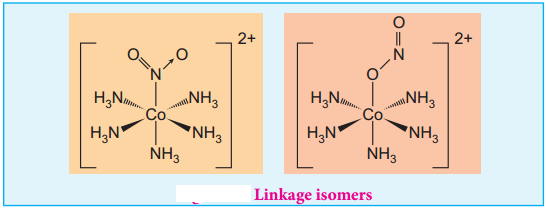
This type of isomers arises when an ambidentate ligand is bonded to the central metal atom/ion through either of its two different donor atoms. In the below mentioned examples, the nitrite ion is bound to the central metal ion Co3+ through a nitrogen atom in one complex, and through oxygen atom in other complex. [Co(NH3)5(NO2)]2+

Isomerism in Coordination Compounds img 2

Coordination Isomers:

This type of isomers arises in the coordination compounds having both the cation and anion as complex ions. The interchange of one or more ligands between the cationic and the anionic coordination entities result in different isomers.

For example, in the coordination compound, [Co(NH3)6][Cr(CN)6] the ligands ammonia and cyanide were bound respectively to cobalt and chromium while in its coordination isomer [Cr(NH3)6][Co(CN)6] they are reversed.

Some more examples for coordination isomers

  1. [Cr(NH3)5CN][Co(NH3)(CN)5] and [Co(NH3)5CN)] [Cr(NH3)(CN)5]
  2. [Pt(NH3)4][Pd(Cl)4] and [Pd(NH3)4][Pt(Cl)4]

Ionisation Isomers:

This type of isomers arises when an ionisable counter ion (simple ion) itself can act as a ligand. The exchange of such counter ions with one or more ligands in the coordination entity will result in ionisation isomers. These isomers will give different ions in solution. For example, consider the coordination compound [Pt(en)2Cl2]Br2.

In this compound, both Brand Cl have the ability to act as a ligand and the exchange of these two ions result in a different isomer [Pt(en)2Br2]Cl2. In solution the first compound gives Br ions while the later gives Clions and hence these compounds are called ionisation isomers.

Some more example for the isomers,

  1. [Cr(NH3)4ClBr]NO2 and [Cr(NH3)4Cl NO2]Br
  2. [Co(NH3)4Br2]Cl and [Co(NH3)4Cl Br] Br

Solvate Isomers:

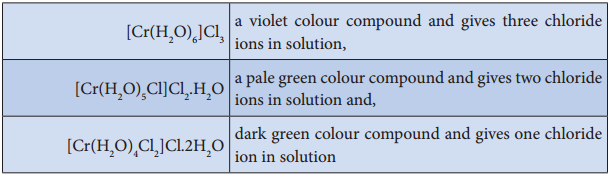
The exchange of free solvent molecules such as water, ammonia, alcohol etc in the crystal lattice with a ligand in the coordination entity will give different isomers. These type of isomers are called solvate isomers. If the solvent molecule is water, then these isomers are called hydrate isomers. For example, the complex with chemical formula CrCl3.6H2O has three hydrate isomers as shown below.

Isomerism in Coordination Compounds img 3

Stereoisomers:

Similar to organic compounds, coordination compounds also exhibit stereoisomerism. The stereoisomers of a coordination compound have the same chemical formula and connectivity between the central metal atom and the ligands. But they differ in the spatial arrangement of ligands in three dimensional space. They can be further classified as geometrical isomers and optical isomers.

Geometrical Isomers:

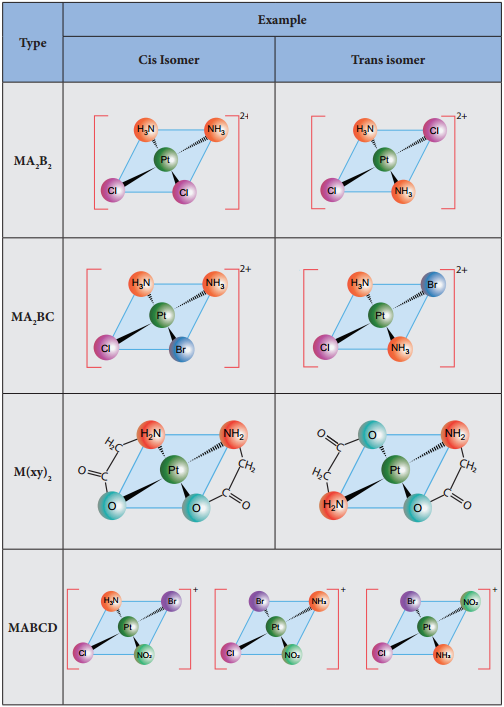
Geometrical isomerism exists in heteroleptic complexes due to different possible three dimensional spatial arrangements of the ligands around the central metal atom. This type of isomerism exists in square planer and octahedral complexes. In square planar complexes of the form [MA2B2]n+ and [MA2BC]n+ (where A, B and C are mono dentate ligands and M is the central metal ion/atom), Similar groups (A or B) present either on same side or on the opposite side of the central metal atom (M) give rise to two different geometrical isomers, and they are called, cis and trans isomers respectively.

The square planar complex of the type [M(xy)2]n+ where xy is a bidentate ligand with two different coordinating atoms also shows cis-trans isomerism. Square planar complex of the form [MABCD]n+ also shows geometrical isomerism. In this case, by considering any one of the ligands (A, B, C or D) as a reference, the rest of the ligands can be arranged in three different ways leading to three geometrical isomers.

Figure 5.4 MA2B2MA2BC M(xy)2 MABCD – isomers

Isomerism in Coordination Compounds img 4

Octahedral Complexes:

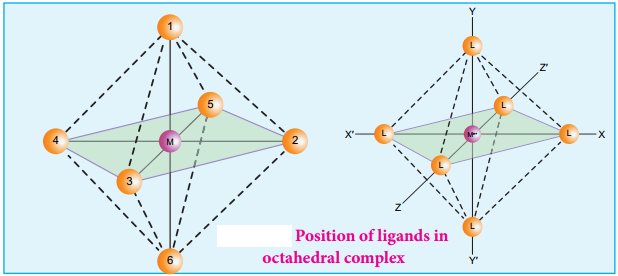
Octahedral complexes of the type [MA2B4]n+, [M(xx)2B2]n+ shows cis-trans isomerism. Here A and B are monodentate ligands and xx is bidentate ligand with two same kind of donor atoms. In the octahedral complex, the position of ligands is indicated by the following numbering scheme.

Isomerism in Coordination Compounds img 5

In the above scheme, the positions (1, 2), (1, 3), (1, 4), (1, 5), (2, 3), (2, 5), (2, 6), (3, 4), (3, 6), (4, 5), (4, 6), and (5, 6) are identical and if two similar groups are present in any one of these positions, the isomer is referred as a cis isomer. Similarly, positions (1, 6), (2, 4), and (3, 5) are identical and if similar ligands are present in these positions it is referred as a trans-isomer.

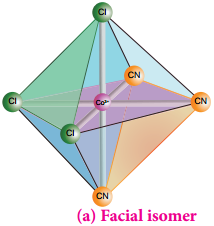
Octahedral complex of the type [MA3B3]n+ also shows geometrical isomerism. If the three similar ligands (A) are present in the corners of one triangular face of the octahedron and the other three ligands (B) are present in the opposing triangular face, then the isomer is referred as a facial isomer (fac isomer) – Figure 5.6 (a).

Isomerism in Coordination Compounds img 6

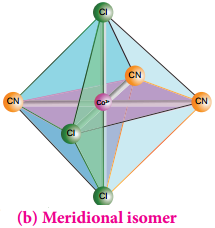
If the three similar ligands are present around the meridian which is an imaginary semicircle from one apex of the octahedral to the opposite apex as shown in the figure 5.6(b), the isomer is called as a meridional isomer (mer isomer). This is called meridional because each set of ligands can be regarded as lying on a meridian of an octahedron.

Isomerism in Coordination Compounds img 7

As the number of different ligands increases, the number of possible isomers also increases. For the octahedral complex of the type [MABCDEF]n+, where A, B, C, D, E and F are monodentate ligands, fifteen different orientation are possible corresponding to 15 geometrical isomers. It is difficult to generate all the possible isomers.

Optical Isomerism

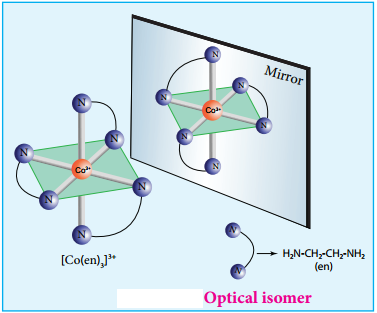
Coordination compounds which possess chairality exhibit optical isomerism similar to organic compounds. The pair of two optically active isomers which are mirror images of each other are called enantiomers. Their solutions rotate the plane of the plane polarised light either clockwise or anticlockwise and the corresponding isomers are called ‘d’ (dextro rotatory) and ‘l’ (levo rotatory) forms respectively. The octahedral complexes of type [M(xx)3]n+, [M(xx)2AB]n+ and [M(xx)2B2]n+ exhibit optical isomerism.

Examples:

The optical isomers of [Co(en)3]3+ are shown in figure 5.7.

Isomerism in Coordination Compounds img 8

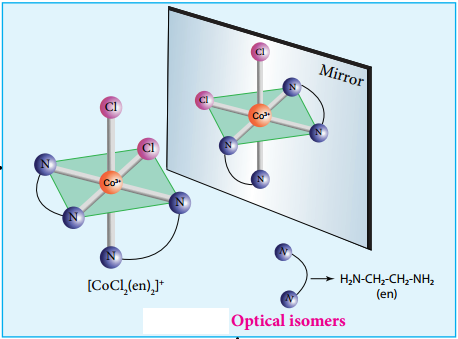
The coordination complex [CoCl2(en)2]+ has three isomers, two optically active cis forms and one optically inactive transform. These structures are shown below.

Isomerism in Coordination Compounds img 9

Nomenclature of Coordination Compounds

Find free online Chemistry Topics covering a broad range of concepts from research institutes around the world.

Nomenclature of Coordination Compounds

In the earlier days, the compounds were named after their discoverers. For example, K[PtCl3(C2H4)] was called Zeise’s salt and [Pt(NH3)4][PtCl4] is called Magnus’s green salt etc. There are numerous coordination compounds that have been synthesised and characterised.

The International Union of Pure and Applied Chemistry (IUPAC) has developed an elaborate system of nomenclature to name them systematically. The guidelines for naming coordination compounds based on IUPAC recommendations (2005) are as follows:

1. The cation is named first, followed by the anion regardless of whether the ion is simple or complex. For example

  • In K4[Fe(CN)6], the cation K+ is named first followed by [Fe(CN)6]4-.
  • In [Co(NH3)6]Cl3, the complex cation [Co(NH3)6]3+ is named first followed by the anion Cl
  • In [Pt(NH3)4][PtCl4], the complex cation [Pt(NH3)4]2+ is named first followed by the complex anion [PtCl4]2-

2. The simple ions are named as in other ionic compounds. For example,

Simple Cation

SymbolSimple Anion

Symbol

SodiumNa+ChlorideCl
PotassiumK+NitrateNO3
CopperCu2+SulphateSO42-

3. To name a complex ion, the ligands are named first followed by the central metal atom/ion. When a complex ion contains more than one kind of ligands they are named in alphabetical order.

a. Naming the ligands:

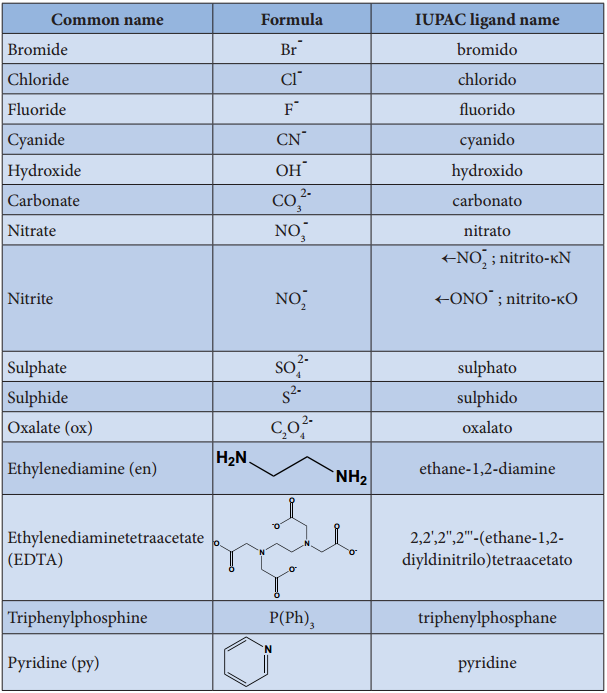
(i) The name of anionic ligands ends with the letter ‘o’ and the cationic ligand ends with ‘ium’. The neutral ligands are usually called with their molecular names with fewer exceptions namely, H2O (aqua), CO (carbonyl), NH3 (ammine) and NO (nitrosyl).

(ii) A κ-term is used to denote an ambidendate ligand in which more than one coordination mode is possible. For example, the ligand thiocyanate can bind to the central atom/ion, through either the sulphur or the nitrogen atom. In this ligand, if sulphur forms a coordination bond with metal then the ligand is named thiocyanato-κS and if nitrogen is involved, then it is named thiocyanato-κN.

Nomenclature of Coordination Compounds img 1

(iii) If the coordination entity contains more than one ligand of a particular type, the multiples of ligand (2, 3, 4 etc…) is indicated by adding appropriate Greek prefixes (di, tri, tetra, etc…) to the name of the ligand. If the name of a ligand itself contains a Greek prefix (eg. ethylenediamine), use an alternate prefies (bis, tris, tetrakis etc..) to specify the multiples of such ligands. These numerical prefixes are not taken into account for alphabetising the name of ligands.

b. Naming the Central Metal:

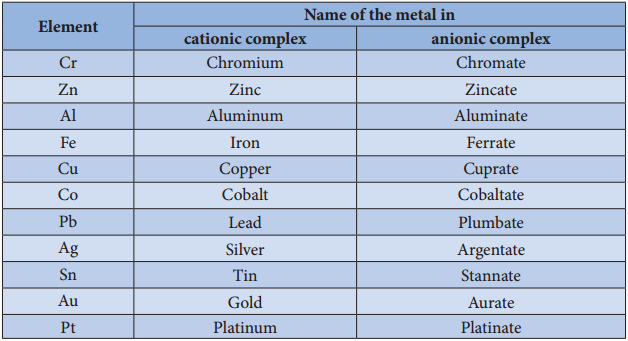
In cationic/neutral complexes, the element name is used as such for naming the central metal atom/ion, whereas, a suffix ‘ate’ is used along with the element name in anionic complexes. The oxidation state of the metal is written immediately after the metal name using roman numerals in parenthesis.

Nomenclature of Coordination Compounds img 2

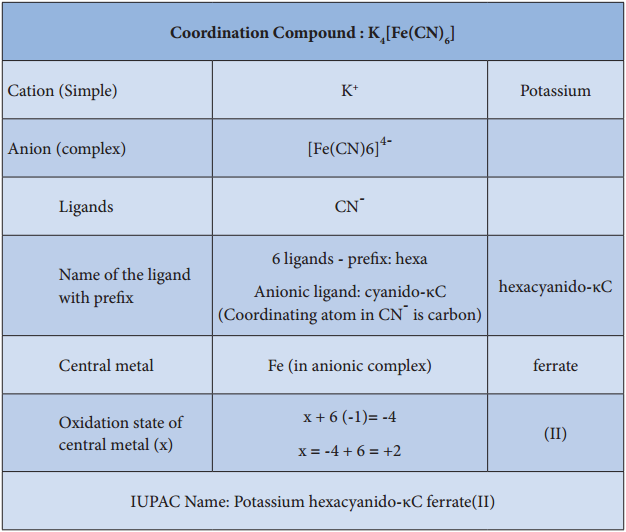
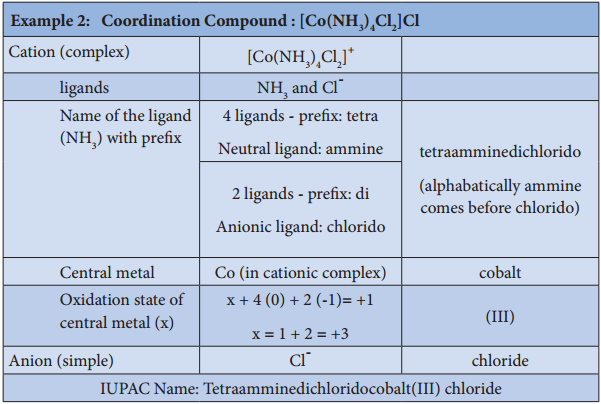
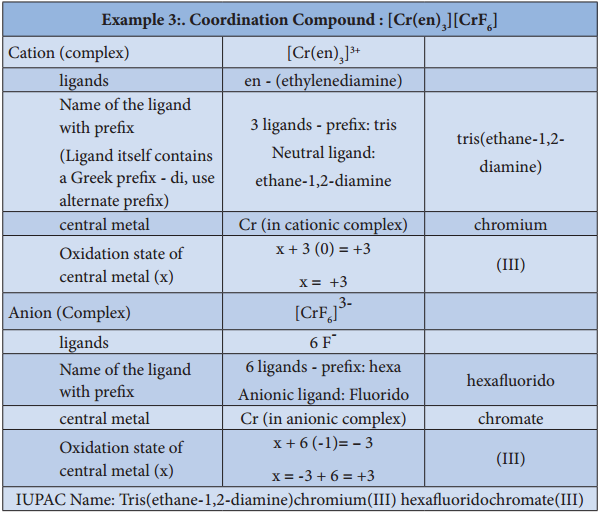
Naming of coordination compounds using IUPAC guidelines.

Example 1:

Nomenclature of Coordination Compounds img 3

Nomenclature of Coordination Compounds img 4

Nomenclature of Coordination Compounds img 5

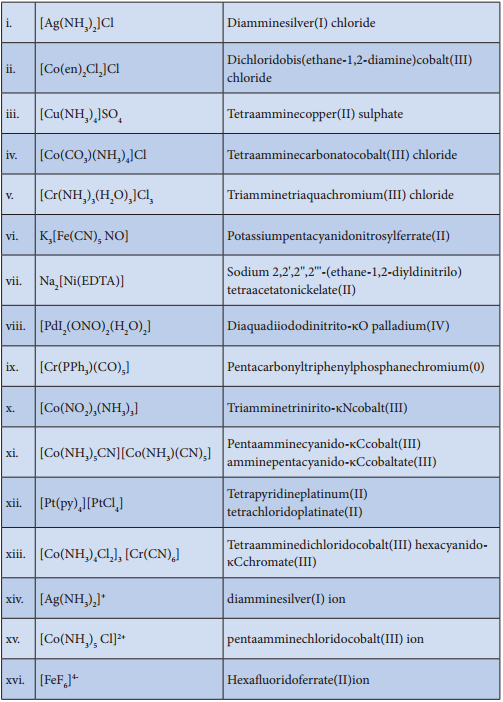
More examples with names are given in the list below for better understanding of IUPAC Nomenclature:

Nomenclature of Coordination Compounds img 6

Definition of Important Terms Pertaining to Co-Ordination Compounds

Find free online Chemistry Topics covering a broad range of concepts from research institutes around the world.

Definition of Important Terms Pertaining to Co-Ordination Compounds

Coordination Entity:

Coordination entity is an ion or a neutral molecule, composed of a central atom, usually a metal and the array of other atoms or groups of atoms (ligands) that are attached to it. In the formula, the coordination entity is enclosed in square brackets. For example, in potassium ferrocyanide, K4[Fe(CN)6], the coordination entity is [Fe(CN)6]4-. In nickel tetracarbonyl, the coordination entity is [Ni(CO)4].

Central Atom/Ion:

The central atom/ion is the one that occupies the central position in a coordination entity and binds other atoms or groups of atoms (ligands) to itself, through a coordinate covalent bond. For example, in K4[Fe(CN)6], the central metal ion is Fe2+. In the coordination entity [Fe(CN)6]4-, the Fe2+ accepts an electron pair from each ligand, CNand thereby forming six coordinate covalent bonds with them. since, the central metal ion has an ability to accept electron pairs, it is referred to as a Lewis acid.

Ligands:

The ligands are the atoms or groups of atoms bound to the central atom/ion. The atom in a ligand that is bound directly to the central metal atom is known as a donor atom. For example, in K4[Fe(CN)6]4- the ligand is CN ion, but the donor atom is carbon and in [Co(NH3)6]Cl3 the ligand is NH3 molecule and the donor atom is nitrogen.

Coordination Sphere:

The complex ion of the coordination compound containing the central metal atom/ion and the ligands attached to it, is collectively called coordination sphere and are usually enclosed in square brackets with the net charge. The other ionisable ions, are written outside the bracket are called counter ions. For example, the coordination compound K4[Fe(CN)6] contains the complex ion [Fe(CN)6]4- and is referred as the coordination sphere. The other associated ion K+ is called the counter ion.

Coordination Polyhedron:

The three dimensional spacial arrangement of ligand atoms/ions that are directly attached to the central atom is known as the coordination polyhedron (or polygon). For example, in K4[Fe(CN)6], the coordination polyhedra is octrahedral. The coordination polyhedra of [Ni(CO)4] is tetrahedral.

Coordination Number:

The number of ligand donor atoms bonded to a central metal ion in a complex is called the coordination number of the metal. In other words, the coordination number is equal to the number of σ-bonds between ligands and the central atom.

For example,

  • In K4[Fe(CN)6], the coordination number of Fe2+ is 6.
  • In [Ni(en)3]Cl2, the coordination number of Ni2+ is also 6. Here the ligand ‘en’ represents ethane-1,2-diamine (NH2-CH2-CH2-NH2) and it contains two donor atoms (Nitrogen).
  • Each ligand forms two  coordination bonds with nickel. So,totally there are six coordination bonds between them.

Oxidation State (Number):

The oxidation state of a central atom in a coordination entity is defined as the charge it would bear if all the ligands were removed along with the electron pairs that were shared with the central atom. In naming a complex, it is represented by a Roman numeral.

For example, in the coordination entity [Fe(CN)6]4-, the oxidation state of iron is represented as (II). The net charge on the complex ion is equal to the sum the oxidation state of the central metal and the charge the on the ligands attached to it. Using this relation the oxidation number can be calculated as follows Net charge = (oxidation state of the central metal) + [(No. of ligands) × (charge on the ligand)]

Example 1:

In [Fe(CN)6]4-, let the oxidation number of iron is x:
The net charge: – 4 = x + 6 (-1) ⇒ x = +2

Example 2:

In [Co(NH3)5Cl]2+, let the oxidation number of cobalt is x:
The net charge: +2 = x + 5 (0) + 1 (-1) ⇒ x = +3

Types of Complexes:

The coordination compounds can be classified into the following types based on

  • The net charge of the complex ion
  • Kinds of ligands present in the coordination entity.

Classification based on the net charge on the complex:

A coordination compound in which the complex ion

(i) Carries a net positive charge is called a cationic complex. Examples: [Ag(NH3)2]+, [Co(NH3)6]3+,
[Fe(H2)O6]2+, etc

(ii) Carries a net negative charge is called an anionic complex. Examples: [Ag(CN)2], [Co(CN)6]3-,
[Fe(CN)6]4-, etc

(iii) Bears no net charge, is called a neutral complex. Examples: [Ni(CO)4], [Fe(CO)5], [Co(NH3)3(Cl3)].

Classification Based on Kind of Ligands:

A coordination compound in which

(i) The central metal ion/atom is coordinated to only one kind of ligands is called a homoleptic complex.
Examples: [Co(NH3)6]3+, [Fe(H2O)6]2+.

(ii) The central metal ion/atom is coordinated to more than one kind of ligands is called a heteroleptic complex. Example, [Co(NH3)5Cl]2+, [Pt(NH3)2Cl2)].

Werner’s theory of Coordination Compounds

Find free online Chemistry Topics covering a broad range of concepts from research institutes around the world.

Werner’s theory of Coordination Compounds

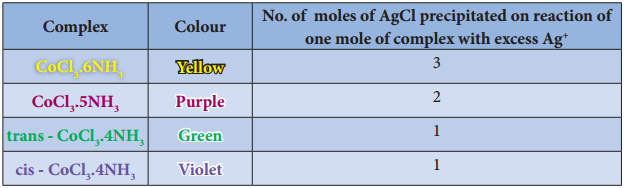
Swiss chemist Alfred Werner was the first one to propose a theory of coordination compounds to explain the observed behaviour of them. Let us consider the different coloured complexes of cobalt (III) chloride with ammonia which exhibit different properties as shown below.

Werner’S Theory of Coordination Compounds img 1

In this case, the valences of the elements present in both the reacting molecules, cobalt (III) chloride and ammonia are completely satisfied. Yet these substances react to form the above mentioned complexes.

To explain this behaviour Werner postulated his theory as follows:

1. Most of the elements exhibit, two types of valence namely primary valence and secondary valence and each element tend to satisfy both the valences. In modern terminology, the primary valence is referred as the oxidation state of the metal atom and the secondary valence as the coordination number. For example, according to Werner, the primary and secondary valences of cobalt are 3 and 6 respectively.

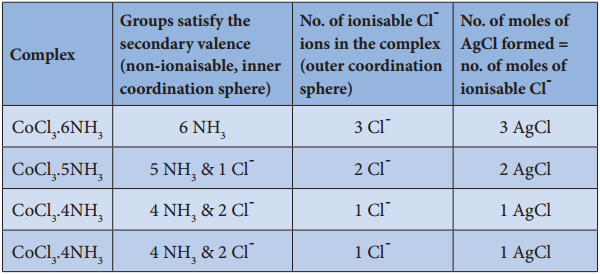
2. The primary valence of a metal ion is positive in most of the cases and zero in certain cases. They are always satisfied by negative ions. For example in the complex CoCl3.6NH3, The primary valence of Co is +3 and is satisfied by 3Cl ions.

3. The secondary valence is satisfied by negative ions, neutral molecules, positive ions or the combination of these. For example, in CoCl3.6NH3 the secondary valence of cobalt is 6 and is satisfied by six neutral ammonia molecules, whereas in CoCl3.5NH3 the secondary valence of cobalt is satisfied by five neutral ammonia molecules and a Cl ion.

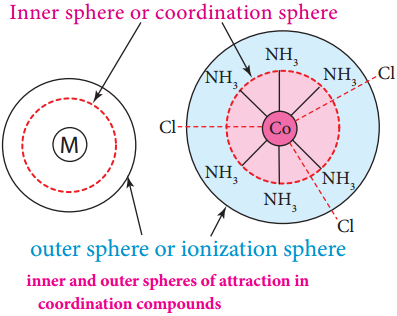
4. According to Werner, there are two spheres of attraction around a metal atom/ion in a complex. The inner sphere is known as coordination sphere and the groups present in this sphere are firmly attached to the metal. The outer sphere is called ionisation sphere. The groups present in this sphere are loosely bound to the central metal ion and hence can be separated into ions upon dissolving the complex in a suitable solvent.

Werner’S Theory of Coordination Compounds img 2

1. The primary valences are non-directional while the secondary valences are directional. The geometry of the complex is determined by the spacial arrangement of the groups which satisfy the secondary valence. For example, if a metal ion has a secondary valence of six, it has an octahedral geometry. If the secondary valence is 4, it has either tetrahedral or square planar geometry.

The following table illustrates the Werner’s postulates.

Werner’S Theory of Coordination Compounds img 3

Limitations of Werner’s Theory:

Even though, Werner’s theory was able to explain a number of properties of coordination compounds, it does not explain their colour and the magnetic properties.

Important Compound of Transition Elements

Find free online Chemistry Topics covering a broad range of concepts from research institutes around the world.

Important Compound of Transition Elements

Oxides and Oxoanions of Metals

Generally, transition metal oxides are formed by the reaction of transition metals with molecular oxygen at high temperatures. Except the first member of 3d series, Scandium, all other transition elements form ionic metal oxides. The oxidation number of metal in metal oxides ranges from +2 to +7. As the oxidation number of a metal increases, ionic character decreases, for example, Mn2O7 is covalent.

Mostly higher oxides are acidic in nature, Mn2O7 dissolves in water to give permanganic acid (HMnO4), similarly CrO3 gives chromic acid (H2CrO4) and dichromic acid (H2Cr2O7). Generally lower oxides may be amphoteric or basic, for example, Chromium (III) oxide – Cr2O3, is amphoteric and Chromium(II) oxide, CrO, is basic in nature.

Potassium Dichromate K2Cr2O7

Preparation:

Potassium dichromate is prepared from chromate ore. The ore is concentrated by gravity separation. It is then mixed with excess sodium carbonate and lime and roasted in a reverbratory furnace.

Important Compound of Transition Elements img 1

The roasted mass is treated with water to separate soluble sodium chromate from insoluble iron oxide. The yellow solution of sodium chromate is treated with concentrated sulphuric acid which converts sodium chromate into sodium dichromate.

Important Compound of Transition Elements img 2

The above solution is concentrated to remove less soluble sodium sulphate. The resulting solution is filtered and further concentrated. It is cooled to get the crystals of Na2SO4.2H2O.

The saturated solution of sodium dichromate in water is mixed with KCl and then concentrated to get crystals of NaCl. It is filtered while hot and the filtrate is cooled to obtain K2Cr2O7 crystals.

Important Compound of Transition Elements img 3

Physical Properties:

Potassium dichromate is an orange red crystalline solid which melts at 671K and it is moderately soluble in cold water, but very much soluble in hot water. On heating it decomposes and forms Cr2O3 and molecular oxygen. As it emits toxic chromium fumes upon heating, it is mainly replaced by sodium dichromate.

Important Compound of Transition Elements img 4

Structure of Dichromate Ion:

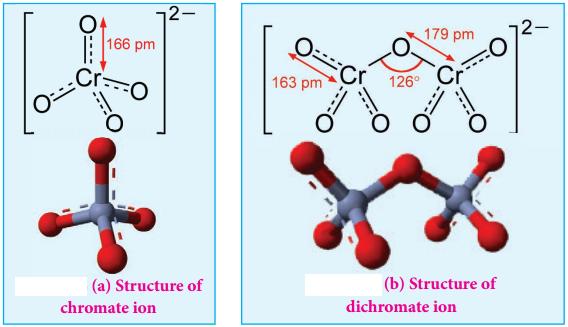
Both chromate and dichromate ion are oxo anions of chromium and they are moderately strong oxidizing agents. In these ions chromium is in +6 oxidation state. In an aqueous solution, chromate and dichromate ions can be interconvertible, and in an alkaline solution chromate ion is predominant, whereas dichromate ion becomes predominant in acidic solutions. Structures of these ions are shown in the figure.
Important Compound of Transition Elements img 5

Chemical Properties:

1. Oxidation

Potassium dichromate is a powerful oxidising agent in acidic medium. Its oxidising action in the presence of H+ ions is shown below. You can note that the change in the oxidation state of chromium from Cr6+ to Cr3+. Its oxidising action is shown below.

Cr2O72- + 14H+ + 6e → 2Cr3+ + 7H2O

The oxidising nature of potassium dichromate (dichromate ion) is illustrated in the following examples.

(i) It oxidises ferrous salts to ferric salts.

Cr2O72- + 6Fe2+ + 14H+ → 2Cr3+ + 6Fe3+ + 7H2O

(ii) It oxidises iodide ions to iodine

Cr2O72- + 6I + 14H+ → 2Cr3+ + 3I2 + 7H2O

(iii) It oxidises sulphide ion to sulphur

Cr2O72- + 3S2- + 14H+ → 2Cr3+ + 3S + 7H2O

(iv) It oxidises sulphur dioxide to sulphate ion

Cr2O72- + 3SO2 + 2H+ → 2Cr3+ + 3SO2-4 + H2O

(v) It oxidises stannous salts to stannic salt

Cr2O72- + 3Sn2+ + 14H+ → 2Cr3+ + 3Sn4+ + 7H2O

(vi) It oxidises alcohols to acids.

2K2Cr2O7 + 8H2SO4 + 3CH3CH2OH →
2K2SO4 + 2Cr2(SO4)3 + 3CH3COOH + 11H2O

Chromyl Chloride Test:

When potassium dichromate is heated with any chloride salt in the presence of Conc H2SO4, orange red vapours of chromyl chloride (CrO2Cl2) is evolved. This reaction is used to confirm the presence of chloride ion in inorganic qualitative analysis.

Important Compound of Transition Elements img 6

The chromyl chloride vapours are dissolved in sodium hydroxide solution and then acidified with acetic acid and treated with lead acetate. A yellow precipitate of lead chromate is obtained.

CrO2Cl2 + 4NaOH → Na2CrO4 + 2NaCl + 2H2O

Important Compound of Transition Elements img 7

Uses of Potassium Dichromate:

Some important uses of potassium dichromate are listed below.

  1. It is used as a strong oxidizing agent.
  2. It is used in dyeing and printing.
  3. It used in leather tanneries for chrome tanning.
  4. It is used in quantitative analysis for the estimation of iron compounds and iodides.

Potassium Permanganate – KMnO4

Preparation:
Potassium permanganate is prepared from pyrolusite (MnO2) ore. The preparation involves the following steps.

(i) Conversion of MnO2 to potassium manganate:

Powdered ore is fused with KOH in the presence of air or oxidising agents like KNO3 or KClO3. A green coloured potassium manganate is formed.

Important Compound of Transition Elements img 8

(ii) Oxidation of potassium manganate to potassium permanganate:

Potassium manganate thus obtained can be oxidised in two ways, either by chemical oxidation or electrolytic oxidation.

Chemical Oxidation:

In this method potassium manganate is treated with ozone (O3) or chlorine to get potassium permanganate.

2MnO42- + O3 + H2O → 2MnO4 + 2OH + O2
2MnO42- + Cl2 → 2MnO4 + 2Cl

Electrolytic Oxidation

In this method aqueous solution of potassium manganate is electrolyzed in the presence of little alkali.

K2MnO4 ⇄ 2K+ + MnO42-
H2O ⇄ H+ + OH

Manganate ions are converted into permanganate ions at anode.

Important Compound of Transition Elements img 9

H2 is liberated at the cathode.

2H+ + 2e → H2

The purple coloured solution is concentrated by evaporation and forms crystals of potassium permanganate on cooling.

Physical Properties:

Potassium permanganate exists in the form of dark purple crystals which melts at 513 K. It is sparingly soluble in cold water but, fairly soluble in hot water.

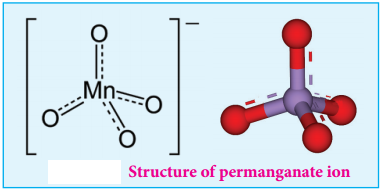
Structure of Permanganate ion

Permanganate ion has tetrahedral geometry in which the central Mn7+ is sp3 hybridised.
Important Compound of Transition Elements img 10

Chemical Properties:

1. Action of Heat:

When heated, potassium permanganate decomposes to form potassium manganate and manganese dioxide.

2KMnO4 → 2K2MnO4 + MnO2 + O2

2. Action of conc H2SO4

On treating with cold conc H2SO4, it decomposes to form manganese heptoxide, which subsequently decomposes explosively.

Important Compound of Transition Elements img 11

But with hot conc H2SO4, Potassium permanganate give MnSO4. 

Important Compound of Transition Elements img 12

3. Oxidising Property:

Potassium permanganate is a strong oxidising agent, its oxidising action differs in different reaction medium.

(a) In neutral medium:

In neutral medium, it is reduced to MnO2

MnO4 + 2H2O + 3e → MnO2 + 4OH

(i) It oxidises H2S to sulphur

2MnO4 + 2H2O + 3e → MnO2 + 4OH

(ii) It oxidises thiosulphate into sulphate

8MnO4 + 3S2O32- + H2O → 6SO42- + 8MnO2 + 2OH

(b) In alkaline medium:

In the presence of alkali metal hydroxides, the permanganate ion is converted into manganate.

MnO4 + e → MnO42-

This manganate is further reduced to MnO2 by some reducing agents.

MnO42- + H2O → MnO2 + 2OH + [O]

So the overall reaction can be written as follows.

MnO4 + 2H2O + 3e → MnO2 + 4OH

This reaction is similar as that for neutral medium.

Bayer’s Reagent:

Cold dilute alkaline KMnO4 is known as Bayer’s reagent. It is used to oxidise alkenes into diols. For example, ethylene can be converted into ethylene glycol and this reaction is used as a test for unsaturation.

(c) In acid medium:

In the presence of dilute sulphuric acid, potassium permanganate acts as a very strong oxidising agent. Permanganate ion is converted into Mn2+ ion.

MnO4 + 8H+ + 5e → Mn2+ + 4H2O

The oxidising nature of potassium permanganate (permanganate ion) in acid medium is illustrated in the following examples.

(i) It oxidises ferrous salts to ferric salts.

2MnO4 + 10Fe2+ + 16H+ → 2Mn2+ + 10Fe3+ + 8H2O

(ii) It oxidises iodide ions to iodine

2MnO4 + 10 I + 16H+ → 2Mn2+ + 5I2 + 8H2O

(iii) It oxidises oxalic acid to CO2

2MnO4 + 5(COO)2-2 + 16H+ → 2Mn2+ + 10CO2 + 8H2O

(iv) It oxidises sulphide ion to sulphur

2MnO4 + 5 S2- + 16H+ → 2Mn2+ + 5 S + 8H2O

(v) It oxidises nitrites to nitrates

2MnO4 + 5 NO2 + 6H+ → 2Mn2+ + 5NO3 + 3H2O

(vi) It oxidises alcohols to aldehydes.

2KMnO4 + 3H2SO4 + 5CH3CH2OH → K2SO4 + 2MnSO4 + 5CH3CHO + 8H2O

(vii) It oxidises sulphite to sulphate

2MnO4 + 5SO32- + 6H+ → 2Mn2+ + 5SO42- + 3H2O

Uses of Potassium Permanganate:

Some important uses of potassium permanganate are listed below.

  1. It is used as a strong oxidizing agent.
  2. It is used for the treatment of various skin infections and fungal infections of the foot.
  3. It used in water treatment industries to remove iron and hydrogen sulphide from well water.
  4. It is used as Bayer’s reagent for detecting unsaturation in an organic compound.
  5. It is used in quantitative analysis for the estimation of ferrous salts, oxalates, hydrogen peroxide and iodides.

F-Block Elements – Inner Transition Elements

In the inner transition elements there are two series of elements.

  1. Lanthanoids (previously called lanthanides)
  2. Actinoids (previously called actinides)

Lanthanoid series consists of fourteen elements from Cerium (58Ce) to Lutetium (71Lu) following Lanthanum (57La). These elements are characterised by the preferential filling of 4f orbitals, Similarly actinoids consists of 14 elements from Thrium (90Th) to Lawrencium (103Lr) following Actinium (89Ac). These elements are characterised by the preferential filling of 5f orbital.

The position of Lanthanoids in the periodic table

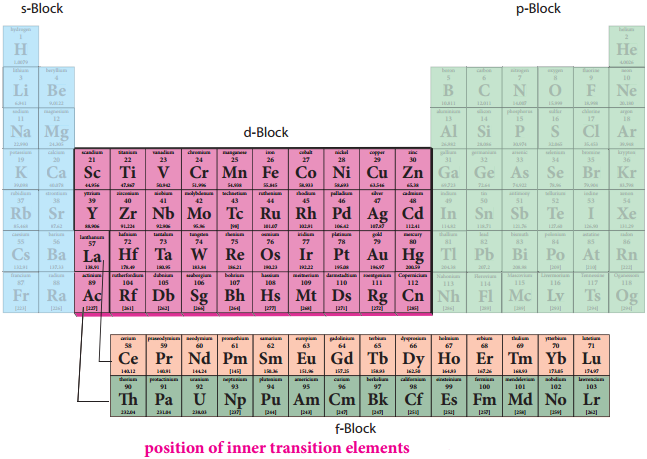
The actual position of Lanthanoids in the periodic table is at group number 3 and period number 6. However, in the sixth period after lanthanum, the electrons are preferentially filled in inner 4f sub shell and these fourteen elements following lanthanum show similar chemical properties. Therefore these elements are grouped together and placed at the bottom of the periodic table. This position can be justified as follows.

  1. Lanthanoids have general electronic configuration [Xe] 4f1-14 5d10-1 6s2
  2. The common oxidation state of lanthanoides is +3
  3. All these elements have similar physical and chemical properties.

Similarly the fourteen elements following actinium resemble in their physical and chemical properties. If we place these elements after Lanthanum in the periodic table below 4d series, the properties of the elements belongs to a group would be different and it would affect the proper structure of the periodic table. Hence a separate position is provided to the inner transition elements as shown in the figure.
Important Compound of Transition Elements img 13

Electronic Configuration of Lanthanoids:

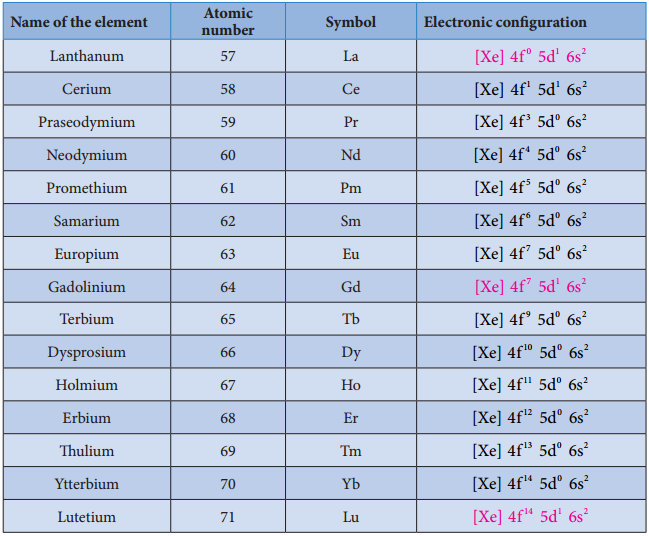
We know that the electrons are filled in different orbitals in the order of their increasing energy in accordance with Aufbau principle. As per this rule after filling 5s, 5p and 6s and 4f level begin to fill from lanthanum, and hence the expected electronic configuration of Lanthanum(La) is [Xe] 4f1 5d° 6s2 but the actual electronic configuration of Lanthanum is [Xe] 4f° 5d1 6s2 and it belongs to d block.

Filling of 4f orbital starts from Cerium (Ce) and its electronic configuration is [Xe] 4f1 5d1 6s2. As we move from Cerium to other elements the additional electrons are progressively filled in 4f orbitals as shown in the table.

Table: Electronic Configuration of Lanthanum and Lanthanoids
Important Compound of Transition Elements img 14

In Gadolinium (Gd) and Lutetium (Lu) the 4f orbitals, are half-filled and completely filled, and one electron enters 5d orbitals. Hence the general electronic configuration of 4f series of elements can be written as [Xe] 4f1-14 5d0-1 6s2

Oxidation State of Lanthanoids:

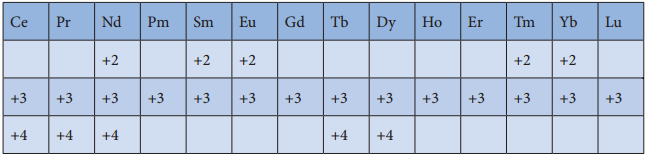
The common oxidation state of lanthanoids is +3. In addition to that some of the lanthanoids also show either +2 or +4 oxidation states. Gd3+ and Lu3+ ions have extra stability, it is due to the fact that they have exactly half filled and completely filled f-orbitals respectively their electronic configurations are

Gd3+: [Xe]4f7
Lu3+: [Xe]4f14

Similarly Cerium and terbium attain 4f° and 4f7 configurations respectively in the +4 oxidation states. Eu2+
and Yb2+ ions have exactly half filled and completely filled f orbitals respectively.

The stability of different oxidation states has an impact on the properties of these elements the following table shows the different oxidation states of lanthanoids.
Important Compound of Transition Elements img 15

Atomic and Ionic Radii:

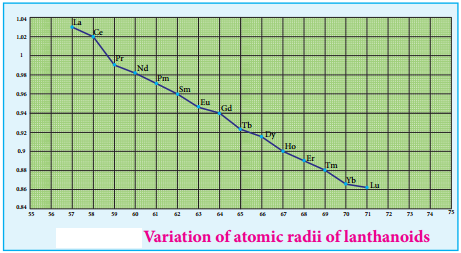
As we move across 4f series, the atomic and ionic radii of lanthanoids show gradual decrease with increse in atomic number. This decrease in ionic size is called lanthanoid contraction.
Important Compound of Transition Elements img 16

Cause of Lanthanoid Contraction:

As we move from one element to another in 4f series (Ce to Lu) the nuclear charge increases by one unit and an additional electron is added into the same inner 4f sub shell. We know that 4f sub shell have a diffused shapes and therefore the shielding effect of 4f elelctrons relatively poor hence, with increase of nuclear charge, the valence shell is pulled slightly towards nucleus. As a result, the effective nuclear charge experienced by the 4f elelctorns increases and the size of Ln3+ ions decreases. Lanthanoid contraction of various lanthanoids is shown in the graph.

Consequences of Lanthanoid Contraction:

1. Basicity Differences

As we from Ce3+ to Lu3+, the basic character of Ln3+ ions decrease. Due to the decrease in the size of Ln3+ ions, the ionic character of Ln – OH bond decreases (covalent character increases) which results in the decrease in the basicity.

2. Similarities Among Lanthanoids:

In the complete f – series only 10 pm decrease in atomic radii and 20 pm decrease in ionic radii is observed because of this very small change in radii of lanthanoids, their chemical properties are quite similar.

The elements of the second and third transition series resemble each other more closely than the elements of the first and second transition series. For example

Series

Element

Atomic Radius

3d SeriesTi132 pm
4d SeriesZr145 pm
5d SeriesHf144 pm

Actinoids:

The fourteen elements following actinium, i.e., from thorium (Th to lawrentium (Lr) are called actinoids. Unlike the lanthanoids, all the actinoids are radioactive and most of them have short half lives. Only thorium and uranium (U) occur in significant amount in nature and a trace amounts of Plutonium (Pu) is also found in Uranium ores. Neptunium (Np) and successive heavier elements are produced synthetically by the artificial transformation of naturally occuring elements by nuclear reactions. Similar to lanthanoids, they are placed at the bottom of the periodic table.

Electronic Configuration:

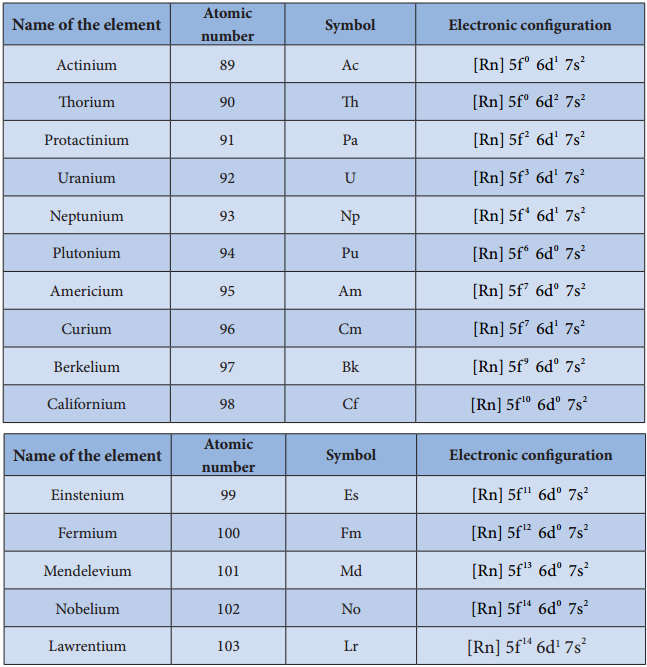
The electronic configuration of actinoids is not definite. The general valence shell electronic configuration of 5f elements is represented as [Rn]5f1-146d0-27s2. The following table show the electronic configuration of actinoids.

Table: Electronic configuration of actinoids
Important Compound of Transition Elements img 17

Oxidation State of Actinoids:

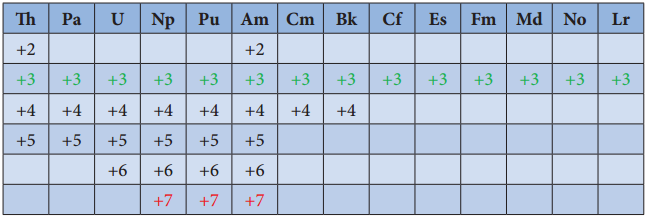
Like lanthanoids, the most common state of actinoids is +3. In addition to that actinoids show variable oxidation states such as +2 , +3 , +4 ,+5,+6 and +7. The elements Americium(Am) and Thrium (Th show +2 oxidation state in some compounds, for example thorium iodide (ThI2). The elements T, Pa, U, Np, Pu and Am show +5 oxidation states. Np and Pu exhibit +7 oxidation state.
Important Compound of Transition Elements img 18

Differences Between Lanthanoids and Actinoids:

Lanthanoids

Actinoids

1. Differentiating electron enters in 4f orbital1. Differentiating electron enters in 5f orbital
2. Binding energy of 4f orbitals are higher2. Binding energy of 5f orbitals are lower
3. They show less tendency to form complexes3. They show greater tendency to form complexes
4. Most of the lanthanoids are colourless4. Most of the actinoids are coloured. For example.
U3+(red), U4+(green), UO22+(yellow)
5. They do not form oxo cations5. They do form oxo cations such as UO22+, NPO22+ etc
6. Besides +3 oxidation states lanthanoids show +2 and +4 oxidation states in few cases6. Besides +3 oxidation states actinoids show higher oxidation states such as +4, +5, +6 and +7