Half Life Period of a Reaction

Find free online Chemistry Topics covering a broad range of concepts from research institutes around the world.

Half Life Period of a Reaction

The half life of a reaction is defined as the time required for the reactant concentration to reach one half its initial value. For a first order reaction, the half life is a constant i.e., it does not depend on the initial concentration.

The rate constant for a first order reaction is given by

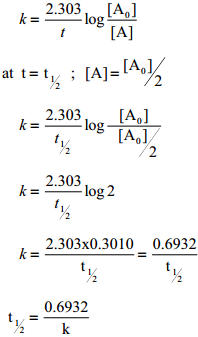
Half Life Period of a Reaction img 1

Let us calculate the half life period for a zero order reaction.

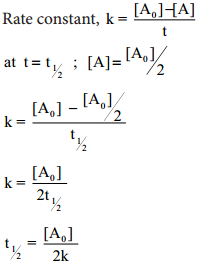
Half Life Period of a Reaction img 2

Hence, in contrast to the half life of a first order reaction, the half life of a zero order reaction is directly proportional to the initial concentration of the reactant.

Example 1

A first order reaction takes 8 hours for 90% completion. Calculate the time required for 80% completion. (log 5 = 0.6989; log 10 = 1)
Solution:
For a first order reaction
k = \(\frac{2.303}{t}\)log[latex]\frac{\left[\mathrm{A}_{0}\right]}{[\mathrm{A}]}[/latex] …………. (1)
Let [A°] = 100M
When t = t90%; [A]=10M (given that t90% = 8hours)
t = t90%; [A]=20M

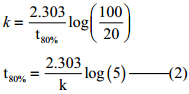
Half Life Period of a Reaction img 3

Find the value of k using the given data

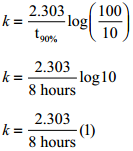
Half Life Period of a Reaction img 4

Substitute the value of k in equation (2)

t80% = \(\frac{2.303}{2.303/8hours}\) log(5)
t80% = 8hours × 0.6989
t80% = 5.59hours

Example 2

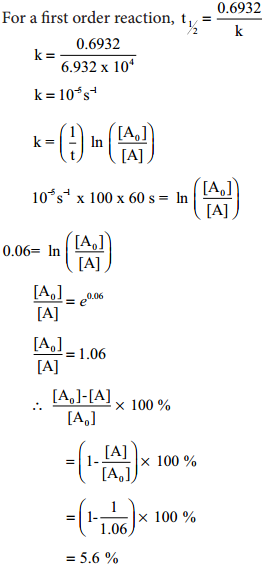
The half life of a first order reaction x → products is 6.932 × 10⁴s at 500k. What percentage of x would be decomposed on heating at 500K for 100 min.(e0.06=1.06).
Solution:
Given t1/2 = 0.6932 × 10⁴s
\(\frac{\left[\mathrm{A}_{0}\right]-[\mathrm{A}]}{\left[\mathrm{A}_{0}\right]}\) × 100
We know that
For a first order reaction, t1/2 = \(\frac{0.6932}{k}\)

Half Life Period of a Reaction img 5

Example 3

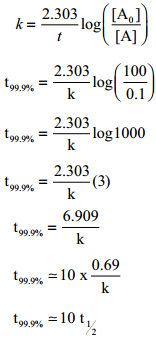
Show that case of first order reaction, the time required for 99.9% completion is nearly ten times the time required for half completion of the reaction.
Solution:
Let [A°] = 100
When t = t99.9%; [A] = (100 – 99.9) = 0.1

Half Life Period of a Reaction img 6

The Integrated Rate Equation

Find free online Chemistry Topics covering a broad range of concepts from research institutes around the world.

The Integrated Rate Equation

We have just learnt that the rate of change of concentration of the reactant is directly proportional to that of concentration of the reactant. For a general reaction, A → product. The rate law is Rate = \(\frac{-d[A]}{dt}\) = k[A]x

Where k is the rate constant, and x is the order of the reaction. The above equation is a differential equation, \(\frac{-d[A]}{dt}\), so it gives rate at any instant. However, using the above expression, we cannot answer questions such as how long will it take for a specific concentration of A to be used up in the reaction? What will be the concentration of reactant after a time ‘t’?. To answer such questions, we need the integrated form of the above rate law which contains time as a variable.

Integrated Rate Law for a First Order Reaction

A reaction whose rate depends on the reactant concentration raised to the first power is called a first order reaction. Let us consider the following first order reaction,

A → Product

Rate law can be expressed as
Rate = k[A]1
Where, k is the fist order rate constant.
\(\frac{-d[A]}{dt}\) = k[A]1
⇒ \(\frac{-d[A]}{[A]}\) = k dt …………… (1)

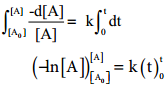
Integrate the above equation between the limits of time t = 0 and time equal to t, while the concentration varies from the initial concentration [A0] to [A] at the later time.
The Integrated Rate Equation img 1

– ln[A] – (- In[A0]) = k (t-0)
– ln[A] + In[A0] = kt
ln(\(\frac{\left[\mathrm{A}_{0}\right]}{[\mathrm{A}]}\)) = kt ……….. (2)

This equation is in natural logarithm. To convert it into usual logarithm with base 10, we have to multiply the term by 2.303. 2.303 log (\(\frac{\left[\mathrm{A}_{0}\right]}{[\mathrm{A}]}\)) = kt
k = \(\frac{2.303}{t}\)log(\(\frac{\left[\mathrm{A}_{0}\right]}{[\mathrm{A}]}\)) ………… (3)
Equation (2) can be written in the form y = mx + c as below
ln[A0]-ln[A] = kt
ln[A] = ln[A0]-kt
⇒ y = c + mx
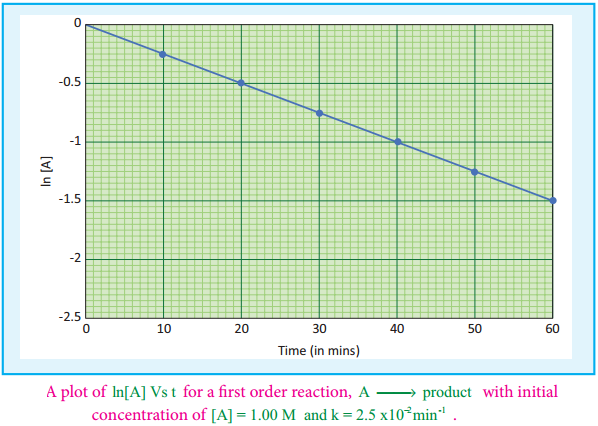
The Integrated Rate Equation img 2

If we follow the reaction by measuring the concentration of the reactants at regular time interval ‘t’, a plot of ln[A] against ‘t’ yields a straight line with a negative slope. From this, the rate constant is calculated. Examples for the first order reaction

(i) Decomposition of Dinitrogen Pentoxide

N2O5(g) → 2NO2(g) + \(\frac{1}{2}\)O2(g)

(ii) Decomposition of Sulphurylchloride

SO2Cl2(l) → SO2(g) + Cl2(g)

(iii) Decomposition of the H2O2 in aqueous solution; H2O2 → H2O(l) + \(\frac{1}{2}\)O2(g)

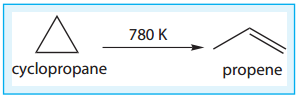
(iv) Isomerisation of Cyclopropane to Propene.

Pseudo First Order Reaction:

Kinetic study of a higher order reaction is difficult to follow, for example, in a study of a second order reaction involving two different reactants; the simultaneous measurement of change in the concentration of both the reactants is very difficult.

To overcome such difficulties, A second order reaction can be altered to a first order reaction by taking one of the reactant in large excess, such reaction is called pseudo first order reaction. Let us consider the acid hydrolysis of an ester,

The Integrated Rate Equation img 3

Rate = k [CH3COOCH3] [H2O]

If the reaction is carried out with the large excess of water, there is no significant change in the concentration of water during hydrolysis. i.e.,concentration of water remains almost a constant.

Now, we can define k [H2O] = k’; Therefore the above rate equation becomes
Rate = k'[CH3COOCH3]
Thus it follows first order kinetics.

Integrated Rate law for a Zero Order Reaction:

A reaction in which the rate is independent of the concentration of the reactant over a wide range of concentrations is called as zero order reactions. Such reactions are rare. Let us consider the following hypothetical zero order reaction.

A → product
The rate law can be written as,
Rate = k[A]°
\(\frac{-d[A]}{dt}\) = k(1) (∴[A]° = 1)
⇒ -d[A] = k dt

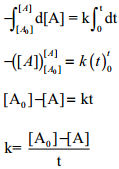
Integrate the above equation between the limits of [A°] at zero time and [A] at some later time ‘t’,
The Integrated Rate Equation img 4

Equation (2) is in the form of a straight line y = mx + c
i.e., [A] = – kt + [A°]
⇒ y = c + mx

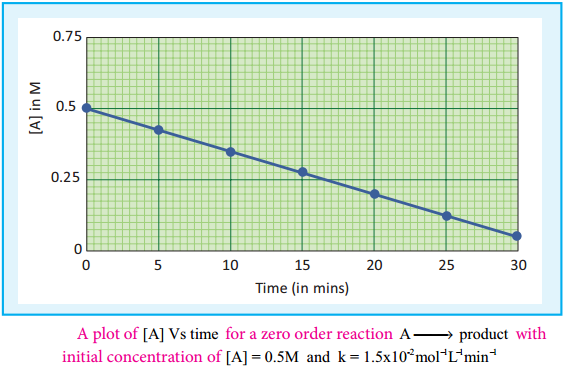
A plot of [A] Vs time gives a straight line with a slope of – k and y – intercept of [A°].

Fig 7.4: A plot of [A] Vs time for a zero order reaction A → product with initial concentration of [A] = 0.5M and k = 1.5 × 10⁻²mol-1L-1min-1
The Integrated Rate Equation img 5

Examples for a Zero Order Reaction:

1. Photochemical reaction between H2 and I2

The Integrated Rate Equation img 6

2. Decomposition of N2O on hot Platinum Surface

N2O(g) ⇄ N2(g) + \(\frac{1}{2}\)O2(g)

3. Iodination of Acetone in Acid Medium is Zero Order With Respect to Iodine.

The Integrated Rate Equation img 7
Rate = k [CH3COCH3][H+]
Molecularity

Find free online Chemistry Topics covering a broad range of concepts from research institutes around the world.

Molecularity

Kinetic studies involve not only measurement of a rate of reaction but also proposal of a reasonable reaction mechanism. Each and every single step in a reaction mechanism is called an elementary reaction.

An elementary step is characterized by its molecularity. The total number of reactant species that are involved in an elementary step is called molecularity of that particular step. Let us recall the hydrolysis of t butyl bromide studied in XI standard. Since the rate determining elementary step involves only t-butyl bromide, the reaction is called a Unimolecular Nucleophilic substitution (SN1) reaction.

Let us understand the elementary reactions by considering another reaction, the decomposition of hydrogen peroxide catalysed by I.

2H2O2(aq) → 2H2O(l) + O2(g)

It is experimentally found that the reaction is first order with respect to both H2O2 and I, which indicates
that I is also involved in the reaction. The mechanism involves the following steps.

Step: 1

H2O2(aq) + I(aq) → H2O(l) + Ol(aq)

Step: 2

H2O2(aq) + OI(aq) → H2O(l) + I(aq) + O2(g)

Overall Reaction is

2H2O2(aq) → 2H2O(l) + O2(g)

These two reactions are elementary reactions. Adding equ (1) and (2) gives the overall reaction. Step 1 is the rate determining step, since it involves both H2O2 and I, the overall reaction is bimolecular.

Differences Between Order and Molecularity:

Order of a Reaction

Molecularity of a Reaction

1. It is the sum of the powers of concentration terms involved in the experimentally determined rate law.1. It is the total number of
reactant species that are involved in an elementary
step.
2. It can be zero (or) fractional (or) integer2. It is always a whole number, cannot be zero
or a fractional number.
3. It is assigned for a
overall reaction
3. It is assigned for each
elementary step of mechanism.

Rate Law and Rate Constant

Find free online Chemistry Topics covering a broad range of concepts from research institutes around the world.

Rate Law and Rate Constant

Rate Law and Rate Constant:

We have just learnt that, the rate of the reaction depends upon the concentration of the reactant. Now let us understand how the reaction rate is related to concentration by considering the following general reaction.

xA + yB → products

The rate law for the above reaction is generally expressed as Rate = k [A]m[B]n

Where k is proportionality constant called the rate constant. The values of m and n represent the reaction order with respect to A and B respectively. The overall order of the reaction is given by (m+n). The values of the exponents (m and n) in the rate law must be determined by experiment. They cannot be deduced from the Stoichiometry of the reaction. For example, consider the isomerisation of cyclopropane, that we discussed earlier.

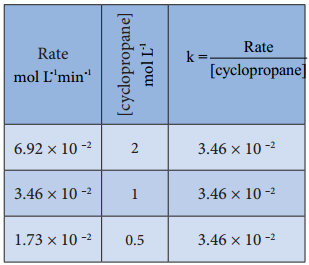
The results shown in table 7.2 indicate that if the concentration of cyclopropane is reduced to half, the rate also reduced to half. It means that the rate depends upon [cyclopropane] raised to the first power i.e., Rate = k[cyclopropane]1

⇒ \(\frac{Rate}{[cyclopropane]}\) = k

Rate Constant for Isomerisation

Rate Law and Rate Constant img 1

Let us consider an another example, the oxidation of nitric oxide (NO)

2NO(g) + O2(g) → 2NO2(g)

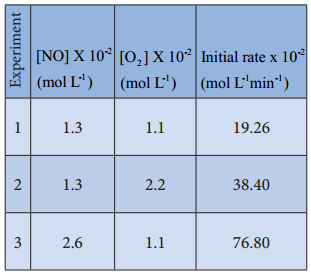
Series of experiments are conducted by keeping the concentration of one of the reactants constant and the changing the concentration of the others.

Rate Law and Rate Constant img 4

Rate = k [NO]m[O2]n
For experiment 1, the rate law is
Rate1 = k [NO]m[O2]n
19.26 × 10-2 = k[1.3]m[1.1]n ………….. (1)
Similarly for experiment 2
Rate2 = k[NO]m[O2]n
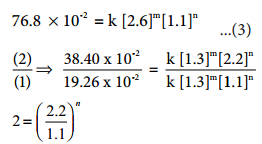
38.40 × 10-2 = k[1.3]m[2.2]n …………… (2)
For experiment 3
Rate3 = k[NO]m[O2]n
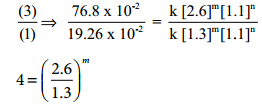
76.8 × 10-2 = k[2.6]m[1.1]n …………….. (3)

Rate Law and Rate Constant img 2

2=2n i.e., n = 1

Therefore the reaction is first order with respect to O2

Rate Law and Rate Constant img 3

4=2m i.e., m = 2

Therefore the reaction is second order with respect to NO

The rate law is Rate1 = k[NO]2[O2]1
The overall order of the reaction = (2 + 1) = 3

Differences Between Rate and Rate Constant of a Reaction:

Rate of a Reaction

Rate Constant of a Reaction

1. It represents the speed at which
the reactants are converted into
products at any instant.
1. It is a proportionality
constant.
2. It is measured as decrease in the
concentration of the reactants or
increase in the concentration of
products.
2. It is equal to therate of reaction,
when the concentration
of each of the reactants is unity
3. It depends on the initial
concentration of reactants.
3. It does not depend on
the initial concentration of
reactants.

Rate of a Chemical Reaction

Find free online Chemistry Topics covering a broad range of concepts from research institutes around the world.

Rate of a Chemical Reaction

A rate is a change in a particular variable per unit time. You have already learnt in physics that change in the displacement of a particle per unit time gives its velocity. Similarly in a chemical reaction, the change in the concentration of the species involved in a chemical reaction per unit time gives the rate of a reaction.

Let us consider a simple general reaction

A → B

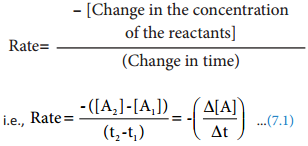
The concentration of the reactant ([A]) can be measured at different time intervals. Let the concentration of A at two different times t2 and t2, (t2 > t1) be [A1] and [A2] respectively. The rate of the reaction can be expressed as

Rate of a Chemical Reaction img 1

During the reaction, the concentration of the reactant decreases i.e. [A2] < [A1] and hence the change in concentration [A2] [A1] gives a negative value. By convention the reaction rate is a positive one and hence a negative sign is introduced in the rate expression (equation 7.1).

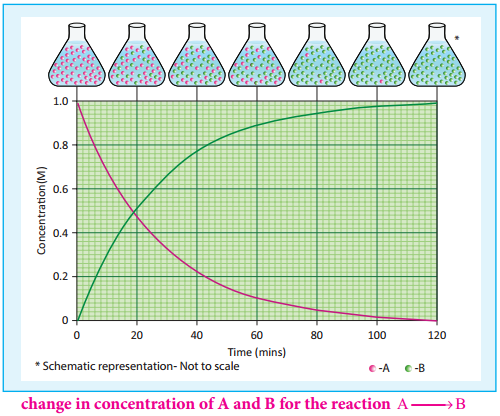
If the reaction is followed by measuring the product concentration, the rate is given by (\(\frac{∆[B]}{∆t}\)) since [B2] > [B1], no minus sign is required here.

Change in Concentration of A and B for the Reaction A → B

Rate of a Chemical Reaction img 2

Unit of Rate of a Reaction:

Rate of a Chemical Reaction img 3

Usually, concentration is expressed in number of moles per litre and time is expressed in seconds and therefore the unit of the rate of a reaction is mol L-1s-1. Depending upon the nature of the reaction, minute, hour, year etc can also be used. For a gas phase reaction, the concentration of the gaseous species is usually expressed in terms of their partial pressures and in such cases the unit of reaction rate is atm s-1.

Stoichiometry and Rate of a Reaction:

In a reaction A → B, the stoichiometry of both reactant and product are same, and hence the rate of disappearance of reactant (A) and the rate of appearance of product (B) are same. Now, let us consider a different reaction

A → 2B

In this case, for every mole of A, that disappears two moles of B appear, i.e., the rate of formation of B is twice as fast as the rate of disappearance of A. therefore, the rate of the reaction can be expressed as below.

Rate = \(\frac{+d[B]}{dt}\) = 2(-\(\frac{d[A]}{dt}\)) In other words,
Rate = \(\frac{-d[A]}{dt}\) = \(\frac{1}{2}\) \(\frac{d[B]}{dt}\)

For a general reaction, the rate of the reaction is equal to the rate of consumption of a reactant (or formation of a product) divided by its coeffcient in the balanced equation

xA + yB → lC + mD
Rate = \(\frac{-1}{x}\) \(\frac{d[A]}{dt}\) = \(\frac{-1}{y}\) \(\frac{d[B]}{dt}\)
= \(\frac{1}{l}\) \(\frac{d[C]}{dt}\)
= \(\frac{1}{m}\) \(\frac{d{D]}{dt}\)

Average and Instantaneous Rate:

Let us understand the average rate and instantaneous rate by considering the isomerisation of cyclopropane.

Rate of a Chemical Reaction img 4

The kinetics of the above reaction is followed by measuring the concentration of cyclopropane at regular intervals and the observations are shown below. (Table 7.1)

Concentration of Cyclopropane at various times during its Isomerisation at 780K

table 1

Rate of a Chemical Reaction img 5

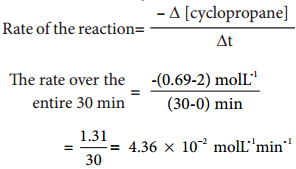
It means that during the first 30 minutes of the reaction, the concentration of the reactant (cyclo propane) decreases as an average of 4.36 × 10⁻² mol L-1 each minute.

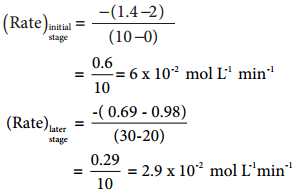
Let us calculate the average rate for an initial and later stage over a short period.

Rate of a Chemical Reaction img 6

From the above calculations, we come to know that the rate decreases with time as the reaction proceeds and the average rate cannot be used to predict the rate of the reaction at any instant. The rate of the reaction, at a particular instant during the reaction is called the instantaneous rate,

As ∆t → 0;
\(\frac{-∆[cyclopropane]}{∆t}\) = \(\frac{-∆[cyclopropane]}{dt}\)

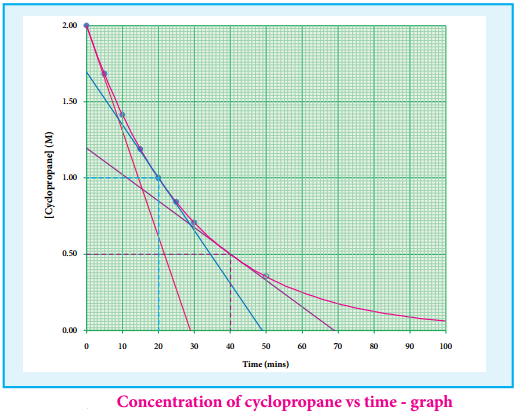
A plot of [cyclopropane] Vs (time) gives a curve as shown in the figure 7.2. Instantaneous rate at a particular instant ‘t’ \(\frac{-d[cyclopropane]}{dt}\) is obtained by calculating the slope of a tangent drawn to the curve at that instant.

In general, the instantaneous reaction rate at a moment of mixing the reactants (t = 0) is calculated from the slope of the tangent drawn to the curve. The rate calculated by this method is called initial rate of a reaction.

Rate of a Chemical Reaction img 7

Let us calculate the instantaneous rate of isomerisation cyclopropane at different concentrations: 2M, 1M and 0.5M from the graph shown in fig 7.2, the results obtained are tabulated below.

Rate of Isomerisation

table 2