Common ion Effect

Find free online Chemistry Topics covering a broad range of concepts from research institutes around the world.

Common ion Effect

When a salt of a weak acid is added to the acid itself, the dissociation of the weak acid is suppressed further. For example, the addition of sodium acetate to acetic acid solution leads to the suppression in the dissociation of acetic acid which is already weakly dissociated. In this case, CH3COOH and CH3COONa have the common ion, CH3COO.

Let us analyse why this happens. Acetic acid is a weak acid. It is not completely dissociated in aqueous solution and hence the following equilibrium exists. CH3COOH(aq) ⇄ H+(aq) + CH3COO(aq).

However, the added salt, sodium acetate, completely dissociates to produce Na+ and CH3COO ion.

CH3COONa(aq) → Na+(aq) + CH3COO(aq)

Hence, the overall concentration of CH3COO is increased, and the acid dissociation equilibrium is disturbed. We know from Le chatelier’s principle that when a stress is applied to a system at equilibrium, the system adjusts itself to nullify the effect produced by that stress.

So, in order to maintain the equilibrium, the excess CH3COO ions combines with H+ ions to produce much more unionized CH3COOH i.e, the equilibrium will shift towards the left. In other words, the dissociation of a weak acid (CH3COOH) is suppressed. Thus, the dissociation of a weak acid (CH3COOH) is suppressed in the presence of a salt (CH3COONa) containing an ion common to the weak electrolyte. It is called the common ion effect.

The common-ion effect refers to the decrease in solubility of an ionic precipitate by the addition to the solution of a soluble compound with an ion in common with the precipitate. This behaviour is a consequence of Le Chatelier’s principle for the equilibrium reaction of the ionic association/dissociation.

The common ion effect is the phenomenon in which the addition of an ion common to two solutes causes precipitation or reduces ionization. An example of the common ion effect is when sodium chloride (NaCl) is added to a solution of HCl and water.

The common ion effect suppresses the ionization of a weak acid by adding more of an ion that is a product of this equilibrium. The common ion effect suppresses the ionization of a weak base by adding more of an ion that is a product of this equilibrium. The reaction is put out of balance, or equilibrium.

Aquifers which contain chalk and limestone, a common ion effect is used in these to obtain drinking water. Calcium carbonate is sparingly soluble in water, and it can be precipitated out by adding sodium chloride in the solution. In this way, the common ion effect is used in treatment of water.

According to Le Chatelier’s principle, addition of more ions alters the equilibrium and shifts the reaction to favor the solid or deionized form. In the case of an an acidic buffer, the hydrogen ion concentration decreases, and the resulting solution is less acidic than a solution containing the pure weak acid.

Le Chatelier’s principle is an observation about chemical equilibria of reactions. It states that changes in the temperature, pressure, volume, or concentration of a system will result in predictable and opposing changes in the system in order to achieve a new equilibrium state.

At a given temperature, the product of water concentrations and ions is known as the ionic product of water. With the rise in temperature, the value increases i.e. the concentration of H+ and OH ions increases with temperature increases.

If you have a solution and solute in equilibrium, adding a common ion (an ion that is common with the dissolving solid) decreases the solubility of the solute. This is because Le Chatelier’s principle states the reaction will shift toward the left (toward the reactants) to relieve the stress of the excess product.

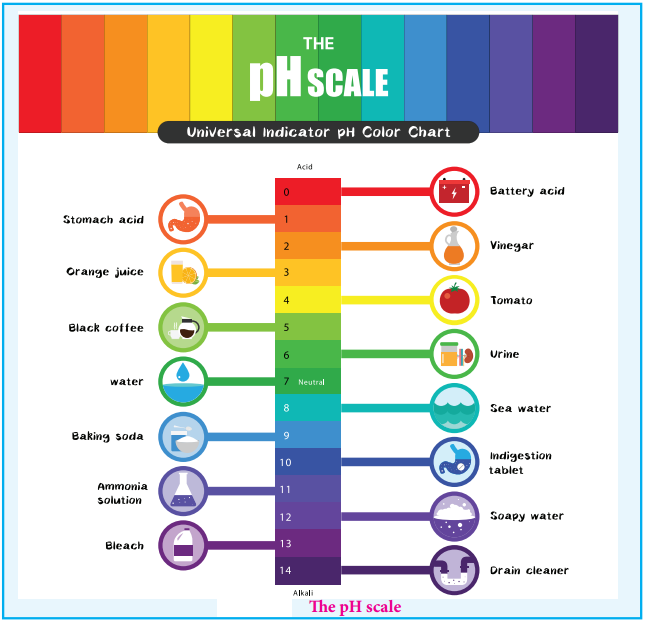
pH gives us the measure of acid/base strength of any solution. pH scale ranges from 0-14, 7 is neutral, below 7 it represents acidic nature i.e. the compound is acidic and above 7 it represents basic nature i.e. the compound is basic i.e. pH is the negative logarithm of hydrogen ion.

The solubility of slightly soluble substances can be decreased by the presence of a common ion. This effect is known as common ion effect. Addition of a common ion to a slightly soluble salt solution will add up to the concentration of the common ion.

Le Chatelier’s principle (also known as “Chatelier’s principle” or “The Equilibrium Law”) states that when a system experiences a disturbance (such as concentration, temperature, or pressure changes), it will respond to restore a new equilibrium state.

Explanation:

This phenomenon is called the common-ion effect. When a compound dissolves in water it dissociates into ions. Increasing the concentration of one of these ions will shift the equilibrium towards the compound, thereby making it hard for the compound to dissolve in water (decreases solubility of compound).

When there is an increase in pressure, the equilibrium will shift towards the side of the reaction with fewer moles of gas. When there is a decrease in pressure, the equilibrium will shift towards the side of the reaction with more moles of gas.

The classic example of the practical use of the Le Chatelier principle is the Haber-Bosch process for the synthesis of ammonia, in which a balance between low temperature and high pressure must be found.

Le Chatelier’s Principle helps to predict what effect a change in temperature, concentration or pressure will have on the position of the equilibrium in a chemical reaction. This is very important, particularly in industrial applications, where yields must be accurately predicted and maximised.
Ionisation of Weak Acids

Find free online Chemistry Topics covering a broad range of concepts from research institutes around the world.

Ionisation of Weak Acids

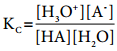
We have already learnt that weak acids are partially dissociated in water and there is an equilibrium between the undissociated acid and its dissociated ions. Consider the ionisation of a weak monobasic acid HA in water.

Applying law of chemical equilibrium, the equilibrium constant Kc is given by the expression

Ionisation of Weak Acids img 1 …………. (8.9)

The square brackets, as usual, represent the concentrations of the respective species in moles per litre. In dilute solutions, water is present in large excess and hence, its concentration may be taken as constant say K. Further H3O+ indicates that hydrogen ion is hydrated, for simplicity it may be replaced by H+. The above equation may then be written as,

Ionisation of Weak Acids img 2 ………….. (8.10)

The product of the two constants KC and K gives another constant. Let it be Ka

Ionisation of Weak Acids img 3 …………. (8.11)

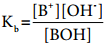
The constant Ka is called dissociation constant of the acid. Like other equilibrium constants, Ka also varies only with temperature. Similarly, for a weak base, the dissociation constant can be written as below.

Ionisation of Weak Acids img 4 ………….. (8.12)

Ostwald’s Dilution Law

Ostwald’s dilution law relates the dissociation constant of the weak acid (Ka) with its degree of dissociation (α) and the concentration (c). Degree of dissociation (α) is the fraction of the total number of moles of a substance that dissociates at equilibrium.

Ionisation of Weak Acids img 5

We shall derive an expression for ostwald’s law by considering a weak acid, i.e. acetic acid (CH3COOH). The dissociation of acetic acid can be represented as

CH3COOH ⇄ H+ + CH3COO

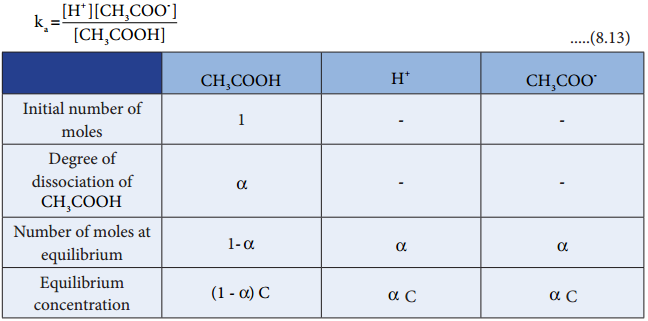
The dissociation constant of acetic acid is,

Ionisation of Weak Acids img 6

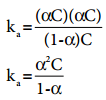
Substituting the equilibrium concentration in equation (8.13)

Ionisation of Weak Acids img 7 …………. (8.14)

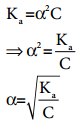
We know that weak acid dissociates only to a very small extent. Compared to one, α is so small and hence in the denominator (1 – α) ~ 1. The above expression (8.14) now becomes,

Ionisation of Weak Acids img 8 ………….. (8.15)

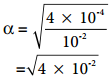
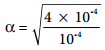
Let us consider an acid with Ka value 4 × 10⁻⁴ and calculate the degree of dissociation of that acid at two different concentration 1 × 10⁻²M and 1 × 10⁻⁴M using the above expression (8.15) For 1 × 10⁻²M,

Ionisation of Weak Acids img 9
= 2 × 10-1
= 0.2

For 1 × 10⁻⁴M
Ionisation of Weak Acids img 10
= 2

When the dilution increases by 100 times, (Concentration decreases from 1 × 10⁻²M to 1 × 10⁻²M), the dissociation increases by 10 times. Thus, we can conclude that, when dilution increases, the degree of dissociation of weak electrolyte also increases. This statement is known as Ostwald’s dilution Law.

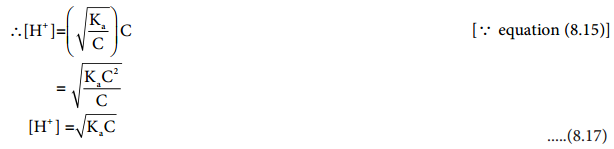
The concentration of H+ (H3O+) can be caluculated using the Ka value as below.

[H+] = αC (Refer table) ………….. (8.16)

Equilibrium molar concentration of [H+] is equal to αC

Ionisation of Weak Acids img 11

Similarly, for a weak base

Kb = α2 and α = \(\sqrt{\frac{K_{b}}{C}}\)
[OH] = αC
(or)
[OH] = \(\sqrt{\mathrm{K}_{\mathrm{b}} \mathrm{C}}\) ………….. (8.18)

The pH Scale

Find free online Chemistry Topics covering a broad range of concepts from research institutes around the world.

The pH Scale

We usually deal with acid / base solution in the concentration range 10-1 to 10-2M. To express the strength of such low concentrations, Sorensen introduced a logarithmic scale known as the pH scale. The term pH is derived from the French word ‘Purissance de hydrogene’ meaning, the power of hydrogen. pH of a solution is defined as the negative logarithm of base 10 of the molar concentration of the hydronium ions present in the solution.

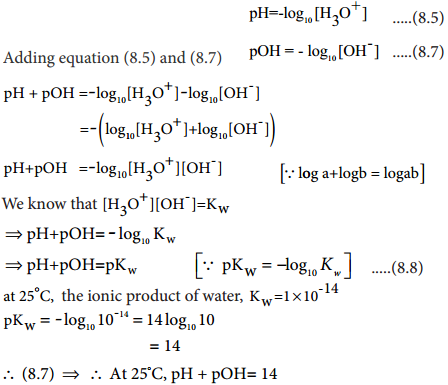
pH = – log10[H3O+] …………. (8.5)

The concentration of H3O+ in a solution of known pH can be calculated using the following expression.

[H3O+] = 10-pH (or) [H3O+] = antilog of (-pH) …………. (8.6)

Similarly, pOH can also be defined as follows

pOH = -log10[OH] …………….. (8.7)

As discussed earlier, in neutral solutions, the concentration of [H3O+] as well as [OH+] is equal to 1 × 10⁻⁷M at 25°C . The pH of a neutral solution can be calculated by substituting this H3O+ concentration in the expression (8.5)

pH = – log10[H3O+]
= – log1010-7
= (-7)(-1)log1010 = +7(1) = 7 [∵log1010 = 1]

Similary, we can calculate the pOH of a neutral solution using the expression (8.7), it is also equal to 7. The negative sign in the expression (8.5) indicates that when the concentration of [H3O+] increases the pH value decreases.

For example, if the [H3O+] increases from to 10-7 to 10-5M the pH value of the solution decreases from 7 to 5. We know that in acidic solution, [H3O+]>[OH], i.e; [H3O+]>10-7. So, we can conclude that acidic solution should have pH value less than 7 and basic solution should have pH value greater than 7.

Relation Between pH and pOH

A relation between pH and pOH can be established using their following definitions

The pH Scale img 1

The pH Scale img 2

Ionisation of Water

Find free online Chemistry Topics covering a broad range of concepts from research institutes around the world.

Ionisation of Water

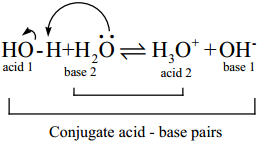
We have learnt that when an acidic or a basic substance is dissolved in water, depending upon its nature, it can either donate (or) accept a proton. In addition to that the pure water itself has a little tendency to dissociate. i.e, one water molecule donates a proton to an another water molecule. This is known as auto ionisation of water and it is represented as below.

Ionisation of Water img 1

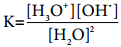
In the above ionisation, one water molecule acts as an acid while the another water molecule acts as a base. The dissociation constant for the above ionisation is given by the following expression

Ionisation of Water img 2 …………… (8.3)

The concentration of pure liquid water is one. i.e, [H2O]2 = 1
∵ Kw = [H3O+][OH] …………. (8.4)

Here, Kw represents the ionic product (ionic product constant) of water.

It was experimentally found that the concentration of H3O+ in pure water is 1 × 10⁻⁷ at 25°C. Since the dissociation of water produces equal number of H3O+ and OH, the concentration of OHis also equal to 1 × 10⁻⁷ at 25°C.

Therefore, the ionic product of water at 25°C is

KW = [H3O]+[OH] …………. (8.4)
KW = (1 × 10⁻⁷)(1 × 10⁻⁷)
= 1 × 10-14.

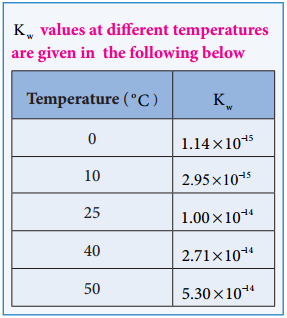
Like all equilibrium constants, Kw is also a constant at a particular temperature. The dissociation of water is an endothermic reaction. With the increase in temperature, the concentration of H3O+ and OH also increases, and hence the ionic product also increases.

In neutral aqueous solution like NaCl solution, the concentration of H3O+ is always equal to the concentration of OH whereas in case of an aqueous solution of a substance which may behave as an acid (or) a base, the concentration of H3O+ will not equal to
[OH].

Ionisation of Water img 3

We can understand this by considering the aqueous HCl as an example. In addition to the auto ionisation of water, the following equilibrium due to the dissociation of HCl can also exist.

HCl + H2O ⇄ H3O+ + Cl

In this case, in addition to the auto ionisation of water, HCl molecules also produces H3O+ ion by donating
a proton to water and hence [H3O+]>[OH]. It means that the aqueous HCl solution is acidic. Similarly, in basic solution such as aqueous NH3, NaOH etc…. [OH]>[H3O+].

Strength of Acids and Bases

Find free online Chemistry Topics covering a broad range of concepts from research institutes around the world.

Strength of Acids and Bases

The strength of acids and bases can be determined by the concentration of H3O+ (or) OH produced per mole of the substance dissolved in H2O. Generally we classify the acids/bases either as strong or weak. A strong acid is the one that is almost completely dissociated in water while a weak acid is only partially dissociated in water.

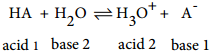
Let us quantitatively define the strength of an acid (HA) by considering the following general equilibrium.

Strength of Acids and Bases img 1

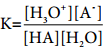
The equilibrium constant for the above ionisation is given by the following expression

Strength of Acids and Bases img 2………… (8.1)

We can omit the concentration of H2O in the above expression since it is present in large excess and essentially unchanged.

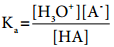
Strength of Acids and Bases img 3 ……………. (8.2)

Here, Ka is called the ionisation constant or dissociation constant of the acid. It measures the strength of an acid. Acids such as HCl, HNO3 etc… are almost completely ionised and hence they have high Ka value (Ka for HCl at 25°C is 2 × 10⁶).

Acids such as formic acid (Ka = 1.8 × 10⁻⁴ at 25°C), acetic acid (1.8 × 10⁻⁵ at 25°C) etc.. are partially ionised in solution and in such cases, there is an equilibrium between the unionised acid molecules and their dissociated ions. Generally, acids with Ka value greater than ten are considered as strong acids and less than one considered as weak acids.

Let us consider the dissociation of HCl in aqueous solution,

Strength of Acids and Bases img 4

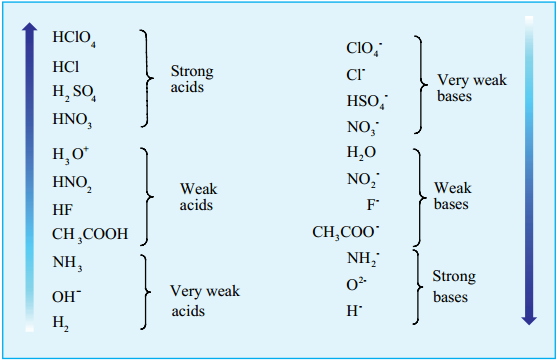
As discussed earlier, due to the complete dissociation, the equilibrium lies almost 100% to the right. i.e., the Cl ion has only a negligible tendency to accept a proton form H3O+. It means that the conjugate base of a strong acid is a weak base and vice versa. The following table illustrates the relative strength of conjugate acid – base pairs.

Strength of Acids and Bases img 5