The Squirrel Extra Questions and Answers Class 7 English Honeycomb

Here we are providing The Squirrel Extra Questions and Answers Class 7 English Honeycomb, Extra Questions for Class 7 English was designed by subject expert teachers.

We have created the most comprehensive The Squirrel Poem Class 7 Questions and Answers. These Questions and Answers are help to score more marks in your Board Exams.

The Squirrel Extra Questions and Answers Class 7 English Honeycomb

The Squirrel Extra Questions and Answers Short Answer Type

Question 1.
What does a grey overcoat refer to?
Answer:
The squirrel’s body is being refered to a grey overcoat.

Question 2.
How does squirrel eat a nut?
Answer:
The squirrel sits up straight to eat a nut.

Question 3.
How do squirrels usually sit?
Answer:
The squirrel usually sits and runs with a bended back.

Question 4.
What did the squirrel do if someone came too close to his tree?
Answer:
The squirrel would run away instantly if someone try to come too close to his tree.

Question 5.
The poet talks about a small creature with sensitivity. Do you agree or not.
Answer:
The poem is a reflection of the poet’s observation we come across in our day to day surrounding. A squirrel is the most commonly found animal that we see around us. Yet, very few of us would have thought of it as a subject matter.

Question 6.
Why does the poet say the squirrel ‘wore a question mark for tail’? Draw a squirrel or find a picture of a squirrel sitting on the ground. How would you describe its tail?
Answer:
The Poet said that the squirrel “wore a question mark for a tail” because its tail is twisted appearing like a question mark.

Question 7.
Do we usually say that an animal ‘wears’ a tail? What do we say? (Think: Does an animal wear a coat? Consult a dictionary if you like, and find out how ‘wear’ is used in different ways.)
Answer:
No, we do not usually say that an animal ‘wears’ a tail. We usually say that animal ‘has’ a tail.

Question 8.
“He liked to tease and play”. Who is teasing whom? How?
Answer:
The squirrel is teasing the poet and his friends. When poet and his friends ran around the tree on which the squirrel is sitting, it went the other way teasing and playing with them.

The Squirrel Extra Questions and Answers Reference to Context

Question 1.
He wore a question mark for tail,
An overcoat of gray,
He sat up straight to eat a nut.

Explanation
The tail of the squirrel is twisted like a question mark. Its colour is grey and while eating a nut it sit straight on its legs and hold the nut in its forearms.

(i) Does a squirrel wear a overcoat?
(ii) What is the shape of squirrel’s tail?
(iii) How does it eat a nut?
(iv) What is its skin colour?
(v) Choose the past tense of wear from the above lines.
Answer:
(i) No, it does not.
(ii) Its shapes is twisted into a question mark.
(iii) It eats a nut by sitting on its hind legs
(iv) Its skin colour is grey.
(v) Wore.

Question 2.
He liked to tease and play,

And if we ran around his tree,
He went the other way.

Explanation
The poet loves the game of hide and seek between him and the squirrel. If he went too close to the squirrel, the squirrel would go and hide in the other direction.

(i) What does he like to do?
(ii) Why does he went the other way?
(iii) Why is the squirrel scared?
(iv) Name the poem.
(v) Name the poet.
Answer:
(i) He likes to tease and play.
(ii) He went the, other way when he see human being around the tree.
(iii) The squirrel is scared because of the poet.
(iv) The poem name is ‘The squirrel’.
(v) The poets name is ‘Mildred Bowers Armstrong’.

Conductivity of Electronic Solution

Find free online Chemistry Topics covering a broad range of concepts from research institutes around the world.

Conductivity of Electronic Solution

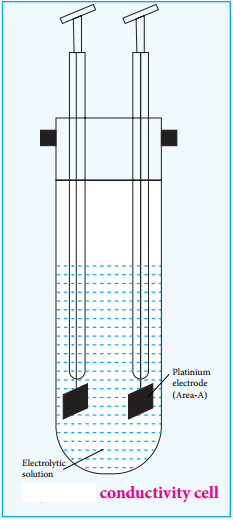
We have already learnt that when an electrolyte such as sodium chloride, potassium chloride etc is dissolved in a solvent like water, the electrolyte is completely dissociated to give its constituent ions (namely cations and anions). When an electric field is applied to such an electrolytic solution, the ions present in the solution carry charge from one electrode to another electrode and thereby they conduct electricity. The conductivity of the electrolytic solution is measured using a conductivity cell. (Fig 9.1)
Conductivity of Electronic Solution img 1

A conductivity cell consists of two electrodes immersed in an electrolytic solution. It obeys Ohm’s law like metallic conductor. i.e., at a constant temperature, the current flowing through the cell (I) is directly proportional to the voltage across the cell (V). i.e., I α V (or) I = \(\frac{V}{R}\)
⇒ V = IR …………….. (9.1)

Where ‘R’ is the resistance of the solution in ohm (Ω). Here the resistance is the opposition that a cell offers to the flow of electric current through it.

Resistivity (ρ)

Let us consider a conductivity cell in which the electrolytic solution is confied between the two electrodes having cross sectional area (A) and are separated by a distance ‘l’. Like the metallic conductor, the resistance of such an electrolytic solution is also directly proportional to the length (l) and inversely proportional to the cross sectional area (A).

R α \(\frac{l}{A}\)
R = ρ\(\frac{l}{A}\) (9.2)

Where ρ (rho) is called the specific resistance or resistivity, which depends on the nature of the electrolyte.

If \(\frac{l}{A}\) = 1 m-1, then, ρ = R. Hence the resistivity is defined as the resistance of an electrolyte confined between two electrodes having unit cross sectional area and are separated by a unit distance. The ratio (\(\frac{l}{A}\)) is called the cell constant, Unit of resitivity is ohm metre (Ωm).

Conductivity

It is more convenient to use conductance rather than resistance. The reciprocal of the resistance (\(\frac{1}{R}\)) gives the conductance of an electrolytic solution. The SI unit of conductance is Siemen (S).

C = \(\frac{1}{R}\) ………….. (9.3)

Substitute (R) from (9.2) in (9.3)
Conductivity of Electronic Solution img 2

⇒ i.e., C = \(\frac{1}{ρ}\).\(\frac{A}{l}\) ………….. (9.4)

The reciprocal of the specific resistance (\(\frac{1}{ρ}\)) is called the specific conductance (or) conductivity. It is represented by the symbol κappa(κ).

Substitute \(\frac{1}{ρ}\) = κ in equation (9.4) and rearranging

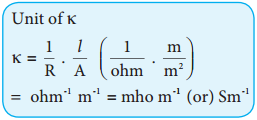
⇒ κ = C.(\(\frac{l}{A}\)) ……………. (9.5)
Conductivity of Electronic Solution img 3

If A = 1m2 and l = 1m; then κ = C.

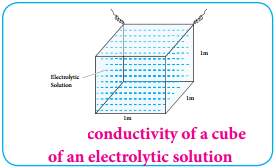
The specific conductance is defined as the conductance of a cube of an electrolytic solution of unit dimensions (Fig 9.2). The SI unit of specific conductance is Sm-1.

Example

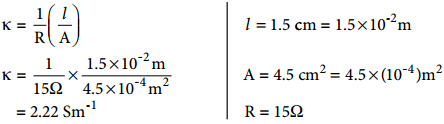
A conductivity cell has two platinum electrodes separated by a distance 1.5 cm and the cross sectional area of each electrode is 4.5 sq cm. Using this cell, the resistance of 0.5 N electrolytic solution was measured as 15 Ω. Find the specific conductance of the solution.

Solution
Conductivity of Electronic Solution img 4

Molar Conductivity (Λb)

Solutions of different concentrations have different number of electrolytic ions in a given volume of solution and hence they have different specific conductance. Therefore a new quantity called molar conductance (Λm) was introduced.

Let us imagine a conductivity cell in which the electrodes are separated by 1m and having V m3 of electrolytic solution which contains 1 mole of electrolyte. The conductance of such a system is called the molar conductance (Λm)

We have just learnt that the conductance of 1 m3 electrolytic solution is called the specific conductance (κ). Therefore, the conductance of the above mentioned V m3 solution (Λm) is given by the following expression.

m) = κ × V ……….. (9.6)

Conductivity of Electronic Solution img 5

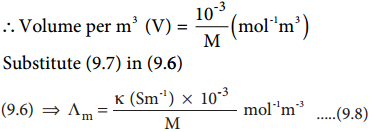
Therefore, Volume of the solution containing one mole of solute = \(\frac{1}{M}\)(mol-1L)
Conductivity of Electronic Solution img 6

The above relation defines the molar conductance in terms of the specific conductance and the concentration of the electrolyte.

Example

Calculate the molar conductance of 0.025 M aqueous solution of calcium chloride at 25°C. The specific conductance of calcium chloride is 12.04 × 10⁻²Sm-1.
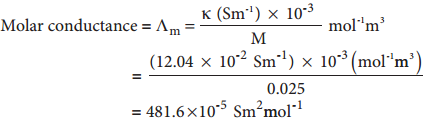
Conductivity of Electronic Solution img 7

Equivalent Conductance (Λ)

Equivalent conductance is defined as the conductance of ‘V’ m3 of electrolytic solution containing one gram equivalent of electrolyte in a conductivity cell in which the electrodes are one metre apart. The relation between the equivalent conductance and the specific conductance is given below.

Conductivity of Electronic Solution img 8 ………….. (9.9)

Where κ the specific conductance and N is the concentration of the electrolytic solution expressed in normality.

Factors Affecting Electrolytic Conductance

If the interionic attraction between the oppositely charged ions of solutes increases, the conductance will decrease.

Solvent of higher dielectric constant show high conductance in solution. Conductance is inversely proportional to the Viscosity of the medium. i.e., conductivity increases with the decrease in viscosity.

If the temperature of the electrolytic solution increases, conductance also increases. Increase in temperature increases the kinetic energy of the ions and decreases the attractive force between the oppositely charged ions and hence conductivity increases.

Molar conductance of a solution increases with increase in dilution. This is because, for a strong electrolyte, interionic forces of attraction decrease with dilution. For a weak electrolyte, degree of dissociation increases with dilution.

Measurement of Conductivity of Ionic Solutions

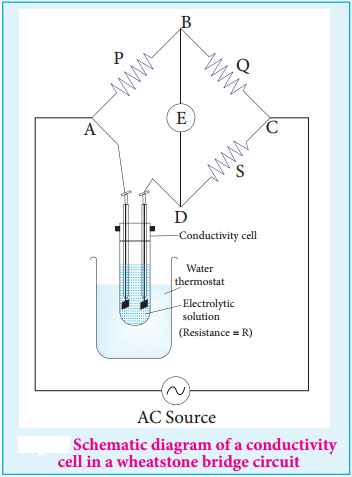
We have already learnt to measure the specific resistance of a metallic wire using a metre bridge in your physics practical experiment. We know that it works on the principle of wheatstone bridge. Similarly, the conductivity of an electrolytic solution is determined by using a wheatstone bridge arrangement in which one resistance is replaced by a conductivity cell filled with the electrolytic solution of unknown conductivity.
Conductivity of Electronic Solution img 9

In the measurement of specific resistance of a metallic wire, a DC power supply is used. Here, if we apply DC current through the conductivity cell, it will lead to the electrolysis of the solution taken in the cell. So, AC current is used for this measurement to prevent electrolysis.

A wheatstone bridge is constituted using known resistances P, Q, a variable resistance S and conductivity cell (Let the resistance of the electrolytic solution taken in it be R) as shown in the figure 9.3. An AC source (550 Hz to 5 KHz) is connected between the junctions A and C.

Connect a suitable detector E (Such as the telephone ear piece detector) between the junctions ‘B’ and ‘D’. The variable resistance ‘S’ is adjusted until the bridge is balanced and in this conditions there is no current flow through the detector.

Under Balanced Condition,

\(\frac{P}{Q}\) = \(\frac{R}{S}\)
∴R = \(\frac{P}{Q}\) × S ………….. (9.10)

The resistance of the electrolytic solution (R) is calculated from the known resistance values P, Q and the measured ‘S’ value under balanced condition using the above expression (9.10).

Conductivity Calculation

Specific conductance (or) conductivity of an electrolyte can be calculated from the resistance value using the following expression.

κ = \(\frac{1}{R}\)(\(\frac{l}{A}\)) [∵equation 9.5]

The value of the cell constant \(\frac{l}{A}\) is usually provided by the cell manufacturer. Alternatively the cell constant may be determined using KCl solution whose concentration and specific conductance are known.

Example

The resistance of a conductivity cell is measured as 190 Ω using 0.1M KCl solution (specific conductance of 0.1M KCl is 1.3 Sm-1). When the same cell is filled with 0.003M sodium chloride solution, the measured resistance is 6.3KΩ. Both these measurements are made at a particular temperature. Calculate the specific and molar conductance of NaCl solution.

Given that
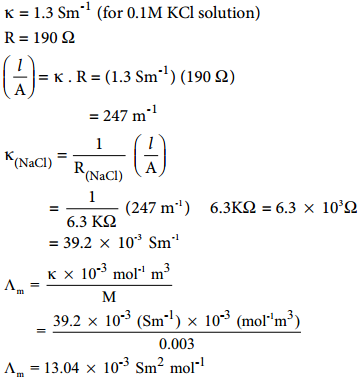
Conductivity of Electronic Solution img 10

Solubility Product

Find free online Chemistry Topics covering a broad range of concepts from research institutes around the world.

Solubility Product

We have come across many precipitation reactions in inorganic qualitative analysis. For example, dil HCl is used to precipitate Pb2+ ions as PbCl2 which is sparingly soluble in water.

Kidney stones are developed over a period of time due to the precipitation of Ca2+ (as calcium oxalate etc.). To understand the precipitation, let us consider the solubility equilibria that exist between the undissociated sparingly soluble salt and its constituent ions in solution.

For a general salt XmYm

Solubility Product img 1

The equilibrium constant for the above is

Solubility Product img 2

In solubility equilibria, the equilibrium constant is referred as solubility product constant (or) Solubility product. In such heterogeneous equilibria, the concentration of the solid is a constant and is omitted in the above expression

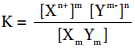
Ksp = [Xn+]m[Ym]n

The solubility product of a compound is defined as the product of the molar concentration of the constituent ions, each raised to the power of its stoichiometric co – efficient in a balanced equilibrium equation.

Solubility product finds useful to decide whether an ionic compound gets precipitated when solution that contains the constituent ions are mixed.

When the product of molar concentration of the constituent ions i.e., ionic product, exceeds the solubility product then the compound gets precipitated.

The expression for the solubility product and the ionic product appears to be the same but in the solubility product expression, the molar concentration represents the equilibrium concentration and in ionic product, the initial concentration (or) concentration at a given time ‘t’ is used.

In general we can summarise as,

Ionic product > Ksp, precipitation will occur and the solution is super saturated. Ionic product < Ksp, no precipitation and the solution is unsaturated.

Ionic product = Ksp, equilibrium exist and the solution is saturated.

Determination of Solubility Product from Molar Solubility

Solubility product can be calculated from the molar solubility i.e., the maximum number of moles of solute that can be dissolved in one litre of the solution. For a solute XmYn,

XmYn(s) ⇄ mXn+(aq) + nYm-(aq)

From the above stoichiometrically balanced equation we have come to know that 1 mole of XmYn(s) dissociated to furnish ‘m’ moles of Xn+ and ‘n’ moles of Ym- is ‘s’ is molar solubility of XmYn, then

[Xn+]=ms and [Ym+]=ns
∴ Ksp = [Xn+]m[Ym+]n

Ksp=(ms)m(ns)n
Ksp=(m)m(n)n(s)m+n

Salt Hydrolysis

Find free online Chemistry Topics covering a broad range of concepts from research institutes around the world.

Salt Hydrolysis

When an acid reacts with a base, a salt and water are formed and the reaction is called neutralization. Salts completely dissociate in aqueous solutions to give their constituent ions. The ions so produced are hydrated in water. In certain cases, the cation, anion or both react with water and the reaction is called salt hydrolysis. Hence, salt hydrolysis is the reverse of neutralization reaction.

Salts of Strong Acid and a Strong Base

Let us consider the reaction between NaOH and nitric acid to give sodium nitrate and water.
NaOH(aq) + HNO3(aq) → NaNO3(aq) + H2O(l)

The salt NaNO3 completely dissociates in water to produce Na+ and NO3 ions.
NaNO3(aq) → Na+(aq) + NO3(aq)

Water dissociates to a small extent as
H2O(l) ⇄ H+(aq) + OH(aq)

Since [H+] = [OH], water is neutral
NO3 ion is the conjugate base of the strong acid HNO3 and hence it has no tendency to react

with H+. Similarly, Na+ is the conjugate acid of the strong base NaOH and it has no tendency to react with OH.

It means that there is no hydrolysis. In such cases [H+] = [OH] pH is maintained and, therefore, the solution is neutral.

Hydrolysis of Salt of Strong Base and Weak Acid (Anionic Hydrolysis)

Let us consider the reactions between sodium hydroxide and acetic acid to give sodium acetate and water.
NaOH (aq) + CH3COOH(aq) ⇄ CH3COONa(aq) + H2O(l)

In aqueous solution, CH3COONa is completely dissociated as below

CH3COONa (aq) → CH3COO(aq) + Na+(aq)

CH3COO is a conjugate base of the weak acid CH3COOH and it has a tendency to react with H+
from water to produce unionised acid.

There is no such tendency for Na+ to react with OH.

CH3COO(aq) + H2O(l) ⇄ CH3COOH(aq) + OH(aq) and therefore [OH]>[H+], in such cases, the solution is basic due to hydrolysis and the pH is greater than 7. Let us find a relation between the equilibrium constant for the hydrolysis reaction (hydrolysis constant) and the dissociation constant of the acid.

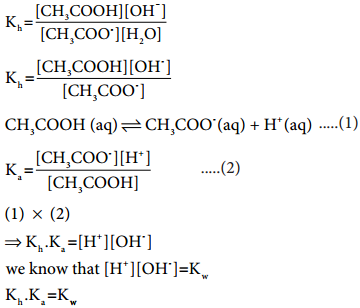
Salt Hydrolysis img 1

Kh value in terms of degree of hydrolysis (h) and the concentration of salt (C) for the equilibrium can be obtained as in the case of ostwald’s dilution law. Kh = h2C and i.e [OH] = \(\sqrt{\mathrm{K}_{\mathrm{h}} \cdot \mathrm{C}}\) and i.e [OH] = \(\sqrt{\mathrm{K}_{\mathrm{h}} \cdot \mathrm{C}}\).

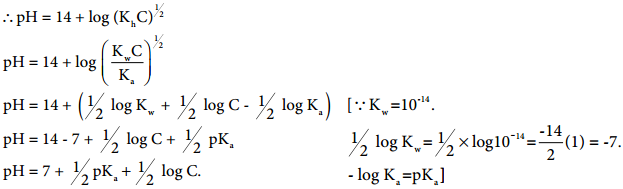
pH of salt solution in terms of Ka and the concentration of the electrolyte

pH + pOH = 14
pH = 14 – p OH = 14 – {- log [OH]}
= 14 + log[OH]

Salt Hydrolysis img 2

Hydrolysis of Salt of Strong Acid and Weak Base (Cationic Hydrolysis)

Let us consider the reactions between a strong acid, HCl, and a weak base, NH4OH, to produce a salt, NH4Cl, and water.

HCl (aq) + NH4OH(aq) ⇄ NH4Cl(aq) + H2O(l)
NH4Cl(aq) → NH4+ + Cl(aq)

NH4+ is a strong conjugate acid of the weak base NH4OH and it has a tendency to react with with OH from water to produce unionised NH4OH shown below.

NH4+(aq) + H2O(l) ⇄ NH4OH(aq) + H+(aq)

There is no such tendency shown by Cl and therefore [H+]>[OH]; the solution is acidic and the pH
is less than 7.

As discussed in the salt hydrolysis of strong base and weak acid. In this case also, we can establish a relationship between the Kh and kb as Kh.Kb = Kw

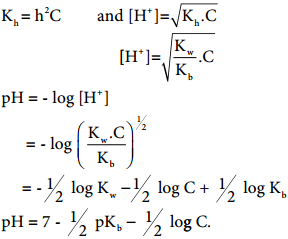
Let us calculate the Kh value in terms of degree of hydrolysis (h) and the concentration of salt

Salt Hydrolysis img 3

Hydrolysis of Salt of Weak Acid and Weak Base (Anionic & Cationic Hydrolysis)

Let us consider the hydrolysis of ammonium acetate.
CH3COONH4(aq) → CH3COO(aq) + NH4+(aq)

In this case, both the cation (NH4+) and anion (CH3COO) have the tendency to
react with water

CH3COO + H2O ⇄ CH3COOH + OH
NH4+ + H2O ⇄ NH4OH + H+

The nature of the solution depends on the strength of acid (or) base i.e, if Ka > Kb; then the solution is acidic and pH < 7, if Ka < Kb; then the solution is acidic and pH < 7, if Ka < Kb; then the solution is basic and pH > 7, if Ka = Kb; then the solution is basic and pH > 7, if Ka = Kb; then the solution is neutral.

The relation between the dissociation constant (Ka, Kb) and the hydrolysis constant is given by the following
expression.

Ka.Kb.Kh = Kw

pH of the Solution

pH of the solution can be calculated using the following expression,
pH = 7 + 1/2 pKa – 1/2 pKb.

Buffer Solution

Find free online Chemistry Topics covering a broad range of concepts from research institutes around the world.

Buffer Solution

Do you know that our blood maintains a constant pH, irrespective of a number of cellular acid – base reactions. Is it possible to maintain a constant hydronium ion concentration in such reactions? Yes, it is possible due to buffer action.

Buffer is a solution which consists of a mixture of a weak acid and its conjugate base (or) a weak base and its conjugate acid. This buffer solution resists drastic changes in its pH upon addition of a small quantities of acids (or) bases, and this ability is called buffer action. The buffer containing carbonic acid (H2CO3) and its conjugate base HCO3 is present in our blood. There are two types of buffer solutions.

1. Acidic Buffer Solution:

A solution containing a weak acid and its salt.
Example: Solution containing acetic acid and sodium acetate

2. Basic Buffer Solution:

A solution containing a weak base and its salt.
Example: Solution containing NH4OH and NH4Cl

Buffer Action

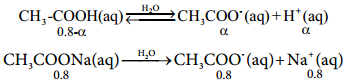
To resist changes in its pH on the addition of an acid (or) a base, the buffer solution should contain both acidic as well as basic components so as to neutralize the effect of added acid (or) base and at the same time, these components should not consume each other. Let us explain the buffer action in a solution containing CH3COOH and CH3COONa. The dissociation of the buffer components occurs as below.

Buffer Solution img 1

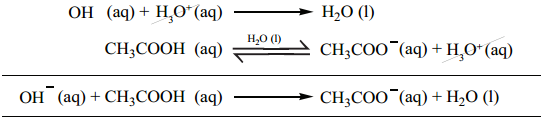
If an acid is added to this mixture, it will be consumed by the conjugate base CH3COO to form the undissociated weak acid i.e, the increase in the concentration of H+ does not reduce the pH significantly.

CH3COO(aq) + H+(aq) → CH3COOH(aq)

If a base is added, it will be neutralized by H3O+, and the acetic acid is dissociated to maintain the equlibrium. Hence the pH is not significantly altered.

Buffer Solution img 2

These neutralization reactions are identical to those reactions that we have already discussed in common ion effect.

Les us analyse the effect of the addition of 0.01 mol of solid sodium hydroxide to one litre of a buffer solution containing 0.8 M CH3COOH and 0.8 M CH3COONa. Assume that the volume change due to the addition of NaOH is negligible. (Given: K4 for CH3COOH is 1.8 × 10⁻⁵).

Buffer Solution img 3

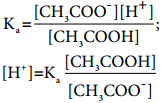
The dissociation constant for CH3COOH is given by

Buffer Solution img 4

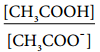
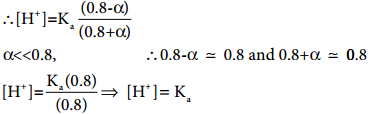
The above expression shows that the concentration of H+ is directly proportional to

Buffer Solution img 5

Let the degree of dissociation of CH3COOH be α then,
[CH3OOH] = 0.8 – α and [CH3COO]
= α + 0.8

Buffer Solution img 6

Given that

Kafor CH3COOH is 1.8 × 10⁻⁵
∴ [H+] = 1.8 × 10⁻⁵; pH = – log (1.8 × 10⁻⁵)
= 5 – log 1.8
= 5 – 0.26
pH = 4.74

Calculation of pH after adding 0.01 mol NaOH to 1 litre of buffer.

Given that the volume change due to the addition of NaOH is negligible
∴[OH] = 1.8 × 10⁻⁵; pH = – log (1.8 × 10⁻⁵)
= 5 – log 1.8
= 5 – 0.26
pH = 4.74

Caluculation of pH after adding 0.01 mol NaOH to 1 litre of buffer.

Given that the volume change due to the addition of NaOH is negligible
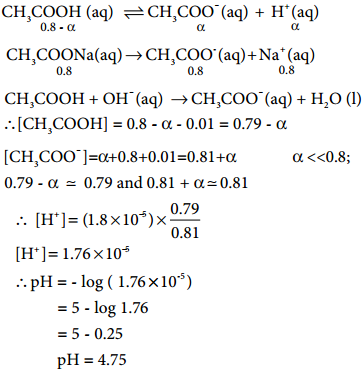
∴ [OH] = 0.01 M.

The consumption of OH are expressed by the following equations.

Buffer Solution img 7

The addition of a strong base (0.01 M NaOH) increased the pH only slightly ie., from 4.74 to 4.75 . So, the buffer action is verified.

Buffer Capacity and Buffer Index

The buffering ability of a solution can be measured in terms of buffer capacity. Vanslyke introduced a quantity called buffer index, β , as a quantitative measure of the buffer capacity. It is defined as the number of gram equivalents of acid or base added to 1 litre of the buffer solution to change its pH by unity.

Here, β = \(\frac{dB}{d(pH)}\) …………. (8.19)
dB = number of gram equivalents of acid / base added to one litre of buffer solution.
d(pH) = The change in the pH after the addition of acid / base.

Henderson – Hassel Balch Equation

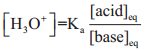
We have already learnt that the concentration of hydronium ion in an acidic buffer solution depends on the ratio of the concentration of the weak acid to the concentration of its conjugate base present in the solution i.e.,

Buffer Solution img 8………….. (8.20)

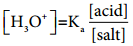
The weak acid is dissociated only to a small extent. Moreover, due to common ion effect, the dissociation is further suppressed and hence the equilibrium concentration of the acid is nearly equal to the initial concentration of the unionised acid. Similarly, the concentration of the conjugate base is nearly equal to the initial concentration of the added salt.

Buffer Solution img 9 …………… (8.21)

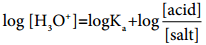
Here [acid] and [salt] represent the initial concentration of the acid and salt, respectively used to prepare the buffer solution. Taking logarithm on both sides of the equation

Buffer Solution img 12 ……………. (8.22)

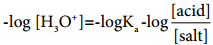
Reverse the sign on both sides

Buffer Solution img 13 …………….. (8.23)

We know that

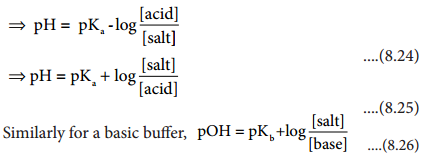
pH = – log [H3O+] and pKa = – logKa

Buffer Solution img 11