Enzyme Catalysis

Find free online Chemistry Topics covering a broad range of concepts from research institutes around the world.

Enzyme Catalysis

Enzymes are complex protein molecules with three dimensional structures. They catalyse the chemical reaction in living organism. They are often present in colloidal state and extremely specific in catalytic action. Each enzyme produced in a particular living cell can catalyse a particular reaction in the cell.

Some common examples for enzyme catalysis

1. The peptide glycyl L-glutamyl L-tyrosin is hydrolysed by an enzyme called pepsin.

2. The enzyme diastase hydrolyses starch into maltose
2(C6H10O5)n + nH2O → nC12H22O11

3. The yeast contains the enzyme zymase which converts glucose into ethanol.
C6H12O6 → 2C2H5OH + 2CO2

4. The enzyme micoderma aceti oxidises alcohol into acetic acid.
C2H5OH + O2 → CH3COOH + H2O

5. The enzyme urease present in soya beans hydrolyses the urea.
NH2 – CO – NH2 + H2O → 2NH3 + CO2

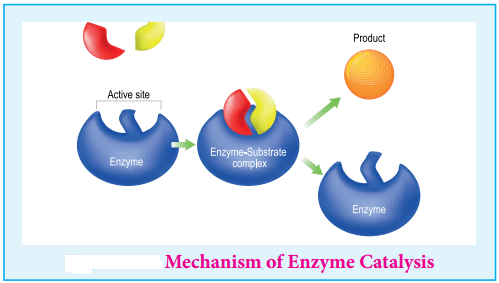
Mechanism of Enzyme Catalysed Reaction

The following mechanism is proposed for the enzyme catalysis
E + S ⇄ ES → P + E

Where E is the enzyme, S the substrate (reactant), Es represents activated complex and P the products.

Enzyme Catalysis img 1

Enzyme Catalysed Reaction show Certain General Special Characteristics.

(i) Effective and efficient conversion is the special characteristic of enzyme catalysed reactions. An enzyme may transform a million molecules of reactant into product in a minute.
For eg. 2H2O2 → 2H2O + O2

For this reaction, the activation energy is 18k cal/mole without a catalyst. With colloidal platinum as a catalyst the activation energy is 11.7 kcal/mole.

But with the enzyme catalyst the activation energy of this reaction is less than 2kcal/mole.

(ii) Enzyme catalysis is highly specific in nature.

H2N-CO-NH2 + H2O → 2NH3 + CO2

The enzyme urease which catalyses the reaction of urea does not catalyse the following reaction of methyl urea

H2N-CO-NH-CH3 + H2O → No reaction

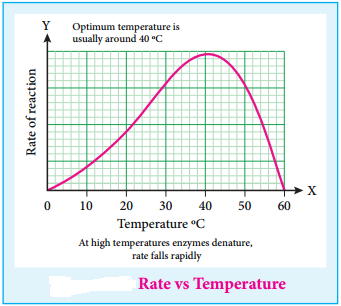
(iii) Enzyme catalysed reaction has maximum rate at optimum temperature. At first rate of reaction increases with the increase of temperature, but above a particular temperature the activity of enzyme is destroyed. The rate may even drop to zero. The temperature at which enzymic activity is high or maximum is called as optimum temperature.

Enzyme Catalysis img 2

For Example:

  • Enzymes involved in human body have an optimum temperature 37°C/98°F
  • During high fever, as body temperature rises the enzymatic activity may collapse and lead to danger.

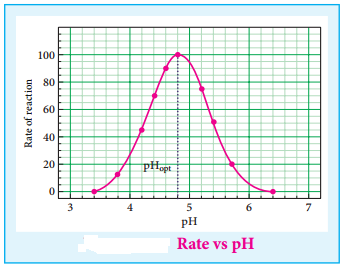
(iv) The rate of enzyme catalysed reactions varies with the pH of the system. The rate is maximum at a pH called optimum pH.

Enzyme Catalysis img 3

(v) Enzymes can be inhibited i.e. poisoned. Activity of an enzyme is decreased and destroyed by a poison. The physiological action of drugs is related to their inhibiting action.

Example: Sulpha drugs. Penicillin inhibits the action of bacteria and used for curing diseases like pneumonia, dysentery, cholera and other infectious diseases.

(vi) Catalytic activity of enzymes is increased by coenzymes or activators. A small non protein (vitamin) called a coenzyme promotes the catalytic activity of enzyme.

Catalysis

Find free online Chemistry Topics covering a broad range of concepts from research institutes around the world.

Catalysis

In 1836 Berzelius identified certain substances loosen the bond in the reacting molecules and increased the rate of the reaction. But he also found these substances didn’t undergo any change chemically. In order to indicate the property, he gave them the name catalyst. (In greek, kata-wholly, lein-to loosen).

Later it was identified that there were many substances which retarded the speed of a reaction.

Hence a catalyst is defined as a substance which alters the rate of chemical reaction without itself undergoing chemical change. The phenomenon which involves the action of a catalyst is called catalysis.

Positive and Negative Catalysis:

In positive catalysis, the rate of a reaction is increased by the presence of catalyst but in negative catalysis, the rate of reaction is decreased by the presence of a catalyst. The two main types of catalysis

  1. Homogeneous Catalysis and
  2. Heterogeneous Catalysis

Homogeneous Catalysis

In a homogeneous catalysed reaction, the reactants, products and catalyst are present in the same phase.

Illustration (1):

Catalysis img 1

In this reaction the catalyst NO, reactants, SO2 and O2, and product, SO3 are present in the gaseous form.

Illustration (2):

In the decomposition of acetaldehyde by I2 catalyst, the reactants and products are all present in the vapour phase.

CH3CHO(g) + [I2](g) → CH4(g) + CO(g) + [I2](g)

Let us consider some examples in which the reactants, products and catalyst are present in aqueous solution.

(1) Hydrolysis of cane sugar with a mineral acid as catalyst

Catalysis img 2

(2) Ester hydrolysis with acid or alkali as catalyst

Catalysis img 3

Heterogeneous Catalysis

In a reaction, the catalyst is present in a different phase i.e. it is not present in the same phase as that of reactants or products. This is generally referred as contact catalysis and the catalyst present is in the form of finely divided metal or as gauze.

Illustration

(i) In the manufacture of sulphuric acid by contact process SO3 is prepared by the action of SO2 and O2
in the presence of Pt or V2O5 as a catalyst.

Catalysis img 4

(ii) In the Haber’s process for the manufacture of ammonia, iron is used as a catalyst for the reaction between Hydrogen and Nitrogen.

Catalysis img 5

(iii) Oxidation of ammonia is carried out in presence of platinum gauze

Catalysis img 6

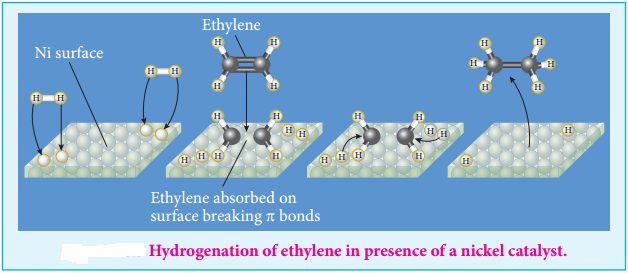
(iv) The hydrogenation of unsaturated organic compounds is carried out using finely divided nickel as a catalyst.

Catalysis img 7

(v) Decomposition of H2O2 occurs in the presence of the Pt catalyst

Catalysis img 8

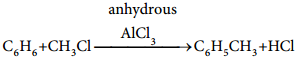
(vi) In the presence of anhydrous AlCl3, benzene reacts with ethanoyl chloride to produce acetophenone

Catalysis img 9

Characteristics of Catalysts

  1. For a chemical reaction, catalyst is needed in very small quantity. Generally, a pinch of catalyst is enough for a reaction in bulk.
  2. There may be some physical changes, but the catalyst remains unchanged in mass and chemical composition in a chemical reaction.
  3. A catalyst itself cannot initiate a reaction. It means it can not start a reaction which is not taking place. But, if the reaction is taking place in a slow rate it can increase its rate.
  4. A solid catalyst will be more effective if it is taken in a finely divided form.
  5. A catalyst can catalyse a particular type of reaction, hence they are said to be specific in nature.
  6. In an equilibrium reaction, presence of catalyst reduces the time for attainment of equilibrium and hence it does not affect the position of equilibrium and the value of equilibrium constant.
  7. A catalyst is highly effective at a particular temperature called as optimum temperature.
  8. Presence of a catalyst generally does not change the nature of products.

For example: 2SO2 + O2 → SO3
This reaction is slow in the absence of a catalyst, but fast in the presence of Pt catalyst

Promoters and Catalyst Poison

1. In a catalysed reaction the presence of a certain substance increases the activity of a catalyst. Such a substance is called a promoter.
2. For example in the Haber’s process of manufacture of ammonia, the activity of the iron catalyst is increased by the presence of molybdenum.
3. Hence molybdenum is called a promoter. In the same way Al2O3 can also be used as a promoter to increase the activity of the iron catalyst.

On the other hand, certain substances when added to a catalysed reaction decreases or completely destroys the activity of catalyst and they are often known as catalytic poisons.

Few examples,

In the reaction, 2SO2 + O2 → 2SO3 with a Pt catalyst, the poison is As2O3
blocks the activity of the catalyst. So, the activity is lost.

In the Haber’s process of the manufacture of ammonia, the Fe catalyst is poisoned by the presence of H2S.

In the reaction, 2H2 + O2 → 2H2O,
CO acts as a catalytic poison for Pt – catalyst

Auto Catalysis

In certain reactions one of the products formed acts as a catalyst to the reaction. Initially the rate of reaction will be very slow but with the increase in time the rate of reaction increases.

Auto catalysis is observed in the following reactions.

CH3COOC2H5 + H2O → CH3COOH + C2H5OH

Acetic acid acts as the autocatalyst

2AsH3 → 2As + 3H2

Arsenic acts as an autocatalyst

Negative Catalysis

In certain reactions, presence of certain substances, decreases the rate of the reaction. Ethanol is a negative catalyst for the following reaction.

(i) 4CHCl3 + 3O2 → 4COCl2 + 2H2O + 2Cl2

Ethanol decreases the rate of the reaction

(ii) 2H2O2 → 2H2O + O2

In the decomposition of hydrogen peroxide, dilute acid or glycerol acts as a negative catalyst.

Theories of Catalysis

For a chemical reaction to occur, the reactants are to be activated to form the activated complex. The energy required for the reactants to reach the activated complex is called the activation energy. The activation energy can be decreased by increasing the reaction temperature. In the presence of a catalyst, the reactants are activated at reduced temperatures in otherwords, the activation energy is lowered.

The catalyst adsorbs the reactants activates them by weakening the bonds and allows them to react to form the products. As activation energy is lowered in presence of a catalyst, more molecules take part in the reaction and hence the rate of the reaction increases.

The action of catalysis in chemical reactions is explained mainly by two important theories. They are

  • The intermediate compound formation theory
  • The adsorption theory.

The Intermediate Compound Formation Theory

A catalyst acts by providing a new path with low energy of activation. In homogeneous catalysed reactions a catalyst may combine with one or more reactant to form an intermediate which reacts with other reactant or decompose to give products and the catalyst is regenerated.

Consider the reactions:

A + B → AB (1)
A + C → AC (intermediate) (2)
C is the catalyst
AC + B → AB + C (3)

Activation energies for the reactions (2) and (3) are lowered compared to that of (1). Hence the formation and decomposition of the intermediate accelerate the rate of the reaction.

Example 1:

The mechanism of Fridel craft reaction is given below

Catalysis img 10

The action of catalyst is explained as follows

CH3Cl + AlCl3 → [CH3]+[AlCl4]

It is an intermediate.

C6H6 + [CH3+] [AlCl4] → C6H5CH3 + AlCl3 + HCl

Example 2:

Thermal decomposition of KClO3 in presence of MnO2 proceeds as follows.

Steps in the reaction
2KClO3 → 2KCl + 3O2 can be given as
It is an intermediate.
6MnO3 → 6MnO2 + 3O2

Example 3:

Formation of water due to the reaction of H2 and O2 in the presence of Cu proceeds as follows.
Steps in the reaction H2 + \(\frac{1}{2}\)O2 → H2O can be given as

2Cu + \(\frac{1}{2}\)O2 → Cu2O

It is an intermediate.

Cu2O + H2 → H2O + 2Cu

Example 4:

Oxidation of HCl by air in presence of CuCl2 proceeds as follows. Steps in the reaction

4HCl + O2 → 2H2O + 2Cl2 can be given as

2CuCl2 → Cl2 + Cu2Cl2
2Cu2Cl2 + O2 → 2Cu2OCl2

It is an intermediate.

2Cu2OCl2 + 4HCl → 2H2O + 4CuCl2

This theory describes

  • The specificity of a catalyst and
  • The increase in the rate of the reaction with increase in the concentration of a catalyst.

Limitations

  • The intermediate compound theory fails to explain the action of catalytic poison and activators (promoters).
  • This theory is unable to explain the mechanism of heterogeneous catalysed reactions.

Adsorption Theory

Langmuir explained the action of catalyst in heterogeneous catalysed reactions based on adsorption. The reactant molecules are adsorbed on the catalyst surfaces, so this can also be called as contact catalysis. According to this theory, the reactants are adsorbed on the catalyst surface to form an activated complex which subsequently decomposes and gives the product.

The various steps involved in a heterogeneous catalysed reaction are given as follows:

  1. Reactant molecules diffuse from bulk to the catalyst surface.
  2. The reactant molecules are adsorbed on the surface of the catalyst.
  3. The adsorbed reactant molecules are activated and form activated complex which is decomposed to form the products.
  4. The product molecules are desorbed.
  5. The product diffuse away from the surface of the catalyst.

Catalysis img 11

Active Centres

The surface of a catalyst is not smooth. It bears steps, cracks and corners. Hence the atoms on such locations of the surface are co-ordinatively unsaturated. So, they have much residual force of attraction. Such sites are called active centres. So, the surface carries high surface free energy.

The presence of such active centres increases the rate of reaction by adsorbing and activating the reactants. The adsorption theory explains the following

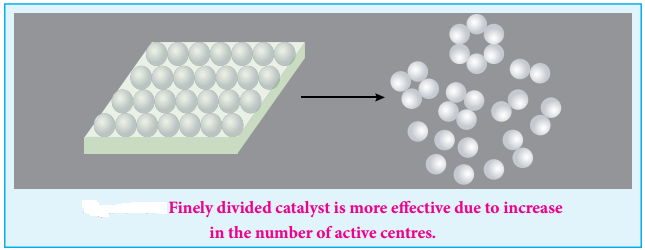
1. Increase in the surface area of metals and metal oxides by reducing the particle size increases acting of the catalyst and hence the rate of the reaction.

Catalysis img 12

2. The action of catalytic poison occurs when the poison blocks the active centres of the catalyst.

3. A promoter or activator increases the number of active centres on the surfaces.

Adsorption and Absorption

Find free online Chemistry Topics covering a broad range of concepts from research institutes around the world.

Adsorption and Absorption

Solid surfaces have the ability to attract the contacting species due to free valency or residual force on them.

For example:
charcoal adsorbs ammonia, silica gel adsorbs water., charcoal adsorbs colorants from sugar.

These examples prove that adsorption is a surface phenomenon. In contrast to adsorption, absorption is a bulk phenomenon i.e. the adsorbate molecules are distributed throughout the adsorbent.

  1. Adsorbent is the material on which adsorption takes place.
  2. Adsorbed substance is called an adsorbate.
  3. The surface of separation of the two phases where the concentration of adsorbed molecule is high is known as interface.
  4. In adsorption, if the concentration of a substance in the interface is high, then it is called positive adsorption.
  5. If it is less, then it is called negative adsorption.
  6. The process of removing an adsorbed substance from the surface is called desorption.
  7. The gaseous molecules like He, Ne, O2, SO2 and NH3 and solutions of NaCl or KCl can be adsorbed by suitable adsorbents. These are referred as adsorbates.
  8. Silica gel and metals like Ni, Cu, Pt, Ag and Pd and certain colloids can act as adsorbents.

Characteristics of Adsorption

1. Adsorption can occur in all interfacial surfaces i.e. the adsorption can occur in between gas-solid, liquid solid, liquid-liquid, solid-solid and gas-liquid.

2. Adsorption is a spontaneous process and it is always accompanied by decrease in free energy. When ∆G reaches zero, the equilibrium is attained. We know,

∆G = ∆H – T ∆S where ∆G is Change in Free energy.
∆H is Change in enthalpy and ∆S = Change in entropy.

3. When molecules are adsorbed, there is always a decrease in randomness of the molecules. ie., ∆S < 0, and T∆S is negative. Hence, adsorption is exothermic. Adsorption is a quick process whereas absorption is a slow process.

Types of Adsorption

Adsorption is classifid as physical adsorption and chemical adsorption, depending on the nature of forces acting between adsorbent and adsorbate. In chemical adsorption, gas molecules are held to the surface by formation of chemical bonds. Since strong bond is formed, nearly 400 KJ / mole is given out as heat of adsorption.

Examples

(a) Adsorption of O2 on tungsten, Adsorption of H2 on nickel, Adsorption of ethyl alcohol vapours on nickel.

In physical adsorption, physical forces such as van der waals force of attraction, dipole – dipole interaction, dispersion forces etc., exist between adsorbent and adsorbate. As these forces are weak, heat of adsorption is low, hence physical adsorption occurs at low temperatures.

Examples

(a) Adsorption of N2 on mica.
(b) Adsorption of gases on charcoal.

The following table 10.1 illustrates the distinction between chemical and physical adsorption.

Distinction Between Chemical and Physical Adsorption

Chemical adsorption or Chemisorption or Activated adsorptionPhysical adsorption or van der waals
adsorption or Physisorption
1. It is very slow1. It is instantaneous
2. It is very specific depends on nature of
adsorbent and adsorbate.
2. It is non-specific
3. Chemical adsorption is fast with increase pressure, it can not alter the amount3. In Physisorption, when pressure increases the extent of adsorption increases
4. When temperature is raised chemisorption first increases and then
decreases
4. Physisorption decreases with increase in
temperature
5. Chemisorption involves transfer of electrons between the adsorbent and adsorbate5. No transfer of electrons
6. Heat of adsorption is high i.e., from 40-
400kJ/mole
6. Heat of adsorption is low in the order of
40kJ/mole.
7. Monolayer of the adsorbate is formed7. Multilayer of the adsorbate is formed on
the adsorbent
8. Adsorption occurs at fixed sites called
active centres. It depends on surface area
8. It occurs on all sides
9. Chemisorption involves the formation
of activated complex with appreciable
activation energy
9. Activation energy is insignifiant

Factors Affecting Adsorption

The adsorption is well understood by considering the various factors affecting it. Qualitatively, the extent of surface adsorption depends on the following factors.

  1. Nature of adsorbent
  2. Nature of adsorbate
  3. Pressure
  4. Concentration at a given temperature.

1. Surface Area of Adsorbent:

As the adsorption is a surface phenomenon it depends on the surface area of adsorbent. i.e., higher the surface area, higher is the amount adsorbed.

2. Nature of Adsorbate

The nature of adsorbate can inflence the adsorption. Gases like SO2, NH3, HCl and CO2 are easily liquefiable as they have greater van der waal’s force of attraction. On the other hand, permanent gases like H2, N2 and O2 can not be liquefied easily. These permanent gases are having low critical temperature and adsorbed slowly, while gases with high critical temperature are adsorbed readily.

3. Effect of Temperature

When temperature is raised chemisorption fist increases and then decreases. whereas physisorption decreases with increase in temperature.

4. Effect of Pressure:

chemical adsorption is fast with increase in pressure, it can not alter the amount of adsorption. In Physisorption the extent of adsorption increases with increase in pressure.

Adsorption Isotherms and Isobars

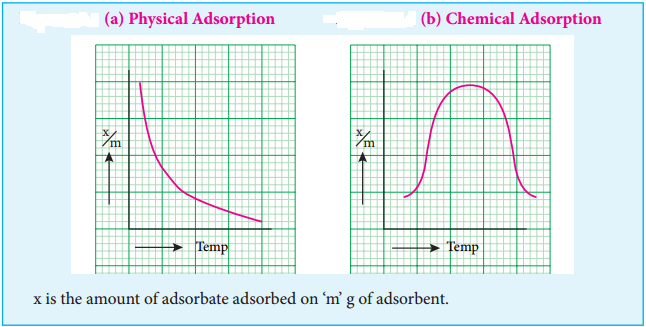
Adsorption isotherms represents the variation of adsorption at constant temperature. When amount of adsorption is plotted versus temperature at constant pressure it is called adsorption isobar. Adsorption isobars of physisorption and chemisorption are different as represented in the graphs.

Adsorption and Absorption img 1

In physical adsorption, \(\frac{x}{m}\) decreases with increase in Temprature, But in chemical adsorption, \(\frac{x}{m}\) increases with rise in temperature and then decreases.

The increase illustrates the requirement of activation of the surface for adsorption is due to fact that formation of activated complex requires certain energy. The decrease at high temperature is due to desorption, as the kinetic energy of the adsorbate increases.

Adsorption Isotherms

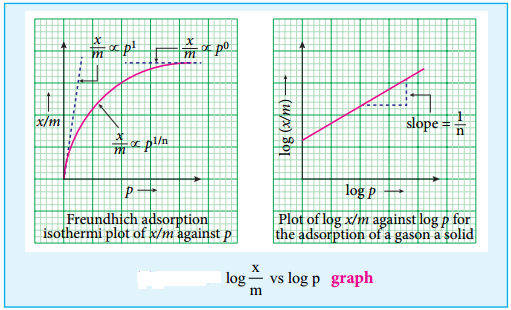
Adsorption isotherm can be studied quantitatively. A plot between the amount of adsorbate adsorbed and pressure (or concentration of adsorbate) at constant temperature is called adsorption isotherms. In order to explain these isotherms various equations were suggested as follows:

(i) Freundlich adsorption isotherm.
According to Freundlich,
\(\frac{x}{m}\) = kp1/n

where x is the amount of adsorbate, adsorbed on ‘m’ gm of adsorbent at a pressure of p. K and n are constant introduced by freundlich. Value n is always less than unity.

This equation is applicable for adsorption of gases on solid surfaces. The same equation becomes \(\frac{x}{m}\) = K c1/n, when used for adsorption in solutions with c as concentration.

This equation quantitively predicts the effect of pressure(or concentration) on the adsorption of gases(or adsorbates) at constant temperature.

Taking log on both sides of equation \(\frac{x}{m}\) = Kp1/n
log \(\frac{x}{m}\) = logK + \(\frac{1}{n}\)log P

Adsorption and Absorption img 2

Hence the intercept represents the value of log k and the slope gives \(\frac{1}{n}\).

This equation explains the increase of \(\frac{x}{m}\) with increase in pressure. But experimental values show the deviation at low pressure.

Limitations

This equation is purely empirical and valid over a limited pressure range. The values of constants k and n also found vary with temperature. No theoretical explanations were given.

Applications of Adsorption

Though we have innumerable applications for adsorption, we consider few of them

1. Gas Masks:

During world war I charcoal gas mask was employed by both the British and American. Activated charcoal was found to be one of the best adsorbents.

2. To create high vacuum in vessels, Tail and Dewar used activated charcoal. For dehydration and also purification of gases like CO2, N2, Cl2, O2 and He, alumina and silica are employed. In the blast furnace silica gel is also used for drying air.

3. One of the highly important use of adsorption is the softening of hardwater. Permutit is employed for this process which adsorbs Ca2+ and Mg2+ ions in its surface, there is an ion exchange as shown below it occurs on the surface.

Na2Al2Si4O12 + CaCl2 → CaAl2Si4O12 + 2NaCl

Exhausted permutit is regenerated by adding a solution of common salt.

CaAl2Si4O12 + 2NaCl → Na2Al2Si4O12 + CaCl2

4. Ion Exchange Resins

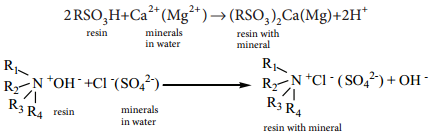
Ion exchange resins are working only based on the process of adsorption. Ion exchange resins are used to demineralise water. This process is carried out by passing water through two columns of cation and anion exchange resins.

Adsorption and Absorption img 3

5. Petroleum Refining and Refining of Vegetable Oil

Fuller’s earth and silica gel are used for refining process.

6. Decolourisation of Sugar:

Sugar prepared from molasses is decolourised to remove coloured impurities by adding animal charcoal which acts as decolourising material.

7. Chromatography

The chromatographic technique is applied for separation of components in a mixture. It is mainly based on adsorption of components on the surface of adsorbents. This method is very effective and used for identification, detection and estimation of many substances even if they are contained in micro quantities.

8. Catalysed Reaction

Catalysis is an important branch of surface chemistry which is based on the phenomenon of adsorption of materials on the catalyst surface.

Examples:

In the Haber’s process, ammonia is manufactured from N2 and H2 as shown by the following reactions.

In this process, Fe is the catalyst and Mo is a promoter. The surface of the Fe catalyses the reaction.

In the hydrogenation of oils to obtain vanaspathi, Nickel is used as a catalyst. Nickel surface catalyses the reaction.

Adsorption and Absorption img 4

9. Qualitative Analysis

When blue litmus solution is added to Al3+ ion, a red coloration is seen due to the acidic nature of the solution. Addition of ammonium hydroxide to it gives a blue lake. This is due to the adsorption of blue colour litmus compound on the surface of Al (OH)3 Which is formed during the addition of NH4OH.

10. Medicine:

Drugs cure diseases by adsorption on body tissues.

11. Concentration of Ores of Metals

Sulphides ores are concentrated by a process called froth fltation in which light ore particles are wetted by pine oil.

12. Mordants and Dyes

Most of the dyes are adsorbed on the surface of the fabrics. Mordants are the substances used for fining dyes onto the fabric.

13. Adsorption Indicators

In the precipitation titrations, the end point is indicated by an external indicator which changes its colour after getting adsorbed on precipitate. It is used to indicate the end point of the titration.

Thermodynamics of Cell Reactions

Find free online Chemistry Topics covering a broad range of concepts from research institutes around the world.

Thermodynamics of Cell Reactions

We have just learnt that in a galvanic cell, the chemical energy is converted into electrical energy. The electrical energy produced by the cell is equal to the product of the total charge of electrons and the emf of the cell which drives these electrons between the electrodes.

If ‘n’ is the number of moles of electrons exchanged between the oxidising and reducing agent in the overall cell reaction, then the electrical energy produced by the cell is given as below.

Electrical energy = Charge of ‘n’ mole of electrons × Ecell ……. (9.20)
Charge of 1 mole of electrons = one Faraday (1F)
∴ Charge of ‘n’ mole of electrons = nF
Equation (9.20) ⇒ Electrical energy = nFEcell ……. (9.21)

∴ Charge of one elctron = 1.602 × 10⁻¹⁹C
∴ Charge of one mole of elctron = 6.023 × 1023 × 1.602 × 10-19C
= 96488 C
i.e., 1F = 96500 C

This energy is used to do the electric work. Therefore the maximum work that can be obtained from a galvanic cell is

(Wmax)cell = – nFEcell …………… (9.22)

Here the (-) sign is introduced to indicate that the work is done by the system on the surroundings.

We know from the Second Law of thermodynamics that the maximum work done by the system is equal to the change in the Gibbs free energy of the system.

i.e., Wmax = ∆G …………… (9.23)

From (9.22) and (9.23),

∆G = – nFEcell ……………. (9.24)

For a spontaneous cell reaction, the DG should be negative. The above expression (9.24) indicates that Ecell should be positive to get a negative ∆G value.

When all the cell components are in their standard state, the equation (9.24) becomes

∆G° = – nFE°cell ………….. (9.25)

We know that the standard free energy change is related to the equilibrium constant as per the following expression.

∆G° = – RTlnKeq …………… (9.26)
Comparing (9.25) and (9.26),
⇒ E°cell = \(\frac{2.303RT}{nF}\)log Keq ………….. (9.27)

Nernst Equation

Nernst equation is the one which relates the cell potential and the concentration of the species involved in an electrochemical reaction. Let us consider an electrochemical cell for which the overall redox reaction is,
xA + yB ⇄ lC + mD. The reaction quotient Q for the above reaction is given below
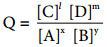
Thermodynamics of Cell Reactions img 1 ……….. (9.28)

We have already learnt that,
∆G = ∆G° + RT lnQ

The Gibbs free energy can be related to the cell emf as follows [∴equation (9.24) and (9.25)]
∆G = – nFE cell; ∆G° = – nFE°cell
Substitute these values and Q from (9.28) in the equation (9.29)

Thermodynamics of Cell Reactions img 2 ………… (9.30)

Divide the whole equation (9.30) by (-nF)
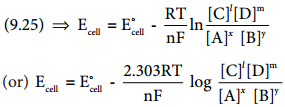
Thermodynamics of Cell Reactions img 3 ………… (9.31)

The above equation (9.31) is called the Nernst equation. At 25°C (298K), the above equation (9.31) becomes,
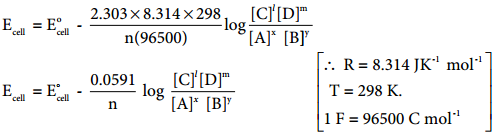
Thermodynamics of Cell Reactions img 4 ……………… (9.32)

Let us calculate the emf of the following cell at 25°C using Nernst equation

Cu (s)|Cu2+(0.25 aq, M)|Fe2+(0.1 aq M)|Pt(s)
Given: (E°)Fe2+|Fe2+ = 0.77V and (E°)Cu2+|Cu = 0.34 V

Half reactions are
Cu (s) → Cu2+(aq) + 2e …………… (1)
2 Fe3+(aq) + 2e → 2Fe2+(aq) …………. (2)

the overall reaction is

Cu (s) + 2Fe3+(aq) → Cu2+(aq) + 2Fe2+ (aq), and n = 2
Apply Nernst equation at 25°C.
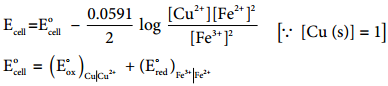
Thermodynamics of Cell Reactions img 5

Given standard reduction potential of Cu2+|Cu is 0.34V
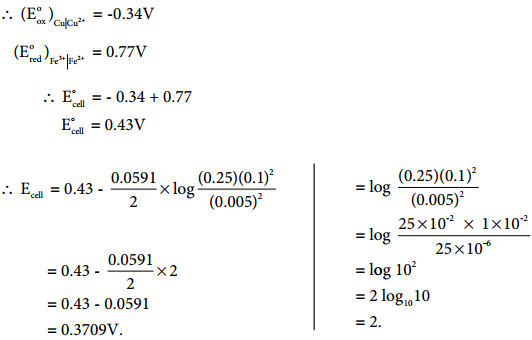
Thermodynamics of Cell Reactions img 6

Electrolytic Cell and Electrolysis

Electrolysis is a process in which the electrical energy is used to cause a non-spontaneous chemical reaction to occur; the energy is often used to decompose a compound into its elements. The device which is used to carry out the electrolysis is called the electrolytic cell.

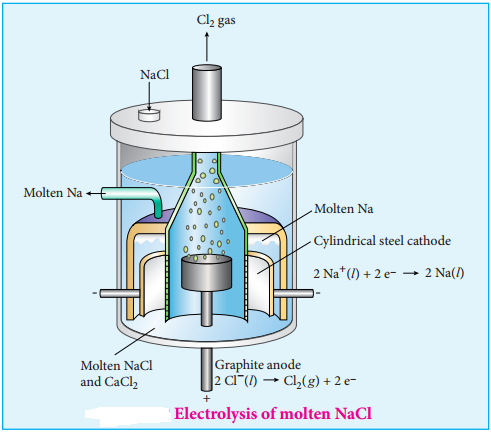
The electrochemical process occurring in the electrolytic cell and galvanic cell are the reverse of each other. Let us understand the function of a electrolytic cell by considering the electrolysis of molten sodium chloride.

The electrolytic cell consists of two iron electrodes dipped in molten sodium chloride and they are connected to an external DC power supply via a key as shown in the figure (9.8). The electrode which is attached to the negative end of the power supply is called the cathode, and the one which attached to the positive end is called the anode. Once the key is closed, the external DC power supply drives the electrons to the cathode and at the same time pull the electrons from the anode.
Thermodynamics of Cell Reactions img 7

Cell Reactions

Na+ ions are attracted towards cathode, where they combine with the electrons and reduced to liquid sodium.

Cathode (Reduction)

Na+(l) + e → Na(l) E° = – 2.71
Similarly, Cl ions are attracted towards anode where they lose their electrons and oxidised to chlorine gas.

Anode (Oxidation)

2Cl(l) → Cl2(g) + 2e E° = – 1.36V

The overall reaction is,
2Na+(l) + 2Cl(l) → 2Na(l) + Cl2(g) E° = – 4.07V

The negative E° value shows that the above reaction is a non spontaneous one. Hence, we have to supply a voltage greater than 4.07V to cause the electrolysis of molten NaCl. In electrolytic cell, oxidation occurs at the anode and reduction occur at the cathode as in a galvanic cell, but the sign of the electrodes is the reverse i.e., in the electrolytic cell cathode is – ve and anode is + ve.

Faraday’s Laws of Electrolysis
First Law

The mass of the substance (m) liberated at an electrode during electrolysis is directly proportional to the quantity of charge (Q) passed through the cell.

i.e m α Q

We know that the charge is related to the current by the equation I = \(\frac{Q}{t}\) ⇒ Q = It
∴ m α It
(or)
m = Z It …………. (9.33)

Where is Z is known as the electro chemical equivalent of the substance produced of the electrode. When, I = 1A and t = 1sec, Q = 1C, in such case the equation (9.32) becomes, (9.33)
⇒ m = Z …………….. (9.34)

Thus, the electrochemical equivalent is defined as the amount of substance deposited or liberated at the electrode by a charge of 1 coulomb.

Electro Chemical Equivalent and Molar Mass

Consider the following general electrochemical redox reaction
Mn+(aq) + ne → M(s)
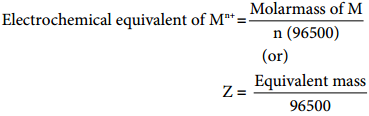
We can infer from the above equation that ‘n’ moles of electrons are required to precipitate 1 mole of Mn+ as M(s).

The quantity of charge required to precipitate one mole of Mn+ = Charge of ‘n’ moles of electrons
= nF

In other words, the mass of substance deposited by one coulomb of charge
Thermodynamics of Cell Reactions img 8 …………… (9.35)

Second Law

Thermodynamics of Cell Reactions img 9

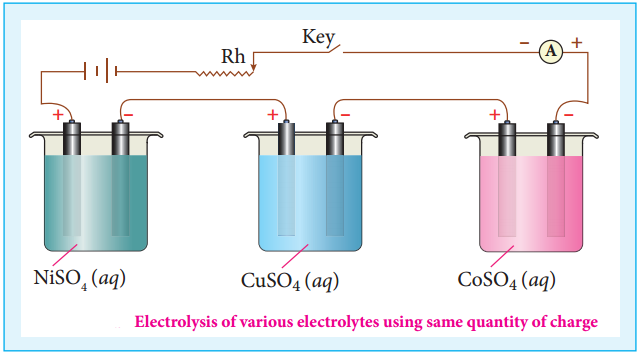
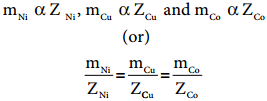
When the same quantity of charge is passed through the solutions of different electrolytes, the amount of substances liberated at the respective electrodes are directly proportional to their electrochemical equivalents.

Let us consider three electrolytic cells connected in series to the same DC electrical source as shown in the figure 9.9. Each cell is filled with a different electrolytes namely NiSO4, CuSO4 and CoSO4, respectively.

When Q coulomb charge is passed through the electrolytic cells the masses of Nickel, copper and cobalt deposited at the respective electrodes be mNi, mCu and mCo, respectively.

According to Faraday’s second Law,
Thermodynamics of Cell Reactions img 10 ………….. (9.36)

Batteries

Batteries are indispensable in the modern electronic world. For example, Li – ion batteries are used in cell phones, dry cell in flashlight etc. These batteries are used as a source of direct current at a constant voltage. We can classify them into primary batteries (non – rechargeable) and secondary batteries (rechargeable). In this section, we will briefly discuss the electrochemistry of some batteries.

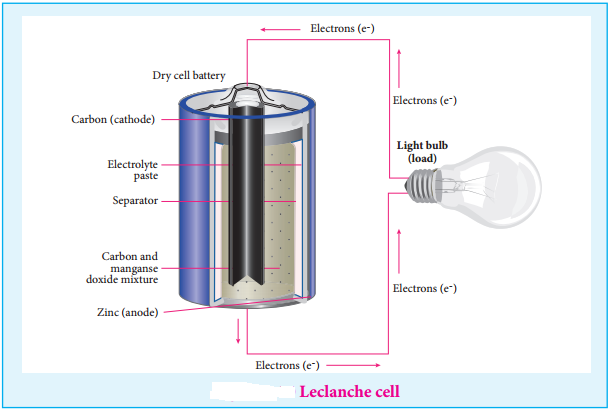
Leclanche Cell

Anode: Zinc container
Cathode: Graphite rod in contact with MnO2
Electrolyte: ammonium chloride and zinc chloride in water

Emf of the cell is about 1.5V
Cell reaction

Oxidation at Anode
Zn (s) → Zn2+(aq) + 2e ……… (1)

Reduction at Cathode
2 NH4+(aq) + 2e → 2NH3(aq) + H2(g) ………… (2)

The hydrogen gas is oxidised to water by MnO2
H2 (g) + 2 MnO2 (s) → Mn2O3(s) + H2O(l)
Equation (1) + (2)+(3) gives the overall redox reaction
Thermodynamics of Cell Reactions img 11

Zn (s) + 2NH4+(aq) + 2 MnO2(s) → Zn2+(aq) + Mn2O3 (s) + H2O(l) + 2NH3 ………… (4)

Ammonia produced at the cathode combines with Zn2+ to form a complex ion [Zn(NH3)4]2+(aq). As the reaction proceeds, the concentration of NH4+ will decrease and the aqueous NH3 will increase which lead to the decrease in the emf of cell.

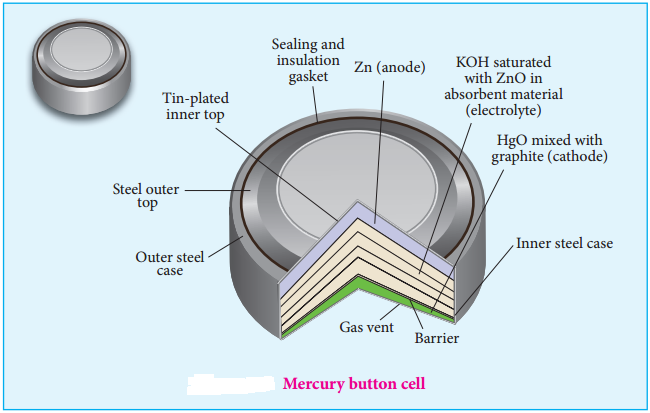
Mercury Button Cell

Anode: zinc amalgamated with mercury
Cathode: HgO mixed with graphite
Electrolyte: Paste of KOH and ZnO

Thermodynamics of Cell Reactions img 18

Overall reaction: Zn (s) + HgO (s) → ZnO (s) + Hg (l)
Cell emf: about 1.35V.
Uses: It has higher capacity and longer life. Used in pacemakers, electronic watches, cameras etc.
Thermodynamics of Cell Reactions img 12

Secondary Batteries

We have already learnt that the electrochemical reactions which take place in a galvanic cell may be reversed by applying a potential slightly greater than the emf generated by the cell. This principle is used in secondary batteries to regenerate the original reactants. Let us understand the function of secondary cell by considering the lead storage battery as an example.

Lead Storage Battery

Anode: Spongy lead
Cathode: lead plate bearing PbO2
Electrolyte: 38% by mass of H2SO4 with density 1.2g / mL.

Oxidation occurs at the anode

Pb(s) → Pb2+(aq) + 2e ……….. (1)
The Pb2+ ions combine with SO42-(aq) → PbSO4 (s) …………. (2)

Reduction occurs at the cathode

PbO2 (s) + 4 H+(aq) + 2e → Pb2+(aq) + 2H2O(l) ………. (3)
The Pb2+ ions also combine with SO42- → Pb2+(aq) + 2H2O(l)

The emf of a single cell is about 2V. Usually six such cells are combined in series to produce 12 volt

The emf of the cell depends on the concentration of H2SO4. As the cell reaction uses SO42-
ions, the concentration H2SO4 decreases. When the cell potential falls to about 1.8V, the cell has to be recharged.

Recharge of the Cell

As said earlier, a potential greater than 2V is applied across the electrodes, the cell reactions that take place during the discharge process are reversed. During recharge process, the role of anode and cathode is reversed and H2SO4 is regenerated.

Oxidation occurs at the cathode (now act as anode)

image

Reduction occurs at the anode (now act as cathode) PbSO4(s) + 2e → Pb(s) + SO42-(aq)
Overall reaction
2PbSO4(s) + 2H2O(l) → Pb(s) + PbO2(s) + 4H+(aq) + 2SO42-(aq)

Thus, the overall cell reaction is exactly the reverse of the redox reaction which takes place while discharging.

Uses:
Used in automobiles, trains, inverters etc.

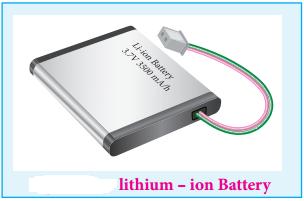
The lithium – ion Battery

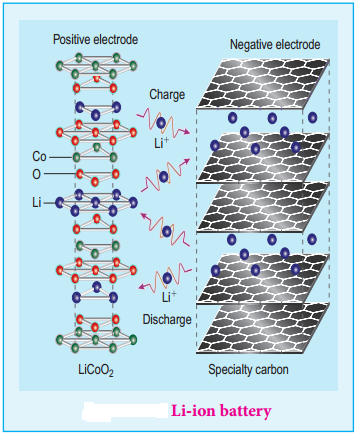
Anode: Porus graphite
Cathode: Transition metal oxide such as CoO2.
Thermodynamics of Cell Reactions img 13

Electrolyte: Lithium salt in an organic solvent
At the anode oxidation occurs
Li (s) → Li+(aq) + e

At the cathode reduction occurs
Li+ + CoO2(s) + e → LiCoO2(s)

Overall reactions
Li (s) + CoO2 → LiCoO2 (s)

Both electrodes allow Li+ ions to move in and out of their structures.

During discharge, the Li+ ions produced at the anode move towards cathode through the non – aqueous electrolyte. When a potential greater than the emf produced by the cell is applied across the electrode, the cell reaction is reversed and now the Li+ ions move from cathode to anode where they become embedded on the porous graphite electrode. This is known as intercalation.
Thermodynamics of Cell Reactions img 14

Uses:

Used in cellular phones, laptops, computers, digital cameras, etc.

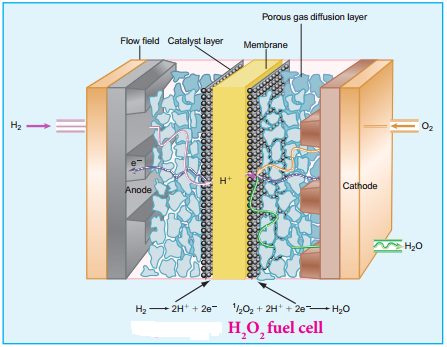
Fuel Cell:

The galvanic cell in which the energy of combustion of fuels is directly converted into electrical energy is called the fuel cell. It requires a continuous supply of reactant to keep functioning. The general representation of a fuel cell is follows.
Thermodynamics of Cell Reactions img 15

Fuel | Electrode | Electrolyte | Electrode | Oxidant

Let us understand the function of fuel cell by considering hydrogen – oxygen fuel cell. In this case, hydrogen act as a fuel and oxygen as an oxidant and the electrolyte is aqueous KOH maintained at 200°C and 20 – 40 atm. Porous graphite electrode containing Ni and NiO serves as the inert electrodes.

Hydrogen and oxygen gases are bubbled through the anode and cathode, respectively.

Oxidation occurs at the anode:
2H2g + 4 OH(aq) → 4H2O(l) + 4e
Reduction occurs at the cathode O2(g) + 2H2O(l) + 4e → 4 OH(aq)

The overall reaction is 2H2 (g) + O2 (g) → 2H2O(l)

The above reaction is the same as the hydrogen combustion reaction, however, they do not react directly ie., the oxidation and reduction reactions take place separately at the anode and cathode respectively like H2 – O2 fuel cell. Other fuel cells like propane – O2 and methane O2 have also been developed.

Corrosion

We are familiar with the rusting of iron. Have you ever noticed a green film formed on copper and brass vessels?. In both, the metal is oxidised by oxygen in presence of moisture. This redox process which causes the deterioration of metal is called corrosion.

As the corrosion of iron causes damages to our buildings, bridges etc… it is important to know the chemistry of rusting and how to prevent it. Rusting of iron is an electrochemical process.

Electrochemical Mechanism of Corrosion

The formation of rust requires both oxygen and water. Since it is an electrochemical redox process, it requires an anode and cathode in different places on the surface of iron. The iron surface and a droplet of water on the surface as shown in figure (9.15) form a tiny galvanic cell. The region enclosed by water is exposed to low amount of oxygen and it acts as the anode.

The remaining area has high amount of oxygen and it acts as cathode. So based on the oxygen content, an electro chemical cell is formed corrosion occurs at the anode i,e,. in the region enclosed by the water as discussed below.
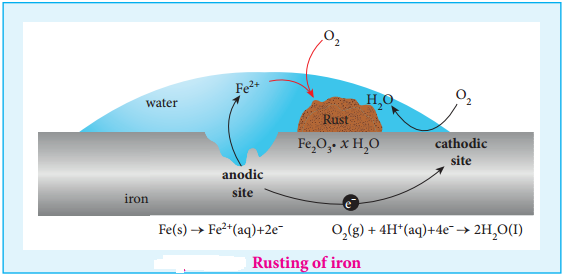
Thermodynamics of Cell Reactions img 16

At Anode (Oxidation):

Iron dissolves in the anode region

2Fe (s) → 2Fe2+ (aq) + 4e E° = 1.23V

The electrons move through the iron metal from the anode to the cathode area where the oxygen dissolved in water, is reduced to water.

At Cathode (Reduction):

The reaction of atmospheric carbon dioxide with water gives carbonic acid which furnishes the H+ ions for reduction.

O2(g) + 4H+(aq) + 4e → 2H2O(l) E° = 0.44 + 1.23 = 1.67V

The positive emf value indicates that the reaction is spontaneous.

Fe2+(aq) + O2(g) + 4H+(aq) → 4Fe3+(aq) + 2H2O(l)
4Fe3+(aq) + 4H2O(l) → Fe2O3.H2O(s) + 6H+(aq)

Other metals such as aluminium, copper and silver also undergo corrosion, but at a slower rate than iron. For example, let us consider the reduction of aluminium,
Al(s) → Al3+(aq) + 3e

Al3+, which reacts with oxygen in air to forms a protective coating of Al2O3. This coating act as a protective film for the inner surface. So, further corrosion is prevented.

Protection of Metals form Corrosion

This can be achieved by the following methods.

  • Coating metal surface by paint.
  • Galvanizing – by coating with another metal such as zinc. zinc is stronger reducing agent than iron and hence it can be more easily corroded than iron. i.e., instead of iron, the zinc is oxidised.
  • Cathodic protection – In this technique, unlike galvanising the entire surface of the metal to be protected need not be covered with a protecting metal.

Instead, metals such as Mg or zinc which is corroded more easily than iron can be used as a sacrificial anode and the iron material acts as a cathode. So iron is protected, but Mg or Zn is corroded.

Passivation:

The metal is treated with strong oxidising agents such as concentrated HNO3. As a result, a protective oxide layer is formed on the surface of metal.

Alloy Formation:

The oxidising tendency of iron can be reduced by forming its alloy with other more anodic metals.
Example, stainless steel – an alloy of Fe and Cr.

Electrochemical Series

We have already learnt that the standard single electrode potentials are measured using standard hydrogen electrode. The standard electrode potential at 298K for various metal metal ion electrodes are arranged in the decreasing order of their standard reduction potential values as shown in the figure. This series is called electrochemical series.

The standard reduction potential (E°) is a measure of the oxidising tendency of the species. The greater the E° value, greater is the tendency shown by the species to accept electrons and undergo reduction. So higher the (E°) Value, lesser is the tendency to undergo corrosion.
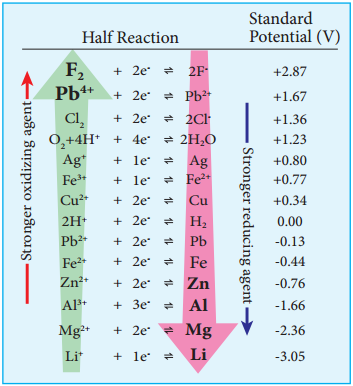
Thermodynamics of Cell Reactions img 17

Electrochemical Cell

Find free online Chemistry Topics covering a broad range of concepts from research institutes around the world.

Electrochemical Cell

Electrochemical cell is a device which converts chemical energy into electrical energy and vice versa. It consists of two separate electrodes which are in contact with an electrolyte solution. Electrochemical cells are mainly classified into the following two types.

1. Galvanic Cell (Voltaic Cell):

It is a device in which a spontaneous chemical reaction generates an electric current i.e., it converts chemical energy into electrical energy. It is commonly known as a battery.

2. Electrolytic Cell:

It is a device in which an electric current from an external source drives a nonspontaneous reaction i.e., it converts electrical energy into chemical energy.

Galvanic Cell

We have already learnt in XI standard that when a zinc metal strip is placed in a copper sulphate solution, the blue colour of the solution fades and the copper is deposited on the zinc strip as red – brown crust due to the following spontaneous chemical reaction.

Zn(s) + CuSO4(aq) → ZnSO4(aq) + Cu(s)

The energy produced in the above reaction is lost to the surroundings as heat.

In the above redox reaction, Zinc is oxidised to Zn2+ ions and the Cu2+ ions are reduced to metallic copper.
The half reactions are represented as below.

Zn(s) → Zn2+(aq) + 2e (oxidation)
Cu2+(aq) + 2e → Cu(s) (reduction)

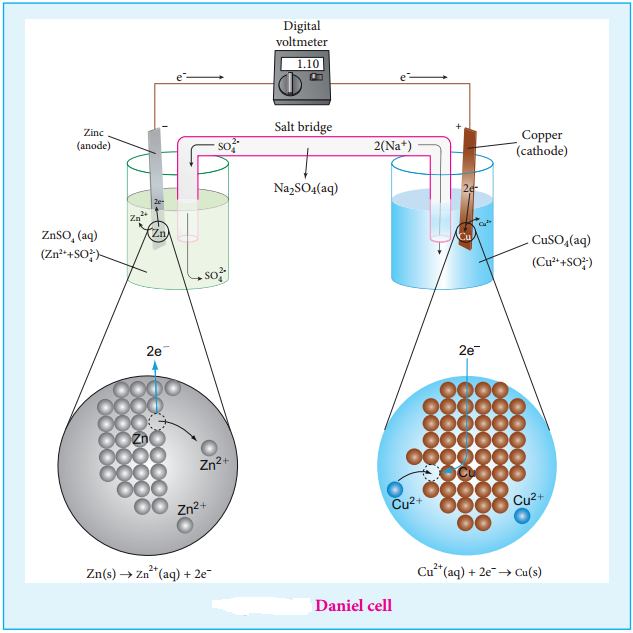
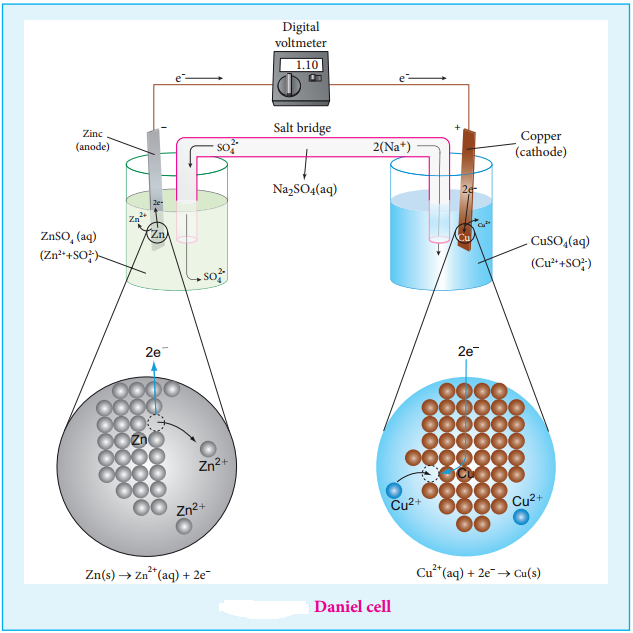
If we perform the above two half reactions separately in an apparatus as shown in figure 9.5, some of the energy produced in the reaction will be converted into electrical energy. Let us understand the function of a galvanic cell by considering Daniel cell as an example. It uses the above reaction for generation of electrical energy. The separation of half reaction is the basis for the construction of Daniel cell. It consists of two half cells.

Oxidation Half Cell

A metallic zinc strip that dips into an aqueous solution of zinc sulphate taken in a beaker, as shown in Figure 9.5.

Electrochemical Cell img 1

Reduction Half Cell

A copper strip that dips into an aqueous solution of copper sulphate taken in a beaker, as shown in Figure 9.5.

Electrochemical Cell img 2

Joining the Half Cells

The zinc and copper strips are externally connected using a wire through a switch (k) and a load (example: volt meter). The electrolytic solution present in the cathodic and anodic compartment are connected using an inverted U tube containing a agar-agar gel mixed with an inert electrolytes such as KCl, Na2SO4 etc., The ions of inert electrolyte do not react with other ions present in the half cells and they are not either oxidised (or) reduced at the electrodes. The solution in the salt bridge cannot get poured out, but through which the ions can move into (or) out of the half cells.

When the switch (k) closes the circuit, the electrons flows from zinc strip to copper strip. Ths is due to the following redox reactions which are taking place at the respective electrodes.

Anodic Oxidation

The electrode at which the oxidation occurs is called the anode. In Daniel cell, the oxidation take place at zinc electrode, i.e., zinc is oxidised to Zn2+ ions by loosing its electrons. The Zn2+ ions enter the solution and the electrons enter the zinc metal, then flow through the external wire and then enter the copper strip. Electrons are liberated at zinc electrode and hence it is negative (- ve).

Zn(s) → Zn2+(aq) + 2e (loss of electron-oxidation)

Cathodic Reduction

As discussed earlier, the electrons flow through the circuit from zinc to copper, where the Cu2+ ions in the solution accept the electrons, get reduced to copper and the same get deposited on the electrode. Here, the electrons are consumed and hence it is positive (+ ve).

Cu2+ + 2e → Cu (s) (gain of electron-reduction)

Salt Bridge

The electrolytes present in two half cells are connected using a salt bridge. We have learnt that the anodic oxidation of zinc electrodes results in the increase in concentration of Zn2+ in solution. i.e., the solution contains more number of Zn2+ ions as compared to SO42- and hence the solution in the anodic compartment would become positively charged.

Similarly, the solution in the cathodic compartment would become negatively charged as the Cu2+ ions are reduced to copper i.e., the cathodic solution contain more number of SO42- ions compared to Cu2+.

To maintain the electrical neutrality in both the compartments, the non reactive anions Cl (from KCl taken in the salt bridge) move from the salt bridge and enter into the anodic compartment, at the same time some of the K+ ions move from the salt bridge into the cathodic compartment.

Completion of Circuit

Electrons flow from the negatively charged zinc anode into the positively charged copper cathode through the external wire, at the same time, anions move towards anode and cations are move towards the cathode compartment. This completes the circuit.

Consumption of Electrodes

As the Daniel cell operates, the mass of zinc electrode gradually decreases while the mass of the copper electrode increases and hence the cell will function until the entire metallic zinc electrode is converted in to Zn2+ or the entire Cu2+ ions are converted in to metallic copper.

Unlike Daniel cell, in certain cases, the reactants (or) products cannot serve as electrodes and in such cases insert electrode such as graphite (or) platinum is used which conducts current in the external circuit.

Galvanic Cell Notation

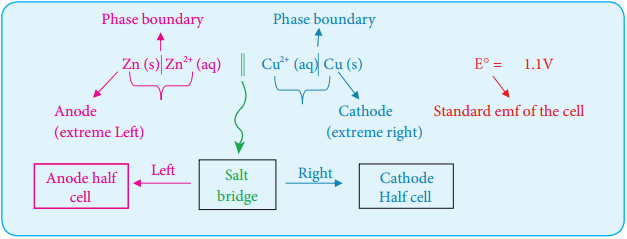
The galvanic cell is represented by a cell diagram, for example, Daniel cell is represented as

Zn (s)|Zn2+(aq)||Cu2+(aq)|Cu (s)

In the above notation, a single vertical bar (|) represents a phase boundary and the double vertical bar (||) represents the salt bridge. The anode half cell is written on the left side of the salt bridge and the cathode half cell on the right side.

The anode and cathode are written on the extreme left and extreme right, respectively. The emf of the cell is written on the right side after cell diagram.

Electrochemical Cell img 3

Example

The net redox reaction of a galvanic cell is given below
2 Cr (s) + 3Cu2+(aq) → 2Cr3+ (aq) + 3Cu (s)

Write the half reactions and describe the cell using cell notation.
Anodic oxidation 2Cr (s) → 2Cr3+ (aq) + 6e ….. (1)
Cathodic reduction : 3Cu2+ (aq) + 6e → 3 Cu (s) ….. (2)

Cell Notation is
Cr (s)|Cr 3+(aq)||Cu2+(aq)|Cu(s)

Emf of a Cell

We have learnt that when two half cells of a Daniel cell are connected, a spontaneous redox reaction will take place which results in the flow of electrons from anode to cathode. The force that pushes the electrons away from the anode and pulls them towards cathode is called the electromotive force (emf) (or) the cell potential. The SI unit of cell potential is the volt (v).

When there is one volt difference in electrical potential between the anode and cathode, one joule of energy is released for each columb of charge that moves between them.

i.e., 1J = 1C × 1V ….. (9.18)

The cell voltage depends on the nature of the electrodes, the concentration of the electrolytes and the temperature at which the cell is operated. For example

At, 25°C , The emf of the below mentioned Daniel cell is 1.107 Volts

Zn (s)|Zn2+(aq, 1M)||Cu2+(aq, 1M)|Cu (s) E° = 1.107 V0lts

Measurement of Electrode Potential

The overall redox reaction can be considered as the sum of two half reactions i.e., oxidation and reduction. Similarly, the emf of a cell can be considered as the sum of the electrode potentials at the cathode and anode,

Ecell = (Eox)anode + (Ered)cathode ….. (9.19)

Here, (Eox)anode represents the oxidation potential at anode and (Ered)cathode represents the reduction potential at cathode. It is impossible to measure the emf of a single electrode, but we can measure the potential difference between the two electrodes (Ecell) using a voltmeter.

If we know the emf of any one of the electrodes which constitute the cell, we can calculate the emf of the other electrode from the measured emf of the cell using the expression (9.19). Hence, we need a reference
electrode whose emf is known.

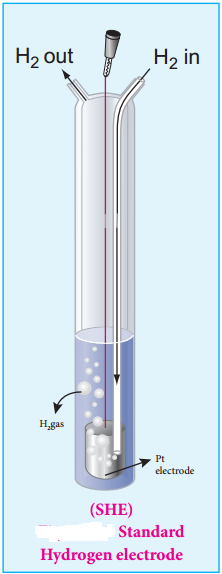
For that purpose, Standard Hydrogen Electrode (SHE) is used as the reference electrode. It has been assigned an arbitrary emf of exactly zero volt. It consists of a platinum electrode in contact with 1M HCl solution and 1 atm hydrogen gas. The hydrogen gas is bubbled through the solution at 25°C as shown in the figure 9.6. SHE can act as a cathode as well as an anode.

The Half cell reactions are given below.

If SHE is used as a cathode, the reduction reaction is
2H+(aq, 1M) + 2e → H2(g, 1 atm) E° = 0 volt

If SHE is used as an anode, the oxidation reaction is
H2(g, 1 atm) → 2H+(aq, 1M) + 2e E° = 0 volt

Electrochemical Cell img 4

Illustration

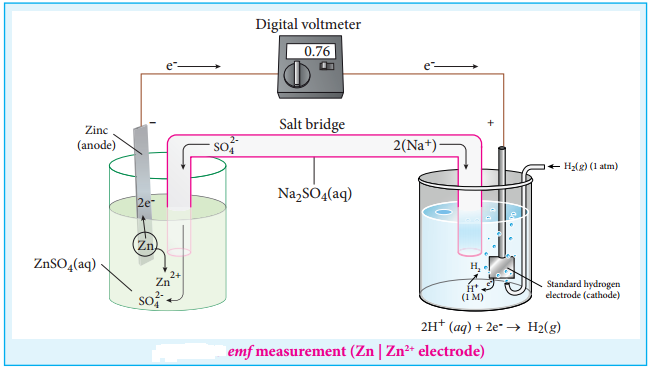
Let us calculate the reduction potential of zinc electrode dipped in zinc sulphate solution using SHE.

Step: 1

The following galvanic cell is constructed using SHE
Zn (s) | Zn2+(aq, 1M)|| H+(aq, 1M)| H2 (g, 1atm)| Pt (s)

Step: 2

The emf of the above galvanic cell is measured using a volt meter. In this case, the measured emf of the above galvanic cell is 0.76V.

Calculation
We know that,

cell = (E°ox)zn|zn2++ (E°red)SHE [From equation (9.19)]
cell = 0.76 and (E°red)SHE = 0V . Substitute these values in the above equation

Electrochemical Cell img 5

⇒ 0.76V = (E°ox)zn|zn2+ + 0V
⇒ (E°ox)zn|zn2+ = 0.76V

This oxidation potential corresponds to the below mentioned half cell reaction which takes place at the cathode.

Zn → Zn2++ 2e (Oxidation)

The emf for the reverse reaction will give the reduction potential
Zn2++2e → Z ; E° = – 0.76V
∴ (Eo°red)zn2+|zn = – 0.76V.