Functional Derivatives of Carboxylic Acids

Find free online Chemistry Topics covering a broad range of concepts from research institutes around the world.

Functional Derivatives of Carboxylic Acids

Compounds such as acid chlorides, amides, esters etc., are called carboxylic acid derivatives because they differ from a carboxylic acid only in the nature of the group or atom that has replaced the – OH group of carboxylic acid.
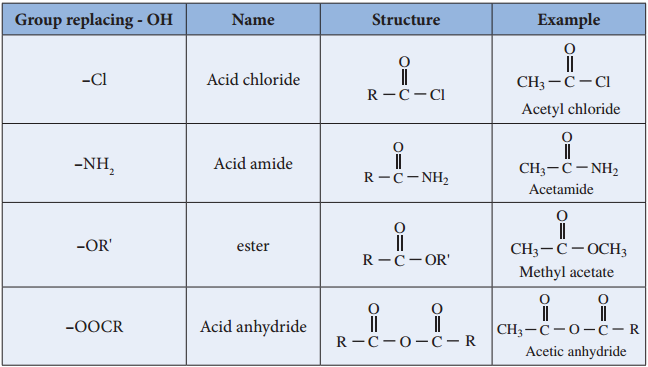
Functional Derivatives of Carboxylic Acids img 1

Relative Reactivity of Acid Derivatives

The reactivity of the acid derivatives follows the order

Functional Derivatives of Carboxylic Acids img 2

The above order of reactivity can be explained in terms of

  1. Basicity of the leaving group
  2. Resonance effect

1. Basicity of the Leaving Group

Weaker bases are good leaving groups. Hence acyl derivatives with weaker bases as leaving groups (L) can easily rupture the bond and are more reactive. The correct order of the basicity of the leaving group is Functional Derivatives of Carboxylic Acids img 3. Hence the reverse is the order of reactivity.

2. Resonance Effect

Lesser the electronegativity of the group, greater would be the resonance stabilization as shown below. This effect makes the molecule more stable and reduces the reactivity of the acyl compound. The order of electronegativity of the leaving groups follows the order – Cl > – OCOR > – OR > – NH2

Hence the order of reactivity of the acid derivatives with nucleophilic reagent follows the order

acid halide > acid anhydride > esters > acid amides

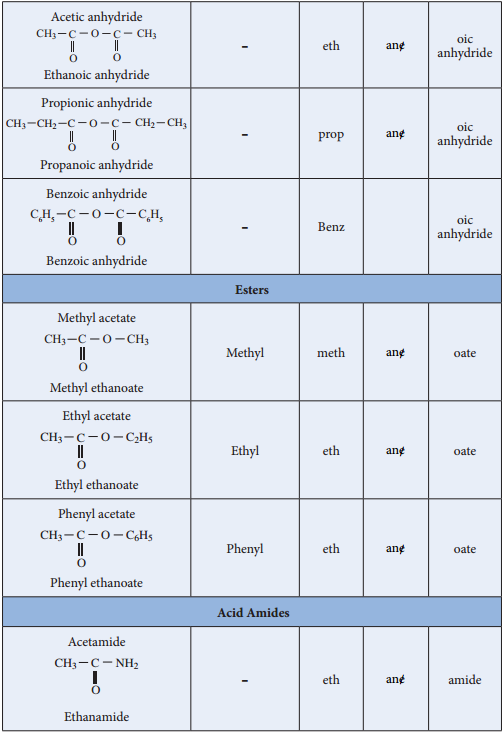
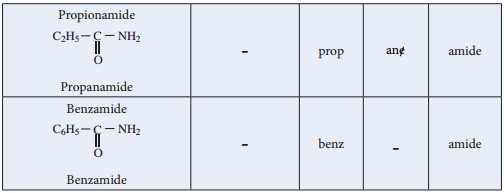
Nomenclature
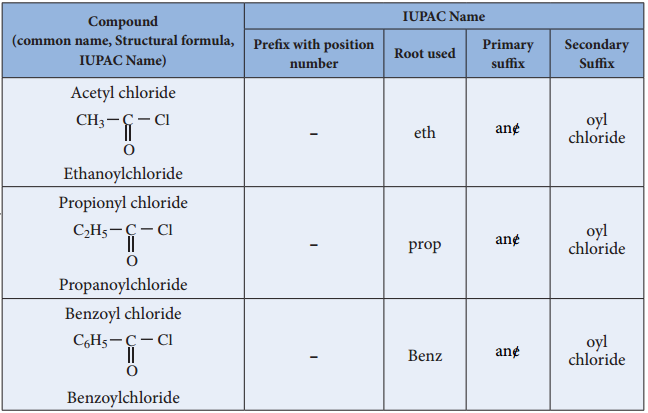
Functional Derivatives of Carboxylic Acids img 4
Functional Derivatives of Carboxylic Acids img 4a
Functional Derivatives of Carboxylic Acids img 4b

Acid Halides:

Methods of Preparation of Acid Chloride:

Acid chlorides are prepared from carboxylic acid by treating it with anyone of the chlorinating agent such as SOCl2, PCl5, or PCl3

1. By Reaction with Thionyl Chloride (SOCl2)

Functional Derivatives of Carboxylic Acids img 5

This method is superior to others as the by products being gases escape leaving the acid chloride in the pure state.

Physical Properties:

  • They emit pale fumes of hydrogen chloride when exposed to air on account of their reaction with water vapour.
  • They are insoluble in water but slowly begins to dissolve due to hydrolysis.

Chemical Properties:

They react with weak nucleophiles such as water, alcohols, ammonia and amines to produce the corresponding acid, ester, amide or substituted amides.

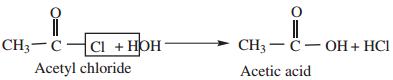
1. Hydrolysis:

Acyl halides undergo hydrolysis to form corresponding carboxylic acids
Functional Derivatives of Carboxylic Acids img 6

2. Reaction with Alcohols (Alcoholysis) gives esters.

Functional Derivatives of Carboxylic Acids img 7

3. Reaction with Ammonia (Ammonolysis) gives acid amides.

Functional Derivatives of Carboxylic Acids img 8

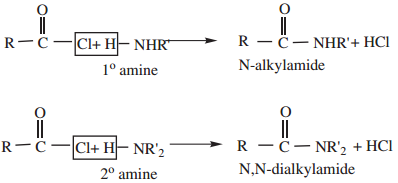
4. Reaction with 1° and 2° Amines gives N-alkyl amides.
Functional Derivatives of Carboxylic Acids img 9

5. Reduction

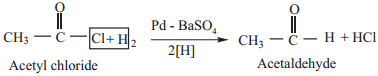
(a) When reduced with hydrogen in the presence of ‘poisoned’ palladium catalyst, they form aldehydes. This reaction is called Rosenmund reduction. We have already learnt this reaction under the preparation of aldehydes.
Functional Derivatives of Carboxylic Acids img 10

(b) When reduced with LiAlH4 gives primary alcohols.

Functional Derivatives of Carboxylic Acids img 11

Acid Anhydride

Methods of Preparation

1. Heating carboxylic acid with P2O5

We have already learnt that when carboxylic acids are heated with P2O5 dehydration takes place to form
acid anhydride.

2. By Reaction of Acid Halide With a Salt of Carboxylic Acids

Acid chlorides on heating with sodium salt of carboxylic acids gives corresponding anhydride.
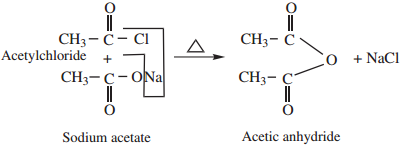
Functional Derivatives of Carboxylic Acids img 12

Chemical Properties

1. Hydrolysis

Acid anhydride are slowly hydrolysed, by water to form corresponding carboxylic acids.
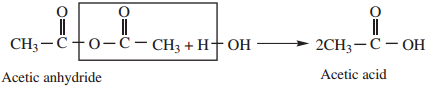
Functional Derivatives of Carboxylic Acids img 13

2. Reaction With Alcohol

Acid anhydride reacts with alcohols to form esters.

Functional Derivatives of Carboxylic Acids img 14

3. Reaction With Ammonia

Acid anhydride reacts with ammonia to form amides.

Functional Derivatives of Carboxylic Acids img 15

4. Reaction with PCl5

Acid anhydride reacts with PCl5 to form acyl chlorides.

Functional Derivatives of Carboxylic Acids img 16

Esters

Methods of Preparation

1. Esterification

We have already learnt that treatment of alcohols with carboxylic acids in presence of mineral acid gives esters. The reaction is carried to completion by using an excess of reactant or by removing the water from the reaction mixture.

2. Alcoholysis of Acid Chloride or Acid Anhydrides

(ii) Treatment of acid chloride or acid anhydride with alcohol also gives esters.

Physical Properties

Esters are colour less liquids or solids with characteristic fruity smell. Flavours of some of the esters are given below.

Ester

Flavour

1. Amyl acetateBanana
2. Ethyl butyratePineapple
3. Octyl acetateOrange
4. Isobutyl formateRaspberry
5. Amyl butyrateApricot

Chemical Properties

They react with weak nucleophiles such as water, alcohols, ammonia and amines to produce the corresponding acid, ester, amide or substituted amides.

1. Hydrolysis

We have already learnt that hydrolysis of esters gives alcohol and carboxylic acid.

2. Reaction With Alcohol (Transesterification)

Esters of an alcohol can react with another alcohol in the presence of a mineral acid to give the ester of second alcohol. The interchange of alcohol portions of the esters is termed transesterification.

 Transesterification

3. Reaction With Ammonia (Ammonolysis)

Esters react slowly with ammonia to form amides and alcohol.

4. Claisen Condensation

Esters containing at least one ∝ – hydrogen atom undergo self condensation in the presence of a strong base such as sodium ethoxide to form β – keto ester.

Functional Derivatives of Carboxylic Acids img 28

5. Reaction with PCl5

Esters react with PCl5 to give a mixture of acyl and alkyl chloride

Functional Derivatives of Carboxylic Acids img 29

Acid Amides

Acid amides are derivatives of carboxylic acid in which the – OH part of carboxyl group has been replaced by – NH2 group. The general formula of amides are given as follows image 21 Now, we shall focus our attention mainly on the study of chemistry of acetamide.

Methods of Preparation

1. Ammonolysis of Acid Derivatives

Acid amides are prepared by the action of ammonia with acid chlorides or acid anhydrides.
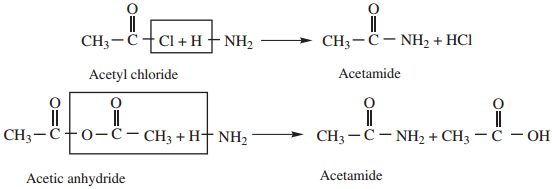
2. Heating Ammonium Carboxylates

Ammonium salts of carboxylic acids (ammonium carboxylates) on heating, lose a molecule of water to form amides.
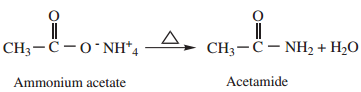
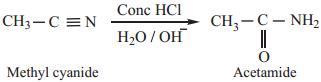
3. Partial Hydrolysis of Alkyl Cyanides (Nitriles)

Partial hydrolysis of alkyl cyanides with cold con HCl gives amides
Chemical Properties

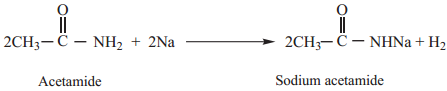
1. Amphoteric Character

Amides behave both as weak acid as well as weak base and thus show amphoteric character. This can be proved by the following reactions.
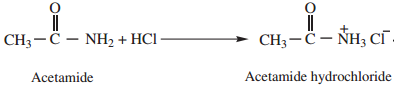
Acetamide (as acid) reacts with sodium to form sodium salt and hydrogen gas is liberated. 
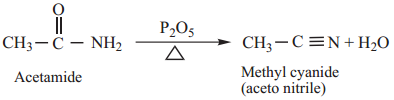
3. Dehydration

Amides on heating with strong dehydrating agents like P2O5 get dehydrated to form cyanides.
4. Hof Mann’s Degradation

Amides reacts with bromine in the presence of caustic alkali to form a primary amine carrying one carbon less than the parent amide.

5. Reduction

Amides on reduction with LiAlH4 or Sodium and ethyl alcohol to form corresponding amines.

Functional Derivatives of Carboxylic Acids img 27

Acidity of Carboxylic Acids

Find free online Chemistry Topics covering a broad range of concepts from research institutes around the world.

Acidity of Carboxylic Acids

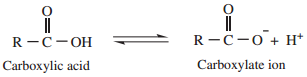
Carboxylic acids undergo ionisation to produce H+ and carboxylate ions in aqueous solution. The carboxylate anion is stabilised by resonance which make the Carboxylic acid to donate the proton easily.

Acidity of Carboxylic Acids img 1

The resonance structure of carboxylate ion are given below.

Acidity of Carboxylic Acids img 2

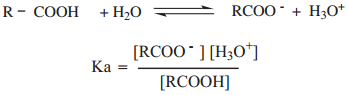
The strength of carboxylic acid can be expressed in terms of the dissociation constant(Ka):

Acidity of Carboxylic Acids img 3

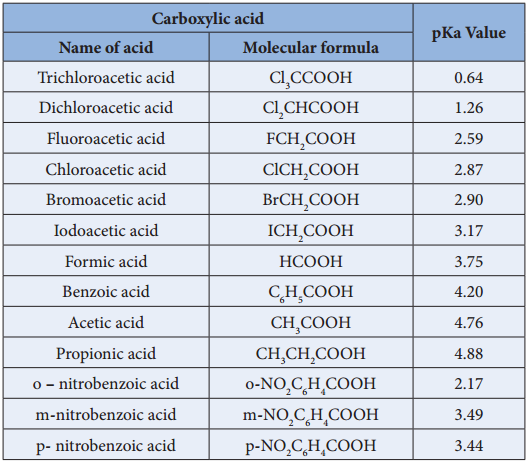
The dissociation constant is generally called acidity constant because it measures the relative strength of an acid. The stronger the acid, the higher will be its Ka value.

The dissociation constant of an acid can also be expressed in terms of pKa value.

pKa = – log Ka

A stronger acid will have higher Ka value but smaller pKa value.

Ka and pKa values of some Carboxylic acids of 298 K

Acidity of Carboxylic Acids img 4

Effect of substituents on the acidity of carboxylic acid.

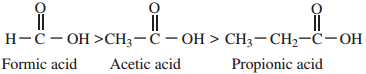
(i) Electron Releasing Alkyl Group Decreases the Acidity

Th electron releasing groups (+I groups) increase the negative charge on the carboxylate ion and destabilise it and hence the loss of proton becomes difficult. For example, formic acid is more stronger than acetic acid.

Acidity of Carboxylic Acids img 5

(ii) Electron with Drawing Substituents Increases the Acidity

The electron – withdrawing substituents decrease the negative charge on the carboxylate ion and stabilize it. In such cases, the loss of proton becomes relatively easy. Acidity increases with increasing electronegativity of the substituents. For example, the acidity of various halo acetic acids follows the order

F – CH2 – COOH > Cl – CH2 COOH > Br – CH2 – COOH > I – CH2 – COOH

Acidity increases with increasing number of electron – withdrawing substituents on the α – carbon. For example

Cl3C – COOH > Cl2CH – COOH > ClCH2COOH > CH3COOH

The effect of various, electron withdrawing groups on the acidity of a carboxylic acid follows the order,

– NO2 > – CN > – F > – Cl > – Br > – I > Ph

The relative acidities of various organic compounds are

RCOOH > ArOH > H2O > ROH > RC ≡ CH

Chemical Properties of Carboxylic Acids

Find free online Chemistry Topics covering a broad range of concepts from research institutes around the world.

Chemical Properties of Carboxylic Acids

Carboxylic acid do not give the characteristic reaction of carbonyl group image 1 as given by the aldehydes and ketones. as the carbonyl group of carboxylic acid is involved in resonance:

The reactions of carboxylic acids can be classified as follows:

(A) Reactions involving cleavage of O – H bond.
(B) Reactions involving cleavage of C – OH bond.
(C) Reactions involving – COOH group.
(D) Substitution reactions involving hydrocarbon part.

(A) Reactions involving cleavage of O – H bond.

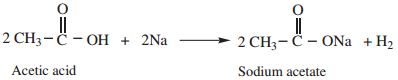
1. Reactions with Metals

Carboxylic acid react with active metals like Na, Mg, Zn etc to form corresponding salts with the liberation of hydrogen.

Example

Chemical Properties of Carboxylic Acids img 1

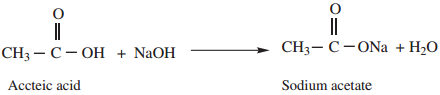
2. Reaction with Alkalies

Carboxylic acid reacts with alkalies to neutralise them and form salts.

Example

Chemical Properties of Carboxylic Acids img 2

3. Reaction with Carbonates and Bicarbonates (Test for Carboxylic Acid Group)

Carboxylic acids decompose carbonates and bicarbonates evolving carbondioxide gas with effervescence.

Example

Chemical Properties of Carboxylic Acids img 3

4. All Carboxylic Acids Turn Blue Litmus Red

(B) Reactions involving cleavage of C-OH bond

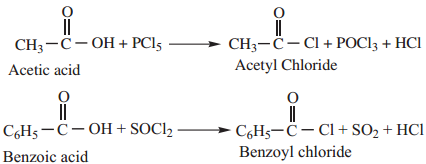
1. Reactions with PCl5, PCl3 and SOCl2

Example

Chemical Properties of Carboxylic Acids img 4

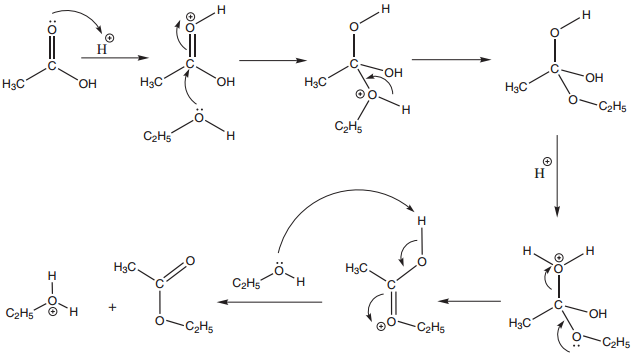
2. Reactions with Alcohols (Esterification)

When carboxylic acids are heated with alcohols in the presence of conc. H2SO4 or dry HCl gas, esters are formed. The reaction is reversible and is called esterification.

Example

Chemical Properties of Carboxylic Acids img 5

Mechanism of Esterification:

The Mechanism of esterifiation involves the following steps.

Chemical Properties of Carboxylic Acids img 6

(C) Reactions involving – COOH group

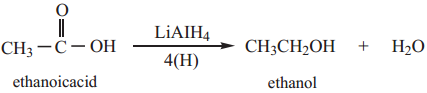
1. Reduction

(i) Partial Reduction to Alcohols

Carboxylic acids are reduced to primary alcohols by LiAlH4 or with hydrogen in the presence of copper chromite as catalyst. Sodium borohydride does not reduce the – COOH group.

Example

Chemical Properties of Carboxylic Acids img 7

(ii) Complete Reduction to Alkanes

When treated with HI and red phosphorous, carboxylic acid undergoes complete reduction to yield alkanes containing the same number of carbon atoms.

Example

Chemical Properties of Carboxylic Acids img 8

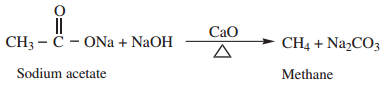
2. Decarboxylation

Removal of CO2 from carboxyl group is called as decarboxylation. Carboxylic acids lose carbon dioxide to form hydrocarbon when their sodium salts are heated with soda lime (NaOH and CaO in the ratio 3:1)

Example

Chemical Properties of Carboxylic Acids img 9

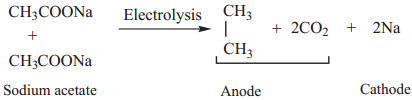
3. Kolbe’s Electrolytic Decarboxylation

The aqueous solutions of sodium or potassium salts of carboxylic acid on electrolysis gives alkanes at anode. This reaction is called kolbes electrolysis.

Chemical Properties of Carboxylic Acids img 10

Sodium formate solution on electrolysis gives hydrogen

4. Reactions with Ammonia

Carboxylic acids react with ammonia to form ammonium salt which on further heating at high temperature gives amides.

Example

Chemical Properties of Carboxylic Acids img 11

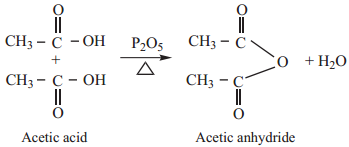
5. Action of Heat in the Presence of P2O5

Carboxylic acid on heating in the presence of a strong dehydrating agent such as P2O5 forms acid anhydride.

Example

Chemical Properties of Carboxylic Acids img 12

(D) Substitution Reactions in the Hydrocarbon Part

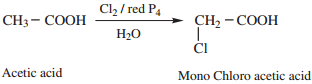
1. α – Halogenation

Carboxylic acids having an α – hydrogen are halogenated at the α – position on treatment with chlorine or bromine in the presence of small amount of red posphorus to form α halo carboxylic acids. This reaction is known as Hell – Volhard – Zelinsky reaction (HVZ reaction). The α – Halogenated acids are convenient starting materials for preparing α – substituted acids.

Chemical Properties of Carboxylic Acids img 13

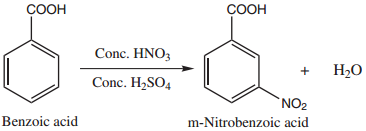
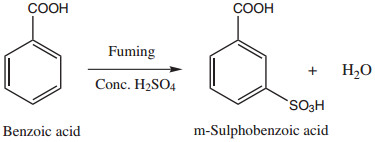
2. Electrophilic Substitution in Aromatic Carboxylic Acids

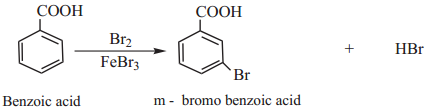
Aromatic carboxylic acid undergoes electrophilic substitution reactions. The carboxyl group is a deactivating and meta directing group. Some common electrophilic substitution reactions of benzoic acid are given below.

(i) Halogenation

Chemical Properties of Carboxylic Acids img 14

(ii) Nitration

Chemical Properties of Carboxylic Acids img 15

(iii) Sulphonation

Chemical Properties of Carboxylic Acids img 16

(iv) Benzoic acid does not undergo friedal crafts reaction. This is due to the strong deactivating nature of the carboxyl group.

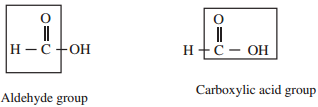
(E) Reducing Action of Formic Acid

Formic acid contains both an aldehyde as well as an acid group. Hence, like other aldehydes, formic acid can easily be oxidised and therefore acts as a strong reducing agent

Chemical Properties of Carboxylic Acids img 17

(i) Formic acid reduces Tollens reagent (ammonical silver nitrate solution) to metallic silver.

Chemical Properties of Carboxylic Acids img 18

(ii) Formic acid reduces Fehlings solution. It reduces blue coloured cupric ions to red coloured cuprous ions.

Chemical Properties of Carboxylic Acids img 19

Tests for Carboxylic Acid Group

  1. In aqueous solution carboxylic acid turn blue litmus red.
  2. Carboxylic acids give brisk effervescence with sodium bicarbonate due to the evolution of carbon-di-oxide.
  3. When carboxylic acid is warmed with alcohol and Con H2SO4 it forms an ester, which is detected by its fruity odour.

Physical Properties of Carboxylic Acids

Find free online Chemistry Topics covering a broad range of concepts from research institutes around the world.

Physical Properties of Carboxylic Acids

1. Aliphatic carboxylic acid upto nine carbon atoms are colour less liquids with pungent odour. The higher members are odourless wax like solids.

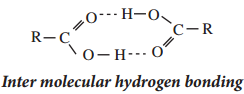
2. Carboxylic acids have higher boiling point than aldehydes, ketones and even alcohols of comparable molecular masses. This is due to more association of carboxylic acid molecules through intermolecular hydrogen bonding.

Physical Properties of Carboxylic Acids img 1

In fact, most of the carboxylic acids exist as dimer in its vapour phase.

3. Lower aliphatic carboxylic acids (up to four carbon) are miscible with water due to the formation of hydrogen bonds with water. Higher carboxylic acid are insoluble in water due to increased hydrophobic interaction of hydrocarbon part. The simplest aromatic carboxylic acid, benzoic acid is insoluble in water.

4. Vinegar is 6 to 8% solution of acetic acid in water. Pure acetic acid is called glacial acetic acid. Because it forms ice like crystal when cooled. When aqueous acetic acid is cooled at 289.5 K, acetic acid solidifies and forms ice like crystals, where as water remains in liquid state and removed by filtration. This process is repeated to obtain glacial acetic acid.

  • Carboxylic acids have high boiling points compared to other substances of comparable molar mass. Boiling points increase with molar mass.
  • Carboxylic acids having one to four carbon atoms are completely miscible with water. Solubility decreases with molar mass.

Carboxylic acids are soluble in water. Carboxylic acids do not dimerise in water, but forms hydrogen bonds with water. Carboxylic acids are polar and due to the presence of the hydroxyl in the carboxyl group, they are able to form hydrogen bonds with water molecules.

The solubility of compounds containing the carboxyl functional group in water depends on the size of the compound. The smaller the compound (the shorter the R group), the higher the solubility. The boiling point of a carboxylic acid is generally higher than that of water.

Larger carboxylic acids are solids with low melting points. There are a great many aromatic carboxylic acids, which are all crystalline solids. Carboxylic acids can form intermolecular hydrogen bonds and thus have relatively high melting and boiling points compared to other organic compounds that cannot hydrogen bond.

  • Carboxyl group comprises electronegative oxygen double bond to a carbon atom.
  • A compound comprising a carboxyl group will possess a high melting point, hydrophilic centres, and boiling point.

Methods of Preparation of Carboxylic Acids

Find free online Chemistry Topics covering a broad range of concepts from research institutes around the world.

Methods of Preparation of Carboxylic Acids

Some important methods for the preparation of carboxylic acids are as follows:

1. From Primary Alcohols and Aldehydes

Primary alcohols and aldehydes can easily be oxidised to the corresponding carboxylic acids with oxidising agents such as potassium permanganate (in acidic or alkaline medium), potassium dichromate (in acidic medium)

Example

Methods of Preparation of Carboxylic Acids img 1

2. Hydrolysis of Nitriles

Nitriles yield carboxylic acids when subjected to hydrolysis with an acid or alkali.

Example

Methods of Preparation of Carboxylic Acids img 2

3. Acidic Hydrolysis of Esters

Esters on hydrolysis with dilute mineral acids yield corresponding carboxylic acid

Example

Methods of Preparation of Carboxylic Acids img 3

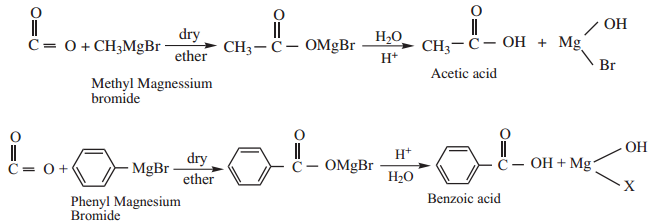
4. From Grignard Reagent

Grignard reagent reacts with carbon dioxide (dry ice) to form salts of carboxylic acid which in turn give corresponding carboxylic acid aftr acidifiation with mineral acid.

Example

Methods of Preparation of Carboxylic Acids img 4

Formic acid cannot be prepared by Grignard reagent since the acid contains only one carbon atom.

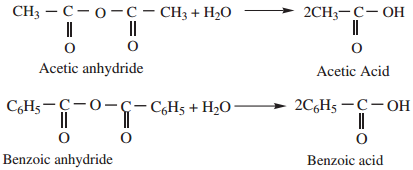
5. Hydrolysis of Acylhalides and Anhydrides

(a) Acid chlorides when hydrolysed with water give Carboxylic acids.

Example

Methods of Preparation of Carboxylic Acids img 5

(b) Acid anhydride when hydrolysed with water give corresponding carboxylic acids.

Methods of Preparation of Carboxylic Acids img 6

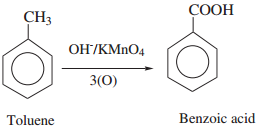
6. Oxidation of Alkyl Benzenes

Aromatic carboxylic acids can be prepared by vigorous oxidation of alkyl benzene with chromic acid or acidic or alkaline potassium permanganate. The entire side chain is oxidised to – COOH group irrespective of the length of the side chain.

Example

Methods of Preparation of Carboxylic Acids img 7