Avogadro’s number | Definition & Units

Find free online Chemistry Topics covering a broad range of concepts from research institutes around the world.

Avogadro’s number | Definition & Units

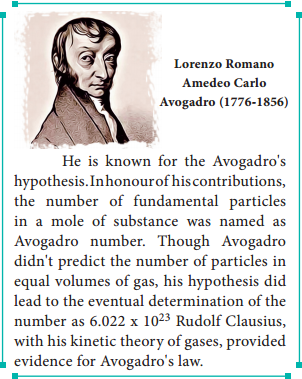
The total number of entities present in one mole of any substance is equal to 6.022 × 10²³. This number is called Avogadro number which is named after the Italian physicist Amedeo Avogadro who proposed that equal volume of all gases under the same conditions of temperature and pressure contain equal number of molecules. Avogadro number does not have any unit.

In a chemical reaction, atoms or molecules react in a specific ratio. Let us consider the following examples

Reaction 1:

C + O2 → CO2

Reaction 2:

CH4 + 2O2 → CO2 + 2 H2O

In the first reaction, one carbon atom reacts with one oxygen molecule to give one carbon dioxide molecule. In the second reaction, one molecule of methane burns with two molecules of oxygen to give one molecule of carbon dioxide and two molecules of water.

It is clear that the ratio of reactants is based on the number of molecules. Even though the ratio is based on the number of molecules it is practically difficult to count the number of molecules.

Because of this reason it is beneficial to use ‘mole’ concept rather than the actual number of molecules to quantify the reactants and the products. We can explain the first reaction as one mole of carbon reacts with one mole of oxygen to give one mole of carbon dioxide and the second reaction as one mole of methane burns with two moles of oxygen to give one mole of carbon dioxide and two moles of water. When only atoms are involved, scientists also use the term one gram atom instead of one mole.
Avogadro Number img 1

Molar Mass:

Molar mass is defined as the mass of one mole of a substance. The molar mass of a compound is equal to the sum of the relative atomic masses of its constituents expressed in g mol-1.

Examples:

  • Relative atomic mass of one hydrogen atom = 1.008 u
  • Molar mass of hydrogen atom = 1.008 g mol-1
  • Relative molecular mass of glucose = 180 u
  • Molar mass of glucose = 180 g mol-1

Molar Volume:

The volume occupied by one mole of any substance in the gaseous state at a given temperature and pressure is called molar volume.

Conditions

Volume occupied by one mole of any gaseous substances (in litre)

273 K and 1 bar pressure (STP)22.71
273 K and 1 atm pressure22.4
298 K and 1 atm pressure (Room temperature & Pressure (SATP)22.47

Mole Concept – What is a Mole? Related Formulae and Examples

Find free online Chemistry Topics covering a broad range of concepts from research institutes around the world.

Mole Concept – What is a Mole? Related Formulae and Examples

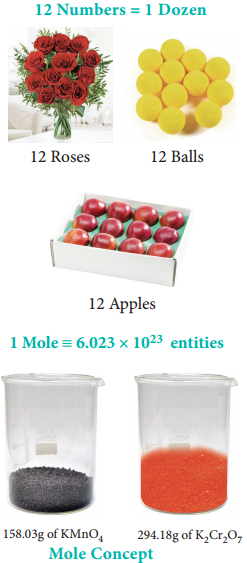
Often we use special names to express the quantity of individual items for our convenience. For example, a dozen roses means 12 roses and one quire paper means 24 single sheets. We can extend this analogy to understand the concept of mole that is used for quantifying atoms and molecules in chemistry. Mole is the SI unit to represent a specific amount of a substance.

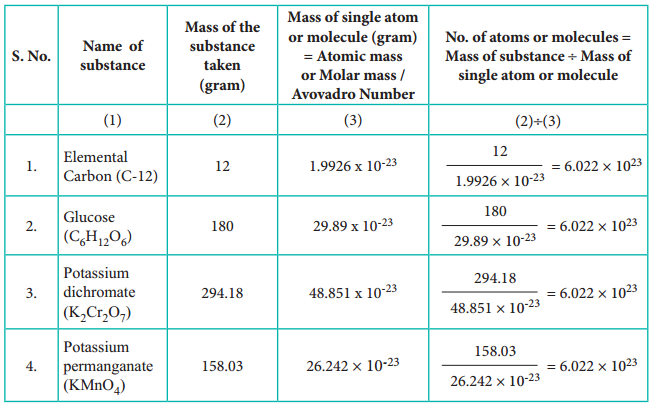
To understand the mole concept, let us calculate the total number of atoms present in 12 g of carbon – 12 isotope or molecules in 158.03 g of potassium permanganate, 294.18 g of potassium dichromate and 180 g of glucose.

Mole Concept img 1

Table 1.2 Calculation of Number of Entities in One Mole of Substance.

Mole Concept img 2

From the calculations we come to know that 12 g of carbon-12 contains 6.022 × 10²³ carbon atoms and same numbers of molecules are present in 158.03 g of potassium permanganate and 294.18 g of potassium dichromate. Similar to the way we use the term ‘dozen’ to represent 12 entities, we can use the term ‘mole’ to represent 6.022 × 10²³ (atoms or molecules or ions)

One mole is the amount of substance of a system, which contains as many elementary particles as there are atoms in 12 g of carbon-12 isotope. The elementary particles can be molecules, atoms, ions, electrons or any other specified particles.

Molar Mass – Definition, Formula

Find free online Chemistry Topics covering a broad range of concepts from research institutes around the world.

Molar Mass – Definition, Formula

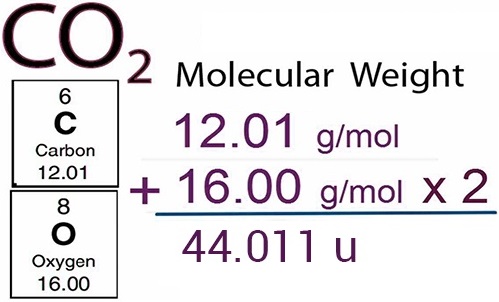
Similar to relative atomic mass, relative molecular mass is defined as the ratio of the mass of a molecule to the unified atomic mass unit. The relative molecular mass of any compound can be calculated by adding the relative atomic masses of its constituent atoms.

Molecular Mass img 1

For example,

(i) Relative molecular mass of hydrogen molecule (H2)
= 2 × (relative atomic mass of hydrogen atom)
= 2 × 1.008 u
= 2.016 u.

(ii) Relative molecular mass of glucose (C6H12O6)
= (6 × 12) + ( 12 × 1.008) + (6 × 16)
= 72 + 12.096 + 96
= 180.096 u

Relative Atomic Masses of Some Elements

Element

Relative atomic massElement

Relative atomic mass

H1.008Cl35.45
C12K39.10
N14Ca40.08
O16Cr51.99
Na23Mn54.94
Mg24.3Fe55.85
S32.07Cu63.55

Atomic Mass | Definition, Units & Facts

Find free online Chemistry Topics covering a broad range of concepts from research institutes around the world.

Atomic Mass | Definition, Units & Facts

How much does an individual atom weigh? As atoms are too small with diameter of 10-10 m and weigh approximately 10-27 kg, it is not possible to measure their mass directly. Hence it is proposed to have relative scale based on a standard atom.

The C-12 atom is considered as standard by the IUPAC (International Union of Pure and Applied Chemistry), and its mass is fixed as 12 amu (or) u. The amu (or) unified atomic mass unit is defined as one twelfth of the mass of a Carbon-12 atom in its ground state.

i.e. 1 amu (or) 1u ≈ 1.6605 × 10⁻²⁷ kg.

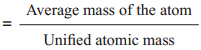
In this scale, the relative atomic mass is defined as the ratio of the average atomic mass to the unified atomic mass unit.

Relative atomic mass (Ar)

Atomic Masses img 1

For example,

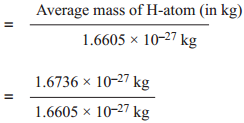
Relative atomic mass of hydrogen (Ar)H

Atomic Masses img 2

= 1.0078 ≈ 1.008 u.

Since most of the elements consist of isotopes that differ in mass, we use average atomic mass. Average atomic mass is defined as the average of the atomic masses of all atoms in their naturally occurring isotopes. For example, chlorine consists of two naturally occurring isotopes 17Cl35 and 17Cl37 in the ratio 77:23, the average relative atomic mass of chlorine is

= \(\frac{(35×77)+(37×23)}{100}\)
= 35.46 u

Classification of Matter (Elements, Compounds)

Find free online Chemistry Topics covering a broad range of concepts from research institutes around the world.

Classification of Matter (Elements, Compounds)

Look around your classroom. What do you see? You might see your bench, table, blackboard, window etc. What are these things made of ? They are all made of matter. Matter is defined as anything that has mass and occupies space. All matter is composed of atoms. This knowledge of matter is useful to explain the experiences that we have with our surroundings.

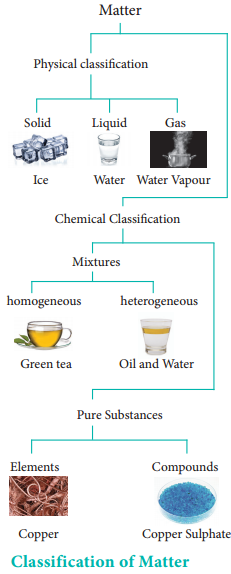
In order to understand the properties of matter better, we need to classify them. There are different ways to classify matter. The two most commonly used methods are classification by their physical state and by chemical composition as described in the chart.

Classification of Matter img 1

Physical Classification of Matter:

Matter can be classified as solids, liquids and gases based on their physical state. The physical state of matter can be converted into one another by modifying the temperature and pressure suitably.

Chemical Classification:

Matter can be classified into mixtures and pure substances based on chemical compositions. Mixtures consist of more than one chemical entity present without any chemical interactions. They can be further classified as homogeneous or heterogeneous mixtures based on their physical appearance. Pure substances are composed of simple atoms or molecules. They are further classified as elements and compounds.

Element:

An element consists of only one type of atom. We know that an atom is the smallest electrically neutral particle, being made up of fundamental particles, namely electrons, protons and neutrons. Element can exist as monatomic or polyatomic units.

Example:

Monatomic unit – Gold (Au), Copper (Cu); Polyatomic unit Hydrogen (H2), Phosphorous (P4) and
Sulphur (S8)

Compound:

Compounds are made up of molecules which contain two or more atoms of different elements.

Example:

Carbon dioxide (CO2), Glucose (C6H12O6), Hydrogen Sulphide (H2S), Sodium Chloride (NaCl)

Properties of compounds are different from those of their constituent elements. For example, sodium is a shiny metal, and chlorine is an irritating gas. But the compound formed from these two elements, sodium chloride, shows different characteristics as it is a crystalline solid, vital for biological functions.