Quantum Mechanical Model of Atom – Schrodinger Equation:

Find free online Chemistry Topics covering a broad range of concepts from research institutes around the world.

Quantum Mechanical Model of Atom – Schrodinger Equation:

The motion of objects that we come across in our daily life can be well described using classical mechanics which is based on the Newton’s laws of motion. In classical mechanics the physical state of the particle is defined by its position and momentum. If we know both these properties, we can predict the future state of the system based on the force acting on it using classical mechanics.

However, according to Heisenberg’s uncertainty principle both these properties cannot be measured simultaneously with absolute accuracy for a microscopic particle such as an electron. The classical mechanics does not consider the dual nature of the matter which is significant for microscopic particles.

As a consequence, it fails to explain the motion of microscopic particles. Based on the Heisenberg’s principle and the dual nature of the microscopic particles, a new mechanics called quantum mechanics was developed.

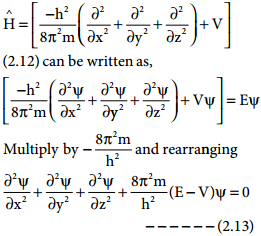
Erwin Schrodinger expressed the wave nature of electron in terms of a differential equation. This equation determines the change of wave function in space depending on the field of force in which the electron moves. The time independent Schrödinger equation can be expressed as,

\(\hat {H} \)Ψ = EΨ ………….. (2.12)

Where \(\hat {H} \) is called Hamiltonian operator, Ψ is the wave function and is a funciton of position Ψ(x, y, z) E is the energy of the system

Quantum Mechanical Model of Atom - Schrodinger Equation img 1

The above schrodinger wave equation does not contain time as a variable and is referred to as time independent Schrodinger wave equation. This equation can be solved only for certain values of E, the total energy. i.e. the energy of the system is quantised. The permitted total energy values are called eigen values and corresponding wave functions represent the atomic orbitals.

Main Features of the Quantum Mechanical Model of Atom

1. The energy of electrons in atoms is quantised

2. The existence of quantized electronic energy levels is a direct result of the wave like properties of electrons. The solutions of Schrodinger wave equation gives the allowed energy levels (orbits).

3. According to Heisenberg uncertainty principle, the exact position and momentum of an electron can not be determined with absolute accuracy. As a consequence, quantum mechanics introduced the concept of orbital. Orbital is a three dimensional space in which the probability of finding the electron is maximum.

4. The solution of Schrodinger wave equation for the allowed energies of an atom gives the wave function ψ, which represents an atomic orbital. The wave nature of electron present in an orbital can be well defined by the wave function ψ.

5. The wave function ψ itself has no physical meaning. However, the probability of finding the electron in a small volume dxdydz around a point (x, y, z) is proportional to |ψ(x, y, z)|<sup>2</sup> dxdydz around a point (x, y, z) is proportional to |ψ(x, y, z)|<sup>2</sup> is known as probability density and is always positive.

Heisenberg’s Uncertainty Principle

Find free online Chemistry Topics covering a broad range of concepts from research institutes around the world.

Heisenberg’s Uncertainty Principle

The dual nature of matter imposes a limitation on the simultaneous determination of position and momentum of a microscopic particle. Based on this, Heisenberg arrived at his uncertainty principle, which states that ‘It is impossible to accurately determine both the position and the momentum of a microscopic particle simultaneously’. The product of uncertainty (error) in the measurement is expressed as follows.

Δx.Δp ≥ h/4π …………….. (2.11)

where, Δx and Δp are uncertainties in determining the position and momentum, respectively.

The uncertainty principle has negligible effect for macroscopic objects and becomes significant only for microscopic particles such as electrons. Let us understand this by calculating the uncertainty in the velocity of the electron in hydrogen atom. (Bohr radius of 1st orbit is 0.529 Ǻ) Assuming that the position of the electron in this orbit is determined with the accuracy of 0.5 % of the radius.

Uncertainity in Position = ∆x
= \(\frac{0.5%}{100%}\) × 0.529 Ǻ
= \(\frac{0.5}{100}\) × 0.529 × 10⁻¹⁰m
Δx = 2.645 × 10⁻¹³m

From the Heisenberg’s uncertainity principle,
Δx.Δp ≥ \(\frac{h}{4π}\)
Δx.(m.Δv) ≥ \(\frac{h}{4π}\)

Heisenberg’s Uncertainty Principle img 1

Δv ≥ 2.189 × 10⁸ ms-1

Therefore, the uncertainty in the velocity of the electron is comparable with the velocity of light. At this high level of uncertainty it is very difficult to find out the exact velocity.

Wave Particle Duality of Matter

Find free online Chemistry Topics covering a broad range of concepts from research institutes around the world.

Wave Particle Duality of Matter

Albert Einstein proposed that light has dual nature. i.e. light photons behave both like a particle and as a wave. Louis de Broglie extended this concept and proposed that all forms of matter showed dual character. To quantify this relation, he derived an equation for the wavelength of a matter wave. He combined the following two equations of energy of which one represents wave character (hυ) and the other represents the particle nature (mc2).

(i) Planck’s quantum hypothesis:
E = hυ ……………. (2.6)

(ii) Einstein’s mass-energy relationship
E = mc2 …………….. (2.7)

From (2.6) and (2.7)

hν = mc2
hc/λ = mc2
λ = h/mc …………….. (2.8)

The equation 2.8 represents the wavelength of photons whose momentum is given by mc (Photons have zero rest mass)

For a particle of matter with mass m and moving with a velocity v, the equation 2.8 can be written as
λ = h/mv ………………. (2.9)

This is valid only when the particle travels at speeds much less than the speed of Light.

This equation implies that a moving particle can be considered as a wave and a wave can exhibit the properties (i.e momentum) of a particle. For a particle with high linear momentum (mv) the wavelength will be so small and cannot be observed. For a microscopic particle such as an electron, the mass is of the order of 10-31 kg, hence the wavelength is much larger than the size of atom and it becomes significant.

Let us understand this by calculating de Broglie wavelength in the following two cases:

  • A 6.626 kg iron ball moving at 10 ms-1
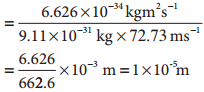
  • An electron moving at 72.73 ms-1

λironball= h/mv

Wave Particle Duality of Matter img 1

λelectron= h/mv

Wave Particle Duality of Matter img 2

For the electron, the de Broglie wavelength is significant and measurable while for the iron ball it is too small to measure, hence it becomes insignificant.

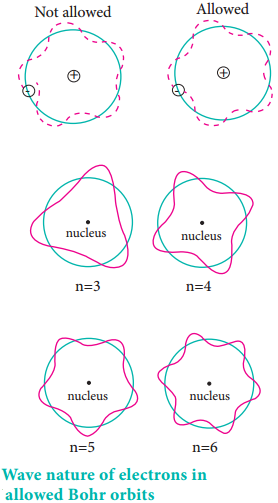
According to the de Broglie concept, the electron that revolves around the nucleus exhibits both particle and wave character. In order for the electron wave to exist in phase, the circumference of the orbit should be an integral multiple of the wavelength of the electron wave. Otherwise, the electron wave is out of phase.

Circumference of the orbit = nλ

2πr = nλ ……………… (2.10)
2πr = nh/mv

Rearranging,
mvr = nh/2π …………… (2.11)

Angular momentum = nh/2π

The above equation was already predicted by Bohr. Hence, De Broglie and Bohr’s concepts are in agreement with each other.

Wave Particle Duality of Matter img 3

Davison and Germer Experiment:

The wave nature of electron was experimentally confirmed by Davisson and Germer. They allowed the accelerated beam of electrons to fall on a nickel crystal and recorded the diffraction pattern. The resultant diffraction pattern is similar to the x-ray diffraction pattern. The finding of wave nature of electron leads to the development of various experimental techniques such as electron microscope, low energy electron diffraction etc.

Introduction to Atom Models

Find free online Chemistry Topics covering a broad range of concepts from research institutes around the world.

Introduction to Atom Models

Let us recall the history of the development of atomic models from the previous classes. We know that all things are made of matter. The basic unit that makes up all matter is atom. The word ‘atom’ has been derived from the Greek word ‘a – tomio’ meaning nondivisible.

Atom was considered as nondivisible until the discovery of subatomic particles such as electron, proton and neutron. J. J. Thomson’s cathode ray experiment revealed that atoms consist of negatively charged particles called electrons.

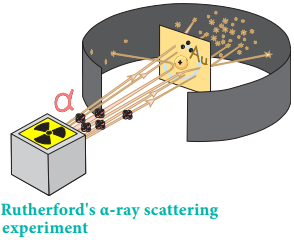
He proposed that atom is a positively charged sphere in which these electrons are embedded like the seeds in the watermelon. Later, Rutherford’s α-ray scattering experiment results proved that Thomson’s model was wrong. Rutherford bombarded a thin gold foil with a stream of fast moving α-particles. It was observed that

  1. Most of the α-particles passed through the foil
  2. Some of them were deflected through a small angle and
  3. Very few α-particles were reflected back by 180°

Introduction to Atom Models img 1

Based on these observations, he proposed that in an atom there is a tiny positively charged nucleus and the electrons are moving around the nucleus with high speed. The theory of electromagnetic radiation states that a moving charged particle should continuously loose its energy in the form of radiation.

Therefore, the moving electron in an atom should continuously loose its energy and finally collide with nucleus resulting in the collapse of the atom. However, this doesn’t happen and the atoms are stable. Moreover, this model does not explain the distribution of electrons around the nucleus and their energies.

Bohr Atom Model:

The work of Planck and Einstein showed that the energy of electromagnetic radiation is quantised in units of hν (where ν is the frequency of radiation and h is Planck’s constant 6.626 × 10⁻³⁴ Js). Extending Planck’s quantum hypothesis to the energies of atoms, Niels Bohr proposed a new atomic model for the hydrogen atom. This model is based on the following assumptions:

1. The energies of electrons in an atom are quantised.

2. The electron is revolving around the nucleus in a certain circular path of fixed energy called stationary orbit.

3. Electron can revolve only in those orbits in which the angular momentum (mvr) of the electron must be equal to an integral multiple of h/2π.

i.e. mvr = nh/2π ……………… (2.1)
where n = 1, 2, 3, … etc.,

4. As long as an electron revolves in the fixed stationary orbit, it doesn’t lose its energy. However, when an electron jumps from higher energy state (E2) to a lower energy state (E1), the excess energy is emitted as radiation. The frequency of the emitted radiation is

E2 – E1 = hυ
and
υ = \(\frac{(E2)-E1)}{h}\) ………………. (2.2)

Conversely, when suitable energy is supplied to an electron, it will jump from lower energy orbit to a higher energy orbit.

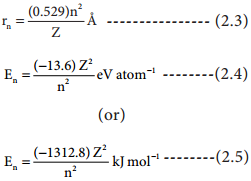
Applying Bohr’s postulates to a hydrogen like atom (one electron species such as H, He+ and Li2+ etc..) the radius of the nth orbit and the energy of the electron revolving in the nth orbit were derived.

The results are as follows:

Introduction to Atom Models img 2

The detailed derivation of rn and En will be discussed in 12th standard atomic physics unit.

Limitation of Bohr’s Atom Model:

The Bohr’s atom model is applicable only to species having one electron such as hydrogen, Li2+ etc… and not applicable to multi electron atoms. It was unable to explain the splitting of spectral lines in the presence of magnetic field (Zeeman effect) or an electric field (Stark effect).

Bohr’s theory was unable to explain why the electron is restricted to revolve around the nucleus in a fixed orbit in which the angular momentum of the electron is equal to nh/2π and a logical answer for this, was provided by Louis de Broglie.

Oxidation Number Defination and Examples

Find free online Chemistry Topics covering a broad range of concepts from research institutes around the world.

Oxidation Number Defination and Examples

It is defined as the imaginary charge left on the atom when all other atoms of the compound have been removed in their usual oxidation states that are assigned according to set of rules. A term that is often used interchangeably with oxidation number is oxidation state.

1. The oxidation state of a free element (i.e. in its uncombined state) is zero.
Example: each atom in H2, Cl2, Na, S8 have the oxidation number of zero.

2. For a monatomic ion, the oxidation state is equal to the net charge on the ion.

Example:

The oxidation number of sodium in Na+ is +1.

The oxidation number of chlorine in Cl is -1.

3. The algebric sum of oxidation states of all atoms in a molecule is equal to zero, while in ions, it is equal to the net charge on the ion.

Example:

In H2SO4; 2 × (oxidation number of hydrogen) + (oxidation number of S) + 4 (oxidation number of oxygen) = 0.

In SO42-; (oxidation number of S) + 4 (oxidation number of oxygen) = – 2.

4. Hydrogen has an oxidation number of +1 in all its compounds except in metal hydrides where it has – 1 value.

Example:

Oxidation number of hydrogen in hydrogen chloride (HCl) is + 1.
Oxidation number of hydrogen in sodium hydride (NaH) is -1.

5. Fluorine has an oxidation state of – 1 in all its compounds.

6. The oxidation state of oxygen in most compounds is – 2. Exceptions are peroxides, super oxides and compounds with fluorine.

Example:

Oxidation number of oxygen,

(i) in water (H2O) is – 2.

(ii) in hydrogen peroxide (H2O2) is -1.
2 (+ 1) + 2x = 0;
⇒ 2x = – 2;
⇒ x = – 1

(iii) in super oxides such as KO2 is – 1
+1 + 2x = 0;
2x = – 1;
x = – 1/2

(iv) in oxygen difloride (OF2) is + 2.
x + 2 (- 1) = 0;
x = + 2

7. Alkali metals have an oxidation state of + 1 and alkaline earth metals have an oxidation state of + 2 in all their compounds.

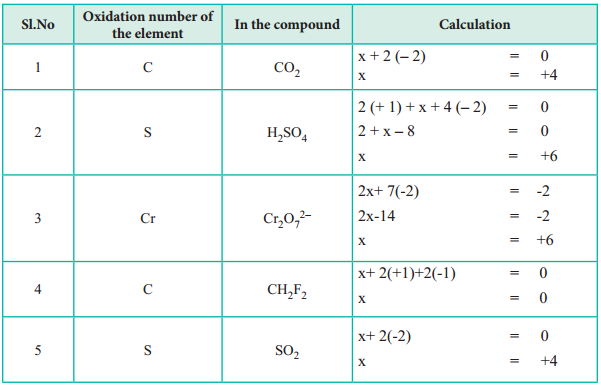
Calculation of Oxidation Number Using the Above Rules.
Oxidation Number img 1

Redox Reactions in Terms of Oxidation Numbers

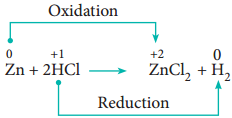
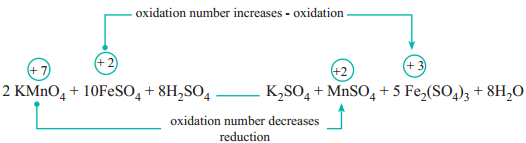
During redox reactions, the oxidation number of elements changes. A reaction in which oxidation number of the element increases is called oxidation. A reaction in which it decreases is called reduction.

Consider the following reaction
Oxidation Number img 2

In this reaction, manganese in potassium permanganate (KMnO4) favours the oxidation of ferrous sulphate (FeSO4) into ferric sulphate (Fe2(SO4)3 by gaining electrons and thereby gets reduced. Such reagents are called oxidising agents or oxidants. Similarly, the reagents which facilitate reduction by releasing electrons and get oxidised are called reducing agents.

Types of Redox Reactions

Redox reactions are classified into the following types.

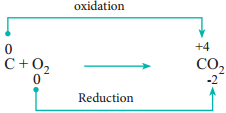
1. Combination Reactions:

Redox reactions in which two substances combine to form a single compound are called combination reaction.

Example:
Oxidation Number img 3

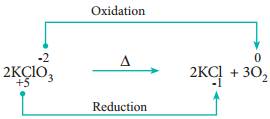
2. Decomposition Reactions:

Redox reactions in which a compound breaks down into two or more components are called decomposition reactions. These reactions are opposite to combination reactions. In these reactions, the oxidation number of the different elements in the same substance is changed.

Example
Oxidation Number img 4

3. Displacement Reactions:

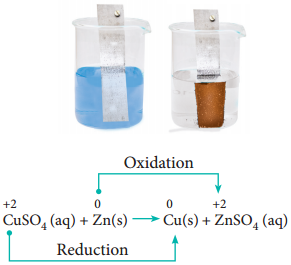
Redox reactions in which an ion (or an atom) in a compound is replaced by an ion (or atom) of another element are called displacement reactions. They are further classified into

  • Metal Displacement Reactions
  • Non-Metal Displacement Reactions

Metal Displacement Reactions:

Place a zinc metal strip in an aqueous copper sulphate solution taken in a beaker. Observe the solution, the intensity of blue colour of the solution slowly reduced and finally disappeared. The zinc metal strip became coated with brownish metallic copper. This is due to the following metal displacement reaction.
Oxidation Number img 5

Non-Metal Displacement

Oxidation Number img 6

4. Disproportionation Reaction (Auto Redox Reactions)

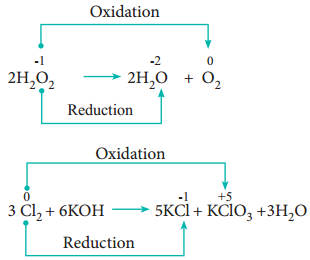
In some redox reactions, the same compound can undergo both oxidation and reduction. In such reactions, the oxidation state of one and the same element is both increased and decreased. These reactions are called disproportionation reactions.

Examples
Oxidation Number img 7

5. Competitive Electron Transfer Reaction

In metal displacement reactions, we learnt that zinc replaces copper from copper sulphate solution. Let us examine whether the reverse reaction takes place or not. As discussed earlier, place a metallic copper strip in zinc sulphate solution. If copper replaces zinc from zinc sulphate solution, Cu2+ ions would be released into the solution and the colour of the solution would change to blue.

But no such change is observed. Therefore, we conclude that among zinc and copper, zinc has more tendency to release electrons and copper to accept the electrons.

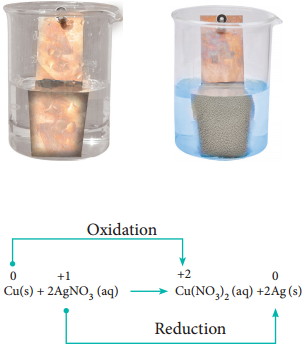
Let us extend the reaction to copper metal and silver nitrate solution. Place strip of metallic copper in sliver nitrate solution taken in a beaker. After some time, the solution slowly turns blue. This is due to the formation of Cu2+ ions, i.e. copper replaces silver from silver nitrate.

The reaction is,
Oxidation Number img 8

It indicates that between copper and silver, copper has the tendency to release electrons and silver to accept electrons.

From the above experimental observations, we can conclude that among the three metals, namely, zinc, copper and silver, the electron releasing tendency is in the following order.

Zinc > Copper > Silver

This kind of competition for electrons among various metals helps us to design (galvanic) cells. In XII standard we will study the galvanic cell in detail.

Balancing (the Equation) of Redox Reactions

The two methods for balancing the equation of redox reactions are as follows.

  • The oxidation number method
  • Ion-electron method / half reaction method.

Both are based on the same principle:

In oxidation – reduction reactions the total number of electrons donated by the reducing agent is equal to the total number of electrons gained by
the oxidising agent.

Oxidation Number Method

In this method, the number of electrons lost or gained in the reaction is calculated from the oxidation numbers of elements before and after the reaction. Let us consider the oxidation of ferrous sulphate by potassium permanganate in acid medium. The unbalanced chemical equation is,

FeSO4 + KMnO4 + H2SO4 → Fe2(SO4)3 + MnSO4 + K2SO4 + H2O

Step 1

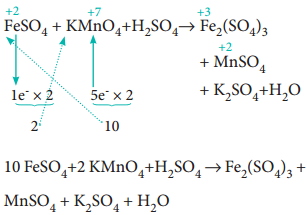
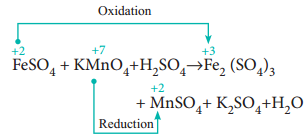
Using oxidation number concept, identify the reactants (atom) which undergo oxidation and reduction.
Oxidation Number img 9

(a) The oxidation number of Mn in KMnO4 changes from +7 to +2 by gaining five electrons.

(b) The oxidation number of Fe in FeSO4 changes from +2 to +3 by loosing one electron.

Step 2

Since, the total number of electrons lost is equal to the total number of electrons gained, equate, the number of electrons, by cross multiplication of the respective formula with suitable integers on reactant side as below. Here, the product Fe2(SO4)3 contains 2 moles of iron, So, the Coefficients 1e & 5e are multiplied by the number ‘2’.

Oxidation Number img 10

10 FeSO4 + 2 KMnO4 + H2SO4 → Fe2(SO4)3 + MnSO4 + K2SO4 + H2O

Step 3

Balance the reactant / Product Oxidised / Reduced

Now, based on the reactant side, balance the products (ie oxidised and reduced).The above equation becomes

10FeSO4 + 2KMnO4 + H2SO4 → 5Fe2(SO4)3 + 2MnSO4 + K2SO4 + H2O

Step 4

Balance the other elements except H and O atoms. In this case, we have to balance K and S atoms but K is balanced automatically.

Reactant Side:

10 ‘S’ atoms (10 FeSO4)

Product Side:

18 ‘S’ atoms

5Fe2(SO4)3 + 2MnSO4 + K2SO4

15S + 2S + 1S = 18S

Therefore the difference 8-S atoms in reactant side, has to be balanced by multiplying H2SO4 by ‘8’ The equation now becomes,

10FeSO4 + 2KMnO4 + 8H2SO4 → 5Fe2(SO4)3 + 2MnSO4 + K2SO4 + H2O

Step 5

Balancing ‘H’ and ‘O’ atoms

Reactant side ’16’-H atoms (8H2SO4 i.e. 8 × 2H = 16 ‘H’)

Product side ‘2’ – H atoms (H2O i.e. 1 × 2H = 2 ‘H’)

Therefore, multiply H2O molecules in the product side by ‘8’

10 FeSO4 + 2 KMnO4 + 8 H2SO4 → 5 Fe2(SO4)3 + 2 MnSO4 + k2SO4 + 8H2O

The oxygen atom is automatically balanced. This is the balanced equation.

Ion – Electron Method

This method is used for ionic redox reactions.

Step 1

Using oxidation number concept, find out the reactants which undergo oxidation and reduction.

Step 2

Write two separate half equations for oxidation and reduction reaction, Let us consider the same example which we have already discussed in
oxidation number method.

KMnO4 + FeSO4 + H2SO4 → MnSO4 + Fe2(SO4)3 + K2SO4 + H2O

The ionic form of this reaction is,

The two half reactions are,

Fe2+ → Fe3+ + 1e ………………….. (1)
and
MnO4 + 5e → Mn2+ …………………. (2)

Balance the atoms and charges on both sides of the half reactions.

Equation (1) ⇒ No changes i.e.,

Fe2+ → Fe3+ + 1e ………………….. (1)

Equation (2) ⇒ 4’O’ on the reactant side, therefore add 4H2O on the product side, to balance ‘H’ – add, 8H+ in the reactant side

MnO4 + 5e + 8H+ → Mn2+ + 4H2O ……………… (3)

Step 3

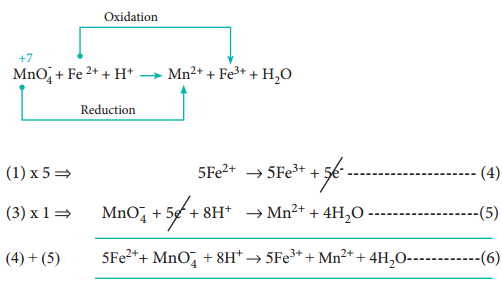
Equate both half reactions such that the number of electrons lost is equal to number of electrons gained. Addition of two half reactions gives the balanced equation represented by equation (6).
Oxidation Number img 11