Preparation of Hydrogen

Find free online Chemistry Topics covering a broad range of concepts from research institutes around the world.

Preparation of Hydrogen

High purity hydrogen (>99.9 %) is obtained by the electrolysis of water containing traces of acid or alkali or the electrolysis of aqueous solution of sodium hydroxide or potassium hydroxide using a nickel anode and iron cathode. However, this process is not economical for large-scale production.

At Anode:

2 OH → H2O + ½ O2 + 2e

At Cathode:

2 H2O + 2 e → 2 OH + H2

Overall Reaction:

H2O → H2 + ½ O2

Laboratory Preparation

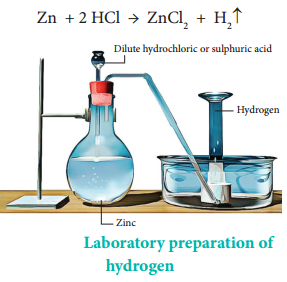
Hydrogen is conveniently prepared in laboratory by the reaction of metals, such as zinc, iron, tin with dilute acid.

Preparation of Hydrogen img 1

Industrial Production

In the large-scale, hydrogen is produced by steam-reforming of hydrocarbons. In this method hydrocarbon such as methane is mixed with steam and passed over nickel catalyst in the range 800-900 °C and 35 atm pressures.

Preparation of Hydrogen img 2

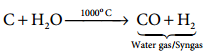
In an another process, steam is passed over a red-hot coke to produce carbon monoxide and hydrogen. The mixture of gases produced in this way is known as water gas (CO+H2). This is also called syngas (Synthetic gas) as it is used in the synthesis of organic compounds such as methanol and simple hydrocarbons.

Preparation of Hydrogen img 3

Conversion of Carbon Monoxide in Water gas to Carbon Dioxide:

The carbon monoxide of the water gas can be converted to carbon dioxide by mixing the gas mixture with more steam at 400°C and passed over a shift converter containing iron/copper catalyst. This reaction is called as water-gas shift reaction.

CO + H2 → CO2 + H2

The CO2 formed in the above process is absorbed in a solution of potassium carbonate.

CO2 + K2CO3 + H2O → 2KHCO3

Preparation of Deuterium:

Electrolysis of Heavy Water:

Normal water contains 1.6 × 10⁻⁴ percentage of heavy water. The dissociation of protium water (H2O) is more than heavy water (D2O). Therefore, when water is electrolysed, hydrogen is liberated much faster than D2. The electrolysis is continued until the resulting solution becomes enriched in heavy water. Further electrolysis of the heavy water gives deuterium.

Preparation of Hydrogen img 4

Preparation of Tritium:

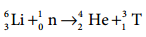
As explained earlier the tritium is present only in trace amounts. So it can be artificially prepared by bombarding lithium with slow neutrons in a nuclear fission reactor. The nuclear transmutation reaction for this process is as follows.

Preparation of Hydrogen img 5

Position in Periodic Table

Find free online Chemistry Topics covering a broad range of concepts from research institutes around the world.

Position in Periodic Table

The hydrogen has the electronic configuration of 1s1 which resembles with ns1 general valence shell configuration of alkali metals and shows similarity with them as follows:

  1. It forms unipositive ion (H+) like alkali metals (Na+, K+, Cs+)
  2. It forms halides (HX), oxides (H2O), peroxides (H2O2) and sulphides (H2S) like alkali metals (NaX, Na2O, Na2O2, Na2S)
  3. It also acts as a reducing agent.

However, unlike alkali metals which have ionization energy ranging from 377 to 520 kJ mol-1, the hydrogen has 1, 314 KJ mol-1 which is much higher than alkali metals. Like the formation of halides (X) from halogens, hydrogen also has a tendency to gain one electron to form hydride ion (H) whose electronic configuration is similar to the noble gas, helium. However, the electron affinity of hydrogen is much less than that of halogen atoms. Hence, the tendency of hydrogen to form hydride ion is low compared to that of halogens to form the halide ions as evident from the following reactions:

½ H2 + e → H ΔH = + 36 kcal mol-1
½ Br2 + e → Br ΔH = – 55 kcal mol-1

Since, hydrogen has similarities with alkali metals as well as the halogens; it is difficult to f nd the right position in the periodic table. However, in most of its compounds hydrogen exists in +1 oxidation state. Therefore, it is reasonable to place the hydrogen in group 1 along with alkali metals as shown in the latest periodic table published by IUPAC.

Isotopes of Hydrogen

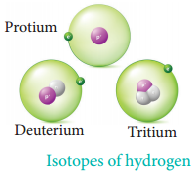
Hydrogen has three naturally occurring isotopes, viz., protium (1H1 or H), deuterium (1H2 or D) and tritium (1H3 or T). Protium (1H1) is the predominant form (99.985 %) and it is the only isotope that does not contain a neutron.

Position in Periodic Table img 1

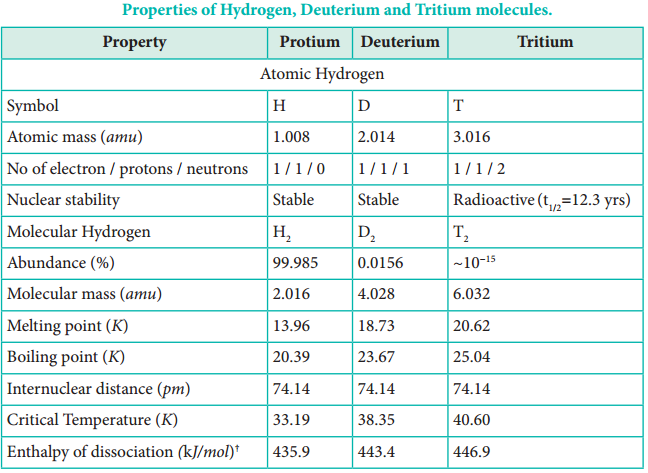
Deuterium, also known as heavy hydrogen, constitutes about 0.015 %. The third isotope, tritium is a radioactive isotope of hydrogen which occurs only in traces (~1 atom per 1018 hydrogen atoms). Due to the existence of these isotopes naturally occurring hydrogen exists as H2, HD, D2, HT, T2 and DT. The properties of these isotopes are shown in Table 4.1.

Position in Periodic Table img 2

Ortho and Para-Hydrogen:

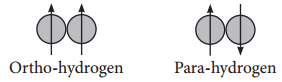
In the hydrogen atom, the nucleus has a spin. When molecular hydrogen is formed, the spins of two hydrogen nuclei can be in the same direction or in the opposite direction as shown in the figure. These two forms of hydrogen molecules are called ortho and para hydrogens respectively.

Position in Periodic Table img 3

At room temperature, normal hydrogen consists of about 75% ortho-form and 25% paraform. As the ortho-form is more stable than para-form, the conversion of one isomer into the other is a slow process. However, the equilibrium shift in favour of para hydrogen when the temperature is lowered.

The para-form can be catalytically transformed into ortho-form using platinum or iron. Alternatively, it can also be converted by passing an electric discharge, heating above 800°C and mixing with paramagnetic molecules such as O2, NO, NO2 or with nascent/atomic hydrogen.

Ortho and para hydrogen are similar in chemical properties but differ in some of the physical properties. For example, the melting point of para hydrogen is 13.83 K while that of ortho hydrogen 13.95 K; boiling point of para hydrogen is 20.26 K while that of ortho hydrogen 20.39 K. Since the nuclear spins are in opposite directions the magnetic moment of para hydrogen is zero and ortho hydrogen has magnetic moment twice that of a proton.

Periodic Trends in Chemical Properties:

Find free online Chemistry Topics covering a broad range of concepts from research institutes around the world.

Periodic Trends in Chemical Properties:

So far, we have studied the periodicity of the physical properties such as atomic radius, ionisation enthalpy, electron gain enthalpy and electronegativity. In addition, the chemical properties such as reactivity, valence, oxidation state etc… also show periodicity to certain extent.

In this section, we will discuss briefly about the periodicity in valence (oxidation state) and anomalous behaviour of second period elements (diagonal relationship).

Valence or Oxidation States

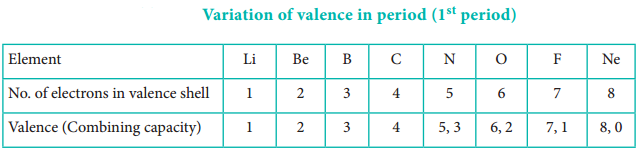
The valence of an atom is the combining capacity relative to hydrogen atom. It is usually equal to the total number of electrons in the valence shell or equal to eight minus the number of valence electrons. It is more convenient to use oxidation state in the place of valence.

Periodicity of Valence or Oxidation States

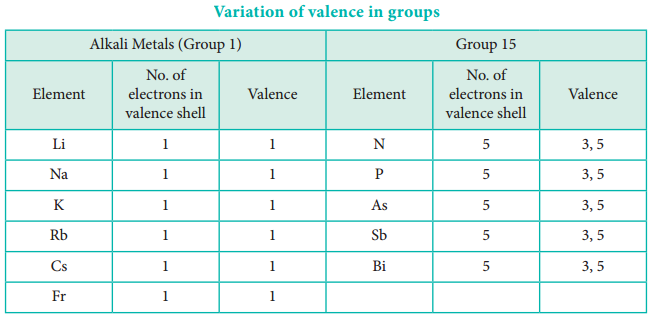
The valence of an atom primarily depends on the number of electrons in the valence shell. As the number of valence electrons remains same for the elements in same group, the maximum valence also remains the same. However, in a period the number of valence electrons increases, hence the valence also increases.

Periodic Trends in Chemical Properties img 1

Periodic Trends in Chemical Properties img 2

In addition to that some elements have variable valence. For example, most of the elements of group 15 which have 5 valence electrons show two valences 3 and 5. Similarly transition metals and inner transition metals also show variable oxidation states.

Anomalous Properties of Second Period Elements:

As we know, the elements of the same group show similar physical and chemical properties. However, the first element of each group differs from other members of the group in certain properties. For example, lithium and beryllium form more covalent compounds, unlike the alkali and alkali earth metals which predominantly form ionic compounds.

The elements of the second period have only four orbitals (2s & 2p) in the valence shell and have a maximum co-valence of 4, whereas the other members of the subsequent periods have more orbitals in their valence shell and shows higher valences. For example, boron forms BF4 and aluminium forms AlF63-.

Diagonal Relationship

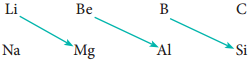
On moving diagonally across the periodic table, the second and third period elements show certain similarities. Even though the similarity is not same as we see in a group, it is quite pronounced in the following pair of elements.

Periodic Trends in Chemical Properties img 3

The similarity in properties existing between the diagonally placed elements is called ‘diagonal relationship’.

Periodic Trends and Chemical Reactivity:

The physical and chemical properties of elements depend on the valence shell electronic configuration as discussed earlier. The elements on the left side of the periodic table have less ionisation energy and readily lose their valence electrons.

On the other hand, the elements on right side of the periodic table have high electron affinity and readily accept electrons. As a consequence of this, elements of these extreme ends show high reactivity when compared to the elements present in the middle. The noble gases having completely filled electronic configuration neither accept nor lose their electron readily and hence they are chemically inert in nature.

The ionisation energy is directly related to the metallic character and the elements located in the lower left portion of the periodic table have less ionisation energy and therefore show metallic character. On the other hand the elements located in the top right portion have very high ionisation energy and are nonmetallic in nature.

Let us analyse the nature of the compounds formed by elements from both sides of the periodic table. Consider the reaction of alkali metals and halogens with oxygen to give the corresponding oxides.

4 Na + O2 → 2 Na2O
2 Cl2 + 7O2 → 2 Cl2O7

Since sodium oxide reacts with water to give strong base sodium hydroxide, it is a basic oxide. Conversely Cl2O7 gives strong acid called perchloric acid upon reaction with water So, it is an acidic oxide.

Na2O + H2O → 2NaOH
Cl2O7 → 2 Cl2O7

Thus, the elements from the two extreme ends of the periodic table behave differently as expected. As we move down the group, the ionisation energy decreases and the electropositive character of elements increases. Hence, the hydroxides of these elements become more basic. For example, let us consider the nature of the second group hydroxides:

Be(OH)2 amphoteric; Mg(OH)2 weakly basic; Ba(OH)2 strongly basic

Beryllium hydroxide reacts with both acid and base as it is amphoteric in nature.

Be(OH)2 + 2HCl → BeCl2 + 2H2O
Be(OH)2+ 2 NaOH → Na2BeO2 + 2H2O.

Periodic Trends in Properties

Find free online Chemistry Topics covering a broad range of concepts from research institutes around the world.

Periodic Trends in Properties

As discussed earlier, the electronic configuration of the elements shows a periodic variation with increase in atomic numbers. Similarly a periodic trend is observed in physical and chemical behaviour of elements. In this section, we will study the periodic trends in the following properties of elements.

  • Atomic Radius
  • Ionic Radius
  • Ionisation Enthalpy (energy)
  • Electron Gain Enthalpy (Electron Affinity)
  • Electronegativity

Atomic Radius

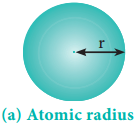
Atomic radius of an atom is defined as the distance between the centre of its nucleus and the outermost shell containing the valence electron.

It is not possible to measure the radius of an isolated atom directly. Except for noble gases, usually atomic radius is referred to as covalent radius or metallic radius depending upon the nature of bonding between the concerned atoms.
Periodic Trends in Properties img 1

Covalent Radius

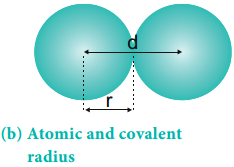
It is one-half of the internuclear distance between two identical atoms linked together by a single covalent bond. Inter nuclear distance can be determined using x-ray diffraction studies.
Periodic Trends in Properties img 2

Example:

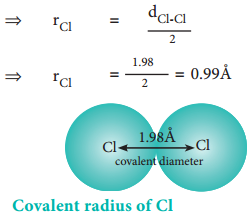
The experimental internuclear distance in Cl2 molecule is 1.98 Å. The covalent radius of chlorine is calculated as below.

dCl-Cl = rCl + rCl
⇒ dCl-Cl = 2rCl
Periodic Trends in Properties img 3

The formation of covalent bond involves the overlapping of atomic orbitals and it reduces the expected internuclear distance. Therefore covalent radius is always shorter than the actual atomic radius.

In case of hetero nuclear diatomic molecules, the covalent radius of individual atom can also be calculated using the internuclear distance (dA-B) between two different atoms A and B. The simplest method proposed by Schomaker and Stevenson is as follows.

dA-B = rA + rB – 0.09 (xA – xB)

where χA and χB are the electronegativities of A and B respectively in Pauling units. Here χA > χB and
radius is in Å.

Let us calculate the covalent radius of hydrogen using the experimental dH-Cl value is 1.28 Å and the covalent radius of chlorine is 0.99 Å. In pauling scale the electronegativity of chlorine and hydrogen are 3 and 2.1 respectively.

dH-Cl = rH + rCl – 0.09 (xCl – xH)
1.28 = rH + 0.99 – 0.09 (3 – 2.1)
1.28 = rH + 0.99 – 0.09 (0.9)
1.28 = rH + 0.99 – 0.081
1.28 = rH + 0.909
∴ rH = 1.28 – 0.909 = 0.371 Å

Metallic Radius

It is defied as one-half of the distance between two adjacent metal atoms in the closely packed metallic crystal lattice. For example, the distance between the adjacent copper atoms in solid copper is 2.56 Å and therefore the metallic radius of copper is \(\frac{2.56}{2}\) = 1.28 Å

The metallic radius can be calculated using the unit cell length of the metallic crystal. You will study the detailed calculation procedure in XII standard solid state unit.

Periodic Trends in Atomic Radius

Variation in Periods

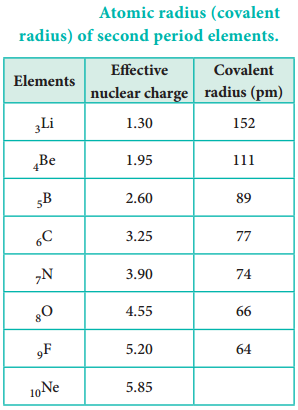
Atomic radius tends to decrease in a period. As we move from left to right along a period, the valence electrons are added to the same shell. The simultaneous addition of protons to the nucleus, increases the nuclear charge, as well as the electrostatic attractive force between the valence electrons and the nucleus. Therefore atomic radius decreases along a period.

Effective Nuclear Charge

In addition to the electrostatic forces of attraction between the nucleus and the electrons, there exists repulsive forces among the electrons. The repulsive force between the inner shell electrons and the valence electrons leads to a decrease in the electrostatic attractive forces acting on the valence electrons by the nucleus. Thus, the inner shell electrons act as a shield between the nucleus and the valence electrons. This effect is called shielding effect.

The net nuclear charge experienced by valence electrons in the outermost shell is called the effective nuclear charge. It is approximated by the below mentioned equation.

Zeff = Z – S

Where Z is the atomic number and ‘S’ is the screening constant which can be calculated using Slater’s rules as described below.

Step 1:

Write the electronic configuration of the atom and rearrange it by grouping ns and np orbitals together and others separately in the following form. (1s) (2s, 2p) (3s, 3p) (3d) (4s, 4p) (4d) (4f) (5s, 5p) …

Step 2:

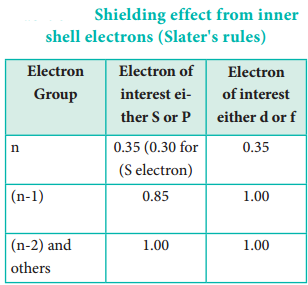
Identify the group in which the electron of interest is present. The electron present right to this group does not contribute to the shielding effect. Each of the electrons within the identified group (denoted by ‘n’) shields to an extent of 0.35 unit of nuclear charge. However, it is 0.30 unit for 1s electron.

Step 3:

Shielding of inner shell electrons. If the electron of interest belongs to either s or p orbital,

  • Each electron within the (n-1) group shields to an extent of 0.85 unit of nuclear charge, and
  • Each electron within the (n-2) group (or) even lesser group (n-3), (n-4) etc … completely shields i.e. to an extent of 1.00 unit of nuclear charge.

If the electron of interest belongs to d or f orbital, then each of electron left of the group of electron of interest shields to an extent of 1.00 unit of nuclear charge.

Step 4:

Summation of the shielding effect of all the electrons gives the shielding constant ‘S’

Example:

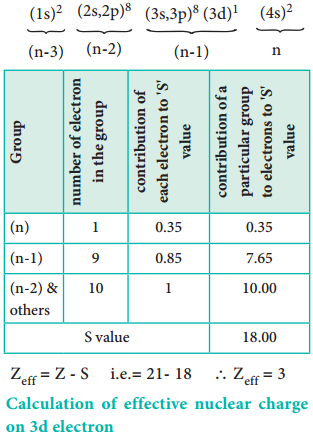
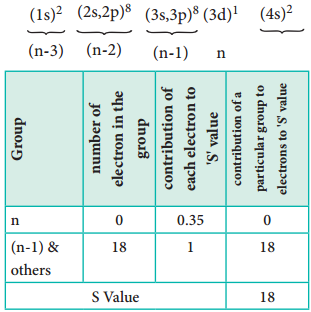
Let us explain the calculation of effective nuclear charge on 4s electron and 3d electron in scandium. The electronic configuration of scandium is 1s2, 2s2, 2p6, 3s2, 3p6, 4s2, 3d1. we can rearrange as below.
Periodic Trends in Properties img 4

Calculation of Effective Nuclear Charge on 3d Electron
Periodic Trends in Properties img 5

∴ Zeff = Z – S i.e. = 21 – 8 ∴Zeff = 3
Periodic Trends in Properties img 6

Periodic Trends in Properties img 7

Variation in Group

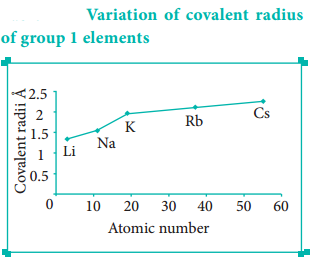
In the periodic table, the atomic radius of elements increases down the group. As we move down a group, new shells are opened to accommodate the newly added valence electrons. As a result, the distance between the centre of the nucleus and the outermost shell containing the valence electron increases. Hence, the atomic radius increases. The trend in the variation of the atomic radius of the alkali metals down the group os shown below.
Periodic Trends in Properties img 8

Ionic Radius

It is defined as the distance from the centre of the nucleus of the ion up to which it exerts its influence on the electron cloud of the ion. Ionic radius of uni-univalent crystal can be calculated using Pauling’s method from the inter ionic distance between the nuclei of the cation and anion. Pauling assumed that ions present in a crystal lattice are perfect spheres, and they are in contact with each other. Therefore,

d = rC+ + rA ………………… (1)

Where d is the distance between the centre of the nucleus of cation C+ and anion A and rC+, rA are the radius of the cation and anion respectively.

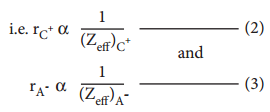
Pauling also assumed that the radius of the ion having noble gas electronic configuration (Na+ and Cl having
1s2 2s2, 2p6 configuration) is inversely proportional to the effective nuclear charge felt at the periphery of
the ion.
Periodic Trends in Properties img 9

Where Zeff is the effective nuclear charge and Zeff = Z – S

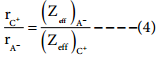
Dividing the equation 2 by 3
Periodic Trends in Properties img 10

On solving equation (1) and (4) the values of rC+ and rA can be obtained

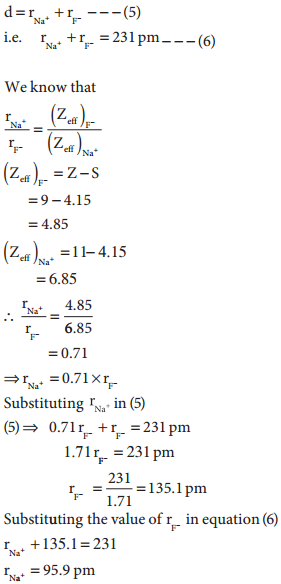
Let us explain this method by calculating the ionic radii of Na+ and F in NaF crystal whose interionic distance is equal to 231 pm.
Periodic Trends in Properties img 11

Ionisation Energy

It is defined as the minimum amount of energy required to remove the most loosely bound electron from the valence shell of the isolated neutral gaseous atom in its ground state. It is expressed in kJ mol-1 or in electron volts (eV). M(g) + IE1 → M+(g) + 1 e

Successive Ionisation Energies

The minimum amount of energy required to remove an electron from a unipositive cation is called second ionisation energy. It is represented by the following equation.

M+(g) + IE2 → M2+(g) + 1e

In this way we can define the successive ionisation energies such as third, fourth etc.

The total number of electrons are less in the cation than the neutral atom while the nuclear charge remains the same. Therefore the effective nuclear charge of the cation is higher than the corresponding neutral atom. Thus the successive ionisation energies, always increase in the following order

IE1 < IE2 < IE3 < …..

Periodic Trends in Ionisation Energy

The ionisation energy usually increases along a period with few exceptions. As discussed earlier, when we move from left to right along a period, the valence electrons are added to the same shell, at the same time protons are added to the nucleus.

This successive increase of nuclear charge increases the electrostatic attractive force on the valence electron and more energy is required to remove the valence electron resulting in high ionisation energy.

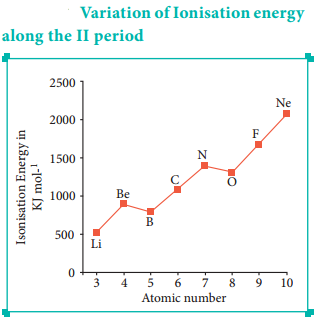
Let us consider the variation in ionisation energy of second period elements. The plot of atomic number vs ionisation energy is given below.

In the following graph, there are two deviation in the trends of ionisiation energy. It is expected that boron has higher ionisation energy than beryllium since it has higher nuclear charge. However, the actual ionisation energies of beryllium and boron are 899 and 800 kJ mol-1 respectively contrary to the expectation. It is due to the fact that beryllium with completely filled 2s orbital, is more stable than partially filled valence shell electronic configuration of boron. (2s2, 2p1)
Periodic Trends in Properties img 12

The electronic configuration of beryllium (Z=4) in its ground state is 1s2, 2s2 and that of boran is (Z = 5) 1s2 2s2 2p1

Similarly, nitrogen with 1s2, 2s2, 2p3 electronic configuration has higher ionisation energy (1402 kJ mol-1) than oxygen (1314 kJ mol-1). Since the half filled electronic configuration is more stable, it requires higher energy to remove an electron from 2p orbital of nitrogen. Whereas the removal one 2p electron from oxygen leads to a stable half filled configuration. This makes comparatively easier to remove 2p electron from oxygen.

Periodic Variation in Group

The ionisation energy decreases down a group. As we move down a group, the valence electron occupies new shells, the distance between the nucleus and the valence electron increases. So, the nuclear forces of attraction on valence electron decreases and hence ionisation energy also decreases down a group.

Ionisation Energy and Shielding Effect

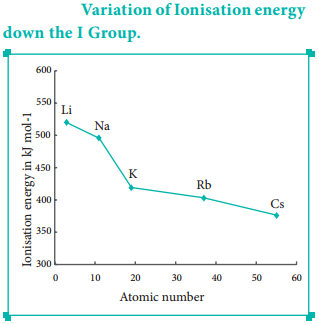
As we move down a group, the number of inner shell electron increases which in turn increases the repulsive force exerted by them on the valence electrons, i.e. the increased shielding effect caused by the inner electrons decreases the attractive force acting on the valence electron by the nucleus. Therefore the ionisation energy decreases. Let us understand this trend by considering the ionisation energy of alkali metals.
Periodic Trends in Properties img 13

Electron Affinity

It is defined as the amount of energy released (required in the case noble gases) when an electron is added to the valence shell of an isolated neutral gaseous atom in its ground state to form its anion. It is expressed in kJ mol-1

A + e → A + EA

Variation of Electron Affinity in a Period:

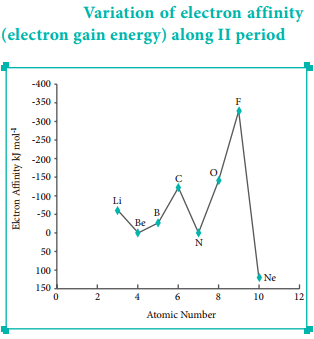
The variation of electron affinity is not as systematic as in the case of ionisation energy. As we move from alkali metals to halogens in a period, generally electron affinity increases, i.e. the amount of energy released will be more. This is due to an increase in the nuclear charge and decrease in size of the atoms.

However, in case of elements such as beryllium (1s2, 2s2), nitrogen (1s2, 2s2, 2p3) the addition of extra electron will disturb their stable electronic configuration and they have almost zero electron affinity.
Periodic Trends in Properties img 14

Noble gases have stable ns2, np6 configuration, and the addition of further electron is unfavourable and requires energy. Halogens having the general electronic configuration of ns2, np5 readily accept an electron to get the stable noble gas electronic configuration (ns2, np6), and therefore in each period the halogen has high electron affinity. (high negative values)

Variation of Electron Affinity in a Group:

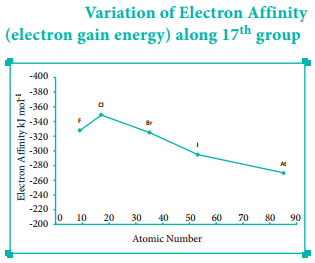
As we move down a group, generally the electron affinity decreases. It is due to increase in atomic size and the shielding effect of inner shell electrons. However, oxygen and fluorine have lower affinity than sulphur and chlorine respectively.

The sizes of oxygen and fluorine atoms are comparatively small and they have high electron density. Moreover, the extra electron added to oxygen and fluorine has to be accommodated in the 2p orbital which is relatively compact compared to the 3p orbital of sulphur and chlorine so, oxygen and fluorine have lower electron affinity than their respective group elements sulphur and chlorine.
Periodic Trends in Properties img 15

Electronegativity

It is defined as the relative tendency of an element present in a covalently bonded molecule, to attract the shared pair of electrons towards itself. Electronegativity is not a measurable quantity. However, a number of scales are available to calculate its value. One such method was developed by Pauling, he assigned arbitrary value of electronegativities for hydrogen and fluorine as 2.1 and 4.0 respectively. Based on this the  electronegativity values for other elements can be calculated using the following expression

Periodic Trends in Properties img 16

Where EAB, EAA and EBB are the bond dissociation energies (K cal) of AB, A2 and B2 molecules respectively.

The electronegativity of any given element is not a constant and its value depends on the element to which it is covalently bound. The electronegativity values play an important role in predicting the nature of the bond.

Variation of Electronegativity in a Period:

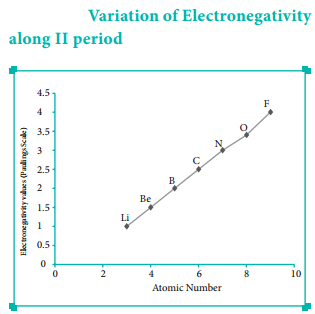
The electronegativity generally increases across a period from left to right. As discussed earlier, the atomic radius decreases in a period, as the attraction between the valence electron and the nucleus increases. Hence the tendency to attract shared pair of electrons increases. Therefore, electronegativity also increases in a period.
Periodic Trends in Properties img 17

Periodic Trends in Properties img 18

Variation of Electronegativity in a Group:

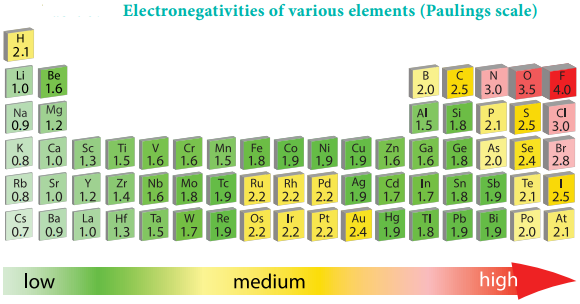
The electronegativity generally decreases down a group. As we move down a group the atomic radius increases and the nuclear attractive force on the valence electron decreases. Hence, the electronegativity decreases.

Noble gases are assigned zero electronegativity. The electronegativity values of the elements of s-block show the expected decreasing order in a group. Except 13th and 14th group all other p-block elements follow the expected decreasing trend in electronegativity.
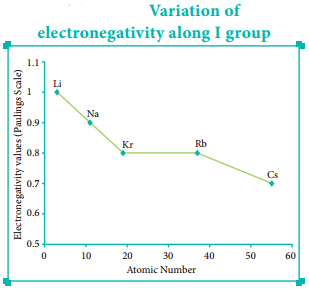
Periodic Trends in Properties img 19

Grouping of Elements Based on Electronic Configurations

Find free online Chemistry Topics covering a broad range of concepts from research institutes around the world.

Grouping of Elements Based on Electronic Configurations

In the modern periodic table, the elements are organised in 7 periods and 18 groups based on the modern periodic law. The placement of element in the periodic table is closely related to its outer shell electronic configuration. Let us analyse the change in the electronic configuration of elements along the periods and down the groups.

Variation of Electronic Configuration Along the Periods

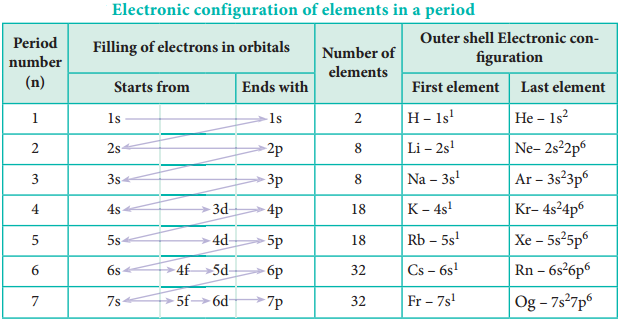
We have already learnt that each period starts with the element having general outer electronic configuration ns1 and ends with ns2, np6 where n is the period number. The first period starts with the filling of valence electrons in 1s orbital, which can accommodate only two electrons.

Hence, the first period has two elements, namely hydrogen and helium. The second period starts with the filling of valence electrons in 2s orbital followed by three 2p orbitals with eight elements from lithium to neon. The third period starts with filling of valence electrons in the 3s orbital followed by 3p orbitals.

The fourth period starts with filling of valence electrons from 4s orbital followed by 3d and 4p orbitals in accordance with Aufbau principle. Similarly, we can explain the electronic configuration of elements in the subsequent periods (Table 3.10).

Grouping of Elements Based on Electronic Configurations img 1

In the fourth period the filling of 3d orbitals starts with scandium and ends with zinc. These 10 elements are called first transition series. Similarly 4d, 5d and 6d orbitals are filled in successive periods and the corresponding series of elements are called second, third and fourth transition series respectively.

In the sixth period the filling of valence electrons starts with 6s orbital followed by 4f, 5d and 6p orbitals. The filling up of 4f orbitals begins with Cerium (Z=58) and ends at Lutetium (Z=71). These 14 elements constitute the first inner-transition series called Lanthanides.

Similarly, in the seventh period 5f orbitals are filled, and it’s -14 elements constitute the second inner transition series called Actinides. These two series are placed separately at the bottom of the modern periodic table.

Variation of Electronic Configuration in the Groups:

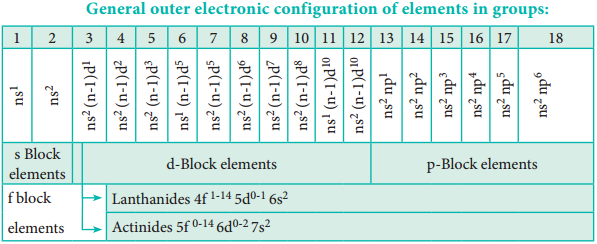
Elements of a group have similar electronic configuration in the outer shell. The general outer electronic configurations for the 18 groups are listed in the Table 3.11. The groups can be combined as s, p, d and f block elements on the basis of the orbital in which the last valence electron enters.

The elements of group 1 and group 2 are called s-block elements, since the last valence electron enters the ns orbital. The group 1 elements are called alkali metals while the group 2 elements are called alkaline earth metals.

These are soft metals and possess low melting and boiling points with low ionisation enthalpies. They are highly reactive and form ionic compounds. They are highly electropositive in nature and most of the elements imparts colour to the flame. We will study the properties of these group elements in detail in subsequent chapters.

The elements of groups 13 to 18 are called p-block elements or representative elements and have a general electronic configuration ns2, np1-6. The elements of the group 16 and 17 are called chalcogens and halogens respectively.

The elements of 18th group contain completely filled valence shell electronic configuration (ns2, np6) and are called inert gases or nobles gases. The elements of p-block have high negative electron gain enthalpies. The ionisation energies are higher than that of s-block elements. They form mostly covalent compounds and shows more than one oxidation states in their compounds.

The elements of the groups 3 to 12 are called d-block elements or transition elements with general valence shell electronic configuration ns1-2, (n-1)d1-10. These elements also show more than one oxidation state and form ionic, covalent and co-ordination compounds. They can form interstitial compounds and alloys which can also act as catalysts. These elements have high melting points and are good conductors of heat and electricity.

The lanthanides (4f1-14, 5d0-1, 6s2) and the actinides (5f0-14, 6d0-2, 7s2) are called f-block elements. These elements are metallic in nature and have high melting points. Their compounds are mostly coloured. These elements also show variable oxidation states.

Grouping of Elements Based on Electronic Configurations img 2