Hydrogen Peroxide

Find free online Chemistry Topics covering a broad range of concepts from research institutes around the world.

Hydrogen Peroxide

Hydrogen peroxide (H2O2) is one of the most important peroxides. It can be prepared by treating metal peroxide with dilute acid.

BaO2 + H2SO4 → BaSO4 + H2O2
Na2O2 + H2SO4 → Na2SO4 + H2O2

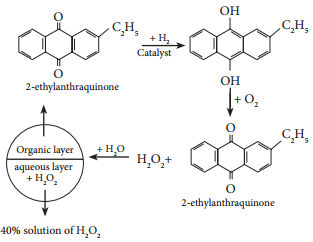
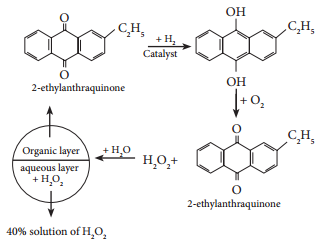
On an industrial scale, hydrogen peroxide is now prepared exclusively by autoxidation of 2-alkyl anthraquinol.
Hydrogen Peroxide img 1

Physical Properties:

Pure hydrogen peroxide is almost a colorless liquid (pale blue), less volatile and more viscous than water.

A 30 % solution of hydrogen peroxide is marketed as ‘100-volume’ hydrogen peroxide indicating that at S.T.P., 100 ml of oxygen is liberated by 1 ml of this solution on heating.

Chemical Properties:

Hydrogen peroxide is highly unstable and the aqueous solution spontaneously disproportionates to give oxygen and water. The reaction is, however, slow but is explosive when catalyzed by metal. If it is stored in glass container, it dissolves the alkali metals from the glass, which catalyzes the disproportionation reaction. For this reason, H2O2 solutions are stored in plastic bottles.

H2O2 → H2O + ½O2

Hydrogen peroxide can act both as an oxidizing agent and a reducing agent. Oxidation is usually performed in acidic medium while the reduction reactions are performed in basic medium.

In Acidic Conditions:

H2O2 + 2 H+ + 2e → 2 H2O (E° = + 1.77 V)

For Example

2FeSO4 + H2SO4 + H2O2 → Fe2(SO4)3 + 2H2O

In Basic Conditions:

HO2 + OH → 2H2O

For Example,

2KMnO4(aq) + 3 H2O2(aq)

2MnO2 + 2KOH + 2H2O + 3O2(g)

Uses of Hydrogen Peroxide:

The oxidizing ability of hydrogen peroxide and the harmless nature of its products, i.e., water and oxygen, lead to its many applications. It is used in water treatment to oxidize pollutants, as a mild antiseptic, and as bleach in textile, paper and hair-care industry.

Hydrogen peroxide is used to restore the white colour of the old paintings which was lost due to the reaction of hydrogen sulphide in air with the white pigment Pb3(OH)2(CO3)2 to form black colored lead sulphide. Hydrogen peroxide oxidises black coloured lead sulphide to white coloured lead sulphate, there by restoring the colour.

PbS + 4H2O2 → PbSO4 + 4 H2O

Structure of Hydrogen Peroxide:

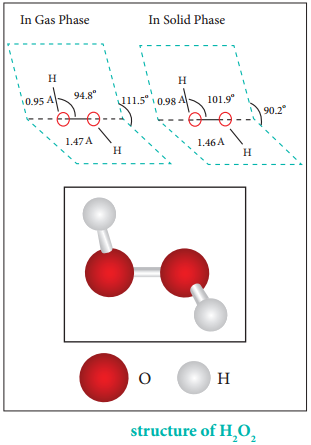
Both in gas-phase and solid-phase, the molecule adopts a skew conformation due to repulsive interaction of the OH bonds with lone-pairs of electrons on each oxygen atom. Indeed, it is the smallest molecule known to show hindered rotation about a single bond.
Hydrogen Peroxide img 2

H2O2 has a non-planar structure. The molecular dimensions in the gas phase and solid phase differ as shown in figure 4.5. Structurally, H2O2 is represented by the dihydroxyl formula in which the two OH groups do not lie in the same plane.

One way of explaining the shape of hydrogen peroxide is that the hydrogen atoms would lie on the pages of a partly opened book, and the oxygen atoms along the spine. In the solid phase of molecule, the dihedral angle reduces to 90.2° due to hydrogen bonding and the O-O-H angle expands from 94.8° to 101.9°.
Heavy Water of Hydrolysis

Find free online Chemistry Topics covering a broad range of concepts from research institutes around the world.

Heavy Water of Hydrolysis

Heavy water (D2O) is the oxide of heavy hydrogen. One part of heavy water is present in 5000 parts of ordinary water. It is mainly obtained as the product of electrolysis of water, as D2O does not undergo electrolysis as easily as H2O.

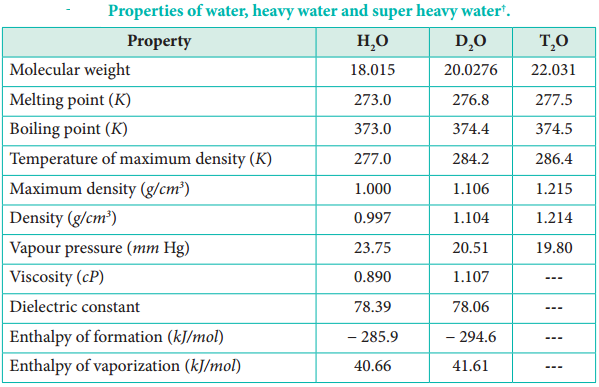
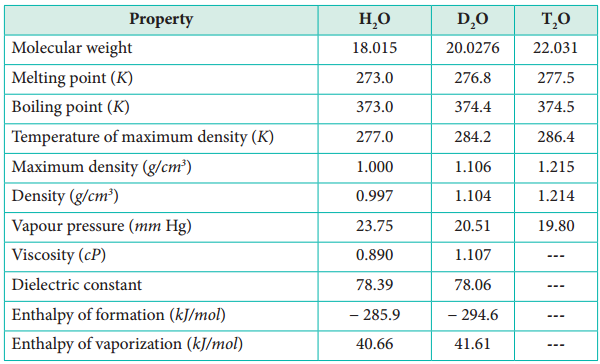
D2O is a colorless, odorless and tasteless liquid. However, there is a marked difference between physical properties of water and heavy water as shown in Table 4.2.

Table: Properties of water, heavy water and super heavy water.

Heavy Water of Hydrolysis img 1

2 NaOH + D2O → 2NaOD + HOD
HCl + D2O → DCl + HOD
NH4Cl + 4D2O → ND4Cl + 4HOD

These exchange reactions are useful in determining the number of ionic hydrogens present in a given compound. For example, when D2O is treated with of hypo-phosphorus acid only one hydrogen atom is exchanged with deuterium. It indicates that, it is a monobasic acid.

H3PO2 + D2O → H2DPO2 + HDO

It is also used to prepare some deuterium compounds:

Al4C3 + 12D2O → 4Al(OD)3 + 3CD4
CaC2 + 2 D2O → Ca(OD)2 + C2D2
Mg3N2 + 6D2O → 3Mg(OD)2 + 2ND3
Ca3P2 + 6D2O → 3Ca(OD)2 + 2PD3

Uses of Heavy Water:

  1. Heavy water is widely used as moderator in nuclear reactors as it can lower the energies of fast neutrons
  2. It is commonly used as a tracer to study organic reaction mechanisms and mechanism of metabolic reactions
  3. It is also used as a coolant in nuclear reactors as it absorbs the heat generated

The heavy water produced is used as a moderator of neutrons in nuclear power plants. In the laboratory heavy water is employed as an isotopic tracer in studies of chemical and biochemical processes.

Heavy water is a form of water with a unique atomic structure and properties coveted for the production of nuclear power and weapons. Like ordinary water-H2O-each molecule of heavy water contains two hydrogen atoms and one oxygen atom. The difference, though, lies in the hydrogen atoms.

The hydrogen is then liquefied and distilled to separate the two components, then the deuterium is reacted with oxygen to form heavy water. Producing heavy water requires advanced infrastructure, and heavy water is actively produced in Argentina, Canada, India, and Norway.

The heavy water is not manufactured, but rather it is extracted from the quantity that is found naturally in lake water. The water is separated through a series of towers, using hydrogen sulphide as an agent.

It was accepted by Norsk Hydro, and production began in 1935. The technology is straightforward. Heavy water (D2O) is separated from normal water by electrolysis, because the difference in mass between the two hydrogen isotopes translates into a slight difference in the speed at which the reaction proceeds.

Heavy water is indeed heavier than normal water (which contains a tiny amount of heavy water molecules naturally), and heavy-water ice will sink in normal water.

Since the chemical properties of the heavier hydrogen-nucleus-with-a-neutron are slightly different, heavy water starts to gum up all manner of body parts. Eventually, if you drank enough purified heavy water-more than 20 gallons, at least a quarter heavy-you’d die.

Heavy Water of Hydrolysis img 2

Compounds of Hydrogen

Find free online Chemistry Topics covering a broad range of concepts from research institutes around the world.

Compounds of Hydrogen

Water

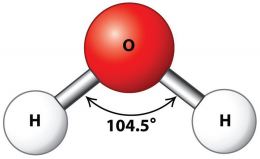
Water is one of the most abundant compounds of hydrogen and our earth’s surface contains approximately 70 % of ocean which is the major source of water. However, sea water contains many dissolved salts hence it can not be used directly. Water is essential for all living things and our body contains about 65% water.

Compounds of Hydrogen img 1

Physical Properties:

Water is a colourless and volatile liquid. The peculiar properties of water in the condensed phases are due to the presence of inter molecular hydrogen bonding between water molecules. Hydrogen bonding is responsible for the high melting and boiling points of water. Some of the physical parameters of water are listed in Table 4.2.

Compounds of Hydrogen img 2

‘Unless otherwise stated, all data are at 298 K.

Chemical Properties:

Water reacts with metals, non-metals and other compounds differently. The most reactive metals are the alkali metals. They decompose water even in cold with the evolution of hydrogen leaving an alkali solution.

2Na + 2 H2O → 2 NaOH + H2

The group 2 metals (except beryllium) react in a similar way but less violently. The hydroxides are less soluble than those of Group 1.

Ba + 2H2O → Ba(OH)2+ H2

Some transition metals react with hot water or steam to form the corresponding oxides. For example, steam passed over red hot iron results in the formation of iron oxide with the release of hydrogen.

3Fe + 4H2O → Fe3O4 + 4H2

Lead and copper decompose water only at a white heat. Silver, gold, mercury and platinum do not have any effect on water. In the elemental form, the non-metals such as carbon, sulphur and phosphorus normally do not react with water. However, as we have seen earlier, carbon will react with steam when it is red (or white) hot to give water gas.

On the other hand, the halogens react with water to give an acidic solution. For example, chlorine forms hydrochloric acid and hypo chlorous acid. It is responsible for the antibacterial action of chlorine water, and for its use as bleach.

Cl2 + H2O → HCl + HOCl

Fluorine reacts dif erently to liberate oxygen from water.

2F2 + 2 H2O → 4HF + O2

In a similar way, compounds of nonmetals react with water to give acidic or alkaline solutions. For example, solutions of carbonates are slightly alkaline.

CO32- + H2O → HCO3 + OH

Water is an amphoteric oxide. It has the ability to accept as well as donate protons and hence it can act as an acid or a base. For example, in the reaction with HCl it accepts proton where as in the reaction with weak base ammonia it donates proton.

NH3 + H2O → NH4+ + OH
HCl + H2O → H3O+ + Cl

Water dissolves ionic compounds. In addition, it also hydrolyses some covalent compounds.

SiCl4 + 2 H2O → SiO2 + 4 HCl
P4O10 + 6 H2O → 4 H3PO4

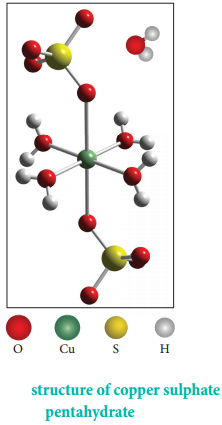
Many salts crystallized from aqueous solutions form hydrated crystals. The water in the hydrated salts may form co-ordinate bond or just present in interstitial positions of crystals.

Examples:

[Cr(H2O)6]Cl3 – All six water molecules form co-ordinate bond

BaCl2. 2H2O – Both the water molecules are present in interstitial positions.

CuSO4.5H2O – In this compound four water molecules form co-ordinate bonds while the fifth water molecule, present outside the co-ordination, can form intermolecular hydrogen bond with another molecule. [Cu(H2O)4)]SO4.2H2O

Compounds of Hydrogen img 3

Hard and Soft Water:

Hard water contains high amounts of mineral ions. The most common ions found in hard water are the soluble metal cations such as magnesium & calcium, though iron, aluminium, and manganese may also be found in certain areas.

Presence of these metal salts in the form of bicarbonate, chloride and sulphate in water makes water ‘hard’. When hard water is boiled carbonates of magnesium and calcium present in it gets precipitated. On the other hand, water free from soluble salts of calcium and magnesium is called sof water. The hardness of water is of two types, viz., temporary hardness and permanent hardness.

Temporary Hardness and its Removal:

Temporary hardness is primarily due to the presence of soluble bicarbonates of magnesium and calcium. This can be removed by boiling the hard water followed by filtration. Upon boiling, these salts decompose into insoluble carbonate which leads to their precipitation. The magnesium carbonate thus formed further hydrolysed to give insoluble magnesium hydroxide.

Ca(HCO3)2 → CaCO3 + H2O + CO2
Mg(HCO3)2 → MgCO3 + H2O + CO2
MgCO3 + H2O → Mg(OH)2 + CO2

The resulting precipitates can be removed by filtration.

Alternatively, we can use Clark’s method in which, calculated amount of lime is added to hard water containing the magnesium and calcium, and the resulting carbonates and hydroxides can be filtered – off

Ca(HCO3)2 + Ca(OH)2 → 2CaCO3 + 2H2O
Mg (HCO3)2 + 2 Ca(OH)2

2CaCO3 + Mg(OH)2 +2 H2O

Permanent Hardness:

Permanent hardness of water is due to the presence of soluble salts of magnesium and calcium in the form of chlorides and sulphates in it. It can be removed by adding washing soda, which reacts with these metal (M = Ca or Mg) chlorides and sulphates in hard water to form insoluble carbonates.

MCl2 + Na2CO3 → MCO3 + 2 NaCl
MSO4 + Na2CO3 → MCO3 + Na2SO4

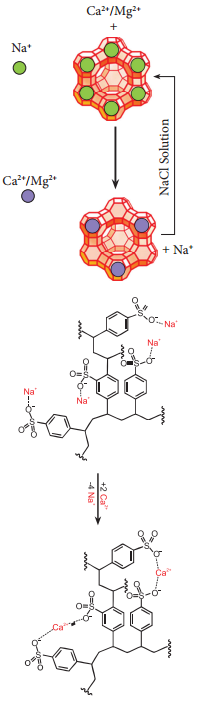
In another way to soften the hard water is by using a process called ionexchange. That is, hardness can be removed by passing through an ion-exchange bed like zeolites or column containing ionexchange resin. Zeolites are hydrated sodium alumino-silicates with a general formula,
Na2O∙Al2O3.xSiO2.yH2O (x = 2 to 10, y = 2 to 6).

Zeolites have porous structure in which the monovalent sodium ions are loosely held and can be exchanged with hardness producing metal ions (M = Ca2+ or Mg2+) in water. The complex structure can conveniently be represented as Na2 – Z with sodium as exchangeable cations.

Na2 – Z + M2+ → M-Z + 2 Na2+

When exhausted, the materials can be regenerated by treating with aqueous sodium chloride. The metal ions (Ca2+ and Mg2+) caught in the zeolite (or resin) are released and they get replenished with sodium ions.

M-Z + 2NaCl → Na2-Z + MCl2

Compounds of Hydrogen img 4

Uses of Hydrogen

Find free online Chemistry Topics covering a broad range of concepts from research institutes around the world.

Uses of Hydrogen

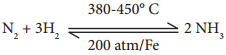
1. Over 90 % hydrogen produced in industry is used for synthetic applications. One such process is Haber process which is used to synthesis ammonia in large scales. Ammonia is used for the manufacture of chemicals such as nitric acid, fertilizers and explosives.

Uses of Hydrogen img 1

2. It can be used to manufacture the industrial solvent, methanol from carbon monoxide using copper as catalyst.

Uses of Hydrogen img 2

3. Unsaturated fatty oils can be converted into saturated fats called Vanaspati (margarine) by the reduction reaction with Pt/H2.

4. In metallurgy, hydrogen can be used to reduce many metal oxides to metals at high temperatures.

CuO + H2 → Cu + H2O
WO3 + 3H2 → W + 3H2O

5. Atomic hydrogen and oxy-hydrogen torches are used for cutting and welding.

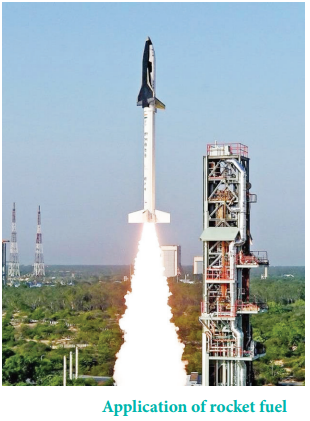
6. Liquid hydrogen is used as a rocket fuel.

7. Hydrogen is also used in fuel cells for generating electrical energy. The reversible uptake of hydrogen in metals is also attractive for rechargeable metal hydride battery.

Uses of Hydrogen img 3

  1. Hydrogen is used in the synthesis of ammonia and the manufacture of nitrogenous fertilizers.
  2. Hydrogenation of unsaturated vegetable oils for manufacturing vanaspati fat.
  3. It is used in the manufacture of many organic compounds, for example, methanol.

It is also used to make epoxyethane (ethylene oxide), used as antifreeze and to make polyester, and chloroethene, the precursor to PVC. Oxygen gas is used for oxy-acetylene welding and cutting of metals. A growing use is in the treatment of sewage and of effluent from industry.

Hydrogen use today is dominated by industry, namely: oil refining, ammonia production, methanol production and steel production. Virtually all of this hydrogen is supplied using fossil fuels, so there is significant potential for emissions reductions from clean hydrogen.

Use of hydrogen. Nearly all of the hydrogen consumed in the United States is used by industry for refining petroleum, treating metals, producing fertilizer, and processing foods.

  • Rocket fuel is a major use of hydrogen for energy.
  • Hydrogen fuel cells produce electricity.
  • Hydrogen use in vehicles.
  • The refueling challenge.

Physical Properties of Hydrogen

Find free online Chemistry Topics covering a broad range of concepts from research institutes around the world.

Physical Properties of Hydrogen

Physical Properties:

Hydrogen is a colorless, odorless, tasteless, lightest and highly flammable gas. It is a non-polar diatomic molecule. It can be liquefied under low temperature and high pressure. Hydrogen is a good reducing agent. Various physical constants of hydrogen molecule are listed in Table 4.1.

Chemical Properties:

Hydrogen reacts with oxygen to give water. This is an explosive reaction and releases lot of energy. This is used in fuel cells to generate electricity.

2H2 + O2 → 2 H2O

Similarly, hydrogen also reacts with halogens to give corresponding halides. Reaction with fluorine takes place even in dark with explosive violence while with chlorine at room temperature under light. It combines with bromine on heating and reaction with iodine is a photochemical reaction.

H2 + X2 → 2 HX (X = F, Cl, Br & I)

In the above reactions the hydrogen has an oxidation state of +1. It also has a tendency to react with reactive metals such as lithium, sodium and calcium to give corresponding hydrides in which the oxidation state of hydrogen is -1.

2 Li + H2 → 2 LiH
2 Na + H2 → 2 NaH

These hydrides are used as reducing agents in synthetic organic chemistry. It is used to prepare other important hydrides such as lithium aluminium hydride and sodium boro hydride.

4 LiH + AlCl3 → Li[AlH4] + 3 LiCl
4 NaH + B(OCH3) → Na[BH4] + 3 CH3ONa

Hydrogen itself acts as a reducing agent. In the presence of finely divided nickel, it adds to the unsaturated organic compounds to form saturated compounds.

Physical Properties of Hydrogen img 1

Chemical properties of Deuterium

Like hydrogen, deuterium also reacts with oxygen to form deuterium oxide called heavy water. It also reacts with halogen to give corresponding halides.

2 D2 + O2 → 2 D2O
D2 + X2 → 2 DX
(X = F, Cl, Br & I)

Deuterium Exchange Reactions:

Deuterium can replace reversibly hydrogen in compounds either partially or completely depending upon the reaction conditions. These reactions occur in the presence of deuterium or heavy water.

CH4 + 2 D2 → CD4 + 2 H2
2 NH3 + 3D2 → 2 ND3 + 3 H2

Properties of Tritium

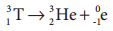
It is a β-emitter with a half-life period of 12.3 years.

Physical Properties of Hydrogen img 2